IntroductIon of
mechanIcs
Md. Asif Rahman (151-15-5090)
our Group members
Md. Asif Rahman (151-15-5090)
Mst. Keya (151-15-5136)
Mostake Ahmed Hero (151-15-5083)
Salma Siddika (151-15-4946)
Md. Zubayer Islam (151-15-5047)
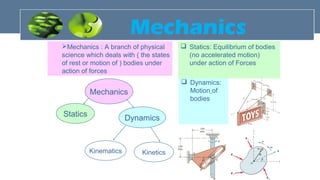
Mechanics
Statics Dynamics
Kinematics Kinetics
Mechanics : A branch of physical
science which deals with ( the states
of rest or motion of ) bodies under
action of forces
 Dynamics:
Motion of
bodies
 Statics: Equilibrium of bodies
(no accelerated motion)
under action of Forces
Mechanics
Mechanics
Kinematics:- Description of motion and includes
consideration of time, displacement, velocity,
acceleration and space factors of a system‘s
motion
Kinetics:- Study of forces associated with the
motion of a body
prIncIpLes of
mechanIcs
Mst. Keya (151-15-5136)
neWton’s fIrst LaW
The study of rigid body mechanics is
formulated on the basis of Newton’s laws
of motion.
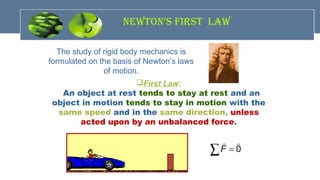
First Law:
An object at rest tends to stay at rest and an
object in motion tends to stay in motion with the
same speed and in the same direction, unless
acted upon by an unbalanced force.
neWton’s second LaW
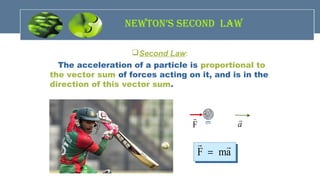
Second Law:
The acceleration of a particle is proportional to
the vector sum of forces acting on it, and is in the
direction of this vector sum.
m
F

a

amF

=
NEWTON’S Third LAW
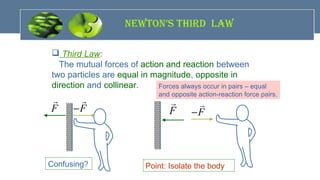
 Third Law:
The mutual forces of action and reaction between
two particles are equal in magnitude, opposite in
direction and collinear.
F
r
F−
rF
r
F−
r
Confusing? Point: Isolate the body
Forces always occur in pairs – equal
and opposite action-reaction force pairs.
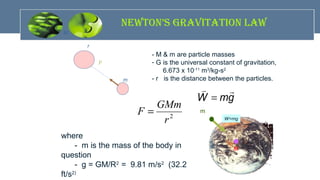
2
r
GMm
F =
- M & m are particle masses
- G is the universal constant of gravitation,
6.673 x 10⁻¹¹
m3
/kg-s2
- r is the distance between the particles.
where
- m is the mass of the body in
question
- g = GM/R2
= 9.81 m/s2
(32.2
ft/s2)
m
M
W=mg
M
m
r
F
NEWTON’S GrAviTATiON LAW
FricTiONAL
FOrcE
Mostake Ahmed Hero (151-15-5083)
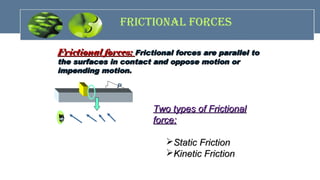
FricTiONAL FOrcES
PP
Frictional forces:Frictional forces: Frictional forces are parallel toFrictional forces are parallel to
the surfaces in contact and oppose motion orthe surfaces in contact and oppose motion or
impending motion.impending motion.
Two types of FrictionalTwo types of Frictional
force:force:
Static FrictionStatic Friction
Kinetic FrictionKinetic Friction
FricTiONAL FOrcE
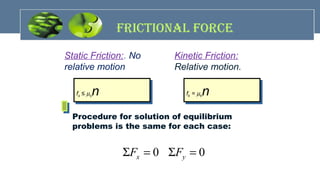
Static Friction:. No
relative motion
Kinetic Friction:
Relative motion.
fk = µknfk = µknfs ≤ µsnfs ≤ µsn
Procedure for solution of equilibrium
problems is the same for each case:
0 0x yF FΣ = Σ =
dEpENdENcE OF FricTiON
 Nature of surface.
 Roughness of surface.
 Medium between two surface.
 Temperature.
impOrTANT pOiNTS TO cONSidEr WhEN SOLviNG
FricTiON prObLEmS
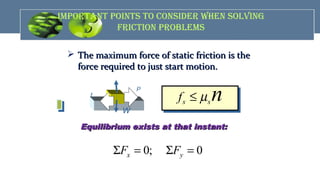
 The maximum force of static friction is theThe maximum force of static friction is the
force required to just start motion.force required to just start motion.
s sf nµ≤
n
fs
P
W
Equilibrium exists at that instant:Equilibrium exists at that instant:
0; 0x yF FΣ = Σ =
impOrTANT pOiNTS TO cONSidEr WhEN SOLviNG
FricTiON prObLEmS
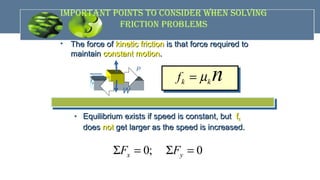
• The force ofThe force of kinetic frictionkinetic friction is that force required tois that force required to
maintainmaintain constant motionconstant motion..
k kf nµ=
• Equilibrium exists if speed is constant, butEquilibrium exists if speed is constant, but ffkk
doesdoes notnot get larger as the speed is increased.get larger as the speed is increased.
0; 0x yF FΣ = Σ =
n
fk
P
W
Moment of Inertia &
Radius of Gyration
Salma Siddika (151-15-4946)
Moment of Inertia of a body.
Radius of Gyration.
Moment of Inertia of Composite
Bodies.
MoMent of InertIa &
radIus of GyratIon
Moment of Inertia
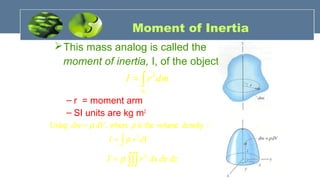
This mass analog is called the
moment of inertia, I, of the object
– r = moment arm
– SI units are kg m2
∫=
m
dmrI 2
∫∫∫= dzdydxrI 2
ρ
dVrI
dVdm
∫=
=
2
:densityvolumetheiswhere,Using
ρ
ρρ
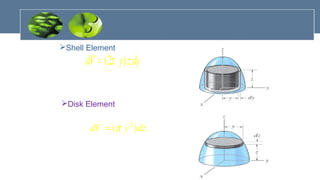
Shell Element
Disk Element
dyzydV )2( π=
dzydV )( 2
π=
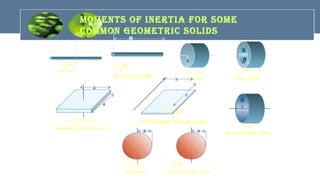
RodThin
12
1 2
MLI =
end)at(axisRodThin
3
1 2
MLI =
L
DiskSolid
2
1 2
MRI =
R
CylinderHollow
)(
2
1 2
2
2
1 RRMI +=
R2
R2
CylinderHollowdThin Walle
2
MRI =
R
a
b
center)(throughPlaterRectangula
)(
12
1 22
baMI +=
a
b
edge)(aboutPlaterRectangulaThin
3
1 2
MaI =
SphereSolid
5
2 2
MRI =
R
SphereHollowdThin Walle
3
2 2
MRI =
R
MoMents of InertIa for soMe
coMMon GeoMetrIc solIds
radIus of GyratIon
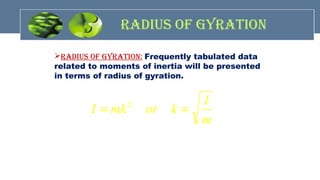
radIus of GyratIon: Frequently tabulated data
related to moments of inertia will be presented
in terms of radius of gyration.
m
I
kormkI == 2
MoMent of InertIa of
coMposIte bodIes
1. Divide the composite area into simple body.
2. Compute the moment of inertia of each simple body
about its centroidal axis from table.
3. Transfer each centroidal moment of inertia to a
parallel reference axis
4. The sum of the moments of inertia for each simple
body about the parallel reference axis is the moment
of inertia of the composite body.
5. Any cutout area has must be assigned a negative
moment; all others are considered positive.
projectIle
MotIon
Md. Zubayer Islam (151-15-5047)
What is Projectile
Motion?
PROJECTILE MOTION: when an object is
thrown obliquely into space it’s called a
projectile and its motion is called
projectile motion.
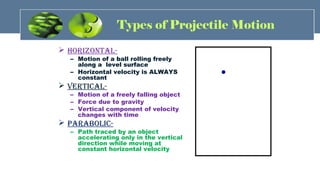
Types of Projectile Motion
 HORIzONTaL-
– Motion of a ball rolling freely
along a level surface
– Horizontal velocity is ALWAYS
constant
 VERTICaL-
– Motion of a freely falling object
– Force due to gravity
– Vertical component of velocity
changes with time
 PaRabOLIC-
– Path traced by an object
accelerating only in the vertical
direction while moving at
constant horizontal velocity
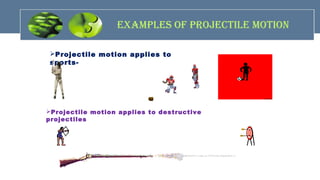
ExaMPLEs Of PROJECTILE MOTION
Projectile motion applies to
sports-
Projectile motion applies to destructive
projectiles
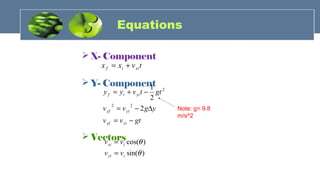
Equations
 X- Component
 Y- Component
 Vectors
tvxx xiif +=
gtvv
ygvv
gttvyy
yiyf
yiyf
yiif
−=
∆−=
−+=
2
2
1
22
2
)sin(
)cos(
θ
θ
iyi
ixi
vv
vv
=
=
Note: g= 9.8
m/s^2
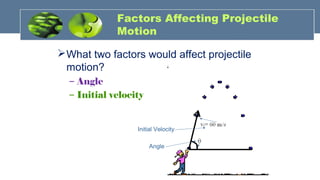
Factors Affecting Projectile
Motion
What two factors would affect projectile
motion?
– Angle
– Initial velocity
Initial Velocity
Angle
CONCLusION Of PROJECTILE
MOTION
A projectile is any object upon which the only force is gravity.
Projectiles travel with a parabolic trajectory due to the
influence of gravity.
There are no horizontal forces acting upon projectiles and
thus no horizontal acceleration.
The horizontal velocity of a projectile is constant. there is a
vertical acceleration caused by gravity 9.8 m/s.
The horizontal motion of a projectile is independent of its
vertical motion.
Mechanics

Mechanics

  • 2.
  • 3.
    our Group members Md.Asif Rahman (151-15-5090) Mst. Keya (151-15-5136) Mostake Ahmed Hero (151-15-5083) Salma Siddika (151-15-4946) Md. Zubayer Islam (151-15-5047)
  • 4.
    Mechanics Statics Dynamics Kinematics Kinetics Mechanics: A branch of physical science which deals with ( the states of rest or motion of ) bodies under action of forces  Dynamics: Motion of bodies  Statics: Equilibrium of bodies (no accelerated motion) under action of Forces Mechanics
  • 5.
    Mechanics Kinematics:- Description ofmotion and includes consideration of time, displacement, velocity, acceleration and space factors of a system‘s motion Kinetics:- Study of forces associated with the motion of a body
  • 6.
  • 7.
    neWton’s fIrst LaW Thestudy of rigid body mechanics is formulated on the basis of Newton’s laws of motion. First Law: An object at rest tends to stay at rest and an object in motion tends to stay in motion with the same speed and in the same direction, unless acted upon by an unbalanced force.
  • 8.
    neWton’s second LaW SecondLaw: The acceleration of a particle is proportional to the vector sum of forces acting on it, and is in the direction of this vector sum. m F  a  amF  =
  • 9.
    NEWTON’S Third LAW Third Law: The mutual forces of action and reaction between two particles are equal in magnitude, opposite in direction and collinear. F r F− rF r F− r Confusing? Point: Isolate the body Forces always occur in pairs – equal and opposite action-reaction force pairs.
  • 10.
    2 r GMm F = - M& m are particle masses - G is the universal constant of gravitation, 6.673 x 10⁻¹¹ m3 /kg-s2 - r is the distance between the particles. where - m is the mass of the body in question - g = GM/R2 = 9.81 m/s2 (32.2 ft/s2) m M W=mg M m r F NEWTON’S GrAviTATiON LAW
  • 11.
  • 12.
    FricTiONAL FOrcES PP Frictional forces:Frictionalforces: Frictional forces are parallel toFrictional forces are parallel to the surfaces in contact and oppose motion orthe surfaces in contact and oppose motion or impending motion.impending motion. Two types of FrictionalTwo types of Frictional force:force: Static FrictionStatic Friction Kinetic FrictionKinetic Friction
  • 13.
    FricTiONAL FOrcE Static Friction:.No relative motion Kinetic Friction: Relative motion. fk = µknfk = µknfs ≤ µsnfs ≤ µsn Procedure for solution of equilibrium problems is the same for each case: 0 0x yF FΣ = Σ =
  • 14.
    dEpENdENcE OF FricTiON Nature of surface.  Roughness of surface.  Medium between two surface.  Temperature.
  • 15.
    impOrTANT pOiNTS TOcONSidEr WhEN SOLviNG FricTiON prObLEmS  The maximum force of static friction is theThe maximum force of static friction is the force required to just start motion.force required to just start motion. s sf nµ≤ n fs P W Equilibrium exists at that instant:Equilibrium exists at that instant: 0; 0x yF FΣ = Σ =
  • 16.
    impOrTANT pOiNTS TOcONSidEr WhEN SOLviNG FricTiON prObLEmS • The force ofThe force of kinetic frictionkinetic friction is that force required tois that force required to maintainmaintain constant motionconstant motion.. k kf nµ= • Equilibrium exists if speed is constant, butEquilibrium exists if speed is constant, but ffkk doesdoes notnot get larger as the speed is increased.get larger as the speed is increased. 0; 0x yF FΣ = Σ = n fk P W
  • 17.
    Moment of Inertia& Radius of Gyration Salma Siddika (151-15-4946)
  • 18.
    Moment of Inertiaof a body. Radius of Gyration. Moment of Inertia of Composite Bodies. MoMent of InertIa & radIus of GyratIon
  • 19.
    Moment of Inertia Thismass analog is called the moment of inertia, I, of the object – r = moment arm – SI units are kg m2 ∫= m dmrI 2 ∫∫∫= dzdydxrI 2 ρ dVrI dVdm ∫= = 2 :densityvolumetheiswhere,Using ρ ρρ
  • 20.
  • 21.
    RodThin 12 1 2 MLI = end)at(axisRodThin 3 12 MLI = L DiskSolid 2 1 2 MRI = R CylinderHollow )( 2 1 2 2 2 1 RRMI += R2 R2 CylinderHollowdThin Walle 2 MRI = R a b center)(throughPlaterRectangula )( 12 1 22 baMI += a b edge)(aboutPlaterRectangulaThin 3 1 2 MaI = SphereSolid 5 2 2 MRI = R SphereHollowdThin Walle 3 2 2 MRI = R MoMents of InertIa for soMe coMMon GeoMetrIc solIds
  • 22.
    radIus of GyratIon radIusof GyratIon: Frequently tabulated data related to moments of inertia will be presented in terms of radius of gyration. m I kormkI == 2
  • 23.
    MoMent of InertIaof coMposIte bodIes 1. Divide the composite area into simple body. 2. Compute the moment of inertia of each simple body about its centroidal axis from table. 3. Transfer each centroidal moment of inertia to a parallel reference axis 4. The sum of the moments of inertia for each simple body about the parallel reference axis is the moment of inertia of the composite body. 5. Any cutout area has must be assigned a negative moment; all others are considered positive.
  • 24.
  • 25.
    What is Projectile Motion? PROJECTILEMOTION: when an object is thrown obliquely into space it’s called a projectile and its motion is called projectile motion.
  • 26.
    Types of ProjectileMotion  HORIzONTaL- – Motion of a ball rolling freely along a level surface – Horizontal velocity is ALWAYS constant  VERTICaL- – Motion of a freely falling object – Force due to gravity – Vertical component of velocity changes with time  PaRabOLIC- – Path traced by an object accelerating only in the vertical direction while moving at constant horizontal velocity
  • 27.
    ExaMPLEs Of PROJECTILEMOTION Projectile motion applies to sports- Projectile motion applies to destructive projectiles
  • 28.
    Equations  X- Component Y- Component  Vectors tvxx xiif += gtvv ygvv gttvyy yiyf yiyf yiif −= ∆−= −+= 2 2 1 22 2 )sin( )cos( θ θ iyi ixi vv vv = = Note: g= 9.8 m/s^2
  • 29.
    Factors Affecting Projectile Motion Whattwo factors would affect projectile motion? – Angle – Initial velocity Initial Velocity Angle
  • 30.
    CONCLusION Of PROJECTILE MOTION Aprojectile is any object upon which the only force is gravity. Projectiles travel with a parabolic trajectory due to the influence of gravity. There are no horizontal forces acting upon projectiles and thus no horizontal acceleration. The horizontal velocity of a projectile is constant. there is a vertical acceleration caused by gravity 9.8 m/s. The horizontal motion of a projectile is independent of its vertical motion.