Orientation: Mechanical Engineering 
Kathleen Baril, Heterick Memorial 
Library
What we will cover 
How to find 
patents 
How to 
find 
articles 
How to 
find 
books
Research Tools
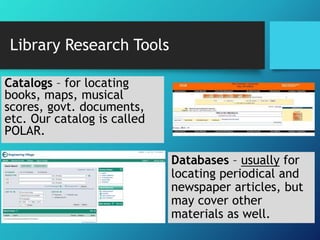
Catalogs – for locating 
books, maps, musical 
scores, govt. documents, 
etc. Our catalog is called 
POLAR. 
Databases – usually for 
locating periodical and 
newspaper articles, but 
may cover other 
materials as well. 
Library Research Tools
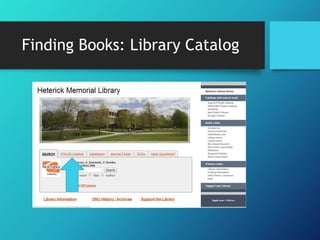
Finding Books: Library Catalog
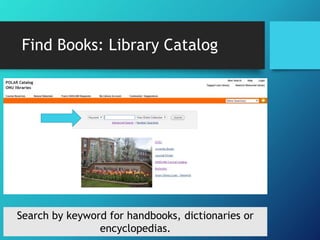
Find Books: Library Catalog 
Search by keyword for handbooks, dictionaries or 
encyclopedias.
Keyword Search 
•Looks in several locations (usually subject, article 
title, abstracts or contents) 
•Does not require an exact match 
•Generates comparatively large number of hits (not 
precise) 
•Good if you are not familiar with terminology 
•Look for the same or similar words which keep 
appearing
Subject Search 
•Looks in one place – subject 
•Usually requires an exact match between 
your term and a pre-set list of terms 
•Precise (motion pictures -- review) 
•Can be used after keyword search has 
identified specific subjects
Find Books: Library Catalog 
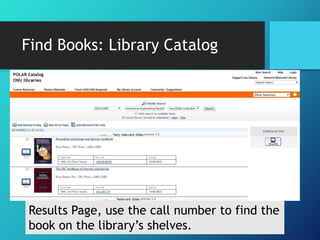
Results Page, use the call number to find the 
book on the library’s shelves.
Find Books: OhioLINK 
• OhioLINK is a consortium of most of the 
college and university libraries in Ohio. 
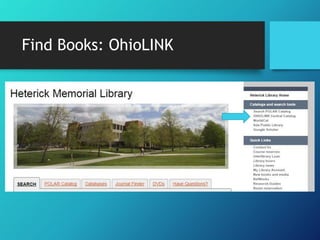
• You may request items from the OhioLINK 
catalog to be delivered to the ONU library. 
• Requests generally arrive in 5-7 working 
days. 
• No charge. 
• May renew 3 times.
Find Books: OhioLINK
Find Books: OhioLINK 
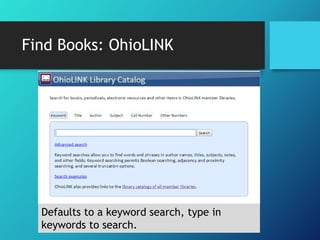
Defaults to a keyword search, type in 
keywords to search.
Find Books: OhioLINK 
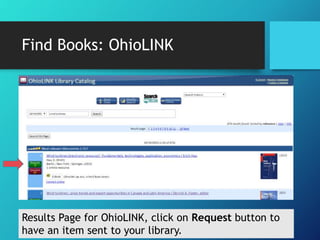
Results Page for OhioLINK, click on Request button to 
have an item sent to your library.
Find Books: Ebooks - Springer 
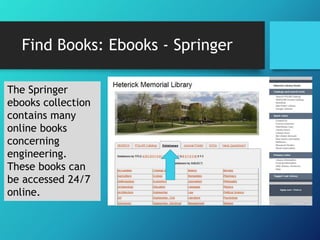
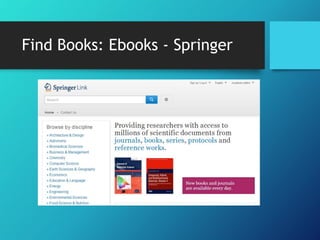
The Springer 
ebooks collection 
contains many 
online books 
concerning 
engineering. 
These books can 
be accessed 24/7 
online.
Find Books: Ebooks - Springer
Find Books: Ebooks - Springer 
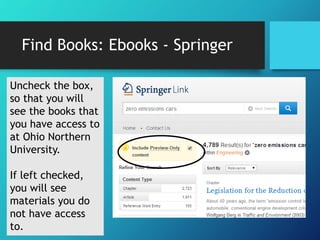
Uncheck the box, 
so that you will 
see the books that 
you have access to 
at Ohio Northern 
University. 
If left checked, 
you will see 
materials you do 
not have access 
to.
Popular versus Scholarly 
Periodicals 
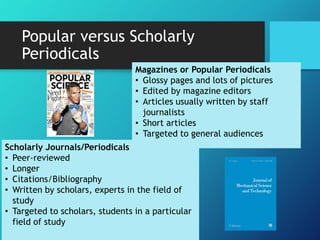
Magazines or Popular Periodicals 
• Glossy pages and lots of pictures 
• Edited by magazine editors 
• Articles usually written by staff 
journalists 
• Short articles 
• Targeted to general audiences 
Scholarly Journals/Periodicals 
• Peer-reviewed 
• Longer 
• Citations/Bibliography 
• Written by scholars, experts in the field of 
study 
• Targeted to scholars, students in a particular 
field of study
Peer Review Process 
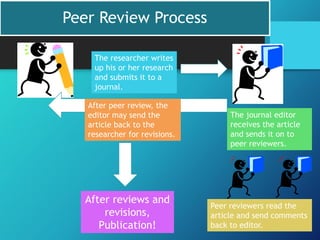
The researcher writes 
up his or her research 
and submits it to a 
journal. 
The journal editor 
receives the article 
and sends it on to 
peer reviewers. 
Peer reviewers read the 
article and send comments 
back to editor. 
After peer review, the 
editor may send the 
article back to the 
researcher for revisions. 
After reviews and 
revisions, 
Publication!
Compendex 
What is Compendex? 
• Compendex is an engineering database that 
covers the engineering literature from 190 
engineering disciplines. 
• Indexes journal articles, conference articles, 
conferences proceedings, book chapters, 
etc. 
• Index database, so you must link out to find 
the full-text of the materials in this 
resource.
Compendex 
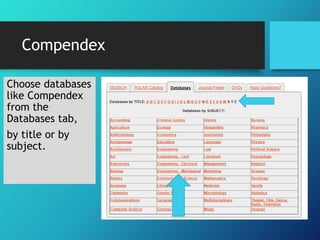
Choose databases 
like Compendex 
from the 
Databases tab, 
by title or by 
subject.
Compendex 
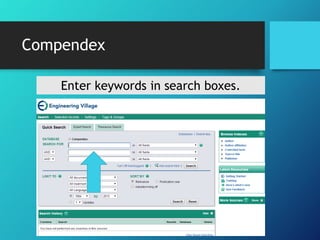
Enter keywords in search boxes.
Compendex 
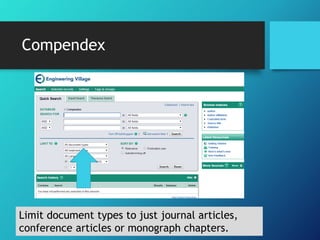
Limit document types to just journal articles, 
conference articles or monograph chapters.
Compendex: Results Page 
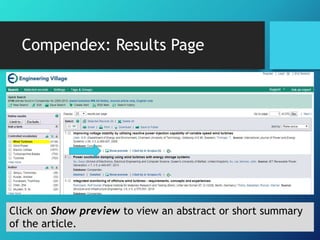
Click on Show preview to view an abstract or short summary 
of the article.
Compendex :Results Page 
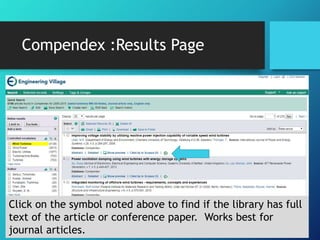
Click on the symbol noted above to find if the library has full 
text of the article or conference paper. Works best for 
journal articles.
Compendex: Results Page 
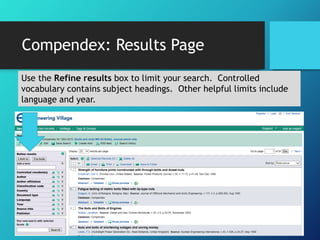
Use the Refine results box to limit your search. Controlled 
vocabulary contains subject headings. Other helpful limits include 
language and year.
Compendex 
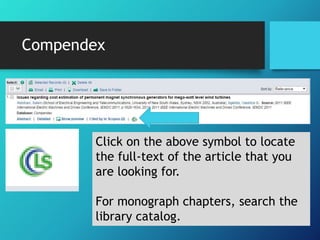
Click on the above symbol to locate 
the full-text of the article that you 
are looking for. 
For monograph chapters, search the 
library catalog.
Compendex 
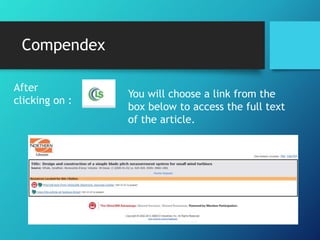
After 
clicking on : 
You will choose a link from the 
box below to access the full text 
of the article.
Compendex 
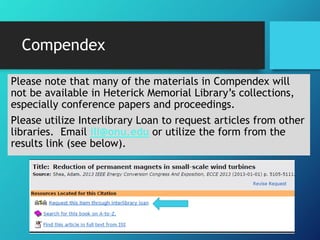
Please note that many of the materials in Compendex will 
not be available in Heterick Memorial Library’s collections, 
especially conference papers and proceedings. 
Please utilize Interlibrary Loan to request articles from other 
libraries. Email ill@onu.edu or utilize the form from the 
results link (see below).
Patents 
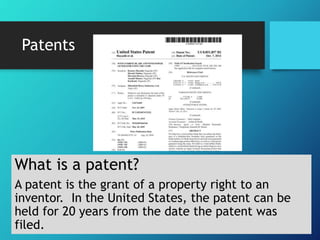
What is a patent? 
A patent is the grant of a property right to an 
inventor. In the United States, the patent can be 
held for 20 years from the date the patent was 
filed.
Patents 
Why look for a patent? 
To see if anyone else has 
already created what you 
want to patent.
Patents – United States 
What is a patent? 
“A patent is an intellectual property right 
granted by the Government of the United States 
of America to an inventor “to exclude others 
from making, using, offering for sale, or selling 
the invention throughout the United States or 
importing the invention into the United States” 
for a limited time in exchange for public 
disclosure of the invention when the patent is 
granted.” 
From http://www.uspto.gov/patents/.
Patent Resources: USPTO 
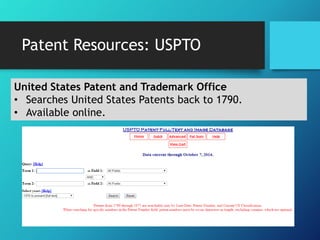
United States Patent and Trademark Office 
• Searches United States Patents back to 1790. 
• Available online.
Patent Resources: USPTO 
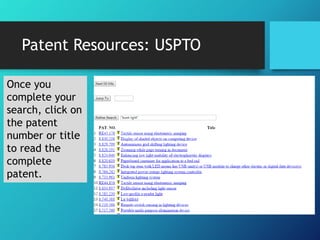
Once you 
complete your 
search, click on 
the patent 
number or title 
to read the 
complete 
patent.
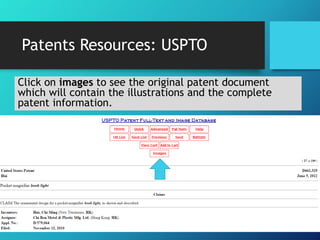
Patents Resources: USPTO 
Click on images to see the original patent document 
which will contain the illustrations and the complete 
patent information.
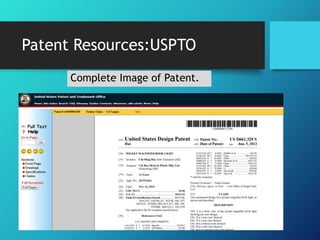
Patent Resources:USPTO 
Complete Image of Patent.
Patents : Research Strategy 
For further guidance 
when searching United 
States patents, follow the 
USPTO quick guide steps, 
found at 
http://www.uspto.gov/pr 
oducts/library/ptdl/servi 
ces/7_Step_US_Patent_Se 
arch_Strategy_Guide_201 
4.pdf.
Patent Resources: 
Derwent Innovations Index 
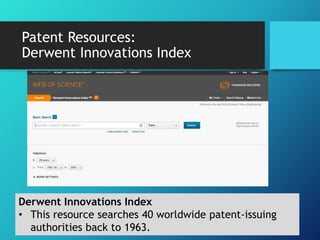
• This resource searches 40 worldwide patent-issuing 
authorities back to 1963.
Librarians: Always here to help
Need Help? 
• Ask at the Reference Desk or call for help: x2185 
• Contact us by email: reference@onu.edu 
• Make an individual appointment with a librarian for more 
extensive research assistance. 
• Librarians on duty: 
• Monday – Thursday 
• 8:00 AM – 4:30 PM 
• 6:00 PM – 9:00 PM 
• Friday 
• 8:00 AM – 4:30 PM

Mech eng orientation fall 2014

  • 1.
    Orientation: Mechanical Engineering Kathleen Baril, Heterick Memorial Library
  • 2.
    What we willcover How to find patents How to find articles How to find books
  • 3.
  • 4.
    Catalogs – forlocating books, maps, musical scores, govt. documents, etc. Our catalog is called POLAR. Databases – usually for locating periodical and newspaper articles, but may cover other materials as well. Library Research Tools
  • 5.
  • 6.
    Find Books: LibraryCatalog Search by keyword for handbooks, dictionaries or encyclopedias.
  • 7.
    Keyword Search •Looksin several locations (usually subject, article title, abstracts or contents) •Does not require an exact match •Generates comparatively large number of hits (not precise) •Good if you are not familiar with terminology •Look for the same or similar words which keep appearing
  • 8.
    Subject Search •Looksin one place – subject •Usually requires an exact match between your term and a pre-set list of terms •Precise (motion pictures -- review) •Can be used after keyword search has identified specific subjects
  • 9.
    Find Books: LibraryCatalog Results Page, use the call number to find the book on the library’s shelves.
  • 10.
    Find Books: OhioLINK • OhioLINK is a consortium of most of the college and university libraries in Ohio. • You may request items from the OhioLINK catalog to be delivered to the ONU library. • Requests generally arrive in 5-7 working days. • No charge. • May renew 3 times.
  • 11.
  • 12.
    Find Books: OhioLINK Defaults to a keyword search, type in keywords to search.
  • 13.
    Find Books: OhioLINK Results Page for OhioLINK, click on Request button to have an item sent to your library.
  • 14.
    Find Books: Ebooks- Springer The Springer ebooks collection contains many online books concerning engineering. These books can be accessed 24/7 online.
  • 15.
  • 16.
    Find Books: Ebooks- Springer Uncheck the box, so that you will see the books that you have access to at Ohio Northern University. If left checked, you will see materials you do not have access to.
  • 17.
    Popular versus Scholarly Periodicals Magazines or Popular Periodicals • Glossy pages and lots of pictures • Edited by magazine editors • Articles usually written by staff journalists • Short articles • Targeted to general audiences Scholarly Journals/Periodicals • Peer-reviewed • Longer • Citations/Bibliography • Written by scholars, experts in the field of study • Targeted to scholars, students in a particular field of study
  • 18.
    Peer Review Process The researcher writes up his or her research and submits it to a journal. The journal editor receives the article and sends it on to peer reviewers. Peer reviewers read the article and send comments back to editor. After peer review, the editor may send the article back to the researcher for revisions. After reviews and revisions, Publication!
  • 19.
    Compendex What isCompendex? • Compendex is an engineering database that covers the engineering literature from 190 engineering disciplines. • Indexes journal articles, conference articles, conferences proceedings, book chapters, etc. • Index database, so you must link out to find the full-text of the materials in this resource.
  • 20.
    Compendex Choose databases like Compendex from the Databases tab, by title or by subject.
  • 21.
    Compendex Enter keywordsin search boxes.
  • 22.
    Compendex Limit documenttypes to just journal articles, conference articles or monograph chapters.
  • 23.
    Compendex: Results Page Click on Show preview to view an abstract or short summary of the article.
  • 24.
    Compendex :Results Page Click on the symbol noted above to find if the library has full text of the article or conference paper. Works best for journal articles.
  • 25.
    Compendex: Results Page Use the Refine results box to limit your search. Controlled vocabulary contains subject headings. Other helpful limits include language and year.
  • 26.
    Compendex Click onthe above symbol to locate the full-text of the article that you are looking for. For monograph chapters, search the library catalog.
  • 27.
    Compendex After clickingon : You will choose a link from the box below to access the full text of the article.
  • 28.
    Compendex Please notethat many of the materials in Compendex will not be available in Heterick Memorial Library’s collections, especially conference papers and proceedings. Please utilize Interlibrary Loan to request articles from other libraries. Email ill@onu.edu or utilize the form from the results link (see below).
  • 29.
    Patents What isa patent? A patent is the grant of a property right to an inventor. In the United States, the patent can be held for 20 years from the date the patent was filed.
  • 30.
    Patents Why lookfor a patent? To see if anyone else has already created what you want to patent.
  • 31.
    Patents – UnitedStates What is a patent? “A patent is an intellectual property right granted by the Government of the United States of America to an inventor “to exclude others from making, using, offering for sale, or selling the invention throughout the United States or importing the invention into the United States” for a limited time in exchange for public disclosure of the invention when the patent is granted.” From http://www.uspto.gov/patents/.
  • 32.
    Patent Resources: USPTO United States Patent and Trademark Office • Searches United States Patents back to 1790. • Available online.
  • 33.
    Patent Resources: USPTO Once you complete your search, click on the patent number or title to read the complete patent.
  • 34.
    Patents Resources: USPTO Click on images to see the original patent document which will contain the illustrations and the complete patent information.
  • 35.
  • 36.
    Patents : ResearchStrategy For further guidance when searching United States patents, follow the USPTO quick guide steps, found at http://www.uspto.gov/pr oducts/library/ptdl/servi ces/7_Step_US_Patent_Se arch_Strategy_Guide_201 4.pdf.
  • 37.
    Patent Resources: DerwentInnovations Index Derwent Innovations Index • This resource searches 40 worldwide patent-issuing authorities back to 1963.
  • 38.
  • 39.
    Need Help? •Ask at the Reference Desk or call for help: x2185 • Contact us by email: reference@onu.edu • Make an individual appointment with a librarian for more extensive research assistance. • Librarians on duty: • Monday – Thursday • 8:00 AM – 4:30 PM • 6:00 PM – 9:00 PM • Friday • 8:00 AM – 4:30 PM

Editor's Notes

  • #2 Warhol Colored Gears (Intermediate)   To reproduce the video effects on this slide, do the following: On the Home tab, in the Slides group, click Layout, and then click Blank. On the Design tab, in the Themes group, click the arrow next to Colors and then click Metro. On the Insert tab, in the Media group, click Video, and then click Video from File. In the left pane of the Insert Video dialog box, click the drive or library that contains the video. In the right pane of the dialog box, click the first video that you want and then click Insert. Under Video Tools, on the Format tab in the Size group, click the arrow at the bottom right corner to launch the Format Video dialog box. Select Size in the left pane, and then in the Size pane do the following: Under Scale, clear the Lock Aspect Ratio box. Under Size and Rotate, set Height to 3.13” and Width to 4.17”. Also in the Format Video dialog box, select Position in the left pane, and then in the Position pane do the following: In the Horizontal box, enter 0.64” From Top Left Corner. In the Vertical box, enter 0.47” From Top Left Corner. Also in the Format Video dialog box, select Border Color in the left pane, and then in the Border Color pane select Solid Line. Click the arrow to the right of Color and under Theme Colors select Black, Text 1 (first row, second option). Also in the Format Video dialog box, select Border Style in the left pane, and then in the Border Style pane, in the Width box, enter 0.75”. Also in the Format Video dialog box, select Shadow in the left pane, and then in the Shadow pane do the following: Click the arrow to the right of Color and under Theme Colors select Black, Text 1 (first row, second option). In the Transparency box, enter 40%. In the Size box, enter 102%. In the Blur box, enter 5 pt. In the Angle box, enter 0 degrees. In the Distance box, enter 0 pt. Close the Format Video dialog box. Under Video Tools, on the Format tab, in the Adjust group, click the arrow under Color, and then under Recolor select Periwinkle, Accent color 5 Dark (second row, sixth option from left). On the Animations tab, in the Timing group, select the arrow to the right of Start and select With Previous. On the Insert tab, in the Media group, click Video, and then click Video from file. In the left pane of the Insert Video dialog box, click the drive or library that contains the video. In the right pane of the dialog box, click the second video that you want and then click Insert. Under Video Tools, on the Format tab in the Size group, click the arrow at the bottom right corner to launch the Format Video dialog box, select Size in the left pane, and then in the Size pane do the following: Under Scale, clear the Lock Aspect Ratio box. Under Size and Rotate, set the Height to 3.13” and the Width to 4.17”. Also in the Format Video dialog box, select Position in the left pane, and then in the Position pane do the following: In the Horizontal box, enter 5.19” From Top Left Corner. In the Vertical box, enter 0.47” From Top Left Corner. Also in the Format Video dialog box, select Border Color in the left pane, and then in the Border Color pane select Solid Line. Click the arrow to the right of Color and under Theme Colors select Black, Text1 (first row, second option). Also in the Format Video dialog box, select Border Style in the left pane, and then in the Border Style pane, in the Width box, enter 0.75”. Also in the Format Video dialog box, select Shadow in the left pane, and then in the Shadow pane do the following: Click the arrow to the right of Color and under Theme Colors select Black, Text 1 (first row, second option). In the Transparency box, enter 40%. In the Size box, enter 102%. In the Blur box, enter 5 pt. In the Angle box, enter 0 degrees. In the Distance box, enter 0 pt. Close the Format Video dialog box. Under Video Tools, on the Format tab, in the Adjust group, click the arrow under Color, and then under Recolor select Pink, Accent color 2 Dark (second row, third option from left). On the Animations tab, in the Timing group, select the arrow to the right of Start and select With Previous. Press and hold CTRL and select both videos. On the Home tab, in the Clipboard group, click the arrow to the right of Copy, and then select Duplicate. Select the duplicated right video. Under Video tools, on the Format tab, in the Size group, click the arrow at the bottom right to launch the Format Video dialog box, select Position in the left pane and then in the Position pane do the following: In the Horizontal box, enter 0.64” From Top Left Corner. In the Vertical box, enter 3.91” From Top Left Corner. Close the Format Video dialog box. Select the duplicated right video. Under Video Tools, on the Format tab, in the Arrange group click the arrow to the right of Rotate and then do the following: Flip Vertical. Flip Horizontal. With the video still selected, under Video Tools, on the Format tab, in the Adjust group, click the arrow under Color, and then under Recolor select Green, Accent color 1 Dark (second row, second option from left). Select the duplicated left video, under Video tools, on the Format tab, in the Size group, click the arrow at the bottom right to launch the Format Video dialog box, select Position in the left pane and then in the Position pane do the following: In the Horizontal box, enter 5.19” From Top Left Corner. In the Vertical box, enter 3.91” From Top Left Corner. Close the Format Video dialog box. Select the duplicated left video. Under Video Tools, on the Format tab, in the Arrange group click the arrow to the right of Rotate and then do the following: Flip Vertical. Flip Horizontal. With the video still selected, under Video Tools, on the Format tab, in the Adjust group, click the arrow under Color, and then under Recolor select Gold, Accent color 3 Dark (second row, fourth option from left).