Division of Livestock Products Technology
INDIAN VETERINARY RESEARCH INSTITUTE
IZATNAGAR-243 122, BAREILLY (U.P.) INDIA
Meat Emulsion-
Factors affecting emulsion stability
Division of Livestock Products Technology
INDIAN VETERINARY RESEARCH INSTITUTE
IZATNAGAR-243 122, BAREILLY (U.P.) INDIA
Emulsion Based Meat Products
An emulsion is a stable mixture of two immiscible substances.
Emulsion – fine, pasty, homogenous mixture e.g. sausages, patties.
1. None e.g. ham, bacon
2. Some e.g. reformed ham, restructured products
3. Coarse e.g. meat balls, ground meat patties
4. Fine e.g. sausages
Degree of comminution (i.e. Extent of division of meat into meat
pieces or particles)
Division of Livestock Products Technology
INDIAN VETERINARY RESEARCH INSTITUTE
IZATNAGAR-243 122, BAREILLY (U.P.) INDIA
Meat Emulsion/Meat batter
 Two phase system, with the dispersed phase consisting of either solid or
liquid fat particles, and the continuous phase consists of a matrix of muscle
and connective tissue fibers, or segment of fibers, suspended in an aqueous
medium containing soluble proteins and other soluble muscle constituents
 Can be classified as oil in water emulsion but not true similar to mayonaise
 Do not conform to one requirement of “Classical” emulsion as fat particles
in many commercial meat emulsion are larger than 50µm in diameter
instead of typical 0.1 to 5.0 micrometers(µm)
 Soluble protein dissolved in the aqueous phase act as emulsifying agent by
coating all surfaces of the dispersed fat particles (When fat is in contact with
water, there is a high interfacial tension between the two phases )
 The amount of fat emulsified per unit of protein is referred to as
emulsification capacity.
Division of Livestock Products Technology
INDIAN VETERINARY RESEARCH INSTITUTE
IZATNAGAR-243 122, BAREILLY (U.P.) INDIA
Purposes of preparation of emulsion
Meat of spent animals can be effectively utilized for preparation of
emulsion.
During mincing and chopping, muscle and connective tissue fibers are
broken and thus meat tissue becomes tender.
Emulsion prevents moisture and fat loss during cooking. This
improves qualities particularly juiciness, texture, flavour and cooking
yield of the product.
The batter prepared can be transformed to a variety of products of
different taste, shape and characteristics.
The volume of product can be increased by incorporating number of
edible meat byproducts, low value meats and non-meat ingredients.
Emulsion based meat products can be prepared economically than
other meat products.
Division of Livestock Products Technology
INDIAN VETERINARY RESEARCH INSTITUTE
IZATNAGAR-243 122, BAREILLY (U.P.) INDIA
Ingredients required for preparation of emulsion based meat products
1. Raw meat materials : Meat from different species of animals, low value
cuts, meat trimmings, mechanically separated meats.
2. Fat : Generally 10% external fat is added. Maximum limit of fat in the final
product is 30%. Based on initial fat content of meat, added fat can be decided.
3. Chilled water/ice : Generally 10% chilled water is added. Combination of fat
(maximum 30%) and added water shall not exceed 40%.
4. Salt : added @ 1.5 to 2%.
5. Alkaline phosphate : Generally added @ 0.3%. Maximum limit is 0.5% in
the finished products.
6. Sodium nitrite : Generally added @ 150 mg/kg (ppm).
7. Sugar : Can be added upto 1%.
8. Binders and extenders : Generally added to improve functional properties
and volume of meat products e.g. concentrate milk powders, whey proteins,
cereal flours (added upto 3.5%), modified starches, soy proteins (added upto
2% of formulation) etc.
Division of Livestock Products Technology
INDIAN VETERINARY RESEARCH INSTITUTE
IZATNAGAR-243 122, BAREILLY (U.P.) INDIA
Steps for preparation of emulsion based on meat products
Chilled meat and fat are grinded (minced) separately in the meat
grinder/mincer.
Meat is placed in bowl chopper and chopped after addition of salt.
Other ingredients like ice, sodium nitrite, salt, fat phosphate,
binders/extenders, condiments and spices are added during chopping.
In between rest of 1-2 minutes is given. Sequence of adding
ingredients is very important.
Chopping is continued till batter (emulsion) is formed. Generally it
takes 6-10 minutes. No meat particle should be visible in emulsion.
Care should be taken that during chopping temperature do not rise
above 10°C.
Emulsion is taken out from bowl chopper and stuffed into casings for
preparation of sausages. For preparation of meat blocks emulsion is
filled in blocks. Meat balls, patties and many other products can be
prepared from emulsion by using different types of molds/machines.
The prepared products are then smoked or roasted or steam-cooked or
fried depending upon type of product.
Division of Livestock Products Technology
INDIAN VETERINARY RESEARCH INSTITUTE
IZATNAGAR-243 122, BAREILLY (U.P.) INDIA
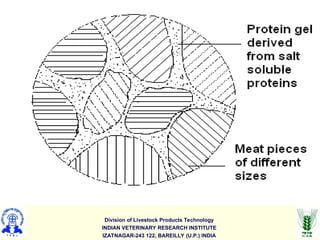
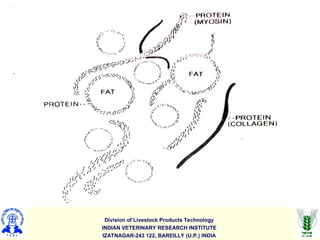
Mechanism of emulsion formulation
In the formation of emulsion, swelling and solubilization of proteins
occur due to disruption of structure and action of added salt,
phosphates and water during chopping.
The presence of salts open up the structure of proteins due to their
electric charges.
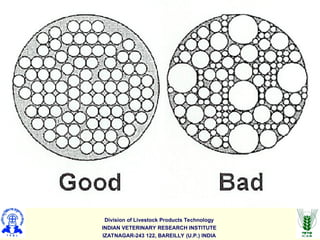
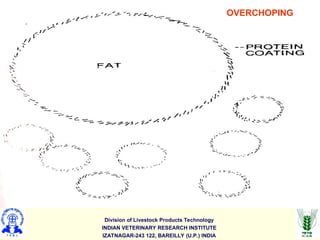
The fat present in meat or added during chopping also divided into
smaller particles. Over chopping or under chopping cause unequal
division of fat particles.
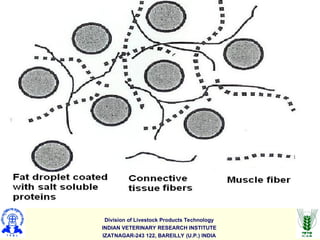
The hydrophobic portion (fat loving) of proteins associate with fat
while hydrophilic (water loving) portion associate with aqueous
phase i.e. water.
This allows adsorption of proteins to the dispersed fat particles i.e.
fat droplets is coated with proteins and the surface between two
immiscible fluids gets stabilized. Thus, emulsification of salt soluble
proteins, fat globules and water takes place.
The meat proteins act as emulsifiers and stabilize the batter. The
coating of fat particles will not allow separation of fat during cooking.
Division of Livestock Products Technology
INDIAN VETERINARY RESEARCH INSTITUTE
IZATNAGAR-243 122, BAREILLY (U.P.) INDIA
Division of Livestock Products Technology
INDIAN VETERINARY RESEARCH INSTITUTE
IZATNAGAR-243 122, BAREILLY (U.P.) INDIA
Division of Livestock Products Technology
INDIAN VETERINARY RESEARCH INSTITUTE
IZATNAGAR-243 122, BAREILLY (U.P.) INDIA
Division of Livestock Products Technology
INDIAN VETERINARY RESEARCH INSTITUTE
IZATNAGAR-243 122, BAREILLY (U.P.) INDIA
Factors effecting emulsion function and stability
Quality of meat (Bind values are used to rank meats of different origin
according to their ability to form stable meat batters)
pH of meat (More protein is extracted as the pH of muscle increases )
Amount and type of salt
Amount and type of salt soluble proteins
Type and quality of fat
Temperature of meat, fat and water (during chopping below 600
F
and during emulsification 700
F)
Increase in temperature during emulsion formation
Consistency of batter
Size of Mince plate used
Division of Livestock Products Technology
INDIAN VETERINARY RESEARCH INSTITUTE
IZATNAGAR-243 122, BAREILLY (U.P.) INDIA
Division of Livestock Products Technology
INDIAN VETERINARY RESEARCH INSTITUTE
IZATNAGAR-243 122, BAREILLY (U.P.) INDIA
OVERCHOPING
Division of Livestock Products Technology
INDIAN VETERINARY RESEARCH INSTITUTE
IZATNAGAR-243 122, BAREILLY (U.P.) INDIA
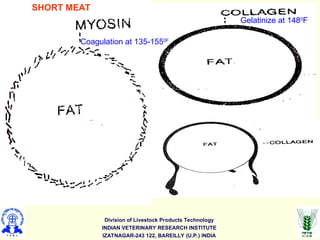
SHORT MEAT
Gelatinize at 1480
F
Coagulation at 135-1550F
Division of Livestock Products Technology
INDIAN VETERINARY RESEARCH INSTITUTE
IZATNAGAR-243 122, BAREILLY (U.P.) INDIA
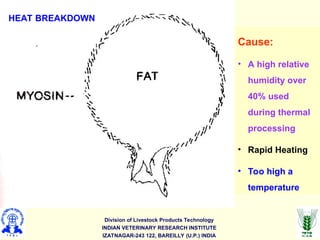
Cause:
• A high relative
humidity over
40% used
during thermal
processing
• Rapid Heating
• Too high a
temperature
HEAT BREAKDOWN

Meat Emulsion-Factors affecting emulsion stability.ppt

  • 1.
    Division of LivestockProducts Technology INDIAN VETERINARY RESEARCH INSTITUTE IZATNAGAR-243 122, BAREILLY (U.P.) INDIA Meat Emulsion- Factors affecting emulsion stability
  • 2.
    Division of LivestockProducts Technology INDIAN VETERINARY RESEARCH INSTITUTE IZATNAGAR-243 122, BAREILLY (U.P.) INDIA Emulsion Based Meat Products An emulsion is a stable mixture of two immiscible substances. Emulsion – fine, pasty, homogenous mixture e.g. sausages, patties. 1. None e.g. ham, bacon 2. Some e.g. reformed ham, restructured products 3. Coarse e.g. meat balls, ground meat patties 4. Fine e.g. sausages Degree of comminution (i.e. Extent of division of meat into meat pieces or particles)
  • 3.
    Division of LivestockProducts Technology INDIAN VETERINARY RESEARCH INSTITUTE IZATNAGAR-243 122, BAREILLY (U.P.) INDIA Meat Emulsion/Meat batter  Two phase system, with the dispersed phase consisting of either solid or liquid fat particles, and the continuous phase consists of a matrix of muscle and connective tissue fibers, or segment of fibers, suspended in an aqueous medium containing soluble proteins and other soluble muscle constituents  Can be classified as oil in water emulsion but not true similar to mayonaise  Do not conform to one requirement of “Classical” emulsion as fat particles in many commercial meat emulsion are larger than 50µm in diameter instead of typical 0.1 to 5.0 micrometers(µm)  Soluble protein dissolved in the aqueous phase act as emulsifying agent by coating all surfaces of the dispersed fat particles (When fat is in contact with water, there is a high interfacial tension between the two phases )  The amount of fat emulsified per unit of protein is referred to as emulsification capacity.
  • 4.
    Division of LivestockProducts Technology INDIAN VETERINARY RESEARCH INSTITUTE IZATNAGAR-243 122, BAREILLY (U.P.) INDIA Purposes of preparation of emulsion Meat of spent animals can be effectively utilized for preparation of emulsion. During mincing and chopping, muscle and connective tissue fibers are broken and thus meat tissue becomes tender. Emulsion prevents moisture and fat loss during cooking. This improves qualities particularly juiciness, texture, flavour and cooking yield of the product. The batter prepared can be transformed to a variety of products of different taste, shape and characteristics. The volume of product can be increased by incorporating number of edible meat byproducts, low value meats and non-meat ingredients. Emulsion based meat products can be prepared economically than other meat products.
  • 5.
    Division of LivestockProducts Technology INDIAN VETERINARY RESEARCH INSTITUTE IZATNAGAR-243 122, BAREILLY (U.P.) INDIA Ingredients required for preparation of emulsion based meat products 1. Raw meat materials : Meat from different species of animals, low value cuts, meat trimmings, mechanically separated meats. 2. Fat : Generally 10% external fat is added. Maximum limit of fat in the final product is 30%. Based on initial fat content of meat, added fat can be decided. 3. Chilled water/ice : Generally 10% chilled water is added. Combination of fat (maximum 30%) and added water shall not exceed 40%. 4. Salt : added @ 1.5 to 2%. 5. Alkaline phosphate : Generally added @ 0.3%. Maximum limit is 0.5% in the finished products. 6. Sodium nitrite : Generally added @ 150 mg/kg (ppm). 7. Sugar : Can be added upto 1%. 8. Binders and extenders : Generally added to improve functional properties and volume of meat products e.g. concentrate milk powders, whey proteins, cereal flours (added upto 3.5%), modified starches, soy proteins (added upto 2% of formulation) etc.
  • 6.
    Division of LivestockProducts Technology INDIAN VETERINARY RESEARCH INSTITUTE IZATNAGAR-243 122, BAREILLY (U.P.) INDIA Steps for preparation of emulsion based on meat products Chilled meat and fat are grinded (minced) separately in the meat grinder/mincer. Meat is placed in bowl chopper and chopped after addition of salt. Other ingredients like ice, sodium nitrite, salt, fat phosphate, binders/extenders, condiments and spices are added during chopping. In between rest of 1-2 minutes is given. Sequence of adding ingredients is very important. Chopping is continued till batter (emulsion) is formed. Generally it takes 6-10 minutes. No meat particle should be visible in emulsion. Care should be taken that during chopping temperature do not rise above 10°C. Emulsion is taken out from bowl chopper and stuffed into casings for preparation of sausages. For preparation of meat blocks emulsion is filled in blocks. Meat balls, patties and many other products can be prepared from emulsion by using different types of molds/machines. The prepared products are then smoked or roasted or steam-cooked or fried depending upon type of product.
  • 7.
    Division of LivestockProducts Technology INDIAN VETERINARY RESEARCH INSTITUTE IZATNAGAR-243 122, BAREILLY (U.P.) INDIA Mechanism of emulsion formulation In the formation of emulsion, swelling and solubilization of proteins occur due to disruption of structure and action of added salt, phosphates and water during chopping. The presence of salts open up the structure of proteins due to their electric charges. The fat present in meat or added during chopping also divided into smaller particles. Over chopping or under chopping cause unequal division of fat particles. The hydrophobic portion (fat loving) of proteins associate with fat while hydrophilic (water loving) portion associate with aqueous phase i.e. water. This allows adsorption of proteins to the dispersed fat particles i.e. fat droplets is coated with proteins and the surface between two immiscible fluids gets stabilized. Thus, emulsification of salt soluble proteins, fat globules and water takes place. The meat proteins act as emulsifiers and stabilize the batter. The coating of fat particles will not allow separation of fat during cooking.
  • 8.
    Division of LivestockProducts Technology INDIAN VETERINARY RESEARCH INSTITUTE IZATNAGAR-243 122, BAREILLY (U.P.) INDIA
  • 9.
    Division of LivestockProducts Technology INDIAN VETERINARY RESEARCH INSTITUTE IZATNAGAR-243 122, BAREILLY (U.P.) INDIA
  • 10.
    Division of LivestockProducts Technology INDIAN VETERINARY RESEARCH INSTITUTE IZATNAGAR-243 122, BAREILLY (U.P.) INDIA
  • 11.
    Division of LivestockProducts Technology INDIAN VETERINARY RESEARCH INSTITUTE IZATNAGAR-243 122, BAREILLY (U.P.) INDIA Factors effecting emulsion function and stability Quality of meat (Bind values are used to rank meats of different origin according to their ability to form stable meat batters) pH of meat (More protein is extracted as the pH of muscle increases ) Amount and type of salt Amount and type of salt soluble proteins Type and quality of fat Temperature of meat, fat and water (during chopping below 600 F and during emulsification 700 F) Increase in temperature during emulsion formation Consistency of batter Size of Mince plate used
  • 12.
    Division of LivestockProducts Technology INDIAN VETERINARY RESEARCH INSTITUTE IZATNAGAR-243 122, BAREILLY (U.P.) INDIA
  • 13.
    Division of LivestockProducts Technology INDIAN VETERINARY RESEARCH INSTITUTE IZATNAGAR-243 122, BAREILLY (U.P.) INDIA OVERCHOPING
  • 14.
    Division of LivestockProducts Technology INDIAN VETERINARY RESEARCH INSTITUTE IZATNAGAR-243 122, BAREILLY (U.P.) INDIA SHORT MEAT Gelatinize at 1480 F Coagulation at 135-1550F
  • 15.
    Division of LivestockProducts Technology INDIAN VETERINARY RESEARCH INSTITUTE IZATNAGAR-243 122, BAREILLY (U.P.) INDIA Cause: • A high relative humidity over 40% used during thermal processing • Rapid Heating • Too high a temperature HEAT BREAKDOWN