Measuring IPv6 ISP
Performance
Geoff Huston
APNIC Labs
July 2016
What are we looking at:
• How	“reliable”	are	IPv6	connections?
• How	“fast”	are	IPv6	connections?
What are we looking at:
• How	“reliable”	are	IPv6	connections?
• How	“fast”	are	IPv6	connections?
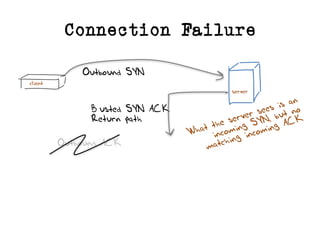
Outbound SYN
Busted SYN ACK
Return path
Connection Failure
server
client
Outbound ACK
Compare two data sets
• The	first	data	set	has	been	collected	across	
2011
– Teredo	and	6to4	were	still	active	as	IPv6	
mechanisms
– Little	in	the	way	of	other	IPv6	services
• The	second	data	set	has	been	collected	across	
2015/2016
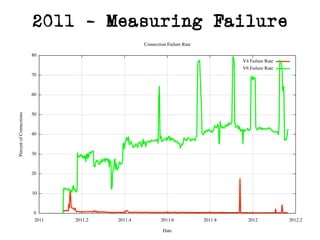
2011 - Measuring Failure
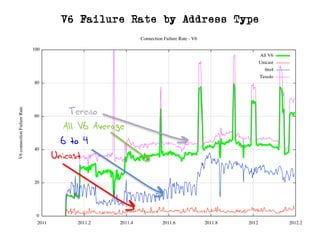
V6 Failure Rate by Address Type
All V6 Average
Teredo
6 to 4
Unicast
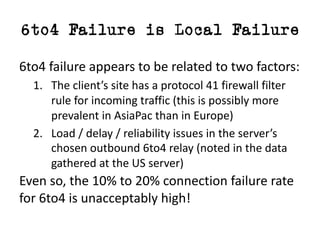
6to4 Failure is Local Failure
6to4	failure	appears	to	be	related	to	two	factors:
1. The	client’s	site	has	a	protocol	41	firewall	filter	
rule	for	incoming	traffic (this	is	possibly	more	
prevalent	in	AsiaPac than	in	Europe)
2. Load	/	delay	/	reliability	issues	in	the	server’s	
chosen	outbound	6to4	relay	(noted	in	the	data	
gathered	at	the	US	server)
Even	so,	the	10%	to	20%	connection	failure	rate	
for	6to4	is	unacceptably	high!
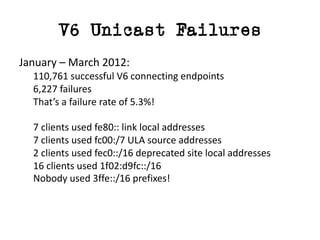
V6 Unicast Failures
January	– March	2012:
110,761	successful	V6	connecting	endpoints
6,227	failures
That’s	a	failure	rate	of	5.3%!
7	clients	used	fe80::	link	local	addresses
7 clients	used	fc00:/7	ULA	source	addresses
2	clients	used	fec0::/16	deprecated	site	local	addresses
16	clients	used	1f02:d9fc::/16	
Nobody	used	3ffe::/16	prefixes!
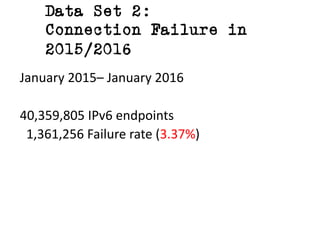
Data Set 2:
Connection Failure in
2015/2016
January	2015– January	2016
40,359,805	IPv6	endpoints
1,361,256	Failure	rate	(3.37%)
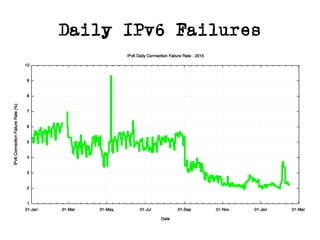
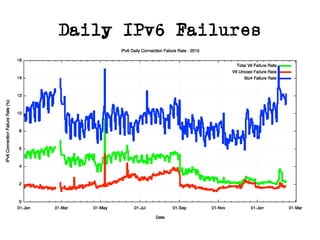
Daily IPv6 Failures
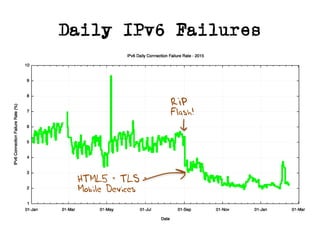
Daily IPv6 Failures
RIP
Flash!
HTML5 + TLS +
Mobile Devices
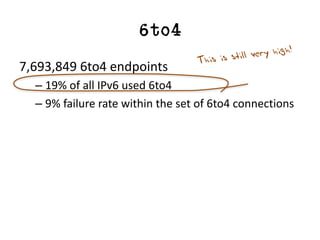
6to4
7,693,849 6to4	endpoints	
– 19%	of	all	IPv6	used	6to4
– 9%	failure	rate	within	the	set	of	6to4	connections
Daily IPv6 Failures
Daily IPv6 Failures
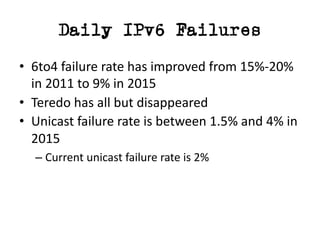
• 6to4	failure	rate	has	improved	from	15%-20%	
in	2011	to	9%	in	2015
• Teredo	has	all	but	disappeared
• Unicast	failure	rate	is	between	1.5%	and	4%	in	
2015
– Current	unicast	failure	rate	is	2%
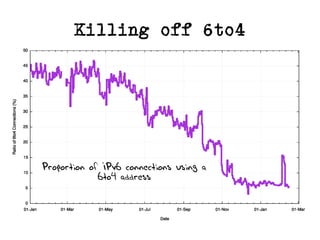
Killing off 6to4
Proportion of IPv6 connections using a
6to4 address
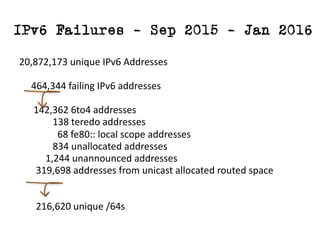
IPv6 Failures – Sep 2015 – Jan 2016
20,872,173	unique	IPv6	Addresses
464,344	failing	IPv6	addresses
142,362	6to4	addresses
138	teredo addresses
68	fe80::	local	scope	addresses	
834	unallocated	addresses
1,244	unannounced	addresses
319,698	addresses	from	unicast	allocated	routed	space
216,620	unique	/64s
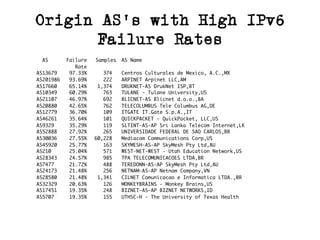
Origin AS’s with High IPv6
Failure Rates
AS Failure Samples AS Name
Rate
AS13679 97.33% 374 Centros Culturales de Mexico, A.C.,MX
AS201986 93.69% 222 ARPINET Arpinet LLC,AM
AS17660 65.14% 1,374 DRUKNET-AS DrukNet ISP,BT
AS10349 60.29% 763 TULANE - Tulane University,US
AS21107 46.97% 692 BLICNET-AS Blicnet d.o.o.,BA
AS20880 42.65% 762 TELECOLUMBUS Tele Columbus AG,DE
AS12779 36.70% 109 ITGATE IT.Gate S.p.A.,IT
AS46261 35.64% 101 QUICKPACKET - QuickPacket, LLC,US
AS9329 35.29% 119 SLTINT-AS-AP Sri Lanka Telecom Internet,LK
AS52888 27.92% 265 UNIVERSIDADE FEDERAL DE SAO CARLOS,BR
AS30036 27.55% 60,228 Mediacom Communications Corp,US
AS45920 25.77% 163 SKYMESH-AS-AP SkyMesh Pty Ltd,AU
AS210 25.04% 571 WEST-NET-WEST - Utah Education Network,US
AS28343 24.57% 985 TPA TELECOMUNICACOES LTDA,BR
AS7477 21.72% 488 TEREDONN-AS-AP SkyMesh Pty Ltd,AU
AS24173 21.48% 256 NETNAM-AS-AP Netnam Company,VN
AS28580 21.48% 1,341 CILNET Comunicacao e Informatica LTDA.,BR
AS32329 20.63% 126 MONKEYBRAINS - Monkey Brains,US
AS17451 19.35% 248 BIZNET-AS-AP BIZNET NETWORKS,ID
AS5707 19.35% 155 UTHSC-H - The University of Texas Health
It’s not good!
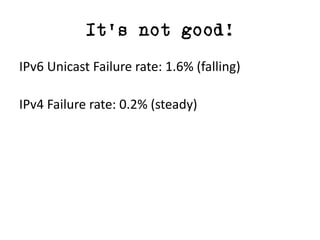
IPv6	Unicast	Failure	rate:	1.6%	(falling)
IPv4	Failure	rate:	0.2%	(steady)
What are we looking at:
• How	“reliable”	are	IPv6	connections?
• How	“fast”	are	IPv6	connections?
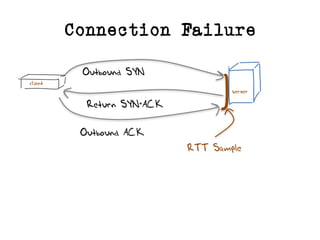
Outbound SYN
Return SYN+ACK
Connection Failure
server
client
Outbound ACK
RTT Sample
Why SYN Handshakes?
• Every	TCP	session	starts	with	a	SYN	handshake
• It’s	typically	a	kernel	level	operation,	which	
means	that	there	is	little	in	the	way	of	
transport	protocol	or	application	level	
interaction	with	the	SYN	exchange
• On	the	downside	there	is	only	a	single	sample	
point	per	measurement
Generating a comparative RTT
profile
• For	each	successful	connection	couplet	(IPv4	
and	IPv4)	from	the	same	endpoint,	gather	the	
pair	of	RTT	measurements	from the	SYN-ACK	
exchanges
• Use	the	server’s	web	logs	to	associate	a	couplet	of	
IPv4	and	IPv6	addresses
• Use	the	packet	dumps	to	collect	RTT	information	
from	the	SYN-ACK	Exchange
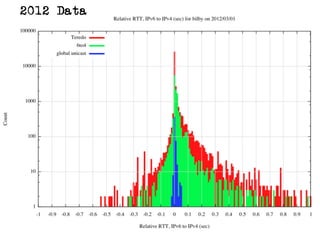
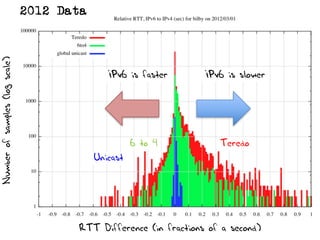
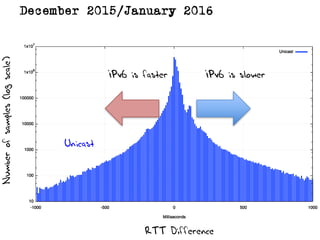
• Plot	the	difference	in	RTT	in	buckets
2012 Data
IPv6 is slowerIPv6 is faster
RTT Difference (in fractions of a second)
Numberofsamples(logscale)
Teredo6 to 4
Unicast
2012 Data
IPv6 is slowerIPv6 is faster
RTT Difference
Numberofsamples(logscale)
Unicast
December 2015/January 2016
IPv6 is slowerIPv6 is faster
RTT Difference
Numberofsamples(logscale)
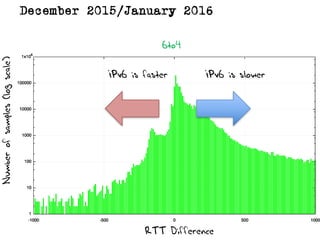
6to4
December 2015/January 2016
IPv6 is slowerIPv6 is faster
RTT Difference
Numberofsamples(logscale)
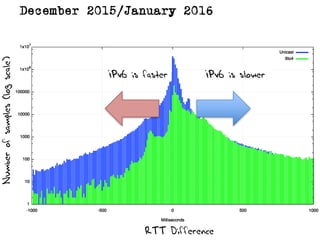
December 2015/January 2016
IPv6 is slowerIPv6 is faster
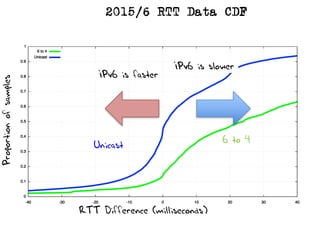
RTT Difference (millisecs)
Proportionofsamples
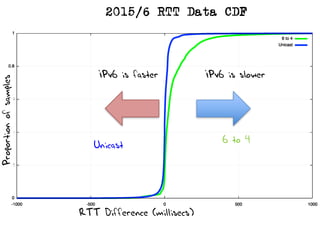
2015/6 RTT Data CDF
6 to 4
Unicast
IPv6 is slower
IPv6 is faster
RTT Difference (milliseconds)
Proportionofsamples
6 to 4
Unicast
2015/6 RTT Data CDF
IPv6 is slower
IPv6 is faster
RTT Difference (milliseconds)
Proportionofsamples
6 to 4
Unicast
2015/6 RTT Data CDF
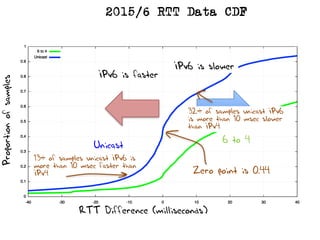
Zero point is 0.44
13% of samples unicast IPv6 is
more than 10 msec faster than
IPv4
32% of samples unicast IPv6
is more than 10 msec slower
than IPv4
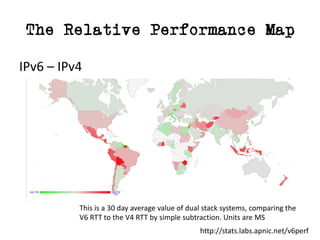
Mapping the Data
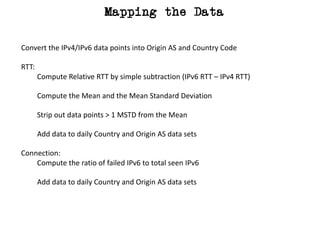
Convert	the	IPv4/IPv6	data	points	into	Origin	AS	and	Country	Code
RTT:
Compute	Relative	RTT	by	simple	subtraction	(IPv6	RTT	– IPv4	RTT)
Compute	the	Mean	and	the	Mean	Standard	Deviation
Strip	out	data	points	>	1	MSTD	from	the	Mean
Add	data	to	daily	Country	and	Origin	AS	data	sets
Connection:
Compute	the	ratio	of	failed	IPv6	to	total	seen	IPv6
Add	data	to	daily	Country	and	Origin	AS	data	sets
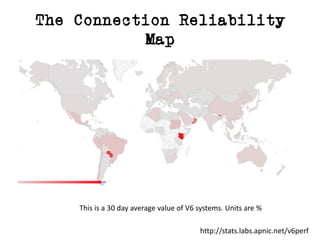
The Connection Reliability
Map
This	is	a	30	day	average	value	of	V6	systems.	Units	are	%
http://stats.labs.apnic.net/v6perf
The Relative Performance Map
IPv6	– IPv4
This	is	a	30	day	average	value	of	dual	stack	systems,	comparing	the
V6	RTT	to	the	V4	RTT	by	simple	subtraction.	Units	are	MS
http://stats.labs.apnic.net/v6perf
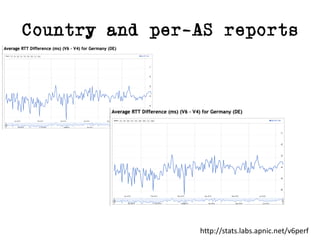
Country and per-AS reports
http://stats.labs.apnic.net/v6perf
Questions to you…
• Is this helpful information?
• Is the layout useful or not?
• What other views would be helpful to you?
Thanks!

Measuring IPv6 ISP performance

  • 1.
    Measuring IPv6 ISP Performance GeoffHuston APNIC Labs July 2016
  • 2.
    What are welooking at: • How “reliable” are IPv6 connections? • How “fast” are IPv6 connections?
  • 3.
    What are welooking at: • How “reliable” are IPv6 connections? • How “fast” are IPv6 connections?
  • 4.
    Outbound SYN Busted SYNACK Return path Connection Failure server client Outbound ACK
  • 5.
    Compare two datasets • The first data set has been collected across 2011 – Teredo and 6to4 were still active as IPv6 mechanisms – Little in the way of other IPv6 services • The second data set has been collected across 2015/2016
  • 6.
  • 7.
    V6 Failure Rateby Address Type All V6 Average Teredo 6 to 4 Unicast
  • 8.
    6to4 Failure isLocal Failure 6to4 failure appears to be related to two factors: 1. The client’s site has a protocol 41 firewall filter rule for incoming traffic (this is possibly more prevalent in AsiaPac than in Europe) 2. Load / delay / reliability issues in the server’s chosen outbound 6to4 relay (noted in the data gathered at the US server) Even so, the 10% to 20% connection failure rate for 6to4 is unacceptably high!
  • 9.
    V6 Unicast Failures January –March 2012: 110,761 successful V6 connecting endpoints 6,227 failures That’s a failure rate of 5.3%! 7 clients used fe80:: link local addresses 7 clients used fc00:/7 ULA source addresses 2 clients used fec0::/16 deprecated site local addresses 16 clients used 1f02:d9fc::/16 Nobody used 3ffe::/16 prefixes!
  • 10.
    Data Set 2: ConnectionFailure in 2015/2016 January 2015– January 2016 40,359,805 IPv6 endpoints 1,361,256 Failure rate (3.37%)
  • 11.
  • 12.
  • 13.
    6to4 7,693,849 6to4 endpoints – 19% of all IPv6 used 6to4 –9% failure rate within the set of 6to4 connections
  • 14.
  • 15.
    Daily IPv6 Failures •6to4 failure rate has improved from 15%-20% in 2011 to 9% in 2015 • Teredo has all but disappeared • Unicast failure rate is between 1.5% and 4% in 2015 – Current unicast failure rate is 2%
  • 16.
    Killing off 6to4 Proportionof IPv6 connections using a 6to4 address
  • 17.
    IPv6 Failures –Sep 2015 – Jan 2016 20,872,173 unique IPv6 Addresses 464,344 failing IPv6 addresses 142,362 6to4 addresses 138 teredo addresses 68 fe80:: local scope addresses 834 unallocated addresses 1,244 unannounced addresses 319,698 addresses from unicast allocated routed space 216,620 unique /64s
  • 18.
    Origin AS’s withHigh IPv6 Failure Rates AS Failure Samples AS Name Rate AS13679 97.33% 374 Centros Culturales de Mexico, A.C.,MX AS201986 93.69% 222 ARPINET Arpinet LLC,AM AS17660 65.14% 1,374 DRUKNET-AS DrukNet ISP,BT AS10349 60.29% 763 TULANE - Tulane University,US AS21107 46.97% 692 BLICNET-AS Blicnet d.o.o.,BA AS20880 42.65% 762 TELECOLUMBUS Tele Columbus AG,DE AS12779 36.70% 109 ITGATE IT.Gate S.p.A.,IT AS46261 35.64% 101 QUICKPACKET - QuickPacket, LLC,US AS9329 35.29% 119 SLTINT-AS-AP Sri Lanka Telecom Internet,LK AS52888 27.92% 265 UNIVERSIDADE FEDERAL DE SAO CARLOS,BR AS30036 27.55% 60,228 Mediacom Communications Corp,US AS45920 25.77% 163 SKYMESH-AS-AP SkyMesh Pty Ltd,AU AS210 25.04% 571 WEST-NET-WEST - Utah Education Network,US AS28343 24.57% 985 TPA TELECOMUNICACOES LTDA,BR AS7477 21.72% 488 TEREDONN-AS-AP SkyMesh Pty Ltd,AU AS24173 21.48% 256 NETNAM-AS-AP Netnam Company,VN AS28580 21.48% 1,341 CILNET Comunicacao e Informatica LTDA.,BR AS32329 20.63% 126 MONKEYBRAINS - Monkey Brains,US AS17451 19.35% 248 BIZNET-AS-AP BIZNET NETWORKS,ID AS5707 19.35% 155 UTHSC-H - The University of Texas Health
  • 19.
  • 20.
    What are welooking at: • How “reliable” are IPv6 connections? • How “fast” are IPv6 connections?
  • 21.
    Outbound SYN Return SYN+ACK ConnectionFailure server client Outbound ACK RTT Sample
  • 22.
    Why SYN Handshakes? •Every TCP session starts with a SYN handshake • It’s typically a kernel level operation, which means that there is little in the way of transport protocol or application level interaction with the SYN exchange • On the downside there is only a single sample point per measurement
  • 23.
    Generating a comparativeRTT profile • For each successful connection couplet (IPv4 and IPv4) from the same endpoint, gather the pair of RTT measurements from the SYN-ACK exchanges • Use the server’s web logs to associate a couplet of IPv4 and IPv6 addresses • Use the packet dumps to collect RTT information from the SYN-ACK Exchange • Plot the difference in RTT in buckets
  • 24.
  • 25.
    IPv6 is slowerIPv6is faster RTT Difference (in fractions of a second) Numberofsamples(logscale) Teredo6 to 4 Unicast 2012 Data
  • 26.
    IPv6 is slowerIPv6is faster RTT Difference Numberofsamples(logscale) Unicast December 2015/January 2016
  • 27.
    IPv6 is slowerIPv6is faster RTT Difference Numberofsamples(logscale) 6to4 December 2015/January 2016
  • 28.
    IPv6 is slowerIPv6is faster RTT Difference Numberofsamples(logscale) December 2015/January 2016
  • 29.
    IPv6 is slowerIPv6is faster RTT Difference (millisecs) Proportionofsamples 2015/6 RTT Data CDF 6 to 4 Unicast
  • 30.
    IPv6 is slower IPv6is faster RTT Difference (milliseconds) Proportionofsamples 6 to 4 Unicast 2015/6 RTT Data CDF
  • 31.
    IPv6 is slower IPv6is faster RTT Difference (milliseconds) Proportionofsamples 6 to 4 Unicast 2015/6 RTT Data CDF Zero point is 0.44 13% of samples unicast IPv6 is more than 10 msec faster than IPv4 32% of samples unicast IPv6 is more than 10 msec slower than IPv4
  • 32.
    Mapping the Data Convert the IPv4/IPv6 data points into Origin AS and Country Code RTT: Compute Relative RTT by simple subtraction (IPv6 RTT –IPv4 RTT) Compute the Mean and the Mean Standard Deviation Strip out data points > 1 MSTD from the Mean Add data to daily Country and Origin AS data sets Connection: Compute the ratio of failed IPv6 to total seen IPv6 Add data to daily Country and Origin AS data sets
  • 33.
  • 34.
    The Relative PerformanceMap IPv6 – IPv4 This is a 30 day average value of dual stack systems, comparing the V6 RTT to the V4 RTT by simple subtraction. Units are MS http://stats.labs.apnic.net/v6perf
  • 35.
    Country and per-ASreports http://stats.labs.apnic.net/v6perf
  • 36.
    Questions to you… •Is this helpful information? • Is the layout useful or not? • What other views would be helpful to you?
  • 37.