



2016#apricot2016
IPv6 Performance
Geoff Huston
APNIC Labs
February 2015
2016#apricot2016
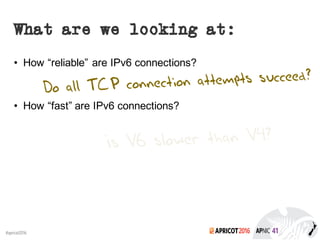
What are we looking at:
• How “reliable” are IPv6 connections?
• How “fast” are IPv6 connections?
2016#apricot2016
What are we looking at:
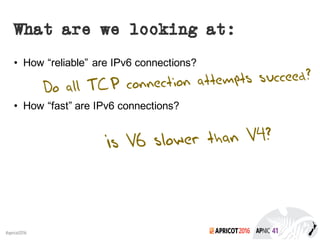
• How “reliable” are IPv6 connections?
• How “fast” are IPv6 connections?
2016#apricot2016
The Measurement Technique
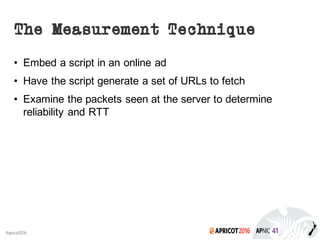
• Embed a script in an online ad
• Have the script generate a set of URLs to fetch
• Examine the packets seen at the server to determine
reliability and RTT
2016#apricot2016
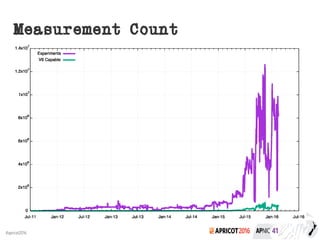
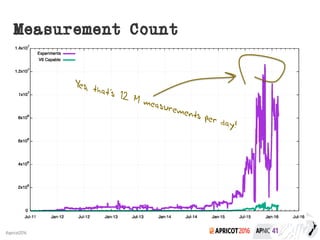
Measurement Count
2016#apricot2016
Measurement Count
2016#apricot2016
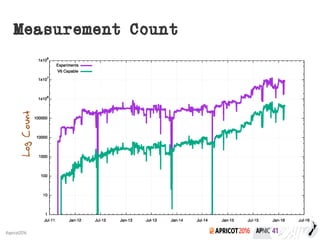
Measurement CountLogCount
2016#apricot2016
What are we looking at:
• How “reliable” are IPv6 connections?
• How “fast” are IPv6 connections?
2016#apricot2016
Let’s dive into Naked SINs!
Y
2016#apricot2016
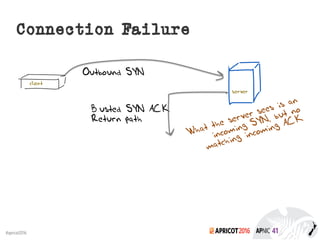
Outbound SYN
Busted SYN ACK
Return path
Connection Failure
server
client
2016#apricot2016
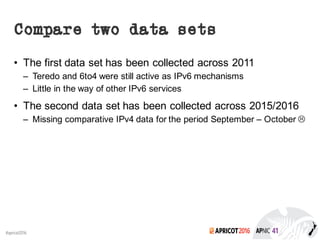
Compare two data sets
• The first data set has been collected across 2011
– Teredo and 6to4 were still active as IPv6 mechanisms
– Little in the way of other IPv6 services
• The second data set has been collected across 2015/2016
– Missing comparative IPv4 data for the period September – October L
2016#apricot2016
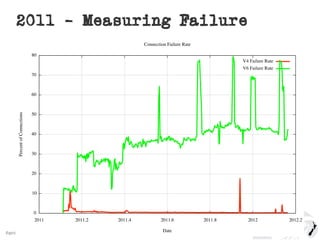
2011 - Measuring Failure
2016#apricot2016
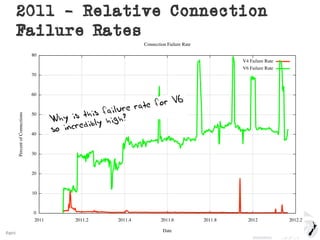
2011 - Relative Connection
Failure Rates
2016#apricot2016
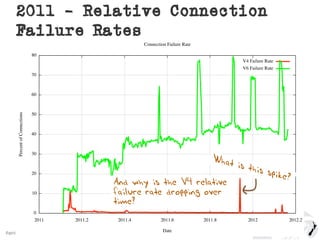
And why is the V4 relative
failure rate dropping over
time?
2011 - Relative Connection
Failure Rates
2016#apricot2016
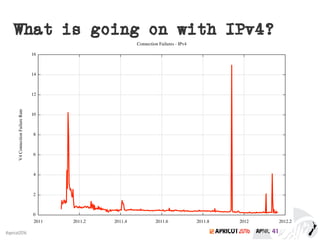
What is going on with IPv4?
2016#apricot2016
What is going on with IPv4?
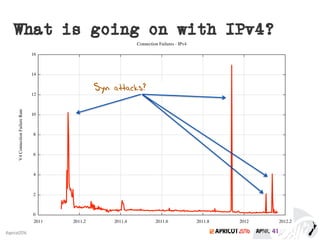
The failure rate for V4 decreases as the volume of
experiments increases – which implies that the
number of “naked SYNs” being sent to the servers is
not related to the number of tests being performed.
Aside from residual IPv4 failures in the image fetch
due to device resets, connection dropouts, etc, the
bulk of the recorded failures here is probably
attributable to bots doing all-of-address scanning on
port 80 – or maybe not!
2016#apricot2016
What is going on with IPv4?
Syn attacks?
2016#apricot2016
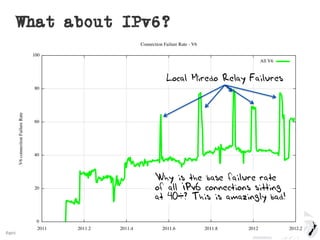
What about IPv6?
Local Miredo Relay Failures
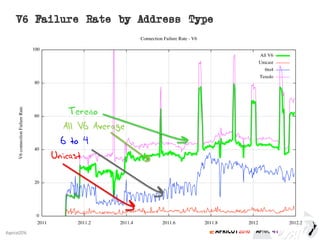
Why is the base failure rate
of all IPv6 connections sitting
at 40%? This is amazingly bad!
2016#apricot2016
V6 Failure Rate by Address Type
All V6 Average
Teredo
6 to 4
Unicast
2016#apricot2016
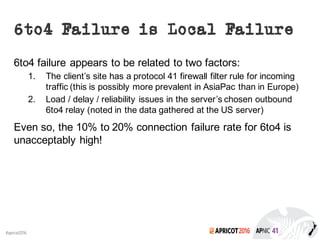
6to4 Failure is Local Failure
6to4 failure appears to be related to two factors:
1. The client’s site has a protocol 41 firewall filter rule for incoming
traffic (this is possibly more prevalent in AsiaPac than in Europe)
2. Load / delay / reliability issues in the server’s chosen outbound
6to4 relay (noted in the data gathered at the US server)
Even so, the 10% to 20% connection failure rate for 6to4 is
unacceptably high!
2016#apricot2016
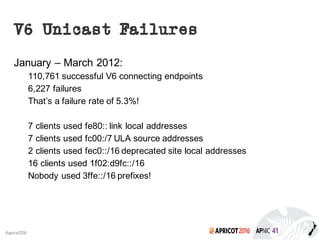
V6 Unicast Failures
January – March 2012:
110,761 successful V6 connecting endpoints
6,227 failures
That’s a failure rate of 5.3%!
7 clients used fe80:: link local addresses
7 clients used fc00:/7 ULA source addresses
2 clients used fec0::/16 deprecated site local addresses
16 clients used 1f02:d9fc::/16
Nobody used 3ffe::/16 prefixes!
2016#apricot2016
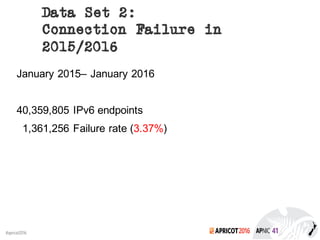
Data Set 2:
Connection Failure in
2015/2016
January 2015– January 2016
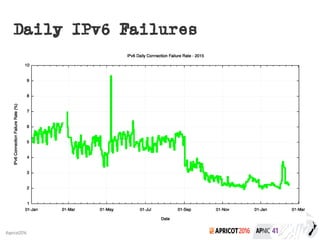
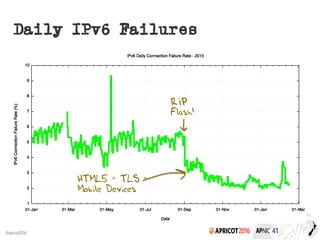
40,359,805 IPv6 endpoints
1,361,256 Failure rate (3.37%)
2016#apricot2016
Daily IPv6 Failures
2016#apricot2016
Daily IPv6 Failures
RIP
Flash!
HTML5 + TLS +
Mobile Devices
2016#apricot2016
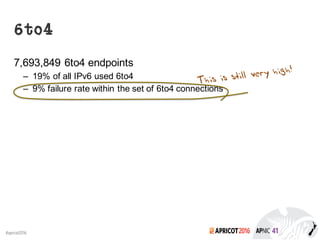
6to4
7,693,849 6to4 endpoints
– 19% of all IPv6 used 6to4
– 9% failure rate within the set of 6to4 connections
2016#apricot2016
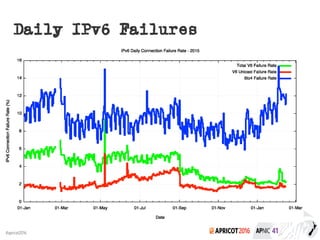
Daily IPv6 Failures
2016#apricot2016
Daily IPv6 Failures
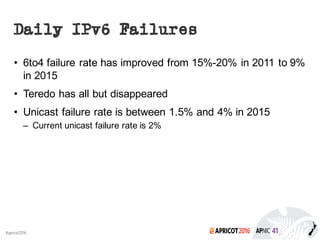
• 6to4 failure rate has improved from 15%-20% in 2011 to 9%
in 2015
• Teredo has all but disappeared
• Unicast failure rate is between 1.5% and 4% in 2015
– Current unicast failure rate is 2%
2016#apricot2016
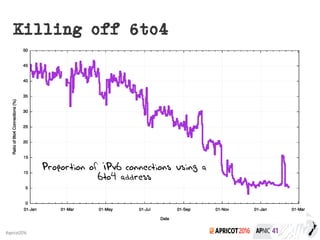
Killing off 6to4
Proportion of IPv6 connections using a
6to4 address
2016#apricot2016
IPv6 Failures – Sep 2015 – Jan
2016
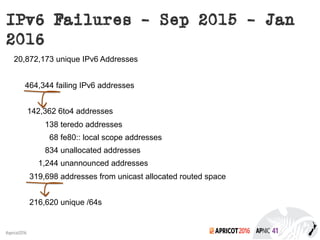
20,872,173 unique IPv6 Addresses
464,344 failing IPv6 addresses
142,362 6to4 addresses
138 teredo addresses
68 fe80:: local scope addresses
834 unallocated addresses
1,244 unannounced addresses
319,698 addresses from unicast allocated routed space
216,620 unique /64s
2016#apricot2016
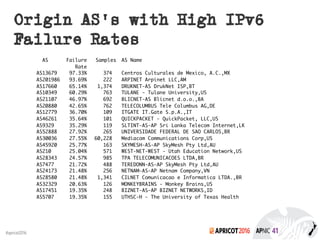
Origin AS’s with High IPv6
Failure Rates
AS Failure Samples AS Name
Rate
AS13679 97.33% 374 Centros Culturales de Mexico, A.C.,MX
AS201986 93.69% 222 ARPINET Arpinet LLC,AM
AS17660 65.14% 1,374 DRUKNET-AS DrukNet ISP,BT
AS10349 60.29% 763 TULANE - Tulane University,US
AS21107 46.97% 692 BLICNET-AS Blicnet d.o.o.,BA
AS20880 42.65% 762 TELECOLUMBUS Tele Columbus AG,DE
AS12779 36.70% 109 ITGATE IT.Gate S.p.A.,IT
AS46261 35.64% 101 QUICKPACKET - QuickPacket, LLC,US
AS9329 35.29% 119 SLTINT-AS-AP Sri Lanka Telecom Internet,LK
AS52888 27.92% 265 UNIVERSIDADE FEDERAL DE SAO CARLOS,BR
AS30036 27.55% 60,228 Mediacom Communications Corp,US
AS45920 25.77% 163 SKYMESH-AS-AP SkyMesh Pty Ltd,AU
AS210 25.04% 571 WEST-NET-WEST - Utah Education Network,US
AS28343 24.57% 985 TPA TELECOMUNICACOES LTDA,BR
AS7477 21.72% 488 TEREDONN-AS-AP SkyMesh Pty Ltd,AU
AS24173 21.48% 256 NETNAM-AS-AP Netnam Company,VN
AS28580 21.48% 1,341 CILNET Comunicacao e Informatica LTDA.,BR
AS32329 20.63% 126 MONKEYBRAINS - Monkey Brains,US
AS17451 19.35% 248 BIZNET-AS-AP BIZNET NETWORKS,ID
AS5707 19.35% 155 UTHSC-H - The University of Texas Health
2016#apricot2016
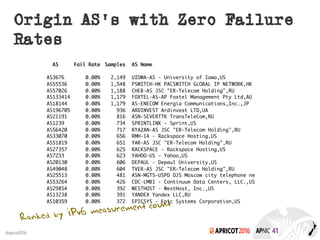
Origin AS’s with Zero Failure
Rates
AS Fail Rate Samples AS Name
AS3676 0.00% 2,149 UIOWA-AS - University of Iowa,US
AS55536 0.00% 1,548 PSWITCH-HK PACSWITCH GLOBAL IP NETWORK,HK
AS57026 0.00% 1,188 CHEB-AS JSC "ER-Telecom Holding",RU
AS133414 0.00% 1,179 FOXTEL-AS-AP Foxtel Management Pty Ltd,AU
AS18144 0.00% 1,179 AS-ENECOM Energia Communications,Inc.,JP
AS196705 0.00% 936 ARDINVEST Ardinvest LTD,UA
AS21191 0.00% 816 ASN-SEVERTTK TransTeleCom,RU
AS1239 0.00% 734 SPRINTLINK - Sprint,US
AS56420 0.00% 717 RYAZAN-AS JSC "ER-Telecom Holding",RU
AS33070 0.00% 656 RMH-14 - Rackspace Hosting,US
AS51819 0.00% 651 YAR-AS JSC "ER-Telecom Holding",RU
AS27357 0.00% 625 RACKSPACE - Rackspace Hosting,US
AS7233 0.00% 623 YAHOO-US - Yahoo,US
AS20130 0.00% 606 DEPAUL - Depaul University,US
AS49048 0.00% 604 TVER-AS JSC "ER-Telecom Holding",RU
AS25513 0.00% 481 ASN-MGTS-USPD OJS Moscow city telephone network,RU
AS53264 0.00% 426 CDC-LMB1 - Continuum Data Centers, LLC.,US
AS29854 0.00% 392 WESTHOST - WestHost, Inc.,US
AS13238 0.00% 391 YANDEX Yandex LLC,RU
AS10359 0.00% 372 EPICSYS - Epic Systems Corporation,US
2016#apricot2016
What about IPv4 Connection
Failures?
2011: failure rate 0.2%
2016#apricot2016
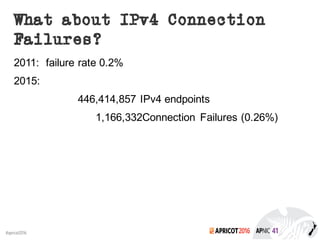
What about IPv4 Connection
Failures?
2011: failure rate 0.2%
2015:
446,414,857 IPv4 endpoints
1,166,332Connection Failures (0.26%)
2016#apricot2016
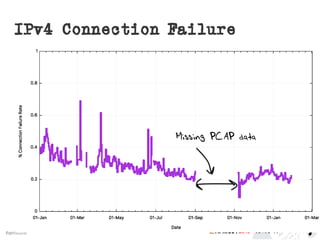
IPv4 Connection Failure
Missing PCAP data
2016#apricot2016
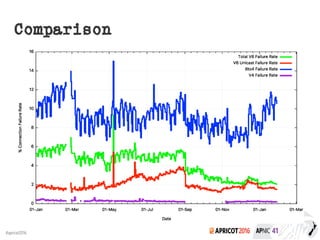
Comparison
2016#apricot2016
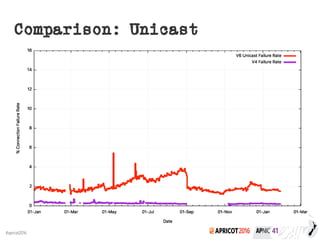
Comparison: Unicast
2016#apricot2016
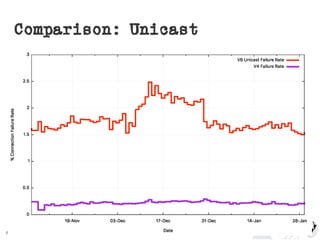
Comparison: Unicast
2016#apricot2016
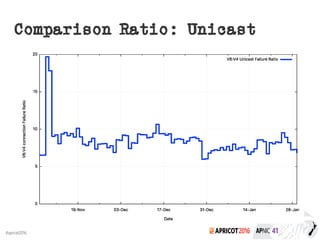
Comparison Ratio: Unicast
2016#apricot2016
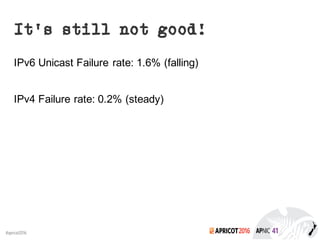
It’s still not good!
IPv6 Unicast Failure rate: 1.6% (falling)
IPv4 Failure rate: 0.2% (steady)
2016#apricot2016
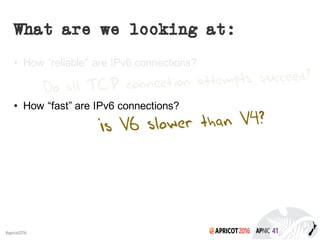
What are we looking at:
• How “reliable” are IPv6 connections?
• How “fast” are IPv6 connections?
2016#apricot2016
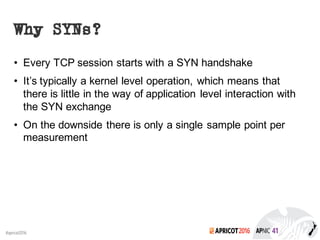
Why SYNs?
• Every TCP session starts with a SYN handshake
• It’s typically a kernel level operation, which means that
there is little in the way of application level interaction with
the SYN exchange
• On the downside there is only a single sample point per
measurement
2016#apricot2016
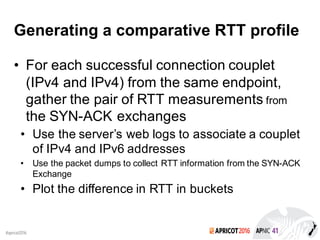
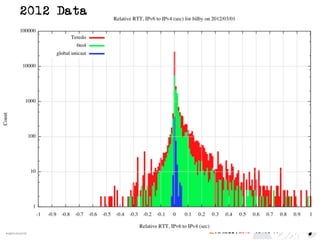
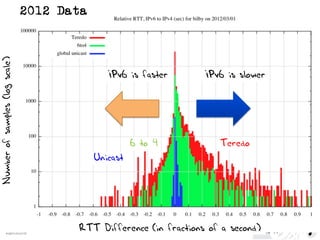
Generating a comparative RTT profile
• For each successful connection couplet
(IPv4 and IPv4) from the same endpoint,
gather the pair of RTT measurements from
the SYN-ACK exchanges
• Use the server’s web logs to associate a couplet
of IPv4 and IPv6 addresses
• Use the packet dumps to collect RTT information from the SYN-ACK
Exchange
• Plot the difference in RTT in buckets
2016#apricot2016
2012 Data
2016#apricot2016
IPv6 is slowerIPv6 is faster
RTT Difference (in fractions of a second)
Numberofsamples(logscale)
Teredo6 to 4
Unicast
2012 Data
2016#apricot2016
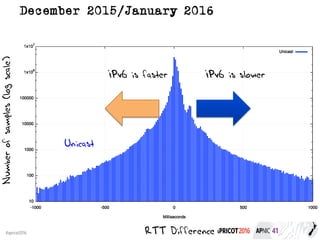
IPv6 is slowerIPv6 is faster
RTT Difference
Numberofsamples(logscale)
Unicast
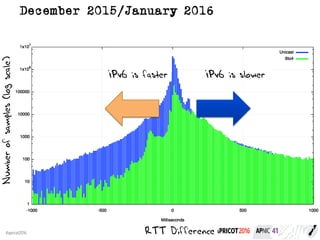
December 2015/January 2016
2016#apricot2016
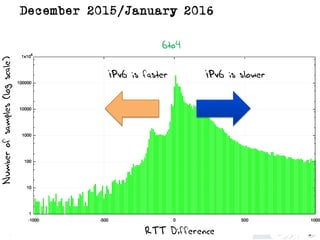
IPv6 is slowerIPv6 is faster
RTT Difference
Numberofsamples(logscale)
6to4
December 2015/January 2016
2016#apricot2016
IPv6 is slowerIPv6 is faster
RTT Difference
Numberofsamples(logscale)
December 2015/January 2016
2016#apricot2016
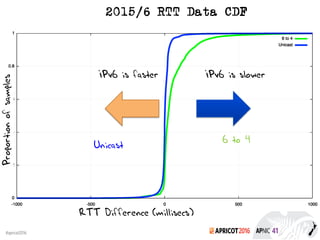
IPv6 is slowerIPv6 is faster
RTT Difference (millisecs)
Proportionofsamples
2015/6 RTT Data CDF
6 to 4
Unicast
2016#apricot2016
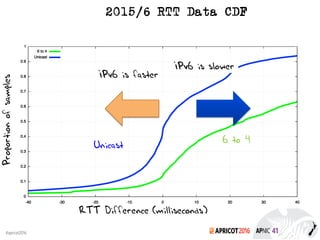
IPv6 is slower
IPv6 is faster
RTT Difference (milliseconds)
Proportionofsamples
6 to 4
Unicast
2015/6 RTT Data CDF
2016#apricot2016
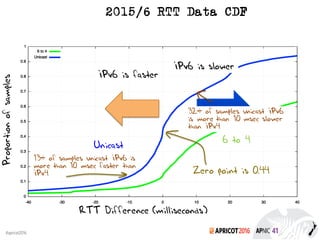
IPv6 is slower
IPv6 is faster
RTT Difference (milliseconds)
Proportionofsamples
6 to 4
Unicast
2015/6 RTT Data CDF
Zero point is 0.44
13% of samples unicast IPv6 is
more than 10 msec faster than
IPv4
32% of samples unicast IPv6
is more than 10 msec slower
than IPv4
2016#apricot2016
Is IPv6 as “good” as IPv4?
2016#apricot2016
Is IPv6 as “good” as IPv4?
Is IPv6 as fast as IPv4?
Basically, yes
IPv6 is faster about half of the time
For 65% of unicast cases, IPv6 is within 10ms RTT of IPv4
So they perform at much the same rate
But that’s just for unicast IPv6
The use of 6to4 makes this a whole lot worse!
2016#apricot2016
Is IPv6 as “good” as IPv4?
Is IPv6 as robust as IPv4?
IPv4 connection reliability currently sits at 0.2%
The base failure rate of Unicast V6 connection attempts at 1.8% of the
total V6 unicast connections is not brilliant.
6to4 is still terrible!
It could be better.
It could be a whole lot better!
2016#apricot2016
Is IPv6 as “good” as IPv4?
If you can establish a connection, then IPv4 and IPv6 appear
to have comparable RTT measurements across most of the
Internet
But the odds of establishing that connection are still weighted
in favour of IPv4!
2016#apricot2016
That’s it!

IPv6 Performance

  • 1.
  • 2.
    2016#apricot2016 What are welooking at: • How “reliable” are IPv6 connections? • How “fast” are IPv6 connections?
  • 3.
    2016#apricot2016 What are welooking at: • How “reliable” are IPv6 connections? • How “fast” are IPv6 connections?
  • 4.
    2016#apricot2016 The Measurement Technique •Embed a script in an online ad • Have the script generate a set of URLs to fetch • Examine the packets seen at the server to determine reliability and RTT
  • 5.
  • 6.
  • 7.
  • 8.
    2016#apricot2016 What are welooking at: • How “reliable” are IPv6 connections? • How “fast” are IPv6 connections?
  • 9.
  • 10.
    2016#apricot2016 Outbound SYN Busted SYNACK Return path Connection Failure server client
  • 11.
    2016#apricot2016 Compare two datasets • The first data set has been collected across 2011 – Teredo and 6to4 were still active as IPv6 mechanisms – Little in the way of other IPv6 services • The second data set has been collected across 2015/2016 – Missing comparative IPv4 data for the period September – October L
  • 12.
  • 13.
    2016#apricot2016 2011 - RelativeConnection Failure Rates
  • 14.
    2016#apricot2016 And why isthe V4 relative failure rate dropping over time? 2011 - Relative Connection Failure Rates
  • 15.
  • 16.
    2016#apricot2016 What is goingon with IPv4? The failure rate for V4 decreases as the volume of experiments increases – which implies that the number of “naked SYNs” being sent to the servers is not related to the number of tests being performed. Aside from residual IPv4 failures in the image fetch due to device resets, connection dropouts, etc, the bulk of the recorded failures here is probably attributable to bots doing all-of-address scanning on port 80 – or maybe not!
  • 17.
    2016#apricot2016 What is goingon with IPv4? Syn attacks?
  • 18.
    2016#apricot2016 What about IPv6? LocalMiredo Relay Failures Why is the base failure rate of all IPv6 connections sitting at 40%? This is amazingly bad!
  • 19.
    2016#apricot2016 V6 Failure Rateby Address Type All V6 Average Teredo 6 to 4 Unicast
  • 20.
    2016#apricot2016 6to4 Failure isLocal Failure 6to4 failure appears to be related to two factors: 1. The client’s site has a protocol 41 firewall filter rule for incoming traffic (this is possibly more prevalent in AsiaPac than in Europe) 2. Load / delay / reliability issues in the server’s chosen outbound 6to4 relay (noted in the data gathered at the US server) Even so, the 10% to 20% connection failure rate for 6to4 is unacceptably high!
  • 21.
    2016#apricot2016 V6 Unicast Failures January– March 2012: 110,761 successful V6 connecting endpoints 6,227 failures That’s a failure rate of 5.3%! 7 clients used fe80:: link local addresses 7 clients used fc00:/7 ULA source addresses 2 clients used fec0::/16 deprecated site local addresses 16 clients used 1f02:d9fc::/16 Nobody used 3ffe::/16 prefixes!
  • 22.
    2016#apricot2016 Data Set 2: ConnectionFailure in 2015/2016 January 2015– January 2016 40,359,805 IPv6 endpoints 1,361,256 Failure rate (3.37%)
  • 23.
  • 24.
  • 25.
    2016#apricot2016 6to4 7,693,849 6to4 endpoints –19% of all IPv6 used 6to4 – 9% failure rate within the set of 6to4 connections
  • 26.
  • 27.
    2016#apricot2016 Daily IPv6 Failures •6to4 failure rate has improved from 15%-20% in 2011 to 9% in 2015 • Teredo has all but disappeared • Unicast failure rate is between 1.5% and 4% in 2015 – Current unicast failure rate is 2%
  • 28.
    2016#apricot2016 Killing off 6to4 Proportionof IPv6 connections using a 6to4 address
  • 29.
    2016#apricot2016 IPv6 Failures –Sep 2015 – Jan 2016 20,872,173 unique IPv6 Addresses 464,344 failing IPv6 addresses 142,362 6to4 addresses 138 teredo addresses 68 fe80:: local scope addresses 834 unallocated addresses 1,244 unannounced addresses 319,698 addresses from unicast allocated routed space 216,620 unique /64s
  • 30.
    2016#apricot2016 Origin AS’s withHigh IPv6 Failure Rates AS Failure Samples AS Name Rate AS13679 97.33% 374 Centros Culturales de Mexico, A.C.,MX AS201986 93.69% 222 ARPINET Arpinet LLC,AM AS17660 65.14% 1,374 DRUKNET-AS DrukNet ISP,BT AS10349 60.29% 763 TULANE - Tulane University,US AS21107 46.97% 692 BLICNET-AS Blicnet d.o.o.,BA AS20880 42.65% 762 TELECOLUMBUS Tele Columbus AG,DE AS12779 36.70% 109 ITGATE IT.Gate S.p.A.,IT AS46261 35.64% 101 QUICKPACKET - QuickPacket, LLC,US AS9329 35.29% 119 SLTINT-AS-AP Sri Lanka Telecom Internet,LK AS52888 27.92% 265 UNIVERSIDADE FEDERAL DE SAO CARLOS,BR AS30036 27.55% 60,228 Mediacom Communications Corp,US AS45920 25.77% 163 SKYMESH-AS-AP SkyMesh Pty Ltd,AU AS210 25.04% 571 WEST-NET-WEST - Utah Education Network,US AS28343 24.57% 985 TPA TELECOMUNICACOES LTDA,BR AS7477 21.72% 488 TEREDONN-AS-AP SkyMesh Pty Ltd,AU AS24173 21.48% 256 NETNAM-AS-AP Netnam Company,VN AS28580 21.48% 1,341 CILNET Comunicacao e Informatica LTDA.,BR AS32329 20.63% 126 MONKEYBRAINS - Monkey Brains,US AS17451 19.35% 248 BIZNET-AS-AP BIZNET NETWORKS,ID AS5707 19.35% 155 UTHSC-H - The University of Texas Health
  • 31.
    2016#apricot2016 Origin AS’s withZero Failure Rates AS Fail Rate Samples AS Name AS3676 0.00% 2,149 UIOWA-AS - University of Iowa,US AS55536 0.00% 1,548 PSWITCH-HK PACSWITCH GLOBAL IP NETWORK,HK AS57026 0.00% 1,188 CHEB-AS JSC "ER-Telecom Holding",RU AS133414 0.00% 1,179 FOXTEL-AS-AP Foxtel Management Pty Ltd,AU AS18144 0.00% 1,179 AS-ENECOM Energia Communications,Inc.,JP AS196705 0.00% 936 ARDINVEST Ardinvest LTD,UA AS21191 0.00% 816 ASN-SEVERTTK TransTeleCom,RU AS1239 0.00% 734 SPRINTLINK - Sprint,US AS56420 0.00% 717 RYAZAN-AS JSC "ER-Telecom Holding",RU AS33070 0.00% 656 RMH-14 - Rackspace Hosting,US AS51819 0.00% 651 YAR-AS JSC "ER-Telecom Holding",RU AS27357 0.00% 625 RACKSPACE - Rackspace Hosting,US AS7233 0.00% 623 YAHOO-US - Yahoo,US AS20130 0.00% 606 DEPAUL - Depaul University,US AS49048 0.00% 604 TVER-AS JSC "ER-Telecom Holding",RU AS25513 0.00% 481 ASN-MGTS-USPD OJS Moscow city telephone network,RU AS53264 0.00% 426 CDC-LMB1 - Continuum Data Centers, LLC.,US AS29854 0.00% 392 WESTHOST - WestHost, Inc.,US AS13238 0.00% 391 YANDEX Yandex LLC,RU AS10359 0.00% 372 EPICSYS - Epic Systems Corporation,US
  • 32.
    2016#apricot2016 What about IPv4Connection Failures? 2011: failure rate 0.2%
  • 33.
    2016#apricot2016 What about IPv4Connection Failures? 2011: failure rate 0.2% 2015: 446,414,857 IPv4 endpoints 1,166,332Connection Failures (0.26%)
  • 34.
  • 35.
  • 36.
  • 37.
  • 38.
  • 39.
    2016#apricot2016 It’s still notgood! IPv6 Unicast Failure rate: 1.6% (falling) IPv4 Failure rate: 0.2% (steady)
  • 40.
    2016#apricot2016 What are welooking at: • How “reliable” are IPv6 connections? • How “fast” are IPv6 connections?
  • 41.
    2016#apricot2016 Why SYNs? • EveryTCP session starts with a SYN handshake • It’s typically a kernel level operation, which means that there is little in the way of application level interaction with the SYN exchange • On the downside there is only a single sample point per measurement
  • 42.
    2016#apricot2016 Generating a comparativeRTT profile • For each successful connection couplet (IPv4 and IPv4) from the same endpoint, gather the pair of RTT measurements from the SYN-ACK exchanges • Use the server’s web logs to associate a couplet of IPv4 and IPv6 addresses • Use the packet dumps to collect RTT information from the SYN-ACK Exchange • Plot the difference in RTT in buckets
  • 43.
  • 44.
    2016#apricot2016 IPv6 is slowerIPv6is faster RTT Difference (in fractions of a second) Numberofsamples(logscale) Teredo6 to 4 Unicast 2012 Data
  • 45.
    2016#apricot2016 IPv6 is slowerIPv6is faster RTT Difference Numberofsamples(logscale) Unicast December 2015/January 2016
  • 46.
    2016#apricot2016 IPv6 is slowerIPv6is faster RTT Difference Numberofsamples(logscale) 6to4 December 2015/January 2016
  • 47.
    2016#apricot2016 IPv6 is slowerIPv6is faster RTT Difference Numberofsamples(logscale) December 2015/January 2016
  • 48.
    2016#apricot2016 IPv6 is slowerIPv6is faster RTT Difference (millisecs) Proportionofsamples 2015/6 RTT Data CDF 6 to 4 Unicast
  • 49.
    2016#apricot2016 IPv6 is slower IPv6is faster RTT Difference (milliseconds) Proportionofsamples 6 to 4 Unicast 2015/6 RTT Data CDF
  • 50.
    2016#apricot2016 IPv6 is slower IPv6is faster RTT Difference (milliseconds) Proportionofsamples 6 to 4 Unicast 2015/6 RTT Data CDF Zero point is 0.44 13% of samples unicast IPv6 is more than 10 msec faster than IPv4 32% of samples unicast IPv6 is more than 10 msec slower than IPv4
  • 51.
    2016#apricot2016 Is IPv6 as“good” as IPv4?
  • 52.
    2016#apricot2016 Is IPv6 as“good” as IPv4? Is IPv6 as fast as IPv4? Basically, yes IPv6 is faster about half of the time For 65% of unicast cases, IPv6 is within 10ms RTT of IPv4 So they perform at much the same rate But that’s just for unicast IPv6 The use of 6to4 makes this a whole lot worse!
  • 53.
    2016#apricot2016 Is IPv6 as“good” as IPv4? Is IPv6 as robust as IPv4? IPv4 connection reliability currently sits at 0.2% The base failure rate of Unicast V6 connection attempts at 1.8% of the total V6 unicast connections is not brilliant. 6to4 is still terrible! It could be better. It could be a whole lot better!
  • 54.
    2016#apricot2016 Is IPv6 as“good” as IPv4? If you can establish a connection, then IPv4 and IPv6 appear to have comparable RTT measurements across most of the Internet But the odds of establishing that connection are still weighted in favour of IPv4!
  • 55.