The Measuring Process
■The process of comparing something with a
standard.
Two (2) System of Units
1. English System
1. -FPS System (Foot, Pound, Second)
2. Metric System
-MKS System (meter, kilogram, second)
-CGS System (centimetre, grams, second)
1. -SI (International System of Units)
5
6.
SI System
Fundamental PropertiesDerived Properties
Length
Mass
Time
Temperature
Electric Current
Luminous
Intensity
Amount of
Substance
Density
Volume
Speed
Acceleration
Work
Energy
Pressure
-basic quantities
which are
independent of one
another
-combinations of the
fundamental
quantities
The Metric System
7.
7
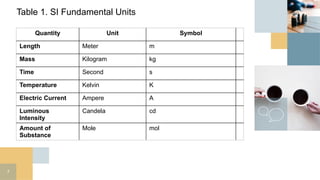
Quantity Unit Symbol
LengthMeter m
Mass Kilogram kg
Time Second s
Temperature Kelvin K
Electric Current Ampere A
Luminous
Intensity
Candela cd
Amount of
Substance
Mole mol
Table 1. SI Fundamental Units
8.
Accuracy versus Precision
Accuracy-the closeness of a measurement to the true/accepted value.
Precision-the closeness of results to others that have been obtained in
exactly the same way.
A B C D
Low accuracy, low
precision
Low accuracy, high
precision
High accuracy, low
precision
High accuracy, high
precision
9.
Sample Problems
The followingdartboards illustrate the types of errors often seen in measurements.
The bull’s-eye represents the actual value, and the darts represent the data.
(a) Which experiments yield the same average result?
(b) Which experiment(s) display(s) high precision?
(c) Which experiment(s) display(s) high accuracy?
(d) Which experiment(s) show(s) a systematic error?
(e) Which experiment(s) is both the least accurate and the least precise?
(f) Which experiment is both the most accurate and most precise?
Random versus SystematicErrors
Random/Indeterminate Errors
-results from the unpredictable/inevitable changes during data
measurement.
-affects the precision of measurements
ex:
■ electronic noise from an electrical device
■ slight variation of temperature when the volume of gas is being
measured
■ uncontrollable presence of wind when determining the period of
simple pendulum
12.
Systematic/Determinate Errors
-have adefinite value and assignable cause.
-affects the accuracy of measurements.
Types of Systematic Errors
Instrument Errors
-caused by imperfections in measuring devices and
instabilities in their components
Method Errors
-arise from non-ideal chemical/physical behaviour of
analytical systems.
Personal Errors
-result from the carelessness, inattention, or personal
limitations of the experiment.
13.
Classify whether thefollowing situations will result to
systematic or random error.
1. Air friction
2. Incorrect reading of a scale
3. Uncalibrated measurements
4. Non-uniformity of an object whose size is repeatedly
measured.
5. Effects caused by temperature variations.
6. Estimating the last decimal place in a measurement.
7. The measuring tape has been stretched.
8. Reading the volume of water in the graduated cylinder at
different angles.
13
14.
Sample Problems
Classify whetherthe following situations will result to systematic or random error.
1. One end of a meter stick is worn-out and measurements were taken from that
end.
2. Inter surface interaction gives rise to friction when the acceleration of a block of
wood is being measured. The surface is assumed to be frictionless.
3. Wind is present when the time for a simple pendulum to complete one back-
and-forth motion was measured.
4. The stopwatch runs slow because of low-battery power when the time for a
simple pendulum to complete one back-and-forth motion was taken.
5. The triple beam balance was not properly calibrated before getting the mass of
a beaker.
6. Clouds are present when the ultraviolet intensity from the sun was determined.
7. The contact between the thermometer and the body, whose temperature is to
be measured, is not consistent.
14
Editor's Notes
#2 Give situations where they have used the concept or process of measurement.
#5 Science involves experiments to support, refute or validate a hypothesis or a theory.
#8 Can a measurement be both precise and accurate?
#9 Systematic error affects the accuracy of measurements.
#11 What causes mistakes or errors in the measurement?







![Human Reproduction [ Reproductive System ] Notes @irfanullah_mehar Irfanullah...](https://cdn.slidesharecdn.com/ss_thumbnails/humanreproductionreproductivesystemnotesirfanullahmeharirfanullahmeharjanantantra-260111172350-56e85778-thumbnail.jpg?width=640&height=640&fit=bounds)


