Chapter 9: Measurement What is matter? a.  Anything that has mass (weight) and takes up space How do we describe matter? By its properties ( a way to describe matter) size, color, shape, hardness, taste, odor, visibility  (Can’t  measure these properties) Volume  Mass Temperature Can measure these properties
What are the three states of matter? a.  Solid- has a shape and takes up space b.  Liquid- takes up space but has no shape c.  Gas – has no shape and doesn’t take up space Changing States of Matter Simulation
 
III.  How do you measure length? Ruler, tape measure, odometer, metric system Centimeter- (cm) length of pinky finger tip; 100cm = 1m  book, pencil Meter- (m) slightly larger than yardstick; 1.  chalkboard, gym, room Kilometer- (km) – 1000m = 1km; smaller than mile 1.  To Florida, to Canton, to P&C a.  Millimeter (mm)- 1000mm =1m
 
V.  How do you measure the mass (amount of matter) of an object? a.  Balance Scale b. Grams (g) – 1000g = 1kg; 1 large paperclip 1.  popcorn, cucumber, you Kilograms (kg)- large objects 1.  truck, cow
 
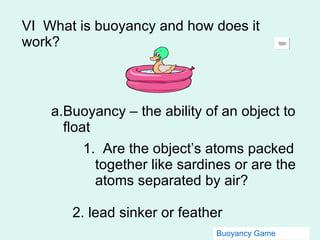
VI  What is buoyancy and how does it work? Buoyancy – the ability of an object to float 1.  Are the object’s atoms packed together like sardines or are the atoms separated by air? 2. lead sinker or feather Buoyancy Game
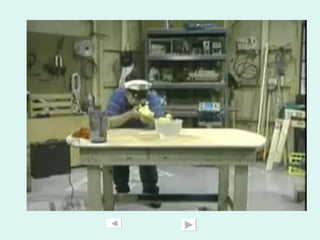
3.  The more dense (heavy) an object is the more likely it will sink
 
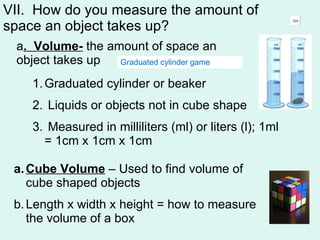
VII.  How do you measure the amount of space an object takes up? a .  Volume-  the amount of space an object takes up Graduated cylinder or beaker Liquids or objects not in cube shape Measured in milliliters (ml) or liters (l); 1ml = 1cm x 1cm x 1cm Cube Volume  – Used to find volume of cube shaped objects Length x width x height = how to measure the volume of a box Graduated cylinder game
 
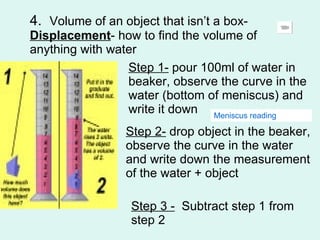
4.  Volume of an object that isn’t a box-  Displacement - how to find the volume of anything with water Step 1-  pour 100ml of water in beaker, observe the curve in the water (bottom of meniscus) and write it down Step 2-  drop object in the beaker, observe the curve in the water and write down the measurement of the water + object Step 3 -   Subtract step 1 from step 2 Meniscus reading
 

Measurement

  • 1.
    Chapter 9: MeasurementWhat is matter? a. Anything that has mass (weight) and takes up space How do we describe matter? By its properties ( a way to describe matter) size, color, shape, hardness, taste, odor, visibility (Can’t measure these properties) Volume Mass Temperature Can measure these properties
  • 2.
    What are thethree states of matter? a. Solid- has a shape and takes up space b. Liquid- takes up space but has no shape c. Gas – has no shape and doesn’t take up space Changing States of Matter Simulation
  • 3.
  • 4.
    III. Howdo you measure length? Ruler, tape measure, odometer, metric system Centimeter- (cm) length of pinky finger tip; 100cm = 1m book, pencil Meter- (m) slightly larger than yardstick; 1. chalkboard, gym, room Kilometer- (km) – 1000m = 1km; smaller than mile 1. To Florida, to Canton, to P&C a. Millimeter (mm)- 1000mm =1m
  • 5.
  • 6.
    V. Howdo you measure the mass (amount of matter) of an object? a. Balance Scale b. Grams (g) – 1000g = 1kg; 1 large paperclip 1. popcorn, cucumber, you Kilograms (kg)- large objects 1. truck, cow
  • 7.
  • 8.
    VI Whatis buoyancy and how does it work? Buoyancy – the ability of an object to float 1. Are the object’s atoms packed together like sardines or are the atoms separated by air? 2. lead sinker or feather Buoyancy Game
  • 9.
    3. Themore dense (heavy) an object is the more likely it will sink
  • 10.
  • 11.
    VII. Howdo you measure the amount of space an object takes up? a . Volume- the amount of space an object takes up Graduated cylinder or beaker Liquids or objects not in cube shape Measured in milliliters (ml) or liters (l); 1ml = 1cm x 1cm x 1cm Cube Volume – Used to find volume of cube shaped objects Length x width x height = how to measure the volume of a box Graduated cylinder game
  • 12.
  • 13.
    4. Volumeof an object that isn’t a box- Displacement - how to find the volume of anything with water Step 1- pour 100ml of water in beaker, observe the curve in the water (bottom of meniscus) and write it down Step 2- drop object in the beaker, observe the curve in the water and write down the measurement of the water + object Step 3 - Subtract step 1 from step 2 Meniscus reading
  • 14.