Measure What Matters
How Google, Bono, and the Gates Foundation Rock the World with OKRs
Book by John Doerr
Summarized by Angeli Recella
–Larry Page, Google Cofounder
“As much as I hate processes, good ideas with
great execution are how you make magic.
And that’s where OKRs come in.”
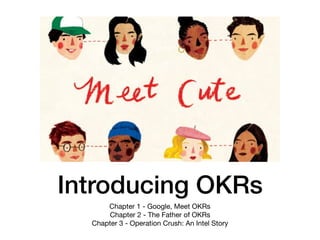
Introducing OKRs
Chapter 1 - Google, Meet OKRs

Chapter 2 - The Father of OKRs

Chapter 3 - Operation Crush: An Intel Story
–Yogi Berra
“If you don’t know where you’re going,
you might not get there.”
Quick Definitions
• OKRs - short for Objectives and Key Results; a
management methodology that helps to ensure that the
company focuses on efforts on the same important issues
throughout the organization.

• Objective - is “WHAT is to be achieved”, no more and no
less; significant, concrete, action-oriented, and (ideally)
inspirational

• Key Results - is “HOW we get to the objective”; specific
and time-bound, aggressive yet realistic, measurable and
verifiable
Things to Note
• Where an objective can be long-lived, rolled over for a
year or longer, key results evolve as the work progresses. 

• OKRs surface your primary goals. They channel

efforts and coordination. They link diverse operations,
lending purpose and unity to the entire organization.
Things to Note
• No single factor has more impact to employee
engagement than “clearly defined goals that are written
down and shared freely… Goals create alignment, clarity,
and job satisfaction.” 

• At smaller startups, where people absolutely need to
be pulling in the same direction, OKRs are a survival
tool.
Basic OKR Hygiene
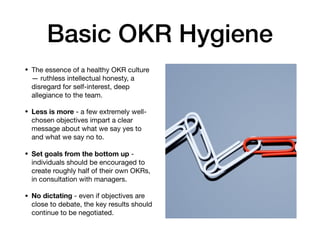
• The essence of a healthy OKR culture
— ruthless intellectual honesty, a
disregard for self-interest, deep
allegiance to the team.

• Less is more - a few extremely well-
chosen objectives impart a clear
message about what we say yes to
and what we say no to.

• Set goals from the bottom up -
individuals should be encouraged to
create roughly half of their own OKRs,
in consultation with managers.

• No dictating - even if objectives are
close to debate, the key results should
continue to be negotiated.
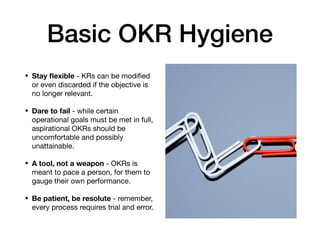
Basic OKR Hygiene
• Stay flexible - KRs can be modified
or even discarded if the objective is
no longer relevant.

• Dare to fail - while certain
operational goals must be met in full,
aspirational OKRs should be
uncomfortable and possibly
unattainable.

• A tool, not a weapon - OKRs is
meant to pace a person, for them to
gauge their own performance.

• Be patient, be resolute - remember,
every process requires trial and error.
–Andy Grove
“Bad companies are destroyed by crisis.
Good companies survive them.
Great companies are improved by them.”
Superpower #1
Focus and Commit to Priorities
Chapters 4 to 6
–J.K. Rowling
“It is our choices… that show what we truly are,
far more than our abilities.”
Successful organizations focus on
the handful of initiatives that can
make a real difference, deferring
less urgent ones.
What are our main priorities for this coming period?
Where should people be concentrating their efforts?
An effective goal-setting system
starts with disciplined thinking at the
top, with leaders who invest the time
and energy to choose what counts.
Communicate with Clarity
Leaders must get across the WHY as well
as the WHAT. Their people need more than
milestones for motivation. They are
thirsting for meaning, to understand how
their goals relate to the mission.
Clear-cut time frames intensify our
focus and commitment; nothing
moves us forward like a deadline.
Don’t allow the perfect to
be enemy of the good.
Completion of all key results must
result in an attainment of the
objective. If not, it’s not an OKR.
Superpower #2
Align and Connect for Teamwork
Chapters 7 to 9
–Steve Jobs
“We don’t hire smart people to tell them what to do.
We hire smart people so they can tell us what to
do.”
Research shows that public goals
are more likely to be attained than
goals held in private.
Why make OKRs Public:
• Meritocracy flourishes in sunlight. Critiques and
corrections are out in public view.

• Organizational poisons — suspicion, sandbagging,
politicking — lose their toxic power because OKRs makes
objectives objective, in black and white.

• Transparency seeds collaboration.
Companies with highly aligned
employees are more than twice
as likely to be top performers.
To avoid compulsive, soul-killing
over-alignment, healthy
organizations encourage some
goals to emerge from the bottom up.
Micromanagement is mismanagement.
A healthy OKR environment strikes a
balance between alignment and autonomy,
common purpose and creative latitude.
Connected companies are quicker
companies.
A transparent OKR system promotes
collaboration. When goals are visible to
all, a “team of teams” can attack
trouble spots wherever they surface.
OKRs are not islands.
To the contrary, they create networks to
connect an organization’s most vital work.
When employees align with a company’s
topline goals, their impact is amplified.
They stop duplicating efforts or working
counterproductively against the grain.
Superpower #3
Track for Accountability
Chapters 10 to 11
–W. Edwards Deming
“In God we trust; all others must bring data.”
Employees are most engaged when they
can actually see how their work
contributes to the company’s success.
OKRs speak to something more powerful,
the intrinsic value of the work itself.
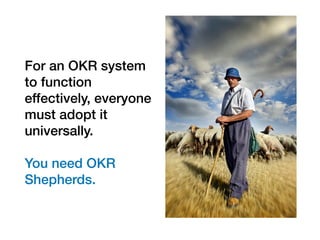
For an OKR system
to function
effectively, everyone
must adopt it
universally.
You need OKR
Shepherds.
Superpower #4
Stretch for Amazing
Chapters 12 to 13
–Mellody Hobson
“The biggest risk of all is not taking one.”
At Google, aspirational OKRs are set at 60
to 70 percent attainment. In other words,
performance is expected to fall short at
least 30 percent of the time. And that’s
considered success!
To succeed, a stretch goal cannot
seem like a long march to nowhere.
Stretch your team too far and too fast,
and it may snap.
In pursuing high-effort, high-risk goals,
employee commitment is essential.
Leaders must convey two things: the
importance of the outcome, and the
belief that it’s attainable.

Measure What Matters

  • 1.
    Measure What Matters HowGoogle, Bono, and the Gates Foundation Rock the World with OKRs Book by John Doerr Summarized by Angeli Recella
  • 2.
    –Larry Page, GoogleCofounder “As much as I hate processes, good ideas with great execution are how you make magic. And that’s where OKRs come in.”
  • 3.
    Introducing OKRs Chapter 1- Google, Meet OKRs Chapter 2 - The Father of OKRs Chapter 3 - Operation Crush: An Intel Story
  • 4.
    –Yogi Berra “If youdon’t know where you’re going, you might not get there.”
  • 5.
    Quick Definitions • OKRs- short for Objectives and Key Results; a management methodology that helps to ensure that the company focuses on efforts on the same important issues throughout the organization. • Objective - is “WHAT is to be achieved”, no more and no less; significant, concrete, action-oriented, and (ideally) inspirational • Key Results - is “HOW we get to the objective”; specific and time-bound, aggressive yet realistic, measurable and verifiable
  • 6.
    Things to Note •Where an objective can be long-lived, rolled over for a year or longer, key results evolve as the work progresses. • OKRs surface your primary goals. They channel efforts and coordination. They link diverse operations, lending purpose and unity to the entire organization.
  • 7.
    Things to Note •No single factor has more impact to employee engagement than “clearly defined goals that are written down and shared freely… Goals create alignment, clarity, and job satisfaction.” • At smaller startups, where people absolutely need to be pulling in the same direction, OKRs are a survival tool.
  • 8.
    Basic OKR Hygiene •The essence of a healthy OKR culture — ruthless intellectual honesty, a disregard for self-interest, deep allegiance to the team. • Less is more - a few extremely well- chosen objectives impart a clear message about what we say yes to and what we say no to. • Set goals from the bottom up - individuals should be encouraged to create roughly half of their own OKRs, in consultation with managers. • No dictating - even if objectives are close to debate, the key results should continue to be negotiated.
  • 9.
    Basic OKR Hygiene •Stay flexible - KRs can be modified or even discarded if the objective is no longer relevant. • Dare to fail - while certain operational goals must be met in full, aspirational OKRs should be uncomfortable and possibly unattainable. • A tool, not a weapon - OKRs is meant to pace a person, for them to gauge their own performance. • Be patient, be resolute - remember, every process requires trial and error.
  • 10.
    –Andy Grove “Bad companiesare destroyed by crisis. Good companies survive them. Great companies are improved by them.”
  • 11.
    Superpower #1 Focus andCommit to Priorities Chapters 4 to 6
  • 12.
    –J.K. Rowling “It isour choices… that show what we truly are, far more than our abilities.”
  • 13.
    Successful organizations focuson the handful of initiatives that can make a real difference, deferring less urgent ones.
  • 14.
    What are ourmain priorities for this coming period? Where should people be concentrating their efforts? An effective goal-setting system starts with disciplined thinking at the top, with leaders who invest the time and energy to choose what counts.
  • 15.
    Communicate with Clarity Leadersmust get across the WHY as well as the WHAT. Their people need more than milestones for motivation. They are thirsting for meaning, to understand how their goals relate to the mission.
  • 16.
    Clear-cut time framesintensify our focus and commitment; nothing moves us forward like a deadline.
  • 17.
    Don’t allow theperfect to be enemy of the good.
  • 18.
    Completion of allkey results must result in an attainment of the objective. If not, it’s not an OKR.
  • 19.
    Superpower #2 Align andConnect for Teamwork Chapters 7 to 9
  • 20.
    –Steve Jobs “We don’thire smart people to tell them what to do. We hire smart people so they can tell us what to do.”
  • 21.
    Research shows thatpublic goals are more likely to be attained than goals held in private.
  • 22.
    Why make OKRsPublic: • Meritocracy flourishes in sunlight. Critiques and corrections are out in public view. • Organizational poisons — suspicion, sandbagging, politicking — lose their toxic power because OKRs makes objectives objective, in black and white. • Transparency seeds collaboration.
  • 23.
    Companies with highlyaligned employees are more than twice as likely to be top performers.
  • 24.
    To avoid compulsive,soul-killing over-alignment, healthy organizations encourage some goals to emerge from the bottom up.
  • 25.
    Micromanagement is mismanagement. Ahealthy OKR environment strikes a balance between alignment and autonomy, common purpose and creative latitude.
  • 26.
    Connected companies arequicker companies. A transparent OKR system promotes collaboration. When goals are visible to all, a “team of teams” can attack trouble spots wherever they surface.
  • 27.
    OKRs are notislands. To the contrary, they create networks to connect an organization’s most vital work. When employees align with a company’s topline goals, their impact is amplified. They stop duplicating efforts or working counterproductively against the grain.
  • 28.
    Superpower #3 Track forAccountability Chapters 10 to 11
  • 29.
    –W. Edwards Deming “InGod we trust; all others must bring data.”
  • 30.
    Employees are mostengaged when they can actually see how their work contributes to the company’s success. OKRs speak to something more powerful, the intrinsic value of the work itself.
  • 31.
    For an OKRsystem to function effectively, everyone must adopt it universally. You need OKR Shepherds.
  • 32.
    Superpower #4 Stretch forAmazing Chapters 12 to 13
  • 33.
    –Mellody Hobson “The biggestrisk of all is not taking one.”
  • 34.
    At Google, aspirationalOKRs are set at 60 to 70 percent attainment. In other words, performance is expected to fall short at least 30 percent of the time. And that’s considered success!
  • 35.
    To succeed, astretch goal cannot seem like a long march to nowhere. Stretch your team too far and too fast, and it may snap. In pursuing high-effort, high-risk goals, employee commitment is essential. Leaders must convey two things: the importance of the outcome, and the belief that it’s attainable.