
This document is confidential and contains proprietary information, including trade secrets of CitiusTech. Neither the document nor any of the information
contained in it may be reproduced or disclosed to any unauthorized person under any circumstances without the express written permission of CitiusTech.
Quality & Outcomes Framework (QOF)
02 November, 2017 | Author: Guhan S | Healthcare Business Analyst
CitiusTech Thought
Leadership
22
Objectives
Note: Indicators, payment system and other details mentioned in this document are applicable
for QOF in England, UK only
Objective of the Document
This document about Quality and Outcome Framework (QOF) aims to give overview of:
 The practice of QOF in England
 The key changes for 2017/18
 Domains and underlying indicators
 Process of reward payments, its types of payments and calculation methods and
 Exception reporting
Key Stakeholders
This document will give broad understanding of QOF for:
 Health IT vendors
 General Practitioners
 CCGs and other healthcare providers
 The document also lists down the direct impact on Healthcare IT
33
 Overview of QOF
 Domains of QOF
 Process Flow of Reward Payments
 Data Extraction & Achievement Scoring
 Payment Methods and its Calculations
 Criteria of Exception Reporting
 Challenges in using QOF Data
 Highlights
 References
Agenda
44
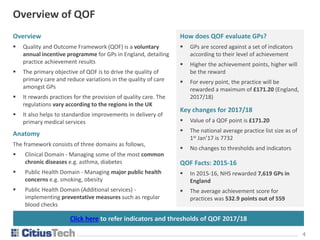
How does QOF evaluate GPs?
 GPs are scored against a set of indicators
according to their level of achievement
 Higher the achievement points, higher will
be the reward
 For every point, the practice will be
rewarded a maximum of £171.20 (England,
2017/18)
Anatomy
The framework consists of three domains as follows,
 Clinical Domain - Managing some of the most common
chronic diseases e.g. asthma, diabetes
 Public Health Domain - Managing major public health
concerns e.g. smoking, obesity
 Public Health Domain (Additional services) -
implementing preventative measures such as regular
blood checks
Click here to refer indicators and thresholds of QOF 2017/18
Overview
 Quality and Outcome Framework (QOF) is a voluntary
annual incentive programme for GPs in England, detailing
practice achievement results
 The primary objective of QOF is to drive the quality of
primary care and reduce variations in the quality of care
amongst GPs
 It rewards practices for the provision of quality care. The
regulations vary according to the regions in the UK
 It also helps to standardize improvements in delivery of
primary medical services
Overview of QOF
Key changes for 2017/18
 Value of a QOF point is £171.20
 The national average practice list size as of
1st Jan’17 is 7732
 No changes to thresholds and indicators
QOF Facts: 2015-16
 In 2015-16, NHS rewarded 7,619 GPs in
England
 The average achievement score for
practices was 532.9 points out of 559
55
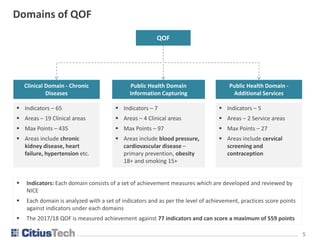
Domains of QOF
Clinical Domain - Chronic
Diseases
 Indicators – 65
 Areas – 19 Clinical areas
 Max Points – 435
 Areas include chronic
kidney disease, heart
failure, hypertension etc.
Public Health Domain
Information Capturing
 Indicators – 7
 Areas – 4 Clinical areas
 Max Points – 97
 Areas include blood pressure,
cardiovascular disease –
primary prevention, obesity
18+ and smoking 15+
Public Health Domain -
Additional Services
 Indicators – 5
 Areas – 2 Service areas
 Max Points – 27
 Areas include cervical
screening and
contraception
QOF
 Indicators: Each domain consists of a set of achievement measures which are developed and reviewed by
NICE
 Each domain is analyzed with a set of indicators and as per the level of achievement, practices score points
against indicators under each domains
 The 2017/18 QOF is measured achievement against 77 indicators and can score a maximum of 559 points
66
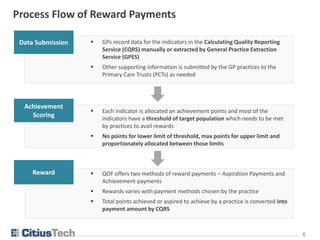
Data Submission  GPs record data for the indicators in the Calculating Quality Reporting
Service (CQRS) manually or extracted by General Practice Extraction
Service (GPES)
 Other supporting information is submitted by the GP practices to the
Primary Care Trusts (PCTs) as needed
Achievement
Scoring
 Each indicator is allocated an achievement points and most of the
indicators have a threshold of target population which needs to be met
by practices to avail rewards
 No points for lower limit of threshold, max points for upper limit and
proportionately allocated between those limits
Reward  QOF offers two methods of reward payments – Aspiration Payments and
Achievement payments
 Rewards varies with payment methods chosen by the practice
 Total points achieved or aspired to achieve by a practice is converted into
payment amount by CQRS
Process Flow of Reward Payments
77
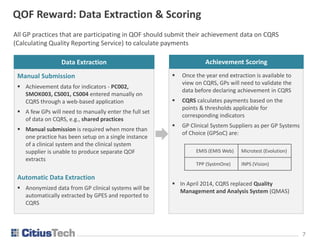
QOF Reward: Data Extraction & Scoring
Manual Submission
 Achievement data for indicators - PC002,
SMOK003, CS001, CS004 entered manually on
CQRS through a web-based application
 A few GPs will need to manually enter the full set
of data on CQRS, e.g., shared practices
 Manual submission is required when more than
one practice has been setup on a single instance
of a clinical system and the clinical system
supplier is unable to produce separate QOF
extracts
Automatic Data Extraction
 Anonymized data from GP clinical systems will be
automatically extracted by GPES and reported to
CQRS
 Once the year end extraction is available to
view on CQRS, GPs will need to validate the
data before declaring achievement in CQRS
 CQRS calculates payments based on the
points & thresholds applicable for
corresponding indicators
 GP Clinical System Suppliers as per GP Systems
of Choice (GPSoC) are:
 In April 2014, CQRS replaced Quality
Management and Analysis System (QMAS)
Data Extraction Achievement Scoring
EMIS (EMIS Web) Microtest (Evolution)
TPP (SystmOne) INPS (Vision)
All GP practices that are participating in QOF should submit their achievement data on CQRS
(Calculating Quality Reporting Service) to calculate payments
88
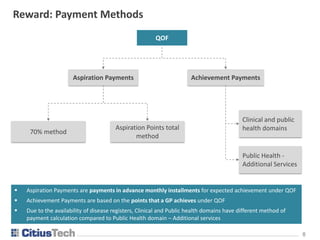
Reward: Payment Methods
QOF
Aspiration Payments
70% method
Achievement Payments
Clinical and public
health domainsAspiration Points total
method
Public Health -
Additional Services
 Aspiration Payments are payments in advance monthly installments for expected achievement under QOF
 Achievement Payments are based on the points that a GP achieves under QOF
 Due to the availability of disease registers, Clinical and Public health domains have different method of
payment calculation compared to Public Health domain – Additional services
99
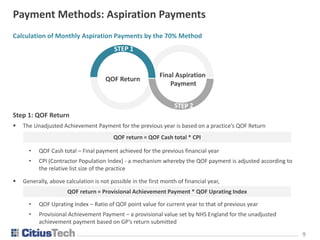
Payment Methods: Aspiration Payments
Calculation of Monthly Aspiration Payments by the 70% Method
Step 1: QOF Return
 The Unadjusted Achievement Payment for the previous year is based on a practice’s QOF Return
• QOF Cash total – Final payment achieved for the previous financial year
• CPI (Contractor Population Index) - a mechanism whereby the QOF payment is adjusted according to
the relative list size of the practice
 Generally, above calculation is not possible in the first month of financial year,
• QOF Uprating Index – Ratio of QOF point value for current year to that of previous year
• Provisional Achievement Payment – a provisional value set by NHS England for the unadjusted
achievement payment based on GP’s return submitted
QOF return = Provisional Achievement Payment * QOF Uprating Index
QOF return = QOF Cash total * CPI
QOF Return
Final Aspiration
Payment
1010
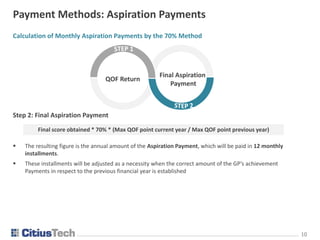
Payment Methods: Aspiration Payments
Calculation of Monthly Aspiration Payments by the 70% Method
Step 2: Final Aspiration Payment
 The resulting figure is the annual amount of the Aspiration Payment, which will be paid in 12 monthly
installments.
 These installments will be adjusted as a necessity when the correct amount of the GP’s achievement
Payments in respect to the previous financial year is established
Final score obtained * 70% * (Max QOF point current year / Max QOF point previous year)
QOF Return
Final Aspiration
Payment
1111
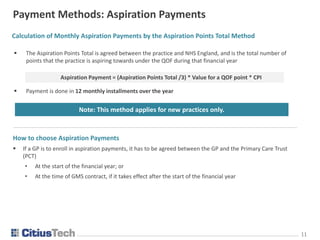
Payment Methods: Aspiration Payments
Calculation of Monthly Aspiration Payments by the Aspiration Points Total Method
 The Aspiration Points Total is agreed between the practice and NHS England, and is the total number of
points that the practice is aspiring towards under the QOF during that financial year
 Payment is done in 12 monthly installments over the year
Note: This method applies for new practices only.
Aspiration Payment = (Aspiration Points Total /3) * Value for a QOF point * CPI
How to choose Aspiration Payments
 If a GP is to enroll in aspiration payments, it has to be agreed between the GP and the Primary Care Trust
(PCT)
• At the start of the financial year; or
• At the time of GMS contract, if it takes effect after the start of the financial year
1212
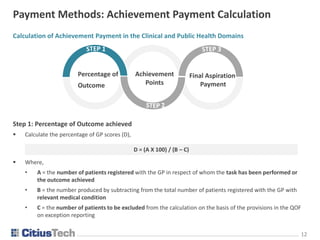
Calculation of Achievement Payment in the Clinical and Public Health Domains
Step 1: Percentage of Outcome achieved
 Calculate the percentage of GP scores (D),
 Where,
• A = the number of patients registered with the GP in respect of whom the task has been performed or
the outcome achieved
• B = the number produced by subtracting from the total number of patients registered with the GP with
relevant medical condition
• C = the number of patients to be excluded from the calculation on the basis of the provisions in the QOF
on exception reporting
D = (A X 100) / (B – C)
Payment Methods: Achievement Payment Calculation
Final Aspiration
Payment
Percentage of
Outcome
Achievement
Points
1313
Calculation of Achievement Payment in the Clinical and Public Health Domains
Step 2: Achievement Points
 Calculate the number of points which the practice is entitled to in relation to that indicator
 Where,
• E = minimum percentage score set for that indicator (lower threshold)
• F = maximum percentage score set for that indicator (upper threshold)
• G = total number of points available in relation to that indicator
Achievement points = [(D – E) / (F – E)] X G
Payment Methods: Achievement Payment Calculation
Final Aspiration
Payment
Percentage of
Outcome
Achievement
Points
1414
Calculation of Achievement Payment in the Clinical and Public Health Domains
Step 3: Final Achievement Payments
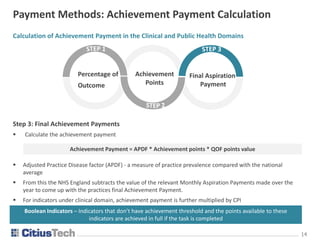
 Calculate the achievement payment
 Adjusted Practice Disease factor (APDF) - a measure of practice prevalence compared with the national
average
 From this the NHS England subtracts the value of the relevant Monthly Aspiration Payments made over the
year to come up with the practices final Achievement Payment.
 For indicators under clinical domain, achievement payment is further multiplied by CPI
Achievement Payment = APDF * Achievement points * QOF points value
Payment Methods: Achievement Payment Calculation
Final Aspiration
Payment
Percentage of
Outcome
Achievement
Points
Boolean Indicators – Indicators that don’t have achievement threshold and the points available to these
indicators are achieved in full if the task is completed
1515
Calculation of Achievement Payment in the Public Health - Additional Services Domain
Step 1: Population Outcome = Practice's relevant target population/GPs registered list size
Step 2: Target Population Factor = Population Outcome / [Avg no of patients registered with all practices in the
relevant target population / Avg of all practices registered list sizes]
Step3: Achievement payment = Target population factor * QOF points value * Achievement points * CPI
Payment Methods: Achievement Payment Calculation
Achievement
Payment
Total Population
Factor
Population
Outcome
 Indicators under public health – additional services do not apply to all of the GP’s registered population
and the achievement points will be paid if the service is offered to the relevant target population
 Some indicators such as CS002 and CON003 have achievement thresholds, and the method for calculating
achievement points is same as that for this type of indicator in the clinical domain and others are Boolean
indicators
1616
Criteria of Exception Reporting
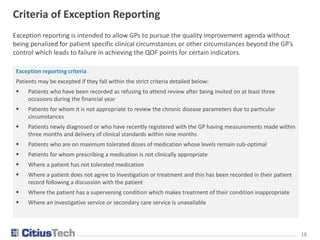
Exception reporting is intended to allow GPs to pursue the quality improvement agenda without
being penalized for patient specific clinical circumstances or other circumstances beyond the GP’s
control which leads to failure in achieving the QOF points for certain indicators.
Exception reporting criteria
Patients may be excepted if they fall within the strict criteria detailed below:
 Patients who have been recorded as refusing to attend review after being invited on at least three
occasions during the financial year
 Patients for whom it is not appropriate to review the chronic disease parameters due to particular
circumstances
 Patients newly diagnosed or who have recently registered with the GP having measurements made within
three months and delivery of clinical standards within nine months
 Patients who are on maximum tolerated doses of medication whose levels remain sub-optimal
 Patients for whom prescribing a medication is not clinically appropriate
 Where a patient has not tolerated medication
 Where a patient does not agree to investigation or treatment and this has been recorded in their patient
record following a discussion with the patient
 Where the patient has a supervening condition which makes treatment of their condition inappropriate
 Where an investigative service or secondary care service is unavailable
1717
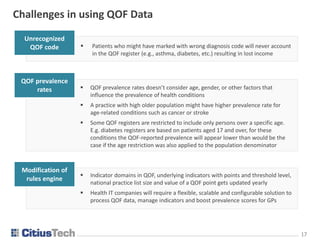
Unrecognized
QOF code
QOF prevalence
rates  QOF prevalence rates doesn’t consider age, gender, or other factors that
influence the prevalence of health conditions
 A practice with high older population might have higher prevalence rate for
age-related conditions such as cancer or stroke
 Some QOF registers are restricted to include only persons over a specific age.
E.g. diabetes registers are based on patients aged 17 and over, for these
conditions the QOF-reported prevalence will appear lower than would be the
case if the age restriction was also applied to the population denominator
Modification of
rules engine
 Indicator domains in QOF, underlying indicators with points and threshold level,
national practice list size and value of a QOF point gets updated yearly
 Health IT companies will require a flexible, scalable and configurable solution to
process QOF data, manage indicators and boost prevalence scores for GPs
Challenges in using QOF Data
 Patients who might have marked with wrong diagnosis code will never account
in the QOF register (e.g., asthma, diabetes, etc.) resulting in lost income
1818
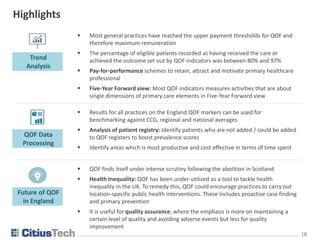
 Results for all practices on the England QOF markers can be used for
benchmarking against CCG, regional and national averages
 Analysis of patient registry: Identify patients who are not added / could be added
to QOF registers to boost prevalence scores
 Identify areas which is most productive and cost effective in terms of time spent
QOF Data
Processing
Highlights
 Most general practices have reached the upper payment thresholds for QOF and
therefore maximum remuneration
 The percentage of eligible patients recorded as having received the care or
achieved the outcome set out by QOF indicators was between 80% and 97%
 Pay-for-performance schemes to retain, attract and motivate primary healthcare
professional
 Five-Year Forward view: Most QOF indicators measures activities that are about
single dimensions of primary care elements in Five-Year Forward view
Trend
Analysis
 QOF finds itself under intense scrutiny following the abolition in Scotland
 Health Inequality: QOF has been under-utilized as a tool to tackle health
inequality in the UK. To remedy this, QOF could encourage practices to carry out
location-specific public health interventions. These includes proactive case finding
and primary prevention
 It is useful for quality assurance, where the emphasis is more on maintaining a
certain level of quality and avoiding adverse events but less for quality
improvement
Future of QOF
in England
1919
References
 http://content.digital.nhs.uk/qof
 https://www.bma.org.uk/-
/media/files/pdfs/practical%20advice%20at%20work/contracts/independent%20contractors/qof
%20guidance/focusonqofpaymentsnov2013.pdf
 http://www.nhsemployers.org/~/media/Employers/Documents/Primary%20care%20contracts/Q
OF/2016-17/2016-17%20QOF%20guidance%20documents.pdf
 http://www.content.digital.nhs.uk/catalogue/PUB22266/qof-1516-anx3-dq-faq.pdf
 https://www.ncbi.nlm.nih.gov/pmc/articles/PMC5330348/
 https://chpi.org.uk/blog/future-qof-primary-care-lessons-diabetes-story-2/
 http://blogs.lshtm.ac.uk/prucomm/files/2017/02/Review-of-QOF-21st-December-2016.pdf
 http://www.isdscotland.org/Health-Topics/General-Practice/Quality-And-Outcomes-
Framework/Information-for-users-of-QOF-register-and-prevalence-data.asp
2020
Thank You
Author:
Guhan S
Healthcare Business Analyst
thoughtleaders@citiustech.com
About CitiusTech
2,700+
Healthcare IT professionals worldwide
1,200+
Healthcare software engineering
700+
HL7 certified professionals
30%+
CAGR over last 5 years
80+
Healthcare customers
 Healthcare technology companies
 Hospitals, IDNs & medical groups
 Payers and health plans
 ACO, MCO, HIE, HIX, NHIN and RHIO
 Pharma & Life Sciences companies

Quality & Outcomes Framework (QOF)

  • 1.
    This document isconfidential and contains proprietary information, including trade secrets of CitiusTech. Neither the document nor any of the information contained in it may be reproduced or disclosed to any unauthorized person under any circumstances without the express written permission of CitiusTech. Quality & Outcomes Framework (QOF) 02 November, 2017 | Author: Guhan S | Healthcare Business Analyst CitiusTech Thought Leadership
  • 2.
    22 Objectives Note: Indicators, paymentsystem and other details mentioned in this document are applicable for QOF in England, UK only Objective of the Document This document about Quality and Outcome Framework (QOF) aims to give overview of:  The practice of QOF in England  The key changes for 2017/18  Domains and underlying indicators  Process of reward payments, its types of payments and calculation methods and  Exception reporting Key Stakeholders This document will give broad understanding of QOF for:  Health IT vendors  General Practitioners  CCGs and other healthcare providers  The document also lists down the direct impact on Healthcare IT
  • 3.
    33  Overview ofQOF  Domains of QOF  Process Flow of Reward Payments  Data Extraction & Achievement Scoring  Payment Methods and its Calculations  Criteria of Exception Reporting  Challenges in using QOF Data  Highlights  References Agenda
  • 4.
    44 How does QOFevaluate GPs?  GPs are scored against a set of indicators according to their level of achievement  Higher the achievement points, higher will be the reward  For every point, the practice will be rewarded a maximum of £171.20 (England, 2017/18) Anatomy The framework consists of three domains as follows,  Clinical Domain - Managing some of the most common chronic diseases e.g. asthma, diabetes  Public Health Domain - Managing major public health concerns e.g. smoking, obesity  Public Health Domain (Additional services) - implementing preventative measures such as regular blood checks Click here to refer indicators and thresholds of QOF 2017/18 Overview  Quality and Outcome Framework (QOF) is a voluntary annual incentive programme for GPs in England, detailing practice achievement results  The primary objective of QOF is to drive the quality of primary care and reduce variations in the quality of care amongst GPs  It rewards practices for the provision of quality care. The regulations vary according to the regions in the UK  It also helps to standardize improvements in delivery of primary medical services Overview of QOF Key changes for 2017/18  Value of a QOF point is £171.20  The national average practice list size as of 1st Jan’17 is 7732  No changes to thresholds and indicators QOF Facts: 2015-16  In 2015-16, NHS rewarded 7,619 GPs in England  The average achievement score for practices was 532.9 points out of 559
  • 5.
    55 Domains of QOF ClinicalDomain - Chronic Diseases  Indicators – 65  Areas – 19 Clinical areas  Max Points – 435  Areas include chronic kidney disease, heart failure, hypertension etc. Public Health Domain Information Capturing  Indicators – 7  Areas – 4 Clinical areas  Max Points – 97  Areas include blood pressure, cardiovascular disease – primary prevention, obesity 18+ and smoking 15+ Public Health Domain - Additional Services  Indicators – 5  Areas – 2 Service areas  Max Points – 27  Areas include cervical screening and contraception QOF  Indicators: Each domain consists of a set of achievement measures which are developed and reviewed by NICE  Each domain is analyzed with a set of indicators and as per the level of achievement, practices score points against indicators under each domains  The 2017/18 QOF is measured achievement against 77 indicators and can score a maximum of 559 points
  • 6.
    66 Data Submission GPs record data for the indicators in the Calculating Quality Reporting Service (CQRS) manually or extracted by General Practice Extraction Service (GPES)  Other supporting information is submitted by the GP practices to the Primary Care Trusts (PCTs) as needed Achievement Scoring  Each indicator is allocated an achievement points and most of the indicators have a threshold of target population which needs to be met by practices to avail rewards  No points for lower limit of threshold, max points for upper limit and proportionately allocated between those limits Reward  QOF offers two methods of reward payments – Aspiration Payments and Achievement payments  Rewards varies with payment methods chosen by the practice  Total points achieved or aspired to achieve by a practice is converted into payment amount by CQRS Process Flow of Reward Payments
  • 7.
    77 QOF Reward: DataExtraction & Scoring Manual Submission  Achievement data for indicators - PC002, SMOK003, CS001, CS004 entered manually on CQRS through a web-based application  A few GPs will need to manually enter the full set of data on CQRS, e.g., shared practices  Manual submission is required when more than one practice has been setup on a single instance of a clinical system and the clinical system supplier is unable to produce separate QOF extracts Automatic Data Extraction  Anonymized data from GP clinical systems will be automatically extracted by GPES and reported to CQRS  Once the year end extraction is available to view on CQRS, GPs will need to validate the data before declaring achievement in CQRS  CQRS calculates payments based on the points & thresholds applicable for corresponding indicators  GP Clinical System Suppliers as per GP Systems of Choice (GPSoC) are:  In April 2014, CQRS replaced Quality Management and Analysis System (QMAS) Data Extraction Achievement Scoring EMIS (EMIS Web) Microtest (Evolution) TPP (SystmOne) INPS (Vision) All GP practices that are participating in QOF should submit their achievement data on CQRS (Calculating Quality Reporting Service) to calculate payments
  • 8.
    88 Reward: Payment Methods QOF AspirationPayments 70% method Achievement Payments Clinical and public health domainsAspiration Points total method Public Health - Additional Services  Aspiration Payments are payments in advance monthly installments for expected achievement under QOF  Achievement Payments are based on the points that a GP achieves under QOF  Due to the availability of disease registers, Clinical and Public health domains have different method of payment calculation compared to Public Health domain – Additional services
  • 9.
    99 Payment Methods: AspirationPayments Calculation of Monthly Aspiration Payments by the 70% Method Step 1: QOF Return  The Unadjusted Achievement Payment for the previous year is based on a practice’s QOF Return • QOF Cash total – Final payment achieved for the previous financial year • CPI (Contractor Population Index) - a mechanism whereby the QOF payment is adjusted according to the relative list size of the practice  Generally, above calculation is not possible in the first month of financial year, • QOF Uprating Index – Ratio of QOF point value for current year to that of previous year • Provisional Achievement Payment – a provisional value set by NHS England for the unadjusted achievement payment based on GP’s return submitted QOF return = Provisional Achievement Payment * QOF Uprating Index QOF return = QOF Cash total * CPI QOF Return Final Aspiration Payment
  • 10.
    1010 Payment Methods: AspirationPayments Calculation of Monthly Aspiration Payments by the 70% Method Step 2: Final Aspiration Payment  The resulting figure is the annual amount of the Aspiration Payment, which will be paid in 12 monthly installments.  These installments will be adjusted as a necessity when the correct amount of the GP’s achievement Payments in respect to the previous financial year is established Final score obtained * 70% * (Max QOF point current year / Max QOF point previous year) QOF Return Final Aspiration Payment
  • 11.
    1111 Payment Methods: AspirationPayments Calculation of Monthly Aspiration Payments by the Aspiration Points Total Method  The Aspiration Points Total is agreed between the practice and NHS England, and is the total number of points that the practice is aspiring towards under the QOF during that financial year  Payment is done in 12 monthly installments over the year Note: This method applies for new practices only. Aspiration Payment = (Aspiration Points Total /3) * Value for a QOF point * CPI How to choose Aspiration Payments  If a GP is to enroll in aspiration payments, it has to be agreed between the GP and the Primary Care Trust (PCT) • At the start of the financial year; or • At the time of GMS contract, if it takes effect after the start of the financial year
  • 12.
    1212 Calculation of AchievementPayment in the Clinical and Public Health Domains Step 1: Percentage of Outcome achieved  Calculate the percentage of GP scores (D),  Where, • A = the number of patients registered with the GP in respect of whom the task has been performed or the outcome achieved • B = the number produced by subtracting from the total number of patients registered with the GP with relevant medical condition • C = the number of patients to be excluded from the calculation on the basis of the provisions in the QOF on exception reporting D = (A X 100) / (B – C) Payment Methods: Achievement Payment Calculation Final Aspiration Payment Percentage of Outcome Achievement Points
  • 13.
    1313 Calculation of AchievementPayment in the Clinical and Public Health Domains Step 2: Achievement Points  Calculate the number of points which the practice is entitled to in relation to that indicator  Where, • E = minimum percentage score set for that indicator (lower threshold) • F = maximum percentage score set for that indicator (upper threshold) • G = total number of points available in relation to that indicator Achievement points = [(D – E) / (F – E)] X G Payment Methods: Achievement Payment Calculation Final Aspiration Payment Percentage of Outcome Achievement Points
  • 14.
    1414 Calculation of AchievementPayment in the Clinical and Public Health Domains Step 3: Final Achievement Payments  Calculate the achievement payment  Adjusted Practice Disease factor (APDF) - a measure of practice prevalence compared with the national average  From this the NHS England subtracts the value of the relevant Monthly Aspiration Payments made over the year to come up with the practices final Achievement Payment.  For indicators under clinical domain, achievement payment is further multiplied by CPI Achievement Payment = APDF * Achievement points * QOF points value Payment Methods: Achievement Payment Calculation Final Aspiration Payment Percentage of Outcome Achievement Points Boolean Indicators – Indicators that don’t have achievement threshold and the points available to these indicators are achieved in full if the task is completed
  • 15.
    1515 Calculation of AchievementPayment in the Public Health - Additional Services Domain Step 1: Population Outcome = Practice's relevant target population/GPs registered list size Step 2: Target Population Factor = Population Outcome / [Avg no of patients registered with all practices in the relevant target population / Avg of all practices registered list sizes] Step3: Achievement payment = Target population factor * QOF points value * Achievement points * CPI Payment Methods: Achievement Payment Calculation Achievement Payment Total Population Factor Population Outcome  Indicators under public health – additional services do not apply to all of the GP’s registered population and the achievement points will be paid if the service is offered to the relevant target population  Some indicators such as CS002 and CON003 have achievement thresholds, and the method for calculating achievement points is same as that for this type of indicator in the clinical domain and others are Boolean indicators
  • 16.
    1616 Criteria of ExceptionReporting Exception reporting is intended to allow GPs to pursue the quality improvement agenda without being penalized for patient specific clinical circumstances or other circumstances beyond the GP’s control which leads to failure in achieving the QOF points for certain indicators. Exception reporting criteria Patients may be excepted if they fall within the strict criteria detailed below:  Patients who have been recorded as refusing to attend review after being invited on at least three occasions during the financial year  Patients for whom it is not appropriate to review the chronic disease parameters due to particular circumstances  Patients newly diagnosed or who have recently registered with the GP having measurements made within three months and delivery of clinical standards within nine months  Patients who are on maximum tolerated doses of medication whose levels remain sub-optimal  Patients for whom prescribing a medication is not clinically appropriate  Where a patient has not tolerated medication  Where a patient does not agree to investigation or treatment and this has been recorded in their patient record following a discussion with the patient  Where the patient has a supervening condition which makes treatment of their condition inappropriate  Where an investigative service or secondary care service is unavailable
  • 17.
    1717 Unrecognized QOF code QOF prevalence rates QOF prevalence rates doesn’t consider age, gender, or other factors that influence the prevalence of health conditions  A practice with high older population might have higher prevalence rate for age-related conditions such as cancer or stroke  Some QOF registers are restricted to include only persons over a specific age. E.g. diabetes registers are based on patients aged 17 and over, for these conditions the QOF-reported prevalence will appear lower than would be the case if the age restriction was also applied to the population denominator Modification of rules engine  Indicator domains in QOF, underlying indicators with points and threshold level, national practice list size and value of a QOF point gets updated yearly  Health IT companies will require a flexible, scalable and configurable solution to process QOF data, manage indicators and boost prevalence scores for GPs Challenges in using QOF Data  Patients who might have marked with wrong diagnosis code will never account in the QOF register (e.g., asthma, diabetes, etc.) resulting in lost income
  • 18.
    1818  Results forall practices on the England QOF markers can be used for benchmarking against CCG, regional and national averages  Analysis of patient registry: Identify patients who are not added / could be added to QOF registers to boost prevalence scores  Identify areas which is most productive and cost effective in terms of time spent QOF Data Processing Highlights  Most general practices have reached the upper payment thresholds for QOF and therefore maximum remuneration  The percentage of eligible patients recorded as having received the care or achieved the outcome set out by QOF indicators was between 80% and 97%  Pay-for-performance schemes to retain, attract and motivate primary healthcare professional  Five-Year Forward view: Most QOF indicators measures activities that are about single dimensions of primary care elements in Five-Year Forward view Trend Analysis  QOF finds itself under intense scrutiny following the abolition in Scotland  Health Inequality: QOF has been under-utilized as a tool to tackle health inequality in the UK. To remedy this, QOF could encourage practices to carry out location-specific public health interventions. These includes proactive case finding and primary prevention  It is useful for quality assurance, where the emphasis is more on maintaining a certain level of quality and avoiding adverse events but less for quality improvement Future of QOF in England
  • 19.
    1919 References  http://content.digital.nhs.uk/qof  https://www.bma.org.uk/- /media/files/pdfs/practical%20advice%20at%20work/contracts/independent%20contractors/qof %20guidance/focusonqofpaymentsnov2013.pdf http://www.nhsemployers.org/~/media/Employers/Documents/Primary%20care%20contracts/Q OF/2016-17/2016-17%20QOF%20guidance%20documents.pdf  http://www.content.digital.nhs.uk/catalogue/PUB22266/qof-1516-anx3-dq-faq.pdf  https://www.ncbi.nlm.nih.gov/pmc/articles/PMC5330348/  https://chpi.org.uk/blog/future-qof-primary-care-lessons-diabetes-story-2/  http://blogs.lshtm.ac.uk/prucomm/files/2017/02/Review-of-QOF-21st-December-2016.pdf  http://www.isdscotland.org/Health-Topics/General-Practice/Quality-And-Outcomes- Framework/Information-for-users-of-QOF-register-and-prevalence-data.asp
  • 20.
    2020 Thank You Author: Guhan S HealthcareBusiness Analyst thoughtleaders@citiustech.com About CitiusTech 2,700+ Healthcare IT professionals worldwide 1,200+ Healthcare software engineering 700+ HL7 certified professionals 30%+ CAGR over last 5 years 80+ Healthcare customers  Healthcare technology companies  Hospitals, IDNs & medical groups  Payers and health plans  ACO, MCO, HIE, HIX, NHIN and RHIO  Pharma & Life Sciences companies