



Electronic Health Records Initiative Understanding the  American Recovery and Reinvestment Act and it’s Impact
Overview The ARRA recently signed into law in February 2009 includes incentives for physician practices and hospitals to implement and demonstrate “ meaningful use ” of a  qualified  electronic health records system (EHR). ARRA provides for significant incentives for those physicians and hospitals that are meaningful EHR users . There are significant penalties for those physicians and hospitals that do not implement EHR prior to 2015. Practices and hospitals that already have EHR qualify for the incentives as long as the system meets the “qualified” criteria and they can demonstrate “meaningful use”.
Agenda Health IT Economic & Clinical Health Act (HITECH) provision of the American Recovery and Reinvestment Act (ARRA) Qualified EHR Meaningful Use Health Information Exchange (HIE) EHR Meaningful Use Incentive Programs Opportunities HIT Extension Centers Q & A
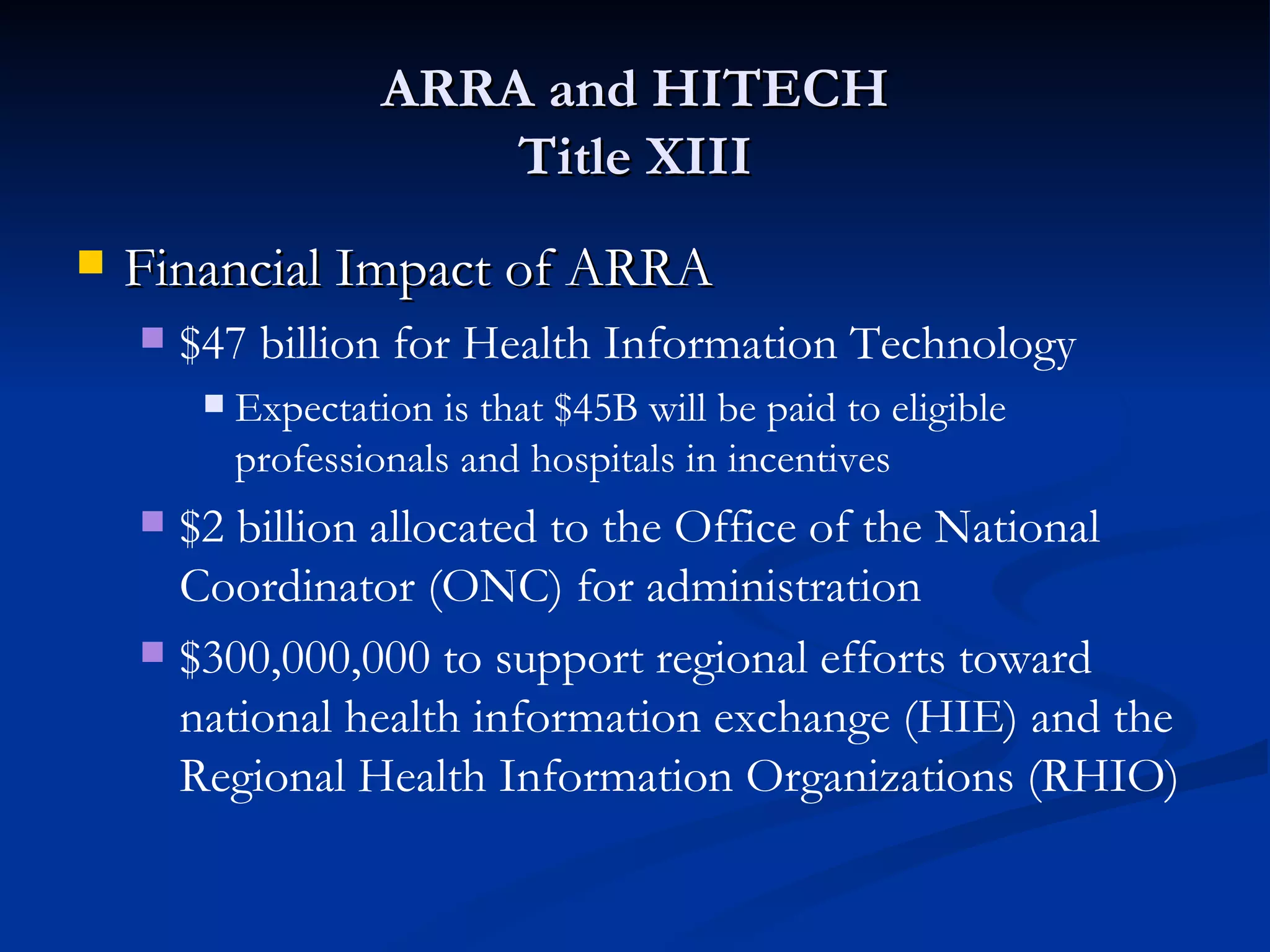
ARRA and HITECH Title XIII Financial Impact of ARRA $47 billion for Health Information Technology Expectation is that $45B will be paid to eligible professionals and hospitals in incentives $2 billion allocated to the Office of the National Coordinator (ONC) for administration $300,000,000 to support regional efforts toward national health information exchange (HIE) and the Regional Health Information Organizations (RHIO)
Title IV HITECH  Medicare and Medicaid Health Information Technology Incentives are available for implementation and  “meaningful” use  of  qualified  EHR systems. Qualified Electronic Health Record — The term ‘qualified electronic health record’ means an electronic record of health-related information on an individual includes  patient demographic  and  clinical health   information , such as medical history and problem lists has the capacity— to provide  clinical decision support to support  computerized physician order entry to capture and query information relevant to  health care quality to  exchange electronic health information  with, and integrate such information from other sources
Office of the National Coordinator  (ONC) Formed under the provisions of ARRA to further define key policies and regulations of the HITECH Act. Define certification process of EHR’s Establish Meaningful Use objectives and measures Define incentive payment plans Administer HITECH Act
Qualified EHR
Qualified EHR Application Certification body and standards ONC will certify organization to qualify EHR systems Stated goal is to have more than one certified organization Most recognized EHR certification body today is Certification Commission on Health Information Technology (CCHIT) Established in 2004, certifying EHR systems since 2006 Comprehensive certification process Published certification standards Endorsed by AMA and many other professional organizations
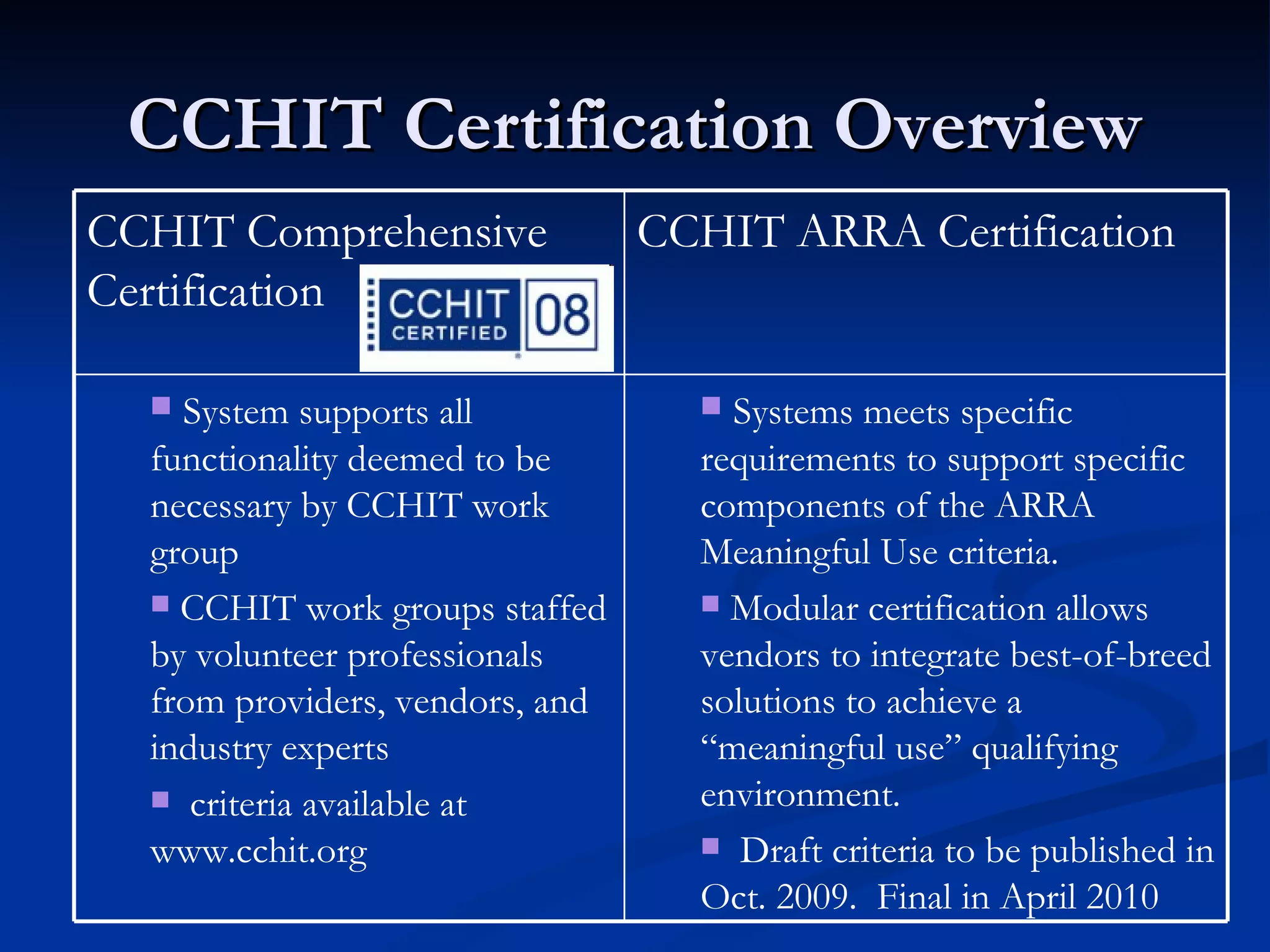
CCHIT Certification Overview Systems meets specific requirements to support specific components of the ARRA Meaningful Use criteria. Modular certification allows vendors to integrate best-of-breed solutions to achieve a “meaningful use” qualifying environment. Draft criteria to be published in Oct. 2009.  Final in April 2010 System supports all functionality deemed to be necessary by CCHIT work group CCHIT work groups staffed by volunteer professionals from providers, vendors, and industry experts criteria available at www.cchit.org CCHIT ARRA Certification CCHIT Comprehensive Certification
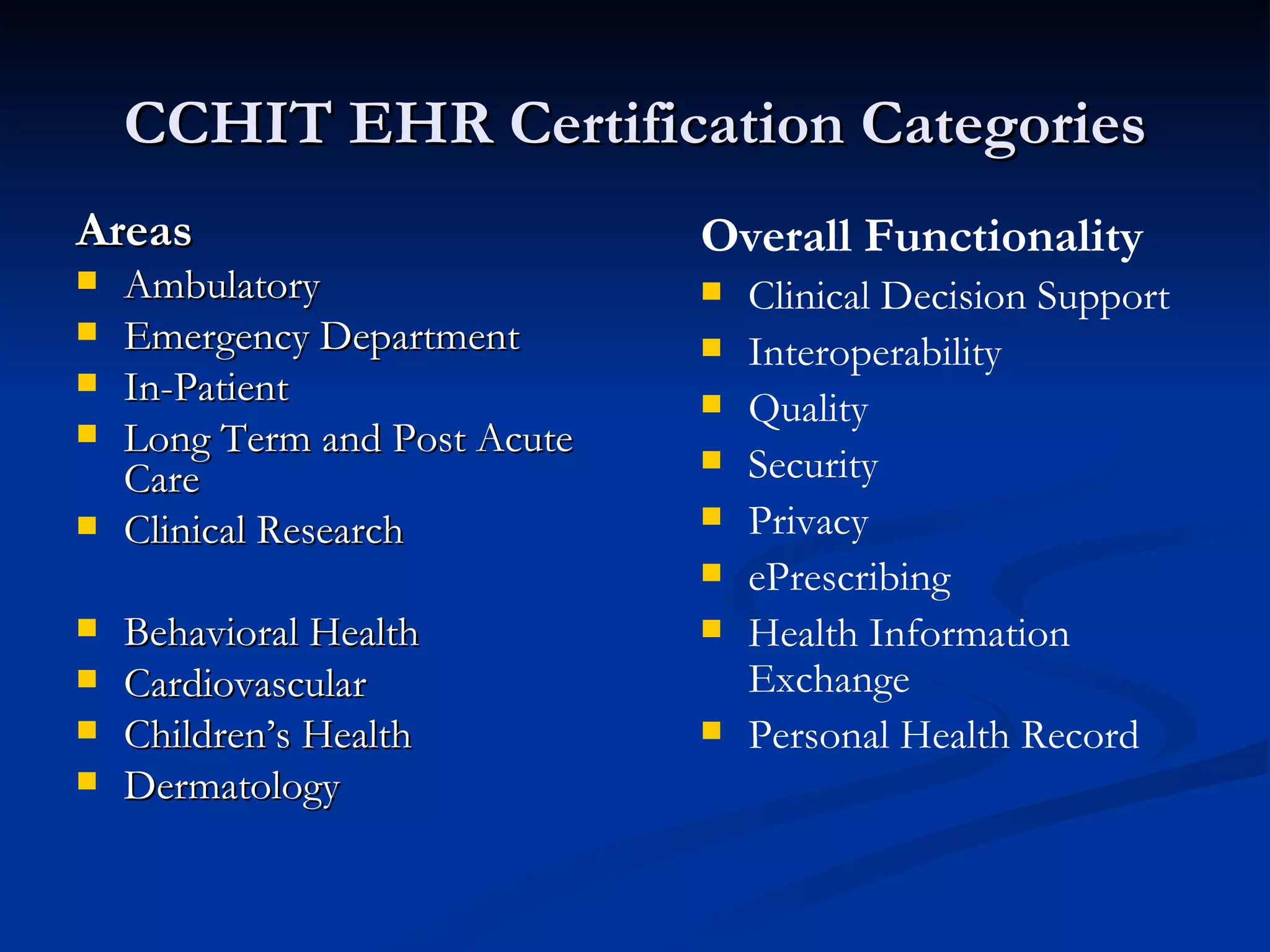
CCHIT EHR Certification Categories Areas Ambulatory Emergency Department In-Patient Long Term and Post Acute Care Clinical Research Behavioral Health Cardiovascular Children’s Health Dermatology Overall Functionality Clinical Decision Support Interoperability Quality Security Privacy ePrescribing Health Information Exchange Personal Health Record
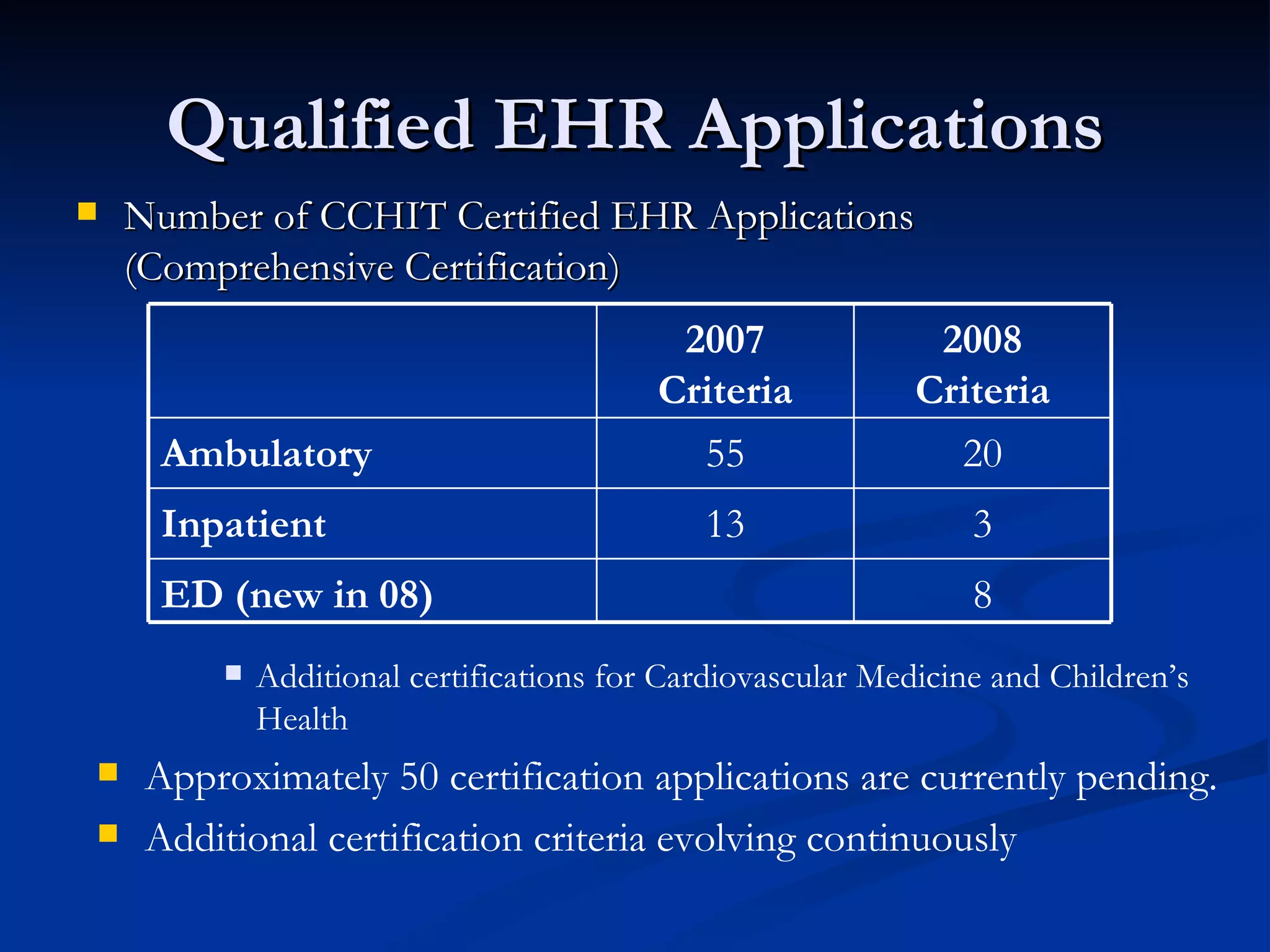
Qualified EHR Applications Number of CCHIT Certified EHR Applications (Comprehensive Certification) Additional certifications for Cardiovascular Medicine and Children’s Health Approximately 50 certification applications are currently pending. Additional certification criteria evolving continuously 8 3 20 2008 Criteria ED (new in 08) 13 Inpatient 55 Ambulatory 2007 Criteria
Meaningful Use
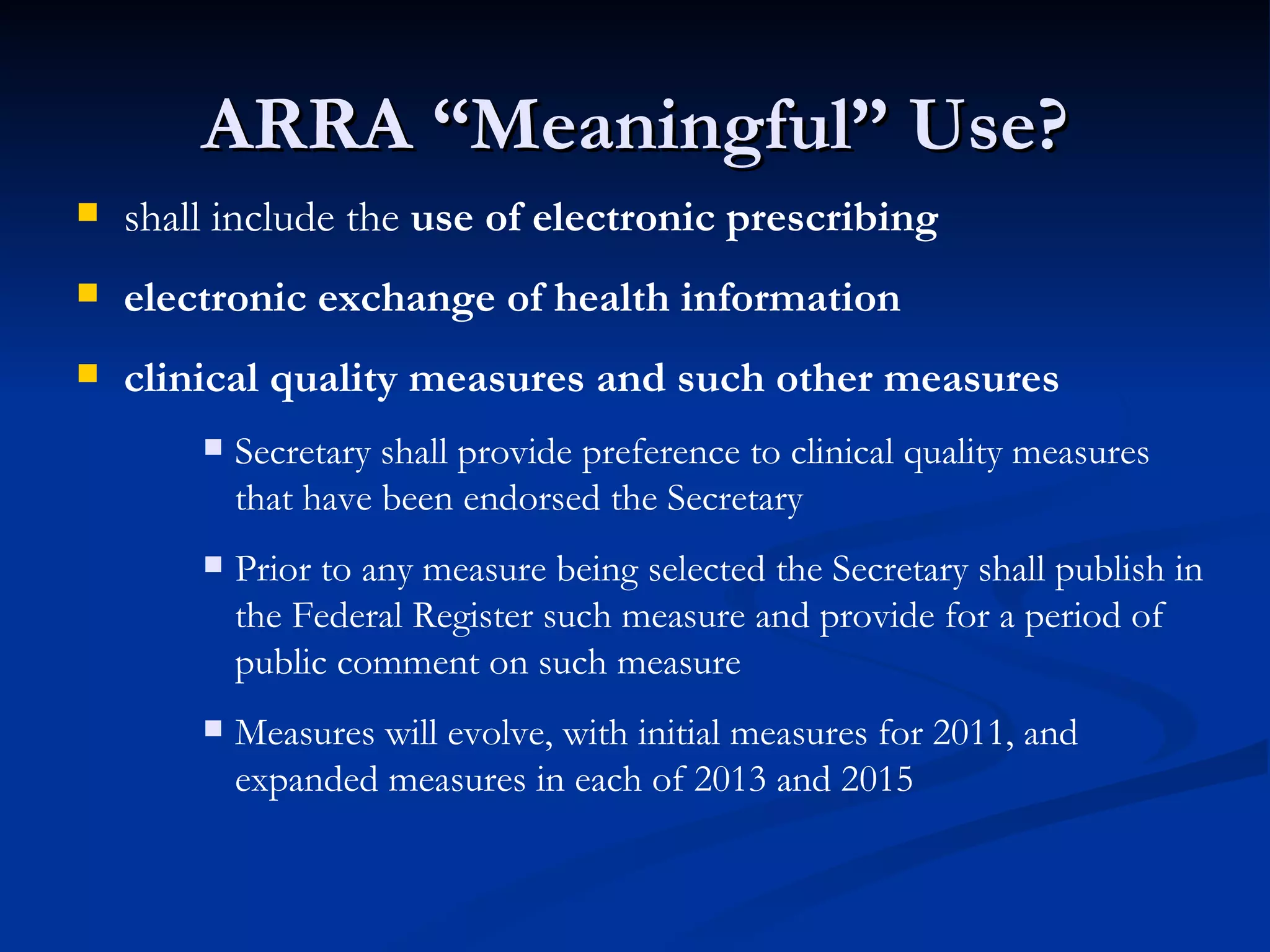
ARRA “Meaningful” Use? shall include the  use of electronic prescribing electronic exchange of health information clinical quality measures   and such other measures Secretary shall provide preference to clinical quality measures that have been endorsed the Secretary Prior to any measure being selected the Secretary shall publish in the Federal Register such measure and provide for a period of public comment on such measure Measures will evolve, with initial measures for 2011, and expanded measures in each of 2013 and 2015
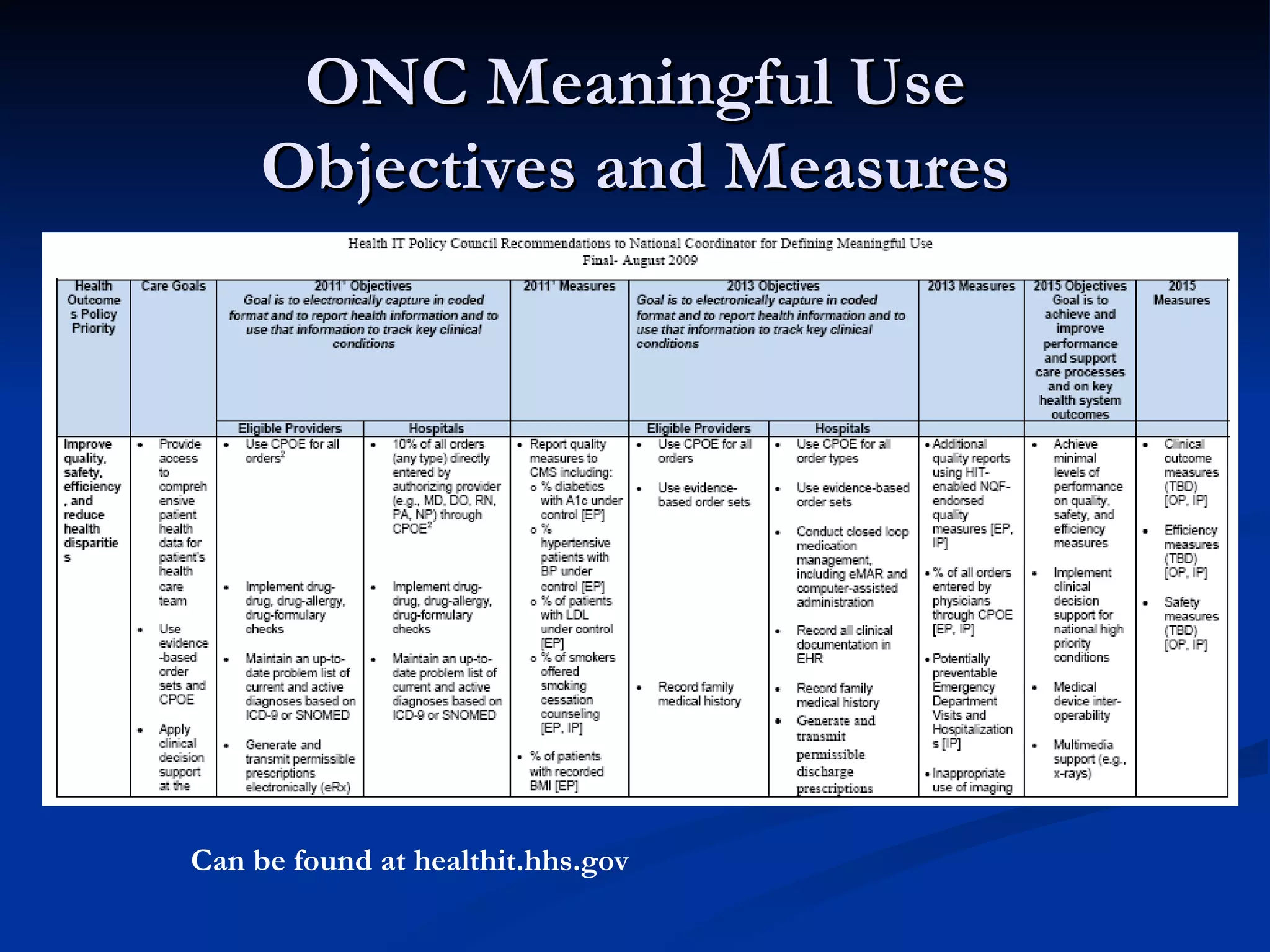
ONC Meaningful Use Objectives and Measures Can be found at healthit.hhs.gov
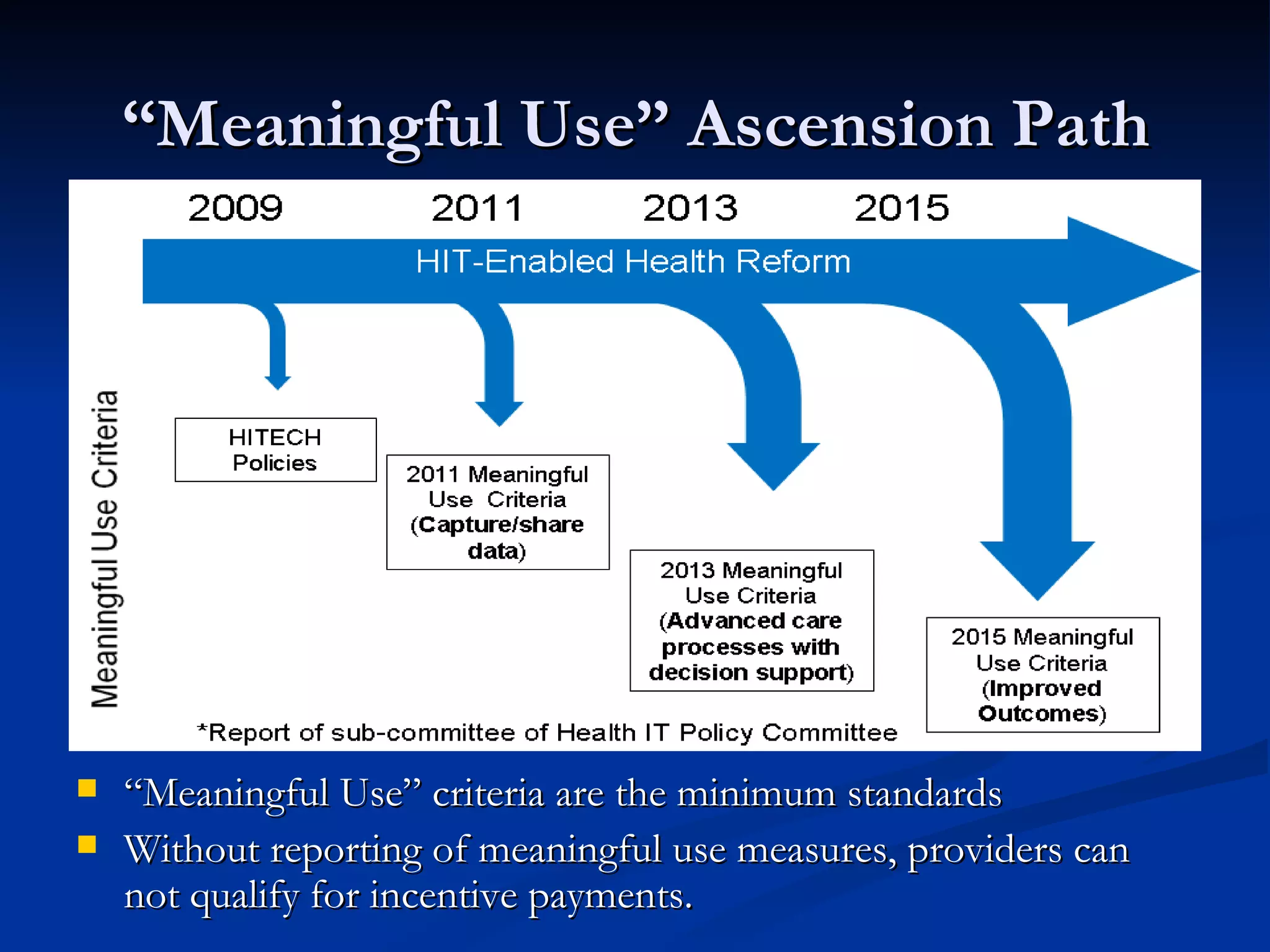
“ Meaningful Use” Ascension Path “ Meaningful Use” criteria are the minimum standards Without reporting of meaningful use measures, providers can not qualify for incentive payments. Meaningful Use Ascension Path
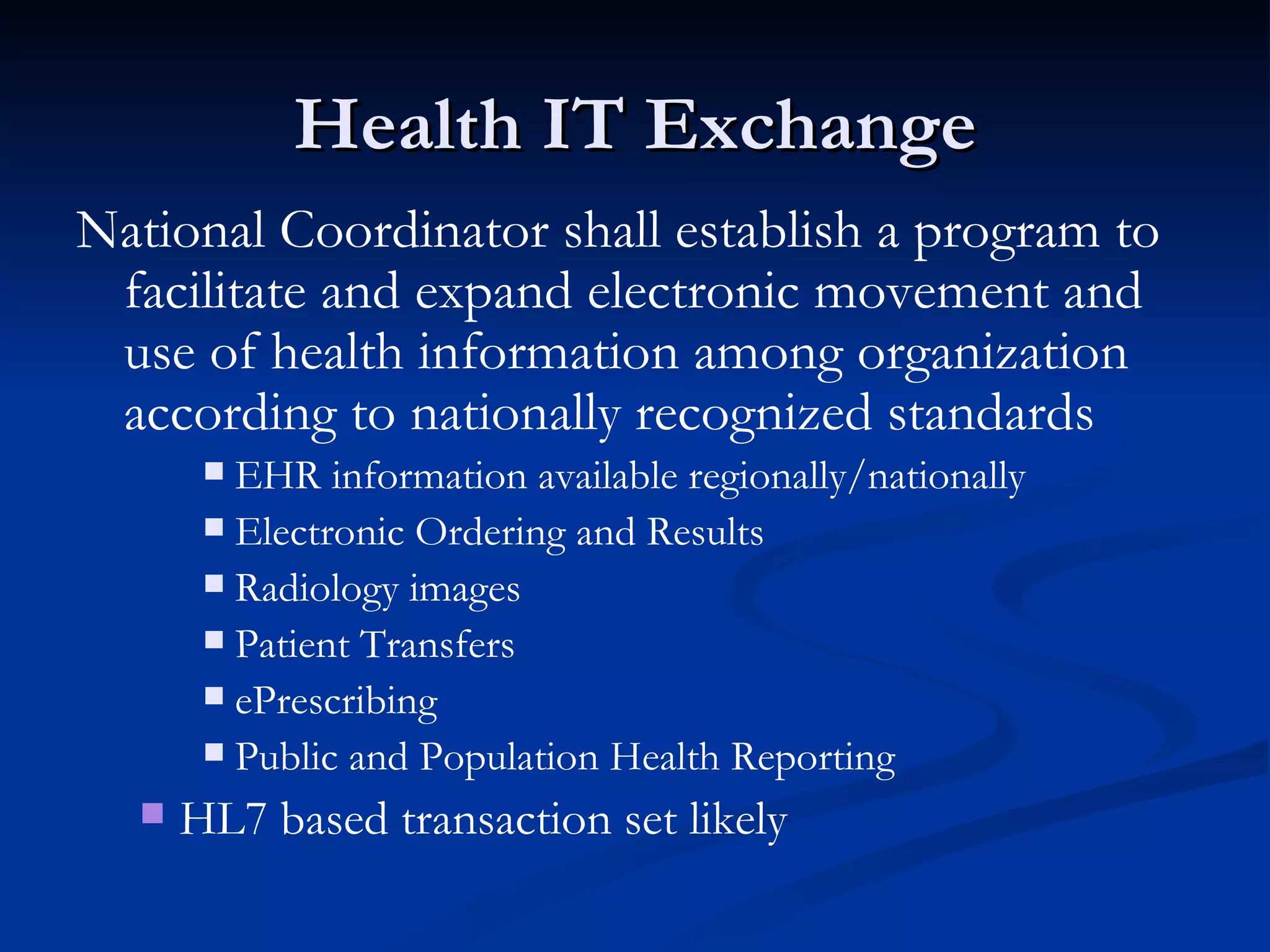
Health IT Exchange National Coordinator shall establish a program to facilitate and expand electronic movement and use of health information among organization according to nationally recognized standards EHR information available regionally/nationally Electronic Ordering and Results Radiology images Patient Transfers ePrescribing Public and Population Health Reporting HL7 based transaction set likely
Incentives
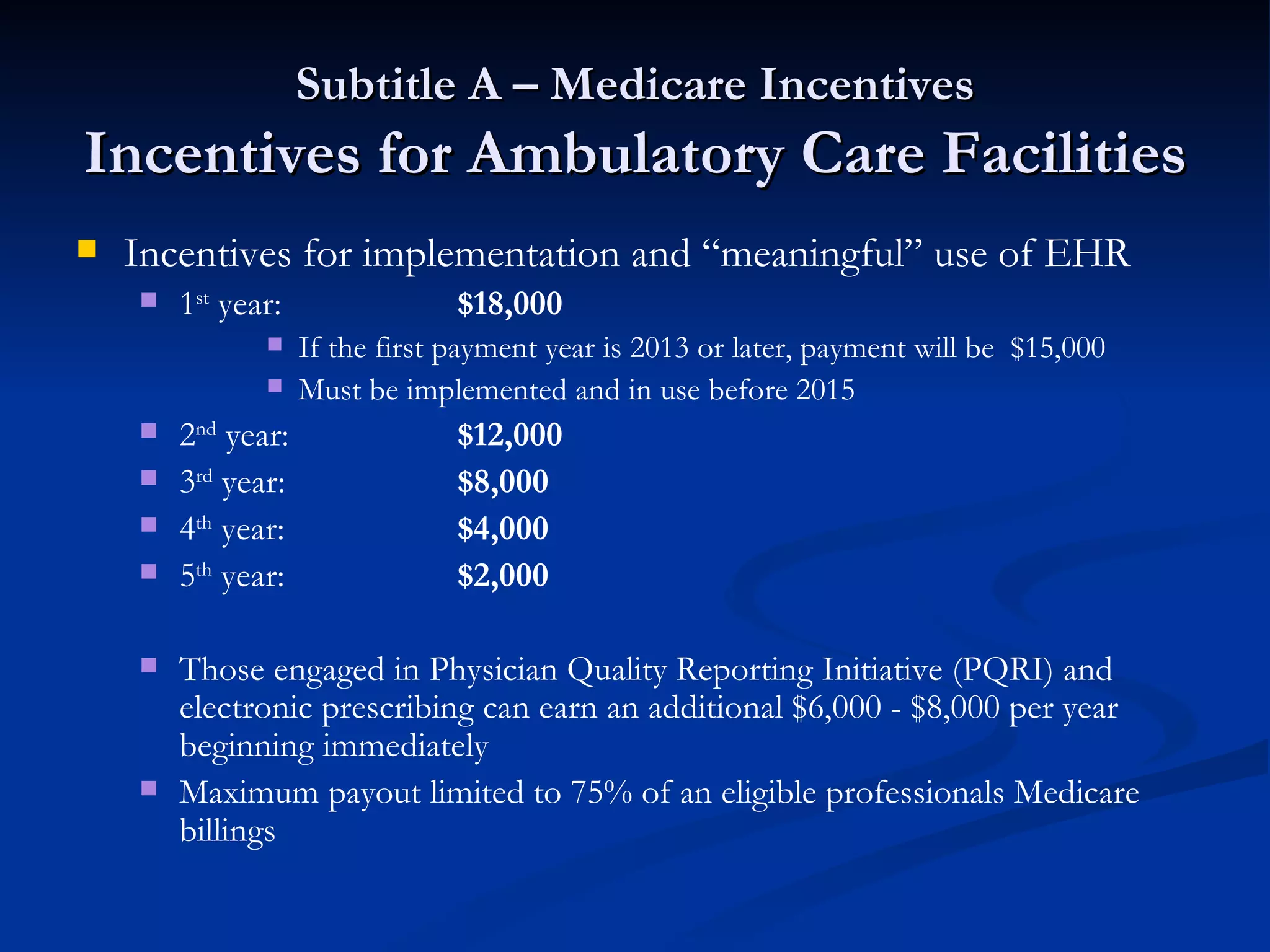
Subtitle A – Medicare Incentives Incentives for Ambulatory Care Facilities Incentives for implementation and “meaningful” use of EHR 1 st  year: $18,000  If the first payment year is 2013 or later, payment will be  $15,000  Must be implemented and in use before 2015 2 nd  year: $12,000 3 rd  year: $8,000   4 th  year: $4,000 5 th  year: $2,000 Those engaged in Physician Quality Reporting Initiative (PQRI) and electronic prescribing can earn an additional $6,000 - $8,000 per year beginning immediately Maximum payout limited to 75% of an eligible professionals Medicare billings
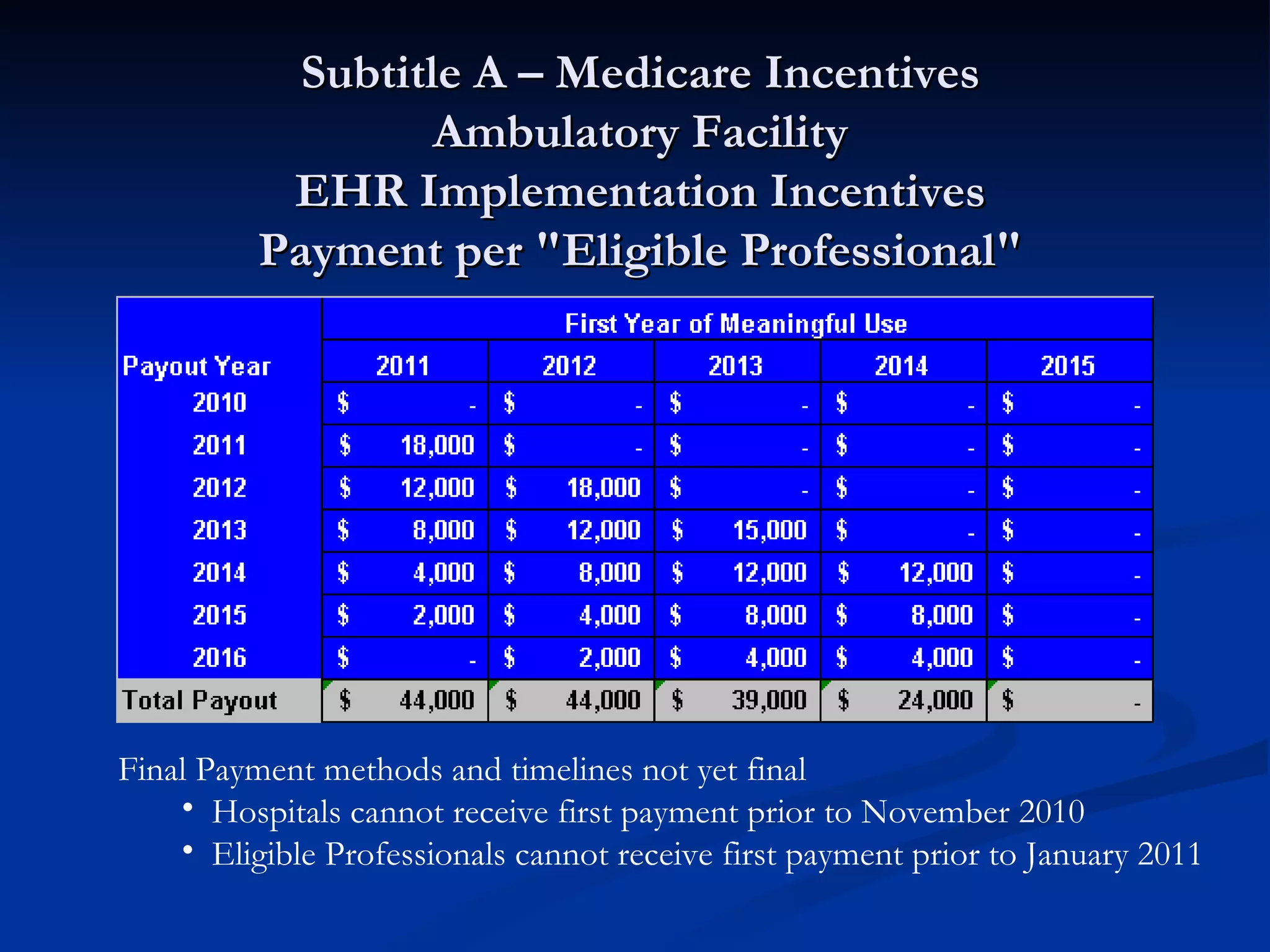
Subtitle A – Medicare Incentives Ambulatory Facility EHR Implementation Incentives Payment per "Eligible Professional" Final Payment methods and timelines not yet final Hospitals cannot receive first payment prior to November 2010 Eligible Professionals cannot receive first payment prior to January 2011
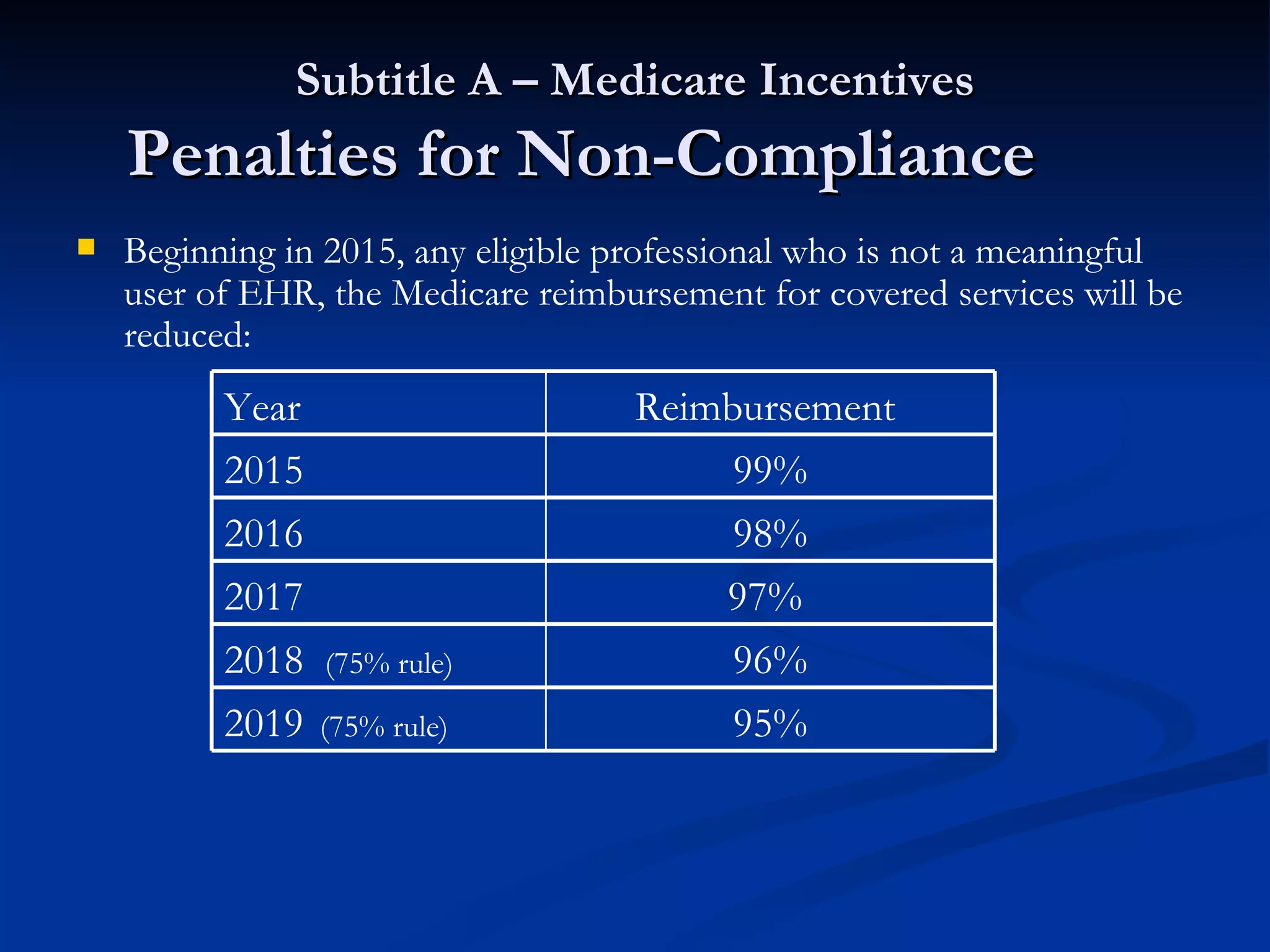
Subtitle A – Medicare Incentives Penalties for Non-Compliance Beginning in 2015, any eligible professional who is not a meaningful user of EHR, the Medicare reimbursement for covered services will be reduced: 95% 2019   (75% rule) 96% 2018  (75% rule) 99% 2015 98% 2016 97%  2017 Reimbursement  Year
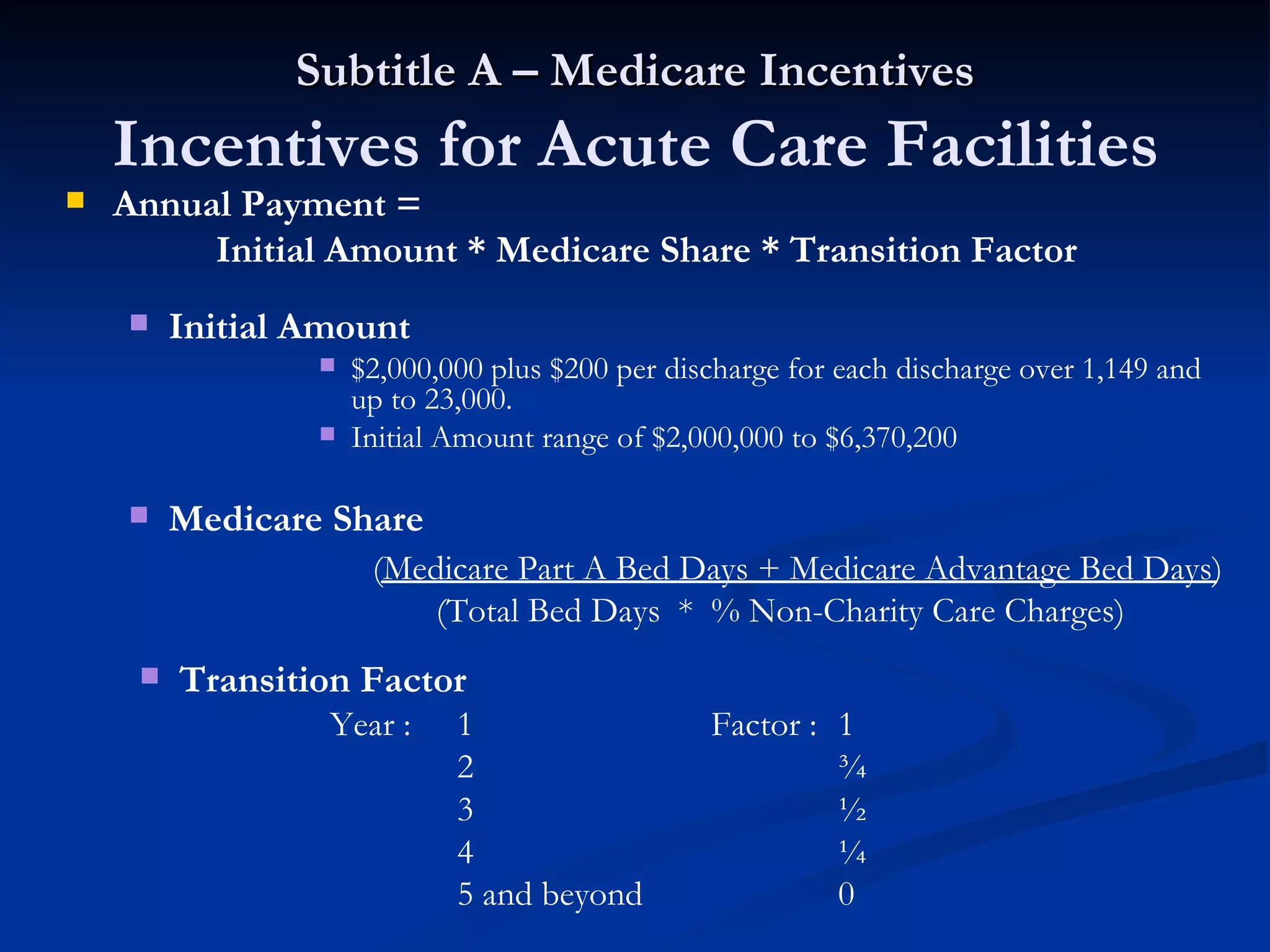
Subtitle A – Medicare Incentives Incentives for Acute Care Facilities Annual Payment =  Initial Amount * Medicare Share * Transition Factor   Initial Amount $2,000,000 plus $200 per discharge for each discharge over 1,149 and up to 23,000. Initial Amount range of $2,000,000 to $6,370,200 Medicare Share (Medicare Part A Bed Days + Medicare Advantage Bed Days) (Total Bed Days  *  % Non-Charity Care Charges) Transition Factor Year : 1 Factor : 1 2 ¾ 3 ½ 4 ¼ 5 and beyond 0
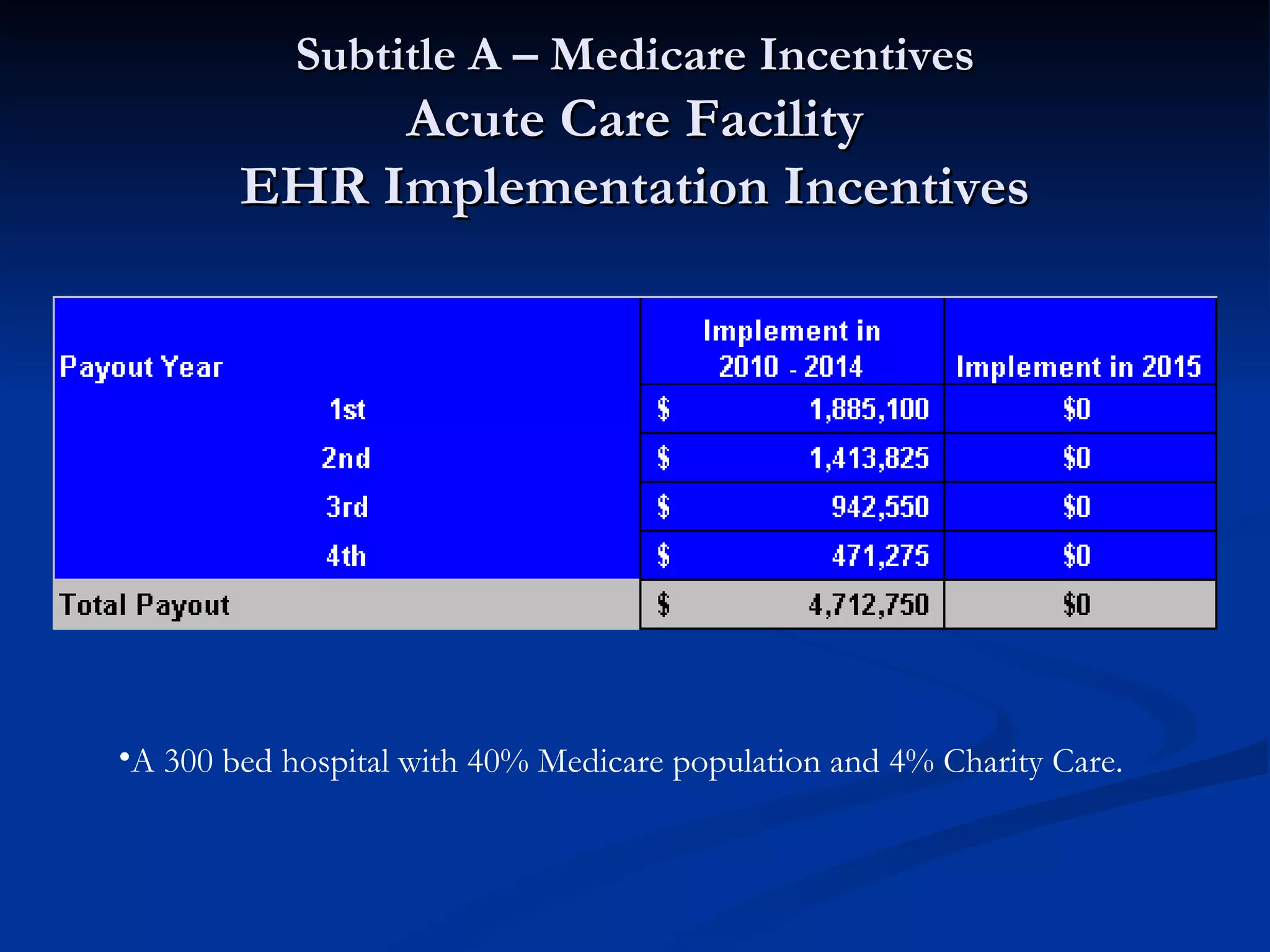
Subtitle A – Medicare Incentives Acute Care Facility EHR Implementation Incentives A 300 bed hospital with 40% Medicare population and 4% Charity Care.
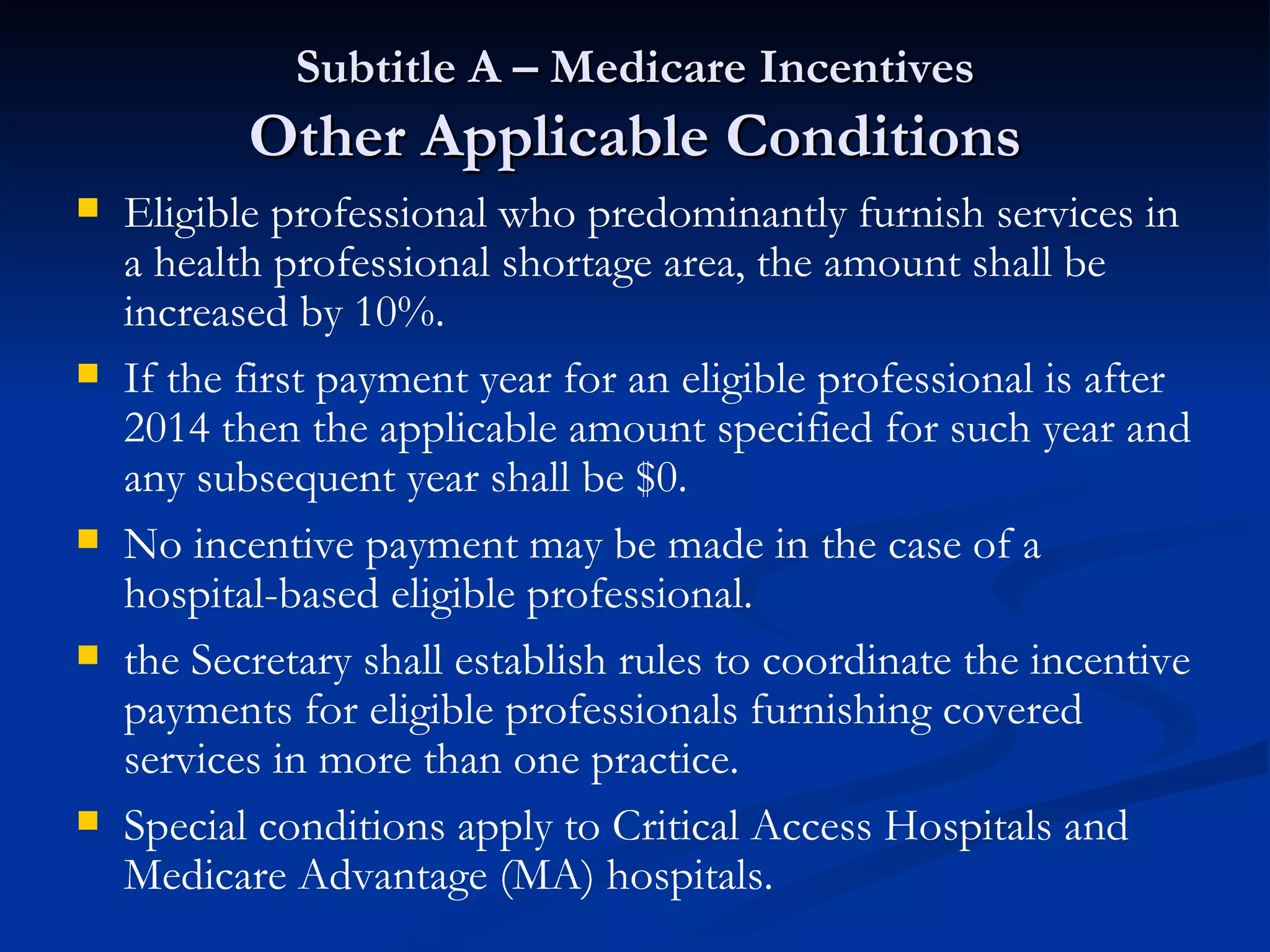
Subtitle A – Medicare Incentives Other Applicable Conditions Eligible professional who predominantly furnish services in a health professional shortage area, the amount shall be increased by 10%. If the first payment year for an eligible professional is after 2014 then the applicable amount specified for such year and any subsequent year shall be $0. No incentive payment may be made in the case of a hospital-based eligible professional. the Secretary shall establish rules to coordinate the incentive payments for eligible professionals furnishing covered services in more than one practice. Special conditions apply to Critical Access Hospitals and Medicare Advantage (MA) hospitals.
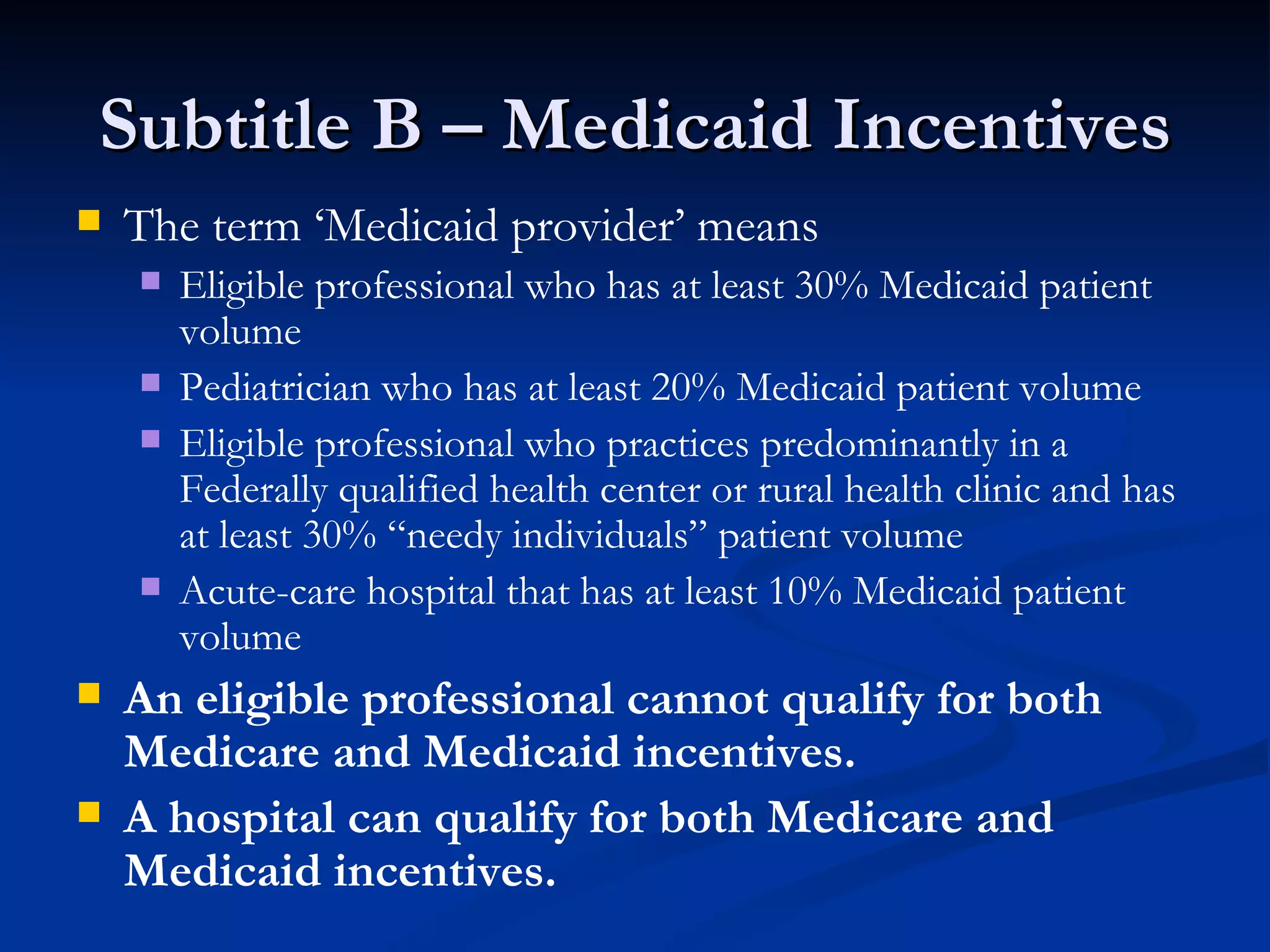
Subtitle B – Medicaid Incentives The term ‘Medicaid provider’ means Eligible professional who has at least 30% Medicaid patient volume Pediatrician who has at least 20% Medicaid patient volume Eligible professional who practices predominantly in a Federally qualified health center or rural health clinic and has at least 30% “needy individuals” patient volume  Acute-care hospital that has at least 10% Medicaid patient volume An eligible professional cannot qualify for both Medicare and Medicaid incentives. A hospital can qualify for both Medicare and Medicaid incentives.
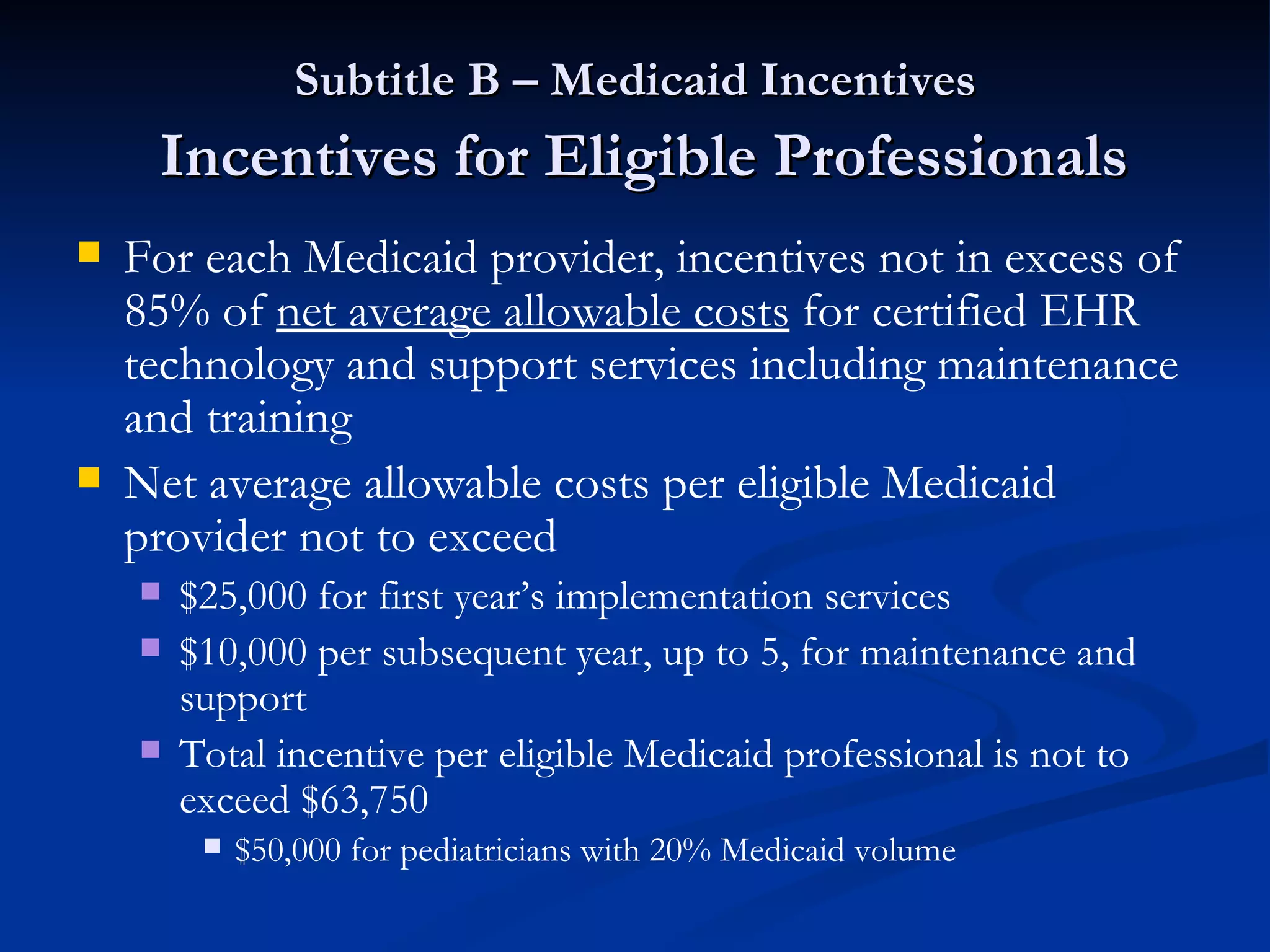
Subtitle B – Medicaid Incentives   Incentives for Eligible Professionals For each Medicaid provider, incentives not in excess of 85% of  net average allowable costs  for certified EHR technology and support services including maintenance and training Net average allowable costs per eligible Medicaid provider not to exceed  $25,000 for first year’s implementation services $10,000 per subsequent year, up to 5, for maintenance and support  Total incentive per eligible Medicaid professional is not to exceed $63,750 $50,000 for pediatricians with 20% Medicaid volume
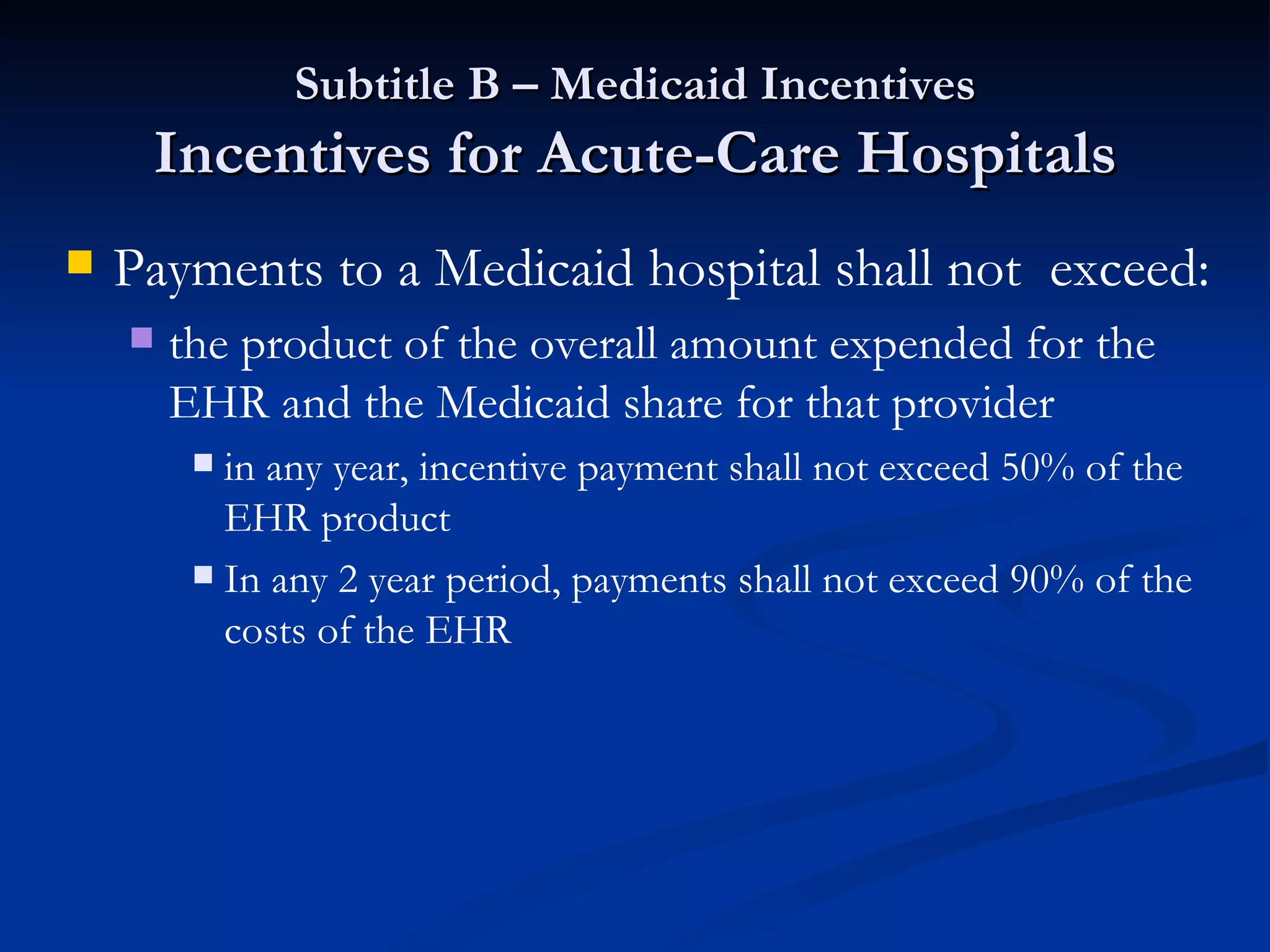
Subtitle B – Medicaid Incentives Incentives for Acute-Care Hospitals Payments to a Medicaid hospital shall not  exceed: the product of the overall amount expended for the EHR and the Medicaid share for that provider in any year, incentive payment shall not exceed 50% of the EHR product In any 2 year period, payments shall not exceed 90% of the costs of the EHR
Opportunity
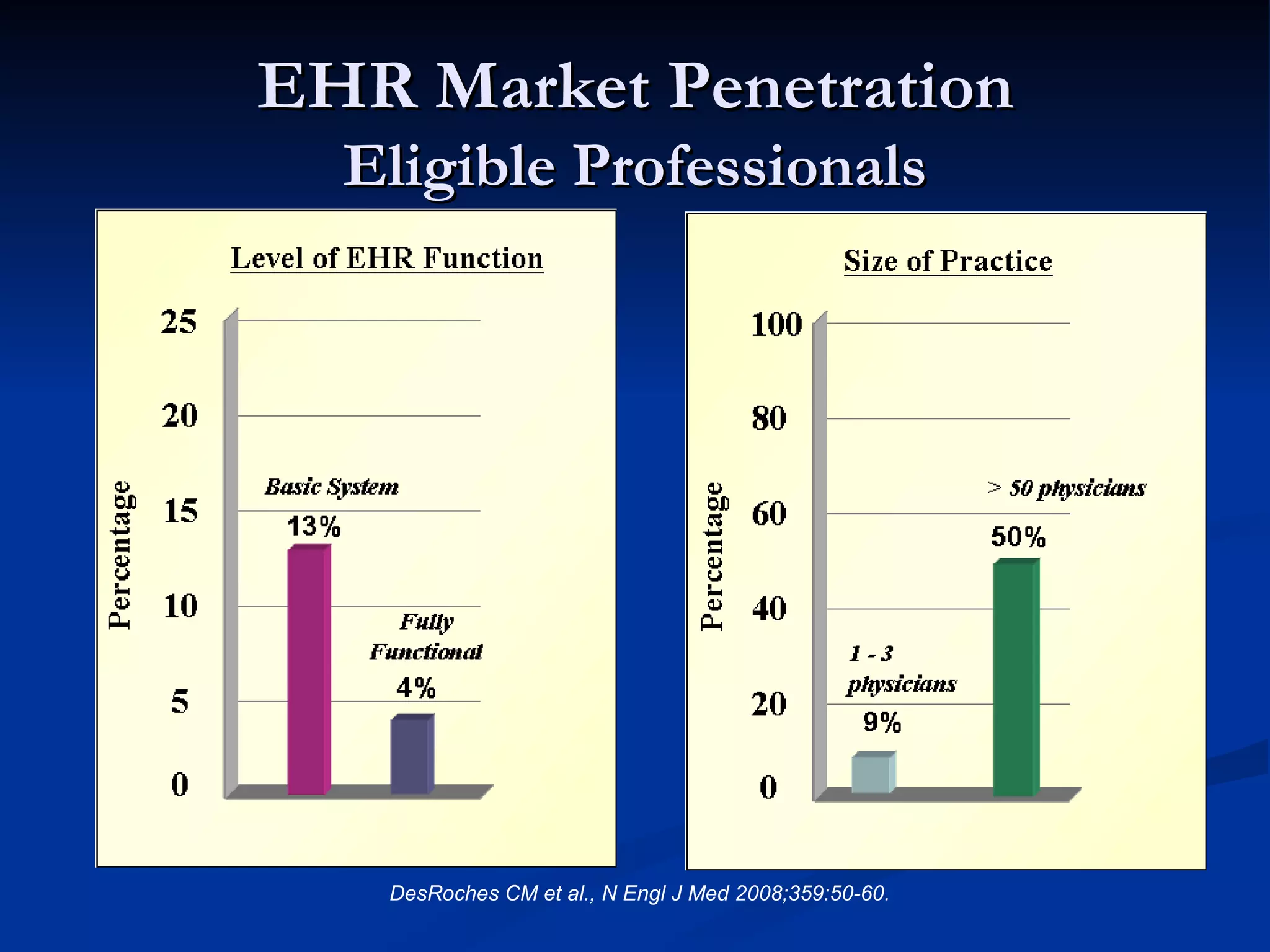
EHR Market Penetration Eligible Professionals DesRoches CM et al., N Engl J Med 2008;359:50-60.
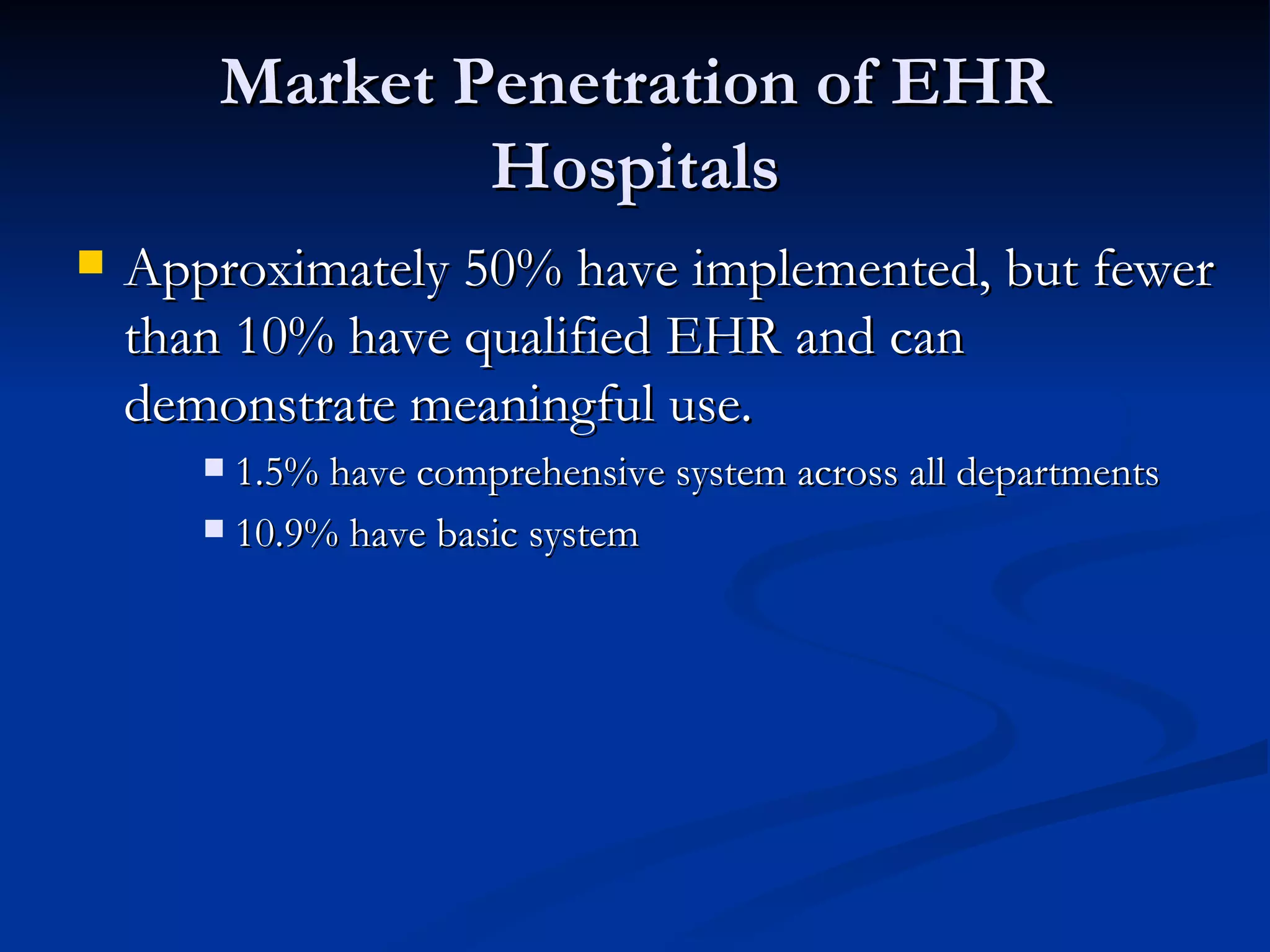
Market Penetration of EHR Hospitals Approximately 50% have implemented, but fewer than 10% have qualified EHR and can demonstrate meaningful use. 1.5% have comprehensive system across all departments 10.9% have basic system
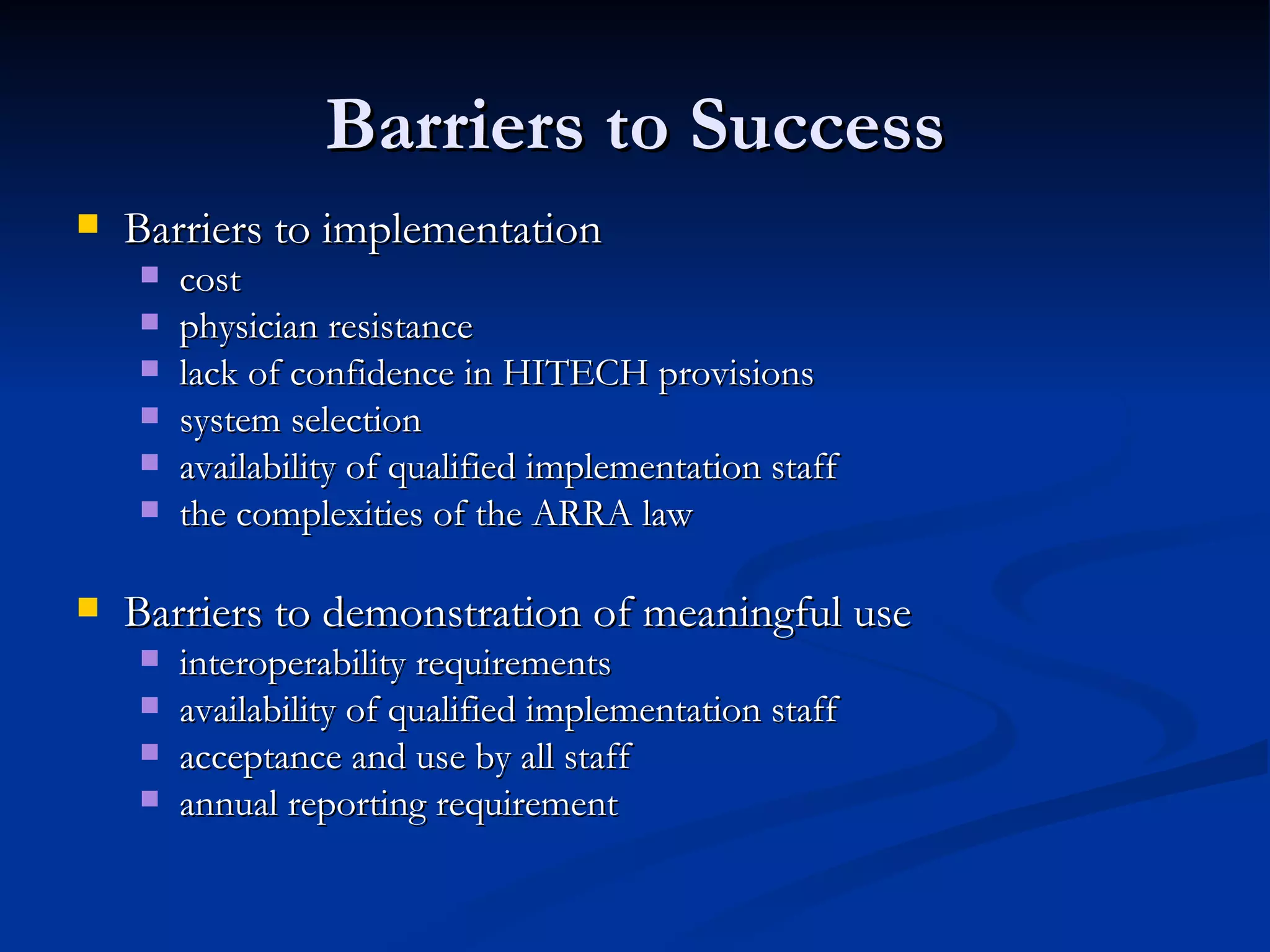
Barriers to Success Barriers to implementation  cost physician resistance  lack of confidence in HITECH provisions system selection availability of qualified implementation staff the complexities of the ARRA law  Barriers to demonstration of meaningful use interoperability requirements availability of qualified implementation staff acceptance and use by all staff annual reporting requirement
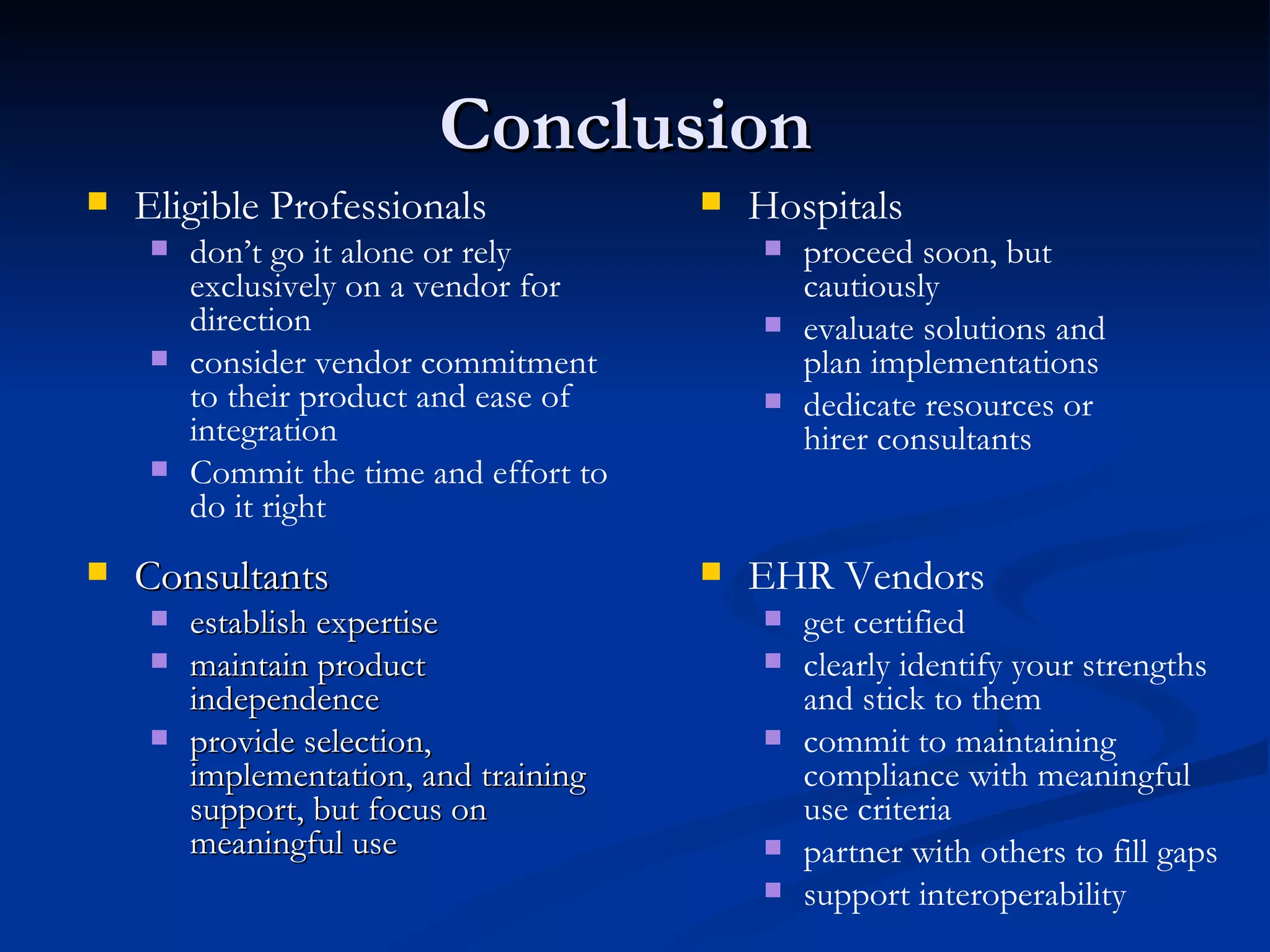
Conclusion  Consultants establish expertise maintain product independence provide selection, implementation, and training support, but focus on meaningful use EHR Vendors get certified clearly identify your strengths and stick to them commit to maintaining compliance with meaningful use criteria partner with others to fill gaps support interoperability Hospitals proceed soon, but cautiously evaluate solutions and plan implementations dedicate resources or hirer consultants Eligible Professionals don’t go it alone or rely exclusively on a vendor for direction consider vendor commitment to their product and ease of integration Commit the time and effort to do it right
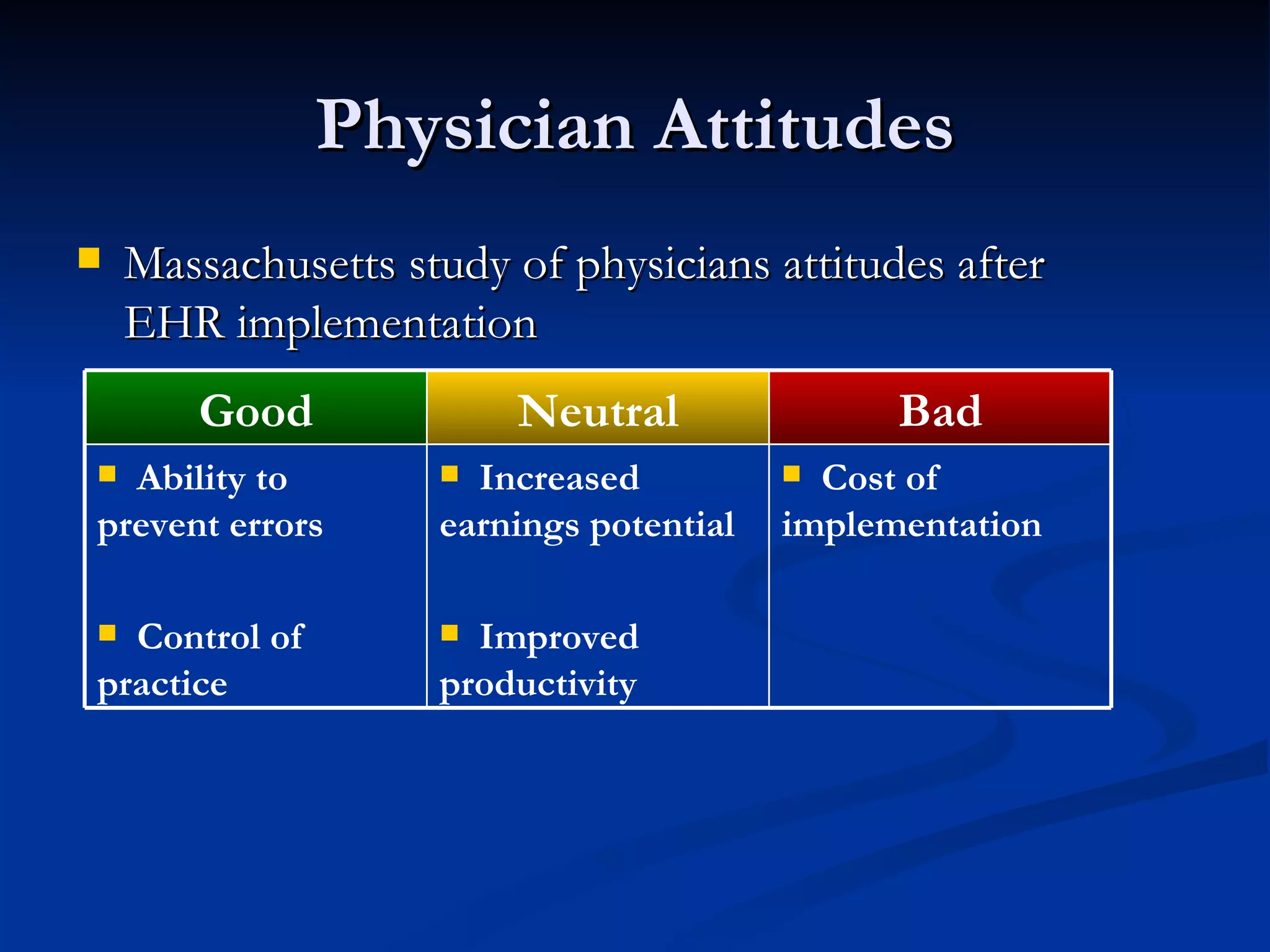
Physician Attitudes Massachusetts study of physicians attitudes after EHR implementation Cost of implementation Increased earnings potential Improved productivity Ability to prevent errors Control of practice Bad Neutral Good
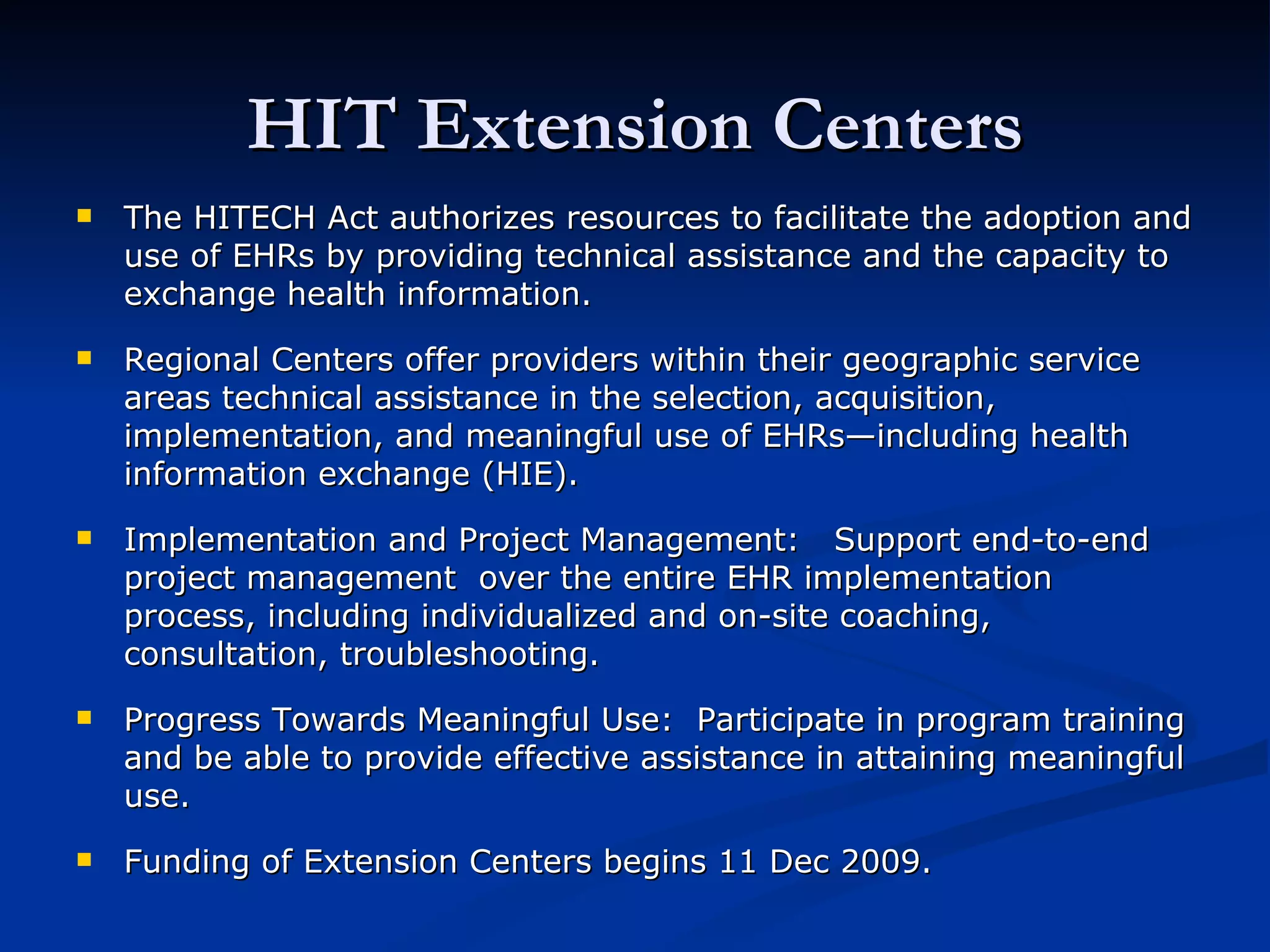
HIT Extension Centers The HITECH Act authorizes resources to facilitate the adoption and use of EHRs by providing technical assistance and the capacity to exchange health information. Regional Centers offer providers within their geographic service areas technical assistance in the selection, acquisition, implementation, and meaningful use of EHRs—including health information exchange (HIE). Implementation and Project Management:  Support end-to-end project management  over the entire EHR implementation process, including individualized and on-site coaching, consultation, troubleshooting. Progress Towards Meaningful Use:  Participate in program training and be able to provide effective assistance in attaining meaningful use. Funding of Extension Centers begins 11 Dec 2009.
Q & A Dan Falke [email_address] (513) 227-2740 Jeff Burke [email_address] (513) 702-6846

The Circuit EHR Presentation

  • 1.
    Electronic Health RecordsInitiative Understanding the American Recovery and Reinvestment Act and it’s Impact
  • 2.
    Overview The ARRArecently signed into law in February 2009 includes incentives for physician practices and hospitals to implement and demonstrate “ meaningful use ” of a qualified electronic health records system (EHR). ARRA provides for significant incentives for those physicians and hospitals that are meaningful EHR users . There are significant penalties for those physicians and hospitals that do not implement EHR prior to 2015. Practices and hospitals that already have EHR qualify for the incentives as long as the system meets the “qualified” criteria and they can demonstrate “meaningful use”.
  • 3.
    Agenda Health ITEconomic & Clinical Health Act (HITECH) provision of the American Recovery and Reinvestment Act (ARRA) Qualified EHR Meaningful Use Health Information Exchange (HIE) EHR Meaningful Use Incentive Programs Opportunities HIT Extension Centers Q & A
  • 4.
    ARRA and HITECHTitle XIII Financial Impact of ARRA $47 billion for Health Information Technology Expectation is that $45B will be paid to eligible professionals and hospitals in incentives $2 billion allocated to the Office of the National Coordinator (ONC) for administration $300,000,000 to support regional efforts toward national health information exchange (HIE) and the Regional Health Information Organizations (RHIO)
  • 5.
    Title IV HITECH Medicare and Medicaid Health Information Technology Incentives are available for implementation and “meaningful” use of qualified EHR systems. Qualified Electronic Health Record — The term ‘qualified electronic health record’ means an electronic record of health-related information on an individual includes patient demographic and clinical health information , such as medical history and problem lists has the capacity— to provide clinical decision support to support computerized physician order entry to capture and query information relevant to health care quality to exchange electronic health information with, and integrate such information from other sources
  • 6.
    Office of theNational Coordinator (ONC) Formed under the provisions of ARRA to further define key policies and regulations of the HITECH Act. Define certification process of EHR’s Establish Meaningful Use objectives and measures Define incentive payment plans Administer HITECH Act
  • 7.
  • 8.
    Qualified EHR ApplicationCertification body and standards ONC will certify organization to qualify EHR systems Stated goal is to have more than one certified organization Most recognized EHR certification body today is Certification Commission on Health Information Technology (CCHIT) Established in 2004, certifying EHR systems since 2006 Comprehensive certification process Published certification standards Endorsed by AMA and many other professional organizations
  • 9.
    CCHIT Certification OverviewSystems meets specific requirements to support specific components of the ARRA Meaningful Use criteria. Modular certification allows vendors to integrate best-of-breed solutions to achieve a “meaningful use” qualifying environment. Draft criteria to be published in Oct. 2009. Final in April 2010 System supports all functionality deemed to be necessary by CCHIT work group CCHIT work groups staffed by volunteer professionals from providers, vendors, and industry experts criteria available at www.cchit.org CCHIT ARRA Certification CCHIT Comprehensive Certification
  • 10.
    CCHIT EHR CertificationCategories Areas Ambulatory Emergency Department In-Patient Long Term and Post Acute Care Clinical Research Behavioral Health Cardiovascular Children’s Health Dermatology Overall Functionality Clinical Decision Support Interoperability Quality Security Privacy ePrescribing Health Information Exchange Personal Health Record
  • 11.
    Qualified EHR ApplicationsNumber of CCHIT Certified EHR Applications (Comprehensive Certification) Additional certifications for Cardiovascular Medicine and Children’s Health Approximately 50 certification applications are currently pending. Additional certification criteria evolving continuously 8 3 20 2008 Criteria ED (new in 08) 13 Inpatient 55 Ambulatory 2007 Criteria
  • 12.
  • 13.
    ARRA “Meaningful” Use?shall include the use of electronic prescribing electronic exchange of health information clinical quality measures and such other measures Secretary shall provide preference to clinical quality measures that have been endorsed the Secretary Prior to any measure being selected the Secretary shall publish in the Federal Register such measure and provide for a period of public comment on such measure Measures will evolve, with initial measures for 2011, and expanded measures in each of 2013 and 2015
  • 14.
    ONC Meaningful UseObjectives and Measures Can be found at healthit.hhs.gov
  • 15.
    “ Meaningful Use”Ascension Path “ Meaningful Use” criteria are the minimum standards Without reporting of meaningful use measures, providers can not qualify for incentive payments. Meaningful Use Ascension Path
  • 16.
    Health IT ExchangeNational Coordinator shall establish a program to facilitate and expand electronic movement and use of health information among organization according to nationally recognized standards EHR information available regionally/nationally Electronic Ordering and Results Radiology images Patient Transfers ePrescribing Public and Population Health Reporting HL7 based transaction set likely
  • 17.
  • 18.
    Subtitle A –Medicare Incentives Incentives for Ambulatory Care Facilities Incentives for implementation and “meaningful” use of EHR 1 st year: $18,000 If the first payment year is 2013 or later, payment will be $15,000 Must be implemented and in use before 2015 2 nd year: $12,000 3 rd year: $8,000 4 th year: $4,000 5 th year: $2,000 Those engaged in Physician Quality Reporting Initiative (PQRI) and electronic prescribing can earn an additional $6,000 - $8,000 per year beginning immediately Maximum payout limited to 75% of an eligible professionals Medicare billings
  • 19.
    Subtitle A –Medicare Incentives Ambulatory Facility EHR Implementation Incentives Payment per "Eligible Professional" Final Payment methods and timelines not yet final Hospitals cannot receive first payment prior to November 2010 Eligible Professionals cannot receive first payment prior to January 2011
  • 20.
    Subtitle A –Medicare Incentives Penalties for Non-Compliance Beginning in 2015, any eligible professional who is not a meaningful user of EHR, the Medicare reimbursement for covered services will be reduced: 95% 2019 (75% rule) 96% 2018 (75% rule) 99% 2015 98% 2016 97% 2017 Reimbursement Year
  • 21.
    Subtitle A –Medicare Incentives Incentives for Acute Care Facilities Annual Payment = Initial Amount * Medicare Share * Transition Factor Initial Amount $2,000,000 plus $200 per discharge for each discharge over 1,149 and up to 23,000. Initial Amount range of $2,000,000 to $6,370,200 Medicare Share (Medicare Part A Bed Days + Medicare Advantage Bed Days) (Total Bed Days * % Non-Charity Care Charges) Transition Factor Year : 1 Factor : 1 2 ¾ 3 ½ 4 ¼ 5 and beyond 0
  • 22.
    Subtitle A –Medicare Incentives Acute Care Facility EHR Implementation Incentives A 300 bed hospital with 40% Medicare population and 4% Charity Care.
  • 23.
    Subtitle A –Medicare Incentives Other Applicable Conditions Eligible professional who predominantly furnish services in a health professional shortage area, the amount shall be increased by 10%. If the first payment year for an eligible professional is after 2014 then the applicable amount specified for such year and any subsequent year shall be $0. No incentive payment may be made in the case of a hospital-based eligible professional. the Secretary shall establish rules to coordinate the incentive payments for eligible professionals furnishing covered services in more than one practice. Special conditions apply to Critical Access Hospitals and Medicare Advantage (MA) hospitals.
  • 24.
    Subtitle B –Medicaid Incentives The term ‘Medicaid provider’ means Eligible professional who has at least 30% Medicaid patient volume Pediatrician who has at least 20% Medicaid patient volume Eligible professional who practices predominantly in a Federally qualified health center or rural health clinic and has at least 30% “needy individuals” patient volume Acute-care hospital that has at least 10% Medicaid patient volume An eligible professional cannot qualify for both Medicare and Medicaid incentives. A hospital can qualify for both Medicare and Medicaid incentives.
  • 25.
    Subtitle B –Medicaid Incentives Incentives for Eligible Professionals For each Medicaid provider, incentives not in excess of 85% of net average allowable costs for certified EHR technology and support services including maintenance and training Net average allowable costs per eligible Medicaid provider not to exceed $25,000 for first year’s implementation services $10,000 per subsequent year, up to 5, for maintenance and support Total incentive per eligible Medicaid professional is not to exceed $63,750 $50,000 for pediatricians with 20% Medicaid volume
  • 26.
    Subtitle B –Medicaid Incentives Incentives for Acute-Care Hospitals Payments to a Medicaid hospital shall not exceed: the product of the overall amount expended for the EHR and the Medicaid share for that provider in any year, incentive payment shall not exceed 50% of the EHR product In any 2 year period, payments shall not exceed 90% of the costs of the EHR
  • 27.
  • 28.
    EHR Market PenetrationEligible Professionals DesRoches CM et al., N Engl J Med 2008;359:50-60.
  • 29.
    Market Penetration ofEHR Hospitals Approximately 50% have implemented, but fewer than 10% have qualified EHR and can demonstrate meaningful use. 1.5% have comprehensive system across all departments 10.9% have basic system
  • 30.
    Barriers to SuccessBarriers to implementation cost physician resistance lack of confidence in HITECH provisions system selection availability of qualified implementation staff the complexities of the ARRA law Barriers to demonstration of meaningful use interoperability requirements availability of qualified implementation staff acceptance and use by all staff annual reporting requirement
  • 31.
    Conclusion Consultantsestablish expertise maintain product independence provide selection, implementation, and training support, but focus on meaningful use EHR Vendors get certified clearly identify your strengths and stick to them commit to maintaining compliance with meaningful use criteria partner with others to fill gaps support interoperability Hospitals proceed soon, but cautiously evaluate solutions and plan implementations dedicate resources or hirer consultants Eligible Professionals don’t go it alone or rely exclusively on a vendor for direction consider vendor commitment to their product and ease of integration Commit the time and effort to do it right
  • 32.
    Physician Attitudes Massachusettsstudy of physicians attitudes after EHR implementation Cost of implementation Increased earnings potential Improved productivity Ability to prevent errors Control of practice Bad Neutral Good
  • 33.
    HIT Extension CentersThe HITECH Act authorizes resources to facilitate the adoption and use of EHRs by providing technical assistance and the capacity to exchange health information. Regional Centers offer providers within their geographic service areas technical assistance in the selection, acquisition, implementation, and meaningful use of EHRs—including health information exchange (HIE). Implementation and Project Management: Support end-to-end project management over the entire EHR implementation process, including individualized and on-site coaching, consultation, troubleshooting. Progress Towards Meaningful Use: Participate in program training and be able to provide effective assistance in attaining meaningful use. Funding of Extension Centers begins 11 Dec 2009.
  • 34.
    Q & ADan Falke [email_address] (513) 227-2740 Jeff Burke [email_address] (513) 702-6846