 by David Barnes  www.bizwitz.com  db@bizwitz.com 
More Digital Revolutions
Thoughts and predictions on Displays, how
they influence Digital Media and how they are
influenced in return, for LatinDisplay 2010.
16-Nov-10 1More Digital Revolutions, LatinDisplay 2010
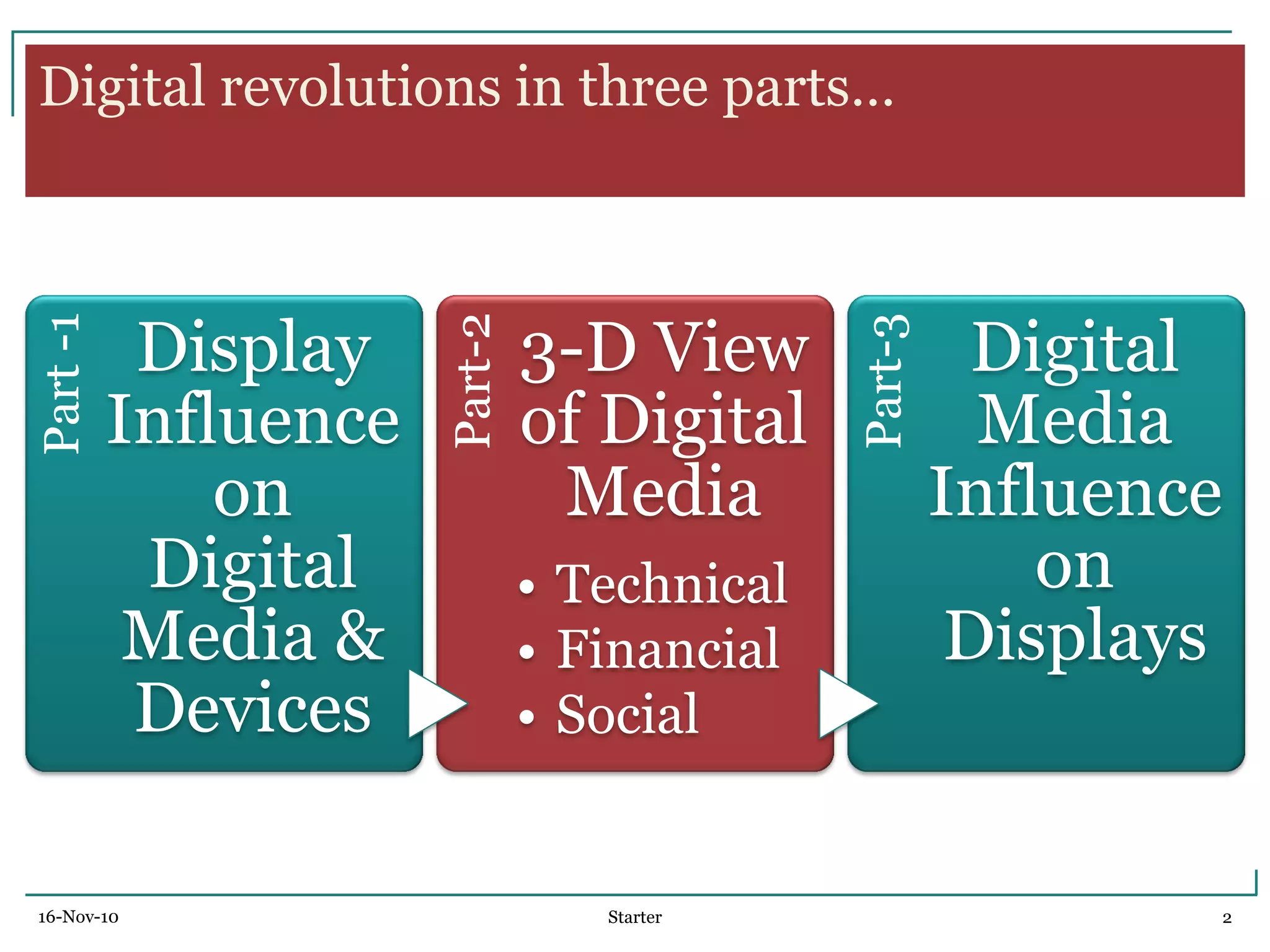
Digital revolutions in three parts…
16-Nov-10 Starter 2
Part-1
Display
Influence
on
Digital
Media &
Devices
Part-2
3-D View
of Digital
Media
• Technical
• Financial
• Social
Part-3
Digital
Media
Influence
on
Displays
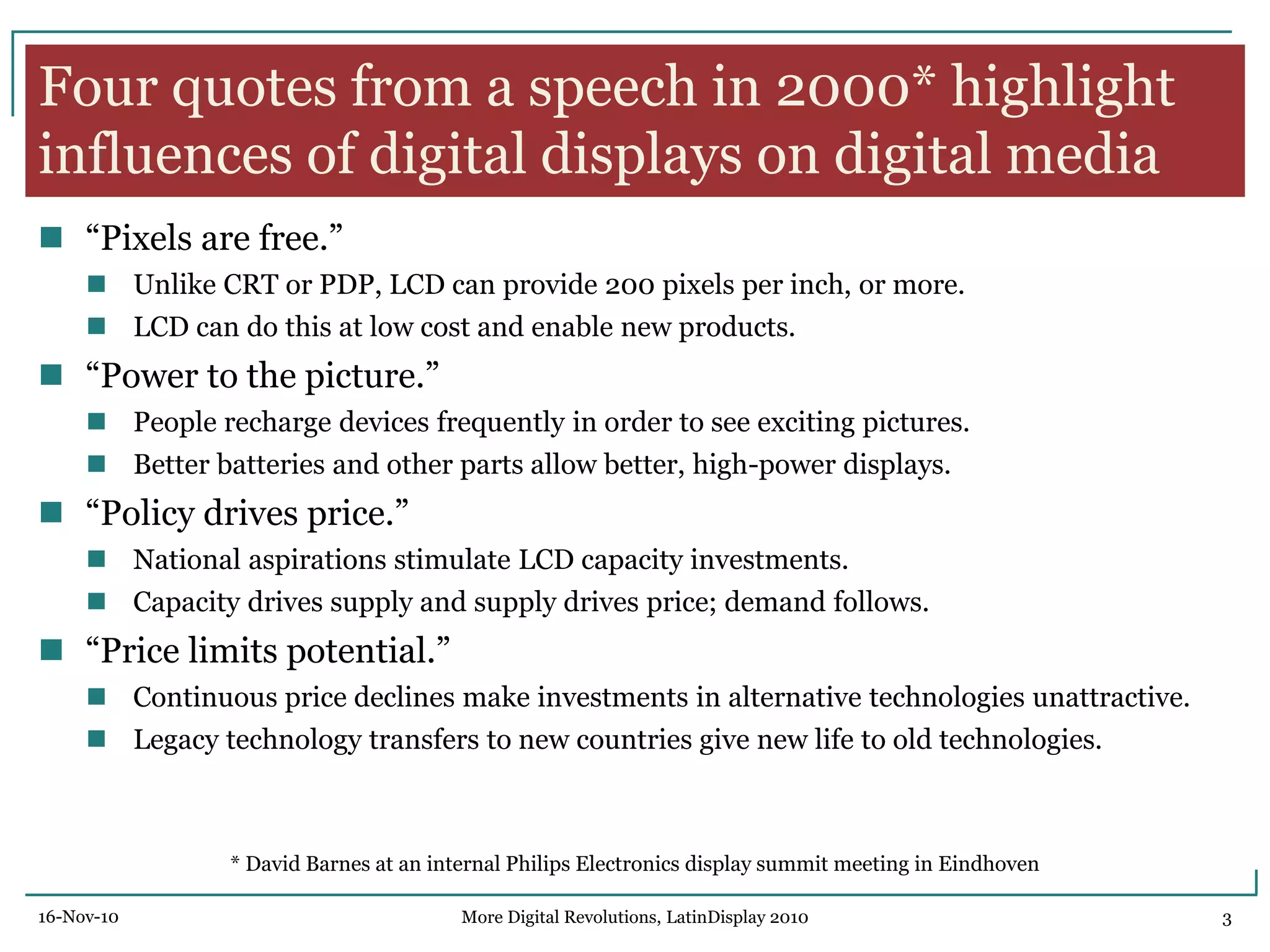
Four quotes from a speech in 2000* highlight
influences of digital displays on digital media
 ―Pixels are free.‖
 Unlike CRT or PDP, LCD can provide 200 pixels per inch, or more.
 LCD can do this at low cost and enable new products.
 ―Power to the picture.‖
 People recharge devices frequently in order to see exciting pictures.
 Better batteries and other parts allow better, high-power displays.
 ―Policy drives price.‖
 National aspirations stimulate LCD capacity investments.
 Capacity drives supply and supply drives price; demand follows.
 ―Price limits potential.‖
 Continuous price declines make investments in alternative technologies unattractive.
 Legacy technology transfers to new countries give new life to old technologies.
* David Barnes at an internal Philips Electronics display summit meeting in Eindhoven
16-Nov-10 3More Digital Revolutions, LatinDisplay 2010
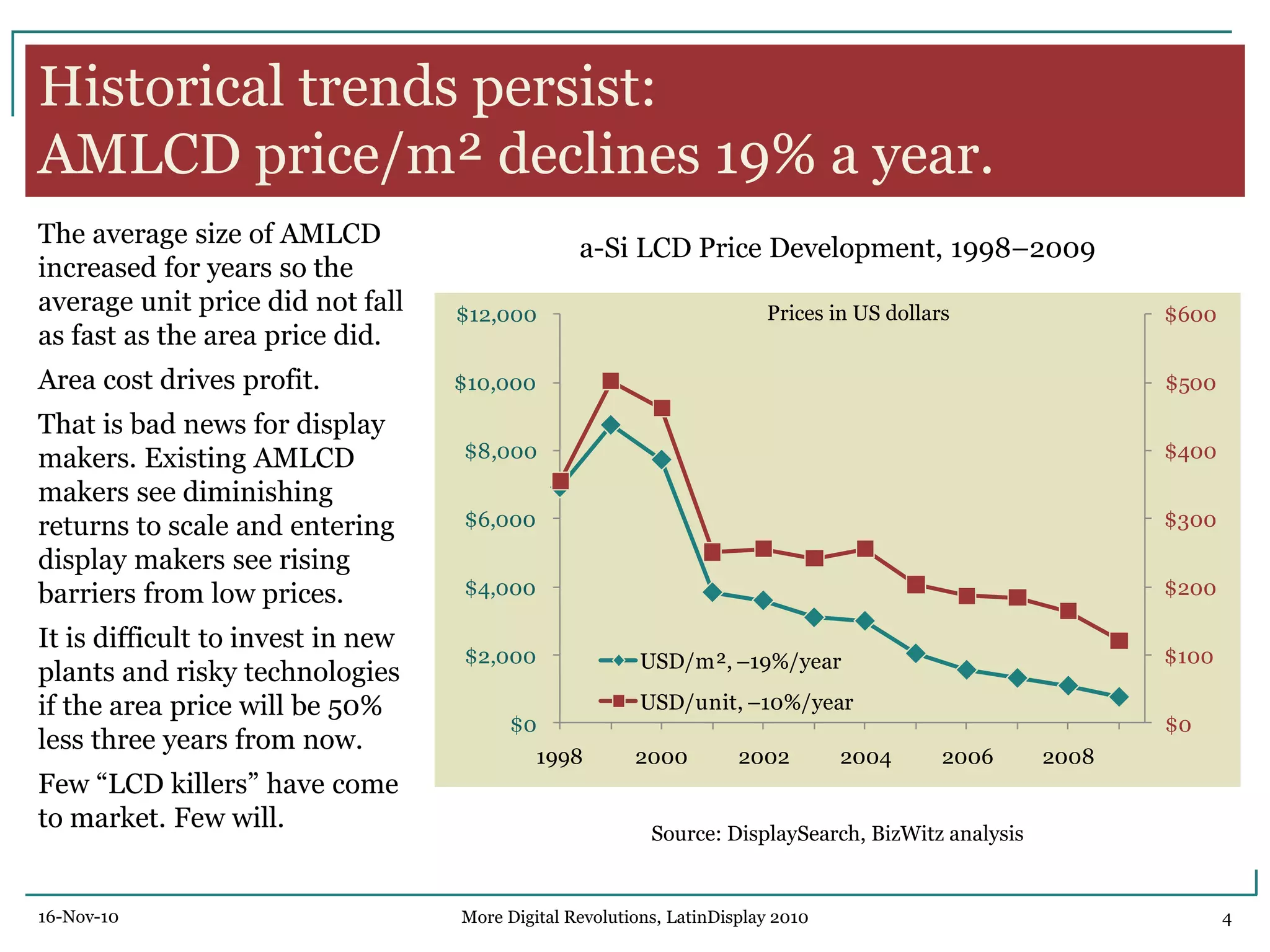
Historical trends persist:
AMLCD price/m² declines 19% a year.
The average size of AMLCD
increased for years so the
average unit price did not fall
as fast as the area price did.
Area cost drives profit.
That is bad news for display
makers. Existing AMLCD
makers see diminishing
returns to scale and entering
display makers see rising
barriers from low prices.
It is difficult to invest in new
plants and risky technologies
if the area price will be 50%
less three years from now.
Few ―LCD killers‖ have come
to market. Few will.
a-Si LCD Price Development, 1998–2009
Source: DisplaySearch, BizWitz analysis
$0
$100
$200
$300
$400
$500
$600
$0
$2,000
$4,000
$6,000
$8,000
$10,000
$12,000
1998 2000 2002 2004 2006 2008
USD/m², –19%/year
USD/unit, –10%/year
Prices in US dollars
16-Nov-10 4More Digital Revolutions, LatinDisplay 2010
The pace of AMLCD price reduction for
eReader-sized panels limits new tech entry
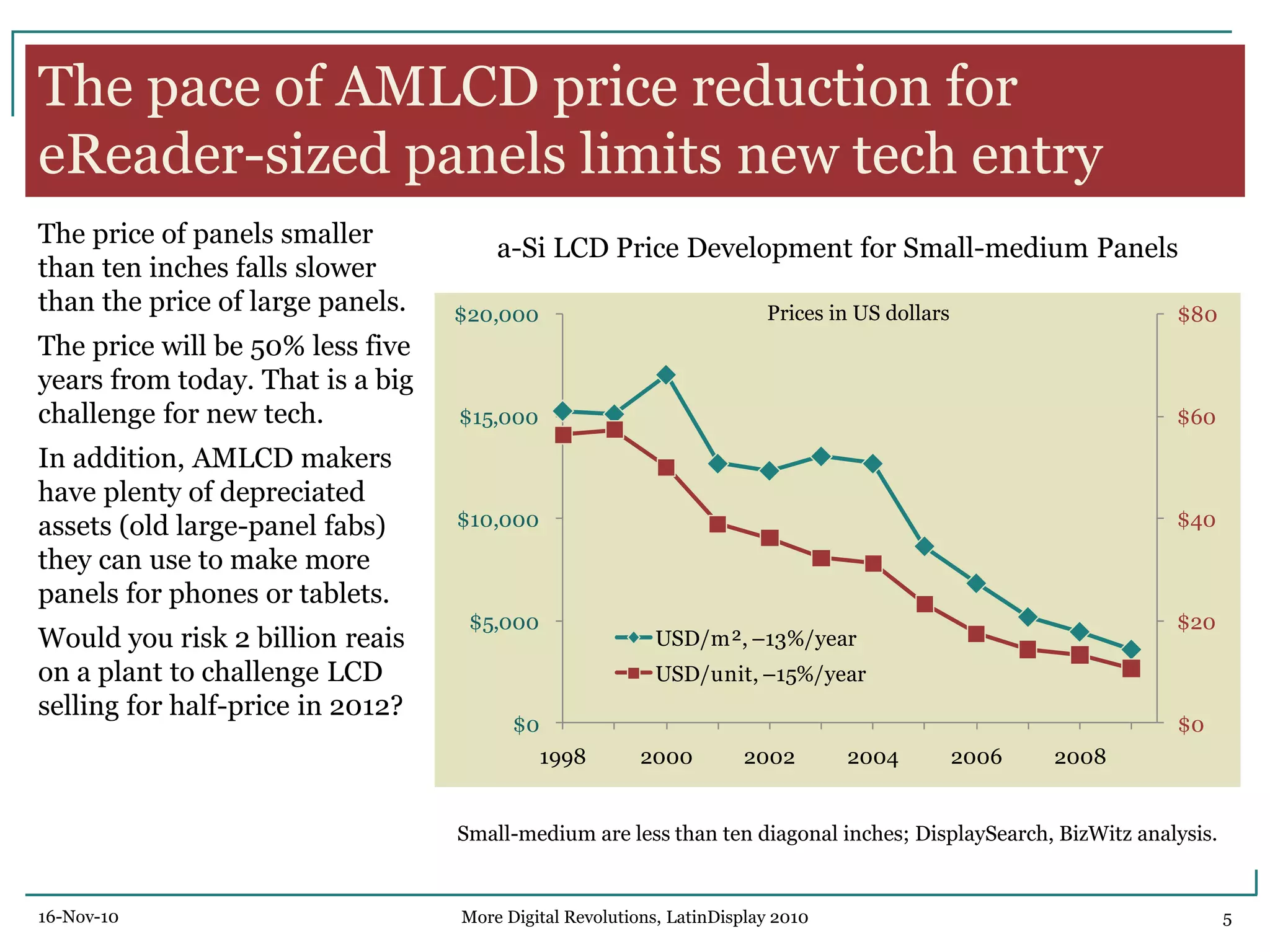
The price of panels smaller
than ten inches falls slower
than the price of large panels.
The price will be 50% less five
years from today. That is a big
challenge for new tech.
In addition, AMLCD makers
have plenty of depreciated
assets (old large-panel fabs)
they can use to make more
panels for phones or tablets.
Would you risk 2 billion reais
on a plant to challenge LCD
selling for half-price in 2012?
a-Si LCD Price Development for Small-medium Panels
Small-medium are less than ten diagonal inches; DisplaySearch, BizWitz analysis.
$0
$20
$40
$60
$80
$0
$5,000
$10,000
$15,000
$20,000
1998 2000 2002 2004 2006 2008
USD/m², –13%/year
USD/unit, –15%/year
Prices in US dollars
16-Nov-10 5More Digital Revolutions, LatinDisplay 2010
Cuidado: most forecasts are made for new-tech
managers seeking money, not for most of us.
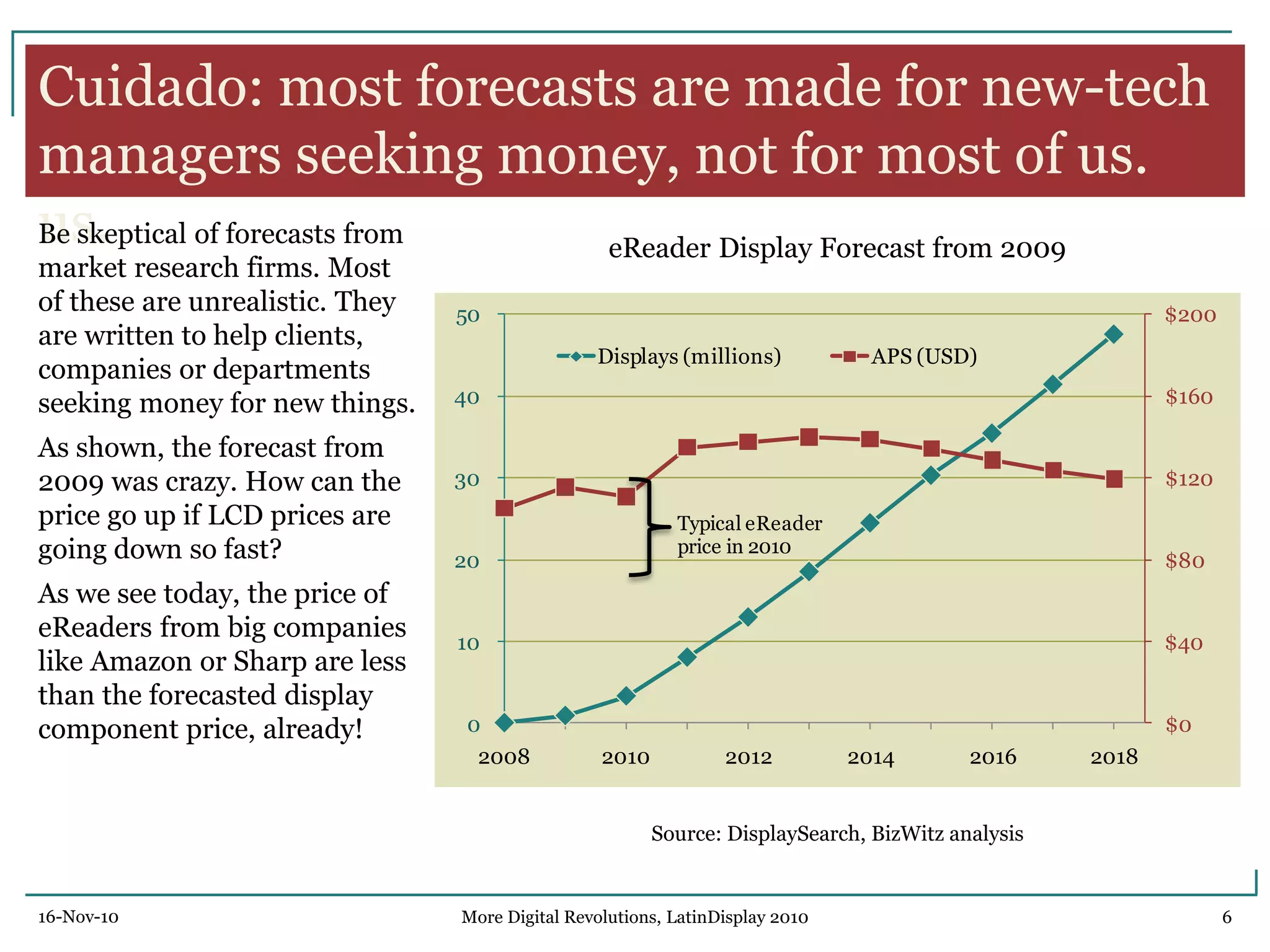
us.Be skeptical of forecasts from
market research firms. Most
of these are unrealistic. They
are written to help clients,
companies or departments
seeking money for new things.
As shown, the forecast from
2009 was crazy. How can the
price go up if LCD prices are
going down so fast?
As we see today, the price of
eReaders from big companies
like Amazon or Sharp are less
than the forecasted display
component price, already!
eReader Display Forecast from 2009
Source: DisplaySearch, BizWitz analysis
$0
$40
$80
$120
$160
$200
0
10
20
30
40
50
2008 2010 2012 2014 2016 2018
Displays (millions) APS (USD)
Typical eReader
price in 2010
16-Nov-10 6More Digital Revolutions, LatinDisplay 2010
Digital displays have enabled hand-held TV and
internet commerce everywhere, everywhen.
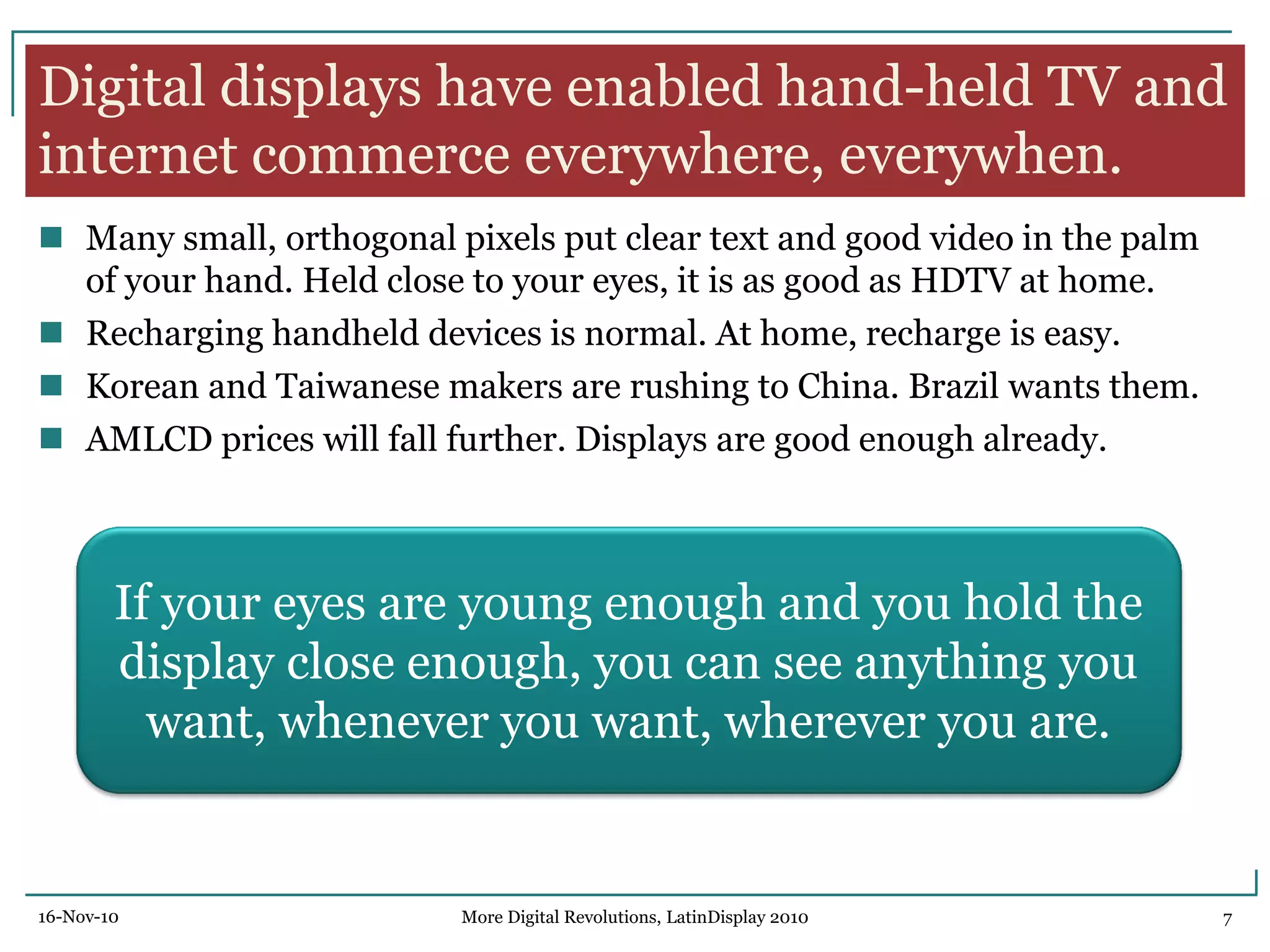
 Many small, orthogonal pixels put clear text and good video in the palm
of your hand. Held close to your eyes, it is as good as HDTV at home.
 Recharging handheld devices is normal. At home, recharge is easy.
 Korean and Taiwanese makers are rushing to China. Brazil wants them.
 AMLCD prices will fall further. Displays are good enough already.
If your eyes are young enough and you hold the
display close enough, you can see anything you
want, whenever you want, wherever you are.
16-Nov-10 7More Digital Revolutions, LatinDisplay 2010
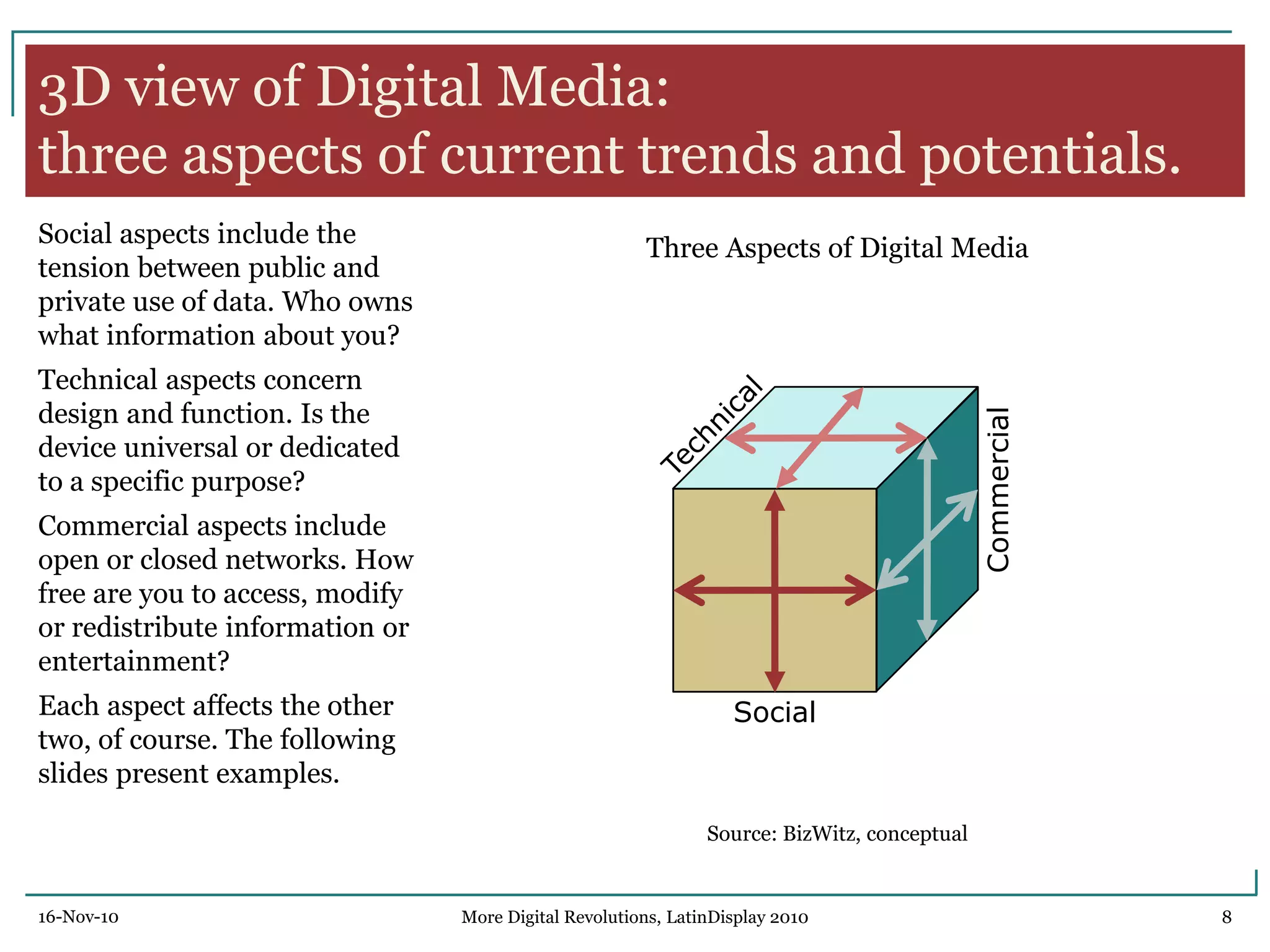
3D view of Digital Media:
three aspects of current trends and potentials.
Social aspects include the
tension between public and
private use of data. Who owns
what information about you?
Technical aspects concern
design and function. Is the
device universal or dedicated
to a specific purpose?
Commercial aspects include
open or closed networks. How
free are you to access, modify
or redistribute information or
entertainment?
Each aspect affects the other
two, of course. The following
slides present examples.
Three Aspects of Digital Media
Source: BizWitz, conceptual
Social
Commercial
16-Nov-10 8More Digital Revolutions, LatinDisplay 2010
Commercial versus Social interests:
significant regional differences and changes
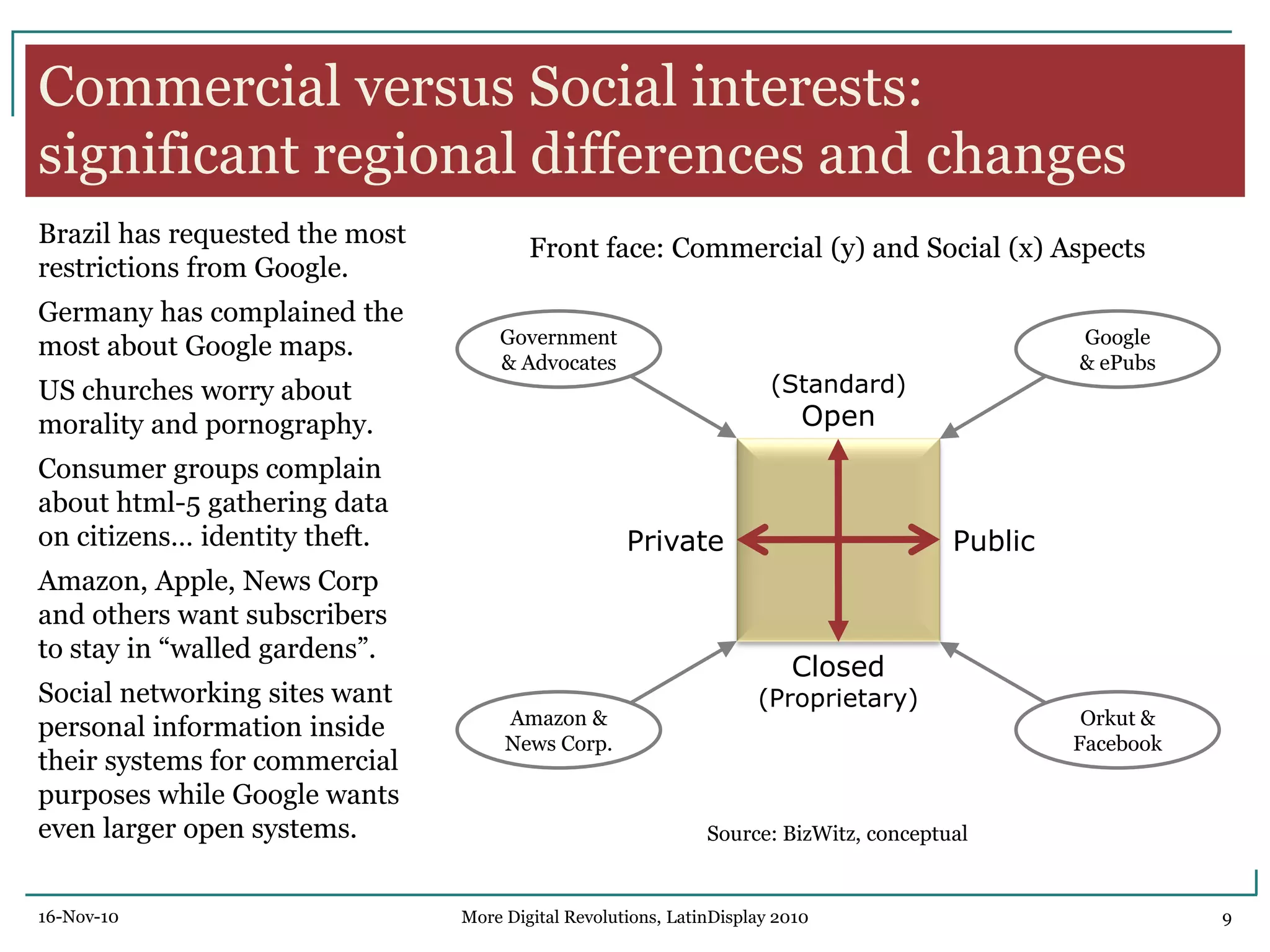
Brazil has requested the most
restrictions from Google.
Germany has complained the
most about Google maps.
US churches worry about
morality and pornography.
Consumer groups complain
about html-5 gathering data
on citizens… identity theft.
Amazon, Apple, News Corp
and others want subscribers
to stay in ―walled gardens‖.
Social networking sites want
personal information inside
their systems for commercial
purposes while Google wants
even larger open systems.
Front face: Commercial (y) and Social (x) Aspects
Source: BizWitz, conceptual
(Standard)
Open
Public
Closed
(Proprietary)
Private
Amazon &
News Corp.
Orkut &
Facebook
Google
& ePubs
Government
& Advocates
16-Nov-10 9More Digital Revolutions, LatinDisplay 2010
Digital consumption and Social participation
vary from person to person.
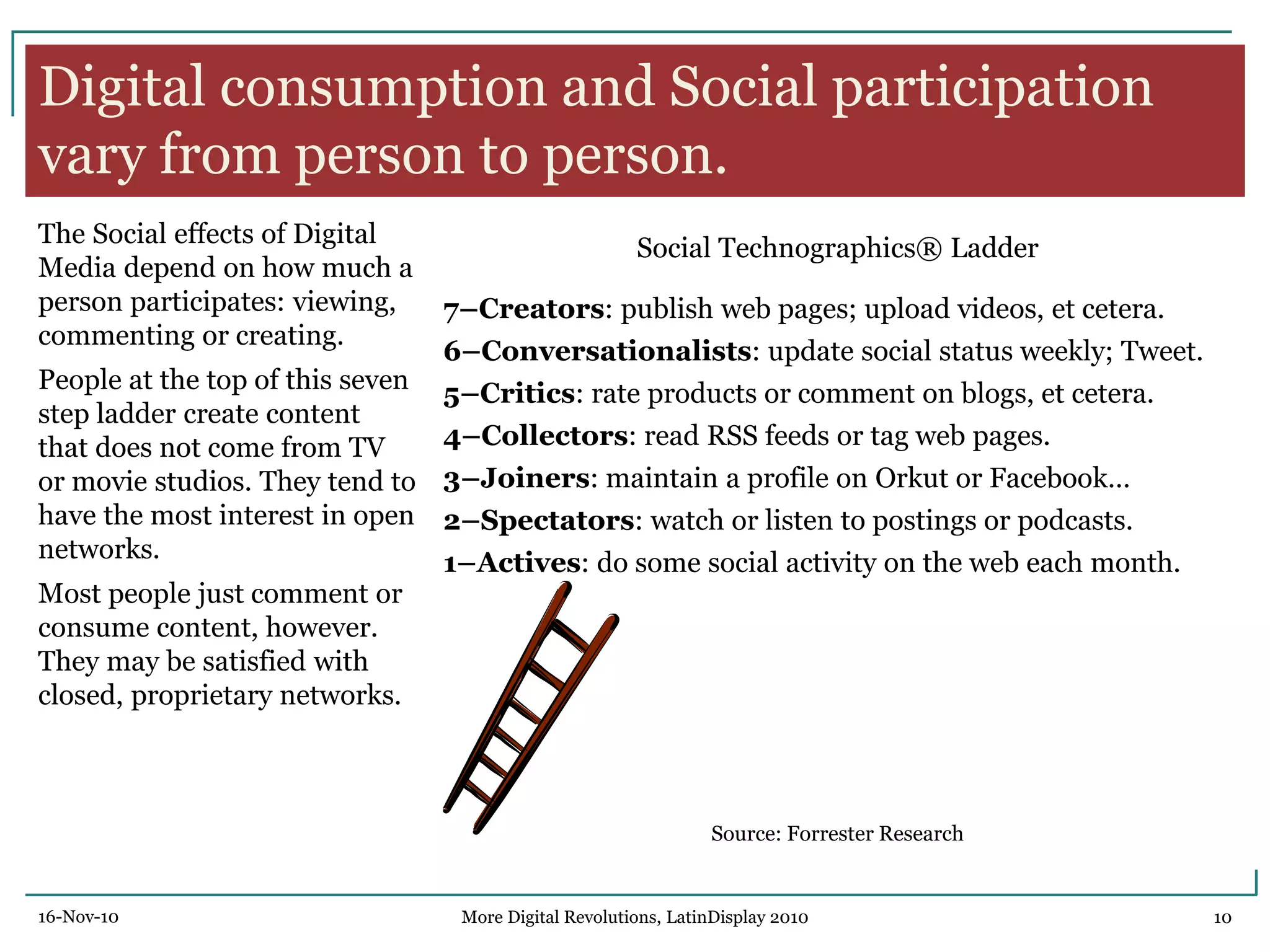
The Social effects of Digital
Media depend on how much a
person participates: viewing,
commenting or creating.
People at the top of this seven
step ladder create content
that does not come from TV
or movie studios. They tend to
have the most interest in open
networks.
Most people just comment or
consume content, however.
They may be satisfied with
closed, proprietary networks.
7–Creators: publish web pages; upload videos, et cetera.
6–Conversationalists: update social status weekly; Tweet.
5–Critics: rate products or comment on blogs, et cetera.
4–Collectors: read RSS feeds or tag web pages.
3–Joiners: maintain a profile on Orkut or Facebook…
2–Spectators: watch or listen to postings or podcasts.
1–Actives: do some social activity on the web each month.
Social Technographics® Ladder
Source: Forrester Research
16-Nov-10 10More Digital Revolutions, LatinDisplay 2010
Digital consumption and Social participation
vary from place to place.
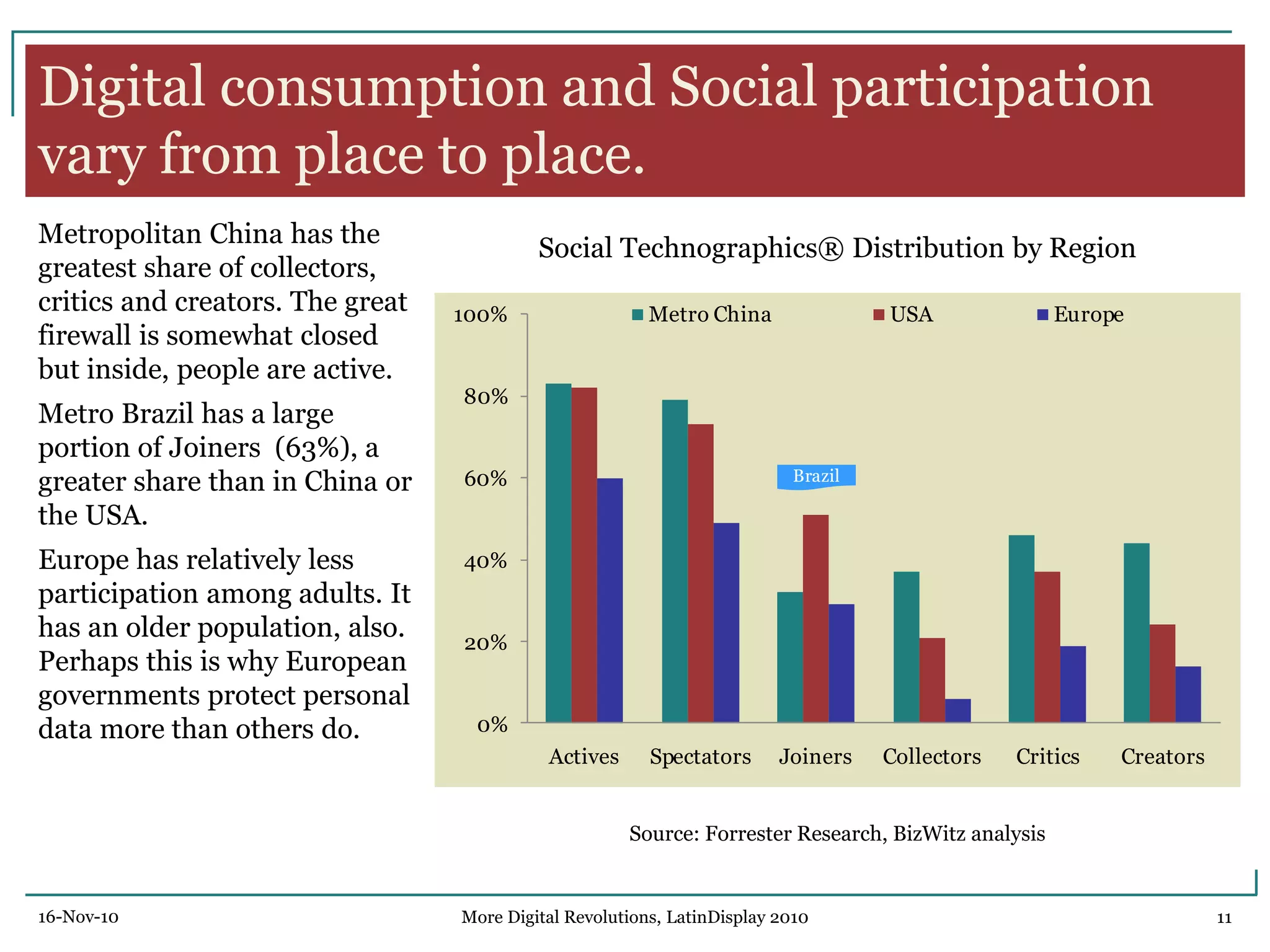
Metropolitan China has the
greatest share of collectors,
critics and creators. The great
firewall is somewhat closed
but inside, people are active.
Metro Brazil has a large
portion of Joiners (63%), a
greater share than in China or
the USA.
Europe has relatively less
participation among adults. It
has an older population, also.
Perhaps this is why European
governments protect personal
data more than others do.
Social Technographics® Distribution by Region
Source: Forrester Research, BizWitz analysis
0%
20%
40%
60%
80%
100%
Actives Spectators Joiners Collectors Critics Creators
Metro China USA Europe
Brazil
16-Nov-10 11More Digital Revolutions, LatinDisplay 2010
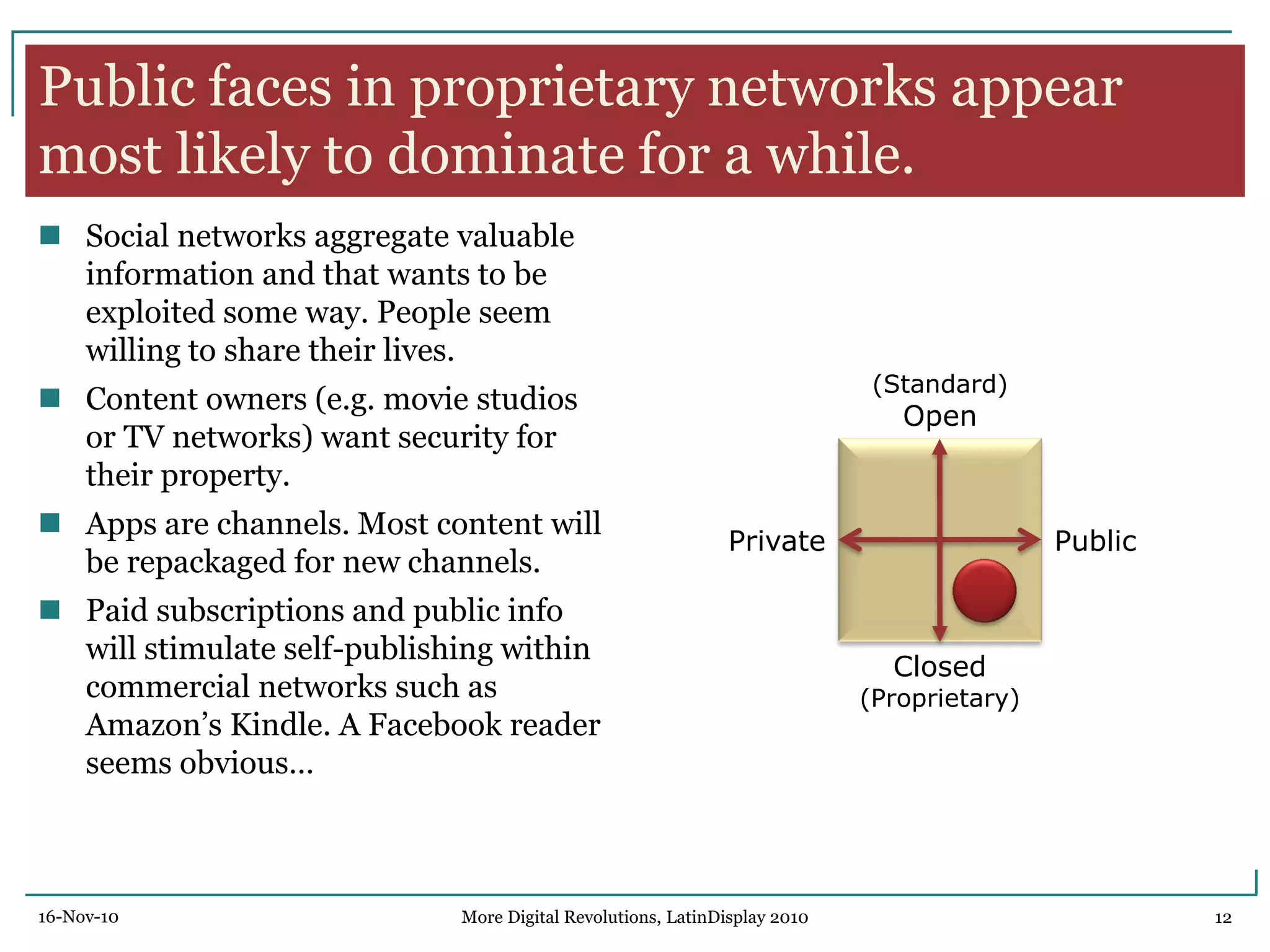
Public faces in proprietary networks appear
most likely to dominate for a while.
 Social networks aggregate valuable
information and that wants to be
exploited some way. People seem
willing to share their lives.
 Content owners (e.g. movie studios
or TV networks) want security for
their property.
 Apps are channels. Most content will
be repackaged for new channels.
 Paid subscriptions and public info
will stimulate self-publishing within
commercial networks such as
Amazon‘s Kindle. A Facebook reader
seems obvious…
(Standard)
Open
Public
Closed
(Proprietary)
Private
16-Nov-10 12More Digital Revolutions, LatinDisplay 2010
Technical versus Social interests:
general-purpose devices for the young at heart.
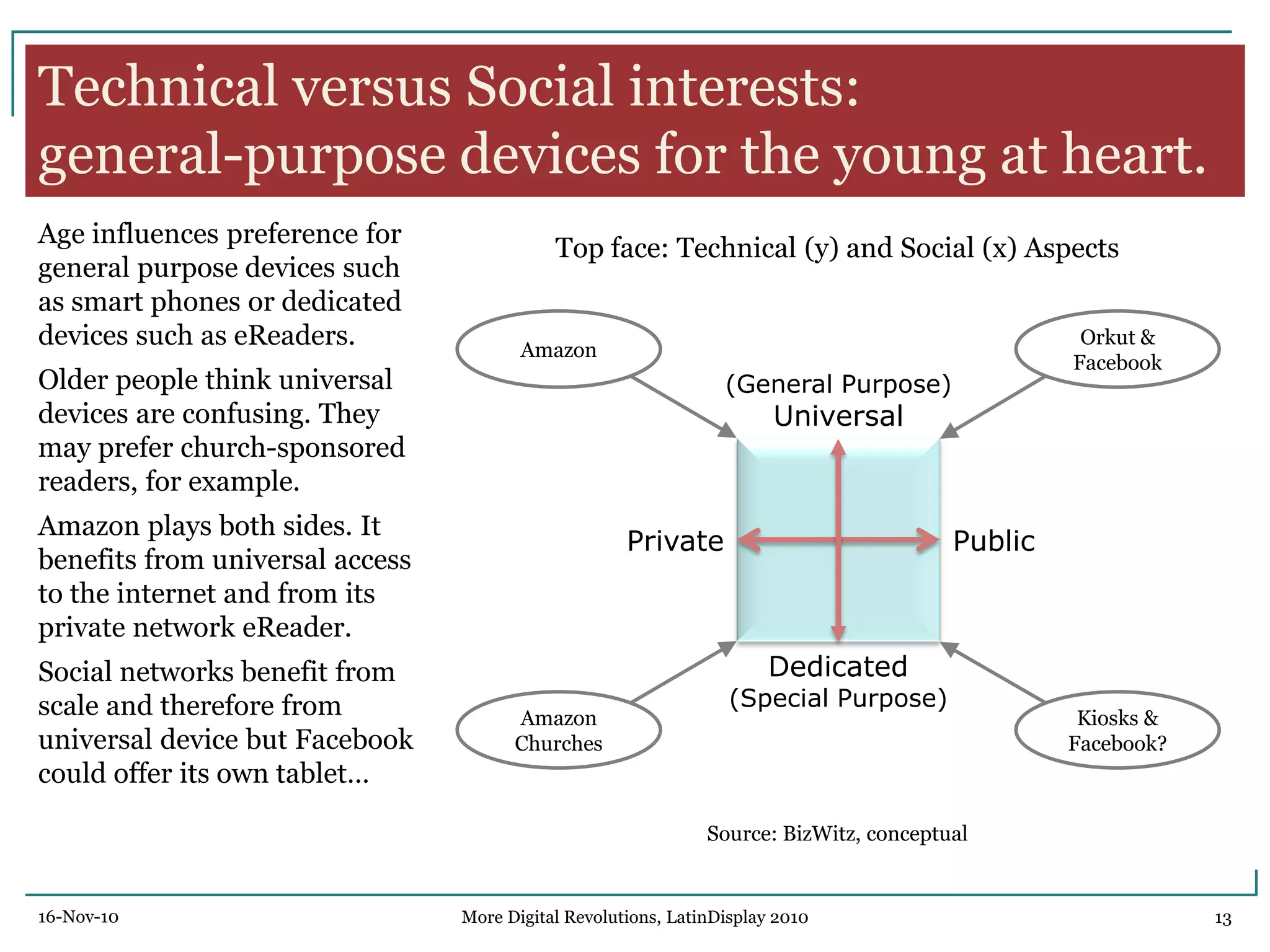
Age influences preference for
general purpose devices such
as smart phones or dedicated
devices such as eReaders.
Older people think universal
devices are confusing. They
may prefer church-sponsored
readers, for example.
Amazon plays both sides. It
benefits from universal access
to the internet and from its
private network eReader.
Social networks benefit from
scale and therefore from
universal device but Facebook
could offer its own tablet…
Top face: Technical (y) and Social (x) Aspects
Source: BizWitz, conceptual
(General Purpose)
Universal
Public
Dedicated
(Special Purpose)
Private
Amazon
Churches
Kiosks &
Facebook?
Orkut &
Facebook
Amazon
16-Nov-10 13More Digital Revolutions, LatinDisplay 2010
General-purpose, multi-functional devices are
most popular, even in aging populations.
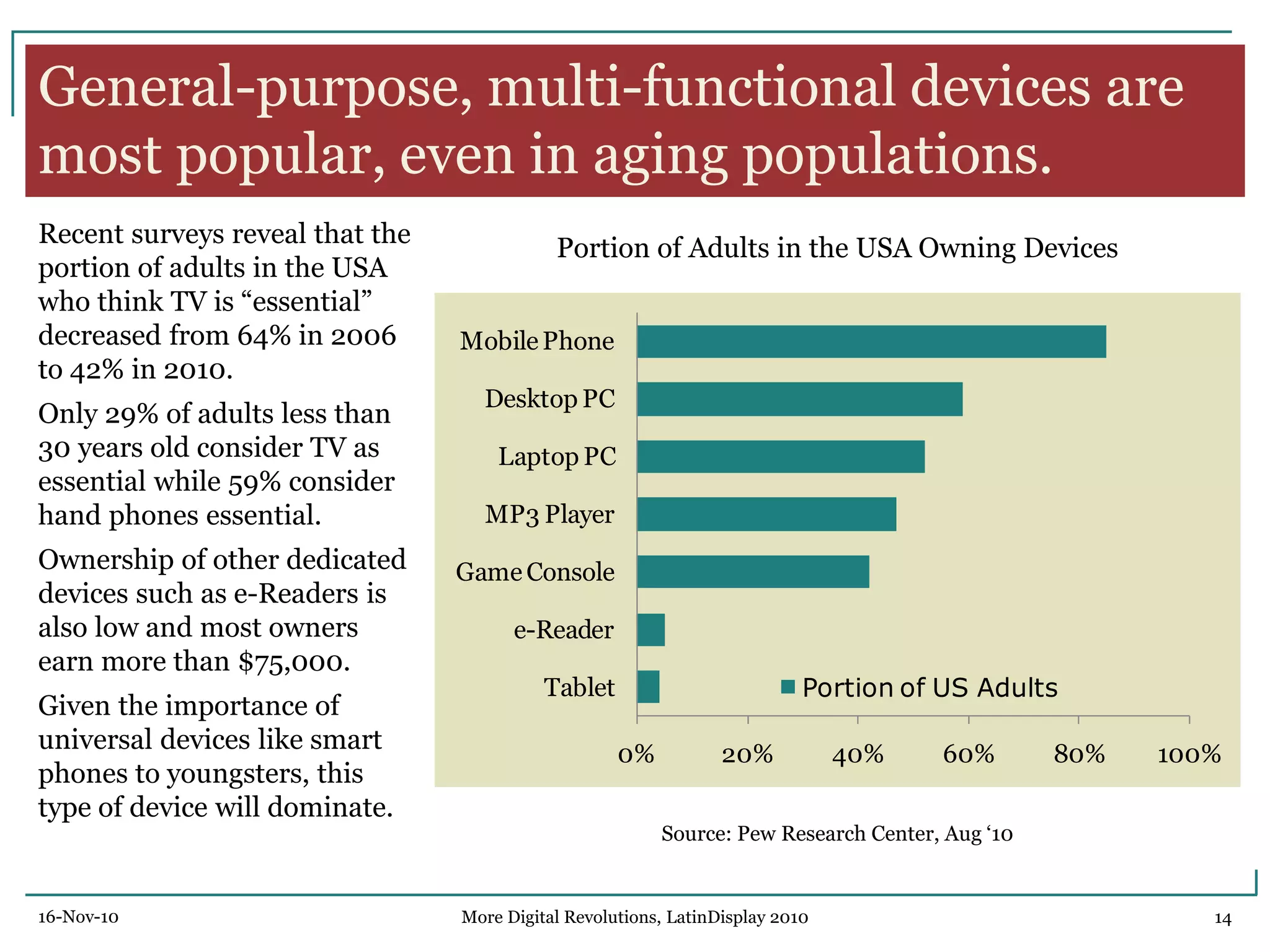
Recent surveys reveal that the
portion of adults in the USA
who think TV is ―essential‖
decreased from 64% in 2006
to 42% in 2010.
Only 29% of adults less than
30 years old consider TV as
essential while 59% consider
hand phones essential.
Ownership of other dedicated
devices such as e-Readers is
also low and most owners
earn more than $75,000.
Given the importance of
universal devices like smart
phones to youngsters, this
type of device will dominate.
Portion of Adults in the USA Owning Devices
Source: Pew Research Center, Aug ‗10
0% 20% 40% 60% 80% 100%
Tablet
e-Reader
Game Console
MP3 Player
Laptop PC
Desktop PC
MobilePhone
Portion of US Adults
16-Nov-10 14More Digital Revolutions, LatinDisplay 2010
Universal devices may dominate Dedicated
ones but Public/Private may be balanced.
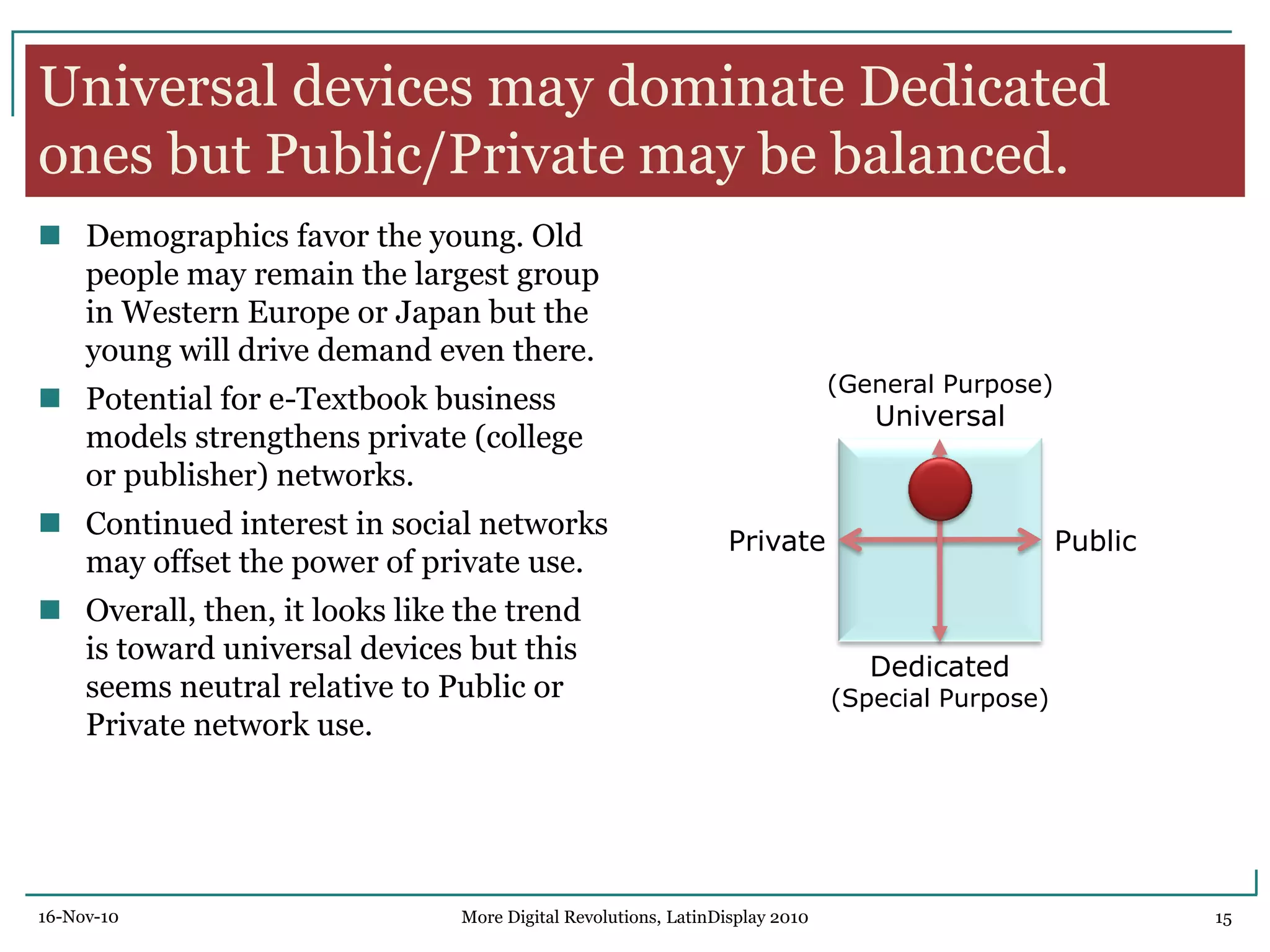
 Demographics favor the young. Old
people may remain the largest group
in Western Europe or Japan but the
young will drive demand even there.
 Potential for e-Textbook business
models strengthens private (college
or publisher) networks.
 Continued interest in social networks
may offset the power of private use.
 Overall, then, it looks like the trend
is toward universal devices but this
seems neutral relative to Public or
Private network use.
(General Purpose)
Universal
Public
Dedicated
(Special Purpose)
Private
16-Nov-10 15More Digital Revolutions, LatinDisplay 2010
Commercial versus Technical interests:
internal and external conflicts.
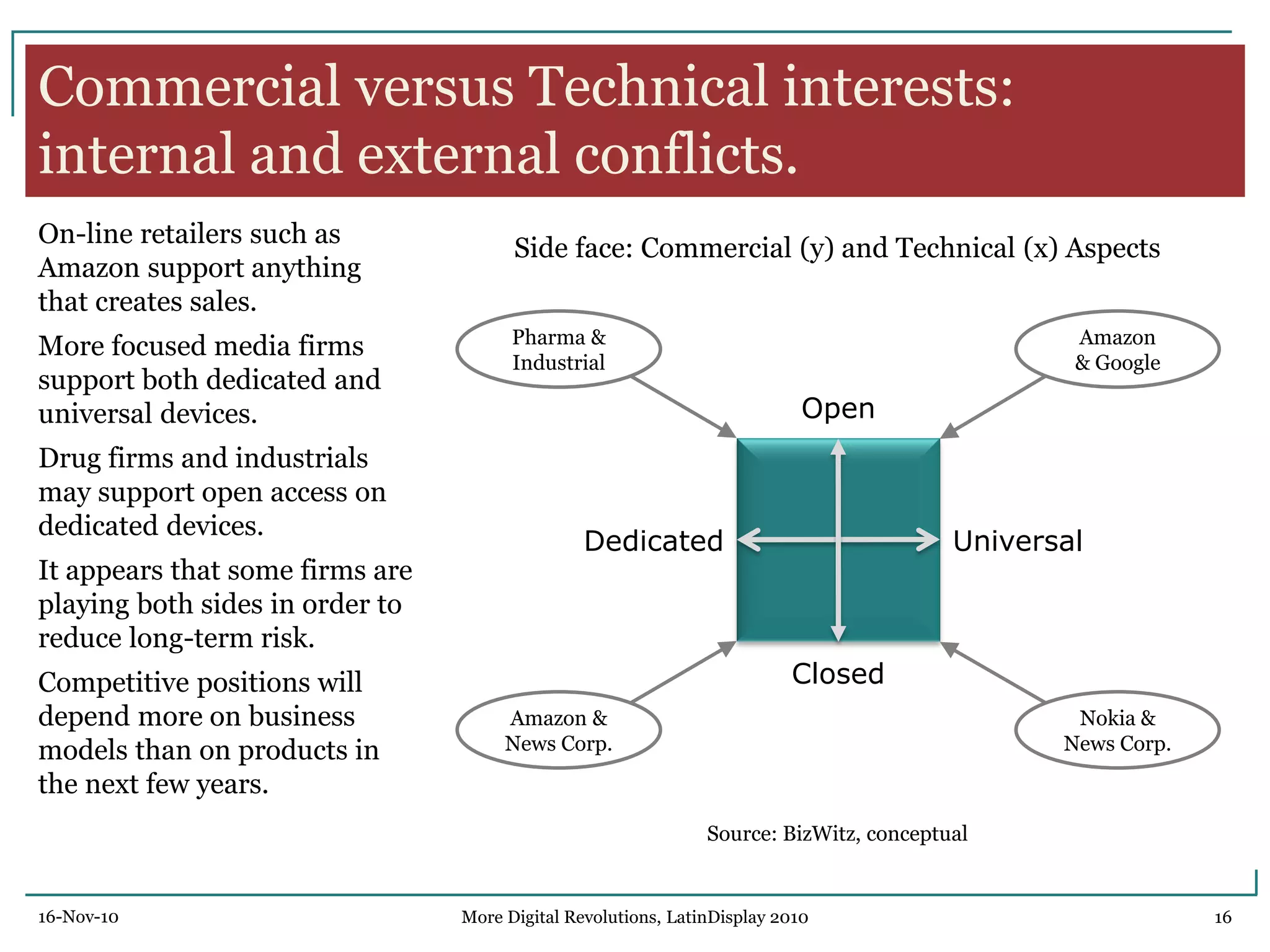
On-line retailers such as
Amazon support anything
that creates sales.
More focused media firms
support both dedicated and
universal devices.
Drug firms and industrials
may support open access on
dedicated devices.
It appears that some firms are
playing both sides in order to
reduce long-term risk.
Competitive positions will
depend more on business
models than on products in
the next few years.
Side face: Commercial (y) and Technical (x) Aspects
Source: BizWitz, conceptual
Open
Universal
Closed
Dedicated
Amazon &
News Corp.
Nokia &
News Corp.
Amazon
& Google
Pharma &
Industrial
16-Nov-10 16More Digital Revolutions, LatinDisplay 2010
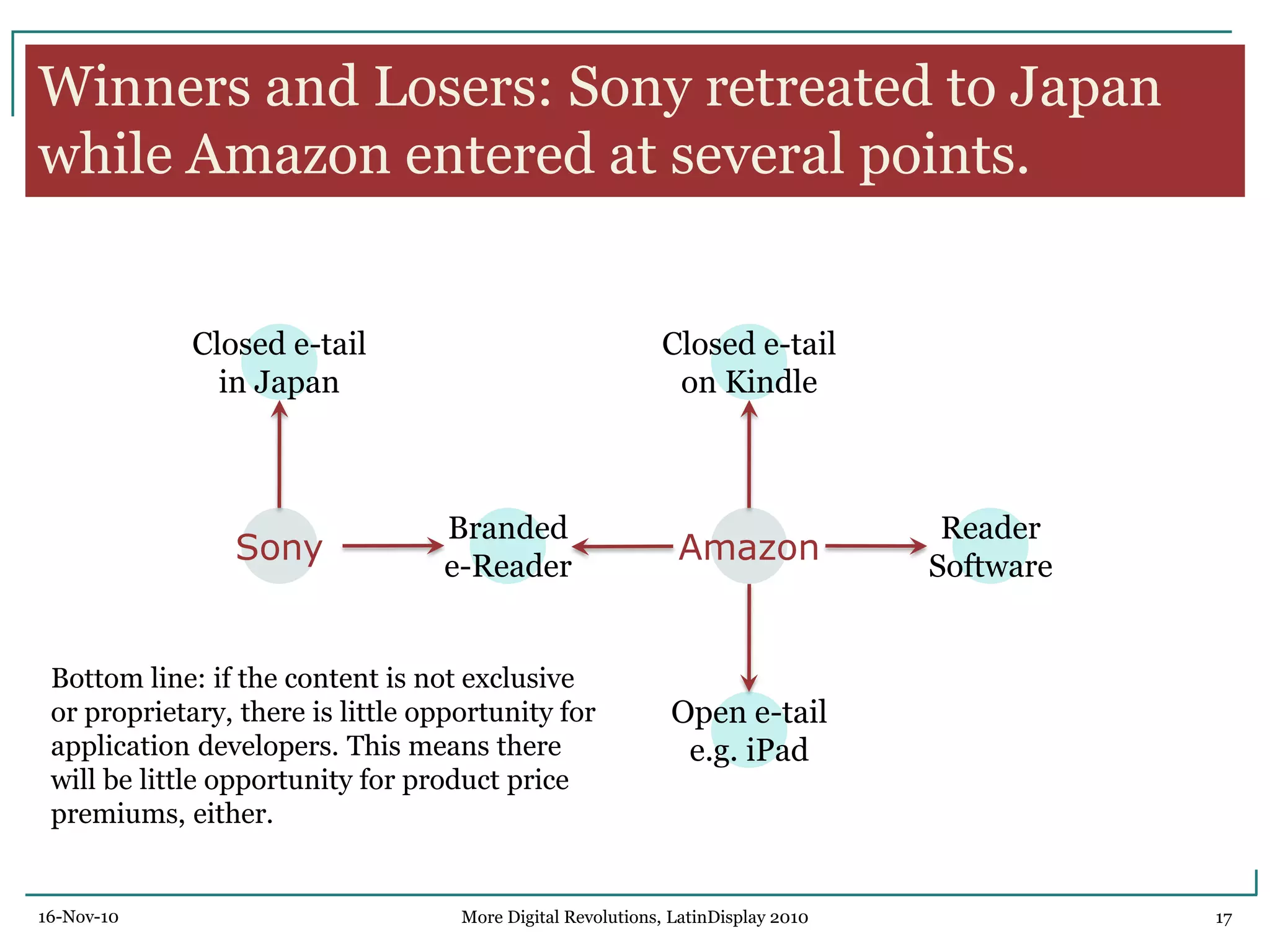
Winners and Losers: Sony retreated to Japan
while Amazon entered at several points.
AmazonSony
Closed e-tail
in Japan
Closed e-tail
on Kindle
Open e-tail
e.g. iPad
Reader
Software
Branded
e-Reader
Bottom line: if the content is not exclusive
or proprietary, there is little opportunity for
application developers. This means there
will be little opportunity for product price
premiums, either.
16-Nov-10 17More Digital Revolutions, LatinDisplay 2010
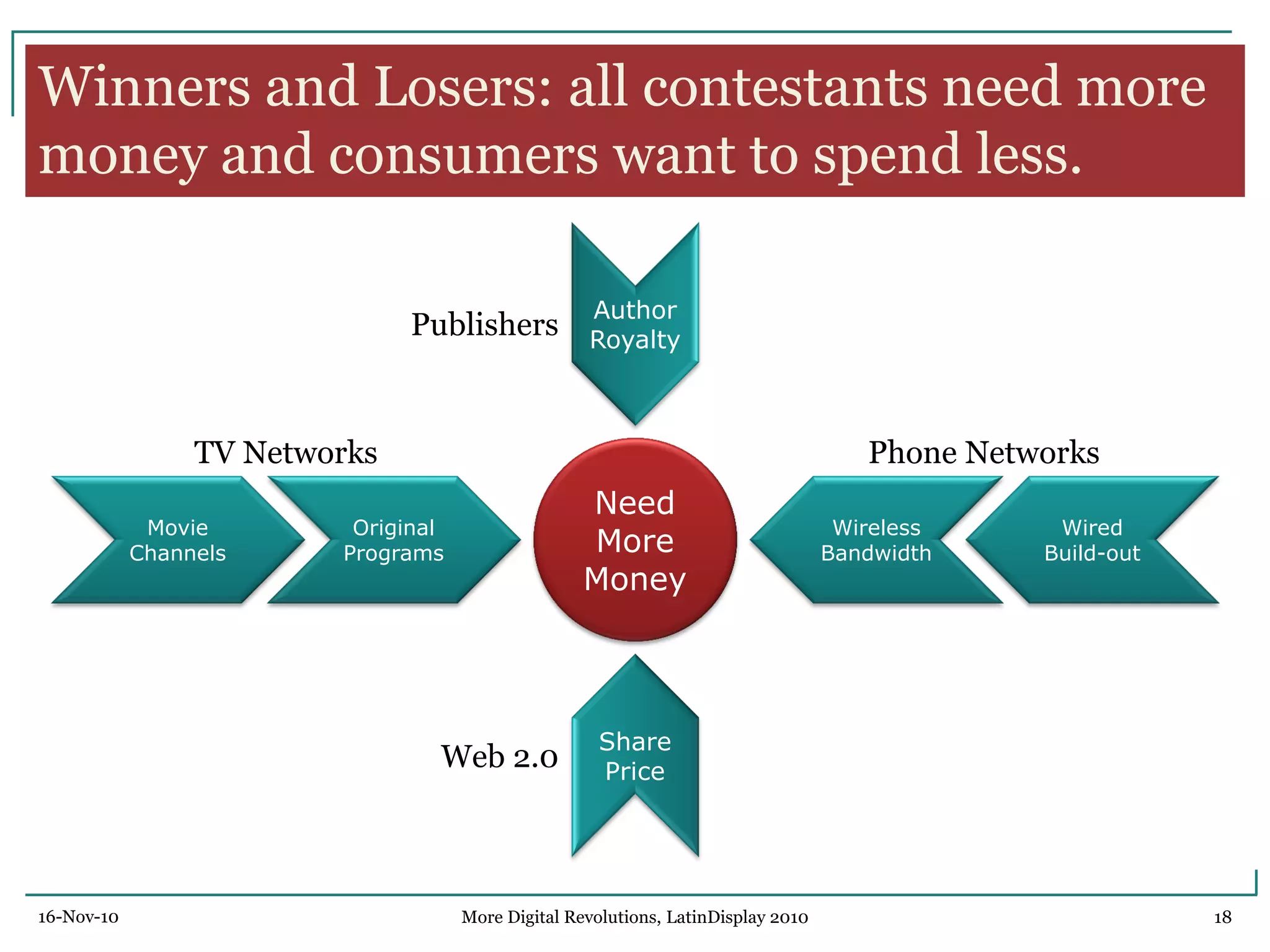
Winners and Losers: all contestants need more
money and consumers want to spend less.
16-Nov-10 More Digital Revolutions, LatinDisplay 2010 18
Movie
Channels
Share
Price
Author
Royalty
Wireless
Bandwidth
Original
Programs
Need
More
Money
Wired
Build-out
Publishers
TV Networks Phone Networks
Web 2.0
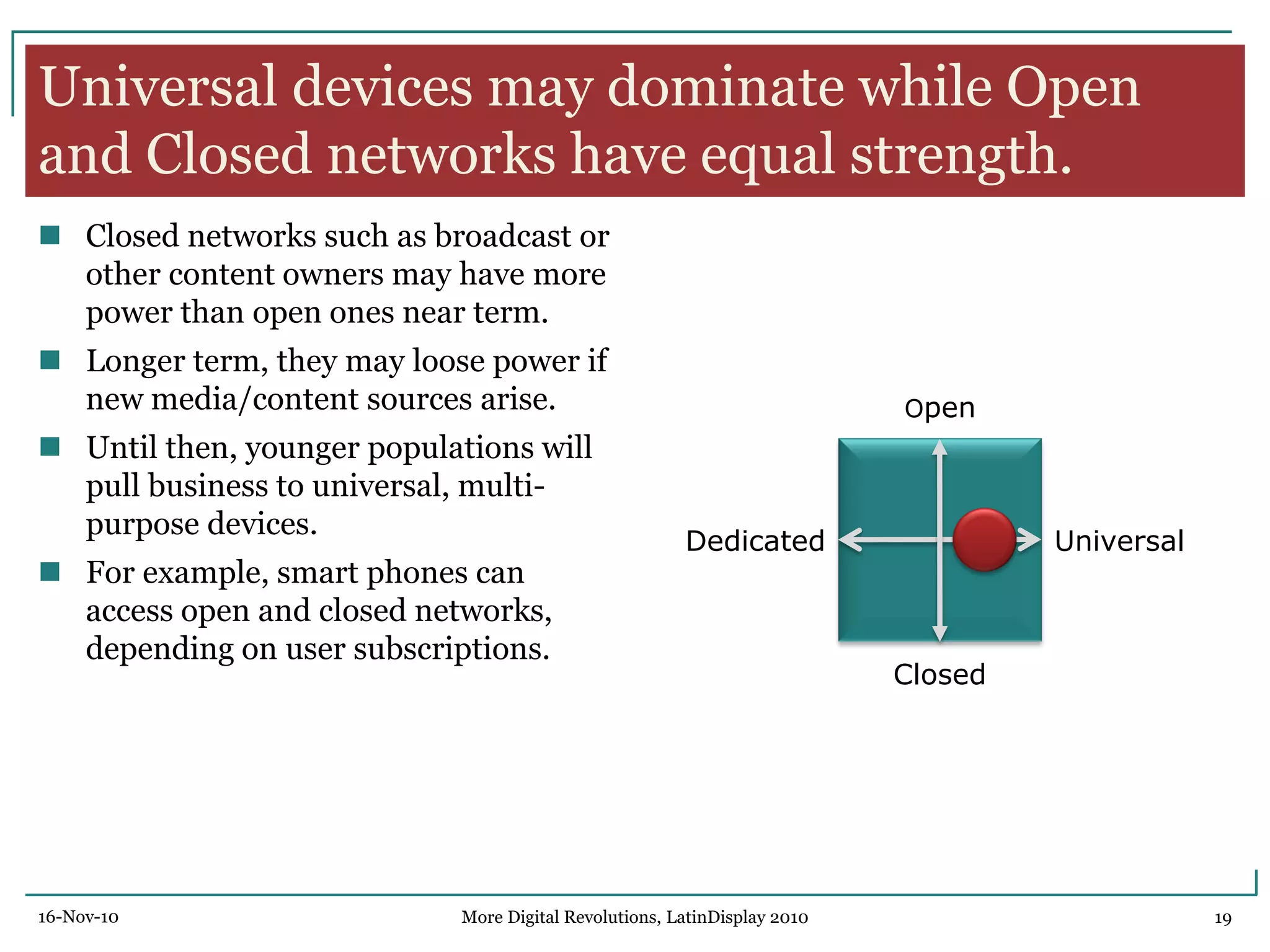
Universal devices may dominate while Open
and Closed networks have equal strength.
 Closed networks such as broadcast or
other content owners may have more
power than open ones near term.
 Longer term, they may loose power if
new media/content sources arise.
 Until then, younger populations will
pull business to universal, multi-
purpose devices.
 For example, smart phones can
access open and closed networks,
depending on user subscriptions.
Open
Universal
Closed
Dedicated
16-Nov-10 19More Digital Revolutions, LatinDisplay 2010
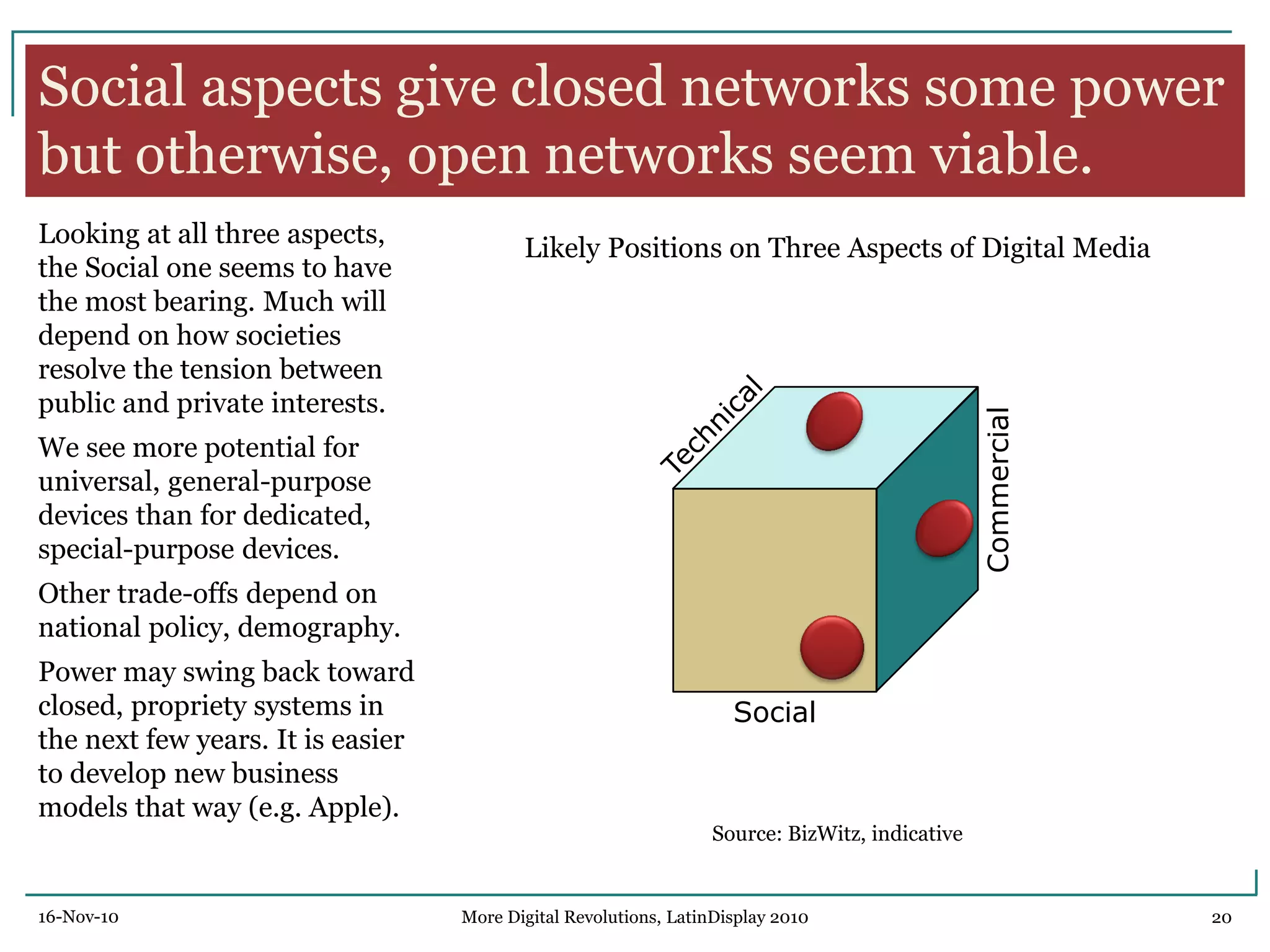
Social aspects give closed networks some power
but otherwise, open networks seem viable.
Looking at all three aspects,
the Social one seems to have
the most bearing. Much will
depend on how societies
resolve the tension between
public and private interests.
We see more potential for
universal, general-purpose
devices than for dedicated,
special-purpose devices.
Other trade-offs depend on
national policy, demography.
Power may swing back toward
closed, propriety systems in
the next few years. It is easier
to develop new business
models that way (e.g. Apple).
Likely Positions on Three Aspects of Digital Media
Source: BizWitz, indicative
Social
Commercial
16-Nov-10 20More Digital Revolutions, LatinDisplay 2010
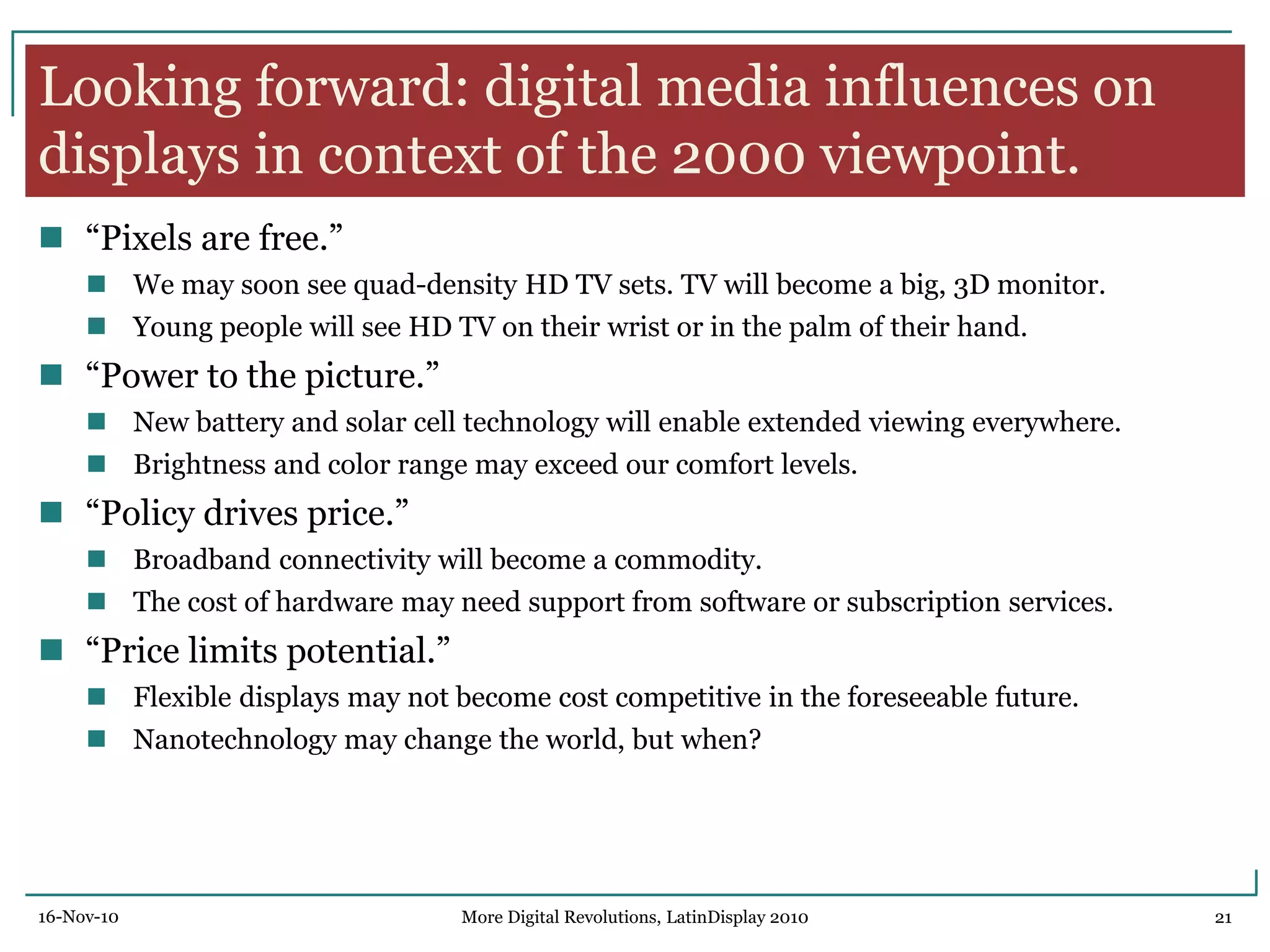
Looking forward: digital media influences on
displays in context of the 2000 viewpoint.
 ―Pixels are free.‖
 We may soon see quad-density HD TV sets. TV will become a big, 3D monitor.
 Young people will see HD TV on their wrist or in the palm of their hand.
 ―Power to the picture.‖
 New battery and solar cell technology will enable extended viewing everywhere.
 Brightness and color range may exceed our comfort levels.
 ―Policy drives price.‖
 Broadband connectivity will become a commodity.
 The cost of hardware may need support from software or subscription services.
 ―Price limits potential.‖
 Flexible displays may not become cost competitive in the foreseeable future.
 Nanotechnology may change the world, but when?
16-Nov-10 21More Digital Revolutions, LatinDisplay 2010
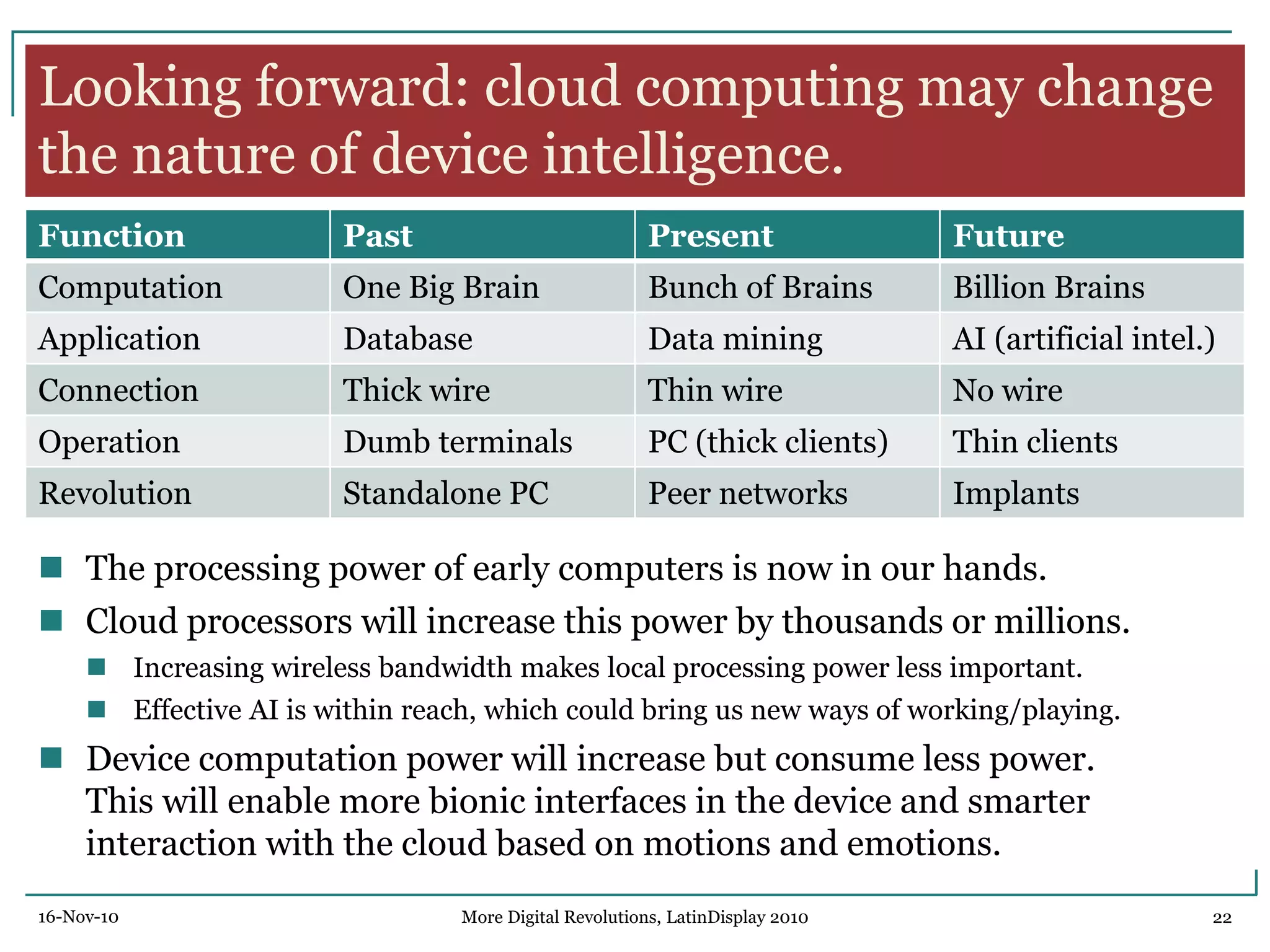
Looking forward: cloud computing may change
the nature of device intelligence.
Function Past Present Future
Computation One Big Brain Bunch of Brains Billion Brains
Application Database Data mining AI (artificial intel.)
Connection Thick wire Thin wire No wire
Operation Dumb terminals PC (thick clients) Thin clients
Revolution Standalone PC Peer networks Implants
16-Nov-10 More Digital Revolutions, LatinDisplay 2010 22
 The processing power of early computers is now in our hands.
 Cloud processors will increase this power by thousands or millions.
 Increasing wireless bandwidth makes local processing power less important.
 Effective AI is within reach, which could bring us new ways of working/playing.
 Device computation power will increase but consume less power.
This will enable more bionic interfaces in the device and smarter
interaction with the cloud based on motions and emotions.
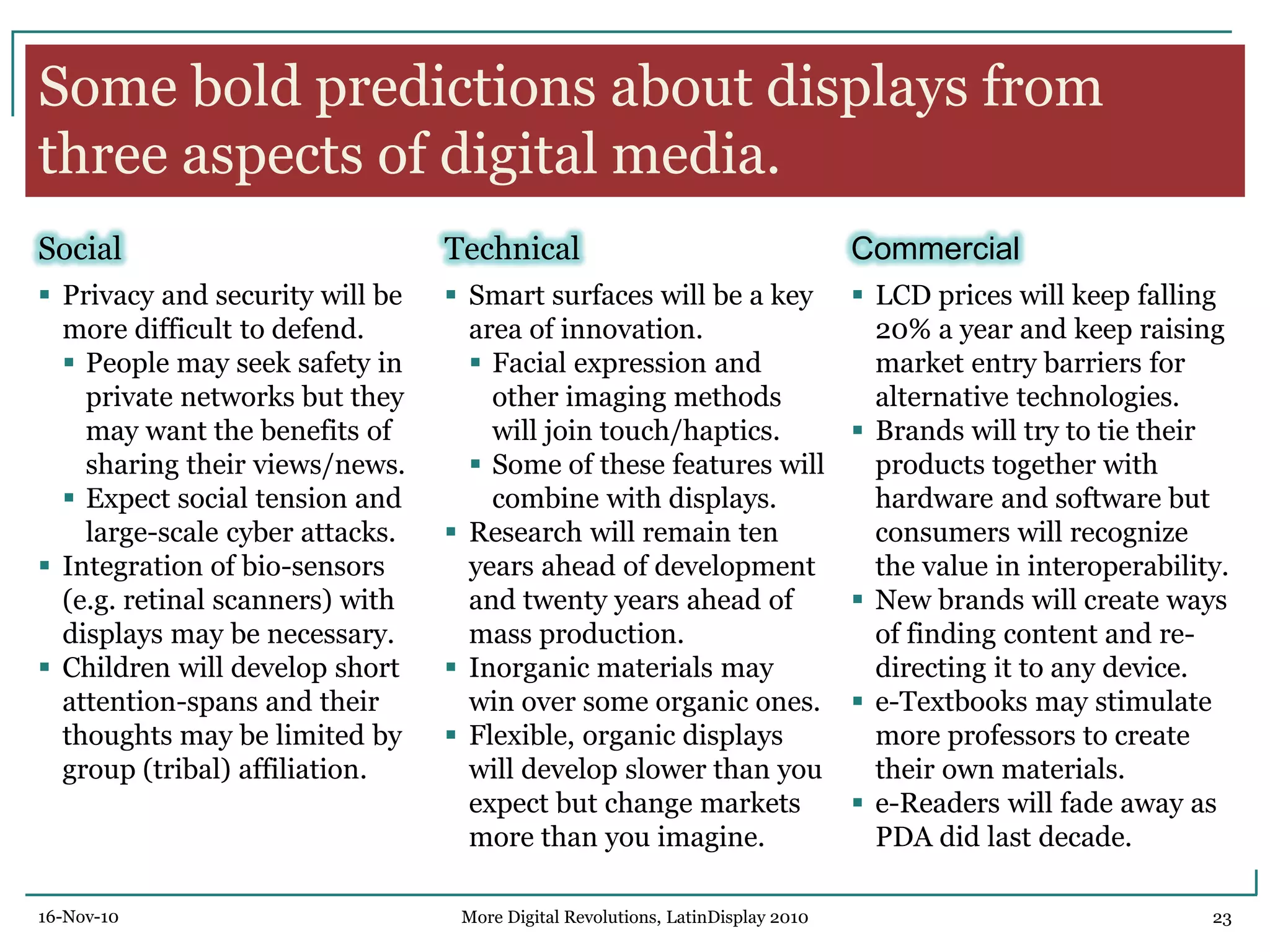
Some bold predictions about displays from
three aspects of digital media.
Social
 Privacy and security will be
more difficult to defend.
 People may seek safety in
private networks but they
may want the benefits of
sharing their views/news.
 Expect social tension and
large-scale cyber attacks.
 Integration of bio-sensors
(e.g. retinal scanners) with
displays may be necessary.
 Children will develop short
attention-spans and their
thoughts may be limited by
group (tribal) affiliation.
Technical
 Smart surfaces will be a key
area of innovation.
 Facial expression and
other imaging methods
will join touch/haptics.
 Some of these features will
combine with displays.
 Research will remain ten
years ahead of development
and twenty years ahead of
mass production.
 Inorganic materials may
win over some organic ones.
 Flexible, organic displays
will develop slower than you
expect but change markets
more than you imagine.
Commercial
 LCD prices will keep falling
20% a year and keep raising
market entry barriers for
alternative technologies.
 Brands will try to tie their
products together with
hardware and software but
consumers will recognize
the value in interoperability.
 New brands will create ways
of finding content and re-
directing it to any device.
 e-Textbooks may stimulate
more professors to create
their own materials.
 e-Readers will fade away as
PDA did last decade.
16-Nov-10 23More Digital Revolutions, LatinDisplay 2010
Thank you for listening…
www.BizWitz.com
16-Nov-10 24More Digital Revolutions, LatinDisplay 2010
M&A—JV—IPO
Project Valuation
Supply Strategies
Scenario Planning

MDR latin display

  • 1.
     by DavidBarnes  www.bizwitz.com  db@bizwitz.com  More Digital Revolutions Thoughts and predictions on Displays, how they influence Digital Media and how they are influenced in return, for LatinDisplay 2010. 16-Nov-10 1More Digital Revolutions, LatinDisplay 2010
  • 2.
    Digital revolutions inthree parts… 16-Nov-10 Starter 2 Part-1 Display Influence on Digital Media & Devices Part-2 3-D View of Digital Media • Technical • Financial • Social Part-3 Digital Media Influence on Displays
  • 3.
    Four quotes froma speech in 2000* highlight influences of digital displays on digital media  ―Pixels are free.‖  Unlike CRT or PDP, LCD can provide 200 pixels per inch, or more.  LCD can do this at low cost and enable new products.  ―Power to the picture.‖  People recharge devices frequently in order to see exciting pictures.  Better batteries and other parts allow better, high-power displays.  ―Policy drives price.‖  National aspirations stimulate LCD capacity investments.  Capacity drives supply and supply drives price; demand follows.  ―Price limits potential.‖  Continuous price declines make investments in alternative technologies unattractive.  Legacy technology transfers to new countries give new life to old technologies. * David Barnes at an internal Philips Electronics display summit meeting in Eindhoven 16-Nov-10 3More Digital Revolutions, LatinDisplay 2010
  • 4.
    Historical trends persist: AMLCDprice/m² declines 19% a year. The average size of AMLCD increased for years so the average unit price did not fall as fast as the area price did. Area cost drives profit. That is bad news for display makers. Existing AMLCD makers see diminishing returns to scale and entering display makers see rising barriers from low prices. It is difficult to invest in new plants and risky technologies if the area price will be 50% less three years from now. Few ―LCD killers‖ have come to market. Few will. a-Si LCD Price Development, 1998–2009 Source: DisplaySearch, BizWitz analysis $0 $100 $200 $300 $400 $500 $600 $0 $2,000 $4,000 $6,000 $8,000 $10,000 $12,000 1998 2000 2002 2004 2006 2008 USD/m², –19%/year USD/unit, –10%/year Prices in US dollars 16-Nov-10 4More Digital Revolutions, LatinDisplay 2010
  • 5.
    The pace ofAMLCD price reduction for eReader-sized panels limits new tech entry The price of panels smaller than ten inches falls slower than the price of large panels. The price will be 50% less five years from today. That is a big challenge for new tech. In addition, AMLCD makers have plenty of depreciated assets (old large-panel fabs) they can use to make more panels for phones or tablets. Would you risk 2 billion reais on a plant to challenge LCD selling for half-price in 2012? a-Si LCD Price Development for Small-medium Panels Small-medium are less than ten diagonal inches; DisplaySearch, BizWitz analysis. $0 $20 $40 $60 $80 $0 $5,000 $10,000 $15,000 $20,000 1998 2000 2002 2004 2006 2008 USD/m², –13%/year USD/unit, –15%/year Prices in US dollars 16-Nov-10 5More Digital Revolutions, LatinDisplay 2010
  • 6.
    Cuidado: most forecastsare made for new-tech managers seeking money, not for most of us. us.Be skeptical of forecasts from market research firms. Most of these are unrealistic. They are written to help clients, companies or departments seeking money for new things. As shown, the forecast from 2009 was crazy. How can the price go up if LCD prices are going down so fast? As we see today, the price of eReaders from big companies like Amazon or Sharp are less than the forecasted display component price, already! eReader Display Forecast from 2009 Source: DisplaySearch, BizWitz analysis $0 $40 $80 $120 $160 $200 0 10 20 30 40 50 2008 2010 2012 2014 2016 2018 Displays (millions) APS (USD) Typical eReader price in 2010 16-Nov-10 6More Digital Revolutions, LatinDisplay 2010
  • 7.
    Digital displays haveenabled hand-held TV and internet commerce everywhere, everywhen.  Many small, orthogonal pixels put clear text and good video in the palm of your hand. Held close to your eyes, it is as good as HDTV at home.  Recharging handheld devices is normal. At home, recharge is easy.  Korean and Taiwanese makers are rushing to China. Brazil wants them.  AMLCD prices will fall further. Displays are good enough already. If your eyes are young enough and you hold the display close enough, you can see anything you want, whenever you want, wherever you are. 16-Nov-10 7More Digital Revolutions, LatinDisplay 2010
  • 8.
    3D view ofDigital Media: three aspects of current trends and potentials. Social aspects include the tension between public and private use of data. Who owns what information about you? Technical aspects concern design and function. Is the device universal or dedicated to a specific purpose? Commercial aspects include open or closed networks. How free are you to access, modify or redistribute information or entertainment? Each aspect affects the other two, of course. The following slides present examples. Three Aspects of Digital Media Source: BizWitz, conceptual Social Commercial 16-Nov-10 8More Digital Revolutions, LatinDisplay 2010
  • 9.
    Commercial versus Socialinterests: significant regional differences and changes Brazil has requested the most restrictions from Google. Germany has complained the most about Google maps. US churches worry about morality and pornography. Consumer groups complain about html-5 gathering data on citizens… identity theft. Amazon, Apple, News Corp and others want subscribers to stay in ―walled gardens‖. Social networking sites want personal information inside their systems for commercial purposes while Google wants even larger open systems. Front face: Commercial (y) and Social (x) Aspects Source: BizWitz, conceptual (Standard) Open Public Closed (Proprietary) Private Amazon & News Corp. Orkut & Facebook Google & ePubs Government & Advocates 16-Nov-10 9More Digital Revolutions, LatinDisplay 2010
  • 10.
    Digital consumption andSocial participation vary from person to person. The Social effects of Digital Media depend on how much a person participates: viewing, commenting or creating. People at the top of this seven step ladder create content that does not come from TV or movie studios. They tend to have the most interest in open networks. Most people just comment or consume content, however. They may be satisfied with closed, proprietary networks. 7–Creators: publish web pages; upload videos, et cetera. 6–Conversationalists: update social status weekly; Tweet. 5–Critics: rate products or comment on blogs, et cetera. 4–Collectors: read RSS feeds or tag web pages. 3–Joiners: maintain a profile on Orkut or Facebook… 2–Spectators: watch or listen to postings or podcasts. 1–Actives: do some social activity on the web each month. Social Technographics® Ladder Source: Forrester Research 16-Nov-10 10More Digital Revolutions, LatinDisplay 2010
  • 11.
    Digital consumption andSocial participation vary from place to place. Metropolitan China has the greatest share of collectors, critics and creators. The great firewall is somewhat closed but inside, people are active. Metro Brazil has a large portion of Joiners (63%), a greater share than in China or the USA. Europe has relatively less participation among adults. It has an older population, also. Perhaps this is why European governments protect personal data more than others do. Social Technographics® Distribution by Region Source: Forrester Research, BizWitz analysis 0% 20% 40% 60% 80% 100% Actives Spectators Joiners Collectors Critics Creators Metro China USA Europe Brazil 16-Nov-10 11More Digital Revolutions, LatinDisplay 2010
  • 12.
    Public faces inproprietary networks appear most likely to dominate for a while.  Social networks aggregate valuable information and that wants to be exploited some way. People seem willing to share their lives.  Content owners (e.g. movie studios or TV networks) want security for their property.  Apps are channels. Most content will be repackaged for new channels.  Paid subscriptions and public info will stimulate self-publishing within commercial networks such as Amazon‘s Kindle. A Facebook reader seems obvious… (Standard) Open Public Closed (Proprietary) Private 16-Nov-10 12More Digital Revolutions, LatinDisplay 2010
  • 13.
    Technical versus Socialinterests: general-purpose devices for the young at heart. Age influences preference for general purpose devices such as smart phones or dedicated devices such as eReaders. Older people think universal devices are confusing. They may prefer church-sponsored readers, for example. Amazon plays both sides. It benefits from universal access to the internet and from its private network eReader. Social networks benefit from scale and therefore from universal device but Facebook could offer its own tablet… Top face: Technical (y) and Social (x) Aspects Source: BizWitz, conceptual (General Purpose) Universal Public Dedicated (Special Purpose) Private Amazon Churches Kiosks & Facebook? Orkut & Facebook Amazon 16-Nov-10 13More Digital Revolutions, LatinDisplay 2010
  • 14.
    General-purpose, multi-functional devicesare most popular, even in aging populations. Recent surveys reveal that the portion of adults in the USA who think TV is ―essential‖ decreased from 64% in 2006 to 42% in 2010. Only 29% of adults less than 30 years old consider TV as essential while 59% consider hand phones essential. Ownership of other dedicated devices such as e-Readers is also low and most owners earn more than $75,000. Given the importance of universal devices like smart phones to youngsters, this type of device will dominate. Portion of Adults in the USA Owning Devices Source: Pew Research Center, Aug ‗10 0% 20% 40% 60% 80% 100% Tablet e-Reader Game Console MP3 Player Laptop PC Desktop PC MobilePhone Portion of US Adults 16-Nov-10 14More Digital Revolutions, LatinDisplay 2010
  • 15.
    Universal devices maydominate Dedicated ones but Public/Private may be balanced.  Demographics favor the young. Old people may remain the largest group in Western Europe or Japan but the young will drive demand even there.  Potential for e-Textbook business models strengthens private (college or publisher) networks.  Continued interest in social networks may offset the power of private use.  Overall, then, it looks like the trend is toward universal devices but this seems neutral relative to Public or Private network use. (General Purpose) Universal Public Dedicated (Special Purpose) Private 16-Nov-10 15More Digital Revolutions, LatinDisplay 2010
  • 16.
    Commercial versus Technicalinterests: internal and external conflicts. On-line retailers such as Amazon support anything that creates sales. More focused media firms support both dedicated and universal devices. Drug firms and industrials may support open access on dedicated devices. It appears that some firms are playing both sides in order to reduce long-term risk. Competitive positions will depend more on business models than on products in the next few years. Side face: Commercial (y) and Technical (x) Aspects Source: BizWitz, conceptual Open Universal Closed Dedicated Amazon & News Corp. Nokia & News Corp. Amazon & Google Pharma & Industrial 16-Nov-10 16More Digital Revolutions, LatinDisplay 2010
  • 17.
    Winners and Losers:Sony retreated to Japan while Amazon entered at several points. AmazonSony Closed e-tail in Japan Closed e-tail on Kindle Open e-tail e.g. iPad Reader Software Branded e-Reader Bottom line: if the content is not exclusive or proprietary, there is little opportunity for application developers. This means there will be little opportunity for product price premiums, either. 16-Nov-10 17More Digital Revolutions, LatinDisplay 2010
  • 18.
    Winners and Losers:all contestants need more money and consumers want to spend less. 16-Nov-10 More Digital Revolutions, LatinDisplay 2010 18 Movie Channels Share Price Author Royalty Wireless Bandwidth Original Programs Need More Money Wired Build-out Publishers TV Networks Phone Networks Web 2.0
  • 19.
    Universal devices maydominate while Open and Closed networks have equal strength.  Closed networks such as broadcast or other content owners may have more power than open ones near term.  Longer term, they may loose power if new media/content sources arise.  Until then, younger populations will pull business to universal, multi- purpose devices.  For example, smart phones can access open and closed networks, depending on user subscriptions. Open Universal Closed Dedicated 16-Nov-10 19More Digital Revolutions, LatinDisplay 2010
  • 20.
    Social aspects giveclosed networks some power but otherwise, open networks seem viable. Looking at all three aspects, the Social one seems to have the most bearing. Much will depend on how societies resolve the tension between public and private interests. We see more potential for universal, general-purpose devices than for dedicated, special-purpose devices. Other trade-offs depend on national policy, demography. Power may swing back toward closed, propriety systems in the next few years. It is easier to develop new business models that way (e.g. Apple). Likely Positions on Three Aspects of Digital Media Source: BizWitz, indicative Social Commercial 16-Nov-10 20More Digital Revolutions, LatinDisplay 2010
  • 21.
    Looking forward: digitalmedia influences on displays in context of the 2000 viewpoint.  ―Pixels are free.‖  We may soon see quad-density HD TV sets. TV will become a big, 3D monitor.  Young people will see HD TV on their wrist or in the palm of their hand.  ―Power to the picture.‖  New battery and solar cell technology will enable extended viewing everywhere.  Brightness and color range may exceed our comfort levels.  ―Policy drives price.‖  Broadband connectivity will become a commodity.  The cost of hardware may need support from software or subscription services.  ―Price limits potential.‖  Flexible displays may not become cost competitive in the foreseeable future.  Nanotechnology may change the world, but when? 16-Nov-10 21More Digital Revolutions, LatinDisplay 2010
  • 22.
    Looking forward: cloudcomputing may change the nature of device intelligence. Function Past Present Future Computation One Big Brain Bunch of Brains Billion Brains Application Database Data mining AI (artificial intel.) Connection Thick wire Thin wire No wire Operation Dumb terminals PC (thick clients) Thin clients Revolution Standalone PC Peer networks Implants 16-Nov-10 More Digital Revolutions, LatinDisplay 2010 22  The processing power of early computers is now in our hands.  Cloud processors will increase this power by thousands or millions.  Increasing wireless bandwidth makes local processing power less important.  Effective AI is within reach, which could bring us new ways of working/playing.  Device computation power will increase but consume less power. This will enable more bionic interfaces in the device and smarter interaction with the cloud based on motions and emotions.
  • 23.
    Some bold predictionsabout displays from three aspects of digital media. Social  Privacy and security will be more difficult to defend.  People may seek safety in private networks but they may want the benefits of sharing their views/news.  Expect social tension and large-scale cyber attacks.  Integration of bio-sensors (e.g. retinal scanners) with displays may be necessary.  Children will develop short attention-spans and their thoughts may be limited by group (tribal) affiliation. Technical  Smart surfaces will be a key area of innovation.  Facial expression and other imaging methods will join touch/haptics.  Some of these features will combine with displays.  Research will remain ten years ahead of development and twenty years ahead of mass production.  Inorganic materials may win over some organic ones.  Flexible, organic displays will develop slower than you expect but change markets more than you imagine. Commercial  LCD prices will keep falling 20% a year and keep raising market entry barriers for alternative technologies.  Brands will try to tie their products together with hardware and software but consumers will recognize the value in interoperability.  New brands will create ways of finding content and re- directing it to any device.  e-Textbooks may stimulate more professors to create their own materials.  e-Readers will fade away as PDA did last decade. 16-Nov-10 23More Digital Revolutions, LatinDisplay 2010
  • 24.
    Thank you forlistening… www.BizWitz.com 16-Nov-10 24More Digital Revolutions, LatinDisplay 2010 M&A—JV—IPO Project Valuation Supply Strategies Scenario Planning