
FutureTalking Steering Committee - Q1 March 2008 Denk- en  Studiedag 12/2/09
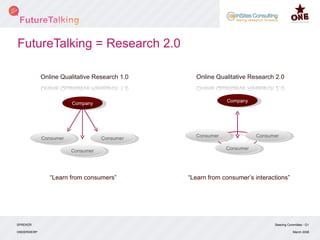
FutureTalking = Research 2.0 Company Consumer Consumer Consumer Company Consumer Consumer Consumer “ Learn from consumers” “ Learn from consumer’s interactions”
Eerder onderzoek
Dynamics within Social Networks Jo Caudron Steering Committee - Q1 Dynamics within social networks March 2008 Jo Caudron
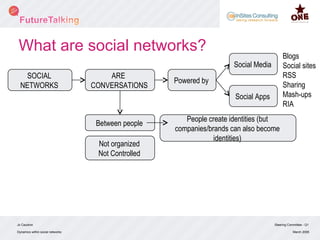
What are social networks? Steering Committee - Q1 Dynamics within social networks March 2008 Jo Caudron Blogs Social sites RSS Sharing  Mash-ups RIA SOCIAL NETWORKS ARE  CONVERSATIONS Powered by Social Media Social Apps Between people People create identities (but companies/brands can also become identities) Not organized Not Controlled
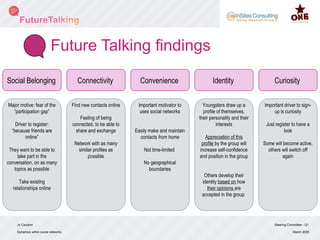
Future Talking findings Steering Committee - Q1 Dynamics within social networks March 2008 Jo Caudron Social Belonging Connectivity Convenience Identity Curiosity Major motive: fear of the “participation gap” Driver to register: “because friends are online” They want to be able to take part in the conversation, on as many topics as possible Take existing relationships online Find new contacts online Feeling of being connected, to be able to share and exchange Network with as many similar profiles as possible Important motivator to uses social networks Easily make and maintain contacts  from home Not time-limited  No geographical boundaries Youngsters draw up a profile of themselves, their personality and their interests Appreciation of this profile  by the group will increase self-confidence and position in the group Others develop their identity  based on  how  their opinions  are accepted in the group  Important driver to sign-up is curiosity Just register to have a look Some will become active, others will switch off again
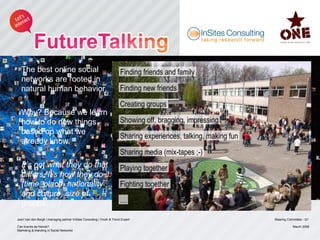
The best online social networks are rooted in natural human behavior. Why? Because we learn how to do new things based on what we already know. It’s not what they do that differs, It’s how they do it. (time, place, nationality and culture, size of groups, …)  Steering Committee - Q1 March 2008 Can brands be friends? Marketing & branding in Social Networks Joeri Van den Bergh | managing partner InSites Consulting | Youth & Trend Expert Finding friends and family Finding new friends Creating groups Showing off, bragging, impressing Sharing experiences, talking, making fun Sharing media (mix-tapes ;-) Playing together Fighting together …
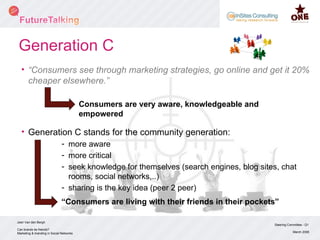
Generation C “ Consumers see through marketing strategies, go online and get it 20% cheaper elsewhere.” Generation C stands for the community generation: more aware more critical seek knowledge for themselves (search engines, blog sites, chat rooms, social networks,..) sharing is the key idea (peer 2 peer) Steering Committee - Q1 March 2008 Can brands be friends? Marketing & branding in Social Networks Joeri Van den Bergh  Consumers are very aware, knowledgeable and empowered “ Consumers are living with their friends in their pockets”
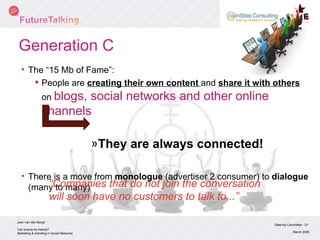
Generation C The “15 Mb of Fame”: People are  creating their own content  and  share it with others  on  blogs, social networks and other online channels They are always connected! There is a move from  monologue  (advertiser 2 consumer) to  dialogue  (many to many) Steering Committee - Q1 March 2008 Can brands be friends? Marketing & branding in Social Networks Joeri Van den Bergh  “ Companies that do not join the conversation will soon have no customers to talk to...”
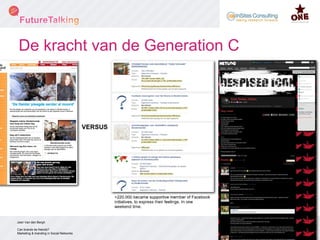
De kracht van de Generation C Steering Committee - Q1 March 2008 Can brands be friends? Marketing & branding in Social Networks Joeri Van den Bergh
FutureTalking - Q2 Steering Committee - Q2 June 2008 Entertainment in the digital era
About Content, Ownership & Context Entertainment Jo Caudron Steering Committee - Q2 June 2008 CONTENT OWNERSHIP CONTEXT
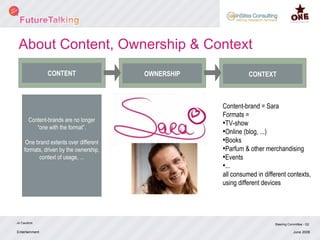
About Content, Ownership & Context Entertainment Jo Caudron Steering Committee - Q2 June 2008 CONTENT OWNERSHIP CONTEXT Content-brands are no longer “one with the format”. One brand extents over different formats, driven by the ownership, context of usage, ... Content-brand = Sara Formats = TV-show Online (blog, ...) Books Parfum & other merchandising Events ... all consumed in different contexts, using different devices
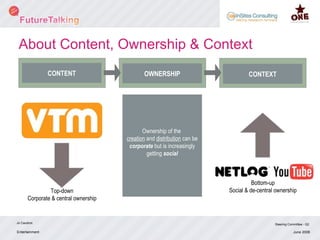
Entertainment Jo Caudron Steering Committee - Q2 June 2008 CONTENT OWNERSHIP CONTEXT Ownership of the  creation  and  distribution  can be  corporate  but is increasingly getting  social Top-down Corporate & central ownership Bottom-up Social & de-central ownership About Content, Ownership & Context
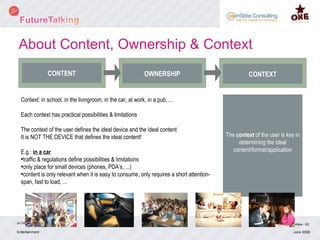
Entertainment Jo Caudron Steering Committee - Q2 June 2008 CONTENT OWNERSHIP CONTEXT Context: in school, in the livingroom, in the car, at work, in a pub, ... Each context has practical possibilities & limitations The context of the user defines the ideal device and the ideal content It is NOT THE DEVICE that defines the ideal content! E.g.:  in a car traffic & regulations define possibilities & limitations only place for small devices (phones, PDA’s, ...) content is only relevant when it is easy to consume, only requires a short attention-span, fast to load, ...  The  context  of the user is key in determining the ideal content/format/application About Content, Ownership & Context
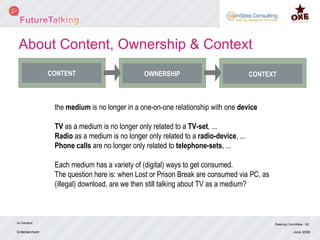
Entertainment Jo Caudron Steering Committee - Q2 June 2008 CONTENT OWNERSHIP CONTEXT the  medium  is no longer in a one-on-one relationship with one  device TV  as a medium is no longer only related to a  TV-set , ... Radio  as a medium is no longer only related to a  radio-device , ... Phone calls  are no longer only related to  telephone-sets , ... Each medium has a variety of (digital) ways to get consumed. The question here is: when Lost or Prison Break are consumed via PC, as (illegal) download, are we then still talking about TV as a medium? About Content, Ownership & Context
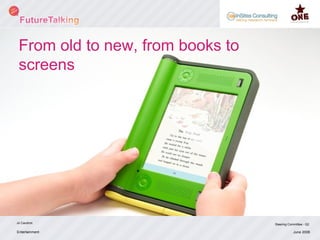
From old to new, from books to screens Entertainment Jo Caudron Steering Committee - Q2 June 2008
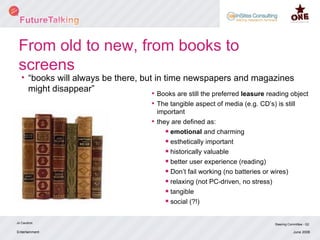
From old to new, from books to screens “ books will always be there, but in time newspapers and magazines might disappear”  Entertainment Jo Caudron Steering Committee - Q2 June 2008 Books are still the preferred  leasure  reading object The tangible aspect of media (e.g. CD’s) is still important they are defined as: emotional  and charming esthetically important historically valuable better user experience (reading) Don’t fail working (no batteries or wires) relaxing (not PC-driven, no stress) tangible  social (?!)
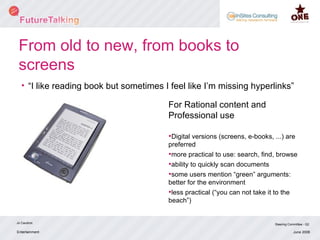
From old to new, from books to screens “I like reading book but sometimes I feel like I’m missing hyperlinks”  Entertainment Jo Caudron Steering Committee - Q2 June 2008 For Rational content and Professional use Digital versions (screens, e-books, ...) are preferred more practical to use: search, find, browse ability to quickly scan documents some users mention “green” arguments: better for the environment less practical (“you can not take it to the beach”)
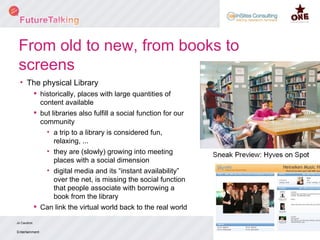
From old to new, from books to screens The physical Library historically, places with large quantities of content available  but libraries also fulfill a social function for our community a trip to a library is considered fun, relaxing, ... they are (slowly) growing into meeting places with a social dimension digital media and its “instant availability” over the net, is missing the social function that people associate with borrowing a book from the library Can link the virtual world back to the real world Entertainment Jo Caudron Steering Committee - Q2 June 2008
Steering Committee - Q2 June 2008 Digital Lifestyle Presentations
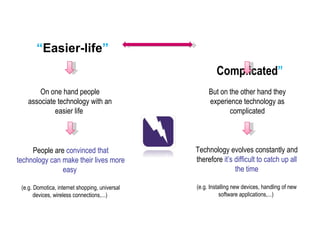
“ Easier-life ” “ Complicated ” On one hand people associate technology with an easier life  But on the other hand they experience technology as complicated People are  convinced that technology can make their lives more easy  (e.g. Domotica, internet shopping, universal devices, wireless connections,...)  Technology evolves constantly and therefore  it’s difficult to catch up all the time (e.g. Installing new devices, handling of new software applications,...)
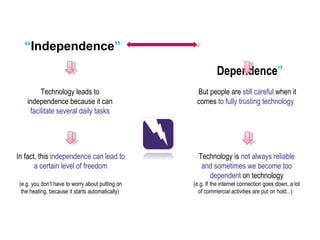
“ Independence ” “ Dependence ” Technology leads to independence because it can  facilitate several daily tasks But people are  still careful  when it comes  to fully trusting technology  In fact, this  independence can lead to a certain level of freedom (e.g. you don’t have to worry about putting on the heating, because it starts automatically)  Technology is  not always reliable and sometimes we become too dependent  on technology (e.g. If the internet connection goes down, a lot of commercial activities are put on hold...)
But  what can be done to   neutralize  these fields of tension?
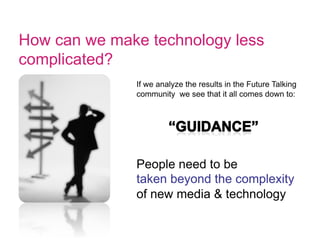
How can we make technology less complicated?
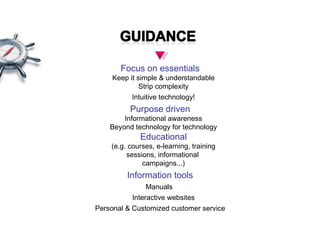
Focus on essentials Keep it simple & understandable Strip complexity Intuitive technology! Purpose driven Informational awareness Beyond technology for technology Educational (e.g. courses, e-learning, training sessions, informational  campaigns...) Information tools Manuals  Interactive websites Personal & Customized customer service
 
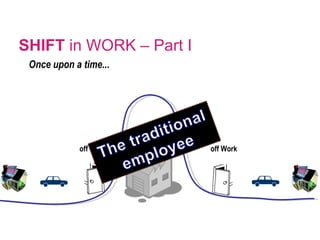
SHIFT  in WORK – Part I Once upon a time... off Home off Work
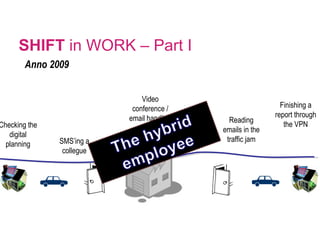
SHIFT  in WORK – Part I Anno 2009 Checking the digital planning SMS’ing a collegue Video conference / email handling / .. Reading emails in the traffic jam Finishing a report through the VPN
Apart from new working places,  also the in-betweens are being covered today
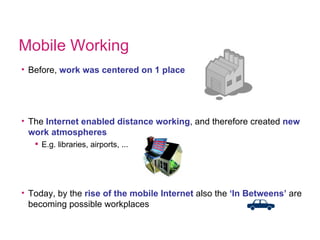
Mobile Working Before,  work was centered on 1 place The  Internet enabled distance working , and therefore created  new work atmospheres E.g. libraries, airports, ... Today, by the  rise of the mobile Internet  also the  ‘In Betweens’  are becoming possible workplaces
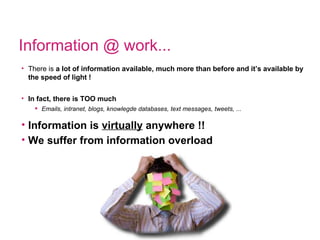
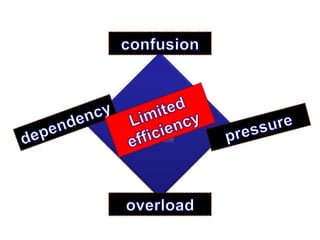
Information @ work... There is  a lot of information available, much more than before and it’s available by the speed of light ! In fact, there is TOO much Emails, intranet, blogs, knowlegde databases, text messages, tweets, ... Information is  virtually  anywhere !! We suffer from information overload
Information overload Sorting through information is  time-consuming The current perception is that everyone needs to sort his files systematically for himself: Every employee wages his own struggle  against the overload The results of this struggle  depend on the effort  of the employee
People feel in-between two era’s
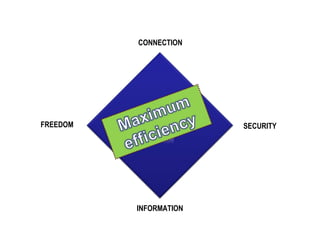
CONNECTION SECURITY FREEDOM INFORMATION
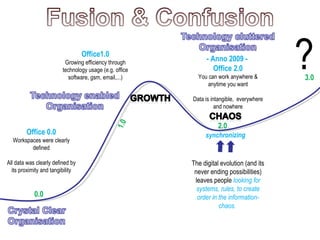
0.0 1.0 Office 0.0 Workspaces were clearly defined All data was clearly defined by its proximity and tangibility - Anno 2009 -  Office 2.0 You can work anywhere & anytime you want Data is intangible,  everywhere and nowhere 3.0 The digital evolution (and its never ending possibilities) leaves people  looking for systems, rules, to create order in the information-chaos.  Office1.0 Growing efficiency through technology usage (e.g. office software, gsm, email,...) 2.0 ? synchronizing
 

Future Talking Bibnet

  • 1.
    FutureTalking Steering Committee- Q1 March 2008 Denk- en Studiedag 12/2/09
  • 2.
    FutureTalking = Research2.0 Company Consumer Consumer Consumer Company Consumer Consumer Consumer “ Learn from consumers” “ Learn from consumer’s interactions”
  • 3.
  • 4.
    Dynamics within SocialNetworks Jo Caudron Steering Committee - Q1 Dynamics within social networks March 2008 Jo Caudron
  • 5.
    What are socialnetworks? Steering Committee - Q1 Dynamics within social networks March 2008 Jo Caudron Blogs Social sites RSS Sharing Mash-ups RIA SOCIAL NETWORKS ARE CONVERSATIONS Powered by Social Media Social Apps Between people People create identities (but companies/brands can also become identities) Not organized Not Controlled
  • 6.
    Future Talking findingsSteering Committee - Q1 Dynamics within social networks March 2008 Jo Caudron Social Belonging Connectivity Convenience Identity Curiosity Major motive: fear of the “participation gap” Driver to register: “because friends are online” They want to be able to take part in the conversation, on as many topics as possible Take existing relationships online Find new contacts online Feeling of being connected, to be able to share and exchange Network with as many similar profiles as possible Important motivator to uses social networks Easily make and maintain contacts from home Not time-limited No geographical boundaries Youngsters draw up a profile of themselves, their personality and their interests Appreciation of this profile by the group will increase self-confidence and position in the group Others develop their identity based on how their opinions are accepted in the group Important driver to sign-up is curiosity Just register to have a look Some will become active, others will switch off again
  • 7.
    The best onlinesocial networks are rooted in natural human behavior. Why? Because we learn how to do new things based on what we already know. It’s not what they do that differs, It’s how they do it. (time, place, nationality and culture, size of groups, …) Steering Committee - Q1 March 2008 Can brands be friends? Marketing & branding in Social Networks Joeri Van den Bergh | managing partner InSites Consulting | Youth & Trend Expert Finding friends and family Finding new friends Creating groups Showing off, bragging, impressing Sharing experiences, talking, making fun Sharing media (mix-tapes ;-) Playing together Fighting together …
  • 8.
    Generation C “Consumers see through marketing strategies, go online and get it 20% cheaper elsewhere.” Generation C stands for the community generation: more aware more critical seek knowledge for themselves (search engines, blog sites, chat rooms, social networks,..) sharing is the key idea (peer 2 peer) Steering Committee - Q1 March 2008 Can brands be friends? Marketing & branding in Social Networks Joeri Van den Bergh Consumers are very aware, knowledgeable and empowered “ Consumers are living with their friends in their pockets”
  • 9.
    Generation C The“15 Mb of Fame”: People are creating their own content and share it with others on blogs, social networks and other online channels They are always connected! There is a move from monologue (advertiser 2 consumer) to dialogue (many to many) Steering Committee - Q1 March 2008 Can brands be friends? Marketing & branding in Social Networks Joeri Van den Bergh “ Companies that do not join the conversation will soon have no customers to talk to...”
  • 10.
    De kracht vande Generation C Steering Committee - Q1 March 2008 Can brands be friends? Marketing & branding in Social Networks Joeri Van den Bergh
  • 11.
    FutureTalking - Q2Steering Committee - Q2 June 2008 Entertainment in the digital era
  • 12.
    About Content, Ownership& Context Entertainment Jo Caudron Steering Committee - Q2 June 2008 CONTENT OWNERSHIP CONTEXT
  • 13.
    About Content, Ownership& Context Entertainment Jo Caudron Steering Committee - Q2 June 2008 CONTENT OWNERSHIP CONTEXT Content-brands are no longer “one with the format”. One brand extents over different formats, driven by the ownership, context of usage, ... Content-brand = Sara Formats = TV-show Online (blog, ...) Books Parfum & other merchandising Events ... all consumed in different contexts, using different devices
  • 14.
    Entertainment Jo CaudronSteering Committee - Q2 June 2008 CONTENT OWNERSHIP CONTEXT Ownership of the creation and distribution can be corporate but is increasingly getting social Top-down Corporate & central ownership Bottom-up Social & de-central ownership About Content, Ownership & Context
  • 15.
    Entertainment Jo CaudronSteering Committee - Q2 June 2008 CONTENT OWNERSHIP CONTEXT Context: in school, in the livingroom, in the car, at work, in a pub, ... Each context has practical possibilities & limitations The context of the user defines the ideal device and the ideal content It is NOT THE DEVICE that defines the ideal content! E.g.: in a car traffic & regulations define possibilities & limitations only place for small devices (phones, PDA’s, ...) content is only relevant when it is easy to consume, only requires a short attention-span, fast to load, ... The context of the user is key in determining the ideal content/format/application About Content, Ownership & Context
  • 16.
    Entertainment Jo CaudronSteering Committee - Q2 June 2008 CONTENT OWNERSHIP CONTEXT the medium is no longer in a one-on-one relationship with one device TV as a medium is no longer only related to a TV-set , ... Radio as a medium is no longer only related to a radio-device , ... Phone calls are no longer only related to telephone-sets , ... Each medium has a variety of (digital) ways to get consumed. The question here is: when Lost or Prison Break are consumed via PC, as (illegal) download, are we then still talking about TV as a medium? About Content, Ownership & Context
  • 17.
    From old tonew, from books to screens Entertainment Jo Caudron Steering Committee - Q2 June 2008
  • 18.
    From old tonew, from books to screens “ books will always be there, but in time newspapers and magazines might disappear” Entertainment Jo Caudron Steering Committee - Q2 June 2008 Books are still the preferred leasure reading object The tangible aspect of media (e.g. CD’s) is still important they are defined as: emotional and charming esthetically important historically valuable better user experience (reading) Don’t fail working (no batteries or wires) relaxing (not PC-driven, no stress) tangible social (?!)
  • 19.
    From old tonew, from books to screens “I like reading book but sometimes I feel like I’m missing hyperlinks” Entertainment Jo Caudron Steering Committee - Q2 June 2008 For Rational content and Professional use Digital versions (screens, e-books, ...) are preferred more practical to use: search, find, browse ability to quickly scan documents some users mention “green” arguments: better for the environment less practical (“you can not take it to the beach”)
  • 20.
    From old tonew, from books to screens The physical Library historically, places with large quantities of content available but libraries also fulfill a social function for our community a trip to a library is considered fun, relaxing, ... they are (slowly) growing into meeting places with a social dimension digital media and its “instant availability” over the net, is missing the social function that people associate with borrowing a book from the library Can link the virtual world back to the real world Entertainment Jo Caudron Steering Committee - Q2 June 2008
  • 21.
    Steering Committee -Q2 June 2008 Digital Lifestyle Presentations
  • 22.
    “ Easier-life ”“ Complicated ” On one hand people associate technology with an easier life But on the other hand they experience technology as complicated People are convinced that technology can make their lives more easy (e.g. Domotica, internet shopping, universal devices, wireless connections,...) Technology evolves constantly and therefore it’s difficult to catch up all the time (e.g. Installing new devices, handling of new software applications,...)
  • 23.
    “ Independence ”“ Dependence ” Technology leads to independence because it can facilitate several daily tasks But people are still careful when it comes to fully trusting technology In fact, this independence can lead to a certain level of freedom (e.g. you don’t have to worry about putting on the heating, because it starts automatically) Technology is not always reliable and sometimes we become too dependent on technology (e.g. If the internet connection goes down, a lot of commercial activities are put on hold...)
  • 24.
    But whatcan be done to neutralize these fields of tension?
  • 25.
    How can wemake technology less complicated?
  • 26.
    Focus on essentialsKeep it simple & understandable Strip complexity Intuitive technology! Purpose driven Informational awareness Beyond technology for technology Educational (e.g. courses, e-learning, training sessions, informational campaigns...) Information tools Manuals Interactive websites Personal & Customized customer service
  • 27.
  • 28.
    SHIFT inWORK – Part I Once upon a time... off Home off Work
  • 29.
    SHIFT inWORK – Part I Anno 2009 Checking the digital planning SMS’ing a collegue Video conference / email handling / .. Reading emails in the traffic jam Finishing a report through the VPN
  • 30.
    Apart from newworking places, also the in-betweens are being covered today
  • 31.
    Mobile Working Before, work was centered on 1 place The Internet enabled distance working , and therefore created new work atmospheres E.g. libraries, airports, ... Today, by the rise of the mobile Internet also the ‘In Betweens’ are becoming possible workplaces
  • 32.
    Information @ work...There is a lot of information available, much more than before and it’s available by the speed of light ! In fact, there is TOO much Emails, intranet, blogs, knowlegde databases, text messages, tweets, ... Information is virtually anywhere !! We suffer from information overload
  • 33.
    Information overload Sortingthrough information is time-consuming The current perception is that everyone needs to sort his files systematically for himself: Every employee wages his own struggle against the overload The results of this struggle depend on the effort of the employee
  • 34.
  • 35.
  • 36.
  • 37.
    0.0 1.0 Office0.0 Workspaces were clearly defined All data was clearly defined by its proximity and tangibility - Anno 2009 - Office 2.0 You can work anywhere & anytime you want Data is intangible, everywhere and nowhere 3.0 The digital evolution (and its never ending possibilities) leaves people looking for systems, rules, to create order in the information-chaos. Office1.0 Growing efficiency through technology usage (e.g. office software, gsm, email,...) 2.0 ? synchronizing
  • 38.