22 Jun 15 When Berserkers Collapse 1
When
Berserkers
Collapse
When Berserkers Collapse
Presented to the Pacific Northwest
Chapter of the Society for Information
Display (SID PNW)
24 June 2015 — David Barnes
Forward into the past
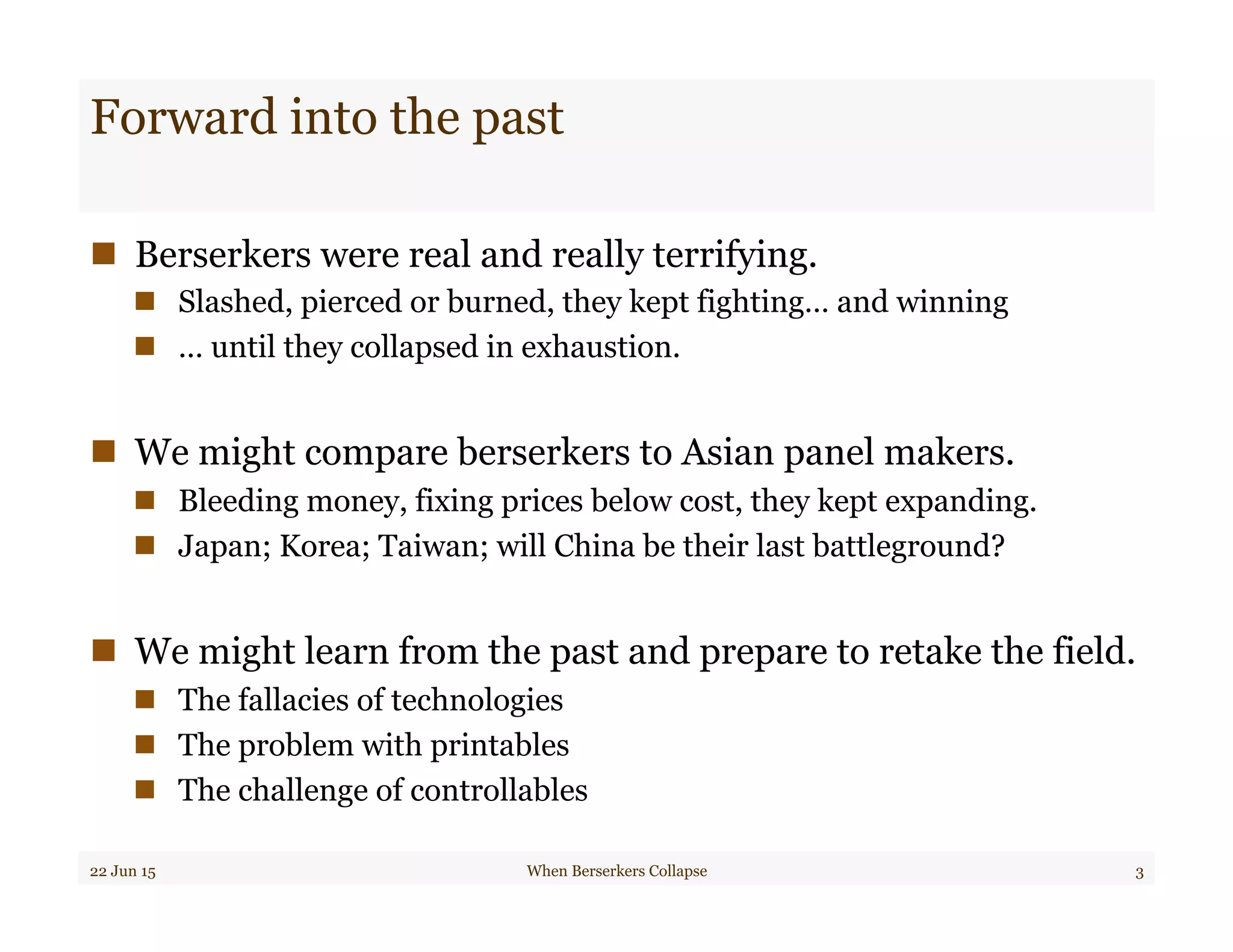
n  Berserkers were real and really terrifying.
n  Slashed, pierced or burned, they kept fighting… and winning
n  … until they collapsed in exhaustion.
n  We might compare berserkers to Asian panel makers.
n  Bleeding money, fixing prices below cost, they kept expanding.
n  Japan; Korea; Taiwan; will China be their last battleground?
n  We might learn from the past and prepare to retake the field.
n  The fallacies of technologies
n  The problem with printables
n  The challenge of controllables
22 Jun 15 When Berserkers Collapse 3
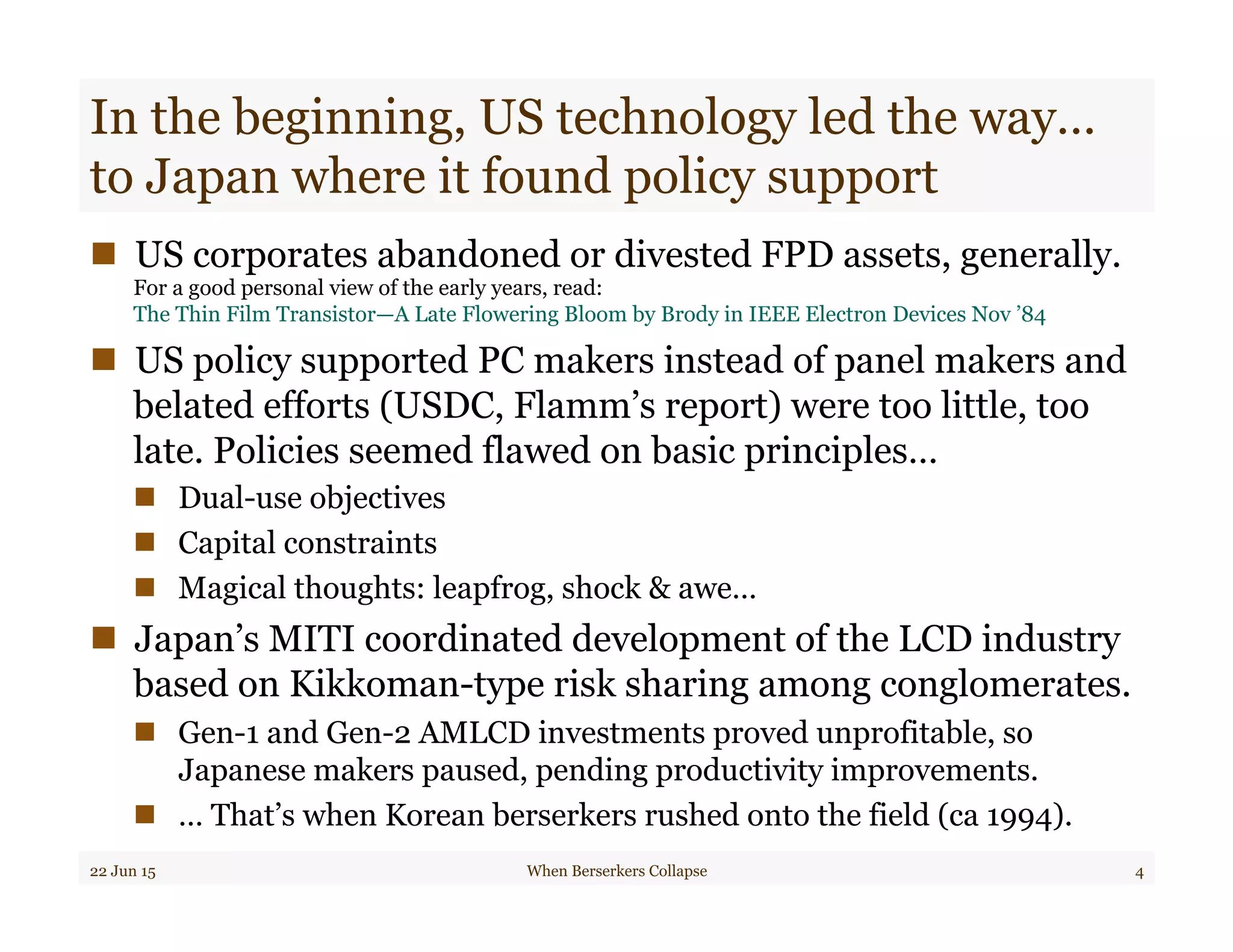
In the beginning, US technology led the way…
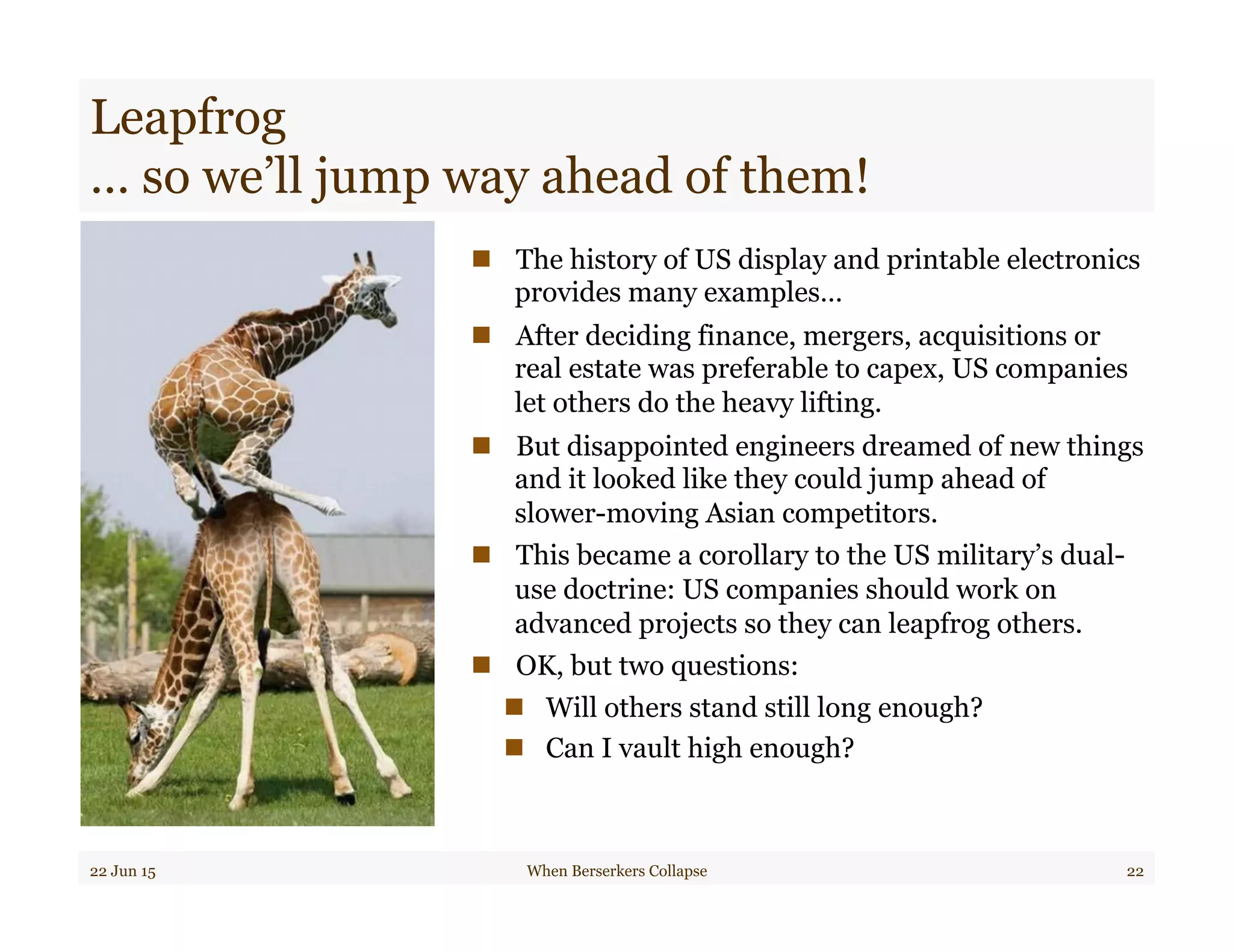
to Japan where it found policy support
n  US corporates abandoned or divested FPD assets, generally.
For a good personal view of the early years, read:
The Thin Film Transistor—A Late Flowering Bloom by Brody in IEEE Electron Devices Nov ’84
n  US policy supported PC makers instead of panel makers and
belated efforts (USDC, Flamm’s report) were too little, too
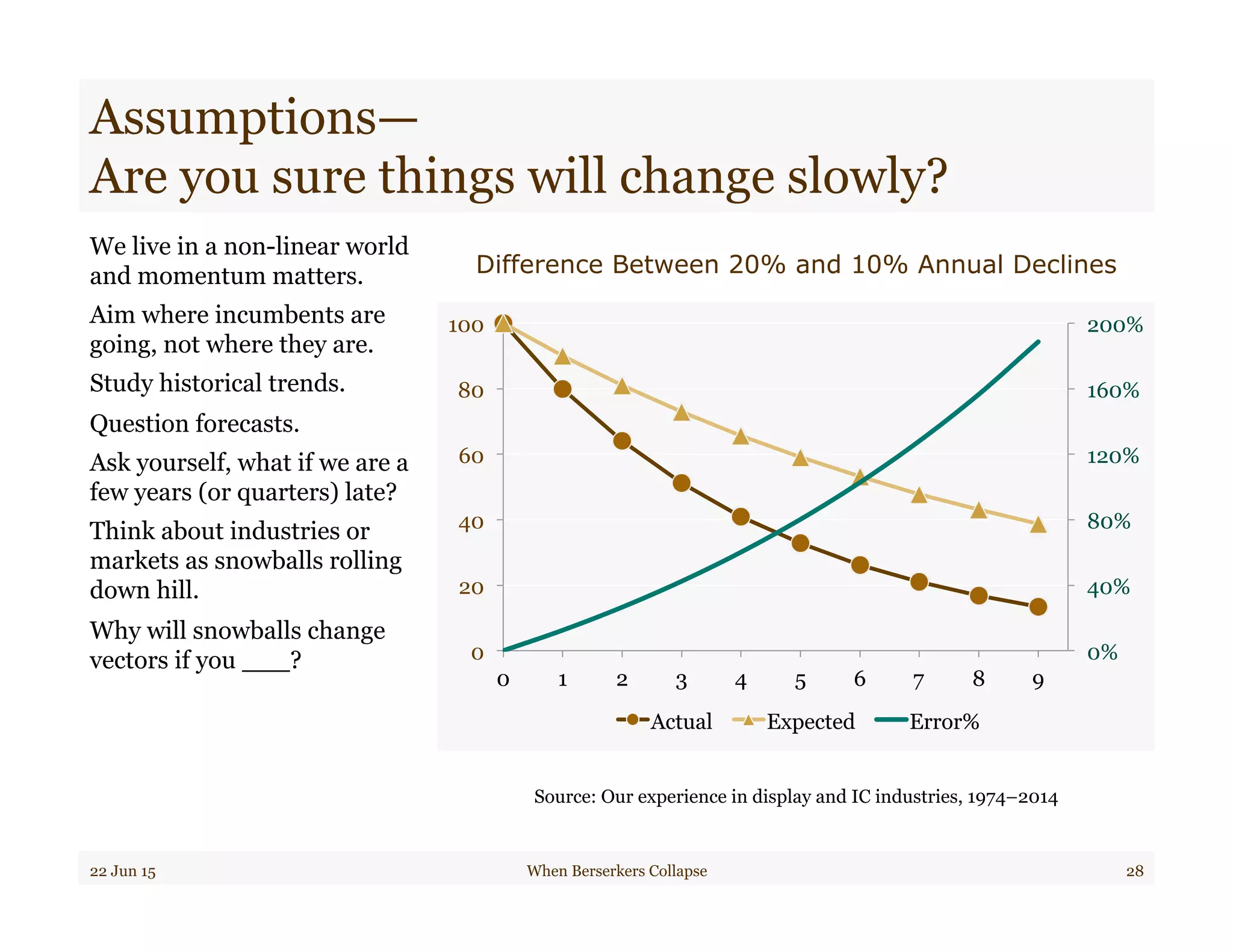
late. Policies seemed flawed on basic principles…
n  Dual-use objectives
n  Capital constraints
n  Magical thoughts: leapfrog, shock & awe…
n  Japan’s MITI coordinated development of the LCD industry
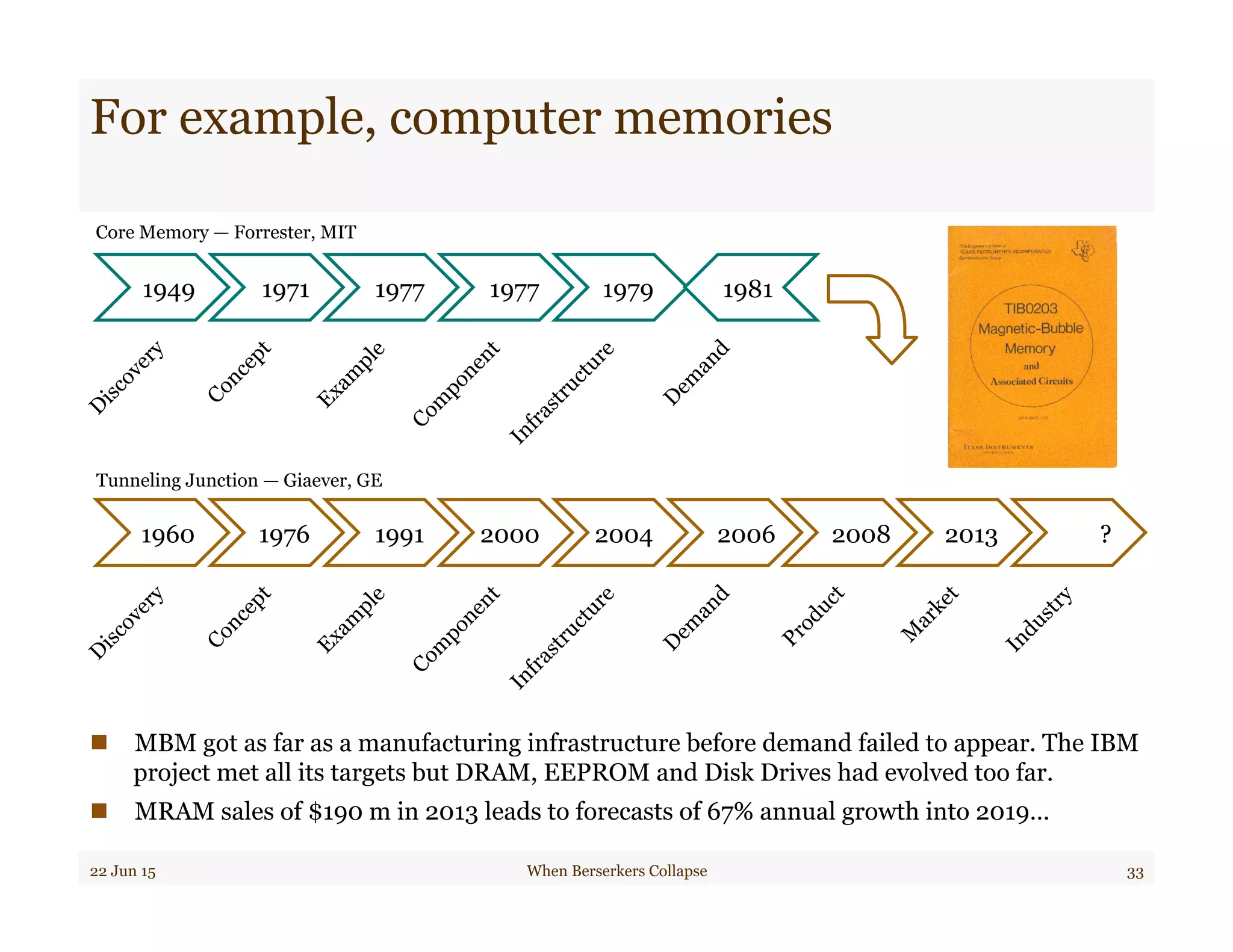
based on Kikkoman-type risk sharing among conglomerates.
n  Gen-1 and Gen-2 AMLCD investments proved unprofitable, so
Japanese makers paused, pending productivity improvements.
n  … That’s when Korean berserkers rushed onto the field (ca 1994).
22 Jun 15 When Berserkers Collapse 4
US organizations discovered Panel-land and
dominated the battlefield…
US display makers did not fail
for lack of technology.
I count 72 companies in the
market from 1970 to 2010.
More than 1 in 3 companies
concentrated on LCD and
nearly as many focused on
projection technologies for
beamers or HMD systems.
US organizations also
pioneered plasma and
electrophoretic technologies.
Hix and other entrepreneurs
were prolific in the NW of the
US!
Raise your hand if you recall
PALC…
0 5 10 15 20 25 30
LCD
Proj
FED
EL
EPD
PDP
VFD
OLED
Other
22 Jun 15 When Berserkers Collapse 5
Number of US Firms by Technology, 1970–2010
Source: Our research and analysis
… then came the berserkers.
There were many false starts,
as one would expect.
We see a surge of exits after
the ITC rescinded 731-TA-469
in 1993 in favor of PC makers.
After Korean Gen-2.5 AMLCD
fabs came on-line  in 1996, we
see a greater surge of exits.
There are several other
explanations, of course. For
example, consumer demand
for projection displays rose
and fell in various markets.
Nevertheless, I think the data
shows the effect of Korea, then
Taiwan rushing into the fray.
0
1
2
3
4
5
6
7
1970 1975 1980 1985 1990 1995 2000 2005 2010
22 Jun 15 When Berserkers Collapse 6
Distribution of US Exits by Year
Source: Our research and analysis
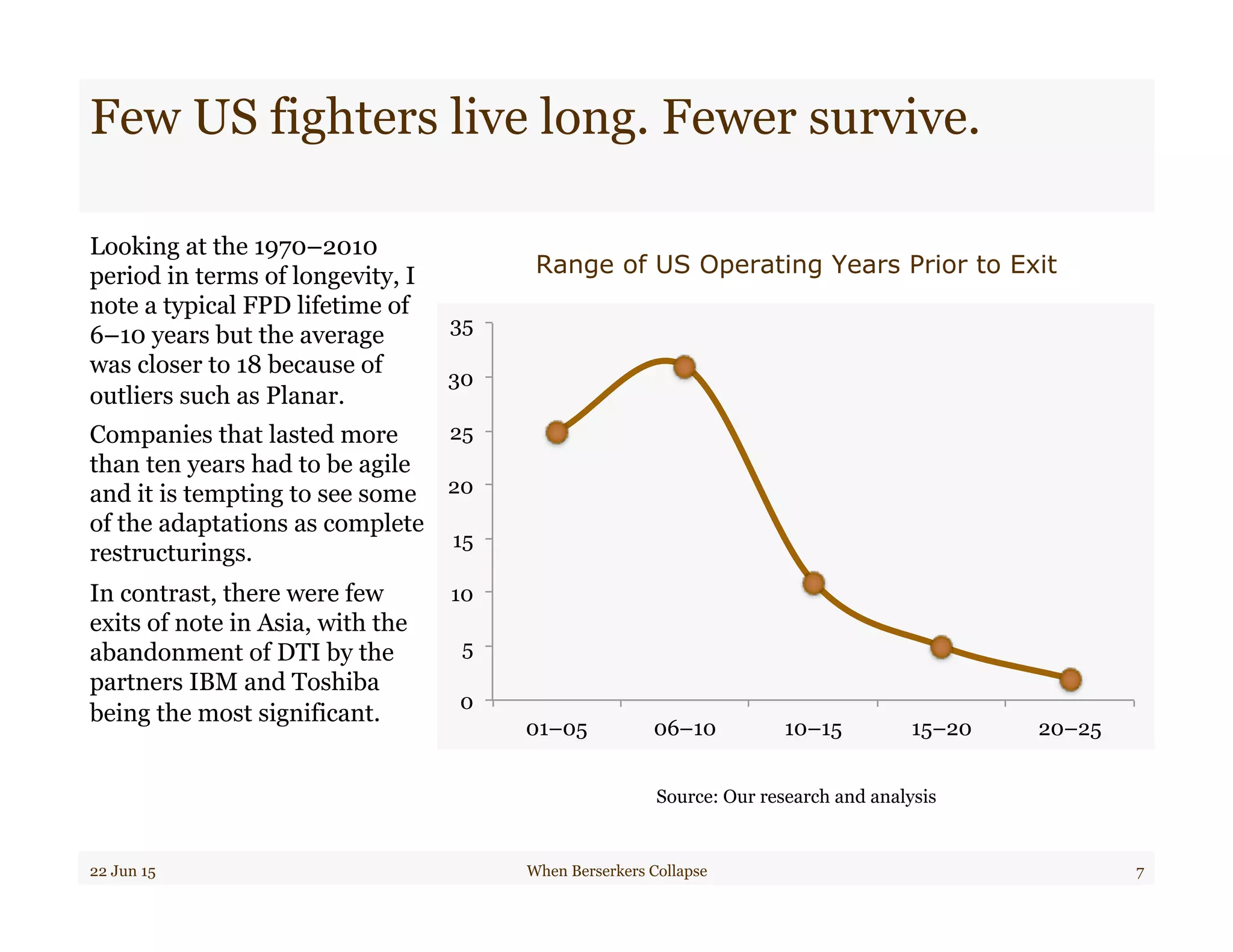
Few US fighters live long. Fewer survive.
Looking at the 1970–2010
period in terms of longevity, I
note a typical FPD lifetime of
6–10 years but the average
was closer to 18 because of
outliers such as Planar.
Companies that lasted more
than ten years had to be agile
and it is tempting to see some
of the adaptations as complete
restructurings.
In contrast, there were few
exits of note in Asia, with the
abandonment of DTI by the
partners IBM and Toshiba
being the most significant. 0
5
10
15
20
25
30
35
01–05 06–10 10–15 15–20 20–25
22 Jun 15 When Berserkers Collapse 7
Range of US Operating Years Prior to Exit
Source: Our research and analysis
Before the Koreans rushed into Panel-land, it
looked as if Japan would remain dominant
Indeed, the coordination in
Japan did create a supply
chain structure that survives
today…
Glass, optical film, chemical
and process tool suppliers
who supported fabrication
enabled industry expansion in
Korea, Taiwan and China.
The only real change has been
self-sourcing of color filters
pioneered in Korea.
Even the shift to open-cell
sales is an echo of the initial
Kikkoman-type structure.
Japan Inc. was only a decade
behind US conglomerates in
terms of structural changes…
AMLCD Maker 1994 Share Their Fate
Sharp 35%
Decreasing share
and restructure
NEC 18%
Divested > SVA
> BOE
DTI 13%
Split and part
sold to CMO
Hosiden 6%
Sold to Philips >
TPO > Innolux
Hitachi 5% Divested > JDI
22 Jun 15 When Berserkers Collapse 8
AMLCD Leaders Twenty Years Ago
Share of Sales from Nikkei Microdevices, 1996
In hindsight, AMLCD berserkers captured
almost every square inch of the display market
Active-matrix, flat panel
displays comprised 35% of
total display sales in 1999.
Fifteen years later, that share
was a dominant 98%.
Berserkers killed King CRT,
Duke PDP, and all the barons
contending for the throne.
The areal price of AMLCD
declined exponentially near
18% a year until 2009 when
macroeconomic conditions
forced price decay to slow in
the 10% regime.
Most competing technologies
were crushed by relentless
price pressure.
$0
$25
$50
$75
$100
$125
$150
1999 2004 2009 2014
Proj.
FED
EL
VFD
CRT
PMFPD
PDP
AMFPD
22 Jun 15 When Berserkers Collapse 9
Global Display Sales by Technology (USD billions)
Source: HIS, our analysis
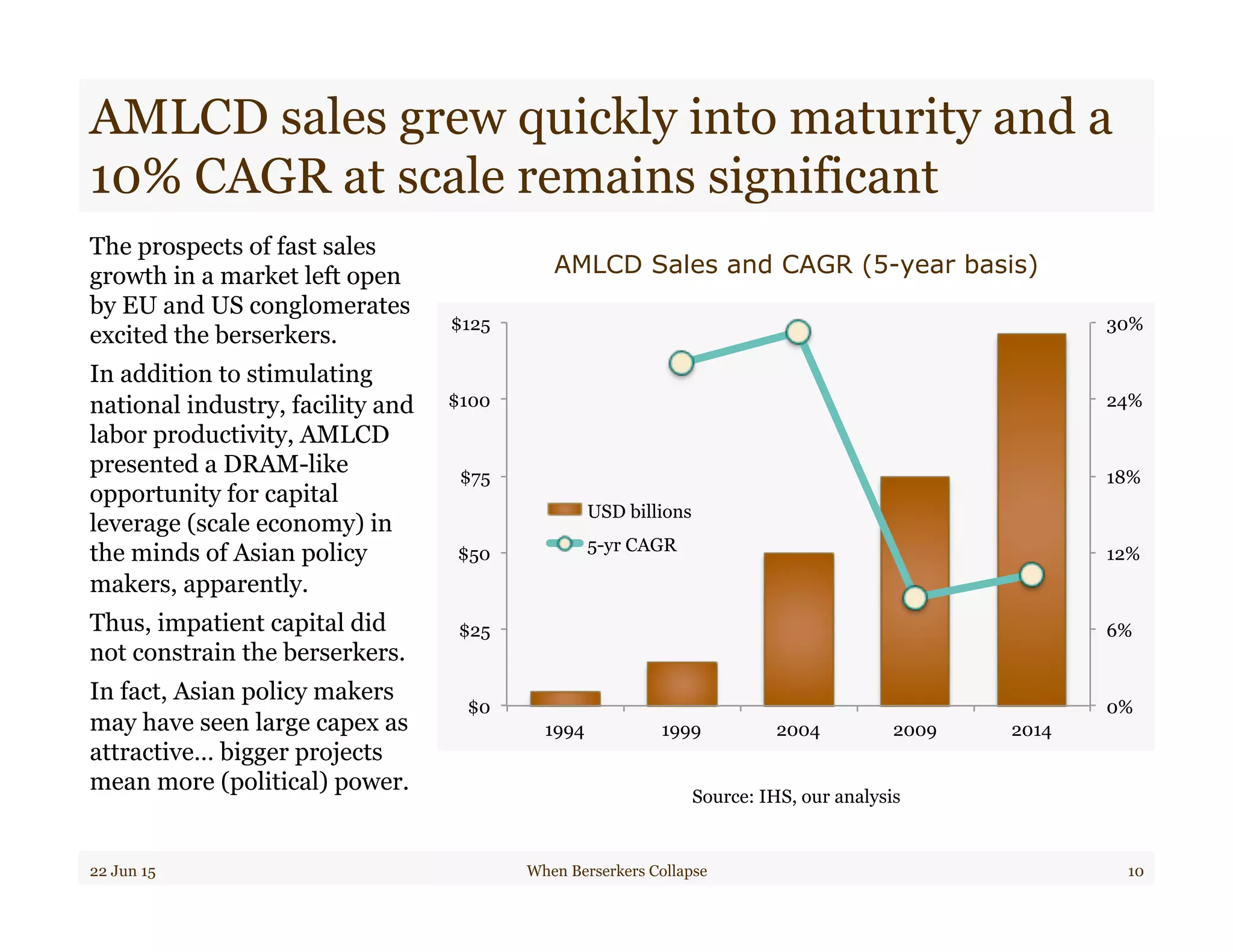
AMLCD sales grew quickly into maturity and a
10% CAGR at scale remains significant
The prospects of fast sales
growth in a market left open
by EU and US conglomerates
excited the berserkers.
In addition to stimulating
national industry, facility and
labor productivity, AMLCD
presented a DRAM-like
opportunity for capital
leverage (scale economy) in
the minds of Asian policy
makers, apparently.
Thus, impatient capital did
not constrain the berserkers.
In fact, Asian policy makers
may have seen large capex as
attractive… bigger projects
mean more (political) power.
22 Jun 15 When Berserkers Collapse 10
AMLCD Sales and CAGR (5-year basis)
Source: IHS, our analysis
0%
6%
12%
18%
24%
30%
$0
$25
$50
$75
$100
$125
1994 1999 2004 2009 2014
USD billions
5-yr CAGR
In contrast, impatient capital forced US firms to
consider low-capex (e.g. printed) means
Following on the work of Hart
et al in the 1990’s, Rattan et al
have written about the shift
from large-scale corporate
R&D to small-scale app
development and the
concomitant decline in long-
term technology commitment.
As a consequence, small US or
EU organizations have raised
modest amounts of capital to
fund high-risk approaches to
printable electronics or to
speculative product markets.
Such ventures now seem less
attractive than low-risk “tech”
that speculates on social
media or uber-propositions.
"Flat Panel Displays in Perspective examines the
potential benefits of a domestic, high-volume, FPD
industry for the nation, and evaluates the role of
government policies in developing it. The report
concludes that such an industry would provide both
economic and national security benefits. The extent of
these benefits is difficult to determine, however, largely
because trends in technology development and industry
structure are resulting in more displays at declining
prices. The barriers to establishing a high-
volume FPD industry are formidable, and
government tools to address them are limited."
— Roger Herdman, Director, OTA (1995)
22 Jun 15 When Berserkers Collapse 11
High Barriers and Limited Means
Source: U.S. Congress, Office of Technology Assessment, OTA-ITC-631
Berserkers were not constrained by capital and
they put about $190B into the ground
Knowledgeable estimates
range up to $200 billion but I
get $190 using LGD
numbers…
The point is, that is much
more than US conglomerates
would want to sink into fixed
assets. Flamm expected a 1:2
gearing ratio but Taiwanese
expansion shows 3:2… way
more than reluctant capital
would support.
Historical data shows that
Japanese and Korean capacity
has peaked. Taiwan’s growth
has flattened out already…
This leaves Chinese capital as
the only force remaining. How
long with expansion continue?
0
50
100
150
200
250
2000 2003 2006 2009 2012 2015
Germany
Singapore
Japan
China
Taiwan
Korea
22 Jun 15 When Berserkers Collapse 12
TFT Capacity by Nation (millions m²)
Source: IHS, our analysis
The problem is that money has not come back
out of the ground. Panel makers are charities.
Taiwanese executives have
said my words are harsh, but
they invite me back to advise
on strategy, anyway…
The fact is the numbers show
that Taiwanese AMLCD firms
transferred $11.7 billion from
shareholders to suppliers and
employees since 2000.
That money benefitted the
nation and many domestic
businesses, so it is fair to say
the panel makers were
charitable with their equity.
This illustrates the attraction
for other nations, such as
China or Brazil and India, to
foster such industry… but so
far only China has done so.
($25)
($20)
($15)
($10)
($5)
$0
$5
$10
$15
2001 2003 2005 2007 2009 2011 2013
Annual CFO Annual PP&E Cumulative FCF
22 Jun 15 When Berserkers Collapse 13
Taiwanese AMLCD Industry Results (USD billions)
Free-cash flow (FCF) is cash-flow from operations minus capex (PP&E).
Source: public disclosures; SEC rates and our analysis
TFT capacity began decelerating in 2009…
Only Chinese berserkers are rushing-in, now.
Based on Taiwanese history,
which was stimulated by
national policy (hoping to
duplicate its IC success), I
assume China is 40% to 50%
of the way to maturity.
That suggests a total quarterly
capacity in the 80 million m²
regime… perhaps 1/3 more
than total capacity this year.
While such Chinese-led
expansion is substantial, it
implies that even the new
berserkers might start
collapsing from capital
exhaustion near the end of
this decade.
0
10
20
30
40
50
60
70
80
Q1'01 Q1'04 Q1'07 Q1'10 Q1'13 Q1'16
Capacity Model
22 Jun 15 When Berserkers Collapse 14
S-Curve Model of Capacity (millions m²/quarter)
Pearl-Reed model: 11% growth with 2Q’09 inflection
Source: IHS, our analysis
But what about Brazil or India?
I expect China will signal the end of expansion.
My experience with project
plans in both Brazil and India
leads me to be skeptical.
National policies seem more
tuned to becoming more
competitive in advanced
technologies rather than to
developing commodity
production infrastructure.
I anticipate occasional studies
and some activities in high-
end product integration but
there is no reason to expect
semiconductor-based effort.
If this view is correct, then
berserkers may collapse next
decade and open the field to
new challengers.
22 Jun 15 When Berserkers Collapse 15
The Future Is Not Black or White
Source: Our conjecture
?
?
So what can challengers learn from the past?
n  Discern the limits of control and visibility.
n  Entrants seldom have much control. They depend on leaders.
n  Entrants seldom have much visibility; Apple and Corning may have
better visibility by many conversations and in Apple’s case by leading
category developments.
n  Avoid magical thinking.
n  Something may not be inevitable. Good enough may be good enough.
n  Shock and awe strategies may not shock or awe global competitors.
n  Low capex processes needing high cost materials can kill you…
n  Beware of multi-party game dynamics
n  A producing nation cannot have open markets, rich material suppliers
and rich tool suppliers… that is an impossible trinity.
n  US material suppliers (e.g. 3M or Corning) have profited more from
the AMLCD industry than have all panel makers. Pick your position.
22 Jun 15 When Berserkers Collapse 16
APPENDIX
Some slides from my LOPEC 2014 presentation…
22 Jun 15 When Berserkers Collapse 17
Innovations are rare because they are uniquely
useful and valuable
Talk about about innovation is
cheap but realizing it is costly
and difficult for businesses
In most cases, organizations
modify something or offer
some novelty: a 753 ppi LCD
Value may be increased by
creating a product line or
range: a 4K TV sub-brand
Sometimes an organization
has a patentable product: IPS/
FFS LCD
More rarely, an organization
combines high-resolution with
a sub-brand, FSS LCD and
software and an apps store to
create the iOS business, which
is unique, useful and valuable
.
22 Jun 15 When Berserkers Collapse 18
Utility-Value Matrix of Innovation
Our conceptual diagram
Invention
Patentable
Modification
Promotable
Innovation
Uniquely
valuable
Creation
Valuable
Value
Utility
Being approximately correct rather than being
precisely wrong requires sincere assessment
All organizations have limited
visibility and control… some
more than others.
Few can sustain an external
focus and coordinate co-op
development, long term.
Ironically, materials suppliers
are often isolated and very
dependent on other tech or
market developments, yet
they often profit most from
merging technologies.
A combinations of inaccurate
mental maps, dependencies
and untested assumptions
lead to unfortunate forecasts
for others assuming more
visibility or control.
.
22 Jun 15 When Berserkers Collapse 19
Visibility–Control Matrix
Our conceptual diagram
§ Inward focus
§ Independent
development
§ Isolated
§ Dependent
§ External focus
§ Cooperative
development
§ Involved
§ Associated
Control
Visibility
The map is not the territory
… ways we fool ourselves into foolish actions
22 Jun 15 When Berserkers Collapse 20
JohannesVingboons,ca1650
Logic Bubbles
… isn’t obvious that_____?
n  When an Asian businessman
hears that a project will take a
lot of capital, he says, “Good!”
n  More money will be, “spread
around.” He will gain face.
n  Big projects are wanted for big
populations.
n  When a Western businessman
hears a project will take a lot
of capital, he says, “Bad!”
n  Investors want big returns on
small amounts.
n  “Let’s make it R2R, then.”
n  We all tend to think others
know and understand our
constraints… but they don’t.
22 Jun 15 When Berserkers Collapse 21
Leapfrog
… so we’ll jump way ahead of them!
n  The history of US display and printable electronics
provides many examples…
n  After deciding finance, mergers, acquisitions or
real estate was preferable to capex, US companies
let others do the heavy lifting.
n  But disappointed engineers dreamed of new things
and it looked like they could jump ahead of
slower-moving Asian competitors.
n  This became a corollary to the US military’s dual-
use doctrine: US companies should work on
advanced projects so they can leapfrog others.
n  OK, but two questions:
n  Will others stand still long enough?
n  Can I vault high enough?
22 Jun 15 When Berserkers Collapse 22
Shock and Awe
… our new ____ will change everything!
n  This is another US-centric motif but one
that may resonate with veterans of EU
Framework projects.
n  While it may be is tempting to think that
incumbent suppliers might roll over and
give up when you announce, they might
not even pause their relentless progress
toward more for less.
n  Worse, they may alter course and change
the playing field before you realize it.
n  Getting to Baghdad is just the
beginning…
22 Jun 15 When Berserkers Collapse 23
Determinism
… all we have to do is ____.
n  If we ___, then they must ___.
n  This fallacy has some parallel to
Marx’s historical determinism…
which might not be wrong, just late.
n  It also intertwines with logic bubbles
n  … they must know that they have no
alternative once we enter the market.
n  If I had a euro for each cost forecast
I’ve seen that showed Tech-X would
beat all others because… I’d retire.
n  Why do you assume they plan to be
profitable, ever?
n  The point here is that people have
different constraints and preferences
than you do and that you should not
assume something is inevitable.
22 Jun 15 When Berserkers Collapse 24
Magic
… and then, ____ will happen.
n  Leap of faith
… a noble thing at times but dangerous.
n  “Presto” is nice to say but difficult to do.
n  Magical thinking comes in two general forms.
n  Sympathy: A is similar to B so if I do this to A,
then B will change also.
n  Correspondence: B changed when A changed, so
C will change when D changes.
n  Governments and organizations succumb to
magical thinking frequently, so the only good
antidote is a strong sense of history
… and remembering that correlation does not
imply causation.
22 Jun 15 When Berserkers Collapse 25
Example of a misleading mental map
… the rise and fall (and rise and fall?) of LTPS
A famous market research
firm forecasted LTPS-based
display sales would rise 141%
a year from 1997 to 2002 and
reach $4,800 million.
In hindsight, sales increased
62% a year to reach $784 m.
The forecast proved to be 5X
too high 5 years later.
What went wrong?
§  Tools: no way to pattern IC
resolutions at TV sizes
§  Momenta: no way to catch-
up with a-Si:H TFT
§  Costs: on-glass integration
more costly than parts (DIC)
§  Values: a-Si technology was
good enough for most things
22 Jun 15 When Berserkers Collapse 26
LTPS Display Forecast and Actual Sales
Our analysis of a Q2‘97 report and a Q2’05 report by the same firm
$-
$1 b
$2 b
$3 b
$4 b
$5 b
1997 1998 1999 2000 2001 2002
Actual Sales
1997 Forecast
Assumptions—
Are you sure things will change quickly?
David Sarnoff and RCA had a
wonderful vision of TV sets
you could hang on the wall
… and we could 50 years later.
It took more than a few things
to change.
It took materials, tools, many
breakthroughs and euros.
… spent by many companies
… over many years
… with some success
… and lots of failure
So today, we can say
“nothing’s on” our TV made
by companies that make no
money for investors.
22 Jun 15 When Berserkers Collapse 27
RCA’s Vision of the Future in 1955
Source: Technician Magazine, Oct ‘55
Assumptions—
Are you sure things will change slowly?
We live in a non-linear world
and momentum matters.
Aim where incumbents are
going, not where they are.
Study historical trends.
Question forecasts.
Ask yourself, what if we are a
few years (or quarters) late?
Think about industries or
markets as snowballs rolling
down hill.
Why will snowballs change
vectors if you ___?
22 Jun 15 When Berserkers Collapse 28
Difference Between 20% and 10% Annual Declines
Source: Our experience in display and IC industries, 1974–2014
0%
40%
80%
120%
160%
200%
0
20
40
60
80
100
0 1 2 3 4 5 6 7 8 9
Actual Expected Error%
Assumptions—
The trend is your friend, until the end.
You can model the areal price
of AMLCD with a simple sine
wave riding on an exponential
decay line.
The problem with this is you
can find data to support any
trend you want
… if you think short-term.
The AMLCD industry has a
nominal ten-quarter cycle
based on capital and people
resources, so you need to look
back three or more years to
see the real historical trend.
Momentum matters.
Are you moving fast enough
… in the right direction?
22 Jun 15 When Berserkers Collapse 29
Sine-wave Model of AMLCD Area Price by Quarter
Our analysis circa 2006
0
20
40
60
80
100
1 5 9 13
Price Decay Trend
Quarterly Price Cycle
Up 10%
Assumptions—
Are you solving the right problem?
The problem is how to get rid of
mice, not how to catch them.
n  Bubble memory was the better
mouse trap of the 1970’s.
n  TI introduced a 92 kb MBM in 1978.
n  By 1979, Rockwell, IBM, TI and Intel
had over 500 engineers involved.
n  By 1981, all projects were abandoned.
n  EEPROM was better, faster and
cheaper.
n  It evolved from conventional IC
technology.
n  It required less design and production
infrastructure change.
n  The problem was how to keep data,
not how to write data.
22 Jun 15 When Berserkers Collapse 30
Precedence and Dependence
… another way to say visibility and control
n  No organization is an island.
n  Each must decide
n  … to collaborate or contend with
incumbents;
n  … to compliment existing products or
to replace them with new ones.
n  In general, if you cannot find and
defend a market segment for
contending and substituting
… then you should seek one in which
you can collaborate and compliment.
n  The following slides show phases of
development any new technology
passes through on the way to market
22 Jun 15 When Berserkers Collapse 31
Contend
Collaborate
Substitute
Compliment
Speaking of dependences
… here are nine phase gates to negotiate
n  Revolutionary technologies must go through all nine steps to commercialization.
n  Bubble memories
n  LCD
n  Disruptive technologies may start at the point of demand (6), developing a
business model or value proposition, and build on existing infrastructure.
n  Small disk drives
n  OLED (?)
n  Evolutionary technologies may start at the point of finding a new product
“carrier” or identifying a new market (8). IGZO might be an example of this.
22 Jun 15 When Berserkers Collapse 32
1 2 3 4 5 6 7 8 9
For example, computer memories
n  MBM got as far as a manufacturing infrastructure before demand failed to appear. The IBM
project met all its targets but DRAM, EEPROM and Disk Drives had evolved too far.
n  MRAM sales of $190 m in 2013 leads to forecasts of 67% annual growth into 2019…
22 Jun 15 When Berserkers Collapse 33
1949 1971 1977 1977 1979
1960 1976 1991 2000 2004 2006 2008 2013 ?
1981
Tunneling Junction — Giaever, GE
Core Memory — Forrester, MIT
… and AMLCD
Industrialization can take 27 years, or more.
n  Marconi patented the LC light valve concept in 1936 but the TN mode wasn’t
developed until 1969.
n  It took billions of dollars and MITI (Japan) coordination to build AMLCD scale
and infrastructure.
n  NEC introduced the LCD notebook PC in 1986.
n  The modern AMLCD industry was not in place until 1994… thirty years after RCA
developed the TV on a wall concept on the work of Richard Williams.
n  Affordable LCD TV you could hang on the wall did not appear until 2003–2004…
forty years after the concept was announced at Rockefeller Center.
22 Jun 15 When Berserkers Collapse 34
Liquid Crystal Light Valve — Marconi
1936 1963 1969 1973 ~1980 1982 1986 1992 1994
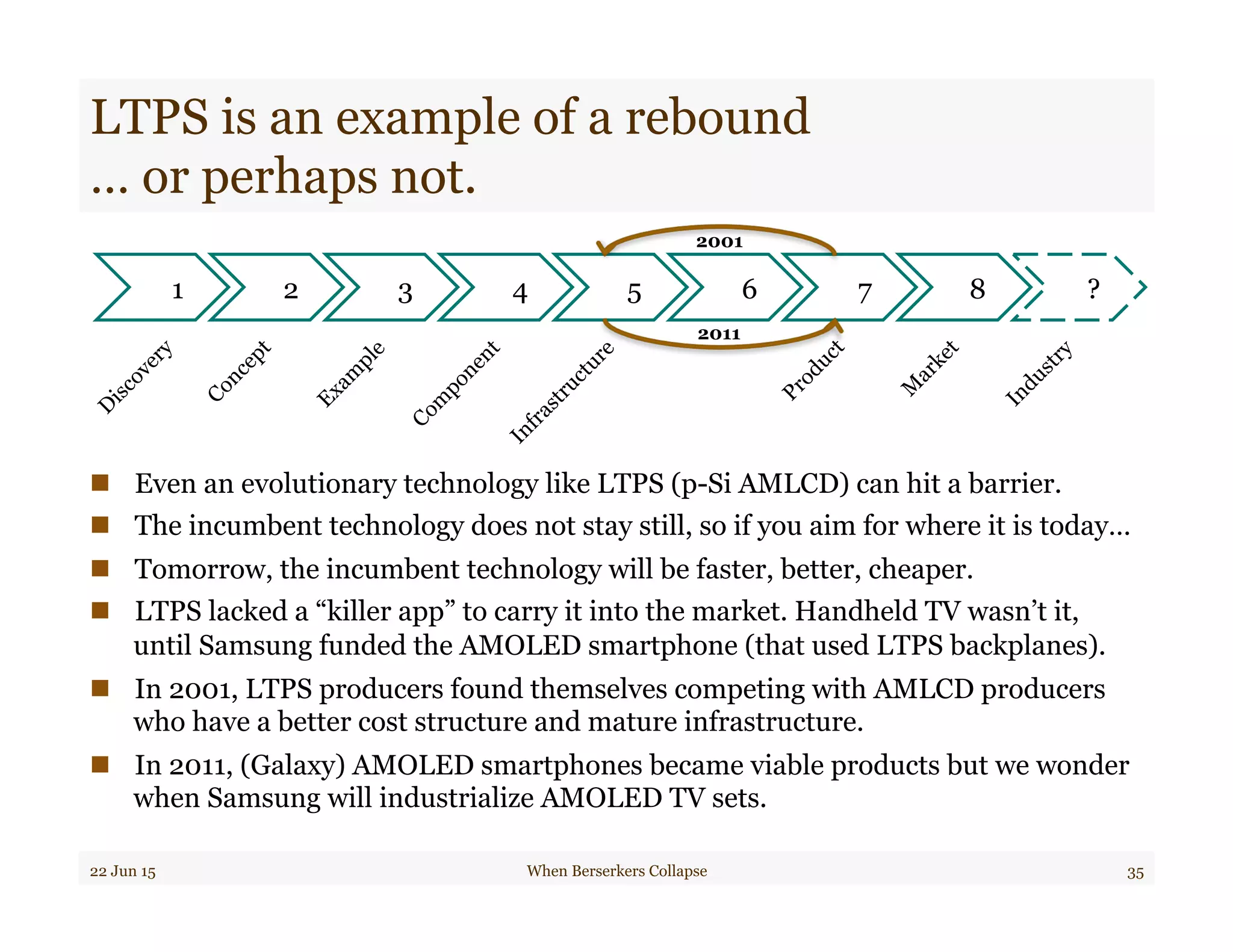
LTPS is an example of a rebound
… or perhaps not.
n  Even an evolutionary technology like LTPS (p-Si AMLCD) can hit a barrier.
n  The incumbent technology does not stay still, so if you aim for where it is today…
n  Tomorrow, the incumbent technology will be faster, better, cheaper.
n  LTPS lacked a “killer app” to carry it into the market. Handheld TV wasn’t it,
until Samsung funded the AMOLED smartphone (that used LTPS backplanes).
n  In 2001, LTPS producers found themselves competing with AMLCD producers
who have a better cost structure and mature infrastructure.
n  In 2011, (Galaxy) AMOLED smartphones became viable products but we wonder
when Samsung will industrialize AMOLED TV sets.
22 Jun 15 When Berserkers Collapse 35
1 2 3 4 5 6 7 8 ?
2001
2011
Summary
22 Jun 15 When Berserkers Collapse 36
There are two ways to slide easily through life:
to believe everything or to doubt everything;
both ways save us from thinking.
— Alfred Korzybski
… who also said:
The map is not the territory.
Flex/Displays is a difficult business…
Our analysts are here to help
22 Jun 15 When Berserkers Collapse 37
Growth
§ Market entry
§ Business structure
§ Phase gates, R&D
Technologies
§ Market sensing
§ Market & IP value
§ Consortia synergy
Alliances
§ M&A candidates
§ Partnerships, JVs
§ Integration plans
Plans
§ Strategic audits
§ Investor insights
§ Business valuation
Materials
§ Pricing policies
§ Market strategies
§ Licenses, royalties
Performance
§ Price position
§ Cost reduction
§ Portfolio balance
CapEx
§ Factory plans
§ Tool selections
§ Plant conversions
Sourcing
§ Make/buy
§ Value chains
§ Supplier selection

Berserkers

  • 1.
    22 Jun 15When Berserkers Collapse 1 When Berserkers Collapse
  • 2.
    When Berserkers Collapse Presentedto the Pacific Northwest Chapter of the Society for Information Display (SID PNW) 24 June 2015 — David Barnes
  • 3.
    Forward into thepast n  Berserkers were real and really terrifying. n  Slashed, pierced or burned, they kept fighting… and winning n  … until they collapsed in exhaustion. n  We might compare berserkers to Asian panel makers. n  Bleeding money, fixing prices below cost, they kept expanding. n  Japan; Korea; Taiwan; will China be their last battleground? n  We might learn from the past and prepare to retake the field. n  The fallacies of technologies n  The problem with printables n  The challenge of controllables 22 Jun 15 When Berserkers Collapse 3
  • 4.
    In the beginning,US technology led the way… to Japan where it found policy support n  US corporates abandoned or divested FPD assets, generally. For a good personal view of the early years, read: The Thin Film Transistor—A Late Flowering Bloom by Brody in IEEE Electron Devices Nov ’84 n  US policy supported PC makers instead of panel makers and belated efforts (USDC, Flamm’s report) were too little, too late. Policies seemed flawed on basic principles… n  Dual-use objectives n  Capital constraints n  Magical thoughts: leapfrog, shock & awe… n  Japan’s MITI coordinated development of the LCD industry based on Kikkoman-type risk sharing among conglomerates. n  Gen-1 and Gen-2 AMLCD investments proved unprofitable, so Japanese makers paused, pending productivity improvements. n  … That’s when Korean berserkers rushed onto the field (ca 1994). 22 Jun 15 When Berserkers Collapse 4
  • 5.
    US organizations discoveredPanel-land and dominated the battlefield… US display makers did not fail for lack of technology. I count 72 companies in the market from 1970 to 2010. More than 1 in 3 companies concentrated on LCD and nearly as many focused on projection technologies for beamers or HMD systems. US organizations also pioneered plasma and electrophoretic technologies. Hix and other entrepreneurs were prolific in the NW of the US! Raise your hand if you recall PALC… 0 5 10 15 20 25 30 LCD Proj FED EL EPD PDP VFD OLED Other 22 Jun 15 When Berserkers Collapse 5 Number of US Firms by Technology, 1970–2010 Source: Our research and analysis
  • 6.
    … then camethe berserkers. There were many false starts, as one would expect. We see a surge of exits after the ITC rescinded 731-TA-469 in 1993 in favor of PC makers. After Korean Gen-2.5 AMLCD fabs came on-line  in 1996, we see a greater surge of exits. There are several other explanations, of course. For example, consumer demand for projection displays rose and fell in various markets. Nevertheless, I think the data shows the effect of Korea, then Taiwan rushing into the fray. 0 1 2 3 4 5 6 7 1970 1975 1980 1985 1990 1995 2000 2005 2010 22 Jun 15 When Berserkers Collapse 6 Distribution of US Exits by Year Source: Our research and analysis
  • 7.
    Few US fighterslive long. Fewer survive. Looking at the 1970–2010 period in terms of longevity, I note a typical FPD lifetime of 6–10 years but the average was closer to 18 because of outliers such as Planar. Companies that lasted more than ten years had to be agile and it is tempting to see some of the adaptations as complete restructurings. In contrast, there were few exits of note in Asia, with the abandonment of DTI by the partners IBM and Toshiba being the most significant. 0 5 10 15 20 25 30 35 01–05 06–10 10–15 15–20 20–25 22 Jun 15 When Berserkers Collapse 7 Range of US Operating Years Prior to Exit Source: Our research and analysis
  • 8.
    Before the Koreansrushed into Panel-land, it looked as if Japan would remain dominant Indeed, the coordination in Japan did create a supply chain structure that survives today… Glass, optical film, chemical and process tool suppliers who supported fabrication enabled industry expansion in Korea, Taiwan and China. The only real change has been self-sourcing of color filters pioneered in Korea. Even the shift to open-cell sales is an echo of the initial Kikkoman-type structure. Japan Inc. was only a decade behind US conglomerates in terms of structural changes… AMLCD Maker 1994 Share Their Fate Sharp 35% Decreasing share and restructure NEC 18% Divested > SVA > BOE DTI 13% Split and part sold to CMO Hosiden 6% Sold to Philips > TPO > Innolux Hitachi 5% Divested > JDI 22 Jun 15 When Berserkers Collapse 8 AMLCD Leaders Twenty Years Ago Share of Sales from Nikkei Microdevices, 1996
  • 9.
    In hindsight, AMLCDberserkers captured almost every square inch of the display market Active-matrix, flat panel displays comprised 35% of total display sales in 1999. Fifteen years later, that share was a dominant 98%. Berserkers killed King CRT, Duke PDP, and all the barons contending for the throne. The areal price of AMLCD declined exponentially near 18% a year until 2009 when macroeconomic conditions forced price decay to slow in the 10% regime. Most competing technologies were crushed by relentless price pressure. $0 $25 $50 $75 $100 $125 $150 1999 2004 2009 2014 Proj. FED EL VFD CRT PMFPD PDP AMFPD 22 Jun 15 When Berserkers Collapse 9 Global Display Sales by Technology (USD billions) Source: HIS, our analysis
  • 10.
    AMLCD sales grewquickly into maturity and a 10% CAGR at scale remains significant The prospects of fast sales growth in a market left open by EU and US conglomerates excited the berserkers. In addition to stimulating national industry, facility and labor productivity, AMLCD presented a DRAM-like opportunity for capital leverage (scale economy) in the minds of Asian policy makers, apparently. Thus, impatient capital did not constrain the berserkers. In fact, Asian policy makers may have seen large capex as attractive… bigger projects mean more (political) power. 22 Jun 15 When Berserkers Collapse 10 AMLCD Sales and CAGR (5-year basis) Source: IHS, our analysis 0% 6% 12% 18% 24% 30% $0 $25 $50 $75 $100 $125 1994 1999 2004 2009 2014 USD billions 5-yr CAGR
  • 11.
    In contrast, impatientcapital forced US firms to consider low-capex (e.g. printed) means Following on the work of Hart et al in the 1990’s, Rattan et al have written about the shift from large-scale corporate R&D to small-scale app development and the concomitant decline in long- term technology commitment. As a consequence, small US or EU organizations have raised modest amounts of capital to fund high-risk approaches to printable electronics or to speculative product markets. Such ventures now seem less attractive than low-risk “tech” that speculates on social media or uber-propositions. "Flat Panel Displays in Perspective examines the potential benefits of a domestic, high-volume, FPD industry for the nation, and evaluates the role of government policies in developing it. The report concludes that such an industry would provide both economic and national security benefits. The extent of these benefits is difficult to determine, however, largely because trends in technology development and industry structure are resulting in more displays at declining prices. The barriers to establishing a high- volume FPD industry are formidable, and government tools to address them are limited." — Roger Herdman, Director, OTA (1995) 22 Jun 15 When Berserkers Collapse 11 High Barriers and Limited Means Source: U.S. Congress, Office of Technology Assessment, OTA-ITC-631
  • 12.
    Berserkers were notconstrained by capital and they put about $190B into the ground Knowledgeable estimates range up to $200 billion but I get $190 using LGD numbers… The point is, that is much more than US conglomerates would want to sink into fixed assets. Flamm expected a 1:2 gearing ratio but Taiwanese expansion shows 3:2… way more than reluctant capital would support. Historical data shows that Japanese and Korean capacity has peaked. Taiwan’s growth has flattened out already… This leaves Chinese capital as the only force remaining. How long with expansion continue? 0 50 100 150 200 250 2000 2003 2006 2009 2012 2015 Germany Singapore Japan China Taiwan Korea 22 Jun 15 When Berserkers Collapse 12 TFT Capacity by Nation (millions m²) Source: IHS, our analysis
  • 13.
    The problem isthat money has not come back out of the ground. Panel makers are charities. Taiwanese executives have said my words are harsh, but they invite me back to advise on strategy, anyway… The fact is the numbers show that Taiwanese AMLCD firms transferred $11.7 billion from shareholders to suppliers and employees since 2000. That money benefitted the nation and many domestic businesses, so it is fair to say the panel makers were charitable with their equity. This illustrates the attraction for other nations, such as China or Brazil and India, to foster such industry… but so far only China has done so. ($25) ($20) ($15) ($10) ($5) $0 $5 $10 $15 2001 2003 2005 2007 2009 2011 2013 Annual CFO Annual PP&E Cumulative FCF 22 Jun 15 When Berserkers Collapse 13 Taiwanese AMLCD Industry Results (USD billions) Free-cash flow (FCF) is cash-flow from operations minus capex (PP&E). Source: public disclosures; SEC rates and our analysis
  • 14.
    TFT capacity begandecelerating in 2009… Only Chinese berserkers are rushing-in, now. Based on Taiwanese history, which was stimulated by national policy (hoping to duplicate its IC success), I assume China is 40% to 50% of the way to maturity. That suggests a total quarterly capacity in the 80 million m² regime… perhaps 1/3 more than total capacity this year. While such Chinese-led expansion is substantial, it implies that even the new berserkers might start collapsing from capital exhaustion near the end of this decade. 0 10 20 30 40 50 60 70 80 Q1'01 Q1'04 Q1'07 Q1'10 Q1'13 Q1'16 Capacity Model 22 Jun 15 When Berserkers Collapse 14 S-Curve Model of Capacity (millions m²/quarter) Pearl-Reed model: 11% growth with 2Q’09 inflection Source: IHS, our analysis
  • 15.
    But what aboutBrazil or India? I expect China will signal the end of expansion. My experience with project plans in both Brazil and India leads me to be skeptical. National policies seem more tuned to becoming more competitive in advanced technologies rather than to developing commodity production infrastructure. I anticipate occasional studies and some activities in high- end product integration but there is no reason to expect semiconductor-based effort. If this view is correct, then berserkers may collapse next decade and open the field to new challengers. 22 Jun 15 When Berserkers Collapse 15 The Future Is Not Black or White Source: Our conjecture ? ?
  • 16.
    So what canchallengers learn from the past? n  Discern the limits of control and visibility. n  Entrants seldom have much control. They depend on leaders. n  Entrants seldom have much visibility; Apple and Corning may have better visibility by many conversations and in Apple’s case by leading category developments. n  Avoid magical thinking. n  Something may not be inevitable. Good enough may be good enough. n  Shock and awe strategies may not shock or awe global competitors. n  Low capex processes needing high cost materials can kill you… n  Beware of multi-party game dynamics n  A producing nation cannot have open markets, rich material suppliers and rich tool suppliers… that is an impossible trinity. n  US material suppliers (e.g. 3M or Corning) have profited more from the AMLCD industry than have all panel makers. Pick your position. 22 Jun 15 When Berserkers Collapse 16
  • 17.
    APPENDIX Some slides frommy LOPEC 2014 presentation… 22 Jun 15 When Berserkers Collapse 17
  • 18.
    Innovations are rarebecause they are uniquely useful and valuable Talk about about innovation is cheap but realizing it is costly and difficult for businesses In most cases, organizations modify something or offer some novelty: a 753 ppi LCD Value may be increased by creating a product line or range: a 4K TV sub-brand Sometimes an organization has a patentable product: IPS/ FFS LCD More rarely, an organization combines high-resolution with a sub-brand, FSS LCD and software and an apps store to create the iOS business, which is unique, useful and valuable . 22 Jun 15 When Berserkers Collapse 18 Utility-Value Matrix of Innovation Our conceptual diagram Invention Patentable Modification Promotable Innovation Uniquely valuable Creation Valuable Value Utility
  • 19.
    Being approximately correctrather than being precisely wrong requires sincere assessment All organizations have limited visibility and control… some more than others. Few can sustain an external focus and coordinate co-op development, long term. Ironically, materials suppliers are often isolated and very dependent on other tech or market developments, yet they often profit most from merging technologies. A combinations of inaccurate mental maps, dependencies and untested assumptions lead to unfortunate forecasts for others assuming more visibility or control. . 22 Jun 15 When Berserkers Collapse 19 Visibility–Control Matrix Our conceptual diagram § Inward focus § Independent development § Isolated § Dependent § External focus § Cooperative development § Involved § Associated Control Visibility
  • 20.
    The map isnot the territory … ways we fool ourselves into foolish actions 22 Jun 15 When Berserkers Collapse 20 JohannesVingboons,ca1650
  • 21.
    Logic Bubbles … isn’tobvious that_____? n  When an Asian businessman hears that a project will take a lot of capital, he says, “Good!” n  More money will be, “spread around.” He will gain face. n  Big projects are wanted for big populations. n  When a Western businessman hears a project will take a lot of capital, he says, “Bad!” n  Investors want big returns on small amounts. n  “Let’s make it R2R, then.” n  We all tend to think others know and understand our constraints… but they don’t. 22 Jun 15 When Berserkers Collapse 21
  • 22.
    Leapfrog … so we’lljump way ahead of them! n  The history of US display and printable electronics provides many examples… n  After deciding finance, mergers, acquisitions or real estate was preferable to capex, US companies let others do the heavy lifting. n  But disappointed engineers dreamed of new things and it looked like they could jump ahead of slower-moving Asian competitors. n  This became a corollary to the US military’s dual- use doctrine: US companies should work on advanced projects so they can leapfrog others. n  OK, but two questions: n  Will others stand still long enough? n  Can I vault high enough? 22 Jun 15 When Berserkers Collapse 22
  • 23.
    Shock and Awe …our new ____ will change everything! n  This is another US-centric motif but one that may resonate with veterans of EU Framework projects. n  While it may be is tempting to think that incumbent suppliers might roll over and give up when you announce, they might not even pause their relentless progress toward more for less. n  Worse, they may alter course and change the playing field before you realize it. n  Getting to Baghdad is just the beginning… 22 Jun 15 When Berserkers Collapse 23
  • 24.
    Determinism … all wehave to do is ____. n  If we ___, then they must ___. n  This fallacy has some parallel to Marx’s historical determinism… which might not be wrong, just late. n  It also intertwines with logic bubbles n  … they must know that they have no alternative once we enter the market. n  If I had a euro for each cost forecast I’ve seen that showed Tech-X would beat all others because… I’d retire. n  Why do you assume they plan to be profitable, ever? n  The point here is that people have different constraints and preferences than you do and that you should not assume something is inevitable. 22 Jun 15 When Berserkers Collapse 24
  • 25.
    Magic … and then,____ will happen. n  Leap of faith … a noble thing at times but dangerous. n  “Presto” is nice to say but difficult to do. n  Magical thinking comes in two general forms. n  Sympathy: A is similar to B so if I do this to A, then B will change also. n  Correspondence: B changed when A changed, so C will change when D changes. n  Governments and organizations succumb to magical thinking frequently, so the only good antidote is a strong sense of history … and remembering that correlation does not imply causation. 22 Jun 15 When Berserkers Collapse 25
  • 26.
    Example of amisleading mental map … the rise and fall (and rise and fall?) of LTPS A famous market research firm forecasted LTPS-based display sales would rise 141% a year from 1997 to 2002 and reach $4,800 million. In hindsight, sales increased 62% a year to reach $784 m. The forecast proved to be 5X too high 5 years later. What went wrong? §  Tools: no way to pattern IC resolutions at TV sizes §  Momenta: no way to catch- up with a-Si:H TFT §  Costs: on-glass integration more costly than parts (DIC) §  Values: a-Si technology was good enough for most things 22 Jun 15 When Berserkers Collapse 26 LTPS Display Forecast and Actual Sales Our analysis of a Q2‘97 report and a Q2’05 report by the same firm $- $1 b $2 b $3 b $4 b $5 b 1997 1998 1999 2000 2001 2002 Actual Sales 1997 Forecast
  • 27.
    Assumptions— Are you surethings will change quickly? David Sarnoff and RCA had a wonderful vision of TV sets you could hang on the wall … and we could 50 years later. It took more than a few things to change. It took materials, tools, many breakthroughs and euros. … spent by many companies … over many years … with some success … and lots of failure So today, we can say “nothing’s on” our TV made by companies that make no money for investors. 22 Jun 15 When Berserkers Collapse 27 RCA’s Vision of the Future in 1955 Source: Technician Magazine, Oct ‘55
  • 28.
    Assumptions— Are you surethings will change slowly? We live in a non-linear world and momentum matters. Aim where incumbents are going, not where they are. Study historical trends. Question forecasts. Ask yourself, what if we are a few years (or quarters) late? Think about industries or markets as snowballs rolling down hill. Why will snowballs change vectors if you ___? 22 Jun 15 When Berserkers Collapse 28 Difference Between 20% and 10% Annual Declines Source: Our experience in display and IC industries, 1974–2014 0% 40% 80% 120% 160% 200% 0 20 40 60 80 100 0 1 2 3 4 5 6 7 8 9 Actual Expected Error%
  • 29.
    Assumptions— The trend isyour friend, until the end. You can model the areal price of AMLCD with a simple sine wave riding on an exponential decay line. The problem with this is you can find data to support any trend you want … if you think short-term. The AMLCD industry has a nominal ten-quarter cycle based on capital and people resources, so you need to look back three or more years to see the real historical trend. Momentum matters. Are you moving fast enough … in the right direction? 22 Jun 15 When Berserkers Collapse 29 Sine-wave Model of AMLCD Area Price by Quarter Our analysis circa 2006 0 20 40 60 80 100 1 5 9 13 Price Decay Trend Quarterly Price Cycle Up 10%
  • 30.
    Assumptions— Are you solvingthe right problem? The problem is how to get rid of mice, not how to catch them. n  Bubble memory was the better mouse trap of the 1970’s. n  TI introduced a 92 kb MBM in 1978. n  By 1979, Rockwell, IBM, TI and Intel had over 500 engineers involved. n  By 1981, all projects were abandoned. n  EEPROM was better, faster and cheaper. n  It evolved from conventional IC technology. n  It required less design and production infrastructure change. n  The problem was how to keep data, not how to write data. 22 Jun 15 When Berserkers Collapse 30
  • 31.
    Precedence and Dependence …another way to say visibility and control n  No organization is an island. n  Each must decide n  … to collaborate or contend with incumbents; n  … to compliment existing products or to replace them with new ones. n  In general, if you cannot find and defend a market segment for contending and substituting … then you should seek one in which you can collaborate and compliment. n  The following slides show phases of development any new technology passes through on the way to market 22 Jun 15 When Berserkers Collapse 31 Contend Collaborate Substitute Compliment
  • 32.
    Speaking of dependences …here are nine phase gates to negotiate n  Revolutionary technologies must go through all nine steps to commercialization. n  Bubble memories n  LCD n  Disruptive technologies may start at the point of demand (6), developing a business model or value proposition, and build on existing infrastructure. n  Small disk drives n  OLED (?) n  Evolutionary technologies may start at the point of finding a new product “carrier” or identifying a new market (8). IGZO might be an example of this. 22 Jun 15 When Berserkers Collapse 32 1 2 3 4 5 6 7 8 9
  • 33.
    For example, computermemories n  MBM got as far as a manufacturing infrastructure before demand failed to appear. The IBM project met all its targets but DRAM, EEPROM and Disk Drives had evolved too far. n  MRAM sales of $190 m in 2013 leads to forecasts of 67% annual growth into 2019… 22 Jun 15 When Berserkers Collapse 33 1949 1971 1977 1977 1979 1960 1976 1991 2000 2004 2006 2008 2013 ? 1981 Tunneling Junction — Giaever, GE Core Memory — Forrester, MIT
  • 34.
    … and AMLCD Industrializationcan take 27 years, or more. n  Marconi patented the LC light valve concept in 1936 but the TN mode wasn’t developed until 1969. n  It took billions of dollars and MITI (Japan) coordination to build AMLCD scale and infrastructure. n  NEC introduced the LCD notebook PC in 1986. n  The modern AMLCD industry was not in place until 1994… thirty years after RCA developed the TV on a wall concept on the work of Richard Williams. n  Affordable LCD TV you could hang on the wall did not appear until 2003–2004… forty years after the concept was announced at Rockefeller Center. 22 Jun 15 When Berserkers Collapse 34 Liquid Crystal Light Valve — Marconi 1936 1963 1969 1973 ~1980 1982 1986 1992 1994
  • 35.
    LTPS is anexample of a rebound … or perhaps not. n  Even an evolutionary technology like LTPS (p-Si AMLCD) can hit a barrier. n  The incumbent technology does not stay still, so if you aim for where it is today… n  Tomorrow, the incumbent technology will be faster, better, cheaper. n  LTPS lacked a “killer app” to carry it into the market. Handheld TV wasn’t it, until Samsung funded the AMOLED smartphone (that used LTPS backplanes). n  In 2001, LTPS producers found themselves competing with AMLCD producers who have a better cost structure and mature infrastructure. n  In 2011, (Galaxy) AMOLED smartphones became viable products but we wonder when Samsung will industrialize AMOLED TV sets. 22 Jun 15 When Berserkers Collapse 35 1 2 3 4 5 6 7 8 ? 2001 2011
  • 36.
    Summary 22 Jun 15When Berserkers Collapse 36 There are two ways to slide easily through life: to believe everything or to doubt everything; both ways save us from thinking. — Alfred Korzybski … who also said: The map is not the territory.
  • 37.
    Flex/Displays is adifficult business… Our analysts are here to help 22 Jun 15 When Berserkers Collapse 37 Growth § Market entry § Business structure § Phase gates, R&D Technologies § Market sensing § Market & IP value § Consortia synergy Alliances § M&A candidates § Partnerships, JVs § Integration plans Plans § Strategic audits § Investor insights § Business valuation Materials § Pricing policies § Market strategies § Licenses, royalties Performance § Price position § Cost reduction § Portfolio balance CapEx § Factory plans § Tool selections § Plant conversions Sourcing § Make/buy § Value chains § Supplier selection