OpenQRM is not Dead by Kris Buytaert
Kris Buytaert  Senior Linux and Open Source Consultant @ Inuits.be „ Infrastructure Architect“ Linux since 0.98 OpenMosix, openQRM, ... Early Adopter (Xen, MySQL Cluster)  Automating Large Scale Deployment , High Availability Surviving the 10 th  floor test http://www.krisbuytaert.be/blog/ http://www.virtualization.com/
Agenda Managing  Physical and Virtual Machines Why openQRM  Architecture Plug-ins Virtual Environments  Appliance Virtualization
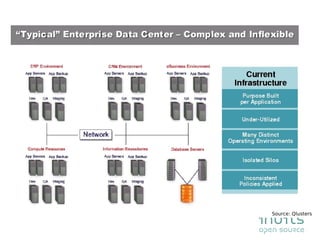
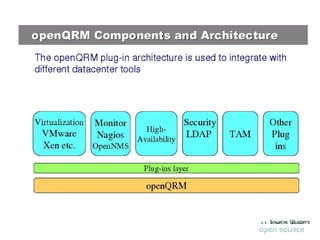
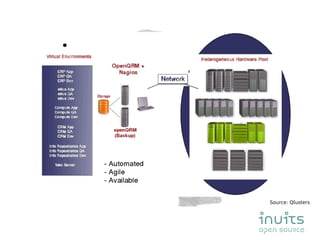
Source: Qlusters
Data-center Requirements Rapid multi-environment provisioning Dynamic load handling Monitoring and management of commodity servers Improve servers utilization to cut costs Patching + configuration management
Managing your Infrastructure Proprietary tools Platform specific tools Infrastructures.org  Kickstart/Fai/SystemImager Cfengine / Puppet
What is openQRM ? open-source project at sourceforge.net (GPL) data-center management platform Not just your virtual platforms provides generic virtualization layer supports complex network topologies developer-friendly
OpenQRM History OpenMosix Qlusters Managing Clusters Managing Infrastructures Open Source  early 2006 Set Free April 2008  V4 Rewrite  June 2008 Qlusters Closed shop July 2008 OpenQRM 4.1 Mid August 2008
Source: Qlusters
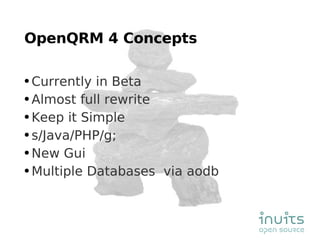
OpenQRM 4 Concepts Currently in Beta Almost full rewrite Keep it Simple s/Java/PHP/g; New Gui Multiple Databases  via aodb
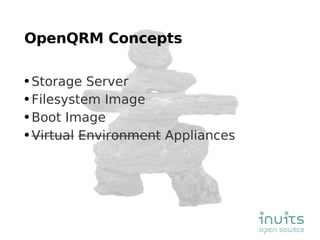
OpenQRM Concepts Storage Server Filesystem Image Boot Image Virtual Environment  Appliances
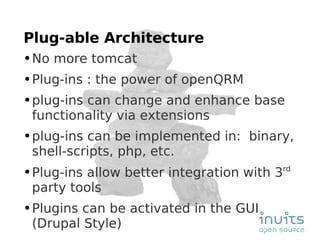
Plug-able Architecture No more tomcat Plug-ins : the power of openQRM plug-ins can change and enhance base functionality via extensions plug-ins can be implemented in:  binary, shell-scripts, php, etc. Plug-ins allow better integration with 3 rd  party tools Plugins can be activated in the GUI (Drupal Style)
The New Gui Redesign by Alexander Kuballa Looks like phplayer menu but stripped Adodb => no more db lock in Fully Themable Easier to contribute
Virtual data-center logical layer for servers/services called virtual environments (VE) virtual environments consist of : a boot-image (e.g. a linux kernel) a root-file system (local, NFS, ISCSI) provisioning meta-data deployed according provisioning meta-data on idle resources
Source: Qlusters
1 : Storage Server Centralized storage for fs-images on either NFS or ISCSI , AOE , ... automatic fs-image creation fs-image management tools e.g. create, remove, clone support for local root-file-systems through local-deployment plug-in
2: Filesystem Image From an existing machine (golden image) Generated Template Chroot Install Automagic install
3: Boot Image Kernel to boot the different platforms with. Tied to the hardware => Not to the Service
Initial boot of a datacenter node Node is empty Boots from network (dhcp / tftpboot /pxe) Idle Resource
Deployment of a service Idle node reboots Chosen kernel boots Minimal initrd mounts filesystem Plugins for storage types Chroots Starts  Virtual Environment  Appliance
Managing A Node Start Stop Put in Maintenance
Easy-migration openQRM adapts to the existing data-center environment (not the other way around) step-by-step migration to openQRM environment Install openqrmplugin on existing system moving on from easy-migration to full virtualized data-center
Higher-Availability (for the managed nodes) High-Availability in 3 layers Hardware fail-over VE restarts on available resource from the high- availability pool .  (This is a restart, not a fail-over) Application fail-over Application fails over to hot-standby system OpenQRM server HA
Partitioning seamlessly manages physical servers and virtual machines (Partitions) supports all mainstream virtualization technologies as VMware, Xen,  Linux-VServer Partition-engine conforms all different kinds of virtualization Partition plug-ins provide generic resource from type “partition”
Managing Partitions Xen plugin is based on the VMWare one Stop / start Pause Change memory config Live Migrate
Road-map 4.1 finalyzing the base system Usability improvements for Images and Appliance forms User-management enhancements GUI Design enhancements Event Interface for managed servers Automatic dependency resolving for appliances Deployment parameters clean-up Finalizing Update-Path (backup/restore of the openQRM environment)
Road-map 4.2 adding plugins openQRM-server HA-setup Adding udev to the intird Iscsi- and Aoe-storage enhancements + bugfixes Group-command plugin Webmin plugin Consider Nagiosadmin plugin Virtualbox plugin
Road-map 4.3 adding even more plugins openVZ plugin Support for clusterfilestem on Iscsi- and Aoe-storage (Ocfs2 + GFS2) LinuxCOE plugin
Summary and conclusion Extensible open-architecture Unique features and lots of automatism Better data-center performance through better scalability, more flexibility and dynamic management Supports all mainstream virtualization technologies Smooth integration phase
Virtual Demo
Kris  Buytaert  <Kris.Buytaert@inuits.be> http://www.krisbuytaert.be/blog/ http://mattinaction.blogspot.com/ http://virtualization.com http://openqrm.sf.net Contact & Further Reading :
Time for questions ? !

openQRM is Not Dead

  • 1.
    OpenQRM is notDead by Kris Buytaert
  • 2.
    Kris Buytaert Senior Linux and Open Source Consultant @ Inuits.be „ Infrastructure Architect“ Linux since 0.98 OpenMosix, openQRM, ... Early Adopter (Xen, MySQL Cluster) Automating Large Scale Deployment , High Availability Surviving the 10 th floor test http://www.krisbuytaert.be/blog/ http://www.virtualization.com/
  • 3.
    Agenda Managing Physical and Virtual Machines Why openQRM Architecture Plug-ins Virtual Environments Appliance Virtualization
  • 4.
  • 5.
    Data-center Requirements Rapidmulti-environment provisioning Dynamic load handling Monitoring and management of commodity servers Improve servers utilization to cut costs Patching + configuration management
  • 6.
    Managing your InfrastructureProprietary tools Platform specific tools Infrastructures.org Kickstart/Fai/SystemImager Cfengine / Puppet
  • 7.
    What is openQRM? open-source project at sourceforge.net (GPL) data-center management platform Not just your virtual platforms provides generic virtualization layer supports complex network topologies developer-friendly
  • 8.
    OpenQRM History OpenMosixQlusters Managing Clusters Managing Infrastructures Open Source early 2006 Set Free April 2008 V4 Rewrite June 2008 Qlusters Closed shop July 2008 OpenQRM 4.1 Mid August 2008
  • 9.
  • 10.
    OpenQRM 4 ConceptsCurrently in Beta Almost full rewrite Keep it Simple s/Java/PHP/g; New Gui Multiple Databases via aodb
  • 11.
    OpenQRM Concepts StorageServer Filesystem Image Boot Image Virtual Environment Appliances
  • 12.
    Plug-able Architecture Nomore tomcat Plug-ins : the power of openQRM plug-ins can change and enhance base functionality via extensions plug-ins can be implemented in: binary, shell-scripts, php, etc. Plug-ins allow better integration with 3 rd party tools Plugins can be activated in the GUI (Drupal Style)
  • 13.
    The New GuiRedesign by Alexander Kuballa Looks like phplayer menu but stripped Adodb => no more db lock in Fully Themable Easier to contribute
  • 14.
    Virtual data-center logicallayer for servers/services called virtual environments (VE) virtual environments consist of : a boot-image (e.g. a linux kernel) a root-file system (local, NFS, ISCSI) provisioning meta-data deployed according provisioning meta-data on idle resources
  • 15.
  • 16.
    1 : StorageServer Centralized storage for fs-images on either NFS or ISCSI , AOE , ... automatic fs-image creation fs-image management tools e.g. create, remove, clone support for local root-file-systems through local-deployment plug-in
  • 17.
    2: Filesystem ImageFrom an existing machine (golden image) Generated Template Chroot Install Automagic install
  • 18.
    3: Boot ImageKernel to boot the different platforms with. Tied to the hardware => Not to the Service
  • 19.
    Initial boot ofa datacenter node Node is empty Boots from network (dhcp / tftpboot /pxe) Idle Resource
  • 20.
    Deployment of aservice Idle node reboots Chosen kernel boots Minimal initrd mounts filesystem Plugins for storage types Chroots Starts Virtual Environment Appliance
  • 21.
    Managing A NodeStart Stop Put in Maintenance
  • 22.
    Easy-migration openQRM adaptsto the existing data-center environment (not the other way around) step-by-step migration to openQRM environment Install openqrmplugin on existing system moving on from easy-migration to full virtualized data-center
  • 23.
    Higher-Availability (for themanaged nodes) High-Availability in 3 layers Hardware fail-over VE restarts on available resource from the high- availability pool . (This is a restart, not a fail-over) Application fail-over Application fails over to hot-standby system OpenQRM server HA
  • 24.
    Partitioning seamlessly managesphysical servers and virtual machines (Partitions) supports all mainstream virtualization technologies as VMware, Xen, Linux-VServer Partition-engine conforms all different kinds of virtualization Partition plug-ins provide generic resource from type “partition”
  • 25.
    Managing Partitions Xenplugin is based on the VMWare one Stop / start Pause Change memory config Live Migrate
  • 26.
    Road-map 4.1 finalyzingthe base system Usability improvements for Images and Appliance forms User-management enhancements GUI Design enhancements Event Interface for managed servers Automatic dependency resolving for appliances Deployment parameters clean-up Finalizing Update-Path (backup/restore of the openQRM environment)
  • 27.
    Road-map 4.2 addingplugins openQRM-server HA-setup Adding udev to the intird Iscsi- and Aoe-storage enhancements + bugfixes Group-command plugin Webmin plugin Consider Nagiosadmin plugin Virtualbox plugin
  • 28.
    Road-map 4.3 addingeven more plugins openVZ plugin Support for clusterfilestem on Iscsi- and Aoe-storage (Ocfs2 + GFS2) LinuxCOE plugin
  • 29.
    Summary and conclusionExtensible open-architecture Unique features and lots of automatism Better data-center performance through better scalability, more flexibility and dynamic management Supports all mainstream virtualization technologies Smooth integration phase
  • 30.
  • 31.
    Kris Buytaert <Kris.Buytaert@inuits.be> http://www.krisbuytaert.be/blog/ http://mattinaction.blogspot.com/ http://virtualization.com http://openqrm.sf.net Contact & Further Reading :
  • 32.

Editor's Notes

  • #2 Hello Ladies and Gentlemen, nice to have your here at linuxkongress in Nürnberg and welcome to the talk about Managing enterprise data-centers with openQRM Some short informations about me : My name is Matt Rechenburg and i am project manager of different open-source projects like openMosixview or kiscsiadmin. I am living in Bonn/Germany and working as a freelancer for all different kinds of open-source and also commercial projects. Currently i am heavily involved in the openQRM project working on enhancing the main engine and developing different plugins. You will find me in the openQRM forums and mailling list.