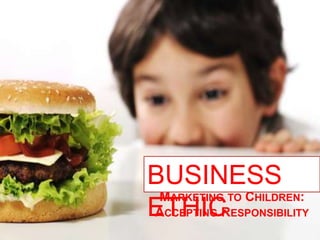
BUSINESS
M
C
ETHIC
A
R
ARKETING TO

CCEPTING

HILDREN:

ESPONSIBILITY
Presentation of the situation
• Marketing to children at Mc Donald
• Responsibility of the company is
challenging
• Deceptive marketing practices to
children.

• Corporate Accountability International
launched a campaign to fire Ronald
Mc Donald  Failure
• Request from Sisters of St. Francis of
Philadelphia  Failure
• Response of Mc Donald : “ leave to parent’s the right to choose what their
children eat, saying it is up to personal responsibility”.
Concepts
Corporate Social Responsibility is the Continuing commitment
by business to behave Ethically and contribute to economic
development while improving the quality of life of the workforce
and their families as well as of the local community and society
at large. World Business Council for Sustainable Development

Does McDonald’s have a corporate social
responsibility
about kids healthcare
?
Concepts
The Friedmans's theory of individualism: the company's main goal is to
maximize profit for the owner and
stockholders.
• McDonald's is purposely marketing children because they are able to
persuade their parents to purchase their products.
• Children push to get a new toy in a Happy Meal and play on the
playground provided at many establishments which drive profits
• Children are unable to drive or buy the food but their parents are. By
having children go with a parent or adult, it doubles profit. If one adult
goes, that is one burger, but if a child and an adult go, its two.

Therefore increasing sales
The company is acting ethical.


Concepts
Utilitarian theory: happiness should be maximized while pain should
be minimized.
• The stakeholders are happy considering the situation.
• The employees are happy; with higher profits employees are able
to have job security and higher wages
At a short term point of view:
• The children are happy with their toys, and playgrounds, and a
clown, which is the face of the McDonald's Corporation.
• Parents are happy because its fast and easy and it makes their
children happy, hence the name Happy Meal.
=> At a short term point of view: McDonald’s is ethical
At a long term point of view:
• The parents and their children can have health concerns due to
overweight. In this case they would not be happy.
=> At a short term point of view: McDonald’s is not ethical
Concepts
Kantiantheory: one should do things for the right reasons.
Kantiantheoryisattached to the saying "the end does not justify the
means. »
• McDonald's began the marketing techniques to children out of selfinterest to maximize profits
• McDonald's was not motivated to justprovide a toybecauseit's the
right thing to do, but to attractthem to come back.
Inthatsense, McDonald's isunethical
Concepts
The virtuetheory, which states that one should express good
character, whichincludes courage, honesty, temperance, and justice.
•

McDonald's ishonestwiththeirfood nutrition, and variety of
productsthatsatisfydifferentconsumersneeds. Consumers know that
McDonald's providesfastfood for cheap prices
• In reference to the lawsuit, Monet Parham, the consumersalways
have the control and power to buy or not and Monet
Parhamhadthat control.

McDonald'sactedethically
Concepts: Normative ethics and normative
justice
Practical Reason = Moral Issues
Normative Ethics

BUSINESS ETHICS

Individual
Ethics
What kind of
person do I want
to be ?
What are my
ethical duties as a
manager?

Social Ethics

What are the
ethical
obligations of the
organisation I
work for ?
Normative CSR

Personal morality

Self-regulation

Personal values

Corporate values

Professional ethics

Normative Justice

Justice

What should
be the legal
obligations of
the
organisation
I work for?

Positive Law

What are the legal
obligations of the
organisation I work for?
Civil law
Corporate law
Employment law
Etc.
A Normative justice that should be
a normative ethics
1950

1967

1980

1981

1998

• TV advertising begins

• The first calls for change: Petition to halt TV commercials for candy and sugary snack foods directed at
children

• Congress passes FTC improvement Act that allowed to regulated on case-by-case basis and barred from
issuing industry-wide regulations

• Industry initiates volontary self-regulation

• Children’s Online Privacy Protection Act requires teh Federal Trade Commission to develop specific rules to
implement the provisions of the act concerning the invasion of children’s Online Privacy Protection Rule
Personnalcommentary: Responsability of
McDonald’s
DID YOU KNOW ?
- 30% of the children ages 6 to
11 are overweight and 15,3%
of the children ages 6 to 11
are obese
- The eating habits children
develop carry on into
adulthood
- Mcdonald’s marketing goal is
20 visits/cust/month
- 90% of children visit
McDonald’s once a month
- Only 1 Happy Meal option
meets calorie guidelines for
children
Personnalcommentary: Responsability of
McDonald’s
• By the age of 3, children are
able to understand the
difference between television
programs and commercials
• By the age of 10, most
children are able to
understand the persuasive
nature of adverstising and that
not all advertisements tell the
truth
• HOWEVER, being able to
understand the persuasive
nature of marketing is another
story
Personnalcommentary: Responsability of
McDonald’s

Recentstudies have shownthat the influence
childrenexert on the purchasingdecisions in
householdsis extensive and on the increase. Some of
the factorscited are as follows:
1. Parents are havingfewerchildren and thusspending
more on eachchild;
2. Parents are havingchildrenlater, at a time whenthey are
beyond the struggle phase in theircareer;
3. Young professionalspurchasepresents for children to
compensate for the lack of time they are able to
spendwiththem
Personnalcommentary: Responsability of
the parents

• Parents influence children’seating habits
throughtheirimplicit and explicit modeling of
foodconsumptionbehavior(Fisher and Birch
1995). For example, the children of parents
who consume fruits and vegetables do the
same(Nicklas et al. 2001).
THANK YOU FOR YOUR
ATTENTION

Mcdo Marketing Children

  • 1.
  • 2.
    Presentation of thesituation • Marketing to children at Mc Donald • Responsibility of the company is challenging • Deceptive marketing practices to children. • Corporate Accountability International launched a campaign to fire Ronald Mc Donald  Failure • Request from Sisters of St. Francis of Philadelphia  Failure • Response of Mc Donald : “ leave to parent’s the right to choose what their children eat, saying it is up to personal responsibility”.
  • 3.
    Concepts Corporate Social Responsibilityis the Continuing commitment by business to behave Ethically and contribute to economic development while improving the quality of life of the workforce and their families as well as of the local community and society at large. World Business Council for Sustainable Development Does McDonald’s have a corporate social responsibility about kids healthcare ?
  • 4.
    Concepts The Friedmans's theoryof individualism: the company's main goal is to maximize profit for the owner and stockholders. • McDonald's is purposely marketing children because they are able to persuade their parents to purchase their products. • Children push to get a new toy in a Happy Meal and play on the playground provided at many establishments which drive profits • Children are unable to drive or buy the food but their parents are. By having children go with a parent or adult, it doubles profit. If one adult goes, that is one burger, but if a child and an adult go, its two. Therefore increasing sales The company is acting ethical. 

  • 5.
    Concepts Utilitarian theory: happinessshould be maximized while pain should be minimized. • The stakeholders are happy considering the situation. • The employees are happy; with higher profits employees are able to have job security and higher wages At a short term point of view: • The children are happy with their toys, and playgrounds, and a clown, which is the face of the McDonald's Corporation. • Parents are happy because its fast and easy and it makes their children happy, hence the name Happy Meal. => At a short term point of view: McDonald’s is ethical At a long term point of view: • The parents and their children can have health concerns due to overweight. In this case they would not be happy. => At a short term point of view: McDonald’s is not ethical
  • 6.
    Concepts Kantiantheory: one shoulddo things for the right reasons. Kantiantheoryisattached to the saying "the end does not justify the means. » • McDonald's began the marketing techniques to children out of selfinterest to maximize profits • McDonald's was not motivated to justprovide a toybecauseit's the right thing to do, but to attractthem to come back. Inthatsense, McDonald's isunethical
  • 7.
    Concepts The virtuetheory, whichstates that one should express good character, whichincludes courage, honesty, temperance, and justice. • McDonald's ishonestwiththeirfood nutrition, and variety of productsthatsatisfydifferentconsumersneeds. Consumers know that McDonald's providesfastfood for cheap prices • In reference to the lawsuit, Monet Parham, the consumersalways have the control and power to buy or not and Monet Parhamhadthat control. McDonald'sactedethically
  • 8.
    Concepts: Normative ethicsand normative justice Practical Reason = Moral Issues Normative Ethics BUSINESS ETHICS Individual Ethics What kind of person do I want to be ? What are my ethical duties as a manager? Social Ethics What are the ethical obligations of the organisation I work for ? Normative CSR Personal morality Self-regulation Personal values Corporate values Professional ethics Normative Justice Justice What should be the legal obligations of the organisation I work for? Positive Law What are the legal obligations of the organisation I work for? Civil law Corporate law Employment law Etc.
  • 9.
    A Normative justicethat should be a normative ethics 1950 1967 1980 1981 1998 • TV advertising begins • The first calls for change: Petition to halt TV commercials for candy and sugary snack foods directed at children • Congress passes FTC improvement Act that allowed to regulated on case-by-case basis and barred from issuing industry-wide regulations • Industry initiates volontary self-regulation • Children’s Online Privacy Protection Act requires teh Federal Trade Commission to develop specific rules to implement the provisions of the act concerning the invasion of children’s Online Privacy Protection Rule
  • 10.
    Personnalcommentary: Responsability of McDonald’s DIDYOU KNOW ? - 30% of the children ages 6 to 11 are overweight and 15,3% of the children ages 6 to 11 are obese - The eating habits children develop carry on into adulthood - Mcdonald’s marketing goal is 20 visits/cust/month - 90% of children visit McDonald’s once a month - Only 1 Happy Meal option meets calorie guidelines for children
  • 11.
    Personnalcommentary: Responsability of McDonald’s •By the age of 3, children are able to understand the difference between television programs and commercials • By the age of 10, most children are able to understand the persuasive nature of adverstising and that not all advertisements tell the truth • HOWEVER, being able to understand the persuasive nature of marketing is another story
  • 12.
    Personnalcommentary: Responsability of McDonald’s Recentstudieshave shownthat the influence childrenexert on the purchasingdecisions in householdsis extensive and on the increase. Some of the factorscited are as follows: 1. Parents are havingfewerchildren and thusspending more on eachchild; 2. Parents are havingchildrenlater, at a time whenthey are beyond the struggle phase in theircareer; 3. Young professionalspurchasepresents for children to compensate for the lack of time they are able to spendwiththem
  • 13.
    Personnalcommentary: Responsability of theparents • Parents influence children’seating habits throughtheirimplicit and explicit modeling of foodconsumptionbehavior(Fisher and Birch 1995). For example, the children of parents who consume fruits and vegetables do the same(Nicklas et al. 2001).
  • 14.
    THANK YOU FORYOUR ATTENTION