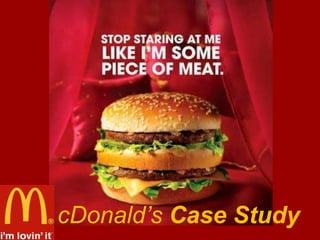
cDonald’s Case Study
Inception of mcdonald’s
Richard and Maurice McDonald
started McDonald’s as a barbeque
restaurant in 1940
Ray Kroc, a multi mix salesman
franchised a restaurant in 1955 and
later bought the whole chain
Ronald McDonald, the world
famous mascot - introduced in 1960
Expanded to over 700 restaurants
in USA by 1965 - Aggressively
expanded overseas in the 80s
Added almost 2000 new restaurants
every year
Mantra for mcdonald’s initial
success – ray kroc
•Domestic and international
expansion reinforced with quality,
service, cleanliness and values.
•Iconic golden arch and red and
white stripe restaurants
•Menu expanded – iconic items – Big
Mac, Fillet-O-Fish, Egg McMuffin
•Ramped up advertising – targeted
children and families
the magnitude of mcdonald’s
McDonald’s serves 70 million people every day.
That’s 5 million more than the population of UK
World’s largest chain of restaurants.
118 countries – 34000 locations –
1.9 million employees
Generated revenues of $27 billion in 2012
Brand promise
Hot, high quality food at a great value at the speed
and convenience of McDonald’s
High Quality Great Value
Speed and convenience
Science behind mcdonald’s success
Customer service has
always been top priority
FOCUS:
•Consistency of quality
•Creating strong brand
equity through holistic
marketing activities
•Emphasis on cleanliness
and service
•Affordability of products
•Localized offerings
satisfying regional taste
Science behind mcdonald’s success
Quick Service Affordability
Science behind mcdonald’s success
Localized Offerings Quality Control
Creating Brand equity
Wide Array of Marketing Campaigns
Creating Brand equity
Adding more products to the product line.
Expanding beyond hamburgers. Brand extension.
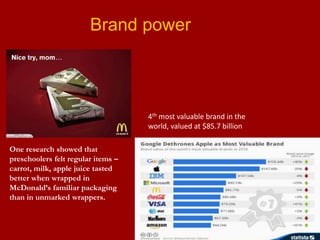
Brand power
Regular food items tastes better
when wrapped in McDonald’s
familiar packaging
4th most valuable brand in the
world, valued at $85.7 billion
Marketing strategies
Marketing Segmentation
Psychographic segmentation
Demographic segmentation based on
income
Marketing strategies
Marketing Segmentation
India
China
Japan
Geographic segmentation
catering to needs of local market
Brand positioning
Family restaurant –
Ronald McDonald
Targets kids – Happy
Meals
Attracts teenagers and
young adults - $1 menu
Attracts health
conscious consumers –
Premium low calorie
salads
McCafe – targets
consumers in booming
coffee industry
What are McDonald’s core brand values? Have these
changed over the years?
Core values – quality, cleanliness, service
and value
Products, product pricing, restaurants
and employees showcase these values
Lost their way in the 80s and 90s due to
aggressive expansion
Devised a strategy to restore broken
brand promise
Strategy of 5P’s – people, product,
promotion, pricing and place.
How has McDonald’s grown it’s brand equity over the
years?
Brand equity has been created over the years
by:
• Holistic marketing activities
• Smart brand elements – Ronald McDonald
• Campaigns – I’m loving it, Closest thing to
home
• Overhauling restaurants and improving
services
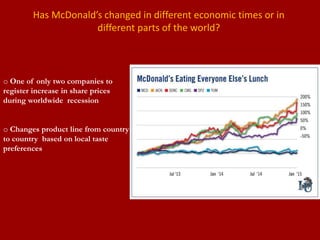
Has McDonald’s changed in different economic times or in
different parts of the world?
o One of only two companies to
register increase in share prices
during worldwide recession
o Changes product line from country
to country based on local taste
preferences
Risks McDonald’s may face in future
Rising competition in
the market
Association with
obesity
Rapid expansion ->
deteriorating quality and
service
How to overcome those risks
Introducing healthier items
Study market risks and
avoid them by research
Innovate their product
line and marketing
strategy
SUMMARY
Richard and Maurice McDonald started the
company, Ray Kroc expanded it to several
countries. Now it has grown to be the world’s
largest restaurant chain with 1.9 million employees
Managed to create an international presence
Reputed for service and quality
Strengthened brand equity by product line
extension and various marketing campaigns
Adopted clever marketing strategies – market
segmentation – demographic, geographic,
psychographic
Faces risk from competition
Needs to continuously innovate and update to stay
relevant
Disclaimer
Created by Aniketo Ghosh, Heritage Institute of Technology, Kolkata
during a marketing internship under Prof. Sameer Mathur, IIM –
Lucknow.

McDonald's Case Study

  • 1.
  • 2.
    Inception of mcdonald’s Richardand Maurice McDonald started McDonald’s as a barbeque restaurant in 1940 Ray Kroc, a multi mix salesman franchised a restaurant in 1955 and later bought the whole chain Ronald McDonald, the world famous mascot - introduced in 1960 Expanded to over 700 restaurants in USA by 1965 - Aggressively expanded overseas in the 80s Added almost 2000 new restaurants every year
  • 3.
    Mantra for mcdonald’sinitial success – ray kroc •Domestic and international expansion reinforced with quality, service, cleanliness and values. •Iconic golden arch and red and white stripe restaurants •Menu expanded – iconic items – Big Mac, Fillet-O-Fish, Egg McMuffin •Ramped up advertising – targeted children and families
  • 4.
    the magnitude ofmcdonald’s McDonald’s serves 70 million people every day. That’s 5 million more than the population of UK World’s largest chain of restaurants. 118 countries – 34000 locations – 1.9 million employees Generated revenues of $27 billion in 2012
  • 5.
    Brand promise Hot, highquality food at a great value at the speed and convenience of McDonald’s High Quality Great Value Speed and convenience
  • 6.
    Science behind mcdonald’ssuccess Customer service has always been top priority FOCUS: •Consistency of quality •Creating strong brand equity through holistic marketing activities •Emphasis on cleanliness and service •Affordability of products •Localized offerings satisfying regional taste
  • 7.
    Science behind mcdonald’ssuccess Quick Service Affordability
  • 8.
    Science behind mcdonald’ssuccess Localized Offerings Quality Control
  • 9.
    Creating Brand equity WideArray of Marketing Campaigns
  • 10.
    Creating Brand equity Addingmore products to the product line. Expanding beyond hamburgers. Brand extension.
  • 11.
    Brand power Regular fooditems tastes better when wrapped in McDonald’s familiar packaging 4th most valuable brand in the world, valued at $85.7 billion
  • 12.
    Marketing strategies Marketing Segmentation Psychographicsegmentation Demographic segmentation based on income
  • 13.
  • 14.
    Brand positioning Family restaurant– Ronald McDonald Targets kids – Happy Meals Attracts teenagers and young adults - $1 menu Attracts health conscious consumers – Premium low calorie salads McCafe – targets consumers in booming coffee industry
  • 15.
    What are McDonald’score brand values? Have these changed over the years? Core values – quality, cleanliness, service and value Products, product pricing, restaurants and employees showcase these values Lost their way in the 80s and 90s due to aggressive expansion Devised a strategy to restore broken brand promise Strategy of 5P’s – people, product, promotion, pricing and place.
  • 16.
    How has McDonald’sgrown it’s brand equity over the years? Brand equity has been created over the years by: • Holistic marketing activities • Smart brand elements – Ronald McDonald • Campaigns – I’m loving it, Closest thing to home • Overhauling restaurants and improving services
  • 17.
    Has McDonald’s changedin different economic times or in different parts of the world? o One of only two companies to register increase in share prices during worldwide recession o Changes product line from country to country based on local taste preferences
  • 18.
    Risks McDonald’s mayface in future Rising competition in the market Association with obesity Rapid expansion -> deteriorating quality and service
  • 19.
    How to overcomethose risks Introducing healthier items Study market risks and avoid them by research Innovate their product line and marketing strategy
  • 20.
    SUMMARY Richard and MauriceMcDonald started the company, Ray Kroc expanded it to several countries. Now it has grown to be the world’s largest restaurant chain with 1.9 million employees Managed to create an international presence Reputed for service and quality Strengthened brand equity by product line extension and various marketing campaigns Adopted clever marketing strategies – market segmentation – demographic, geographic, psychographic Faces risk from competition Needs to continuously innovate and update to stay relevant
  • 21.
    Disclaimer Created by AniketoGhosh, Heritage Institute of Technology, Kolkata during a marketing internship under Prof. Sameer Mathur, IIM – Lucknow.