“One world, One Burger”- McDonald’sWelcome to McDonald's India!!
consumer behavior
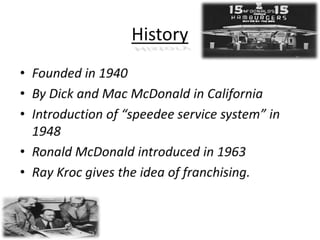
HistoryFounded in 1940By Dick and Mac McDonald in CaliforniaIntroduction of “speedee service system” in 1948Ronald McDonald introduced in 1963Ray Kroc gives the idea of franchising.10/3/2011
McDonald's in INDIAEntered in India  1996
McDonald's India is a 50 – 50 JV partnership between MCDONALD’S CORPORATION (U.S.A) and two Indian businessman AmitJatia and Vikram Bakshi
Trained extensively with their Indian management team in Indonesia and US before launch
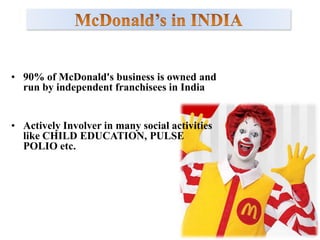
The entire menu was changedMcDonald’s in INDIA90% of McDonald's business is owned and run by independent franchisees in India
Actively Involver in many social activities like CHILD EDUCATION, PULSE POLIO etc.10/3/20116consumer behaviorIndian challenge40% vegetarians selections to suit Indian tastes.Respect for local culture-no beef or pork served.Soft serves and mc shakesare egglessRe-formulated own products using spices favored by Indians.Only vegetable oil used as cooking medium.
McDonald’s Corporation has been growing and spreading internationally for the past three decades.Although McDonald’s seems convenient, cheap and clean there are many negative aspects of the business. In spite of paying their employees low wages and negatively impacting other cultures, McDonald’s have managed to position themselves as a positive piece of Americana. The unethical practices of this large fast food corporation are known but do not seem to detract from the all-American image that the corporation seeks to project.
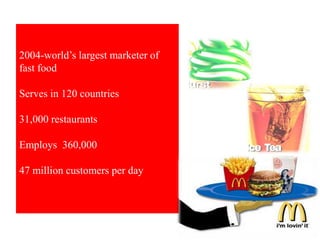
2004-world’s largest marketer of fast foodServes in 120 countries31,000 restaurantsEmploys  360,00047 million customers per day
Ethical problemAlthough McDonald’s makes the effort to support children with life threatening illnesses, thediet offered by this corporation and others contributes to obesity, heart disease, asthma, andpossibly mad cow disease. What kind of message are we giving our children when we promotehealthy eating, and “at least 59 of the nation's 250 children's hospitals have fast-foodrestaurants?” (Tanner, 2006)Environmentally, McDonald’s practices are also questionable. Unlike a fresh ground beefpatty at a local butcher shop, “a typical fast-food hamburger patty contains meat from more thanone thousand different cattle, raised in as many as five countries” (Schlosser, 2004). This raisesthe possibility of a particular patty containing contaminants of unknown origin. As notedpreviously, instead of locally grown potatoes, the corporation uses their own geneticallymodified potatoes. The practices of using food from extreme distances, is problematicenvironmentally. From a public health perspective, the use of beef from multiple sources makescontaminated sources far more difficult to trace.
Impact on foreign culturesNot only do McDonald’s products harm individual and environmental well-being, they are alsohaving an influence on some East Asian cultures with the corporation’s entry into thosecountries. “Critics claim that the rapid spread of McDonald’s and its fast-food rivals underminesindigenous cuisines and helps create a homogenous, global culture” (Watson, 2006). Chineseparents want to connect their children to the world outside of China, so they reward them with atrip to McDonald’s, but in so doing they are also taking away from their culture. “In twentyyears [Yunxiang Yan, a UCLA anthropologist] predicts, young people in Beijing (like theircounterparts in Hong Kong today) will not even care about the foreign origin of McDonald’swhich will be serving ordinary food to people more interested in getting a quick meal than inhaving a cultural experience” (Watson, 2006).Another major change brought to the East by the entry by McDonald’s and Americancorporations into Asian countries, is the new obsession with American culture. “Prior to thearrival of McDonald’s, festivities marking youngsters’ specific birth dates were unknown inmost of East Asia. In Hong Kong, for instance, lunar-calendar dates of birth were recorded foruse in later life- to help match prospective marriage partners’ horoscopes or choose an auspiciousburial date” (Watson, 2006).With the presence of McDonald’s restaurants in Asian countries, and the accompanyingAmerican cultural norms, children in these countries are recognizing the potential for celebrationof individual birthdays. McDonald’s exploits this cultural change to market party packages toChinese children who want to celebrate this new occasion. In many respects, McDonald’semergence in Asia is permanently altering culture, and norms of the past are being lost in theirMcDonald’s party packages and Big Macs.In addition to contributing to cultural changes in China, McDonald’s has offended othercultures through some of its actions. The chain has stirred up controversy with some UnitedStates Hindus, many vegetarians, and some Japanese. “McDonald's, the fast food giant currentlyembroiled in a row concerning undisclosed beef flavoring in French fries, has made a formalapology to those it has offended” (McDonald’s resolves french fry dispute, 2002). This mayseem like a petty dispute, but is not a small issue to Hindus who believe that the cow is sacred. Inresponse to this offense to Hindus, vegetarians, and others, McDonald’s offered an apology, andpaid the groups ten million of dollars in settlement.In addition, “fast food giant McDonalds is facing criticism in Japan after a number of itsapple pies were found to contain a banned food coloring agent (McDonald’s apple pies found tocontain banned food coloring in Japan, 2006). In 15 McDonald locations across Japan there hasbeen an apple pie recall due to the use of an illegal coloring agent known as azorubin.McDonald’s has claimed that the substance is not harmful, using consumers in the EuropeanUnion and Australia as examples where people consume apple pies containing azorubin,seemingly without ill effect. McDonald’s has, however, recalled the pies and announced thatthey will no longer purchase their pies from the China-based factory using azorubin.
Controversy Another controversy arose in a Southlake McDonald’s because of a bacon ranch salad. ChrissyHaley, wife of an assistant coach of the Dallas Cowboy’s, found a rat in her salad after orderingthat salad and a Happy Meal for her child. According to newspaper reports, Haley and her nannyfound the dead rat under a large lettuce leaf in a shared salad. McDonald’s has yet to respond,apologize, or even ask if the women are okay. “Both women have had blood and stool samplestested repeatedly over the last five and a half months and are undergoing sessions with Dallasclinical psychologist Dr. Rycke Marshall” (Whitt, 2006). Chrissy Haley, who has tested negativefor any illness, is suing McDonald’s for $1.7 million, for both the dead rodent in her salad andMcDonald’s response (or lack thereof) to the incident. The corporation has chosen not tocooperate during the course of the law suit, which was set to reach court in September 2007
Labor relationBesides health issues, the company also has issues with its workers. The corporation pays minimum wage to their workers, who essentially do assembly line, factory-type work. Most of the workers get paid minimum wage in spite of the fact that the company is now worth more than a billion dollars.
backlashThere are an increasing number of people who speak out against McDonald’s and similarcorporations. George Ritzer is well known for his efforts to raise awareness of the impact ofglobalization and global corporations by speaking at different colleges around the country. In thearticle “Nuggets of Wisdom” author Madelyn Pennino refers to an Elizabethtown Collegeassembly at which Ritzer spoke to students about the illusion created by McDonald’s, of bargainprices and convenience for people ordering a super-sized meal (2006).In reality, this bigger, faster, and cheaper choice is actually not very convenient.“Efficiency has become inefficient” Ritzer said referencing the huge line waiting in the drivethru (Pennino, 2006). One of the goals of Ritzer and other anti-McDonalds activists is to spreadawareness of real costs of doing business with the corporation and to make sure that the nameMcDonald’s does not become synonymous with America around the world.

Mcdonald 11

  • 1.
    “One world, OneBurger”- McDonald’sWelcome to McDonald's India!!
  • 2.
  • 3.
    HistoryFounded in 1940ByDick and Mac McDonald in CaliforniaIntroduction of “speedee service system” in 1948Ronald McDonald introduced in 1963Ray Kroc gives the idea of franchising.10/3/2011
  • 4.
  • 5.
    McDonald's India isa 50 – 50 JV partnership between MCDONALD’S CORPORATION (U.S.A) and two Indian businessman AmitJatia and Vikram Bakshi
  • 6.
    Trained extensively withtheir Indian management team in Indonesia and US before launch
  • 7.
    The entire menuwas changedMcDonald’s in INDIA90% of McDonald's business is owned and run by independent franchisees in India
  • 8.
    Actively Involver inmany social activities like CHILD EDUCATION, PULSE POLIO etc.10/3/20116consumer behaviorIndian challenge40% vegetarians selections to suit Indian tastes.Respect for local culture-no beef or pork served.Soft serves and mc shakesare egglessRe-formulated own products using spices favored by Indians.Only vegetable oil used as cooking medium.
  • 9.
    McDonald’s Corporation hasbeen growing and spreading internationally for the past three decades.Although McDonald’s seems convenient, cheap and clean there are many negative aspects of the business. In spite of paying their employees low wages and negatively impacting other cultures, McDonald’s have managed to position themselves as a positive piece of Americana. The unethical practices of this large fast food corporation are known but do not seem to detract from the all-American image that the corporation seeks to project.
  • 10.
    2004-world’s largest marketerof fast foodServes in 120 countries31,000 restaurantsEmploys 360,00047 million customers per day
  • 11.
    Ethical problemAlthough McDonald’smakes the effort to support children with life threatening illnesses, thediet offered by this corporation and others contributes to obesity, heart disease, asthma, andpossibly mad cow disease. What kind of message are we giving our children when we promotehealthy eating, and “at least 59 of the nation's 250 children's hospitals have fast-foodrestaurants?” (Tanner, 2006)Environmentally, McDonald’s practices are also questionable. Unlike a fresh ground beefpatty at a local butcher shop, “a typical fast-food hamburger patty contains meat from more thanone thousand different cattle, raised in as many as five countries” (Schlosser, 2004). This raisesthe possibility of a particular patty containing contaminants of unknown origin. As notedpreviously, instead of locally grown potatoes, the corporation uses their own geneticallymodified potatoes. The practices of using food from extreme distances, is problematicenvironmentally. From a public health perspective, the use of beef from multiple sources makescontaminated sources far more difficult to trace.
  • 12.
    Impact on foreignculturesNot only do McDonald’s products harm individual and environmental well-being, they are alsohaving an influence on some East Asian cultures with the corporation’s entry into thosecountries. “Critics claim that the rapid spread of McDonald’s and its fast-food rivals underminesindigenous cuisines and helps create a homogenous, global culture” (Watson, 2006). Chineseparents want to connect their children to the world outside of China, so they reward them with atrip to McDonald’s, but in so doing they are also taking away from their culture. “In twentyyears [Yunxiang Yan, a UCLA anthropologist] predicts, young people in Beijing (like theircounterparts in Hong Kong today) will not even care about the foreign origin of McDonald’swhich will be serving ordinary food to people more interested in getting a quick meal than inhaving a cultural experience” (Watson, 2006).Another major change brought to the East by the entry by McDonald’s and Americancorporations into Asian countries, is the new obsession with American culture. “Prior to thearrival of McDonald’s, festivities marking youngsters’ specific birth dates were unknown inmost of East Asia. In Hong Kong, for instance, lunar-calendar dates of birth were recorded foruse in later life- to help match prospective marriage partners’ horoscopes or choose an auspiciousburial date” (Watson, 2006).With the presence of McDonald’s restaurants in Asian countries, and the accompanyingAmerican cultural norms, children in these countries are recognizing the potential for celebrationof individual birthdays. McDonald’s exploits this cultural change to market party packages toChinese children who want to celebrate this new occasion. In many respects, McDonald’semergence in Asia is permanently altering culture, and norms of the past are being lost in theirMcDonald’s party packages and Big Macs.In addition to contributing to cultural changes in China, McDonald’s has offended othercultures through some of its actions. The chain has stirred up controversy with some UnitedStates Hindus, many vegetarians, and some Japanese. “McDonald's, the fast food giant currentlyembroiled in a row concerning undisclosed beef flavoring in French fries, has made a formalapology to those it has offended” (McDonald’s resolves french fry dispute, 2002). This mayseem like a petty dispute, but is not a small issue to Hindus who believe that the cow is sacred. Inresponse to this offense to Hindus, vegetarians, and others, McDonald’s offered an apology, andpaid the groups ten million of dollars in settlement.In addition, “fast food giant McDonalds is facing criticism in Japan after a number of itsapple pies were found to contain a banned food coloring agent (McDonald’s apple pies found tocontain banned food coloring in Japan, 2006). In 15 McDonald locations across Japan there hasbeen an apple pie recall due to the use of an illegal coloring agent known as azorubin.McDonald’s has claimed that the substance is not harmful, using consumers in the EuropeanUnion and Australia as examples where people consume apple pies containing azorubin,seemingly without ill effect. McDonald’s has, however, recalled the pies and announced thatthey will no longer purchase their pies from the China-based factory using azorubin.
  • 13.
    Controversy Another controversyarose in a Southlake McDonald’s because of a bacon ranch salad. ChrissyHaley, wife of an assistant coach of the Dallas Cowboy’s, found a rat in her salad after orderingthat salad and a Happy Meal for her child. According to newspaper reports, Haley and her nannyfound the dead rat under a large lettuce leaf in a shared salad. McDonald’s has yet to respond,apologize, or even ask if the women are okay. “Both women have had blood and stool samplestested repeatedly over the last five and a half months and are undergoing sessions with Dallasclinical psychologist Dr. Rycke Marshall” (Whitt, 2006). Chrissy Haley, who has tested negativefor any illness, is suing McDonald’s for $1.7 million, for both the dead rodent in her salad andMcDonald’s response (or lack thereof) to the incident. The corporation has chosen not tocooperate during the course of the law suit, which was set to reach court in September 2007
  • 14.
    Labor relationBesides healthissues, the company also has issues with its workers. The corporation pays minimum wage to their workers, who essentially do assembly line, factory-type work. Most of the workers get paid minimum wage in spite of the fact that the company is now worth more than a billion dollars.
  • 15.
    backlashThere are anincreasing number of people who speak out against McDonald’s and similarcorporations. George Ritzer is well known for his efforts to raise awareness of the impact ofglobalization and global corporations by speaking at different colleges around the country. In thearticle “Nuggets of Wisdom” author Madelyn Pennino refers to an Elizabethtown Collegeassembly at which Ritzer spoke to students about the illusion created by McDonald’s, of bargainprices and convenience for people ordering a super-sized meal (2006).In reality, this bigger, faster, and cheaper choice is actually not very convenient.“Efficiency has become inefficient” Ritzer said referencing the huge line waiting in the drivethru (Pennino, 2006). One of the goals of Ritzer and other anti-McDonalds activists is to spreadawareness of real costs of doing business with the corporation and to make sure that the nameMcDonald’s does not become synonymous with America around the world.

Editor's Notes

  • #2 Can you guess the name of the company which: Is the ninth most valuable brand in the world?Has replaced the US army as the Nations largest job training organization?Controls the market share of more than 3 food chains taken together in America? It’s none other than McDonald’s Corporation USA.
  • #4 In 1954, a fifty-two-year-old milk-shake machine salesman saw a hamburger stand in San Bernardino, California, and envisioned a massive new industry: fast food.
  • #5 McDonald's India is an employer of opportunity, providing quality employment and region. long-term careers to the Indian people. The average McDonald's restaurant employs more than 100 people in 25 different positions – from cashier to restaurant manager. McDonald's world class-training inputs to its employees can be seen in the present close to 2000 employees currently in Mumbai and Delhi.
  • #7 Much higher degree of adaptability.
  • #16 Limited menu, fresh food, fast service and affordable prices have been the pillars behind McDonald’s success in India. Intense competition and demands for a wider menu, drive-through and sit-down meals - encouraged the fast food giant to customize product variety without hindering the efficacy of its supply chain