McKinsey Global Institute 
MEDA 2014 Fall Conference 
October 2014 
Advancing manufacturing 
in Maryland: What matters
1 
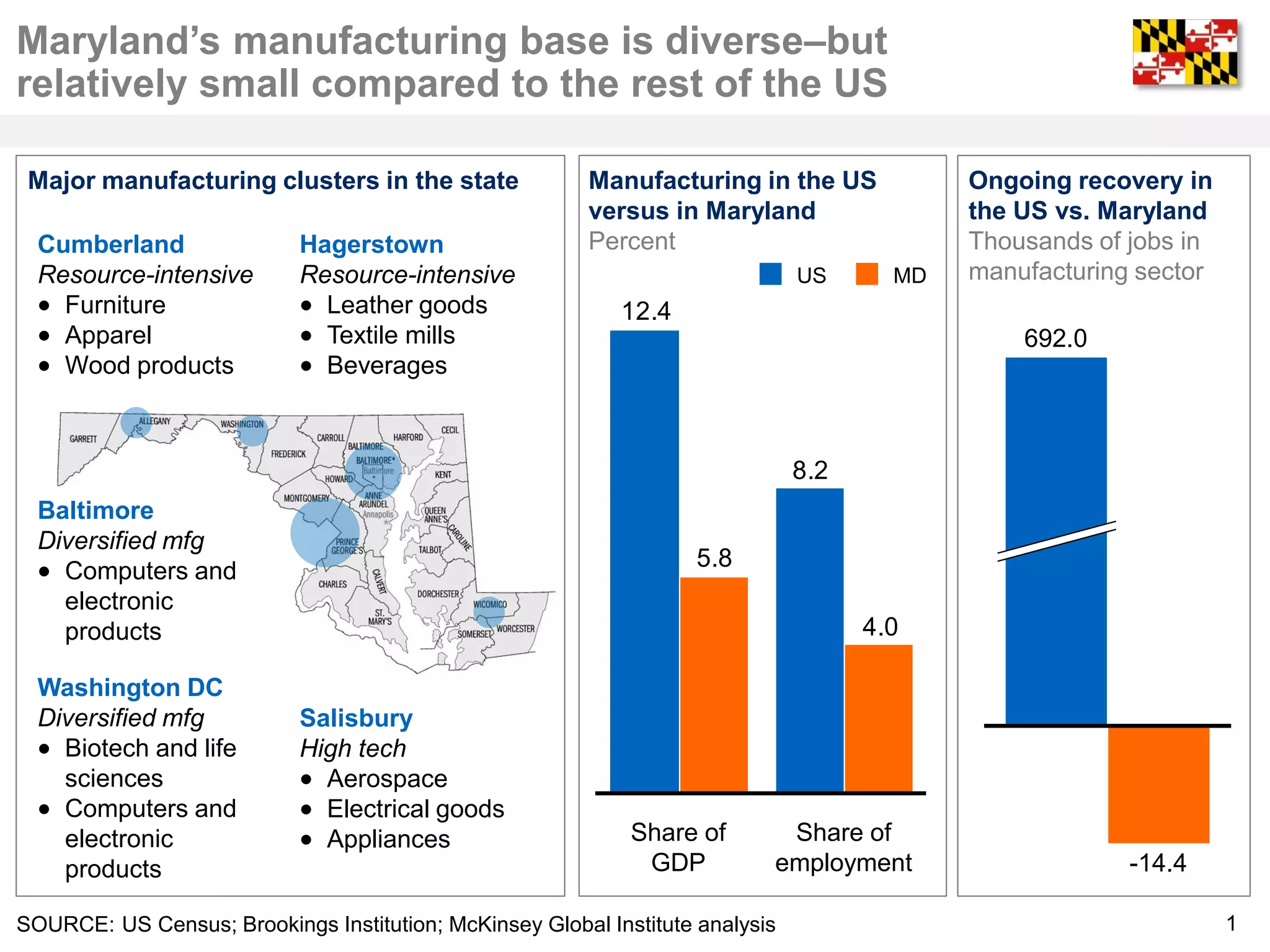
Maryland’s manufacturing base is diverse–but 
relatively small compared to the rest of the US 
SOURCE: US Census; Brookings Institution; McKinsey Global Institute analysis 
8.2 
12.4 
4.0 
5.8 
Share of 
employment 
Share of 
GDP 
US MD 
Manufacturing in the US 
versus in Maryland 
Percent 
692.0 
-14.4 
Ongoing recovery in 
the US vs. Maryland 
Thousands of jobs in 
manufacturing sector 
Salisbury 
High tech 
 Aerospace 
 Electrical goods 
 Appliances 
Baltimore 
Diversified mfg 
 Computers and 
electronic 
products 
Cumberland 
Resource-intensive 
 Furniture 
 Apparel 
 Wood products 
Hagerstown 
Resource-intensive 
 Leather goods 
 Textile mills 
 Beverages 
Washington DC 
Diversified mfg 
 Biotech and life 
sciences 
 Computers and 
electronic 
products 
Major manufacturing clusters in the state
2 
Maryland’s employment gains are not in 
traditional manufacturing industries 
SOURCE: US Cluster Mapping Project, Institute for Strategy and Competitiveness, HBS; McKinsey Global Institute analysis 
0 
0.5 
1.0 
1.5 
2.0 
2.5 
3.0 
3.5 
4.0 
4.5 
5.0 
5.5 
6.0 
6.5 
7.0 
7.5 
-0.8 -0.7 -0.6 -0.5 -0.4 -0.3 -0.2 -0.1 0 0.1 0.2 0.3 0.4 0.5 0.6 0.7 0.8 0.9 1.0 1.1 1.2 1.3 1.4 
Change in employment since 1995 
Percent 
Share of US employment 
Percent 
IT services 
Insurance 
Logistics 
Publishing 
Electrical equipment 
Biopharmaceuticals 
Apparel 
Fabricated metals 
Furniture 
Paper products 
Chemical products 
Automotive 
Upstream metals 
Plastics 
Construction products 
Food processing 
Aerospace 
Capital goods 
Communication equipment and services 
Hospitality 
Finance 
Education 
Business services 
Employment size in MD
3 
Manufacturing matters—but not just for jobs
4 
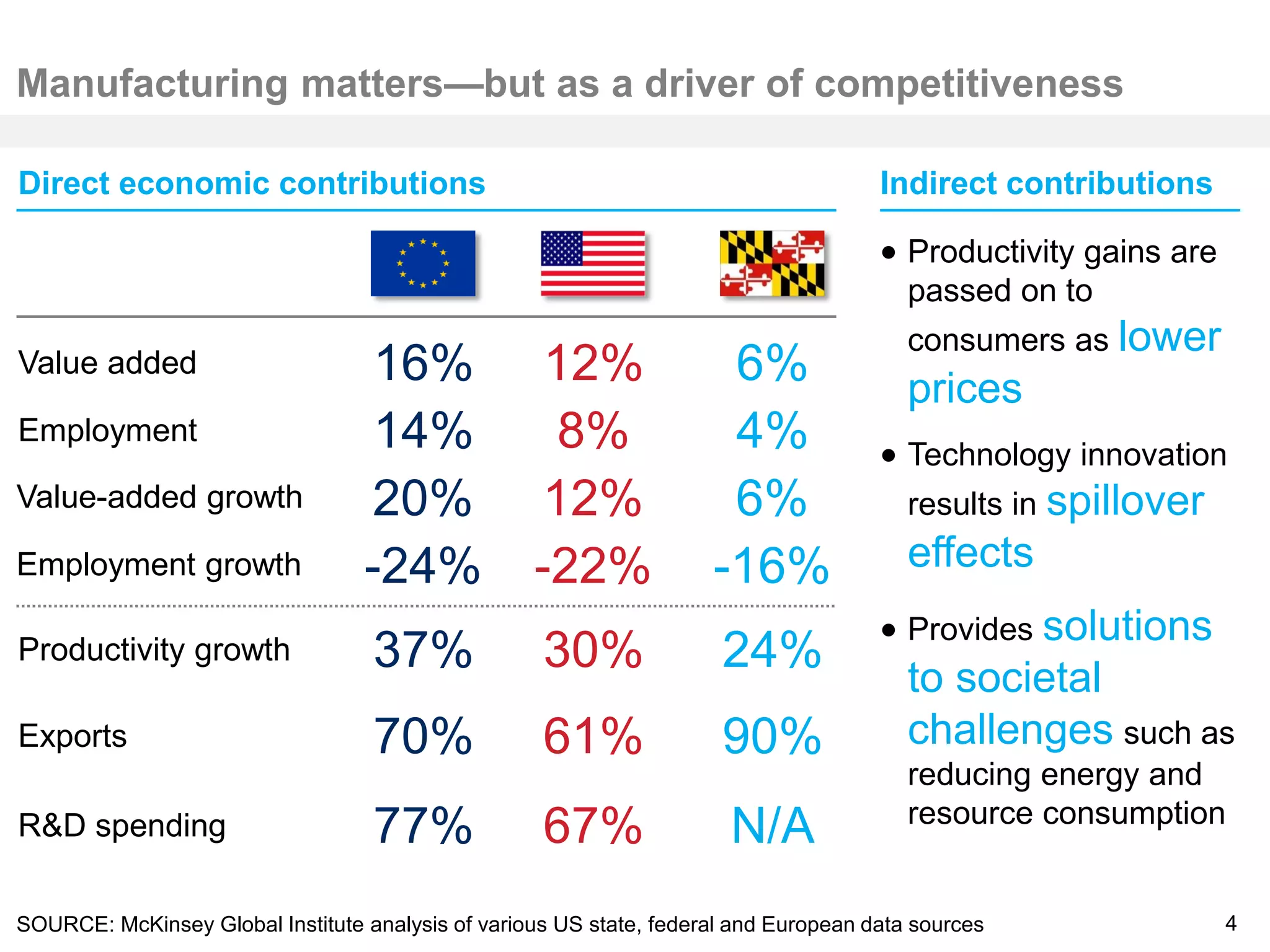
Manufacturing matters—but as a driver of competitiveness 
SOURCE: McKinsey Global Institute analysis of various US state, federal and European data sources 
Direct economic contributions 
Productivity gains are passed on to consumers as lower prices 
Technology innovation results in spillover effects 
Provides solutions to societal challenges such as reducing energy and resource consumption 
Indirect contributions 
Exports 
70% 
61% 
R&D spending 
77% 
67% 
Productivity growth 
37% 
30% 
90% 
N/A 
24% 
Value added 
16% 
12% 
6% 
Employment 
14% 
8% 
4% 
Value-added growth 
20% 
12% 
Employment growth 
-24% 
-22% 
6% 
-16%
5 
0 
5 
10 
15 
20 
25 
30 
35 
40 
0 5,000 10,000 15,000 20,000 25,000 30,000 
Manufacturing employment 
% of total employment 
GDP per capita 
1990 PPP-adjusted dollars 
United States 
United Kingdom 
Taiwan 
South Korea 
Mexico 
Japan 
India 
Germany 
Canada 
Brazil 
Employment follows inverted U-shape as an economy prospers 
SOURCE: McKinsey Global Institute analysis
6 
Local and regional demand matters
7 
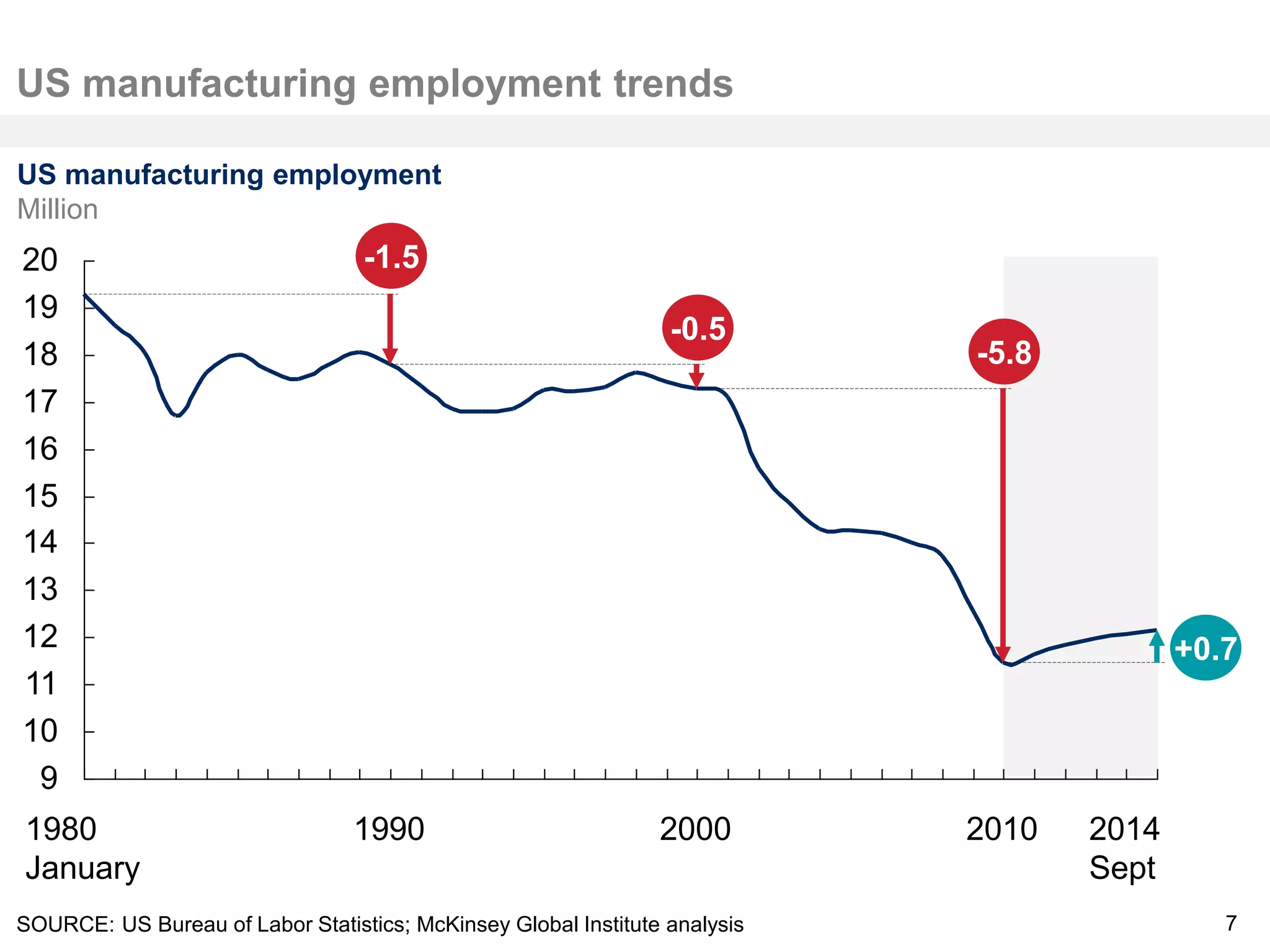
US manufacturing employment trends 
SOURCE: US Bureau of Labor Statistics; McKinsey Global Institute analysis 
US manufacturing employment 
Million 
12 
11 
15 
13 
9 
14 
16 
17 
10 
18 
20 
19 
2014 
Sept 
1980 1990 2000 2010 
January 
-1.5 
-0.5 
-5.8 
+0.7
8 
-3 
-2 
-1 
0 
1 
2 
3 
4 
5 
6 
7 
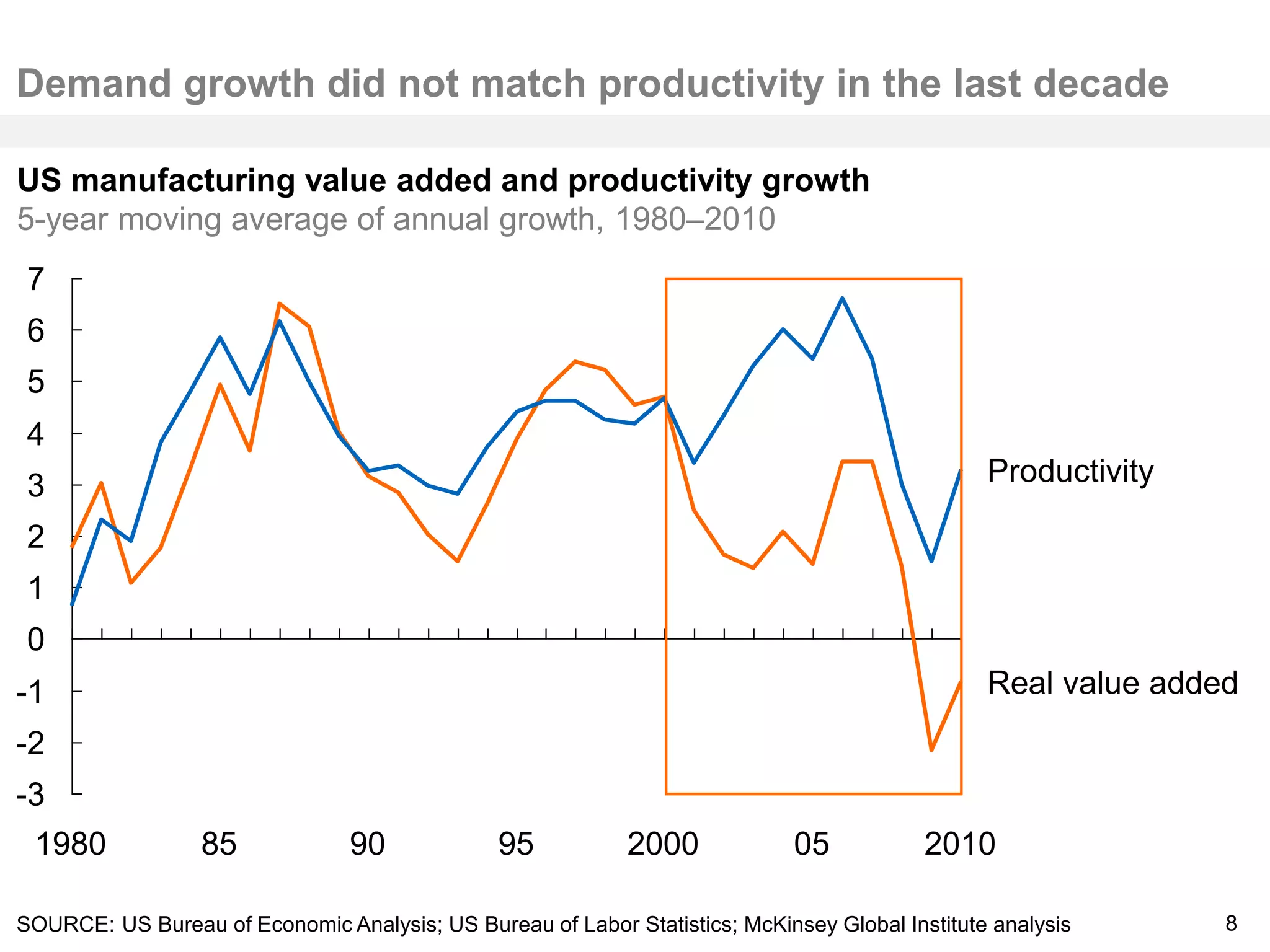
Productivity 
Real value added 
1980 85 90 95 2000 05 2010 
US manufacturing value added and productivity growth 
5-year moving average of annual growth, 1980–2010 
Demand growth did not match productivity in the last decade 
SOURCE: US Bureau of Economic Analysis; US Bureau of Labor Statistics; McKinsey Global Institute analysis
9 
Four demand-driven industries are driving recent US job growth 
SOURCE: US Bureau of Labor Statistics; McKinsey Global Institute analysis 
Gross and net job gains in US manufacturing in the recovery 
Thousand jobs, Jan 2010 to Sep 2014 
26 
38 
102 96 
45 
52 
54 
156 
204 
239 
693 
Net 
gains 
Electr- Other 
onics 
Printing, 
textiles 
Gross 
gains 
853 
Rubber Other 
and 
plastics 
Food, 
bever-age 
Primary 
metals 
Mach-inery 
Fabri-cated 
metals 
Autos, 
other 
transport 
35% of 2010 employment 
80% of new jobs since 2010
10 
105 
100 
95 
90 
85 
80 
75 
70 
65 
60 
55 
50 
0 
14 
51 
58 
63 
68 
73 
80 
1998 99 00 01 02 03 04 05 06 07 08 09 10 11 12 13 
Diverse industries with very different employment trajectories 
SOURCE: US Bureau of Labor Statistics; McKinsey Global Institute analysis 
Manufacturing employment by industry group in the United States, 1998–2013 
Index: 100 = January 1998 
Energy-/resource-intensive 
commodities 
Labor-intensive 
tradables 
Global technologies 
Manufacturing 
overall 
Global innovation 
for local markets 
Regional processing
11 
Suppliers matter– not just large firms
12 
Net exports, 2012 
Nominal $ billion 
-34 
151 
-246 
-45 
-195 
-276 
Total 
1 
-23 
306 
-27 
-69 
Health, education, 
and public services 
Services 
Knowledge-intensive 
manufacturing 
Capital-intensive 
manufacturing 
Labor-intensive 
manufacturing 
Primary resources -321 
7 
98 
-104 
-499 
280 
425 
-133 207 -645 
Advanced economies run a large trade surplus 
in knowledge-intensive manufacturing 
but the United States is an exception 
SOURCE: IHS Global Insight; McKinsey Global Institute analysis
13 
The US trade deficit in knowledge-intensive 
manufacturing has grown since the mid-1990s 
Net exports, 1980–2012 
$ billion, real (2005) 
-150 
-200 
-250 
-300 
0 
-100 
150 
-50 
100 
50 
2000 
Chemicals, including pharmaceuticals 
Medical, precision, and optical 
Non-automotive transport equipment 
1980 85 90 95 05 10 2012 
All knowledge-intensive manufacturing 
Motor vehicles, trailers, and parts 
Semiconductors and electronics 
Computers and office machinery 
Machinery, equipment, and appliances 
Electrical machinery 
-0.2 -0.6 -0.1 -0.7 
Overall trade balance 
as a share of GDP 
-1.3 -2.0 -2.0 
SOURCE: IHS Global Insight; McKinsey Global Institute analysis
14 
What’s coming next matters
15 
Innovation used to be (and still is) dominated by large firms 
SOURCE: Bureau of Economic Analysis; US Department of Commerce; NSF Science Resource Statistics, 2009; 
McKinsey Global Institute analysis 
All other 
16 
Govern-ment 
10 
Multinationals 
74 
Aggregate US R&D spend in manufacturing 
100% = approximately $300 billion 
 Larger capital requirements for 
manufacturing R&D than for 
software or Internet innovation 
 Longer cycle times in hardware 
 Limited access to advanced 
technology platforms 
 Low VC activity in hardware vs. 
software and Internet solutions 
 Small manufacturers embedded 
in supply chains of large firms 
Disadvantages for small firms 
in manufacturing innovation 
But new technologies 
disrupt the status quo
16 
Disruptive technologies can transform manufacturing 
SOURCE: McKinsey Global Institute 
Smarter, cheaper robots 
More flexibility in labor vs. automation 
Less scope for labor arbitrage 
Internet of Things 
New source of value—from “intelligence” 
Importance of software, services, solutions 
Additive manufacturing 
Faster to prototype, customize, go to market 
Shorter innovation cycles 
Advanced materials 
Opportunity to optimize design to value 
Ability to customize performance and products
17 
Transformative impact of technology in manufacturing 
Change in economies of scale—variety of scale options 
New source of value from information-driven intelligence 
Proliferation of product variants, faster response times, efficiency, and tailoring 
BOTTOM LINE: Democratization of innovation— not just large firms any more
18 
A new perspective on manufacturing: Next-shoring 
Proximity to demand 
Proximity to innovation 
SOURCE: McKinsey Global Institute 
Long-term competitiveness 
Healthy supplier ecosystem 
Local and regional demand 
Technology and innovation
19 
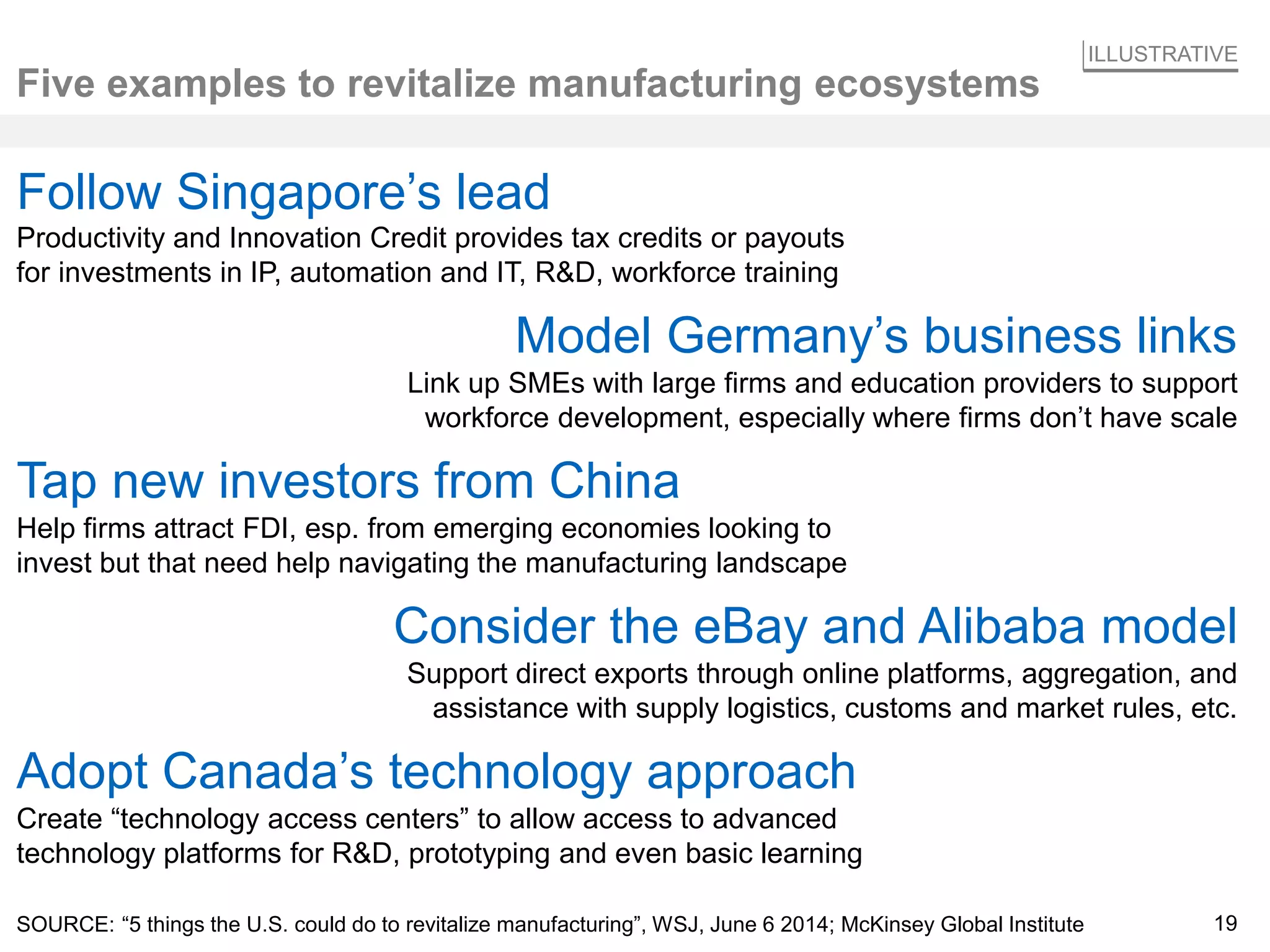
Five examples to revitalize manufacturing ecosystems 
SOURCE: “5 things the U.S. could do to revitalize manufacturing”, WSJ, June 6 2014; McKinsey Global Institute 
Productivity and Innovation Credit provides tax credits or payouts for investments in IP, automation and IT, R&D, workforce training 
Follow Singapore’s lead 
Link up SMEs with large firms and education providers to support workforce development, especially where firms don’t have scale 
Model Germany’s business links 
Help firms attract FDI, esp. from emerging economies looking to invest but that need help navigating the manufacturing landscape 
Tap new investors from China 
Support direct exports through online platforms, aggregation, and assistance with supply logistics, customs and market rules, etc. 
Consider the eBay and Alibaba model 
Create “technology access centers” to allow access to advanced technology platforms for R&D, prototyping and even basic learning 
Adopt Canada’s technology approach 
ILLUSTRATIVE
20 
@mckinsey_mgi 
Download these and our other reports at 
www.mckinsey.com/mgi 
Sree_Ramaswamy@mckinsey.com 
An economy that works: Job creation and America's future (June 2011) 
Disruptive technologies: Advances that will transform life, business, and the global economy (May 2013) 
Manufacturing the future: The next era of global growth and innovation (November 2012) 
Next-shoring: A CEO’s guide (January 2014)

McKinsey Global Institute MEDA presentation - Fall Conf 2014

  • 1.
    McKinsey Global Institute MEDA 2014 Fall Conference October 2014 Advancing manufacturing in Maryland: What matters
  • 2.
    1 Maryland’s manufacturingbase is diverse–but relatively small compared to the rest of the US SOURCE: US Census; Brookings Institution; McKinsey Global Institute analysis 8.2 12.4 4.0 5.8 Share of employment Share of GDP US MD Manufacturing in the US versus in Maryland Percent 692.0 -14.4 Ongoing recovery in the US vs. Maryland Thousands of jobs in manufacturing sector Salisbury High tech  Aerospace  Electrical goods  Appliances Baltimore Diversified mfg  Computers and electronic products Cumberland Resource-intensive  Furniture  Apparel  Wood products Hagerstown Resource-intensive  Leather goods  Textile mills  Beverages Washington DC Diversified mfg  Biotech and life sciences  Computers and electronic products Major manufacturing clusters in the state
  • 3.
    2 Maryland’s employmentgains are not in traditional manufacturing industries SOURCE: US Cluster Mapping Project, Institute for Strategy and Competitiveness, HBS; McKinsey Global Institute analysis 0 0.5 1.0 1.5 2.0 2.5 3.0 3.5 4.0 4.5 5.0 5.5 6.0 6.5 7.0 7.5 -0.8 -0.7 -0.6 -0.5 -0.4 -0.3 -0.2 -0.1 0 0.1 0.2 0.3 0.4 0.5 0.6 0.7 0.8 0.9 1.0 1.1 1.2 1.3 1.4 Change in employment since 1995 Percent Share of US employment Percent IT services Insurance Logistics Publishing Electrical equipment Biopharmaceuticals Apparel Fabricated metals Furniture Paper products Chemical products Automotive Upstream metals Plastics Construction products Food processing Aerospace Capital goods Communication equipment and services Hospitality Finance Education Business services Employment size in MD
  • 4.
  • 5.
    4 Manufacturing matters—butas a driver of competitiveness SOURCE: McKinsey Global Institute analysis of various US state, federal and European data sources Direct economic contributions Productivity gains are passed on to consumers as lower prices Technology innovation results in spillover effects Provides solutions to societal challenges such as reducing energy and resource consumption Indirect contributions Exports 70% 61% R&D spending 77% 67% Productivity growth 37% 30% 90% N/A 24% Value added 16% 12% 6% Employment 14% 8% 4% Value-added growth 20% 12% Employment growth -24% -22% 6% -16%
  • 6.
    5 0 5 10 15 20 25 30 35 40 0 5,000 10,000 15,000 20,000 25,000 30,000 Manufacturing employment % of total employment GDP per capita 1990 PPP-adjusted dollars United States United Kingdom Taiwan South Korea Mexico Japan India Germany Canada Brazil Employment follows inverted U-shape as an economy prospers SOURCE: McKinsey Global Institute analysis
  • 7.
    6 Local andregional demand matters
  • 8.
    7 US manufacturingemployment trends SOURCE: US Bureau of Labor Statistics; McKinsey Global Institute analysis US manufacturing employment Million 12 11 15 13 9 14 16 17 10 18 20 19 2014 Sept 1980 1990 2000 2010 January -1.5 -0.5 -5.8 +0.7
  • 9.
    8 -3 -2 -1 0 1 2 3 4 5 6 7 Productivity Real value added 1980 85 90 95 2000 05 2010 US manufacturing value added and productivity growth 5-year moving average of annual growth, 1980–2010 Demand growth did not match productivity in the last decade SOURCE: US Bureau of Economic Analysis; US Bureau of Labor Statistics; McKinsey Global Institute analysis
  • 10.
    9 Four demand-drivenindustries are driving recent US job growth SOURCE: US Bureau of Labor Statistics; McKinsey Global Institute analysis Gross and net job gains in US manufacturing in the recovery Thousand jobs, Jan 2010 to Sep 2014 26 38 102 96 45 52 54 156 204 239 693 Net gains Electr- Other onics Printing, textiles Gross gains 853 Rubber Other and plastics Food, bever-age Primary metals Mach-inery Fabri-cated metals Autos, other transport 35% of 2010 employment 80% of new jobs since 2010
  • 11.
    10 105 100 95 90 85 80 75 70 65 60 55 50 0 14 51 58 63 68 73 80 1998 99 00 01 02 03 04 05 06 07 08 09 10 11 12 13 Diverse industries with very different employment trajectories SOURCE: US Bureau of Labor Statistics; McKinsey Global Institute analysis Manufacturing employment by industry group in the United States, 1998–2013 Index: 100 = January 1998 Energy-/resource-intensive commodities Labor-intensive tradables Global technologies Manufacturing overall Global innovation for local markets Regional processing
  • 12.
    11 Suppliers matter–not just large firms
  • 13.
    12 Net exports,2012 Nominal $ billion -34 151 -246 -45 -195 -276 Total 1 -23 306 -27 -69 Health, education, and public services Services Knowledge-intensive manufacturing Capital-intensive manufacturing Labor-intensive manufacturing Primary resources -321 7 98 -104 -499 280 425 -133 207 -645 Advanced economies run a large trade surplus in knowledge-intensive manufacturing but the United States is an exception SOURCE: IHS Global Insight; McKinsey Global Institute analysis
  • 14.
    13 The UStrade deficit in knowledge-intensive manufacturing has grown since the mid-1990s Net exports, 1980–2012 $ billion, real (2005) -150 -200 -250 -300 0 -100 150 -50 100 50 2000 Chemicals, including pharmaceuticals Medical, precision, and optical Non-automotive transport equipment 1980 85 90 95 05 10 2012 All knowledge-intensive manufacturing Motor vehicles, trailers, and parts Semiconductors and electronics Computers and office machinery Machinery, equipment, and appliances Electrical machinery -0.2 -0.6 -0.1 -0.7 Overall trade balance as a share of GDP -1.3 -2.0 -2.0 SOURCE: IHS Global Insight; McKinsey Global Institute analysis
  • 15.
    14 What’s comingnext matters
  • 16.
    15 Innovation usedto be (and still is) dominated by large firms SOURCE: Bureau of Economic Analysis; US Department of Commerce; NSF Science Resource Statistics, 2009; McKinsey Global Institute analysis All other 16 Govern-ment 10 Multinationals 74 Aggregate US R&D spend in manufacturing 100% = approximately $300 billion  Larger capital requirements for manufacturing R&D than for software or Internet innovation  Longer cycle times in hardware  Limited access to advanced technology platforms  Low VC activity in hardware vs. software and Internet solutions  Small manufacturers embedded in supply chains of large firms Disadvantages for small firms in manufacturing innovation But new technologies disrupt the status quo
  • 17.
    16 Disruptive technologiescan transform manufacturing SOURCE: McKinsey Global Institute Smarter, cheaper robots More flexibility in labor vs. automation Less scope for labor arbitrage Internet of Things New source of value—from “intelligence” Importance of software, services, solutions Additive manufacturing Faster to prototype, customize, go to market Shorter innovation cycles Advanced materials Opportunity to optimize design to value Ability to customize performance and products
  • 18.
    17 Transformative impactof technology in manufacturing Change in economies of scale—variety of scale options New source of value from information-driven intelligence Proliferation of product variants, faster response times, efficiency, and tailoring BOTTOM LINE: Democratization of innovation— not just large firms any more
  • 19.
    18 A newperspective on manufacturing: Next-shoring Proximity to demand Proximity to innovation SOURCE: McKinsey Global Institute Long-term competitiveness Healthy supplier ecosystem Local and regional demand Technology and innovation
  • 20.
    19 Five examplesto revitalize manufacturing ecosystems SOURCE: “5 things the U.S. could do to revitalize manufacturing”, WSJ, June 6 2014; McKinsey Global Institute Productivity and Innovation Credit provides tax credits or payouts for investments in IP, automation and IT, R&D, workforce training Follow Singapore’s lead Link up SMEs with large firms and education providers to support workforce development, especially where firms don’t have scale Model Germany’s business links Help firms attract FDI, esp. from emerging economies looking to invest but that need help navigating the manufacturing landscape Tap new investors from China Support direct exports through online platforms, aggregation, and assistance with supply logistics, customs and market rules, etc. Consider the eBay and Alibaba model Create “technology access centers” to allow access to advanced technology platforms for R&D, prototyping and even basic learning Adopt Canada’s technology approach ILLUSTRATIVE
  • 21.
    20 @mckinsey_mgi Downloadthese and our other reports at www.mckinsey.com/mgi Sree_Ramaswamy@mckinsey.com An economy that works: Job creation and America's future (June 2011) Disruptive technologies: Advances that will transform life, business, and the global economy (May 2013) Manufacturing the future: The next era of global growth and innovation (November 2012) Next-shoring: A CEO’s guide (January 2014)