Eric Mittelstadt, CEO How You Can Help Meet 21 st  Century Challenges to U.S. Manufacturing MaximizeMinnesota: Your First-Line Resource November 15, 2007
What We Will Cover Today 1. Status & Outlook for US Manufacturing 2. Workforce Implications 3. Process Technology Developments 4. Network Centric Manufacturing 5. What You Can Do 6. Key Points
1.   U.S. Manufacturing Numbers Positive Profitability  returned to that of the late 90’s boom years Overall U.S.  output  of manufactured goods highest ever Productivity  increased, & must continue to do so in today’s hyper-competitive global economy BUT,  Jobs  in manufacturing recently decreasing Inevitable result of increased productivity when demand does not increase even faster  Some implications to you in later slides
  Inescapable Trend & US Competitive Advantage   Products that can be well defined & packaged: Will tend to be sourced off-shore due to: Significant labor cost advantage   Portability with IT technology Tough because US labor costs will never be lowest US competitive advantage has been & must continue to be:   Technology Creation (American Ingenuity)  and Manufactur ing   Know-how  to commercialize it quickly into a constant stream of new & valuable products This is the engine for our economic future, and the key to our national security
Productivity Must Continue to Increase Increasingly “hyper-competitive” global economy, As more nations strive to develop their economies Consumer pressures for higher quality, content and customization at lower prices Inevitable fluctuations in the economy Because we are a smaller nation, we must be more innovative, creative & productive if we are to remain a world power
Metrics for Healthy U.S. Manufacturing Not just how many manufacturing jobs Essential to people involved, but measures only  input Especially with less experienced workforce,  output  is really critical  Similarly, % of GDP is misleading; for example: New components of GDP mean lower % of GDP for manufacturing even if absolute manufacturing output holds steady; e.g., Homeland Security, Telecom, etc. More important are manufacturing  output  increases from: Unimaginable new industries with undefined new jobs    as a result of R&D, both public & private Advanced Processes, Robotic Automation, Lean, 6-Sigma, Just-in-Time, etc.
  Inescapable trends   The need for increased productivity by definition means producing more with fewer people Thus, an inevitable  reduction  in the number of manufacturing jobs Similar to agriculture in the past, but not as severe Skills & experience loss + increasing technology requires well-trained workers & lifelong learning Requires innovation in both product & process development & deployment, as well as workforce issues
NACFAM’s Focus NACFAM works on Manufactur ing  issues: Workforce Technology Supply Chain Sustainability Manufactur er  issues are covered by NAM, et al: Taxes Trade Tort   Energy   Health Care   Pensions Regulations
2.  Workforce Implications Demographics – by 2018 (11 years from now!): 70 million baby boomers will retire About half of them are in today’s US workforce That means skills & experience of roughly 1/4 of today’s workforce will be lost in the next decade Manufacturing more than 1/4 due to older workforce Overall population growing, plus those retiring “Baby Boomers” are more demanding; means more  output More output with less skilled & experienced workers means: Continuously more advanced process technologies, requiring life-long learning to deploy them effectively Well-trained workers; knowledge must replace experience BIG challenge for education systems & workers
Work er  Implications Because of the demands on businesses, workers of the future at all levels must be enabled to work in a more “Network-centric” way with: More skills in Science, Technology, Engineering & Math (STEM) Collaboration skills for teamwork, inside & outside their company Creativity, analytic & problem solving skills, for greater innovation in product & process Continuous updating of all these skills to be: The best they can be for their current employer Easily mobile to other jobs in new industries
  To Help US Workers, Government Must: Encourage & enable workers to continuously learn so they can update & increase all of their skills Not  just try to preserve old jobs, but rather: Devise innovative ways to minimize unemployment Creatively mitigate inevitable short-term displacements in a growing economy Make its policies & programs for manufactur ing  the most competitive & accessible, versus other countries
To Help US Workers, Educators Must: Help define and understand 21 st  century demands on the workforce as required to maintain: Our standard of living, and Our World leadership Collaborate with industry to understand its needs, both current & future Respond to all these needs effectively Collaborate with government to innovatively optimize the return on public dollars they spend
  To Help US Workers & Themselves, Companies Must: Understand  that Government & Education will take time to achieve objectives for a competitive 21 st  century workforce Therefore, manufacturers must hedge by doing all they can for themselves & their employees, including  innovation  in: Recruiting new workers, both entering & displaced Retaining existing workers through empowerment to  accomplish meaningful goals, competitive compensation policies, & trust that they truly want to contribute Training of incumbent workers to continuously upgrade their skills as well as experience Utilizing employees past their traditional retirement age Leveraging foreign labor w/o losing US competitiveness
Workforce Tools Available to Companies Manufacturing Skill Standards Council (MSSC) Industry & labor led, with education & government Focused on production workers & first-line supervisors Covers all manufacturing industries Validated standards, assessments, certification process Textbook & curriculum to prepare workers for testing Benefits – Employers know what they are getting   –  Employees’ credentials document their skills   –  Educators know what to teach Advanced Manufacturing Competency Model (AMCM - DOL) Industry & Government led Tied to existing manufacturing standards, including:  AWS (welding), NIMS (metalworking), MSSC, etc. Used to describe needed competencies & for DOL grants
  Workforce Tools Available, cont. Career Cluster Initiative (DOEd) Industry, education & government NACFAM brokering collaboration to tie to MSSC, AMCM  Aimed at providing career paths & curriculum for them to  State Directors of Technical Education STEM Talent Development Regional Conferences Led by MEP centers so far; NACFAM brokers & organizes Include industry, labor, education & government For example, Philadelphia regional conference 170 attendees paid money to come Determined what needed to be done by whom with whom in Washington, the region, states, local, etc. Within two weeks set up a “Regional Compact” to  drive action in detail All without spending one dollar of taxpayer money!
  3.   Process Technology Developments Disruptive Technologies  per NACFAM 2005 Report Industry executives views on disruptive potential & likely impact on national security & economic growth Disruptive defined as “Technological developments that have reached sufficient critical mass or ‘tipping point’ to cause a significant proportion of manufacturers to fundamentally alter their planning, operations, structure or processes.” Seven Categories Identified: Sensors Micro-fabrication & Nano-fabrication Modeling & Simulation Reconfigurable Tools & Systems Smart Systems Solid Free Form Fabrication (SFFF) Visualization, Planning, & Knowledge Management
Next Generation Manufacturing Technology Initiative  (NGMTI)  Purpose: Accelerate development & implementation of breakthrough technologies for defense industrial base transformation & global competitiveness of US-based manufacturing Thrust Areas: Emerging Process Technologies Model Based Enterprise Safe, Secure, Reliable & Sustainable Manufacturing Power RF Modules Intelligent Systems Enterprise Integration Knowledge Applications Strategic Investment Plans – “Technology roadmap”, prioritization & business case to guide investments Done for first three (3) thrust areas; more to follow
NGMTI, cont. Projects – Coalitions to prove out candidate technologies & establish business case for widespread deployment: Defense Battery Supply Base Manufacturing Risk (done) Fuel Cells Manufacturing Roadmap (done) Advanced Aerospace Casting Processes Lightweight Composites for Tactical Military Vehicles Digital Direct Manufacturing  Low-cost Titanium Powder Production Dual Fuel Cells Manufacturing Materials for Personnel Extremity Protection Electro-Mechanical Industry Model-based Product-driven Product & Process Design Friction Stir Joining Technologies Multi-Enterprise Collaboration Information Delivery to Point of Use   (info: www.ngmti.org)
  Interagency Wkg. Grp. (IWG) for Manufacturing R&D Under NSTC; chaired by NIST MEL Members include virtually all Federal R&D agencies; i.e.: DOA, DOC, DOD, DOEd, DOEn, DHS, DOL, DOT, EPA, NIH, NASA, NSF, OSTP, OMB, SBA Priorities for coordinating multidisciplinary focus: Intelligent & Integrated Manufacturing Systems (IIMS) Manufacturing for the Hydrogen Economy  Nanomanufacturing Acts as forum within NSTC: Provides policy, program & budget recommendations Promotes exchange of information Reports to the President (website N/A)
  NACFAM Technology & Innovation Initiative Came out of NACFAM June 27-28 Annual Meeting Goal – Accelerate innovation thru multi-stakeholder collaborations (like SEMATECH, USCAR, UTC-Britain) Criteria – Mega Problem, Multi-sector, Need for Open collaboration, Societal benefits or National threats  Draft List of “Mega Problems” for manufacturing technologies Sustainable or green manufacturing Energy diversity / security Large defense projects Defense Sustainment Activities STEM & Workforce Water Hydrogen economy Possible fits – Nanotechnology, Intelligent & Integrated manufacturing, Ergonomics, Robotics / Automation
  4.   Future Shape of Manufacturing   Biggest Trend: OEMs becoming assemblers or integrators of systems, subsystems and components manufactured & engineered by their supply chain; i.e., the “Network” “ Network Centric Manufacturing”
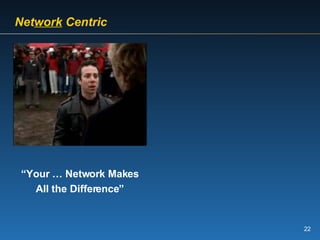
  Net work  Centric   “ Your … Network Makes All the Difference”
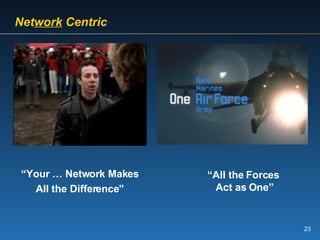
  Net work  Centric   “ Your … Network Makes All the Difference” “ All the Forces  Act as One”
  Net work  Centric   Terminology for a Reason Not   net  centric; i.e., we don’t mean just the Internet,   which is for data & information We  do  mean net work ,   which is for people, organizations, companies For example, one multi-billion $ company said  IT  is a really big deal, but it’s about 20% of the solution;   80% is the people, the relationships, the  trust
  Network Centric   Manufacturing (NCM) Challenges   Trust  for Sure Trust among & between people, companies, labor, government, education, associations, NGOs, etc. How do we do that when it seems to be going the other way in DC, the UN, the WTO, etc.?
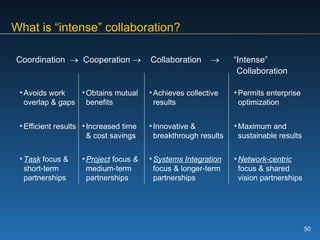
  NCM Challenges (cont.)   Not Just Collaboration, but “ Intense Collaboration ” More than just Internet based, or IT based Must flow from real trust & mutual commitment Required to optimize the entire network Not just the OEM, nor even just for the customer Not just the OEM, suppliers & customer, but also   governments, educators, NGOs, etc.
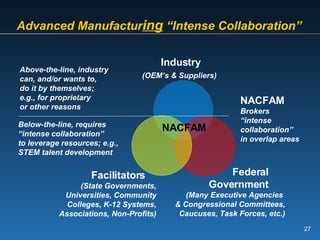
Advanced Manufactur ing  “Intense Collaboration”     NACFAM Above-the-line, industry   can, and/or wants to, do it by themselves; e.g., for proprietary or other reasons Below-the-line, requires   “ intense collaboration” to leverage resources; e.g., STEM talent development   NACFAM Brokers   “ intense collaboration” in overlap areas Industry (OEM’s & Suppliers)   Federal  Government  (Many Executive Agencies  & Congressional Committees, Caucuses, Task Forces, etc.) Facilitators  (State Governments, Universities, Community Colleges, K-12 Systems, Associations, Non-Profits)
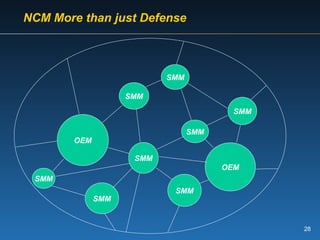
OEM SMM SMM SMM OEM SMM SMM SMM SMM NCM More than just Defense SMM
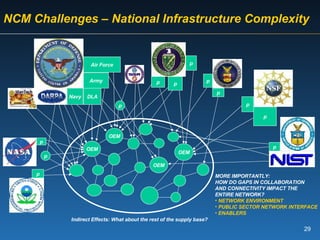
OEM OEM Army Navy DLA OEM p Indirect Effects: What about the rest of the supply base? OEM p p p p p p p MORE IMPORTANTLY: HOW DO GAPS IN COLLABORATION  AND CONNECTIVITY IMPACT THE  ENTIRE NETWORK?   NETWORK ENVIRONMENT PUBLIC SECTOR NETWORK INTERFACE ENABLERS NCM Challenges – National Infrastructure Complexity Air Force p p p p
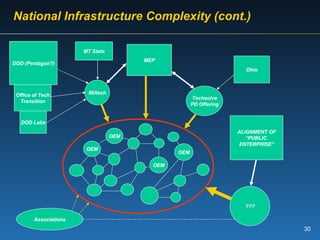
OEM OEM DOD (Pentagon?) OEM Office of Tech Transition MEP OEM National Infrastructure Complexity (cont.) Miltech DOD Labs MT State Ohio Techsolve PD Offering DOL ??? EPA NSF States/ Universities NIST  ATP / TIP ALIGNMENT OF “ PUBLIC  ENTERPRISE” Associations
  National Infrastructure Requirements Easier Access  to the Myriad Government Agencies, Policies, Programs, Regulations Affecting Manufacturing  & NCM; e.g., GAO Reported in May, 2007: 5 Interagency Activities & 15 Programs Specifically for Manufacturers An Additional 15 Interagency Activities & 239 Programs  for the business sector in general, most of which apply  also to manufacturing Alignment  of Federal Government programs with: The real needs of the NCM extended enterprises, & Across Federal Agencies
DOD, Network Centric Manufacturing & IWGs DOD Drives Most of What Federal Government Does in Manufacturing because it is: Multi-billion $ Customer of Manufacturing Companies Dependent on Large, Medium & Small Manufacturers for Much Technology & Innovation Network Centric Manufacturing (NCM) is: Exciting & Necessary in the Complexity of the 21 st  Century Hyper-Competitive Global Economy A Theme Manufacturing Can Rally Around IWGs Need Such an Over-reaching Theme To Lead Alignment of Individual Agency Capabilities to Help Make US Manufacturing Globally Competitive
  NCM Challenges -- SMMs   SMM Capabilities  throughout the Supply Network Over 300,000 smaller manufacturers (SMMs) in USA SMMs face the same challenges as OEMs, but  without the resources of big companies to cope Therefore SMMs Require Support in Many Areas
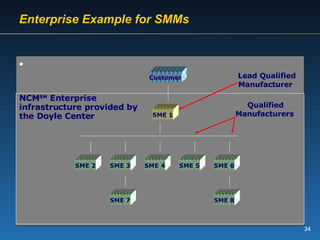
Enterprise Example for SMMs SME 1 SME 3 SME 4 SME 5 SME 2 SME 6 SME 7 SME 8 NCM SM  Enterprise infrastructure provided by the Doyle Center Customer Qualified Manufacturers   Lead Qualified Manufacturer
Applications for SMM Enterprise Example Rapid Response for Legacy Parts:   addressing situations where expensive or critical capital equipment remains out of service due to spare part unavailability  Manufacturing Readiness & Launch   providing technology tools and consulting services to engineering oriented organizations to assist in the transition from a design to a manufacturing environment   (Contact: Dennis Thompson dthompson@doylecenter.org)
5.   What  You  Can Do! For OEMs  &  SMMs, competitiveness comes from: Innovation -- new technologies, products, processes Faster times to market with the resulting products The help of the entire  network Requires robust manufactur ing  capabilities at all tiers: Supply network skills in collaboration & “orchestration” Creative workforce recruiting, hiring, development & retention policies Increasingly in corporate citizenship, including sustainable, green manufacturing, etc. Innovative  process  development & deployment This is where  you  come in !
  What Progressive Companies Must Do   Government at best will take time to achieve its strategy for US manufacturing; at worst it will not get much done Therefore, manufacturers must hedge by doing all they can for themselves, including: Innovative Workforce Policies Network Centric Supply Chain Skills & Practices Lower Cost Sustainable & Green Manufacturing Processes Productivity Increases through Innovative Technology New Processes, Automation, etc., can offset low cost labor This can solve the issue of US manufacturing competitiveness for many companies, small & large ! BUT,  Total  Costs, not just cheap labor, must be considered
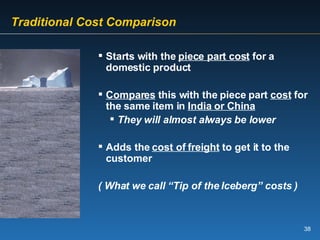
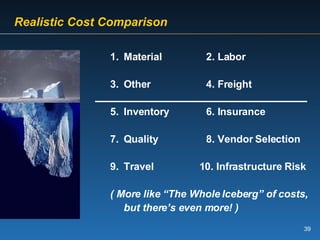
Traditional Cost Comparison Starts with the  piece part cost  for a domestic product Compares  this with the piece part  cost  for the same item in  India or China They will almost always be lower   Adds the  cost of freight  to get it to the customer ( What we call “Tip of the Iceberg” costs )
  Realistic Cost Comparison   Material 2. Labor 3. Other  4. Freight 5. Inventory 6. Insurance 7. Quality 8. Vendor Selection 9. Travel   10. Infrastructure Risk ( More like “The Whole Iceberg” of costs, but there’s even more! )
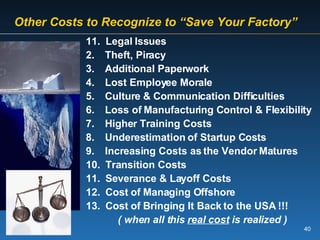
  Other Costs to Recognize to “Save Your Factory” 11.  Legal Issues Theft, Piracy Additional Paperwork Lost Employee Morale Culture & Communication Difficulties Loss of Manufacturing Control & Flexibility Higher Training Costs Underestimation of Startup Costs Increasing Costs as the Vendor Matures Transition Costs Severance & Layoff Costs Cost of Managing Offshore Cost of Bringing It Back to the USA !!! ( when all this  real cost  is realized )
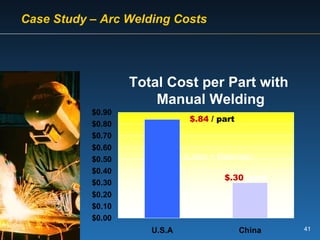
Total Cost per Part with  Manual Welding $.84   / part $.30 / part (Labor + Materials) Case Study – Arc Welding Costs
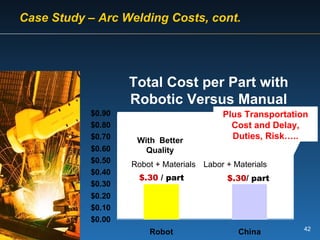
Total Cost per Part with  Robotic Versus Manual  Robot + Materials Labor + Materials $.30   / part $.30 / part With  Better Quality Plus Transportation Cost and Delay, Duties, Risk….. Case Study – Arc Welding Costs, cont.
Actions to “Save Your Factory”  Manufacturing will go to the countries whose companies: Improve quality & delivery while reducing costs thru Six Sigma, Advanced Processes, Automation, ERP, Lean, Just-in-time, Sustainable/Green Manufacturing, etc. Slash time to commercialize product   innovations Innovatively employ their workforce Intensely collaborate with their supply network Partner with government & education where possible North America is in the best position to win the race Culture of innovation, entrepreneurship, etc. Starting to address challenges of laws, regulation, etc. Working on the paradox of “Intense Collaboration” to succeed in the “hyper-competitive” global economy
6.   Key Points to Leave with You Today Your  Leadership  is essential in today’s “Flat World” Importance of  output rather than only input In everything we do, whether for our company,  or our country Trend to “ Network Centric Manufacturing ” demands of you:  “ Intense” collaboration  &  innovation  especially in: Workforce Development Process Technology Development & Deployment Supply Network Participation & “Orchestration” Skills Sustainable/Green Manufacturing
Key Points, cont. Leaders like you must help government understand: In today’s constrained budget environment, focus must be  not only on funding levels (input), but more  importantly return on public dollars (output), e.g., for: R&D -- New Industries & jobs from new technologies, products & processes, incl. Sustainable Manufacturing Workforce investment, including economies of use with regional & economic development activities National Infrastructure to Support & Lead the Evolution of Network Centric Manufacturing
Regarding the National Council for Advanced Manufacturing (NACFAM) Please contact: Eric Mittelstadt, CEO Phone: 202-429-2220 ext. 4; Fax: 202-429-2422 E-mail:  [email_address] For More Information:
Appendix  November 15, 2007
Manufacturing in America  “ing” Recommendations Interagency, Advisory & Inter-governmental Recommendations: Manufacturing Council for Oversight & Advice Including Subgroup on Workforce Development IWG on Manufacturing Competitiveness Including Subgroups on Workforce & Technology Inter-Governmental Coordinating Committee IWG on Manufacturing R&D To Identify Priorities for Future Federal Support Including Technology, Supply Chain & Sustainability Supply Chain & SMM Recommendations: Supply Chain Initiative to Promote Access to Global Markets Support a Newly Coordinated MEP & Create a National Virtual Network of Centers of Manufacturing Excellence Encourage SBIR & SBTT Programs to Focus on Manufacturing Explore New Avenues for Leveraging of National Labs & Universities for the Benefit of SMMs
“ ing” Recommendations, cont. Education & Training Recommendations: Enhance Workforce Skills for Manufacturing of the Future Establish a High School & Technical Education Partnership Initiative Establish Personal Reemployment Accounts Coordinate Economic Adjustment & Education/Training for Manufacturing Communities Improve Delivery of Assistance for Retraining of Displaced Workers Technology & Innovation Recommendations: Make Permanent the R & E Tax Credit R&D in New Energy Technology Review Federal R&D Funding for Generic Technologies, Engineering, & Physical Sciences For Better Coordination & Focus on Innovation & Productivity Strengthen Partnerships to Promote Manufacturing Tech Transfer Expand Cooperative Technical Assistance Programs on Standards Promote Standards to Better Protect Industrial Control Systems
What is “intense” collaboration?   Coordination     Cooperation     Collaboration     “Intense”    Collaboration   Permits enterprise optimization Achieves collective results Obtains mutual benefits Avoids work overlap & gaps  Network-centric   focus & shared vision partnerships Systems Integration   focus & longer-term partnerships  Project  focus  &  medium-term   partnerships  Task  focus & short-term partnerships Maximum and sustainable results Innovative & breakthrough results Increased time & cost savings Efficient results
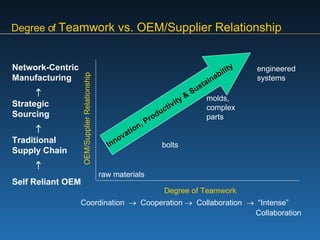
Network-Centric Manufacturing  Strategic Sourcing  Traditional Supply Chain  Self Reliant OEM Coordination     Cooperation     Collaboration     “Intense”    Collaboration   Innovation, Productivity & Sustainability Degree of  Teamwork vs. OEM/Supplier  Relationship Degree of Teamwork OEM/Supplier Relationship raw materials bolts molds,  complex  parts engineered  systems
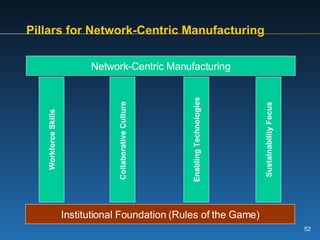
Pillars for Network-Centric Manufacturing Workforce Skills Collaborative Culture  Enabling Technologies Sustainability Focus Network-Centric Manufacturing Institutional Foundation (Rules of the Game)
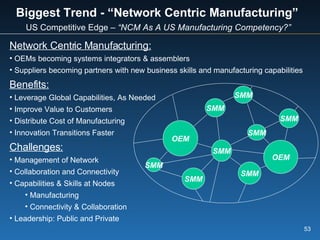
Biggest Trend - “Network Centric Manufacturing” US Competitive Edge –  “NCM As A US Manufacturing Competency?” Network Centric Manufacturing: OEMs becoming systems integrators & assemblers Suppliers becoming partners with new business skills and manufacturing capabilities  Benefits: Leverage Global Capabilities, As Needed Improve Value to Customers Distribute Cost of Manufacturing  Innovation Transitions Faster Challenges: Management of Network Collaboration and Connectivity Capabilities & Skills at Nodes Manufacturing Connectivity & Collaboration Leadership: Public and Private OEM SMM SMM SMM OEM SMM SMM SMM SMM SMM
OEM OEM DOD Army Navy DLA OEM SBIR Air Force DARPA, Mantech, Etc. p EPA Dept of Labor, Dept of Commerce, Etc. NSF, NIST, Etc. OEM p p p p p p p Why National Manufacturing Leadership Required?? Launching NCM requires real collaboration within the Interagency Working Group NCM  adds value to every US manufacturing sector  NCM touches every size and type of US manufacturing company  NCM scope includes manufacturing capabilities, skills, training, R&D, & policies NCM outcomes have national, regional, and local impacts
“ Operating in a Network Centric World ” … A Challenge Identified by Industry Executives “ Our customers expect superiority in our product performance  and demand life-cycle affordability. We can’t meet their  expectations from inside our own silos.”  “ How we connect, how we collaborate, how we make and meet commitments, and how we structure contracts in such a network centric world will determine whether we can achieve superiority and affordability of our products.” Ralph Heath, President LM Aeronautics Keynote Speech on December 5, 2006 Defense Manufacturing Conference (DMC) “ Those who can build relationships based on intense collaboration and trust will accomplish the tasks quicker and at lower costs – and they will take home the prize.”
Characterizing the NCM Environment Many Stakeholders, Potential Conflicting Goals/Constraints Different for Development, Production, & Sustainment Network Centric Stakeholders that Are Distributed in Space, Time, & Organizational Type Partners & Competitors; Roles May Change Over Time Lots of Interfaces, Facts, Assumptions, Lack of Awareness Stakeholders that Must Compromise on Requirements and Strategy; & Then Must Execute to Resulting Commitments Lack of Understanding/Capability at the “Enterprise Network Level” Methods, Best Practices & Proven Experience Skills & Tools (especially for collaboration / visualization) Metrics
  National Infrastructure – Premise & Scope   Federal actions affecting manufacturing will affect ability of US manufacturers to adopt NCM & excel at it; i.e., either:  Help it Hurt it Neither; i.e., neutral Potential National Infrastructure includes: Programs - SBIR, NIST MEP, etc. Agencies - DOC MAS, NIST MEL, etc. Federal Collaboration – IWGs, etc. Regulations - DARs, Export Controls, etc. Policies - Anti-trust, Foreign Trade, etc.
  Complexity  of  Federal Support for Manufacturing  Government Support (GAO, May, 2007): 6 Interagency Activities 15 Programs Specifically for Manufacturing Additional 15  Interagency Activities &  239  Programs for Business Interagency Activities for Manufacturing: DOC IWG on Manufacturing Competitiveness NSTC IWG on Manufacturing R&D Green Suppliers Network (NIST, EPA) Export Market Assistance (NIST, DOC-ITA) RFID Training Assistance (NIST, DOD) TechLink and MilTech Assistance (NIST, DOD)
  Complexity  of  Federal Support for Mfg. (cont.)   Programs for Manufacturing: ManTech, NGMTI, BMPP (DOD)  Manufacturing Extension Partnership (NIST MEP) MilTech (DOD)  Defense Small Business Technology & Readiness Resources Program (Navy)  Manufacturing Technical Assistance Production (MTAPP) Program (Air Force) Technology Insertion, Demonstration, & Evaluation (TIDE) Program (Air Force) Trade Adjustment Assistance (TAA) for Firms Program (DOC) Textiles & Apparel Program (DOC) Industrial Technologies Program (DOE ITP)  Manufacturers’ Assistance, Investigational New Drug Application, & Prescription Drug User Fee Act & Reductions for Small Business Programs (FDA)  Research Program for the Manufacturing Sector (NIOSH)  Domestic Food Distribution Procurements & the International Food Aid Procurements (DOAg) Outreach to Small & Very Small Plants Program (DOAg)  Partnership for Advancing Technology in Housing Initiative (HUD)  Dream It. Do It, NAM campaign partially funded by DOL
Key Points for NCM Trend to “ Network Centric Manufacturing ” (NCM) demands: “ Intense” collaboration , including trust & commitment Connectivity ; incl. visibility, real-time common data, etc.  Collaboration of  Industry & Government  with  infrastructure investments by  both  of them Challenge to Industry: Commitment to  common  infrastructure requirements Collaborate on  industry  investments to meet them Drive  Federal involvement to meet them Challenge to Government: Align  programs, policies, regulations, etc., with   NCM needs  of that real industry commitment
Competency Models Tools for Skills Gap Analysis  and Workforce Development Activities Presentation by: LeeSa Page Director, Workforce Development  NACFAM October 2007
What is a Competency Model? A competency model is a  tool  to organize the knowledge, skills and abilities an individual needs to successfully perform at work. Competency models form the foundation for: developing curriculum selecting training materials licensure and certification requirements job descriptions recruiting and hiring performance reviews
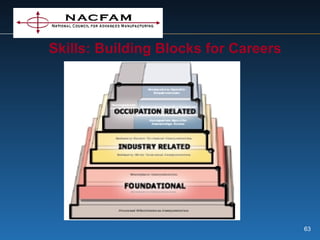
Skills: Building Blocks for Careers
Competency Descriptions Foundational:  Personal, Academic, and Workplace Basics (i.e., dependability, math, reading, teamwork) Industry-related:  Industry-specific and Industry-wide technical skills (i.e., production, quality control) Occupational-related:   Occupation-specific technical skills and management skills (i.e., administration and management)
Advanced Manufacturing Based on the national, industry-validated Manufacturing Skill Standards Council (MSSC) skill standards, assessment and certification program for high-skill production technicians. Complimentary with the Career Clusters Institute “Manufacturing Pathway Plan of Study” which is also based on the MSSC standards.
Advanced Manufacturing Production  Maintenance, Installation & Repair  Manufacturing Process Development/Design  Supply Chain Management  Quality Assurance/Continuous Improvement  Health & Safety
Competency Models are tools  that enable business and industry to... •  Clearly articulate workforce needs  •  Define requirements for employee success on a job  and at different levels of career progression •  Increase the likelihood that qualified candidates will  be hired •  Place individuals into appropriate assignments once  they are hired •  Provide a shared understanding of what will be  measured in performance appraisals •  Facilitate performance appraisal discussions
Competency Models are tools  that enable business and industry to... •  Focus on the knowledge, skills and abilities that have  the most impact on effectiveness and  productivity •  Ensure training and development efforts and  investments are in line with organizational  values and vision •  Guide employee development efforts •  Focus training and development efforts on areas  where there are significant deficiencies •  Provide a framework for ongoing coaching and  mentoring •  Identify gaps in current training offerings
So How Do I Use It? Resource Site:  Competency Model Clearinghouse http://www.careeronestop.org/COMPETENCYMODEL/default.aspx Find validated industry workforce requirements Develop your own workforce requirements skill sets based on these requirements Find industry certifications, curriculum and training resources to support education/training needs
What are the benefits? Streamline your hiring/selection process Save time and money using a tool that has been developed and validated by industry Keep up with industry requirements for high skill technicians

Maximize Minnesota Eric Mittelstadt

  • 1.
    Eric Mittelstadt, CEOHow You Can Help Meet 21 st Century Challenges to U.S. Manufacturing MaximizeMinnesota: Your First-Line Resource November 15, 2007
  • 2.
    What We WillCover Today 1. Status & Outlook for US Manufacturing 2. Workforce Implications 3. Process Technology Developments 4. Network Centric Manufacturing 5. What You Can Do 6. Key Points
  • 3.
    1. U.S. Manufacturing Numbers Positive Profitability returned to that of the late 90’s boom years Overall U.S. output of manufactured goods highest ever Productivity increased, & must continue to do so in today’s hyper-competitive global economy BUT, Jobs in manufacturing recently decreasing Inevitable result of increased productivity when demand does not increase even faster Some implications to you in later slides
  • 4.
    InescapableTrend & US Competitive Advantage Products that can be well defined & packaged: Will tend to be sourced off-shore due to: Significant labor cost advantage Portability with IT technology Tough because US labor costs will never be lowest US competitive advantage has been & must continue to be: Technology Creation (American Ingenuity) and Manufactur ing Know-how to commercialize it quickly into a constant stream of new & valuable products This is the engine for our economic future, and the key to our national security
  • 5.
    Productivity Must Continueto Increase Increasingly “hyper-competitive” global economy, As more nations strive to develop their economies Consumer pressures for higher quality, content and customization at lower prices Inevitable fluctuations in the economy Because we are a smaller nation, we must be more innovative, creative & productive if we are to remain a world power
  • 6.
    Metrics for HealthyU.S. Manufacturing Not just how many manufacturing jobs Essential to people involved, but measures only input Especially with less experienced workforce, output is really critical Similarly, % of GDP is misleading; for example: New components of GDP mean lower % of GDP for manufacturing even if absolute manufacturing output holds steady; e.g., Homeland Security, Telecom, etc. More important are manufacturing output increases from: Unimaginable new industries with undefined new jobs as a result of R&D, both public & private Advanced Processes, Robotic Automation, Lean, 6-Sigma, Just-in-Time, etc.
  • 7.
    Inescapabletrends The need for increased productivity by definition means producing more with fewer people Thus, an inevitable reduction in the number of manufacturing jobs Similar to agriculture in the past, but not as severe Skills & experience loss + increasing technology requires well-trained workers & lifelong learning Requires innovation in both product & process development & deployment, as well as workforce issues
  • 8.
    NACFAM’s Focus NACFAMworks on Manufactur ing issues: Workforce Technology Supply Chain Sustainability Manufactur er issues are covered by NAM, et al: Taxes Trade Tort Energy Health Care Pensions Regulations
  • 9.
    2. WorkforceImplications Demographics – by 2018 (11 years from now!): 70 million baby boomers will retire About half of them are in today’s US workforce That means skills & experience of roughly 1/4 of today’s workforce will be lost in the next decade Manufacturing more than 1/4 due to older workforce Overall population growing, plus those retiring “Baby Boomers” are more demanding; means more output More output with less skilled & experienced workers means: Continuously more advanced process technologies, requiring life-long learning to deploy them effectively Well-trained workers; knowledge must replace experience BIG challenge for education systems & workers
  • 10.
    Work er Implications Because of the demands on businesses, workers of the future at all levels must be enabled to work in a more “Network-centric” way with: More skills in Science, Technology, Engineering & Math (STEM) Collaboration skills for teamwork, inside & outside their company Creativity, analytic & problem solving skills, for greater innovation in product & process Continuous updating of all these skills to be: The best they can be for their current employer Easily mobile to other jobs in new industries
  • 11.
    ToHelp US Workers, Government Must: Encourage & enable workers to continuously learn so they can update & increase all of their skills Not just try to preserve old jobs, but rather: Devise innovative ways to minimize unemployment Creatively mitigate inevitable short-term displacements in a growing economy Make its policies & programs for manufactur ing the most competitive & accessible, versus other countries
  • 12.
    To Help USWorkers, Educators Must: Help define and understand 21 st century demands on the workforce as required to maintain: Our standard of living, and Our World leadership Collaborate with industry to understand its needs, both current & future Respond to all these needs effectively Collaborate with government to innovatively optimize the return on public dollars they spend
  • 13.
    ToHelp US Workers & Themselves, Companies Must: Understand that Government & Education will take time to achieve objectives for a competitive 21 st century workforce Therefore, manufacturers must hedge by doing all they can for themselves & their employees, including innovation in: Recruiting new workers, both entering & displaced Retaining existing workers through empowerment to accomplish meaningful goals, competitive compensation policies, & trust that they truly want to contribute Training of incumbent workers to continuously upgrade their skills as well as experience Utilizing employees past their traditional retirement age Leveraging foreign labor w/o losing US competitiveness
  • 14.
    Workforce Tools Availableto Companies Manufacturing Skill Standards Council (MSSC) Industry & labor led, with education & government Focused on production workers & first-line supervisors Covers all manufacturing industries Validated standards, assessments, certification process Textbook & curriculum to prepare workers for testing Benefits – Employers know what they are getting – Employees’ credentials document their skills – Educators know what to teach Advanced Manufacturing Competency Model (AMCM - DOL) Industry & Government led Tied to existing manufacturing standards, including: AWS (welding), NIMS (metalworking), MSSC, etc. Used to describe needed competencies & for DOL grants
  • 15.
    WorkforceTools Available, cont. Career Cluster Initiative (DOEd) Industry, education & government NACFAM brokering collaboration to tie to MSSC, AMCM Aimed at providing career paths & curriculum for them to State Directors of Technical Education STEM Talent Development Regional Conferences Led by MEP centers so far; NACFAM brokers & organizes Include industry, labor, education & government For example, Philadelphia regional conference 170 attendees paid money to come Determined what needed to be done by whom with whom in Washington, the region, states, local, etc. Within two weeks set up a “Regional Compact” to drive action in detail All without spending one dollar of taxpayer money!
  • 16.
    3. Process Technology Developments Disruptive Technologies per NACFAM 2005 Report Industry executives views on disruptive potential & likely impact on national security & economic growth Disruptive defined as “Technological developments that have reached sufficient critical mass or ‘tipping point’ to cause a significant proportion of manufacturers to fundamentally alter their planning, operations, structure or processes.” Seven Categories Identified: Sensors Micro-fabrication & Nano-fabrication Modeling & Simulation Reconfigurable Tools & Systems Smart Systems Solid Free Form Fabrication (SFFF) Visualization, Planning, & Knowledge Management
  • 17.
    Next Generation ManufacturingTechnology Initiative (NGMTI) Purpose: Accelerate development & implementation of breakthrough technologies for defense industrial base transformation & global competitiveness of US-based manufacturing Thrust Areas: Emerging Process Technologies Model Based Enterprise Safe, Secure, Reliable & Sustainable Manufacturing Power RF Modules Intelligent Systems Enterprise Integration Knowledge Applications Strategic Investment Plans – “Technology roadmap”, prioritization & business case to guide investments Done for first three (3) thrust areas; more to follow
  • 18.
    NGMTI, cont. Projects– Coalitions to prove out candidate technologies & establish business case for widespread deployment: Defense Battery Supply Base Manufacturing Risk (done) Fuel Cells Manufacturing Roadmap (done) Advanced Aerospace Casting Processes Lightweight Composites for Tactical Military Vehicles Digital Direct Manufacturing Low-cost Titanium Powder Production Dual Fuel Cells Manufacturing Materials for Personnel Extremity Protection Electro-Mechanical Industry Model-based Product-driven Product & Process Design Friction Stir Joining Technologies Multi-Enterprise Collaboration Information Delivery to Point of Use (info: www.ngmti.org)
  • 19.
    InteragencyWkg. Grp. (IWG) for Manufacturing R&D Under NSTC; chaired by NIST MEL Members include virtually all Federal R&D agencies; i.e.: DOA, DOC, DOD, DOEd, DOEn, DHS, DOL, DOT, EPA, NIH, NASA, NSF, OSTP, OMB, SBA Priorities for coordinating multidisciplinary focus: Intelligent & Integrated Manufacturing Systems (IIMS) Manufacturing for the Hydrogen Economy Nanomanufacturing Acts as forum within NSTC: Provides policy, program & budget recommendations Promotes exchange of information Reports to the President (website N/A)
  • 20.
    NACFAMTechnology & Innovation Initiative Came out of NACFAM June 27-28 Annual Meeting Goal – Accelerate innovation thru multi-stakeholder collaborations (like SEMATECH, USCAR, UTC-Britain) Criteria – Mega Problem, Multi-sector, Need for Open collaboration, Societal benefits or National threats Draft List of “Mega Problems” for manufacturing technologies Sustainable or green manufacturing Energy diversity / security Large defense projects Defense Sustainment Activities STEM & Workforce Water Hydrogen economy Possible fits – Nanotechnology, Intelligent & Integrated manufacturing, Ergonomics, Robotics / Automation
  • 21.
    4. Future Shape of Manufacturing Biggest Trend: OEMs becoming assemblers or integrators of systems, subsystems and components manufactured & engineered by their supply chain; i.e., the “Network” “ Network Centric Manufacturing”
  • 22.
    Network Centric “ Your … Network Makes All the Difference”
  • 23.
    Network Centric “ Your … Network Makes All the Difference” “ All the Forces Act as One”
  • 24.
    Network Centric Terminology for a Reason Not net centric; i.e., we don’t mean just the Internet, which is for data & information We do mean net work , which is for people, organizations, companies For example, one multi-billion $ company said IT is a really big deal, but it’s about 20% of the solution; 80% is the people, the relationships, the trust
  • 25.
    NetworkCentric Manufacturing (NCM) Challenges Trust for Sure Trust among & between people, companies, labor, government, education, associations, NGOs, etc. How do we do that when it seems to be going the other way in DC, the UN, the WTO, etc.?
  • 26.
    NCMChallenges (cont.) Not Just Collaboration, but “ Intense Collaboration ” More than just Internet based, or IT based Must flow from real trust & mutual commitment Required to optimize the entire network Not just the OEM, nor even just for the customer Not just the OEM, suppliers & customer, but also governments, educators, NGOs, etc.
  • 27.
    Advanced Manufactur ing “Intense Collaboration” NACFAM Above-the-line, industry can, and/or wants to, do it by themselves; e.g., for proprietary or other reasons Below-the-line, requires “ intense collaboration” to leverage resources; e.g., STEM talent development NACFAM Brokers “ intense collaboration” in overlap areas Industry (OEM’s & Suppliers) Federal Government (Many Executive Agencies & Congressional Committees, Caucuses, Task Forces, etc.) Facilitators (State Governments, Universities, Community Colleges, K-12 Systems, Associations, Non-Profits)
  • 28.
    OEM SMM SMMSMM OEM SMM SMM SMM SMM NCM More than just Defense SMM
  • 29.
    OEM OEM ArmyNavy DLA OEM p Indirect Effects: What about the rest of the supply base? OEM p p p p p p p MORE IMPORTANTLY: HOW DO GAPS IN COLLABORATION AND CONNECTIVITY IMPACT THE ENTIRE NETWORK? NETWORK ENVIRONMENT PUBLIC SECTOR NETWORK INTERFACE ENABLERS NCM Challenges – National Infrastructure Complexity Air Force p p p p
  • 30.
    OEM OEM DOD(Pentagon?) OEM Office of Tech Transition MEP OEM National Infrastructure Complexity (cont.) Miltech DOD Labs MT State Ohio Techsolve PD Offering DOL ??? EPA NSF States/ Universities NIST ATP / TIP ALIGNMENT OF “ PUBLIC ENTERPRISE” Associations
  • 31.
    NationalInfrastructure Requirements Easier Access to the Myriad Government Agencies, Policies, Programs, Regulations Affecting Manufacturing & NCM; e.g., GAO Reported in May, 2007: 5 Interagency Activities & 15 Programs Specifically for Manufacturers An Additional 15 Interagency Activities & 239 Programs for the business sector in general, most of which apply also to manufacturing Alignment of Federal Government programs with: The real needs of the NCM extended enterprises, & Across Federal Agencies
  • 32.
    DOD, Network CentricManufacturing & IWGs DOD Drives Most of What Federal Government Does in Manufacturing because it is: Multi-billion $ Customer of Manufacturing Companies Dependent on Large, Medium & Small Manufacturers for Much Technology & Innovation Network Centric Manufacturing (NCM) is: Exciting & Necessary in the Complexity of the 21 st Century Hyper-Competitive Global Economy A Theme Manufacturing Can Rally Around IWGs Need Such an Over-reaching Theme To Lead Alignment of Individual Agency Capabilities to Help Make US Manufacturing Globally Competitive
  • 33.
    NCMChallenges -- SMMs SMM Capabilities throughout the Supply Network Over 300,000 smaller manufacturers (SMMs) in USA SMMs face the same challenges as OEMs, but without the resources of big companies to cope Therefore SMMs Require Support in Many Areas
  • 34.
    Enterprise Example forSMMs SME 1 SME 3 SME 4 SME 5 SME 2 SME 6 SME 7 SME 8 NCM SM Enterprise infrastructure provided by the Doyle Center Customer Qualified Manufacturers Lead Qualified Manufacturer
  • 35.
    Applications for SMMEnterprise Example Rapid Response for Legacy Parts: addressing situations where expensive or critical capital equipment remains out of service due to spare part unavailability Manufacturing Readiness & Launch providing technology tools and consulting services to engineering oriented organizations to assist in the transition from a design to a manufacturing environment (Contact: Dennis Thompson dthompson@doylecenter.org)
  • 36.
    5. What You Can Do! For OEMs & SMMs, competitiveness comes from: Innovation -- new technologies, products, processes Faster times to market with the resulting products The help of the entire network Requires robust manufactur ing capabilities at all tiers: Supply network skills in collaboration & “orchestration” Creative workforce recruiting, hiring, development & retention policies Increasingly in corporate citizenship, including sustainable, green manufacturing, etc. Innovative process development & deployment This is where you come in !
  • 37.
    WhatProgressive Companies Must Do Government at best will take time to achieve its strategy for US manufacturing; at worst it will not get much done Therefore, manufacturers must hedge by doing all they can for themselves, including: Innovative Workforce Policies Network Centric Supply Chain Skills & Practices Lower Cost Sustainable & Green Manufacturing Processes Productivity Increases through Innovative Technology New Processes, Automation, etc., can offset low cost labor This can solve the issue of US manufacturing competitiveness for many companies, small & large ! BUT, Total Costs, not just cheap labor, must be considered
  • 38.
    Traditional Cost ComparisonStarts with the piece part cost for a domestic product Compares this with the piece part cost for the same item in India or China They will almost always be lower Adds the cost of freight to get it to the customer ( What we call “Tip of the Iceberg” costs )
  • 39.
    RealisticCost Comparison Material 2. Labor 3. Other 4. Freight 5. Inventory 6. Insurance 7. Quality 8. Vendor Selection 9. Travel 10. Infrastructure Risk ( More like “The Whole Iceberg” of costs, but there’s even more! )
  • 40.
    OtherCosts to Recognize to “Save Your Factory” 11. Legal Issues Theft, Piracy Additional Paperwork Lost Employee Morale Culture & Communication Difficulties Loss of Manufacturing Control & Flexibility Higher Training Costs Underestimation of Startup Costs Increasing Costs as the Vendor Matures Transition Costs Severance & Layoff Costs Cost of Managing Offshore Cost of Bringing It Back to the USA !!! ( when all this real cost is realized )
  • 41.
    Total Cost perPart with Manual Welding $.84 / part $.30 / part (Labor + Materials) Case Study – Arc Welding Costs
  • 42.
    Total Cost perPart with Robotic Versus Manual Robot + Materials Labor + Materials $.30 / part $.30 / part With Better Quality Plus Transportation Cost and Delay, Duties, Risk….. Case Study – Arc Welding Costs, cont.
  • 43.
    Actions to “SaveYour Factory” Manufacturing will go to the countries whose companies: Improve quality & delivery while reducing costs thru Six Sigma, Advanced Processes, Automation, ERP, Lean, Just-in-time, Sustainable/Green Manufacturing, etc. Slash time to commercialize product innovations Innovatively employ their workforce Intensely collaborate with their supply network Partner with government & education where possible North America is in the best position to win the race Culture of innovation, entrepreneurship, etc. Starting to address challenges of laws, regulation, etc. Working on the paradox of “Intense Collaboration” to succeed in the “hyper-competitive” global economy
  • 44.
    6. Key Points to Leave with You Today Your Leadership is essential in today’s “Flat World” Importance of output rather than only input In everything we do, whether for our company, or our country Trend to “ Network Centric Manufacturing ” demands of you: “ Intense” collaboration & innovation especially in: Workforce Development Process Technology Development & Deployment Supply Network Participation & “Orchestration” Skills Sustainable/Green Manufacturing
  • 45.
    Key Points, cont.Leaders like you must help government understand: In today’s constrained budget environment, focus must be not only on funding levels (input), but more importantly return on public dollars (output), e.g., for: R&D -- New Industries & jobs from new technologies, products & processes, incl. Sustainable Manufacturing Workforce investment, including economies of use with regional & economic development activities National Infrastructure to Support & Lead the Evolution of Network Centric Manufacturing
  • 46.
    Regarding the NationalCouncil for Advanced Manufacturing (NACFAM) Please contact: Eric Mittelstadt, CEO Phone: 202-429-2220 ext. 4; Fax: 202-429-2422 E-mail: [email_address] For More Information:
  • 47.
  • 48.
    Manufacturing in America “ing” Recommendations Interagency, Advisory & Inter-governmental Recommendations: Manufacturing Council for Oversight & Advice Including Subgroup on Workforce Development IWG on Manufacturing Competitiveness Including Subgroups on Workforce & Technology Inter-Governmental Coordinating Committee IWG on Manufacturing R&D To Identify Priorities for Future Federal Support Including Technology, Supply Chain & Sustainability Supply Chain & SMM Recommendations: Supply Chain Initiative to Promote Access to Global Markets Support a Newly Coordinated MEP & Create a National Virtual Network of Centers of Manufacturing Excellence Encourage SBIR & SBTT Programs to Focus on Manufacturing Explore New Avenues for Leveraging of National Labs & Universities for the Benefit of SMMs
  • 49.
    “ ing” Recommendations,cont. Education & Training Recommendations: Enhance Workforce Skills for Manufacturing of the Future Establish a High School & Technical Education Partnership Initiative Establish Personal Reemployment Accounts Coordinate Economic Adjustment & Education/Training for Manufacturing Communities Improve Delivery of Assistance for Retraining of Displaced Workers Technology & Innovation Recommendations: Make Permanent the R & E Tax Credit R&D in New Energy Technology Review Federal R&D Funding for Generic Technologies, Engineering, & Physical Sciences For Better Coordination & Focus on Innovation & Productivity Strengthen Partnerships to Promote Manufacturing Tech Transfer Expand Cooperative Technical Assistance Programs on Standards Promote Standards to Better Protect Industrial Control Systems
  • 50.
    What is “intense”collaboration? Coordination  Cooperation  Collaboration  “Intense” Collaboration Permits enterprise optimization Achieves collective results Obtains mutual benefits Avoids work overlap & gaps Network-centric focus & shared vision partnerships Systems Integration focus & longer-term partnerships Project focus & medium-term partnerships Task focus & short-term partnerships Maximum and sustainable results Innovative & breakthrough results Increased time & cost savings Efficient results
  • 51.
    Network-Centric Manufacturing Strategic Sourcing  Traditional Supply Chain  Self Reliant OEM Coordination  Cooperation  Collaboration  “Intense” Collaboration Innovation, Productivity & Sustainability Degree of Teamwork vs. OEM/Supplier Relationship Degree of Teamwork OEM/Supplier Relationship raw materials bolts molds, complex parts engineered systems
  • 52.
    Pillars for Network-CentricManufacturing Workforce Skills Collaborative Culture Enabling Technologies Sustainability Focus Network-Centric Manufacturing Institutional Foundation (Rules of the Game)
  • 53.
    Biggest Trend -“Network Centric Manufacturing” US Competitive Edge – “NCM As A US Manufacturing Competency?” Network Centric Manufacturing: OEMs becoming systems integrators & assemblers Suppliers becoming partners with new business skills and manufacturing capabilities Benefits: Leverage Global Capabilities, As Needed Improve Value to Customers Distribute Cost of Manufacturing Innovation Transitions Faster Challenges: Management of Network Collaboration and Connectivity Capabilities & Skills at Nodes Manufacturing Connectivity & Collaboration Leadership: Public and Private OEM SMM SMM SMM OEM SMM SMM SMM SMM SMM
  • 54.
    OEM OEM DODArmy Navy DLA OEM SBIR Air Force DARPA, Mantech, Etc. p EPA Dept of Labor, Dept of Commerce, Etc. NSF, NIST, Etc. OEM p p p p p p p Why National Manufacturing Leadership Required?? Launching NCM requires real collaboration within the Interagency Working Group NCM adds value to every US manufacturing sector NCM touches every size and type of US manufacturing company NCM scope includes manufacturing capabilities, skills, training, R&D, & policies NCM outcomes have national, regional, and local impacts
  • 55.
    “ Operating ina Network Centric World ” … A Challenge Identified by Industry Executives “ Our customers expect superiority in our product performance and demand life-cycle affordability. We can’t meet their expectations from inside our own silos.” “ How we connect, how we collaborate, how we make and meet commitments, and how we structure contracts in such a network centric world will determine whether we can achieve superiority and affordability of our products.” Ralph Heath, President LM Aeronautics Keynote Speech on December 5, 2006 Defense Manufacturing Conference (DMC) “ Those who can build relationships based on intense collaboration and trust will accomplish the tasks quicker and at lower costs – and they will take home the prize.”
  • 56.
    Characterizing the NCMEnvironment Many Stakeholders, Potential Conflicting Goals/Constraints Different for Development, Production, & Sustainment Network Centric Stakeholders that Are Distributed in Space, Time, & Organizational Type Partners & Competitors; Roles May Change Over Time Lots of Interfaces, Facts, Assumptions, Lack of Awareness Stakeholders that Must Compromise on Requirements and Strategy; & Then Must Execute to Resulting Commitments Lack of Understanding/Capability at the “Enterprise Network Level” Methods, Best Practices & Proven Experience Skills & Tools (especially for collaboration / visualization) Metrics
  • 57.
    NationalInfrastructure – Premise & Scope Federal actions affecting manufacturing will affect ability of US manufacturers to adopt NCM & excel at it; i.e., either: Help it Hurt it Neither; i.e., neutral Potential National Infrastructure includes: Programs - SBIR, NIST MEP, etc. Agencies - DOC MAS, NIST MEL, etc. Federal Collaboration – IWGs, etc. Regulations - DARs, Export Controls, etc. Policies - Anti-trust, Foreign Trade, etc.
  • 58.
    Complexity of Federal Support for Manufacturing Government Support (GAO, May, 2007): 6 Interagency Activities 15 Programs Specifically for Manufacturing Additional 15 Interagency Activities & 239 Programs for Business Interagency Activities for Manufacturing: DOC IWG on Manufacturing Competitiveness NSTC IWG on Manufacturing R&D Green Suppliers Network (NIST, EPA) Export Market Assistance (NIST, DOC-ITA) RFID Training Assistance (NIST, DOD) TechLink and MilTech Assistance (NIST, DOD)
  • 59.
    Complexity of Federal Support for Mfg. (cont.) Programs for Manufacturing: ManTech, NGMTI, BMPP (DOD) Manufacturing Extension Partnership (NIST MEP) MilTech (DOD) Defense Small Business Technology & Readiness Resources Program (Navy) Manufacturing Technical Assistance Production (MTAPP) Program (Air Force) Technology Insertion, Demonstration, & Evaluation (TIDE) Program (Air Force) Trade Adjustment Assistance (TAA) for Firms Program (DOC) Textiles & Apparel Program (DOC) Industrial Technologies Program (DOE ITP) Manufacturers’ Assistance, Investigational New Drug Application, & Prescription Drug User Fee Act & Reductions for Small Business Programs (FDA) Research Program for the Manufacturing Sector (NIOSH) Domestic Food Distribution Procurements & the International Food Aid Procurements (DOAg) Outreach to Small & Very Small Plants Program (DOAg) Partnership for Advancing Technology in Housing Initiative (HUD) Dream It. Do It, NAM campaign partially funded by DOL
  • 60.
    Key Points forNCM Trend to “ Network Centric Manufacturing ” (NCM) demands: “ Intense” collaboration , including trust & commitment Connectivity ; incl. visibility, real-time common data, etc. Collaboration of Industry & Government with infrastructure investments by both of them Challenge to Industry: Commitment to common infrastructure requirements Collaborate on industry investments to meet them Drive Federal involvement to meet them Challenge to Government: Align programs, policies, regulations, etc., with NCM needs of that real industry commitment
  • 61.
    Competency Models Toolsfor Skills Gap Analysis and Workforce Development Activities Presentation by: LeeSa Page Director, Workforce Development NACFAM October 2007
  • 62.
    What is aCompetency Model? A competency model is a tool to organize the knowledge, skills and abilities an individual needs to successfully perform at work. Competency models form the foundation for: developing curriculum selecting training materials licensure and certification requirements job descriptions recruiting and hiring performance reviews
  • 63.
  • 64.
    Competency Descriptions Foundational: Personal, Academic, and Workplace Basics (i.e., dependability, math, reading, teamwork) Industry-related: Industry-specific and Industry-wide technical skills (i.e., production, quality control) Occupational-related: Occupation-specific technical skills and management skills (i.e., administration and management)
  • 65.
    Advanced Manufacturing Basedon the national, industry-validated Manufacturing Skill Standards Council (MSSC) skill standards, assessment and certification program for high-skill production technicians. Complimentary with the Career Clusters Institute “Manufacturing Pathway Plan of Study” which is also based on the MSSC standards.
  • 66.
    Advanced Manufacturing Production Maintenance, Installation & Repair Manufacturing Process Development/Design Supply Chain Management Quality Assurance/Continuous Improvement Health & Safety
  • 67.
    Competency Models aretools that enable business and industry to... • Clearly articulate workforce needs • Define requirements for employee success on a job and at different levels of career progression • Increase the likelihood that qualified candidates will be hired • Place individuals into appropriate assignments once they are hired • Provide a shared understanding of what will be measured in performance appraisals • Facilitate performance appraisal discussions
  • 68.
    Competency Models aretools that enable business and industry to... • Focus on the knowledge, skills and abilities that have the most impact on effectiveness and productivity • Ensure training and development efforts and investments are in line with organizational values and vision • Guide employee development efforts • Focus training and development efforts on areas where there are significant deficiencies • Provide a framework for ongoing coaching and mentoring • Identify gaps in current training offerings
  • 69.
    So How DoI Use It? Resource Site: Competency Model Clearinghouse http://www.careeronestop.org/COMPETENCYMODEL/default.aspx Find validated industry workforce requirements Develop your own workforce requirements skill sets based on these requirements Find industry certifications, curriculum and training resources to support education/training needs
  • 70.
    What are thebenefits? Streamline your hiring/selection process Save time and money using a tool that has been developed and validated by industry Keep up with industry requirements for high skill technicians