Solution “Typical”
Payback
(Months)
Energy
Savings
(%)
Advantages Considerations
Automatic
Monitoring and
Targetting (aM&T)
3 to 12 3 - 10% of
total utility use
Highly useful for effective energy
management
Critical information for employee
engagement programmes
Can identify low, medium, high cost
opportunities for energy and utility
consumption
Can identify exceptional consumptions
immediately
High quality performance reporting
Need to consider means for
collecting data
Essential to have appropriate
reporting and processes
Level of sophistication tailored to
energy spend
Resource support considerations
High efficiency
motors
3 to 12 2 - 5% Improved intrinsic efficiency
Direct replacements for standard motors
Implement as part of a motor
management programme
Efficiency level IE2 is mandatory from
June 11
Not necessary for very light duty
applications (say less than 1000
hours per year)
May not be suitable for high torque
applications - e.g. Crushers in the
aggregates industry
Appropriate alignment (laser) should
be considered for direct drive
applications
Variable Speed drives	


3 to 12 20-70% Smoother control of process - reduced
maintenance and improved reliability
Controlled starting and stopping
Longer system life
Different level of savings for Variable
Torque and Constant Torque
applications
Ensure that the motors are suitable
for VSD operation - esp. old or cheap
motors
May not be able to reduce the speed
greatly if high constant head
pressure is required
Correct installation and maintenance
is important
Lighting
LED’s 1 to 12 70% Higher lumens / Watt Consideration must be given to the
environment in which lamps are
being fitted
Colour rendition qualities need to be
considered
(Metal Halide)
High
Frequency
fittings
12 to 36 10-30% Integrate controls
Dimmable
Maximum savings available where
daylight savings to be made
(T5
Fluorescent)
12 to 36 10-50% Dimmable
Integrate controls
Higher number of fittings may be
required if retrofitting existing
Fluorescent lamp installation
High
Frequency
adapters
12 to 36 20-50% Reduced installation requirements
Energy savings similar to high frequency
fittings
Maintenance
May not be possible to retrofit to
older fittings
Controls
[including
constant light
control with
DALI,KNX etc]
12 to 48 30% Improved control of lighting
Reduced ‘lighting pollution’
Extend lamp life
A number of light fittings will not be
compatible with controls
Consideration should be given to
integrating lighting control to local
environment / process control
Enhanced
Automation Systems
12 to 48 2 -10% Operational efficiency improvements
Less labour intensive
Quality of product - consistent
Integrate data collection and energy
management functions into existing
automation systems
Solution “Typical”
Payback
(Months)
Energy
Savings
(%)
Advantages Considerations
Voltage Optimisation 24 to 60 3-8%
(Can be higher
in special
cases)
Reduce energy consumption by
providing the optimium voltage (most
sites have an ‘over’ voltage condition)
Can improve reliability of equipment -
reduce failures and maintenance
Can integrate other power quality
measures such as harmonics
Similar benefits may be achieved
through ‘tapping down transformers’.
Sometimes the benefits are
“oversold”
A power survey should be carried out
in order to evaluate benefits
Consider full installation costs and
impact
Savings depend on the mix of loads
in the facility so it needs careful
consideration
Combined Heat &
Power
36 to 84 80-90% Reduced CO₂ emissions through high
overall system efficiency typically
80-90% for reciprocating prime mover
Cooling with tri-generation
Reduce ‘supply’ risk
Unit needs to be sized so that the
majority of heat can be used
Consider environmental impact of
the CHP systems - noise, pollution,
access etc
Use of Absorption chillers.
Economics subject to using heat that
would otherwise be rejected. Ensure
Availability of skills needed for
maintenance of tri-generation
systems
Consideration needs to be given to
the fuel source (renewable?) and
type of CHP used taking into account
Heat:Power ratio
Anaerobic Digestion 36 to 60 80-90% Reduce chemical oxygen demand (COD)
and therefore effluent charges
Pass gases through CHP set
Reduce costs associated with disposing
of organic waste
Reduce site CO₂ emissions
Effluent strength, quality and
amount of “feedstock” materials need
to be sufficient to maintain
production of gases
Treatment of gases maybe required
prior to use in CHP set
Environmental planning and
regulation
Dependent of ROCs / FIT
Power Management
Controls
12 to 48 Costs savings
mainly derived
via tariff power
factor
correction
charge offset
Reduce costs - e.g. tariff management
Improve power quality
Reduce energy demand
Benefits will depend upon the tariff
charges from the supplier
Can improve system reliability
Higher power factor and lower
harmonics reduce kWh consumption
Building
Management System	
3 to 48 15-25% Improve plant control (AHUs, Chillers etc)
Improves the comfort and flexibility of
the facility
Consider integrating into process
control systems
Building Controls	 3 to 48 15-25% Improve plant control (local level)
Possibility of intelligent building
automation
Enhanced building comfort and
flexibility
Consider integrating into building
systems
Correct installation and maintenance
is important
Use BMS as the energy management
system
High efficiency fans 36 to 84 20% Improved intrinsic efficiency Consider as part of larger project
(VSD) as the payback will be
significantly shorter
HVAC (Filters)	
	
3 to 24 10-25% Reduce pressure drop across filters
Reduce fan power for same volume
(VSD)
Greater savings realised when
installed in system fitted with VSD
Solution “Typical”
Payback
(Months)
Energy
Savings
(%)
Advantages Considerations
HVAC (Free Cooling) 1 to 24 up to 75% of
cooling
requirement
Free Cooling can displace use of
refrigeration plant
Reduce CO₂ emissions
Where displaces use of cooling
systems
Compressed Air
(VSD)
3 to 24 10-35% Increased efficiency kW/cfm at part loads
Particularly suitable for sites with
varying demand
Base load should be managed by
fixed speed compressors
Compressed Air
(Pressure)	
0 to 24 3-12% Reduce the power demand kW/cfm
Reduce the power demand kW/cfm
Pressure should be reduced gradually
to ensure that there are no adverse
effects on production
Compressed air
(leaks)	
	
0 to 12 10-30% Reduce demand
Reduce base load
Best approach is to aim to reduce
80% of leaks
Survey plant monthly
Wind Power	
	
	
72 to 120 N/A Renewable energy
Claim ROC’s & FiTs
Reduce CO₂ emissions
Planning in built up areas is
expensive and can be difficult
Small scale wind may struggle with
payback once maintenance is
included
Large scale is more economic
Ground Source Heat
Pumps (GSHP)	
	
	
36 to 84 N/A Renewable energy
Reduced CO₂ emissions
Claim RHI
Heat obtained is low grade and
therefore usually only suitable for
under floor heating. Buildings
should be thermally efficient to
minimise space heating load
Air Source Heat
Pumps (ASHP)	
	
36 to 84 N/A Renewable energy
Reduced CO₂ emissions
Claim RHI
Integrating into existing heating
systems may be difficult
Solar Thermal	 12 to 36 N/A Renewable energy
Reduced CO₂ emissions
Claim RHI
Provides domestic hot water,
although could be integrated into a
space heating system
Boilers (Combustion
Efficiency)	
3 to 12 2-45% Optimise Efficiency, Reduce primary
energy
Reduced CO₂ emissions
Ensure correct burner setup
Boilers (Steam
raising efficiency)	
	
1 to 12 3-30% Reduce energy
Reduced CO₂ emissions
Reduce water use through optimised
water treatment
Consider optimising boiler heat
exchange, inc cleaning & use of
economisers, boiler load control
Leak and steam trap assessment
Reducing blowdown
Biomass	
	
36 to 84 N/A Renewable energy
Reduced CO₂ emissions
Claim RHI
Fuel type, storage space and delivery
are important considerations
Refrigeration (COSP)	 3 to 18 10-45% Reduce energy
Increased efficiency - kWh cooling/kWh
electrical input
Reduced CO₂ emissions
Reduce pump power using VSD’s
Solution “Typical”
Payback
(Months)
Energy
Savings
(%)
Advantages Considerations
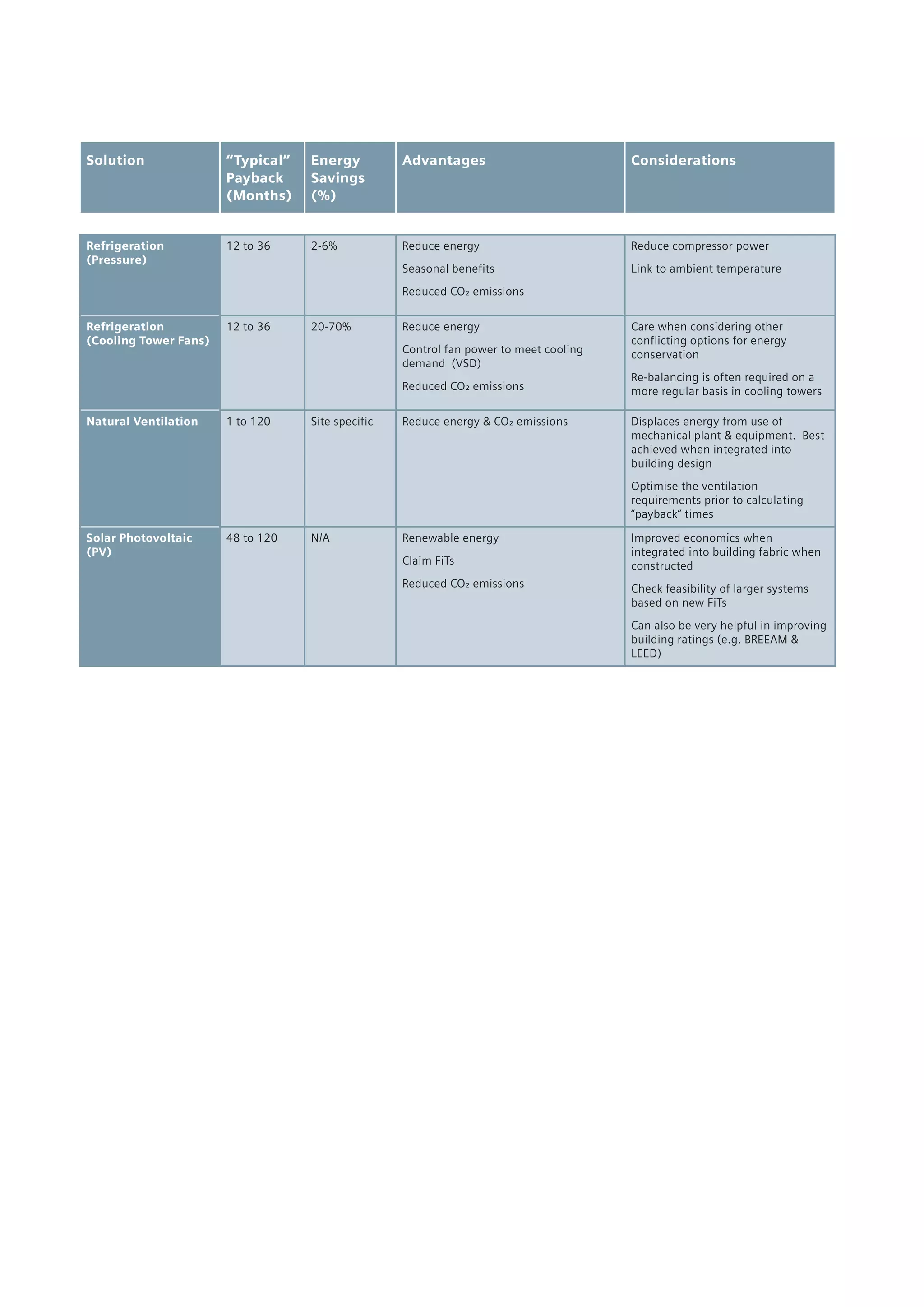
Refrigeration
(Pressure)	
	
	
12 to 36 2-6% Reduce energy
Seasonal benefits
Reduced CO₂ emissions
Reduce compressor power
Link to ambient temperature
Refrigeration
(Cooling Tower Fans)	
	
	
12 to 36 20-70% Reduce energy
Control fan power to meet cooling
demand (VSD)
Reduced CO₂ emissions
Care when considering other
conflicting options for energy
conservation
Re-balancing is often required on a
more regular basis in cooling towers
Natural Ventilation	
	
1 to 120 Site specific Reduce energy & CO₂ emissions Displaces energy from use of
mechanical plant & equipment. Best
achieved when integrated into
building design
Optimise the ventilation
requirements prior to calculating
“payback” times
Solar Photovoltaic
(PV)	
	
	
48 to 120 N/A Renewable energy
Claim FiTs
Reduced CO₂ emissions
Improved economics when
integrated into building fabric when
constructed
Check feasibility of larger systems
based on new FiTs
Can also be very helpful in improving
building ratings (e.g. BREEAM &
LEED)
Energy efficiency   where to invest

Energy efficiency where to invest

  • 3.
    Solution “Typical” Payback (Months) Energy Savings (%) Advantages Considerations Automatic Monitoringand Targetting (aM&T) 3 to 12 3 - 10% of total utility use Highly useful for effective energy management Critical information for employee engagement programmes Can identify low, medium, high cost opportunities for energy and utility consumption Can identify exceptional consumptions immediately High quality performance reporting Need to consider means for collecting data Essential to have appropriate reporting and processes Level of sophistication tailored to energy spend Resource support considerations High efficiency motors 3 to 12 2 - 5% Improved intrinsic efficiency Direct replacements for standard motors Implement as part of a motor management programme Efficiency level IE2 is mandatory from June 11 Not necessary for very light duty applications (say less than 1000 hours per year) May not be suitable for high torque applications - e.g. Crushers in the aggregates industry Appropriate alignment (laser) should be considered for direct drive applications Variable Speed drives 3 to 12 20-70% Smoother control of process - reduced maintenance and improved reliability Controlled starting and stopping Longer system life Different level of savings for Variable Torque and Constant Torque applications Ensure that the motors are suitable for VSD operation - esp. old or cheap motors May not be able to reduce the speed greatly if high constant head pressure is required Correct installation and maintenance is important Lighting LED’s 1 to 12 70% Higher lumens / Watt Consideration must be given to the environment in which lamps are being fitted Colour rendition qualities need to be considered (Metal Halide) High Frequency fittings 12 to 36 10-30% Integrate controls Dimmable Maximum savings available where daylight savings to be made (T5 Fluorescent) 12 to 36 10-50% Dimmable Integrate controls Higher number of fittings may be required if retrofitting existing Fluorescent lamp installation High Frequency adapters 12 to 36 20-50% Reduced installation requirements Energy savings similar to high frequency fittings Maintenance May not be possible to retrofit to older fittings Controls [including constant light control with DALI,KNX etc] 12 to 48 30% Improved control of lighting Reduced ‘lighting pollution’ Extend lamp life A number of light fittings will not be compatible with controls Consideration should be given to integrating lighting control to local environment / process control Enhanced Automation Systems 12 to 48 2 -10% Operational efficiency improvements Less labour intensive Quality of product - consistent Integrate data collection and energy management functions into existing automation systems
  • 4.
    Solution “Typical” Payback (Months) Energy Savings (%) Advantages Considerations VoltageOptimisation 24 to 60 3-8% (Can be higher in special cases) Reduce energy consumption by providing the optimium voltage (most sites have an ‘over’ voltage condition) Can improve reliability of equipment - reduce failures and maintenance Can integrate other power quality measures such as harmonics Similar benefits may be achieved through ‘tapping down transformers’. Sometimes the benefits are “oversold” A power survey should be carried out in order to evaluate benefits Consider full installation costs and impact Savings depend on the mix of loads in the facility so it needs careful consideration Combined Heat & Power 36 to 84 80-90% Reduced CO₂ emissions through high overall system efficiency typically 80-90% for reciprocating prime mover Cooling with tri-generation Reduce ‘supply’ risk Unit needs to be sized so that the majority of heat can be used Consider environmental impact of the CHP systems - noise, pollution, access etc Use of Absorption chillers. Economics subject to using heat that would otherwise be rejected. Ensure Availability of skills needed for maintenance of tri-generation systems Consideration needs to be given to the fuel source (renewable?) and type of CHP used taking into account Heat:Power ratio Anaerobic Digestion 36 to 60 80-90% Reduce chemical oxygen demand (COD) and therefore effluent charges Pass gases through CHP set Reduce costs associated with disposing of organic waste Reduce site CO₂ emissions Effluent strength, quality and amount of “feedstock” materials need to be sufficient to maintain production of gases Treatment of gases maybe required prior to use in CHP set Environmental planning and regulation Dependent of ROCs / FIT Power Management Controls 12 to 48 Costs savings mainly derived via tariff power factor correction charge offset Reduce costs - e.g. tariff management Improve power quality Reduce energy demand Benefits will depend upon the tariff charges from the supplier Can improve system reliability Higher power factor and lower harmonics reduce kWh consumption Building Management System 3 to 48 15-25% Improve plant control (AHUs, Chillers etc) Improves the comfort and flexibility of the facility Consider integrating into process control systems Building Controls 3 to 48 15-25% Improve plant control (local level) Possibility of intelligent building automation Enhanced building comfort and flexibility Consider integrating into building systems Correct installation and maintenance is important Use BMS as the energy management system High efficiency fans 36 to 84 20% Improved intrinsic efficiency Consider as part of larger project (VSD) as the payback will be significantly shorter HVAC (Filters) 3 to 24 10-25% Reduce pressure drop across filters Reduce fan power for same volume (VSD) Greater savings realised when installed in system fitted with VSD
  • 5.
    Solution “Typical” Payback (Months) Energy Savings (%) Advantages Considerations HVAC(Free Cooling) 1 to 24 up to 75% of cooling requirement Free Cooling can displace use of refrigeration plant Reduce CO₂ emissions Where displaces use of cooling systems Compressed Air (VSD) 3 to 24 10-35% Increased efficiency kW/cfm at part loads Particularly suitable for sites with varying demand Base load should be managed by fixed speed compressors Compressed Air (Pressure) 0 to 24 3-12% Reduce the power demand kW/cfm Reduce the power demand kW/cfm Pressure should be reduced gradually to ensure that there are no adverse effects on production Compressed air (leaks) 0 to 12 10-30% Reduce demand Reduce base load Best approach is to aim to reduce 80% of leaks Survey plant monthly Wind Power 72 to 120 N/A Renewable energy Claim ROC’s & FiTs Reduce CO₂ emissions Planning in built up areas is expensive and can be difficult Small scale wind may struggle with payback once maintenance is included Large scale is more economic Ground Source Heat Pumps (GSHP) 36 to 84 N/A Renewable energy Reduced CO₂ emissions Claim RHI Heat obtained is low grade and therefore usually only suitable for under floor heating. Buildings should be thermally efficient to minimise space heating load Air Source Heat Pumps (ASHP) 36 to 84 N/A Renewable energy Reduced CO₂ emissions Claim RHI Integrating into existing heating systems may be difficult Solar Thermal 12 to 36 N/A Renewable energy Reduced CO₂ emissions Claim RHI Provides domestic hot water, although could be integrated into a space heating system Boilers (Combustion Efficiency) 3 to 12 2-45% Optimise Efficiency, Reduce primary energy Reduced CO₂ emissions Ensure correct burner setup Boilers (Steam raising efficiency) 1 to 12 3-30% Reduce energy Reduced CO₂ emissions Reduce water use through optimised water treatment Consider optimising boiler heat exchange, inc cleaning & use of economisers, boiler load control Leak and steam trap assessment Reducing blowdown Biomass 36 to 84 N/A Renewable energy Reduced CO₂ emissions Claim RHI Fuel type, storage space and delivery are important considerations Refrigeration (COSP) 3 to 18 10-45% Reduce energy Increased efficiency - kWh cooling/kWh electrical input Reduced CO₂ emissions Reduce pump power using VSD’s
  • 6.
    Solution “Typical” Payback (Months) Energy Savings (%) Advantages Considerations Refrigeration (Pressure) 12to 36 2-6% Reduce energy Seasonal benefits Reduced CO₂ emissions Reduce compressor power Link to ambient temperature Refrigeration (Cooling Tower Fans) 12 to 36 20-70% Reduce energy Control fan power to meet cooling demand (VSD) Reduced CO₂ emissions Care when considering other conflicting options for energy conservation Re-balancing is often required on a more regular basis in cooling towers Natural Ventilation 1 to 120 Site specific Reduce energy & CO₂ emissions Displaces energy from use of mechanical plant & equipment. Best achieved when integrated into building design Optimise the ventilation requirements prior to calculating “payback” times Solar Photovoltaic (PV) 48 to 120 N/A Renewable energy Claim FiTs Reduced CO₂ emissions Improved economics when integrated into building fabric when constructed Check feasibility of larger systems based on new FiTs Can also be very helpful in improving building ratings (e.g. BREEAM & LEED)