FACTORS
INFLUENCING THE
USAGE OF DIGITAL
MOBILE WALLET IN
NEPAL
MBA APR presentation by
Rabindra Aryal
APR supervisor – Bikash Shrestha
4th July 2021
Contents
Motivation
Objective
Study framewrork
Hypothesis of study
Research methods
Findings
Conclusion
Implications
Motivation
Increasing number of
smartphone users in Nepal, and many
of them adopting e services for
financial transaction.
Growing number of digital wallet
service providers In Nepal needs
information on users adaptation
behavior.
Increasing user base of Digital wallet
users & increasing supportive
platforms to widely use digital wallet.
Objective
To explore the purpose of usage of digital wallet
among users.
To analyze the differences in perception of the
performance expectancy, effort expectancy, social
influence & facilitating conditions across age
groups.
To examine the relationship of performance
expectancy, effort expectancy, social influence &
facilitating condition with behavioral intention to
use.
To identify the impact of performance expectancy,
effort expectancy, social influence, facilitating
conditions on behavioral intention to use for digital
mobile services.
Study Framework
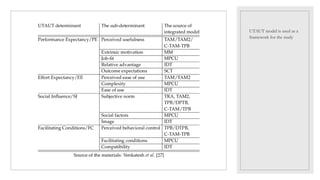
UTAUT model is used as a
framework for the study
Hypothesis of study
1. H01. There is no significant mean difference on the perception of performance expectancy across below or equal to 30 &
above 30.
2. H02. There is no significant mean difference on the perception of effort expectancy across below or equal to 30 & above
30.
3. H03. There is no significant mean difference on the perception of social influence across below or equal to 30 & above 30.
4. H04. There is no significant mean difference on the perception of facilitating condition across below or equal to 30 &
above 30.
5. H05. There is no significant relationship of performance expectancy with user's behavioral intention to use digital wallet.
6. H06. There is no significant relationship of effort expectancy with user's behavioral intention to use digital wallet.
7. H07. There is no significant relationship of social influence with user's behavioral intention to use digital wallet.
8. H08. There is no significant relationship of facilitating condition with user's behavioral intention to use digital wallet.
9. H09. There is no significant impact of effort expectancy on user's behavioral intention to use digital wallet.
10.H10. There is no significant impact of performance expectancy on user's behavioral intention to use digital wallet.
11.H11. There is no significant impact of social influence on user's behavioral intention to use digital wallet.
12.H12. There is no significant impact of facilitating condition on user's behavioral intention to use digital wallet.
Population and
sample of the
study
The population used in the study are the entire
population of Nepal
The people who are internet users and above the age
of 18 are within Nepal were considered as sample.
Convenience sampling was used to select
participants because of accessibility as ease.
KMO test returned the value of 0.948 and according
to the rule of thumb for interpreting the statistic the
sampling is adequate for the study.
Nature and
source of data
A total of 161 questionnaires were acquired by asking
respondents to participate in an online survey .
The questionnaires of various formats like Likert scale, multiple-
choice, single choice and open-ended questions were used
The study applied a structured questionnaire, based on the original
work of Venkatesh et al. (2003). Constructs and Corresponding
Items for questionnaires were based on the study of Abrahão et al.
(2016) and Patil et al. (2020).
To test the reliability of questioners Cronbach's Alpha was examined
of each construct.
The Validity of the questionnaire was examined under Convergent
validity using Pearson's Correlation Coefficient
Method of data
analysis
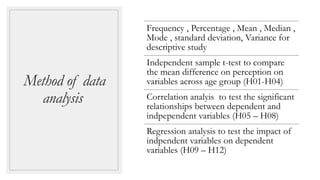
Frequency , Percentage , Mean , Median ,
Mode , standard deviation, Variance for
descriptive study
Independent sample t-test to compare
the mean difference on perception on
variables across age group (H01-H04)
Correlation analyis to test the significant
relationships between dependent and
indpependent variables (H05 – H08)
Regression analysis to test the impact of
indpendent variables on dependent
variables (H09 – H12)
Findings –
purpose of use
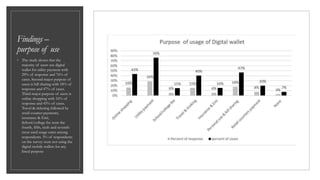
◦ The study shows that the
majority of users use digital
wallet for utility payment with
29% of response and 76% of
cases. Second major purpose of
users is bill sharing with 18% of
response and 47% of cases.
Third major purpose of users is
online shopping with 16% of
response and 43% of cases.
Travel & ticketing followed by
retail counter payments,
insurance & Emi,
School/college fee were the
fourth, fifth, sixth and seventh-
most used usage cases among
respondents. 3% of respondents
on the survey were not using the
digital mobile wallets for any
listed purpose
Finding – difference in perception across age
group
Differences in perception of the performance expectancy, effort expectancy,
social influence & facilitating conditions across age groups were not found hence
accepting H01-H04. Independent sample t-test was used to study the difference.
The result contradicts with previous studies.
Findings – Relationship
The relationship of performance expectancy, effort expectancy, social influence
& facilitating condition with behavioral intention to use is significant and
positive. Correlation analysis was used to study the relationship. The hypothesis
H05 – H08 rejected. The result is consistent with the previous studies on the
topic
Findings – Impact
• The impact of performance expectancy and social influence, on behavioral intention to
use for digital mobile wallets found positive and significant. Hence rejecting H10 and H11.
• The impact of Effort expectancy and facilitating conditions , on behavioral intention to
use for digital mobile wallets found positive but insignificant hence accepting H09 and
H12.
• The Regression analysis was used to test the impact among variables. The result
contradicts with the previous study
• R2 equals 59.8 percent which shows a 59.8 percent variation in behavioral intention to use
is due to performance expectancy, effort expectancy, social influence and facilitating
condition.
Conclusion
◦ The perception on performance expectancy, effort expectancy , social influence and
facilitating conditions across age group was same, hence the users of both age groups do have
similar perception on determinants of behavioral intention to use of digital wallet.
◦ The relationship of performance expectancy, effort expectancy , social influence and
facilitating conditions with behavioral intention to use is positive and significant proving that
determinants are clearly related with use behaviors.
◦ The impact of performance expectancy and social influence on use behavior is clearly observed
while other 2 determinants Effort expectancy and facilitating conditions was positive but the
significant impact was not observed.
◦ The results of overall study was different and contradicts with majority of the study on the
topic previously.
Practical Implications
◦ The study will help Digital mobile wallets service providers to identify the
relation & impact of performance expectancy, effort expectancy , social
influence and facilitating conditions with behavior intention to review the
marketing plan and include the campaign to increase the social influence and
performance expectancy to gain more users on digital wallet.
◦ The finding of the study will guide the researcher and professional of related
field in improving and promoting digital mobile wallet usage as well to study
further on topic.

MBA thesis presentation Nepal open university

  • 1.
    FACTORS INFLUENCING THE USAGE OFDIGITAL MOBILE WALLET IN NEPAL MBA APR presentation by Rabindra Aryal APR supervisor – Bikash Shrestha 4th July 2021
  • 2.
    Contents Motivation Objective Study framewrork Hypothesis ofstudy Research methods Findings Conclusion Implications
  • 3.
    Motivation Increasing number of smartphoneusers in Nepal, and many of them adopting e services for financial transaction. Growing number of digital wallet service providers In Nepal needs information on users adaptation behavior. Increasing user base of Digital wallet users & increasing supportive platforms to widely use digital wallet.
  • 4.
    Objective To explore thepurpose of usage of digital wallet among users. To analyze the differences in perception of the performance expectancy, effort expectancy, social influence & facilitating conditions across age groups. To examine the relationship of performance expectancy, effort expectancy, social influence & facilitating condition with behavioral intention to use. To identify the impact of performance expectancy, effort expectancy, social influence, facilitating conditions on behavioral intention to use for digital mobile services.
  • 5.
  • 6.
    UTAUT model isused as a framework for the study
  • 7.
    Hypothesis of study 1.H01. There is no significant mean difference on the perception of performance expectancy across below or equal to 30 & above 30. 2. H02. There is no significant mean difference on the perception of effort expectancy across below or equal to 30 & above 30. 3. H03. There is no significant mean difference on the perception of social influence across below or equal to 30 & above 30. 4. H04. There is no significant mean difference on the perception of facilitating condition across below or equal to 30 & above 30. 5. H05. There is no significant relationship of performance expectancy with user's behavioral intention to use digital wallet. 6. H06. There is no significant relationship of effort expectancy with user's behavioral intention to use digital wallet. 7. H07. There is no significant relationship of social influence with user's behavioral intention to use digital wallet. 8. H08. There is no significant relationship of facilitating condition with user's behavioral intention to use digital wallet. 9. H09. There is no significant impact of effort expectancy on user's behavioral intention to use digital wallet. 10.H10. There is no significant impact of performance expectancy on user's behavioral intention to use digital wallet. 11.H11. There is no significant impact of social influence on user's behavioral intention to use digital wallet. 12.H12. There is no significant impact of facilitating condition on user's behavioral intention to use digital wallet.
  • 8.
    Population and sample ofthe study The population used in the study are the entire population of Nepal The people who are internet users and above the age of 18 are within Nepal were considered as sample. Convenience sampling was used to select participants because of accessibility as ease. KMO test returned the value of 0.948 and according to the rule of thumb for interpreting the statistic the sampling is adequate for the study.
  • 9.
    Nature and source ofdata A total of 161 questionnaires were acquired by asking respondents to participate in an online survey . The questionnaires of various formats like Likert scale, multiple- choice, single choice and open-ended questions were used The study applied a structured questionnaire, based on the original work of Venkatesh et al. (2003). Constructs and Corresponding Items for questionnaires were based on the study of Abrahão et al. (2016) and Patil et al. (2020). To test the reliability of questioners Cronbach's Alpha was examined of each construct. The Validity of the questionnaire was examined under Convergent validity using Pearson's Correlation Coefficient
  • 10.
    Method of data analysis Frequency, Percentage , Mean , Median , Mode , standard deviation, Variance for descriptive study Independent sample t-test to compare the mean difference on perception on variables across age group (H01-H04) Correlation analyis to test the significant relationships between dependent and indpependent variables (H05 – H08) Regression analysis to test the impact of indpendent variables on dependent variables (H09 – H12)
  • 11.
    Findings – purpose ofuse ◦ The study shows that the majority of users use digital wallet for utility payment with 29% of response and 76% of cases. Second major purpose of users is bill sharing with 18% of response and 47% of cases. Third major purpose of users is online shopping with 16% of response and 43% of cases. Travel & ticketing followed by retail counter payments, insurance & Emi, School/college fee were the fourth, fifth, sixth and seventh- most used usage cases among respondents. 3% of respondents on the survey were not using the digital mobile wallets for any listed purpose
  • 12.
    Finding – differencein perception across age group Differences in perception of the performance expectancy, effort expectancy, social influence & facilitating conditions across age groups were not found hence accepting H01-H04. Independent sample t-test was used to study the difference. The result contradicts with previous studies.
  • 13.
    Findings – Relationship Therelationship of performance expectancy, effort expectancy, social influence & facilitating condition with behavioral intention to use is significant and positive. Correlation analysis was used to study the relationship. The hypothesis H05 – H08 rejected. The result is consistent with the previous studies on the topic
  • 14.
    Findings – Impact •The impact of performance expectancy and social influence, on behavioral intention to use for digital mobile wallets found positive and significant. Hence rejecting H10 and H11. • The impact of Effort expectancy and facilitating conditions , on behavioral intention to use for digital mobile wallets found positive but insignificant hence accepting H09 and H12. • The Regression analysis was used to test the impact among variables. The result contradicts with the previous study • R2 equals 59.8 percent which shows a 59.8 percent variation in behavioral intention to use is due to performance expectancy, effort expectancy, social influence and facilitating condition.
  • 15.
    Conclusion ◦ The perceptionon performance expectancy, effort expectancy , social influence and facilitating conditions across age group was same, hence the users of both age groups do have similar perception on determinants of behavioral intention to use of digital wallet. ◦ The relationship of performance expectancy, effort expectancy , social influence and facilitating conditions with behavioral intention to use is positive and significant proving that determinants are clearly related with use behaviors. ◦ The impact of performance expectancy and social influence on use behavior is clearly observed while other 2 determinants Effort expectancy and facilitating conditions was positive but the significant impact was not observed. ◦ The results of overall study was different and contradicts with majority of the study on the topic previously.
  • 16.
    Practical Implications ◦ Thestudy will help Digital mobile wallets service providers to identify the relation & impact of performance expectancy, effort expectancy , social influence and facilitating conditions with behavior intention to review the marketing plan and include the campaign to increase the social influence and performance expectancy to gain more users on digital wallet. ◦ The finding of the study will guide the researcher and professional of related field in improving and promoting digital mobile wallet usage as well to study further on topic.