Anurag Sinha : 2023008
Darsh Patel : 2023016
Haily Shah : 2023024
Harsh Dave : 2023025
Kanish Vaghela : 2023032
Manishkumar Dohre : 2023040
Submitted By : Group – 8 | Section - A
Parth Gajjar : 2023048
Ronakdeep Bhatia : 2023056
Smitkumar Parmar : 2023064
Vedant Kansara : 2023072
Organizational Theory and Design (OB-503)
NIFTY-FIFTY COMPANIES & CASE STUDIES
Submitted To : Prof. Shubhasheesh Bhattacharya
List of Companies
Nifty Fifty Companies :
• Hero Moto Cop
• Reliance Industrial Limited
Case Studies explaining Organizational Decision Making
• Nokia
• Flipkart - Myntra
• JSAW
• REPL
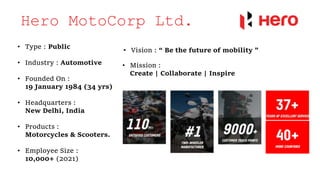
Hero MotoCorp Ltd.
• Type : Public
• Industry : Automotive
• Founded On :
19 January 1984 (34 yrs)
• Headquarters :
New Delhi, India
• Products :
Motorcycles & Scooters.
• Employee Size :
10,000+ (2021)
• Vision : “ Be the future of mobility ”
• Mission :
Create | Collaborate | Inspire
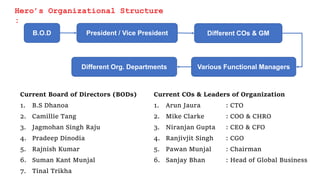
Hero’s Organizational Structure
:
Current Board of Directors (BODs)
1. B.S Dhanoa
2. Camillie Tang
3. Jagmohan Singh Raju
4. Pradeep Dinodia
5. Rajnish Kumar
6. Suman Kant Munjal
7. Tinal Trikha
Current COs & Leaders of Organization
1. Arun Jaura : CTO
2. Mike Clarke : COO & CHRO
3. Niranjan Gupta : CEO & CFO
4. Ranjivjit Singh : CGO
5. Pawan Munjal : Chairman
6. Sanjay Bhan : Head of Global Business
B.O.D President / Vice President Different COs & GM
Various Functional Managers
Different Org. Departments
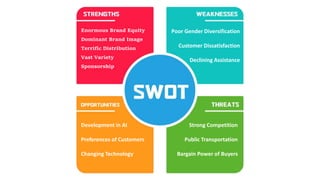
Enormous Brand Equity
Dominant Brand Image
Terrific Distribution
Vast Variety
Sponsorship
Poor Gender Diversification
Customer Dissatisfaction
Declining Assistance
Development in AI
Preferences of Customers
Changing Technology
Strong Competition
Public Transportation
Bargain Power of Buyers
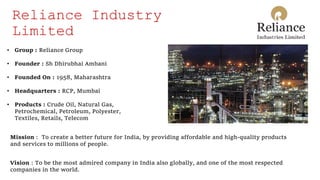
Reliance Industry
Limited
Mission : To create a better future for India, by providing affordable and high-quality products
and services to millions of people.
Vision : To be the most admired company in India also globally, and one of the most respected
companies in the world.
• Group : Reliance Group
• Founder : Sh Dhirubhai Ambani
• Founded On : 1958, Maharashtra
• Headquarters : RCP, Mumbai
• Products : Crude Oil, Natural Gas,
Petrochemical, Petroleum, Polyester,
Textiles, Retails, Telecom
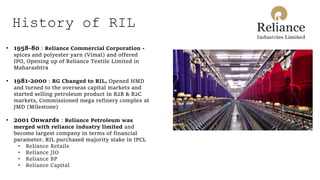
History of RIL
• 1958-80 : Reliance Commercial Corporation -
spices and polyester yarn (Vimal) and offered
IPO, Opening up of Reliance Textile Limited in
Maharashtra
• 1981-2000 : RG Changed to RIL, Opened HMD
and turned to the overseas capital markets and
started selling petroleum product in B2B & B2C
markets, Commissioned mega refinery complex at
JMD (Milestone)
• 2001 Onwards : Reliance Petroleum was
merged with reliance industry limited and
become largest company in terms of financial
parameter. RIL purchased majority stake in IPCL
• Reliance Retails
• Reliance JIO
• Reliance BP
• Reliance Capital
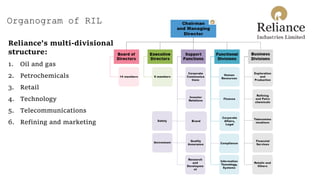
Organogram of RIL
Reliance’s multi-divisional
structure:
1. Oil and gas
2. Petrochemicals
3. Retail
4. Technology
5. Telecommunications
6. Refining and marketing
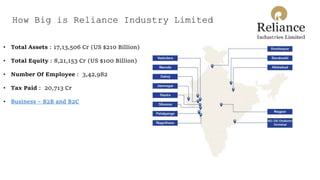
How Big is Reliance Industry Limited
• Total Assets : 17,13,506 Cr (US $210 Billion)
• Total Equity : 8,21,153 Cr (US $100 Billion)
• Number Of Employee : 3,42,982
• Tax Paid : 20,713 Cr
• Business – B2B and B2C
Case Study – 1 : NOKIA
• Nokia Corp (Nokia) is a communications and information technology company.
• Between 1996 - 2001, Nokia’s turnover increased fivefold, from €6.5 billion to €31 billion.
• Nokia was operating almost in 140 countries with more than 55000 employees. It was the
golden time of Nokia.
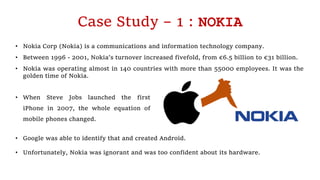
• When Steve Jobs launched the first
iPhone in 2007, the whole equation of
mobile phones changed.
• Google was able to identify that and created Android.
• Unfortunately, Nokia was ignorant and was too confident about its hardware.
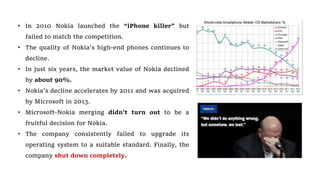
• In 2010 Nokia launched the “iPhone killer” but
failed to match the competition.
• The quality of Nokia's high-end phones continues to
decline.
• In just six years, the market value of Nokia declined
by about 90%.
• Nokia's decline accelerates by 2011 and was acquired
by Microsoft in 2013.
• Microsoft-Nokia merging didn’t turn out to be a
fruitful decision for Nokia.
• The company consistently failed to upgrade its
operating system to a suitable standard. Finally, the
company shut down completely.
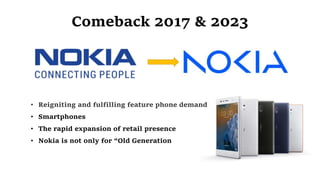
Comeback 2017 & 2023
• Reigniting and fulfilling feature phone demand
• Smartphones
• The rapid expansion of retail presence
• Nokia is not only for “Old Generation
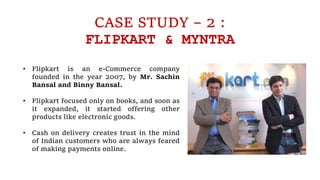
CASE STUDY – 2 :
FLIPKART & MYNTRA
• Flipkart is an e-Commerce company
founded in the year 2007, by Mr. Sachin
Bansal and Binny Bansal.
• Flipkart focused only on books, and soon as
it expanded, it started offering other
products like electronic goods.
• Cash on delivery creates trust in the mind
of Indian customers who are always feared
of making payments online.
• The merger happened in 2014 & with this allowed Flipkart to venture into
the fashion space.
• 9000+ pin codes that cover more than 100 cities.
• Myntra lost money : A controversial App-only decision, and excessive focus
on private-label brands.
• Myntra revenue rises 45% to Rs 3,501 crore, losses widen 40% (2022).
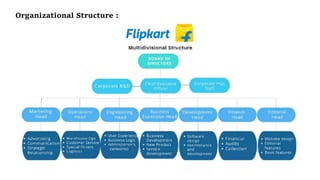
• Flipkart grew from a hierarchically flat start-up to a Matrix structure.
• Myntra was very successful in the fashion industry and due to its
competitive edge over Amazon.
• The acquisition of Myntra made Flipkart a leader in the fashion industry.
Organizational Structure :
CASE STUDY – 3 :
JINDAL SAW LTD GROUP
• JSW has been in business with Jindal Saw Ltd. (JSAW) for a very long
time. Currently, JSAW has put JSW in a fix, as they want raw materials
urgently.
• Kumar, the senior customer relationship manager, has 2 options for mode
of transportation to choose from: rakes (rail route), which is faster but
expensive, and barges (sea route) which is slower but cheaper, almost
22% lesser cost than rakes.
• The cost is not a priority for Kumar, he is more interested in maintaining
the relationship with JSAW by providing them with the goods in order to
keep the production running.
• The availability of rakes cannot be confirmed until the next day, i.e. 24
hours, while the availability of barges can be confirmed quickly, the
barges are an entirely new avenue for JSW, while they are comfortable
and competent with rakes as their medium of transportation.
• Also, the port is nearer to the JSAW's manufacturing unit than the
railway station, which would decrease the time of transportation
marginally.
• According to our consensus, JSW should confirm the availability of
barges, and send the raw materials immediately.
• On the other hand, if they don't get the availability of barges, they have
no other option than to wait for the confirmation on rakes.
• Reason being barged would be giving confirmation immediately, hence
quick decisions can be taken regarding mode of transportation.
• And all the needful can be done regarding the supply.
• Talking about the relationship between both companies, even though
JSW fails to supply the goods in due time it won’t affect the relationship
between both companies.
• Assuming the JSAW company would be competent enough to understand
the situation and support JSW for the same.
CASE STUDY – 4 :
RAJWANT ENGINEERING LTD.
THE Ethical Dilemma……
• Rajwant Engg Ltd (REPL), a small-scale
company owned by H.S. Sokhi, was in
business with ClientCo, for around 2 decades.
• ClientCo's new procurement manager, R.K.
Gupta, met with Sokhi and asked him to
either give huge discounts to ClientCo or
give him a bribe so that the association can
continue.
• This is where REPL faces an ethical dilemma,
if they give in to Gupta's demands, they would
face dire financial crises, leading to employee
layoffs and retrenchment. Or else they would
have to face legal actions if the contract is not
honored.
• Business runs on ethics and goodwill, the image of the company depends on
how the company has its relations with its customer.
• REPL should give discounts to ClientCo, this would solve the situation in both
ways, breach of contract won’t happen and even they would survive the current
market situation, eliminating the option of dissolving of the firm.
• Alongside they should start looking for new customers so that they can shift to
the new customers and sever ties with ClientCo.
• This will help them distribute their overall business into smaller percentages.
This would eventually reduce the risk of facing such problems in the future for
the company.
Our Solution
Thank you

MBA Case Study Presentation Organization Theory & Decision - Parth Gajjar

  • 1.
    Anurag Sinha :2023008 Darsh Patel : 2023016 Haily Shah : 2023024 Harsh Dave : 2023025 Kanish Vaghela : 2023032 Manishkumar Dohre : 2023040 Submitted By : Group – 8 | Section - A Parth Gajjar : 2023048 Ronakdeep Bhatia : 2023056 Smitkumar Parmar : 2023064 Vedant Kansara : 2023072 Organizational Theory and Design (OB-503) NIFTY-FIFTY COMPANIES & CASE STUDIES Submitted To : Prof. Shubhasheesh Bhattacharya
  • 2.
    List of Companies NiftyFifty Companies : • Hero Moto Cop • Reliance Industrial Limited Case Studies explaining Organizational Decision Making • Nokia • Flipkart - Myntra • JSAW • REPL
  • 3.
    Hero MotoCorp Ltd. •Type : Public • Industry : Automotive • Founded On : 19 January 1984 (34 yrs) • Headquarters : New Delhi, India • Products : Motorcycles & Scooters. • Employee Size : 10,000+ (2021) • Vision : “ Be the future of mobility ” • Mission : Create | Collaborate | Inspire
  • 4.
    Hero’s Organizational Structure : CurrentBoard of Directors (BODs) 1. B.S Dhanoa 2. Camillie Tang 3. Jagmohan Singh Raju 4. Pradeep Dinodia 5. Rajnish Kumar 6. Suman Kant Munjal 7. Tinal Trikha Current COs & Leaders of Organization 1. Arun Jaura : CTO 2. Mike Clarke : COO & CHRO 3. Niranjan Gupta : CEO & CFO 4. Ranjivjit Singh : CGO 5. Pawan Munjal : Chairman 6. Sanjay Bhan : Head of Global Business B.O.D President / Vice President Different COs & GM Various Functional Managers Different Org. Departments
  • 5.
    Enormous Brand Equity DominantBrand Image Terrific Distribution Vast Variety Sponsorship Poor Gender Diversification Customer Dissatisfaction Declining Assistance Development in AI Preferences of Customers Changing Technology Strong Competition Public Transportation Bargain Power of Buyers
  • 6.
    Reliance Industry Limited Mission :To create a better future for India, by providing affordable and high-quality products and services to millions of people. Vision : To be the most admired company in India also globally, and one of the most respected companies in the world. • Group : Reliance Group • Founder : Sh Dhirubhai Ambani • Founded On : 1958, Maharashtra • Headquarters : RCP, Mumbai • Products : Crude Oil, Natural Gas, Petrochemical, Petroleum, Polyester, Textiles, Retails, Telecom
  • 7.
    History of RIL •1958-80 : Reliance Commercial Corporation - spices and polyester yarn (Vimal) and offered IPO, Opening up of Reliance Textile Limited in Maharashtra • 1981-2000 : RG Changed to RIL, Opened HMD and turned to the overseas capital markets and started selling petroleum product in B2B & B2C markets, Commissioned mega refinery complex at JMD (Milestone) • 2001 Onwards : Reliance Petroleum was merged with reliance industry limited and become largest company in terms of financial parameter. RIL purchased majority stake in IPCL • Reliance Retails • Reliance JIO • Reliance BP • Reliance Capital
  • 8.
    Organogram of RIL Reliance’smulti-divisional structure: 1. Oil and gas 2. Petrochemicals 3. Retail 4. Technology 5. Telecommunications 6. Refining and marketing
  • 9.
    How Big isReliance Industry Limited • Total Assets : 17,13,506 Cr (US $210 Billion) • Total Equity : 8,21,153 Cr (US $100 Billion) • Number Of Employee : 3,42,982 • Tax Paid : 20,713 Cr • Business – B2B and B2C
  • 10.
    Case Study –1 : NOKIA • Nokia Corp (Nokia) is a communications and information technology company. • Between 1996 - 2001, Nokia’s turnover increased fivefold, from €6.5 billion to €31 billion. • Nokia was operating almost in 140 countries with more than 55000 employees. It was the golden time of Nokia. • When Steve Jobs launched the first iPhone in 2007, the whole equation of mobile phones changed. • Google was able to identify that and created Android. • Unfortunately, Nokia was ignorant and was too confident about its hardware.
  • 11.
    • In 2010Nokia launched the “iPhone killer” but failed to match the competition. • The quality of Nokia's high-end phones continues to decline. • In just six years, the market value of Nokia declined by about 90%. • Nokia's decline accelerates by 2011 and was acquired by Microsoft in 2013. • Microsoft-Nokia merging didn’t turn out to be a fruitful decision for Nokia. • The company consistently failed to upgrade its operating system to a suitable standard. Finally, the company shut down completely.
  • 12.
    Comeback 2017 &2023 • Reigniting and fulfilling feature phone demand • Smartphones • The rapid expansion of retail presence • Nokia is not only for “Old Generation
  • 13.
    CASE STUDY –2 : FLIPKART & MYNTRA • Flipkart is an e-Commerce company founded in the year 2007, by Mr. Sachin Bansal and Binny Bansal. • Flipkart focused only on books, and soon as it expanded, it started offering other products like electronic goods. • Cash on delivery creates trust in the mind of Indian customers who are always feared of making payments online.
  • 14.
    • The mergerhappened in 2014 & with this allowed Flipkart to venture into the fashion space. • 9000+ pin codes that cover more than 100 cities. • Myntra lost money : A controversial App-only decision, and excessive focus on private-label brands. • Myntra revenue rises 45% to Rs 3,501 crore, losses widen 40% (2022). • Flipkart grew from a hierarchically flat start-up to a Matrix structure. • Myntra was very successful in the fashion industry and due to its competitive edge over Amazon. • The acquisition of Myntra made Flipkart a leader in the fashion industry.
  • 15.
  • 16.
    CASE STUDY –3 : JINDAL SAW LTD GROUP
  • 17.
    • JSW hasbeen in business with Jindal Saw Ltd. (JSAW) for a very long time. Currently, JSAW has put JSW in a fix, as they want raw materials urgently. • Kumar, the senior customer relationship manager, has 2 options for mode of transportation to choose from: rakes (rail route), which is faster but expensive, and barges (sea route) which is slower but cheaper, almost 22% lesser cost than rakes. • The cost is not a priority for Kumar, he is more interested in maintaining the relationship with JSAW by providing them with the goods in order to keep the production running. • The availability of rakes cannot be confirmed until the next day, i.e. 24 hours, while the availability of barges can be confirmed quickly, the barges are an entirely new avenue for JSW, while they are comfortable and competent with rakes as their medium of transportation.
  • 18.
    • Also, theport is nearer to the JSAW's manufacturing unit than the railway station, which would decrease the time of transportation marginally. • According to our consensus, JSW should confirm the availability of barges, and send the raw materials immediately. • On the other hand, if they don't get the availability of barges, they have no other option than to wait for the confirmation on rakes. • Reason being barged would be giving confirmation immediately, hence quick decisions can be taken regarding mode of transportation. • And all the needful can be done regarding the supply. • Talking about the relationship between both companies, even though JSW fails to supply the goods in due time it won’t affect the relationship between both companies. • Assuming the JSAW company would be competent enough to understand the situation and support JSW for the same.
  • 19.
    CASE STUDY –4 : RAJWANT ENGINEERING LTD.
  • 20.
    THE Ethical Dilemma…… •Rajwant Engg Ltd (REPL), a small-scale company owned by H.S. Sokhi, was in business with ClientCo, for around 2 decades. • ClientCo's new procurement manager, R.K. Gupta, met with Sokhi and asked him to either give huge discounts to ClientCo or give him a bribe so that the association can continue. • This is where REPL faces an ethical dilemma, if they give in to Gupta's demands, they would face dire financial crises, leading to employee layoffs and retrenchment. Or else they would have to face legal actions if the contract is not honored.
  • 22.
    • Business runson ethics and goodwill, the image of the company depends on how the company has its relations with its customer. • REPL should give discounts to ClientCo, this would solve the situation in both ways, breach of contract won’t happen and even they would survive the current market situation, eliminating the option of dissolving of the firm. • Alongside they should start looking for new customers so that they can shift to the new customers and sever ties with ClientCo. • This will help them distribute their overall business into smaller percentages. This would eventually reduce the risk of facing such problems in the future for the company. Our Solution
  • 23.