MBA Management Perspectives
Unit 2: Ethics, Governance and CSR

                          Session 4

                   Dr. Andrea Werner
                a.werner@mdx.ac.uk
Session overview

 Last three sessions:
   Stakeholder approach, CSR and related concepts
   Corporate Governance
   Ethical Theory


 Today: Managing individual and corporate
  values - Business Ethics Management


                                                     2
Business Ethics Management


“Business ethics management is the direct
  attempt [of companies] to formally or
  informally manage ethical issues or
  problems through specific policies,
  practices and programmes.” (Crane and
  Matten 2010:185)


                                            3
Why business ethics management?
   Corporate scandals
   Concern about reputation
   Part of risk management
   Compliance with regulation (especially US)
   Part of good corporate governance
     “It is important that all employees should know what standards of
      conduct are expected of them. We regard it as good practice for
      boards of directors to draw up codes of ethics or statements of
      business practice and to publish them both internally and
      externally.” (Cadbury Report, 1992)
 (mimetic behaviour)

                                                                          4
Components of business ethics
management
   Value and mission statement
   Code of ethics
   Reporting/Advice channels
   Ethics awareness raising and training
   Ethics managers / officers /board committees

 Risk management systems
 Stakeholder consultation, dialogue and partnership
  programmes
 Auditing, accounting, reporting

 Ethical culture

                                                       5
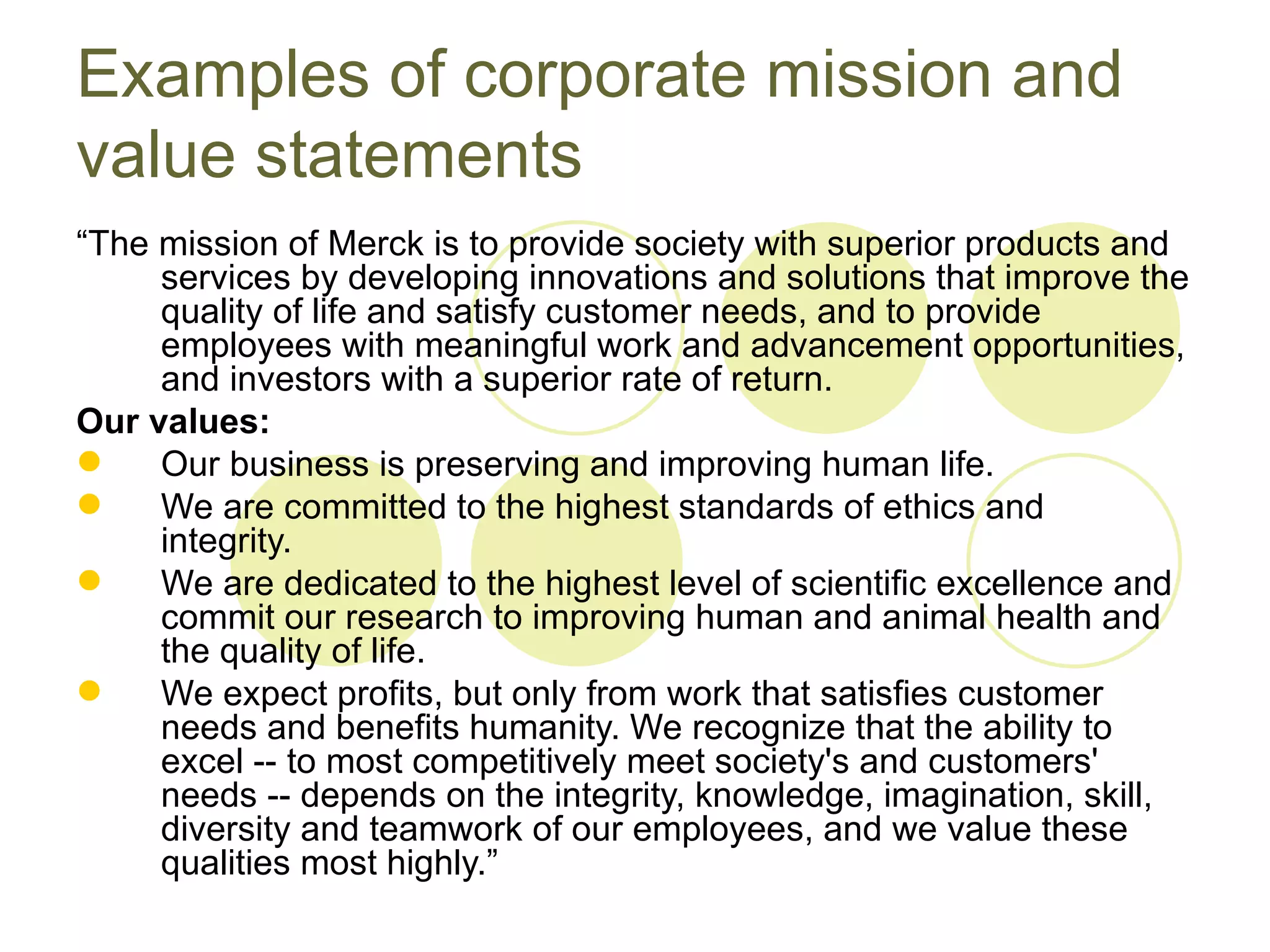
Examples of corporate mission and
value statements
“The mission of Merck is to provide society with superior products and
     services by developing innovations and solutions that improve the
     quality of life and satisfy customer needs, and to provide
     employees with meaningful work and advancement opportunities,
     and investors with a superior rate of return.
Our values:
    Our business is preserving and improving human life.
    We are committed to the highest standards of ethics and
     integrity.
    We are dedicated to the highest level of scientific excellence and
     commit our research to improving human and animal health and
     the quality of life.
    We expect profits, but only from work that satisfies customer
     needs and benefits humanity. We recognize that the ability to
     excel -- to most competitively meet society's and customers'
     needs -- depends on the integrity, knowledge, imagination, skill,
     diversity and teamwork of our employees, and we value these
     qualities most highly.”
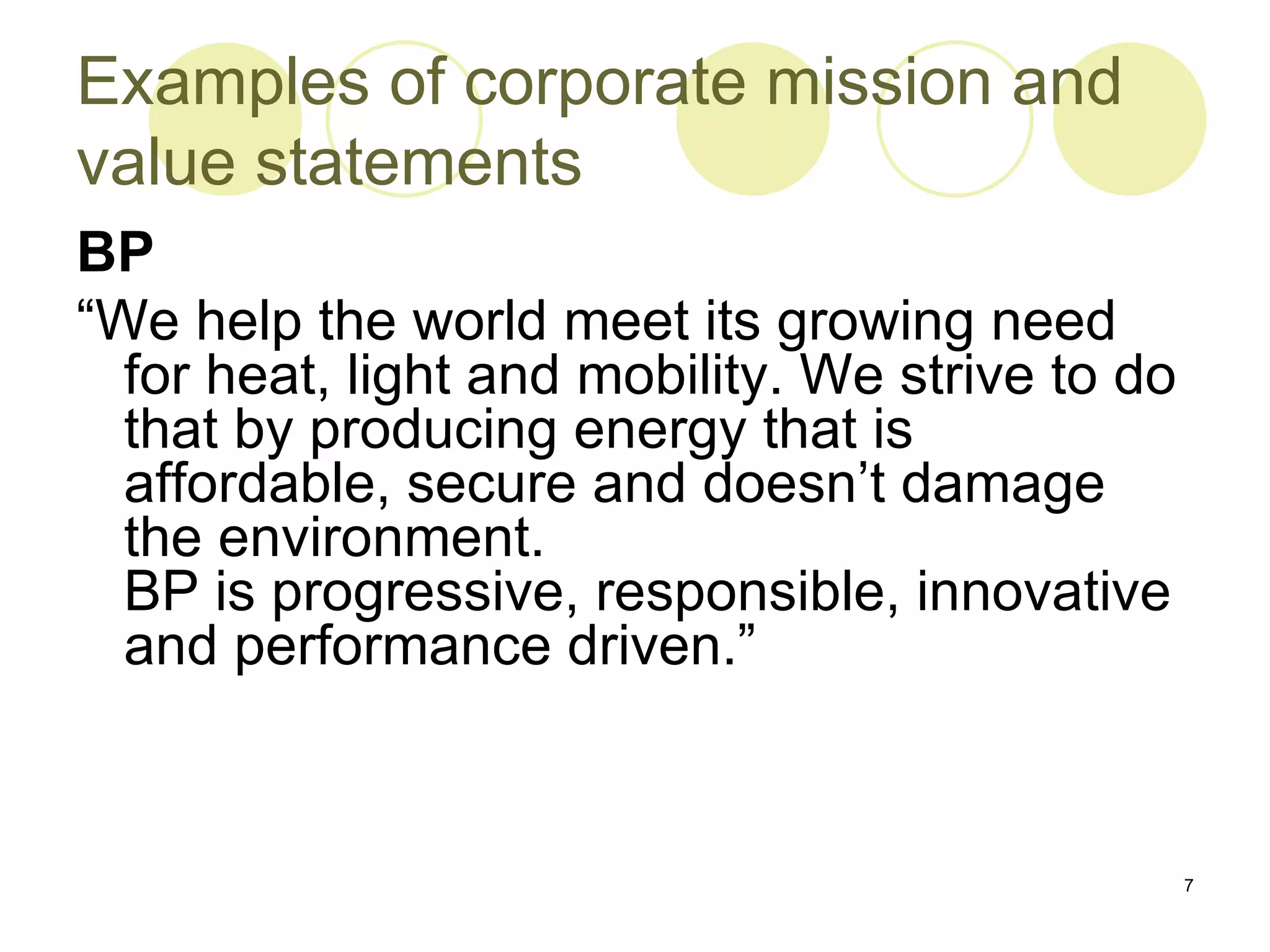
Examples of corporate mission and
value statements
BP
“We help the world meet its growing need
  for heat, light and mobility. We strive to do
  that by producing energy that is
  affordable, secure and doesn’t damage
  the environment.
  BP is progressive, responsible, innovative
  and performance driven.”


                                                  7
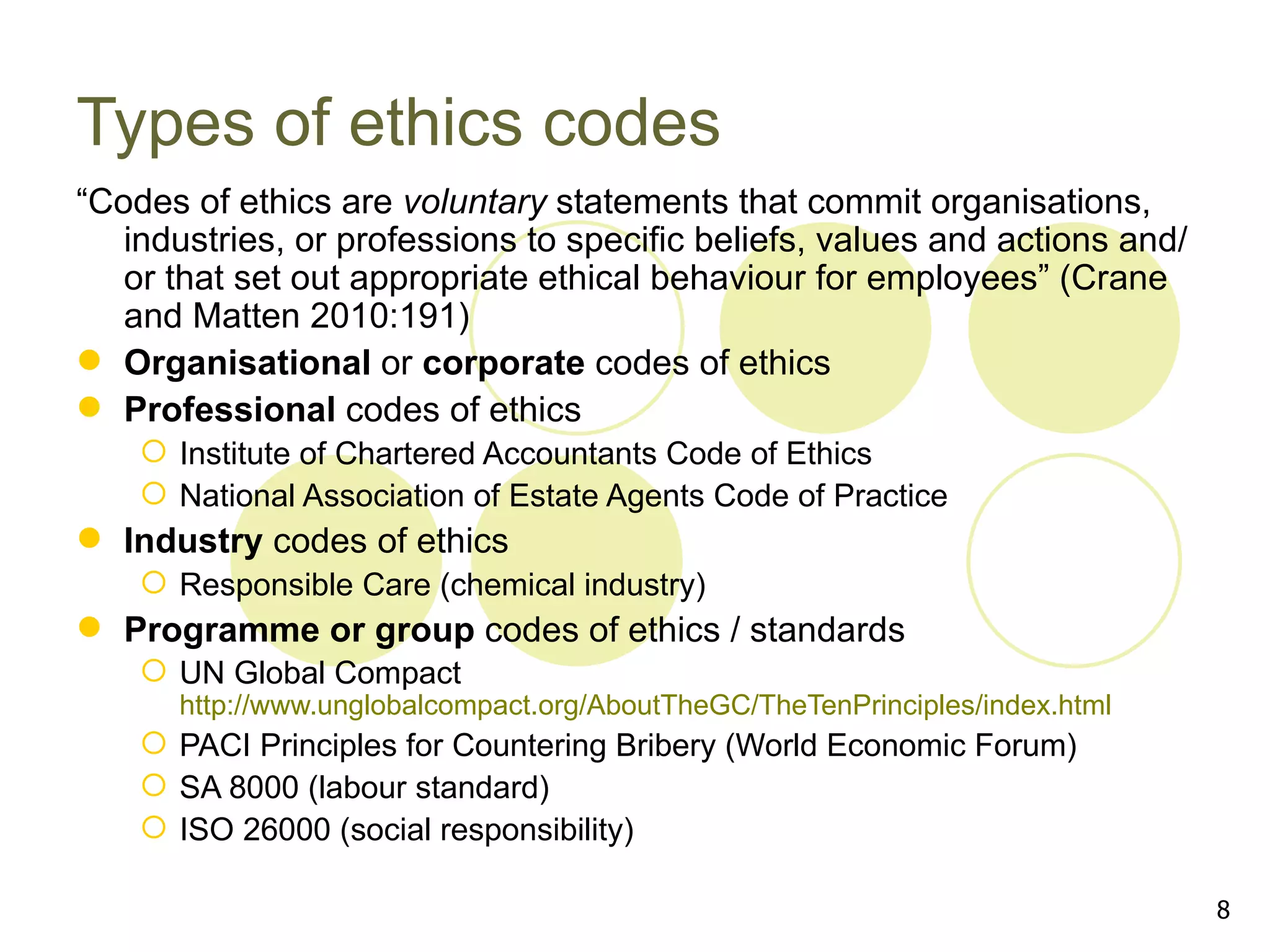
Types of ethics codes
“Codes of ethics are voluntary statements that commit organisations,
   industries, or professions to specific beliefs, values and actions and/
   or that set out appropriate ethical behaviour for employees” (Crane
   and Matten 2010:191)
 Organisational or corporate codes of ethics
 Professional codes of ethics
     Institute of Chartered Accountants Code of Ethics
     National Association of Estate Agents Code of Practice
 Industry codes of ethics
     Responsible Care (chemical industry)
 Programme or group codes of ethics / standards
     UN Global Compact
      http://www.unglobalcompact.org/AboutTheGC/TheTenPrinciples/index.html
     PACI Principles for Countering Bribery (World Economic Forum)
     SA 8000 (labour standard)
     ISO 26000 (social responsibility)

                                                                              8
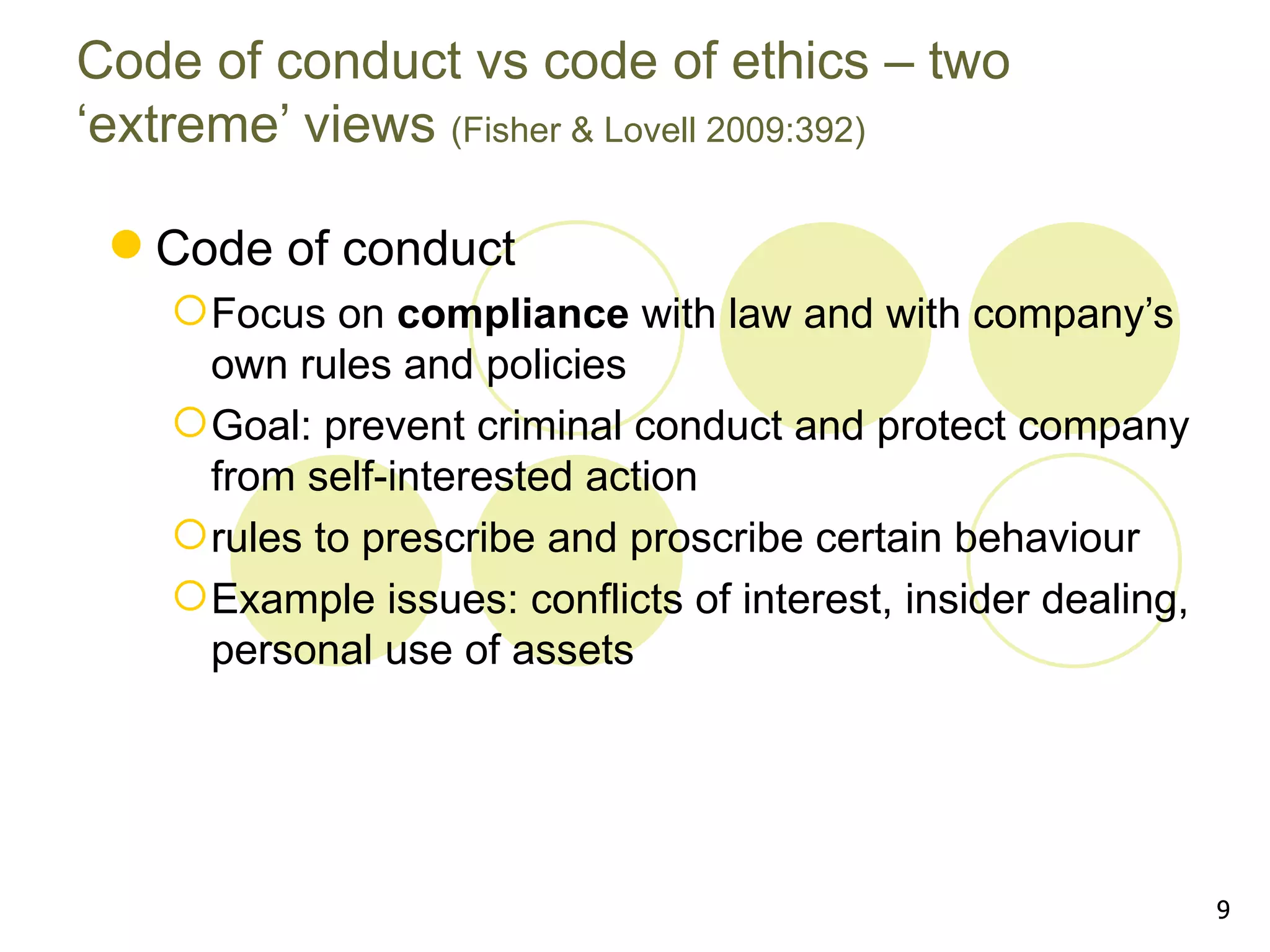
Code of conduct vs code of ethics – two
‘extreme’ views (Fisher & Lovell 2009:392)

  Code of conduct
     Focus on compliance with law and with company’s
      own rules and policies
     Goal: prevent criminal conduct and protect company
      from self-interested action
     rules to prescribe and proscribe certain behaviour
     Example issues: conflicts of interest, insider dealing,
      personal use of assets


                                                                9
Code of conduct vs code of ethics – two
‘extreme’ views (Fisher & Lovell 2009:392)
  Code of ethics
     focus on commitments of company
     links to values and visions of the company
     seeks to build relations of trust with all stakeholder
      groups
     encourages employees to display behaviour based on
      virtues such as integrity and honesty
     sets out general principles
     Example issues: equal opportunities for employees,
      value for money products and services, respecting
      human rights, respecting the community, the
      environment
                                                           10
Look at the examples you brought:

 Do you think this is a code of conduct (regulating
  employee behaviour) or a code of ethics (setting out
  organisational commitments to stakeholders) or both?
  Why?

 Do you think the code addresses sufficiently the
  ethical/CSR issues that the company is facing? Why?
  Why not?

 What do you like about this code, what do you dislike
  about this code?


                                                          11
What makes a code / ethics programme work?
    Clearly based on values (linked to values and mission statement)
    Balance between principles and prescriptions
    Stakeholder orientation
    Employees (and other groups) are involved in drawing up the code
    ‘User friendly’ style of code (e.g. provision of examples, reasonable
     length)
    Support structures (implementation and communication, training,
     speak up mechanisms etc)
    Support from top-level management
    Follow-through (e.g. consistent policies and actions, violations are
     taken seriously)
    Embedded in an ethical culture
    Reference to ‘higher level’ codes (industry, global codes etc.)

                                                                         12
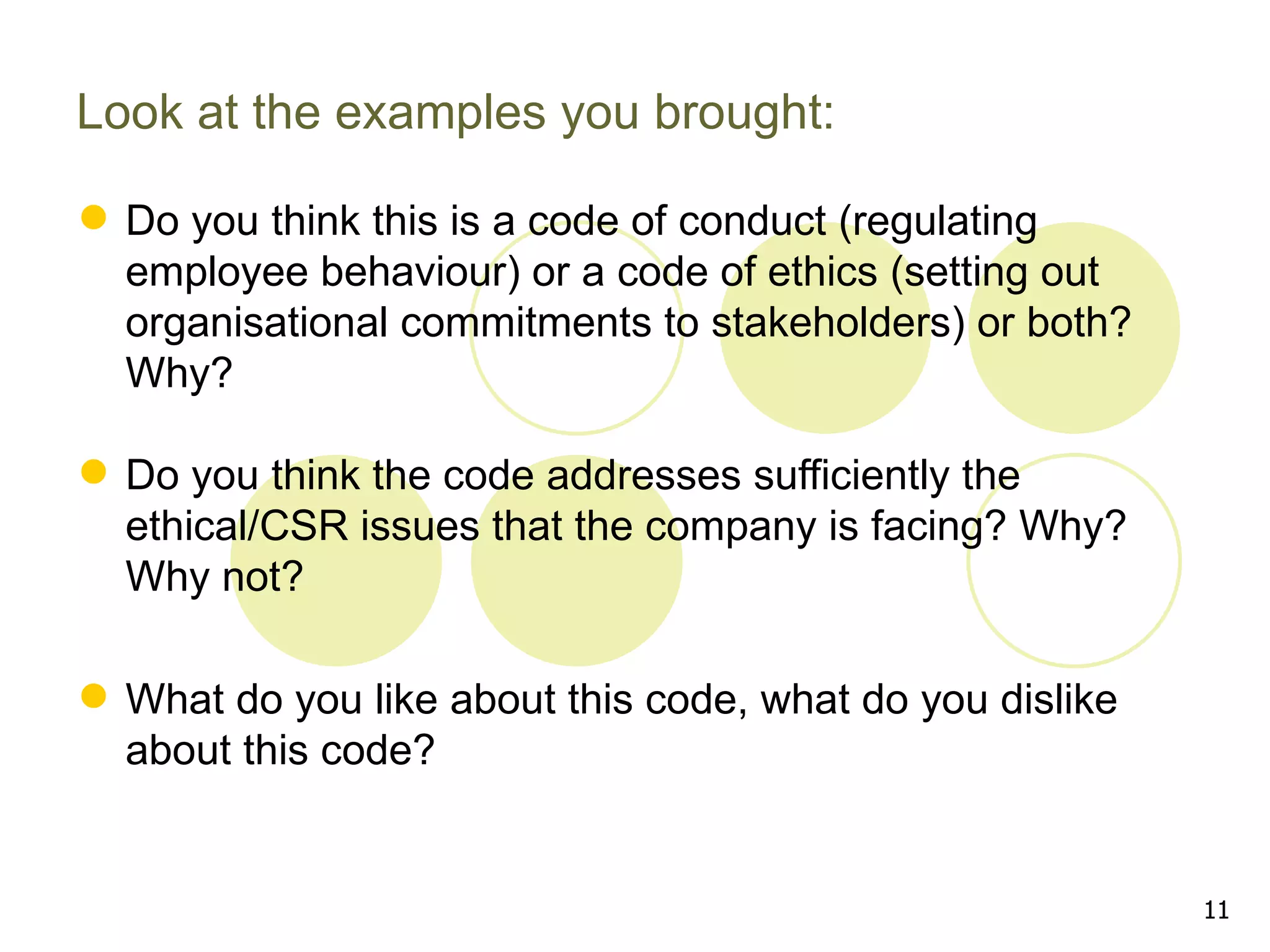
Corporate Scandals and
  whistleblowing                                HBOS and the
                                                banking crisis
                                                Whistleblower:
                                                Paul Moore
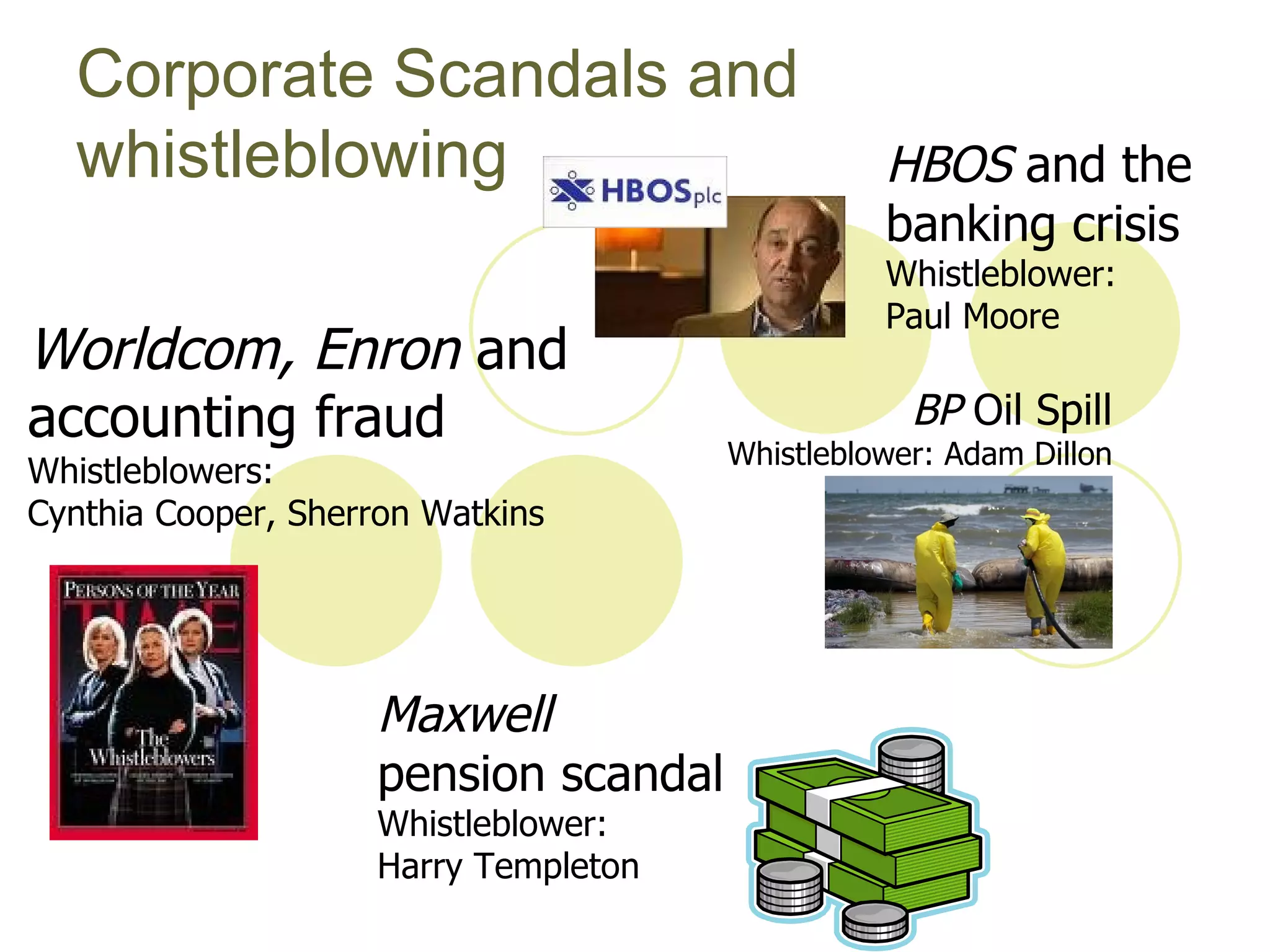
Worldcom, Enron and
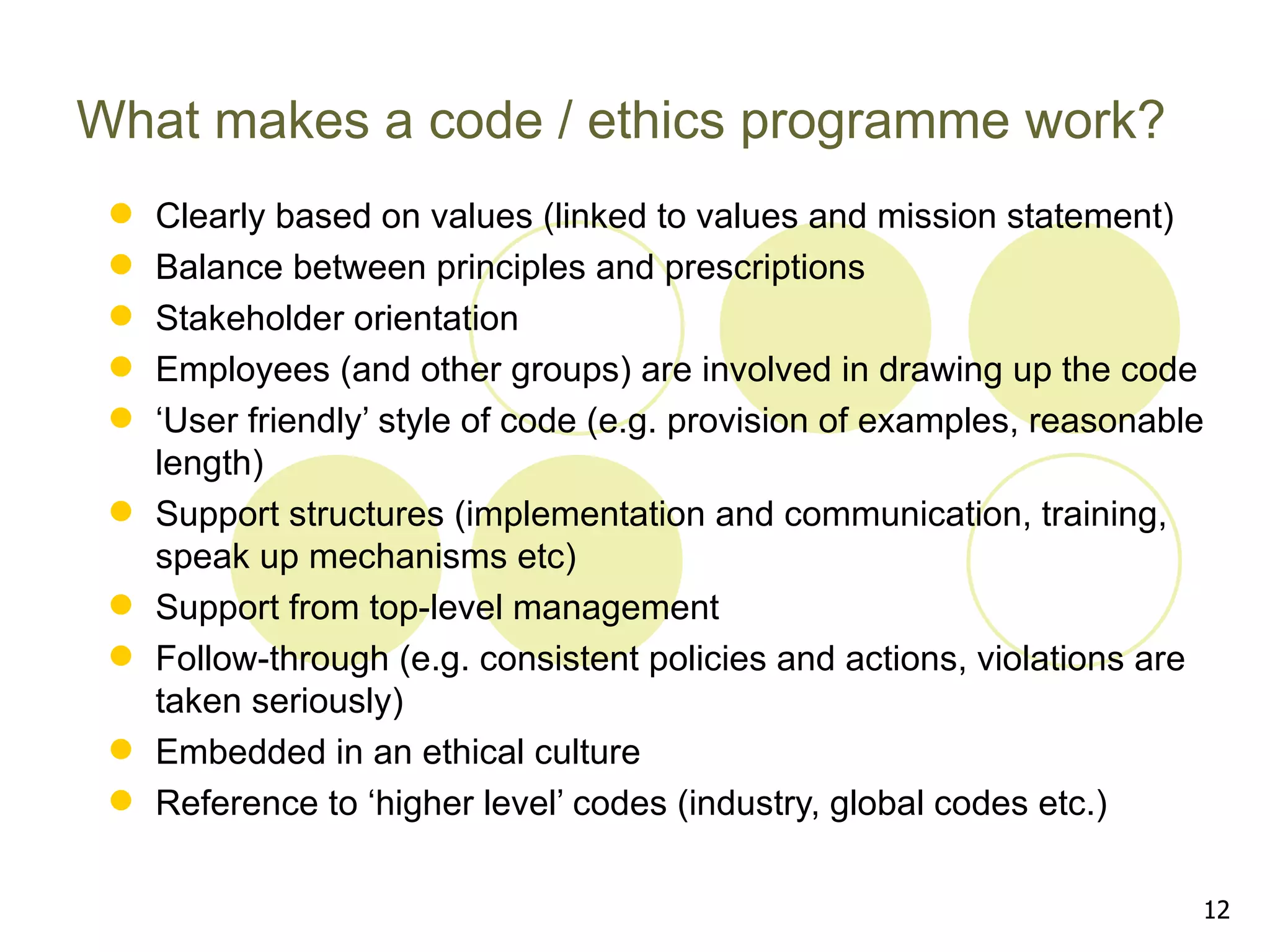
accounting fraud                                  BP Oil Spill
                                      Whistleblower: Adam Dillon
Whistleblowers:
Cynthia Cooper, Sherron Watkins


                    Maxwell
                    pension scandal
                    Whistleblower:
                    Harry Templeton
What is a whistleblower?
 An employee (or ex-employee) of an
  organisation
 Is in possession of privileged information
  about what s/he perceives to be illegal and/or
  unethical conduct in the organisation
 Decides to (voluntarily) bring this information
  to the attention of those who might be able to
  rectify this malpractice
   Internal/external whistleblowing
A recent whistleblowing case
 Paul Moore and HBOS
http://www.youtube.com/watch?v=_GsyJ9V136E&feature=related
http://edition.cnn.com/video/#/video/business/2009/02/18/finighan.uk.whistleb


 Why did he decide to speak up?

 To what extent would his personality have played a role?

 What consequences did he have to suffer for his actions?

 What do you make of his motives?

 Why did not more people raise concerns as he did?

 What would have happened if senior management had responded
   to his concerns?
What is at stake in whistleblowing cases?
 the need for employees to feel able to exercise moral
  agency (i.e. follow their conscience and/or their
  professional ethos)
 public interest in information that affects societal welfare
  (avoidance of harm)

VS
 the contractual requirement of employees to display
  loyalty to the organisation and respect confidentiality of
  information (potential damage to organisation)
 Likely negative consequences of whistleblowing (career-
  related, financial, emotional, health-related)
 protection from malicious and ill-founded accusations
  from disgruntled employees
How should companies respond?


 Formal ‘whistleblowing’ policies
   What do your corporate codes of ethics examples say
    about internal whistleblowing (e.g. raising concerns,
    reporting violations, speaking up)


 Organisational culture
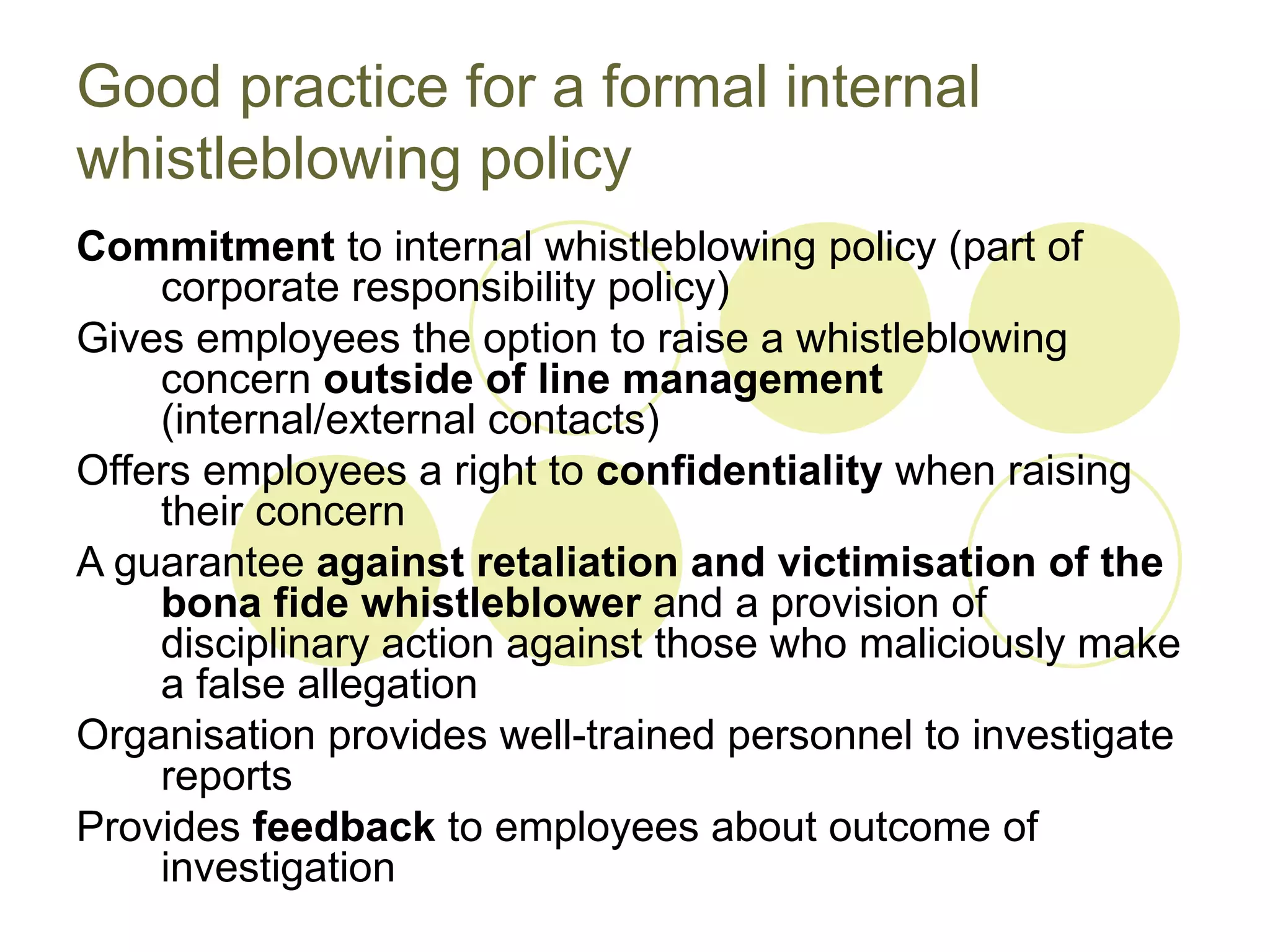
Good practice for a formal internal
whistleblowing policy
Commitment to internal whistleblowing policy (part of
    corporate responsibility policy)
Gives employees the option to raise a whistleblowing
    concern outside of line management
    (internal/external contacts)
Offers employees a right to confidentiality when raising
    their concern
A guarantee against retaliation and victimisation of the
    bona fide whistleblower and a provision of
    disciplinary action against those who maliciously make
    a false allegation
Organisation provides well-trained personnel to investigate
    reports
Provides feedback to employees about outcome of
    investigation
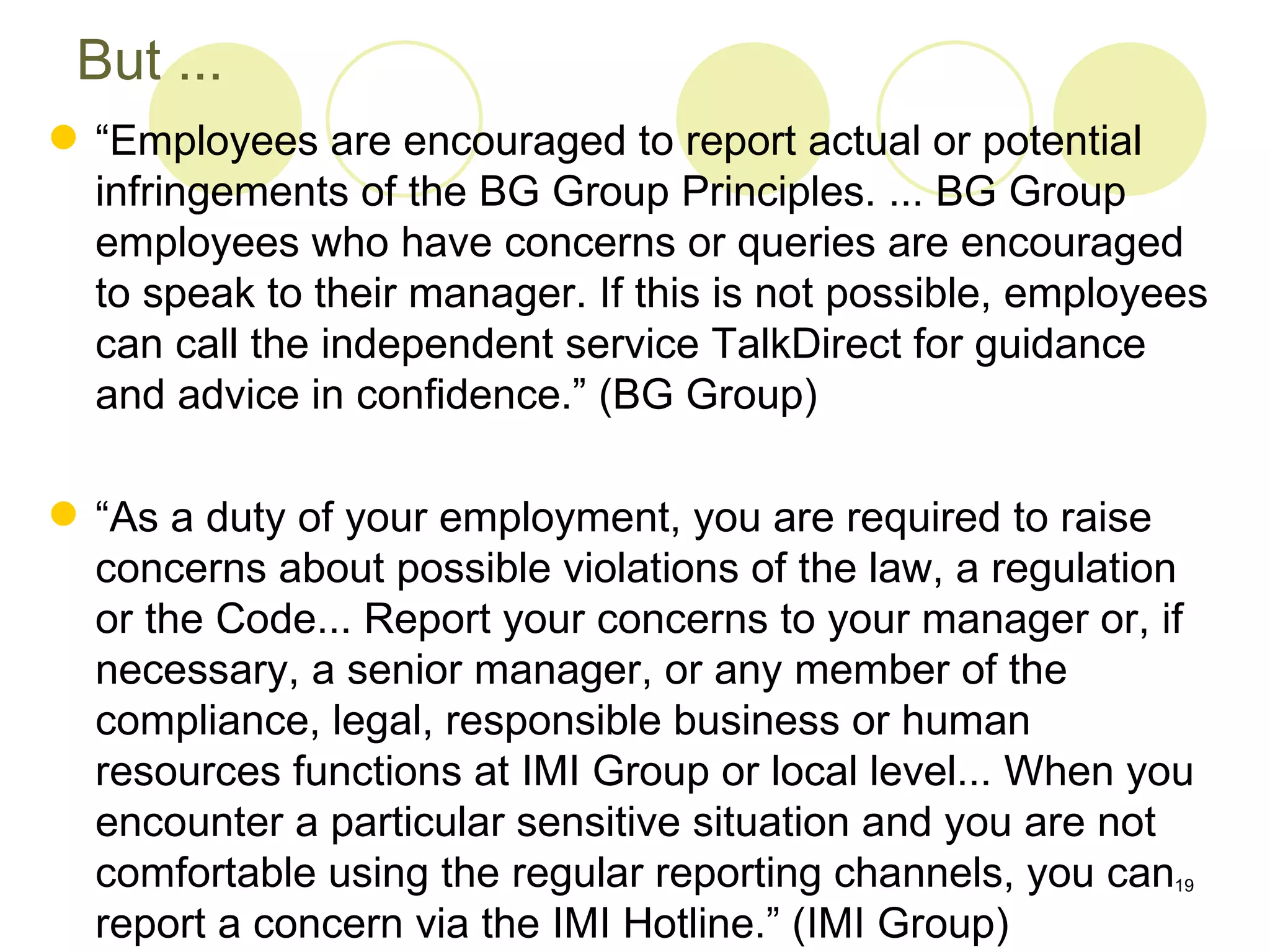
But ...
 “Employees are encouraged to report actual or potential
  infringements of the BG Group Principles. ... BG Group
  employees who have concerns or queries are encouraged
  to speak to their manager. If this is not possible, employees
  can call the independent service TalkDirect for guidance
  and advice in confidence.” (BG Group)

 “As a duty of your employment, you are required to raise
  concerns about possible violations of the law, a regulation
  or the Code... Report your concerns to your manager or, if
  necessary, a senior manager, or any member of the
  compliance, legal, responsible business or human
  resources functions at IMI Group or local level... When you
  encounter a particular sensitive situation and you are not
  comfortable using the regular reporting channels, you can19
  report a concern via the IMI Hotline.” (IMI Group)
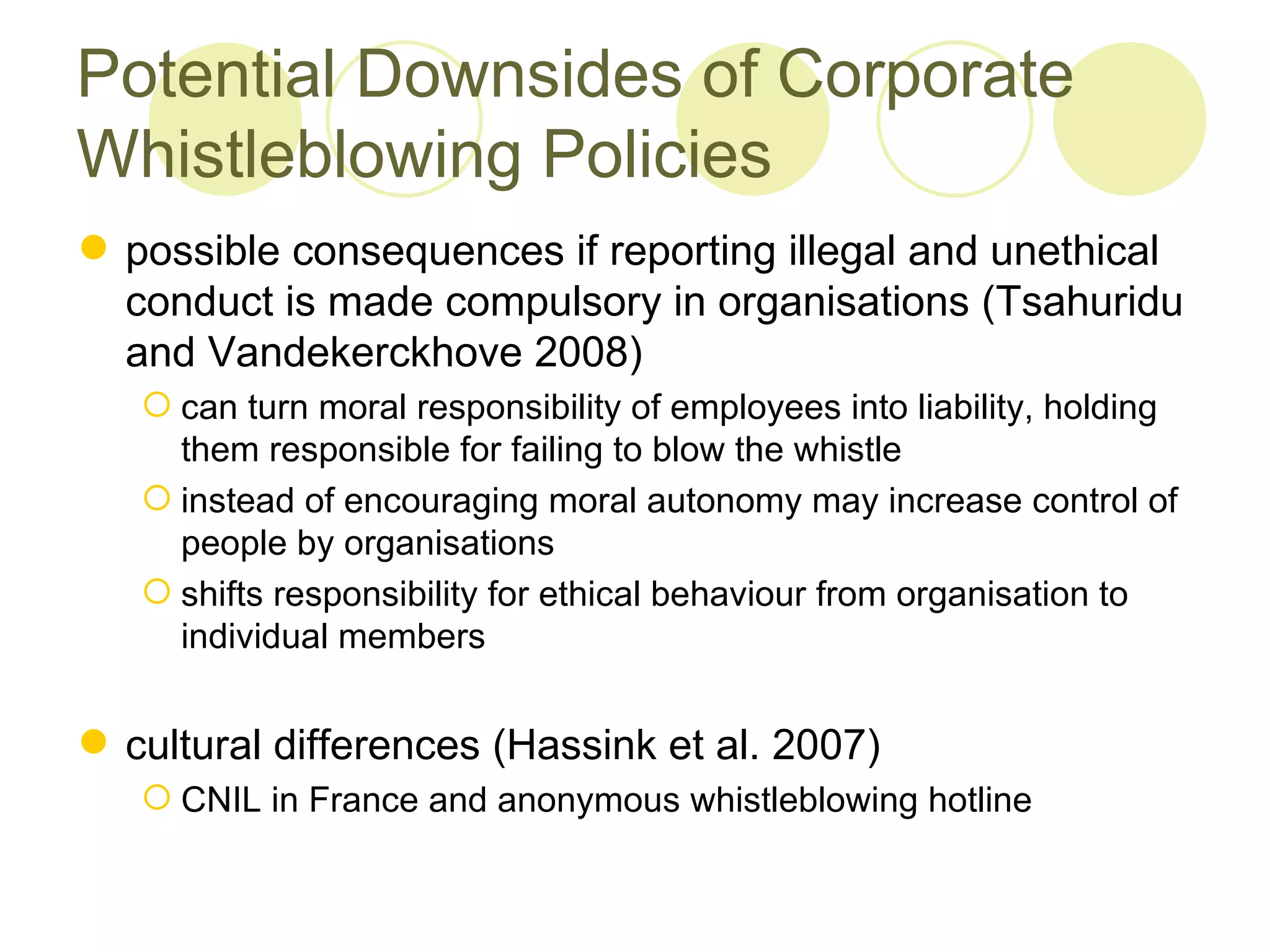
Potential Downsides of Corporate
Whistleblowing Policies
 possible consequences if reporting illegal and unethical
  conduct is made compulsory in organisations (Tsahuridu
  and Vandekerckhove 2008)
    can turn moral responsibility of employees into liability, holding
     them responsible for failing to blow the whistle
    instead of encouraging moral autonomy may increase control of
     people by organisations
    shifts responsibility for ethical behaviour from organisation to
     individual members


 cultural differences (Hassink et al. 2007)
    CNIL in France and anonymous whistleblowing hotline
 How can employees raise concerns
  (more) effectively?


                                     21
Enablers for ‘Voicing Values’ (Gentile 2010)
- Tips for Employees
 Enlist allies
 Select and sequence your audience
 Gain greater confidence in your viewpoint as a result of
  securing more information
 Work through incremental steps
 Change the frame of the problem: position it as opportunity
  seeking rather than risk management, for example, or as a
  ‘learning dialogue’ rather than a reproach
 Find win-win solutions
 Appeal to shared purpose, values (appeal to alignment)
 Normalise (managing this kind of conflict is just part of doing
  the job)
 Play to your strengths (how can you best influence?)
                                                                    22
Organisational culture and ethics
Paul Moore:

“The sales culture had got markedly out of balance
  with the ability to control this sales culture.”

“I witnessed and resisted a reckless lending
   culture that ultimately led to the bank’s collapse.”

“It was a kind of culture that celebrated bullying.”
Ethical organisational culture – beyond a code
of ethics and ‘speak up’ mechanisms
 Organisational ‘lived’ ethos
   Schein’s levels of culture:
        artefacts, espoused values, basic assumptions
                                     (1992, cited in Fisher & Lovell 2009:411)


 Role of senior managers
    commitment, communication, example

 Encouragement of dialogue and debate
    encourage employees to voice concerns
    no stifling of dissenting voices
 Fostering of autonomy and ‘moral imagination’ (see
  Gentile’s [2010] Giving Voice to Values approach)
Ethical organisational culture – beyond a code
of ethics and ‘speak up’ mechanisms

 Appropriate reward and incentive systems
  (Trevino et al 1999)
   reward for ethical behaviour
   punishment for unethical behaviour
   performance targets and ethical behaviour
   incentives vs motivations


 Commitment to organisational learning
  e.g. after incidents
Readings
 Crane & Matten (2010). Business Ethics. Chapter 5
 Griseri & Seppala (2010). Business and Corporate
  Social Responsibility. Chapter 11
 Fisher, C., Lovell, A. (2009) Business Ethics and Values.
  Harlow: Pearson Education, Prentice Hall. Chapters 7
  and 10.
 Boatright, J. (2009) Ethics and the Conduct of Business.
  Upper Saddle River: Pearson Education, Prentice Hall.
  4th edition. Chapter 4
 Schwartz, M. (2004) ‘Effective corporate codes of ethics:
  perception of code users’, Journal of Business Ethics
  55(4), 323–343.
 Trevino, L., Weaver, G., Gibson, D. and Toffler, B.
  (1999) ‘Managing ethics and legal compliance: what
  works and what hurts’, California Management Review 26
  41(2), 131–151.
Coursework

 Choose company
 Choose issue
 Suggested structure:
   Company background
   Explanation of issue
   Application of CSR/business ethics theories to explain
    why company should care about the issue
   Analysis of existing business ethics management
    tools/policies
   Recommendations to improve practice
                                                         27

Mba 2011 12 ethics unit - session 4

  • 1.
    MBA Management Perspectives Unit2: Ethics, Governance and CSR Session 4 Dr. Andrea Werner a.werner@mdx.ac.uk
  • 2.
    Session overview  Lastthree sessions:  Stakeholder approach, CSR and related concepts  Corporate Governance  Ethical Theory  Today: Managing individual and corporate values - Business Ethics Management 2
  • 3.
    Business Ethics Management “Businessethics management is the direct attempt [of companies] to formally or informally manage ethical issues or problems through specific policies, practices and programmes.” (Crane and Matten 2010:185) 3
  • 4.
    Why business ethicsmanagement?  Corporate scandals  Concern about reputation  Part of risk management  Compliance with regulation (especially US)  Part of good corporate governance  “It is important that all employees should know what standards of conduct are expected of them. We regard it as good practice for boards of directors to draw up codes of ethics or statements of business practice and to publish them both internally and externally.” (Cadbury Report, 1992)  (mimetic behaviour) 4
  • 5.
    Components of businessethics management  Value and mission statement  Code of ethics  Reporting/Advice channels  Ethics awareness raising and training  Ethics managers / officers /board committees  Risk management systems  Stakeholder consultation, dialogue and partnership programmes  Auditing, accounting, reporting  Ethical culture 5
  • 6.
    Examples of corporatemission and value statements “The mission of Merck is to provide society with superior products and services by developing innovations and solutions that improve the quality of life and satisfy customer needs, and to provide employees with meaningful work and advancement opportunities, and investors with a superior rate of return. Our values:  Our business is preserving and improving human life.  We are committed to the highest standards of ethics and integrity.  We are dedicated to the highest level of scientific excellence and commit our research to improving human and animal health and the quality of life.  We expect profits, but only from work that satisfies customer needs and benefits humanity. We recognize that the ability to excel -- to most competitively meet society's and customers' needs -- depends on the integrity, knowledge, imagination, skill, diversity and teamwork of our employees, and we value these qualities most highly.”
  • 7.
    Examples of corporatemission and value statements BP “We help the world meet its growing need for heat, light and mobility. We strive to do that by producing energy that is affordable, secure and doesn’t damage the environment. BP is progressive, responsible, innovative and performance driven.” 7
  • 8.
    Types of ethicscodes “Codes of ethics are voluntary statements that commit organisations, industries, or professions to specific beliefs, values and actions and/ or that set out appropriate ethical behaviour for employees” (Crane and Matten 2010:191)  Organisational or corporate codes of ethics  Professional codes of ethics  Institute of Chartered Accountants Code of Ethics  National Association of Estate Agents Code of Practice  Industry codes of ethics  Responsible Care (chemical industry)  Programme or group codes of ethics / standards  UN Global Compact http://www.unglobalcompact.org/AboutTheGC/TheTenPrinciples/index.html  PACI Principles for Countering Bribery (World Economic Forum)  SA 8000 (labour standard)  ISO 26000 (social responsibility) 8
  • 9.
    Code of conductvs code of ethics – two ‘extreme’ views (Fisher & Lovell 2009:392)  Code of conduct  Focus on compliance with law and with company’s own rules and policies  Goal: prevent criminal conduct and protect company from self-interested action  rules to prescribe and proscribe certain behaviour  Example issues: conflicts of interest, insider dealing, personal use of assets 9
  • 10.
    Code of conductvs code of ethics – two ‘extreme’ views (Fisher & Lovell 2009:392)  Code of ethics  focus on commitments of company  links to values and visions of the company  seeks to build relations of trust with all stakeholder groups  encourages employees to display behaviour based on virtues such as integrity and honesty  sets out general principles  Example issues: equal opportunities for employees, value for money products and services, respecting human rights, respecting the community, the environment 10
  • 11.
    Look at theexamples you brought:  Do you think this is a code of conduct (regulating employee behaviour) or a code of ethics (setting out organisational commitments to stakeholders) or both? Why?  Do you think the code addresses sufficiently the ethical/CSR issues that the company is facing? Why? Why not?  What do you like about this code, what do you dislike about this code? 11
  • 12.
    What makes acode / ethics programme work?  Clearly based on values (linked to values and mission statement)  Balance between principles and prescriptions  Stakeholder orientation  Employees (and other groups) are involved in drawing up the code  ‘User friendly’ style of code (e.g. provision of examples, reasonable length)  Support structures (implementation and communication, training, speak up mechanisms etc)  Support from top-level management  Follow-through (e.g. consistent policies and actions, violations are taken seriously)  Embedded in an ethical culture  Reference to ‘higher level’ codes (industry, global codes etc.) 12
  • 13.
    Corporate Scandals and whistleblowing HBOS and the banking crisis Whistleblower: Paul Moore Worldcom, Enron and accounting fraud BP Oil Spill Whistleblower: Adam Dillon Whistleblowers: Cynthia Cooper, Sherron Watkins Maxwell pension scandal Whistleblower: Harry Templeton
  • 14.
    What is awhistleblower?  An employee (or ex-employee) of an organisation  Is in possession of privileged information about what s/he perceives to be illegal and/or unethical conduct in the organisation  Decides to (voluntarily) bring this information to the attention of those who might be able to rectify this malpractice  Internal/external whistleblowing
  • 15.
    A recent whistleblowingcase  Paul Moore and HBOS http://www.youtube.com/watch?v=_GsyJ9V136E&feature=related http://edition.cnn.com/video/#/video/business/2009/02/18/finighan.uk.whistleb  Why did he decide to speak up?  To what extent would his personality have played a role?  What consequences did he have to suffer for his actions?  What do you make of his motives?  Why did not more people raise concerns as he did?  What would have happened if senior management had responded to his concerns?
  • 16.
    What is atstake in whistleblowing cases?  the need for employees to feel able to exercise moral agency (i.e. follow their conscience and/or their professional ethos)  public interest in information that affects societal welfare (avoidance of harm) VS  the contractual requirement of employees to display loyalty to the organisation and respect confidentiality of information (potential damage to organisation)  Likely negative consequences of whistleblowing (career- related, financial, emotional, health-related)  protection from malicious and ill-founded accusations from disgruntled employees
  • 17.
    How should companiesrespond?  Formal ‘whistleblowing’ policies  What do your corporate codes of ethics examples say about internal whistleblowing (e.g. raising concerns, reporting violations, speaking up)  Organisational culture
  • 18.
    Good practice fora formal internal whistleblowing policy Commitment to internal whistleblowing policy (part of corporate responsibility policy) Gives employees the option to raise a whistleblowing concern outside of line management (internal/external contacts) Offers employees a right to confidentiality when raising their concern A guarantee against retaliation and victimisation of the bona fide whistleblower and a provision of disciplinary action against those who maliciously make a false allegation Organisation provides well-trained personnel to investigate reports Provides feedback to employees about outcome of investigation
  • 19.
    But ...  “Employeesare encouraged to report actual or potential infringements of the BG Group Principles. ... BG Group employees who have concerns or queries are encouraged to speak to their manager. If this is not possible, employees can call the independent service TalkDirect for guidance and advice in confidence.” (BG Group)  “As a duty of your employment, you are required to raise concerns about possible violations of the law, a regulation or the Code... Report your concerns to your manager or, if necessary, a senior manager, or any member of the compliance, legal, responsible business or human resources functions at IMI Group or local level... When you encounter a particular sensitive situation and you are not comfortable using the regular reporting channels, you can19 report a concern via the IMI Hotline.” (IMI Group)
  • 20.
    Potential Downsides ofCorporate Whistleblowing Policies  possible consequences if reporting illegal and unethical conduct is made compulsory in organisations (Tsahuridu and Vandekerckhove 2008)  can turn moral responsibility of employees into liability, holding them responsible for failing to blow the whistle  instead of encouraging moral autonomy may increase control of people by organisations  shifts responsibility for ethical behaviour from organisation to individual members  cultural differences (Hassink et al. 2007)  CNIL in France and anonymous whistleblowing hotline
  • 21.
     How canemployees raise concerns (more) effectively? 21
  • 22.
    Enablers for ‘VoicingValues’ (Gentile 2010) - Tips for Employees  Enlist allies  Select and sequence your audience  Gain greater confidence in your viewpoint as a result of securing more information  Work through incremental steps  Change the frame of the problem: position it as opportunity seeking rather than risk management, for example, or as a ‘learning dialogue’ rather than a reproach  Find win-win solutions  Appeal to shared purpose, values (appeal to alignment)  Normalise (managing this kind of conflict is just part of doing the job)  Play to your strengths (how can you best influence?) 22
  • 23.
    Organisational culture andethics Paul Moore: “The sales culture had got markedly out of balance with the ability to control this sales culture.” “I witnessed and resisted a reckless lending culture that ultimately led to the bank’s collapse.” “It was a kind of culture that celebrated bullying.”
  • 24.
    Ethical organisational culture– beyond a code of ethics and ‘speak up’ mechanisms  Organisational ‘lived’ ethos  Schein’s levels of culture:  artefacts, espoused values, basic assumptions (1992, cited in Fisher & Lovell 2009:411)  Role of senior managers  commitment, communication, example  Encouragement of dialogue and debate  encourage employees to voice concerns  no stifling of dissenting voices  Fostering of autonomy and ‘moral imagination’ (see Gentile’s [2010] Giving Voice to Values approach)
  • 25.
    Ethical organisational culture– beyond a code of ethics and ‘speak up’ mechanisms  Appropriate reward and incentive systems (Trevino et al 1999)  reward for ethical behaviour  punishment for unethical behaviour  performance targets and ethical behaviour  incentives vs motivations  Commitment to organisational learning e.g. after incidents
  • 26.
    Readings  Crane &Matten (2010). Business Ethics. Chapter 5  Griseri & Seppala (2010). Business and Corporate Social Responsibility. Chapter 11  Fisher, C., Lovell, A. (2009) Business Ethics and Values. Harlow: Pearson Education, Prentice Hall. Chapters 7 and 10.  Boatright, J. (2009) Ethics and the Conduct of Business. Upper Saddle River: Pearson Education, Prentice Hall. 4th edition. Chapter 4  Schwartz, M. (2004) ‘Effective corporate codes of ethics: perception of code users’, Journal of Business Ethics 55(4), 323–343.  Trevino, L., Weaver, G., Gibson, D. and Toffler, B. (1999) ‘Managing ethics and legal compliance: what works and what hurts’, California Management Review 26 41(2), 131–151.
  • 27.
    Coursework  Choose company Choose issue  Suggested structure:  Company background  Explanation of issue  Application of CSR/business ethics theories to explain why company should care about the issue  Analysis of existing business ethics management tools/policies  Recommendations to improve practice 27

Editor's Notes

  • #5 Why?
  • #6 CSR reports
  • #7 Link to which theory Social values
  • #8 Link to Enron?
  • #9 Professional codes, industry codes important in your work?
  • #10 Arguments for: enables organisation to clarify standards increase awareness of ethical issues that can arise at work a tool to resist pressure to perform unethical or illegal action provide a formal basis and language for the discussion of ethical issues minimise unethical/illegal conduct help to manage relations with external constituencies contribute to decision-making in the company increase employee commitment to organisation
  • #11 Arguments against: just PR and window dressing, can generate cynicism marginality presumes ethical immaturity on the part of the employees may suppress individual moral instincts, emotions and empathy in order to ensure bureaucratic conformity and consistency inflexibility ethical culture is more important than presence of code
  • #12 Groups of 2-3 Range and wording of issues Reference to values What does code imply about organisation’s view of its staff? Specifics of organisation, Is there any reference to external codes (professional, international)?
  • #13 But is it possible to ‘manage values’? (Griseri and Seppala 2010:pp.297)
  • #14 Enron, Worldcom: and Cynthia Cooper (chief auditor – investigated financial irregularities in company, was told to stop, kept investigating informed the board, led to conviction of CFO) – internal whistleblowing Maxwell – Harry Templeton, printer, pension fund trustee discovered that pension fund money was diverted (turned out to be £400 million), raised it with Maxwell, was fired by Maxwell, gave later evidence in court Adam Dillon: http://www.guardian.co.uk/environment/2010/jul/16/bp-whistleblower-oil-cleanup-disarray
  • #15 Strict view: outside normal channels of communication Must be done out of moral protest not personal gain / revenge Formal / informal Anonymous / identified
  • #16 FOLLOW UP BBC VIDEO http://business.timesonline.co.uk/tol/business/industry_sectors/banking_and_finance/article5701380.ece?token=null&offset=0&page=1 http://news.bbc.co.uk/1/hi/programmes/politics_show/7944807.stm http://news.bbc.co.uk/1/hi/business/7882635.stm http://www.youtube.com/watch?v=VpktR7UyeZk&NR=1 http://www.youtube.com/watch?v=EBP5YAcP8Bk&NR=1 http://www.youtube.com/watch?v=_GsyJ9V136E&feature=related
  • #18 Reputation Risk Management Demonstration of good governance Minimisation of costs and compensation from accidents, investigations, litigation, regulatory inspections organization where the value of open whistleblowing is recognized will be better able to: • deter wrongdoing; • pick up potential problems early; • enable critical information to get to the people who need to know and can address the issue; • demonstrate to stakeholders, regulators and the courts that they are accountable and well managed; • reduce the risk of anonymous and malicious leaks; • minimize costs and compensation from accidents, investigations, litigation and regulatory inspections; and • maintain and enhance its reputation.
  • #21 Critique of ‘compulsory reporting’ requirement in corporate whistleblowing policies (Tsahuridu and Vandekerckhove 2008) Shifting responsibility from organisation to individual Holding employees accountable for NOT blowing the whistle CNIL: anonymous whistleblowing systems only encouraged not compulsory, fear of ‘snitching’ – On May 26, 2005, the French National Commission for Data Protection and Liberties (CNIL) decided that the anonymous whistleblower hotlines McDonald’s and CEAC/Exide Technologies wanted to implement as part of their new codes of conduct, were in violation of the Data Protection Law. Anonymous reporting through such mechanisms was regarded unfair collection of data, since the subject of the data is not informed. These hotlines were judged as disproportionate in relation to their objectives, and going too far in addition to the present French labour law providing the means to detect and punish violations of company rules (Dechert, 2005).
  • #22 Paul Moore
  • #24 Enron certainly had a strong culture. But our stated values of respect, integrity, communication and excellence (RICE) did not describe that culture… At Enron, we had a firm culture in place that emphasised making earnings targets no matter what, and I don’t think any one person could have changed that culture.” (Sherron Watkins, Enron whistleblower, cited in Beenen & Pinto 2009) BP: “culture of complacency”
  • #25 Schein: artefacts: most visible level of culture: signs (company logo), symbols, written codes, forms of address, rituals, architecture, décor of company’s premises espoused values: beliefs that are articulated, audibly expressed, ‘the way things are done around here’, ‘take the moment, ‘go for it’, could be influence by code? basic assumptions: what is really going on, unspoken assumptions (do what your boss says if you want to survive), difficult to unearth, can you change a culture? Johnson and Johnson vs Enron – RESPONSE IN CRISES appropriate reward and incentive systems: interested in HOW they get their results, reward of ethical behaviour, non-retaliation and reward for reporting violations of ethical standards also: behaviour does not always depend on external incentive Enron ‘rank or yank’ performance pressured culture led to unethical (fraudulent) behaviour) Tate and Lyle, for example, state in their code: . . . neither Operating Units nor their management or employees will be criticized for loss of business resulting from complying with the Company’s policies.
  • #26 senior managers: set the tone, commitment crucial, personal example – not living up to stated values can create credibility gap dialogue and debate: a speak up culture? no retaliation for critical stance appropriate reward and incentive systems: interested in HOW they get their results, reward of ethical behaviour, non-retaliation and reward for reporting violations of ethical standards also: performance does not always depend on external incentive Enron ‘rank or yank’ performance pressured culture led to unethical (fraudulent) behaviour) Tate and Lyle, for example, state in their code: . . . neither Operating Units nor their management or employees will be criticized for loss of business resulting from complying with the Company’s policies. Organisational learning: BP aftermath, Siemens aftermath
  • #28 Go through coursework brief