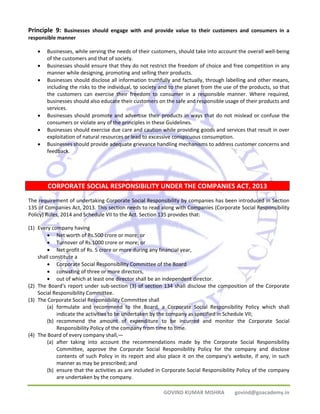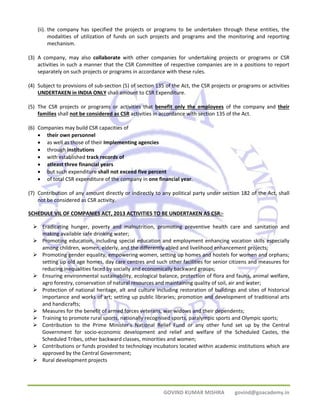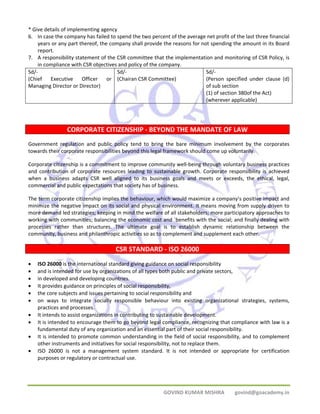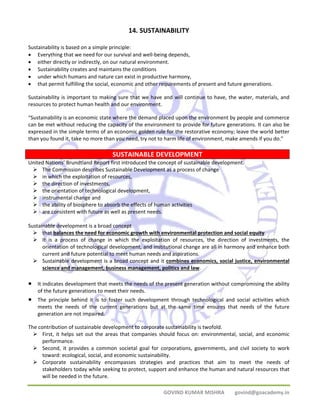




















ETHICS, GOVERNANCE 
AND 
SUSTAINABILITY 
CS GOVIND KUMAR MISHRA
CHAPTER 1 
ETHICS 
To be able to do the right thing in the right way, in each case and at every moment, one 
must be in the right consciousness. 
- Sri Aurobindo 
Inner consciousness is the awareness, the capacity to listen to the inner voice that tells us 
that there is someone who is looking up at us and also warns that there is someone who 
is watching us. The soul and core of Corporate Governance is not the conduct or 
behavior that we see outwardly. It is internalized values that an organization and its top 
management follow. 
The essence of a human being is consciousness and the world we create around us is 
the expression of our consciousness. The creative and the beautiful as well as the corrupt 
and degenerate are the outcome of our consciousness. 
The quality our consciousness depends on the part of the consciousness in which we live. 
There are two parts in our consciousness. First is the lower physical-vital being driven 
predominantly by self-interest, material needs and sensuous desires, quite often 
degenerating into greed. The second is the higher mental, moral and spiritual being 
seeking for truth, beauty, goodness, harmony and unity. The corporate governance, to be 
truly effective and enduring, has to be based on this higher part of our human nature 
or conscience. An important quality of this higher part of our conscience is self-governance. 
Corporate governance should endeavour to create corporate consciousness and an 
environment in which those who are charged with governance and those who are 
governed display genuine ethical, social and ecological responsibilities. 
Ethics, sometimes known as philosophical ethics, ethical theory, moral theory, and moral 
philosophy, is a branch of philosophy that involves systematizing, defending and 
recommending concepts of right and wrong conduct, often addressing disputes of moral 
diversity. The term comes from the Greek word “ethos” which refers to character, 
guiding beliefs, standards and ideals that pervade a group, a community or people. 
The Oxford Dictionary states ethics as “the moral principle that governs a person’s 
behaviour or how an activity is conducted”. 
The synonyms of ethics as per Collins Thesaurus are – conscience, moral code, 
morality, moral philosophy, moral values, principles, rules of conduct and standards. 
Thus, ethics relates to the standards of conduct and moral judgments that differentiate 
right from wrong. 
Ethics is not a natural science but a creation of the human mind. 
GOVIND KUMAR MISHRA | govind@goacademy.in 1
FEATURES OF ETHICS: 
• Ethics is a conception of right or wrong conduct. Ethics tells us when our behaviour 
is moral and when it is immoral. 
• It deals with the moral choices that we make in the course of performing our duties 
with regard to the other members of society. 
• They are important not only in business and politics but in every human 
GOVIND KUMAR MISHRA | govind@goacademy.in 2 
endeavour. 
• The concepts of equity and justice are implicit in ethics. Fair and equitable 
treatment to all is its primary aim. 
ETHICS IN BUSINESS 
Business ethics is one of the important branches of applied ethics. Business ethics is the 
application of general ethical ideas to business. It refers to the moral principles and 
standards and a code of conduct that businessmen are expected to follow while dealing 
with others. 
Business ethics refers to a ‘code of conduct’ which businessmen are expected to follow 
while dealing with others. It comprises of the principles and standards that guide 
behaviour in the conduct of business. It reflects the philosophy of business, one of whose 
aims is to determine the fundamental purposes of a company. 
Business ethics stands for the saneness or purity of purpose that is upheld through 
carefully designed actual practices of a business enterprise. It is an embodiment of 
conscious concern towards execution of business processes in tune with the nobility of 
the purpose. 
Businesses must balance their desire to maximise profits against the needs of 
stakeholders. The significant issues in business ethics include ethical management of 
enterprise in relation to its stakeholders in particular and natural environment in general. 
The responsibility towards society is a moral obligation arising out of business ethics, 
which in turn is steeped in the philosophy of business. 
Why ethics is necessary and important in business? 
• There is a kind of social contract between the society and business by which the 
society expects the business to work in its interest. Society creates and accepts 
business enterprises, hence it expects them to work in a manner which is not 
detrimental to its well being and interests. 
• A business enterprise that is honest and fair to its customers, employees, and 
other stakeholders earns their trust and good will. It ultimately results in customer
satisfaction, healthy competition, industrial growth and high earnings. 
• Businesses must balance their desire to maximise profits against the requirements 
of stakeholders. Maintaining this balance often requires trade-offs. To address this 
unique aspect of business, rules are articulated to guide it to earn profits without 
harming individuals or society as a whole. 
• Mahatma Gandhi once mentioned that all business entrepreneurs should ask 
themselves the question whether the activities they are contemplating would be of 
some use to the common man. This statement emphasizes the importance of 
nobility of business purpose. 
• Ethical business behaviour is not only about good business but about good 
citizenship as well. Morally conscious businessmen have created names and built 
great business empires. 
• Ethical policies and practices enable a business enterprise to build goodwill for 
itself. A business organisation that adheres to a code of conduct gains a 
competitive advantage and builds long term value. 
• Business can prosper only when a society is stable and peaceful. 
CORPORATE GOVERNANCE ETHICS 
Corporate governance is meant to run companies ethically in a manner such that all 
stakeholders including creditors, distributors, customers, employees, the society at large, 
governments and even competitors are dealt with in a fair manner. Good corporate 
governance should look at all stakeholders and not just the shareholders alone. 
Corporate governance is not something which regulators have to impose on a 
management, it should come from within. It is the value-based management and ethics 
that the organization has to use in its governance. 
PHILOSOPHIES/THEORIES/STUDIES OF ETHICS 
1. DEONTOLOGICAL THEORIES – KANTIAN ETHICS: 
This is a combination of two greek words, "Deon" meaning Duty and "Logos" 
meaning Logics. In deontological theories actions are judged as ethical or unethical 
based on duty or intentions of an actor. 
No other animal possesses such a propensity for reasoned thought and action, and it 
is exactly this ability which obliges us to act according to the moral law / duty. This 
theory emphasises acting in accordance with and for the sake of duty. Motivation for 
action must be based on obligation. Morality should provide us with a framework of 
rational principles (rules) that guide and restrict action, independent of personal 
intentions and desires. 
GOVIND KUMAR MISHRA | govind@goacademy.in 3
Hence, according to Kantian ethics, is an action passes the test of categorical 
imperative, the action is ethical. It can be claimed that categorical imperative rules out 
some certain practices, such as theft, fraud, coercion and so on in business left. If 
Kantian ethics can be applied in business life, it provides universal place in business 
world. 
GOVIND KUMAR MISHRA | govind@goacademy.in 4 
2. TELEOLOGICAL THEORIES: 
Teleology is derived from the Greek word 'telos' meaning ends or purposes. This 
theory holds that ends or consequences of an act determine whether the act is good 
or bad. Rightness of actions is determined solely by their good consequences. 
Teleological approach is also known as consequential ethics. 
Teleological analysis of business ethics leads to the consideration of the full range of 
stakeholders in any business decision, including the management, the staff, the 
customers, the shareholders, the country, humanity and environment. 
3. UTILITARIAN APPROACH: 
Utilitarianism is an ethics of welfare. Business guided by utilitarian approach focuses 
on behaviours and their results, not on the means of such actions. It can be described 
by the phrase, “the greatest good for the greatest number.” 
The utilitarian approach prescribes ethical standards for managers in the areas of 
organisational goals, i.e., maximisation of profits; and having efficiency which denotes 
optimum utilization of scarce resource. 
Utilitarianism prescribes that the moral worth of an action is solely determined by its 
contribution to overall utility, that is, its contribution to the happiness and satisfaction 
of the greatest member. 
Jeremy Bentham is considered as the founder of traditional utilitarianism. He 
propagates on objective basis for making value judgements that would provide 
common acceptable norm for determining social policy and social legislation. 
The utilitarian principle states, “an action is right from ethical print of view if and only if 
the sum total of utilities produced by that act are greater than the sum total of utilities 
produced by any other act that can be performed at that point of time by any person”. 
This approach gives precedence to good over right. 
4. VIRTUE THEORY: 
Virtue theory of ethics is a very old concept existing since the time of Aristotle 
(384BC), and there are a variety of theories that fall under the category of virtue 
theory.
Virtue – it is a slightly old – fashioned term. Virtue theory is more concerned with 
answering the question of how to live a good life or how to be a good person. Virtue 
theory aims to offer an account of the characteristics one must have to be considered 
virtuous. 
According to Aristotle, “role of ethics is to enable us to lead a successful and good 
life”. This in Aristotle's view is possible only for virtuous people. In his words “virtue is 
a character trait that manifests itself in habitual action”. 
Thus, we can define virtue as a trait of character, that is essential for leading a 
successful life. Virtues should contribute to the idea of a good life. They are not 
merely means to happiness but are constituents of it. 
GOVIND KUMAR MISHRA | govind@goacademy.in 5 
5. JUSTICE THEORY: 
Justice approach is also known as fairness approach. Greek philosophers have 
contributed to the idea that all equals should be treated equally. Justice does not 
depend on consequences; it depends on the principle of equality. 
The key to a well-ordered society is the creation of institutions that enable individuals 
with conflicting ends to interact in mutually beneficial ways. The focus here is on 
social justice. 
6. EGOISM: Egoism is derived from the Latin word 'ego' meaning 'I'. The theory of 
egoism holds that the good is based on the pursuit of self-interest. This model takes 
into account harms, benefits and rights for a person’s own welfare. 
Under this model an action is morally correct if it increases benefits for the individual 
in a way that does not intentionally hurt others, and if these benefits are believed to 
counterbalance any unintentional harms that ensue. 
7. RELATIVISM: 
Theory of Relativism promotes the idea that some elements or aspects of experience 
or culture are relative to, i.e., dependent on, other elements or aspects. It holds that 
there are no absolute truths in ethics and that what is morally right or wrong varies 
from person to person or from society to society.
ETHICS 
The ethica 
include: 
IN FINANC 
al issues in 
• In a 
• Re 
• Ins 
accounting 
lated party 
sider trading 
arkets. 
ecutive com 
bery, kickba 
ke reimburs 
IN HUMAN 
s of human 
e employer 
oyer and em 
scrimination 
gion, disab 
xual harass 
irmative Ac 
ues surrou 
rkplace and 
ues affectin 
c. 
scrimination 
ues relatin 
wer betwee 
cupational 
IN MARKE 
g ethics is 
h the mora 
lation of m 
not limited t 
h how suc 
s. The ethi 
ma 
• Exe 
• Bri 
• Fak 
ETHICS 
The ethics 
around the 
the emplo 
• Dis 
reli 
• Sex 
• Aff 
• Iss 
wo 
• Iss 
etc 
• Dis 
• Iss 
pow 
• Oc 
ETHICS 
Marketing 
deals with 
and regul 
ethics is n 
deals wit 
customers 
include: 
SCOPE 
CE 
finance tha 
E OF BU 
USINES 
at compani 
– window d 
transaction 
g, securitie 
SS ETH 
es and em 
dressing, m 
ns not at ar 
es fraud lea 
mpensation 
acks, over 
sements. 
N RESOU 
n resource m 
r-employee 
mployee.Th 
n issues, i 
bilities etc. 
sment. 
ction. 
nding the re 
d trade unio 
ng the priva 
HICS 
ployees are 
misleading f 
m length 
ading to m 
. 
billing of ex 
e confronte 
financial an 
alysis. 
manipulation 
xpenses an 
RCES 
manageme 
relationshi 
e ethical iss 
.e., discrim 
ed with 
n of the fin 
nd facilitatio 
ent (HRM) c 
ip, such as 
sues faced 
mination on 
epresentati 
onisation. 
acy of the e 
n of whistle-ng 
nancial 
on payment 
covers thos 
the rights a 
by HRM in 
n the base 
ion of empl 
employee: 
-blowers. 
airness of 
loyer and e 
health issu 
to the fa 
en the empl 
safety and 
ETING 
that area 
al principle 
marketing. T 
o the kind o 
ch product 
cal issues 
s. 
se ethical is 
and duties 
nclude: 
es of age, 
oyees and 
workplace 
the emplo 
employee. 
ues. 
of applied 
es behind t 
The issue 
of products 
ts are deli 
confronted 
ssues that a 
issues betw 
the democ 
cratization o 
surveillanc 
oyment con 
ethics whi 
the operati 
of marketi 
alone. It al 
vered to t 
d in this ar 
GOVIN 
ich 
on 
ing 
lso 
the 
rea 
ND KUMAR M 
ntract and 
MISHRA | gov 
ce, drug tes 
the balanc 
vind@goacad 
gender, r 
demy.in 6 
arise 
ween 
race, 
of the 
sting, 
ce of
• Pric 
• Ant 
cing: price 
ti-competiti 
angements 
sleading ad 
ntents of ad 
cision mak 
ildren and m 
rrogate ad 
oducts, like 
ack markets 
IN PRODU 
a of busine 
to ensure 
s do not ca 
acute dilem 
usually a d 
n process a 
ility, since 
ive technolo 
arra 
• Mis 
• Co 
• De 
• Ch 
• Su 
pro 
• Bla 
ETHICS 
This area 
company 
processes 
the more a 
there is u 
production 
permissib 
preventati 
Companie 
those com 
1. Attra 
Peopl 
Such 
climat 
create 
willing 
act o 
challe 
Talen 
and b 
2. Inves 
Invest 
reputa 
more 
efficie 
includ 
results 
fixing, price 
ve practic 
s and tying 
dvertisemen 
dvertiseme 
ing. 
marketing. 
vertising: F 
apple juice 
s and grey m 
UCTION 
ess ethics 
e that the 
ause harm 
mmas in this 
degree of 
and it is di 
the degree 
ogies or ch 
VANTAG 
ng a "clear 
at do not dis 
d retaining 
o join organ 
s are able 
a lot to 
ronment th 
n company’ 
ecisions. R 
he compan 
will invest 
matches the 
lty: 
concerned 
e company 
aware that 
uctivity and 
ors, based 
ned loyalty. 
ADV 
es displayin 
mpanies tha 
cting and 
e aspire to 
companies 
te matters 
e an envir 
g to rely on 
n those de 
enge for th 
ted people 
eliefs that m 
stor Loyal 
tors are 
ation of the 
and more 
ency, produ 
ding investo 
s in sustain 
e discrimina 
ces, like 
arrangeme 
nts. 
nts. 
ation and p 
manipulati 
ents. 
rice skimm 
on of su 
le, many l 
water. 
For examp 
e, soda and 
markets. 
deals wit 
eir product 
to society 
s area arise 
danger in 
ifficult to de 
e of permis 
anging soc 
GES OF 
r commitme 
splay an eth 
g talent: 
nizations th 
to attract 
the emplo 
hat is trust 
s policies, 
Retaining ta 
ny as getti 
t their ener 
eir own. 
ing. 
upply, exc 
iquor firms 
th the duti 
ts and pr 
y at large. S 
e out of the 
any produ 
efine the d 
ssibility ma 
cial percept 
F BUSI 
ent to ethic 
hical condu 
clusive de 
s carry adv 
ies of a 
roduction 
Some of 
fact that 
uct or its 
egree of 
ay depend 
ions of acc 
NESS E 
cal conduc 
uct. 
hat have hi 
the best ta 
oyees. Ethi 
tworthy, m 
ability to ta 
alented pe 
ng them i 
rgy and tale 
about e 
in which th 
t an ethical 
d profits. R 
d on depe 
vertisement 
on the cha 
eptable risk 
ETHICS 
ct" consiste 
anging stat 
k. 
S 
ntly outper 
values. 
ethical 
zations 
ployees 
ons and 
s big a 
place. 
organizatio 
gh ethical 
alent. The 
ical organi 
making emp 
ake decisio 
eople is as 
n the first 
ent only in 
ethics, soc 
hey invest. 
climate pr 
Relationship 
endability, 
GOVIN 
cial respon 
Investors a 
rovides a fo 
p with any 
trust and 
ND KUMAR M 
ons with va 
nsibility an 
are becomin 
oundation f 
stakeholde 
commitme 
MISHRA | gov 
nd 
ng 
for 
er, 
nt 
vind@goacad 
demy.in 7 
aling 
ts of 
te of 
rform 
alues
3. Custo 
omer satis 
omer satisfa 
ated purch 
ct is essen 
any should 
ring succes 
al practices 
etitive posit 
Custo 
Repea 
respe 
compa 
endur 
ethica 
compe 
too. 
4. Regu 
ulators: 
lators eye c 
not alway 
isation that 
gains reputa 
Regul 
need 
organ 
also g 
sfaction: 
action is a v 
ases/orders 
ntial for the 
d evoke t 
ss. This is a 
s. Ethical c 
tion for the 
vital factor o 
s and an e 
e success 
trust and 
achieved by 
conduct tow 
company. 
companies 
ys monitor 
t acts withi 
ation public 
of a succes 
enduring re 
of the com 
respect a 
y a compan 
wards custo 
It promotes 
functioning 
the funct 
n the confi 
cly. 
ssful busine 
elationship 
mpany. The 
among cus 
ny only whe 
omers build 
s a strong p 
g ethically a 
ioning of 
nes of bus 
GOVIN 
ess strategy 
with mutua 
e name of a 
stomers fo 
en it adopt 
ds a strong 
public image 
as responsi 
the ethica 
iness ethic 
ND KUMAR M 
y. 
al 
or 
s 
ge 
ible citizens 
lly sound 
cs not only 
MISHRA | gov 
s. The regu 
company. 
earns profi 
vind@goacad 
demy.in 8 
ulator 
Any 
it but
10 
CHAPTER 2 
ETHICAL PRINCIPLES IN BUSINESS 
ORGANIZATION STRUCTURE AND ETHICS 
The ethical climate reflects whether the firm has an ethical conscience. It is a function of 
many factors including corporate policies on ethics, top management’s leadership on 
ethical issues, industry culture, etc. 
The ethical tendency or climate of organizations is set at the top. What top managers do, 
the culture they establish and reinforce, makes a huge difference in the way employees 
act in the organization, when ethical dilemmas are faced. When the ethical climate is 
unclear or negative, ethical dilemmas often result in unethical behaviour. The focus of 
ethics programme is compliance with rules and regulations. 
An organization’s structure is important to the study of business ethics. 
In a CENTRALIZED 
ORGANIZATION: 
• Decision-making authority is 
concentrated in the hands of 
top-level managers, 
• Little authority is delegated to 
lower levels. 
• Responsibility, both internal and 
external, rests with top 
management. 
• This structure is especially suited for organizations that make high-risk decisions and 
whose lower-level managers are not highly skilled in decision making. 
• It is also suitable for organizations in which production processes are routine and 
efficiency is of primary importance. 
• These organizations are usually extremely bureaucratic, and the division of labour is 
typically very well defined. 
• Because of the top-down approach and the distance between employee and decision 
maker, centralized organizational structures can lead to unethical acts. 
• If the centralized organization is very bureaucratic, some employees may behave 
according to “the letter of the law” rather than the spirit. 
In a DECENTRALIZED ORGANIZATION: 
• Decision making authority is delegated as far down the chain of command as 
possible. 
• Such organizations have relatively few formal rules, coordination and control are 
usually informal and personal. 
• They focus on increasing the flow of information. 
• one of the main strengths of decentralized organizations is their adaptability and early
11 
recognition of external change. 
• It provides greater flexibility to managers and they can react quickly to changes in 
their ethical environment. 
• Weakness of decentralized organizations is the difficulty they have in responding 
quickly to changes in policy and procedures established by top management. 
ROLE OF BOARD OF DIRECTORS 
The independent perspective and judgment of 
independent directors can be helpful in determining a 
company’s approach towards ethical issues and 
stakeholder interests. 
The ethical tone of an organization is set at the top, the 
actions and attitudes of the board greatly influence the 
ethical climate of an organization. 
The board of directors holds the ultimate 
responsibility for their firm’s success or failure, as well 
as for ethics of their actions. The directors on a company’s board assume legal 
responsibility for the firm’s resources and decisions. Board members have a 
fiduciary duty, i.e. a position of trust and confidence. 
SCHEDULE IV of the Companies Act, 2013 prescribed Code for Independent 
Directors, which cast duty on Independent Directors to report concerns about 
unethical behaviour actual or suspected fraud or violation of the company’s code of 
conduct or ethics policy. 
A Report by the Conference Board Commission on Public Trust and Private 
Enterprise suggested the following areas of oversight by a Board: 
• Designation of a Board committee to oversee ethics issues; 
• Designation of an officer to oversee ethics and compliance with the code of 
ethics; 
• Inclusion of ethics-related criteria in employees' annual performance reviews 
and in the evaluation and compensation of management; 
• Representation by senior management that all known ethics breaches have 
been reported, investigated, and resolved; and 
• Disclosure of practices and processes the company has adopted to promote 
ethical behavior. 
ETHICS PROGRAMME 
Compliance Orientation 
Programme 
Values Orientation
A company must have an effective ethics program to ensure that all employees 
understand organizational values and comply with the policies and codes of 
conduct that create its ethical climate. 
Two types of ethics program can be created: 
1. Compliance Orientation Programme: 
A compliance orientation creates order by requiring that employees comply 
with and commit to the required conduct. It uses legal terms, statutes, and 
contracts that teach employees the rules and penalties for non-compliance. 
12 
2. Values Orientation: 
Values Orientation strives to develop shared values. Instead of relying on 
coercion, the company’s values are seen as something to which people 
willingly aspire. 
The process of establishing organizational ethics programs may begin by 
developing codes of conduct. Codes of conduct are formal statements that 
describe what an organization expects of its employees. 
Such statements may take different forms a code of ethics like, a code of 
conduct, and a statement of values. 
Code of Ethics 
Code of conduct 
Code of 
Conduct 
Statement of 
Values 
1. Code of ethics, is the most comprehensive and consists of general 
statements, sometimes altruistic or inspirational, that serve as principles and 
the basis for rules of conduct. A code of ethics generally specifies methods 
for reporting violations, disciplinary action for violations, and a structure of 
due process. 
2. Code of conduct, is a written document that may contain some inspiration 
statements but usually specifies acceptable or unacceptable types of 
behavior. A code of conduct is more akin to a regulatory set of rules and as 
such tends to elicit less debate about specific actions. 
3. Statement of values, it serves the general public and also addresses 
distinct groups of stakeholders. Values statements are conceived by 
management and are fully developed with input from all stakeholders.
4. A company can have a `CREDO’ which can be used as a tool to define the 
ethical practices that the company pursues and the respect for 
stakeholders including (customers, employees, community). Credo is a Latin 
word which means “a set of fundamental beliefs or a guiding principle.” For a 
company, a credo is like a mission statement. A good credo gives the 
company a reason to exist; it develops the spirit of employees motivating 
them at all times. It is a statement of common values that allows employees 
to understand the importance of the stakeholders and services provided. It is 
the force which makes them work together to achieve a consistent high 
standard. 
BEST PRACTICES IN ETHICS PROGRAMME 
1. RECOMMENDATIONS OF THE ETHICS COMMITTEE should include 
a) staff training, 
b) evaluations of compliance systems, 
c) appropriate funding and staffing of the corporate ethics office, and 
d) effective protections to employees who "blow the whistle" on 
13 
perceived actions contrary to the spirit and/or letter of the code. 
2. ANNUAL TRAINING on the code is a good practice. 
3. Every publicly listed corporation should consider establishing a REGULAR 
REVIEW SYSTEM to ensure that the code is dynamic and updated in the 
light of new developments. 
4. Every member of the BOARD OF DIRECTORS of a publicly listed 
corporation should be required to sign the Code of Ethics and pledge that 
she or he will never support a Board motion to suspend the Code. 
5. All OUTSIDE LAW FIRMS AND AUDITING FIRMS that consult to publicly 
listed corporations should be required to sign statements noting that they 
understand and accept the corporation's Code of Ethics. 
6. EMPLOYEES basically want to know two things 
(a) What is expected or required for them to survive and to be successful 
(b) "How they were doing" at that point in time. 
FEATURES OF GOOD ETHICS PROGRAMME 
1. Leadership means that executives and supervisors care about ethics and 
values as much as they do about the bottom line.
2. Consistency between words and actions refers that top management 
“practises what it preaches”. This is more important than formal mechanisms, 
such as hotlines for people to report wrongdoing. 
3. Fairness means that the organisation operates fairly. To most employees, 
the most important ethical issue is how the organization treats them and their 
co-workers. 
4. Openness means that people can talk openly about ethics and values, and 
14 
that ethics and values are integrated into business decision-making. 
5. Just rewards says that ethical behaviour is fairly rewarded. This has greater 
influence on the effectiveness of an ethics programme than the perception 
that unethical behaviour is punished. 
6. Value-driven means that an ethical and compliance programme is value-driven. 
This has the most positive effect on ethics and compliance 
programme and results in: 
a) lower observed unethical conduct; 
b) stronger employee commitment; 
c) a stronger belief that it is acceptable to deliver bad news to 
management. 
CODE OF ETHICS 
• Managers at all levels and in all functional areas face ethical issues. In fact, 
there is seldom a decision wherein an ethical dimension is not involved. 
• Matters of right and wrong, just and unjust, and fair and unfair arise 
frequently. In order to deal with these issues, managers need some 
guidelines. 
• Organisations, both business and non-business formulate such guidelines in 
the form of a code of conduct or code of ethics. 
• Code of ethics should reflect top managements’ desire for compliance with 
the values, rules, and policies that support an ethical climate. 
• The development of a code of ethics should involve the president, board of 
directors, and chief executive officers who will be implementing the code. 
• Legal staff should also be called on to ensure that the code has assessed 
key areas of risk correctly and that it provides buffers for potential legal 
problems.
• Corporate code of ethics often contains SIX CORE VALUES or principles in 
addition to more detailed descriptions and examples of appropriate conduct. 
The six values that are desirable for codes of ethics include: 
(1) Trustworthiness, 
(2) Respect, 
(3) Responsibility, 
(4) Fairness, 
(5) Caring, and 
(6) Citizenship. 
In the United States of America, Section 406 of the SARBANES OXLEY ACT, 
2002 requires public companies to disclose: 
1. whether they have a written code of ethics that applies to their principal 
executive officer, principal financial officer, principal accounting officer or 
controller, or persons performing similar functions; 
2. any waivers of the code of ethics for these individuals; and 
3. any changes to the code of ethics. 
• If companies do not have a code of ethics, they must explain why they have 
15 
not adopted one. 
• To create a code of ethics, an organization must 
¾ define its most important guiding values, 
¾ formulate behavioural standards review the existing procedures for 
guidance and direction and 
¾ establish the systems and processes to ensure that the code is 
implemented and effective. 
• Thus, code of ethics outlines a set of fundamental principles which could be 
used both as the basis for operational requirements (things one must do), and 
operational prohibitions (things one must not do). 
CODE OF CONDUCT 
• A corporate code of conduct may be defined as a document containing the 
core values and moral principles which all those working in the company are 
expected to follow in the course of their duties as well as in their daily activities. 
• It reflects commitment of the company to ensure ethical behaviour on the part 
of its members. 
• It also indicates how an employee should act in general or in specific 
situations. 
• A code of conduct lays down 'dos' and 'don'ts'. It describes socially acceptable 
and responsible behaviour.
• It is a corporate code of conduct that helps its members to promote high 
16 
standards of ethics and practice. 
• It makes them aware of ethical dilemmas and by adhering to these code of 
conduct, business people can observe elevated standards of conduct and 
personal integrity so as to win the trust and confidence of the stakeholders. 
Code of Conduct contains standards of business conduct that must guide actions 
of the Board and senior management of the Company. 
The code of conduct may include the following: 
a) Company Values. 
b) Avoidance of conflict of interests. 
c) Accurate and timely disclosure in reports and documents that the company 
files before Government agencies, as well as in the company’s other 
communications. 
d) Compliance of applicable laws, rules and regulations including Insider 
Trading Regulations. 
e) Maintaining confidentiality of the company affairs. 
f) Standards of business conduct for the company’s customers, communities, 
suppliers, shareholders, competitors, employees. 
g) Prohibition of Directors and senior management from taking corporate 
opportunities for themselves or their families. 
h) Review of the adequacy of the Code annually by the Board. 

i) No authority to waive off the Code should be given to anyone in any 
circumstances. 
ETHICS TRAINING AND COMMUNICATION 
• A major step in developing an effective ethics program would be to implement 
a training program and communication systems, to train educate and 
communicate employees about the firm’s ethical standards. 
• Training programs can educate employees about the firm’s policies and 
expectations, as well as relevant laws, regulations and general social 
standards. 
• These can also make employees aware of available resources, support 
systems, and designated personnel who can assist them with ethical and 
legal advice. 
• They empower employees to ask tough questions and make ethical 
decisions. 
• Many companies are now incorporating ethics training into their employee 
and management development training efforts.
• Managers from every department must be involved in the development of an 
17 
ethics training program. 
• Training and communication initiatives should reflect the unique 
characteristics of organization; its size, culture, values, management style, 
and employee base. 
• It is important for the ethics program to differentiate between personal and 
organizational ethics. 
• To be successful, business ethics programs should educate employees about 
formal ethical frameworks and mode for analyzing business ethics issue. 
• Written standards deter wrongdoing and promote: 
1. Honest and ethical conduct, including the ethical handling of actual or 
apparent conflicts of interest between personal and professional 
relationships; 
2. Full, fair, accurate, timely, and understandable disclosure in reports 
and documents that a company filed by the company; 
3. Compliance with applicable governmental laws, rules and regulations; 
4. The prompt internal reporting of violations of the code to an 
appropriate person or persons identified in the code; and, 
5. Accountability for adherence to the code. 
ETHICS TRAINING AND COMMUNICATION 
ETHICS COMMITTEE 
Writing a code of conduct, supporting it at top levels and communicating it to 
employees is just a beginning. Companies should have a committee of 
independent non-executive directors who are responsible for ensuring that 
systems are in place in the company to assure employee compliance with the 
Code of Ethics. 
Functions of Ethics Committee: The oversight process of the Ethics Committee 
of an organization involves the following areas to be addressed by it: 
1. Review of the definitions of standards and procedures: The Committee 
should review the organization's areas of operation, the activities that require a 
formal set of ethical standards and procedures. The ethics committee can 
suggest behaviours to upper management that reinforce the organization's 
guidelines. 
2. Facilitate Compliance: The ethics Committee has the responsibility for overall 
compliance. It is the responsible authority for ethics compliance within its area
of jurisdiction. In case of inconsistencies, the committee should make 
recommendations on improving the existing compliance mechanisms. There 
should be regular follow-ups to ensure that compliance recommendations are 
understood and accepted. 
3. Due diligence of prospective employees: The ethics committee should 
define how the organization will balance the rights of individual applicants and 
employees against the organization's need to avoid risks that come from 
placing known violators in positions of discretionary responsibility. 
4. Oversight of communication and training of ethics program: The ethics 
committee should define methods and mechanisms for communicating ethical 
standards and procedures. The ethics committee should solicit stakeholders 
input regarding how standards and procedures are defined and enforced. 
5. Monitor and audit compliance: the ethics committee should design controls 
which monitor, audit and demonstrate employees' adherence to published 
standards and procedures. There should also be some mechanisms to check 
the effectiveness and reliability of such internal controls. 
6. Enforcement of disciplinary mechanism: Disciplinary provisions should be 
in place to ensure consistent responses to similar violations of standards and 
procedures. There should be provisions for those who ignore as well as for 
those who violate standards and procedures. 
7. Analysis and follow-up: When violations occur, the ethics committee should 
have ways to identify why they occurred. It is also important that lessons 
learned from prior violations are systematically applied to reduce the chances 
of similar violations taking place in future. 
18 
INTEGRITY PACT 
• Developed by Transparency International (TI), 
• Integrity Pact (IP) is a tool aimed at preventing corruption in public 
contracting. 
• It consists of a process that includes an agreement between a government or 
a government department and all bidders for a public contract. 
• It contains rights and obligations to the effect that neither side will pay, offer, 
demand or accept bribes; 
• collude with competitors to obtain the contract; 
• or engage in such abuses while carrying out the contract. 
• The IP also introduces a monitoring system that provides for independent 
oversight and accountability.
Integrity Pact is a written agreement between the government/government 
department and all bidders to refrain from bribery and collusion. 
A monitoring system that provides for independent oversight and increased 
government accountability of the public contracting process. 
Under IP, bidders are required to disclose all commissions and similar expenses 
paid by them to anyone in connection with the contract. If the written agreement is 
violated then the pact describes the following sanctions (penal provisions) that 
shall apply: 
19 
• Loss or denial of contract; 
• Forfeiture of the bid or performance bond and liability for damages; 
• Exclusion from bidding on future contracts (debarment); and, 
• Criminal or disciplinary action against employees of the government. 
The IP is monitored by an independent monitoring system which aims to ensure 
that the pact is implemented and the obligations of the parties are fulfilled. The 
monitor performs functions such as: 
• Overseeing corruption risks in the contracting process and the execution of 
work; 
• Offering guidance on possible preventive measures; 
• Responding to the concerns and/or complaints of bidders or interested 
external stakeholders; 
• Informing the public about the contracting process’s transparency and 
integrity (or lack thereof). 
USE OF AN INTEGRITY PACT 
1. Companies can abstain from bribing safe in the knowledge that: 
• their competitors have provided assurances to do the same, and 
• government procurement, privatisation or licensing agencies will follow 
transparent procedures and undertake to prevent corruption, including 
extortion, by their officials. 
2. Governments can reduce the high cost and distorting impact of corruption on 
public procurement, privatisation or licensing in their programmes, which will 
have a more hospitable investment climate and public support. 
3. Citizens can more easily monitor public decision-making and their 
government’s activities.
20 
CONCEPT OF WHISTLE-BLOWER 
A whistleblower is a person who publicly complains concealed misconduct on 
the part of an organization or a body of people, usually from within that same 
organisation. Whistleblowers can be employees, suppliers, contractors, clients or 
any individual who somehow becomes aware 
of illegal activities taking place in a business 
either through witnessing the behavior or 
being told about it. 
Whistleblowers frequently the face retaliation 
- sometimes at the hands of the organisation 
or the group which they have accused, unless 
a system is in place that would ensure 
confidentiality. 
In this context whistleblowers are often 
protected under law from employer retaliation. 
In India, Revised Clause 49 of the equity Listing agreement provides as under 
with regard to Whistle Blower policy: 
Whistle Blower Policy 
1. The company shall establish a vigil mechanism for directors and employees to 
report concerns about unethical behaviour, actual or suspected fraud or 
violation of the company’s code of conduct or ethics policy. 
2. This mechanism should also provide for adequate safeguards against 
victimization of director(s) / employee(s) who avail of the mechanism and also 
provide for direct access to the Chairman of the Audit Committee in 
exceptional cases. 
3. The details of establishment of such mechanism shall be disclosed by the 
company on its website and in the Board’s report 
This has been made a mandatory requirement for all the listed company with effect 
from October 01, 2014. 
• The company should devise an effective whistle blower mechanism 
• enabling stakeholders, including individual employees and their 
representative bodies, to freely communicate their concerns about illegal or 
unethical practices.
• The audit committee is responsible to review its functioning, 
• and a disclosure be made in the Annual Report about the Whistle Blower 
21 
policy 
• and affirmation that no personnel has been denied access to the audit 
committee. 
SOCIAL AND ETHICAL ACCOUNTING 
• Social and ethical accounting is a process 
• that helps a company to address issues of accountability to stakeholders, 
• and to improve performance in of all spheres, i.e. social, environmental and 
economic. 
• The process normally links a company’s values to the development of 
policies and performance targets and to the assessment and 
communication of performance. 
• Social and ethical accounting has no standardized model. 
• The issues are defined by the company’s values and aims, 
• by the interests and expectations of its stakeholders, and by societal norms 
and regulations. 
• The social and ethical accounting framework implicitly concerns itself with 
issues, such as 
i. economic performance, 
ii. working conditions, 
iii. environmental and animal protection, 
iv. human rights, 
v. fair trade and ethical trade, 
vi. human resource management and community development, 
vii. and hence with the sustainability of a company’s activities. 
PRINCIPLES of social and ethical accounting 
This principle requires that the aspirations and needs of all stakeholder groups are 
taken into account at all stages of the social and ethical accounting process. 
1. Planning: The company commits to the process of social and ethical 
accounting, auditing and reporting, and defines and reviews its values and 
social and ethical objectives and targets. 
2. Accounting: The scope of the process is defined, information is collated and 
analysed, and performance targets and improvement plans are developed.
3. Reporting: A report on the company’s systems and performance is prepared. 
4. Auditing: The process of preparing the report, with the report itself, is 
externally audited, and the report is made accessible to stakeholders in order 
to obtain feedback from them. 
5. Embedding: To support each of the stages, structures and systems are 
developed to strengthen the process and to integrate them into the company’s 
activities. 
6. Stakeholder engagement: The concerns stakeholders are addressed at 
22 
each stage of the process through regular involvement. 
The nature of social and ethical reporting is related to the size and nature of the 
organization. Even a comprehensive and clear report needs to be trusted to be 
valuable. 
ETHICS AUDIT 
• The reasons for examining the state of a company's ethics are many and 
various. 
• They include external societal pressures, risk management, stakeholder 
obligations, and identifying a baseline to measure future improvements. 
• In some cases, companies are driven to it by a gross failure in ethics, which 
may have resulted in costly legal action or stricter government regulation. 
• An ethical profile brings together all the factors which affect a company's 
reputation, by examining the way in which it does business. 
• The following are some of the suggested steps in ethics audit: 
i. The first step in conducting an audit is securing the commitment of the 
firm’s top management. 
ii. The second step is establishing a committee or team to oversee the 
audit process. 
iii. The third step is establishing the scope of the audit. 
iv. The fourth step should include a review of the firm’s mission values, 
goals, and policies. 
v. The fifth step is identifying the tools or methods that can be employed 
to measure the firm’s progress and then collecting and analyzing the 
relevant information. 
vi. The sixth step is having the results of the data analysis verified by an 
independent party. 
vii. The final step in the audit process is reporting the audit findings to the 
board of directors and top executives and, if approved, to external 
stakeholders.
23 
ETHICAL DILEMMA 
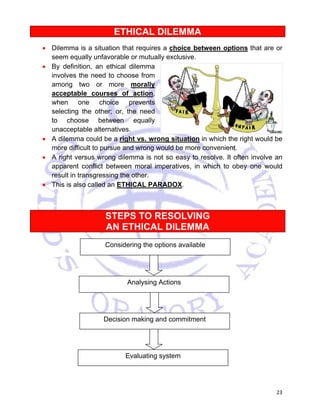
• Dilemma is a situation that requires a choice between options that are or 
seem equally unfavorable or mutually exclusive. 
• By definition, an ethical dilemma 
involves the need to choose from 
among two or more morally 
acceptable courses of action, 
when one choice prevents 
selecting the other; or, the need 
to choose between equally 
unacceptable alternatives. 
• A dilemma could be a right vs. wrong situation in which the right would be 
more difficult to pursue and wrong would be more convenient. 
• A right versus wrong dilemma is not so easy to resolve. It often involve an 
apparent conflict between moral imperatives, in which to obey one would 
result in transgressing the other. 
• This is also called an ETHICAL PARADOX. 
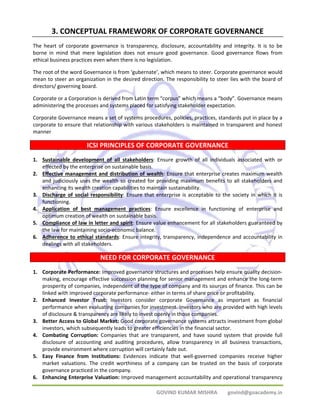
STEPS TO RESOLVING 
AN ETHICAL DILEMMA 
Considering the options available 
Analysing Actions 
Decision making and commitment 
Evaluating system
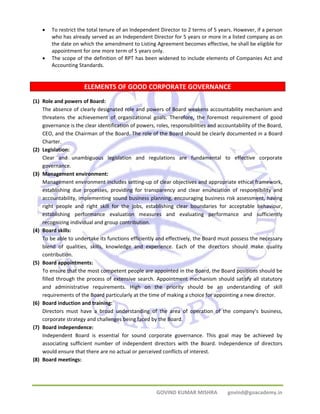
3. CONCEPTUAL FRAMEWORK OF CORPORATE GOVERNANCE 
The heart of corporate governance is transparency, disclosure, accountability and integrity. It is to be 
borne in mind that mere legislation does not ensure good governance. Good governance flows from 
ethical business practices even when there is no legislation. 
The root of the word Governance is from ‘gubernate’, which means to steer. Corporate governance would 
mean to steer an organization in the desired direction. The responsibility to steer lies with the board of 
directors/ governing board. 
Corporate or a Corporation is derived from Latin term “corpus” which means a “body”. Governance means 
administering the processes and systems placed for satisfying stakeholder expectation. 
Corporate Governance means a set of systems procedures, policies, practices, standards put in place by a 
corporate to ensure that relationship with various stakeholders is maintained in transparent and honest 
manner 
ICSI PRINCIPLES OF CORPORATE GOVERNANCE 
1. Sustainable development of all stakeholders: Ensure growth of all individuals associated with or 
GOVIND KUMAR MISHRA govind@goacademy.in 
effected by the enterprise on sustainable basis. 
2. Effective management and distribution of wealth: Ensure that enterprise creates maximum wealth 
and judiciously uses the wealth so created for providing maximum benefits to all stakeholders and 
enhancing its wealth creation capabilities to maintain sustainability. 
3. Discharge of social responsibility: Ensure that enterprise is acceptable to the society in which it is 
functioning. 
4. Application of best management practices: Ensure excellence in functioning of enterprise and 
optimum creation of wealth on sustainable basis. 
5. Compliance of law in letter and spirit: Ensure value enhancement for all stakeholders guaranteed by 
the law for maintaining socio‐economic balance. 
6. Adherence to ethical standards: Ensure integrity, transparency, independence and accountability in 
dealings with all stakeholders. 
NEED FOR CORPORATE GOVERNANCE 
1. Corporate Performance: Improved governance structures and processes help ensure quality decision‐making, 
encourage effective succession planning for senior management and enhance the long‐term 
prosperity of companies, independent of the type of company and its sources of finance. This can be 
linked with improved corporate performance‐ either in terms of share price or profitability. 
2. Enhanced Investor Trust: Investors consider corporate Governance as important as financial 
performance when evaluating companies for investment. Investors who are provided with high levels 
of disclosure & transparency are likely to invest openly in those companies. 
3. Better Access to Global Market: Good corporate governance systems attracts investment from global 
investors, which subsequently leads to greater efficiencies in the financial sector. 
4. Combating Corruption: Companies that are transparent, and have sound system that provide full 
disclosure of accounting and auditing procedures, allow transparency in all business transactions, 
provide environment where corruption will certainly fade out. 
5. Easy Finance from Institutions: Evidences indicate that well‐governed companies receive higher 
market valuations. The credit worthiness of a company can be trusted on the basis of corporate 
governance practiced in the company. 
6. Enhancing Enterprise Valuation: Improved management accountability and operational transparency
fulfill investors’ expectations and confidence on management and corporations, and in return, 
increase the value of corporations. 
7. Reduced Risk of Corporate Crisis and Scandals: Effective Corporate Governance ensures efficient risk 
mitigation system in place. The transparent and accountable system that 
8. Accountability: Investor relations’ is essential part of good corporate governance. The company is 
obliged to make timely disclosures on regular basis to all its shareholders in order to maintain good 
investors’ relation. Good Corporate Governance practices create the environment where Boards 
cannot ignore their accountability to these stakeholders. 
EVIDENCE OF CORPORATE GOVERNANCE FROM THE ARTHASHASTRA 
Kautilya’s Arthashastra maintains that for good governance, all administrators, including the king 
were considered servants of the people. Good governance and stability were completely linked. If 
rulers are responsive, accountable, removable, recallable, there is stability. If not then, there is 
instability. 
Arthashastra talks self‐discipline for a king and the six enemies which a king should overcome – 
lust, anger, greed, conceit, arrogance and foolhardiness. In the present day context, this 
addresses the ethics aspect of businesses and the personal ethics of the corporate leaders. “ 
Duty of a king– 
• Raksha – literally means protection, in the corporate scenario it can be equated with the 
GOVIND KUMAR MISHRA govind@goacademy.in 
risk management aspect. 
• Vriddhi – literally means growth, in the present day context can be equated to 
stakeholder value enhancement 
• Palana – literally means maintenance/compliance, in the present day context it can be 
equated to compliance to the law in letter and spirit. 
• Yogakshema – literally means well being and in Kautilya’s Arthashastra it is used in 
context of a social security system. In the present day context it can be equated to 
corporate social responsibility. 
A king can reign only with the help of others; 
one wheel alone does not move a chariot. 
Therefore, a king should appoint advisors (as 
councilors and ministers) and listen to their 
advice.” There could be no stronger counsel 
relevant to modern day corporate governance 
structures for executive managements to heed 
the advice given by the non‐executive 
independent colleagues on the board of 
directors. 
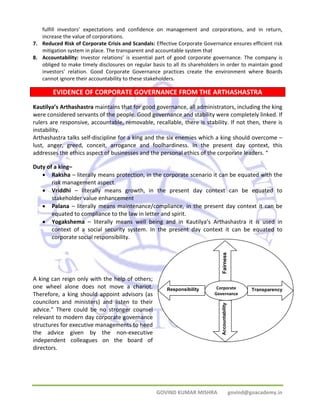
Corporate 
Governance 
Transparency 
Fairness 
Responsibility 
Accountability
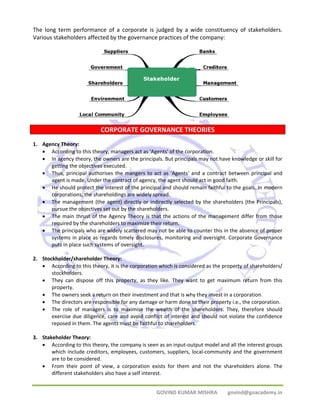
The long term performance of a corporate is judged by a wide constituency of stakeholders. 
Various stakeholders affected by the governance practices of the company: 
CORPORATE GOVERNANCE THEORIES 
GOVIND KUMAR MISHRA govind@goacademy.in 
1. Agency Theory: 
• According to this theory, managers act as 'Agents' of the corporation. 
• In agency theory, the owners are the principals. But principals may not have knowledge or skill for 
getting the objectives executed. 
• Thus, principal authorises the mangers to act as 'Agents' and a contract between principal and 
agent is made. Under the contract of agency, the agent should act in good faith. 
• He should protect the interest of the principal and should remain faithful to the goals. In modern 
corporations, the shareholdings are widely spread. 
• The management (the agent) directly or indirectly selected by the shareholders (the Principals), 
pursue the objectives set out by the shareholders. 
• The main thrust of the Agency Theory is that the actions of the management differ from those 
required by the shareholders to maximize their return. 
• The principals who are widely scattered may not be able to counter this in the absence of proper 
systems in place as regards timely disclosures, monitoring and oversight. Corporate Governance 
puts in place such systems of oversight. 
2. Stockholder/shareholder Theory: 
• According to this theory, it is the corporation which is considered as the property of shareholders/ 
stockholders. 
• They can dispose off this property, as they like. They want to get maximum return from this 
property. 
• The owners seek a return on their investment and that is why they invest in a corporation. 
• The directors are responsible for any damage or harm done to their property i.e., the corporation. 
• The role of managers is to maximise the wealth of the shareholders. They, therefore should 
exercise due diligence, care and avoid conflict of interest and should not violate the confidence 
reposed in them. The agents must be faithful to shareholders. 
3. Stakeholder Theory: 
• According to this theory, the company is seen as an input‐output model and all the interest groups 
which include creditors, employees, customers, suppliers, local‐community and the government 
are to be considered. 
• From their point of view, a corporation exists for them and not the shareholders alone. The 
different stakeholders also have a self interest.
• The managers and the corporation are responsible to mediate between these different 
GOVIND KUMAR MISHRA govind@goacademy.in 
stakeholders interest. 
• This theory assumes that stakeholders are capable and willing to negotiate and bargain with one 
another. 
• The role of shareholders is reduced in the corporation. But they should also work to make their 
interest compatible with the other stake holders. 
• This requires integrity and managers play an important role here. They are faithful agents but of 
all stakeholders, not just stockholders. 
4. Stewardship Theory: 
• The word 'steward' means a person who manages another's property or estate. 
• Here, the word is used in the sense of guardian in relation to a corporation, this theory is value 
based. 
• The managers and employees are to safeguard the resources of corporation and its property and 
interest when the owner is absent. They are like a caretaker. 
• They have to take utmost care of the corporation. They should not use the property for their 
selfish ends. 
• This theory thus makes use of the social approach to human nature. The managers should manage 
the corporation as if it is their own corporation. 
• They are not agents as such but occupy a position of stewards. 
• The managers are motivated by the principal’s objective and the behavior pattern is collective, 
pro‐organizational and trustworthy. 
• Thus, under this theory, first of all values as standards are identified and formulated. 
• Second step is to develop training programmes that help to achieve excellence. Thirdly, moral 
support is important to fill any gaps in values. 
CORPORATE GOVERNANCE – DEVELOPMENTS IN INDIA 
(1) Confederation of Indian Industry (CII)‐ Desirable Corporate Governance: A Code 
CII took a special initiative on Corporate Governance, the first institution initiative in Indian Industry. The 
objective was to develop and promote a code for Corporate Governance to be adopted and followed by 
Indian companies, whether in the Private Sector, the Public Sector, Banks or Financial Institutions, all of 
which are corporate entities. The final draft of the said Code was widely circulated in 1997. In April 1998, 
the Code was released. It was called Desirable Corporate Governance: 
Recommendation I 
The full board should meet a minimum of six times a year, preferably at an interval of two months, and 
each meeting should have agenda items that require at least half a day’s discussion. 
Recommendation II 
Any listed company with a turnover of Rs.100 crores and above should have professionally competent, 
independent, non‐executive directors, who should constitute: 
• atleast 30 per cent of the board if the Chairman of the company is a non‐executive director, or 
• atleast 50 per cent of the board if the Chairman and Managing Director is the same person. 
Recommendation III 
No single person should hold directorships in more than 10 listed companies.
Recommendation IV 
For non‐executive directors to play a material role in corporate decision making and maximising long term 
shareholder value, they need to: 
GOVIND KUMAR MISHRA govind@goacademy.in 
• become active participants in boards, 
• have clearly defined responsibilities 
• know how to read financial statements. 
Recommendation V 
To secure better effort from non‐executive directors companies should: 
• Pay a commission over and above the sitting fees for the use of the professional inputs. 
• Consider offering stock options, so as to relate rewards to performance. Commissions are rewards 
on current profits. 
Recommendation VI 
While re‐appointing members of the board, companies should give the attendance record of the 
concerned directors. 
Recommendation VII 
Key information that must be reported to, and placed before, the board 
• Annual operating plans and budgets; 
• Budgets; 
• Quarterly results; 
• Internal audit reports; 
• Show cause, demand and prosecution notices; 
• Default in payment of interest or non‐payment of the principal; 
• Defaults such as non‐payment of inter‐corporate deposits; 
• Any issue which involves possible public or product liability claims; 
• Details of any joint venture or collaboration agreement; 
• Labour problems and their proposed solutions; 
• Quarterly details of foreign exchange exposure; 
• Recruitment and remuneration of senior officers 
Recommendation VIII 
• Listed companies with either a turnover of over Rs.100 crores or a paid‐up capital of Rs. 20 crores 
should set up Audit Committees within two years. 
• Composition: at least three members, all drawn from a company’s non‐executive directors. 
• To be effective, the Audit Committees should have clearly defined Terms of Reference. 
• Audit Committees should assist the board in fulfilling its functions. 
• Audit Committees should periodically interact with the statutory auditors and the internal 
auditors. 
• Management to ensure that members of the committee have full access to financial data 
Recommendation IX 
Under “Additional Shareholder’s Information”, listed companies should give data on: 
• High and low monthly averages of share prices in a major Stock Exchange. 
• Statement on value added, which is total income minus the cost of all inputs and administrative
GOVIND KUMAR MISHRA govind@goacademy.in 
expenses. 
• Greater detail on business segments, up to 10% of turnover, giving share in sales revenue, review 
of operations, analysis of markets and future prospects. 
Recommendation X 
Consolidation of Group Accounts should be optional and subject to: 
• The FIs allowing companies to leverage on the basis of the group’s assets, and 
• The Income‐tax Department using the group concept in assessing corporate income‐tax. 
• If a company chooses to voluntarily consolidate, it should not be necessary to annex the accounts 
of its subsidiary companies. 
• However, if a company consolidates, then the definition of “group” should include the parent 
company and its subsidiaries. 
Recommendation XI 
Major Indian stock exchanges should gradually insist upon a compliance certificate, signed by the CEO and 
the CFO. 
Recommendation XII 
For all companies with paid‐up capital of Rs. 20 crores or more, the quality and quantity of disclosure that 
accompanies a GDR issue should be the norm for any domestic issue. 
Recommendation XIII Funding 
Recommendation XIV Nominee Director 
Recommendation XV Disclosure of Ratings 
Recommendation XVI Default on fixed deposits by company 
2. KUMAR MANGALAM BIRLA COMMITTEE (2000) 
The Securities and Exchange Board of India (SEBI) had set up a Committee under the Chairmanship of 
Kumar Mangalam Birla to promote and raise standards of corporate governance. The Report of the 
committee was the first formal and comprehensive attempt to evolve a Code of Corporate Governance, in 
the context of prevailing conditions of governance in Indian companies, as well as the state of capital 
markets at that time. 
The recommendations of the Report, led to inclusion of Clause 49 in the Listing Agreement in the year 
2000. 
SUMMARY OF THE REPORT 
• The Board should have an optimum combination of Executive and Non Executive Directors with not 
less than 50 per cent of the Board consisting of non‐executive directors. 
• In the case of Non‐executive Chairman, at least one‐third of the Board should consist of independent 
directors and in the case of an executive Chairman, at least half of the Board should consist of 
independent directors. 
• Board meetings should be held at least four times in a year, with a maximum time gap of four months 
between any two meetings. 
• A director should not be a member in more than 10 committees or act as Chairman of more than five 
committees across all companies in which he is a director. 
• Financial Institutions should appoint nominee directors on a selective basis and nominee director 
should have the same responsibility as any other director of the company. 
• Non‐executive Chairman should be entitled to maintain Chairman's office at the expense of the 
company and also allowed reimbursement of expenses incurred in performance of his duties. 
AUDIT COMMITTEE
Qualified and independent audit committee should be set up by the board of a company 
Composition 
¾ the audit committee should have minimum three members, all being non‐executive directors, 
with the majority being independent, and with at least one director having financial and 
accounting knowledge; 
¾ the chairman of the committee should be an independent director; 
¾ the chairman should be present at Annual General Meeting to answer shareholder queries; 
¾ the Company Secretary should act as the secretary to the committee. 
GOVIND KUMAR MISHRA govind@goacademy.in 
Frequency of Meeting 
¾ The audit committee should meet at least thrice a year. One meeting must be held before 
finalization of annual accounts and one necessarily every six months. 
Quorum 
¾ The quorum should be either two members or one‐third of the members of the audit committee, 
whichever is higher and there should be a minimum of two independent directors. 
Powers of Audit Committee 
¾ To investigate any activity within its terms of reference. 
¾ To seek information from any employee. 
¾ To obtain outside legal or other professional advice. 
¾ To secure attendance of outsiders with relevant expertise, if it considers necessary. 
Functions of the Audit Committee 
¾ Recommending the appointment and removal of external auditor, fixation of audit fee and also 
approval for payment for any other services. 
¾ Reviewing with management the annual financial statements before submission to the board 
REMUNERATION COMMITTEE 
• Remuneration Committee should comprise of at least three directors, all of whom should be non‐executive 
directors, the chairman of committee being an independent director. 
• All the members of the remuneration committee should be present at the meeting. These 
recommendations are non mandatory. 
• The board of directors should decide the remuneration of non‐executive directors. 
• The Corporate Governance section of the Annual Report should make disclosures about remuneration 
paid to Directors. 
• Shareholders/Investors' Grievance Committee of Directors. 
• General Body Meetings ‐ Details of last three AGMs should be furnished. 
• Disclosures ‐ Details of non‐compliance by the company including penalties and strictures imposed by 
the Stock Exchanges, SEBI or any statutory authority on any matter related to capital markets during 
the last three years must be disclosed to the shareholders. 
• General shareholder information ‐ Various specified matters of interest to be included in the Annual 
Report. 
• Auditor's Certificate on Corporate Governance. 
• Companies should consolidated accounts in respect of all subsidiaries in which they hold 51 per cent 
or more of the capital. 
• Information like quarterly results, presentation made by companies to analysts may be put on 
company’s. 
• A board committee under the chairmanship of a non‐executive director should be formed to 
specifically look into the redressing of shareholder complaints like transfer of shares, non‐receipt of 
balance sheet, non‐receipt of declared dividends etc. 
• Half‐yearly declaration of financial performance.
3. NARESH CHANDRA COMMITTEE (2002) 
Naresh Chandra Committee was appointed to examine and recommend inter alia amendments to the law 
involving the auditor‐client relationships and the role of independent directors. 
Recommendation 2.1: Disqualifications for audit assignments 
• Prohibition of any direct financial interest in the audit client; 
• Prohibition of receiving any loans and/or guarantees from or on behalf of the audit client; 
• Prohibition of personal relationships; 
• Prohibition of service or cooling off period; 
• Prohibition of undue dependence on an audit client. 
Recommendation 2.2: List of prohibited non‐audit services 
The Committee recommends that the following services should not be provided by an audit firm to any 
audit client: 
• Accounting and bookkeeping services, related to the accounting records or financial statements of 
GOVIND KUMAR MISHRA govind@goacademy.in 
the audit client. 
• Internal audit services. 
• Financial information systems design and implementation, including services related to IT systems 
for preparing financial or management accounts and information flows of a company. 
• Actuarial services. 
• Broker, dealer, investment adviser or investment banking services. 
• Outsourced financial services. 
• Management functions, including the provision of temporary staff to audit clients. 
• Any form of staff recruitment, and particularly hiring of senior management staff for the audit 
client. 
• Valuation services and fairness opinion. 
Recommendation 2.4: Compulsory Audit Partner Rotation 
Recommendation 2.5: Auditor’s disclosure of contingent liabilities 
Recommendation 2.6: Auditor’s disclosure of qualifications and consequent action 
Recommendation 2.7: Management’s certification in the event of auditor’s replacement 
Recommendation 2.8: Auditor’s annual certification of independence 
Recommendation 2.9: Appointment of auditors 
Recommendation 2.10: CEO and CFO certification of annual audited accounts: 
• For all listed companies as well as public limited companies whose paid‐up capital and free 
reserves exceeds Rs.10 crore, or turnover exceeds Rs.50 crore, there should be a certification by 
the CEO (either the Executive Chairman or the Managing Director) and the CFO (whole‐time 
Finance Director or otherwise) 
Recommendation 3.1: Setting up of independent Quality Review Board 
Recommendation 4.1: Defining an independent director 
Recommendation 4.2: Percentage of independent directors 
• Not less than 50 per cent of the board of directors of any listed company, as well as unlisted public 
limited companies with a paid‐up share capital and free reserves of Rs.10 crore and above, or 
turnover of Rs.50 crore and above, should consist of independent directors. 
• However, this will not apply to: (1) unlisted public companies, which have no more than 50 
shareholders and which are without debt of any kind from the public, banks, or financial 
institutions, as long as they do not change their character, (2) unlisted subsidiaries of listed 
companies. Nominee directors will be excluded both from the numerator and the denominator.
Recommendation 4.3: Minimum board size of listed companies 
• The minimum board size of all listed companies, as well as unlisted public limited companies with 
a paid‐up share capital and free reserves of Rs.10 crore and above, or turnover of Rs.50 crore and 
above should be seven — of which at least four should be independent directors. 
• However, this will not apply to: (1) unlisted public companies, which have no more than 50 
shareholders and which are without debt of any kind from the public, banks, or financial 
institutions, as long as they do not change their character, (2) unlisted subsidiaries of listed 
companies. 
Recommendation 4.4: Disclosure on duration of board meetings/Committee meetings 
Recommendation 4.5: Tele‐conferencing and video conferencing 
Recommendation 4.6: Additional disclosure to directors 
Recommendation 4.7: Independent directors on Audit Committees of listed companies 
Recommendation 4.9: Remuneration of non‐executive directors 
Recommendation 4.10: Exempting non‐executive directors from certain liabilities 
Recommendation 4.11: Training of independent directors 
4. N.R. NARAYANA MURTHY COMMITTEE (2003) 
In the year 2002, SEBI constituted a Committee under the Chairmanship of Shri N.R. Narayana Murthy, for 
reviewing implementation of the corporate governance code by listed companies and for issue of revised 
clause 49 based on its recommendations. 
• Audit committees of publicly listed companies should be required to review the following 
GOVIND KUMAR MISHRA govind@goacademy.in 
information mandatorily: 
¾ Financial statements and draft audit report, including quarterly/half yearly financial 
information; 
¾ Management discussion and analysis of financial condition and results of operations; 
¾ Reports relating to compliance with laws and to risk management; 
¾ Management letters/letters of internal control weaknesses issued by statutory/internal 
auditors; and 
¾ Records of related party transactions. 
• All audit committee members should be “financially literate” and at least one member should 
have accounting or related financial management expertise. 
• In case a company has followed a treatment different from that prescribed in an accounting 
standard, management should give disclosure. 
• Companies should be encouraged to move towards a regime of unqualified financial statements. 
• A statement of all transactions with related parties including their bases should be placed before 
the independent audit committee for formal approval/ratification. 
• To inform Board members about the risk assessment and minimization procedures. 
• Management should place a report before the entire Board of Directors every quarter 
documenting the business risks faced by the company, measures to address and minimize such 
risks, and any limitations to the risk taking capacity of the corporation. 
• Companies raising money through an Initial Public Offering (“IPO”) should disclose to the Audit 
Committee, the uses/applications of funds. 
• This statement should be certified by the Independent auditors of the company. 
• It should be obligatory for the Board of a company to lay down the code of conduct for all Board 
members and senior management of a company. 
• There shall be no nominee directors. 
• All compensation paid to non‐executive directors may be fixed by the Board of Directors and
should be approved by shareholders in general meeting. 
• Companies should publish their compensation philosophy and statement of entitled 
compensation in respect of non‐executive directors in their annual report or put up on the 
company’s website and reference drawn thereto in the annual report. 
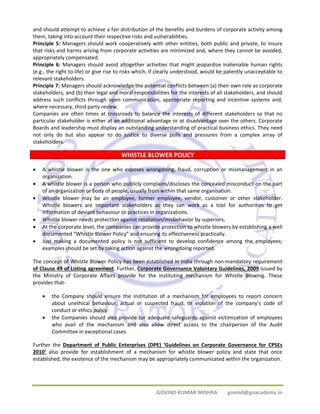
• The term “independent director” is defined as a non‐executive director of the company who: 
¾ apart from receiving director remuneration, does not have any material pecuniary 
relationships or transactions with the company, its promoters, its senior management or 
its holding company, its subsidiaries and associated companies; 
¾ is not related to promoters or management at the board level or at one level below the 
GOVIND KUMAR MISHRA govind@goacademy.in 
board; 
¾ has not been an executive of the company in the immediately preceding three financial 
years; 
¾ is not a partner or an executive of the statutory audit firm or the internal audit firm that is 
associated with the company, and has not been a partner or an executive of any such firm 
for the last three years. This will also apply to legal firm(s) and consulting firm(s) that have 
a material association with the entity. 
¾ is not a supplier, service provider or customer of the company. This should include lessor‐lessee 
type relationships also; and 
¾ is not a substantial shareholder of the company, i.e. owning two per cent or more of the 
block of voting shares. 
• The considerations as regards remuneration paid to an independent director shall be the same as 
those applied to a non‐executive director. 
• Personnel who observe an unethical or improper practice (not necessarily a violation of law) 
should be able to approach the audit committee without necessarily informing their supervisors. 
• Companies shall annually affirm that they have not denied any personnel access to the audit 
committee of the company (in respect of matters involving alleged misconduct) and that they 
have provided protection to “whistle blowers” from unfair termination and other unfair or 
prejudicial employment practices. 
• The provisions relating to the composition of the Board of Directors of the holding company 
should be made applicable to the composition of the Board of Directors of subsidiary companies. 
¾ At least one independent director on the Board of Directors of the parent company shall 
be a director on the Board of Directors of the subsidiary company. 
¾ The Audit Committee of the parent company shall also review the financial statements, in 
particular the investments made by the subsidiary company. 
¾ The minutes of the Board meetings of the subsidiary company shall be placed for review 
at the Board meeting of the parent company. 
• The performance evaluation of non‐executive directors should be by a peer group comprising the 
entire Board of Directors, excluding the director being evaluated; and Peer group evaluation 
should be the mechanism to determine whether to extend/continue the terms of appointment of 
nonexecutive directors. 
• SEBI should make rules for the following: 
¾ Disclosure in the report issued by a security analyst whether the company that is being 
written about is a client of the analyst’s employer or an associate of the analyst’s 
employer, and the nature of services rendered to such company, if any; 
¾ Disclosure in the report issued by a security analyst whether the analyst or the analyst’s 
¾ employer or an associate of the analyst’s employer hold or held (in the 12 months 
immediately preceding the date of the report) or intend to hold any debt or equity 
instrument in the issuer company that is the subject matter of the report of the analyst.
CORPORATE GOVERNANCE THROUGH LISTING AGREEMENT 
Corporate Governance 
SEBI appointed the Committee on Corporate Governance on May 7, 1999 under the Chairmanship of Shri 
Kumar Mangalam Birla, to promote and raise the standards of Corporate Governance. The Committee’s 
primary aim was to: 
(i). to suggest suitable amendments to the listing agreement executed by the stock exchanges 
with the companies and any other measures to improve the standards of corporate 
governance in the listed companies; 
(ii). to draft a code of corporate best practices; and 
(iii). to suggest safeguards to be instituted within the companies to deal with insider information 
Accountability Transparency Equal treatment to all 
stakeholders 
GOVIND KUMAR MISHRA govind@goacademy.in 
and insider trading. 
The report also identified key constituents’ roles, responsibilities and rights in the context of good 
corporate governance. It recognized three major aspects of corporate governance. 
Considering the recommendations of the report SEBI incorporated Clause 49 to the listing agreement in 
February 2000. SEBI, as part of its endeavour to improve the standards of corporate governance in line 
with the needs of a dynamic market has amended the Clause 49 from time to time. 
SEBI vide its circular No. CIR/CFD/POLICY CELL /2/2014 dated April 17, 2014 came out with Corporate 
Governance in listed entities ‐ Amendments to Clause 49 of the Equity Listing Agreement which lays down 
the detailed corporate governance norms for listed companies providing for stricter disclosures and 
protection of investor rights, including equitable treatment for minority and foreign shareholders. 
The new norms are aligned with the Companies Act, 2013 and are aimed to encourage companies to 
adopt best practices on corporate governance. The highlights of the revised Clause 49 are as follows: 
• Exclusion of nominee Director from the definition of Independent Director. 
• At least one woman director on the Board of the company. 
• Compulsory whistle blower mechanism. 
• Expanded role of Audit Committee. 
• Prohibition of stock options to Independent Directors. 
• Separate meeting of Independent Directors. 
• Constitution of Stakeholders Relationship Committee. 
• Enhanced disclosure of remuneration policies. 
• Performance evaluation of Independent Directors and the Board of Directors. 
• Prior approval of Audit Committee for all material Related Party Transactions (RPTs) 
• Approval of all material RPTs by shareholders through special resolution with related parties 
abstaining from voting. 
• Mandatory constitution of Nomination and Remuneration Committee. Chairman of the said 
committees shall be independent. 
• The maximum number of Boards an independent director can serve on listed companies be 
restricted to 7 and 3 in case the person is serving as a whole time director in a listed company.
• To restrict the total tenure of an Independent Director to 2 terms of 5 years. However, if a person 
who has already served as an Independent Director for 5 years or more in a listed company as on 
the date on which the amendment to Listing Agreement becomes effective, he shall be eligible for 
appointment for one more term of 5 years only. 
• The scope of the definition of RPT has been widened to include elements of Companies Act and 
GOVIND KUMAR MISHRA govind@goacademy.in 
Accounting Standards. 
ELEMENTS OF GOOD CORPORATE GOVERNANCE 
(1) Role and powers of Board: 
The absence of clearly designated role and powers of Board weakens accountability mechanism and 
threatens the achievement of organizational goals. Therefore, the foremost requirement of good 
governance is the clear identification of powers, roles, responsibilities and accountability of the Board, 
CEO, and the Chairman of the Board. The role of the Board should be clearly documented in a Board 
Charter. 
(2) Legislation: 
Clear and unambiguous legislation and regulations are fundamental to effective corporate 
governance. 
(3) Management environment: 
Management environment includes setting‐up of clear objectives and appropriate ethical framework, 
establishing due processes, providing for transparency and clear enunciation of responsibility and 
accountability, implementing sound business planning, encouraging business risk assessment, having 
right people and right skill for the jobs, establishing clear boundaries for acceptable behaviour, 
establishing performance evaluation measures and evaluating performance and sufficiently 
recognizing individual and group contribution. 
(4) Board skills: 
To be able to undertake its functions efficiently and effectively, the Board must possess the necessary 
blend of qualities, skills, knowledge and experience. Each of the directors should make quality 
contribution. 
(5) Board appointments: 
To ensure that the most competent people are appointed in the Board, the Board positions should be 
filled through the process of extensive search. Appointment mechanism should satisfy all statutory 
and administrative requirements. High on the priority should be an understanding of skill 
requirements of the Board particularly at the time of making a choice for appointing a new director. 
(6) Board induction and training: 
Directors must have a broad understanding of the area of operation of the company’s business, 
corporate strategy and challenges being faced by the Board. 
(7) Board independence: 
Independent Board is essential for sound corporate governance. This goal may be achieved by 
associating sufficient number of independent directors with the Board. Independence of directors 
would ensure that there are no actual or perceived conflicts of interest. 
(8) Board meetings:
Directors must devote sufficient time and give due attention to meet their obligations. Attending 
Board meetings regularly and preparing thoroughly before entering the Boardroom increases the 
quality of interaction at Board meetings. 
GOVIND KUMAR MISHRA govind@goacademy.in 
(9) Code of conduct: 
It is essential that the organization’s explicitly prescribed norms of ethical practices and code of 
conduct are communicated to all stakeholders and are clearly understood and followed by each 
member of the organization. Systems should be in place to periodically measure, evaluate and if 
possible recognise the adherence to code of conduct. 
(10) Strategy setting: 
The objectives of the company must be clearly documented in a long‐term corporate strategy 
including an annual business plan together with achievable and measurable performance targets 
and milestones. 
(11) Business and community obligations: 
Though basic activity of a business entity is inherently commercial yet it must also take care of 
community’s obligations. 
(12) Financial and operational reporting: 
The reports and information provided by the management must be comprehensive but not so 
extensive and detailed as to hamper comprehension of the key issues. The reports should be 
available to Board members well in advance to allow informed decision‐making. Reporting should 
include status report about the state of implementation to facilitate the monitoring of the progress 
of all significant Board approved initiatives. 
(13) Monitoring the Board performance: 
The Board must monitor and evaluate its combined performance and also that of individual 
directors at periodic intervals, using key performance indicators besides peer review. The Board 
should establish an appropriate mechanism for reporting the results of Board’s performance 
evaluation results. 
(14) Audit Committees: 
The Audit Committee is inter alia responsible for liaison with the management; internal and 
statutory auditors, reviewing the adequacy of internal control and compliance with significant 
policies and procedures, reporting to the Board on the key issues. The quality of Audit Committee 
significantly contributes to the governance of the company. 
(15) Risk management: 
Risk is an important element of corporate functioning and governance. There should be a clearly 
established process of identifying, analyzing and treating risks, which could prevent the company 
from effectively achieving its objectives. Appropriate control procedures in the form of a risk 
management plan must be put in place to manage risk throughout the organization.
LEGISLATIVE FRAMEWORK OF 
CORPORATE GOVERNANCE IN INDIA 
The heart of corporate governance is transparency, disclosure, accountability and integrity. Good 
governance flows from ethical business practices even when there is no legislation. Corporate 
governance is not just a legal concept, it is a governance concept, and it is something which has 
to come from within. However, one cannot have abstract concepts applicable to corporates at 
large and there lies the need for a legislative framework. 
Legal and regulatory framework of corporate governance in India is mainly covered under: 
GOVIND KUMAR MISHRA govind@goacademy.in 
• SEBI guidelines, 
• Listing Agreement and 
• Companies Act 2013, 
• Competition Act, 
• Consumer Protection laws, 
• Labour laws, 
• Environment laws, 
• Anti‐Money Laundering Laws, etc. 
One cannot have abstract concepts applicable to corporates at large and there lies the need for a 
legislative framework. In India, there exists a coordination mechanism among various functional 
regulators like: 
• Corporates (MCA) 
• Capital Market and Stock Exchanges (SEBI) 
• Money Market and Banking (RBI) 
• Insurance – Life and Non life (IRDA) 
• Communication (TRAI) 
• Foreign business (FIPB/SIA) 
• Imports and Exports (FEMA, DGFT) 
• Intermediaries, Banking Companies and Insurance business (FIU‐India Financial 
Intelligence Unit) 
• Listed companies, Stock brokers (Stock Exchanges) 
• Professions (Professional Institutes like ICSI, ICAI, ICAI (CMA) etc.) 
BOARD STRUCTURE 
Size Composition Number of 
Directorship 
Meetings of 
the Board 
Powers of 
the Board 
Section 
149 (1) 
Section 149(4); 
Rule 4 of the Companies (Appointment 
and Qualification of Directors) Rules, 2014; 
Proviso 2 to Section 149; 
Rule 3; Third proviso to Section 149; 
Clause 49(II)(A) of the Listing Agreement 
Section 165 Section 173 
Section 174 
Section 
179; Rule 8 
Section 180 
CHAPTER 4
SIZE OF THE BOARD 
Section 149 (1) of the Companies Act, 2013 contains provisions regarding the composition of 
board of directors. 
Minimum Number Of Director 
GOVIND KUMAR MISHRA govind@goacademy.in 
• Three in case of Public company, 
• Two in case of Private company and 
• One in case of One Person Company. 
Maximum Number = directors stipulated is 15. 
More than 15 directors = passing a Special Resolution in General Meeting. Approval of Central 
Government is not required. 
COMPOSITION 
Independent Director Woman Director Resident Director 
Section 149(4); 
Proviso 2 to Section 149; 
Rule 4 
Rule 3 
Third proviso to Section 149 
INDEPENDENT DIRECTOR = 1/3 
Section 149(4) provides that every public listed Company shall have at‐least one third (1/3) of 
total number of directors as independent directors and Central Government may further 
prescribe minimum number of independent directors in any class or classes of company. 
Rule 4 of the Companies (Appointment and Qualification of Directors) Rules, 2014: Following 
class or classes of companies shall have at least two independent directors: 
PUBLIC COMPANIES 
paid‐up share capital of 10 
crore rupees or more; 
turnover of 100 crore rupees 
or more; 
outstanding loans, debentures 
and deposits, exceeding 50 
crore rupees. 
Provided that in case of companies covered under this rule shall appoint a higher number of 
independent directors as required due to composition of its audit committee. 
WOMAN DIRECTOR 
Proviso 2 to Section 149 provides that such class or classes of companies as may be prescribed 
in Rules shall have at least ONE woman director. 
With regard to this, Rule 3 of the Companies (Appointment and Qualification of Directors) 
Rules, 2014 prescribes that the following class of companies shall have at least one woman 
director: 
Every Listed Company Every other Public Company having: 
• Paid‐up capital of 100 crore rupees or more; or 
• Turnover of 300 crore rupees or more.
RESIDENT DIRECTOR 
Third proviso to Section 149 provides that every company shall have at least ONE director 
who has stayed in India for a total period of not less than 182 days in the previous calendar year. 
Clause 49(II)(A) of the Listing Agreement provides that The Board of Directors of the company 
shall have an optimum combination of executive and non‐ executive directors with at least one 
woman director and not less than fifty percent of the Board of Directors comprising non‐executive 
GOVIND KUMAR MISHRA govind@goacademy.in 
directors. 
Clause 49(II)(A) of the Listing Agreement 
executive non‐ executive 
at least one woman director 
not less than fifty percent of the Board = non‐executive 
directors 
Clause 49 further provides that in case the Chairman of the board in a non –executive director, at 
least one third of the Board should comprise independent directors and in case the company 
does not have a regular non‐executive Chairman, at least half of the Board should comprise 
independent directors. 
Provided that where the regular non‐executive Chairman is a promoter of the company or is 
related to any promoter or person occupying management positions at the Board level or at one 
level below the Board, at least one‐half of the Board of the company shall consist of independent 
directors. 
CHAIRMAN 
Chairman of the board in a non –executive 
director 
At least one third of the Board independent 
director 
If does not have a regular non‐executive 
Chairman 
at least half of the Board independent director 
If regular non‐executive Chairman is a 
promoter or related to Board 
at least half of the Board independent director 
NUMBER OF DIRECTORSHIP 
¾ Section 165 stipulates that a person cannot hold office at the same time as director 
(including any alternate directorship) in more than 20 companies. 
¾ Provided that the maximum number of public companies in which a person can be appointed 
as a director shall not exceed ten. 
¾ For reckoning the limit of public companies in which a person can be appointed as director, 
directorship private companies that are either holding or subsidiary company of a public 
company shall be included. 
¾ The members of a company may, by special resolution, specify any lesser number of 
companies in which a director of the company may act as directors. 
¾ Clause 49 of the Listing Agreement provides that a director shall not be a member in more 
than ten committees or act as Chairman of more than five committees across all companies
GOVIND KUMAR MISHRA govind@goacademy.in 
in which he is a director. 
¾ Clause 49, also provides that a person shall not serve as an independent director in more 
than seven listed companies. 
¾ Further, any person who is serving as a whole time director in any listed company shall serve 
as an independent director in not more than three listed companies. 
MEETINGS OF THE BOARD 
¾ Section 173 of the Act deals with MEETINGS of the Board and Section 174 deals with 
QUORUM. 
¾ The FIRST BOARD MEETING should be held within thirty days of the date of incorporation. 
¾ There shall be a minimum of four Board meetings every year and not more one hundred and 
twenty days shall intervene between two consecutive Board meetings. 
¾ In case of ONE PERSON COMPANY (OPC), SMALL COMPANY and Dormant Company, at least 
one Board meeting should be conducted in each half of the calendar year and the gap 
between two meetings should not be less than Ninety days. 
¾ Not less than seven days’ notice in writing shall be given to every director at the registered 
address as available with the company. 
¾ The notice can be given by hand delivery or by post or by electronic means. 
¾ In case the Board meeting is called at shorter notice, at least one independent director shall 
be present at the meeting. 
¾ If independent director is not present, then decision of the meeting shall be circulated to all 
directors and it shall be final only after ratification of decision by at least one Independent 
Director. 
¾ One third of total strength or two directors, whichever is higher, shall be the QUORUM for a 
meeting. 
¾ For the purpose of determining the QUORUM, the participation by a director through Video 
Conferencing or other audio visual means shall also be counted. 
¾ Clause 49 of the Listing Agreement provides that the Board shall meet at least four times a 
year, with a maximum time gap of one hundred and twenty days between any two 
meetings. 
POWERS OF THE BOARD 
In terms Section 179 of the Companies Act, 2013 the Board of directors of a company shall be 
entitled to exercise all such powers, and to do all such acts and things, as the company is 
authorised to exercise and do. 
The Board shall not exercise any power which is to be exercised or done by the company in 
general meeting.
The banking company is not covered under the purview of this section. The company may impose 
restriction and conditions on the powers of the Board. 
The following (section 179(3) and Rule 8) powers of the Board of directors shall be exercised 
only by means of resolutions passed at meetings of the Board, namely:‐ 
(1) to make calls on shareholders in respect of money unpaid on their shares; 
(2) to authorise buy‐back of securities under section 68; 
(3) to issue securities, including debentures, whether in or outside India; 
(4) to borrow monies; 
(5) to invest the funds of the company; 
(6) to grant loans or give guarantee or provide security in respect of loans; 
(7) to approve financial statement and the Board’s report; 
(8) to diversify the business of the company; 
(9) to approve amalgamation, merger or reconstruction; 
(10) to take over a company or acquire a controlling or substantial stake in another 
GOVIND KUMAR MISHRA govind@goacademy.in 
company; 
(11) to make political contributions; 
(12) to appoint or remove key managerial personnel (KMP); 
(13) to take note of appointment(s) or removal(s) of one level below the Key Management 
Personnel; 
(14) to appoint internal auditors and secretarial auditor; 
(15) to take note of the disclosure of director’s interest and shareholding; 
(16) to buy, sell investments held by the company (other than trade investments), 
constituting five percent or more of the paid–up share capital and free reserves of the 
investee company; 
(17) to invite or accept or renew public deposits and related matters; 
(18) to review or change the terms and conditions of public deposit; 
(19) to approve quarterly, half yearly and annual financial statements or financial results as 
the case may be. 
The Board may, by a resolution passed at a meeting, DELEGATE the powers specified in (4) to (6) 
above to any 
• committee of directors, 
• the managing director, 
• the manager or 
• any other principal officer of the company or 
• in the case of a branch office of the company, the principal officer of the branch office. 
Section 180 provides that the board can exercise the following powers only with the consent of 
the company by SPECIAL RESOLUTION:– 
(a) to sell, lease or otherwise dispose of the whole or substantially the whole of the 
undertaking of the company or where the company owns more than one undertaking, of 
the whole or substantially the whole of any of such undertakings; 
(b) to invest otherwise in trust securities the amount of compensation received by it as a
GOVIND KUMAR MISHRA govind@goacademy.in 
result of any merger or amalgamation; 
(c) to borrow money, where the money to be borrowed, together with the money already 
borrowed by the company will exceed aggregate of its paid‐up share capital and free 
reserves, apart from temporary loans obtained from the company’s bankers in the 
ordinary course of business; 
(d) to remit, or give time for the repayment of, any debt due from a director. The special 
resolution relating to borrowing money exceeding paid up capital and free reserves 
specify the total amount up to which the money may be borrowed by Board. The title of 
buyer or the person who takes on lease any property, investment or undertaking on good 
faith cannot be affected and also in case if such sale or lease covered in the ordinary 
business of such company. The resolution may also stipulate the conditions of such sale 
and lease, but this doesn’t authorise the company to reduce its capital except the 
provisions contained in this Act. 
The debt incurred by the company exceeding the paid up capital and free reserves is not valid 
and effectual, unless the lender proves that the loan was advanced on good faith and also having 
no knowledge of limit imposed had been exceeded Powers of the Board are not spelt out in 
Listing Agreement. However, it provides for the responsibilities and functions of the board. 
BOARD COMMITTEES 
Audit 
Committees 
Section 177 
Clause 49 
Nomination and 
Remuneration 
Committees 
Section 178 
Clause 49 
Stakeholders 
Relationship 
Committee 
Section 178(5) 
Corporate Social 
Responsibility 
Committee 
Section 135 
AUDIT COMMITTEES 
Section 177 of the Companies Act, 2013 has enlarged the responsibilities of auditors to include 
monitoring of auditors’ independence, evaluation of their performance, approval of modification 
of related‐party transactions, scrutiny of loans and investments, valuation of assets and 
evaluation of internal controls and risk management. 
NOMINATION AND REMUNERATION COMMITTEES: 
The Nomination and Remuneration Committee helps the Board of Directors in the preparations 
relating to the election of members of the Board of Directors, handling matters within its scope of 
responsibility that relate to the conditions of employment and remuneration of senior 
management, to management’s and personnel’s remuneration and incentive schemes. The 
responsibilities of the Remuneration and Nomination Committee are defined in its policy 
document. Section 178 of the Act deals with provisions related to the aforementioned 
committee. Clause 49 of the Listing agreement also provides for mandatory constitution of 
Nomination and Remuneration Committee. 
STAKEHOLDERS RELATIONSHIP COMMITTEE 
Section 178(5) of the Companies Act, 2013 provides for constitution of the Stakeholders 
Relationship Committee. Further, under Listing Agreement, a committee under the Chairmanship
of a non‐executive director and such other members as may be decided by the Board of the 
company shall be formed to specifically look into the redressal of grievances of shareholders, 
debenture holders and other security holders. 
This Committee shall be designated as ‘Stakeholders Relationship Committee’ and shall consider 
and resolve the grievances of the security holders of the company including complaints related to 
transfer of shares, non‐receipt of balance sheet, non‐receipt of declared dividends. 
Clause 49 (VIII) (E) of the Listing Agreement provides that Stakeholders Relationship Committee, 
under the Chairmanship of non‐executive director shall be constituted to look into and redress 
the grievances of shareholders, debenture holders and other security holders. 
CORPORATE SOCIAL RESPONSIBILITY COMMITTEE 
Section 135 of the Companies Act, 2013 provides that companies specified in the said section 
shall constitute a Corporate Social Responsibility Committee (CSR Committee) of the Board. 
Further Listing Agreement also mandates the constitution of CSR committees for certain 
companies. 
DISCLOSURE AND TRANSPARENCY 
GOVIND KUMAR MISHRA govind@goacademy.in 
COMPANIES 
ACT, 2013 
MADE UNDER 
COMPANIES ACT, 
2013 
LISTING AGREEMENT SEBI REGULATIONS 
Disclosures 
Under Section 
134 
Disclosures 
Under other 
Sections 
• Companies 
(Accounts) Rules, 
2014 
• Companies( Share 
Capital and 
Debenture) Rules, 
2014 
• Companies 
(Appointment & 
Remuneration of 
Managerial 
Personnel) Rules, 
2014 
• Companies 
(Corporate Social 
Responsibility) 
Rules, 2014 
Clause 19 Clause 20 Clause 22 
Clause 29 Clause 30 Clause 31 
Clause 32 Clause 35 Clause 35 
Clause 35B Clause 36 Clause 
41 
Disclosures on mandatory 
requirements Clause49 (I) (C) 
• Related Party Transactions; 
• Disclosure of Accounting 
Treatment; 
• Remuneration of Directors; 
• Management; 
• Shareholders; 
• Disclosure of resignation of 
directors; 
• Disclosure of formal letter 
of appointment; 
• Disclosures in Annual 
report; 
• Securities and 
Exchange Board of 
India (Issue of 
Capital and 
Disclosure 
Requirements) 
Regulations, 2009; 
• Securities and 
Exchange Board of 
India (Substantial 
Acquisition of Shares 
and Takeovers) 
Regulations, 2011; 
• Securities and 
Exchange Board of 
India (Prohibition of 
Insider Trading) 
Regulations, 1992;
• Proceeds from public issues, 
rights issue, preferential 
issues, etc. ; 
• Report on Corporate 
Governance; 
• Disclosures on non‐mandatory 
requirements; 
• Clause 55 
1. IN TERMS OF COMPANIES ACT, 2013 
A. Disclosures U/Section 134 of Companies Act 2013 
Section 134(3): A Report by its Board of Directors shall be attached to statements laid 
before a company in general meeting, which shall include— 
(a) the extract of the Annual Return as provided under Section 92(3); 
(b) number of Meetings of the Board; 
(c) Directors’ Responsibility Statement; 
(d) a statement on declaration given by Independent Directors under section 149(6); 
(e) company covered under section 178(1), company’s policy on directors’ appointment and 
remuneration including criteria for determining qualifications, positive attributes, 
independence of a director and other matters as given under sub‐section (3) of section 
178; 
(f) explanations or comments by the Board on every qualification, reservation or adverse 
remark or disclaimer made— 
(i) by the auditor in his report; and 
(ii) by the company secretary in practice in his secretarial audit report. 
(g) particulars of loans, guarantees or investments u/section 186; 
(h) particulars of contracts or arrangements with related parties referred to in section 188(1) 
GOVIND KUMAR MISHRA govind@goacademy.in 
in the prescribed form. 
(i) the state of the company’s affairs. 
(j) the amounts, if any, which it proposes to carry to any Reserves; 
(k) the amount, if any, which it recommends should be paid by way of Dividend; 
(l) material changes and commitments, if any, affecting the financial position of the 
company which have occurred between the end of the financial year of the company to 
which the financial statements relate and the date of the report; 
(m)the conservation of energy, technology absorption, foreign exchange earnings and outgo, 
in such manner as may be prescribed; 
(n) a statement indicating development and implementation of a Risk Management policy; 
(o) the details about the policy developed and implemented by the company on Corporate 
Social Responsibility initiatives taken during the year;
(p) in case of a listed company and every other public company having such paid‐up share 
capital as may be prescribed, a statement indicating the manner in which formal annual 
evaluation has been made by the Board of its own performance and that of its 
committees and individual directors; 
(q) such other matters as may be prescribed. 
Section 134(5) referred in section 134(3)(c), (i.e. DRS) shall state that— 
(a) in the preparation of the annual accounts, the applicable accounting standards had been 
followed along with proper explanation relating to material departures; 
(b) the directors had selected such accounting policies and applied them consistently and 
made judgments and estimates that are reasonable and prudent so as to give a true and fair 
view of the state of affairs of the company at the end of the financial year and of the profit 
and loss of the company for that period; 
(c) the directors had taken proper and sufficient care for the maintenance of adequate 
accounting records in accordance with the provisions of this Act for safeguarding the assets 
of the company and for preventing and detecting fraud and other irregularities; 
(d) the directors had prepared the annual accounts on a going concern basis; and 
(e) the directors, in the case of a listed company, had laid down internal financial controls to 
be followed by the company and that such internal financial controls are adequate and 
were operating effectively. 
(f) the directors had devised proper systems to ensure compliance with the provisions of all 
applicable laws and that such systems were adequate and operating effectively. 
B. Disclosures Under other Sections of Companies Act 2013 
™ Proviso to Section 178(4) states that the Board’s Report shall disclose the policy according 
to which The Nomination and Remuneration Committee ensure that: 
(a) the level and composition of remuneration is reasonable and sufficient to attract, retain 
and motivate directors of the quality required to run the company successfully. 
(b) relationship of remuneration to performance is clear and meets appropriate performance 
GOVIND KUMAR MISHRA govind@goacademy.in 
benchmarks; and 
(c) Remuneration to directors, key managerial personnel and senior management involves a 
balance between fixed and incentive pay reflecting short and long‐term performance 
objectives appropriate to the working of the company and its goals. 
™ Section 149(10) an Independent Director shall be eligible to reappointment on passing of a 
special resolution and disclosure of such appointment in the board's report. 
™ Section 177(8), Board’s Report shall disclose the composition of audit committee and also 
discloses the recommendation of the audit committee which is not accepted by the board 
along with reason thereof.
™ Proviso to section 177(10) prescribes that the disclosure in board’s report includes the 
detail of establishment of vigil mechanism under section 177(9). 
™ Section 204(1) every listed company and other prescribed companies in Rule 9 Companies 
(Appointment & Remuneration of Managerial Personnel) Rules, 2014 shall annex the 
SECRETARIAL AUDIT report given by a Company Secretary in practice with Board’s Report. 
Board in its report shall explain any qualification or other remarks made by the Company 
Secretary in Practice. 
™ Section 135(2) provides that the Board's report u/section 134(3) shall disclose the 
composition of the Corporate Social Responsibility Committee. 
™ Section 134(8) states that if a company contravenes the provisions of this section, the 
company shall be punishable with fine which shall not be less than FIFTY THOUSAND rupees 
but which may extend to TWENTY‐FIVE lakhs rupees. 
Every officer of the company who is in default shall be punishable with imprisonment for a 
term which may extend to THREE YEARS or with fine which shall not be less than FIFTY 
THOUSAND rupees but which may extend to FIVE LAKHS RUPEES, or with both 
2. IN TERMS OF VARIOUS RULES MADE UNDER COMPANIES ACT, 2013 
GOVIND KUMAR MISHRA govind@goacademy.in 
A. Companies (Accounts) Rules, 2014 
As per Rule 8 following matters to be disclose in the Board’s Report:‐ 
(1) The Board’s Report shall be prepared based on the stand alone financial statements of the 
company and the report shall contain a separate section wherein a report on the 
performance and financial position of each of the subsidiaries, associates and joint 
venture companies included in the consolidated financial statement is presented. 
(2) The Report of the Board shall contain the particulars of contracts or arrangements with 
related parties referred to in section 188(1) in the Form AOC‐2. 
(3) The report of the Board shall contain the following information and details, namely:‐ 
(a) Conservation of energy‐ the capital investment on energy conservation equipments, 
The steps taken the steps taken for conservation of energy and utilising alternate 
sources of energy and the impact thereon. 
(b) Technology absorption‐ the efforts made towards technology absorption, expenditure 
incurred on R&D, the benefits derived, in case of imported technology; the details 
about year of import, absorption of technology imported. 
(c) Foreign exchange earnings and Outgo‐ actual inflows and outgo during the year. 
(4) Every listed company and every other public company having a paid up share capital of 
twenty five crore rupees or more calculated at the end of the preceding financial year 
shall include, in the report by its Board of directors, a statement indicating the manner in
which formal annual evaluation has been made by the Board of its own performance and 
that of its committees and individual directors. 
(5) In addition to the information and details specified in sub‐rule (4), the report of the Board 
shall also contain – 
(i) the financial summary or highlights; 
(ii) the change in the nature of business, if any; 
(iii) the details of directors or key managerial personnel who were appointed or have 
GOVIND KUMAR MISHRA govind@goacademy.in 
resigned during the year; 
(iv) the names of companies which have become or ceased to be its Subsidiaries, joint 
ventures or associate companies during the year; 
(v) the details relating to deposits, covered under Chapter V of the Act 
(vi) the details relating to deposits, not in compliance with Chapter V of the Act. 
(vii) the details of significant and material orders passed by the regulators or courts or 
tribunals impacting the going concern status and company’s operations in future. 
(viii) the details in respect of adequacy of internal financial controls with reference to 
the Financial Statements. 
B. Companies (Share Capital and Debenture) Rules, 2014 
The Board of Directors shall, inter alia, disclose details regarding issue of shares with 
differential rights in the Board’s Report for the financial year in which the issue of equity 
shares with differential rights was completed. 
As per sub rule (13) of rule 8 the Board of Directors shall, inter alia, disclose details about the 
issue of sweat equity shares in the Directors’ Report for the year in which such shares are 
issued. 
As per the rule 12(9) of Companies (Share Capital and Debenture) Rules 2014, the Board of 
directors, shall, inter alia, disclose details of the Employees Stock Option Scheme in the 
Directors’ Report for the year. 
When the voting rights are not exercised directly by the employees in respect of shares to 
which the scheme relates, the Board of Directors shall, inter alia, disclose in the Board’s 
report for the relevant financial year Disclosures shall be made in terms of Rule 16(4) 
Companies (Share Capital and Debentures) Rules, 2014. 
C. Companies (Corporate Social Responsibility) Rules, 2014 
Rule 8 of Companies (Corporate Social Responsibility) Rules, 2014 prescribes that the 
following CSR reporting:‐ 
i) The Board’s Report of a company under these rules pertaining to a financial year 
commencing on a or after 1st day of April, 2014 shall include an Annual Report on CSR 
containing particulars specified in Annexure. 
ii) In case of a foreign company, the balance sheet filed under section 381(1)(a) shall 
contain an Annexure regarding report on CSR.
3. IN TERMS OF LISTING AGREEMENT 
GOVIND KUMAR MISHRA govind@goacademy.in 
Clause 19 
A company is required: 
• to give prior intimation to the Stock Exchange about the Board Meeting at which 
proposal for Buyback of Securities, declaration/recommendation of Dividend or Rights or 
issue of convertible debentures or of debentures carrying a right to subscribe to equity 
shares or the passing over of dividend is due to be considered at least 2 working days in 
advance; 
• to give notice simultaneously to the Stock Exchanges in case the proposal for declaration 
of bonus is communicated to the Board of Directors of the company as part of the agenda 
papers. 
Clause 20 
The company will, immediately on the date of the meeting of its Board of Directors held to 
consider or decide the same, intimate to the Stock Exchange within 15 MINUTES of the closure 
of the Board Meetings by phone/fax/e‐mail. 
• all dividends and/or cash bonuses recommended or declared or the decision to pass any 
dividend or interest payment; 
• the total turnover, gross profit/loss, provision for depreciation, tax provisions and net 
profits for the year (with comparison with the previous year) and the amounts 
appropriated from reserves, capital profits, accumulated profits of past years or other 
special source to provide wholly or partly for the dividend, even if this calls for 
qualification that such information is provisional or subject to audit. 
• the decision on Buyback of Securities. 
Clause 22 
The Company will, immediately on the date of the meeting of its Board of Directors held to 
consider or decide the same, intimate to the Stock Exchange within 15 minutes of the closure of 
the Board Meetings by Letter/fax: 
• short particulars of any increase of capital whether by issue of bonus shares through 
capitalization, or by way of right shares to be offered to the shareholders or debenture 
holders, or in any other way; 
• short particulars of the reissue of forfeited shares or securities, or the issue of shares or 
securities held in reserve for future issue or the creation in any form or manner of new 
shares or securities or any other rights, privileges or benefits to subscribe to; 
• short particulars of any other alterations of capital, including calls; 
• any other information necessary to enable the holders of the listed securities of the 
Company to appraise its position and to avoid the establishment of a false market in such 
listed securities.
Clause 29 
The Company will promptly notify the Stock Exchange of any proposed change in the general 
character or nature of its business. 
Clause 30 
The Company will promptly notify the Stock Exchange: 
(a) of any change in the Company’s directorate by death, resignation, removal or otherwise; 
(b) of any change of Managing Director, Managing Agents or Secretaries and Treasures; 
(c) of any change of Auditors appointed to audit the books and accounts of the Company. 
Clause 31 
The Company will forward to the Stock Exchange promptly and without application: 
• SIX copies of the Statutory and Directors Annual Reports, Balance Sheets and Profit and 
Loss Accounts and of all periodical and special reports as soon as they are issued and one 
copy each to all the recognised stock exchanges in India; 
• SIX copies of all notices, resolutions and circulars relating to new issue of capital prior to 
GOVIND KUMAR MISHRA govind@goacademy.in 
their despatch to the shareholders; 
• THREE copies of all the notices, call letters or any other circulars including with 
Annexures thereto, at the same time as they are sent to the shareholders, debenture 
holders or creditors or any class of them or advertised in the Press. 
• copy of the proceedings at all Annual and Extraordinary General Meetings of the 
Company; 
• THREE copies of all notices, circulars, etc., issued or advertised in the press either by the 
company, or by any company which it proposes to absorb or with which the Company 
proposes to merge or amalgamate, or under orders of the court or any other statutory 
authority in connection with any merger, amalgamation, re‐construction, reduction of 
capital, scheme or arrangement, including notices, circulars, etc. issued or advertised in 
the press in regard to meetings of shareholders or debenture holders or creditors or any 
class of them and copies of the proceedings at all such meetings. 
Clause 32 
The Company shall supply: 
(i) Soft copies of full annual reports containing its Balance Sheet, Profit & Loss account and 
Directors Report to all those shareholder(s) who have registered their email address(es) 
for the purpose; 
(ii) Hard copy of statement containing the salient features of all the documents, as 
prescribed in section 136 of the Companies Act, 2013 to those shareholder(s) who have 
not so registered; 
(iii) Hard copies of full annual reports to those shareholders, who request for the same. 
The Company will also give a Cash Flow Statement along with Balance Sheet and Profit and Loss 
Account. The Cash Flow Statement will be prepared in accordance with the Accounting Standard 
on Cash Flow Statement (AS‐3) issued by the Institute of Chartered Accountants of India, and the
Cash Flow Statement shall be presented only under the Indirect Method as given in AS‐3. 
The company will mandatorily publish Consolidated Financial Statements in its Annual Report in 
addition to the individual financial statements. The company will have to get its Consolidated 
Financial Statements audited by the statutory auditors of the company and file the same with 
the Stock Exchange. Companies shall be required to make disclosures in compliance with the 
Accounting Standard or “Related Party Disclosures” in the Annual Report. 
Clause 35 
The company will file the Shareholding Pattern including of promoters group with the exchange, 
separately for each class of equity shares/security in the specified formats, in compliance with 
the following timelines:‐ 
(a) One day prior to listing of its securities on the stock exchanges. 
(b) On a quarterly basis, within 21 days from the end of each quarter. 
(c) Within 10 days of any capital restructuring of the company resulting in a change 
exceeding + ‐2% of the total paid‐up share capital. 
Clause 35A 
The company will submit to the stock exchange, within 48 hours of conclusion of its General 
Meeting, details regarding the voting results in the prescribed format. 
Clause 35B 
(i) The issuer (company) shall provide e‐voting facility to its shareholders, in respect of all 
shareholders' resolutions, to be passed at General Meetings or through postal ballot. 
Such e‐voting facility shall be kept open for such period specified under the Companies 
(Management and Administration) Rules, 2014 for shareholders to send their assent or 
dissent. 
(ii) Issuer shall continue to enable those shareholders, who do not have access to e‐voting 
facility, to send their assent or dissent in writing on a postal ballot as per the provisions 
of the Companies (Management and Administration) Rules, 2014 or amendments made 
thereto. 
(iii) Issuer shall utilize the service of any one of the agencies providing e‐voting platform, 
which is in compliance with conditions specified by the Ministry of Corporate Affairs, 
Government of India, from time to time. 
(iv) Issuer shall mention the Internet link of such e‐voting platform in the notice to their 
GOVIND KUMAR MISHRA govind@goacademy.in 
shareholders. 
Clause 36 
The Company will keep the Exchange informed of events such as strikes, lock‐outs, closure on 
account of power cuts, etc. and all events which will have a bearing on the performance / 
operations of the company as well as price sensitive information both at the time of occurrence 
of the event and subsequently after the cessation of the event in order to enable the 
shareholders and the public to appraise the position of the company and to avoid the 
establishment of a false market in its securities.
GOVIND KUMAR MISHRA govind@goacademy.in 
Clause 41 
UNAUDITED quarterly 
results 
AUDITED LAST QUARTER 
LIMITED REVIEW 45days 
from the end of the quarter. 
45 days of end of each quarter audited financial results ‐ 65 days 
of the end of the financial year 
The company has an option either to submit audited or unaudited quarterly and year to date 
financial results to the stock exchange within 45 days of end of each quarter (other than the last 
quarter). 
If the company decided to submit the UNAUDITED quarterly results then it shall be subjected to 
LIMITED REVIEW by the statutory auditors & in case of public sector undertakings, by practicing 
Chartered Accountant. Also, this shall be submitted to the exchange within 45days from the end 
of the quarter. 
In respect of the LAST QUARTER, the company shall submit audited financial results for the 
entire financial year within 65 days of the end of the financial year. 
The Quarterly Financial Results shall be: 
• Approved by the Board of Directors of the company or by a committee thereof, other 
than the audit committee. 
• The committee shall consist of not less than 1/3 of the directors and shall include the 
managing director and at least one independent director. 
• Submitted to the stock exchange within fifteen minutes of conclusion of the meeting. 
• Signed by the Chairman or Managing Director, or a Whole Time Director. In the absence 
of all of them, it shall be signed by any other director of the company who is duly 
authorized by the Board to sign the financial results. 
Clause 49 
SEBI requires Listed companies to include a separate report on Corporate Governance in their 
Annual Report by including Clause 49 in the Listing Agreement. The disclosures about Corporate 
Governance to be made in the Annual Report are as under: 
(1) Disclosures on mandatory requirements; 
(2) Disclosure on non‐mandatory requirements. 
DISCLOSURES ON MANDATORY REQUIREMENTS 
Clause49 (I) (C) of the Listing agreement provides for the Disclosure and Transparency 
The company should ensure timely and accurate disclosure on all material matters including the 
financial situation, performance, ownership, and governance of the company. 
A. Related Party Transactions 
B. Disclosure of Accounting Treatment 
C. Remuneration of Directors 
1. All pecuniary relationship or transactions of the non‐executive directors vis‐à‐vis the 
company shall be disclosed in the Annual Report.
2. In addition to the disclosures required under the Companies Act, 2013, the following 
disclosures on the remuneration of directors shall be made in the section on the 
corporate governance of the Annual Report: 
a) All elements of remuneration package of individual directors summarized under major 
groups, such as salary, benefits, bonuses, stock options, pension etc. 
b) Details of fixed component and performance linked incentives, along with the 
GOVIND KUMAR MISHRA govind@goacademy.in 
performance criteria. 
c) Service contracts, notice period, severance fees. 
d) Stock option details, if any ‐ and whether issued at a discount as well as the period 
over which accrued and over which exercisable. 
3. The company shall publish its criteria of making payments to non‐executive directors in 
its annual report. 
4. The company shall disclose the number of shares and convertible instruments held by 
non‐executive directors in the annual report. 
5. Non‐executive directors shall be required to disclose their shareholding (both own or 
held by / for other persons on a beneficial basis) in the listed company in which they are 
proposed to be appointed as directors, prior to their appointment. 
D. Management 
1. As part of the directors’ report or as an addition thereto, a Management Discussion and 
Analysis report should form part of the Annual Report. 
2. Senior management shall make disclosures to the board relating to all material financial 
and commercial transactions, where they have personal interest that may have a 
potential conflict with the interest of the company at large. 
3. The Code of Conduct for the Board of Directors and the senior management shall be 
disclosed on the website of the company. 
E. Shareholders 
1. In case of the appointment of a new director or re‐appointment of a director the 
shareholders must be provided with the following information: 
(a) A brief resume of the director; 
(b) Nature of his expertise in specific functional areas; 
(c) Names of companies in which the person also holds the directorship and the 
membership of Committees of the Board; and 
(d) Shareholding of non‐executive directors. 
2. Disclosure of relationships between directors inter‐se shall be made in the Annual 
Report, notice of appointment of a director, prospectus and letter of offer for issuances 
and any related filings made to the stock exchanges where the company is listed. 
3. A ‘Stakeholders Relationship Committee’ under the Chairmanship of a non‐executive 
director and other members formed to specifically look into the redressal of grievances of 
shareholders, debenture holders and other security holders. 
F. Disclosure of resignation of directors 
1. The company shall disclose the letter of resignation along with the detailed reasons of 
resignation provided by the director of the company on its website not later than one
working day from the date of receipt of the letter of resignation. 
2. The company shall also forward a copy of the letter of resignation along with the detailed 
reasons of resignation to the stock exchanges not later than one working day from the 
date of receipt of resignation for dissemination through its website. 
GOVIND KUMAR MISHRA govind@goacademy.in 
G. Disclosure of formal letter of appointment 
The letter of appointment of the independent director along with the detailed profile shall 
be disclosed on the websites of the company and the Stock Exchanges not later than one 
working day from the date of such appointment. 
H. Disclosures in Annual report 
1. The details of training imparted to Independent Directors. 
2. The details of establishment of vigil mechanism. 
3. remuneration policy and the evaluation criteria . 
I. Proceeds from public issues, rights issue, preferential issues, etc. 
1. When money is raised through an issue, the company shall disclose the uses / applications 
of funds by major category on a quarterly basis as a part of their quarterly declaration of 
financial results to the Audit Committee. 
2. On an annual basis, the company shall prepare a statement of funds utilized for purposes 
other than those stated in the offer document / prospectus / notice and place it before 
the audit committee. 
3. This statement shall be certified by the statutory auditors of the company. 
4. As per Clause 54 of the listing agreement the company shall maintain a functional website 
containing basic information about the company 
DISCLOSURES ON NON‐MANDATORY REQUIREMENTS 
These requirements may be implemented at the discretion of the company. However, the 
disclosures of the compliance with mandatory requirements and adoption/non‐adoption of the 
non‐mandatory requirements shall be made in the section on corporate governance of the 
Annual Report. 
1. The Board ‐ A non‐executive Chairman may be entitled to maintain a Chairman's office at 
the company's expense and also allowed reimbursement of expenses incurred in 
performance of his duties. 
2. Shareholder Rights‐ A half‐yearly declaration of financial performance including summary 
of the significant events in last six‐months, may be sent to each household of 
shareholders. 
3. Audit qualifications‐Company may move towards a regime of unqualified financial 
statements. 
4. Separate posts of Chairman and CEO ‐The company may appoint separate persons to the 
post of Chairman and Managing Director/CEO. 
5. Reporting of Internal Auditor‐The Internal auditor may report directly to the Audit 
Committee.
4. DISCLOSURES IN TERMS OF SEBI REGULATIONS 
A. Securities and Exchange Board of India (Issue of Capital and Disclosure 
GOVIND KUMAR MISHRA govind@goacademy.in 
Requirements) Regulations, 2009. 
1. Filing of offer document (Regulation 6) 
In case of a (a) a public issue; or (b) A right issue, where the aggregate value of the specified 
securities offered is 50 Lakh rupees or more, a draft offer document, along with fees, shall be 
filed with the SEBI through the lead merchant banker, at least 30 days prior to registering the 
prospectus, red herring prospectus or shelf prospectus with the Registrar of Companies or 
filing the letter of offer with the designated stock exchange, as the case may be. 
2. Copies of offer documents to be available to public (Regulation 61) 
3. Manner of disclosures in the offer document (Regulation 57) 
The offer document shall contain all material disclosures which are true and adequate so as 
to enable the applicants to take an informed investment decision. 
4. Pre‐issue advertisement for public issue (Regulation 47) 
5. Issue opening and issue closing advertisement for public issue (Regulation 48) 
6. Post‐ issue reports (Regulation 65) 
The lead merchant banker shall submit post‐issue reports to the Board as follows: 
(a) initial post issue report in specified format, within three days of closure of the issue 
(b) final post issue report in specified format, within fifteen days of the date of finalisation of 
basis of allotment or within fifteen days of refund of money in case of failure of issue. 
The lead merchant banker shall submit a due diligence certificate as per the format specified, 
along with the final post issue report. 
7. Post‐issue Advertisements (Regulation 66) 
B. Securities and Exchange Board of India (Substantial Acquisition of Shares and Takeovers) 
Regulations, 2011 
Disclosure of Acquisition and Disposal (Regulation 29) 
1. Any acquirer who acquires shares or voting rights in a target company (together with 
person acting in concert with him), aggregating to five per cent or more of the shares of 
such target company, shall disclose their aggregate shareholding and voting rights in such 
target company in specified format. 
2. Further, any person, who together with persons acting in concert with him, holds shares 
or voting rights entitling them to five per cent or more of the shares or voting rights in a 
target company, shall disclose the number of shares or voting rights held and subsequent 
change in shareholding or voting rights, even if such change results in shareholding falling 
below five per cent and such change exceeds two per cent of total shareholding or voting 
rights in the target company, in the prescribed format. 
3. The disclosures required under sub‐regulation (1) and (2) shall be made within two 
working days of the receipt of intimation of allotment of shares, or the acquisition of
shares or voting rights in the target company to,— 
(a) every stock exchange where the shares of the target company are listed; and 
(b) the target company at its registered office. 
However, this requirement shall not apply to a scheduled commercial bank or public financial 
institution as pledgee in connection with a pledge of shares for securing indebtedness in the 
ordinary course of business. 
Continual disclosures (Regulation 30) 
1. Every person, who together with persons acting in concert with him, holds shares or 
voting rights entitling him to exercise twenty‐five per cent or more of the voting rights in 
a target company, shall disclose their aggregate shareholding and voting rights as of the 
thirty‐first day of March, in such target company in the prescribed format. 
2. The Promoter of every target company shall together with persons acting in concert with 
him, disclose their aggregate shareholding and voting rights as of the thirty‐first day of 
March, in such target company in such form as may be specified. 
3. The disclosures required under sub‐regulation (1) and (2) shall be made within seven 
working days from the end of each financial year to,— 
(a) every stock exchange where the shares of the target company are listed; and 
(b) the target company at its registered office. 
Disclosure of Encumbered shares (Regulation 31) 
1. The promoter of every target company shall disclose details of shares in such target 
company encumbered by him or by persons acting in concert with him in the prescribed 
format. 
2. The promoter of every target company shall disclose details of any invocation of such 
encumbrance or release of such encumbrance of shares in prescribed format. 
3. The disclosures required under sub‐regulation (1) and sub‐regulation (2) shall be made 
within seven working days from the creation or invocation or release of encumbrance, as 
the case may be to,— 
(a) every stock exchange where the shares of the target company are listed; and 
(b) the target company at its registered office. 
(Securities that are owned by one entity, but subject to a legal claim by another.) 
C. Securities and Exchange Board of India (Prohibition of Insider Trading) Regulations, 1992 
Disclosure of interest or holding by directors and officers and substantial shareholders in listed 
companies ‐ Initial Disclosure. 
(Regulation 13) 
1. Any person who holds more than 5% shares or voting rights in any listed company shall 
disclose to the company in the prescribed form, the number of shares or voting rights held 
by such person, on becoming such holder, within 2 (two) working days of:— 
(a) the receipt of intimation of allotment of shares; or 
(b) the acquisition of shares or voting rights, as the case may be. 
2. Any person who is a director or officer of a listed company shall disclose to the company 
GOVIND KUMAR MISHRA govind@goacademy.in
in the prescribed form, the number of shares or voting rights held and positions taken in 
derivatives by such person and his dependents, within 2 working days of becoming a 
director or officer of the company. 
GOVIND KUMAR MISHRA govind@goacademy.in 
Continual disclosure 
1. Any person who holds more than 5% shares or voting rights in any listed company shall 
disclose to the company in the prescribed form the number of shares or voting rights held 
and change in shareholding or voting rights, even if such change results in shareholding 
falling below 5%, if there has been change in such holdings from the last disclosure made 
and such change exceeds 2% of total shareholding or voting rights in the company. 
2. Any person who is a director or officer of a listed company, shall disclose to the company 
and the stock exchange where the securities of the company are listed, in the prescribed 
form, the total number of shares or voting rights held and change in shareholding or 
voting rights, if there has been a change in such holdings of such person and his 
dependents from the last disclosure made and the change exceeds 
(a) Rs. 5 lakh in value or 
(b) 25,000 shares or 
(c) 1% of total shareholding or voting rights, whichever is lower. 
3. These disclosures shall be made within 2 working days of: 
(a) the receipts of intimation of allotment of shares, or 
(b) the acquisition or sale of shares or voting rights, as the case may be. 
Disclosure by company to stock exchanges 
Every listed company, shall disclose to all stock exchanges on which the company is listed, the 
information received under these regulation, within 2 working days of receipt. 
Code of internal procedures and conduct for listed companies and other entities. 
(Regulation 12) 
All listed companies and organisations associated with securities markets including: 
(a) the intermediaries as mentioned in Section 12 of the SEBI Act, asset management 
company and trustees of mutual funds; 
(b) the self‐regulatory organisations recognised or authorised by the Board; 
(c) the recognised stock exchanges and clearing house or corporations; 
(d) the public financial institutions as defined in Section 2 (72) of the Companies Act, 2013; 
and 
(e) the professional firms such as auditors, accountancy firms, law firms, analysts, 
consultants, etc., assisting or advising listed companies, 
shall frame a code of internal procedures and conduct as near thereto the Model Code specified 
under these regulation without diluting it in any manner and ensure compliance of the same. 
The aforesaid entities shall abide by the code of Corporate Disclosure Practices as specified under 
these regulations and are required to adopt appropriate mechanisms and procedures to enforce 
the codes specified.
CHAPTER 5 
BOARD EFFECTIVENESS ISSUES AND CHALLENGES 
PART‐1 
WHO ARE BOARD OF DIRECTORS? 
A board of directors is a body of elected or 
appointed members who jointly oversee the 
activities of a company. They are also referred as 
board of governors, board of managers, board of 
regents, board of trustees, or simply referred to as 
"the board". 
As per Section 2(10) of the Companies Act, 2013 
“Board of Directors” or “Board”, in relation to a 
company means the collective body of directors of 
the company appointed to the Board of the Company. 
The board’s role is to provide entrepreneurial leadership of the company within a framework of 
prudent and effective controls which enables risk to be assessed and managed. 
ROLE OF DIRECTORS 
Establish 
Vision & 
Mission 
Strategic 
direction & 
advice 
Overseeing 
Imple-mentation 
Appointment 
& valuating 
CEO and 
senior staff 
1. To establish the Vision & Mission Statement: 
Ensuring 
Stakeholder 
relations 
Risk 
Mitigation 
Procuring 
Resources 
Based on the value of quality, openness, integrity, responsibility and accountability, board 
members and employees should act in the best interest of achieving the organizations 
mission and vision at all times. 
GOVIND KUMAR MISHRA govind@goacademy.in 
2. Strategic Direction and advice: 
Boards are in an excellent position to provide input and advice to the CEO and the top 
management regarding the company’s strategic direction. As the directors are not involved in 
day‐to‐day development of strategy, however, they are in a position to provide an objective 
and detached view of its potential effectiveness. 
3. Overseeing Strategy Implementation and performance: 
Developing a valid strategy is only the first step in creating an effective organization. The 
board plays a crucial role in advising, evaluating and monitoring strategy implementation. 
4. Appointing and evaluation of CEO and Senior management: 
It is the duty as well as the power of the Board to appoint the CEO and other senior
management officers and specialist officers of the company. The Board has to be involved in 
planning the development of senior management. 
GOVIND KUMAR MISHRA govind@goacademy.in 
5. Ensuring Stakeholder Relations: 
To serve as a communications link with members and other stakeholders of an organization ‐ 
organization can accomplish this by informing people of upcoming events, promoting items of 
interest and providing newsworthy information. To serve as a communication link with the 
general public‐ Promote the organizations purpose, goals and objectives, programs and 
activities before the public to foster awareness, accomplishments and opportunities for 
involvement. 
6. Risk Mitigation: 
Directors are expected to identify and manage obstacles that may prevent the organization 
from reaching its goals. In managing risk, directors have a responsibility to owners to foresee 
what could affect the organisation and to make sure plans are in place that will minimise the 
impact of events or changes that will have a negative effect 
7. Procuring resources: Financial resources, human resources, technological resources, business 
relationship are the key resources that are essential to an organization’s success. Boards play 
an important role in helping the organization procuring the resources. 
GOVERNANCE FUNCTIONARIES 
Executive 
Director 
Non 
Executive 
Director 
Shadow 
Director 
Woman 
Director 
Resident 
Director 
Independent 
Director 
Nominee 
Director 
Lead 
Independent 
Director 
Chairman CEO CS 
EXECUTIVE DIRECTOR 
The term executive director is usually used to describe a person who is both a member of the 
board and who also has day to day responsibilities in respect of the affairs of the company. 
Executive directors perform operational and strategic business functions such as: 
• managing people 
• looking after assets 
• hiring and firing 
• entering into contracts 
Executive directors are usually employed by the company and paid a salary, so are protected by 
employment law. 
NON EXECUTIVE DIRECTOR 
They are not in employment of the company. They are the members of the Board, who normally 
do not take part in the day‐to‐day implementation of the company policy. They are generally 
appointed to provide the company with the benefits of professional expertise and outside 
perspective to the board. They play an effective role in governance of listed companies, but they 
may or may not be independent director. 
SHADOW DIRECTOR 
Shadow Director is a person who is not formally appointed as a director, but in accordance with
whose directions or instructions the directors of a company are accustomed to act. However, a 
person is not a shadow director merely because the directors act on advice given by him in a 
professional capacity. 
Holder of controlling or majority stock (share) of a private firm who is not (technically) a director 
and does not openly participate in the firm’s governance, but whose directions or instructions are 
routinely complied with by the employees or other directors. In the eyes of law, he or she is a de 
facto director and is held equally liable for the obligations of the firm with the other de facto and 
de jure directors. (de jure‐ formally and legally appointed or elected as a director) 
WOMAN DIRECTOR 
(Refer to Chapter 4) 
RESIDENT DIRECTOR 
(Refer to Chapter 4) 
INDEPENDENT DIRECTOR 
As per section 2(47) of the Companies Act, 2013, “independent directors” means an independent 
director referred to in subsection (6) of section 149 
NOMINEE DIRECTOR 
A nominee director belongs to the category of non‐executive director, and is appointed on 
behalf of an interested party. 
It is pertinent to mention here that there is a divergent view as to whether a nominee director 
can be considered independent or not. Naresh Chandra Committee in its report stated that 
‘nominee director’ will be excluded from the pool of directors in the determination of the 
number of independent directors. In other words, such a director will not feature either in the 
numerator or the denominator. 
While Clause 49 specifically provides that nominee directors appointed by an institution, which 
has invested in or lent to the company shall be deemed to be independent directors. Section 
149(6) of the Companies Act, 2013 specifically excludes nominee director from being considered 
as Independent. 
LEAD INDEPENDENT DIRECTOR 
Internationally, it is considered a good practice to designate an independent director as a lead 
independent director or senior independent director. He coordinates the activities of other non‐employee 
directors and advises chairman on issues ranging from the schedule of board meetings 
to recommending retention of advisors and consultants to the management. 
CHAIRMAN 
GOVIND KUMAR MISHRA govind@goacademy.in
The responsibility for ensuring that boards provide the leadership which is expected of them is 
that of their chairman. Chairmen, however, have no legal position; they are whoever the board 
elects to take the chair at a particular meeting. Boards are not bound to continue with the same 
chairman for successive meetings. In law, all directors have broadly equal responsibilities and 
chairmen are no more equal than any other board member. Chairmen are an administrative 
convenience and a means of ensuring that board meetings are properly conducted. 
CHIEF EXECUTIVE OFFICER (CEO) 
As per Section 2(18) of the Companies act, 2013, “Chief Executive Officer” means an officer of a 
company, who has been designates as such by it. 
The Board appoints the CEO based on the criterion of his capability and competence to manage 
the company effectively. His main responsibilities include developing and implementing high‐level 
strategies, making major corporate decisions, managing the overall operations and 
resources of a company, and acting as the main point of communication between the board of 
directors and the corporate operations. He is involved with every aspect of the company’s 
performance. The CEO is supported and advised by a skilled board and CEO is ultimately 
accountable to the board for his actions. The most important skill of a CEO is to think 
strategically. 
COMPANY SECRETARY 
As per Section 2(24) of the Companies Act, 2013, company secretary” or “secretary” means a 
company secretary as defined in clause section 2(1)(c) of the Company Secretaries Act, 1980 who 
is appointed by a company to perform the functions of a company secretary under this Act. 
Under Section 2(60) of the Companies Act, the company secretary has also been included in the 
category of the officer of the company and shall be considered to be in default in complying with 
any provisions of the Companies Act, 2013. 
Company Secretary acts as a vital link between the company and its Board of Directors, 
shareholders and other stakeholders and regulatory authorities 
Section 2(51) of the Companies Act, 2013 defines KMP as “Key managerial personnel”, in relation 
to a company, means — 
(i) the Chief Executive Officer or the managing director or the manager; 
(ii) the company secretary; 
(iii) the whole‐time director; 
(iv) the Chief Financial Officer; and 
(v) such other officer as may be prescribed. 
APPOINTMENT OF COMPANY SECRETARY 
Section 203 (2) of Companies Act, 2013 provides that every whole‐time key managerial 
personnel of a company shall be appointed by means of a resolution of the Board containing the 
terms and conditions of the appointment including the remuneration. 
GOVIND KUMAR MISHRA govind@goacademy.in
Rule 8 and 8A of companies (Appointment and Remuneration of Managerial Personnel) Rules, 
2014 
Rule 8 – Every listed company and every public company having paid up capital of 10 crore or 
more rupees shall have whole‐ time Key Managerial personnel. 
Rule 8A – Companies other than covered under rule 8 which has paid up capital of 5 crore or 
more shall have a whole‐time Company Secretary. 
FUNCTIONS AND DUTIES OF A COMPANY SECRETARY 
Section 205 of the Companies Act, 2013 prescribed that the functions of the company secretary 
shall include,— 
(a) to report to the Board about compliance with the provisions of this Act, the rules made 
thereunder and other laws applicable to the company; 
(b) to ensure that the company complies with the applicable secretarial standards; 
(c) to discharge such other duties as may be prescribed. 
Further, Rule 10 of the Companies (Appointment and Remuneration of managerial Personnel) 
Rules, 2014:‐ 
¾ To guide the directors of the company regarding their duties, responsibilities and powers; 
¾ To facilitate the convening of meetings; 
¾ To attend Board Meetings, Committee Meetings and General Meetings; 
¾ To maintain minutes of the meetings; 
¾ To obtain the approvals from Board, General Meeting, Government and other authorities 
GOVIND KUMAR MISHRA govind@goacademy.in 
as required; 
¾ To represent before various regulators, and other authorities; 
¾ To assist the Board in the conduct of affairs of the company; 
¾ To assist and advise the Board in ensuring good corporate governance; 
¾ To assist and advise the Board in ensuring the compliance of corporate governance 
requirements and best practices; 
¾ To discharge such other duties as specified under the Act or rules; 
¾ To discharge such other duties as may be assigned by the Board from time to time 
INDEPENDENT DIRECTORS 
ROLE 
Independent directors are known to bring an objective view in board deliberations. They act as 
the guardians of the interest of all shareholders and stakeholders, especially in the areas of 
potential conflict. Independent directors are required because they perform the following 
important role: 
(i) Balance the often conflicting interests of the stakeholders. 
(ii) Facilitate withstanding and countering pressures from owners. 
(iii) Fulfill a useful role in succession planning.
(iv) Act as a coach, mentor and sounding Board for their full time colleagues. 
(v) Provide independent judgment and wider perspectives. 
WHO IS AN INDEPENDENT DIRECTOR? 
Section 149(6) of Companies Act, 2013 defines independent director as: An independent director 
in relation to a company, means a director other than a Managing Director or a Whole‐Time 
Director or a Nominee Director,— 
(a) who, in the opinion of the Board, is a person of integrity and possesses relevant expertise 
GOVIND KUMAR MISHRA govind@goacademy.in 
and experience; 
(b) who: 
• is or was not a promoter of the company or its holding, subsidiary or associate 
company; 
• who is not related to promoters or directors in the company, its holding, subsidiary 
or associate company; 
(c) who has or had no Pecuniary Relationship 
• with the company, 
• its holding, 
• subsidiary or 
• associate company, or 
• their promoters, or 
• directors, 
• during the two immediately preceding financial years or during the current financial 
year; 
(d) none of whose relatives has or had Pecuniary Relationship or Transaction with the 
company, its holding, subsidiary or associate company, or their promoters, or directors, 
• amounting to two per cent or more of its gross turnover or total income or 
• fifty lakh rupees or 
• such higher amount as may be prescribed, 
• whichever is lower, 
• during the two immediately preceding financial years or during the current 
financial year; 
(e) who, neither himself nor any of his relatives— 
(i) holds or has held the position of a 
• Key Managerial Personnel or 
• is or has been Employee 
• of the company or its holding, subsidiary or associate company 
• in any of the three financial years immediately preceding the financial year in 
which he is proposed to be appointed; 
(ii) is or has been an employee or proprietor or a partner, in any of the three financial 
years immediately preceding the financial year in which he is proposed to be 
appointed, of— 
(A). a firm of auditors or company secretaries in practice or cost auditors of 
the company or its holding, subsidiary or associate company; or
(B). any legal or a consulting firm that has or had any transaction with the 
company, its holding, subsidiary or associate company amounting to ten 
per cent or more of the gross turnover of such firm; 
(iii) holds together with his relatives two per cent or more of the total Voting power 
Financial Relation 
Co/H/S/AC/P/D 
C.Exec Director 
Receipts >=25% 
from 
Holds >=2% 
Voting Power 
of 
GOVIND KUMAR MISHRA govind@goacademy.in 
of the company; or 
(iv) is a Chief Executive or Director, by whatever name called, 
• of any non profit organisation 
• that receives Twenty‐Five per cent or more 
• of its receipts from 
• the company, 
• any of its promoters, 
• directors or 
• its holding, subsidiary or associate company or 
• that holds two per cent or more 
• of the total voting power of the company; 
(f) who possesses such other qualifications as may be prescribed. 
c 
Promoters Directors 
No PR 
Associate 
Holding Subsidiary 
Company 
2 FY preceding Current FY 
>=2% of 
GT/TI 
50Lac Prescribed 
Amt. 
Lower 
2 preceeding 
FY 
Current FY 
with 
NPO 
company H/S/A co. Directors Promoters 
3FY preceding FY of Appointment 
Present/Past 
Emp/Prop/Partne 
Transaction 
with 
Co/H/S/AC 
>=10% of GT of 
Firm 
Firm of 
Auditor/CS/CW 
Firm of 
Legal/Consulting
MANNER OF SELECTION of an independent director 
Section 150 (1): Independent directors may be selected from a data bank of eligible and willing 
persons maintained by the agency (a body, institute or association as may be authorised by 
Central Government). Such agency shall put data bank of independent directors on the website of 
Ministry of Corporate Affairs or any other notified website. 
The appointment of independent directors has to be approved by members in a General 
meeting and the explanatory statement annexed to the notice must indicate justification for 
such appointment. 
Any person who desires to get his name included in the data bank of independent directors shall 
make an application to the agency in Form DIR‐1 Application for inclusion of name in the 
databank of Independent Directors which includes the personal, educational, professional, work 
experience, other Board details of the applicant. 
DECLARATION OF INDEPENDENCE: 
A statement/ declaration by an independent director that he meets the criteria of independence, 
is a good governance practice. Companies are encouraged to obtain such a certificate at the time 
of appointment as well as annually. 
Section 149(7) of Companies Act, 2013 states that every independent director shall at the first 
meeting of the Board in which he participates as a director and thereafter at the first meeting of 
the Board in every financial year or whenever there is any change in the circumstances which 
may affect his status as an independent director, give a declaration that he meets the criteria of 
independence. 
CODE OF CONDUCT 
• Eighth proviso to Section 149 provides that 
• the independent directors shall abide by the 
• provisions specified in Schedule IV. 
• It is a guide to professional conduct for independent directors. 
• Adherence to these standards by independent directors and 
• fulfillment of their responsibilities in a professional and faithful manner 
• will promote confidence of the investment community, 
• particularly minority shareholders, regulators and companies 
• in the institution of independent directors. 
TENURE OF AN INDEPENDENT DIRECTOR 
As per proviso 10 to Section 149 of the Companies Act, 2013, subject to provisions of Section 
GOVIND KUMAR MISHRA govind@goacademy.in
152, an independent director shall hold office for a term up to five consecutive years on the 
Board of a company and shall be eligible for reappointment for another term of up to five 
consecutive years on passing of a special resolution by the company. 
Provided that a person who has already served as an independent director for five years or more 
in a company as on October 1, 2014 shall be eligible for appointment, on completion of his 
present term, for one more term of up to five years only. 
Provided further no independent director shall hold office for two consecutive terms but shall be 
eligible for appointment as independent director after the expiration of three years of ceasing 
to be an independent director in the company. (Section 149(11)) (i.e., after 10 years a break of 3 years is 
mandatory). 
REMUNERATION OF INDEPENDENT DIRECTORS 
• An independent director 
• shall not be entitled to any stock option and 
• may receive remuneration 
• by way of fee 
• provided under sub‐section (5) of section 197, 
• reimbursement of expenses for participation in the Board and other meetings and 
• profit related commission 
• as may be approved by the members. 
LEGAL POSITION OF AN INDEPENDENT DIRECTOR 
As per Section 149(12), notwithstanding anything contained in this Act, an independent 
director; shall be held liable, only in respect of such acts of omission or commission by a 
company which had occurred with his knowledge, attributable through Board processes, and 
with his consent or connivance or where he had not acted diligently. 
Further, Section 149(13) states that the provisions of sections 152(6) & (7) in respect of 
retirement of directors by rotation shall not be applicable to appointment of independent 
directors. 
BOARD COMPOSITION 
Section 149 of Companies Act 2013, provides following in relation to Board Composition: 
(1) Every company shall have a Board of Directors consisting of individuals as directors and shall 
have— 
(a) a minimum number of three directors in the case of a public company, two directors in 
the case of a private company, and one director in the case of a One Person Company; 
and 
GOVIND KUMAR MISHRA govind@goacademy.in 
(b) a maximum of fifteen directors: 
Provided that a company may appoint more than fifteen directors after passing a special
resolution. 
Provided further that such class or classes of companies as may be prescribed, shall have at least 
one woman director. 
(2) Every company existing on or before the date of commencement of this Act shall within one 
year from such commencement comply with the requirements of the provisions of sub‐section 
GOVIND KUMAR MISHRA govind@goacademy.in 
(1). 
(3) Every company shall have at least one director who has stayed in India for a total period of 
not less than one hundred and eighty‐two days in the previous calendar year. 
(4) Every listed public company shall have at least one‐third of the total number of directors as 
independent directors and the Central Government may prescribe the minimum number of 
independent directors in case of any class or classes of public companies. 
(5) Every company existing on or before the date of commencement of this Act shall, within one 
year from such commencement or from the date of notification of the rules in this regard as 
may be applicable, comply with the requirements of the provisions of sub‐section (4). 
Further, as per Section 151 of the Companies Act, 2013, a listed company may have one 
director elected by such small shareholders in such manner and with such terms and conditions 
as may be prescribed. 
For the purpose of this section “SMALL SHAREHOLDERS” means a shareholder holding shares of 
nominal value of not more than twenty thousand rupees or such other sum as may be 
prescribed. 
Rule 7 of the Companies (Appointment and Qualification of Directors) Rules, 2014 prescribes 
provisions related to appointment of small shareholders’ director 
Clause 49 (refer Chapter 4)
PART‐ 2 
BOARD CHARTER 
Board Charter is intended as a tool to assist directors in fulfilling their responsibilities as Board 
members. It sets out the respective roles, responsibilities and authorities of the Board and of 
Management in the governance, management and control of the organization. 
A Model Charter may include the following: 
The Role of the Board 
(1) The principal functions and responsibilities of the Board relating to: 
(a) Strategies 
(b) Corporate Governance 
(c) Financial Management 
(d) Relationship with Senior Management 
GOVIND KUMAR MISHRA govind@goacademy.in 
(2) The Role of the Chairman 
(3) The Role of the CEO 
(4) The Role of the Company Secretary 
(5) Directors Code of Conduct 
(6) Conflicts of Interests 
(7) Related Party transactions 
(8) Board Members Qualifications, skills 
(9) Board Meetings 
(10) Delegation of Authority by the Board 
(a) Role & power of Committees 
(b) Committee Meetings 
(11) Protocol for media contact and comment 
(12) Hospitality and Gifts‐‐ not solicit such courtesies and will not accept gifts, services, benefits 
or hospitality that might influence, or appear to influence, the Directors’ and Officers’ 
conduct in representing the Company. 
(13) Board Evaluation 
(14) Directors liability insurance 
(15) Director Induction 
(16) Non‐Executive Director Remuneration 
(17) Director reimbursement of expenses 
GOOD PRACTICES IN CONVENING BOARD MEETINGS 
• Annual Calendar 
• Meeting Location 
• Board Meeting Frequency 
• Board Agenda: 
Preparation of Agenda 
Key success factors for setting the agenda include:
¾ Agendas should strike a balance between reviews of past performance and forward‐looking 
GOVIND KUMAR MISHRA govind@goacademy.in 
issues. 
¾ Strategic issues require more time for debate so it is a good practice that the allocated 
discussion time is indicated in the agenda. 
¾ Some issues will need to be brought to the board several times as projects progress 
and circumstances develop. 
• Circulation of Notice & Agenda 
• Board Briefing Papers 
• The Information Requirements for Board Meetings 
PROVISIONS REGARDING MEETINGS OF THE BOARD 
MEETINGS OF THE BOARD: 
Section 173 of Companies Act, 2013 
¾ The Act provides that the First Board Meeting should be held within 30 days of the date of 
Incorporation. 
¾ In addition to the first meeting to be held within thirty days of the date of incorporation, 
there shall be minimum of 4 Board meetings every year and not more 182 days shall 
intervene between two consecutive Board meetings. 
¾ In case of One Person Company (OPC), Small Company And Dormant Company, minimum 1 
Board meeting should be conducted in each half of the calendar year and the gap between 
two meetings should not be less than 90 days. 
NOTICE OF BOARD MEETINGS 
¾ Not less than Seven days’ notice in writing 
¾ shall be given to every director 
¾ at the registered address as available with the company. 
¾ The notice can be given by hand delivery or by post or by electronic means. 
¾ In case the Board meeting is called at shorter notice, 
¾ at least one independent director shall be present at the meeting. 
¾ If he is not present, 
¾ then decision of the meeting shall be 
¾ circulated to all directors and 
¾ it shall be final only after 
¾ ratification of decision 
¾ by at least one Independent Director. 
XXXX 
120 DAYS
QUORUM FOR BOARD MEETINGS: 
Section 174 
¾ 1/3rd of total strength or 
¾ two directors, 
¾ whichever is higher, 
¾ shall be the quorum for a meeting. 
¾ If due to resignations or removal of director(s), 
¾ the number of directors of the company is 
¾ reduced below the quorum as fixed by the Articles of Association of the company, 
¾ then, the continuing Directors 
¾ may act for the purpose of increasing the number of Directors 
¾ to that required for the quorum or 
¾ for summoning a general meeting of the Company. 
¾ It shall not act for any other purpose. 
For the purpose of determining the quorum, 
¾ the participation by a director 
¾ through Video Conferencing or 
¾ other audio visual means shall also be counted. 
¾ If at any time the number of interested directors 
¾ exceeds or is equal to 2/3rd of 
¾ the total strength of the Board of directors, 
¾ the number of directors 
¾ who are not interested and present at the meeting, 
¾ being not less than Two shall be the quorum during such time. 
Adjournment 
If the meeting shall be adjourned due to want of quorum, unless the articles provide shall be held 
to the same day at the same time and place in the next week or if the day is National Holiday, 
the next working day at the same time and place. 
xxxxxxxxxxxxxx 
REQUIREMENTS and PROCEDURES for CONVENING and CONDUCTING BOARD’S MEETINGS 
Rule 3 of the Companies (Meetings of Board and its Powers) Rules, 2014 provides for the 
requirements and procedures, in addition to the procedures required for Board meetings in 
person, for convening and conducting Board meetings through video conferencing or other 
audio visual means: 
(1) Every Company shall make necessary arrangements to avoid failure of video or audio 
GOVIND KUMAR MISHRA govind@goacademy.in
GOVIND KUMAR MISHRA govind@goacademy.in 
visual connection. 
(2) The Chairperson of the meeting and the company secretary, if any, shall take due and 
reasonable care: 
(a) to safeguard the integrity of the meeting by ensuring sufficient security and 
identification procedures; 
(b) to ensure the availability of proper video conferencing or other audio visual 
equipment or facilities for providing transmission of the communications for effective 
participation of the directors and other authorized participants at the Board meeting; 
(c) to record the proceedings and prepare the minutes of the meeting; 
(d) to store for safekeeping and marking the tape recording(s) or other electronic 
recording mechanism as part of the records of the company at least before the time of 
completion of audit of that particular year; 
(e) to ensure that no person other than the concerned director are attending or have 
access to the proceedings of the meeting through video conferencing mode or other 
audio visual means; and 
(f) to ensure that participants attending the meeting through audio visual means are 
able to hear and see the other participants clearly during the course of the meeting, 
but the differently abled persons, may make request to the Board to allow a person to 
accompany him. 
(3) (a) The Notices of the meeting shall be sent to all the directors in accordance with the 
provisions of subsection (3) of section 173 of the Act. 
(b) The notice shall inform the option available and all information necessary to directors 
to participate through video conferencing mode or other audio visual means. 
(c) Director interested in participating through video conferencing or other audio visual 
means, shall communicate in advance and give prior intimation to that effect at the 
beginning of the calendar year and such declaration shall be valid for one calendar 
year. 
(d) In the absence of any such intimation from the director, it shall be assumed that the 
director will attend the meeting in person. 
(4) At the commencement of the meeting, a roll call shall be taken by the Chairperson when 
every director participating through video conferencing or other audio visual means shall 
state, for the record, the following namely : 
(a) name; 
(b) the location from where he is participating; 
(c) that he can completely and clearly see, hear and communicate with the other 
participants; 
(d) that he has received the agenda and all the relevant material for the meeting; and 
(e) that no one other than the concerned director is attending or having access to the 
proceedings of the meeting at the location.
GOVIND KUMAR MISHRA govind@goacademy.in 
(5) . 
(a) After the roll call, the Chairperson or the Secretary shall inform the Board about the 
names of persons other than the directors who are present for the said meeting at 
the request or with the permission of the Chairman and confirm that the required 
quorum is complete. (It is clarified that a director participating in a meeting through 
video conferencing or other audio visual means shall be counted for the purpose of 
quorum). 
(b) The roll call shall also be made at the conclusion of the meeting and at the re‐commencement 
of the meeting after every break to confirm the presence of a 
quorum throughout the meeting. 
(6) With respect to every meeting conducted through video conferencing or other audio 
visual means, the scheduled venue of the meeting, shall be deemed to be the place of the 
said meeting and all recordings of the proceedings at the meeting shall be deemed to be 
made at such place (venue should be in India). 
(7) The Statutory Registers which are required to be placed in the Board meeting, shall be 
placed at the scheduled venue of the meeting and where such registers are required to 
be signed by the directors, the same shall be deemed to have been signed by the 
directors participating through electronic mode if they have given their consent to this 
effect and it is so recorded in the minutes of the meeting. 
(8) . 
(a) Every participant shall identify himself for the record before speaking on any item 
of business on the agenda. 
(b) If a statement of a director in the meeting through video conferencing or other 
audio visual means is interrupted or garbled, the Chairperson or company 
secretary shall request for a repeat or reiteration by the director. 
(9) If a motion is objected to and there is a need to put it to vote, the Chairperson shall call 
the roll and note the vote of each director who shall identify himself while casting his 
vote. 
(10) No person other than the Chairperson, directors, Secretary shall be allowed access to the 
place where any director is attending the meeting either physically or through video 
conferencing without the permission of the Board. 
(11) . 
(a) At the end of discussion on each agenda item, the Chairperson of the meeting 
shall announce the summary of the decision taken on such item along with names 
of the directors, if any, dissented from the decision taken by majority. 
(b) The Minutes shall disclose the particulars of the directors who attended the 
meeting through video conferencing or other audio visual means. 
(12) . 
(a) The draft minutes of the meeting shall be circulated among all the directors within 
fifteen days of the meeting either in writing or in electronic mode as may be 
decided by the Board. 
(b) Every director who attended the meeting, shall confirm or give his comments,
about the accuracy of recording of the proceedings in the draft minutes, within 
seven days or some reasonable time, after receipt of the draft minutes failing 
which his approval shall be presumed. 
(c) After completion of the meeting, the minutes shall be entered in the minute book 
as specified under section 118 of the Act and signed by the Chairperson. 
MATTERS NOT TO BE DEALT with in a Meeting through Video Conferencing or other Audio 
Visual Means: 
Rule 4 prescribe restriction on following matters which shall not be dealt with in any meeting 
held through video conferencing or other audio visual means: 
(i) the approval of the annual financial statements; 
(ii) the approval of the Board’s report; 
(iii) the approval of the prospectus; 
(iv) the Audit Committee Meetings for consideration of accounts; and 
(v) the approval of the matter relating to amalgamation, merger, demerger, acquisition 
GOVIND KUMAR MISHRA govind@goacademy.in 
and takeover. 
PENALTY for not giving notice: 
Every officer of the company who is duty bound to give notice under this section if fails to 
do so shall be liable to a penalty of 20,000 Rupees. 
Section 118(10) Compliance with Secretarial Standards relating to Board Meetings 
XXXXXXXXXXXXXXX 
DECISION MAKING process at the meeting 
(I) The Chairman and/or Managing Director should explain the proposal put up before the 
Board, the background and the expectation of the proposal. 
(II) The criticality and viability of the proposal should be explained and their views should be 
elicited from all angles. 
(III) The Board could then deliberate all these issues and come to a decision. 
MINUTES of the Meeting 
Section 118 provides that 
• every company shall prepare, sign and keep 
• minutes of proceedings of every general meeting, 
• including the meeting called by the requisitionists and 
• all proceedings of meeting of any 
• class of share holders or 
• creditors or 
• Board of Directors or 
• committee of the Board and
• also resolution passed by postal ballot 
• within Thirty days of the conclusion of every such meeting concerned. 
• In case of meeting of Board of Directors or of a committee of Board, 
• the minutes shall contain name 
• of the directors present and 
• also name of dissenting director or a director 
• who has not concurred the resolution. 
The chairman shall exercise his absolute discretion in respect of inclusion or non‐inclusion of the 
matters which is regarded as defamatory of any person, irrelevant or detrimental to company’s 
interest in the minutes. 
Minutes kept shall be evidence of the proceedings recorded in a meeting. 
CONFIDENTIALITY 
All board papers and proceedings should be considered to be highly confidential. Board papers 
should not be shown or circulated to non‐directors. Directors should take great care not to 
discuss or disclose any board meeting content or proceedings outside the boardroom. 
SEPARATE MEETINGS Schedule IV 
Boards shall consider organizing separate meetings with independent directors to update 
them on all business‐related issues and new initiatives. Such meetings are chaired by the 
independent non‐executive Director or by senior/ lead independent director. The outcome of 
the meeting is put forward at the Board meeting. 
Schedule IV of the Companies Act, 2013 provides following regarding separate meeting of the 
Independent Directors: 
(1) The independent directors of the company shall hold at least one meeting in a year, 
without the attendance of non‐independent directors and members of management; 
(2) All the independent directors of the company shall strive to be present at such meeting; 
(3) The meeting shall: 
(a) review the performance of non‐independent directors and the Board as a whole; 
(b) review the performance of the Chairperson of the company, taking into account 
the views of executive directors and non‐executive directors; 
(c) assess the quality, quantity and timeliness of flow of information between the 
company management and the Board that is necessary for the Board to effectively 
and reasonably perform their duties. 
GOVIND KUMAR MISHRA govind@goacademy.in
PART‐3 
RESPONSIBILITIES OF BOARD 
Responsibilities cast upon Directors are quite onerous and multifarious. The duties of directors 
are partly statutory, partly regulatory and partly fiduciary. Directors are in fiduciary position and 
must exercise their powers for the benefit of the company. Board is responsible for direction, 
control, conduct management and supervision of the company’s affairs. 
The responsibilities of the directors can be summarized as below: 
™ RESPONSIBILITIES TOWARDS THE COMPANY 
GOVIND KUMAR MISHRA govind@goacademy.in 
The board should ensure that: 
• It acts in the best interest of the company. 
• The decisions it takes do not serve the personal interests of its members. 
• It helps the company in increasing its profits and turnover by following principles of 
equity, ethics and values. 
• It helps the company in building its goodwill. 
• It shares with the management the decision taken by them and the reasons thereof. 
• That the company has systems and means to best utilize the resources of the company 
and especially its intangible resources. 
™ RESPONSIBILITIES TOWARDS MANAGEMENT 
The board must ensure that 
• It gives its guidance, support and direction to the management in every decision. 
• It acts as leader to inspire and motivate the management to perform their duties. 
• It encourages compliance and disclosures. 
• It trusts the management and gives it the freedom to act. 
• It does not dictate terms but take objective decisions. 
• It follows the company’s code of conduct and the other rules and the regulations of 
the company. 
™ RESPONSIBILITIES TOWARDS STAKEHOLDERS 
The board must ensure that: 
• Its every decision helps in the increasing the stakeholders value. 
• It does not act in a manner by which any stakeholder is prejudiced. 
• One stakeholder should not be benefited at the cost of the other. — It must 
discourage restrictive or monopolistic activities for the undue benefit of the company. 
• That proper system is established and followed which helps in resolving the grievances 
of the stakeholders.
• That company has policies for different class of stakeholders which are equally 
applicable. Such policies should be based on the principles of equity and justice. 
• That company discloses its policies to all the stakeholders. 
• The stakeholders are able to establish long term relationships based on trust and 
GOVIND KUMAR MISHRA govind@goacademy.in 
confidence. 
™ CORPORATE SOCIAL RESPONSIBILITY 
The board must ensure that: 
• The company has policies which encourage social activities on purely non profitable 
basis. 
• Such policies are followed ethically and resources are provided to give effect to these 
policies. 
• The actual benefit is actually passed on to the society by doing such activities. 
• That these policies cover activities such as upliftment of society, providing education 
to the needed, promoting employment, preservation of environment, etc. 
• That the company’s products are eco‐friendly and comply with all the related norms. 
• That the company does not take any decision which affects the society adversely. 
™ RESPONSIBILITY TOWARDS GOVERNMENT 
The board must ensure that: 
• The company complies with all the laws applicable to it whether they are the central 
laws or state laws. 
• There are systems and checks to ensure that the above is complied. 
• That all the dues towards the government in the form of taxes, rates, etc. are paid on 
time. 
• It supports the initiatives taken by the government for the promotion of welfare and 
security of the nation. 
™ INTER‐SE RESPONSIBILITIES 
The board must ensure that: 
• True and full disclosure of all the transactions, where there is an interest, is made to 
the other members of the board. 
• Follow board decorum and code for conduct of meetings. 
• All relevant information is shared among themselves for a proper decision making. 
• Enable to the board to take an independent, unbiased and objective decisions. 
• The executive directors respect and give due regard to the presence and opinions of 
the nonexecutive independent directors.
THE KEY DIFFERENCE BETWEEN DIRECTORS AND MANAGERS 
Basis Directors Managers 
GOVIND KUMAR MISHRA govind@goacademy.in 
Leadership 
It is the board of directors who must provide 
the intrinsic leadership and direction at the 
top of the organization. 
It is the role of managers to 
carry through the strategy on 
behalf of the directors. 
Decision 
Making 
Directors are required to determine the 
future of the organization and protect its 
assets and reputation. They also need to 
consider how their decisions related to 
‘Stake‐holders’ and the regulatory 
framework. 
Managers are concerned with 
Implementing the decisions and 
the policies made by the board. 
Duties and 
responsibilities 
Directors, not managers, have the ultimate 
responsibility for the longer‐term prosperity 
of the company. Directors are required in 
law to apply skill and care in exercising their 
duty to the company and are subject to 
fiduciary duties. If they are in breach of their 
duties or act improperly directors may be 
made personally liable in both civil and 
criminal law. On occasion, directors can be 
held responsible for acts of the company. 
Directors also owe certain duties to the 
stakeholders of the company. 
Managers have far fewer legal 
responsibilities. 
Relationship 
with 
shareholders 
Directors are accountable to the 
shareholders for the company’s 
performance and can be removed from 
office by them or the shareholders can pass 
a special resolution requiring the Directors 
to act in a particular way. Directors act as 
“Fiduciaries” of the shareholders and should 
act in their best interests but also taking into 
account the best interests of the company 
(as a separate legal entity) and the other 
stakeholders. 
Managers are usually appointed 
and dismissed by directors or 
management and do not have 
any legal requirement to be held 
to account. 
Ethics and 
values 
Directors have a key role in the 
determination of the value and ethical 
position of the company. 
Managers must enact the ethos, 
taking their direction from the 
board.
GOVIND KUMAR MISHRA govind@goacademy.in 
Company 
Administration 
Directors are responsible for the company’s 
administration. 
While the related duties 
associated with company 
administration can be delegated 
to managers, the ultimate 
responsibility for them resides 
with the directors. 
Statutory 
Provisions on 
insolvency 
If a company becomes insolvent, law 
imposes various duties and responsibilities 
on directors that may involve personal 
liability, criminal prosecution and 
disqualification. 
These statutory provisions do 
not affect managers. 
Statutory 
Provisions in 
general 
There are many other statutory provisions 
that can create offences on strict liability 
under which Directors may face penalties if 
the company fails to comply. A very wide 
range of statutes impose duties on Directors 
which are numerous. 
Generally managers are not 
responsible under the Statutory 
Provisions. 
Disqualification Directors can be disqualified as Directors 
under law. 
The control over the 
employment of a Manager rests 
with the company.
PART‐ 4 
TRAINING OF DIRECTORS 
Director Induction 
To be effective, new directors need to have a good deal of knowledge about the company and 
the industry within which it operates involves introducing new directors to the people with whom 
they will be working and explaining how the board operates. It involves building up rapport, trust, 
and credibility with the other directors so that the new director is accepted by and can work with 
fellow directors. 
An INDUCTION PROGRAM should be available to enable new directors to gain an understanding 
of: 
• the company’s financial, strategic, operational and risk management position 
• the rights, duties and responsibilities of the directors 
• the roles and responsibilities of senior executives 
• the role of board committees. 
An INDUCTION KIT should be given to new directors which should contain the following: 
• Memorandum and Articles of Association with a summary of most important provisions 
• Brief history of the company 
• Current business plan, market analysis and budgets 
• All relevant policies and procedures, such as a policy for obtaining independent 
GOVIND KUMAR MISHRA govind@goacademy.in 
professional advice for directors; 
• Protocol, procedures and dress code for Board meetings, general meetings, , staff social 
events, site visits etc including the involvement of partners; 
• Press releases in the last one year 
• copies of recent press cuttings and articles concerning the company 
• Annual report for last three years 
• Notes on agenda and Minutes of last six Board meetings 
• Board’s meeting schedule and Board committee meeting schedule 
• Description of Board procedures. 
DIRECTORS DEVELOPMENT PROGRAMME 
Professional development should not be treated as merely another training schedule rather than 
that it more structured so as to sharpen the existing skills and knowledge of directors. It is a good 
practice for boards to arrange for an ongoing updation of their members with changes in 
governance, technologies, markets, products, and so on through: 
• Ongoing education 
• Site visits 
• Seminars; and 
• Various short term and long term Courses
PERFORMANCE REVIEW of Board & Individual Director 
A formal evaluation of the board and of the individual directors is one potentially effective way to 
respond to the demand for greater board accountability and effectiveness. Four areas of 
performance improvement have been identified: 
(1) more effective board operations, 
(2) better team dynamics and communication, 
(3) greater clarity with regard to member roles and responsibilities, and 
(4) improved CEO‐board relations. 
The performance appraisal of executive directors is judged by the performance/the operating 
results of the company. The performance appraisal of non‐executive directors is complex. 
Normally companies use— 
(1) Self‐appraisal 
(2) Peer review method wherein the every director’s performance is reviewed by the other 
GOVIND KUMAR MISHRA govind@goacademy.in 
directors. 
This is done under the direction of a lead independent director/chairman. 
™ Proviso 2 to Section 178 of the Companies Act, 2013 provides that the Nomination and 
Remuneration Committee shall carry out evaluation of every director’s performance. 
Further, Schedule IV of the Companies Act, 2013 provides for the following evaluation 
mechanism of independent directors: 
(1) The performance evaluation of independent directors shall be done by the entire Board of 
Directors, excluding the director being evaluated. 
(2) On the basis of the report of performance evaluation, it shall be determined whether to 
extend or continue the term of appointment of the independent director. 
™ Section 134(2)(p) provides that in case of a listed company and every other public 
company having such paid‐up share capital as may be prescribed, a statement indicating the 
manner in which formal annual evaluation has been made by the Board of its own 
performance and that of its committees and individual directors shall be included in the 
report by Board of Directors. 
™ Revised Clause 49 of Listing Agreement provides following for the performance evaluation 
of independent directors: 
(a) The Nomination Committee shall lay down the evaluation criteria for performance 
evaluation of independent directors. 
(b) The company shall disclose the criteria for performance evaluation, as laid down by 
the Nomination Committee, in its Annual Report. 
(c) The performance evaluation of independent directors shall be done by the entire 
Board of Directors (excluding the director being evaluated).
(d) On the basis of the report of performance evaluation, it shall be determined whether 
to extend or continue the term of appointment of the independent director. 
PERFORMANCE EVALUATION OF THE NON‐EXECUTIVE DIRECTOR 
The chairman and other board members should consider the following issues and the individual 
concerned should also be asked to assess themselves. For each non‐executive director: 
(1) How well prepared and informed are they for board meetings and is their meeting 
GOVIND KUMAR MISHRA govind@goacademy.in 
attendance satisfactory? 
(2) Do they demonstrate a willingness to devote time and effort to understand the 
company and its business and a readiness to participate in events outside the 
boardroom, such as site visits? 
(3) What has been the quality and value of their contributions at board meetings? 
(4) What has been their contribution to development of strategy and to risk management? 
(5) How successfully have they brought their knowledge and experience to bear in the 
consideration of strategy? 
(6) How effectively have they probed to test information and assumptions? Where 
necessary, how resolute are they in maintaining their own views and resisting pressure 
from others? 
(7) How effectively and proactively have they followed up their areas of concern? 
(8) How effective and successful are their relationships with fellow board members, the 
company secretary and senior management? 
(9) Does their performance and behavior engender mutual trust and respect within the 
board? 
(10) How actively and successfully do they refresh their knowledge and skills and are they up 
to date with: 
• the latest developments in areas such as corporate governance framework and 
financial reporting? 
• the industry and market conditions?
CHAPTER 6 
BOARD COMMITTEES 
NEED AND ADVANTAGES OF COMMITTEES MANAGEMENT 
Committees are a sub‐set of the board, deriving their authority from the powers delegated to 
them by the board. Committees are usually formed as a means of improving board effectiveness 
and efficiency in areas where more focused, specialized and technically oriented discussions are 
required. These committees prepare the groundwork for decision‐making and report at the 
subsequent board meeting. 
Since the Board of Directors is ultimately responsible for the acts of the committees, the role and 
structure of the board committees should be define with due care. 
Under section 177 of Companies Act, 2013, Board of Directors may delegate certain matters to 
the committees set up for the purpose. 
Committees allow the board to: 
• Handle a greater number of issues with greater efficiency by having experts focus on 
GOVIND KUMAR MISHRA govind@goacademy.in 
specific areas. 
• Develop subject specific expertise on areas such as compliance management, risk 
management and financial reporting. 
• Enhance the objectivity and independence of the Board’s judgment. 
The reasons or increased use of board committees are: 
• Responsibilities are shared. 
• More members become involved. 
• Specialized skills of members can be used to best advantage. 
• Inexperienced members gain confidence while serving on the committee. 
• Matters may be examined in more detail by a committee 
ENHANCING EFFECTIVENESS OF COMMITTEES 
The following are the manifestations of an effective committee. 
¾ Committee Charter defining purpose of the committee. 
¾ Sensitivity to each other’s needs; good communication among all members. 
¾ Good preparation on part of the chair and members. 
¾ Access to independent professional advice when necessary. 
¾ Interested, committed members—Nomination to committees should be done taking into 
consideration the expertise, time commitment etc. 
¾ Minutes are complete and concise. 
¾ Periodic self assessment of committee’s performance.
¾ Recognition and appreciation are given to members so that they feel they are really 
Board Committee 
Mandatory Committee Non Mandatory Committee 
GOVIND KUMAR MISHRA govind@goacademy.in 
making a contribution. 
¾ The work of the committee is accepted and makes a valuable contribution to the 
organization. 
MEMBERSHIP IN COMMITTEES 
CLAUSE 49 of Listing Agreement 
• a director shall not be a member 
• in more than ten committees or 
• act as Chairman of 
• more than five committees 
• across all companies in which he is a director. 
• Furthermore it should be a 
• mandatory annual requirement 
• for every director 
• to inform the company 
• about the committee positions 
• he occupies in other companies 
• and notify changes as and when they take place. 
Explanation: 
• For the purpose of considering the limit of the committees on which a director can serve, 
• all public limited companies, whether listed or not, shall be included and 
• all other companies including private limited companies, foreign companies and 
companies under Section 8 of the Companies Act, 2013 shall be excluded. 
• Audit Committee • Corporate Governance 
• Nominations and Remunerations • Science Technology and Sustainability 
• Stakeholders Relationship • Risk Management 
• CSR Committee • Regulatory, Compliance and 
Governmental affairs committee 
• Corporate Compliance
MANDATORY COMMITTEES 
Clause 49 of the Listing Agreement applicable to all listed entities provides for constitution of 
mandatory committees. 
1. AUDIT COMMITTEE 
Clause 49 of the Listing Agreement 
Section 177 of Companies Act, 2013 
Audit Committee’s primary responsibility 
• Integrity of financial reports and compliance of Internal control systems 
• Enterprise risk management 
• Compliance with laws 
• Whistle‐blowing process 
• Related party transactions 
• Creditor obligation defaults 
• Senior management compensation, expense reimbursements and assets use 
Audit Committee’s Enabling Responsibilities 
• “Own” the relationship with both auditors‐ Internal & Statutory 
• Determine appointment 
• Periodic appraisal 
• All commercial relationships 
• Private meetings 
• Ensure independence from management influence 
• Planning & Structure of the audit 
• Code of conduct quality & enforcement. 
CLAUSE 49 
A. Qualified and Independent Audit Committee 
A qualified and independent audit committee shall be set up, giving the terms of reference 
subject to the following: 
(1) The audit committee shall have minimum three directors as members. Two‐thirds of the 
members of audit committee shall be independent directors. 
(2) All members of audit committee shall be financially literate and at least one member shall 
have accounting or related financial management expertise. 
(3) The Chairman of the Audit Committee shall be an independent director; 
(4) The Chairman of the Audit Committee shall be present at Annual General Meeting to 
GOVIND KUMAR MISHRA govind@goacademy.in 
answer shareholder queries; 
(5) The Audit Committee may invite such of the executives, as it considers appropriate (and
particularly the head of the finance function) to be present at the meetings of the 
committee, but on occasions it may also meet without the presence of any executives of 
the company. The finance director, head of internal audit and a representative of the 
statutory auditor may be present as invitees for the meetings of the audit committee; 
(6) The Company Secretary shall act as the secretary to the committee. 
GOVIND KUMAR MISHRA govind@goacademy.in 
B. MEETING of Audit Committee 
• The Audit Committee should meet at least four times in a year 
• and not more than four months shall elapse between two meetings. 
• The quorum shall be either two members 
• or one third of the members of the audit committee 
• whichever is greater, 
• but there should be a minimum of two independent members present. 
C. POWERS of Audit Committee 
The Audit Committee shall have powers, which should include the following: 
(1) To investigate any activity within its terms of reference. 
(2) To seek information from any employee. 
(3) To obtain outside legal or other professional advice. 
(4) To secure attendance of outsiders with relevant expertise, if it considers necessary. 
D. ROLE of Audit Committee 
The role of the Audit Committee shall include the following: 
(1) Oversight of the company’s financial reporting process and the disclosure of its financial 
information to ensure that the financial statement is correct, sufficient and credible; 
(2) Recommendation for appointment, remuneration and terms of appointment of auditors 
of the company; 
(3) Approval of payment to statutory auditors for any other services rendered by the 
statutory auditors; 
(4) Reviewing, with the management, the annual financial statements and auditor's report 
thereon before submission to the board for approval, with particular reference to: 
(a) Matters required to be included in the Director’s Responsibility Statement to be 
included in the Board’s report in terms of clause (c) of sub‐section 3 of section 134 
of the Companies Act, 2013 
(b) Changes, if any, in accounting policies and practices and reasons for the same 
(c) Major accounting entries involving estimates based on the exercise of judgment by 
management 
(d) Significant adjustments made in the financial statements arising out of audit 
findings 
(e) Compliance with listing and other legal requirements relating to financial 
statements 
(f) Disclosure of any related party transactions
(g) Qualifications in the draft audit report 
(5) Reviewing, with the management, the quarterly financial statements before submission 
GOVIND KUMAR MISHRA govind@goacademy.in 
to the board for approval; 
(6) Reviewing, with the management, the statement of uses / application of funds raised 
through an issue (public issue, rights issue, preferential issue, etc.), the statement of 
funds utilized for purposes other than those stated in the offer document / prospectus / 
notice and the report submitted by the monitoring agency monitoring the utilisation of 
proceeds of a public or rights issue, and making appropriate recommendations to the 
Board to take up steps in this matter; 
(7) Review and monitor the auditor’s independence and performance, and effectiveness of 
audit process; 
(8) Approval or any subsequent modification of transactions of the company with related 
parties; 
(9) Scrutiny of inter‐corporate loans and investments; 
(10) Valuation of undertakings or assets of the company, wherever it is necessary; 
(11) Evaluation of internal financial controls and risk management systems; 
(12) Reviewing, with the management, performance of statutory and internal auditors, 
adequacy of the internal control systems; 
(13) Reviewing the adequacy of internal audit function, if any, including the structure of the 
internal audit department, staffing and seniority of the official heading the department, 
reporting structure coverage and frequency of internal audit; 
(14) Discussion with internal auditors of any significant findings and follow up there on; 
(15) Reviewing the findings of any internal investigations by the internal auditors into matters 
where there is suspected fraud or irregularity or a failure of internal control systems of a 
material nature and reporting the matter to the board; 
(16) Discussion with statutory auditors before the audit commences, about the nature and 
scope of audit as well as post‐audit discussion to ascertain any area of concern; 
(17) To look into the reasons for substantial defaults in the payment to the depositors, 
debenture holders, shareholders (in case of non‐payment of declared dividends) and 
creditors; 
(18) To review the functioning of the Whistle Blower mechanism; 
(19) Approval of appointment of CFO (i.e., the whole‐time Finance Director or any other 
person heading the finance function or discharging that function) after assessing the 
qualifications, experience and background, etc. of the candidate; 
(20) Carrying out any other function as is mentioned in the terms of reference of the Audit 
Committee. 
E. Review of information by Audit Committee 
The Audit Committee shall mandatorily review the following information: 
(1) Management discussion and analysis of financial condition and results of operations; 
(2) Statement of significant related party transactions (as defined by the Audit Committee), 
submitted by management; 
(3) Management letters / letters of internal control weaknesses issued by the statutory 
auditors; 
(4) Internal audit reports relating to internal control weaknesses; and
(5) The appointment, removal and terms of remuneration of the Chief internal auditor shall 
be subject to review by the Audit Committee. 
Section 177 
(1) The requirement of constitution of Audit Committee has been limited to: 
Every Listed Companies all Public companies with 
• Paid up Capital of 10 crore rupees or more 
• Turnover of 100 crore rupees or more 
• having in aggregate, outstanding loans or borrowings or 
debentures or deposits exceeding 50 crore rupees or more 
GOVIND KUMAR MISHRA govind@goacademy.in 
(2) The Committee shall comprise of 
• minimum 3 directors 
• with majority of the directors being Independent Directors. 
• The majority of members of audit committee including its chairperson shall be person 
with ability to read and understand the financial statement. 
(3) A transition period of one year from the date on which the new Act comes into effect has 
been provided to enable companies to reconstitute the Audit Committee. 
(4) The terms of reference of the Audit Committee have now been specified and inter alia 
includes, ‐ 
(i). the recommendation for appointment, remuneration and terms of appointment of 
auditors of the company; 
(ii). review and monitor the auditor’s independence and performance, and effectiveness 
of audit process; 
(iii). examination of the financial statement and the auditors’ report thereon; 
(iv). approval or any subsequent modification of transactions of the company with 
related parties; 
(v). scrutiny of inter‐corporate loans and investments; 
(vi). valuation of undertakings or assets of the company, wherever it is necessary; 
(vii). evaluation of internal financial controls and risk management systems; 
(viii). monitoring the end use of funds raised through public offers and related matters. 
(5) The Audit Committee may call for the 
• comments of the auditors 
• about internal control systems, 
• the scope of audit, 
• including the observations of the auditors 
• and review of financial statement 
• before their submission to the Board 
• and may also discuss any related issues 
• with the internal and statutory auditors and the management of the company. 
(6) The audit committee, holds the authority to investigate into matters or referred by the Board 
and have the powers to obtain professional advice from external sources and have full access 
to records of the company. 
(7) In addition to the auditor, the KMP shall also have a right to be heard in the meetings of the
Audit Committee when it considers the auditor’s report, though they shall not have voting 
rights. 
(8) Every listed company and the companies belonging to the following class or classes shall 
establish a vigil mechanism for their directors and employees to report genuine concerns or 
grievances:‐ 
1. The companies which accept deposits from the public; 
2. The companies which have borrowed money from banks and public financial institutions 
Clause 49 of the Listing Agreement 
Section 178 of Companies Act, 2013 
GOVIND KUMAR MISHRA govind@goacademy.in 
in excess of fifty crore rupees. 
(9) In case of other companies, the Board of directors shall nominate a director to play the role 
of audit committee for the purpose of vigil mechanism to whom other directors and 
employees may report their concerns. 
(10) In case of repeated frivolous complaints being filed by a director or an employee, the audit 
committee or the director nominated to play the role of audit committee may take suitable 
action against the concerned director or employee including reprimand. 
(11) The Vigil Mechanism shall operate for directors and employees to enable them to bring to 
report genuine concerns. Further the said mechanism shall provide safeguards against 
victimization and provide for direct access to the chairperson of the Audit Committee in 
appropriate or exceptional cases. 
(12) The details of establishment of the Vigil Mechanism is required to be disclosed by the 
company on its website, if any and in the Board’s report. 
Default 
If a default is made in complying with the provisions of section 177 of the Companies Act, 2013, 
• the company and 
• every officer who is in default, 
• shall be punishable with 
• IMPRISONMENT for a term which may extend to ONE YEAR, or 
• with FINE which may extend to FIFTY THOUSAND rupees or with both. 
XXXXXXXXXXXXXXXXXXXX 
Nomination and Remuneration 
Committee 
CLAUSE 49 
In terms of the recently amended Clause 49 of the Listing Agreement which will take effect from 
October 1, 2014, companies are required to constitute Nomination and Remuneration 
Committee. The provisions with regard Nomination and Remuneration Committee is as under: 
(A). The company shall set up a nomination and remuneration committee 
• which shall comprise at least three directors,
• all of whom shall be non‐executive directors and 
• at least half shall be independent. 
• Chairman of the committee shall be an independent director. 
(B). The Role of the committee shall, inter‐alia, include the following: 
1. Formulation of the criteria for determining qualifications, positive attributes and 
independence of a director and recommend to the Board a policy, relating to the 
remuneration of the directors, key managerial personnel and other employees; 
2. Formulation of criteria for evaluation of Independent Directors and the Board; 
3. Devising a policy on Board diversity; 
4. Identifying persons who are qualified to become directors and who may be 
appointed in senior management in accordance with the criteria laid down, and 
recommend to the Board their appointment and removal. The company shall 
disclose the remuneration policy and the evaluation criteria in its Annual Report. 
(C). The Chairman of the nomination and remuneration committee could be present at the 
Annual General Meeting, to answer the shareholders’ queries. However, it would be up to 
the Chairman to decide who should answer the queries. 
Section 178 
1. The Board of directors of following companies shall constitute Nomination and 
Remuneration Committee of the Board: 
Every Listed Companies all Public companies with 
• Paid up Capital of 10 crore rupees or more 
• Turnover of 100 crore rupees or more 
• having in aggregate, outstanding loans or borrowings or 
debentures or deposits exceeding 50 crore rupees or more 
GOVIND KUMAR MISHRA govind@goacademy.in 
2. The committee shall CONSIST of 
• three or more non‐executive directors 
• out of which not less than one‐half shall be independent directors. 
3. The chairperson of the company (whether executive or non‐executive) may be appointed as a 
member of the Nomination and Remuneration Committee but shall not chair such 
Committee. 
4. The Committee shall formulate the criteria for determining qualifications, positive attributes 
and independence of a director and recommend to the Board a policy, relating to the 
remuneration for the directors, key managerial personnel and other employees. 
5. The Committee shall, while formulating the policy ensure that— 
(a) the level and composition of remuneration is reasonable and sufficient to attract, retain 
and motivate directors of the quality required to run the company successfully; 
(b) relationship of remuneration to performance is clear and meets appropriate performance 
benchmarks; and 
(c) remuneration to directors, key managerial personnel and senior management involves a 
balance between fixed and incentive pay reflecting short and long‐term performance 
objectives appropriate to the working of the company and its goals. such policy shall be 
disclosed in the Board's report.
THE STAKEHOLDERS RELATIONSHIP COMMITTEE 
• Clause 49 of Listing Agreement mandates 
• a committee under the Chairmanship of a non‐executive director 
• and such other members as may be decided by the Board 
• shall be formed to specifically look into 
• the redressal of grievances of shareholders, debenture holders and other security holders. 
• This Committee shall be designated as ‘Stakeholders Relationship Committee’ and shall 
consider and resolve the grievances of the security holders of the company including 
complaints related to transfer of shares, non‐receipt of balance sheet, non‐receipt of declared 
dividends. 
Section 178(5) of the Companies Act, 2013 provides for 
• constitution of the Stakeholders Relationship Committee. 
• The Board of a company that has more than one thousand 
• shareholders, debenture‐holders, deposit‐holders and any other security holders at any time 
• during a financial year is required to constitute a Stakeholders Relationship Committee 
• consisting of a chairperson 
• who shall be a non‐executive director 
• and such other members as may be decided by the Board. 
• The Stakeholders Relationship Committee shall consider and resolve the grievances of 
GOVIND KUMAR MISHRA govind@goacademy.in 
security holders of the company. 
• The chairperson of each of the committees constituted under this section or, in his absence, 
any other member of the committee authorised by him in this behalf shall attend the general 
meetings of the company. 
XXXXXXXXXXXXXXX 
CORPORATE SOCIAL RESPONSIBILITY COMMITTEE 
One of the key changes in the Companies Act, 2013 is the introduction of a Corporate Social 
Responsibility section making India the first country to mandate CSR through a statutory 
provision. While CSR is not mandatory for companies, the rules are in line with the ‘Comply or 
Explain’ principle with penalties applicable only if an explanation is not offered. 
The provisions of the Section 135 may be summarized as under: 
1. The Section applies to the following classes of companies during any financial year: 
(i). Companies having Net Worth of rupees Five Hundred Crore or more; 
(ii). Companies having Turnover of rupees One Thousand Crore or more; 
(iii). Companies having Net Profit of rupees Five Crore or more. 
2. The companies specified above shall constitute a Corporate Social Responsibility Committee 
(CSR Committee) of the Board. 
3. The CSR Committee shall consist of three or more Directors, out of which at least one Director
GOVIND KUMAR MISHRA govind@goacademy.in 
shall be an Independent Director. 
4. After taking into account the recommendations of the CSR Committee, the Board shall 
approve the CSR Policy for the company. 
5. The contents of the Policy shall be disclosed in the Board’s report. 
6. It shall also be placed on the Company’s website, if any, in a manner to be prescribed by the 
Central Government. 
7. The Board shall ensure that the activities as are included in the CSR Policy (from the activities 
as specified in Schedule VII) are undertaken by the Company. 
The following additional features of the Section are relevant: 
1. While spending the amount earmarked for CSR activities, the company shall give preference 
to the local area and areas around it where it operates; 
2. If the Company fails to spend the amount, the Board shall specify the reasons for not 
spending the amount in the Board’s Report. 
3. The eligible companies are required to spend in every financial year, AT LEAST 2% OF THE 
AVERAGE NET PROFITS of the Company made during the three immediately preceding 
financial years in pursuance of its CSR Policy. For this purpose, “Average Net Profit” shall be 
calculated in accordance with the provisions of Section 198 of the Companies Act, 2013. 
XXXXXXXXXXXXXXXXXXXXXXXXXX 
NON‐MANDATORY COMMITTEES 
In addition to the Committees of the Board mandated by the Companies Act, 2013, Board of 
Directors may also constitute other Committees to oversee a specific objective or project. 
1. CORPORATE GOVERNANCE COMMITTEE 
• The Corporate Governance Committee is responsible 
• for considering and making recommendations to the Board 
• concerning the appropriate size, functions and needs of the Board. 
• A company may constitute this Committee to 
• develop and recommend the board 
• a set of corporate governance guidelines applicable to the company, 
• implement policies and processes relating to corporate governance principles, 
• to review, periodically, the corporate governance guidelines of the company. 
• Typically, the committee is responsible for 
• considering matters relating to corporate governance 
• including the composition of board, 
• appointment of new directors, 
• review of strategic human resource decisions, 
• succession planning for the chairman and
• other key board and executive positions, 
• performance evaluation of the board and its committees and individual directors. 
2. REGULATORY, COMPLIANCE & GOVERNMENT AFFAIRS COMMITTEE 
The primary objective of the Compliance Committee is to review, oversee, and monitor: 
• the Company’s compliance with applicable legal and regulatory requirements, 
• the Company’s policies, programs, and procedures to ensure compliance with relevant 
laws, the Company’s Code of Conduct, and other relevant standards; 
• the Company’s efforts to implement legal obligations arising from settlement agreements 
GOVIND KUMAR MISHRA govind@goacademy.in 
and other similar documents; and 
• perform any other duties as are directed by the Board of Directors of the company. 
3. SCIENCE, TECHNOLOGY & SUSTAINABILITY COMMITTEE 
This committee: 
• Monitors and reviews the overall strategy, direction and effectiveness of the Company’s 
research and development. 
• Serves as a resource and provides input, as needed, regarding the scientific and 
technological aspects of product safety matters. 
• Reviews the Company’s policies, programs and practices on environment, health, safety 
and un‐sustainability. 
• Assists the Board in identifying and comprehending significant emerging science and 
technology policy and public health issues and trends that may impact the Company’s 
overall business strategy. 
• Assists the Board in its oversight of the Company’s major acquisitions and business 
development activities as they relate to the acquisition or development of new science or 
technology. 
4. RISK MANAGEMENT COMMITTEE 
A risk management Committee’s role is to assist the Board in establishing risk management 
policy, overseeing and monitoring its implementation. The committee shall be constituted with at 
least three directors, majority being independent directors. 
Major functions: 
(a) Assisting the Board in fulfilling its corporate governance oversight responsibilities with 
regard to identification, evaluation and mitigation of operational, strategic and external 
environment risks. 
(b) To ensure that management has instituted adequate process to evaluate major risks faced 
by the company 
(c) Establishing the role and responsibilities of officers/team who shall be responsible for: 
• Facilitating the execution of risk management practices in the enterprise
• Reviewing enterprise risks from time to time, initiating mitigation actions, 
identifying owners and reviewing progress 
• Reporting risk events and incidents in a timely manner 
(d) Monitoring and reviewing risk management practices of the Company 
(e) Reviewing and approving risk‐related disclosures. 
OTHER COMMITTEES 
Companies depending upon the need may have more committees like: 
GOVIND KUMAR MISHRA govind@goacademy.in 
• Strategies Committee 
• Capital Expenditure (Capex) Committee. 
• HR Committee 
• Project Appraisal Committee
CHAPTER 7 
CORPORATE GOVERNANCE AND SHAREHOLDER RIGHTS 
RIGHTS OF SHAREHOLDERS 
The Preamble to Securities and Exchange Board of India Act, 1992 reads as under: 
“An Act to provide for the establishment of a Board to protect the interests of investors in 
securities and to promote the development of, and to regulate the securities market and for 
matters connected there with or incidental thereto.” 
The SEBI Act, 1992, the various SEBI Regulations and Guidelines and the Companies Act, 2013 
enables the empowerment of shareholder rights. 
Shareholders generally enjoy the following types of RIGHTS: 
• Voting rights on issues that affect the corporation as a whole 
• Rights related to the assets of the corporation 
• Rights related to the transfer of stock 
• Rights to receive dividends as declared by the board of directors of the corporation 
• Right to receive financial statements 
• Rights to inspect the records and books of the corporation 
• Rights to bring suit against the corporation for wrongful acts by the directors and officers 
GOVIND KUMAR MISHRA govind@goacademy.in 
of the corporation 
• Rights to share in the proceeds recovered when the corporation liquidates its assets 
The OECD Principles on Corporate Governance, (Organisation for Economic Co‐operation and 
Development) which broadly recommends the following two principles with regard to 
shareholders: 
(1) The corporate governance framework should protect and facilitate the exercise of 
shareholders’ rights. (Principle II). 
(2) The corporate governance framework should ensure the equitable treatment of all 
shareholders, including minority and foreign shareholders. All shareholders should have 
the opportunity to obtain effective redress for violation of their rights (Principle III). 
SHAREHOLDER RIGHTS ENSHRINED IN THE COMPANIES ACT, 2013 
(1) Right to receive copies of the following documents from the company: 
(i) Copies of Audited Financial statements (Section 136). 
(ii) Report of the Cost Auditor, if so directed by the Government. 
(iii) Contract for the appointment of the managing or whole time director (Section 190). 
(iv) Notices of the general meetings of the company (Sections 101). 
(2) Right to inspect statutory registers/returns and get copies thereof on payment of prescribed 
fee. The members have been given right to inspect the following registers etc.: 
(i) Debenture trust deed (Section 71); 
(ii) Register of Charges (Section 87); 
(iii) Register of Members, Debenture holders and Index Registers, Annual Returns 
(Section 94); 
(iv) Minutes Book of General Meetings (Section 119); 
(v) Register of Contracts (Section 189);
(vi) Register of Directors’ (Section 171); 
(vii) Register of Directors’ and Key Managerial Personnel and their Shareholdings 
GOVIND KUMAR MISHRA govind@goacademy.in 
(Section 170); 
(viii) Copy of agreement of appointment of the managing or whole time director (Section 
190). 
(3) Right to attend meetings of the shareholders and exercise voting rights at these meetings 
either personally or through proxy (Sections 96,100,105 and 107). 
(4) Other rights. Over and above the rights enumerated at Item Nos. 1 to 3 above, the 
members have the following rights: 
a) To receive share certificates as title of their holdings [Section 46 read with the 
Companies (Issue of Share Certificates) Rules, 1960). 
b) To transfer shares (Sections 44 and 56 and Articles). 
c) To resist and safeguard against increase in his liability without his written consent. 
d) To receive dividend when declared. 
e) to have rights shares (Section 62). 
f) To appoint directors (Section 152). 
g) To share the surplus assets on winding up (Section 320). 
h) Right of dissentient shareholders to apply to court (Section 48). 
i) Right to make application collectively to the Tribunal for oppression and 
mismanagement (Sections 241 and 242).Right of Nomination. 
j) Section 47 of the Act provides that every member, shall have votes in proportion to his 
share of the paid‐up equity share capital of the company. 
k) Preference shareholders ordinarily vote only on matters directly relating to rights 
attached to preference share capital. 
l) Section 48 of the Act lays down that the rights attached to the shares of any class can 
be varied with the 
• consent in writing of the holders of not less than three‐fourths of the issued shares 
of that class or 
• with the sanction of a special resolution passed at a separate meeting of the 
holders of the issued shares of the class. 
Further, the variation of rights of shareholders can be effected only: 
i. If provision with respect to such variation is contained in the Memorandum or 
Articles of association of the company; or 
ii. In the absence of any such provision in a Memorandum or Articles of association 
of the company, if such variation is not prohibited by the terms of issue of the 
shares of that class. 
m) Section 48 of the Act, confers certain rights upon the DISSENTIENT SHAREHOLDERS. 
Where the rights of any class of shares are varied, 
• the holders of not less than ten per cent of the shares of that class, 
• being persons who did not consent to or vote in favour of the resolution for the 
variation, 
• can apply to the Tribunal to have the variation cancelled. 
• Where any such application is made to the Tribunal, 
• the variation will not be effective unless and until it is confirmed by the Tribunal.
Power And Duty To ACQUIRE SHARES OF SHAREHOLDERS DISSENTING From Scheme Or 
Contract Approved By Majority 
Where a scheme or contract involving the transfer of shares 
• in a company to another company has, 
• within four months after the making of the offer in that behalf by the transferee 
GOVIND KUMAR MISHRA govind@goacademy.in 
company, 
• been approved by the holders of not less than 9/10 in value of the shares whose transfer 
is involved, 
• the transferee company may, at any time 
• within two months after the expiry of the said four months, 
• give notice to any dissenting shareholder, 
• that it desires to acquire his shares; 
• and when such a notice is given, 
• the transferee company shall, 
• unless, on an application made by the dissenting shareholder within one month from the 
date on which the notice was given, 
• unless the CLB/Tribunal thinks fit to order otherwise, be entitled and bound to acquire 
those shares. 
APPLICATION TO TRIBUNAL FOR RELIEF IN CASE OF OPPRESSION 
• Any member of a company 
• who complain that the affairs of the company 
• are being conducted in a manner 
• may apply to the Tribunal for an order. 
If the Tribunal is of opinion that the company's affairs are being conducted in a manner 
prejudicial to public interest or in a manner oppressive to any member or members; and that to 
wind up the company would unfairly prejudice such member or members but that otherwise the 
facts would justify the making of a winding up order on the ground that it was just and equitable 
that the company should be wound up; Tribunal may, with a view to bringing to an end the 
matters complained of, make such order as it thinks fit. 
APPLICATION TO TRIBUNAL FOR RELIEF IN CASES OF MISMANAGEMENT 
Any members of a company who complain that the 
• affairs of the company are being conducted in a manner prejudicial to public interest or 
• to the interests of the company; or 
• that a material change of the company 
• has taken place in the management or control of the company, 
• whether by an alteration in its Board of directors or manager or 
• in the ownership of the company's shares,
• and that by reason of such change, 
• it is likely that the affairs of the company [will be conducted in a manner prejudicial to 
public interest or] in a manner prejudicial to the interests of the company; 
GOVIND KUMAR MISHRA govind@goacademy.in 
• may apply to the Tribunal for an order. 
If Tribunal is of opinion that the affairs of the company are being conducted as aforesaid the 
Tribunal may, with a view to bringing to an end or preventing the matters complained of, make 
such order as it thinks fit. 
The following persons have a right to apply under the above sections: 
(i) in the case of a company having a share capital, 
• not less than 100 members of the company or 
• not less than 1/10 of the total number of its members, 
• whichever is less, or 
• any member or members holding not less than 1/10 of the issued share capital of 
the company, 
• provided that the applicant or applicants have paid all calls and other sums due on 
their shares; 
(ii) in the case of a company not having a share capital, not less than 1/5 of the total 
number of its members. 
The Central Government may, if in its opinion circumstances exist which make it just and 
equitable so to do, authorise any member or members of the company to apply to the Tribunal 
under section 397 or 398, notwithstanding the requirements of such number of members are not 
fulfilled. 
Pending the making by it of a final order the Tribunal may, on the application of any party to the 
proceeding, make any interim order which it thinks fit for regulating the conduct of the 
company's affairs, upon such terms and conditions as appear to it to be just and equitable. 
WINDING UP 
Shareholder has right to pass a special resolution, resolving that the company be wound up by 
the Tribunal; 
As per section 484, the circumstances in which company may be Wound‐Up Voluntarily are: 
1. when the period, if any, fixed for the duration of the company by the articles has expired, 
or the event, if any, has occurred, on the occurrence of which the articles provide that 
the company is to be dissolved, and the shareholder in general meeting passes a 
resolution requiring the company to be wound‐up voluntarily; 
2. if the shareholder passes a special resolution that the company be wound‐up voluntarily. 
Under Section 397 read with Section 399, shareholder may apply for winding up of company in 
case of oppression and mismanagement.
POWER AND DUTY TO ACQUIRE SHARES OF SHAREHOLDERS DISSENTING FROM THE 
SCHEME OR CONTRACT APPROVED BY THE MAJORITY 
As per section 235(1) of the Act, 
• where a scheme or contract involving the 
• transfer of shares or any class of shares in a company (the transferor company) 
• to another company (the transferee company) has, 
• within four months after making of an offer 
• in that behalf by the transferee company, 
• been approved by the holders of 
• not less than nine‐tenths in value of the shares whose transfer is involved, 
• other than shares already held at the date of the offer by, or 
• by a nominee of the transferee company or its subsidiary companies, 
• the transferee company may, 
• at any time within two months 
• after the expiry of the said four months, 
• give notice in the prescribed manner 
• to any dissenting shareholder that it desires to acquire his shares. 
As per section 235(2), where a notice under sub‐section (1) is given, the transferee company 
shall, unless on an application made by the dissenting shareholder to the Tribunal, within one 
month from the date on which the notice was given and the Tribunal thinks fit to order 
otherwise, be entitled to and bound to acquire those shares on the terms on which, under the 
scheme or contract, the shares of the approving shareholders are to be transferred to the 
transferee company. 
CHALLENGES IN EXERCISING SHAREHOLDERS RIGHTS 
One of the basic challenges in exercising the shareholder rights stems from information 
asymmetry between the dominant shareholders and the minority shareholders. This could be 
attributed to lack of timely disclosure of accurate information on important matters which is 
crucial for the protection of shareholders’ rights for two main reasons. First, shareholders need 
to have access to information about important matters to make decisions that are in their 
interests. Second, information disclosure is crucial in preventing managers and dominant 
shareholders from engaging in activities that are detrimental to minority shareholders. 
Another major challenge arises on account of lack of awareness amongst the small shareholders 
as their rights leading towards a passive approach to voting 
INVESTOR PROTECTION IN INDIA 
Securities and Exchange Board of India (SEBI) is the capital market regulator and nodal agency 
in India who regulates the security market. One of the objectives of the SEBI is to provide a 
degree of protection to the investors and to safeguard their rights, steady flow of savings into 
market and to promote the development of and regulate the securities market. 
Investors should be safeguarded not only against frauds and cheating but also against the losses 
GOVIND KUMAR MISHRA govind@goacademy.in
arising out of unfair practices. Such practices may include: 
¾ Deliberate misstatement in offer statements to investors 
¾ Price manipulations 
¾ Insider trading. 
SEBI has issued many guidelines and regulations to regulate the capital market and to protect the 
investors. Some of the guidelines are: 
• SEBI (Issue of Capital and Disclosure Requirements) Regulations, 2009; 
• SEBI (Ombudsman) Regulation 2003 – designed to redress the investor’s grievance against 
listed companies or intermediaries or both for amicable settlement; 
• SEBI (Prohibition of fraudulent and unfair Trade Practices relating to securities market) 
Regulations 2003 – to prohibit any fraudulent and unfair Trade Practices relating to 
securities market; 
• SEBI (Prohibition of Insider Trading) Regulations 1992 and amended in 2002. The basic 
objective is to prohibit persons who have more access to company’s information which 
can be used to benefit the individual or group of individual or agency. 
• In addition to the above, SEBI has set up a separate cell to address the grievances of 
investors – SEBI Complaints Redressal Sytem (SCORES) 
INSIDER TRADING 
Insider Trading, in general parlance, means dealing in the securities of a company based on 
certain information which is not publicly disclosed (the recipient has access to such information 
due to his proximity to the source) and such information is likely to have an influence on the price 
of the securities. 
The Securities and Exchange Board of India (Prohibition of Insider Trading) Regulations, 1992, 
say, "INSIDER" 
• is any person, 
• who is or 
• was connected with the company, 
• and who is reasonably 
• expected to have access 
• to unpublished 
• price‐sensitive information 
• about the stock of that particular company, 
• or who has access to such unpublished price sensitive information. 
Information that could be PRICE SENSITIVE includes 
• Periodical financial results of a company, 
• Intended declaration of dividend, 
• Issue or buyback of securities, 
• any major expansion plans or execution of new projects, amalgamation, merger, 
takeovers, disposal of the whole or substantial part of the undertaking and any other 
significant changes in policies, plans or operations of the company. 
GOVIND KUMAR MISHRA govind@goacademy.in
PROTECTION OF RIGHTS OF MINORITY SHAREHOLDERS AND RELATED PARTY 
TRANSACTIONS 
ACCOUNTING STANDARD 18 defines Related Party and Related Party Transactions as under: 
RELATED PARTY ‐ parties are considered to be related if at any time during the reporting period 
one party has the ability to control the other party or exercise significant influence over the other 
party in making financial and/or operating decisions. 
RELATED PARTY TRANSACTION ‐ a transfer of resources or obligations between related parties, 
regardless of whether or not a price is charged. 
Related Party Transaction is a critical issue in any organization. They are not necessarily wrong in 
fact transactions with related parties happen across all jurisdictions and in the normal course of 
business. 
However, because of their delicate nature and the risk of abuse or fraud, they must be carefully 
scrutinized and fully disclosed. 
It is very apparent that these types of transactions are detrimental to the interests of the 
minority shareholders. Therefore related party transactions need to be monitored properly to 
prevent abuse. 
ROLE OF AUDIT COMMITTEE 
The audit committee has an important role in monitoring related party transactions. In most 
jurisdictions the first level monitoring of the related party transactions is done by the audit 
committee. 
As per Clause 49(VII) of Listing Agreement, provides following with regard to RELATED PARTY 
TRANSACTIONS: 
(A). A related party transaction is a transfer of resources, services or obligations between a 
company and a related party, regardless of whether a price is charged. 
(B). A ‘related party' is a person or entity that is related to the company. Parties are considered 
to be related if one party has the ability to control the other party or exercise significant 
influence over the other party, directly or indirectly, in making financial and/or operating 
decisions. 
(C). The company shall formulate a policy on materiality of related party transactions and also 
on dealing with Related Party Transactions. 
Provided that a transaction with a related party shall be considered material if the 
transaction / transactions to be entered into individually or taken together with previous 
transactions during a financial year, exceeds five percent of the annual turnover or twenty 
percent of the net worth of the company as per the last audited financial statements of the 
company, whichever is higher. 
(D). All Related Party Transactions shall require prior approval of the Audit Committee. 
(E). All material Related Party Transactions shall require approval of the shareholders through 
special resolution and the related parties shall abstain from voting on such resolutions. 
GOVIND KUMAR MISHRA govind@goacademy.in
Further Listing Agreement provides for DISCLOSURES related to Related Party Transactions in 
the following manner: 
1. Details of all material transactions with related parties shall be disclosed quarterly along with 
the compliance report on corporate governance. 
2. The company shall disclose the policy on dealing with Related Party Transactions on its website 
and also in the Annual Report. 
ROLE OF INTERNAL AUDITORS 
The internal auditors have a key role to play in actually ensuring that the systems of checks and 
balances are functioning effectively. The internal auditor should directly report to the audit 
committee. 
Clause 49 requires that the audit committee review, with management, the performance of 
internal auditors, as well as the adequacy of the internal audit function, if any, including the 
structure of the internal audit department, reporting structure coverage and the frequency of 
internal audit. 
The audit committee should also review the internal audit reports relating to internal control 
weaknesses and discuss significant findings with the internal auditors. Currently, the 
appointment, removal and terms of remuneration of the chief internal auditor should also be 
reviewed by the audit committee. 
DUE DILIGENCE PROCESS 
While, the internal audit process is likely to reveal the occurrence of questionable transactions 
after they have occurred, a system of due diligence will help curbing abusive related party 
transactions from occurring. 
Audit committee should seek a due diligence report with regard to all proposed material 
transactions which should highlight potential conflict of interest. In this regard companies should 
have well articulated policies specifying that transactions beyond certain threshold limits and 
transactions of certain nature would require a pre‐clearance from the audit committee. 
Role of Independent Directors 
Whistle‐blower mechanism 
GOVIND KUMAR MISHRA govind@goacademy.in
SHAREHOLDER ACTIVISM 
Shareholder activism refers to the active involvement of stockholders in their organization. 
Active participation in company meetings is a healthy practice. They can resolve issues laid down 
in the annual and other general meetings and can raise concerns over financial matters or even 
social causes such as protection of the environment. Shareholder activists include public pension 
funds, mutual funds, unions, religious institutions, universities, foundations, environmental 
activists and human rights groups. 
A share in a company is not only a share in profits but also a share in ownership. Shareholders 
must realize that their active participation in the company’s operations ensures 
GOVIND KUMAR MISHRA govind@goacademy.in 
• better management, 
• less frauds and 
• better governance. 
The PURPOSE of shareholder activism is to 
• Provide an overview of shareholder activist, and how it may influence a company’s 
behaviour, 
• Identify what options are available for shareholders wishing to pursue an activist agenda, 
and 
• Consider the legal framework in which UK public companies must operate when faced 
with shareholder activism. 
Shareholder activism can be exercised through proxy battles, publicity campaigns, shareholder 
resolutions, litigation and negotiations with management. 
The SHAREHOLDER ACTIVISM means 
• Establishing dialogue with the management on issues that concern 
• Influencing the corporate culture. 
• Using the corporate democracy provided by law. 
• Increasing general awareness on social and human rights issues concerning the 
organization. 
SHAREHOLDER ACTIVISM
TOOLS USED BY INSTITUTIONAL INVESTORS 
(i) One‐to‐one meetings The meetings between institutional investors and companies are 
extremely important as a means of communication between the two parties. This is one clear 
example of the way that individual investors are at a disadvantage to institutional investors as 
corporate management will usually only arrange such meetings with large investors who are 
overwhelmingly institutional investors. 
(ii) Voting 
The right to vote can be seen as fundamental tools for some element of control by shareholders. 
an institutional investor will try to sort out any contentious issues with management ‘behind the 
scenes’, however if this fails, then they may abstain from voting on a particular issue (rather than 
voting with incumbent management as they generally would) or they may actually vote against a 
resolution. 
(iii) Focus lists 
A number of institutional investors have established ‘focus lists’ whereby they target 
underperforming companies and include them on a list of companies which have 
underperformed a main index, such as Standard and Poor’s. 
(iv) Corporate governance rating systems 
With the increasing emphasis on corporate governance across the globe, it is perhaps not 
surprising that a number of corporate governance rating systems have been developed. 
These corporate governance rating systems should be of benefit to investors, both potential and 
those presently invested, and to the companies themselves. 
CORE PRINCIPLES OF ACCOUNTABLE CORPORATE GOVERNANCE 
1. Optimizing Share owner Return: Corporate governance practices should focus the board’s 
attention on optimizing the company’s operating performance, profitability and returns to 
share owners. 
2. Accountability: Directors should be accountable to share owners and management 
accountable to directors. To ensure this accountability, directors must be accessible to 
share owner inquiry concerning their key decisions affecting the company’s strategic 
direction. 
3. Transparency: Operating, financial, and governance information about companies must be 
readily transparent to permit accurate market comparisons; this includes disclosure and 
transparency of objective globally accepted minimum accounting standards, such as the 
International Financial Reporting Standards (“IFRS”). 
4. One‐share/One‐vote: All investors must be treated equitably and upon the principle of one‐ 
GOVIND KUMAR MISHRA govind@goacademy.in
GOVIND KUMAR MISHRA govind@goacademy.in 
share/one vote. 
5. Proxy Materials: Proxy materials should be written in a manner designed to provide share 
owners with the information necessary to make informed voting decisions. Similarly, proxy 
materials should be distributed in a manner designed to encourage share owner 
participation. All share owner votes, whether cast in person or by proxy, should be formally 
counted with vote outcomes formally announced. 
6. Code of Best Practices: Each capital market in which shares are issued and traded should 
adopt its own Code of Best Practices to promote transparency of information, prevention of 
harmful labor practices, investor protection, and corporate social responsibility. Where such 
a code is adopted, companies should disclose to their share owners whether they are in 
compliance. 
7. Long‐term Vision: Corporate directors and management should have a long‐term strategic 
vision that, at its core, emphasizes sustained share owner value. In turn, despite differing 
investment strategies and tactics, share owners should encourage corporate management 
to resist short‐term behavior by supporting and rewarding long‐term superior returns. 
8. Access to Director Nominations: Share owners should have effective access to the director 
nomination process.
Chapter 8 
CORPORATE GOVERNANCE AND OTHER STAKEHOLDERS 
STAKEHOLDER CONCEPT & ENGAGEMENT 
In a business context, customers, investors and shareholders, employees, suppliers, government agencies, 
communities, and many others who have a “stake” or claim in some aspect of a company’s products, 
operations, markets, industry, and outcomes are known as stakeholders. These groups are influenced by 
business, but they also have the ability to affect businesses. 
Stakeholders provide resources that are more or less critical to a firm’s long‐term success. These resources 
may be both tangible and intangible. 
Stakeholder engagement is an alliance‐building tool. Corporations practice stakeholder engagement in an 
effort to understand the needs of their stakeholders, create partnerships and to promote dialogue. 
Stakeholder engagement identifies stakeholders, assesses stakeholder needs, develops stakeholder 
relations plans and forms alliances with stakeholders. 
Stakeholder engagement is undertaken for numerous reasons which include: 
• Improved corporate responsibility and financial performance across the globe. 
• To avoid conflict through negotiation, mediation and collaborative learning. 
• Development of a shared vision to direct future business decisions and operations. 
• To innovate through collaboration. 
GOVIND KUMAR MISHRA govind@goacademy.in 
Stakeholder engagement involves following steps: 
1. Identify stakeholder 
2. Establish the goals and objectives of the company for engagement. 
3. Identify stakeholder needs and interests. 
4. Determine the stakeholder engagement strategy. 
5. Evaluate outcome and internalize learning. 
STAKEHOLDER ANALYSIS 
• Stakeholder analysis is the identification of a project's/activity’s key stakeholders, an assessment of 
their interests, and the ways in which these interests affect project riskiness and viability. 
• It is linked to both institutional appraisal and social analysis: drawing on the information deriving from 
these approaches, but also contributing to the combining of such data in a single framework. 
• Stakeholder analysis contributes to project design/activity design through the logical framework, and 
by helping to identify appropriate forms of stakeholder participation. 
• Doing a stakeholder analysis can: 
¾ draw out the interests of stakeholders in relation to the problems which the project is seeking 
to address (at the identification stage) or the purpose of the project (once it has started). 
¾ identify conflicts of interests between stakeholders, 
¾ help to identify relations between stakeholders which can be built upon, and may enable 
establish synergies 
¾ help to assess the appropriate type of participation by different stakeholders. 
The underlining factor in the stakeholder concept is that every activity of an organization should be based
taking into account the interests of all the stakeholders. A holistic approach ensuring fairness to all the 
stakeholders is completely necessary for the sustainability of an enterprise. 
A major reason for increasing adoption of a Stakeholder Concept in setting business objectives is the 
recognition that businesses are affected by the "environment" in which they operate. Businesses come 
into regular contact with customers, suppliers, government agencies, families of employees, special 
interest groups. Decisions made by a business are likely to affect one or more of these "stakeholder 
groups". 
The stakeholder concept suggests that the managers of a business should take into account their 
responsibilities to other groups – “not just the shareholder group” ‐ when making decisions. The concept 
suggests that businesses can benefit significantly from cooperating with stakeholder groups, incorporating 
their needs in the decision‐making process. 
BETTER STAKEHOLDERS ENGAGEMENT ENSURES GOOD GOVERNANCE 
Stakeholders are characterized by their relationship to the company and their needs, interests and 
concerns, which will be foremost in their minds at the start of an engagement process. However, as the 
process unfolds they will soon take a particular role with related tasks and responsibilities. The following 
are just some of the different roles that stakeholders can play: 
• Experts, such as academics, who have been invited to contribute knowledge and strategic advice 
GOVIND KUMAR MISHRA govind@goacademy.in 
to the company’s board; 
• Technical advisors with expertise on the social and environmental risks associated with particular 
technological and scientific developments invited to sit on scientific and ethical panels in science 
based industries; 
• Representatives of special interests, such as employees, local communities or the environment, 
commonly invited to participate in stakeholder panels to review company performance and/or 
reporting practices; 
• Co‐implementers, such as NGOs, who have partnered with the company to implement a joint 
solution or program to address a shared challenge; and 
• Stakeholders can only be well informed and knowledgeable if companies are transparent and 
report on issues that impact stakeholders. Both parties have an obligation to communicate 
sincerely and attempt to understand, not just be understood. 
THE CAUX ROUND TABLE 
• The Caux Round Table (CRT) is based on the belief that the world business community should play an 
important role in improving economic and social conditions. 
• As a statement of its aspirations, it developed a document that aims to express a world standard 
against which business behavior can be measured. 
• The CRT Principles for Business were formally launched in 1994, and presented at the United Nations 
World Summit on Social Development in 1995. 
• The CRT Principles for Business articulate a comprehensive set of ethical norms for businesses 
operating internationally or across multiple cultures. 
• The Principles are comprehensive statement of responsible business practice formulated by business 
leaders for business leaders.
Section 1. Preamble 
The mobility of employment, capital, products and technology is making business increasingly global in its 
transactions and its effects. Law and market forces are necessary but insufficient guides for conduct. 
Responsibility for the policies and actions of business and respect for the dignity and interests of its 
stakeholders are fundamental. Shared values, including a commitment to shared prosperity, are as 
important for a global community as for communities of smaller scale. 
For these reasons, and because business can be a powerful agent of positive social change, we offer the 
following principles as a foundation for dialogue and action by business leaders in search of business 
responsibility. In so doing, we affirm the necessity for moral values in business decision making. Without 
them, stable business relationships and a sustainable world community are impossible. 
Section 2. General Principles 
Principle 1. The Responsibilities of Businesses: 
Beyond Shareholders toward Stakeholders 
Principle 2. The Economic and Social Impact of Business: 
Toward Innovation, Justice and World Community 
Principle 3. Business Behavior: 
Beyond the Letter of Law toward a Spirit of Trust 
Principle 4. Respect for Rules 
Principle 5. Support for Multilateral Trade 
Principle 6. Respect for the Environment 
Principle 7. Avoidance of Illicit Operations 
Section 3. Stakeholder Principles 
GOVIND KUMAR MISHRA govind@goacademy.in 
Customers 
Employees 
Owners/Investors 
Suppliers 
Competitors 
Communities 
THE CLARKSON PRINCIPLE OF STAKEHOLDER MANAGEMENT 
The Clarkson Principles emerged from a project undertaken by the Centre for Corporate Social 
Performance and Ethics. 
Principle 1: Managers should acknowledge and actively monitor the concerns of all legitimate 
stakeholders, and should take their interests appropriately into account in decision‐making and 
operations. 
Principle 2: Managers should listen to and openly communicate with stakeholders about their respective 
concerns and contributions, and about the risks that they assume because of their involvement with the 
corporation. 
Principle 3: Managers should adopt processes and modes of behavior that are sensitive to the concerns 
and capabilities of each stakeholder constituency. 
Principle 4: Managers should recognize the interdependence of efforts and rewards among stakeholders,
and should attempt to achieve a fair distribution of the benefits and burdens of corporate activity among 
them, taking into account their respective risks and vulnerabilities. 
Principle 5: Managers should work cooperatively with other entities, both public and private, to insure 
that risks and harms arising from corporate activities are minimized and, where they cannot be avoided, 
appropriately compensated. 
Principle 6: Managers should avoid altogether activities that might jeopardize inalienable human rights 
(e.g., the right to life) or give rise to risks which, if clearly understood, would be patently unacceptable to 
relevant stakeholders. 
Principle 7: Managers should acknowledge the potential conflicts between (a) their own role as corporate 
stakeholders, and (b) their legal and moral responsibilities for the interests of all stakeholders, and should 
address such conflicts through open communication, appropriate reporting and incentive systems and, 
where necessary, third party review. 
Companies are often times at crossroads to balance the interests of different stakeholders so that no 
particular stakeholder is either at an additional advantage or at disadvantage over the others. Corporate 
Boards and leadership must display an outstanding understanding of practical business ethics. They need 
not only do but also appear to do justice to diverse pulls and pressures from a complex array of 
stakeholders. 
WHISTLE BLOWER POLICY 
• A whistle blower is the one who exposes wrongdoing, fraud, corruption or mismanagement in an 
GOVIND KUMAR MISHRA govind@goacademy.in 
organization. 
• A whistle blower is a person who publicly complains/discloses the concealed misconduct on the part 
of an organization or body of people, usually from within that same organisation. 
• Whistle blower may be an employee, former employee, vendor, customer or other stakeholder. 
Whistle blowers are important stakeholders as they can work as a tool for authorities to get 
information of deviant behaviour or practices in organizations. 
• Whistle blower needs protection against retaliation/misbehavior by superiors. 
• At the corporate level, the companies can provide protection to whistle blowers by establishing a well 
documented “Whistle Blower Policy” and ensuring its effectiveness practically. 
• Just making a documented policy is not sufficient to develop confidence among the employees; 
examples should be set by taking action against the wrongdoing reported. 
The concept of Whistle Blower Policy has been established in India through non‐mandatory requirement 
of Clause 49 of Listing agreement. Further, Corporate Governance Voluntary Guidelines, 2009 issued by 
the Ministry of Corporate Affairs provide for the instituting mechanism for Whistle Blowing. These 
provides that‐ 
• the Company should ensure the institution of a mechanism for employees to report concern 
about unethical behaviour, actual or suspected fraud, or violation of the company’s code of 
conduct or ethics policy. 
• the Companies should also provide for adequate safeguards against victimization of employees 
who avail of the mechanism and also allow direct access to the chairperson of the Audit 
Committee in exceptional cases. 
Further the Department of Public Enterprises (DPE) ‘Guidelines on Corporate Governance for CPSEs 
2010’ also provide for establishment of a mechanism for whistle blower policy and state that once 
established, the existence of the mechanism may be appropriately communicated within the organization.
GOVERNANCE NORMS FOR STAKEHOLDERS UNDER COMPANIES ACT, 2013 
The Stakeholders Relationship Committee 
Section 178(5) of the Companies Act, 2013 provides for constitution of the Stakeholders Relationship 
Committee. 
The Board of a company that has more than one thousand shareholders, debenture‐holders, deposit‐holders 
and any other security holders at any time during a financial year is required to constitute a 
Stakeholders Relationship Committee consisting of a chairperson who shall be a non‐executive director 
and such other members as may be decided by the Board. 
The Stakeholders Relationship Committee shall consider and resolve the grievances of security holders of 
the company. The chairperson of each of the committees constituted under this section or, in his absence, 
any other member of the committee authorised by him in this behalf shall attend the general meetings of 
the company. 
Penalty for Contravention 
The company shall be punishable with fine which shall not be less than one lakh rupees but which may 
extend to five lakh rupees. 
Every officer of the company who is in default shall be punishable with imprisonment for a term which 
may extend to one year or with fine not less than rupees twenty five thousand but which may extend to 
one lakh rupees or with both. 
The non‐consideration of resolution of any grievance by the Stakeholders Relationship Committee in good 
faith shall not constitute a contravention of this section. 
Schedule IV under Section 149(7) of the Act contains the Code for Independent Directors. Independent 
Directors are mandated to safeguard the interest of all stakeholders, especially the Minority Shareholders 
and balance the conflicting interests of the stakeholders. 
Governance Norms for Stakeholders under Listing Agreement 
Clause 49(VIII)(E)(4) of Listing Agreement provides that a committee under the Chairmanship of a 
nonexecutive director and such other members as may be decided by the Board of the company shall be 
formed to specifically look into the redressal of grievances of shareholders, debenture holders and other 
security holders. This Committee shall be designated as ‘Stakeholders Relationship Committee’ and shall 
consider and resolve the grievances of the security holders of the company including complaints related to 
transfer of shares, non‐receipt of balance sheet, non‐receipt of declared dividends. 
GOVIND KUMAR MISHRA govind@goacademy.in
9. RISK MANAGEMENT AND INTERNAL CONTROL 
SEGMENT I ‐ RISK MANAGEMENT 
• In this dynamic world, corporate governance demands that 
boards respond to new challenges, by putting in place measures 
which will systematically and thoroughly identify, analyse and 
control risks. 
• World over, the need for putting in place better systems of 
internal controls and a cohesive risk management framework is 
being stressed. 
• The effect of uncertainty on an organization’s objectives is “risk.” 
• Risk management, commonly known in the business community as enterprise risk management (ERM), can 
provide for the structured and explicit consideration of all forms of uncertainty in making any decision. 
• Managing risks is not a new challenge, yet it may get overlooked due to several reasons. 
• The challenges and demands of contemporary markets, customer expectations, regulatory authorities, 
employees and shareholders present organizations with an interesting array of contradictions. 
• Risk management can enhance the environment for identifying and capitalizing on opportunities to create 
Credit 
Risks 
Liquidity 
Risks 
Disaster 
Risks 
System 
s Risks 
Legal 
Risks 
GOVIND KUMAR MISHRA govind@goacademy.in 
value and protect established value. 
• Efficient managers who undertake risk, use a variety of risk management solutions that transcends through 
traditional insurance risk transfer products. 
• Risk basically refers to the variations in the outcomes that could occur over a specified period in a given 
situation. 
• If only one outcome is possible, the variation and hence the risk is zero. If many outcomes are possible, the 
risk is not zero. The greater the variation, the greater the risk 
RISK CLASSIFICATION 
Industry 
& 
Services 
Risks 
Manage‐ment 
and 
Operation 
s Risks 
Market 
Risks 
(1) Industry & Services Risks: 
Political 
Risks 
These risks can be broadly categorised as follows: 
• Economic risks such as dependence on one product, one process, one client, one industry, etc. in the 
short and long term. 
• Services risks 
• Market structure 
• Business dynamics 
• Competition risks affecting tariffs prices, costs, revenues and customer preferences 
• Customer relations risks 
• Reputational risk 
(2) Management and Operations Risks: 
These risks relate broadly to the company’s organisation and management such as planning, monitoring, 
and reporting systems in the day to day management process namely: 
• Risks to Property
• Clear and well defined work processes 
• Changes in Technology/upgradation 
• R&D risks 
• Agency Network Risks 
• Personnel risks such as labour turnover risks involving replacement risks, training risks, cost risks, skill 
risks etc. There are also unrest risks due to strikes and lockouts. These risks affect the company’s 
business and earnings. 
• Enviromental and Pollution Control regulations, etc. 
• Locational benefits near metros, railway stations, ports, cities, etc. 
GOVIND KUMAR MISHRA govind@goacademy.in 
(3) Market Risks: 
These risks relate to market conditions namely: 
• Raw material rates 
• Quantities, quality, suppliers, lead time, interest rates risks and forex risks namely, fluctuation risks and 
interest rate risk in respect of foreign exchange transactions. 
(4) Political Risks: 
These risks relate to political uncertainties namely: 
• Elections 
• War risks 
• Country/Area risks 
• Insurance risks like fire, strikes, riots and civil commotion, marine risks, cargo risks, etc. 
• Fiscal/Monetary Policy Risks including Taxation risks. 
(5) Credit Risks: 
These risks relate to commercial operations namely: 
• Creditworthiness risks 
• Risks in settlement of dues by clients 
• Provisions for doubtful and bad debts 
(6) Liquidity Risks: 
These are financial risk factors namely: 
• Financial solvency and liquidity risks 
• Borrowing limits, delays 
• Cash/Reserve management risks 
• Tax risks. 
(7) Disaster Risks: 
These risks relate to disasters from following factors: 
• Natural risks like fires, floods, earthquakes, etc. 
• Man‐made risks arising under the Factories Act, Mines Act, etc. 
• Risk of failure of effective Disaster Management plans formulated by the company. 
(8) Systems Risks: 
These risks relate to the company’s systems namely: 
• System capacities 
• System reliability 
• Obsolescence risks 
• Data Integrity risks 
• Coordinating and Interface risks. 
(9) Legal Risks: 
These risks relate to the following: 
• Contract risks 
• Contractual Liability 
• Frauds
Identification of 
Evaluation of 
Risk 
Handling of 
Risk 
Implementation 
management 
decisions 
GOVIND KUMAR MISHRA govind@goacademy.in 
• Judicial risks 
• Insurance risks. 
RISK MANAGEMENT PROCESS 
Risk management is a structured, consistent and continuous process, applied across the organisation for the 
identification and assessment of risks, control assessment and exposure monitoring. Risk management is not 
just about preventing risks, but also managing it properly. 
The objectives of the Company’s risk management framework comprise the following: 
• To identify, assess, prioritise and manage existing as well as new risks in a planned and coordinated 
manner. 
• To increase the effectiveness of internal and external reporting structure. 
• To develop a risk culture that encourages employees to identify risks and associated opportunities and 
respond to them with appropriate actions. 
Risk management is not a process for avoiding risk. Properly implemented risk management can actively allow 
a company to undertake activities that have a higher level of risk thereby achieving a greater benefit because 
risks have been identified, understood and well managed. 
Risk management can be seen as a tool for creating opportunities for the businesses as they develop during the 
risk management process. Moreover such opportunities arise also from the complementary effect of risk 
management with other business planning process. 
Risk management provides a framework to: 
• ensure that all the foreseeable risks involved are actually understood and 
• accepted before important decisions are taken. 
• monitor new projects, and ongoing operations, to ensure that they continue to develop satisfactorily, 
and no problems or new risks emerge. 
STEPS IN RISK MANAGEMENT 
Corrective 
Action 
Monitor & 
Review 
(1) Risk Identification: 
Risk 
of risk 
Any business exists in an atmosphere of perpetual change. Hence, the process of risk identification must be
an ongoing one and any failure in proper risk identification would result in passive retention of the risk by 
the company. One is required to be alert to note the changes in environment and react. 
Risk management requires following information for identification of risks— 
(a) Asset information such as list of assets, its original cost, book value, replacement value etc. 
(b) Process information regarding raw materials, process and nature of plant etc., 
(c) Product information whether consumer products or industrial product, chances of liability etc. 
(d) Liability information such as liability to its stakeholders. 
GOVIND KUMAR MISHRA govind@goacademy.in 
(2) Risk Evaluation/Measurement 
The risk measurement process requires a mathematical approach and considerable data on the past losses. 
The data available from the concern itself may not be adequate enough to lend itself amenable to 
analytical exercise. Hence, it becomes necessary to resort to data on industry basis, at national and 
sometimes even at international level. Risk evaluation includes the determination of: 
(a) The probability or chances that losses will occur. 
(b) The impact the losses would have upon the financial affairs of the firm should they occur. 
(c) The ability to predict the losses that will actually occur during the budget period. 
(3) Risk Handling 
• Firms are not entirely free to decide on how they shall handle their risks. 
• In every country there are governmental and official regulations governing health and safety at work 
like fire precautions, hygiene, environmental pollution, food, handling of dangerous substances and 
many other matters relating to properties, personal injuries and other risks. 
• The Central Government and State Governments have enacted compulsory insurance regulations (for 
vehicles and individuals). 
• And in addition a firm may be obliged to insure certain risks under provisions of leases, construction 
and other contracts. 
• Failure to comply with both safety and compulsory insurance regulations may constitute a criminal 
offence and may lead to the closure of a plant or other establishments. 
• Thus, if a firm wishes to carry on certain activities it must comply with the relevant official risk handling 
regulations. 
• There will remain, however, broad areas where it can exercise its own discretion to control physical or 
financial loss. 
Risks can be handled broadly in four ways: 
(i). Risk Avoidance 
Risk 
Handling 
Risk 
Reduction 
Risk 
Avoidance 
Risk 
Retention 
Risk 
Transfer 
Active Passive
It is a rare possibility to avoid a risk completely. A riskless situation is rare. Generally risk avoidance 
is only feasible at the planning stage of an operation. 
GOVIND KUMAR MISHRA govind@goacademy.in 
(ii). Risk Reduction 
• In many ways physical risk reduction is the best way of dealing with any risk situation and 
usually, it is possible to take steps to reduce the probability of loss. 
• The ideal time to think of risk reduction measures is at the planning stage of any new project 
when considerable improvement can be achieved at little or no extra cost. 
• The only cautionary note regarding risk reduction is that, as far as possible expenditure should 
be related to potential future saving in losses and other risk costs; in other words, risk 
prevention generally should be evaluated in the same way as other investment projects. 
(iii).Risk Retention 
• It is also known as risk assumption or risk absorption. 
• It is the most common risk management technique. 
• This technique is used to take care of losses ranging from minor to major break‐down of 
operation. 
• There are two types of retention methods for containing losses as under: 
(a) Risk retained as part of deliberate management strategy after conscious evaluation of 
possible losses and causes. This is known as active form of risk retention. 
(b) Risk retention occurred through negligence. This is known as passive form of risk 
retention. 
(iv) Risk Transfer: 
• This refers to legal assignment of cost of certain potential losses to another. 
• The insurance of ‘risks’ is to occupy an important place, as it deals with those risks that could 
be transferred to an organization that specialises in accepting them, at a price. 
• Usually, there are 3 major means of loss transfer viz.: 
¾ By Tort 
¾ By contract other than insurance 
¾ By contract of insurance. 
• The main method of risk transfer is insurance. 
• The value of the insurance lies in the financial security that affirm can obtain by transferring to 
an insurer, in return for a premium for the risk of losses arising from the occurrence of a 
specified peril. 
• Thus, insurance substitutes certainty for uncertainty. Insurance does not protect a firm against 
all perils but it offers restoration, atleast in part of any resultant economic loss. 
(4) Implementation of Decision: 
The Risk Manager should recommend to the Board or an organization various alternatives of tackling the 
risks. After getting it approved, initiate measures to implement it. Systematic approach to risk management 
requires an integration of different disciplines and holistic assessment techniques. It is desirable to have a 
generic approach to risk assessment that avoids compartmentalization or castling of risks. 
ISO 31000 
¾ ISO 31000 published as a standard on the 13th of November 2009, provides a standard on the 
implementation of risk management. 
¾ ISO 31000 seeks to provide a universally recognised paradigm for practitioners and companies employing 
risk management processes.
¾ The scope of this approach to risk management is to enable all strategic, management and operational 
tasks of an organization throughout projects, functions, and processes to be aligned to a common set of 
risk management objectives. 
¾ ISO 31000 contains 11 key principles that position risk management as a fundamental process in the 
GOVIND KUMAR MISHRA govind@goacademy.in 
success of the organization. 
¾ ISO 31000 is designed to help organizations: 
• Increase the likelihood of achieving objectives 
• Encourage proactive management 
• Be aware of the need to identify and treat risk throughout the organization 
• Improve the identification of opportunities and threats 
• Comply with relevant legal and regulatory requirements and international norms 
• Improve financial reporting 
• Improve governance 
• Improve stakeholder confidence and trust 
• Establish a reliable basis for decision making and planning 
• Improve controls 
• Effectively allocate and use resources for risk treatment 
• Improve operational effectiveness and efficiency 
• Enhance health and safety performance, as well as environmental protection 
• Improve loss prevention and incident management 
• Minimize losses 
• Improve organizational learning 
• Improve organizational resilience. 
FRAUD RISK MANAGEMENT 
¾ Fraud can be defined as: "deceit, trickery, sharp practice, or breach of 
confidence, perpetrated for profit or to gain some unfair or dishonest 
advantage". 
¾ In the broadest sense, a fraud is an intentional deception made for 
personal gain or to damage another individual. 
¾ It is an intentional misrepresentation of material existing fact made by 
one person to another with knowledge of its falsity and for the purpose 
of inducing the other person to act, and upon which the other person 
relies with resulting injury or damage. 
¾ Section 25 of Indian Penal Code, 1860 defines “Fraudulently”. It says “A 
person is said to do a thing fraudulently if he does that thing with intent 
to defraud but not otherwise.” 
¾ It is important to proactively incorporate Fraud Management policy or a plan aligned to its internal control 
and risk management plan. Such policy/plan protects the company from any kind of uncertain happening 
which leads the company to a huge loss or damage (brand reputation, financial loss, assets). 
The Fraud Risk Management Policy will help to strengthen the existing antifraud controls by raising the 
awareness across the Company and: 
• Promote an open and transparent communication culture; 
• Promote zero tolerance to fraud / misconduct; 
• Encourage employees to report suspicious cases of fraud / misconduct; 
• Spread awareness amongst employees and educate them on risks faced by the company.
GOVIND KUMAR MISHRA govind@goacademy.in 
Fraud Risk Management Policy may include the following: 
• Defining fraud: This shall cover activities which the company would consider as fraudulent. 
• Defining Role & responsibilities: The policy may define the responsibilities of the officers who shall be 
involved in effective prevention, detection, monitoring & investigation of fraud. The company may also 
consider constituting a committee or operational structure that shall ensure an effective 
implementation of anti‐fraud strategy of the company. This shall ensure effective investigation in fraud 
cases and prompt as well as accurate reporting of fraud cases to appropriate regulatory and law 
enforcement authorities. 
• Communication channel: Encourage employees to report suspicious cases of fraud / misconduct. Any 
person with knowledge of suspected or confirmed incident of fraud/misconduct must report the case 
immediately through effective and efficient communication channel or mechanism. 
• Disciplinary action: After due investigations disciplinary action against the fraudster may be considered 
as per the company’s policy. 
• Reviewing the policy: The employees should educate their team members on the importance of 
complying with Company’s policies & procedures and identifying/ reporting of suspicious activity, 
where a situation arises. Based on the developments, the policy should be reviewed on periodical basis. 
REPUTATION RISK MANAGEMENT 
¾ Reputation is the trust that an organization has gained over the years by the products, services, brands it 
has provided to the society. 
¾ Corporates are at a risk of losing such reputation, reputation damage are irreparable. 
¾ It is an intangible asset that is broad and far‐reaching and includes image, goodwill and brand equity. 
¾ If ruined can devastate the financial health and welfare of an organization. 
Reputation lost will damage: 
• Brand Value; 
• Share Price; 
• Strategic Relationship; 
• Regulatory relationship; 
• Recruitment/ Retention 
Components of Reputation Risk Management 
• Management of Reputation Risk; 
• Preparation for Reputation Crises; 
• Handling of Reputation Crises 
NON‐COMPLIANCE RISK MANAGEMENT 
¾ Secretarial Audit is a Compliance Audit and it is a part of total compliance management in an organisation. 
¾ The Secretarial Audit is an effective tool for Corporate Compliance Management. 
¾ It helps to detect noncompliance and to take corrective measures. 
¾ The multiplicity of laws, rules, regulations, etc. has necessitated introduction of a compliance management 
system to ensure compliances of laws applicable to a company. 
¾ This has a two‐fold objective: 
• Firstly, to protect the interests of all the stakeholders; 
• Secondly, to avoid any legal actions against the company and its management. 
¾ Under most laws, the persons responsible for compliance and liable for punishment are directors, company 
secretary and the officers who have been designated for specific compliances.
¾ From amongst the directors, the responsibility of managing and whole‐time directors is greater. 
¾ Under the Companies Act, a managing and/or whole‐time director (besides company secretary) is an officer 
who is in default liable for penal consequences of defaults and thus responsible for compliance, while 
under most other laws they are the persons in charge of, and responsible to, the company for the conduct 
of the business of the company. 
¾ In India, a number of statutes contain under the heading “Offences by Companies” an identical provision 
regarding vicarious liability of directors and other company officers for company’s offences. 
SECRETARIAL AUDIT & COMPANY SECRETARY IN PRACTICE (PCS) 
Section 204 of the Companies Act 2013, provides following with respect to Secretarial Audit: 
(1) Every listed company and a company belonging to other class of companies as may be prescribed shall 
annex with its Board’s report made in terms of sub‐section (3) of section 134(Financial statement, Board's report, 
etc), a secretarial audit report, given by a company secretary in practice, in such form as may be prescribed. 
(2) It shall be the duty of the company to give all assistance and facilities to the company secretary in practice, 
for auditing the secretarial and related records of the company. 
(3) The Board of Directors, in their report made in terms of sub‐section (3) of section 134, shall explain in full 
any qualification or observation or other remarks made by the company secretary in practice in his report 
under sub‐section (1). 
(4) If a company or any officer of the company or the company secretary in practice, contravenes the 
provisions of this section, the company, every officer of the company or the company secretary in 
practice, who is in default, shall be punishable with fine which shall not be less than one lakh rupees but 
which may extend to five lakh rupees. 
¾ PCS is a highly specialized professional in matters of statutory, procedural and practical aspects involved in 
GOVIND KUMAR MISHRA govind@goacademy.in 
proper compliances under corporate laws. 
¾ Strong knowledge base makes PCS a competent professional to conduct Secretarial Audit. 
¾ A Company Secretary in Practice has been assigned the role of Secretarial Auditor in section 2(2)(c)(v) of 
the Company Secretaries Act, 1980. 
¾ In order to guide its members with the process of Secretarial Audit, the Institute of Company Secretaries of 
India has issued a Referencer on Secretarial Audit. 
SECRETARIAL AUDIT PROCESS 
¾ Secretarial Audit is a process to check compliance 
¾ with the provisions of various laws and rules/regulations/procedures, maintenance of books, records etc., 
¾ by an independent professional 
¾ to ensure that the company has complied 
¾ with the legal and procedural requirements and 
¾ also followed due processes. 
¾ It is essentially a mechanism to monitor compliance with the requirements of stated laws. 
BENEFICIARIES OF SECRETARIAL AUDIT 
(1) Promoters: Secretarial Audit will assure the Promoters of a company that those in‐charge of its 
management are conducting its affairs in accordance with requirements of laws. 
(2) Management: Secretarial Audit will assure the Management of a company that those who are entrusted 
with the duty and responsibility of compliance are performing their role effectively and efficiently. This also 
helps the management to establish benchmarks for the compliance mechanism, review and improve the 
compliances on a continuing basis.
(3) Non‐executive directors: Secretarial Audit will provide comfort to the Non‐executive Directors that 
appropriate mechanisms and processes are in place to ensure compliance with laws applicable to the 
company, thus mitigating any risk from a regulatory or governance perspective; so that the Directors not in‐charge 
of the day‐to‐day management of the company are not likely to be exposed to penal or other 
GOVIND KUMAR MISHRA govind@goacademy.in 
liability on account of non‐compliance with law. 
(4) Government authorities / regulators: Being a pro‐active measure, Secretarial Audit facilitates reducing the 
burden of the law‐enforcement authorities and promotes governance and the level of compliance. 
(5) Investors: Secretarial Audit will inform the investors whether the company is conducting its affairs within 
the applicable legal framework. 
(6) Other Stakeholders: Financial Institutions, Banks, Creditors and Consumers are enabled to measure the law 
abiding nature of Company management. 
ROLE OF COMPANY SECRETARY IN RISK MANAGEMENT 
¾ As a top level officer and board confidante, a Company Secretary can pay a role in ensuring that a sound 
Enterprise wide Risk Management [ERM] which is effective throughout the company is in place. 
¾ The board of directors may have a risk management sub‐committee assisted by a Risk Management Officer. 
¾ As an officer responsible for coordination and communication for effective corporate functioning and 
governance, a Company Secretary shall ensure that there is an Integrated Framework on which a strong 
system of internal control is built. 
¾ Such a Framework will become a model for discussing and evaluating risk management efforts in the 
organization. Risk and control consciousness should spread throughout the organization. 
¾ A Company Secretary can ensure that this happens so that the risk factor will come into consideration at 
the every stage of formulation of a strategy. 
¾ It will also create awareness about inter‐relationships of risks across business units and at every level of the 
organization. 
¾ A Company Secretary can ensure that the following questions are effectively addressed at the board level: 
• What is the organization’s risk management philosophy? 
• Is that philosophy clearly understood by all personnel? 
• What are the relationships among ERM, performance, and value? 
• How is ERM integrated within organizational initiatives? 
• What is the desired risk culture of the organization and at what point has its risk appetite been set? 
• What strategic objectives have been set for the organization and what strategies have been or will be 
implemented to achieve those objectives? 
• What related operational objectives have been set to add and preserve value? 
• What internal and external factors and events might positively or negatively impact the organization’s 
ability to implement its strategies and achieve its objectives? 
• What is the organization’s level of risk tolerance? 
• Is the chosen risk response appropriate for and in line with the risk tolerance level? 
• Are appropriate control activities (i.e., approvals, authorizations, verifications, reconciliations, reviews 
of operating performance, security of assets, segregation of duties) in place at every level throughout 
the organization? 
• Is communication effective — from the top down, across, and from the bottom up the organization? 
• How effective is the process currently in place for exchanging information with external parties? 
• What is the process for assessing the presence and performance quality of all eight ERM components 
over time?
GOVIND KUMAR MISHRA govind@goacademy.in 
SEGMENT II – INTERNAL CONTROL 
• It is a process for assuring achievement of an organization's objectives in 
operational effectiveness and efficiency, reliable financial reporting, and compliance with laws, 
regulations and policies. A broad concept, internal control involves everything that controls risks to an 
organization. 
• Internal control is defined as a process, effected by an organization's people and information 
technology (IT) systems, designed to help the organization accomplish specific goals or objectives. 
• It is a means by which an organization's resources are directed, monitored, and measured. It plays an 
important role in preventing and detecting fraud and protecting the organization's resources, both 
physical (e.g., machinery and property) and intangible (e.g., reputation or intellectual property such as 
trademarks). 
• At the organizational level, internal control objectives relate to the reliability of financial reporting, 
timely feedback on the achievement of operational or strategic goals, and compliance with laws and 
regulations. 
• At the specific transaction level, internal control refers to the actions taken to achieve a specific 
objective (e.g., how to ensure the organization's payments to third parties are for valid services 
rendered.) Internal control procedures reduce process variation, leading to more predictable 
outcomes. 
• An effective internal control system balances the risk and control and helps a company in exploiting 
business opportunity fully. 
• Committee of Sponsoring Organizations of the Treadway Commission (COSO) is a U.S. private sector 
initiative. COSO has defined internal controls as “a process, effected by an entity’s board of directors, 
management, and other personnel, designed to provide reasonable assurance regarding the 
achievement of objectives relating to operations, reporting, and compliance” 
THE IMPORTANCE OF INTERNAL CONTROL 
1. Internal control has a key role in the management of risks that are significant to the fulfillment of its 
business objectives. A sound system of internal control contributes to safeguarding the shareholders' 
investment and the company's assets. 
2. Internal control facilitates the effectiveness and efficiency of operations, helps ensure the reliability of 
internal and external reporting and assists compliance with laws and regulations. 
3. Effective financial controls, including the maintenance of proper accounting records, are an important 
element of internal control. 
4. They help ensure that the company is not unnecessarily exposed to avoidable financial risks and that 
financial information used within the business and for publication is reliable. 
5. They also contribute to the safeguarding of assets, including the prevention and detection of fraud. 
6. A sound system of internal control therefore depends on a thorough and regular evaluation of the
nature and extent of the risks to which the company is exposed. 
GOVIND KUMAR MISHRA govind@goacademy.in 
COSO'S INTERNAL CONTROL FRAMEWORK 
1. Objectives 
The Framework provides for three categories of objectives, which allow organizations to focus on differing 
aspects of internal control: 
(i) Operations Objectives—These pertain to effectiveness and efficiency of the entity’s operations, 
including operational and financial performance goals, and safeguarding assets against loss. 
(ii) Reporting Objectives—These pertain to internal and external financial and non‐financial reporting 
and may encompass reliability, timeliness, transparency, or other terms as set forth by regulators, 
recognized standard setters, or the entity’s policies. 
(iii) Compliance Objectives—These pertain to adherence to laws and regulations to which the entity is 
subject. 
2. Components of Internal Control 
Internal control consists of five interrelated components. These are derived from the way management runs a 
business, and are integrated with the management process. The components are: 
(i) Control Environment: The control environment is the set of standards, processes, and structures 
that provide the basis for carrying out internal control across the organization. The resulting control 
environment has a pervasive impact on the overall system of internal control. 
(ii) Risk Assessment: Every entity faces a variety of risks from external and internal sources. Risk 
assessment involves a dynamic and iterative process for identifying and assessing risks to the 
achievement of objectives. A precondition to risk assessment is the establishment of objectives, 
linked at different levels of the entity. Risk assessment also requires management to consider the 
impact of possible changes in the external environment and within its own business model that 
may render internal control ineffective. 
(iii) Control Activities: Control activities are the actions established through policies and procedures 
that help ensure that management’s directives to mitigate risks to the achievement of objectives 
are carried out. 
(iv) Information and Communication: Management obtains or generates and uses relevant and quality 
information from both internal and external sources to support the functioning of other 
components of internal control. Communication is the continual, iterative process of providing, 
sharing, and obtaining necessary information. 
(v) Monitoring Activities: Ongoing evaluations, separate evaluations, or some combination of the two 
are used to ascertain whether each of the five components of internal control, including controls to 
effect the principles within each component, is present and functioning.
GOVIND KUMAR MISHRA govind@goacademy.in 
3. Relationship of Objectives and Components 
A direct relationship exists between objectives, which are what an entity strives to achieve, components, which 
represent what is required to achieve the objectives, and the organizational structure of the entity (the 
operating units, legal entities, and other). 
4. Control Environment 
• The organization demonstrates a commitment to integrity and ethical values. 
• The board of directors demonstrates independence from management and exercises oversight of the 
development and performance of internal control. 
• Management establishes, with board oversight, structures, reporting lines, and appropriate authorities 
and responsibilities in the pursuit of objectives. 
• The organization demonstrates a commitment to attract, develop, and retain competent individuals in 
alignment with objectives. 
• The organization holds individuals accountable for their internal control responsibilities in the pursuit 
of objectives. 
5. Risk Assessment 
• The organization specifies objectives with sufficient clarity to enable the identification and assessment 
of risks relating to objectives. 
• The organization identifies risks to the achievement of its objectives across the entity and analyzes risks 
as a basis for determining how the risks should be managed. 
• The organization considers the potential for fraud in assessing risks to the achievement of objectives. 
• The organization identifies and assesses changes that could significantly impact the system of internal 
control. 
6. Control Activities 
• The organization selects and develops control activities that contribute to the mitigation of risks to the 
achievement of objectives to acceptable levels. 
• The organization selects and develops general control activities over technology to support the 
achievement of objectives. 
• The organization deploys control activities through policies that establish what is expected and 
procedures that put policies into action. 
7. Information and Communication 
• The organization obtains or generates and uses relevant, quality information to support the functioning
GOVIND KUMAR MISHRA govind@goacademy.in 
of internal control. 
• The organization internally communicates information, including objectives and responsibilities for 
internal control, necessary to support the functioning of internal control. 
• The organization communicates with external parties regarding matters affecting the functioning of 
internal control. 
8. Monitoring Activities 
• The organization selects, develops, and performs ongoing and/or separate evaluations to ascertain 
whether the components of internal control are present and functioning. 
• The organization evaluates and communicates internal control deficiencies in a timely manner to those 
parties responsible for taking corrective action, including senior management and the board of 
directors, as appropriate. 
ROLE AND RESPONSIBILITIES WITH REGARD TO INTERNAL CONTROL 
1. MANAGEMENT 
It is the role of management to implement board policies on risk and control. In fulfilling its responsibilities 
management should identify and evaluate the risks faced by the company for consideration by the board 
and design, operate and monitor a suitable system of internal control which implements the policies 
adopted by the board. 
The chief executive officer is ultimately responsible and should assume "ownership" of the system. More 
than any other individual, the chief executive sets the "tone at the top" that affects integrity and ethics and 
other factors of a positive control environment. In a large company, the chief executive fulfills this duty by 
providing leadership and direction to senior managers and reviewing the way they're controlling the 
business. 
Senior managers, in turn, assign responsibility for establishment of more specific internal control policies 
and procedures to personnel responsible for the unit's functions. In a smaller entity, the influence of the 
chief executive, often an owner‐manager is usually more direct. In any event, in a cascading responsibility, 
a manager is effectively a chief executive of his or her sphere of responsibility. 
Clause 49 (IX) of Listing Agreement 
It is the responsibility of CEO and CFO to: 
(a) Establish and maintain the internal controls; 
(b) Evaluate effectiveness of internal control system. The assessment of internal control system has 
to be made using recognized framework. 
(c) Disclose deficiencies in the design or operation of internal controls they are aware of; 
(d) Take steps to rectify the deficiencies in the internal control system; 
(e) Inform auditors and Audit Committee of any significant changes in the internal control system 
and significant fraud if any of which they have become aware.
GOVIND KUMAR MISHRA govind@goacademy.in 
2. BOARD OF DIRECTORS 
The board of directors is responsible for the company's system of internal control. It should set appropriate 
policies on internal control and seek regular assurance that will enable it to satisfy itself that the system is 
functioning effectively. The board must further ensure that the system of internal control is effective in 
managing those risks in the manner which it has approved. 
In determining its policies with regard to internal control, and thereby assessing what constitutes a sound 
system of internal control, the board's deliberations should include consideration of the following factors: 
• the nature and extent of the risks facing the company; 
• the extent and categories of risk which it regards as acceptable for the company to bear; 
• the likelihood of the risks concerned materialising; 
• the company's ability to reduce the incidence and impact on the business of risks that do materialise; 
• the costs of operating particular controls relative to the benefit thereby obtained in managing the 
related risks. 
Companies Act 2013 Section 134(5) (e) 
The Directors’ Responsibility Statement referred shall state that— the directors, in the case of a listed 
company, had laid down internal financial controls to be followed by the company and that such internal 
financial controls are adequate and were operating effectively. 
3. INTERNAL AUDITORS 
Internal auditors play an important role in evaluating the effectiveness of control systems, and contribute 
to ongoing effectiveness. Because of organizational position and authority in an entity, an internal audit 
function often plays a significant monitoring role. Section 138 of Companies Act, 2013 provides that: 
(1) Such class or classes of companies as may be prescribed shall be required to appoint an internal 
auditor, who shall either be a chartered accountant or a cost accountant, or such other professional as 
may be decided by the Board to conduct internal audit of the functions and activities of the company. 
(2) The Central Government may, by rules, prescribe the manner and the intervals in which the internal 
audit shall be conducted and reported to the Board. 
4. EMPLOYEES 
All employees have some responsibility for internal control as part of their accountability for achieving 
objectives. They, collectively, should have the necessary knowledge, skills, information, and authority to 
establish, operate and monitor the system of internal control. This will require an understanding of the 
company, its objectives, the industries and markets in which it operates, and the risks it faces. 
In an organization, internal control is the responsibility of everyone and it should be a part of everyone's 
job description. All employees produce information used in the internal control system or take other 
actions needed to effect control. Also, all personnel should be responsible for communicating upward 
problems in operations, noncompliance with the code of conduct, or other policy violations or illegal 
actions.
A number of external parties often contribute to achievement of an entity's objectives. External auditors, 
bringing an independent and objective view, contribute directly through the financial statement audit and 
indirectly by providing information useful to management and the board in carrying out their 
responsibilities. 
Others providing information to the entity useful in effecting internal control are legislators and regulators, 
customers and others transacting business with the enterprise, financial analysts, rating agencies and the 
news media. External parties, however, are not responsible for, nor are they a part of, the entity's internal 
control system. 
GOVIND KUMAR MISHRA govind@goacademy.in
I 
ndian Bankin 
w 
was being car 
time. 
t 
• 
• 
• 
• 
• 
• 
• 
• 
• 
• 
• 
• 
• 
10. COR 
INSURANC 
ng System for 
rried out by t 
Modern b 
the last de 
The first b 
of India w 
Bank of H 
Thereafte 
namely th 
was origin 
as Bank o 
year 180 
Bengal), t 
Bank of M 
For many 
acted as q 
The three 
Indian Ba 
the privat 
In the Ind 
Scheduled 
Banks Gr 
Commerc 
Once the 
called a Sc 
In 1969, t 
Undertak 
the branc 
A merger 
SBI Act of 
Nationaliz 
Nationaliz 
does not a 
banking in Ind 
ecades of the 
banks were T 
which started 
industan. 
er, three pr 
he Bank of B 
nally started 
of Calcutta a 
09 became 
the Bank of B 
Madras, were 
y years the P 
quasi‐central 
e banks merge 
nking System 
te sector were 
ian context, b 
d Banks expre 
oup and oth 
cial Banks. 
name of a b 
cheduled Ban 
the Governm 
ings) Ordinan 
ch network, fo 
reduced the 
f 1955. 
zed banks are 
zed banks ar 
apply to them 
PORATE G 
CE AND PU 
1 
1. GOVERN 
centuries ha 
men called Sh 
the last two 
the businessm 
dia originated 
e 18th century 
he General B 
in 1786, and 
d in 
y. 
Bank 
the 
residency ba 
Bengal (this b 
in the year 1 
and then in 
the Bank 
Bombay and 
set up. 
Presidency ba 
banks. 
ed in 1925 to 
m witnessed a 
e nationalized 
banks can be 
essed as Sche 
her Nationaliz 
anks 
bank 
806 
the 
of 
the 
anks 
GOVERNAN 
UBLIC SECT 
NANCE IN B 
as seen many 
harofs, Seths, 
form the Imp 
major revol 
d on 19th July 
classified as 
eduled Comm 
zed Banks, F 
bank is includ 
nk. 
ment of India 
nce, 1969, an 
ollowed by six 
e number from 
NCE IN BAN 
TOR COMP 
BANKS 
y developmen 
Sahukars, M 
perial Bank of 
ution in the y 
y, 1969. 
Scheduled Ba 
mercial Banks 
Foreign Banks 
ed in the Sec 
NKS, 
PANIES 
nts. An indige 
Mahajans, Che 
f India. 
year 1969 wh 
enous banking 
etis, etc. since 
hen 14 major 
ank and Unsc 
s (SCBs) whic 
s, Regional R 
cond Schedu 
issued an O 
d 14 schedul 
x more in 198 
m 20 to 19. T 
e wholly owne 
e not registe 
m. 
g system 
e ancient 
commercial 
heduled Bank 
h can be furt 
Rural Banks a 
le to the Res 
banks in 
k. 
ther grouped 
and other Sc 
serve Bank of 
nking Compa 
ial banks wer 
rdinance (Ba 
ed commerc 
80. 
The State Ban 
ed by the Gov 
ered under th 
as State 
cheduled 
f India Act, 19 
anies (Acquis 
re nationalise 
nk of India w 
vernment, alt 
he Companie 
934, it is 
sition and Tra 
ed in order to 
was nationaliz 
though some 
s Act, 2013 a 
GOVIN 
ansfer of 
o expand 
ed in 1955 u 
of them have 
and therefor 
ND KUMAR M 
nder the 
e made publi 
e the Compa 
MISHRA go 
c issues. 
anies Act 
ovind@goaca 
ademy.in
REGULATION OF BANKS 
• The Reserve Bank of India, the central bank of the country, is the primary regulator of banks. 
• The Banking Regulation Act, 1949 applies to all banks. 
• Companies Act, 2013 is applicable to all private sector banks registered under the Companies Act, 2013. 
• Banking Companies (Acquisition and Transfer of Undertakings) Act, 1970 and 1980 is applicable to all 
GOVIND KUMAR MISHRA govind@goacademy.in 
nationalized banks except State Bank of India. 
• State Bank of India Act. 
• All listed banks are required to comply with the listing agreement except where the provisions are not in 
conformity with directives of Reserve Bank of India or the Act as applicable to a respective bank. 
BOARD COMPOSITION 
In terms of Banking Companies (Acquisition and Transfer of Undertakings) Act, 1970, which is applicable to 
nationalised banks, the Board Composition shall include‐ 
(a) Not more than TWO WHOLE‐TIME DIRECTORS to be appointed by the Central Government after 
consultation with the Reserve Bank; 
(b) ONE DIRECTOR who is an official of the Central Government to be nominated by the Central 
Government. Such Director shall not be a Director of any other nationalized bank. 
(c) ONE DIRECTOR who is an officer of the Reserve Bank to be nominated by the Central Government on 
the recommendation of the Reserve Bank. 
(d) Not more than TWO DIRECTORS to be nominated by the Central Government from amongst the SEBI, 
NABARD, PFI’s, other institutions in which not less than fifty‐one per cent of the paid‐up capital held or 
controlled by the Central Government; 
(e) ONE DIRECTOR, from among such of the employees who are workmen under the Industrial Disputes 
Act,1947, to be nominated by the Central Government; 
(f) ONE DIRECTOR, from among the employees who are not workmen to be nominated by the Central 
Government after consultation with the Reserve Bank; 
(g) ONE DIRECTOR who has been a Chartered Accountant for not less than fifteen years to be nominated 
by the Central Government after consultation with the Reserve Bank; 
(h) subject to the provisions of clause (i) not more than six Directors to be nominated by the Central 
Government; 
(i) Where the capital issued is‐ 
(i). not more than 20% of the total paid‐up capital, not more than two Directors 
(ii). more than 20% but not more than 40% of the total paid‐up capital, not more than four 
Directors, 
(iii). more than 40% of the total paid‐up capital, not more than six Directors, 
to be elected by the shareholders, other than the Central Government, from amongst themselves. 
TERMS OF OFFICER FOR WHOLE TIME DIRECTORS 
• Whole‐Time Director, including the Managing Director, shall hold office for such term not exceeding 
five years and shall be eligible for re‐appointment. 
• The Central Government shall have the right to terminate at any time before the expiry of the term by 
giving to him notice of not less than three months in writing or three month's salary and allowances in 
lieu of notice; 
• Whole‐time Director, including the Managing Director, shall also have the right to relinquish his office 
by giving to the Central Government notice of not less than three months in writing.
GOVIND KUMAR MISHRA govind@goacademy.in 
CHAIRMAN 
• The Central Government shall, after consultation with the Reserve Bank, appoint one of the Directors 
to be the Chairman of the Board. 
• The Central Government may, after consultation with the Reserve Bank, appoint the same person to 
hold, at the same time, both the Offices of the Chairman and the Managing Director. 
MEETINGS OF THE BOARD 
• Meeting of the Board shall ordinarily be held AT LEAST SIX TIMES in a year and at least once in each 
quarter. 
• A meeting of the board shall be held at the head office of the Nationalised Bank or such other place as 
the board may decide. 
• Ordinarily, not less than fifteen days notice shall be given of any meeting of the board and such notice 
shall be sent to every Director at the address specified by him in this behalf. 
CONSTITUTION OF COMMITTEES 
• Management Committee of the Board 
• Audit Committee 
• Risk Management Committee 
• Nomination Committee 
• Committee of High Value Frauds 
• IT Strategy Committee 
• Remuneration Committee 
• Credit Approvals Committee 
• Customer Service Committee 
• Committee of Directors 
• Human Resources Committee 
2. GOVERNANCE IN INSURANCE COMPANIES 
• The Insurance Regulatory and Development Authority (IRDA) 
• The Companies Act, 
• Insurance Act, 1938 
COMPOSITION OF THE BOARD 
• The Board of Directors is required to have a significant number of “Independent Directors”. 
• At a minimum, where the company has a non‐executive Chairman, at least one third of the directors 
should be independent and in other cases at least fifty percent of the directors should be independent. 
• While the above intention is desirable and would facilitate smooth transition on the listing of the 
companies, the companies should have a minimum of two independent directors so long as they are 
unlisted. 
• Not more than one member of a family or a close relative as defined in the Companies Act or an 
associate (partner, director etc) should be on the Board of an Insurer as ‘Independent Director’. 
The Insurance Act prohibits: 
(i). a life insurance agent to be the Director of the life insurance company; and 
(ii). the common directorship among life insurance companies. 
A due diligence inquiry should be undertaken on the person to be appointed as Director or for the continuance 
of the existing Directors only after obtaining a declaration The Directors are also required to enter into a Deed 
of Covenant
GOVIND KUMAR MISHRA govind@goacademy.in 
CONDUCT OF MEETINGS 
• Company Secretary responsible for proper conduct of the Board meetings. 
• Familiarizing new Directors with the background of the company’s governance philosophy, duties and 
responsibilities of the Directors, etc. 
• Ongoing briefing of Directors on dynamic changes. 
• Control functions of an insurer should be entrusted to Directors possessing the appropriate integrity, 
competence, experience and qualifications. 
CONTROL FUNCTIONS 
• Robust and efficient mechanisms for the identification, assessment, quantification, control, mitigation 
and monitoring of the risks; 
• Appropriate processes for ensuring compliance with the Board approved policy, and applicable laws 
and regulations; 
• Appropriate internal controls to ensure that the risk management and compliance policies are 
observed; 
• An internal audit function capable of reviewing and assessing the adequacy and effectiveness of, and 
the insurer’s adherence to its internal controls as well as reporting on its strategies, policies and 
procedures; and 
• Independence of the control functions, including the risk management function, from business 
operations demonstrated by a credible reporting arrangement. 
COMMITTEES 
The company can establish several Committees to undertake specific functions depending on the size and level 
of the complexity of the operations. 
(1) Audit Committee: The Chairman of the Audit Committee should be an independent Director of the 
Board and should ideally be a professional Chartered Accountant or a person with strong financial 
analysis background. 
(2) Investment Committee: The Committee shall be responsible for laying down an overall investment 
policy and operational framework for the investment operations of the insurer. 
(3) Investment Committee should comprise at least two Non Executive Directors, the Chief Executive 
Officer, Chief of Finance, Chief of Investment Division and wherever an appointed actuary is employed, 
the Appointed Actuary. 
(4) Policyholder Protection Committee: The Committee should put in place systems to ensure that 
policyholders have access to redressal mechanisms and shall establish policies and procedures, for the 
creation of a dedicated unit to deal with customer complaints and resolve disputes expeditiously. 
(5) Asset Liability Management Committee (in case of life insurers): Asset Liability Management is an 
ongoing process of formulating, implementing, monitoring and revising strategies related to assets and 
liabilities to achieve an organization’s financial objectives, given the organization’s risk appetite, risk 
tolerances and business profile. 
CEO & OTHER SENIOR MANAGEMENT 
CEO: Prior approval of the IRDA is required for appointment, re‐appointment or termination of the Chief 
Executive Officer and the Whole Time Directors. The Insurance Act also prohibits the CEO of a life insurance 
company from being a Director in any other insurance company/bank/investment company. 
ACTUARIES: IRDA (Appointed Actuary) Regulations, 2000, details the procedure for the appointment, 
qualifications, powers along with duties and obligations of the Actuary to be appointed in the company.
AUDITORS: The statutory auditors recommended by the Audit Committee are required to be appointed at a 
general body meeting of the shareholders of the insurer. 
The IRDA (Preparation of Financial Statements and Auditors Report of Insurance Companies) Regulations, 2002 
provide for joint audit of each insurance company by two statutory Auditors. 
In order for an audit firm to be eligible to be appointed as statutory auditors the following conditions must be 
complied with: 
• Be in continuous practice for a period of fifteen years; 
• At least one partner/employee should have CISA(Certified Information Systems Auditor/ISA 
(Information Systems Audit) or equivalent qualification. 
• One of the joint auditors may have a term of 5 years and the other 4 years in the first instance. 
• Thereafter, the maximum duration for which an auditor can be retained is a period of five years. 
• In appointment of the statutory auditors, the insurer must ensure compliance with the requirements 
on ‘cooling off’ period of two years on completion of the tenure of 4/5 years as the case may be. 
• No Audit Firm shall carry out more than two statutory audits of Insurance Companies (life /Non Life/ 
not listed on the 
Stock Exchanges 
GOVIND KUMAR MISHRA govind@goacademy.in 
Reinsurance). 
KEY STAKEHOLDERS: The key stakeholders in case of an insurer include shareholders, employees, policyholders 
and supervisors. Other stakeholders could include creditors, service providers, unions, rating agencies, equity 
analysts and the community at large. Towards protecting the interests of the various stakeholders the insurer 
must ensure complete transparency in operations and make periodic disclosures. 
WHISTLE BLOWING: The insurers shall put in place a “whistle blowing” policy; where by mechanisms exist for 
employees to raise concerns internally about possible irregularities, governance weaknesses, financial 
reporting issues or other such matters. These shall include employee reporting in confidence directly to the 
chairman of the board or of a committee of the board or to the external auditor. 
3. GOVERNANCE IN PUBLIC SECTOR ENTERPRISES 
REGULATIONS 
• Department of Public Enterprises (DPE) is the nodal department for issuing the corporate governance 
guidelines for the Public Sector Enterprises for both at center and state level; 
• The Companies Act, 2013; 
• Comptroller and Auditor General of India (C&AG); 
• Central Vigilance Commission (CVC); 
• Administrative Ministries; 
• Listing Agreement; 
• DPE Guidelines. 
CPSEs 
listed on the Stock 
Exchanges 
CPSEs listed on Stock Exchanges 
They have to follow the SEBI Guidelines on Corporate Governance. In addition, they shall follow those 
provisions in these Guidelines which do not exist in the SEBI Guidelines and also do not contradict any of the 
provisions of the SEBI Guidelines.
Unlisted CPSEs 
Each CPSE should strive to institutionalize good Corporate Governance practices broadly in conformity with the 
SEBI Guidelines. The listing of the non‐listed CPSEs on the stock exchanges may also be considered within a 
reasonable time frame to be set by the Administrative Ministry concerned in consultation with the CPSEs 
concerned. The non‐listed CPSEs shall follow the Guidelines on Corporate Governance on a mandatory basis. 
DPE guidelines on Corporate Governance provide following governance parameters: 
• Board of Directors 
• Audit Committee 
• Remuneration Committee 
• Subsidiary Companies 
• Disclosures 
• Report, Compliance and Schedule of Implementation 
GOVIND KUMAR MISHRA govind@goacademy.in
11. CORPORATE GOVERNANCE FORUMS 
The framework for corporate governance is not only an important component affecting the long‐term 
prosperity of companies, but it is critical in terms of National Governance, Human Governance, Societal 
Governance, Economic Governance and Political Governance since the activities of the corporate have an 
impact on every aspect of the society as such. The need to find an institutional framework for corporate 
governance and to advocate its cause has resulted in the setting up and constitution of various corporate 
governance forums and institutions the world over. 
Following are the following prominent Forums and Institutions of Corporate Governance: 
(A). Institute of Company Secretaries of India (ICSI); 
(B). National Foundation for Corporate Governance (NFCG); 
(C). Organization for Economic Co‐operation and Development (OECD); 
(D). Global Corporate Governance Forum (GCGF); 
(E). The Institute of Directors (IoD), UK; 
(F). Commonwealth Association of Corporate Governance (CACG); 
(G). International Corporate Governance Network (ICGN); 
(H). The European Corporate Governance Institute (ECGI); 
(I). Conference Board; 
(J). The Asian Corporate Governance Association (ACGA) 
INSTITUTE OF COMPANY SECRETARIES OF INDIA (ICSI) 
VISION “To be a global leader in promoting Good Corporate Governance" 
MISSION "To develop the high caliber professionals facilitating good Corporate Governance". 
ICSI INITIATIVES: 
¾ Centre for Corporate Governance Research and Training (CCGRT) with the objective of fostering and 
nurturing research initiatives among members of the Company Secretaries profession and other 
researchers. 
¾ ICSI National Award for Excellence in Corporate Governance. 
¾ ICSI Life Time Achievement Award for Translating Excellence in Corporate Governance into Reality is 
GOVIND KUMAR MISHRA govind@goacademy.in 
bestowed on an eminent personality. 
¾ Focus on Corporate Governance in the Course Curriculum. 
¾ Post Membership Qualification Course in corporate governance to enable its members gain acumen, 
insight and thorough expertise in corporate governance. 
¾ Secretarial Standards. 
¾ Corporate Governance Publications. 
¾ Directors Development and Capacity Building Programmes. 
¾ Investor Education and Awareness programmes. 
¾ ICSI Recommendations to Strengthen Corporate Governance Framework. 
¾ National Policy on Corporate Governance. 
¾ Founder member of National Foundation for Corporate Governance. 
¾ Founder member of Corporate Secretaries International Association (CSIA). 
THE ICSI NATIONAL AWARDS FOR EXCELLENCE IN CORPORATE GOVERNANCE 
In pursuit of excellence and to identify, foster and reward the culture of evolving globally acceptable standards 
of corporate governance among Indian companies, the “ICSI National Award for Excellence in Corporate 
Governance” was instituted by ICSI in the year 2001.
The underlying guideline for the Corporate Governance Award is to identify the corporates, which follow the 
best corporate governance norms in letter and spirit. 
The institution of the Award aims at promoting the cause of Corporate Governance by: 
• Recognizing leadership efforts of corporate boards in practising good corporate governance principles 
GOVIND KUMAR MISHRA govind@goacademy.in 
in their functioning; 
• Recognizing implementation of innovative practices, programmes and projects that promote the cause 
of corporate governance; 
• Enthusing the corporates in focusing on corporate governance practices in corporate functioning; and 
• Implementation of acknowledged corporate governance norms in letter and spirit. 
“ICSI Lifetime Achievement Award for Translating Excellence in Corporate Governance into Reality” 
Outstanding contribution to social upliftment and institution building; 
• Exemplary contribution in enhancement of stakeholders’ value; 
• A visionary with innovative ideas; 
• Long tradition of trusteeship, transparency and accountability; 
• Qualities of leadership, team spirit, integrity and accountability; 
• Proven track record of adherence of statutory obligations; and 
• Social acceptance and approval. 
NATIONAL FOUNDATION FOR CORPORATE GOVERNANCE (NFCG) 
MISSION 
• To foster a culture for promoting good governance, voluntary compliance and facilitate effective 
participation of different stakeholders; 
• To create a framework of best practices, structure, processes and ethics; 
• To make significant difference to Indian Corporate Sector by raising the standard of corporate 
governance in India towards achieving stability and growth. 
Ministry of Corporate Affairs, Government of India, has set up National Foundation for Corporate Governance 
(NFCG) 
• in partnership with Confederation of Indian Industry (CII), 
• Institute of Company Secretaries of India (ICSI) and 
• Institute of Chartered Accountants of India (ICAI). 
• In the year 2010, stakeholders in NFCG have been expanded with the inclusion of 
• Institute of Cost Accountants of India and the 
• National Stock Exchange of India Ltd. 
• NFCG endeavours to build capabilities in the area of research in corporate governance and 
• to disseminate quality and timely information to concerned stakeholders. 
• It works to foster partnerships with national as well as international organisations. 
• NFCG works with premier management institutes as well as nationally reputed professional 
organisations 
• to design and administer Directors Training Programmes. 
• NFCG also would work to have arrangements with globally reputed organisations 
• with the aim of promoting bilateral initiatives to improve regulatory framework and practices of 
corporate governance in a concerted and coordinated manner.
GOVIND KUMAR MISHRA govind@goacademy.in 
The internal governance structure of NFCG consists: 
(i). Governing Council: 
Governing Council of NFCG works at the apex level for policy making. It is chaired by Minister in‐charge, 
Ministry of Corporate Affairs, Government of India. 
(ii). Board of Trustees: 
Board of Trustees deal with the implementation of policies and programmes and lay down the 
procedure for the smooth functioning. It is chaired by Secretary, Ministry of Corporate Affairs, 
Government of India. 
(iii).Executive Directorate: 
The Executive Directorate provides the internal support to NFCG activities and implements the 
decisions of the Board of Trustees. The Executive Director is the Chief Executive Officer of NFCG. The 
Executive Directorate exercises such powers as may be delegated to it by the Board of Trustees to carry 
out such functions as may be entrusted to it by the Board. The Executive Director also functions as the 
Secretary of the Council and the Board is supported by full time dedicated professional secretariat. 
ORGANIZATION FOR ECONOMIC CO‐OPERATION AND DEVELOPMENT (OECD) 
• The Organisation for Economic Co‐operation and Development (OECD). was established in 1961. 
• The OECD was one of the first non‐government organizations to spell out the principles that should govern 
corporate. 
• The mission of OECD is to promote policies that will improve the economic and social well‐being of people 
around the world. 
• The OECD Steering Group on Corporate Governance co‐ordinates and guides the Organisation's work on 
corporate governance and related corporate affairs issues, including state‐owned assets, market integrity, 
company law, insolvency and privatisation. 
• The OECD Principles of Corporate Governance has provided governments, regulators and other standard 
setters with an international benchmark. 
Principles of Corporate Governance ‐‐‐ OECD 
(a) They call on governments to have in place an effective institutional and legal framework to support 
good corporate governance practices. 
(b) They call for a corporate governance framework that protects and facilitates the exercise of 
shareholders’ rights. 
(c) They also strongly support the equal treatment of all shareholders, including minority and foreign 
shareholders. 
(d) They recognise the importance of the role of stakeholders in corporate governance. 
(e) They look at the importance of timely, accurate and transparent disclosure mechanisms 
(f) They deal with board structures, responsibilities and procedures. 
GLOBAL CORPORATE GOVERNANCE FORUM (GCGF) 
• The Global Corporate Governance Forum (the Forum) was founded in 1999 
• by the World Bank and the Organisation for Economic Co‐operation and Development (OECD). 
• It was established to promote initiatives to raise corporate governance standards and practices in 
developing countries and emerging markets, using the OECD Principles of Corporate Governance. 
• The Forum promotes sustainable economic growth and poverty reduction within the framework of agreed 
international development targets.
• The Forum focuses on practical, targeted corporate governance initiatives at the local, regional and global 
GOVIND KUMAR MISHRA govind@goacademy.in 
level. 
• The Forum contributes to the efforts of the international community to promote the private sector as an 
engine of growth, reduce the vulnerability of developing and transition economies to financial crises, and 
provide incentives for corporations to invest and perform efficiently, in a socially responsible manner. 
• The Forum seeks to address the corporate governance weaknesses of middle‐income and low‐income 
countries in the context of broader national or regional economic reform programs. 
• The Global Corporate Governance Forum's mandate is to promote global, regional and local initiatives that 
improve corporate governance policy standards and practices in developing countries on the following 
Four Focus Areas: 
(a) raising awareness and building consensus for implementation of reform through meetings, 
briefings, policy papers, and conferences; 
(b) sponsoring research relevant to the needs of developing countries to underpin reform efforts by 
sound analysis through sponsoring papers and building sustainable networks for academics in 
developing countries; 
(c) disseminating best practice materials and publications and guidelines developed with leading 
global specialists and practitioners; and 
(d) supporting institution and capacity building and providing technical assistance to ensure 
implementation at the field level through training programs, toolkits and other direct assistance. 
Programs for implementation of its Initiatives 
¾ Corporate Governance Board Leadership Training 
¾ Corporate Governance 
¾ Codes and Scorecards 
¾ Media Training Program on Corporate Governance Reporting 
¾ Resolving Corporate Governance Disputes 
¾ Research Network 
THE INSTITUTE OF DIRECTORS (IoD), UK 
The IoD is a non party‐political business organisation established in United Kingdom in 1903. The IoD seeks to 
provide an environment conducive to business success. 
Objects of IOD 
(a) To promote for the public benefit high levels of skill, knowledge, professional competence and integrity 
on the part of directors, and equivalent office holders however described, of companies and other 
organisations; 
(b) to promote the study, research and development of the law and practice of corporate governance, and 
to publish, disseminate or otherwise make available the useful results of such study or research; 
(c) to represent the interests of members and of the business community to government and in all public 
forums, and to encourage and foster a climate favourable to entrepreneurial activity and wealth 
creation; and 
(d) to advance the interests of members of the Institute, and to provide facilities, services and benefits for 
them.
COMMONWEALTH ASSOCIATION OF CORPORATE GOVERNANCE (CACG) 
• The Commonwealth Association of Corporate Governance (CACG) was established in 1998 
• with the objective of promoting the best international standards connected to a country 
• on corporate governance through education, consultation and information 
• throughout the Commonwealth 
• as a means to achieve global standards of business efficiency, commercial probity and effective economic 
GOVIND KUMAR MISHRA govind@goacademy.in 
and social development. 
The CACG had two primary objectives: 
¾ to promote good standards in corporate governance and business practice throughout the 
Commonwealth; and 
¾ to facilitate the development of appropriate institutions which will be able to advance, teach and 
disseminate such standards. 
The CACG aimed to facilitate the development of institutional capacity that promotes good corporate 
governance by education, consultation and information in all Commonwealth countries. Corporate governance 
in the Commonwealth is important and is concerned with: 
¾ the profitability and efficiency of Commonwealth business enterprises, and their capacity to create 
wealth and employment; 
¾ the long‐term competitiveness of Commonwealth countries in the global market; 
¾ the stability and credibility of the Commonwealth financial sectors, both nationally and internationally; 
¾ the relationships between business enterprises within an economy and their sustained ability to 
participate in the global economy; and 
¾ the relationship between such business enterprises and their various stakeholders comprising 
shareholders, managers, employees, customers, suppliers, labour unions, communities, providers of 
finance, etc. The Commonwealth Foundation is funded principally through annual contributions made 
by member governments. 
INTERNATIONAL CORPORATE GOVERNANCE NETWORK (ICGN) 
The International Corporate Governance Network (“ICGN”) is a not‐for‐profit company limited by guarantee 
and not having share capital under the laws of England and Wales founded in 1995. It has FOUR PRIMARY 
PURPOSES: 
(i). to provide an investor‐led network for the exchange of views and information about corporate 
governance issues internationally; 
(ii). to examine corporate governance principles and practices; and 
(iii). to develop and encourage adherence to corporate governance standards and guidelines; 
(iv). to generally promote good corporate governance. 
The Network's mission is to develop and encourage adherence to corporate governance standards and 
guidelines, and to promote good corporate governance worldwide. 
THE EUROPEAN CORPORATE GOVERNANCE INSTITUTE (ECGI) 
• The European Corporate Governance Institute (ECGI) was founded in 2002. 
• It has been established to improve corporate governance through fostering independent scientific research 
and related activities. 
• The ECGI is an international scientific non‐profit association. 
• It provides a forum for debate and dialogue between academics, legislators and practitioners, focusing on
major corporate governance issues and thereby promoting best practice. 
• Its primary role is to undertake, commission and disseminate research on corporate governance. 
• Based upon impartial and objective research and the collective knowledge and wisdom of its members, it 
advises on the formulation of corporate governance policy and development of best practice and 
undertake any other activity that will improve understanding and exercise of corporate governance. 
• It acts as a focal point for academics working on corporate governance in Europe and elsewhere, 
encouraging the interaction between the different disciplines, such as economics, law, finance and 
management. 
• The Institute articulates its work by expanding on the activities of the European Corporate Governance 
Network, disseminating research results and other relevant material. 
• It draws on the expertise of scholars from numerous countries and brings together a critical mass of 
expertise and interest to bear on this important subject. 
CONFERENCE BOARD 
• The Conference Board was established in 1916 in the United States of America. 
• It is a not‐for‐profit organization. 
• It creates and disseminates knowledge about management and the marketplace to help businesses 
strengthen their performance and better serve society. 
• It works as a global, independent membership organization in the public interest, it conducts research, 
convenes conferences, makes forecasts, assesses trends, publishes information and analysis, and brings 
executives together to learn from one another. 
• It Board governance programs helps companies improve their processes, inspire public confidence, and 
GOVIND KUMAR MISHRA govind@goacademy.in 
ensure they are complying with regulations. 
• It’s Directors' Institute is a premiere provider of governance education for directors. 
• Through the Directors' Institute, the program provides corporate directors with a non academic, impartial 
forum for open dialogue about the real‐world business challenges they face. 
• The Corporate Governance program at The Conference Board has helped corporations develop strong core 
principals by improving their governance processes through a variety of programs including director 
training and global ethics education. 
• The Conference Board Global Corporate Governance Research Center brings together a distinguished group 
of senior corporate executives from leading world‐class companies and influential institutional investors in 
a non‐adversarial setting. 
• This highly unique forum allows industry leaders to debate, develop, and advance innovative governance 
practices, and to drive landmark research in corporate governance. 
THE ASIAN CORPORATE GOVERNANCE ASSOCIATION (ACGA) 
ACGA was founded in 1999 from a belief that corporate governance is fundamental to the long‐term 
development of Asian economies and capital markets. ACGA is an independent, non‐profit membership 
organisation dedicated to working with investors, companies and regulators in the implementation of effective 
corporate governance practices throughout Asia. 
ACGA's SCOPE OF WORK covers three areas: 
1. Research: 
Tracking corporate governance developments across 11 markets in Asia and producing independent 
analysis of new laws and regulations, investor activism and corporate practices. 
2. Advocacy: Engaging in a constructive dialogue with financial regulators, stock exchanges, institutional
investors and companies on practical issues affecting the regulatory environment and the implementation 
of better corporate governance practices in Asia. 
GOVIND KUMAR MISHRA govind@goacademy.in 
3. Education: 
Organising conferences and seminars that foster a deeper understanding of the competitive benefits of 
sound corporate governance and ways to implement it effectively. 
ACGA is funded by a network of sponsors and corporate members, including leading pension and investment 
funds, other financial institutions, listed companies, multinational corporations, professional firms and 
educational institutions. 
CORPORATE SECRETARIES INTERNATIONAL ASSOCIATION (CSIA) 
• CSIA was established on March 2010 is an international organization whose members comprise national 
bodies of professionals at the frontline of governance. 
• It is dedicated to promoting the values and practices of governance professionals in order to create, foster 
or enhance the environment in which business can be conducted in a fair, profitable and sustainable 
manner. 
• CSIA issued Twenty Practical Steps to Better Corporate Governance 
Twenty Practical Steps to Better Corporate Governance 
1. Recognize that good corporate governance is about the effectiveness of the governing body. 
2. Confirm the leadership role of the board chairman. 
3. Check that non‐executive directors have the necessary skills, experience, and courage. 
4. Consider the caliber of the non‐executive directors. 
5. Review the role and contribution of non‐executive directors. 
6. Ensure that all directors have a sound understanding of the company. 
7. Confirm that the board’s relationship with executive management is sound. 
8. Check that directors can access all the information they need. 
9. Consider whether the board is responsible for formulating strategy. 
10. Recognize that the governance of risk is a board responsibility. 
11. Monitor board performance and pursue opportunities for improvement. 
12. Review relations with shareholders — particularly institutional investors. 
13. Emphasise that the company does not belong to the directors. 
14. Ensure that directors’ remuneration packages are justifiable and justified. 
15. Review relations between external auditors and the company. 
16. Consider relations with the corporate regulators. 
17. Develop written board‐level policies covering relations between the company and the societies it 
affects. 
18. Review the company’s attitudes to ethical behaviour. 
19. Ensure that company secretary’s function is providing value. 
20. Consider how corporate secretary’s function might be developed
12. LEGISLATIVE FRAMEWORK OF CORPORATE GOVERNANCE – 
AN INTERNATIONAL PERSPECTIVE 
AUSTRALIA 
Australia's corporate governance framework contains a range of measures that promote accountability of 
management and transparency of financial and other information. On the regulatory framework of corporate 
governance, the Australian government has undertaken a set of reforms to improve disclosure norms of 
financial information and to update accounting rules. 
According to the 1998 International Survey of Institutional Investors carried out by Russell Reynolds Associates, 
the institutions have set high standards of corporate governance in Australia using the code of corporate 
practices and conduct as their basic model. As Australian companies begin to have global dimensions the 
pressure for good governance will increase in the coming days. 
ACCOUNTABILITY 
In the area of accountability, there are certain minimum obligations and responsibilities directors must fulfill 
including duties to: 
• act in good faith; 
• act in the best interests of the company; 
• exercise their powers with appropriate care and diligence that is reasonable in all of the circumstances; 
• not to make inappropriate use of inside information; 
• not misuse their position for their own or a third party's possible advantage (or to the possible 
GOVIND KUMAR MISHRA govind@goacademy.in 
detriment of the company); 
• avoid inappropriate related party transactions; and 
• avoid insolvent trading. 
TRANSPARENCY AND DISCLOSURE 
The principal objective of Australia's corporate regulatory framework is to enhance disclosure and ensure 
transparency of corporate information as a means of promoting proper conduct of directors and senior 
management. Among the areas covered by the Corporations Act are: 
• the formulation of Australian Accounting Standards to ensure company financial statements can be 
relied on to by all stakeholders; 
• timely disclosure to the market of events that may affect the price of the company's shares; 
• information about shareholdings and beneficial ownership of shares; 
• the entitlement of shareholders to information about the timing of general meetings and their 
purpose; 
• the entitlement of shareholders to ask questions about or comment on the company's management; 
• the provision of information to shareholders in relation to related party transactions; 
• notification to ASIC of information relating to directors, and company officers including CEO's and 
company secretaries; 
• the maintenance by companies of registers of members, option holders and debenture holders; and 
• exposure of director's remuneration and the number of meetings directors have attended. 
THE AUSTRALIAN SECURITIES EXCHANGE CORPORATE GOVERNANCE COUNCIL ISSUED CORPORATE 
GOVERNANCE PRINCIPLES AND RECOMMENDATIONS: 
The ASX Corporate Governance Council’s Recommendations articulates Eight Core Principles. Each Principle is 
explained in detail, with commentary about implementation in the form of Recommendations. The Principles
and Recommendations apply to all ASX listed entities, regardless of the legal form they take, whether they are 
established in Australia or elsewhere, and whether they are internally or externally managed. 
PRINCIPLE 1: Lay solid foundations for management and oversight 
A listed entity should establish and disclose the respective roles and responsibilities of its board and 
management and how their performance is monitored and evaluated. 
GOVIND KUMAR MISHRA govind@goacademy.in 
PRINCIPLE 2: Structure the board to add value 
• Companies should have a board of an effective composition, size and commitment to adequately 
discharge its responsibilities and duties. 
• Majority of the board should be independent directors including its Chairman. 
• The board should regularly assess whether each non‐executive director is independent. 
• Each non‐executive director should provide to the board all information that may be relevant to this 
assessment. 
• The roles of chair and chief executive officer should not be exercised by the same individual. 
• The board should establish a nomination committee. 
• Companies should disclose the process for evaluating the performance of the board, its committees 
and individual directors. 
• The company secretary plays an important role in supporting the effectiveness of the board by 
monitoring that board policy and procedures are followed, and coordinating the timely completion and 
dispatch of board agenda and briefing material. 
• The appointment and removal of the company secretary should be a matter for decision by the board 
as a whole. 
• The company secretary should be accountable to the board, through the chair, on all governance 
matters. 
PRINCIPLE 3: Act ethically and responsibly 
• Clarify the standards of ethical behavior required of the board, senior executives and all employees and 
encourage the observance of those standards. 
• Comply with their legal obligations and have regard to the reasonable expectations of their 
stakeholders. 
• establish a code of conduct and disclose the code or a summary of the code 
PRINCIPLE 4: Corporate Reporting 
• Companies should have a structure to independently verify and safeguard the integrity of their financial 
reporting. 
• The board should establish an audit committee 
PRINCIPLE 5: Make timely and balanced disclosure 
• Companies should establish written policies designed to ensure compliance with ASX Listing Rule 
disclosure requirements and to ensure accountability at a senior executive level for that compliance 
and disclose those policies or a summary of those policies. 
PRINCIPLE 6: Respect the rights of security holders 
• Companies should design a communications policy for promoting effective communication with 
security holders and encouraging their participation at general meetings. 
• All companies should have a website and are encouraged to communicate with security holders via 
electronic methods. 
• The company should describe in its Annual Report, how it communicate with its security holders 
publicly,
GOVIND KUMAR MISHRA govind@goacademy.in 
PRINCIPLE 7: Recognise and manage risk 
• Companies should establish policies for the oversight and management and management of material 
business risks and disclose a summary of those policies. 
• The board should require management to design and implement the risk management and internal 
control system to manage the company's material business risks and report to it on whether those risks 
are being managed effectively. 
• The company should made publicly, ideally by posting it to the Company’s Website a summary of the 
company’s policies on risk oversight and management of material business risks. 
PRINCIPLE 8: Remunerate fairly and responsibly 
• Companies should ensure that the level and composition of remuneration is sufficient and reasonable 
and that its relationship to performance is clear. 
• The board should establish a remuneration committee which should have a charter that clearly sets out 
its role and responsibilities, composition, structure and membership requirements and the procedures 
for inviting non‐committee members to attend meetings. 
• Remuneration policy should be such that it motivates senior executives to pursue the long‐term growth 
and success of the company and demonstrates a clear relationship between senior executives 
performance and remuneration. 
• Companies should clearly distinguish the structure of non‐executive directors’ remuneration from that 
of executive directors and senior executives. 
SINGAPORE 
The Listing Manual in Singapore requires listed companies to describe in company's Annual Reports their 
corporate governance practices with specific reference to the principles of the Code of Corporate Governance 
(the Code), as well as disclose and explain any deviation from any guideline of the Code. 
Compliance with the Code is not mandatory but listed companies are required under the Singapore Exchange 
Listing Rules to disclose their corporate governance practices and give explanations for deviations from the 
Code in their annual reports. 
The 2012 Code of Corporate Governance supersedes and replaces the Code that was issued in July 2005. The 
Code will take effect in respect of Annual Reports relating to financial years commencing from 1 November 
2012. 
PRINCIPLES PRESCRIBED UNDER THE CODE: 
1. Board of Directors 
Every company should be headed by an effective Board to lead and control the company. The Board works with 
Management to achieve this objective and Management remains accountable to the Board. 
2. Board Composition and Guidance 
• There should be a strong and independent element on the Board, which is able to exercise objective
judgement on corporate affairs independently, in particular, from Management and 10% shareholders. 
No individual or small group of individuals should be allowed to dominate the Board's decision making. 
• Normally, at least one‐third of the Board should consist of Independent Directors. 
• every company should appoint an independent director to be the lead independent director. 
• The Board should identify in the company's Annual Report each director it considers to be 
GOVIND KUMAR MISHRA govind@goacademy.in 
independent. 
• The independence of any director who has served on the Board beyond nine years from the date of his 
first appointment should be subject to particularly rigorous review. 
• The Board and its board committees should comprise directors who as a group provide an appropriate 
balance and diversity of skills, experience, gender and knowledge of the company. 
3. Division of Responsibilities between Chairman and CEO 
• There should be a clear division of responsibilities between the leadership of the Board and the 
executives responsible for managing the company's business to ensure an appropriate balance of 
power. 
• Increased accountability and greater capacity of the Board for independent decision making. No one 
individual should represent a considerable concentration of power. 
4. Board Membership 
• The Board should establish a Nomination Committee (NC) to make recommendations to the Board on 
all board appointments, with written terms of reference which clearly set out its authority and duties. 
• The NC should comprise at least three directors, the majority of whom, including the Chairman, should 
be independent. The lead independent director, if any, should be a member of the NC. 
5. Board Performance 
• There should be a formal annual assessment of the effectiveness of the Board as a whole and its board 
committees and the contribution by each director to the effectiveness of the Board. 
• The Board should state in the company's Annual Report how the assessment of the Board, its board 
committees and each director has been conducted. 
• The Chairman should act on the results of the performance evaluation, and, in consultation with the 
Nomination Committee, propose, where appropriate, new members to be appointed to the Board or 
seek the resignation of directors. 
6. Access to Information 
• In order to fulfill their responsibilities, directors should be provided with complete, adequate and 
timely information prior to board meetings and on an on‐going basis so as to enable them to make 
informed decisions to discharge their duties and responsibilities. 
• Directors should have separate and independent access to the company secretary. 
• The role of the company secretary should be clearly defined and should include responsibility for 
ensuring that board procedures are followed and that applicable rules and regulations are complied 
with. 
• The company secretary should attend all board meetings. 
• The appointment and the removal of the company secretary should be a matter for the Board as a 
whole. 
7. Remuneration Matters 
• There should be a formal and transparent procedure for developing policy on executive remuneration 
and for fixing the remuneration packages of individual directors. No director should be involved in 
deciding his own remuneration. 
• The Board should establish a Remuneration Committee (RC) with written terms of reference which
GOVIND KUMAR MISHRA govind@goacademy.in 
clearly set out its authority and duties. 
• The committee should review and recommend to the Board a general framework of remuneration for 
the Board and key management personnel. 
8. Level and Mix of Remuneration 
• The level and structure of remuneration should be aligned with the long‐term interest and risk policies 
of the company, 
• and should be appropriate to attract, retain and motivate 
(a) the directors to provide good stewardship of the company, and 
(b) key management personnel to successfully manage the company. 
• However, companies should avoid paying more than is necessary for this purpose. 
9. Disclosure on Remuneration 
• Every company should provide clear disclosure of its remuneration policies, 
• level and mix of remuneration, 
• and the procedure for setting remuneration, in the company's Annual Report. 
• It should provide disclosure in relation to its remuneration policies to enable investors to understand 
the link between remuneration paid to directors and key management personnel, and performance. 
10. Accountability and Audit 
• The Board should take adequate steps to ensure compliance with legislative and regulatory 
requirements, including requirements under the listing rules of the securities exchange, for instance, by 
establishing written policies where appropriate. 
• The Board should establish an Audit Committee with written terms of reference which clearly set out 
its authority and duties. 
• The AC should meet with the external auditors and internal auditors, in each case without the presence 
of Management, at least annually. 
11. Risk Management and Internal Controls 
• The Board is responsible for the governance of risk. The Board should ensure that Management 
maintains a sound system of risk management and internal controls to safeguard shareholders' 
interests and the company's assets, and should determine the nature and extent of the significant risks 
which the Board is willing to take in achieving its strategic objectives. 
• The Board may establish a separate board risk committee or otherwise assess appropriate means to 
assist it in carrying out its responsibility of overseeing the company's risk management framework and 
policies. 
12 Internal Audit 
• The company should establish an effective internal audit function that is adequately resourced and 
independent of the activities it audits. 
• The Internal Auditor's primary line of reporting should be to the Audit Committee Chairman although 
the Internal Auditor would also report administratively to the CEO. 
• The Audit Committee should, at least annually, review the adequacy and effectiveness of the internal 
audit function. 
13. Shareholder Rights & Responsibilities and Communication with Shareholders.
SOUTH AFRICA 
The release of King III report on 1 September 2009 represents a significant milestone in the evolution of 
corporate governance in South Africa and brings with it significant opportunities for organisations that embrace 
its principles. 
All entities should apply the principles in the Code and consider the best practice recommendations in the 
Report. All entities should by way of explanation make a positive statement about how the principles have 
been applied or have not been applied. 
Highlights of King Code of Governance for South Africa 2009: 
1. Ethical leadership and corporate citizenship 
• The board should provide effective leadership based on an ethical foundation. 
• The board should ensure that the company is seen to be a responsible corporate citizen. 
• The board should ensure that the company’s ethics are managed effectively. 
GOVIND KUMAR MISHRA govind@goacademy.in 
2. Board of Directors 
(i). Role and function of the board 
• The board should act as the focal point for and custodian of corporate governance. 
• The board should make an audit committee. 
• The board should elect a chairman, appoint lead independent director, chief executive officer 
(ii). Board Composition 
• The board should comprise a balance of power, with a majority of non‐executive directors. 
• The majority of non‐executive directors should be independent. 
• At least one third of the non‐executive directors should rotate every year. 
• The board, through its nomination committee, should recommend the eligibility of prospective 
directors. 
(iii).Board appointment process 
• Directors should be appointed through a formal process 
• A nomination committee should assist with the process of identifying suitable members of the 
board. 
• The appointment of non‐executive directors should be formalised through a letter of 
appointment. 
(iv).Director development 
• The induction and ongoing training and development of directors should be conducted through 
formal processes. 
• The board should ensure that a formal induction programme is established for new directors 
and inexperienced directors are developed through mentorship programmes; 
(v). Company Secretary 
• The board should be assisted by a competent, suitably qualified and experienced company 
secretary. 
• The board should appoint and remove the company secretary 
(vi).Performance Assessment 
• The evaluation of the board, its committees and the individual directors should be performed 
every year. 
• The nomination for the re‐appointment of a director should only occur after the evaluation of 
performance and attendance of the director. 
(vii). Board Committees
• The board should delegate certain functions to well‐structured committees but without 
GOVIND KUMAR MISHRA govind@goacademy.in 
abdicating its own responsibilities 
(viii). Remuneration of directors and senior executives 
• Companies should remunerate directors and executives fairly and responsibly. 
• Companies should adopt remuneration policies aligned with the strategy of the company and 
linked to individual performance. 
• The remuneration committee should assist the board in setting and administering 
remuneration policies. 
• Shareholders should approve the company’s remuneration policy 
3. Audit committee 
• The board should ensure that the company has an effective and independent audit committee. 
• Audit committee members should be suitably skilled and experienced independent non‐executive 
directors. 
• All members of the audit committee should be independent non‐executive directors. 
• The audit committee should consist of at least three members. 
• The audit committee should be responsible for overseeing of internal audit. 
• The audit committee is responsible for recommending the appointment of the external auditor and 
overseeing the external audit process 
4. Risk Governance 
• The board should be responsible for the governance of risk. 
• The risk committee or audit committee should assist the board in carrying out its risk responsibilities. 
• The board should ensure continual risk monitoring by management. 
• The board should ensure that there are processes in place enabling complete, timely, relevant, 
accurate and accessible risk disclosure to stakeholders. 
5. Information Technology (IT) Governance 
• The board should ensure that an IT charter and policies are established and implemented. 
• The board should ensure that there is a process in place to identity and exploit opportunities to 
improve the performance and sustainability of the company through the use of IT. 
6. Compliance with laws, rules, codes and standards 
• The board should ensure that the company complies with applicable laws and considers adherence to 
nonbinding rules, codes and standards. 
• Compliance risk should form an integral part of the company’s risk management process 
7. Internal audit 
• Internal audit should provide a written assessment of the effectiveness of the company’s system of 
internal controls and risk management 
8. Stakeholder Relationships 
• Companies should ensure the equitable treatment of shareholders. 
• The board should strive to achieve the appropriate balance between its various stakeholder groupings, 
in the best interests of the company 
9. Integrated reporting and disclosure 
• Sustainability reporting and disclosure should be integrated with the company’s financial reporting. 
• Sustainability reporting and disclosure should be independently assured.
UNITED KINGDOM 
• The “comply or explain” approach is the trademark of corporate governance in the UK. 
• The UK Corporate Governance Code, 2012 sets out the standards of good practice in relation to board 
leadership and effectiveness, remuneration, accountability and relations with shareholders. 
• Listed Companies are required to report to report on how they have applied the main principle of the code, 
and either to confirm that they have complied with the code’s provisions or where they not‐ to provide an 
explanation. 
• The new Code 2012 applies to accounting periods beginning on or after 1 October 2012. 
Following are the few relevant developments in the Code. 
Board Composition 
• The board should include an appropriate combination of executive and non‐executive directors (and, in 
particular, independent non‐executive directors) such that no individual or small group of individuals 
can dominate the board’s decision taking. 
• Except for smaller companies, at least half the board, excluding the chairman, should comprise non‐executive 
directors determined by the board to be independent. A smaller company should have at 
GOVIND KUMAR MISHRA govind@goacademy.in 
least two independent non‐executive directors. 
Role of the Board 
• Every company shall be headed by an effective Board which shall collectively be responsible for the 
long term success of the company. 
• The board’s role is to provide entrepreneurial leadership of the company within a framework of 
prudent and effective controls which enables risk to be assessed and managed. 
• The board should set the company’s strategic aims, ensure that the necessary financial and human 
resources are in place for the company to meet its objectives and review management performance. 
• The code provides that the board and its committees should have the appropriate balance of skills, 
experience, independence and knowledge of the company to enable them to discharge their respective 
duties and responsibilities effectively. 
Chairman 
• Chairman is responsible for leadership of the board and ensuring its effectiveness on all aspects of its 
role. 
• The chairman should also promote a culture of openness and debate by facilitating the effective 
contribution of non executive directors in particular and ensuring constructive relations between 
executive and non‐executive directors. 
• A new provision has been added stating that the chairman should regularly review and agree with each 
director their training and development needs. 
Senior Independent Directors 
• The board should appoint one of the independent non‐executive directors to be the senior 
independent director to provide a representing board for the chairman and to serve as an intermediary 
for the other directors when necessary. 
• The senior independent director should be available to shareholders if they have concerns which 
contact through the normal channels of chairman, chief executive or other executive directors has 
failed to resolve or for which such contact is inappropriate.
GOVIND KUMAR MISHRA govind@goacademy.in 
Performance Evaluation of Directors 
• The board should undertake a formal and rigorous annual evaluation of its own performance and that 
of its committees and individual directors. 
• The board should state in the annual report how performance evaluation of the board, its committees 
and its individual directors has been conducted. 
Election of Directors 
• All directors should be submitted for re‐election at regular intervals, subject to continued satisfactory 
performance. 
• The directors of FTSE 350 companies should be subject to annual election by shareholders. 
• All other directors should be subject to election by shareholders at the first annual general meeting 
after their appointment, and to re‐election thereafter at intervals of no more than three years. 
• Non executive directors who have served longer than nine years should be subject to annual reelection. 
Accountability and Risk Management 
• The code provides that the board should present a fair, balanced and understandable assessment of 
the company’s position and prospects. 
• The board’s responsibility extends to interim and other price‐sensitive public reports and reports to 
regulators as well as to information required to be presented by statutory requirements. 
• The code has clearly held the board responsible for determining the nature and extent of the significant 
risks it is willing to take in achieving its strategic objectives. 
• The board should maintain sound risk management and internal control systems. 
Remuneration 
• Levels of remuneration should be sufficient to attract, retain and motivate directors of the quality 
required to run the company successfully, but a company should avoid paying more than is necessary 
for this purpose. 
• Payouts under incentive schemes should be subject to non‐financial performance criteria where 
appropriate and compatible with the company’s risk policies and systems, and that companies should 
consider provisions that enable them to reclaim variable components in cases of misstatement or 
misconduct. 
• The code provides that for each resolution, where a vote has been taken on a show of hands, the 
company should ensure that the information relating to results is disclosed in meeting and also on the 
website of the company. 
MALASIYA 
MALAYSIAN CORPORATE GOVERNANCE CODE, 2012 
• The Malaysian Code on Corporate Governance 2012 effective from December 31, 2012 is the first 
deliverable of the Corporate Governance Blueprint. 
• It sets out broad principles and specific recommendations on structures and processes which companies 
should adopt in making good corporate governance an integral part of their business dealings and culture. 
• The code focuses on clarifying the role of the board in providing leadership, enhancing board effectiveness 
through strengthening its composition and reinforcing its independence. 
• It also encourages companies to put in place corporate disclosure policies that embody principles of good 
disclosure. 
• The Code consists of eight principles encapsulating broad concepts underpinning good corporate 
governance that companies should apply when implementing the recommendations.
PRINCIPLE 1: Establish Clear Roles And Responsibilities 
Recommendation: 
1.1: The board should establish clear functions reserved for the board and those delegated to management. 
1.2: The board should establish clear roles and responsibilities in discharging its fiduciary and leadership 
GOVIND KUMAR MISHRA govind@goacademy.in 
functions. 
1.3: The board should formalise ethical standards through a code of conduct and ensure its compliance. 
1.4: The board should ensure that the company’s strategies promote sustainability. 
1.5 : The board should have procedures to allow its members access to information and advice. 
1.6 : The board should ensure it is supported by a suitably qualified and competent company secretary. 
1.7 : The board should formalise, periodically review and make public its board charter. 
PRINCIPLE 2: Strengthen Composition 
The board should have transparent policies and procedures that will assist in the selection of board members. 
The board should comprise members who bring value to board deliberations. 
Recommendation 
2.1: The board should establish a Nominating Committee which should comprise exclusively of non‐executive 
directors, a majority of whom must be independent. 
2.2: The Nominating Committee should develop, maintain and review the criteria to be used in the 
recruitment process and annual assessment of directors. 
2.3: The board should establish formal and transparent remuneration policies and procedures to attract and 
retain directors. 
PRINCIPLE 3: Reinforce Independence 
Recommendation 
3.1: The board should undertake an assessment of its independent directors annually. 
3.2: The tenure of an independent director should not exceed a cumulative term of nine years. Upon 
completion of the nine years, an independent director may continue to serve on the board subject to 
the director’s re‐designation as a non‐independent director. 
3.3: The board must justify and seek shareholders’ approval in the event it retains as an independent 
director, a person who has served in that capacity for more than nine years. 
3.4: The positions of chairman and CEO should be held by different individuals, and the chairman must be a 
non‐executive member of the board. 
3.5: The board must comprise a majority of independent directors where the chairman of the board is not an 
independent director. 
PRINCIPLE 4: Foster Commitment 
Directors should devote sufficient time to carry out their responsibilities, regularly update their knowledge and 
enhance their skills. 
Recommendation 
4.1: The board should set out expectations on time commitment for its members and protocols for accepting 
new directorships. 
4.2: The board should ensure its members have access to appropriate continuing education programmes.
PRINCIPLE 5: Uphold Integrity In Financial Reporting 
Recommendation 
5.1: The Audit Committee should ensure financial statements comply with applicable financial reporting 
GOVIND KUMAR MISHRA govind@goacademy.in 
standards. 
5.2: The Audit Committee should have policies and procedures to assess the suitability and independence of 
external auditors. 
PRINCIPLE 6: Recognise And Manage Risks 
Recommendation 
6.1: The board should establish a sound framework to manage risks. 
6.2: The board should establish an internal audit function which reports directly to the Audit Committee. 
PRINCIPLE 7: Ensure Timely And High Quality Disclosure 
Recommendation 
7.1: The board should ensure the company has appropriate corporate disclosure policies and procedures. 
7.2: The board should encourage the company to leverage on information technology for effective 
dissemination of information. 
PRINCIPLE 8: Strengthen Relationship Between Company And Shareholders 
Recommendation 
8.1: The board should take reasonable steps to encourage shareholder participation at general meetings. 
8.2: The board should encourage poll voting. 
8.3: The board should promote effective communication and proactive engagements with shareholders.
13. CORPORATE SOCIAL RESPONSIBILITY 
The vedic philosophy of “Sarva loka hitam” i.e. ‘‘the well‐being of all stakeholders”, has regained importance in 
the current business environment. The concept has evolved over the years and now used as strategy and a 
business opportunity to earn stakeholder goodwill. 
Corporate Social Responsibility (CSR) is a concept whereby companies not only consider their profitability and 
growth, but also the interests of society and the environment by taking responsibility for the impact of their 
activities on stakeholders, environment, consumers, employees, communities, and all other members of the 
public sphere. 
The basic premise is that when the corporations get bigger in size, apart from the economic responsibility of 
earning profits, there are many other responsibilities attached to them which are more of non‐financial/social 
in nature. These are the expectations of the society from these corporate to give something in return to the 
society with whose explicit or implicit help these entities stand where they are. 
CSR is understood to be the way firms integrate social, environmental and economic concerns into their values, 
culture, decision making, strategy and operations in a transparent and accountable manner and thereby 
establish better practices within the firm, create wealth and improve society. CSR is also called Corporate 
Citizenship or Corporate Responsibility. 
With the understanding that businesses play a key role of job and wealth creation in society, CSR is generally 
understood to be the way a company achieves a balance or integration of economic, environmental, and social 
imperatives while at the same time addressing shareholder and stakeholder expectations. 
CSR is a concept whereby companies integrate social and environmental concerns in their business operations 
and in their interaction with their stakeholders on a voluntary basis. 
Essentially, Corporate Social Responsibility is an inter‐disciplinary subject in nature and encompasses in its fold: 
(1) Social, economic, ethical and moral responsibility of companies and managers, 
(2) Compliance with legal and voluntary requirements for business and professional practice, 
(3) Challenges posed by needs of the economy and socially disadvantaged groups, and 
(4) Management of corporate responsibility activities. 
WHY CSR 
CSR creates a favourable public image, which attracts customers. Reputation or brand equity of the products of 
a company which understands and demonstrates its social responsibilities is very high. 
¾ Customers trust the products of such a company and are willing to pay a premium on its products. 
¾ It builds up a positive image encouraging social involvement of employees, which in turn develops a sense 
of loyalty towards the organization, helping in creating a dedicated workforce proud of its company. 
¾ Society gains through better neighborhoods and employment opportunities, while the organization 
benefits from a better community, which is the main source of its workforce and the consumer of its 
products. 
¾ The industry/ business owe its very existence to society and have to respond to needs of the society. 
¾ The company's social involvement discourages excessive regulation or intervention from the Government 
or statutory bodies, and hence gives greater freedom and flexibility in decision‐making. 
¾ The internal activities of the organisation have an impact on the external environment, since the society is 
GOVIND KUMAR MISHRA govind@goacademy.in 
an inter‐dependent system. 
¾ A business organisation has a great deal of power and money, entrusted upon it by the society and should
be accompanied by an equal amount of responsibility. In other words, there should be a balance between 
the authority and responsibility. 
¾ The good public image secured by one organisation by their social responsiveness encourages other 
organizations to adapt themselves to achieve their social responsiveness. 
¾ The atmosphere of social responsiveness encourages co‐operative attitude between groups of companies. 
¾ Companies can better address the grievances of its employees and create employment opportunities for 
GOVIND KUMAR MISHRA govind@goacademy.in 
the unemployed. 
¾ A company with its “ear to the ground” through regular stakeholder dialogue is in a better position to 
anticipate and respond to regulatory, economic, social and environmental changes that may occur. 
¾ When making decisions about where to place their money, investors are looking for indicators of effective 
CSR management. 
¾ In a number of jurisdictions, governments have expedited approval processes for firms that have 
undertaken social and environmental activities beyond those required by regulation. 
FACTORS INFLUENCING CSR 
Many factors and influences, including the following, have led to increasing attention being devoted to CSR: 
¾ Globalization – coupled with focus on cross‐border trade, multinational enterprises and global supply 
chains — is increasingly raising CSR concerns related to human resource management practices, 
environmental protection, and health and safety, among other things. 
¾ Governments and intergovernmental bodies, such as the United Nations, the Organisation for Economic 
Co‐operation and Development and the International Labour Organization have developed compacts, 
declarations, guidelines, principles and other instruments that outline social norms for acceptable conduct. 
¾ Advances in communications technology, such as the Internet, cellular phones and personal digital 
assistants, are making it easier to track corporate activities and disseminate information about them. Non‐governmental 
organizations now regularly draw attention through their websites to business practices they 
view as problematic. 
¾ Consumers and investors are showing increasing interest in supporting responsible business practices and 
are demanding more information on how companies are addressing risks and opportunities related to 
social and environmental issues. 
¾ Numerous serious and high‐profile breaches of corporate ethics have contributed to elevated public 
mistrust of corporations and highlighted the need for improved corporate governance, transparency, 
accountability and ethical standards. 
¾ Citizens in many countries are making it clear that corporations should meet standards of social and 
environmental care, no matter where they operate. 
¾ There is increasing awareness of the limits of government legislative and regulatory initiatives to 
effectively capture all the issues that corporate social responsibility addresses. 
¾ Businesses are recognizing that adopting an effective approach to CSR can reduce risk of business 
disruptions, open up new opportunities, and enhance brand and company reputation. 
TRIPLE BOTTOM LINE APPROACH OF CSR 
• Within the broader concept of corporate social responsibility, the concept of Triple Bottom Line (TBL) is 
gaining significance and becoming popular amongst corporates. 
• Coined in 1997 by John Ellington, noted management consultant, the concept of TBL is based on the 
premise that business entities have more to do than make just profits for the owners of the capital, only 
bottom line people understand. 
• "People, Planet and Profit" is used to succinctly describe the triple bottom lines. 
• “People" (Human Capital) pertains to fair and beneficial business practices toward labor and the
community and region in which a corporation conducts its business. 
• "Planet" (Natural Capital) refers to sustainable environmental practices. 
• It is the lasting economic impact the organization has on its economic environment. 
• A TBL company endeavors to benefit the natural order as much as possible or at the least do no harm and 
GOVIND KUMAR MISHRA govind@goacademy.in 
curtails environmental impact. 
• “Profit" is the bottom line shared by all commerce. 
The need to apply the concept of TBL is caused due to— 
(a) Increased consumer sensitivity to corporate social 
behavior; 
(b) Growing demands for transparency from 
shareholders/stakeholders; 
(c) Increased environmental regulation; 
(d) Legal costs of compliances and defaults; 
(e) Concerns over global warming; 
(f) Increased social awareness; 
(g) Awareness about and willingness for respecting human rights; 
(h) Media’s attention to social issues; 
(i) Growing corporate participation in social upliftment 
CSR IN INDIA 
Indian entrepreneurs and business enterprises have a long tradition of working within the values that have 
defined our nation's character for millennia. India's ancient wisdom, which is still relevant today, inspires 
people to work for the larger objective of the well‐being of all stakeholders. 
The Ministry of Corporate Affairs has adopted the role of an enabler, facilitator and regulator for effective 
functioning and growth of the corporate sector. A number of initiatives are underway on the legislative, service 
delivery and capacity building sides so that the corporate sector is provided with a buoyant and enabling 
regulatory environment for its growth. Simultaneously, the Ministry is also focusing on various issues related to 
inclusive growth in relation to the development of corporate sector. 
Following are the initiatives taken in India for CSR: 
¾ Corporate Social Responsibility Voluntary Guidelines, 2009; 
¾ Guidelines on Corporate Social Responsibility for Central Public Sector Enterprises; 
¾ National Voluntary Guidelines on Social, Environmental and Economic Responsibilities of Business, 
2011; 
¾ Corporate Social Responsibility under the Companies Act, 2013; 
¾ Companies (Corporate Social Responsibility Policy) Rules, 2014 
CORPORATE SOCIAL RESPONSIBILITY VOLUNTARY GUIDELINES, 2009 
The Corporate Social Responsibility Voluntary Guidelines, 2009 issued by the Ministry of Corporate Affairs was 
a recommendatory initiative which underlined that the business sector also needs to take the responsibility of 
exhibiting socially responsible business practices that ensures the distribution of wealth and well‐being of the 
communities in which the business operates.
The CSR activity that a company pursues must be aligned to the business of the company; this ensures that 
such CSR also contributes to the growth of the company on a wider scale. It is not about pursuing an activity of 
CEO’s interest but should be relevant to company’s business. 
The CSR Policy should normally cover following core elements: 
GOVIND KUMAR MISHRA govind@goacademy.in 
(1) Care for all Stakeholders; 
(2) Ethical functioning; 
(3) Respect for Workers' Rights and Welfare; 
(4) Respect for Human Rights; 
(5) Respect for Environment; 
(6) Activities for Social and Inclusive Development: 
AN EFFECTIVE CSR POLICY MAY INCLUDE: 
¾ Vision: The CSR vision of the company should be such that it defines the purpose of the company’s CSR 
initiatives; and defines the company’s CSR goal. The CSR vision should be well aligned to the business goals 
so that it benefits the company as well. 
¾ Implementation: 
• Identification of thrust areas 
• Identification of manner and nature of projects/activities 
• Defining measurable targets & time frame for the activities 
• Performance Management: Quality and standard of the work to be maintained 
• Organisational Mechanism & Assigning responsibilities for due performance of the CSRProjects 
• Manner of Delivering CSR: Foundation/ Partnership with Non Government Organisation/Participation 
of Employees. 
¾ Fund Resources: Budget Allocation and its utilization. 
¾ Medium of Dissemination of information on CSR. 
¾ Management Commitment. 
GUIDELINES ON CORPORATE SOCIAL RESPONSIBILITY FOR CENTRAL PUBLIC SECTOR 
ENTERPRISES 
• Guidelines on Corporate Social Responsibility for Central Public Sector Enterprises issued in March, 
2010 have made CSR allocation of funds mandatory for PSU’s. 
• A PSU with a net profit of less than Rs.100 crore will have to allocate 3‐5% of its earnings on CSR. 
• Those earning net profits of Rs.100‐500 crore a year will have to earmark 2‐3% on CSR (subject to 
minimum of Rs.3 crores). 
• A company with a bottom line of Rs.500 crore and above will have to set aside 0.5‐2% on CSR. 
National Voluntary Guidelines on Social, Environmental and Economic Responsibilities of 
Business, 2011 
These guidelines have been formulated keeping in view the diverse sectors within which businesses operate, as 
well as the wide variety of business organizations that exist in India today – from the small and medium 
enterprises to large corporate organizations. 
These guidelines contain comprehensive principles to be adopted by companies as part of their business 
practices and a structured business responsibility reporting format requiring certain specified disclosures, 
demonstrating the steps taken by companies to implement the said principles.
The principles and the core elements of each of the principles as recommended by the National Voluntary 
Guidelines are summarized below: 
Principle 1: Businesses should conduct and govern themselves with Ethics, Transparency and 
Accountability 
The principle recognizes that ethical conduct in all functions and processes is the cornerstone of responsible 
business. Businesses should: 
• Develop governance structures, procedures and practices that ensure ethical conduct at all levels. 
• Not engage in practices that are abusive, corrupt, or anti‐competition. 
• Truthfully discharge their responsibility on financial and other mandatory disclosures. 
• Report on the status of their adoption of these Guidelines. 
• Avoid complicity with the actions of any third party that violates any of the principles 
Principle 2: Businesses should provide goods and services that are safe and contribute to sustainability 
throughout their life cycle 
Businesses should: 
• assure safety and optimal resource use over the life‐cycle of the product. 
• raise the consumer's awareness of their products and services. 
• In designing the product the manufacturing processes and technologies required to produce it are 
GOVIND KUMAR MISHRA govind@goacademy.in 
resource efficient and sustainable. 
• regularly review and improve upon the process of new technology development, deployment and 
commercialization, incorporating social, ethical, and environmental considerations. 
• recognize and respect the rights of people who may be owners of traditional knowledge, and other 
forms of intellectual property. 
• recognize that over‐consumption results in unsustainable exploitation of our planet's resources, and 
should therefore promote sustainable consumption, including recycling of resources. 
Principle 3: Businesses should promote the well being of all employees 
Businesses should: 
• Respect the right to freedom of association, participation, collective bargaining, and provide access to 
appropriate grievance redressal mechanisms. 
• Provide and maintain equal opportunities irrespective of caste, creed, gender, race, religion, disability 
or sexual orientation. 
• Not use child labour, forced labour or any form of involuntary labour, paid or unpaid. 
• Take cognizance of the work‐life balance of its employees, especially that of women. 
• Provide facilities for the well being of its employees. 
• Provide a workplace environment that is safe, hygienic humane, and which upholds the dignity of the 
employees. 
• Ensure continuous skill and competence upgrading of all employees by providing access to necessary 
learning opportunities. 
• Create systems and practices to ensure a harassment free workplace where employees feel safe and 
secure in discharging their responsibilities. 
Principle 4: Businesses should respect the interests of, and be responsive towards all stakeholders, 
especially those who are disadvantaged, vulnerable and marginalized. 
Businesses should: 
• Systematically identify their stakeholders, understand their concerns, define purpose and scope of 
engagement, and commit to engaging with them. 
• Acknowledge, assume responsibility and be transparent about the impact of their policies, decisions,
product & services and associated operations on the stakeholders. 
• Give special attention to stakeholders in areas that are under‐developed. 
• Resolve differences with stakeholders in a just, fair and equitable manner 
Principle 5: Businesses should respect and promote human rights 
Businesses should: 
• appreciate that human rights are inherent, universal, indivisible and interdependent in nature. 
• Integrate respect for human rights in management systems, in particular through assessing and 
managing human rights impacts of operations, and ensuring all individuals impacted by the business 
have access to grievance mechanisms. 
• Recognize and respect the human rights of all relevant stakeholders and groups within and beyond the 
workplace, including that of communities, consumers and vulnerable and marginalized groups. 
• Within their sphere of influence, promote the awareness and realization of human rights across their 
GOVIND KUMAR MISHRA govind@goacademy.in 
value chain. 
• Not be complicit with human rights abuses by a third party. 
Principle 6: Business should respect, protect, and make efforts to restore the environment 
Businesses should: 
• Utilize natural and manmade resources in an optimal and responsible manner and ensure the 
sustainability of resources by reducing, reusing, recycling and managing waste. 
• Take measures to check and prevent pollution. 
• Ensure that benefits arising out of access and commercialization of biological and other natural 
resources and associated traditional knowledge are shared equitably. 
• Adopt cleaner production methods, promoting use of energy efficient and environment friendly 
technologies and use of renewable energy. 
• Develop Environment Management Systems (EMS) and contingency plans and processes. 
• Report their environmental performance, including the assessment of potential environmental risks 
associated with their operations, to the stakeholders in a fair and transparent manner. 
• Proactively persuade and support its value chain to adopt this principle. 
Principle 7: Businesses, when engaged in influencing public and regulatory policy, should do so in a 
responsible manner 
• Businesses, while pursuing policy advocacy, must ensure that their advocacy positions are consistent 
with the Principles and Core Elements contained in these Guidelines. 
• To the extent possible, businesses should utilize the trade and industry chambers and associations and 
other such collective platforms to undertake such policy advocacy. 
Principle 8: Businesses should support inclusive growth and equitable development 
• Understand their impact on social and economic development, and respond through appropriate 
action to minimise the negative impacts. 
• Innovate and invest in products, technologies and processes that promote the well being of society. 
• Make efforts to complement and support the development priorities at local and national levels, and 
assure appropriate resettlement and rehabilitation of communities who have been displaced owing to 
their business operations. 
• Businesses operating in regions that are underdeveloped should be especially sensitive to local 
concerns.
Principle 9: Businesses should engage with and provide value to their customers and consumers in a 
responsible manner 
• Businesses, while serving the needs of their customers, should take into account the overall well‐being 
GOVIND KUMAR MISHRA govind@goacademy.in 
of the customers and that of society. 
• Businesses should ensure that they do not restrict the freedom of choice and free competition in any 
manner while designing, promoting and selling their products. 
• Businesses should disclose all information truthfully and factually, through labelling and other means, 
including the risks to the individual, to society and to the planet from the use of the products, so that 
the customers can exercise their freedom to consumer in a responsible manner. Where required, 
businesses should also educate their customers on the safe and responsible usage of their products and 
services. 
• Businesses should promote and advertise their products in ways that do not mislead or confuse the 
consumers or violate any of the principles in these Guidelines. 
• Businesses should exercise due care and caution while providing goods and services that result in over 
exploitation of natural resources or lead to excessive conspicuous consumption. 
• Businesses should provide adequate grievance handling mechanisms to address customer concerns and 
feedback. 
CORPORATE SOCIAL RESPONSIBILITY UNDER THE COMPANIES ACT, 2013 
The requirement of undertaking Corporate Social Responsibility by companies has been introduced in Section 
135 of Companies Act, 2013. This section needs to read along with Companies (Corporate Social Responsibility 
Policy) Rules, 2014 and Schedule VII to the Act. Section 135 provides that: 
(1) Every company having 
• Net worth of Rs.500 crore or more; or 
• Turnover of Rs.1000 crore or more; or 
• Net profit of Rs. 5 crore or more during any financial year, 
shall constitute a 
• Corporate Social Responsibility Committee of the Board 
• consisting of three or more directors, 
• out of which at least one director shall be an independent director. 
(2) The Board's report under sub‐section (3) of section 134 shall disclose the composition of the Corporate 
Social Responsibility Committee. 
(3) The Corporate Social Responsibility Committee shall 
(a) formulate and recommend to the Board, a Corporate Social Responsibility Policy which shall 
indicate the activities to be undertaken by the company as specified in Schedule VII; 
(b) recommend the amount of expenditure to be incurred and monitor the Corporate Social 
Responsibility Policy of the company from time to time. 
(4) The Board of every company shall,— 
(a) after taking into account the recommendations made by the Corporate Social Responsibility 
Committee, approve the Corporate Social Responsibility Policy for the company and disclose 
contents of such Policy in its report and also place it on the company's website, if any, in such 
manner as may be prescribed; and 
(b) ensure that the activities as are included in Corporate Social Responsibility Policy of the company 
are undertaken by the company.
GOVIND KUMAR MISHRA govind@goacademy.in 
(5) The Board of every company shall ensure that 
• the company spends, 
• in every financial year, 
• at least two per cent 
• of the average net profits of the company 
• made during the three immediately preceding financial years, 
• in pursuance of its Corporate Social Responsibility Policy. 
• Provided that the company shall give preference to the local area and areas around it where it 
operates, for spending the amount earmarked for Corporate Social Responsibility activities. 
• Provided further that if the company fails to spend such amount, the Board shall, in its report made 
under clause (o) of sub‐section (3) of section 134, specify the reasons for not spending the amount. 
COMPOSITION OF CSR COMMITTEE 
• The CSR committee shall consist of three or more directors, 
• out which one director shall be an independent director. 
• The composition of such Corporate Social Responsibility Committee shall have to be disclosed in the 
Board’s Report as required under Section 134(4). 
• An unlisted public company or a private company which is not required to appoint an independent 
director shall have its CSR Committee without independent director. 
• A private company having only two directors on its Board shall constitute its CSR Committee with two 
such directors. 
• With respect of foreign company, the CSR Committee shall comprise of at least two persons of which 
one person resident in India and another person shall be nominated by the foreign company. 
FUNCTIONS OF THE CSR COMMITTEE 
• The Committee shall formulate and recommend to the Board, a Corporate Social Responsibility Policy 
• which shall indicate the activities to be undertaken by the company as specified in Schedule VII of the 
Act. 
• The Committee shall also initiate a CSR Policy, 
• which shall stipulate how, where, and when they want to invest their funds with respect to this 
requirement. 
• The Committee shall recommend the amount of expenditure to be incurred on the activities referred to 
above. 
• Further, the CSR Committee is under an obligation to monitor the implementation of the CSR policy 
from time to time. 
COMPANIES (CORPORATE SOCIAL RESPONSIBILITY POLICY) RULES, 2014 
The MCA has also notified the Companies (Corporate Social Responsibility Policy) Rules, 2014 (‘the Rules’) to be 
effective from 1 April 2014. The Rules have just released and as these are evaluated in detail, further areas 
requiring clarity may emerge. 
Rule 1 Short Title and Commencement 
Rule 2 Definitions 
Rule 3 Applicability of CSR 
Rule 4 CSR Activities 
Rule 5 CSR Committees 
Rule 6 CSR Policy 
Rule 7 CSR Expenditure 
Rule 8 CSR Reporting 
Rule 9 Disclosure
RULE 2(C) 
“Corporate Social Responsibility (CSR)” means and include but is not limited to:‐ 
(i). Projects or programs relating to activities specified in Schedule VII to the Act; or 
(ii). Projects or programs relating to activities undertaken by the board of directors of the company (Board) 
in pursuance of recommendations of the CSR Committee of the Board as per declared CSR Policy of the 
company subject to the condition that such policy will cover subjects enumerated in Schedule VII of the 
Act. 
RULE 2(e) 
“CSR Policy” relates to the activities to be undertaken by the company as specified in Schedule VII to the Act 
and the expenditure thereon, excluding activities undertaken in pursuance of normal course of business of a 
company; 
RULE 2(f) 
“Net Profit” means the net profit of a company as per its financial statement prepared in accordance with the 
applicable provisions of the Act, but shall not include the following namely:‐ 
(i). any profit arising from any overseas branch or branches of the company or otherwise; and 
(ii). any dividend received from other companies in India, which are covered under and complying with the 
GOVIND KUMAR MISHRA govind@goacademy.in 
provisions of section 135 of the Act: 
Provided that the net profit in respect of a financial year for which the relevant financial statements were 
prepared in accordance with the provisions of the Companies Act, 1956, (1 of 1956) shall not be required to be 
re‐calculated in accordance with the provisions of the Act. 
Provided further, that in case of a foreign company covered under these rules, net profit means the net profit 
of such company as per profit and loss account prepared in terms of clause (a) of sub‐section (1) of section 381 
read with section 198 of the Act. 
RULE‐3 
Corporate Social Responsibility— 
(1) Every company including its holding or subsidiary, and a foreign company having its branch office or project 
office in India, which fulfills the criteria specified in subsection (1) of section 135 of the Act shall comply 
with the provisions of section 135 of the Act and these rules. 
(2) Every company which ceases to be a company covered under sub‐section (1) of section 135 of the Act for 
three consecutive financial years shall not be required to‐ 
(a) constitute a CSR Committee; and 
(b) comply with the provisions contained in sub‐section (2) to (5) of the said section, till such time it 
meets the criteria specified in sub‐section (1) of section 135 
RULE‐ 4 
CSR Activities— 
(1) The CSR activities shall be undertaken by the company, as per its stated CSR Policy, as projects or programs 
or activities (either new or ongoing), excluding activities undertaken in pursuance of its normal course of 
business. 
(2) The Board of a company may decide to undertake its CSR activities approved by the CSR Committee, 
through a registered trust or a registered society or a company established by the company or its holding 
or subsidiary or associate company under section 8 of the Act or otherwise: 
Provided that‐‐‐‐ 
(i). If such trust, society or company is not established by the company or its holding or subsidiary or 
associate company, it shall have an established track record of three years in undertaking similar 
programs or projects:
(ii). the company has specified the projects or programs to be undertaken through these entities, the 
modalities of utilization of funds on such projects and programs and the monitoring and reporting 
mechanism. 
(3) A company, may also collaborate with other companies for undertaking projects or programs or CSR 
activities in such a manner that the CSR Committee of respective companies are in a positions to report 
separately on such projects or programs in accordance with these rules. 
(4) Subject to provisions of sub‐section (5) of section 135 of the Act, the CSR projects or programs or activities 
UNDERTAKEN in INDIA ONLY shall amount to CSR Expenditure. 
(5) The CSR projects or programs or activities that benefit only the employees of the company and their 
families shall not be considered as CSR activities in accordance with section 135 of the Act. 
GOVIND KUMAR MISHRA govind@goacademy.in 
(6) Companies may build CSR capacities of 
• their own personnel 
• as well as those of their Implementing agencies 
• through institutions 
• with established track records of 
• atleast three financial years 
• but such expenditure shall not exceed five percent 
• of total CSR expenditure of the company in one financial year. 
(7) Contribution of any amount directly or indirectly to any political party under section 182 of the Act, shall 
not be considered as CSR activity. 
SCHEDULE VIL OF COMPANIES ACT, 2013 ACTIVITIES TO BE UNDERTAKEN AS CSR:‐ 
¾ Eradicating hunger, poverty and malnutrition, promoting preventive health care and sanitation and 
making available safe drinking water; 
¾ Promoting education, including special education and employment enhancing vocation skills especially 
among children, women, elderly, and the differently abled and livelihood enhancement projects; 
¾ Promoting gender equality, empowering women, setting up homes and hostels for women and orphans; 
setting up old age homes, day care centres and such other facilities for senior citizens and measures for 
reducing inequalities faced by socially and economically backward groups; 
¾ Ensuring environmental sustainability, ecological balance, protection of flora and fauna, animal welfare, 
agro forestry, conservation of natural resources and maintaining quality of soil, air and water; 
¾ Protection of national heritage, alt and culture including restoration of buildings and sites of historical 
importance and works of art; setting up public libraries; promotion and development of traditional arts 
and handicrafts; 
¾ Measures for the benefit of armed forces veterans, war widows and their dependents; 
¾ Training to promote rural sports, nationally recognised sports, paralympic sports and Olympic sports; 
¾ Contribution to the Prime Minister's National Relief Fund or any other fund set up by the Central 
Government for socio‐economic development and relief and welfare of the Scheduled Castes, the 
Scheduled Tribes, other backward classes, minorities and women; 
¾ Contributions or funds provided to technology incubators located within academic institutions which are 
approved by the Central Government; 
¾ Rural development projects
GOVIND KUMAR MISHRA govind@goacademy.in 
Clarification issued by MCA on 18th June, 2014; 
¾ One‐off events such as marathons/ awards/ charitable contribution/ advertisement/ sponsorships of 
TV programmes etc. do not be qualified as part of CSR expenditure. 
¾ Expenses incurred by companies for the fulfillment of any Act/ Statute of regulations (such as Labour 
Laws, Land Acquisition Act etc.) are not count as CSR expenditure under the Companies Act. 
¾ Salaries paid by the companies to regular CSR staff as well as to volunteers of the companies (in 
proportion to company’s time/hours spent specifically on CSR) can be factored into CSR project cost as 
part of the CSR expenditure. 
¾ Expenditure incurred by Foreign Holding Company for CSR activities in India will qualify as CSR spend of 
the Indian subsidiary if, the CSR expenditures are routed through Indian subsidiaries and if the Indian 
subsidiary is required to do so as per section 135 of the Act. 
RULE‐5 
CSR Committees— 
(1) The companies mentioned in the rule 3 shall constitute CSR Committee as under:‐ 
(i). an unlisted public company or a private company covered under sub‐section (1) of section 135 
which is not required to appoint an independent director pursuant to sub‐section (1) of section 135 
which is not required to appoint an independent director pursuant to sub‐section 4 of section 149 
of the Act, shall have its CSR Committee without such director; 
(ii). a private company having only two directors on its Board shall constitute its CSR Committee with 
two such directors; 
(iii). with respect to a foreign company covered under these rules, the CSR Committee shall comprise 
of atleast two persons of which one person shall be a specified under clause (d) of sub‐section 1 of 
section 380 of the Act and another person shall be nominated by the foreign company. 
(2) The CSR Committee shall institute a transparent monitoring mechanism for implementation of the CSR 
projects or programs or activities undertaken by the company. 
RULE‐6 
CSR Policy— 
(1) The CSR Policy of the company shall, inter‐alia, include the following namely:‐ 
(a) a list of CSR projects or programs which a company plans to undertake falling within the purview of the 
Schedule VII of the Act, specifying modalities of execution of such project or programs and 
implementation schedules for the same; and 
(b) monitoring process of such projects or programs; 
Provided that the CSR activities does not include the activities undertaken in pursuance of normal 
course of business of a company. 
Provided further that the Board of Directors shall ensure that activities include by a company and its 
Corporate Social Responsibility Policy are related to the activities include in the Schedule VII of the Act. 
(2) The CSR Policy of the company shall specify that the surplus arising out of the CSR Projects or programs or 
activities shall not form part of the business profit of a company. 
RULE‐7 
CSR Expenditure shall include all expenditure including contribution to corpus for projects or programs relating 
to CSR activities approved by the Board on the recommendation of its CSR Committee, but does not include 
any expenditure on an item not in conformity or not in line with activities which falls within the purview of 
Schedule VII of the Act.
RULE‐8 
CSR Reporting— 
(1) The Board’s Report of a company covered under these rules pertaining to a financial year commencing on 
or after the 1st day of April, 2014 shall include an annual report on CSR containing particulars specified in 
Annexure. 
(2) In case of a foreign company, the balance sheet filed under sub‐clause (1) of sub‐section 1 of section 381 
GOVIND KUMAR MISHRA govind@goacademy.in 
shall contain an Annexure regarding report on CSR 
RULE‐9 
Display of CSR activities in its website— 
The Board of Directors of the company shall, after taking into account the recommendations of CSR Committee, 
approve the CSR Policy of the company and disclose contents of such policy in its report and the same shall be 
displayed on the company’s website, if any, as per the particulars specified in the Annexure. 
ANNEXURE 
FORMAT FOR THE ANNUAL REPORT ON CSR ACTIVITIES TO BE INCLUDED IN THE BOARD REPORT 
1. A brief outline of the company’s CSR policy, including overview of projects or programs proposed to be 
undertaken and a reference to the web‐link to the CSR policy and projects or programs. 
2. The Composition of the CSR Committee. 
3. Average net profit of the company for last three financial years. 
4. Prescribed CSR Expenditure (two percent of the amount as in item 3 above) 
5. Details of CSR spent during the financial year. 
(a) Total amount to be spent for the financial year; 
(b) Amount unspent, if any; 
(c) Manner in which the amount spent during the financial year is detailed below: 
(1) (2) (3) (4) (5) (6) (7) (8) 
S No 
CSR 
project 
or 
activity 
identified 
Sector in 
which 
the 
project is 
covered 
Projects or 
programs 
(1) Local area 
or other 
(2) Specify 
the State and 
district 
where 
projects or 
programs 
was taken 
Amount 
outlay 
(budget) 
project or 
programs 
wise 
Amount spent 
on the projects 
Or programs 
Subheads: 
(1) Direct 
expenditure on 
projects or 
programs 
(2) Overheads: 
Cumulative 
expenditure 
upto the 
reporting 
period. 
Amount 
spent: Direct 
or through 
implementing 
agency 
1. 
2. 
3. 
TOTAL
* Give details of implementing agency 
6. In case the company has failed to spend the two percent of the average net profit of the last three financial 
years or any part thereof, the company shall provide the reasons for not spending the amount in its Board 
report. 
7. A responsibility statement of the CSR committee that the implementation and monitoring of CSR Policy, is 
in compliance with CSR objectives and policy of the company. 
GOVIND KUMAR MISHRA govind@goacademy.in 
Sd/‐ 
(Chief Executive Officer or 
Managing Director or Director) 
Sd/‐ 
(Chairan CSR Committee) 
Sd/‐ 
(Person specified under clause (d) 
of sub section 
(1) of section 380of the Act) 
(wherever applicable) 
CORPORATE CITIZENSHIP ‐ BEYOND THE MANDATE OF LAW 
Government regulation and public policy tend to bring the bare minimum involvement by the corporates 
towards their corporate responsibilities beyond this legal framework should come up voluntarily. 
Corporate citizenship is a commitment to improve community well‐being through voluntary business practices 
and contribution of corporate resources leading to sustainable growth. Corporate responsibility is achieved 
when a business adapts CSR well aligned to its business goals and meets or exceeds, the ethical, legal, 
commercial and public expectations that society has of business. 
The term corporate citizenship implies the behaviour, which would maximize a company’s positive impact and 
minimize the negative impact on its social and physical environment. It means moving from supply driven to 
more demand led strategies; keeping in mind the welfare of all stakeholders; more participatory approaches to 
working with communities; balancing the economic cost and `benefits with the social; and finally dealing with 
processes rather than structures. The ultimate goal is to establish dynamic relationship between the 
community, business and philanthropic activities so as to complement and supplement each other. 
CSR STANDARD ‐ ISO 26000 
• ISO 26000 is the international standard giving guidance on social responsibility 
• and is intended for use by organizations of all types both public and private sectors, 
• in developed and developing countries. 
• It provides guidance on principles of social responsibility, 
• the core subjects and issues pertaining to social responsibility and 
• on ways to integrate socially responsible behaviour into existing organizational strategies, systems, 
practices and processes. 
• It intends to assist organizations in contributing to sustainable development. 
• It is intended to encourage them to go beyond legal compliance, recognizing that compliance with law is a 
fundamental duty of any organization and an essential part of their social responsibility. 
• It is intended to promote common understanding in the field of social responsibility, and to complement 
other instruments and initiatives for social responsibility, not to replace them. 
• ISO 26000 is not a management system standard. It is not intended or appropriate for certification 
purposes or regulatory or contractual use.
14. SUSTAINABILITY 
Sustainability is based on a simple principle: 
• Everything that we need for our survival and well‐being depends, 
• either directly or indirectly, on our natural environment. 
• Sustainability creates and maintains the conditions 
• under which humans and nature can exist in productive harmony, 
• that permit fulfilling the social, economic and other requirements of present and future generations. 
Sustainability is important to making sure that we have and will continue to have, the water, materials, and 
resources to protect human health and our environment. 
“Sustainability is an economic state where the demand placed upon the environment by people and commerce 
can be met without reducing the capacity of the environment to provide for future generations. It can also be 
expressed in the simple terms of an economic golden rule for the restorative economy; leave the world better 
than you found it, take no more than you need, try not to harm life of environment, make amends if you do.” 
SUSTAINABLE DEVELOPMENT 
United Nations’ Brundtland Report first introduced the concept of sustainable development. 
¾ The Commission describes Sustainable Development as a process of change 
¾ in which the exploitation of resources, 
¾ the direction of investments, 
¾ the orientation of technological development, 
¾ instrumental change and 
¾ the ability of biosphere to absorb the effects of human activities 
¾ are consistent with future as well as present needs. 
Sustainable development is a broad concept 
¾ that balances the need for economic growth with environmental protection and social equity. 
¾ It is a process of change in which the exploitation of resources, the direction of investments, the 
orientation of technological development, and institutional change are all in harmony and enhance both 
current and future potential to meet human needs and aspirations. 
¾ Sustainable development is a broad concept and it combines economics, social justice, environmental 
science and management, business management, politics and law. 
• It indicates development that meets the needs of the present generation without compromising the ability 
GOVIND KUMAR MISHRA govind@goacademy.in 
of the future generations to meet their needs. 
• The principle behind it is to foster such development through technological and social activities which 
meets the needs of the current generations but at the same time ensures that needs of the future 
generation are not impaired. 
The contribution of sustainable development to corporate sustainability is twofold. 
¾ First, it helps set out the areas that companies should focus on: environmental, social, and economic 
performance. 
¾ Second, it provides a common societal goal for corporations, governments, and civil society to work 
toward: ecological, social, and economic sustainability. 
¾ Corporate sustainability encompasses strategies and practices that aim to meet the needs of 
stakeholders today while seeking to protect, support and enhance the human and natural resources that 
will be needed in the future.
Four fundamental Principle of Sustainable Development agreed by the world community are: 
(1) Principle of Intergenerational equity: need to preserve natural resources for future generation. 
(2) Principle of sustainable use: use of natural resources in a prudent manner without or with minimum 
ROLE OF BUSINESS IN SUSTAINABLE DEVELOPMENT 
GOVIND KUMAR MISHRA govind@goacademy.in 
tolerable impact on nature. 
(3) Principle of equitable use or intergenerational equity: Use of natural resources by any state / country must 
take into account its impact on other states. 
(4) Principle of integration: Environmental aspects and impacts of socio‐economic activities should be 
integrated so that prudent use of natural resources is ensured. 
The U.S. Environmental Protection Agency defined, "Sustainable development marries two important themes: 
that environmental protection does not preclude economic development and that economic development 
must be ecologically viable now and in the long run." Hence sustainability encompasses ideas and values that 
inspire people to become custodian of the environment without compromising economic growth. 
Trade and Industry being an integral part human society has a pivotal role to play. In this direction, United 
Nations has already initiated UN Global Compact, a strategic policy initiative for businesses that are committed 
to aligning their operations and strategies with ten universally accepted principles in the areas of human rights, 
labour, environment and anti‐corruption. Through the process a business can ensure that markets, commerce, 
technology and finance advance in ways that benefit economies and societies everywhere. 
This is the first initiative under which business world is being aligned to common goals, such as building 
markets, combating corruption, safeguarding the environment and ensuring social inclusion, and it has resulted 
in unprecedented partnerships and openness among business, government, civil society, labour and the United 
Nations. 
The Global Compact is a policy framework for the development, implementation, and disclosure of 
sustainability principles and practices designed to establish sustainable business models and markets building 
inclusive global economy. 
The UN Global Compact has two objectives: 
1. Ten principles in business activities around the world; 
2. Catalyze actions in support of broader UN goals, including the Millennium Development Goals (MDGs) 
The BENEFITS of engagement include the following: 
¾ Adopting an established and globally recognized policy framework for the development, implementation, 
and disclosure of environmental, social, and governance policies and practices. 
¾ Sharing best and emerging practices to advance practical solutions and strategies to common challenges. 
¾ Advancing sustainability solutions in partnership with a range of stakeholders, including UN agencies, 
governments, civil society, labour, and other non‐business interests. 
¾ Linking business units and subsidiaries across the value chain with the Global Compact's Local Networks 
around the world ‐ many of these in developing and emerging markets. 
¾ Accessing the United Nations' extensive knowledge of and experience with sustainability and 
development issues. 
¾ Utilizing UN Global Compact management tools and resources, and the opportunity to engage in 
specialized work streams in the environmental, social and governance realms.
CARBON FOOTPRINT 
¾ A carbon footprint is an estimate of how much carbon is produced to support your lifestyle. 
¾ Essentially, it measures your impact on the climate based on how much carbon you produce. 
¾ Factors that contribute to your carbon footprint include travel methods and general home energy usage. 
¾ Carbon footprints can also be applied on a larger scale, to companies, businesses, even countries. 
¾ The word ‘carbon’ in the phrase ‘carbon footprint’ is often used as a short‐cut to describe the main 
greenhouse gases ‐ carbon dioxide (CO2), methane and nitrous oxide ‐ in terms of carbon dioxide 
equivalents. 
CARBON OFFSETTING 
¾ Carbon offsets are used to reduce the amount of carbon that an individual or institution emits into the 
GOVIND KUMAR MISHRA govind@goacademy.in 
atmosphere. 
¾ Carbon offsets work in a financial system where, instead of reducing its own carbon use, a company can 
comply with emissions caps by purchasing an offset from an independent organization. 
¾ The organization will then use that money to fund a project that reduces carbon in the atmosphere. 
¾ An individual can also engage with this system and similarly pay to offset his or her own personal carbon 
usage instead of, or in addition to, taking direct measures such as driving less or recycling. 
CARBON NEUTRAL 
Through carbon offsetting organisation to individual are counter‐balancing the emissions they produce to 
make themselves carbon neutral. 
CLEAN DEVELOPMENT MECHANISM (CDM) 
UN regulated scheme that allows countries with an emission‐reduction or emission‐limitation commitment 
under the Kyoto Protocol to implement an emission‐reduction project in developing countries. 
CRADLE TO GRAVE 
The life of a product, from creation to end use. 
CRADLE TO CRADLE 
Using an end use product for the source of a new product. 
ECOLOGICAL FOOTPRINT 
¾ The ecological footprint is a measure of human demand on the Earth's ecosystems. 
¾ It compares human demand with planet Earth's ecological capacity to regenerate it. 
¾ It represents the amount of biologically productive land and sea area needed to regenerate the 
resources a human population consumes and to absorb and render harmless the corresponding waste, 
given prevailing technology and resource management practice. 
ENVIRONMENTAL PERFORMANCE INDEX 
¾ Environmental Performance Index (EPI) is a method of quantifying and numerically benchmarking the 
environmental performance of a country's policies. 
¾ This index was developed from the Pilot Environmental Performance Index, first published in 2002, and 
designed to supplement the environmental targets set forth in the U.N. Millennium Development Goals. 
ENERGY STAR 
Energy Star is a program that evaluates the energy efficiency of appliances, house fixtures and other home 
utilities.
ETHICAL CONSUMERISM 
The purchasing of products that do not harm or exploit the workers that help produce a product and to 
minimise the impact on the environment. 
EUI 
EUI, or energy use intensity, is a unit of measurement that describes a building’s energy use. EUI represents 
the energy consumed by a building relative to its size. 
GLOBAL WARMING 
¾ Global warming is an average increase 
¾ in the temperature of the atmosphere 
¾ near the Earth’s surface and in the troposphere, 
¾ which can contribute to changes in global climate patterns. 
¾ Global warming can occur from a variety of causes, 
¾ both natural and human induced. 
¾ In common usage, “global warming” often refers to 
¾ the warming that can occur as a result of 
¾ increased emissions of greenhouse gases 
¾ from human activities. 
GREENHOUSE EFFECT 
Gases produced naturally and by human activities that have contributed to the warming of the planet, known 
as Global warming, by trapping the suns rays. 
GREENWASHING 
¾ Greenwashing is a form of corporate misrepresentation where a company will present a green public 
image and publicize green initiatives that are false or misleading. 
¾ A company might release misleading claims or even true green initiatives while privately engaging in 
GOVIND KUMAR MISHRA govind@goacademy.in 
environmentally damaging practices. 
¾ Companies are trying to take advantage of the growing public concern and awareness for environmental 
issues by promoting an environmentally responsible image. 
¾ Greenwashing is used by companies to win over investors (especially those interested in socially 
responsible investing), create competitive advantage in the marketplace, and convince critics that the 
company is well‐intentioned. 
¾ There is a profit‐driven motive to greenwashing as well— green products are among the fastest growing 
segments in the market. 
¾ Internationally, the increase in green advertising claims has become a cause for concern. 
LIFE CYCLE ASSESSMENT 
¾ Life Cycle Assessment tracks the environmental impacts of a product from its raw materials through 
disposal at the end of its useful life. 
¾ LCA is an important tool for developing an environmental self‐portrait and for finding ways to minimize 
harm. 
¾ A good LCA can shed light on ways to reduce the resources consumed and lower costs all along the 
value chain. 
¾ A Life Cycle Assessment looks at this complete circle and measures environmental impact at every phase. 
¾ It provides the foundation for understanding the issues a company must address and clues to help find 
Eco‐Advantage.
WHAT IS CORPORATE SUSTAINABILITY? 
Corporate sustainability indicates new philosophy as an alternative to the traditional growth and profit 
maximization model under which sustainable development comprising environmental protection, social justice 
and equity, and economic development are given more significant focus while recognizing simultaneous 
corporate growth and profitability. Corporate sustainability describes business practices built around social and 
environmental considerations. 
Corporate sustainability encompasses strategies and practices that aim to meet the needs of the stakeholders 
today while seeking to protect, support and enhance the human and natural resources that will be needed in 
the future. 
Corporate sustainability leaders achieve long‐term shareholder value by gearing their strategies and 
management to harness the market's potential for sustainability products and services while at the same time 
successfully reducing and avoiding sustainability costs and risks. 
The fundamental business objectives towards creating economic values clubbed the environmental and social 
value addition evolved the concept of 'triple bottom line' under sustainable development. Corporate Boards 
are required to address issues such as environment, social justice and economic efficiency to ensure their long 
term existence. 
Following KEY DRIVERS need to be garnered to ensure sustainability Internal Capacity Building strength – In 
order to convert various risks into competitive advantage: 
(1) Social impact assessment – In order to become sensitive to various social factors, like changes in culture, 
GOVIND KUMAR MISHRA govind@goacademy.in 
living habits etc. 
(2) Repositioning capability through development and innovation. Crystallisation of all activities to ensure 
consistent growth. 
(3) Corporate sustainability is a business approach creating shareholder value in long run. These may be 
derived by converting risks arising out of economic, environmental and social activities of a corporate into 
business opportunities keeping in mind the principles of sustainable development. 
As a GOOD CORPORATE CITIZEN, the companies are required to focus on the following key aspects: 
(1) Absolute Value Creation for the Society: 
• Organisations should set its goal towards creation of absolute value to the society. 
• Once it is ensured, a corporate never looks back and its sustainability in long run is built up. 
(2) Ethical Corporate Practices: 
• In the short run, enterprise can gain through non‐ethical practices; however these cannot be 
sustained in long run. 
• Society denies accepting such products or services. 
• many products are today obsolete due to their side effects which such companies never disclosed to 
protect their sales volume. 
(3) Worth of Earth through Environmental Protection: 
• Resources which are not present everywhere and have economic and social value should be 
preserved for long term use and be priced properly after considering environmental and social costs. 
(4) Equitable Business Practices: Corporates should not divulge themselves in unfair means and it should 
create candid business practices, ensure healthy competition and fair trade practices.
CORPORATE SUSTAINABILITY AND CORPORATE SOCIAL RESPONSIBILITY 
GOVIND KUMAR MISHRA govind@goacademy.in 
(5) Corporate Social Responsibility: 
• As a Corporate citizen, every corporate is duty bound to its society wherein they operate and serve. 
• Although there is no hard and fast rules, CSR activities need to be clubbed and integrated into the 
business model of the Company. 
(6) Innovate new technology/process/system to achieve eco‐efficiency: 
• Innovation is the key to success. 
• Risks and crisis can be eliminated through innovation. 
• Learning and Innovative enterprise gets a cutting edge over others. 
• These innovative processes bring sustainability if developments are aimed at satisfying human needs 
and brings quality of life, while progressively reducing ecological impact and resource intensity to a 
level at least in line with earth’s estimated carrying capacity. 
(7) Creating Market for All: 
• Monopoly, unjustified subsidies, price not reflecting real economic, social environmental cost, etc. 
are hindrances to sustainability of a business. 
• Simultaneously, a corporate is to build up its products and services in such a way so as to cater all 
segments of customers/consumers. Customer confidence is essence to corporate success. 
(8) Switching over from Stakeholders Dialogue to holistic Partnership: 
• A business enterprises can advance their activities very positively if it makes all of stakeholders 
partner in its progress. 
• It not only build confidence of various stakeholders, but also helps the management to steer the 
business under a very dynamic and flexible system. 
• This approach offers business, government and other stakeholders of the society to build up alliance 
towards bringing common solutions to common concerns being faced by all. 
(9) Compliance of Statutes: 
¾ Compliance of statutes, rules and regulations, standards set by various bodies ensure clinical check 
up of a corporate and it confers societal license to the corporate to run and operate in the society. 
Corporate Sustainability and Corporate Social Responsibility although nearly synonymous, the two concepts 
have different backgrounds and different theoretical paths. According to management science, the notion of 
Corporate Sustainability can be defined first as the capacity of a firm to create value through the product and 
services it produces and to continue operating over the years. Sustainability, in this context, entails the 
creation of a sustainable competitive advantage. 
Corporate Sustainability can be considered as the attempt to adapt the concept of Sustainable Development 
to the corporate setting, matching the goal of value creation with environmental and social considerations. 
¾ According to the Dow Jones Sustainability Index, ‘Corporate Sustainability is a business approach that 
creates long‐term shareholder value by embracing opportunities and managing risks deriving from 
economic, environmental and social developments. 
¾ The Journal of Environmental Strategy defines corporate sustainability as ‘the capacity of an enterprise to 
maintain economic prosperity in the context of environmental responsibility and social stewardship. 
Accountability, the capability of an organization to continue its activities, indefinitely, having taken due 
account of the impact on natural, social and human capitals. 
Corporate Sustainability includes an attempt to assimilate the environmental and social dimensions into
business operations: processes, products and procedures. In practical terms, the Corporate Sustainability 
approach leads to a very concrete and pragmatic problem; how to measure performance based on the three 
dimensions outlined and how natural and social values can be incorporated into corporate accounting. 
Besides, economic and legal responsibilities (that is to be profitable and obey the law), companies are expected 
to satisfy other requirements, relevant to conformity to social norms and voluntary contributions to the 
community in which they operate. 
Another important Corporate Social Responsibility approach developed during the 1980s in the light of the 
growth of the stakeholder approach, firms have obligations to a broader group of stakeholders than the 
simple shareholders, where a stakeholder is any group or individual who can affect or is affected by the 
achievement of the firm’s objectives. Business can be understood as a set of relationships among groups which 
have a stake in the activities that make up the business. 
Although Corporate Sustainability and Corporate Social Responsibility gave different roots and gave developed 
along diverse theoretical paths, they ultimately converged. This strong complimentarily is evident in some 
recent definitions of Corporate Social Responsibility provided by international organizations like the prince of 
Wales International Business Leaders Forum : Corporate Social Responsibility means open and transparent 
business practices that are based on ethical values and respect for employees, communities and the 
environment. It is designed to deliver sustainable value to society at large, as well as to shareholders. 
The concept of sustainable development has been transposed from the macro to the corporate dimension. 
Companies, in fact, are a productive resource of our socio‐economic system and key to the eventual 
implementation of sustainability. 
According to management theory, the attempt to include sustainability issues in the managerial framework can 
be divided into two separate issues: Corporate Sustainability and Corporate Social Responsibility. The 
actualization of the theoretical pillars of SD within Corporate Sustainability/Corporate Social Responsibility 
seems crucial to effectively respond to the challenges posed by sustainability. 
Government’s Role in improving Sustainability Reporting 
¾ Governments are interceding with unprecedented levels of new regulation like SEBI mandated Business 
GOVIND KUMAR MISHRA govind@goacademy.in 
Responsibility Reporting. 
¾ In 2011, Ministry of Corporate Affairs (MCA), Govt. of India issued the first voluntary reporting framework 
for reporting on Business Responsibility in the form of ‘National Voluntary Guidelines (NVG) on Social, 
Environmental and Economic Responsibilities of Business’. 
¾ SEBI, inserted clause 55 to the listing agreement to give mandate to top 100 listed companies to adopt 
the Business Responsibility Framework. 
¾ Over the past 10 years, environmental issues have steadily encroached on businesses’ capacity to create 
value for customers. 
A concise definition of this word would be "living and working together for the common good," but for some, 
the definition is broader: "All people, regardless of race, religion or culture, harmoniously living and working 
together into the future." Kyosei is a Japanese technique meaning “a spirit of cooperation”. 
Kyosei establishes harmonious relations between the company and ‐ 
¾ Customers; 
¾ Suppliers; 
¾ Competitors; 
KYOSEI
GOVIND KUMAR MISHRA govind@goacademy.in 
¾ Governments; 
¾ Natural Environment 
Kyosei philosophy reflects a confluence of social, environmental, technological and political solutions. It 
believes that peace, prosperity and social and environmental improvement come through positive action. 
It works in five stages 
¾ First is economic survival of the company; 
¾ Second is cooperating with labour; 
¾ Third is cooperating outside the company; 
¾ Fourth is global activism, and 
¾ Fifth is making the government/s a Kyosei partner 
In the first stage of kyosei, a company must work to secure a predictable stream of profits and to establish 
strong market positions. At this stage corporate is at the stage of evolution it is concerned with profit making 
and for its economic survival. Stakeholder’s benefits are not a major concern area. 
In the second stage, managers and workers resolve to cooperate with each other, recognizing that both groups 
are vital to the company's success. Managers and workers unite in working for the prosperity of the 
corporation and both have a share in the profits. Labor disputes get resolved at this stage, but community 
development and environmental protection measures are yet to be undertaken by the company. 
In the third stage, this sense of cooperation is extended beyond the company to encompass customers, 
suppliers, community groups, and even competitors. At this stage company assumes local social 
responsibilities. Companies respect the interests of their own stakeholders‐customers, staff, shareholders, 
suppliers, competitors and the local community. 
At the fourth stage, a company takes the cooperative spirit beyond national boundaries and addresses some of 
the global imbalances. At this stage company assumes global social responsibilities. At this stage company cares 
for all its direct stakeholders including its local community and beyond, it strives to fulfill its corporate 
obligations on a global scale. 
In the fifth stage, which companies rarely achieve, a company urges its national government to work toward 
rectifying global imbalances. At the global level Kyosei will address ‐‐ 
¾ Trade imbalances; 
¾ Income imbalances; 
¾ Environmental imbalances, 
by advocating political, economic and educational reform. 
Kyosei philosophy banks upon the theory of corporate governance that makes governance function look 
outside in: 
¾ Governance leadership will pull and push executive leadership towards satisfaction of all stakeholders; 
¾ Conflicts and tension will be replaced by creative living and working together; 
¾ Spirit of happy cooperation is made all‐pervasive 
Strong relationships are the sine qua non (indispensable and essential action, condition, or ingredient) of the Kyosei 
framework of responsibility. Togetherness and unity of life objectives are the idealist nature of Kyosei. 
Japanese companies like Canon strive hard to make the ideal a reality
15. CORPORATE SUSTAINABILITY REPORTING FRAMEWORKS 
KEY DRIVERS OF SUSTAINABILITY REPORTING 
Sustainability Reporting is a broad term considered synonymous with others used to describe reporting on 
economic, environmental, and social impacts. Sustainability reporting is a practice to measure, disclose, and be 
accountable to internal and external stakeholders for organisational, environmental, social and economic 
performance. 
Sustainability reporting is becoming more prevalent, driven by a growing recognition that sustainability related 
issues can materially affect a company’s performance; demands from various stakeholder groups for increased 
levels of transparency and disclosure; and the need for companies to appropriately respond to issues of 
sustainable development. Sustainability reporting is increasingly being recognized as a priority for sustainable 
development. 
¾ REGULATION:. Governments at most levels have stepped up the pressure on corporations to measure 
the impact of their operations on the environment. Legislation is becoming more innovative and is 
covering an ever wider range of activities. The most notable shift has been from voluntary to 
mandatory sustainability monitoring and reporting. 
¾ CUSTOMERS: Public opinion and consumer preferences are a more abstract but powerful factor that 
exerts considerable influence on companies, particularly those that are consumer oriented. Customers 
significantly influence a company’s reputation through their purchasing choices and brand. 
¾ LOYALTY: This factor has led firms to provide much more information about the products they produce, 
the suppliers who produce them, and the product’s environmental impact from creation to disposal. 
¾ NGO’S AND THE MEDIA: Public reaction comes not just from customers but from advocates and the 
media, who shape public opinion. Advocacy organisations, if ignored or slighted, can damage brand 
value. 
¾ EMPLOYEES: Those who work for a company bring particular pressure to bear on how employers 
behave; they, too, are concerned citizens beyond their corporate roles. 
¾ PEER PRESSURE FROM OTHER COMPANIES: Each company is part of an industry, with the peer 
pressures and alliances that go along with it. Matching industry standards for sustainability reporting 
can be a factor; particularly for those who operate in the same supply chain and have environmental or 
social standards they expect of their partners. 
¾ COMPANIES THEMSELVES: Corporations, as public citizens, feel their own pressure to create a credible 
sustainability policy, with performance measures to back it up, but with an eye on the bottom line as 
well. Companies report that integrated reporting drives them to re‐examine processes with an eye 
towards resource allocation, waste elimination and efficiency improvements. 
¾ INVESTORS: Increasingly, investors want to know that companies they have targeted have responsible, 
GOVIND KUMAR MISHRA govind@goacademy.in 
sustainable, long‐term business approaches. 
BENEFITS OF SUSTAINABILITY REPORTING: 
• Legitimation of corporate activities, products and services which create environmental and social 
impacts. 
• Increase in corporate reputation and brand value. 
• Gaining a competitive advantage. 
• Comparison and benchmarking against competitors. 
• Increasing transparency and accountability within the company. 
• Establishing and supporting employee motivation as well as internal information and control processes.
BUSINESS RESPONSIBILITY REPORTING IN INDIA 
Realizing that adoption of responsible business practices in the interest of the social set‐up and the 
environment are as vital as their financial and operational performance. This is all the more relevant for listed 
entities which, considering the fact that they have accessed funds from the public, have an element of public 
interest involved 
Securities and Exchange Board of India (SEBI) vide circular CIR/CFD/DIL/ 8/2012 dated August 13, 2012 inserted 
a new Clause 55 in the Listing Agreement by mandating inclusion of Business Responsibility Reports (“BR 
reports”) as part of the Annual Reports for listed entities. The circular states that the adoption of responsible 
business practices in the interest of the social set‐up and the environment are as vital as their financial and 
operational performance. 
The aforesaid circular is based on National Voluntary Guidelines on Social, Environmental and Economic 
Responsibilities of Business (NVG) issued by Ministry of Corporate Affairs (MCA) in 2011. 
OVERVIEW OF THE SUGGESTED FRAMEWORK 
As per the suggested framework for the BR Report, disclosures in the template have broadly been classified 
under 5 parts, viz., section A, section B, section C, section D and section E. 
Section A: General Information about the company 
• Corporate Identity Number (CIN) of the Company; 
• Name of the Company; 
• Registered address; 
• Sector(s) that the Company is engaged in (industrial activity code‐wise); 
• Business locations; 
• Markets served by the Company. 
GOVIND KUMAR MISHRA govind@goacademy.in 
Section B: Financial Details of the company 
• Paid up Capital; 
• Total Turnover; 
• Total Spending on Corporate Social Responsibility (CSR) as percentage of profit after tax (%); 
• List of CSR activities undertaken by the company. 
Section C: Information relating to Subsidiaries/ Supply chain associates 
• Participation of the subsidiary companies in BR initiatives of the parent company; 
• Participation of supply chain associates in the BR initiatives of the company. 
Section D: Business Responsibility Information 
• Governance relating to business information; 
• Details of Director/Directors responsible for BR; 
• Details of principle wise (as per NVGs) adoption of policy/policies: in this context details relating to: 
¾ policy formulation in consultation with the relevant stakeholders; 
¾ policy conformance to any national /international standards; 
¾ policy approval by the board; 
¾ constitution of a specified committee of the Board/ Director/Official to oversee the 
implementation of the policy; 
¾ formal communication of policy to relevant internal and external stakeholders; grievance 
redressal mechanism related to the policy/policies; 
¾ independent audit/evaluation of the working of this policy by an internal or external agency, 
have all been given due weightage.
Section E: Principle wise performance is to be given in question answer format. 
Principle 1: Businesses should conduct and govern themselves with Ethics, Transparency and Accountability 
• Policy on ethics, bribery and corruption and its extension to associates; 
• Stakeholders complaints and their redressal. 
Principle 2: Businesses should provide goods and services that are safe and contribute to sustainability 
throughout their life cycle. Details relating to: 
• Products designed keeping environmental concerns in mind; 
• Resource usage in respect of above mentioned products; 
• Procurement of goods from surrounding areas and improving local capacity; 
• Mechanism to recycle products and waste. 
Principle 3: Businesses should promote the well being of all employees. Details relating to: 
• Total number of employees; 
• Number of permanent women employees; 
• Number of employees hired on temporary/contractual/casual basis; 
• Employee association that is recognized by management; 
• Number of complaints relating to child labour, forced labour, involuntary labour, sexual harassment in 
GOVIND KUMAR MISHRA govind@goacademy.in 
the last financial year. 
Principle 4: Businesses should respect the interests of, and be responsive towards all stakeholders, especially 
those who are disadvantaged, vulnerable and marginalized. Details relating to: 
• Identification of the disadvantaged, vulnerable & marginalized stakeholders; 
• Special initiatives taken by the company to engage with the disadvantaged; 
• vulnerable and marginalized stakeholders. 
Principle 5: Businesses should respect and promote human rights details relating to: 
• Policy of the company on human rights and its extension to associates; 
• Stakeholders complaints and their redressal. 
Principle 6: Business should respect, protect, and make efforts to restore the environment. Details relating to: 
• Adoption of strategies/ initiatives to address global environmental issues such as climate change, global 
warming, etc by the company; 
• Identify and assess potential environmental risks; 
• Project related to Clean Development Mechanism; 
• Initiatives on – clean technology, energy efficiency, renewable energy, etc; 
• Number of show cause/ legal notices received from CPCB/SPCB; 
Principle 7: Policy Advocacy specifically in the broad areas of : 
• Governance and Administration, 
• Economic Reforms, 
• Inclusive Development Policies, 
• Energy security, Water, 
• Food Security, 
• Sustainable Business Principles. 
Principle 8: Businesses should support inclusive growth and equitable development. Details relating to: 
• specified programmes/initiatives/projects 
• steps to ensure that this community development initiative is successfully adopted by the community
Principle 9: Businesses should engage with and provide value to their customers and consumers in a 
responsible manner. Details relating to: 
• percentage of customer complaints/consumer cases are pending as on the end of financial year; 
• case filed by stakeholder against the company regarding unfair trade practices, irresponsible 
advertising and/or anti‐competitive behaviour during the last five years and pending on end of financial 
year. 
GLOBAL REPORTING INITIATIVE (GRI) 
The Sustainability Reporting Guidelines developed by the Global Reporting Initiative (GRI), the Netherlands, is 
a significant system that integrates sustainability issues in to a frame of reporting. 
GRI NETWORK: 
• The Global Reporting Initiative (GRI) is a large multi‐stakeholder network of thousands of experts, 
• in dozens of countries worldwide, 
• who participate in GRI’s working groups and governance bodies, 
• use the GRI Guidelines to report, 
• access information in GRI‐based reports, or 
• contribute to develop the Reporting Framework in other ways – both formally and informally. 
PURPOSE OF SUSTAINABILITY REPORTING: 
• Sustainability reporting is the practice of measuring, disclosing, and being accountable 
• to internal and external stakeholders 
• for organizational performance towards the goal of sustainable development. 
• A sustainability report should provide a balanced and reasonable 
• representation of the sustainability performance 
• of a reporting organization – including both positive and negative contributions. 
• Whatever activities a company pursues in order to benefit all the stakeholders. 
GRI REPORTING: 
• The GRI Reporting Framework is intended to serve 
• as a generally accepted framework for reporting 
• on an organization’s economic, environmental, and social performance. 
• It is designed for use by organizations 
• of any size, sector, or location. 
• It takes into account the practical considerations 
• faced by a diverse range of organizations – from small enterprises to those with extensive and 
GOVIND KUMAR MISHRA govind@goacademy.in 
geographically dispersed operations. 
• The GRI Sustainability Reporting Guidelines offer 
• Reporting Principles, Standard Disclosures and an Implementation Manual 
• for the preparation of sustainability reports by organizations, regardless of their size, sector or location. 
G3.1 GUIDELINES: 
• The Sustainability Reporting Guidelines 
• are the cornerstone of the GRI Sustainability Reporting Framework. 
• GRI recommends that every organization uses the Guidelines as the basis for their sustainability report. 
• The Guidelines outline core content for reporting 
• and are relevant to all organizations regardless of size, sector, or location. 
• The GR1 Guidelines outline a disclosure framework
• that organizations can voluntarily, flexibly, and incrementally adopt. 
• GRI initiated multi‐stakeholder projects in the fields of 
• Community Impacts, Gender, Human Rights and Content & Materiality 
• for incremental updates of the framework, resulting in G3.1. 
• It was launched on 23rd March, 2011. 
• It includes expanded guidance for reporting on Human Rights, Local Community impacts and Gender. 
G3.1 Guidelines 
Part 1 
Reporting Principles and 
Guidance 
Defining Report Content, Quality, and Boundary ¾ Strategy and Profile 
Reporting Guidance for Defining Content ¾ Management Approach 
¾ Materiality 
¾ Performance Indicators 
¾ Stakeholder Inclusiveness 
¾ Sustainability Context 
¾ Completeness 
GOVIND KUMAR MISHRA govind@goacademy.in 
Reporting Principles for Defining Quality 
¾ Balance 
¾ Comparability 
¾ Accuracy 
¾ Timeliness 
¾ Clarity 
¾ Reliability 
Reporting Guidance for Boundary Setting 
¾ Control 
¾ Significant influence 
PART 1 
REPORTING PRINCIPLES AND GUIDANCE 
1.1 REPORTING GUIDANCE FOR DEFINING CONTENT 
The STEPS to use the GRI Reporting Framework are as follows: 
1. Identify the topics and related indicators that are relevant by undergoing an interactive process using the 
Principles of materiality and stakeholder inclusiveness, sustainability context, and Report Boundaries. 
2. When identifying the topics consider the relevance of all indicator aspects identified in the GRI Guidelines 
and applicable sector supplements. 
3. From the set of relevant topics and indicators, use the tests listed for each Principle to assess which 
topics and indicators are material. 
4. Use the Principles to prioritize selected topics and decide which will be emphasized. 
5. The specific methods or processes used for assessing materiality be— 
Part 2 
Standard Disclosures
¾ Differentiated for and indentified by each organization. 
¾ Dependent on the guidance and tests found in the GRI Reporting Principles, and 
¾ Disclosed. 
GOVIND KUMAR MISHRA govind@goacademy.in 
WHAT IS MATERIALITY? 
Definition: The information in a report should cover topics and indicators that reflect the organisation’s 
significant economic, environmental and social impacts or that which would substantially influence the 
assessments and decision of stakeholders. Materiality is the threshold at which an issue or Indicator 
becomes sufficiently important that it should be reported. 
A combination of internal and external factors should be used to determine whether information is 
material, including factors such as the organisation’s overall mission and competitive strategy, concerns 
expressed directly by stakeholders and the organisation’s influence on upstream (e.g. customers) entities. 
Assessments of materiality should also take into account the basic expectations expressed in the 
international standards and agreements. 
WHAT IS STAKEHOLDER INCLUSIVENESS? 
Definition: The reporting organization should identify its stakeholders and explain in its report how it has 
responded to their reasonable expectations and interests. 
Stakeholders are defined as entities or individuals that can reasonably be expected to be significantly 
affected by the organization’s activities, products, and/or services; and whose actions can reasonably be 
expected to affect the ability of the organization to successfully implement its strategies and achieve its 
objectives. 
The GRI guidance requires organization to document the stakeholder engagement processes. This will 
make the sustainability report assurable. The overall approach should be sufficiently effective to ensure 
that stakeholders’ information needs are properly understood. 
WHAT IS SUSTAINABILITY CONTEXT? 
The idea of sustainability reporting is that how an organization contributes, or aims to contribute in the 
future, to the improvement or deterioration of economic, environmental, and social conditions, 
developments, and trends at the local, regional, or global level. This involves discussing the performance of 
the organization in the context of the limits and demands placed on environmental or social resources at 
the sectoral, local, regional or global level. 
The organisation’s own sustainability and business strategy policies provide the context in which to discuss 
performance. The relationship between sustainability and organizational strategy should be made clear as 
also the context within which performance is reported. 
WHAT IS COMPLETENESS? 
Coverage of the material topics and Indicators and definition of the report boundary should be sufficient to 
reflect significant economic, environmental, and social impacts and enable stakeholders to assess the 
reporting organization’s performance in the reporting period. Completeness primarily encompasses the 
dimensions of scope, boundary, and time. 
1.2 REPORTING PRINCIPLES FOR DEFINING QUALITY 
This contains Principles that guide choices on ensuring the quality of reported information, including its proper 
presentation. 
BALANCE 
Definition: The report should reflect positive and negative aspects of the organization’s performance to
enable a reasoned assessment of overall performance. The overall presentation of the report’s content 
should provide an unbiased picture of the reporting organization’s performance. 
GOVIND KUMAR MISHRA govind@goacademy.in 
COMPARABILITY 
Issues and information should be selected, compiled, and reported consistently. Reported information 
should be presented in a manner that enables stakeholders to analyze changes in the organization’s 
performance over time, and could support analysis relative to other organizations. Comparability is 
necessary for evaluating performance. 
Stakeholders using the report should be able to compare information reported on economic, 
environmental, and social performance against the organization’s past performance, its objectives, and, to 
the degree possible, against the performance of other organizations. 
ACCURACY 
Definition: The reported information should be sufficiently accurate and detailed for stakeholders to assess 
the reporting organization’s performance. 
TIMELINESS 
Definition: Reporting occurs on a regular schedule and information is available in time for stakeholders to 
make informed decisions. 
The timing of release refers both to the regularity of reporting as well as its proximity to the actual events 
described in the report. 
CLARITY 
Definition: Information should be made available in a manner that is understandable and accessible to 
stakeholders using the report. 
The report should present information in a way that is understandable, accessible, and usable by the 
organization’s range of stakeholders (whether in print form or through other channels). 
RELIABILITY 
Definition: Information and processes used in the preparation of a report should be gathered, recorded, 
compiled, analyzed, and disclosed in a way that could be subject to examination and that establishes the 
quality and materiality of the information. 
Stakeholders should have confidence that a report could be checked to establish the veracity of its contents 
and the extent to which it has appropriately applied Reporting Principles. 
1.3 REPORTING GUIDANCE FOR REPORTING BOUNDARY 
A sustainability report should include in its boundary all entities that generate significant sustainability 
impacts (actual and potential) and/or all entities over which the reporting organization exercises control or 
significant influence with regard to financial and operating policies and practices. For the purpose of setting 
boundaries, the following definitions should apply: 
CONTROL 
The power to govern the financial and operating policies of an enterprise so as to obtain benefits from its 
activities. 
SIGNIFICANT INFLUENCE 
the power to participate in the financial and operating policy decisions of the entity but not the power to 
control those policies. 
PART 2 
STANDARD DISCLOSURES 
There are three different types of disclosures contained in this section. 
STRATEGY AND PROFILE 
Disclosures that set the overall context for understanding organizational performance and includes its 
strategy and analysis, profile, and governance, commitments & engagement. 
MANAGEMENT APPROACH 
Disclosures that cover how an organization addresses a given set of topics in order to provide context for
GRI‐G4 GUIDELINES 
UN GLOBAL COMPACT 
GOVIND KUMAR MISHRA govind@goacademy.in 
understanding performance in a specific area. 
PERFORMANCE INDICATORS 
Indicators that elicit comparable information on the economic, environmental, and social performance of 
the organization. 
The Guidelines are presented in two parts: 
The first part: Reporting Principles and Standard Disclosures contains Reporting Principles, Standard 
Disclosures, and the criteria to be applied by an organization to prepare its sustainability report ‘in 
accordance’ with the Guidelines. Definitions of key terms are also included. 
The second part: Implementation Manual contains explanations of how to apply the Reporting Principles, 
how to prepare the information to be disclosed, and how to interpret the various concepts in the 
Guidelines. 
FEATURES OF GRI ‐ G4 GUIDELINES 
The G4 Guidelines have increased user friendliness and accessibility. Among other features, key enhancements 
in G4 include: 
• up‐to‐date disclosures on governance, ethics and integrity, supply chain, anti‐corruption and GHG 
emissions; 
• generic format for Disclosures on Management Approach; 
• GRI Content Index offering a transparent format to communicate external assurance; 
• Technically‐reviewed content and clear disclosure requirements; 
• Detailed guidance on how to select material topics, and explain the boundaries of where material 
impacts occur; 
• Flexibility for preparers to choose the report focus; 
• Flexibility to combine with local and regional reporting requirements and frameworks; 
• Up‐to‐date harmonization and reference to all available and internationally‐accepted reporting 
documents 
• The UN Global Compact is a strategic policy initiative 
• for businesses that are committed to 
• aligning their operations and strategies 
• with ten universally accepted principles 
• in the areas of human rights, labour, environment and anti‐corruption. 
• By doing so, business, as a primary driver of globalization, 
• can help ensure that markets, commerce, technology and finance 
• advance in ways that benefit economies and societies everywhere. 
• UN Global Compact incorporates a transparency and accountability policy 
• known as the Communication on Progress (COP). 
• Communications on Progress (COP) is a report to inform 
• the company’s stakeholders about the company’s progress 
• in implementing the Global Compact’s ten principles. 
• The purpose of the COP is both to ensure and deepen 
• the commitment of Global Compact participants and to safeguard the integrity of the initiative. 
A company that signs‐on to the Global Compact specifically commits itself to: 
¾ set in motion changes to business operations so that the Global Compact and its principles become part
of management, strategy, culture, and day‐to‐day operations; 
¾ publish in its annual report or similar public corporate report (e.g. sustainability report) a description of 
the ways in which it is supporting the Global Compact and its principles (Communication on Progress), 
¾ publicly advocate the Global Compact and its principles via communications vehicles such as press 
CSR REPORTING FRAMEWORKS 
GOVIND KUMAR MISHRA govind@goacademy.in 
releases, speeches, etc. 
BENEFITS OF PARTICIPATION INCLUDE: 
Direct Benefit: 
• Global and local opportunities to dialogue and collaborate with other businesses, NGOs, labour, and 
governments on critical issues. 
• Exchange of experiences and good practices inspiring practical solutions and strategies to challenging 
problems. 
• Finding an entry‐point through which companies can access the UN's broad knowledge of development 
issues. 
• Leveraging the UN's global reach and convening power with governments, business, civil society and 
other stakeholders 
Indirect Benefit: 
• Increased legitimacy and license to operate, particularly in the developing world, because business 
practices are based on universal values. 
• Improved reputation and increasing brand value to consumers and investors –specifically in the context 
of changing societal expectations. 
• Increased employee morale and productivity, and attracting and retaining the highest qualified 
employees. 
• Improved operational efficiency, for instance through better use of raw materials and waste 
management. 
• Ensuring a company’s accountability and transparency through a public communication on progress 
The following are some of the main standards for social, ethical and environmental reporting currently in use 
internationally: 
The AA 1000 
Framework developed by the Institute of Social and Ethical Accountability provides a standard for social and 
ethical accounting, auditing and reporting, including mandatory external verification and stakeholder 
engagement. 
It aims to assist an organisation in the definition of goals and targets, the measurement of progress made 
against these targets, the auditing and reporting of performance and in the establishment of feedback 
mechanisms. This is done by 
• Developing stakeholder engagement strategy ‐ an integrated strategy for stakeholder engagement that 
strengthens both their relationships with stakeholders and their internal decision making processes. 
• Facilitation of Stakeholder Dialogues ‐ support through the planning, design, capacity building, 
facilitation and follow‐up stages of stakeholder engagement to create processes that create change. 
• Capacity building for stakeholder engagement ‐ Engaging with stakeholders requires new skills and 
ways of thinking through in‐house training in stakeholder engagement, as well as ongoing mentoring 
support for leadership teams.
THE SOCIAL ACCOUNTABILITY ‐ SA8000 
It is one of the world’s first auditable social certification standards for decent workplaces, across all industrial 
sectors. The intent of SA8000 is to provide a standard based on international human rights norms and national 
labour laws that will protect and empower all personnel within a company’s scope of control and influence, 
who produce products or provide services for that company, including personnel employed by the company 
itself, as well as by its suppliers/subcontractors, sub‐suppliers, and home workers. 
SA8000 covers the following areas of accountability: 
¾ Child labor: No workers under the age of 15; minimum lowered to 14 for countries operating under the 
ILO Convention 138 developing‐country exception; remediation of any child found to be working. 
¾ Forced labor: No forced labor, including prison or debt bondage labor; no lodging of deposits or identity 
GOVIND KUMAR MISHRA govind@goacademy.in 
papers by employers or outside recruiters. 
¾ Workplace safety and health: Provide a safe and healthy work environment; take steps to prevent 
injuries; regular health and safety worker training; system to detect threats to health and safety; access 
to bathrooms and potable water. 
¾ Freedom of Association and Right to Collective Bargaining: Respect the right to form and join trade 
unions and bargain collectively; where law prohibits these freedoms, facilitate parallel means of 
association and bargaining. 
¾ Discrimination: No discrimination based on race, caste, origin, religion, disability, gender, sexual 
orientation, union or political affiliation, or age; no sexual harassment. 
¾ Disciplinary practices: No corporal punishment, mental or physical coercion or verbal abuse. 
¾ Working hours: Comply with the applicable law but, in any event, not more than 48 hours per week with 
at least one day off for every seven day period; voluntary overtime paid at a premium rate and not to 
exceed 12 hours per week on a regular basis; overtime may be mandatory if part of a collective 
bargaining agreement. 
¾ Remuneration: Wages paid for a standard work week must meet the legal and industry standards and be 
sufficient to meet the basic need of workers and their families; no disciplinary deductions. 
¾ Management system for Human Resources: Facilities seeking to gain and maintain certification must go 
beyond simple compliance to integrate the standard into their management systems and practices. 
ISO 26000 
• It is the international standard 
• giving guidance on social responsibility and 
• is intended for use by organizations of all types 
• both public and private sectors, in developed and developing countries. 
• It provides guidance on principles of social responsibility, 
• the core subjects and issues pertaining to social responsibility and 
• on ways to integrate socially responsible behaviour 
• into existing organizational strategies, systems, practices and processes. 
It intends to assist organizations in contributing to sustainable development. It is intended to encourage them 
to go beyond legal compliance, recognizing that compliance with law is a fundamental duty of any organization 
and an essential part of their social responsibility. It is intended to promote common understanding in the field 
of social responsibility, and to complement other instruments and initiatives for social responsibility, not to 
replace them. ISO 26000 is not a management system standard. It is not intended or appropriate for 
certification purposes or regulatory or contractual use.
UN‐PRINCIPLES FOR RESPONSIBLE INVESTMENT (PRI) 
• The Principles for Responsible Investment were developed by 
• an international group of institutional investors reflecting the increasing relevance of 
• environmental, social and corporate governance issues to investment practices. 
• The Principles were designed to be applied by all investors, with a special focus on fiduciary institutions 
GOVIND KUMAR MISHRA govind@goacademy.in 
with long‐term perspectives. 
• The PRI Initiative aims to help investors integrate the 
• consideration of environmental, social and governance (ESG) issues into 
• investment decision‐making and ownership practices across 
• all asset classes and regions, and in so doing, help contribute to the creation of a sustainable financial 
system. 
• The Initiative also supports investors to work together to address 
• systemic problems that, if remedied, 
• may lead to less volatile, accountable and sustainable financial markets 
• that reward long‐term responsible investment. 
PRI PRINCIPLES FOR INSTITUTIONAL INVESTORS 
PRINCIPLE 1: 
We will incorporate ESG issues into investment analysis and decision‐making processes. Possible actions: 
¾ Address ESG issues in investment policy statements; 
¾ Support development of ESG‐related tools, metrics, and analyses; 
¾ Assess the capabilities of internal investment managers to incorporate ESG issues; 
¾ Assess the capabilities of external investment managers to incorporate ESG issues; 
¾ Ask investment service providers (such as financial analysts, consultants, brokers, research firms, or 
rating companies) to integrate ESG factors into evolving research and analysis; 
¾ Encourage academic and other research on this theme; 
¾ Advocate ESG training for investment professionals 
PRINCIPLE 2: 
We will be active owners and incorporate ESG issues into our ownership policies and practices. Possible 
actions: 
¾ Develop and disclose an active ownership policy consistent with the Principles; 
¾ Exercise voting rights or monitor compliance with voting policy (if outsourced); 
¾ Develop an engagement capability (either directly or through outsourcing); 
¾ Participate in the development of policy, regulation, and standard setting (such as promoting and 
protecting shareholder rights); 
¾ File shareholder resolutions consistent with long‐term ESG considerations; 
¾ Engage with companies on ESG issues; 
¾ Participate in collaborative engagement initiatives; 
¾ Ask investment managers to undertake and report on ESG‐related engagement 
PRINCIPLE 3: 
We will seek appropriate disclosure on ESG issues by the entities in which we invest. Possible actions: 
¾ Ask for standardised reporting on ESG issues (using tools such as the Global Reporting Initiative); 
¾ Ask for ESG issues to be integrated within annual financial reports; 
¾ Ask for information from companies regarding adoption of/adherence to relevant norms, standards, 
codes of conduct or international initiatives (such as the UN Global Compact); 
¾ Support shareholder initiatives and resolutions promoting ESG disclosure
PRINCIPLE 4: 
We will promote acceptance and implementation of the Principles within the investment industry. Possible 
actions: 
¾ Include Principles‐related requirements in requests for proposals (RFPs); 
¾ Align investment mandates, monitoring procedures, performance indicators and incentive structures 
accordingly (for example, ensure investment management processes reflect long‐term time horizons 
when appropriate); 
¾ Communicate ESG expectations to investment service providers; 
¾ Revisit relationships with service providers that fail to meet ESG expectations; 
¾ Support the development of tools for benchmarking ESG integration; 
¾ Support regulatory or policy developments that enable implementation of the Principles 
PRINCIPLE 5: 
We will work together to enhance our effectiveness in implementing the Principles. Possible actions: 
¾ Support/participate in networks and information platforms to share tools, pool resources, and make 
SUSTAINABILITY INDICES 
GOVIND KUMAR MISHRA govind@goacademy.in 
use of investor reporting as a source of learning; 
¾ Collectively address relevant emerging issues; 
¾ Develop or support appropriate collaborative initiatives 
PRINCIPLE 6: 
We will each report on our activities and progress towards implementing the Principles. Possible actions: 
¾ Disclose how ESG issues are integrated within investment practices; 
¾ Disclose active ownership activities (voting, engagement, and/or policy dialogue); 
¾ Disclose what is required from service providers in relation to the Principles; 
¾ Communicate with beneficiaries about ESG issues and the Principles; 
¾ Report on progress and/or achievements relating to the Principles using a ‘Comply or Explain’ 
approach; 
¾ Seek to determine the impact of the Principles; 
¾ Make use of reporting to raise awareness among a broader group of stakeholders 
DOW‐JONES SUSTAINABILITY INDEX 
• The Dow Jones Sustainability Indices are the first global indices 
• tracking the financial performance of the leading sustainability‐driven companies worldwide, 
• it was launched in 1999. 
• The Dow Jones Sustainability World Index (DJSI World) 
• comprises more than 300 companies 
• that represent the top 10% of the leading sustainability companies 
• out of the biggest 2500 companies in the Dow Jones World Index. 
• In addition to the composite DJSI World, 
• there are six specialized subset indexes 
• excluding alcohol, ex gambling, ex tobacco, ex armaments & firearms, ex alcohol, tobacco, gambling, 
armaments & firearms indexes, and ex alcohol, tobacco, gambling armaments & firearms, and adult 
entertainment. 
ENVIRONMENT, SOCIAL, GOVERNANCE (ESG) INDEX 
• ESG describes the environmental, social and corporate governance issues 
• that investors are considering in the context of corporate behaviour.
• Integration of ESG refers to the active investment management processes 
• that include an analysis of environmental, social, and corporate governance risks 
• and opportunities and sustainability aspects of company performance evaluation. 
• The ESG index employs a unique and innovative methodology 
• that quantifies a company's ESG practices and translates them 
• into a scoring system which is then used to rank 
• each company against its peers in the market. 
• Its quantitative scoring system offers investors 
• complete transparency on Environmental, Social & governance issues of a company. 
Key Performance Indicators: 
¾ Environment ‐ Energy use and efficiency, Greenhouse gas emissions, Water use, Use of ecosystem 
services – impact & dependence and Innovation in environment friendly products and services. 
¾ Social ‐ Employees, Poverty and community impact and Supply chain management. 
¾ Governance ‐ Codes of conduct and business principles, accountability, transparency and disclosure 
CHALLENGES IN MAINSTREAMING SUSTAINABILITY REPORTING 
GOVIND KUMAR MISHRA govind@goacademy.in 
and Implementation – quality and consistency. 
STANDARD & POOR’S ESG INDIA INDEX 
• Standard & Poor’s ESG India index provides investors with 
• exposure to a liquid and tradable index 
• of 50 of the best performing stocks in the 
• Indian market as measured by 
• environmental, social, and governance parameters. 
• The index employs a unique and innovative methodology 
• that quantifies a company’s ESG practices and translates them 
• into a scoring system which is then used to rank 
• each company against their peers in the Indian market. 
• Its quantitative scoring system offers investors complete transparency. 
• The creation of the index involves a two step process, 
• the first of which uses a multi‐layered approach 
• to determine an ‘ESG’ score for each company. 
• The second step determines the weighting of the index by score. 
• Index constituents are derived from the top 500 Indian companies 
• by total market capitalizations that are listed on 
• National Stock Exchange of India Ltd. (NSE). 
• These stocks are then subjected to a screening process which yields a score based on a company’s ESG 
disclosure practices in the public domain. 
Since the Sustainability Reporting is relatively a new concept, many organization find it difficult to prepare 
sustainability. Following may be considered as the challenges in mainstreaming sustainability reporting: 
(1) Government Encouragement: It is the need of the hour, that governments should encourage the corporate 
in their jurisdiction to adopt the sustainability reporting as a measure of good corporate governance. 
(2) Awareness: lack of awareness about the emerging concept of sustainability reporting is also a major 
challenge which the government and corporate governance bodies need to address by arranging the 
sustainability awareness programme. 
(3) Expertise Knowledge: The professional bodies in various jurisdictions should impart the expert knowledge 
of sustainability reporting to their members to develop a good cadre of experts in this emerging area of 
sustainability reporting.
(4) Investor Behaviour: It is a recognized principle that investors should consider the Environmental, Social and 
Governance (ESG) issues while making investment decisions. It should be made a practice that the investor 
fund flow to those organization following the good governance including reporting on sustainability 
aspects. 
SUSTAINABILITY REPORTING – CASE STUDIES 
CASE STUDY I ‐ TATA MOTORS LTD. 
Tata Motors Limited is the leading automotive vehicle manufacturing company in India. Starting its drive to 
become India’s largest automobile Company in the year 1945, the company has become the leading 
manufacturers in the commercial vehicle segment and is among the top three in passenger vehicles with 
winning products in the compact, midsize car and utility vehicle segments in India. Tata Motors is the world’s 
fourth largest truck and bus manufacturer. It is the first Indian company under the engineering sector to be 
listed in the New York Stock Exchange in the year 2004. 
Sustainability Reporting: Robust management systems, sound work ethics, better fuel efficiency standards, 
improved passenger safety, increased material recycling, conservation of energy and water, managing wastes, 
etc. are some of the examples of sustainability in motion at Tata Motors Limited. 
Corporate Governance: The Company continues to strengthen its corporate governance practices through 
implementation of specific models and methods. The Tata Business Excellence Model (TBEM) is a means to 
drive business excellence and also track progress on long term strategic objectives. 
Corporate Social Responsibilities: Health education employability and environment are the key areas of 
Company’s CSR activities. The Tata Code of Conduct (TCoC) plays an important role in infusing the principles of 
ethics, transparency and responsibility across our operations. 
Environment Management: ‘Yugandhara’ is used for creating climate change consciousness amongst the 
employees. The Company focuses on tree plantation, wasteland development, encouraging usage of biogas 
plants, and rainwater harvesting initiatives. The notable initiatives briefly include: 
(i). 4.54% of total energy requirement of the Company was met through the Renewable energy. 
(ii). Company implemented ideas to reduce packaging material and increase use of recycled material. 
(iii).Elimination of hazardous material and reducing their carbon footprint. 
(iv).Re‐cycling of material is best illustrated in the use scrap metal generated externally as well as internally 
GOVIND KUMAR MISHRA govind@goacademy.in 
by either using sustainable packaging. 
(v). Company works towards developing low carbon, fuel saving technologies that will help reduce 
greenhouse gas emissions. 
(vi).Under the scheme of Green Infrastructure, a new technology of using light pipes as a source of light has 
been tried in Jamshedpur. A pilot solar power project of 25KW, is also set up to reduce the energy cost. 
(vii). Through coordination between NEAC (National Environment Awareness Campaign), GVK(Gram Vikas 
Kendra), and Tata Motors Jamshedpur the Company has been able to network with around 500 NGOs 
in the State of Jharkand highlighting the importance of bio‐diversity conservation. 
Water Conservation: The Company promotes recycling and reuse of water at all the plants, and also invest in 
developing systems for rain water harvesting. Two plants of company at Lucknow and Sanand are zero 
discharge plants. 
Social Management: The Company has tremendously made its share in enhancing the standard of living by
providing following benefits to employees and the society itself: 
(i). Company promotes employee well being during their tenure as well as after their retirement. 
(ii). Company has designed climate change mitigation and Sustainability programmes for creating 
GOVIND KUMAR MISHRA govind@goacademy.in 
awareness among Employees. 
(iii). Safety observations and incidents receive a high priority in the company as top management being 
directly involved in all such matters. 
(iv). Navjagrat Manav Samaj (NJMS), a registered society supported by Tata Motors Jamshedpur is part of 
the community services department, which is dedicated to the cause of identifying, treating and 
rehabilitating leprosy afflicted persons and their families. 
(v). Company has strict policy of not employing children in any of its Companies. 
Assurance of Sustainability Report: The Sustainability Report is a fair representation of the company’s 
sustainability‐related strategies, management systems and performance. The Report, along with the referenced 
information in the annual report, meets the general contents and quality requirements of the GRI G3.1, and the 
external assurer confirms that the GRI requirements for Application Level ‘A+’ have been met. 
CASE STUDY II ‐ ITC LIMITED 
ITC is one of India’s largest multi‐business corporate enterprises in the private sector. ITC began its journey 
from 1910 when the British owned Imperial Tobacco Company set foot in Calcutta. Today, with a market 
capitalisation of more than Rs.100,000 crores, portfolio of ITC includes‐ FMCG Businesses comprising Branded 
Packaged Foods, Personal Care Products, Education & Stationery Products, Lifestyle Retailing, Safety Matches 
and Incense Sticks. 
Sustainability Reporting: Company’s Sustainability Report is a transparent and voluntary disclosure of the 
Company’s multidimensional Sustainability Initiatives. 
Corporate Governance Policy of ITC: It includes Trusteeship ‐ which means fulfilling the obligations to other 
stakeholders and protecting the rights of all Shareholders whether large or small. 
Transparency ‐ which means maximum appropriate disclosures without jeopardising the Company’s strategic 
interests and internally, this means openness in the Company’s relationship with its employees and in the 
conduct of its business. ITC believes transparency enhances accountability. 
Empowerment ‐ is a process of unleashing creativity and innovation throughout the organization by truly 
vesting decision‐making powers at the most appropriate levels. 
Control – ensures that freedom of management is exercised within a framework of checks and balances and is 
designed to prevent misuse of power. 
Ethical Corporate Citizenship ‐ means setting exemplary standards of ethical behaviour at all the levels relating 
to company. 
Social Initiatives : In the social development category, ITC has made tremendous effort of global recognition as 
an example in sustainability practices – it is the only company in the world of its size to be carbon positive, 
water positive and solid waste recycling positive. This long and eventful travel across a century has been 
particularly meaningful and satisfying because it has enabled ITC to create over 5 million sustainable 
livelihoods. 
Environment Initiatives: ‘Carbon positive’, ‘Water positive’ and ‘Waste recycling positive’. These path breaking 
initiatives taken by Company have not only helped in demonstrating its leadership in responsible corporate 
stewardship, but have also enabled significant cost savings and nurtured the creation of environmental and 
societal capital, transforming the lives of many living at the margin. 
Assurance of Sustainability Report: The Sustainability Report of ITC has been independently verified by M/s 
Ernst & Young and conforms to the stringent ‘G3’ guidelines of the Global Reporting Initiative (GRI) at the 
highest A+ level. The Report was also ranked 7th globally in ‘best carbon disclosure’ by the Corporate 
Responsibility Reporting Awards.
16. LEGAL FRAMEWORK, CONVENTIONS, 
TREATIES ON ENVIRONMENTAL AND SOCIAL ASPECTS 
KEY DRIVERS OF SUSTAINABILITY REPORTING 
1. UNITED NATIONS CONFERENCE On HUMAN ENVIRONMENT 
• The United Nations Conference on the Human Environment (also known as the Stockholm Conference) 
• was an international conference convened under United Nations auspices 
• held in Stockholm, Sweden from June 5‐16,1972. 
• It was the UN's first major conference 
• on international environmental issues, 
• and marked a turning point in the development of international environmental politics. 
• One of the key issues addressed was the use of CFCs (chlorofluorocarbons) 
• which seemed to be responsible for the depletion of the ozone layer. 
• The Stockholm Conference laid framework 
• for future environmental cooperation; 
• led to the creation of global and regional environmental monitoring networks 
• and the creation of the United Nations Environment Programme. 
2. UNITED NATIONS ENVIRONMENT PROGRAMME 
• United Nations Environment Programme (UNEP), established in 1972, 
• is the voice for the environment within the United Nations system. 
• UNEP acts as a catalyst, advocate, educator and facilitator 
• to promote the wise use and sustainable development 
• of the global environment. 
• To accomplish this, UNEP works with a wide range of partners, 
• including United Nations agencies, international organizations, national governments, nongovernmental 
GOVIND KUMAR MISHRA govind@goacademy.in 
organizations, the private sector and civil society. 
The Mission of the United Nation’s Environment Programme is ‐ 
“To provide leadership and encourage partnership in caring for the environment by inspiring, informing, 
and enabling nations and peoples to improve their quality of life without compromising that of future 
generations.” 
The major Milestones of the UNEP include: 
¾ 1973 ‐ Convention on International Trade in Endangered Species (CITES) 
¾ 1985 ‐ Vienna Convention for the Protection of the Ozone Layer 
¾ 1987 ‐ Montreal Protocol on Substances that Deplete the Ozone Layer 
¾ 1988 ‐ Intergovernmental Panel on Climate Change (IPCC) 
¾ 1989 ‐ Basel Convention on the Transboundary Movement of Hazardous Wastes 
¾ 1992 ‐ UN Conference on Environment and Development (Earth Summit) publishes Agenda 21, a 
blueprint for sustainable development 
¾ 1992 ‐ Convention on Biological Diversity 
¾ 2000 ‐ Malmö Declaration ‐ first Global Ministerial Forum on the Environment calls for strengthened 
international environmental governance 
¾ 2000 ‐ Millennium Declaration ‐ environmental sustainability included as one of eight Millennium 
Development Goals 
¾ 2002 ‐ World Summit on Sustainable Development
¾ 2004 ‐ Bali Strategic Plan for Technology Support and Capacity Building 
¾ 2005 ‐ World Summit outcome document highlights key role of environment in sustainable 
GOVIND KUMAR MISHRA govind@goacademy.in 
development. 
¾ 2012 ‐ The United Nations Conference on Sustainable Development 
In India, the Water (Prevention and Control of Pollution) Act, 1974 and the Air (Prevention and Control of 
Pollution) Act, 1981 have been enacted, essentially to give effect to the decisions taken at the International 
Conference on Human Environment at Stockholm in 1972 declaring man’s fundamental right to live in a 
pollution‐free atmosphere and his responsibility to protect and improve the environment. 
3. BRUNDTLAND COMMISSION 
• The Brundtland Commission, formally the World Commission on Environment and Development (WCED), 
• known by the name of its Chair Gro Harlem Brundtland, 
• was convened by the United Nations in 1983. 
• The Commission was created to address growing concern 
• "about the accelerating deterioration of the human environment and natural resources and the 
consequences of that deterioration for economic and social development." 
• In establishing the Commission, the UN General Assembly recognized 
• that environmental problems were global in nature and determined that it was in the common interest of 
all nations to establish policies for sustainable development. 
• The Report of the Brundtland Commission, 
• Our Common Future, published in 1987, deals with sustainable development and the change of policies 
needed for achieving that. 
• The definition of this term in the report is quite well known and often cited: 
• "Sustainable development is development that meets the needs of the present without compromising 
the ability of future generations to meet their own needs.” 
4. UNITED NATIONS CONFERENCE ON ENVIRONMENT AND DEVELOPMENT 
• The United Nations Commission on Sustainable Development (CSD) 
• was established by the UN General Assembly in December 1992 
• to ensure effective follow‐up of United Nations Conference on Environment and Development (UNCED) 
(known as the Earth Summit) held in Rio De Janeiro. 
• The following documents were the result of the Rio Summit: 
¾ Agenda 21 – is a blueprint on how to make development socially, economically and environmentally 
sustainable. 
¾ The Rio Declaration on Environment and Development – it has 27 principles defining the rights and 
responsibilities of nations as they pursue human development and well‐being. 
¾ A statement of forest principles – they guide the management, conservation and sustainable 
development of all types of forests, as essential to economic development and the maintenance of all 
forms of life. 
¾ The United Nations Framework Convention on Climate Change – aims to stabilize greenhouse gas 
concentrations in the atmosphere at levels that would prevent dangerous human induced 
interference with the climate system. 
¾ The Convention on Biological Diversity – it requires the countries to adopt ways and means to 
conserve the variety of living species, and ensure that the benefits from using biological diversity are 
equitably shared. 
¾ Montreal Protocol on Substances that Deplete the Ozone Layer was designed to reduce the 
production and consumption of ozone depleting substances.
AGENDA‐21 
Agenda 21 – a blueprint for sustainable development into the 21st Century, was agreed during the "Earth 
Summit" at Rio in 1992, and signed by 179 Heads of State and Government. 
Agenda 21 is a guide for individuals, businesses and governments in making choices for development that help 
society and the environment. Agenda 21 deals with: 
(1) Social and economic dimensions: developing countries; poverty; consumption patterns; population; 
health; human settlements; integrating environment and development. 
(2) Conservation and management of resources: atmosphere; land; forests; deserts; mountains; agriculture; 
biodiversity; biotechnology; oceans; fresh water; toxic chemicals; hazardous radioactive and solid waste 
and sewage. 
(3) Strengthening the role of major groups: women; children and youth; indigenous peoples; 
nongovernmental organisations; local authorities; workers; business and industry; farmers; scientists and 
technologists. 
(4) Means of implementation: finance; technology transfer; science; education; capacity‐building; 
international institutions; legal measures; information. 
RIO DECLARATION ON ENVIRONMENT AND DEVELOPMENT 
The Rio Declaration on Environment and Development consists of following 27 principles intended to guide 
future sustainable development around the world. 
1. Human beings are entitled to a healthy and productive life in harmony with nature. 
2. States have the responsibility to ensure that activities within their jurisdiction or control do not cause 
damage to the environment of other states or of areas beyond the limits of national jurisdiction. 
3. The right to development must be fulfilled so as to equitably meet developmental and environmental 
GOVIND KUMAR MISHRA govind@goacademy.in 
needs of present and future generations. 
4. Environmental protection shall constitute an integral part of the development process and cannot be 
considered in isolation from it. 
5. States and people shall cooperate in the essential task of eradicating poverty as an indispensable 
requirement for sustainable development. 
6. The special situation and needs of developing countries, particularly the least developed and those most 
environmentally vulnerable, shall be given special priority. International actions in the field of 
environment and development should also address the interests and needs of all countries. 
7. States shall cooperate in a spirit of global partnership to conserve, protect and restore the health and 
integrity of the Earth's ecosystem. 
8. States should reduce and eliminate unsustainable patterns of production and consumption and promote 
appropriate demographic policies. 
9. States should cooperate to strengthen endogenous capacity‐building for sustainable development by 
improving scientific understanding through new and innovative technologies. 
10. Environmental issues are best handled with participation of all concerned citizens, at the relevant level. 
States shall facilitate and encourage public awareness and participation by making information widely 
available. 
11. States shall enact effective environmental legislation. Environmental standards, management objectives 
and priorities should reflect the environmental and development context to which they apply. Standards 
applied by some countries may be inappropriate and of unwarranted economic and social cost to other 
countries, in particular developing countries. 
12. States should cooperate to promote a supportive and open international economic system that would
lead to economic growth and sustainable development in all countries, to better address the problems of 
environmental degradation. 
13. States shall develop national law regarding liability and compensation for the victims of pollution and 
other environmental damage. States shall also cooperate in an expeditious and more determined 
manner to develop further international law regarding liability and compensation for adverse effects of 
environmental damage caused by activities within their jurisdiction or control to areas beyond their 
jurisdiction. 
14. States should effectively cooperate to discourage or prevent the relocation and transfer to other States 
of any activities and substances that cause severe environmental degradation or are found to be 
harmful to human health. 
15. In order to protect the environment, the precautionary approach shall be widely applied by States 
GOVIND KUMAR MISHRA govind@goacademy.in 
according to their capabilities. 
16. National authorities should endeavour to promote the internalization of environmental costs and the 
use of economic instruments, taking into account the approach that the polluter should, in principle, 
bear the cost of pollution, with due regard to the public interest and without distorting international 
trade and investment. 
17. Environmental impact assessment, as a national instrument, shall be undertaken for proposed activities 
that are likely to have a significant adverse impact on the environment and are subject to decision of a 
competent national authority. 
18. States shall immediately notify other States of any natural disasters or other emergencies that are likely 
to produce sudden harmful effects on the environment of those States. Every effort shall be made by the 
international community to help States so afflicted. 
19. States shall provide prior and timely notification and relevant information to potentially affected States 
on activities that may have a significant adverse transboundary environmental effect and shall consult 
with those States at an early stage and in good faith. 
20. Women have a vital role in environmental management and development. Their full participation is 
therefore essential to achieve sustainable development. 
21. The creativity, ideals and courage of the youth of the world should be mobilized to forge a global 
partnership in order to achieve sustainable development and ensure a better future for all. 
22. Indigenous people and their communities and other local communities have a vital role in 
environmental management and development because of their knowledge and traditional practices. 
23. The environment and natural resources of people under oppression, domination and occupation shall be 
protected. 
24. States shall therefore respect international law providing protection for the environment in times of 
armed conflict and cooperate in its further development, as necessary. 
25. Peace, development and environmental protection are interdependent and indivisible. 
26. States shall resolve all their environmental disputes peacefully and by appropriate means in accordance 
with the Charter of the United Nations. 
27. States and people shall cooperate in good faith and in a spirit of partnership in the fulfillment of the 
principles embodied in this Declaration and in the further development of international law in the field of 
sustainable development. 
STATEMENT OF FOREST PRINCIPLES 
It is a Non‐Legally Binding Authoritative Statement of Principles for a Global Consensus on the Management, 
Conservation and Sustainable Development of all types of Forests. The guiding objective of these principles is to 
contribute to the management, conservation and sustainable development of forests and to provide for their 
multiple and complementary functions and uses.
UNITED NATIONS FRAMEWORK CONVENTION ON CLIMATE CHANGE 
The United Nations Framework Convention on Climate Change (UNFCCC or FCCC) is an international 
environmental treaty produced at the United Nations Conference on Environment and Development (UNCED). 
The treaty is aimed at stabilizing greenhouse gas concentrations in the atmosphere at a level that would 
prevent dangerous anthropogenic (due to human activity) interference with the climate system. 
Signatories to the UNFCCC are divided into three groups: 
1. Annex I countries agree to reduce their emissions (particularly carbon dioxide) to target levels below 
their 1990 emissions levels. If they cannot do so, they must buy emission credits or invest in 
conservation. 
2. Annex II countries, that have to provide financial resources for the developing countries, are a sub‐group 
of the Annex I countries consisting of the OECD members. 
3. Developing countries have no immediate restrictions under the UNFCCC. This serves three purposes: 
¾ Avoids restrictions on growth because pollution is strongly linked to industrial growth, and 
developing economies can potentially grow very fast. 
¾ It means that they cannot sell emissions credits to industrialized nations to permit those nations to 
GOVIND KUMAR MISHRA govind@goacademy.in 
over‐pollute. 
¾ They get money and technologies from the developed countries in Annex II. 
Developing countries may volunteer to become Annex I countries when they are sufficiently developed. 
Developing countries are not expected to implement their commitments under the Convention unless 
developed countries supply enough funding and technology, and this has lower priority than economic and 
social development and dealing with poverty. 
CONVENTION ON BIOLOGICAL DIVERSITY 
The Convention on Biological Diversity, known informally as the Biodiversity Convention, is an international 
treaty that was adopted in Rio de Janeiro in June 1992. The Convention has three main goals: 
1. conservation of biological diversity; 
2. sustainable use of its components; and 
3. fair and equitable sharing of benefits arising from genetic resources. 
Its objective is to develop national strategies for the conservation and sustainable use of biological diversity. It 
is often seen as the key document regarding sustainable development. Some of the issues dealt with under the 
convention include: 
¾ Measures and incentives for the conservation and sustainable use of biological diversity. 
¾ Regulated access to genetic resources and traditional knowledge, including Prior Informed Consent of 
the party providing resources. 
¾ Sharing, in a fair and equitable way, the results of research and development and the benefits arising 
from the commercial and other utilization of genetic resources with the Contracting Party providing 
such resources (governments and/or local communities that provided the traditional knowledge or 
biodiversity resources utilized). 
¾ Access to and transfer of technology, including biotechnology, to the governments and/or local 
communities that provided traditional knowledge and/or biodiversity resources. 
¾ Technical and scientific cooperation. 
¾ Impact assessment. 
¾ Education and public awareness. 
¾ Provision of financial resources. 
¾ National reporting on efforts to implement treaty commitments.
THE MONTREAL PROTOCOL ON SUBSTANCES THAT DEPLETE THE OZONE LAYER 
• It is a protocol to the Vienna Convention for the Protection of the Ozone Layer, 
• an international treaty designed to protect the ozone layer 
• by phasing out the production of numerous substances believed to be responsible for ozone depletion. 
• Due to its widespread adoption and implementation it has been hailed as an example of exceptional 
GOVIND KUMAR MISHRA govind@goacademy.in 
international co‐operation. 
• Since the Montreal Protocol came into effect, 
• the atmospheric concentrations of the most important 
• chlorofluorocarbons and related chlorinated hydrocarbons 
• have either leveled off or decreased. 
• It is believed that if the international agreement is adhered to, the ozone layer is expected to recover by 
2050. 
• A Multilateral Fund for the Implementation of the Montreal Protocol was set up. 
• The main objective of the is to assist developing country parties 
• to the Montreal Protocol whose annual per capita consumption and production 
• of ozone depleting substances (ODS) is less than 0.3 kg 
• to comply with the control measures of the Protocol. 
• Currently, 147 of the 196 Parties to the Montreal Protocol meet these criteria. 
• It embodies the principle agreed at the United Nations Conference on Environment and Development in 
1992 that countries have a common but differentiated responsibility to protect and manage the global 
commons. 
KYOTO PROTOCOL 
The Kyoto Protocol, adopted at the third Conference of the Parties to the UNFCCC (COP 3) in Kyoto, Japan, in 
1997 came into force in 2005, is an international agreement linked to the United Nations Framework 
Convention on Climate Change. The major feature of the Kyoto Protocol is that it sets binding targets for 37 
industrialized countries and the European community for reducing greenhouse gas (GHG) emissions. These 
amount to an average of five per cent against 1990 levels over the five‐year period 2008‐2012. 
The Protocol requires developed countries to reduce their GHG emissions below levels specified for each of 
them in the Treaty. These targets must be met within a five‐year time frame between 2008 and 2012, and add 
up to a total cut in GHG emissions of at least 5% against the baseline of 1990. 
The Protocol places a heavier burden on developed nations under the principle of “common but differentiated 
responsibilities.” This has two main reasons. Firstly, those countries can more easily pay the cost of cutting 
emissions. Secondly, developed countries have historically contributed more to the problem by emitting larger 
amounts of GHGs per person than in developing countries. 
In order to give parties a certain degree of flexibility in meeting their emission reduction targets, the Protocol 
developed three innovative mechanisms ‐ known as Emissions Trading (the carbon market), Joint 
Implementation and the Clean Development Mechanism (CDM). 
These market‐based mechanisms allow developed parties to earn and trade emissions credits through projects 
implemented either in other developed countries or in developing countries, which they can use towards 
meeting their commitments. 
These mechanisms help identify lowest‐cost opportunities for reducing emissions and attract private sector 
participation in emission reduction efforts. Developing nations benefit in terms of technology transfer and
investment brought about through collaboration with industrialized nations under the CDM. 
The Kyoto Protocol is generally seen as an important first step towards a truly global emission reduction 
regime that will stabilize GHG concentrations at a level which will avoid dangerous climate change. The 
Protocol provides the essential architecture for any new international agreement or set of agreements on 
climate change. 
The targets cover emissions of the six main greenhouse gases, namely: 
GOVIND KUMAR MISHRA govind@goacademy.in 
¾ Carbon dioxide (CO2); 
¾ Methane (CH4); 
¾ Nitrous oxide (N2O); 
¾ Hydrofluorocarbons (HFCs); 
¾ Perfluorocarbons (PFCs); and 
¾ Sulphur hexafluoride (SF6) 
BALI ROADMAP 
At the 2007 United Nations Climate Change Conference in Bali, Indonesia in December, 2007, the participating 
nations adopted the Bali Roadmap as a two‐year process to finalizing a bindinig agreement in 2009 in 
Denmark. 
The Bali Road Map consists of a number of forward‐looking decisions that represent the various tracks, 
essential to reaching a secure climate future. The Bali Road Map includes the Bali Action Plan, which charts the 
course for a new negotiating process designed to tackle climate change, with the aim of completing this by 
2009. To conduct the process, a subsidiary body under the Convention was set up, called the Ad Hoc Working 
Group on Long‐term Cooperative Action under the Convention (AWG‐LCA). 
To discuss future commitments for industrialized countries under the Kyoto Protocol, the Conference of the 
Parties serving as the Meeting of the Parties to the Kyoto Protocol established a working group in December 
2005, called the Ad Hoc Working Group on further Commitments for Annex I Parties under the Kyoto Protocol 
(AWG‐KP). 
UNITED NATIONS CONFERENCE ON SUSTAINABLE DEVELOPMENT, RIO+20 
The United Nations Conference on Sustainable Development (Rio+20) took place in Rio de Janeiro, Brazil on 20‐ 
22 June 2012. It resulted in a focused political outcome document which contains clear and practical measures 
for implementing sustainable development. 
In Rio, Member States decided to launch a process to develop a set of Sustainable Development Goals (SDGs), 
which will build upon the Millennium Development Goals and converge with the post 2015 development 
agenda. The Conference also adopted guidelines on green economy policies. Governments also decided to 
establish an intergovernmental process under the General Assembly to prepare options on a strategy for 
sustainable development financing. 
The Rio +20 Conference also galvanized the attention of thousands of representatives of the UN system and 
major groups. It resulted in over 700 voluntary commitments and witnessed the formation of new partnerships 
to advance sustainable development.
The MILLENNIUM DEVELOPMENT GOALS (MDGS) are eight international development goals 
1. Eradicating extreme poverty and hunger, 
2. Achieving universal primary education, 
3. Promoting gender equality and empowering women, 
4. Reducing child mortality rates, 
5. Improving maternal health, 
6. Combating HIV/AIDS, malaria, and other diseases, 
7. Ensuring environmental sustainability, and 
8. Developing a global partnership for development. 
Following are some commitments adopted under Rio+20 outcome document: 
1. Poverty Eradication: poverty eradication should be given highest priority within UN agenda; 
2. Food Security and Nutrition and Sustainable Agriculture: commitment of the right of everyone to have 
access to safe, sufficient and nutritious food, importance of sustainable agriculture and recognize importance 
of addressing access of rural communities – including credit, financial services, markets, land tenure, health 
care and social services 
3. Energy: critical role of energy in sustainable development – access to sustainable modern energy contributes 
to poverty eradication, saves lives and improves health, essential to social inclusion and gender equality. 
4. Sustainable transport: importance of environmentally sound, safe and affordable transportation as a means 
to improve social equity and health. Support development of sustainable transport systems, notably public 
mass transportation systems. Acknowledge that developing countries need assistance. 
5. Sustainable cities: well planned and integrated cities can be economically, socially and environmentally 
sustainable – inclusive housing, safe and healthy living environment for all particularly the vulnerable, 
affordable and sustainable transport and energy, promotion and protection of safe and green urban spaces, 
water and sanitation, air quality, decent jobs and improved urban planning and slum upgrading. Recognize 
importance of mixed‐use planning and non‐motorized mobility ‐ including by promoting pedestrian and cycling 
infrastructures. 
6. Health and population: Health is a precondition for, an outcome of, and an indicator of all three dimensions 
of sustainable development. Sustainable development will not be achieved in presence of high burden on 
communicable/non communicable diseases. 
7. Commit to strengthen health systems toward the provision of equitable, universal coverage and promote 
affordable access to prevention, treatment, care and support related to NCDs, especially cancers, 
cardiovascular diseases, chronic respiratory diseases and diabetes. 
8. Commit to establish or strengthen multi‐sectoral national policies for the prevention and control of non‐communicable 
GOVIND KUMAR MISHRA govind@goacademy.in 
diseases. 
9. Reaffirm the full right to use TRIPS provisions and Doha Declaration on TRIPs to promote access to medicines 
for all and encourage development assistance in this regard. 
10. Call to strengthen health systems through increased financing and the recruitment/training/retention of 
health workers, improved distribution and access to medicines and improving health infrastructure.
11. Commit and consider population trends in development policy, emphasize need for universal access to 
reproductive health including family planning and protection of human rights in this context 
12. Commit to reducing maternal and child mortality, gender equality and protection human rights on matters 
related to sexuality and work to ensure health systems address sexual and reproductive health. 
13. Promoting full and productive employment, decent work for all, and social protections: need full and 
productive employment and decent work for all. Recognize importance of job creation. Workers should have 
access to education, skills and healthcare including occupational health and safety. 
INTERNATIONAL FOREST CARBON INITIATIVE 
The International Forest Carbon Initiative is a key part of Australia's international leadership on reducing 
emissions from deforestation. The Initiative will support international efforts to reduce deforestation through 
the United Nations Framework Convention on Climate Change (UNFCCC). It aims to demonstrate that reducing 
emissions from deforestation and forest degradation can be part of an equitable and effective international 
agreement on climate change. A central element is the Initiative's focus on developing practical demonstration 
activities, particularly in Indonesia and Papua New Guinea. 
INTERNATIONAL LABOUR ORGANISATION (ILO) 
The International Labour Organisation (ILO) was created in 1919, as part of the Treaty of Versailles that ended 
World War I, to reflect the belief that universal and lasting peace can be accomplished only if it is based on 
social justice. The security, humanitarian, political and economic considerations, were the driving force behind 
the creation of ILO. 
There was keen appreciation of the importance of social justice in securing peace, against a background of 
exploitation of workers in the industrializing nations of that time. There was also increasing understanding of 
the world's economic interdependence and the need for cooperation to obtain similarity of working conditions 
in countries competing for markets. 
Reflecting these ideas, the Preamble states: 
¾ Whereas universal and lasting peace can be established only if it is based upon social justice; 
¾ And whereas conditions of labour exist involving such injustice hardship and privation to large numbers 
of people as to produce unrest so great that the peace and harmony of the world are imperilled; and an 
improvement of those conditions is urgently required; 
¾ Whereas also the failure of any nation to adopt humane conditions of labour is an obstacle in the way 
of other nations which desire to improve the conditions in their own countries. 
The areas of improvement listed in the Preamble remain relevant today, for example: 
¾ Regulation of the hours of work including the establishment of a maximum working day and week; 
¾ Regulation of labour supply, prevention of unemployment and provision of an adequate living wage; 
¾ Protection of the worker against sickness, disease and injury arising out of employment; 
¾ Protection of children, young persons and women; 
¾ Provision for old age and injury, protection of the interests of workers when employed in countries 
GOVIND KUMAR MISHRA govind@goacademy.in 
other than their own; 
¾ Recognition of the principle of equal remuneration for work of equal value; 
¾ Recognition of the principle of freedom of association; 
¾ Organization of vocational and technical education, and other measures. 
The ILO is the only 'tripartite' United Nations agency that brings together representatives of governments, 
employers and workers to jointly shape policies and programmes, to achieve its defined objectives.
REGULATORY FRAMEWORK OF ENVIRONMENT PROTECTION IN INDIA 
• The Indian Penal Code, 1860 contains penal provisions for corrupting or fouling the water or spring or 
reservoir so as to make it less fit for the purpose for which it is ordinarily used as well as for vitiating the 
atmosphere so as to make it noxious to the health of any person etc. 
• In 1977, by an amendment to the Constitution of India, Article 48A was introduced imposing a duty on the 
State to protect and improve the environment and safeguard the forests and wildlife of the country. 
• Article 51A also, provides for the protection and improvement of the natural environment including 
forests, lakes, rivers and wild life and to have compassion for living creatures. 
The primary responsibility for administration and implementation of the Policy of the Government of India 
with respect to environmental management, conservation, ecological sustainable development and pollution 
control rests with the Ministry of Environment and Forest (MoEF). 
International Cooperation and Sustainable Development Division (IC&SD) in the Ministry of Environment and 
Forests works in relation to international cooperation in the field of environment, the Division has also been 
entrusted with the additional responsibility of coordinating the sustainable development activities. 
The Ministry is the nodal agency in the Government for various environment related multilateral conventions 
and protocols. Environment related multilateral conventions and protocols etc., are being handled by the 
respective technical and scientific divisions in the Ministry. 
The Ministry of Environment and Forest (MoEF) is responsible to enforce the Regulations established pursuant 
to Major Legal Enactments which are as under: 
¾ The Water (Prevention and Control of Pollution) Act. 
¾ The Air (Prevention and Control of Pollution) Act. 
¾ The Environment (Protection) Act. 
¾ The main objective of the Public Liability Insurance Act 1991 is to provide for damages to victims of an 
accident which occurs as a result of handling any hazardous substance. 
¾ National Green Tribunal (NGT): The National Green Tribunal has been established on 18.10.2010 under 
the National Green Tribunal Act 2010 for effective and expeditious disposal of cases relating to 
environmental protection and conservation of forests and other natural resources. 
¾ Prevention of Cruelty to Animals Act. 
¾ Wild Life (Protection) Act 1972 with the objective of effectively protecting the wild life of this country 
and to control poaching, smuggling and illegal trade in wildlife and its derivatives. 
¾ The Scheduled Tribes and Other Traditional Forest Dwellers (Recognition of Forest Rights) Act, 2006, 
recognizes the rights of forest‐dwelling Scheduled Tribes and other traditional forest dwellers over the 
forest areas inhabited by them and provides a framework for according the same. 
¾ The Forest Conservation Act 1980 was enacted to help conserve the country’s forests. 
¾ The Indian Forest Act, 1927 consolidates the law relating to forests, the transit of forest produce and the 
GOVIND KUMAR MISHRA govind@goacademy.in 
duty leviable on timber and other forest‐produce. 
¾ The Biological Diversity Act 2002 The Act aims at the conservation of biological resources and associated 
knowledge as well as facilitating access to them in a sustainable manner and through a just process.
17. PRINCIPLES OF ABSOLUTE LIABILITY 
RULE IN RYLANDS V. FLETCHER 
Earlier, all actions for environmental torts against companies and industries were governed by the principle of 
strict liability. Strict liability means liability without fault i.e., without intention or negligence. In other words, 
the defendant is held liable without fault. 
Absolute liability for the escape of impounded waters was first established in England during the mid‐nineteenth 
century in the case of Rylands v. Fletcher, (1868) LR 3 330. The rule was first stated by Blackburn, J. 
(Court of Exchequer) 
Blackburn’s opinion established broad liability for land owners whose land development activities result in the 
unexpected release of a large volume of water. 
The liability under this rule is strict and it is no defence to say that the thing escaped without that person’s 
willful act, default or neglect or even that he had no knowledge of its existence. The House of Lords, however, 
added a rider to the above statement stating that – this rule applies only to non‐natural user of the land and it 
does not apply to things naturally established on the land or where the thing escaped due to an act of God or 
an act of stranger or the default of the person injured or where the thing which escapes is present by the 
consent of the person injured or in certain cases where there is statutory authority. 
American courts began dealing with Rylands absolute liability soon after the House of Lords issued its Rylands 
opinion. For several decades following these decisions, courts and commentators in the United States largely 
disapproved of the Rylands doctrine. 
APPLICABILITY OF RYLANDS DOCTRINE IN INDIA 
Industrial Disasters‐Bhopal Gas Disaster 
Bhopal Gas Disaster being the worst industrial disaster of the country has raised complex legal questions about 
the liability of a parent company for the act of its subsidiary, and the responsibility of multinational 
corporations engaged in hazardous activity and transfer of hazardous technology. 
On the night of Dec. 2nd‐3rd, 1984, the most tragic industrial disaster in history occurred in the city of Bhopal, 
Madhya Pradesh. Union Carbide Corporation, (UCC) an American Corporation, had a chemical plant in Bhopal 
under the name Union Carbide India Ltd., (UCIL). The chemical plant manufactured pesticides called Seven and 
Temik. Methyl Isocyanate (MIC), a highly toxic gas is an ingredient in the production of both Seven and Temik. 
On the night of tragedy, MIC leaked from the plant in substantial quantities and the prevailing winds blew the 
deadly gas into the overpopulated hutments adjacent to the plants and into the most densely occupied parts of 
the city. The massive escape of lethal MIC gas from the Bhopal Plant into the atmosphere rained death and 
destruction upon the innocent and helpless persons and caused widespread pollution to its environs in the 
worst industrial disaster mankind had ever known. 
It was estimated that 2660 persons‐lost their lives and more than 2 lakh persons suffered injuries, some serious 
and permanent, some mild and temporary. Livestock were killed and crops damaged. Normal business was 
interrupted. 
On Dec 7th, 1984, the first law suit was filed by a group of American lawyers in the United States on behalf of 
thousands of Indians affected by the gas leak. 
GOVIND KUMAR MISHRA govind@goacademy.in
On 29th Mar. 1985 the Government of India enacted a legislation, called The Bhopal Gas Disaster (Processing of 
Claims) Act providing the Government of India to have the exclusive right to represent Indian plaintiffs as in 
India and also elsewhere in connection with the tragedy. 
The case moved to the Indian Courts, starting in the Bhopal High Court, till it finally reached the Supreme Court, 
Finally in, 1989, the Supreme Court of India came out with a over all settlement of claims and awarded U.S. 
$470 million to the Government of India on behalf of all Bhopal victims in full and final settlement of all the 
past, present and future claims arising from the disaster. 
HAZARDOUS OR INHERENTLY DANGEROUS INDUSTRY 
What is the measure of liability of an enterprise which is engaged in a hazardous or inherently dangerous 
industry, if by reason of an accident occurring in such industry, persons die or is injured? Does the rule in 
Rylands v. Fletcher apply or is there any other principal on which the liability can be determined. This question 
was debated in M.C. Mehta v. Union of India, AIR 1987 SC 1086 commonly called OLEUM GAS LEAK CASE. 
This case came to the limelight after it originated in a writ petition filed in the Supreme Court by the 
environmentalist and lawyer M.C. Mehta, as a public interest litigation. [M.C. Mehta and another (Petitioners) 
v. Union of India and others (Respondents) and Shriram Foods & Fertiliser Industries (Petitioners) v. Union of 
India (Respondents) AIR 1987 SC 965] 
The petition raised some seminal questions: 
¾ concerning the Arts.21 and 32 of the Constitution, 
¾ the principles and norms for determining the liability of large enterprises engaged in manufacture and 
GOVIND KUMAR MISHRA govind@goacademy.in 
sale of hazardous products, 
¾ the basis on which damage in case of such liability should be quantified and 
¾ whether such large enterprises should be allowed to continue to function in thickly populated areas 
¾ and if they are permitted so to function, what measures must be taken for the purpose of reducing to a 
minimum the hazard to the workmen and the community living in the neighbourhood. 
On December 4,1985 a major leakage of oleum gas took place from one of the units of Shriram and this leakage 
affected a large number of people, both amongst the workmen and the public. The Delhi Administration issued 
two orders, on the behest of Public Health and Policy, to cease carrying on any further operation and to remove 
such chemical and gases from the said place. 
The Inspector of Factories and the Assistant Commissioner (Factories) issued separate orders on December 7 
and 24, 1985 shutting down both plants. Aggrieved, Shriram filed a writ petition challenging the two 
prohibitory orders issued under the Factories Act of 1948 and sought interim permission to reopen the caustic 
chlorine plant. 
The Supreme Court after examining the reports of the various committees held that pending consideration of 
the issue whether the caustic chlorine plant should be directed to be shifted and relocated at some other place, 
subject to certain stringent conditions which were specified. 
The Court said that it is not possible to adopt a policy of not having any chemical or other hazardous industries 
merely because they pose hazard or risk to the community. If such a policy were adopted, it would mean the 
end of all progress and development. 
Such industries, even if hazardous have to be set up since they are essential for the economic development and 
advancement of well being of the people. We can only hope to reduce the element of hazard or risk to the 
community by taking all necessary steps for locating such industries in a manner which would pose least risk or 
danger to the community and maximizing safety requirements in such industries.
CORPORATE MANSLAUGHTER AND CORPORATE HOMICIDE ACT 2007, UK 
In the United Kingdom, the Corporate Manslaughter and Corporate Homicide Act introduced a new offence, 
across the UK, for prosecuting companies and other organisations where there has been a gross failing, 
throughout the organisation, in the management of health and safety with fatal consequences. 
The Corporate Manslaughter and Corporate Homicide Act 2007 is a landmark in law. For the first time, 
companies and organisations can be found guilty of corporate manslaughter as a result of serious management 
failures resulting in a gross breach of a duty of care 
The Act, which came into force on 6 April 2008, clarifies the criminal liabilities of companies including large 
organisations where serious failures in the management of health and safety result in a fatality. 
Prosecutions will be of the corporate body and not individuals, but the liability of directors, board members or 
other individuals under health and safety law or general criminal law, will be unaffected. And the corporate 
body itself and individuals can still be prosecuted for separate health and safety offences. 
Companies and organisations should keep their health and safety management systems under review, in 
particular, the way in which their activities are managed and organised by senior management. 
GOVIND KUMAR MISHRA govind@goacademy.in

Ethics, Governance and Sustainability

  • 1.
    ETHICS, GOVERNANCE AND SUSTAINABILITY CS GOVIND KUMAR MISHRA
  • 2.
    CHAPTER 1 ETHICS To be able to do the right thing in the right way, in each case and at every moment, one must be in the right consciousness. - Sri Aurobindo Inner consciousness is the awareness, the capacity to listen to the inner voice that tells us that there is someone who is looking up at us and also warns that there is someone who is watching us. The soul and core of Corporate Governance is not the conduct or behavior that we see outwardly. It is internalized values that an organization and its top management follow. The essence of a human being is consciousness and the world we create around us is the expression of our consciousness. The creative and the beautiful as well as the corrupt and degenerate are the outcome of our consciousness. The quality our consciousness depends on the part of the consciousness in which we live. There are two parts in our consciousness. First is the lower physical-vital being driven predominantly by self-interest, material needs and sensuous desires, quite often degenerating into greed. The second is the higher mental, moral and spiritual being seeking for truth, beauty, goodness, harmony and unity. The corporate governance, to be truly effective and enduring, has to be based on this higher part of our human nature or conscience. An important quality of this higher part of our conscience is self-governance. Corporate governance should endeavour to create corporate consciousness and an environment in which those who are charged with governance and those who are governed display genuine ethical, social and ecological responsibilities. Ethics, sometimes known as philosophical ethics, ethical theory, moral theory, and moral philosophy, is a branch of philosophy that involves systematizing, defending and recommending concepts of right and wrong conduct, often addressing disputes of moral diversity. The term comes from the Greek word “ethos” which refers to character, guiding beliefs, standards and ideals that pervade a group, a community or people. The Oxford Dictionary states ethics as “the moral principle that governs a person’s behaviour or how an activity is conducted”. The synonyms of ethics as per Collins Thesaurus are – conscience, moral code, morality, moral philosophy, moral values, principles, rules of conduct and standards. Thus, ethics relates to the standards of conduct and moral judgments that differentiate right from wrong. Ethics is not a natural science but a creation of the human mind. GOVIND KUMAR MISHRA | govind@goacademy.in 1
  • 3.
    FEATURES OF ETHICS: • Ethics is a conception of right or wrong conduct. Ethics tells us when our behaviour is moral and when it is immoral. • It deals with the moral choices that we make in the course of performing our duties with regard to the other members of society. • They are important not only in business and politics but in every human GOVIND KUMAR MISHRA | govind@goacademy.in 2 endeavour. • The concepts of equity and justice are implicit in ethics. Fair and equitable treatment to all is its primary aim. ETHICS IN BUSINESS Business ethics is one of the important branches of applied ethics. Business ethics is the application of general ethical ideas to business. It refers to the moral principles and standards and a code of conduct that businessmen are expected to follow while dealing with others. Business ethics refers to a ‘code of conduct’ which businessmen are expected to follow while dealing with others. It comprises of the principles and standards that guide behaviour in the conduct of business. It reflects the philosophy of business, one of whose aims is to determine the fundamental purposes of a company. Business ethics stands for the saneness or purity of purpose that is upheld through carefully designed actual practices of a business enterprise. It is an embodiment of conscious concern towards execution of business processes in tune with the nobility of the purpose. Businesses must balance their desire to maximise profits against the needs of stakeholders. The significant issues in business ethics include ethical management of enterprise in relation to its stakeholders in particular and natural environment in general. The responsibility towards society is a moral obligation arising out of business ethics, which in turn is steeped in the philosophy of business. Why ethics is necessary and important in business? • There is a kind of social contract between the society and business by which the society expects the business to work in its interest. Society creates and accepts business enterprises, hence it expects them to work in a manner which is not detrimental to its well being and interests. • A business enterprise that is honest and fair to its customers, employees, and other stakeholders earns their trust and good will. It ultimately results in customer
  • 4.
    satisfaction, healthy competition,industrial growth and high earnings. • Businesses must balance their desire to maximise profits against the requirements of stakeholders. Maintaining this balance often requires trade-offs. To address this unique aspect of business, rules are articulated to guide it to earn profits without harming individuals or society as a whole. • Mahatma Gandhi once mentioned that all business entrepreneurs should ask themselves the question whether the activities they are contemplating would be of some use to the common man. This statement emphasizes the importance of nobility of business purpose. • Ethical business behaviour is not only about good business but about good citizenship as well. Morally conscious businessmen have created names and built great business empires. • Ethical policies and practices enable a business enterprise to build goodwill for itself. A business organisation that adheres to a code of conduct gains a competitive advantage and builds long term value. • Business can prosper only when a society is stable and peaceful. CORPORATE GOVERNANCE ETHICS Corporate governance is meant to run companies ethically in a manner such that all stakeholders including creditors, distributors, customers, employees, the society at large, governments and even competitors are dealt with in a fair manner. Good corporate governance should look at all stakeholders and not just the shareholders alone. Corporate governance is not something which regulators have to impose on a management, it should come from within. It is the value-based management and ethics that the organization has to use in its governance. PHILOSOPHIES/THEORIES/STUDIES OF ETHICS 1. DEONTOLOGICAL THEORIES – KANTIAN ETHICS: This is a combination of two greek words, "Deon" meaning Duty and "Logos" meaning Logics. In deontological theories actions are judged as ethical or unethical based on duty or intentions of an actor. No other animal possesses such a propensity for reasoned thought and action, and it is exactly this ability which obliges us to act according to the moral law / duty. This theory emphasises acting in accordance with and for the sake of duty. Motivation for action must be based on obligation. Morality should provide us with a framework of rational principles (rules) that guide and restrict action, independent of personal intentions and desires. GOVIND KUMAR MISHRA | govind@goacademy.in 3
  • 5.
    Hence, according toKantian ethics, is an action passes the test of categorical imperative, the action is ethical. It can be claimed that categorical imperative rules out some certain practices, such as theft, fraud, coercion and so on in business left. If Kantian ethics can be applied in business life, it provides universal place in business world. GOVIND KUMAR MISHRA | govind@goacademy.in 4 2. TELEOLOGICAL THEORIES: Teleology is derived from the Greek word 'telos' meaning ends or purposes. This theory holds that ends or consequences of an act determine whether the act is good or bad. Rightness of actions is determined solely by their good consequences. Teleological approach is also known as consequential ethics. Teleological analysis of business ethics leads to the consideration of the full range of stakeholders in any business decision, including the management, the staff, the customers, the shareholders, the country, humanity and environment. 3. UTILITARIAN APPROACH: Utilitarianism is an ethics of welfare. Business guided by utilitarian approach focuses on behaviours and their results, not on the means of such actions. It can be described by the phrase, “the greatest good for the greatest number.” The utilitarian approach prescribes ethical standards for managers in the areas of organisational goals, i.e., maximisation of profits; and having efficiency which denotes optimum utilization of scarce resource. Utilitarianism prescribes that the moral worth of an action is solely determined by its contribution to overall utility, that is, its contribution to the happiness and satisfaction of the greatest member. Jeremy Bentham is considered as the founder of traditional utilitarianism. He propagates on objective basis for making value judgements that would provide common acceptable norm for determining social policy and social legislation. The utilitarian principle states, “an action is right from ethical print of view if and only if the sum total of utilities produced by that act are greater than the sum total of utilities produced by any other act that can be performed at that point of time by any person”. This approach gives precedence to good over right. 4. VIRTUE THEORY: Virtue theory of ethics is a very old concept existing since the time of Aristotle (384BC), and there are a variety of theories that fall under the category of virtue theory.
  • 6.
    Virtue – itis a slightly old – fashioned term. Virtue theory is more concerned with answering the question of how to live a good life or how to be a good person. Virtue theory aims to offer an account of the characteristics one must have to be considered virtuous. According to Aristotle, “role of ethics is to enable us to lead a successful and good life”. This in Aristotle's view is possible only for virtuous people. In his words “virtue is a character trait that manifests itself in habitual action”. Thus, we can define virtue as a trait of character, that is essential for leading a successful life. Virtues should contribute to the idea of a good life. They are not merely means to happiness but are constituents of it. GOVIND KUMAR MISHRA | govind@goacademy.in 5 5. JUSTICE THEORY: Justice approach is also known as fairness approach. Greek philosophers have contributed to the idea that all equals should be treated equally. Justice does not depend on consequences; it depends on the principle of equality. The key to a well-ordered society is the creation of institutions that enable individuals with conflicting ends to interact in mutually beneficial ways. The focus here is on social justice. 6. EGOISM: Egoism is derived from the Latin word 'ego' meaning 'I'. The theory of egoism holds that the good is based on the pursuit of self-interest. This model takes into account harms, benefits and rights for a person’s own welfare. Under this model an action is morally correct if it increases benefits for the individual in a way that does not intentionally hurt others, and if these benefits are believed to counterbalance any unintentional harms that ensue. 7. RELATIVISM: Theory of Relativism promotes the idea that some elements or aspects of experience or culture are relative to, i.e., dependent on, other elements or aspects. It holds that there are no absolute truths in ethics and that what is morally right or wrong varies from person to person or from society to society.
  • 7.
    ETHICS The ethica include: IN FINANC al issues in • In a • Re • Ins accounting lated party sider trading arkets. ecutive com bery, kickba ke reimburs IN HUMAN s of human e employer oyer and em scrimination gion, disab xual harass irmative Ac ues surrou rkplace and ues affectin c. scrimination ues relatin wer betwee cupational IN MARKE g ethics is h the mora lation of m not limited t h how suc s. The ethi ma • Exe • Bri • Fak ETHICS The ethics around the the emplo • Dis reli • Sex • Aff • Iss wo • Iss etc • Dis • Iss pow • Oc ETHICS Marketing deals with and regul ethics is n deals wit customers include: SCOPE CE finance tha E OF BU USINES at compani – window d transaction g, securitie SS ETH es and em dressing, m ns not at ar es fraud lea mpensation acks, over sements. N RESOU n resource m r-employee mployee.Th n issues, i bilities etc. sment. ction. nding the re d trade unio ng the priva HICS ployees are misleading f m length ading to m . billing of ex e confronte financial an alysis. manipulation xpenses an RCES manageme relationshi e ethical iss .e., discrim ed with n of the fin nd facilitatio ent (HRM) c ip, such as sues faced mination on epresentati onisation. acy of the e n of whistle-ng nancial on payment covers thos the rights a by HRM in n the base ion of empl employee: -blowers. airness of loyer and e health issu to the fa en the empl safety and ETING that area al principle marketing. T o the kind o ch product cal issues s. se ethical is and duties nclude: es of age, oyees and workplace the emplo employee. ues. of applied es behind t The issue of products ts are deli confronted ssues that a issues betw the democ cratization o surveillanc oyment con ethics whi the operati of marketi alone. It al vered to t d in this ar GOVIN ich on ing lso the rea ND KUMAR M ntract and MISHRA | gov ce, drug tes the balanc vind@goacad gender, r demy.in 6 arise ween race, of the sting, ce of
  • 8.
    • Pric •Ant cing: price ti-competiti angements sleading ad ntents of ad cision mak ildren and m rrogate ad oducts, like ack markets IN PRODU a of busine to ensure s do not ca acute dilem usually a d n process a ility, since ive technolo arra • Mis • Co • De • Ch • Su pro • Bla ETHICS This area company processes the more a there is u production permissib preventati Companie those com 1. Attra Peopl Such climat create willing act o challe Talen and b 2. Inves Invest reputa more efficie includ results fixing, price ve practic s and tying dvertisemen dvertiseme ing. marketing. vertising: F apple juice s and grey m UCTION ess ethics e that the ause harm mmas in this degree of and it is di the degree ogies or ch VANTAG ng a "clear at do not dis d retaining o join organ s are able a lot to ronment th n company’ ecisions. R he compan will invest matches the lty: concerned e company aware that uctivity and ors, based ned loyalty. ADV es displayin mpanies tha cting and e aspire to companies te matters e an envir g to rely on n those de enge for th ted people eliefs that m stor Loyal tors are ation of the and more ency, produ ding investo s in sustain e discrimina ces, like arrangeme nts. nts. ation and p manipulati ents. rice skimm on of su le, many l water. For examp e, soda and markets. deals wit eir product to society s area arise danger in ifficult to de e of permis anging soc GES OF r commitme splay an eth g talent: nizations th to attract the emplo hat is trust s policies, Retaining ta ny as getti t their ener eir own. ing. upply, exc iquor firms th the duti ts and pr y at large. S e out of the any produ efine the d ssibility ma cial percept F BUSI ent to ethic hical condu clusive de s carry adv ies of a roduction Some of fact that uct or its egree of ay depend ions of acc NESS E cal conduc uct. hat have hi the best ta oyees. Ethi tworthy, m ability to ta alented pe ng them i rgy and tale about e in which th t an ethical d profits. R d on depe vertisement on the cha eptable risk ETHICS ct" consiste anging stat k. S ntly outper values. ethical zations ployees ons and s big a place. organizatio gh ethical alent. The ical organi making emp ake decisio eople is as n the first ent only in ethics, soc hey invest. climate pr Relationship endability, GOVIN cial respon Investors a rovides a fo p with any trust and ND KUMAR M ons with va nsibility an are becomin oundation f stakeholde commitme MISHRA | gov nd ng for er, nt vind@goacad demy.in 7 aling ts of te of rform alues
  • 9.
    3. Custo omersatis omer satisfa ated purch ct is essen any should ring succes al practices etitive posit Custo Repea respe compa endur ethica compe too. 4. Regu ulators: lators eye c not alway isation that gains reputa Regul need organ also g sfaction: action is a v ases/orders ntial for the d evoke t ss. This is a s. Ethical c tion for the vital factor o s and an e e success trust and achieved by conduct tow company. companies ys monitor t acts withi ation public of a succes enduring re of the com respect a y a compan wards custo It promotes functioning the funct n the confi cly. ssful busine elationship mpany. The among cus ny only whe omers build s a strong p g ethically a ioning of nes of bus GOVIN ess strategy with mutua e name of a stomers fo en it adopt ds a strong public image as responsi the ethica iness ethic ND KUMAR M y. al or s ge ible citizens lly sound cs not only MISHRA | gov s. The regu company. earns profi vind@goacad demy.in 8 ulator Any it but
  • 10.
    10 CHAPTER 2 ETHICAL PRINCIPLES IN BUSINESS ORGANIZATION STRUCTURE AND ETHICS The ethical climate reflects whether the firm has an ethical conscience. It is a function of many factors including corporate policies on ethics, top management’s leadership on ethical issues, industry culture, etc. The ethical tendency or climate of organizations is set at the top. What top managers do, the culture they establish and reinforce, makes a huge difference in the way employees act in the organization, when ethical dilemmas are faced. When the ethical climate is unclear or negative, ethical dilemmas often result in unethical behaviour. The focus of ethics programme is compliance with rules and regulations. An organization’s structure is important to the study of business ethics. In a CENTRALIZED ORGANIZATION: • Decision-making authority is concentrated in the hands of top-level managers, • Little authority is delegated to lower levels. • Responsibility, both internal and external, rests with top management. • This structure is especially suited for organizations that make high-risk decisions and whose lower-level managers are not highly skilled in decision making. • It is also suitable for organizations in which production processes are routine and efficiency is of primary importance. • These organizations are usually extremely bureaucratic, and the division of labour is typically very well defined. • Because of the top-down approach and the distance between employee and decision maker, centralized organizational structures can lead to unethical acts. • If the centralized organization is very bureaucratic, some employees may behave according to “the letter of the law” rather than the spirit. In a DECENTRALIZED ORGANIZATION: • Decision making authority is delegated as far down the chain of command as possible. • Such organizations have relatively few formal rules, coordination and control are usually informal and personal. • They focus on increasing the flow of information. • one of the main strengths of decentralized organizations is their adaptability and early
  • 11.
    11 recognition ofexternal change. • It provides greater flexibility to managers and they can react quickly to changes in their ethical environment. • Weakness of decentralized organizations is the difficulty they have in responding quickly to changes in policy and procedures established by top management. ROLE OF BOARD OF DIRECTORS The independent perspective and judgment of independent directors can be helpful in determining a company’s approach towards ethical issues and stakeholder interests. The ethical tone of an organization is set at the top, the actions and attitudes of the board greatly influence the ethical climate of an organization. The board of directors holds the ultimate responsibility for their firm’s success or failure, as well as for ethics of their actions. The directors on a company’s board assume legal responsibility for the firm’s resources and decisions. Board members have a fiduciary duty, i.e. a position of trust and confidence. SCHEDULE IV of the Companies Act, 2013 prescribed Code for Independent Directors, which cast duty on Independent Directors to report concerns about unethical behaviour actual or suspected fraud or violation of the company’s code of conduct or ethics policy. A Report by the Conference Board Commission on Public Trust and Private Enterprise suggested the following areas of oversight by a Board: • Designation of a Board committee to oversee ethics issues; • Designation of an officer to oversee ethics and compliance with the code of ethics; • Inclusion of ethics-related criteria in employees' annual performance reviews and in the evaluation and compensation of management; • Representation by senior management that all known ethics breaches have been reported, investigated, and resolved; and • Disclosure of practices and processes the company has adopted to promote ethical behavior. ETHICS PROGRAMME Compliance Orientation Programme Values Orientation
  • 12.
    A company musthave an effective ethics program to ensure that all employees understand organizational values and comply with the policies and codes of conduct that create its ethical climate. Two types of ethics program can be created: 1. Compliance Orientation Programme: A compliance orientation creates order by requiring that employees comply with and commit to the required conduct. It uses legal terms, statutes, and contracts that teach employees the rules and penalties for non-compliance. 12 2. Values Orientation: Values Orientation strives to develop shared values. Instead of relying on coercion, the company’s values are seen as something to which people willingly aspire. The process of establishing organizational ethics programs may begin by developing codes of conduct. Codes of conduct are formal statements that describe what an organization expects of its employees. Such statements may take different forms a code of ethics like, a code of conduct, and a statement of values. Code of Ethics Code of conduct Code of Conduct Statement of Values 1. Code of ethics, is the most comprehensive and consists of general statements, sometimes altruistic or inspirational, that serve as principles and the basis for rules of conduct. A code of ethics generally specifies methods for reporting violations, disciplinary action for violations, and a structure of due process. 2. Code of conduct, is a written document that may contain some inspiration statements but usually specifies acceptable or unacceptable types of behavior. A code of conduct is more akin to a regulatory set of rules and as such tends to elicit less debate about specific actions. 3. Statement of values, it serves the general public and also addresses distinct groups of stakeholders. Values statements are conceived by management and are fully developed with input from all stakeholders.
  • 13.
    4. A companycan have a `CREDO’ which can be used as a tool to define the ethical practices that the company pursues and the respect for stakeholders including (customers, employees, community). Credo is a Latin word which means “a set of fundamental beliefs or a guiding principle.” For a company, a credo is like a mission statement. A good credo gives the company a reason to exist; it develops the spirit of employees motivating them at all times. It is a statement of common values that allows employees to understand the importance of the stakeholders and services provided. It is the force which makes them work together to achieve a consistent high standard. BEST PRACTICES IN ETHICS PROGRAMME 1. RECOMMENDATIONS OF THE ETHICS COMMITTEE should include a) staff training, b) evaluations of compliance systems, c) appropriate funding and staffing of the corporate ethics office, and d) effective protections to employees who "blow the whistle" on 13 perceived actions contrary to the spirit and/or letter of the code. 2. ANNUAL TRAINING on the code is a good practice. 3. Every publicly listed corporation should consider establishing a REGULAR REVIEW SYSTEM to ensure that the code is dynamic and updated in the light of new developments. 4. Every member of the BOARD OF DIRECTORS of a publicly listed corporation should be required to sign the Code of Ethics and pledge that she or he will never support a Board motion to suspend the Code. 5. All OUTSIDE LAW FIRMS AND AUDITING FIRMS that consult to publicly listed corporations should be required to sign statements noting that they understand and accept the corporation's Code of Ethics. 6. EMPLOYEES basically want to know two things (a) What is expected or required for them to survive and to be successful (b) "How they were doing" at that point in time. FEATURES OF GOOD ETHICS PROGRAMME 1. Leadership means that executives and supervisors care about ethics and values as much as they do about the bottom line.
  • 14.
    2. Consistency betweenwords and actions refers that top management “practises what it preaches”. This is more important than formal mechanisms, such as hotlines for people to report wrongdoing. 3. Fairness means that the organisation operates fairly. To most employees, the most important ethical issue is how the organization treats them and their co-workers. 4. Openness means that people can talk openly about ethics and values, and 14 that ethics and values are integrated into business decision-making. 5. Just rewards says that ethical behaviour is fairly rewarded. This has greater influence on the effectiveness of an ethics programme than the perception that unethical behaviour is punished. 6. Value-driven means that an ethical and compliance programme is value-driven. This has the most positive effect on ethics and compliance programme and results in: a) lower observed unethical conduct; b) stronger employee commitment; c) a stronger belief that it is acceptable to deliver bad news to management. CODE OF ETHICS • Managers at all levels and in all functional areas face ethical issues. In fact, there is seldom a decision wherein an ethical dimension is not involved. • Matters of right and wrong, just and unjust, and fair and unfair arise frequently. In order to deal with these issues, managers need some guidelines. • Organisations, both business and non-business formulate such guidelines in the form of a code of conduct or code of ethics. • Code of ethics should reflect top managements’ desire for compliance with the values, rules, and policies that support an ethical climate. • The development of a code of ethics should involve the president, board of directors, and chief executive officers who will be implementing the code. • Legal staff should also be called on to ensure that the code has assessed key areas of risk correctly and that it provides buffers for potential legal problems.
  • 15.
    • Corporate codeof ethics often contains SIX CORE VALUES or principles in addition to more detailed descriptions and examples of appropriate conduct. The six values that are desirable for codes of ethics include: (1) Trustworthiness, (2) Respect, (3) Responsibility, (4) Fairness, (5) Caring, and (6) Citizenship. In the United States of America, Section 406 of the SARBANES OXLEY ACT, 2002 requires public companies to disclose: 1. whether they have a written code of ethics that applies to their principal executive officer, principal financial officer, principal accounting officer or controller, or persons performing similar functions; 2. any waivers of the code of ethics for these individuals; and 3. any changes to the code of ethics. • If companies do not have a code of ethics, they must explain why they have 15 not adopted one. • To create a code of ethics, an organization must ¾ define its most important guiding values, ¾ formulate behavioural standards review the existing procedures for guidance and direction and ¾ establish the systems and processes to ensure that the code is implemented and effective. • Thus, code of ethics outlines a set of fundamental principles which could be used both as the basis for operational requirements (things one must do), and operational prohibitions (things one must not do). CODE OF CONDUCT • A corporate code of conduct may be defined as a document containing the core values and moral principles which all those working in the company are expected to follow in the course of their duties as well as in their daily activities. • It reflects commitment of the company to ensure ethical behaviour on the part of its members. • It also indicates how an employee should act in general or in specific situations. • A code of conduct lays down 'dos' and 'don'ts'. It describes socially acceptable and responsible behaviour.
  • 16.
    • It isa corporate code of conduct that helps its members to promote high 16 standards of ethics and practice. • It makes them aware of ethical dilemmas and by adhering to these code of conduct, business people can observe elevated standards of conduct and personal integrity so as to win the trust and confidence of the stakeholders. Code of Conduct contains standards of business conduct that must guide actions of the Board and senior management of the Company. The code of conduct may include the following: a) Company Values. b) Avoidance of conflict of interests. c) Accurate and timely disclosure in reports and documents that the company files before Government agencies, as well as in the company’s other communications. d) Compliance of applicable laws, rules and regulations including Insider Trading Regulations. e) Maintaining confidentiality of the company affairs. f) Standards of business conduct for the company’s customers, communities, suppliers, shareholders, competitors, employees. g) Prohibition of Directors and senior management from taking corporate opportunities for themselves or their families. h) Review of the adequacy of the Code annually by the Board. i) No authority to waive off the Code should be given to anyone in any circumstances. ETHICS TRAINING AND COMMUNICATION • A major step in developing an effective ethics program would be to implement a training program and communication systems, to train educate and communicate employees about the firm’s ethical standards. • Training programs can educate employees about the firm’s policies and expectations, as well as relevant laws, regulations and general social standards. • These can also make employees aware of available resources, support systems, and designated personnel who can assist them with ethical and legal advice. • They empower employees to ask tough questions and make ethical decisions. • Many companies are now incorporating ethics training into their employee and management development training efforts.
  • 17.
    • Managers fromevery department must be involved in the development of an 17 ethics training program. • Training and communication initiatives should reflect the unique characteristics of organization; its size, culture, values, management style, and employee base. • It is important for the ethics program to differentiate between personal and organizational ethics. • To be successful, business ethics programs should educate employees about formal ethical frameworks and mode for analyzing business ethics issue. • Written standards deter wrongdoing and promote: 1. Honest and ethical conduct, including the ethical handling of actual or apparent conflicts of interest between personal and professional relationships; 2. Full, fair, accurate, timely, and understandable disclosure in reports and documents that a company filed by the company; 3. Compliance with applicable governmental laws, rules and regulations; 4. The prompt internal reporting of violations of the code to an appropriate person or persons identified in the code; and, 5. Accountability for adherence to the code. ETHICS TRAINING AND COMMUNICATION ETHICS COMMITTEE Writing a code of conduct, supporting it at top levels and communicating it to employees is just a beginning. Companies should have a committee of independent non-executive directors who are responsible for ensuring that systems are in place in the company to assure employee compliance with the Code of Ethics. Functions of Ethics Committee: The oversight process of the Ethics Committee of an organization involves the following areas to be addressed by it: 1. Review of the definitions of standards and procedures: The Committee should review the organization's areas of operation, the activities that require a formal set of ethical standards and procedures. The ethics committee can suggest behaviours to upper management that reinforce the organization's guidelines. 2. Facilitate Compliance: The ethics Committee has the responsibility for overall compliance. It is the responsible authority for ethics compliance within its area
  • 18.
    of jurisdiction. Incase of inconsistencies, the committee should make recommendations on improving the existing compliance mechanisms. There should be regular follow-ups to ensure that compliance recommendations are understood and accepted. 3. Due diligence of prospective employees: The ethics committee should define how the organization will balance the rights of individual applicants and employees against the organization's need to avoid risks that come from placing known violators in positions of discretionary responsibility. 4. Oversight of communication and training of ethics program: The ethics committee should define methods and mechanisms for communicating ethical standards and procedures. The ethics committee should solicit stakeholders input regarding how standards and procedures are defined and enforced. 5. Monitor and audit compliance: the ethics committee should design controls which monitor, audit and demonstrate employees' adherence to published standards and procedures. There should also be some mechanisms to check the effectiveness and reliability of such internal controls. 6. Enforcement of disciplinary mechanism: Disciplinary provisions should be in place to ensure consistent responses to similar violations of standards and procedures. There should be provisions for those who ignore as well as for those who violate standards and procedures. 7. Analysis and follow-up: When violations occur, the ethics committee should have ways to identify why they occurred. It is also important that lessons learned from prior violations are systematically applied to reduce the chances of similar violations taking place in future. 18 INTEGRITY PACT • Developed by Transparency International (TI), • Integrity Pact (IP) is a tool aimed at preventing corruption in public contracting. • It consists of a process that includes an agreement between a government or a government department and all bidders for a public contract. • It contains rights and obligations to the effect that neither side will pay, offer, demand or accept bribes; • collude with competitors to obtain the contract; • or engage in such abuses while carrying out the contract. • The IP also introduces a monitoring system that provides for independent oversight and accountability.
  • 19.
    Integrity Pact isa written agreement between the government/government department and all bidders to refrain from bribery and collusion. A monitoring system that provides for independent oversight and increased government accountability of the public contracting process. Under IP, bidders are required to disclose all commissions and similar expenses paid by them to anyone in connection with the contract. If the written agreement is violated then the pact describes the following sanctions (penal provisions) that shall apply: 19 • Loss or denial of contract; • Forfeiture of the bid or performance bond and liability for damages; • Exclusion from bidding on future contracts (debarment); and, • Criminal or disciplinary action against employees of the government. The IP is monitored by an independent monitoring system which aims to ensure that the pact is implemented and the obligations of the parties are fulfilled. The monitor performs functions such as: • Overseeing corruption risks in the contracting process and the execution of work; • Offering guidance on possible preventive measures; • Responding to the concerns and/or complaints of bidders or interested external stakeholders; • Informing the public about the contracting process’s transparency and integrity (or lack thereof). USE OF AN INTEGRITY PACT 1. Companies can abstain from bribing safe in the knowledge that: • their competitors have provided assurances to do the same, and • government procurement, privatisation or licensing agencies will follow transparent procedures and undertake to prevent corruption, including extortion, by their officials. 2. Governments can reduce the high cost and distorting impact of corruption on public procurement, privatisation or licensing in their programmes, which will have a more hospitable investment climate and public support. 3. Citizens can more easily monitor public decision-making and their government’s activities.
  • 20.
    20 CONCEPT OFWHISTLE-BLOWER A whistleblower is a person who publicly complains concealed misconduct on the part of an organization or a body of people, usually from within that same organisation. Whistleblowers can be employees, suppliers, contractors, clients or any individual who somehow becomes aware of illegal activities taking place in a business either through witnessing the behavior or being told about it. Whistleblowers frequently the face retaliation - sometimes at the hands of the organisation or the group which they have accused, unless a system is in place that would ensure confidentiality. In this context whistleblowers are often protected under law from employer retaliation. In India, Revised Clause 49 of the equity Listing agreement provides as under with regard to Whistle Blower policy: Whistle Blower Policy 1. The company shall establish a vigil mechanism for directors and employees to report concerns about unethical behaviour, actual or suspected fraud or violation of the company’s code of conduct or ethics policy. 2. This mechanism should also provide for adequate safeguards against victimization of director(s) / employee(s) who avail of the mechanism and also provide for direct access to the Chairman of the Audit Committee in exceptional cases. 3. The details of establishment of such mechanism shall be disclosed by the company on its website and in the Board’s report This has been made a mandatory requirement for all the listed company with effect from October 01, 2014. • The company should devise an effective whistle blower mechanism • enabling stakeholders, including individual employees and their representative bodies, to freely communicate their concerns about illegal or unethical practices.
  • 21.
    • The auditcommittee is responsible to review its functioning, • and a disclosure be made in the Annual Report about the Whistle Blower 21 policy • and affirmation that no personnel has been denied access to the audit committee. SOCIAL AND ETHICAL ACCOUNTING • Social and ethical accounting is a process • that helps a company to address issues of accountability to stakeholders, • and to improve performance in of all spheres, i.e. social, environmental and economic. • The process normally links a company’s values to the development of policies and performance targets and to the assessment and communication of performance. • Social and ethical accounting has no standardized model. • The issues are defined by the company’s values and aims, • by the interests and expectations of its stakeholders, and by societal norms and regulations. • The social and ethical accounting framework implicitly concerns itself with issues, such as i. economic performance, ii. working conditions, iii. environmental and animal protection, iv. human rights, v. fair trade and ethical trade, vi. human resource management and community development, vii. and hence with the sustainability of a company’s activities. PRINCIPLES of social and ethical accounting This principle requires that the aspirations and needs of all stakeholder groups are taken into account at all stages of the social and ethical accounting process. 1. Planning: The company commits to the process of social and ethical accounting, auditing and reporting, and defines and reviews its values and social and ethical objectives and targets. 2. Accounting: The scope of the process is defined, information is collated and analysed, and performance targets and improvement plans are developed.
  • 22.
    3. Reporting: Areport on the company’s systems and performance is prepared. 4. Auditing: The process of preparing the report, with the report itself, is externally audited, and the report is made accessible to stakeholders in order to obtain feedback from them. 5. Embedding: To support each of the stages, structures and systems are developed to strengthen the process and to integrate them into the company’s activities. 6. Stakeholder engagement: The concerns stakeholders are addressed at 22 each stage of the process through regular involvement. The nature of social and ethical reporting is related to the size and nature of the organization. Even a comprehensive and clear report needs to be trusted to be valuable. ETHICS AUDIT • The reasons for examining the state of a company's ethics are many and various. • They include external societal pressures, risk management, stakeholder obligations, and identifying a baseline to measure future improvements. • In some cases, companies are driven to it by a gross failure in ethics, which may have resulted in costly legal action or stricter government regulation. • An ethical profile brings together all the factors which affect a company's reputation, by examining the way in which it does business. • The following are some of the suggested steps in ethics audit: i. The first step in conducting an audit is securing the commitment of the firm’s top management. ii. The second step is establishing a committee or team to oversee the audit process. iii. The third step is establishing the scope of the audit. iv. The fourth step should include a review of the firm’s mission values, goals, and policies. v. The fifth step is identifying the tools or methods that can be employed to measure the firm’s progress and then collecting and analyzing the relevant information. vi. The sixth step is having the results of the data analysis verified by an independent party. vii. The final step in the audit process is reporting the audit findings to the board of directors and top executives and, if approved, to external stakeholders.
  • 23.
    23 ETHICAL DILEMMA • Dilemma is a situation that requires a choice between options that are or seem equally unfavorable or mutually exclusive. • By definition, an ethical dilemma involves the need to choose from among two or more morally acceptable courses of action, when one choice prevents selecting the other; or, the need to choose between equally unacceptable alternatives. • A dilemma could be a right vs. wrong situation in which the right would be more difficult to pursue and wrong would be more convenient. • A right versus wrong dilemma is not so easy to resolve. It often involve an apparent conflict between moral imperatives, in which to obey one would result in transgressing the other. • This is also called an ETHICAL PARADOX. STEPS TO RESOLVING AN ETHICAL DILEMMA Considering the options available Analysing Actions Decision making and commitment Evaluating system
  • 24.
    3. CONCEPTUAL FRAMEWORKOF CORPORATE GOVERNANCE The heart of corporate governance is transparency, disclosure, accountability and integrity. It is to be borne in mind that mere legislation does not ensure good governance. Good governance flows from ethical business practices even when there is no legislation. The root of the word Governance is from ‘gubernate’, which means to steer. Corporate governance would mean to steer an organization in the desired direction. The responsibility to steer lies with the board of directors/ governing board. Corporate or a Corporation is derived from Latin term “corpus” which means a “body”. Governance means administering the processes and systems placed for satisfying stakeholder expectation. Corporate Governance means a set of systems procedures, policies, practices, standards put in place by a corporate to ensure that relationship with various stakeholders is maintained in transparent and honest manner ICSI PRINCIPLES OF CORPORATE GOVERNANCE 1. Sustainable development of all stakeholders: Ensure growth of all individuals associated with or GOVIND KUMAR MISHRA govind@goacademy.in effected by the enterprise on sustainable basis. 2. Effective management and distribution of wealth: Ensure that enterprise creates maximum wealth and judiciously uses the wealth so created for providing maximum benefits to all stakeholders and enhancing its wealth creation capabilities to maintain sustainability. 3. Discharge of social responsibility: Ensure that enterprise is acceptable to the society in which it is functioning. 4. Application of best management practices: Ensure excellence in functioning of enterprise and optimum creation of wealth on sustainable basis. 5. Compliance of law in letter and spirit: Ensure value enhancement for all stakeholders guaranteed by the law for maintaining socio‐economic balance. 6. Adherence to ethical standards: Ensure integrity, transparency, independence and accountability in dealings with all stakeholders. NEED FOR CORPORATE GOVERNANCE 1. Corporate Performance: Improved governance structures and processes help ensure quality decision‐making, encourage effective succession planning for senior management and enhance the long‐term prosperity of companies, independent of the type of company and its sources of finance. This can be linked with improved corporate performance‐ either in terms of share price or profitability. 2. Enhanced Investor Trust: Investors consider corporate Governance as important as financial performance when evaluating companies for investment. Investors who are provided with high levels of disclosure & transparency are likely to invest openly in those companies. 3. Better Access to Global Market: Good corporate governance systems attracts investment from global investors, which subsequently leads to greater efficiencies in the financial sector. 4. Combating Corruption: Companies that are transparent, and have sound system that provide full disclosure of accounting and auditing procedures, allow transparency in all business transactions, provide environment where corruption will certainly fade out. 5. Easy Finance from Institutions: Evidences indicate that well‐governed companies receive higher market valuations. The credit worthiness of a company can be trusted on the basis of corporate governance practiced in the company. 6. Enhancing Enterprise Valuation: Improved management accountability and operational transparency
  • 25.
    fulfill investors’ expectationsand confidence on management and corporations, and in return, increase the value of corporations. 7. Reduced Risk of Corporate Crisis and Scandals: Effective Corporate Governance ensures efficient risk mitigation system in place. The transparent and accountable system that 8. Accountability: Investor relations’ is essential part of good corporate governance. The company is obliged to make timely disclosures on regular basis to all its shareholders in order to maintain good investors’ relation. Good Corporate Governance practices create the environment where Boards cannot ignore their accountability to these stakeholders. EVIDENCE OF CORPORATE GOVERNANCE FROM THE ARTHASHASTRA Kautilya’s Arthashastra maintains that for good governance, all administrators, including the king were considered servants of the people. Good governance and stability were completely linked. If rulers are responsive, accountable, removable, recallable, there is stability. If not then, there is instability. Arthashastra talks self‐discipline for a king and the six enemies which a king should overcome – lust, anger, greed, conceit, arrogance and foolhardiness. In the present day context, this addresses the ethics aspect of businesses and the personal ethics of the corporate leaders. “ Duty of a king– • Raksha – literally means protection, in the corporate scenario it can be equated with the GOVIND KUMAR MISHRA govind@goacademy.in risk management aspect. • Vriddhi – literally means growth, in the present day context can be equated to stakeholder value enhancement • Palana – literally means maintenance/compliance, in the present day context it can be equated to compliance to the law in letter and spirit. • Yogakshema – literally means well being and in Kautilya’s Arthashastra it is used in context of a social security system. In the present day context it can be equated to corporate social responsibility. A king can reign only with the help of others; one wheel alone does not move a chariot. Therefore, a king should appoint advisors (as councilors and ministers) and listen to their advice.” There could be no stronger counsel relevant to modern day corporate governance structures for executive managements to heed the advice given by the non‐executive independent colleagues on the board of directors. Corporate Governance Transparency Fairness Responsibility Accountability
  • 26.
    The long termperformance of a corporate is judged by a wide constituency of stakeholders. Various stakeholders affected by the governance practices of the company: CORPORATE GOVERNANCE THEORIES GOVIND KUMAR MISHRA govind@goacademy.in 1. Agency Theory: • According to this theory, managers act as 'Agents' of the corporation. • In agency theory, the owners are the principals. But principals may not have knowledge or skill for getting the objectives executed. • Thus, principal authorises the mangers to act as 'Agents' and a contract between principal and agent is made. Under the contract of agency, the agent should act in good faith. • He should protect the interest of the principal and should remain faithful to the goals. In modern corporations, the shareholdings are widely spread. • The management (the agent) directly or indirectly selected by the shareholders (the Principals), pursue the objectives set out by the shareholders. • The main thrust of the Agency Theory is that the actions of the management differ from those required by the shareholders to maximize their return. • The principals who are widely scattered may not be able to counter this in the absence of proper systems in place as regards timely disclosures, monitoring and oversight. Corporate Governance puts in place such systems of oversight. 2. Stockholder/shareholder Theory: • According to this theory, it is the corporation which is considered as the property of shareholders/ stockholders. • They can dispose off this property, as they like. They want to get maximum return from this property. • The owners seek a return on their investment and that is why they invest in a corporation. • The directors are responsible for any damage or harm done to their property i.e., the corporation. • The role of managers is to maximise the wealth of the shareholders. They, therefore should exercise due diligence, care and avoid conflict of interest and should not violate the confidence reposed in them. The agents must be faithful to shareholders. 3. Stakeholder Theory: • According to this theory, the company is seen as an input‐output model and all the interest groups which include creditors, employees, customers, suppliers, local‐community and the government are to be considered. • From their point of view, a corporation exists for them and not the shareholders alone. The different stakeholders also have a self interest.
  • 27.
    • The managersand the corporation are responsible to mediate between these different GOVIND KUMAR MISHRA govind@goacademy.in stakeholders interest. • This theory assumes that stakeholders are capable and willing to negotiate and bargain with one another. • The role of shareholders is reduced in the corporation. But they should also work to make their interest compatible with the other stake holders. • This requires integrity and managers play an important role here. They are faithful agents but of all stakeholders, not just stockholders. 4. Stewardship Theory: • The word 'steward' means a person who manages another's property or estate. • Here, the word is used in the sense of guardian in relation to a corporation, this theory is value based. • The managers and employees are to safeguard the resources of corporation and its property and interest when the owner is absent. They are like a caretaker. • They have to take utmost care of the corporation. They should not use the property for their selfish ends. • This theory thus makes use of the social approach to human nature. The managers should manage the corporation as if it is their own corporation. • They are not agents as such but occupy a position of stewards. • The managers are motivated by the principal’s objective and the behavior pattern is collective, pro‐organizational and trustworthy. • Thus, under this theory, first of all values as standards are identified and formulated. • Second step is to develop training programmes that help to achieve excellence. Thirdly, moral support is important to fill any gaps in values. CORPORATE GOVERNANCE – DEVELOPMENTS IN INDIA (1) Confederation of Indian Industry (CII)‐ Desirable Corporate Governance: A Code CII took a special initiative on Corporate Governance, the first institution initiative in Indian Industry. The objective was to develop and promote a code for Corporate Governance to be adopted and followed by Indian companies, whether in the Private Sector, the Public Sector, Banks or Financial Institutions, all of which are corporate entities. The final draft of the said Code was widely circulated in 1997. In April 1998, the Code was released. It was called Desirable Corporate Governance: Recommendation I The full board should meet a minimum of six times a year, preferably at an interval of two months, and each meeting should have agenda items that require at least half a day’s discussion. Recommendation II Any listed company with a turnover of Rs.100 crores and above should have professionally competent, independent, non‐executive directors, who should constitute: • atleast 30 per cent of the board if the Chairman of the company is a non‐executive director, or • atleast 50 per cent of the board if the Chairman and Managing Director is the same person. Recommendation III No single person should hold directorships in more than 10 listed companies.
  • 28.
    Recommendation IV Fornon‐executive directors to play a material role in corporate decision making and maximising long term shareholder value, they need to: GOVIND KUMAR MISHRA govind@goacademy.in • become active participants in boards, • have clearly defined responsibilities • know how to read financial statements. Recommendation V To secure better effort from non‐executive directors companies should: • Pay a commission over and above the sitting fees for the use of the professional inputs. • Consider offering stock options, so as to relate rewards to performance. Commissions are rewards on current profits. Recommendation VI While re‐appointing members of the board, companies should give the attendance record of the concerned directors. Recommendation VII Key information that must be reported to, and placed before, the board • Annual operating plans and budgets; • Budgets; • Quarterly results; • Internal audit reports; • Show cause, demand and prosecution notices; • Default in payment of interest or non‐payment of the principal; • Defaults such as non‐payment of inter‐corporate deposits; • Any issue which involves possible public or product liability claims; • Details of any joint venture or collaboration agreement; • Labour problems and their proposed solutions; • Quarterly details of foreign exchange exposure; • Recruitment and remuneration of senior officers Recommendation VIII • Listed companies with either a turnover of over Rs.100 crores or a paid‐up capital of Rs. 20 crores should set up Audit Committees within two years. • Composition: at least three members, all drawn from a company’s non‐executive directors. • To be effective, the Audit Committees should have clearly defined Terms of Reference. • Audit Committees should assist the board in fulfilling its functions. • Audit Committees should periodically interact with the statutory auditors and the internal auditors. • Management to ensure that members of the committee have full access to financial data Recommendation IX Under “Additional Shareholder’s Information”, listed companies should give data on: • High and low monthly averages of share prices in a major Stock Exchange. • Statement on value added, which is total income minus the cost of all inputs and administrative
  • 29.
    GOVIND KUMAR MISHRAgovind@goacademy.in expenses. • Greater detail on business segments, up to 10% of turnover, giving share in sales revenue, review of operations, analysis of markets and future prospects. Recommendation X Consolidation of Group Accounts should be optional and subject to: • The FIs allowing companies to leverage on the basis of the group’s assets, and • The Income‐tax Department using the group concept in assessing corporate income‐tax. • If a company chooses to voluntarily consolidate, it should not be necessary to annex the accounts of its subsidiary companies. • However, if a company consolidates, then the definition of “group” should include the parent company and its subsidiaries. Recommendation XI Major Indian stock exchanges should gradually insist upon a compliance certificate, signed by the CEO and the CFO. Recommendation XII For all companies with paid‐up capital of Rs. 20 crores or more, the quality and quantity of disclosure that accompanies a GDR issue should be the norm for any domestic issue. Recommendation XIII Funding Recommendation XIV Nominee Director Recommendation XV Disclosure of Ratings Recommendation XVI Default on fixed deposits by company 2. KUMAR MANGALAM BIRLA COMMITTEE (2000) The Securities and Exchange Board of India (SEBI) had set up a Committee under the Chairmanship of Kumar Mangalam Birla to promote and raise standards of corporate governance. The Report of the committee was the first formal and comprehensive attempt to evolve a Code of Corporate Governance, in the context of prevailing conditions of governance in Indian companies, as well as the state of capital markets at that time. The recommendations of the Report, led to inclusion of Clause 49 in the Listing Agreement in the year 2000. SUMMARY OF THE REPORT • The Board should have an optimum combination of Executive and Non Executive Directors with not less than 50 per cent of the Board consisting of non‐executive directors. • In the case of Non‐executive Chairman, at least one‐third of the Board should consist of independent directors and in the case of an executive Chairman, at least half of the Board should consist of independent directors. • Board meetings should be held at least four times in a year, with a maximum time gap of four months between any two meetings. • A director should not be a member in more than 10 committees or act as Chairman of more than five committees across all companies in which he is a director. • Financial Institutions should appoint nominee directors on a selective basis and nominee director should have the same responsibility as any other director of the company. • Non‐executive Chairman should be entitled to maintain Chairman's office at the expense of the company and also allowed reimbursement of expenses incurred in performance of his duties. AUDIT COMMITTEE
  • 30.
    Qualified and independentaudit committee should be set up by the board of a company Composition ¾ the audit committee should have minimum three members, all being non‐executive directors, with the majority being independent, and with at least one director having financial and accounting knowledge; ¾ the chairman of the committee should be an independent director; ¾ the chairman should be present at Annual General Meeting to answer shareholder queries; ¾ the Company Secretary should act as the secretary to the committee. GOVIND KUMAR MISHRA govind@goacademy.in Frequency of Meeting ¾ The audit committee should meet at least thrice a year. One meeting must be held before finalization of annual accounts and one necessarily every six months. Quorum ¾ The quorum should be either two members or one‐third of the members of the audit committee, whichever is higher and there should be a minimum of two independent directors. Powers of Audit Committee ¾ To investigate any activity within its terms of reference. ¾ To seek information from any employee. ¾ To obtain outside legal or other professional advice. ¾ To secure attendance of outsiders with relevant expertise, if it considers necessary. Functions of the Audit Committee ¾ Recommending the appointment and removal of external auditor, fixation of audit fee and also approval for payment for any other services. ¾ Reviewing with management the annual financial statements before submission to the board REMUNERATION COMMITTEE • Remuneration Committee should comprise of at least three directors, all of whom should be non‐executive directors, the chairman of committee being an independent director. • All the members of the remuneration committee should be present at the meeting. These recommendations are non mandatory. • The board of directors should decide the remuneration of non‐executive directors. • The Corporate Governance section of the Annual Report should make disclosures about remuneration paid to Directors. • Shareholders/Investors' Grievance Committee of Directors. • General Body Meetings ‐ Details of last three AGMs should be furnished. • Disclosures ‐ Details of non‐compliance by the company including penalties and strictures imposed by the Stock Exchanges, SEBI or any statutory authority on any matter related to capital markets during the last three years must be disclosed to the shareholders. • General shareholder information ‐ Various specified matters of interest to be included in the Annual Report. • Auditor's Certificate on Corporate Governance. • Companies should consolidated accounts in respect of all subsidiaries in which they hold 51 per cent or more of the capital. • Information like quarterly results, presentation made by companies to analysts may be put on company’s. • A board committee under the chairmanship of a non‐executive director should be formed to specifically look into the redressing of shareholder complaints like transfer of shares, non‐receipt of balance sheet, non‐receipt of declared dividends etc. • Half‐yearly declaration of financial performance.
  • 31.
    3. NARESH CHANDRACOMMITTEE (2002) Naresh Chandra Committee was appointed to examine and recommend inter alia amendments to the law involving the auditor‐client relationships and the role of independent directors. Recommendation 2.1: Disqualifications for audit assignments • Prohibition of any direct financial interest in the audit client; • Prohibition of receiving any loans and/or guarantees from or on behalf of the audit client; • Prohibition of personal relationships; • Prohibition of service or cooling off period; • Prohibition of undue dependence on an audit client. Recommendation 2.2: List of prohibited non‐audit services The Committee recommends that the following services should not be provided by an audit firm to any audit client: • Accounting and bookkeeping services, related to the accounting records or financial statements of GOVIND KUMAR MISHRA govind@goacademy.in the audit client. • Internal audit services. • Financial information systems design and implementation, including services related to IT systems for preparing financial or management accounts and information flows of a company. • Actuarial services. • Broker, dealer, investment adviser or investment banking services. • Outsourced financial services. • Management functions, including the provision of temporary staff to audit clients. • Any form of staff recruitment, and particularly hiring of senior management staff for the audit client. • Valuation services and fairness opinion. Recommendation 2.4: Compulsory Audit Partner Rotation Recommendation 2.5: Auditor’s disclosure of contingent liabilities Recommendation 2.6: Auditor’s disclosure of qualifications and consequent action Recommendation 2.7: Management’s certification in the event of auditor’s replacement Recommendation 2.8: Auditor’s annual certification of independence Recommendation 2.9: Appointment of auditors Recommendation 2.10: CEO and CFO certification of annual audited accounts: • For all listed companies as well as public limited companies whose paid‐up capital and free reserves exceeds Rs.10 crore, or turnover exceeds Rs.50 crore, there should be a certification by the CEO (either the Executive Chairman or the Managing Director) and the CFO (whole‐time Finance Director or otherwise) Recommendation 3.1: Setting up of independent Quality Review Board Recommendation 4.1: Defining an independent director Recommendation 4.2: Percentage of independent directors • Not less than 50 per cent of the board of directors of any listed company, as well as unlisted public limited companies with a paid‐up share capital and free reserves of Rs.10 crore and above, or turnover of Rs.50 crore and above, should consist of independent directors. • However, this will not apply to: (1) unlisted public companies, which have no more than 50 shareholders and which are without debt of any kind from the public, banks, or financial institutions, as long as they do not change their character, (2) unlisted subsidiaries of listed companies. Nominee directors will be excluded both from the numerator and the denominator.
  • 32.
    Recommendation 4.3: Minimumboard size of listed companies • The minimum board size of all listed companies, as well as unlisted public limited companies with a paid‐up share capital and free reserves of Rs.10 crore and above, or turnover of Rs.50 crore and above should be seven — of which at least four should be independent directors. • However, this will not apply to: (1) unlisted public companies, which have no more than 50 shareholders and which are without debt of any kind from the public, banks, or financial institutions, as long as they do not change their character, (2) unlisted subsidiaries of listed companies. Recommendation 4.4: Disclosure on duration of board meetings/Committee meetings Recommendation 4.5: Tele‐conferencing and video conferencing Recommendation 4.6: Additional disclosure to directors Recommendation 4.7: Independent directors on Audit Committees of listed companies Recommendation 4.9: Remuneration of non‐executive directors Recommendation 4.10: Exempting non‐executive directors from certain liabilities Recommendation 4.11: Training of independent directors 4. N.R. NARAYANA MURTHY COMMITTEE (2003) In the year 2002, SEBI constituted a Committee under the Chairmanship of Shri N.R. Narayana Murthy, for reviewing implementation of the corporate governance code by listed companies and for issue of revised clause 49 based on its recommendations. • Audit committees of publicly listed companies should be required to review the following GOVIND KUMAR MISHRA govind@goacademy.in information mandatorily: ¾ Financial statements and draft audit report, including quarterly/half yearly financial information; ¾ Management discussion and analysis of financial condition and results of operations; ¾ Reports relating to compliance with laws and to risk management; ¾ Management letters/letters of internal control weaknesses issued by statutory/internal auditors; and ¾ Records of related party transactions. • All audit committee members should be “financially literate” and at least one member should have accounting or related financial management expertise. • In case a company has followed a treatment different from that prescribed in an accounting standard, management should give disclosure. • Companies should be encouraged to move towards a regime of unqualified financial statements. • A statement of all transactions with related parties including their bases should be placed before the independent audit committee for formal approval/ratification. • To inform Board members about the risk assessment and minimization procedures. • Management should place a report before the entire Board of Directors every quarter documenting the business risks faced by the company, measures to address and minimize such risks, and any limitations to the risk taking capacity of the corporation. • Companies raising money through an Initial Public Offering (“IPO”) should disclose to the Audit Committee, the uses/applications of funds. • This statement should be certified by the Independent auditors of the company. • It should be obligatory for the Board of a company to lay down the code of conduct for all Board members and senior management of a company. • There shall be no nominee directors. • All compensation paid to non‐executive directors may be fixed by the Board of Directors and
  • 33.
    should be approvedby shareholders in general meeting. • Companies should publish their compensation philosophy and statement of entitled compensation in respect of non‐executive directors in their annual report or put up on the company’s website and reference drawn thereto in the annual report. • The term “independent director” is defined as a non‐executive director of the company who: ¾ apart from receiving director remuneration, does not have any material pecuniary relationships or transactions with the company, its promoters, its senior management or its holding company, its subsidiaries and associated companies; ¾ is not related to promoters or management at the board level or at one level below the GOVIND KUMAR MISHRA govind@goacademy.in board; ¾ has not been an executive of the company in the immediately preceding three financial years; ¾ is not a partner or an executive of the statutory audit firm or the internal audit firm that is associated with the company, and has not been a partner or an executive of any such firm for the last three years. This will also apply to legal firm(s) and consulting firm(s) that have a material association with the entity. ¾ is not a supplier, service provider or customer of the company. This should include lessor‐lessee type relationships also; and ¾ is not a substantial shareholder of the company, i.e. owning two per cent or more of the block of voting shares. • The considerations as regards remuneration paid to an independent director shall be the same as those applied to a non‐executive director. • Personnel who observe an unethical or improper practice (not necessarily a violation of law) should be able to approach the audit committee without necessarily informing their supervisors. • Companies shall annually affirm that they have not denied any personnel access to the audit committee of the company (in respect of matters involving alleged misconduct) and that they have provided protection to “whistle blowers” from unfair termination and other unfair or prejudicial employment practices. • The provisions relating to the composition of the Board of Directors of the holding company should be made applicable to the composition of the Board of Directors of subsidiary companies. ¾ At least one independent director on the Board of Directors of the parent company shall be a director on the Board of Directors of the subsidiary company. ¾ The Audit Committee of the parent company shall also review the financial statements, in particular the investments made by the subsidiary company. ¾ The minutes of the Board meetings of the subsidiary company shall be placed for review at the Board meeting of the parent company. • The performance evaluation of non‐executive directors should be by a peer group comprising the entire Board of Directors, excluding the director being evaluated; and Peer group evaluation should be the mechanism to determine whether to extend/continue the terms of appointment of nonexecutive directors. • SEBI should make rules for the following: ¾ Disclosure in the report issued by a security analyst whether the company that is being written about is a client of the analyst’s employer or an associate of the analyst’s employer, and the nature of services rendered to such company, if any; ¾ Disclosure in the report issued by a security analyst whether the analyst or the analyst’s ¾ employer or an associate of the analyst’s employer hold or held (in the 12 months immediately preceding the date of the report) or intend to hold any debt or equity instrument in the issuer company that is the subject matter of the report of the analyst.
  • 34.
    CORPORATE GOVERNANCE THROUGHLISTING AGREEMENT Corporate Governance SEBI appointed the Committee on Corporate Governance on May 7, 1999 under the Chairmanship of Shri Kumar Mangalam Birla, to promote and raise the standards of Corporate Governance. The Committee’s primary aim was to: (i). to suggest suitable amendments to the listing agreement executed by the stock exchanges with the companies and any other measures to improve the standards of corporate governance in the listed companies; (ii). to draft a code of corporate best practices; and (iii). to suggest safeguards to be instituted within the companies to deal with insider information Accountability Transparency Equal treatment to all stakeholders GOVIND KUMAR MISHRA govind@goacademy.in and insider trading. The report also identified key constituents’ roles, responsibilities and rights in the context of good corporate governance. It recognized three major aspects of corporate governance. Considering the recommendations of the report SEBI incorporated Clause 49 to the listing agreement in February 2000. SEBI, as part of its endeavour to improve the standards of corporate governance in line with the needs of a dynamic market has amended the Clause 49 from time to time. SEBI vide its circular No. CIR/CFD/POLICY CELL /2/2014 dated April 17, 2014 came out with Corporate Governance in listed entities ‐ Amendments to Clause 49 of the Equity Listing Agreement which lays down the detailed corporate governance norms for listed companies providing for stricter disclosures and protection of investor rights, including equitable treatment for minority and foreign shareholders. The new norms are aligned with the Companies Act, 2013 and are aimed to encourage companies to adopt best practices on corporate governance. The highlights of the revised Clause 49 are as follows: • Exclusion of nominee Director from the definition of Independent Director. • At least one woman director on the Board of the company. • Compulsory whistle blower mechanism. • Expanded role of Audit Committee. • Prohibition of stock options to Independent Directors. • Separate meeting of Independent Directors. • Constitution of Stakeholders Relationship Committee. • Enhanced disclosure of remuneration policies. • Performance evaluation of Independent Directors and the Board of Directors. • Prior approval of Audit Committee for all material Related Party Transactions (RPTs) • Approval of all material RPTs by shareholders through special resolution with related parties abstaining from voting. • Mandatory constitution of Nomination and Remuneration Committee. Chairman of the said committees shall be independent. • The maximum number of Boards an independent director can serve on listed companies be restricted to 7 and 3 in case the person is serving as a whole time director in a listed company.
  • 35.
    • To restrictthe total tenure of an Independent Director to 2 terms of 5 years. However, if a person who has already served as an Independent Director for 5 years or more in a listed company as on the date on which the amendment to Listing Agreement becomes effective, he shall be eligible for appointment for one more term of 5 years only. • The scope of the definition of RPT has been widened to include elements of Companies Act and GOVIND KUMAR MISHRA govind@goacademy.in Accounting Standards. ELEMENTS OF GOOD CORPORATE GOVERNANCE (1) Role and powers of Board: The absence of clearly designated role and powers of Board weakens accountability mechanism and threatens the achievement of organizational goals. Therefore, the foremost requirement of good governance is the clear identification of powers, roles, responsibilities and accountability of the Board, CEO, and the Chairman of the Board. The role of the Board should be clearly documented in a Board Charter. (2) Legislation: Clear and unambiguous legislation and regulations are fundamental to effective corporate governance. (3) Management environment: Management environment includes setting‐up of clear objectives and appropriate ethical framework, establishing due processes, providing for transparency and clear enunciation of responsibility and accountability, implementing sound business planning, encouraging business risk assessment, having right people and right skill for the jobs, establishing clear boundaries for acceptable behaviour, establishing performance evaluation measures and evaluating performance and sufficiently recognizing individual and group contribution. (4) Board skills: To be able to undertake its functions efficiently and effectively, the Board must possess the necessary blend of qualities, skills, knowledge and experience. Each of the directors should make quality contribution. (5) Board appointments: To ensure that the most competent people are appointed in the Board, the Board positions should be filled through the process of extensive search. Appointment mechanism should satisfy all statutory and administrative requirements. High on the priority should be an understanding of skill requirements of the Board particularly at the time of making a choice for appointing a new director. (6) Board induction and training: Directors must have a broad understanding of the area of operation of the company’s business, corporate strategy and challenges being faced by the Board. (7) Board independence: Independent Board is essential for sound corporate governance. This goal may be achieved by associating sufficient number of independent directors with the Board. Independence of directors would ensure that there are no actual or perceived conflicts of interest. (8) Board meetings:
  • 36.
    Directors must devotesufficient time and give due attention to meet their obligations. Attending Board meetings regularly and preparing thoroughly before entering the Boardroom increases the quality of interaction at Board meetings. GOVIND KUMAR MISHRA govind@goacademy.in (9) Code of conduct: It is essential that the organization’s explicitly prescribed norms of ethical practices and code of conduct are communicated to all stakeholders and are clearly understood and followed by each member of the organization. Systems should be in place to periodically measure, evaluate and if possible recognise the adherence to code of conduct. (10) Strategy setting: The objectives of the company must be clearly documented in a long‐term corporate strategy including an annual business plan together with achievable and measurable performance targets and milestones. (11) Business and community obligations: Though basic activity of a business entity is inherently commercial yet it must also take care of community’s obligations. (12) Financial and operational reporting: The reports and information provided by the management must be comprehensive but not so extensive and detailed as to hamper comprehension of the key issues. The reports should be available to Board members well in advance to allow informed decision‐making. Reporting should include status report about the state of implementation to facilitate the monitoring of the progress of all significant Board approved initiatives. (13) Monitoring the Board performance: The Board must monitor and evaluate its combined performance and also that of individual directors at periodic intervals, using key performance indicators besides peer review. The Board should establish an appropriate mechanism for reporting the results of Board’s performance evaluation results. (14) Audit Committees: The Audit Committee is inter alia responsible for liaison with the management; internal and statutory auditors, reviewing the adequacy of internal control and compliance with significant policies and procedures, reporting to the Board on the key issues. The quality of Audit Committee significantly contributes to the governance of the company. (15) Risk management: Risk is an important element of corporate functioning and governance. There should be a clearly established process of identifying, analyzing and treating risks, which could prevent the company from effectively achieving its objectives. Appropriate control procedures in the form of a risk management plan must be put in place to manage risk throughout the organization.
  • 37.
    LEGISLATIVE FRAMEWORK OF CORPORATE GOVERNANCE IN INDIA The heart of corporate governance is transparency, disclosure, accountability and integrity. Good governance flows from ethical business practices even when there is no legislation. Corporate governance is not just a legal concept, it is a governance concept, and it is something which has to come from within. However, one cannot have abstract concepts applicable to corporates at large and there lies the need for a legislative framework. Legal and regulatory framework of corporate governance in India is mainly covered under: GOVIND KUMAR MISHRA govind@goacademy.in • SEBI guidelines, • Listing Agreement and • Companies Act 2013, • Competition Act, • Consumer Protection laws, • Labour laws, • Environment laws, • Anti‐Money Laundering Laws, etc. One cannot have abstract concepts applicable to corporates at large and there lies the need for a legislative framework. In India, there exists a coordination mechanism among various functional regulators like: • Corporates (MCA) • Capital Market and Stock Exchanges (SEBI) • Money Market and Banking (RBI) • Insurance – Life and Non life (IRDA) • Communication (TRAI) • Foreign business (FIPB/SIA) • Imports and Exports (FEMA, DGFT) • Intermediaries, Banking Companies and Insurance business (FIU‐India Financial Intelligence Unit) • Listed companies, Stock brokers (Stock Exchanges) • Professions (Professional Institutes like ICSI, ICAI, ICAI (CMA) etc.) BOARD STRUCTURE Size Composition Number of Directorship Meetings of the Board Powers of the Board Section 149 (1) Section 149(4); Rule 4 of the Companies (Appointment and Qualification of Directors) Rules, 2014; Proviso 2 to Section 149; Rule 3; Third proviso to Section 149; Clause 49(II)(A) of the Listing Agreement Section 165 Section 173 Section 174 Section 179; Rule 8 Section 180 CHAPTER 4
  • 38.
    SIZE OF THEBOARD Section 149 (1) of the Companies Act, 2013 contains provisions regarding the composition of board of directors. Minimum Number Of Director GOVIND KUMAR MISHRA govind@goacademy.in • Three in case of Public company, • Two in case of Private company and • One in case of One Person Company. Maximum Number = directors stipulated is 15. More than 15 directors = passing a Special Resolution in General Meeting. Approval of Central Government is not required. COMPOSITION Independent Director Woman Director Resident Director Section 149(4); Proviso 2 to Section 149; Rule 4 Rule 3 Third proviso to Section 149 INDEPENDENT DIRECTOR = 1/3 Section 149(4) provides that every public listed Company shall have at‐least one third (1/3) of total number of directors as independent directors and Central Government may further prescribe minimum number of independent directors in any class or classes of company. Rule 4 of the Companies (Appointment and Qualification of Directors) Rules, 2014: Following class or classes of companies shall have at least two independent directors: PUBLIC COMPANIES paid‐up share capital of 10 crore rupees or more; turnover of 100 crore rupees or more; outstanding loans, debentures and deposits, exceeding 50 crore rupees. Provided that in case of companies covered under this rule shall appoint a higher number of independent directors as required due to composition of its audit committee. WOMAN DIRECTOR Proviso 2 to Section 149 provides that such class or classes of companies as may be prescribed in Rules shall have at least ONE woman director. With regard to this, Rule 3 of the Companies (Appointment and Qualification of Directors) Rules, 2014 prescribes that the following class of companies shall have at least one woman director: Every Listed Company Every other Public Company having: • Paid‐up capital of 100 crore rupees or more; or • Turnover of 300 crore rupees or more.
  • 39.
    RESIDENT DIRECTOR Thirdproviso to Section 149 provides that every company shall have at least ONE director who has stayed in India for a total period of not less than 182 days in the previous calendar year. Clause 49(II)(A) of the Listing Agreement provides that The Board of Directors of the company shall have an optimum combination of executive and non‐ executive directors with at least one woman director and not less than fifty percent of the Board of Directors comprising non‐executive GOVIND KUMAR MISHRA govind@goacademy.in directors. Clause 49(II)(A) of the Listing Agreement executive non‐ executive at least one woman director not less than fifty percent of the Board = non‐executive directors Clause 49 further provides that in case the Chairman of the board in a non –executive director, at least one third of the Board should comprise independent directors and in case the company does not have a regular non‐executive Chairman, at least half of the Board should comprise independent directors. Provided that where the regular non‐executive Chairman is a promoter of the company or is related to any promoter or person occupying management positions at the Board level or at one level below the Board, at least one‐half of the Board of the company shall consist of independent directors. CHAIRMAN Chairman of the board in a non –executive director At least one third of the Board independent director If does not have a regular non‐executive Chairman at least half of the Board independent director If regular non‐executive Chairman is a promoter or related to Board at least half of the Board independent director NUMBER OF DIRECTORSHIP ¾ Section 165 stipulates that a person cannot hold office at the same time as director (including any alternate directorship) in more than 20 companies. ¾ Provided that the maximum number of public companies in which a person can be appointed as a director shall not exceed ten. ¾ For reckoning the limit of public companies in which a person can be appointed as director, directorship private companies that are either holding or subsidiary company of a public company shall be included. ¾ The members of a company may, by special resolution, specify any lesser number of companies in which a director of the company may act as directors. ¾ Clause 49 of the Listing Agreement provides that a director shall not be a member in more than ten committees or act as Chairman of more than five committees across all companies
  • 40.
    GOVIND KUMAR MISHRAgovind@goacademy.in in which he is a director. ¾ Clause 49, also provides that a person shall not serve as an independent director in more than seven listed companies. ¾ Further, any person who is serving as a whole time director in any listed company shall serve as an independent director in not more than three listed companies. MEETINGS OF THE BOARD ¾ Section 173 of the Act deals with MEETINGS of the Board and Section 174 deals with QUORUM. ¾ The FIRST BOARD MEETING should be held within thirty days of the date of incorporation. ¾ There shall be a minimum of four Board meetings every year and not more one hundred and twenty days shall intervene between two consecutive Board meetings. ¾ In case of ONE PERSON COMPANY (OPC), SMALL COMPANY and Dormant Company, at least one Board meeting should be conducted in each half of the calendar year and the gap between two meetings should not be less than Ninety days. ¾ Not less than seven days’ notice in writing shall be given to every director at the registered address as available with the company. ¾ The notice can be given by hand delivery or by post or by electronic means. ¾ In case the Board meeting is called at shorter notice, at least one independent director shall be present at the meeting. ¾ If independent director is not present, then decision of the meeting shall be circulated to all directors and it shall be final only after ratification of decision by at least one Independent Director. ¾ One third of total strength or two directors, whichever is higher, shall be the QUORUM for a meeting. ¾ For the purpose of determining the QUORUM, the participation by a director through Video Conferencing or other audio visual means shall also be counted. ¾ Clause 49 of the Listing Agreement provides that the Board shall meet at least four times a year, with a maximum time gap of one hundred and twenty days between any two meetings. POWERS OF THE BOARD In terms Section 179 of the Companies Act, 2013 the Board of directors of a company shall be entitled to exercise all such powers, and to do all such acts and things, as the company is authorised to exercise and do. The Board shall not exercise any power which is to be exercised or done by the company in general meeting.
  • 41.
    The banking companyis not covered under the purview of this section. The company may impose restriction and conditions on the powers of the Board. The following (section 179(3) and Rule 8) powers of the Board of directors shall be exercised only by means of resolutions passed at meetings of the Board, namely:‐ (1) to make calls on shareholders in respect of money unpaid on their shares; (2) to authorise buy‐back of securities under section 68; (3) to issue securities, including debentures, whether in or outside India; (4) to borrow monies; (5) to invest the funds of the company; (6) to grant loans or give guarantee or provide security in respect of loans; (7) to approve financial statement and the Board’s report; (8) to diversify the business of the company; (9) to approve amalgamation, merger or reconstruction; (10) to take over a company or acquire a controlling or substantial stake in another GOVIND KUMAR MISHRA govind@goacademy.in company; (11) to make political contributions; (12) to appoint or remove key managerial personnel (KMP); (13) to take note of appointment(s) or removal(s) of one level below the Key Management Personnel; (14) to appoint internal auditors and secretarial auditor; (15) to take note of the disclosure of director’s interest and shareholding; (16) to buy, sell investments held by the company (other than trade investments), constituting five percent or more of the paid–up share capital and free reserves of the investee company; (17) to invite or accept or renew public deposits and related matters; (18) to review or change the terms and conditions of public deposit; (19) to approve quarterly, half yearly and annual financial statements or financial results as the case may be. The Board may, by a resolution passed at a meeting, DELEGATE the powers specified in (4) to (6) above to any • committee of directors, • the managing director, • the manager or • any other principal officer of the company or • in the case of a branch office of the company, the principal officer of the branch office. Section 180 provides that the board can exercise the following powers only with the consent of the company by SPECIAL RESOLUTION:– (a) to sell, lease or otherwise dispose of the whole or substantially the whole of the undertaking of the company or where the company owns more than one undertaking, of the whole or substantially the whole of any of such undertakings; (b) to invest otherwise in trust securities the amount of compensation received by it as a
  • 42.
    GOVIND KUMAR MISHRAgovind@goacademy.in result of any merger or amalgamation; (c) to borrow money, where the money to be borrowed, together with the money already borrowed by the company will exceed aggregate of its paid‐up share capital and free reserves, apart from temporary loans obtained from the company’s bankers in the ordinary course of business; (d) to remit, or give time for the repayment of, any debt due from a director. The special resolution relating to borrowing money exceeding paid up capital and free reserves specify the total amount up to which the money may be borrowed by Board. The title of buyer or the person who takes on lease any property, investment or undertaking on good faith cannot be affected and also in case if such sale or lease covered in the ordinary business of such company. The resolution may also stipulate the conditions of such sale and lease, but this doesn’t authorise the company to reduce its capital except the provisions contained in this Act. The debt incurred by the company exceeding the paid up capital and free reserves is not valid and effectual, unless the lender proves that the loan was advanced on good faith and also having no knowledge of limit imposed had been exceeded Powers of the Board are not spelt out in Listing Agreement. However, it provides for the responsibilities and functions of the board. BOARD COMMITTEES Audit Committees Section 177 Clause 49 Nomination and Remuneration Committees Section 178 Clause 49 Stakeholders Relationship Committee Section 178(5) Corporate Social Responsibility Committee Section 135 AUDIT COMMITTEES Section 177 of the Companies Act, 2013 has enlarged the responsibilities of auditors to include monitoring of auditors’ independence, evaluation of their performance, approval of modification of related‐party transactions, scrutiny of loans and investments, valuation of assets and evaluation of internal controls and risk management. NOMINATION AND REMUNERATION COMMITTEES: The Nomination and Remuneration Committee helps the Board of Directors in the preparations relating to the election of members of the Board of Directors, handling matters within its scope of responsibility that relate to the conditions of employment and remuneration of senior management, to management’s and personnel’s remuneration and incentive schemes. The responsibilities of the Remuneration and Nomination Committee are defined in its policy document. Section 178 of the Act deals with provisions related to the aforementioned committee. Clause 49 of the Listing agreement also provides for mandatory constitution of Nomination and Remuneration Committee. STAKEHOLDERS RELATIONSHIP COMMITTEE Section 178(5) of the Companies Act, 2013 provides for constitution of the Stakeholders Relationship Committee. Further, under Listing Agreement, a committee under the Chairmanship
  • 43.
    of a non‐executivedirector and such other members as may be decided by the Board of the company shall be formed to specifically look into the redressal of grievances of shareholders, debenture holders and other security holders. This Committee shall be designated as ‘Stakeholders Relationship Committee’ and shall consider and resolve the grievances of the security holders of the company including complaints related to transfer of shares, non‐receipt of balance sheet, non‐receipt of declared dividends. Clause 49 (VIII) (E) of the Listing Agreement provides that Stakeholders Relationship Committee, under the Chairmanship of non‐executive director shall be constituted to look into and redress the grievances of shareholders, debenture holders and other security holders. CORPORATE SOCIAL RESPONSIBILITY COMMITTEE Section 135 of the Companies Act, 2013 provides that companies specified in the said section shall constitute a Corporate Social Responsibility Committee (CSR Committee) of the Board. Further Listing Agreement also mandates the constitution of CSR committees for certain companies. DISCLOSURE AND TRANSPARENCY GOVIND KUMAR MISHRA govind@goacademy.in COMPANIES ACT, 2013 MADE UNDER COMPANIES ACT, 2013 LISTING AGREEMENT SEBI REGULATIONS Disclosures Under Section 134 Disclosures Under other Sections • Companies (Accounts) Rules, 2014 • Companies( Share Capital and Debenture) Rules, 2014 • Companies (Appointment & Remuneration of Managerial Personnel) Rules, 2014 • Companies (Corporate Social Responsibility) Rules, 2014 Clause 19 Clause 20 Clause 22 Clause 29 Clause 30 Clause 31 Clause 32 Clause 35 Clause 35 Clause 35B Clause 36 Clause 41 Disclosures on mandatory requirements Clause49 (I) (C) • Related Party Transactions; • Disclosure of Accounting Treatment; • Remuneration of Directors; • Management; • Shareholders; • Disclosure of resignation of directors; • Disclosure of formal letter of appointment; • Disclosures in Annual report; • Securities and Exchange Board of India (Issue of Capital and Disclosure Requirements) Regulations, 2009; • Securities and Exchange Board of India (Substantial Acquisition of Shares and Takeovers) Regulations, 2011; • Securities and Exchange Board of India (Prohibition of Insider Trading) Regulations, 1992;
  • 44.
    • Proceeds frompublic issues, rights issue, preferential issues, etc. ; • Report on Corporate Governance; • Disclosures on non‐mandatory requirements; • Clause 55 1. IN TERMS OF COMPANIES ACT, 2013 A. Disclosures U/Section 134 of Companies Act 2013 Section 134(3): A Report by its Board of Directors shall be attached to statements laid before a company in general meeting, which shall include— (a) the extract of the Annual Return as provided under Section 92(3); (b) number of Meetings of the Board; (c) Directors’ Responsibility Statement; (d) a statement on declaration given by Independent Directors under section 149(6); (e) company covered under section 178(1), company’s policy on directors’ appointment and remuneration including criteria for determining qualifications, positive attributes, independence of a director and other matters as given under sub‐section (3) of section 178; (f) explanations or comments by the Board on every qualification, reservation or adverse remark or disclaimer made— (i) by the auditor in his report; and (ii) by the company secretary in practice in his secretarial audit report. (g) particulars of loans, guarantees or investments u/section 186; (h) particulars of contracts or arrangements with related parties referred to in section 188(1) GOVIND KUMAR MISHRA govind@goacademy.in in the prescribed form. (i) the state of the company’s affairs. (j) the amounts, if any, which it proposes to carry to any Reserves; (k) the amount, if any, which it recommends should be paid by way of Dividend; (l) material changes and commitments, if any, affecting the financial position of the company which have occurred between the end of the financial year of the company to which the financial statements relate and the date of the report; (m)the conservation of energy, technology absorption, foreign exchange earnings and outgo, in such manner as may be prescribed; (n) a statement indicating development and implementation of a Risk Management policy; (o) the details about the policy developed and implemented by the company on Corporate Social Responsibility initiatives taken during the year;
  • 45.
    (p) in caseof a listed company and every other public company having such paid‐up share capital as may be prescribed, a statement indicating the manner in which formal annual evaluation has been made by the Board of its own performance and that of its committees and individual directors; (q) such other matters as may be prescribed. Section 134(5) referred in section 134(3)(c), (i.e. DRS) shall state that— (a) in the preparation of the annual accounts, the applicable accounting standards had been followed along with proper explanation relating to material departures; (b) the directors had selected such accounting policies and applied them consistently and made judgments and estimates that are reasonable and prudent so as to give a true and fair view of the state of affairs of the company at the end of the financial year and of the profit and loss of the company for that period; (c) the directors had taken proper and sufficient care for the maintenance of adequate accounting records in accordance with the provisions of this Act for safeguarding the assets of the company and for preventing and detecting fraud and other irregularities; (d) the directors had prepared the annual accounts on a going concern basis; and (e) the directors, in the case of a listed company, had laid down internal financial controls to be followed by the company and that such internal financial controls are adequate and were operating effectively. (f) the directors had devised proper systems to ensure compliance with the provisions of all applicable laws and that such systems were adequate and operating effectively. B. Disclosures Under other Sections of Companies Act 2013 ™ Proviso to Section 178(4) states that the Board’s Report shall disclose the policy according to which The Nomination and Remuneration Committee ensure that: (a) the level and composition of remuneration is reasonable and sufficient to attract, retain and motivate directors of the quality required to run the company successfully. (b) relationship of remuneration to performance is clear and meets appropriate performance GOVIND KUMAR MISHRA govind@goacademy.in benchmarks; and (c) Remuneration to directors, key managerial personnel and senior management involves a balance between fixed and incentive pay reflecting short and long‐term performance objectives appropriate to the working of the company and its goals. ™ Section 149(10) an Independent Director shall be eligible to reappointment on passing of a special resolution and disclosure of such appointment in the board's report. ™ Section 177(8), Board’s Report shall disclose the composition of audit committee and also discloses the recommendation of the audit committee which is not accepted by the board along with reason thereof.
  • 46.
    ™ Proviso tosection 177(10) prescribes that the disclosure in board’s report includes the detail of establishment of vigil mechanism under section 177(9). ™ Section 204(1) every listed company and other prescribed companies in Rule 9 Companies (Appointment & Remuneration of Managerial Personnel) Rules, 2014 shall annex the SECRETARIAL AUDIT report given by a Company Secretary in practice with Board’s Report. Board in its report shall explain any qualification or other remarks made by the Company Secretary in Practice. ™ Section 135(2) provides that the Board's report u/section 134(3) shall disclose the composition of the Corporate Social Responsibility Committee. ™ Section 134(8) states that if a company contravenes the provisions of this section, the company shall be punishable with fine which shall not be less than FIFTY THOUSAND rupees but which may extend to TWENTY‐FIVE lakhs rupees. Every officer of the company who is in default shall be punishable with imprisonment for a term which may extend to THREE YEARS or with fine which shall not be less than FIFTY THOUSAND rupees but which may extend to FIVE LAKHS RUPEES, or with both 2. IN TERMS OF VARIOUS RULES MADE UNDER COMPANIES ACT, 2013 GOVIND KUMAR MISHRA govind@goacademy.in A. Companies (Accounts) Rules, 2014 As per Rule 8 following matters to be disclose in the Board’s Report:‐ (1) The Board’s Report shall be prepared based on the stand alone financial statements of the company and the report shall contain a separate section wherein a report on the performance and financial position of each of the subsidiaries, associates and joint venture companies included in the consolidated financial statement is presented. (2) The Report of the Board shall contain the particulars of contracts or arrangements with related parties referred to in section 188(1) in the Form AOC‐2. (3) The report of the Board shall contain the following information and details, namely:‐ (a) Conservation of energy‐ the capital investment on energy conservation equipments, The steps taken the steps taken for conservation of energy and utilising alternate sources of energy and the impact thereon. (b) Technology absorption‐ the efforts made towards technology absorption, expenditure incurred on R&D, the benefits derived, in case of imported technology; the details about year of import, absorption of technology imported. (c) Foreign exchange earnings and Outgo‐ actual inflows and outgo during the year. (4) Every listed company and every other public company having a paid up share capital of twenty five crore rupees or more calculated at the end of the preceding financial year shall include, in the report by its Board of directors, a statement indicating the manner in
  • 47.
    which formal annualevaluation has been made by the Board of its own performance and that of its committees and individual directors. (5) In addition to the information and details specified in sub‐rule (4), the report of the Board shall also contain – (i) the financial summary or highlights; (ii) the change in the nature of business, if any; (iii) the details of directors or key managerial personnel who were appointed or have GOVIND KUMAR MISHRA govind@goacademy.in resigned during the year; (iv) the names of companies which have become or ceased to be its Subsidiaries, joint ventures or associate companies during the year; (v) the details relating to deposits, covered under Chapter V of the Act (vi) the details relating to deposits, not in compliance with Chapter V of the Act. (vii) the details of significant and material orders passed by the regulators or courts or tribunals impacting the going concern status and company’s operations in future. (viii) the details in respect of adequacy of internal financial controls with reference to the Financial Statements. B. Companies (Share Capital and Debenture) Rules, 2014 The Board of Directors shall, inter alia, disclose details regarding issue of shares with differential rights in the Board’s Report for the financial year in which the issue of equity shares with differential rights was completed. As per sub rule (13) of rule 8 the Board of Directors shall, inter alia, disclose details about the issue of sweat equity shares in the Directors’ Report for the year in which such shares are issued. As per the rule 12(9) of Companies (Share Capital and Debenture) Rules 2014, the Board of directors, shall, inter alia, disclose details of the Employees Stock Option Scheme in the Directors’ Report for the year. When the voting rights are not exercised directly by the employees in respect of shares to which the scheme relates, the Board of Directors shall, inter alia, disclose in the Board’s report for the relevant financial year Disclosures shall be made in terms of Rule 16(4) Companies (Share Capital and Debentures) Rules, 2014. C. Companies (Corporate Social Responsibility) Rules, 2014 Rule 8 of Companies (Corporate Social Responsibility) Rules, 2014 prescribes that the following CSR reporting:‐ i) The Board’s Report of a company under these rules pertaining to a financial year commencing on a or after 1st day of April, 2014 shall include an Annual Report on CSR containing particulars specified in Annexure. ii) In case of a foreign company, the balance sheet filed under section 381(1)(a) shall contain an Annexure regarding report on CSR.
  • 48.
    3. IN TERMSOF LISTING AGREEMENT GOVIND KUMAR MISHRA govind@goacademy.in Clause 19 A company is required: • to give prior intimation to the Stock Exchange about the Board Meeting at which proposal for Buyback of Securities, declaration/recommendation of Dividend or Rights or issue of convertible debentures or of debentures carrying a right to subscribe to equity shares or the passing over of dividend is due to be considered at least 2 working days in advance; • to give notice simultaneously to the Stock Exchanges in case the proposal for declaration of bonus is communicated to the Board of Directors of the company as part of the agenda papers. Clause 20 The company will, immediately on the date of the meeting of its Board of Directors held to consider or decide the same, intimate to the Stock Exchange within 15 MINUTES of the closure of the Board Meetings by phone/fax/e‐mail. • all dividends and/or cash bonuses recommended or declared or the decision to pass any dividend or interest payment; • the total turnover, gross profit/loss, provision for depreciation, tax provisions and net profits for the year (with comparison with the previous year) and the amounts appropriated from reserves, capital profits, accumulated profits of past years or other special source to provide wholly or partly for the dividend, even if this calls for qualification that such information is provisional or subject to audit. • the decision on Buyback of Securities. Clause 22 The Company will, immediately on the date of the meeting of its Board of Directors held to consider or decide the same, intimate to the Stock Exchange within 15 minutes of the closure of the Board Meetings by Letter/fax: • short particulars of any increase of capital whether by issue of bonus shares through capitalization, or by way of right shares to be offered to the shareholders or debenture holders, or in any other way; • short particulars of the reissue of forfeited shares or securities, or the issue of shares or securities held in reserve for future issue or the creation in any form or manner of new shares or securities or any other rights, privileges or benefits to subscribe to; • short particulars of any other alterations of capital, including calls; • any other information necessary to enable the holders of the listed securities of the Company to appraise its position and to avoid the establishment of a false market in such listed securities.
  • 49.
    Clause 29 TheCompany will promptly notify the Stock Exchange of any proposed change in the general character or nature of its business. Clause 30 The Company will promptly notify the Stock Exchange: (a) of any change in the Company’s directorate by death, resignation, removal or otherwise; (b) of any change of Managing Director, Managing Agents or Secretaries and Treasures; (c) of any change of Auditors appointed to audit the books and accounts of the Company. Clause 31 The Company will forward to the Stock Exchange promptly and without application: • SIX copies of the Statutory and Directors Annual Reports, Balance Sheets and Profit and Loss Accounts and of all periodical and special reports as soon as they are issued and one copy each to all the recognised stock exchanges in India; • SIX copies of all notices, resolutions and circulars relating to new issue of capital prior to GOVIND KUMAR MISHRA govind@goacademy.in their despatch to the shareholders; • THREE copies of all the notices, call letters or any other circulars including with Annexures thereto, at the same time as they are sent to the shareholders, debenture holders or creditors or any class of them or advertised in the Press. • copy of the proceedings at all Annual and Extraordinary General Meetings of the Company; • THREE copies of all notices, circulars, etc., issued or advertised in the press either by the company, or by any company which it proposes to absorb or with which the Company proposes to merge or amalgamate, or under orders of the court or any other statutory authority in connection with any merger, amalgamation, re‐construction, reduction of capital, scheme or arrangement, including notices, circulars, etc. issued or advertised in the press in regard to meetings of shareholders or debenture holders or creditors or any class of them and copies of the proceedings at all such meetings. Clause 32 The Company shall supply: (i) Soft copies of full annual reports containing its Balance Sheet, Profit & Loss account and Directors Report to all those shareholder(s) who have registered their email address(es) for the purpose; (ii) Hard copy of statement containing the salient features of all the documents, as prescribed in section 136 of the Companies Act, 2013 to those shareholder(s) who have not so registered; (iii) Hard copies of full annual reports to those shareholders, who request for the same. The Company will also give a Cash Flow Statement along with Balance Sheet and Profit and Loss Account. The Cash Flow Statement will be prepared in accordance with the Accounting Standard on Cash Flow Statement (AS‐3) issued by the Institute of Chartered Accountants of India, and the
  • 50.
    Cash Flow Statementshall be presented only under the Indirect Method as given in AS‐3. The company will mandatorily publish Consolidated Financial Statements in its Annual Report in addition to the individual financial statements. The company will have to get its Consolidated Financial Statements audited by the statutory auditors of the company and file the same with the Stock Exchange. Companies shall be required to make disclosures in compliance with the Accounting Standard or “Related Party Disclosures” in the Annual Report. Clause 35 The company will file the Shareholding Pattern including of promoters group with the exchange, separately for each class of equity shares/security in the specified formats, in compliance with the following timelines:‐ (a) One day prior to listing of its securities on the stock exchanges. (b) On a quarterly basis, within 21 days from the end of each quarter. (c) Within 10 days of any capital restructuring of the company resulting in a change exceeding + ‐2% of the total paid‐up share capital. Clause 35A The company will submit to the stock exchange, within 48 hours of conclusion of its General Meeting, details regarding the voting results in the prescribed format. Clause 35B (i) The issuer (company) shall provide e‐voting facility to its shareholders, in respect of all shareholders' resolutions, to be passed at General Meetings or through postal ballot. Such e‐voting facility shall be kept open for such period specified under the Companies (Management and Administration) Rules, 2014 for shareholders to send their assent or dissent. (ii) Issuer shall continue to enable those shareholders, who do not have access to e‐voting facility, to send their assent or dissent in writing on a postal ballot as per the provisions of the Companies (Management and Administration) Rules, 2014 or amendments made thereto. (iii) Issuer shall utilize the service of any one of the agencies providing e‐voting platform, which is in compliance with conditions specified by the Ministry of Corporate Affairs, Government of India, from time to time. (iv) Issuer shall mention the Internet link of such e‐voting platform in the notice to their GOVIND KUMAR MISHRA govind@goacademy.in shareholders. Clause 36 The Company will keep the Exchange informed of events such as strikes, lock‐outs, closure on account of power cuts, etc. and all events which will have a bearing on the performance / operations of the company as well as price sensitive information both at the time of occurrence of the event and subsequently after the cessation of the event in order to enable the shareholders and the public to appraise the position of the company and to avoid the establishment of a false market in its securities.
  • 51.
    GOVIND KUMAR MISHRAgovind@goacademy.in Clause 41 UNAUDITED quarterly results AUDITED LAST QUARTER LIMITED REVIEW 45days from the end of the quarter. 45 days of end of each quarter audited financial results ‐ 65 days of the end of the financial year The company has an option either to submit audited or unaudited quarterly and year to date financial results to the stock exchange within 45 days of end of each quarter (other than the last quarter). If the company decided to submit the UNAUDITED quarterly results then it shall be subjected to LIMITED REVIEW by the statutory auditors & in case of public sector undertakings, by practicing Chartered Accountant. Also, this shall be submitted to the exchange within 45days from the end of the quarter. In respect of the LAST QUARTER, the company shall submit audited financial results for the entire financial year within 65 days of the end of the financial year. The Quarterly Financial Results shall be: • Approved by the Board of Directors of the company or by a committee thereof, other than the audit committee. • The committee shall consist of not less than 1/3 of the directors and shall include the managing director and at least one independent director. • Submitted to the stock exchange within fifteen minutes of conclusion of the meeting. • Signed by the Chairman or Managing Director, or a Whole Time Director. In the absence of all of them, it shall be signed by any other director of the company who is duly authorized by the Board to sign the financial results. Clause 49 SEBI requires Listed companies to include a separate report on Corporate Governance in their Annual Report by including Clause 49 in the Listing Agreement. The disclosures about Corporate Governance to be made in the Annual Report are as under: (1) Disclosures on mandatory requirements; (2) Disclosure on non‐mandatory requirements. DISCLOSURES ON MANDATORY REQUIREMENTS Clause49 (I) (C) of the Listing agreement provides for the Disclosure and Transparency The company should ensure timely and accurate disclosure on all material matters including the financial situation, performance, ownership, and governance of the company. A. Related Party Transactions B. Disclosure of Accounting Treatment C. Remuneration of Directors 1. All pecuniary relationship or transactions of the non‐executive directors vis‐à‐vis the company shall be disclosed in the Annual Report.
  • 52.
    2. In additionto the disclosures required under the Companies Act, 2013, the following disclosures on the remuneration of directors shall be made in the section on the corporate governance of the Annual Report: a) All elements of remuneration package of individual directors summarized under major groups, such as salary, benefits, bonuses, stock options, pension etc. b) Details of fixed component and performance linked incentives, along with the GOVIND KUMAR MISHRA govind@goacademy.in performance criteria. c) Service contracts, notice period, severance fees. d) Stock option details, if any ‐ and whether issued at a discount as well as the period over which accrued and over which exercisable. 3. The company shall publish its criteria of making payments to non‐executive directors in its annual report. 4. The company shall disclose the number of shares and convertible instruments held by non‐executive directors in the annual report. 5. Non‐executive directors shall be required to disclose their shareholding (both own or held by / for other persons on a beneficial basis) in the listed company in which they are proposed to be appointed as directors, prior to their appointment. D. Management 1. As part of the directors’ report or as an addition thereto, a Management Discussion and Analysis report should form part of the Annual Report. 2. Senior management shall make disclosures to the board relating to all material financial and commercial transactions, where they have personal interest that may have a potential conflict with the interest of the company at large. 3. The Code of Conduct for the Board of Directors and the senior management shall be disclosed on the website of the company. E. Shareholders 1. In case of the appointment of a new director or re‐appointment of a director the shareholders must be provided with the following information: (a) A brief resume of the director; (b) Nature of his expertise in specific functional areas; (c) Names of companies in which the person also holds the directorship and the membership of Committees of the Board; and (d) Shareholding of non‐executive directors. 2. Disclosure of relationships between directors inter‐se shall be made in the Annual Report, notice of appointment of a director, prospectus and letter of offer for issuances and any related filings made to the stock exchanges where the company is listed. 3. A ‘Stakeholders Relationship Committee’ under the Chairmanship of a non‐executive director and other members formed to specifically look into the redressal of grievances of shareholders, debenture holders and other security holders. F. Disclosure of resignation of directors 1. The company shall disclose the letter of resignation along with the detailed reasons of resignation provided by the director of the company on its website not later than one
  • 53.
    working day fromthe date of receipt of the letter of resignation. 2. The company shall also forward a copy of the letter of resignation along with the detailed reasons of resignation to the stock exchanges not later than one working day from the date of receipt of resignation for dissemination through its website. GOVIND KUMAR MISHRA govind@goacademy.in G. Disclosure of formal letter of appointment The letter of appointment of the independent director along with the detailed profile shall be disclosed on the websites of the company and the Stock Exchanges not later than one working day from the date of such appointment. H. Disclosures in Annual report 1. The details of training imparted to Independent Directors. 2. The details of establishment of vigil mechanism. 3. remuneration policy and the evaluation criteria . I. Proceeds from public issues, rights issue, preferential issues, etc. 1. When money is raised through an issue, the company shall disclose the uses / applications of funds by major category on a quarterly basis as a part of their quarterly declaration of financial results to the Audit Committee. 2. On an annual basis, the company shall prepare a statement of funds utilized for purposes other than those stated in the offer document / prospectus / notice and place it before the audit committee. 3. This statement shall be certified by the statutory auditors of the company. 4. As per Clause 54 of the listing agreement the company shall maintain a functional website containing basic information about the company DISCLOSURES ON NON‐MANDATORY REQUIREMENTS These requirements may be implemented at the discretion of the company. However, the disclosures of the compliance with mandatory requirements and adoption/non‐adoption of the non‐mandatory requirements shall be made in the section on corporate governance of the Annual Report. 1. The Board ‐ A non‐executive Chairman may be entitled to maintain a Chairman's office at the company's expense and also allowed reimbursement of expenses incurred in performance of his duties. 2. Shareholder Rights‐ A half‐yearly declaration of financial performance including summary of the significant events in last six‐months, may be sent to each household of shareholders. 3. Audit qualifications‐Company may move towards a regime of unqualified financial statements. 4. Separate posts of Chairman and CEO ‐The company may appoint separate persons to the post of Chairman and Managing Director/CEO. 5. Reporting of Internal Auditor‐The Internal auditor may report directly to the Audit Committee.
  • 54.
    4. DISCLOSURES INTERMS OF SEBI REGULATIONS A. Securities and Exchange Board of India (Issue of Capital and Disclosure GOVIND KUMAR MISHRA govind@goacademy.in Requirements) Regulations, 2009. 1. Filing of offer document (Regulation 6) In case of a (a) a public issue; or (b) A right issue, where the aggregate value of the specified securities offered is 50 Lakh rupees or more, a draft offer document, along with fees, shall be filed with the SEBI through the lead merchant banker, at least 30 days prior to registering the prospectus, red herring prospectus or shelf prospectus with the Registrar of Companies or filing the letter of offer with the designated stock exchange, as the case may be. 2. Copies of offer documents to be available to public (Regulation 61) 3. Manner of disclosures in the offer document (Regulation 57) The offer document shall contain all material disclosures which are true and adequate so as to enable the applicants to take an informed investment decision. 4. Pre‐issue advertisement for public issue (Regulation 47) 5. Issue opening and issue closing advertisement for public issue (Regulation 48) 6. Post‐ issue reports (Regulation 65) The lead merchant banker shall submit post‐issue reports to the Board as follows: (a) initial post issue report in specified format, within three days of closure of the issue (b) final post issue report in specified format, within fifteen days of the date of finalisation of basis of allotment or within fifteen days of refund of money in case of failure of issue. The lead merchant banker shall submit a due diligence certificate as per the format specified, along with the final post issue report. 7. Post‐issue Advertisements (Regulation 66) B. Securities and Exchange Board of India (Substantial Acquisition of Shares and Takeovers) Regulations, 2011 Disclosure of Acquisition and Disposal (Regulation 29) 1. Any acquirer who acquires shares or voting rights in a target company (together with person acting in concert with him), aggregating to five per cent or more of the shares of such target company, shall disclose their aggregate shareholding and voting rights in such target company in specified format. 2. Further, any person, who together with persons acting in concert with him, holds shares or voting rights entitling them to five per cent or more of the shares or voting rights in a target company, shall disclose the number of shares or voting rights held and subsequent change in shareholding or voting rights, even if such change results in shareholding falling below five per cent and such change exceeds two per cent of total shareholding or voting rights in the target company, in the prescribed format. 3. The disclosures required under sub‐regulation (1) and (2) shall be made within two working days of the receipt of intimation of allotment of shares, or the acquisition of
  • 55.
    shares or votingrights in the target company to,— (a) every stock exchange where the shares of the target company are listed; and (b) the target company at its registered office. However, this requirement shall not apply to a scheduled commercial bank or public financial institution as pledgee in connection with a pledge of shares for securing indebtedness in the ordinary course of business. Continual disclosures (Regulation 30) 1. Every person, who together with persons acting in concert with him, holds shares or voting rights entitling him to exercise twenty‐five per cent or more of the voting rights in a target company, shall disclose their aggregate shareholding and voting rights as of the thirty‐first day of March, in such target company in the prescribed format. 2. The Promoter of every target company shall together with persons acting in concert with him, disclose their aggregate shareholding and voting rights as of the thirty‐first day of March, in such target company in such form as may be specified. 3. The disclosures required under sub‐regulation (1) and (2) shall be made within seven working days from the end of each financial year to,— (a) every stock exchange where the shares of the target company are listed; and (b) the target company at its registered office. Disclosure of Encumbered shares (Regulation 31) 1. The promoter of every target company shall disclose details of shares in such target company encumbered by him or by persons acting in concert with him in the prescribed format. 2. The promoter of every target company shall disclose details of any invocation of such encumbrance or release of such encumbrance of shares in prescribed format. 3. The disclosures required under sub‐regulation (1) and sub‐regulation (2) shall be made within seven working days from the creation or invocation or release of encumbrance, as the case may be to,— (a) every stock exchange where the shares of the target company are listed; and (b) the target company at its registered office. (Securities that are owned by one entity, but subject to a legal claim by another.) C. Securities and Exchange Board of India (Prohibition of Insider Trading) Regulations, 1992 Disclosure of interest or holding by directors and officers and substantial shareholders in listed companies ‐ Initial Disclosure. (Regulation 13) 1. Any person who holds more than 5% shares or voting rights in any listed company shall disclose to the company in the prescribed form, the number of shares or voting rights held by such person, on becoming such holder, within 2 (two) working days of:— (a) the receipt of intimation of allotment of shares; or (b) the acquisition of shares or voting rights, as the case may be. 2. Any person who is a director or officer of a listed company shall disclose to the company GOVIND KUMAR MISHRA govind@goacademy.in
  • 56.
    in the prescribedform, the number of shares or voting rights held and positions taken in derivatives by such person and his dependents, within 2 working days of becoming a director or officer of the company. GOVIND KUMAR MISHRA govind@goacademy.in Continual disclosure 1. Any person who holds more than 5% shares or voting rights in any listed company shall disclose to the company in the prescribed form the number of shares or voting rights held and change in shareholding or voting rights, even if such change results in shareholding falling below 5%, if there has been change in such holdings from the last disclosure made and such change exceeds 2% of total shareholding or voting rights in the company. 2. Any person who is a director or officer of a listed company, shall disclose to the company and the stock exchange where the securities of the company are listed, in the prescribed form, the total number of shares or voting rights held and change in shareholding or voting rights, if there has been a change in such holdings of such person and his dependents from the last disclosure made and the change exceeds (a) Rs. 5 lakh in value or (b) 25,000 shares or (c) 1% of total shareholding or voting rights, whichever is lower. 3. These disclosures shall be made within 2 working days of: (a) the receipts of intimation of allotment of shares, or (b) the acquisition or sale of shares or voting rights, as the case may be. Disclosure by company to stock exchanges Every listed company, shall disclose to all stock exchanges on which the company is listed, the information received under these regulation, within 2 working days of receipt. Code of internal procedures and conduct for listed companies and other entities. (Regulation 12) All listed companies and organisations associated with securities markets including: (a) the intermediaries as mentioned in Section 12 of the SEBI Act, asset management company and trustees of mutual funds; (b) the self‐regulatory organisations recognised or authorised by the Board; (c) the recognised stock exchanges and clearing house or corporations; (d) the public financial institutions as defined in Section 2 (72) of the Companies Act, 2013; and (e) the professional firms such as auditors, accountancy firms, law firms, analysts, consultants, etc., assisting or advising listed companies, shall frame a code of internal procedures and conduct as near thereto the Model Code specified under these regulation without diluting it in any manner and ensure compliance of the same. The aforesaid entities shall abide by the code of Corporate Disclosure Practices as specified under these regulations and are required to adopt appropriate mechanisms and procedures to enforce the codes specified.
  • 57.
    CHAPTER 5 BOARDEFFECTIVENESS ISSUES AND CHALLENGES PART‐1 WHO ARE BOARD OF DIRECTORS? A board of directors is a body of elected or appointed members who jointly oversee the activities of a company. They are also referred as board of governors, board of managers, board of regents, board of trustees, or simply referred to as "the board". As per Section 2(10) of the Companies Act, 2013 “Board of Directors” or “Board”, in relation to a company means the collective body of directors of the company appointed to the Board of the Company. The board’s role is to provide entrepreneurial leadership of the company within a framework of prudent and effective controls which enables risk to be assessed and managed. ROLE OF DIRECTORS Establish Vision & Mission Strategic direction & advice Overseeing Imple-mentation Appointment & valuating CEO and senior staff 1. To establish the Vision & Mission Statement: Ensuring Stakeholder relations Risk Mitigation Procuring Resources Based on the value of quality, openness, integrity, responsibility and accountability, board members and employees should act in the best interest of achieving the organizations mission and vision at all times. GOVIND KUMAR MISHRA govind@goacademy.in 2. Strategic Direction and advice: Boards are in an excellent position to provide input and advice to the CEO and the top management regarding the company’s strategic direction. As the directors are not involved in day‐to‐day development of strategy, however, they are in a position to provide an objective and detached view of its potential effectiveness. 3. Overseeing Strategy Implementation and performance: Developing a valid strategy is only the first step in creating an effective organization. The board plays a crucial role in advising, evaluating and monitoring strategy implementation. 4. Appointing and evaluation of CEO and Senior management: It is the duty as well as the power of the Board to appoint the CEO and other senior
  • 58.
    management officers andspecialist officers of the company. The Board has to be involved in planning the development of senior management. GOVIND KUMAR MISHRA govind@goacademy.in 5. Ensuring Stakeholder Relations: To serve as a communications link with members and other stakeholders of an organization ‐ organization can accomplish this by informing people of upcoming events, promoting items of interest and providing newsworthy information. To serve as a communication link with the general public‐ Promote the organizations purpose, goals and objectives, programs and activities before the public to foster awareness, accomplishments and opportunities for involvement. 6. Risk Mitigation: Directors are expected to identify and manage obstacles that may prevent the organization from reaching its goals. In managing risk, directors have a responsibility to owners to foresee what could affect the organisation and to make sure plans are in place that will minimise the impact of events or changes that will have a negative effect 7. Procuring resources: Financial resources, human resources, technological resources, business relationship are the key resources that are essential to an organization’s success. Boards play an important role in helping the organization procuring the resources. GOVERNANCE FUNCTIONARIES Executive Director Non Executive Director Shadow Director Woman Director Resident Director Independent Director Nominee Director Lead Independent Director Chairman CEO CS EXECUTIVE DIRECTOR The term executive director is usually used to describe a person who is both a member of the board and who also has day to day responsibilities in respect of the affairs of the company. Executive directors perform operational and strategic business functions such as: • managing people • looking after assets • hiring and firing • entering into contracts Executive directors are usually employed by the company and paid a salary, so are protected by employment law. NON EXECUTIVE DIRECTOR They are not in employment of the company. They are the members of the Board, who normally do not take part in the day‐to‐day implementation of the company policy. They are generally appointed to provide the company with the benefits of professional expertise and outside perspective to the board. They play an effective role in governance of listed companies, but they may or may not be independent director. SHADOW DIRECTOR Shadow Director is a person who is not formally appointed as a director, but in accordance with
  • 59.
    whose directions orinstructions the directors of a company are accustomed to act. However, a person is not a shadow director merely because the directors act on advice given by him in a professional capacity. Holder of controlling or majority stock (share) of a private firm who is not (technically) a director and does not openly participate in the firm’s governance, but whose directions or instructions are routinely complied with by the employees or other directors. In the eyes of law, he or she is a de facto director and is held equally liable for the obligations of the firm with the other de facto and de jure directors. (de jure‐ formally and legally appointed or elected as a director) WOMAN DIRECTOR (Refer to Chapter 4) RESIDENT DIRECTOR (Refer to Chapter 4) INDEPENDENT DIRECTOR As per section 2(47) of the Companies Act, 2013, “independent directors” means an independent director referred to in subsection (6) of section 149 NOMINEE DIRECTOR A nominee director belongs to the category of non‐executive director, and is appointed on behalf of an interested party. It is pertinent to mention here that there is a divergent view as to whether a nominee director can be considered independent or not. Naresh Chandra Committee in its report stated that ‘nominee director’ will be excluded from the pool of directors in the determination of the number of independent directors. In other words, such a director will not feature either in the numerator or the denominator. While Clause 49 specifically provides that nominee directors appointed by an institution, which has invested in or lent to the company shall be deemed to be independent directors. Section 149(6) of the Companies Act, 2013 specifically excludes nominee director from being considered as Independent. LEAD INDEPENDENT DIRECTOR Internationally, it is considered a good practice to designate an independent director as a lead independent director or senior independent director. He coordinates the activities of other non‐employee directors and advises chairman on issues ranging from the schedule of board meetings to recommending retention of advisors and consultants to the management. CHAIRMAN GOVIND KUMAR MISHRA govind@goacademy.in
  • 60.
    The responsibility forensuring that boards provide the leadership which is expected of them is that of their chairman. Chairmen, however, have no legal position; they are whoever the board elects to take the chair at a particular meeting. Boards are not bound to continue with the same chairman for successive meetings. In law, all directors have broadly equal responsibilities and chairmen are no more equal than any other board member. Chairmen are an administrative convenience and a means of ensuring that board meetings are properly conducted. CHIEF EXECUTIVE OFFICER (CEO) As per Section 2(18) of the Companies act, 2013, “Chief Executive Officer” means an officer of a company, who has been designates as such by it. The Board appoints the CEO based on the criterion of his capability and competence to manage the company effectively. His main responsibilities include developing and implementing high‐level strategies, making major corporate decisions, managing the overall operations and resources of a company, and acting as the main point of communication between the board of directors and the corporate operations. He is involved with every aspect of the company’s performance. The CEO is supported and advised by a skilled board and CEO is ultimately accountable to the board for his actions. The most important skill of a CEO is to think strategically. COMPANY SECRETARY As per Section 2(24) of the Companies Act, 2013, company secretary” or “secretary” means a company secretary as defined in clause section 2(1)(c) of the Company Secretaries Act, 1980 who is appointed by a company to perform the functions of a company secretary under this Act. Under Section 2(60) of the Companies Act, the company secretary has also been included in the category of the officer of the company and shall be considered to be in default in complying with any provisions of the Companies Act, 2013. Company Secretary acts as a vital link between the company and its Board of Directors, shareholders and other stakeholders and regulatory authorities Section 2(51) of the Companies Act, 2013 defines KMP as “Key managerial personnel”, in relation to a company, means — (i) the Chief Executive Officer or the managing director or the manager; (ii) the company secretary; (iii) the whole‐time director; (iv) the Chief Financial Officer; and (v) such other officer as may be prescribed. APPOINTMENT OF COMPANY SECRETARY Section 203 (2) of Companies Act, 2013 provides that every whole‐time key managerial personnel of a company shall be appointed by means of a resolution of the Board containing the terms and conditions of the appointment including the remuneration. GOVIND KUMAR MISHRA govind@goacademy.in
  • 61.
    Rule 8 and8A of companies (Appointment and Remuneration of Managerial Personnel) Rules, 2014 Rule 8 – Every listed company and every public company having paid up capital of 10 crore or more rupees shall have whole‐ time Key Managerial personnel. Rule 8A – Companies other than covered under rule 8 which has paid up capital of 5 crore or more shall have a whole‐time Company Secretary. FUNCTIONS AND DUTIES OF A COMPANY SECRETARY Section 205 of the Companies Act, 2013 prescribed that the functions of the company secretary shall include,— (a) to report to the Board about compliance with the provisions of this Act, the rules made thereunder and other laws applicable to the company; (b) to ensure that the company complies with the applicable secretarial standards; (c) to discharge such other duties as may be prescribed. Further, Rule 10 of the Companies (Appointment and Remuneration of managerial Personnel) Rules, 2014:‐ ¾ To guide the directors of the company regarding their duties, responsibilities and powers; ¾ To facilitate the convening of meetings; ¾ To attend Board Meetings, Committee Meetings and General Meetings; ¾ To maintain minutes of the meetings; ¾ To obtain the approvals from Board, General Meeting, Government and other authorities GOVIND KUMAR MISHRA govind@goacademy.in as required; ¾ To represent before various regulators, and other authorities; ¾ To assist the Board in the conduct of affairs of the company; ¾ To assist and advise the Board in ensuring good corporate governance; ¾ To assist and advise the Board in ensuring the compliance of corporate governance requirements and best practices; ¾ To discharge such other duties as specified under the Act or rules; ¾ To discharge such other duties as may be assigned by the Board from time to time INDEPENDENT DIRECTORS ROLE Independent directors are known to bring an objective view in board deliberations. They act as the guardians of the interest of all shareholders and stakeholders, especially in the areas of potential conflict. Independent directors are required because they perform the following important role: (i) Balance the often conflicting interests of the stakeholders. (ii) Facilitate withstanding and countering pressures from owners. (iii) Fulfill a useful role in succession planning.
  • 62.
    (iv) Act asa coach, mentor and sounding Board for their full time colleagues. (v) Provide independent judgment and wider perspectives. WHO IS AN INDEPENDENT DIRECTOR? Section 149(6) of Companies Act, 2013 defines independent director as: An independent director in relation to a company, means a director other than a Managing Director or a Whole‐Time Director or a Nominee Director,— (a) who, in the opinion of the Board, is a person of integrity and possesses relevant expertise GOVIND KUMAR MISHRA govind@goacademy.in and experience; (b) who: • is or was not a promoter of the company or its holding, subsidiary or associate company; • who is not related to promoters or directors in the company, its holding, subsidiary or associate company; (c) who has or had no Pecuniary Relationship • with the company, • its holding, • subsidiary or • associate company, or • their promoters, or • directors, • during the two immediately preceding financial years or during the current financial year; (d) none of whose relatives has or had Pecuniary Relationship or Transaction with the company, its holding, subsidiary or associate company, or their promoters, or directors, • amounting to two per cent or more of its gross turnover or total income or • fifty lakh rupees or • such higher amount as may be prescribed, • whichever is lower, • during the two immediately preceding financial years or during the current financial year; (e) who, neither himself nor any of his relatives— (i) holds or has held the position of a • Key Managerial Personnel or • is or has been Employee • of the company or its holding, subsidiary or associate company • in any of the three financial years immediately preceding the financial year in which he is proposed to be appointed; (ii) is or has been an employee or proprietor or a partner, in any of the three financial years immediately preceding the financial year in which he is proposed to be appointed, of— (A). a firm of auditors or company secretaries in practice or cost auditors of the company or its holding, subsidiary or associate company; or
  • 63.
    (B). any legalor a consulting firm that has or had any transaction with the company, its holding, subsidiary or associate company amounting to ten per cent or more of the gross turnover of such firm; (iii) holds together with his relatives two per cent or more of the total Voting power Financial Relation Co/H/S/AC/P/D C.Exec Director Receipts >=25% from Holds >=2% Voting Power of GOVIND KUMAR MISHRA govind@goacademy.in of the company; or (iv) is a Chief Executive or Director, by whatever name called, • of any non profit organisation • that receives Twenty‐Five per cent or more • of its receipts from • the company, • any of its promoters, • directors or • its holding, subsidiary or associate company or • that holds two per cent or more • of the total voting power of the company; (f) who possesses such other qualifications as may be prescribed. c Promoters Directors No PR Associate Holding Subsidiary Company 2 FY preceding Current FY >=2% of GT/TI 50Lac Prescribed Amt. Lower 2 preceeding FY Current FY with NPO company H/S/A co. Directors Promoters 3FY preceding FY of Appointment Present/Past Emp/Prop/Partne Transaction with Co/H/S/AC >=10% of GT of Firm Firm of Auditor/CS/CW Firm of Legal/Consulting
  • 64.
    MANNER OF SELECTIONof an independent director Section 150 (1): Independent directors may be selected from a data bank of eligible and willing persons maintained by the agency (a body, institute or association as may be authorised by Central Government). Such agency shall put data bank of independent directors on the website of Ministry of Corporate Affairs or any other notified website. The appointment of independent directors has to be approved by members in a General meeting and the explanatory statement annexed to the notice must indicate justification for such appointment. Any person who desires to get his name included in the data bank of independent directors shall make an application to the agency in Form DIR‐1 Application for inclusion of name in the databank of Independent Directors which includes the personal, educational, professional, work experience, other Board details of the applicant. DECLARATION OF INDEPENDENCE: A statement/ declaration by an independent director that he meets the criteria of independence, is a good governance practice. Companies are encouraged to obtain such a certificate at the time of appointment as well as annually. Section 149(7) of Companies Act, 2013 states that every independent director shall at the first meeting of the Board in which he participates as a director and thereafter at the first meeting of the Board in every financial year or whenever there is any change in the circumstances which may affect his status as an independent director, give a declaration that he meets the criteria of independence. CODE OF CONDUCT • Eighth proviso to Section 149 provides that • the independent directors shall abide by the • provisions specified in Schedule IV. • It is a guide to professional conduct for independent directors. • Adherence to these standards by independent directors and • fulfillment of their responsibilities in a professional and faithful manner • will promote confidence of the investment community, • particularly minority shareholders, regulators and companies • in the institution of independent directors. TENURE OF AN INDEPENDENT DIRECTOR As per proviso 10 to Section 149 of the Companies Act, 2013, subject to provisions of Section GOVIND KUMAR MISHRA govind@goacademy.in
  • 65.
    152, an independentdirector shall hold office for a term up to five consecutive years on the Board of a company and shall be eligible for reappointment for another term of up to five consecutive years on passing of a special resolution by the company. Provided that a person who has already served as an independent director for five years or more in a company as on October 1, 2014 shall be eligible for appointment, on completion of his present term, for one more term of up to five years only. Provided further no independent director shall hold office for two consecutive terms but shall be eligible for appointment as independent director after the expiration of three years of ceasing to be an independent director in the company. (Section 149(11)) (i.e., after 10 years a break of 3 years is mandatory). REMUNERATION OF INDEPENDENT DIRECTORS • An independent director • shall not be entitled to any stock option and • may receive remuneration • by way of fee • provided under sub‐section (5) of section 197, • reimbursement of expenses for participation in the Board and other meetings and • profit related commission • as may be approved by the members. LEGAL POSITION OF AN INDEPENDENT DIRECTOR As per Section 149(12), notwithstanding anything contained in this Act, an independent director; shall be held liable, only in respect of such acts of omission or commission by a company which had occurred with his knowledge, attributable through Board processes, and with his consent or connivance or where he had not acted diligently. Further, Section 149(13) states that the provisions of sections 152(6) & (7) in respect of retirement of directors by rotation shall not be applicable to appointment of independent directors. BOARD COMPOSITION Section 149 of Companies Act 2013, provides following in relation to Board Composition: (1) Every company shall have a Board of Directors consisting of individuals as directors and shall have— (a) a minimum number of three directors in the case of a public company, two directors in the case of a private company, and one director in the case of a One Person Company; and GOVIND KUMAR MISHRA govind@goacademy.in (b) a maximum of fifteen directors: Provided that a company may appoint more than fifteen directors after passing a special
  • 66.
    resolution. Provided furtherthat such class or classes of companies as may be prescribed, shall have at least one woman director. (2) Every company existing on or before the date of commencement of this Act shall within one year from such commencement comply with the requirements of the provisions of sub‐section GOVIND KUMAR MISHRA govind@goacademy.in (1). (3) Every company shall have at least one director who has stayed in India for a total period of not less than one hundred and eighty‐two days in the previous calendar year. (4) Every listed public company shall have at least one‐third of the total number of directors as independent directors and the Central Government may prescribe the minimum number of independent directors in case of any class or classes of public companies. (5) Every company existing on or before the date of commencement of this Act shall, within one year from such commencement or from the date of notification of the rules in this regard as may be applicable, comply with the requirements of the provisions of sub‐section (4). Further, as per Section 151 of the Companies Act, 2013, a listed company may have one director elected by such small shareholders in such manner and with such terms and conditions as may be prescribed. For the purpose of this section “SMALL SHAREHOLDERS” means a shareholder holding shares of nominal value of not more than twenty thousand rupees or such other sum as may be prescribed. Rule 7 of the Companies (Appointment and Qualification of Directors) Rules, 2014 prescribes provisions related to appointment of small shareholders’ director Clause 49 (refer Chapter 4)
  • 67.
    PART‐ 2 BOARDCHARTER Board Charter is intended as a tool to assist directors in fulfilling their responsibilities as Board members. It sets out the respective roles, responsibilities and authorities of the Board and of Management in the governance, management and control of the organization. A Model Charter may include the following: The Role of the Board (1) The principal functions and responsibilities of the Board relating to: (a) Strategies (b) Corporate Governance (c) Financial Management (d) Relationship with Senior Management GOVIND KUMAR MISHRA govind@goacademy.in (2) The Role of the Chairman (3) The Role of the CEO (4) The Role of the Company Secretary (5) Directors Code of Conduct (6) Conflicts of Interests (7) Related Party transactions (8) Board Members Qualifications, skills (9) Board Meetings (10) Delegation of Authority by the Board (a) Role & power of Committees (b) Committee Meetings (11) Protocol for media contact and comment (12) Hospitality and Gifts‐‐ not solicit such courtesies and will not accept gifts, services, benefits or hospitality that might influence, or appear to influence, the Directors’ and Officers’ conduct in representing the Company. (13) Board Evaluation (14) Directors liability insurance (15) Director Induction (16) Non‐Executive Director Remuneration (17) Director reimbursement of expenses GOOD PRACTICES IN CONVENING BOARD MEETINGS • Annual Calendar • Meeting Location • Board Meeting Frequency • Board Agenda: Preparation of Agenda Key success factors for setting the agenda include:
  • 68.
    ¾ Agendas shouldstrike a balance between reviews of past performance and forward‐looking GOVIND KUMAR MISHRA govind@goacademy.in issues. ¾ Strategic issues require more time for debate so it is a good practice that the allocated discussion time is indicated in the agenda. ¾ Some issues will need to be brought to the board several times as projects progress and circumstances develop. • Circulation of Notice & Agenda • Board Briefing Papers • The Information Requirements for Board Meetings PROVISIONS REGARDING MEETINGS OF THE BOARD MEETINGS OF THE BOARD: Section 173 of Companies Act, 2013 ¾ The Act provides that the First Board Meeting should be held within 30 days of the date of Incorporation. ¾ In addition to the first meeting to be held within thirty days of the date of incorporation, there shall be minimum of 4 Board meetings every year and not more 182 days shall intervene between two consecutive Board meetings. ¾ In case of One Person Company (OPC), Small Company And Dormant Company, minimum 1 Board meeting should be conducted in each half of the calendar year and the gap between two meetings should not be less than 90 days. NOTICE OF BOARD MEETINGS ¾ Not less than Seven days’ notice in writing ¾ shall be given to every director ¾ at the registered address as available with the company. ¾ The notice can be given by hand delivery or by post or by electronic means. ¾ In case the Board meeting is called at shorter notice, ¾ at least one independent director shall be present at the meeting. ¾ If he is not present, ¾ then decision of the meeting shall be ¾ circulated to all directors and ¾ it shall be final only after ¾ ratification of decision ¾ by at least one Independent Director. XXXX 120 DAYS
  • 69.
    QUORUM FOR BOARDMEETINGS: Section 174 ¾ 1/3rd of total strength or ¾ two directors, ¾ whichever is higher, ¾ shall be the quorum for a meeting. ¾ If due to resignations or removal of director(s), ¾ the number of directors of the company is ¾ reduced below the quorum as fixed by the Articles of Association of the company, ¾ then, the continuing Directors ¾ may act for the purpose of increasing the number of Directors ¾ to that required for the quorum or ¾ for summoning a general meeting of the Company. ¾ It shall not act for any other purpose. For the purpose of determining the quorum, ¾ the participation by a director ¾ through Video Conferencing or ¾ other audio visual means shall also be counted. ¾ If at any time the number of interested directors ¾ exceeds or is equal to 2/3rd of ¾ the total strength of the Board of directors, ¾ the number of directors ¾ who are not interested and present at the meeting, ¾ being not less than Two shall be the quorum during such time. Adjournment If the meeting shall be adjourned due to want of quorum, unless the articles provide shall be held to the same day at the same time and place in the next week or if the day is National Holiday, the next working day at the same time and place. xxxxxxxxxxxxxx REQUIREMENTS and PROCEDURES for CONVENING and CONDUCTING BOARD’S MEETINGS Rule 3 of the Companies (Meetings of Board and its Powers) Rules, 2014 provides for the requirements and procedures, in addition to the procedures required for Board meetings in person, for convening and conducting Board meetings through video conferencing or other audio visual means: (1) Every Company shall make necessary arrangements to avoid failure of video or audio GOVIND KUMAR MISHRA govind@goacademy.in
  • 70.
    GOVIND KUMAR MISHRAgovind@goacademy.in visual connection. (2) The Chairperson of the meeting and the company secretary, if any, shall take due and reasonable care: (a) to safeguard the integrity of the meeting by ensuring sufficient security and identification procedures; (b) to ensure the availability of proper video conferencing or other audio visual equipment or facilities for providing transmission of the communications for effective participation of the directors and other authorized participants at the Board meeting; (c) to record the proceedings and prepare the minutes of the meeting; (d) to store for safekeeping and marking the tape recording(s) or other electronic recording mechanism as part of the records of the company at least before the time of completion of audit of that particular year; (e) to ensure that no person other than the concerned director are attending or have access to the proceedings of the meeting through video conferencing mode or other audio visual means; and (f) to ensure that participants attending the meeting through audio visual means are able to hear and see the other participants clearly during the course of the meeting, but the differently abled persons, may make request to the Board to allow a person to accompany him. (3) (a) The Notices of the meeting shall be sent to all the directors in accordance with the provisions of subsection (3) of section 173 of the Act. (b) The notice shall inform the option available and all information necessary to directors to participate through video conferencing mode or other audio visual means. (c) Director interested in participating through video conferencing or other audio visual means, shall communicate in advance and give prior intimation to that effect at the beginning of the calendar year and such declaration shall be valid for one calendar year. (d) In the absence of any such intimation from the director, it shall be assumed that the director will attend the meeting in person. (4) At the commencement of the meeting, a roll call shall be taken by the Chairperson when every director participating through video conferencing or other audio visual means shall state, for the record, the following namely : (a) name; (b) the location from where he is participating; (c) that he can completely and clearly see, hear and communicate with the other participants; (d) that he has received the agenda and all the relevant material for the meeting; and (e) that no one other than the concerned director is attending or having access to the proceedings of the meeting at the location.
  • 71.
    GOVIND KUMAR MISHRAgovind@goacademy.in (5) . (a) After the roll call, the Chairperson or the Secretary shall inform the Board about the names of persons other than the directors who are present for the said meeting at the request or with the permission of the Chairman and confirm that the required quorum is complete. (It is clarified that a director participating in a meeting through video conferencing or other audio visual means shall be counted for the purpose of quorum). (b) The roll call shall also be made at the conclusion of the meeting and at the re‐commencement of the meeting after every break to confirm the presence of a quorum throughout the meeting. (6) With respect to every meeting conducted through video conferencing or other audio visual means, the scheduled venue of the meeting, shall be deemed to be the place of the said meeting and all recordings of the proceedings at the meeting shall be deemed to be made at such place (venue should be in India). (7) The Statutory Registers which are required to be placed in the Board meeting, shall be placed at the scheduled venue of the meeting and where such registers are required to be signed by the directors, the same shall be deemed to have been signed by the directors participating through electronic mode if they have given their consent to this effect and it is so recorded in the minutes of the meeting. (8) . (a) Every participant shall identify himself for the record before speaking on any item of business on the agenda. (b) If a statement of a director in the meeting through video conferencing or other audio visual means is interrupted or garbled, the Chairperson or company secretary shall request for a repeat or reiteration by the director. (9) If a motion is objected to and there is a need to put it to vote, the Chairperson shall call the roll and note the vote of each director who shall identify himself while casting his vote. (10) No person other than the Chairperson, directors, Secretary shall be allowed access to the place where any director is attending the meeting either physically or through video conferencing without the permission of the Board. (11) . (a) At the end of discussion on each agenda item, the Chairperson of the meeting shall announce the summary of the decision taken on such item along with names of the directors, if any, dissented from the decision taken by majority. (b) The Minutes shall disclose the particulars of the directors who attended the meeting through video conferencing or other audio visual means. (12) . (a) The draft minutes of the meeting shall be circulated among all the directors within fifteen days of the meeting either in writing or in electronic mode as may be decided by the Board. (b) Every director who attended the meeting, shall confirm or give his comments,
  • 72.
    about the accuracyof recording of the proceedings in the draft minutes, within seven days or some reasonable time, after receipt of the draft minutes failing which his approval shall be presumed. (c) After completion of the meeting, the minutes shall be entered in the minute book as specified under section 118 of the Act and signed by the Chairperson. MATTERS NOT TO BE DEALT with in a Meeting through Video Conferencing or other Audio Visual Means: Rule 4 prescribe restriction on following matters which shall not be dealt with in any meeting held through video conferencing or other audio visual means: (i) the approval of the annual financial statements; (ii) the approval of the Board’s report; (iii) the approval of the prospectus; (iv) the Audit Committee Meetings for consideration of accounts; and (v) the approval of the matter relating to amalgamation, merger, demerger, acquisition GOVIND KUMAR MISHRA govind@goacademy.in and takeover. PENALTY for not giving notice: Every officer of the company who is duty bound to give notice under this section if fails to do so shall be liable to a penalty of 20,000 Rupees. Section 118(10) Compliance with Secretarial Standards relating to Board Meetings XXXXXXXXXXXXXXX DECISION MAKING process at the meeting (I) The Chairman and/or Managing Director should explain the proposal put up before the Board, the background and the expectation of the proposal. (II) The criticality and viability of the proposal should be explained and their views should be elicited from all angles. (III) The Board could then deliberate all these issues and come to a decision. MINUTES of the Meeting Section 118 provides that • every company shall prepare, sign and keep • minutes of proceedings of every general meeting, • including the meeting called by the requisitionists and • all proceedings of meeting of any • class of share holders or • creditors or • Board of Directors or • committee of the Board and
  • 73.
    • also resolutionpassed by postal ballot • within Thirty days of the conclusion of every such meeting concerned. • In case of meeting of Board of Directors or of a committee of Board, • the minutes shall contain name • of the directors present and • also name of dissenting director or a director • who has not concurred the resolution. The chairman shall exercise his absolute discretion in respect of inclusion or non‐inclusion of the matters which is regarded as defamatory of any person, irrelevant or detrimental to company’s interest in the minutes. Minutes kept shall be evidence of the proceedings recorded in a meeting. CONFIDENTIALITY All board papers and proceedings should be considered to be highly confidential. Board papers should not be shown or circulated to non‐directors. Directors should take great care not to discuss or disclose any board meeting content or proceedings outside the boardroom. SEPARATE MEETINGS Schedule IV Boards shall consider organizing separate meetings with independent directors to update them on all business‐related issues and new initiatives. Such meetings are chaired by the independent non‐executive Director or by senior/ lead independent director. The outcome of the meeting is put forward at the Board meeting. Schedule IV of the Companies Act, 2013 provides following regarding separate meeting of the Independent Directors: (1) The independent directors of the company shall hold at least one meeting in a year, without the attendance of non‐independent directors and members of management; (2) All the independent directors of the company shall strive to be present at such meeting; (3) The meeting shall: (a) review the performance of non‐independent directors and the Board as a whole; (b) review the performance of the Chairperson of the company, taking into account the views of executive directors and non‐executive directors; (c) assess the quality, quantity and timeliness of flow of information between the company management and the Board that is necessary for the Board to effectively and reasonably perform their duties. GOVIND KUMAR MISHRA govind@goacademy.in
  • 74.
    PART‐3 RESPONSIBILITIES OFBOARD Responsibilities cast upon Directors are quite onerous and multifarious. The duties of directors are partly statutory, partly regulatory and partly fiduciary. Directors are in fiduciary position and must exercise their powers for the benefit of the company. Board is responsible for direction, control, conduct management and supervision of the company’s affairs. The responsibilities of the directors can be summarized as below: ™ RESPONSIBILITIES TOWARDS THE COMPANY GOVIND KUMAR MISHRA govind@goacademy.in The board should ensure that: • It acts in the best interest of the company. • The decisions it takes do not serve the personal interests of its members. • It helps the company in increasing its profits and turnover by following principles of equity, ethics and values. • It helps the company in building its goodwill. • It shares with the management the decision taken by them and the reasons thereof. • That the company has systems and means to best utilize the resources of the company and especially its intangible resources. ™ RESPONSIBILITIES TOWARDS MANAGEMENT The board must ensure that • It gives its guidance, support and direction to the management in every decision. • It acts as leader to inspire and motivate the management to perform their duties. • It encourages compliance and disclosures. • It trusts the management and gives it the freedom to act. • It does not dictate terms but take objective decisions. • It follows the company’s code of conduct and the other rules and the regulations of the company. ™ RESPONSIBILITIES TOWARDS STAKEHOLDERS The board must ensure that: • Its every decision helps in the increasing the stakeholders value. • It does not act in a manner by which any stakeholder is prejudiced. • One stakeholder should not be benefited at the cost of the other. — It must discourage restrictive or monopolistic activities for the undue benefit of the company. • That proper system is established and followed which helps in resolving the grievances of the stakeholders.
  • 75.
    • That companyhas policies for different class of stakeholders which are equally applicable. Such policies should be based on the principles of equity and justice. • That company discloses its policies to all the stakeholders. • The stakeholders are able to establish long term relationships based on trust and GOVIND KUMAR MISHRA govind@goacademy.in confidence. ™ CORPORATE SOCIAL RESPONSIBILITY The board must ensure that: • The company has policies which encourage social activities on purely non profitable basis. • Such policies are followed ethically and resources are provided to give effect to these policies. • The actual benefit is actually passed on to the society by doing such activities. • That these policies cover activities such as upliftment of society, providing education to the needed, promoting employment, preservation of environment, etc. • That the company’s products are eco‐friendly and comply with all the related norms. • That the company does not take any decision which affects the society adversely. ™ RESPONSIBILITY TOWARDS GOVERNMENT The board must ensure that: • The company complies with all the laws applicable to it whether they are the central laws or state laws. • There are systems and checks to ensure that the above is complied. • That all the dues towards the government in the form of taxes, rates, etc. are paid on time. • It supports the initiatives taken by the government for the promotion of welfare and security of the nation. ™ INTER‐SE RESPONSIBILITIES The board must ensure that: • True and full disclosure of all the transactions, where there is an interest, is made to the other members of the board. • Follow board decorum and code for conduct of meetings. • All relevant information is shared among themselves for a proper decision making. • Enable to the board to take an independent, unbiased and objective decisions. • The executive directors respect and give due regard to the presence and opinions of the nonexecutive independent directors.
  • 76.
    THE KEY DIFFERENCEBETWEEN DIRECTORS AND MANAGERS Basis Directors Managers GOVIND KUMAR MISHRA govind@goacademy.in Leadership It is the board of directors who must provide the intrinsic leadership and direction at the top of the organization. It is the role of managers to carry through the strategy on behalf of the directors. Decision Making Directors are required to determine the future of the organization and protect its assets and reputation. They also need to consider how their decisions related to ‘Stake‐holders’ and the regulatory framework. Managers are concerned with Implementing the decisions and the policies made by the board. Duties and responsibilities Directors, not managers, have the ultimate responsibility for the longer‐term prosperity of the company. Directors are required in law to apply skill and care in exercising their duty to the company and are subject to fiduciary duties. If they are in breach of their duties or act improperly directors may be made personally liable in both civil and criminal law. On occasion, directors can be held responsible for acts of the company. Directors also owe certain duties to the stakeholders of the company. Managers have far fewer legal responsibilities. Relationship with shareholders Directors are accountable to the shareholders for the company’s performance and can be removed from office by them or the shareholders can pass a special resolution requiring the Directors to act in a particular way. Directors act as “Fiduciaries” of the shareholders and should act in their best interests but also taking into account the best interests of the company (as a separate legal entity) and the other stakeholders. Managers are usually appointed and dismissed by directors or management and do not have any legal requirement to be held to account. Ethics and values Directors have a key role in the determination of the value and ethical position of the company. Managers must enact the ethos, taking their direction from the board.
  • 77.
    GOVIND KUMAR MISHRAgovind@goacademy.in Company Administration Directors are responsible for the company’s administration. While the related duties associated with company administration can be delegated to managers, the ultimate responsibility for them resides with the directors. Statutory Provisions on insolvency If a company becomes insolvent, law imposes various duties and responsibilities on directors that may involve personal liability, criminal prosecution and disqualification. These statutory provisions do not affect managers. Statutory Provisions in general There are many other statutory provisions that can create offences on strict liability under which Directors may face penalties if the company fails to comply. A very wide range of statutes impose duties on Directors which are numerous. Generally managers are not responsible under the Statutory Provisions. Disqualification Directors can be disqualified as Directors under law. The control over the employment of a Manager rests with the company.
  • 78.
    PART‐ 4 TRAININGOF DIRECTORS Director Induction To be effective, new directors need to have a good deal of knowledge about the company and the industry within which it operates involves introducing new directors to the people with whom they will be working and explaining how the board operates. It involves building up rapport, trust, and credibility with the other directors so that the new director is accepted by and can work with fellow directors. An INDUCTION PROGRAM should be available to enable new directors to gain an understanding of: • the company’s financial, strategic, operational and risk management position • the rights, duties and responsibilities of the directors • the roles and responsibilities of senior executives • the role of board committees. An INDUCTION KIT should be given to new directors which should contain the following: • Memorandum and Articles of Association with a summary of most important provisions • Brief history of the company • Current business plan, market analysis and budgets • All relevant policies and procedures, such as a policy for obtaining independent GOVIND KUMAR MISHRA govind@goacademy.in professional advice for directors; • Protocol, procedures and dress code for Board meetings, general meetings, , staff social events, site visits etc including the involvement of partners; • Press releases in the last one year • copies of recent press cuttings and articles concerning the company • Annual report for last three years • Notes on agenda and Minutes of last six Board meetings • Board’s meeting schedule and Board committee meeting schedule • Description of Board procedures. DIRECTORS DEVELOPMENT PROGRAMME Professional development should not be treated as merely another training schedule rather than that it more structured so as to sharpen the existing skills and knowledge of directors. It is a good practice for boards to arrange for an ongoing updation of their members with changes in governance, technologies, markets, products, and so on through: • Ongoing education • Site visits • Seminars; and • Various short term and long term Courses
  • 79.
    PERFORMANCE REVIEW ofBoard & Individual Director A formal evaluation of the board and of the individual directors is one potentially effective way to respond to the demand for greater board accountability and effectiveness. Four areas of performance improvement have been identified: (1) more effective board operations, (2) better team dynamics and communication, (3) greater clarity with regard to member roles and responsibilities, and (4) improved CEO‐board relations. The performance appraisal of executive directors is judged by the performance/the operating results of the company. The performance appraisal of non‐executive directors is complex. Normally companies use— (1) Self‐appraisal (2) Peer review method wherein the every director’s performance is reviewed by the other GOVIND KUMAR MISHRA govind@goacademy.in directors. This is done under the direction of a lead independent director/chairman. ™ Proviso 2 to Section 178 of the Companies Act, 2013 provides that the Nomination and Remuneration Committee shall carry out evaluation of every director’s performance. Further, Schedule IV of the Companies Act, 2013 provides for the following evaluation mechanism of independent directors: (1) The performance evaluation of independent directors shall be done by the entire Board of Directors, excluding the director being evaluated. (2) On the basis of the report of performance evaluation, it shall be determined whether to extend or continue the term of appointment of the independent director. ™ Section 134(2)(p) provides that in case of a listed company and every other public company having such paid‐up share capital as may be prescribed, a statement indicating the manner in which formal annual evaluation has been made by the Board of its own performance and that of its committees and individual directors shall be included in the report by Board of Directors. ™ Revised Clause 49 of Listing Agreement provides following for the performance evaluation of independent directors: (a) The Nomination Committee shall lay down the evaluation criteria for performance evaluation of independent directors. (b) The company shall disclose the criteria for performance evaluation, as laid down by the Nomination Committee, in its Annual Report. (c) The performance evaluation of independent directors shall be done by the entire Board of Directors (excluding the director being evaluated).
  • 80.
    (d) On thebasis of the report of performance evaluation, it shall be determined whether to extend or continue the term of appointment of the independent director. PERFORMANCE EVALUATION OF THE NON‐EXECUTIVE DIRECTOR The chairman and other board members should consider the following issues and the individual concerned should also be asked to assess themselves. For each non‐executive director: (1) How well prepared and informed are they for board meetings and is their meeting GOVIND KUMAR MISHRA govind@goacademy.in attendance satisfactory? (2) Do they demonstrate a willingness to devote time and effort to understand the company and its business and a readiness to participate in events outside the boardroom, such as site visits? (3) What has been the quality and value of their contributions at board meetings? (4) What has been their contribution to development of strategy and to risk management? (5) How successfully have they brought their knowledge and experience to bear in the consideration of strategy? (6) How effectively have they probed to test information and assumptions? Where necessary, how resolute are they in maintaining their own views and resisting pressure from others? (7) How effectively and proactively have they followed up their areas of concern? (8) How effective and successful are their relationships with fellow board members, the company secretary and senior management? (9) Does their performance and behavior engender mutual trust and respect within the board? (10) How actively and successfully do they refresh their knowledge and skills and are they up to date with: • the latest developments in areas such as corporate governance framework and financial reporting? • the industry and market conditions?
  • 81.
    CHAPTER 6 BOARDCOMMITTEES NEED AND ADVANTAGES OF COMMITTEES MANAGEMENT Committees are a sub‐set of the board, deriving their authority from the powers delegated to them by the board. Committees are usually formed as a means of improving board effectiveness and efficiency in areas where more focused, specialized and technically oriented discussions are required. These committees prepare the groundwork for decision‐making and report at the subsequent board meeting. Since the Board of Directors is ultimately responsible for the acts of the committees, the role and structure of the board committees should be define with due care. Under section 177 of Companies Act, 2013, Board of Directors may delegate certain matters to the committees set up for the purpose. Committees allow the board to: • Handle a greater number of issues with greater efficiency by having experts focus on GOVIND KUMAR MISHRA govind@goacademy.in specific areas. • Develop subject specific expertise on areas such as compliance management, risk management and financial reporting. • Enhance the objectivity and independence of the Board’s judgment. The reasons or increased use of board committees are: • Responsibilities are shared. • More members become involved. • Specialized skills of members can be used to best advantage. • Inexperienced members gain confidence while serving on the committee. • Matters may be examined in more detail by a committee ENHANCING EFFECTIVENESS OF COMMITTEES The following are the manifestations of an effective committee. ¾ Committee Charter defining purpose of the committee. ¾ Sensitivity to each other’s needs; good communication among all members. ¾ Good preparation on part of the chair and members. ¾ Access to independent professional advice when necessary. ¾ Interested, committed members—Nomination to committees should be done taking into consideration the expertise, time commitment etc. ¾ Minutes are complete and concise. ¾ Periodic self assessment of committee’s performance.
  • 82.
    ¾ Recognition andappreciation are given to members so that they feel they are really Board Committee Mandatory Committee Non Mandatory Committee GOVIND KUMAR MISHRA govind@goacademy.in making a contribution. ¾ The work of the committee is accepted and makes a valuable contribution to the organization. MEMBERSHIP IN COMMITTEES CLAUSE 49 of Listing Agreement • a director shall not be a member • in more than ten committees or • act as Chairman of • more than five committees • across all companies in which he is a director. • Furthermore it should be a • mandatory annual requirement • for every director • to inform the company • about the committee positions • he occupies in other companies • and notify changes as and when they take place. Explanation: • For the purpose of considering the limit of the committees on which a director can serve, • all public limited companies, whether listed or not, shall be included and • all other companies including private limited companies, foreign companies and companies under Section 8 of the Companies Act, 2013 shall be excluded. • Audit Committee • Corporate Governance • Nominations and Remunerations • Science Technology and Sustainability • Stakeholders Relationship • Risk Management • CSR Committee • Regulatory, Compliance and Governmental affairs committee • Corporate Compliance
  • 83.
    MANDATORY COMMITTEES Clause49 of the Listing Agreement applicable to all listed entities provides for constitution of mandatory committees. 1. AUDIT COMMITTEE Clause 49 of the Listing Agreement Section 177 of Companies Act, 2013 Audit Committee’s primary responsibility • Integrity of financial reports and compliance of Internal control systems • Enterprise risk management • Compliance with laws • Whistle‐blowing process • Related party transactions • Creditor obligation defaults • Senior management compensation, expense reimbursements and assets use Audit Committee’s Enabling Responsibilities • “Own” the relationship with both auditors‐ Internal & Statutory • Determine appointment • Periodic appraisal • All commercial relationships • Private meetings • Ensure independence from management influence • Planning & Structure of the audit • Code of conduct quality & enforcement. CLAUSE 49 A. Qualified and Independent Audit Committee A qualified and independent audit committee shall be set up, giving the terms of reference subject to the following: (1) The audit committee shall have minimum three directors as members. Two‐thirds of the members of audit committee shall be independent directors. (2) All members of audit committee shall be financially literate and at least one member shall have accounting or related financial management expertise. (3) The Chairman of the Audit Committee shall be an independent director; (4) The Chairman of the Audit Committee shall be present at Annual General Meeting to GOVIND KUMAR MISHRA govind@goacademy.in answer shareholder queries; (5) The Audit Committee may invite such of the executives, as it considers appropriate (and
  • 84.
    particularly the headof the finance function) to be present at the meetings of the committee, but on occasions it may also meet without the presence of any executives of the company. The finance director, head of internal audit and a representative of the statutory auditor may be present as invitees for the meetings of the audit committee; (6) The Company Secretary shall act as the secretary to the committee. GOVIND KUMAR MISHRA govind@goacademy.in B. MEETING of Audit Committee • The Audit Committee should meet at least four times in a year • and not more than four months shall elapse between two meetings. • The quorum shall be either two members • or one third of the members of the audit committee • whichever is greater, • but there should be a minimum of two independent members present. C. POWERS of Audit Committee The Audit Committee shall have powers, which should include the following: (1) To investigate any activity within its terms of reference. (2) To seek information from any employee. (3) To obtain outside legal or other professional advice. (4) To secure attendance of outsiders with relevant expertise, if it considers necessary. D. ROLE of Audit Committee The role of the Audit Committee shall include the following: (1) Oversight of the company’s financial reporting process and the disclosure of its financial information to ensure that the financial statement is correct, sufficient and credible; (2) Recommendation for appointment, remuneration and terms of appointment of auditors of the company; (3) Approval of payment to statutory auditors for any other services rendered by the statutory auditors; (4) Reviewing, with the management, the annual financial statements and auditor's report thereon before submission to the board for approval, with particular reference to: (a) Matters required to be included in the Director’s Responsibility Statement to be included in the Board’s report in terms of clause (c) of sub‐section 3 of section 134 of the Companies Act, 2013 (b) Changes, if any, in accounting policies and practices and reasons for the same (c) Major accounting entries involving estimates based on the exercise of judgment by management (d) Significant adjustments made in the financial statements arising out of audit findings (e) Compliance with listing and other legal requirements relating to financial statements (f) Disclosure of any related party transactions
  • 85.
    (g) Qualifications inthe draft audit report (5) Reviewing, with the management, the quarterly financial statements before submission GOVIND KUMAR MISHRA govind@goacademy.in to the board for approval; (6) Reviewing, with the management, the statement of uses / application of funds raised through an issue (public issue, rights issue, preferential issue, etc.), the statement of funds utilized for purposes other than those stated in the offer document / prospectus / notice and the report submitted by the monitoring agency monitoring the utilisation of proceeds of a public or rights issue, and making appropriate recommendations to the Board to take up steps in this matter; (7) Review and monitor the auditor’s independence and performance, and effectiveness of audit process; (8) Approval or any subsequent modification of transactions of the company with related parties; (9) Scrutiny of inter‐corporate loans and investments; (10) Valuation of undertakings or assets of the company, wherever it is necessary; (11) Evaluation of internal financial controls and risk management systems; (12) Reviewing, with the management, performance of statutory and internal auditors, adequacy of the internal control systems; (13) Reviewing the adequacy of internal audit function, if any, including the structure of the internal audit department, staffing and seniority of the official heading the department, reporting structure coverage and frequency of internal audit; (14) Discussion with internal auditors of any significant findings and follow up there on; (15) Reviewing the findings of any internal investigations by the internal auditors into matters where there is suspected fraud or irregularity or a failure of internal control systems of a material nature and reporting the matter to the board; (16) Discussion with statutory auditors before the audit commences, about the nature and scope of audit as well as post‐audit discussion to ascertain any area of concern; (17) To look into the reasons for substantial defaults in the payment to the depositors, debenture holders, shareholders (in case of non‐payment of declared dividends) and creditors; (18) To review the functioning of the Whistle Blower mechanism; (19) Approval of appointment of CFO (i.e., the whole‐time Finance Director or any other person heading the finance function or discharging that function) after assessing the qualifications, experience and background, etc. of the candidate; (20) Carrying out any other function as is mentioned in the terms of reference of the Audit Committee. E. Review of information by Audit Committee The Audit Committee shall mandatorily review the following information: (1) Management discussion and analysis of financial condition and results of operations; (2) Statement of significant related party transactions (as defined by the Audit Committee), submitted by management; (3) Management letters / letters of internal control weaknesses issued by the statutory auditors; (4) Internal audit reports relating to internal control weaknesses; and
  • 86.
    (5) The appointment,removal and terms of remuneration of the Chief internal auditor shall be subject to review by the Audit Committee. Section 177 (1) The requirement of constitution of Audit Committee has been limited to: Every Listed Companies all Public companies with • Paid up Capital of 10 crore rupees or more • Turnover of 100 crore rupees or more • having in aggregate, outstanding loans or borrowings or debentures or deposits exceeding 50 crore rupees or more GOVIND KUMAR MISHRA govind@goacademy.in (2) The Committee shall comprise of • minimum 3 directors • with majority of the directors being Independent Directors. • The majority of members of audit committee including its chairperson shall be person with ability to read and understand the financial statement. (3) A transition period of one year from the date on which the new Act comes into effect has been provided to enable companies to reconstitute the Audit Committee. (4) The terms of reference of the Audit Committee have now been specified and inter alia includes, ‐ (i). the recommendation for appointment, remuneration and terms of appointment of auditors of the company; (ii). review and monitor the auditor’s independence and performance, and effectiveness of audit process; (iii). examination of the financial statement and the auditors’ report thereon; (iv). approval or any subsequent modification of transactions of the company with related parties; (v). scrutiny of inter‐corporate loans and investments; (vi). valuation of undertakings or assets of the company, wherever it is necessary; (vii). evaluation of internal financial controls and risk management systems; (viii). monitoring the end use of funds raised through public offers and related matters. (5) The Audit Committee may call for the • comments of the auditors • about internal control systems, • the scope of audit, • including the observations of the auditors • and review of financial statement • before their submission to the Board • and may also discuss any related issues • with the internal and statutory auditors and the management of the company. (6) The audit committee, holds the authority to investigate into matters or referred by the Board and have the powers to obtain professional advice from external sources and have full access to records of the company. (7) In addition to the auditor, the KMP shall also have a right to be heard in the meetings of the
  • 87.
    Audit Committee whenit considers the auditor’s report, though they shall not have voting rights. (8) Every listed company and the companies belonging to the following class or classes shall establish a vigil mechanism for their directors and employees to report genuine concerns or grievances:‐ 1. The companies which accept deposits from the public; 2. The companies which have borrowed money from banks and public financial institutions Clause 49 of the Listing Agreement Section 178 of Companies Act, 2013 GOVIND KUMAR MISHRA govind@goacademy.in in excess of fifty crore rupees. (9) In case of other companies, the Board of directors shall nominate a director to play the role of audit committee for the purpose of vigil mechanism to whom other directors and employees may report their concerns. (10) In case of repeated frivolous complaints being filed by a director or an employee, the audit committee or the director nominated to play the role of audit committee may take suitable action against the concerned director or employee including reprimand. (11) The Vigil Mechanism shall operate for directors and employees to enable them to bring to report genuine concerns. Further the said mechanism shall provide safeguards against victimization and provide for direct access to the chairperson of the Audit Committee in appropriate or exceptional cases. (12) The details of establishment of the Vigil Mechanism is required to be disclosed by the company on its website, if any and in the Board’s report. Default If a default is made in complying with the provisions of section 177 of the Companies Act, 2013, • the company and • every officer who is in default, • shall be punishable with • IMPRISONMENT for a term which may extend to ONE YEAR, or • with FINE which may extend to FIFTY THOUSAND rupees or with both. XXXXXXXXXXXXXXXXXXXX Nomination and Remuneration Committee CLAUSE 49 In terms of the recently amended Clause 49 of the Listing Agreement which will take effect from October 1, 2014, companies are required to constitute Nomination and Remuneration Committee. The provisions with regard Nomination and Remuneration Committee is as under: (A). The company shall set up a nomination and remuneration committee • which shall comprise at least three directors,
  • 88.
    • all ofwhom shall be non‐executive directors and • at least half shall be independent. • Chairman of the committee shall be an independent director. (B). The Role of the committee shall, inter‐alia, include the following: 1. Formulation of the criteria for determining qualifications, positive attributes and independence of a director and recommend to the Board a policy, relating to the remuneration of the directors, key managerial personnel and other employees; 2. Formulation of criteria for evaluation of Independent Directors and the Board; 3. Devising a policy on Board diversity; 4. Identifying persons who are qualified to become directors and who may be appointed in senior management in accordance with the criteria laid down, and recommend to the Board their appointment and removal. The company shall disclose the remuneration policy and the evaluation criteria in its Annual Report. (C). The Chairman of the nomination and remuneration committee could be present at the Annual General Meeting, to answer the shareholders’ queries. However, it would be up to the Chairman to decide who should answer the queries. Section 178 1. The Board of directors of following companies shall constitute Nomination and Remuneration Committee of the Board: Every Listed Companies all Public companies with • Paid up Capital of 10 crore rupees or more • Turnover of 100 crore rupees or more • having in aggregate, outstanding loans or borrowings or debentures or deposits exceeding 50 crore rupees or more GOVIND KUMAR MISHRA govind@goacademy.in 2. The committee shall CONSIST of • three or more non‐executive directors • out of which not less than one‐half shall be independent directors. 3. The chairperson of the company (whether executive or non‐executive) may be appointed as a member of the Nomination and Remuneration Committee but shall not chair such Committee. 4. The Committee shall formulate the criteria for determining qualifications, positive attributes and independence of a director and recommend to the Board a policy, relating to the remuneration for the directors, key managerial personnel and other employees. 5. The Committee shall, while formulating the policy ensure that— (a) the level and composition of remuneration is reasonable and sufficient to attract, retain and motivate directors of the quality required to run the company successfully; (b) relationship of remuneration to performance is clear and meets appropriate performance benchmarks; and (c) remuneration to directors, key managerial personnel and senior management involves a balance between fixed and incentive pay reflecting short and long‐term performance objectives appropriate to the working of the company and its goals. such policy shall be disclosed in the Board's report.
  • 89.
    THE STAKEHOLDERS RELATIONSHIPCOMMITTEE • Clause 49 of Listing Agreement mandates • a committee under the Chairmanship of a non‐executive director • and such other members as may be decided by the Board • shall be formed to specifically look into • the redressal of grievances of shareholders, debenture holders and other security holders. • This Committee shall be designated as ‘Stakeholders Relationship Committee’ and shall consider and resolve the grievances of the security holders of the company including complaints related to transfer of shares, non‐receipt of balance sheet, non‐receipt of declared dividends. Section 178(5) of the Companies Act, 2013 provides for • constitution of the Stakeholders Relationship Committee. • The Board of a company that has more than one thousand • shareholders, debenture‐holders, deposit‐holders and any other security holders at any time • during a financial year is required to constitute a Stakeholders Relationship Committee • consisting of a chairperson • who shall be a non‐executive director • and such other members as may be decided by the Board. • The Stakeholders Relationship Committee shall consider and resolve the grievances of GOVIND KUMAR MISHRA govind@goacademy.in security holders of the company. • The chairperson of each of the committees constituted under this section or, in his absence, any other member of the committee authorised by him in this behalf shall attend the general meetings of the company. XXXXXXXXXXXXXXX CORPORATE SOCIAL RESPONSIBILITY COMMITTEE One of the key changes in the Companies Act, 2013 is the introduction of a Corporate Social Responsibility section making India the first country to mandate CSR through a statutory provision. While CSR is not mandatory for companies, the rules are in line with the ‘Comply or Explain’ principle with penalties applicable only if an explanation is not offered. The provisions of the Section 135 may be summarized as under: 1. The Section applies to the following classes of companies during any financial year: (i). Companies having Net Worth of rupees Five Hundred Crore or more; (ii). Companies having Turnover of rupees One Thousand Crore or more; (iii). Companies having Net Profit of rupees Five Crore or more. 2. The companies specified above shall constitute a Corporate Social Responsibility Committee (CSR Committee) of the Board. 3. The CSR Committee shall consist of three or more Directors, out of which at least one Director
  • 90.
    GOVIND KUMAR MISHRAgovind@goacademy.in shall be an Independent Director. 4. After taking into account the recommendations of the CSR Committee, the Board shall approve the CSR Policy for the company. 5. The contents of the Policy shall be disclosed in the Board’s report. 6. It shall also be placed on the Company’s website, if any, in a manner to be prescribed by the Central Government. 7. The Board shall ensure that the activities as are included in the CSR Policy (from the activities as specified in Schedule VII) are undertaken by the Company. The following additional features of the Section are relevant: 1. While spending the amount earmarked for CSR activities, the company shall give preference to the local area and areas around it where it operates; 2. If the Company fails to spend the amount, the Board shall specify the reasons for not spending the amount in the Board’s Report. 3. The eligible companies are required to spend in every financial year, AT LEAST 2% OF THE AVERAGE NET PROFITS of the Company made during the three immediately preceding financial years in pursuance of its CSR Policy. For this purpose, “Average Net Profit” shall be calculated in accordance with the provisions of Section 198 of the Companies Act, 2013. XXXXXXXXXXXXXXXXXXXXXXXXXX NON‐MANDATORY COMMITTEES In addition to the Committees of the Board mandated by the Companies Act, 2013, Board of Directors may also constitute other Committees to oversee a specific objective or project. 1. CORPORATE GOVERNANCE COMMITTEE • The Corporate Governance Committee is responsible • for considering and making recommendations to the Board • concerning the appropriate size, functions and needs of the Board. • A company may constitute this Committee to • develop and recommend the board • a set of corporate governance guidelines applicable to the company, • implement policies and processes relating to corporate governance principles, • to review, periodically, the corporate governance guidelines of the company. • Typically, the committee is responsible for • considering matters relating to corporate governance • including the composition of board, • appointment of new directors, • review of strategic human resource decisions, • succession planning for the chairman and
  • 91.
    • other keyboard and executive positions, • performance evaluation of the board and its committees and individual directors. 2. REGULATORY, COMPLIANCE & GOVERNMENT AFFAIRS COMMITTEE The primary objective of the Compliance Committee is to review, oversee, and monitor: • the Company’s compliance with applicable legal and regulatory requirements, • the Company’s policies, programs, and procedures to ensure compliance with relevant laws, the Company’s Code of Conduct, and other relevant standards; • the Company’s efforts to implement legal obligations arising from settlement agreements GOVIND KUMAR MISHRA govind@goacademy.in and other similar documents; and • perform any other duties as are directed by the Board of Directors of the company. 3. SCIENCE, TECHNOLOGY & SUSTAINABILITY COMMITTEE This committee: • Monitors and reviews the overall strategy, direction and effectiveness of the Company’s research and development. • Serves as a resource and provides input, as needed, regarding the scientific and technological aspects of product safety matters. • Reviews the Company’s policies, programs and practices on environment, health, safety and un‐sustainability. • Assists the Board in identifying and comprehending significant emerging science and technology policy and public health issues and trends that may impact the Company’s overall business strategy. • Assists the Board in its oversight of the Company’s major acquisitions and business development activities as they relate to the acquisition or development of new science or technology. 4. RISK MANAGEMENT COMMITTEE A risk management Committee’s role is to assist the Board in establishing risk management policy, overseeing and monitoring its implementation. The committee shall be constituted with at least three directors, majority being independent directors. Major functions: (a) Assisting the Board in fulfilling its corporate governance oversight responsibilities with regard to identification, evaluation and mitigation of operational, strategic and external environment risks. (b) To ensure that management has instituted adequate process to evaluate major risks faced by the company (c) Establishing the role and responsibilities of officers/team who shall be responsible for: • Facilitating the execution of risk management practices in the enterprise
  • 92.
    • Reviewing enterpriserisks from time to time, initiating mitigation actions, identifying owners and reviewing progress • Reporting risk events and incidents in a timely manner (d) Monitoring and reviewing risk management practices of the Company (e) Reviewing and approving risk‐related disclosures. OTHER COMMITTEES Companies depending upon the need may have more committees like: GOVIND KUMAR MISHRA govind@goacademy.in • Strategies Committee • Capital Expenditure (Capex) Committee. • HR Committee • Project Appraisal Committee
  • 93.
    CHAPTER 7 CORPORATEGOVERNANCE AND SHAREHOLDER RIGHTS RIGHTS OF SHAREHOLDERS The Preamble to Securities and Exchange Board of India Act, 1992 reads as under: “An Act to provide for the establishment of a Board to protect the interests of investors in securities and to promote the development of, and to regulate the securities market and for matters connected there with or incidental thereto.” The SEBI Act, 1992, the various SEBI Regulations and Guidelines and the Companies Act, 2013 enables the empowerment of shareholder rights. Shareholders generally enjoy the following types of RIGHTS: • Voting rights on issues that affect the corporation as a whole • Rights related to the assets of the corporation • Rights related to the transfer of stock • Rights to receive dividends as declared by the board of directors of the corporation • Right to receive financial statements • Rights to inspect the records and books of the corporation • Rights to bring suit against the corporation for wrongful acts by the directors and officers GOVIND KUMAR MISHRA govind@goacademy.in of the corporation • Rights to share in the proceeds recovered when the corporation liquidates its assets The OECD Principles on Corporate Governance, (Organisation for Economic Co‐operation and Development) which broadly recommends the following two principles with regard to shareholders: (1) The corporate governance framework should protect and facilitate the exercise of shareholders’ rights. (Principle II). (2) The corporate governance framework should ensure the equitable treatment of all shareholders, including minority and foreign shareholders. All shareholders should have the opportunity to obtain effective redress for violation of their rights (Principle III). SHAREHOLDER RIGHTS ENSHRINED IN THE COMPANIES ACT, 2013 (1) Right to receive copies of the following documents from the company: (i) Copies of Audited Financial statements (Section 136). (ii) Report of the Cost Auditor, if so directed by the Government. (iii) Contract for the appointment of the managing or whole time director (Section 190). (iv) Notices of the general meetings of the company (Sections 101). (2) Right to inspect statutory registers/returns and get copies thereof on payment of prescribed fee. The members have been given right to inspect the following registers etc.: (i) Debenture trust deed (Section 71); (ii) Register of Charges (Section 87); (iii) Register of Members, Debenture holders and Index Registers, Annual Returns (Section 94); (iv) Minutes Book of General Meetings (Section 119); (v) Register of Contracts (Section 189);
  • 94.
    (vi) Register ofDirectors’ (Section 171); (vii) Register of Directors’ and Key Managerial Personnel and their Shareholdings GOVIND KUMAR MISHRA govind@goacademy.in (Section 170); (viii) Copy of agreement of appointment of the managing or whole time director (Section 190). (3) Right to attend meetings of the shareholders and exercise voting rights at these meetings either personally or through proxy (Sections 96,100,105 and 107). (4) Other rights. Over and above the rights enumerated at Item Nos. 1 to 3 above, the members have the following rights: a) To receive share certificates as title of their holdings [Section 46 read with the Companies (Issue of Share Certificates) Rules, 1960). b) To transfer shares (Sections 44 and 56 and Articles). c) To resist and safeguard against increase in his liability without his written consent. d) To receive dividend when declared. e) to have rights shares (Section 62). f) To appoint directors (Section 152). g) To share the surplus assets on winding up (Section 320). h) Right of dissentient shareholders to apply to court (Section 48). i) Right to make application collectively to the Tribunal for oppression and mismanagement (Sections 241 and 242).Right of Nomination. j) Section 47 of the Act provides that every member, shall have votes in proportion to his share of the paid‐up equity share capital of the company. k) Preference shareholders ordinarily vote only on matters directly relating to rights attached to preference share capital. l) Section 48 of the Act lays down that the rights attached to the shares of any class can be varied with the • consent in writing of the holders of not less than three‐fourths of the issued shares of that class or • with the sanction of a special resolution passed at a separate meeting of the holders of the issued shares of the class. Further, the variation of rights of shareholders can be effected only: i. If provision with respect to such variation is contained in the Memorandum or Articles of association of the company; or ii. In the absence of any such provision in a Memorandum or Articles of association of the company, if such variation is not prohibited by the terms of issue of the shares of that class. m) Section 48 of the Act, confers certain rights upon the DISSENTIENT SHAREHOLDERS. Where the rights of any class of shares are varied, • the holders of not less than ten per cent of the shares of that class, • being persons who did not consent to or vote in favour of the resolution for the variation, • can apply to the Tribunal to have the variation cancelled. • Where any such application is made to the Tribunal, • the variation will not be effective unless and until it is confirmed by the Tribunal.
  • 95.
    Power And DutyTo ACQUIRE SHARES OF SHAREHOLDERS DISSENTING From Scheme Or Contract Approved By Majority Where a scheme or contract involving the transfer of shares • in a company to another company has, • within four months after the making of the offer in that behalf by the transferee GOVIND KUMAR MISHRA govind@goacademy.in company, • been approved by the holders of not less than 9/10 in value of the shares whose transfer is involved, • the transferee company may, at any time • within two months after the expiry of the said four months, • give notice to any dissenting shareholder, • that it desires to acquire his shares; • and when such a notice is given, • the transferee company shall, • unless, on an application made by the dissenting shareholder within one month from the date on which the notice was given, • unless the CLB/Tribunal thinks fit to order otherwise, be entitled and bound to acquire those shares. APPLICATION TO TRIBUNAL FOR RELIEF IN CASE OF OPPRESSION • Any member of a company • who complain that the affairs of the company • are being conducted in a manner • may apply to the Tribunal for an order. If the Tribunal is of opinion that the company's affairs are being conducted in a manner prejudicial to public interest or in a manner oppressive to any member or members; and that to wind up the company would unfairly prejudice such member or members but that otherwise the facts would justify the making of a winding up order on the ground that it was just and equitable that the company should be wound up; Tribunal may, with a view to bringing to an end the matters complained of, make such order as it thinks fit. APPLICATION TO TRIBUNAL FOR RELIEF IN CASES OF MISMANAGEMENT Any members of a company who complain that the • affairs of the company are being conducted in a manner prejudicial to public interest or • to the interests of the company; or • that a material change of the company • has taken place in the management or control of the company, • whether by an alteration in its Board of directors or manager or • in the ownership of the company's shares,
  • 96.
    • and thatby reason of such change, • it is likely that the affairs of the company [will be conducted in a manner prejudicial to public interest or] in a manner prejudicial to the interests of the company; GOVIND KUMAR MISHRA govind@goacademy.in • may apply to the Tribunal for an order. If Tribunal is of opinion that the affairs of the company are being conducted as aforesaid the Tribunal may, with a view to bringing to an end or preventing the matters complained of, make such order as it thinks fit. The following persons have a right to apply under the above sections: (i) in the case of a company having a share capital, • not less than 100 members of the company or • not less than 1/10 of the total number of its members, • whichever is less, or • any member or members holding not less than 1/10 of the issued share capital of the company, • provided that the applicant or applicants have paid all calls and other sums due on their shares; (ii) in the case of a company not having a share capital, not less than 1/5 of the total number of its members. The Central Government may, if in its opinion circumstances exist which make it just and equitable so to do, authorise any member or members of the company to apply to the Tribunal under section 397 or 398, notwithstanding the requirements of such number of members are not fulfilled. Pending the making by it of a final order the Tribunal may, on the application of any party to the proceeding, make any interim order which it thinks fit for regulating the conduct of the company's affairs, upon such terms and conditions as appear to it to be just and equitable. WINDING UP Shareholder has right to pass a special resolution, resolving that the company be wound up by the Tribunal; As per section 484, the circumstances in which company may be Wound‐Up Voluntarily are: 1. when the period, if any, fixed for the duration of the company by the articles has expired, or the event, if any, has occurred, on the occurrence of which the articles provide that the company is to be dissolved, and the shareholder in general meeting passes a resolution requiring the company to be wound‐up voluntarily; 2. if the shareholder passes a special resolution that the company be wound‐up voluntarily. Under Section 397 read with Section 399, shareholder may apply for winding up of company in case of oppression and mismanagement.
  • 97.
    POWER AND DUTYTO ACQUIRE SHARES OF SHAREHOLDERS DISSENTING FROM THE SCHEME OR CONTRACT APPROVED BY THE MAJORITY As per section 235(1) of the Act, • where a scheme or contract involving the • transfer of shares or any class of shares in a company (the transferor company) • to another company (the transferee company) has, • within four months after making of an offer • in that behalf by the transferee company, • been approved by the holders of • not less than nine‐tenths in value of the shares whose transfer is involved, • other than shares already held at the date of the offer by, or • by a nominee of the transferee company or its subsidiary companies, • the transferee company may, • at any time within two months • after the expiry of the said four months, • give notice in the prescribed manner • to any dissenting shareholder that it desires to acquire his shares. As per section 235(2), where a notice under sub‐section (1) is given, the transferee company shall, unless on an application made by the dissenting shareholder to the Tribunal, within one month from the date on which the notice was given and the Tribunal thinks fit to order otherwise, be entitled to and bound to acquire those shares on the terms on which, under the scheme or contract, the shares of the approving shareholders are to be transferred to the transferee company. CHALLENGES IN EXERCISING SHAREHOLDERS RIGHTS One of the basic challenges in exercising the shareholder rights stems from information asymmetry between the dominant shareholders and the minority shareholders. This could be attributed to lack of timely disclosure of accurate information on important matters which is crucial for the protection of shareholders’ rights for two main reasons. First, shareholders need to have access to information about important matters to make decisions that are in their interests. Second, information disclosure is crucial in preventing managers and dominant shareholders from engaging in activities that are detrimental to minority shareholders. Another major challenge arises on account of lack of awareness amongst the small shareholders as their rights leading towards a passive approach to voting INVESTOR PROTECTION IN INDIA Securities and Exchange Board of India (SEBI) is the capital market regulator and nodal agency in India who regulates the security market. One of the objectives of the SEBI is to provide a degree of protection to the investors and to safeguard their rights, steady flow of savings into market and to promote the development of and regulate the securities market. Investors should be safeguarded not only against frauds and cheating but also against the losses GOVIND KUMAR MISHRA govind@goacademy.in
  • 98.
    arising out ofunfair practices. Such practices may include: ¾ Deliberate misstatement in offer statements to investors ¾ Price manipulations ¾ Insider trading. SEBI has issued many guidelines and regulations to regulate the capital market and to protect the investors. Some of the guidelines are: • SEBI (Issue of Capital and Disclosure Requirements) Regulations, 2009; • SEBI (Ombudsman) Regulation 2003 – designed to redress the investor’s grievance against listed companies or intermediaries or both for amicable settlement; • SEBI (Prohibition of fraudulent and unfair Trade Practices relating to securities market) Regulations 2003 – to prohibit any fraudulent and unfair Trade Practices relating to securities market; • SEBI (Prohibition of Insider Trading) Regulations 1992 and amended in 2002. The basic objective is to prohibit persons who have more access to company’s information which can be used to benefit the individual or group of individual or agency. • In addition to the above, SEBI has set up a separate cell to address the grievances of investors – SEBI Complaints Redressal Sytem (SCORES) INSIDER TRADING Insider Trading, in general parlance, means dealing in the securities of a company based on certain information which is not publicly disclosed (the recipient has access to such information due to his proximity to the source) and such information is likely to have an influence on the price of the securities. The Securities and Exchange Board of India (Prohibition of Insider Trading) Regulations, 1992, say, "INSIDER" • is any person, • who is or • was connected with the company, • and who is reasonably • expected to have access • to unpublished • price‐sensitive information • about the stock of that particular company, • or who has access to such unpublished price sensitive information. Information that could be PRICE SENSITIVE includes • Periodical financial results of a company, • Intended declaration of dividend, • Issue or buyback of securities, • any major expansion plans or execution of new projects, amalgamation, merger, takeovers, disposal of the whole or substantial part of the undertaking and any other significant changes in policies, plans or operations of the company. GOVIND KUMAR MISHRA govind@goacademy.in
  • 99.
    PROTECTION OF RIGHTSOF MINORITY SHAREHOLDERS AND RELATED PARTY TRANSACTIONS ACCOUNTING STANDARD 18 defines Related Party and Related Party Transactions as under: RELATED PARTY ‐ parties are considered to be related if at any time during the reporting period one party has the ability to control the other party or exercise significant influence over the other party in making financial and/or operating decisions. RELATED PARTY TRANSACTION ‐ a transfer of resources or obligations between related parties, regardless of whether or not a price is charged. Related Party Transaction is a critical issue in any organization. They are not necessarily wrong in fact transactions with related parties happen across all jurisdictions and in the normal course of business. However, because of their delicate nature and the risk of abuse or fraud, they must be carefully scrutinized and fully disclosed. It is very apparent that these types of transactions are detrimental to the interests of the minority shareholders. Therefore related party transactions need to be monitored properly to prevent abuse. ROLE OF AUDIT COMMITTEE The audit committee has an important role in monitoring related party transactions. In most jurisdictions the first level monitoring of the related party transactions is done by the audit committee. As per Clause 49(VII) of Listing Agreement, provides following with regard to RELATED PARTY TRANSACTIONS: (A). A related party transaction is a transfer of resources, services or obligations between a company and a related party, regardless of whether a price is charged. (B). A ‘related party' is a person or entity that is related to the company. Parties are considered to be related if one party has the ability to control the other party or exercise significant influence over the other party, directly or indirectly, in making financial and/or operating decisions. (C). The company shall formulate a policy on materiality of related party transactions and also on dealing with Related Party Transactions. Provided that a transaction with a related party shall be considered material if the transaction / transactions to be entered into individually or taken together with previous transactions during a financial year, exceeds five percent of the annual turnover or twenty percent of the net worth of the company as per the last audited financial statements of the company, whichever is higher. (D). All Related Party Transactions shall require prior approval of the Audit Committee. (E). All material Related Party Transactions shall require approval of the shareholders through special resolution and the related parties shall abstain from voting on such resolutions. GOVIND KUMAR MISHRA govind@goacademy.in
  • 100.
    Further Listing Agreementprovides for DISCLOSURES related to Related Party Transactions in the following manner: 1. Details of all material transactions with related parties shall be disclosed quarterly along with the compliance report on corporate governance. 2. The company shall disclose the policy on dealing with Related Party Transactions on its website and also in the Annual Report. ROLE OF INTERNAL AUDITORS The internal auditors have a key role to play in actually ensuring that the systems of checks and balances are functioning effectively. The internal auditor should directly report to the audit committee. Clause 49 requires that the audit committee review, with management, the performance of internal auditors, as well as the adequacy of the internal audit function, if any, including the structure of the internal audit department, reporting structure coverage and the frequency of internal audit. The audit committee should also review the internal audit reports relating to internal control weaknesses and discuss significant findings with the internal auditors. Currently, the appointment, removal and terms of remuneration of the chief internal auditor should also be reviewed by the audit committee. DUE DILIGENCE PROCESS While, the internal audit process is likely to reveal the occurrence of questionable transactions after they have occurred, a system of due diligence will help curbing abusive related party transactions from occurring. Audit committee should seek a due diligence report with regard to all proposed material transactions which should highlight potential conflict of interest. In this regard companies should have well articulated policies specifying that transactions beyond certain threshold limits and transactions of certain nature would require a pre‐clearance from the audit committee. Role of Independent Directors Whistle‐blower mechanism GOVIND KUMAR MISHRA govind@goacademy.in
  • 101.
    SHAREHOLDER ACTIVISM Shareholderactivism refers to the active involvement of stockholders in their organization. Active participation in company meetings is a healthy practice. They can resolve issues laid down in the annual and other general meetings and can raise concerns over financial matters or even social causes such as protection of the environment. Shareholder activists include public pension funds, mutual funds, unions, religious institutions, universities, foundations, environmental activists and human rights groups. A share in a company is not only a share in profits but also a share in ownership. Shareholders must realize that their active participation in the company’s operations ensures GOVIND KUMAR MISHRA govind@goacademy.in • better management, • less frauds and • better governance. The PURPOSE of shareholder activism is to • Provide an overview of shareholder activist, and how it may influence a company’s behaviour, • Identify what options are available for shareholders wishing to pursue an activist agenda, and • Consider the legal framework in which UK public companies must operate when faced with shareholder activism. Shareholder activism can be exercised through proxy battles, publicity campaigns, shareholder resolutions, litigation and negotiations with management. The SHAREHOLDER ACTIVISM means • Establishing dialogue with the management on issues that concern • Influencing the corporate culture. • Using the corporate democracy provided by law. • Increasing general awareness on social and human rights issues concerning the organization. SHAREHOLDER ACTIVISM
  • 102.
    TOOLS USED BYINSTITUTIONAL INVESTORS (i) One‐to‐one meetings The meetings between institutional investors and companies are extremely important as a means of communication between the two parties. This is one clear example of the way that individual investors are at a disadvantage to institutional investors as corporate management will usually only arrange such meetings with large investors who are overwhelmingly institutional investors. (ii) Voting The right to vote can be seen as fundamental tools for some element of control by shareholders. an institutional investor will try to sort out any contentious issues with management ‘behind the scenes’, however if this fails, then they may abstain from voting on a particular issue (rather than voting with incumbent management as they generally would) or they may actually vote against a resolution. (iii) Focus lists A number of institutional investors have established ‘focus lists’ whereby they target underperforming companies and include them on a list of companies which have underperformed a main index, such as Standard and Poor’s. (iv) Corporate governance rating systems With the increasing emphasis on corporate governance across the globe, it is perhaps not surprising that a number of corporate governance rating systems have been developed. These corporate governance rating systems should be of benefit to investors, both potential and those presently invested, and to the companies themselves. CORE PRINCIPLES OF ACCOUNTABLE CORPORATE GOVERNANCE 1. Optimizing Share owner Return: Corporate governance practices should focus the board’s attention on optimizing the company’s operating performance, profitability and returns to share owners. 2. Accountability: Directors should be accountable to share owners and management accountable to directors. To ensure this accountability, directors must be accessible to share owner inquiry concerning their key decisions affecting the company’s strategic direction. 3. Transparency: Operating, financial, and governance information about companies must be readily transparent to permit accurate market comparisons; this includes disclosure and transparency of objective globally accepted minimum accounting standards, such as the International Financial Reporting Standards (“IFRS”). 4. One‐share/One‐vote: All investors must be treated equitably and upon the principle of one‐ GOVIND KUMAR MISHRA govind@goacademy.in
  • 103.
    GOVIND KUMAR MISHRAgovind@goacademy.in share/one vote. 5. Proxy Materials: Proxy materials should be written in a manner designed to provide share owners with the information necessary to make informed voting decisions. Similarly, proxy materials should be distributed in a manner designed to encourage share owner participation. All share owner votes, whether cast in person or by proxy, should be formally counted with vote outcomes formally announced. 6. Code of Best Practices: Each capital market in which shares are issued and traded should adopt its own Code of Best Practices to promote transparency of information, prevention of harmful labor practices, investor protection, and corporate social responsibility. Where such a code is adopted, companies should disclose to their share owners whether they are in compliance. 7. Long‐term Vision: Corporate directors and management should have a long‐term strategic vision that, at its core, emphasizes sustained share owner value. In turn, despite differing investment strategies and tactics, share owners should encourage corporate management to resist short‐term behavior by supporting and rewarding long‐term superior returns. 8. Access to Director Nominations: Share owners should have effective access to the director nomination process.
  • 104.
    Chapter 8 CORPORATEGOVERNANCE AND OTHER STAKEHOLDERS STAKEHOLDER CONCEPT & ENGAGEMENT In a business context, customers, investors and shareholders, employees, suppliers, government agencies, communities, and many others who have a “stake” or claim in some aspect of a company’s products, operations, markets, industry, and outcomes are known as stakeholders. These groups are influenced by business, but they also have the ability to affect businesses. Stakeholders provide resources that are more or less critical to a firm’s long‐term success. These resources may be both tangible and intangible. Stakeholder engagement is an alliance‐building tool. Corporations practice stakeholder engagement in an effort to understand the needs of their stakeholders, create partnerships and to promote dialogue. Stakeholder engagement identifies stakeholders, assesses stakeholder needs, develops stakeholder relations plans and forms alliances with stakeholders. Stakeholder engagement is undertaken for numerous reasons which include: • Improved corporate responsibility and financial performance across the globe. • To avoid conflict through negotiation, mediation and collaborative learning. • Development of a shared vision to direct future business decisions and operations. • To innovate through collaboration. GOVIND KUMAR MISHRA govind@goacademy.in Stakeholder engagement involves following steps: 1. Identify stakeholder 2. Establish the goals and objectives of the company for engagement. 3. Identify stakeholder needs and interests. 4. Determine the stakeholder engagement strategy. 5. Evaluate outcome and internalize learning. STAKEHOLDER ANALYSIS • Stakeholder analysis is the identification of a project's/activity’s key stakeholders, an assessment of their interests, and the ways in which these interests affect project riskiness and viability. • It is linked to both institutional appraisal and social analysis: drawing on the information deriving from these approaches, but also contributing to the combining of such data in a single framework. • Stakeholder analysis contributes to project design/activity design through the logical framework, and by helping to identify appropriate forms of stakeholder participation. • Doing a stakeholder analysis can: ¾ draw out the interests of stakeholders in relation to the problems which the project is seeking to address (at the identification stage) or the purpose of the project (once it has started). ¾ identify conflicts of interests between stakeholders, ¾ help to identify relations between stakeholders which can be built upon, and may enable establish synergies ¾ help to assess the appropriate type of participation by different stakeholders. The underlining factor in the stakeholder concept is that every activity of an organization should be based
  • 105.
    taking into accountthe interests of all the stakeholders. A holistic approach ensuring fairness to all the stakeholders is completely necessary for the sustainability of an enterprise. A major reason for increasing adoption of a Stakeholder Concept in setting business objectives is the recognition that businesses are affected by the "environment" in which they operate. Businesses come into regular contact with customers, suppliers, government agencies, families of employees, special interest groups. Decisions made by a business are likely to affect one or more of these "stakeholder groups". The stakeholder concept suggests that the managers of a business should take into account their responsibilities to other groups – “not just the shareholder group” ‐ when making decisions. The concept suggests that businesses can benefit significantly from cooperating with stakeholder groups, incorporating their needs in the decision‐making process. BETTER STAKEHOLDERS ENGAGEMENT ENSURES GOOD GOVERNANCE Stakeholders are characterized by their relationship to the company and their needs, interests and concerns, which will be foremost in their minds at the start of an engagement process. However, as the process unfolds they will soon take a particular role with related tasks and responsibilities. The following are just some of the different roles that stakeholders can play: • Experts, such as academics, who have been invited to contribute knowledge and strategic advice GOVIND KUMAR MISHRA govind@goacademy.in to the company’s board; • Technical advisors with expertise on the social and environmental risks associated with particular technological and scientific developments invited to sit on scientific and ethical panels in science based industries; • Representatives of special interests, such as employees, local communities or the environment, commonly invited to participate in stakeholder panels to review company performance and/or reporting practices; • Co‐implementers, such as NGOs, who have partnered with the company to implement a joint solution or program to address a shared challenge; and • Stakeholders can only be well informed and knowledgeable if companies are transparent and report on issues that impact stakeholders. Both parties have an obligation to communicate sincerely and attempt to understand, not just be understood. THE CAUX ROUND TABLE • The Caux Round Table (CRT) is based on the belief that the world business community should play an important role in improving economic and social conditions. • As a statement of its aspirations, it developed a document that aims to express a world standard against which business behavior can be measured. • The CRT Principles for Business were formally launched in 1994, and presented at the United Nations World Summit on Social Development in 1995. • The CRT Principles for Business articulate a comprehensive set of ethical norms for businesses operating internationally or across multiple cultures. • The Principles are comprehensive statement of responsible business practice formulated by business leaders for business leaders.
  • 106.
    Section 1. Preamble The mobility of employment, capital, products and technology is making business increasingly global in its transactions and its effects. Law and market forces are necessary but insufficient guides for conduct. Responsibility for the policies and actions of business and respect for the dignity and interests of its stakeholders are fundamental. Shared values, including a commitment to shared prosperity, are as important for a global community as for communities of smaller scale. For these reasons, and because business can be a powerful agent of positive social change, we offer the following principles as a foundation for dialogue and action by business leaders in search of business responsibility. In so doing, we affirm the necessity for moral values in business decision making. Without them, stable business relationships and a sustainable world community are impossible. Section 2. General Principles Principle 1. The Responsibilities of Businesses: Beyond Shareholders toward Stakeholders Principle 2. The Economic and Social Impact of Business: Toward Innovation, Justice and World Community Principle 3. Business Behavior: Beyond the Letter of Law toward a Spirit of Trust Principle 4. Respect for Rules Principle 5. Support for Multilateral Trade Principle 6. Respect for the Environment Principle 7. Avoidance of Illicit Operations Section 3. Stakeholder Principles GOVIND KUMAR MISHRA govind@goacademy.in Customers Employees Owners/Investors Suppliers Competitors Communities THE CLARKSON PRINCIPLE OF STAKEHOLDER MANAGEMENT The Clarkson Principles emerged from a project undertaken by the Centre for Corporate Social Performance and Ethics. Principle 1: Managers should acknowledge and actively monitor the concerns of all legitimate stakeholders, and should take their interests appropriately into account in decision‐making and operations. Principle 2: Managers should listen to and openly communicate with stakeholders about their respective concerns and contributions, and about the risks that they assume because of their involvement with the corporation. Principle 3: Managers should adopt processes and modes of behavior that are sensitive to the concerns and capabilities of each stakeholder constituency. Principle 4: Managers should recognize the interdependence of efforts and rewards among stakeholders,
  • 107.
    and should attemptto achieve a fair distribution of the benefits and burdens of corporate activity among them, taking into account their respective risks and vulnerabilities. Principle 5: Managers should work cooperatively with other entities, both public and private, to insure that risks and harms arising from corporate activities are minimized and, where they cannot be avoided, appropriately compensated. Principle 6: Managers should avoid altogether activities that might jeopardize inalienable human rights (e.g., the right to life) or give rise to risks which, if clearly understood, would be patently unacceptable to relevant stakeholders. Principle 7: Managers should acknowledge the potential conflicts between (a) their own role as corporate stakeholders, and (b) their legal and moral responsibilities for the interests of all stakeholders, and should address such conflicts through open communication, appropriate reporting and incentive systems and, where necessary, third party review. Companies are often times at crossroads to balance the interests of different stakeholders so that no particular stakeholder is either at an additional advantage or at disadvantage over the others. Corporate Boards and leadership must display an outstanding understanding of practical business ethics. They need not only do but also appear to do justice to diverse pulls and pressures from a complex array of stakeholders. WHISTLE BLOWER POLICY • A whistle blower is the one who exposes wrongdoing, fraud, corruption or mismanagement in an GOVIND KUMAR MISHRA govind@goacademy.in organization. • A whistle blower is a person who publicly complains/discloses the concealed misconduct on the part of an organization or body of people, usually from within that same organisation. • Whistle blower may be an employee, former employee, vendor, customer or other stakeholder. Whistle blowers are important stakeholders as they can work as a tool for authorities to get information of deviant behaviour or practices in organizations. • Whistle blower needs protection against retaliation/misbehavior by superiors. • At the corporate level, the companies can provide protection to whistle blowers by establishing a well documented “Whistle Blower Policy” and ensuring its effectiveness practically. • Just making a documented policy is not sufficient to develop confidence among the employees; examples should be set by taking action against the wrongdoing reported. The concept of Whistle Blower Policy has been established in India through non‐mandatory requirement of Clause 49 of Listing agreement. Further, Corporate Governance Voluntary Guidelines, 2009 issued by the Ministry of Corporate Affairs provide for the instituting mechanism for Whistle Blowing. These provides that‐ • the Company should ensure the institution of a mechanism for employees to report concern about unethical behaviour, actual or suspected fraud, or violation of the company’s code of conduct or ethics policy. • the Companies should also provide for adequate safeguards against victimization of employees who avail of the mechanism and also allow direct access to the chairperson of the Audit Committee in exceptional cases. Further the Department of Public Enterprises (DPE) ‘Guidelines on Corporate Governance for CPSEs 2010’ also provide for establishment of a mechanism for whistle blower policy and state that once established, the existence of the mechanism may be appropriately communicated within the organization.
  • 108.
    GOVERNANCE NORMS FORSTAKEHOLDERS UNDER COMPANIES ACT, 2013 The Stakeholders Relationship Committee Section 178(5) of the Companies Act, 2013 provides for constitution of the Stakeholders Relationship Committee. The Board of a company that has more than one thousand shareholders, debenture‐holders, deposit‐holders and any other security holders at any time during a financial year is required to constitute a Stakeholders Relationship Committee consisting of a chairperson who shall be a non‐executive director and such other members as may be decided by the Board. The Stakeholders Relationship Committee shall consider and resolve the grievances of security holders of the company. The chairperson of each of the committees constituted under this section or, in his absence, any other member of the committee authorised by him in this behalf shall attend the general meetings of the company. Penalty for Contravention The company shall be punishable with fine which shall not be less than one lakh rupees but which may extend to five lakh rupees. Every officer of the company who is in default shall be punishable with imprisonment for a term which may extend to one year or with fine not less than rupees twenty five thousand but which may extend to one lakh rupees or with both. The non‐consideration of resolution of any grievance by the Stakeholders Relationship Committee in good faith shall not constitute a contravention of this section. Schedule IV under Section 149(7) of the Act contains the Code for Independent Directors. Independent Directors are mandated to safeguard the interest of all stakeholders, especially the Minority Shareholders and balance the conflicting interests of the stakeholders. Governance Norms for Stakeholders under Listing Agreement Clause 49(VIII)(E)(4) of Listing Agreement provides that a committee under the Chairmanship of a nonexecutive director and such other members as may be decided by the Board of the company shall be formed to specifically look into the redressal of grievances of shareholders, debenture holders and other security holders. This Committee shall be designated as ‘Stakeholders Relationship Committee’ and shall consider and resolve the grievances of the security holders of the company including complaints related to transfer of shares, non‐receipt of balance sheet, non‐receipt of declared dividends. GOVIND KUMAR MISHRA govind@goacademy.in
  • 109.
    9. RISK MANAGEMENTAND INTERNAL CONTROL SEGMENT I ‐ RISK MANAGEMENT • In this dynamic world, corporate governance demands that boards respond to new challenges, by putting in place measures which will systematically and thoroughly identify, analyse and control risks. • World over, the need for putting in place better systems of internal controls and a cohesive risk management framework is being stressed. • The effect of uncertainty on an organization’s objectives is “risk.” • Risk management, commonly known in the business community as enterprise risk management (ERM), can provide for the structured and explicit consideration of all forms of uncertainty in making any decision. • Managing risks is not a new challenge, yet it may get overlooked due to several reasons. • The challenges and demands of contemporary markets, customer expectations, regulatory authorities, employees and shareholders present organizations with an interesting array of contradictions. • Risk management can enhance the environment for identifying and capitalizing on opportunities to create Credit Risks Liquidity Risks Disaster Risks System s Risks Legal Risks GOVIND KUMAR MISHRA govind@goacademy.in value and protect established value. • Efficient managers who undertake risk, use a variety of risk management solutions that transcends through traditional insurance risk transfer products. • Risk basically refers to the variations in the outcomes that could occur over a specified period in a given situation. • If only one outcome is possible, the variation and hence the risk is zero. If many outcomes are possible, the risk is not zero. The greater the variation, the greater the risk RISK CLASSIFICATION Industry & Services Risks Manage‐ment and Operation s Risks Market Risks (1) Industry & Services Risks: Political Risks These risks can be broadly categorised as follows: • Economic risks such as dependence on one product, one process, one client, one industry, etc. in the short and long term. • Services risks • Market structure • Business dynamics • Competition risks affecting tariffs prices, costs, revenues and customer preferences • Customer relations risks • Reputational risk (2) Management and Operations Risks: These risks relate broadly to the company’s organisation and management such as planning, monitoring, and reporting systems in the day to day management process namely: • Risks to Property
  • 110.
    • Clear andwell defined work processes • Changes in Technology/upgradation • R&D risks • Agency Network Risks • Personnel risks such as labour turnover risks involving replacement risks, training risks, cost risks, skill risks etc. There are also unrest risks due to strikes and lockouts. These risks affect the company’s business and earnings. • Enviromental and Pollution Control regulations, etc. • Locational benefits near metros, railway stations, ports, cities, etc. GOVIND KUMAR MISHRA govind@goacademy.in (3) Market Risks: These risks relate to market conditions namely: • Raw material rates • Quantities, quality, suppliers, lead time, interest rates risks and forex risks namely, fluctuation risks and interest rate risk in respect of foreign exchange transactions. (4) Political Risks: These risks relate to political uncertainties namely: • Elections • War risks • Country/Area risks • Insurance risks like fire, strikes, riots and civil commotion, marine risks, cargo risks, etc. • Fiscal/Monetary Policy Risks including Taxation risks. (5) Credit Risks: These risks relate to commercial operations namely: • Creditworthiness risks • Risks in settlement of dues by clients • Provisions for doubtful and bad debts (6) Liquidity Risks: These are financial risk factors namely: • Financial solvency and liquidity risks • Borrowing limits, delays • Cash/Reserve management risks • Tax risks. (7) Disaster Risks: These risks relate to disasters from following factors: • Natural risks like fires, floods, earthquakes, etc. • Man‐made risks arising under the Factories Act, Mines Act, etc. • Risk of failure of effective Disaster Management plans formulated by the company. (8) Systems Risks: These risks relate to the company’s systems namely: • System capacities • System reliability • Obsolescence risks • Data Integrity risks • Coordinating and Interface risks. (9) Legal Risks: These risks relate to the following: • Contract risks • Contractual Liability • Frauds
  • 111.
    Identification of Evaluationof Risk Handling of Risk Implementation management decisions GOVIND KUMAR MISHRA govind@goacademy.in • Judicial risks • Insurance risks. RISK MANAGEMENT PROCESS Risk management is a structured, consistent and continuous process, applied across the organisation for the identification and assessment of risks, control assessment and exposure monitoring. Risk management is not just about preventing risks, but also managing it properly. The objectives of the Company’s risk management framework comprise the following: • To identify, assess, prioritise and manage existing as well as new risks in a planned and coordinated manner. • To increase the effectiveness of internal and external reporting structure. • To develop a risk culture that encourages employees to identify risks and associated opportunities and respond to them with appropriate actions. Risk management is not a process for avoiding risk. Properly implemented risk management can actively allow a company to undertake activities that have a higher level of risk thereby achieving a greater benefit because risks have been identified, understood and well managed. Risk management can be seen as a tool for creating opportunities for the businesses as they develop during the risk management process. Moreover such opportunities arise also from the complementary effect of risk management with other business planning process. Risk management provides a framework to: • ensure that all the foreseeable risks involved are actually understood and • accepted before important decisions are taken. • monitor new projects, and ongoing operations, to ensure that they continue to develop satisfactorily, and no problems or new risks emerge. STEPS IN RISK MANAGEMENT Corrective Action Monitor & Review (1) Risk Identification: Risk of risk Any business exists in an atmosphere of perpetual change. Hence, the process of risk identification must be
  • 112.
    an ongoing oneand any failure in proper risk identification would result in passive retention of the risk by the company. One is required to be alert to note the changes in environment and react. Risk management requires following information for identification of risks— (a) Asset information such as list of assets, its original cost, book value, replacement value etc. (b) Process information regarding raw materials, process and nature of plant etc., (c) Product information whether consumer products or industrial product, chances of liability etc. (d) Liability information such as liability to its stakeholders. GOVIND KUMAR MISHRA govind@goacademy.in (2) Risk Evaluation/Measurement The risk measurement process requires a mathematical approach and considerable data on the past losses. The data available from the concern itself may not be adequate enough to lend itself amenable to analytical exercise. Hence, it becomes necessary to resort to data on industry basis, at national and sometimes even at international level. Risk evaluation includes the determination of: (a) The probability or chances that losses will occur. (b) The impact the losses would have upon the financial affairs of the firm should they occur. (c) The ability to predict the losses that will actually occur during the budget period. (3) Risk Handling • Firms are not entirely free to decide on how they shall handle their risks. • In every country there are governmental and official regulations governing health and safety at work like fire precautions, hygiene, environmental pollution, food, handling of dangerous substances and many other matters relating to properties, personal injuries and other risks. • The Central Government and State Governments have enacted compulsory insurance regulations (for vehicles and individuals). • And in addition a firm may be obliged to insure certain risks under provisions of leases, construction and other contracts. • Failure to comply with both safety and compulsory insurance regulations may constitute a criminal offence and may lead to the closure of a plant or other establishments. • Thus, if a firm wishes to carry on certain activities it must comply with the relevant official risk handling regulations. • There will remain, however, broad areas where it can exercise its own discretion to control physical or financial loss. Risks can be handled broadly in four ways: (i). Risk Avoidance Risk Handling Risk Reduction Risk Avoidance Risk Retention Risk Transfer Active Passive
  • 113.
    It is arare possibility to avoid a risk completely. A riskless situation is rare. Generally risk avoidance is only feasible at the planning stage of an operation. GOVIND KUMAR MISHRA govind@goacademy.in (ii). Risk Reduction • In many ways physical risk reduction is the best way of dealing with any risk situation and usually, it is possible to take steps to reduce the probability of loss. • The ideal time to think of risk reduction measures is at the planning stage of any new project when considerable improvement can be achieved at little or no extra cost. • The only cautionary note regarding risk reduction is that, as far as possible expenditure should be related to potential future saving in losses and other risk costs; in other words, risk prevention generally should be evaluated in the same way as other investment projects. (iii).Risk Retention • It is also known as risk assumption or risk absorption. • It is the most common risk management technique. • This technique is used to take care of losses ranging from minor to major break‐down of operation. • There are two types of retention methods for containing losses as under: (a) Risk retained as part of deliberate management strategy after conscious evaluation of possible losses and causes. This is known as active form of risk retention. (b) Risk retention occurred through negligence. This is known as passive form of risk retention. (iv) Risk Transfer: • This refers to legal assignment of cost of certain potential losses to another. • The insurance of ‘risks’ is to occupy an important place, as it deals with those risks that could be transferred to an organization that specialises in accepting them, at a price. • Usually, there are 3 major means of loss transfer viz.: ¾ By Tort ¾ By contract other than insurance ¾ By contract of insurance. • The main method of risk transfer is insurance. • The value of the insurance lies in the financial security that affirm can obtain by transferring to an insurer, in return for a premium for the risk of losses arising from the occurrence of a specified peril. • Thus, insurance substitutes certainty for uncertainty. Insurance does not protect a firm against all perils but it offers restoration, atleast in part of any resultant economic loss. (4) Implementation of Decision: The Risk Manager should recommend to the Board or an organization various alternatives of tackling the risks. After getting it approved, initiate measures to implement it. Systematic approach to risk management requires an integration of different disciplines and holistic assessment techniques. It is desirable to have a generic approach to risk assessment that avoids compartmentalization or castling of risks. ISO 31000 ¾ ISO 31000 published as a standard on the 13th of November 2009, provides a standard on the implementation of risk management. ¾ ISO 31000 seeks to provide a universally recognised paradigm for practitioners and companies employing risk management processes.
  • 114.
    ¾ The scopeof this approach to risk management is to enable all strategic, management and operational tasks of an organization throughout projects, functions, and processes to be aligned to a common set of risk management objectives. ¾ ISO 31000 contains 11 key principles that position risk management as a fundamental process in the GOVIND KUMAR MISHRA govind@goacademy.in success of the organization. ¾ ISO 31000 is designed to help organizations: • Increase the likelihood of achieving objectives • Encourage proactive management • Be aware of the need to identify and treat risk throughout the organization • Improve the identification of opportunities and threats • Comply with relevant legal and regulatory requirements and international norms • Improve financial reporting • Improve governance • Improve stakeholder confidence and trust • Establish a reliable basis for decision making and planning • Improve controls • Effectively allocate and use resources for risk treatment • Improve operational effectiveness and efficiency • Enhance health and safety performance, as well as environmental protection • Improve loss prevention and incident management • Minimize losses • Improve organizational learning • Improve organizational resilience. FRAUD RISK MANAGEMENT ¾ Fraud can be defined as: "deceit, trickery, sharp practice, or breach of confidence, perpetrated for profit or to gain some unfair or dishonest advantage". ¾ In the broadest sense, a fraud is an intentional deception made for personal gain or to damage another individual. ¾ It is an intentional misrepresentation of material existing fact made by one person to another with knowledge of its falsity and for the purpose of inducing the other person to act, and upon which the other person relies with resulting injury or damage. ¾ Section 25 of Indian Penal Code, 1860 defines “Fraudulently”. It says “A person is said to do a thing fraudulently if he does that thing with intent to defraud but not otherwise.” ¾ It is important to proactively incorporate Fraud Management policy or a plan aligned to its internal control and risk management plan. Such policy/plan protects the company from any kind of uncertain happening which leads the company to a huge loss or damage (brand reputation, financial loss, assets). The Fraud Risk Management Policy will help to strengthen the existing antifraud controls by raising the awareness across the Company and: • Promote an open and transparent communication culture; • Promote zero tolerance to fraud / misconduct; • Encourage employees to report suspicious cases of fraud / misconduct; • Spread awareness amongst employees and educate them on risks faced by the company.
  • 115.
    GOVIND KUMAR MISHRAgovind@goacademy.in Fraud Risk Management Policy may include the following: • Defining fraud: This shall cover activities which the company would consider as fraudulent. • Defining Role & responsibilities: The policy may define the responsibilities of the officers who shall be involved in effective prevention, detection, monitoring & investigation of fraud. The company may also consider constituting a committee or operational structure that shall ensure an effective implementation of anti‐fraud strategy of the company. This shall ensure effective investigation in fraud cases and prompt as well as accurate reporting of fraud cases to appropriate regulatory and law enforcement authorities. • Communication channel: Encourage employees to report suspicious cases of fraud / misconduct. Any person with knowledge of suspected or confirmed incident of fraud/misconduct must report the case immediately through effective and efficient communication channel or mechanism. • Disciplinary action: After due investigations disciplinary action against the fraudster may be considered as per the company’s policy. • Reviewing the policy: The employees should educate their team members on the importance of complying with Company’s policies & procedures and identifying/ reporting of suspicious activity, where a situation arises. Based on the developments, the policy should be reviewed on periodical basis. REPUTATION RISK MANAGEMENT ¾ Reputation is the trust that an organization has gained over the years by the products, services, brands it has provided to the society. ¾ Corporates are at a risk of losing such reputation, reputation damage are irreparable. ¾ It is an intangible asset that is broad and far‐reaching and includes image, goodwill and brand equity. ¾ If ruined can devastate the financial health and welfare of an organization. Reputation lost will damage: • Brand Value; • Share Price; • Strategic Relationship; • Regulatory relationship; • Recruitment/ Retention Components of Reputation Risk Management • Management of Reputation Risk; • Preparation for Reputation Crises; • Handling of Reputation Crises NON‐COMPLIANCE RISK MANAGEMENT ¾ Secretarial Audit is a Compliance Audit and it is a part of total compliance management in an organisation. ¾ The Secretarial Audit is an effective tool for Corporate Compliance Management. ¾ It helps to detect noncompliance and to take corrective measures. ¾ The multiplicity of laws, rules, regulations, etc. has necessitated introduction of a compliance management system to ensure compliances of laws applicable to a company. ¾ This has a two‐fold objective: • Firstly, to protect the interests of all the stakeholders; • Secondly, to avoid any legal actions against the company and its management. ¾ Under most laws, the persons responsible for compliance and liable for punishment are directors, company secretary and the officers who have been designated for specific compliances.
  • 116.
    ¾ From amongstthe directors, the responsibility of managing and whole‐time directors is greater. ¾ Under the Companies Act, a managing and/or whole‐time director (besides company secretary) is an officer who is in default liable for penal consequences of defaults and thus responsible for compliance, while under most other laws they are the persons in charge of, and responsible to, the company for the conduct of the business of the company. ¾ In India, a number of statutes contain under the heading “Offences by Companies” an identical provision regarding vicarious liability of directors and other company officers for company’s offences. SECRETARIAL AUDIT & COMPANY SECRETARY IN PRACTICE (PCS) Section 204 of the Companies Act 2013, provides following with respect to Secretarial Audit: (1) Every listed company and a company belonging to other class of companies as may be prescribed shall annex with its Board’s report made in terms of sub‐section (3) of section 134(Financial statement, Board's report, etc), a secretarial audit report, given by a company secretary in practice, in such form as may be prescribed. (2) It shall be the duty of the company to give all assistance and facilities to the company secretary in practice, for auditing the secretarial and related records of the company. (3) The Board of Directors, in their report made in terms of sub‐section (3) of section 134, shall explain in full any qualification or observation or other remarks made by the company secretary in practice in his report under sub‐section (1). (4) If a company or any officer of the company or the company secretary in practice, contravenes the provisions of this section, the company, every officer of the company or the company secretary in practice, who is in default, shall be punishable with fine which shall not be less than one lakh rupees but which may extend to five lakh rupees. ¾ PCS is a highly specialized professional in matters of statutory, procedural and practical aspects involved in GOVIND KUMAR MISHRA govind@goacademy.in proper compliances under corporate laws. ¾ Strong knowledge base makes PCS a competent professional to conduct Secretarial Audit. ¾ A Company Secretary in Practice has been assigned the role of Secretarial Auditor in section 2(2)(c)(v) of the Company Secretaries Act, 1980. ¾ In order to guide its members with the process of Secretarial Audit, the Institute of Company Secretaries of India has issued a Referencer on Secretarial Audit. SECRETARIAL AUDIT PROCESS ¾ Secretarial Audit is a process to check compliance ¾ with the provisions of various laws and rules/regulations/procedures, maintenance of books, records etc., ¾ by an independent professional ¾ to ensure that the company has complied ¾ with the legal and procedural requirements and ¾ also followed due processes. ¾ It is essentially a mechanism to monitor compliance with the requirements of stated laws. BENEFICIARIES OF SECRETARIAL AUDIT (1) Promoters: Secretarial Audit will assure the Promoters of a company that those in‐charge of its management are conducting its affairs in accordance with requirements of laws. (2) Management: Secretarial Audit will assure the Management of a company that those who are entrusted with the duty and responsibility of compliance are performing their role effectively and efficiently. This also helps the management to establish benchmarks for the compliance mechanism, review and improve the compliances on a continuing basis.
  • 117.
    (3) Non‐executive directors:Secretarial Audit will provide comfort to the Non‐executive Directors that appropriate mechanisms and processes are in place to ensure compliance with laws applicable to the company, thus mitigating any risk from a regulatory or governance perspective; so that the Directors not in‐charge of the day‐to‐day management of the company are not likely to be exposed to penal or other GOVIND KUMAR MISHRA govind@goacademy.in liability on account of non‐compliance with law. (4) Government authorities / regulators: Being a pro‐active measure, Secretarial Audit facilitates reducing the burden of the law‐enforcement authorities and promotes governance and the level of compliance. (5) Investors: Secretarial Audit will inform the investors whether the company is conducting its affairs within the applicable legal framework. (6) Other Stakeholders: Financial Institutions, Banks, Creditors and Consumers are enabled to measure the law abiding nature of Company management. ROLE OF COMPANY SECRETARY IN RISK MANAGEMENT ¾ As a top level officer and board confidante, a Company Secretary can pay a role in ensuring that a sound Enterprise wide Risk Management [ERM] which is effective throughout the company is in place. ¾ The board of directors may have a risk management sub‐committee assisted by a Risk Management Officer. ¾ As an officer responsible for coordination and communication for effective corporate functioning and governance, a Company Secretary shall ensure that there is an Integrated Framework on which a strong system of internal control is built. ¾ Such a Framework will become a model for discussing and evaluating risk management efforts in the organization. Risk and control consciousness should spread throughout the organization. ¾ A Company Secretary can ensure that this happens so that the risk factor will come into consideration at the every stage of formulation of a strategy. ¾ It will also create awareness about inter‐relationships of risks across business units and at every level of the organization. ¾ A Company Secretary can ensure that the following questions are effectively addressed at the board level: • What is the organization’s risk management philosophy? • Is that philosophy clearly understood by all personnel? • What are the relationships among ERM, performance, and value? • How is ERM integrated within organizational initiatives? • What is the desired risk culture of the organization and at what point has its risk appetite been set? • What strategic objectives have been set for the organization and what strategies have been or will be implemented to achieve those objectives? • What related operational objectives have been set to add and preserve value? • What internal and external factors and events might positively or negatively impact the organization’s ability to implement its strategies and achieve its objectives? • What is the organization’s level of risk tolerance? • Is the chosen risk response appropriate for and in line with the risk tolerance level? • Are appropriate control activities (i.e., approvals, authorizations, verifications, reconciliations, reviews of operating performance, security of assets, segregation of duties) in place at every level throughout the organization? • Is communication effective — from the top down, across, and from the bottom up the organization? • How effective is the process currently in place for exchanging information with external parties? • What is the process for assessing the presence and performance quality of all eight ERM components over time?
  • 118.
    GOVIND KUMAR MISHRAgovind@goacademy.in SEGMENT II – INTERNAL CONTROL • It is a process for assuring achievement of an organization's objectives in operational effectiveness and efficiency, reliable financial reporting, and compliance with laws, regulations and policies. A broad concept, internal control involves everything that controls risks to an organization. • Internal control is defined as a process, effected by an organization's people and information technology (IT) systems, designed to help the organization accomplish specific goals or objectives. • It is a means by which an organization's resources are directed, monitored, and measured. It plays an important role in preventing and detecting fraud and protecting the organization's resources, both physical (e.g., machinery and property) and intangible (e.g., reputation or intellectual property such as trademarks). • At the organizational level, internal control objectives relate to the reliability of financial reporting, timely feedback on the achievement of operational or strategic goals, and compliance with laws and regulations. • At the specific transaction level, internal control refers to the actions taken to achieve a specific objective (e.g., how to ensure the organization's payments to third parties are for valid services rendered.) Internal control procedures reduce process variation, leading to more predictable outcomes. • An effective internal control system balances the risk and control and helps a company in exploiting business opportunity fully. • Committee of Sponsoring Organizations of the Treadway Commission (COSO) is a U.S. private sector initiative. COSO has defined internal controls as “a process, effected by an entity’s board of directors, management, and other personnel, designed to provide reasonable assurance regarding the achievement of objectives relating to operations, reporting, and compliance” THE IMPORTANCE OF INTERNAL CONTROL 1. Internal control has a key role in the management of risks that are significant to the fulfillment of its business objectives. A sound system of internal control contributes to safeguarding the shareholders' investment and the company's assets. 2. Internal control facilitates the effectiveness and efficiency of operations, helps ensure the reliability of internal and external reporting and assists compliance with laws and regulations. 3. Effective financial controls, including the maintenance of proper accounting records, are an important element of internal control. 4. They help ensure that the company is not unnecessarily exposed to avoidable financial risks and that financial information used within the business and for publication is reliable. 5. They also contribute to the safeguarding of assets, including the prevention and detection of fraud. 6. A sound system of internal control therefore depends on a thorough and regular evaluation of the
  • 119.
    nature and extentof the risks to which the company is exposed. GOVIND KUMAR MISHRA govind@goacademy.in COSO'S INTERNAL CONTROL FRAMEWORK 1. Objectives The Framework provides for three categories of objectives, which allow organizations to focus on differing aspects of internal control: (i) Operations Objectives—These pertain to effectiveness and efficiency of the entity’s operations, including operational and financial performance goals, and safeguarding assets against loss. (ii) Reporting Objectives—These pertain to internal and external financial and non‐financial reporting and may encompass reliability, timeliness, transparency, or other terms as set forth by regulators, recognized standard setters, or the entity’s policies. (iii) Compliance Objectives—These pertain to adherence to laws and regulations to which the entity is subject. 2. Components of Internal Control Internal control consists of five interrelated components. These are derived from the way management runs a business, and are integrated with the management process. The components are: (i) Control Environment: The control environment is the set of standards, processes, and structures that provide the basis for carrying out internal control across the organization. The resulting control environment has a pervasive impact on the overall system of internal control. (ii) Risk Assessment: Every entity faces a variety of risks from external and internal sources. Risk assessment involves a dynamic and iterative process for identifying and assessing risks to the achievement of objectives. A precondition to risk assessment is the establishment of objectives, linked at different levels of the entity. Risk assessment also requires management to consider the impact of possible changes in the external environment and within its own business model that may render internal control ineffective. (iii) Control Activities: Control activities are the actions established through policies and procedures that help ensure that management’s directives to mitigate risks to the achievement of objectives are carried out. (iv) Information and Communication: Management obtains or generates and uses relevant and quality information from both internal and external sources to support the functioning of other components of internal control. Communication is the continual, iterative process of providing, sharing, and obtaining necessary information. (v) Monitoring Activities: Ongoing evaluations, separate evaluations, or some combination of the two are used to ascertain whether each of the five components of internal control, including controls to effect the principles within each component, is present and functioning.
  • 120.
    GOVIND KUMAR MISHRAgovind@goacademy.in 3. Relationship of Objectives and Components A direct relationship exists between objectives, which are what an entity strives to achieve, components, which represent what is required to achieve the objectives, and the organizational structure of the entity (the operating units, legal entities, and other). 4. Control Environment • The organization demonstrates a commitment to integrity and ethical values. • The board of directors demonstrates independence from management and exercises oversight of the development and performance of internal control. • Management establishes, with board oversight, structures, reporting lines, and appropriate authorities and responsibilities in the pursuit of objectives. • The organization demonstrates a commitment to attract, develop, and retain competent individuals in alignment with objectives. • The organization holds individuals accountable for their internal control responsibilities in the pursuit of objectives. 5. Risk Assessment • The organization specifies objectives with sufficient clarity to enable the identification and assessment of risks relating to objectives. • The organization identifies risks to the achievement of its objectives across the entity and analyzes risks as a basis for determining how the risks should be managed. • The organization considers the potential for fraud in assessing risks to the achievement of objectives. • The organization identifies and assesses changes that could significantly impact the system of internal control. 6. Control Activities • The organization selects and develops control activities that contribute to the mitigation of risks to the achievement of objectives to acceptable levels. • The organization selects and develops general control activities over technology to support the achievement of objectives. • The organization deploys control activities through policies that establish what is expected and procedures that put policies into action. 7. Information and Communication • The organization obtains or generates and uses relevant, quality information to support the functioning
  • 121.
    GOVIND KUMAR MISHRAgovind@goacademy.in of internal control. • The organization internally communicates information, including objectives and responsibilities for internal control, necessary to support the functioning of internal control. • The organization communicates with external parties regarding matters affecting the functioning of internal control. 8. Monitoring Activities • The organization selects, develops, and performs ongoing and/or separate evaluations to ascertain whether the components of internal control are present and functioning. • The organization evaluates and communicates internal control deficiencies in a timely manner to those parties responsible for taking corrective action, including senior management and the board of directors, as appropriate. ROLE AND RESPONSIBILITIES WITH REGARD TO INTERNAL CONTROL 1. MANAGEMENT It is the role of management to implement board policies on risk and control. In fulfilling its responsibilities management should identify and evaluate the risks faced by the company for consideration by the board and design, operate and monitor a suitable system of internal control which implements the policies adopted by the board. The chief executive officer is ultimately responsible and should assume "ownership" of the system. More than any other individual, the chief executive sets the "tone at the top" that affects integrity and ethics and other factors of a positive control environment. In a large company, the chief executive fulfills this duty by providing leadership and direction to senior managers and reviewing the way they're controlling the business. Senior managers, in turn, assign responsibility for establishment of more specific internal control policies and procedures to personnel responsible for the unit's functions. In a smaller entity, the influence of the chief executive, often an owner‐manager is usually more direct. In any event, in a cascading responsibility, a manager is effectively a chief executive of his or her sphere of responsibility. Clause 49 (IX) of Listing Agreement It is the responsibility of CEO and CFO to: (a) Establish and maintain the internal controls; (b) Evaluate effectiveness of internal control system. The assessment of internal control system has to be made using recognized framework. (c) Disclose deficiencies in the design or operation of internal controls they are aware of; (d) Take steps to rectify the deficiencies in the internal control system; (e) Inform auditors and Audit Committee of any significant changes in the internal control system and significant fraud if any of which they have become aware.
  • 122.
    GOVIND KUMAR MISHRAgovind@goacademy.in 2. BOARD OF DIRECTORS The board of directors is responsible for the company's system of internal control. It should set appropriate policies on internal control and seek regular assurance that will enable it to satisfy itself that the system is functioning effectively. The board must further ensure that the system of internal control is effective in managing those risks in the manner which it has approved. In determining its policies with regard to internal control, and thereby assessing what constitutes a sound system of internal control, the board's deliberations should include consideration of the following factors: • the nature and extent of the risks facing the company; • the extent and categories of risk which it regards as acceptable for the company to bear; • the likelihood of the risks concerned materialising; • the company's ability to reduce the incidence and impact on the business of risks that do materialise; • the costs of operating particular controls relative to the benefit thereby obtained in managing the related risks. Companies Act 2013 Section 134(5) (e) The Directors’ Responsibility Statement referred shall state that— the directors, in the case of a listed company, had laid down internal financial controls to be followed by the company and that such internal financial controls are adequate and were operating effectively. 3. INTERNAL AUDITORS Internal auditors play an important role in evaluating the effectiveness of control systems, and contribute to ongoing effectiveness. Because of organizational position and authority in an entity, an internal audit function often plays a significant monitoring role. Section 138 of Companies Act, 2013 provides that: (1) Such class or classes of companies as may be prescribed shall be required to appoint an internal auditor, who shall either be a chartered accountant or a cost accountant, or such other professional as may be decided by the Board to conduct internal audit of the functions and activities of the company. (2) The Central Government may, by rules, prescribe the manner and the intervals in which the internal audit shall be conducted and reported to the Board. 4. EMPLOYEES All employees have some responsibility for internal control as part of their accountability for achieving objectives. They, collectively, should have the necessary knowledge, skills, information, and authority to establish, operate and monitor the system of internal control. This will require an understanding of the company, its objectives, the industries and markets in which it operates, and the risks it faces. In an organization, internal control is the responsibility of everyone and it should be a part of everyone's job description. All employees produce information used in the internal control system or take other actions needed to effect control. Also, all personnel should be responsible for communicating upward problems in operations, noncompliance with the code of conduct, or other policy violations or illegal actions.
  • 123.
    A number ofexternal parties often contribute to achievement of an entity's objectives. External auditors, bringing an independent and objective view, contribute directly through the financial statement audit and indirectly by providing information useful to management and the board in carrying out their responsibilities. Others providing information to the entity useful in effecting internal control are legislators and regulators, customers and others transacting business with the enterprise, financial analysts, rating agencies and the news media. External parties, however, are not responsible for, nor are they a part of, the entity's internal control system. GOVIND KUMAR MISHRA govind@goacademy.in
  • 124.
    I ndian Bankin w was being car time. t • • • • • • • • • • • • • 10. COR INSURANC ng System for rried out by t Modern b the last de The first b of India w Bank of H Thereafte namely th was origin as Bank o year 180 Bengal), t Bank of M For many acted as q The three Indian Ba the privat In the Ind Scheduled Banks Gr Commerc Once the called a Sc In 1969, t Undertak the branc A merger SBI Act of Nationaliz Nationaliz does not a banking in Ind ecades of the banks were T which started industan. er, three pr he Bank of B nally started of Calcutta a 09 became the Bank of B Madras, were y years the P quasi‐central e banks merge nking System te sector were ian context, b d Banks expre oup and oth cial Banks. name of a b cheduled Ban the Governm ings) Ordinan ch network, fo reduced the f 1955. zed banks are zed banks ar apply to them PORATE G CE AND PU 1 1. GOVERN centuries ha men called Sh the last two the businessm dia originated e 18th century he General B in 1786, and d in y. Bank the residency ba Bengal (this b in the year 1 and then in the Bank Bombay and set up. Presidency ba banks. ed in 1925 to m witnessed a e nationalized banks can be essed as Sche her Nationaliz anks bank 806 the of the anks GOVERNAN UBLIC SECT NANCE IN B as seen many harofs, Seths, form the Imp major revol d on 19th July classified as eduled Comm zed Banks, F bank is includ nk. ment of India nce, 1969, an ollowed by six e number from NCE IN BAN TOR COMP BANKS y developmen Sahukars, M perial Bank of ution in the y y, 1969. Scheduled Ba mercial Banks Foreign Banks ed in the Sec NKS, PANIES nts. An indige Mahajans, Che f India. year 1969 wh enous banking etis, etc. since hen 14 major ank and Unsc s (SCBs) whic s, Regional R cond Schedu issued an O d 14 schedul x more in 198 m 20 to 19. T e wholly owne e not registe m. g system e ancient commercial heduled Bank h can be furt Rural Banks a le to the Res banks in k. ther grouped and other Sc serve Bank of nking Compa ial banks wer rdinance (Ba ed commerc 80. The State Ban ed by the Gov ered under th as State cheduled f India Act, 19 anies (Acquis re nationalise nk of India w vernment, alt he Companie 934, it is sition and Tra ed in order to was nationaliz though some s Act, 2013 a GOVIN ansfer of o expand ed in 1955 u of them have and therefor ND KUMAR M nder the e made publi e the Compa MISHRA go c issues. anies Act ovind@goaca ademy.in
  • 125.
    REGULATION OF BANKS • The Reserve Bank of India, the central bank of the country, is the primary regulator of banks. • The Banking Regulation Act, 1949 applies to all banks. • Companies Act, 2013 is applicable to all private sector banks registered under the Companies Act, 2013. • Banking Companies (Acquisition and Transfer of Undertakings) Act, 1970 and 1980 is applicable to all GOVIND KUMAR MISHRA govind@goacademy.in nationalized banks except State Bank of India. • State Bank of India Act. • All listed banks are required to comply with the listing agreement except where the provisions are not in conformity with directives of Reserve Bank of India or the Act as applicable to a respective bank. BOARD COMPOSITION In terms of Banking Companies (Acquisition and Transfer of Undertakings) Act, 1970, which is applicable to nationalised banks, the Board Composition shall include‐ (a) Not more than TWO WHOLE‐TIME DIRECTORS to be appointed by the Central Government after consultation with the Reserve Bank; (b) ONE DIRECTOR who is an official of the Central Government to be nominated by the Central Government. Such Director shall not be a Director of any other nationalized bank. (c) ONE DIRECTOR who is an officer of the Reserve Bank to be nominated by the Central Government on the recommendation of the Reserve Bank. (d) Not more than TWO DIRECTORS to be nominated by the Central Government from amongst the SEBI, NABARD, PFI’s, other institutions in which not less than fifty‐one per cent of the paid‐up capital held or controlled by the Central Government; (e) ONE DIRECTOR, from among such of the employees who are workmen under the Industrial Disputes Act,1947, to be nominated by the Central Government; (f) ONE DIRECTOR, from among the employees who are not workmen to be nominated by the Central Government after consultation with the Reserve Bank; (g) ONE DIRECTOR who has been a Chartered Accountant for not less than fifteen years to be nominated by the Central Government after consultation with the Reserve Bank; (h) subject to the provisions of clause (i) not more than six Directors to be nominated by the Central Government; (i) Where the capital issued is‐ (i). not more than 20% of the total paid‐up capital, not more than two Directors (ii). more than 20% but not more than 40% of the total paid‐up capital, not more than four Directors, (iii). more than 40% of the total paid‐up capital, not more than six Directors, to be elected by the shareholders, other than the Central Government, from amongst themselves. TERMS OF OFFICER FOR WHOLE TIME DIRECTORS • Whole‐Time Director, including the Managing Director, shall hold office for such term not exceeding five years and shall be eligible for re‐appointment. • The Central Government shall have the right to terminate at any time before the expiry of the term by giving to him notice of not less than three months in writing or three month's salary and allowances in lieu of notice; • Whole‐time Director, including the Managing Director, shall also have the right to relinquish his office by giving to the Central Government notice of not less than three months in writing.
  • 126.
    GOVIND KUMAR MISHRAgovind@goacademy.in CHAIRMAN • The Central Government shall, after consultation with the Reserve Bank, appoint one of the Directors to be the Chairman of the Board. • The Central Government may, after consultation with the Reserve Bank, appoint the same person to hold, at the same time, both the Offices of the Chairman and the Managing Director. MEETINGS OF THE BOARD • Meeting of the Board shall ordinarily be held AT LEAST SIX TIMES in a year and at least once in each quarter. • A meeting of the board shall be held at the head office of the Nationalised Bank or such other place as the board may decide. • Ordinarily, not less than fifteen days notice shall be given of any meeting of the board and such notice shall be sent to every Director at the address specified by him in this behalf. CONSTITUTION OF COMMITTEES • Management Committee of the Board • Audit Committee • Risk Management Committee • Nomination Committee • Committee of High Value Frauds • IT Strategy Committee • Remuneration Committee • Credit Approvals Committee • Customer Service Committee • Committee of Directors • Human Resources Committee 2. GOVERNANCE IN INSURANCE COMPANIES • The Insurance Regulatory and Development Authority (IRDA) • The Companies Act, • Insurance Act, 1938 COMPOSITION OF THE BOARD • The Board of Directors is required to have a significant number of “Independent Directors”. • At a minimum, where the company has a non‐executive Chairman, at least one third of the directors should be independent and in other cases at least fifty percent of the directors should be independent. • While the above intention is desirable and would facilitate smooth transition on the listing of the companies, the companies should have a minimum of two independent directors so long as they are unlisted. • Not more than one member of a family or a close relative as defined in the Companies Act or an associate (partner, director etc) should be on the Board of an Insurer as ‘Independent Director’. The Insurance Act prohibits: (i). a life insurance agent to be the Director of the life insurance company; and (ii). the common directorship among life insurance companies. A due diligence inquiry should be undertaken on the person to be appointed as Director or for the continuance of the existing Directors only after obtaining a declaration The Directors are also required to enter into a Deed of Covenant
  • 127.
    GOVIND KUMAR MISHRAgovind@goacademy.in CONDUCT OF MEETINGS • Company Secretary responsible for proper conduct of the Board meetings. • Familiarizing new Directors with the background of the company’s governance philosophy, duties and responsibilities of the Directors, etc. • Ongoing briefing of Directors on dynamic changes. • Control functions of an insurer should be entrusted to Directors possessing the appropriate integrity, competence, experience and qualifications. CONTROL FUNCTIONS • Robust and efficient mechanisms for the identification, assessment, quantification, control, mitigation and monitoring of the risks; • Appropriate processes for ensuring compliance with the Board approved policy, and applicable laws and regulations; • Appropriate internal controls to ensure that the risk management and compliance policies are observed; • An internal audit function capable of reviewing and assessing the adequacy and effectiveness of, and the insurer’s adherence to its internal controls as well as reporting on its strategies, policies and procedures; and • Independence of the control functions, including the risk management function, from business operations demonstrated by a credible reporting arrangement. COMMITTEES The company can establish several Committees to undertake specific functions depending on the size and level of the complexity of the operations. (1) Audit Committee: The Chairman of the Audit Committee should be an independent Director of the Board and should ideally be a professional Chartered Accountant or a person with strong financial analysis background. (2) Investment Committee: The Committee shall be responsible for laying down an overall investment policy and operational framework for the investment operations of the insurer. (3) Investment Committee should comprise at least two Non Executive Directors, the Chief Executive Officer, Chief of Finance, Chief of Investment Division and wherever an appointed actuary is employed, the Appointed Actuary. (4) Policyholder Protection Committee: The Committee should put in place systems to ensure that policyholders have access to redressal mechanisms and shall establish policies and procedures, for the creation of a dedicated unit to deal with customer complaints and resolve disputes expeditiously. (5) Asset Liability Management Committee (in case of life insurers): Asset Liability Management is an ongoing process of formulating, implementing, monitoring and revising strategies related to assets and liabilities to achieve an organization’s financial objectives, given the organization’s risk appetite, risk tolerances and business profile. CEO & OTHER SENIOR MANAGEMENT CEO: Prior approval of the IRDA is required for appointment, re‐appointment or termination of the Chief Executive Officer and the Whole Time Directors. The Insurance Act also prohibits the CEO of a life insurance company from being a Director in any other insurance company/bank/investment company. ACTUARIES: IRDA (Appointed Actuary) Regulations, 2000, details the procedure for the appointment, qualifications, powers along with duties and obligations of the Actuary to be appointed in the company.
  • 128.
    AUDITORS: The statutoryauditors recommended by the Audit Committee are required to be appointed at a general body meeting of the shareholders of the insurer. The IRDA (Preparation of Financial Statements and Auditors Report of Insurance Companies) Regulations, 2002 provide for joint audit of each insurance company by two statutory Auditors. In order for an audit firm to be eligible to be appointed as statutory auditors the following conditions must be complied with: • Be in continuous practice for a period of fifteen years; • At least one partner/employee should have CISA(Certified Information Systems Auditor/ISA (Information Systems Audit) or equivalent qualification. • One of the joint auditors may have a term of 5 years and the other 4 years in the first instance. • Thereafter, the maximum duration for which an auditor can be retained is a period of five years. • In appointment of the statutory auditors, the insurer must ensure compliance with the requirements on ‘cooling off’ period of two years on completion of the tenure of 4/5 years as the case may be. • No Audit Firm shall carry out more than two statutory audits of Insurance Companies (life /Non Life/ not listed on the Stock Exchanges GOVIND KUMAR MISHRA govind@goacademy.in Reinsurance). KEY STAKEHOLDERS: The key stakeholders in case of an insurer include shareholders, employees, policyholders and supervisors. Other stakeholders could include creditors, service providers, unions, rating agencies, equity analysts and the community at large. Towards protecting the interests of the various stakeholders the insurer must ensure complete transparency in operations and make periodic disclosures. WHISTLE BLOWING: The insurers shall put in place a “whistle blowing” policy; where by mechanisms exist for employees to raise concerns internally about possible irregularities, governance weaknesses, financial reporting issues or other such matters. These shall include employee reporting in confidence directly to the chairman of the board or of a committee of the board or to the external auditor. 3. GOVERNANCE IN PUBLIC SECTOR ENTERPRISES REGULATIONS • Department of Public Enterprises (DPE) is the nodal department for issuing the corporate governance guidelines for the Public Sector Enterprises for both at center and state level; • The Companies Act, 2013; • Comptroller and Auditor General of India (C&AG); • Central Vigilance Commission (CVC); • Administrative Ministries; • Listing Agreement; • DPE Guidelines. CPSEs listed on the Stock Exchanges CPSEs listed on Stock Exchanges They have to follow the SEBI Guidelines on Corporate Governance. In addition, they shall follow those provisions in these Guidelines which do not exist in the SEBI Guidelines and also do not contradict any of the provisions of the SEBI Guidelines.
  • 129.
    Unlisted CPSEs EachCPSE should strive to institutionalize good Corporate Governance practices broadly in conformity with the SEBI Guidelines. The listing of the non‐listed CPSEs on the stock exchanges may also be considered within a reasonable time frame to be set by the Administrative Ministry concerned in consultation with the CPSEs concerned. The non‐listed CPSEs shall follow the Guidelines on Corporate Governance on a mandatory basis. DPE guidelines on Corporate Governance provide following governance parameters: • Board of Directors • Audit Committee • Remuneration Committee • Subsidiary Companies • Disclosures • Report, Compliance and Schedule of Implementation GOVIND KUMAR MISHRA govind@goacademy.in
  • 130.
    11. CORPORATE GOVERNANCEFORUMS The framework for corporate governance is not only an important component affecting the long‐term prosperity of companies, but it is critical in terms of National Governance, Human Governance, Societal Governance, Economic Governance and Political Governance since the activities of the corporate have an impact on every aspect of the society as such. The need to find an institutional framework for corporate governance and to advocate its cause has resulted in the setting up and constitution of various corporate governance forums and institutions the world over. Following are the following prominent Forums and Institutions of Corporate Governance: (A). Institute of Company Secretaries of India (ICSI); (B). National Foundation for Corporate Governance (NFCG); (C). Organization for Economic Co‐operation and Development (OECD); (D). Global Corporate Governance Forum (GCGF); (E). The Institute of Directors (IoD), UK; (F). Commonwealth Association of Corporate Governance (CACG); (G). International Corporate Governance Network (ICGN); (H). The European Corporate Governance Institute (ECGI); (I). Conference Board; (J). The Asian Corporate Governance Association (ACGA) INSTITUTE OF COMPANY SECRETARIES OF INDIA (ICSI) VISION “To be a global leader in promoting Good Corporate Governance" MISSION "To develop the high caliber professionals facilitating good Corporate Governance". ICSI INITIATIVES: ¾ Centre for Corporate Governance Research and Training (CCGRT) with the objective of fostering and nurturing research initiatives among members of the Company Secretaries profession and other researchers. ¾ ICSI National Award for Excellence in Corporate Governance. ¾ ICSI Life Time Achievement Award for Translating Excellence in Corporate Governance into Reality is GOVIND KUMAR MISHRA govind@goacademy.in bestowed on an eminent personality. ¾ Focus on Corporate Governance in the Course Curriculum. ¾ Post Membership Qualification Course in corporate governance to enable its members gain acumen, insight and thorough expertise in corporate governance. ¾ Secretarial Standards. ¾ Corporate Governance Publications. ¾ Directors Development and Capacity Building Programmes. ¾ Investor Education and Awareness programmes. ¾ ICSI Recommendations to Strengthen Corporate Governance Framework. ¾ National Policy on Corporate Governance. ¾ Founder member of National Foundation for Corporate Governance. ¾ Founder member of Corporate Secretaries International Association (CSIA). THE ICSI NATIONAL AWARDS FOR EXCELLENCE IN CORPORATE GOVERNANCE In pursuit of excellence and to identify, foster and reward the culture of evolving globally acceptable standards of corporate governance among Indian companies, the “ICSI National Award for Excellence in Corporate Governance” was instituted by ICSI in the year 2001.
  • 131.
    The underlying guidelinefor the Corporate Governance Award is to identify the corporates, which follow the best corporate governance norms in letter and spirit. The institution of the Award aims at promoting the cause of Corporate Governance by: • Recognizing leadership efforts of corporate boards in practising good corporate governance principles GOVIND KUMAR MISHRA govind@goacademy.in in their functioning; • Recognizing implementation of innovative practices, programmes and projects that promote the cause of corporate governance; • Enthusing the corporates in focusing on corporate governance practices in corporate functioning; and • Implementation of acknowledged corporate governance norms in letter and spirit. “ICSI Lifetime Achievement Award for Translating Excellence in Corporate Governance into Reality” Outstanding contribution to social upliftment and institution building; • Exemplary contribution in enhancement of stakeholders’ value; • A visionary with innovative ideas; • Long tradition of trusteeship, transparency and accountability; • Qualities of leadership, team spirit, integrity and accountability; • Proven track record of adherence of statutory obligations; and • Social acceptance and approval. NATIONAL FOUNDATION FOR CORPORATE GOVERNANCE (NFCG) MISSION • To foster a culture for promoting good governance, voluntary compliance and facilitate effective participation of different stakeholders; • To create a framework of best practices, structure, processes and ethics; • To make significant difference to Indian Corporate Sector by raising the standard of corporate governance in India towards achieving stability and growth. Ministry of Corporate Affairs, Government of India, has set up National Foundation for Corporate Governance (NFCG) • in partnership with Confederation of Indian Industry (CII), • Institute of Company Secretaries of India (ICSI) and • Institute of Chartered Accountants of India (ICAI). • In the year 2010, stakeholders in NFCG have been expanded with the inclusion of • Institute of Cost Accountants of India and the • National Stock Exchange of India Ltd. • NFCG endeavours to build capabilities in the area of research in corporate governance and • to disseminate quality and timely information to concerned stakeholders. • It works to foster partnerships with national as well as international organisations. • NFCG works with premier management institutes as well as nationally reputed professional organisations • to design and administer Directors Training Programmes. • NFCG also would work to have arrangements with globally reputed organisations • with the aim of promoting bilateral initiatives to improve regulatory framework and practices of corporate governance in a concerted and coordinated manner.
  • 132.
    GOVIND KUMAR MISHRAgovind@goacademy.in The internal governance structure of NFCG consists: (i). Governing Council: Governing Council of NFCG works at the apex level for policy making. It is chaired by Minister in‐charge, Ministry of Corporate Affairs, Government of India. (ii). Board of Trustees: Board of Trustees deal with the implementation of policies and programmes and lay down the procedure for the smooth functioning. It is chaired by Secretary, Ministry of Corporate Affairs, Government of India. (iii).Executive Directorate: The Executive Directorate provides the internal support to NFCG activities and implements the decisions of the Board of Trustees. The Executive Director is the Chief Executive Officer of NFCG. The Executive Directorate exercises such powers as may be delegated to it by the Board of Trustees to carry out such functions as may be entrusted to it by the Board. The Executive Director also functions as the Secretary of the Council and the Board is supported by full time dedicated professional secretariat. ORGANIZATION FOR ECONOMIC CO‐OPERATION AND DEVELOPMENT (OECD) • The Organisation for Economic Co‐operation and Development (OECD). was established in 1961. • The OECD was one of the first non‐government organizations to spell out the principles that should govern corporate. • The mission of OECD is to promote policies that will improve the economic and social well‐being of people around the world. • The OECD Steering Group on Corporate Governance co‐ordinates and guides the Organisation's work on corporate governance and related corporate affairs issues, including state‐owned assets, market integrity, company law, insolvency and privatisation. • The OECD Principles of Corporate Governance has provided governments, regulators and other standard setters with an international benchmark. Principles of Corporate Governance ‐‐‐ OECD (a) They call on governments to have in place an effective institutional and legal framework to support good corporate governance practices. (b) They call for a corporate governance framework that protects and facilitates the exercise of shareholders’ rights. (c) They also strongly support the equal treatment of all shareholders, including minority and foreign shareholders. (d) They recognise the importance of the role of stakeholders in corporate governance. (e) They look at the importance of timely, accurate and transparent disclosure mechanisms (f) They deal with board structures, responsibilities and procedures. GLOBAL CORPORATE GOVERNANCE FORUM (GCGF) • The Global Corporate Governance Forum (the Forum) was founded in 1999 • by the World Bank and the Organisation for Economic Co‐operation and Development (OECD). • It was established to promote initiatives to raise corporate governance standards and practices in developing countries and emerging markets, using the OECD Principles of Corporate Governance. • The Forum promotes sustainable economic growth and poverty reduction within the framework of agreed international development targets.
  • 133.
    • The Forumfocuses on practical, targeted corporate governance initiatives at the local, regional and global GOVIND KUMAR MISHRA govind@goacademy.in level. • The Forum contributes to the efforts of the international community to promote the private sector as an engine of growth, reduce the vulnerability of developing and transition economies to financial crises, and provide incentives for corporations to invest and perform efficiently, in a socially responsible manner. • The Forum seeks to address the corporate governance weaknesses of middle‐income and low‐income countries in the context of broader national or regional economic reform programs. • The Global Corporate Governance Forum's mandate is to promote global, regional and local initiatives that improve corporate governance policy standards and practices in developing countries on the following Four Focus Areas: (a) raising awareness and building consensus for implementation of reform through meetings, briefings, policy papers, and conferences; (b) sponsoring research relevant to the needs of developing countries to underpin reform efforts by sound analysis through sponsoring papers and building sustainable networks for academics in developing countries; (c) disseminating best practice materials and publications and guidelines developed with leading global specialists and practitioners; and (d) supporting institution and capacity building and providing technical assistance to ensure implementation at the field level through training programs, toolkits and other direct assistance. Programs for implementation of its Initiatives ¾ Corporate Governance Board Leadership Training ¾ Corporate Governance ¾ Codes and Scorecards ¾ Media Training Program on Corporate Governance Reporting ¾ Resolving Corporate Governance Disputes ¾ Research Network THE INSTITUTE OF DIRECTORS (IoD), UK The IoD is a non party‐political business organisation established in United Kingdom in 1903. The IoD seeks to provide an environment conducive to business success. Objects of IOD (a) To promote for the public benefit high levels of skill, knowledge, professional competence and integrity on the part of directors, and equivalent office holders however described, of companies and other organisations; (b) to promote the study, research and development of the law and practice of corporate governance, and to publish, disseminate or otherwise make available the useful results of such study or research; (c) to represent the interests of members and of the business community to government and in all public forums, and to encourage and foster a climate favourable to entrepreneurial activity and wealth creation; and (d) to advance the interests of members of the Institute, and to provide facilities, services and benefits for them.
  • 134.
    COMMONWEALTH ASSOCIATION OFCORPORATE GOVERNANCE (CACG) • The Commonwealth Association of Corporate Governance (CACG) was established in 1998 • with the objective of promoting the best international standards connected to a country • on corporate governance through education, consultation and information • throughout the Commonwealth • as a means to achieve global standards of business efficiency, commercial probity and effective economic GOVIND KUMAR MISHRA govind@goacademy.in and social development. The CACG had two primary objectives: ¾ to promote good standards in corporate governance and business practice throughout the Commonwealth; and ¾ to facilitate the development of appropriate institutions which will be able to advance, teach and disseminate such standards. The CACG aimed to facilitate the development of institutional capacity that promotes good corporate governance by education, consultation and information in all Commonwealth countries. Corporate governance in the Commonwealth is important and is concerned with: ¾ the profitability and efficiency of Commonwealth business enterprises, and their capacity to create wealth and employment; ¾ the long‐term competitiveness of Commonwealth countries in the global market; ¾ the stability and credibility of the Commonwealth financial sectors, both nationally and internationally; ¾ the relationships between business enterprises within an economy and their sustained ability to participate in the global economy; and ¾ the relationship between such business enterprises and their various stakeholders comprising shareholders, managers, employees, customers, suppliers, labour unions, communities, providers of finance, etc. The Commonwealth Foundation is funded principally through annual contributions made by member governments. INTERNATIONAL CORPORATE GOVERNANCE NETWORK (ICGN) The International Corporate Governance Network (“ICGN”) is a not‐for‐profit company limited by guarantee and not having share capital under the laws of England and Wales founded in 1995. It has FOUR PRIMARY PURPOSES: (i). to provide an investor‐led network for the exchange of views and information about corporate governance issues internationally; (ii). to examine corporate governance principles and practices; and (iii). to develop and encourage adherence to corporate governance standards and guidelines; (iv). to generally promote good corporate governance. The Network's mission is to develop and encourage adherence to corporate governance standards and guidelines, and to promote good corporate governance worldwide. THE EUROPEAN CORPORATE GOVERNANCE INSTITUTE (ECGI) • The European Corporate Governance Institute (ECGI) was founded in 2002. • It has been established to improve corporate governance through fostering independent scientific research and related activities. • The ECGI is an international scientific non‐profit association. • It provides a forum for debate and dialogue between academics, legislators and practitioners, focusing on
  • 135.
    major corporate governanceissues and thereby promoting best practice. • Its primary role is to undertake, commission and disseminate research on corporate governance. • Based upon impartial and objective research and the collective knowledge and wisdom of its members, it advises on the formulation of corporate governance policy and development of best practice and undertake any other activity that will improve understanding and exercise of corporate governance. • It acts as a focal point for academics working on corporate governance in Europe and elsewhere, encouraging the interaction between the different disciplines, such as economics, law, finance and management. • The Institute articulates its work by expanding on the activities of the European Corporate Governance Network, disseminating research results and other relevant material. • It draws on the expertise of scholars from numerous countries and brings together a critical mass of expertise and interest to bear on this important subject. CONFERENCE BOARD • The Conference Board was established in 1916 in the United States of America. • It is a not‐for‐profit organization. • It creates and disseminates knowledge about management and the marketplace to help businesses strengthen their performance and better serve society. • It works as a global, independent membership organization in the public interest, it conducts research, convenes conferences, makes forecasts, assesses trends, publishes information and analysis, and brings executives together to learn from one another. • It Board governance programs helps companies improve their processes, inspire public confidence, and GOVIND KUMAR MISHRA govind@goacademy.in ensure they are complying with regulations. • It’s Directors' Institute is a premiere provider of governance education for directors. • Through the Directors' Institute, the program provides corporate directors with a non academic, impartial forum for open dialogue about the real‐world business challenges they face. • The Corporate Governance program at The Conference Board has helped corporations develop strong core principals by improving their governance processes through a variety of programs including director training and global ethics education. • The Conference Board Global Corporate Governance Research Center brings together a distinguished group of senior corporate executives from leading world‐class companies and influential institutional investors in a non‐adversarial setting. • This highly unique forum allows industry leaders to debate, develop, and advance innovative governance practices, and to drive landmark research in corporate governance. THE ASIAN CORPORATE GOVERNANCE ASSOCIATION (ACGA) ACGA was founded in 1999 from a belief that corporate governance is fundamental to the long‐term development of Asian economies and capital markets. ACGA is an independent, non‐profit membership organisation dedicated to working with investors, companies and regulators in the implementation of effective corporate governance practices throughout Asia. ACGA's SCOPE OF WORK covers three areas: 1. Research: Tracking corporate governance developments across 11 markets in Asia and producing independent analysis of new laws and regulations, investor activism and corporate practices. 2. Advocacy: Engaging in a constructive dialogue with financial regulators, stock exchanges, institutional
  • 136.
    investors and companieson practical issues affecting the regulatory environment and the implementation of better corporate governance practices in Asia. GOVIND KUMAR MISHRA govind@goacademy.in 3. Education: Organising conferences and seminars that foster a deeper understanding of the competitive benefits of sound corporate governance and ways to implement it effectively. ACGA is funded by a network of sponsors and corporate members, including leading pension and investment funds, other financial institutions, listed companies, multinational corporations, professional firms and educational institutions. CORPORATE SECRETARIES INTERNATIONAL ASSOCIATION (CSIA) • CSIA was established on March 2010 is an international organization whose members comprise national bodies of professionals at the frontline of governance. • It is dedicated to promoting the values and practices of governance professionals in order to create, foster or enhance the environment in which business can be conducted in a fair, profitable and sustainable manner. • CSIA issued Twenty Practical Steps to Better Corporate Governance Twenty Practical Steps to Better Corporate Governance 1. Recognize that good corporate governance is about the effectiveness of the governing body. 2. Confirm the leadership role of the board chairman. 3. Check that non‐executive directors have the necessary skills, experience, and courage. 4. Consider the caliber of the non‐executive directors. 5. Review the role and contribution of non‐executive directors. 6. Ensure that all directors have a sound understanding of the company. 7. Confirm that the board’s relationship with executive management is sound. 8. Check that directors can access all the information they need. 9. Consider whether the board is responsible for formulating strategy. 10. Recognize that the governance of risk is a board responsibility. 11. Monitor board performance and pursue opportunities for improvement. 12. Review relations with shareholders — particularly institutional investors. 13. Emphasise that the company does not belong to the directors. 14. Ensure that directors’ remuneration packages are justifiable and justified. 15. Review relations between external auditors and the company. 16. Consider relations with the corporate regulators. 17. Develop written board‐level policies covering relations between the company and the societies it affects. 18. Review the company’s attitudes to ethical behaviour. 19. Ensure that company secretary’s function is providing value. 20. Consider how corporate secretary’s function might be developed
  • 137.
    12. LEGISLATIVE FRAMEWORKOF CORPORATE GOVERNANCE – AN INTERNATIONAL PERSPECTIVE AUSTRALIA Australia's corporate governance framework contains a range of measures that promote accountability of management and transparency of financial and other information. On the regulatory framework of corporate governance, the Australian government has undertaken a set of reforms to improve disclosure norms of financial information and to update accounting rules. According to the 1998 International Survey of Institutional Investors carried out by Russell Reynolds Associates, the institutions have set high standards of corporate governance in Australia using the code of corporate practices and conduct as their basic model. As Australian companies begin to have global dimensions the pressure for good governance will increase in the coming days. ACCOUNTABILITY In the area of accountability, there are certain minimum obligations and responsibilities directors must fulfill including duties to: • act in good faith; • act in the best interests of the company; • exercise their powers with appropriate care and diligence that is reasonable in all of the circumstances; • not to make inappropriate use of inside information; • not misuse their position for their own or a third party's possible advantage (or to the possible GOVIND KUMAR MISHRA govind@goacademy.in detriment of the company); • avoid inappropriate related party transactions; and • avoid insolvent trading. TRANSPARENCY AND DISCLOSURE The principal objective of Australia's corporate regulatory framework is to enhance disclosure and ensure transparency of corporate information as a means of promoting proper conduct of directors and senior management. Among the areas covered by the Corporations Act are: • the formulation of Australian Accounting Standards to ensure company financial statements can be relied on to by all stakeholders; • timely disclosure to the market of events that may affect the price of the company's shares; • information about shareholdings and beneficial ownership of shares; • the entitlement of shareholders to information about the timing of general meetings and their purpose; • the entitlement of shareholders to ask questions about or comment on the company's management; • the provision of information to shareholders in relation to related party transactions; • notification to ASIC of information relating to directors, and company officers including CEO's and company secretaries; • the maintenance by companies of registers of members, option holders and debenture holders; and • exposure of director's remuneration and the number of meetings directors have attended. THE AUSTRALIAN SECURITIES EXCHANGE CORPORATE GOVERNANCE COUNCIL ISSUED CORPORATE GOVERNANCE PRINCIPLES AND RECOMMENDATIONS: The ASX Corporate Governance Council’s Recommendations articulates Eight Core Principles. Each Principle is explained in detail, with commentary about implementation in the form of Recommendations. The Principles
  • 138.
    and Recommendations applyto all ASX listed entities, regardless of the legal form they take, whether they are established in Australia or elsewhere, and whether they are internally or externally managed. PRINCIPLE 1: Lay solid foundations for management and oversight A listed entity should establish and disclose the respective roles and responsibilities of its board and management and how their performance is monitored and evaluated. GOVIND KUMAR MISHRA govind@goacademy.in PRINCIPLE 2: Structure the board to add value • Companies should have a board of an effective composition, size and commitment to adequately discharge its responsibilities and duties. • Majority of the board should be independent directors including its Chairman. • The board should regularly assess whether each non‐executive director is independent. • Each non‐executive director should provide to the board all information that may be relevant to this assessment. • The roles of chair and chief executive officer should not be exercised by the same individual. • The board should establish a nomination committee. • Companies should disclose the process for evaluating the performance of the board, its committees and individual directors. • The company secretary plays an important role in supporting the effectiveness of the board by monitoring that board policy and procedures are followed, and coordinating the timely completion and dispatch of board agenda and briefing material. • The appointment and removal of the company secretary should be a matter for decision by the board as a whole. • The company secretary should be accountable to the board, through the chair, on all governance matters. PRINCIPLE 3: Act ethically and responsibly • Clarify the standards of ethical behavior required of the board, senior executives and all employees and encourage the observance of those standards. • Comply with their legal obligations and have regard to the reasonable expectations of their stakeholders. • establish a code of conduct and disclose the code or a summary of the code PRINCIPLE 4: Corporate Reporting • Companies should have a structure to independently verify and safeguard the integrity of their financial reporting. • The board should establish an audit committee PRINCIPLE 5: Make timely and balanced disclosure • Companies should establish written policies designed to ensure compliance with ASX Listing Rule disclosure requirements and to ensure accountability at a senior executive level for that compliance and disclose those policies or a summary of those policies. PRINCIPLE 6: Respect the rights of security holders • Companies should design a communications policy for promoting effective communication with security holders and encouraging their participation at general meetings. • All companies should have a website and are encouraged to communicate with security holders via electronic methods. • The company should describe in its Annual Report, how it communicate with its security holders publicly,
  • 139.
    GOVIND KUMAR MISHRAgovind@goacademy.in PRINCIPLE 7: Recognise and manage risk • Companies should establish policies for the oversight and management and management of material business risks and disclose a summary of those policies. • The board should require management to design and implement the risk management and internal control system to manage the company's material business risks and report to it on whether those risks are being managed effectively. • The company should made publicly, ideally by posting it to the Company’s Website a summary of the company’s policies on risk oversight and management of material business risks. PRINCIPLE 8: Remunerate fairly and responsibly • Companies should ensure that the level and composition of remuneration is sufficient and reasonable and that its relationship to performance is clear. • The board should establish a remuneration committee which should have a charter that clearly sets out its role and responsibilities, composition, structure and membership requirements and the procedures for inviting non‐committee members to attend meetings. • Remuneration policy should be such that it motivates senior executives to pursue the long‐term growth and success of the company and demonstrates a clear relationship between senior executives performance and remuneration. • Companies should clearly distinguish the structure of non‐executive directors’ remuneration from that of executive directors and senior executives. SINGAPORE The Listing Manual in Singapore requires listed companies to describe in company's Annual Reports their corporate governance practices with specific reference to the principles of the Code of Corporate Governance (the Code), as well as disclose and explain any deviation from any guideline of the Code. Compliance with the Code is not mandatory but listed companies are required under the Singapore Exchange Listing Rules to disclose their corporate governance practices and give explanations for deviations from the Code in their annual reports. The 2012 Code of Corporate Governance supersedes and replaces the Code that was issued in July 2005. The Code will take effect in respect of Annual Reports relating to financial years commencing from 1 November 2012. PRINCIPLES PRESCRIBED UNDER THE CODE: 1. Board of Directors Every company should be headed by an effective Board to lead and control the company. The Board works with Management to achieve this objective and Management remains accountable to the Board. 2. Board Composition and Guidance • There should be a strong and independent element on the Board, which is able to exercise objective
  • 140.
    judgement on corporateaffairs independently, in particular, from Management and 10% shareholders. No individual or small group of individuals should be allowed to dominate the Board's decision making. • Normally, at least one‐third of the Board should consist of Independent Directors. • every company should appoint an independent director to be the lead independent director. • The Board should identify in the company's Annual Report each director it considers to be GOVIND KUMAR MISHRA govind@goacademy.in independent. • The independence of any director who has served on the Board beyond nine years from the date of his first appointment should be subject to particularly rigorous review. • The Board and its board committees should comprise directors who as a group provide an appropriate balance and diversity of skills, experience, gender and knowledge of the company. 3. Division of Responsibilities between Chairman and CEO • There should be a clear division of responsibilities between the leadership of the Board and the executives responsible for managing the company's business to ensure an appropriate balance of power. • Increased accountability and greater capacity of the Board for independent decision making. No one individual should represent a considerable concentration of power. 4. Board Membership • The Board should establish a Nomination Committee (NC) to make recommendations to the Board on all board appointments, with written terms of reference which clearly set out its authority and duties. • The NC should comprise at least three directors, the majority of whom, including the Chairman, should be independent. The lead independent director, if any, should be a member of the NC. 5. Board Performance • There should be a formal annual assessment of the effectiveness of the Board as a whole and its board committees and the contribution by each director to the effectiveness of the Board. • The Board should state in the company's Annual Report how the assessment of the Board, its board committees and each director has been conducted. • The Chairman should act on the results of the performance evaluation, and, in consultation with the Nomination Committee, propose, where appropriate, new members to be appointed to the Board or seek the resignation of directors. 6. Access to Information • In order to fulfill their responsibilities, directors should be provided with complete, adequate and timely information prior to board meetings and on an on‐going basis so as to enable them to make informed decisions to discharge their duties and responsibilities. • Directors should have separate and independent access to the company secretary. • The role of the company secretary should be clearly defined and should include responsibility for ensuring that board procedures are followed and that applicable rules and regulations are complied with. • The company secretary should attend all board meetings. • The appointment and the removal of the company secretary should be a matter for the Board as a whole. 7. Remuneration Matters • There should be a formal and transparent procedure for developing policy on executive remuneration and for fixing the remuneration packages of individual directors. No director should be involved in deciding his own remuneration. • The Board should establish a Remuneration Committee (RC) with written terms of reference which
  • 141.
    GOVIND KUMAR MISHRAgovind@goacademy.in clearly set out its authority and duties. • The committee should review and recommend to the Board a general framework of remuneration for the Board and key management personnel. 8. Level and Mix of Remuneration • The level and structure of remuneration should be aligned with the long‐term interest and risk policies of the company, • and should be appropriate to attract, retain and motivate (a) the directors to provide good stewardship of the company, and (b) key management personnel to successfully manage the company. • However, companies should avoid paying more than is necessary for this purpose. 9. Disclosure on Remuneration • Every company should provide clear disclosure of its remuneration policies, • level and mix of remuneration, • and the procedure for setting remuneration, in the company's Annual Report. • It should provide disclosure in relation to its remuneration policies to enable investors to understand the link between remuneration paid to directors and key management personnel, and performance. 10. Accountability and Audit • The Board should take adequate steps to ensure compliance with legislative and regulatory requirements, including requirements under the listing rules of the securities exchange, for instance, by establishing written policies where appropriate. • The Board should establish an Audit Committee with written terms of reference which clearly set out its authority and duties. • The AC should meet with the external auditors and internal auditors, in each case without the presence of Management, at least annually. 11. Risk Management and Internal Controls • The Board is responsible for the governance of risk. The Board should ensure that Management maintains a sound system of risk management and internal controls to safeguard shareholders' interests and the company's assets, and should determine the nature and extent of the significant risks which the Board is willing to take in achieving its strategic objectives. • The Board may establish a separate board risk committee or otherwise assess appropriate means to assist it in carrying out its responsibility of overseeing the company's risk management framework and policies. 12 Internal Audit • The company should establish an effective internal audit function that is adequately resourced and independent of the activities it audits. • The Internal Auditor's primary line of reporting should be to the Audit Committee Chairman although the Internal Auditor would also report administratively to the CEO. • The Audit Committee should, at least annually, review the adequacy and effectiveness of the internal audit function. 13. Shareholder Rights & Responsibilities and Communication with Shareholders.
  • 142.
    SOUTH AFRICA Therelease of King III report on 1 September 2009 represents a significant milestone in the evolution of corporate governance in South Africa and brings with it significant opportunities for organisations that embrace its principles. All entities should apply the principles in the Code and consider the best practice recommendations in the Report. All entities should by way of explanation make a positive statement about how the principles have been applied or have not been applied. Highlights of King Code of Governance for South Africa 2009: 1. Ethical leadership and corporate citizenship • The board should provide effective leadership based on an ethical foundation. • The board should ensure that the company is seen to be a responsible corporate citizen. • The board should ensure that the company’s ethics are managed effectively. GOVIND KUMAR MISHRA govind@goacademy.in 2. Board of Directors (i). Role and function of the board • The board should act as the focal point for and custodian of corporate governance. • The board should make an audit committee. • The board should elect a chairman, appoint lead independent director, chief executive officer (ii). Board Composition • The board should comprise a balance of power, with a majority of non‐executive directors. • The majority of non‐executive directors should be independent. • At least one third of the non‐executive directors should rotate every year. • The board, through its nomination committee, should recommend the eligibility of prospective directors. (iii).Board appointment process • Directors should be appointed through a formal process • A nomination committee should assist with the process of identifying suitable members of the board. • The appointment of non‐executive directors should be formalised through a letter of appointment. (iv).Director development • The induction and ongoing training and development of directors should be conducted through formal processes. • The board should ensure that a formal induction programme is established for new directors and inexperienced directors are developed through mentorship programmes; (v). Company Secretary • The board should be assisted by a competent, suitably qualified and experienced company secretary. • The board should appoint and remove the company secretary (vi).Performance Assessment • The evaluation of the board, its committees and the individual directors should be performed every year. • The nomination for the re‐appointment of a director should only occur after the evaluation of performance and attendance of the director. (vii). Board Committees
  • 143.
    • The boardshould delegate certain functions to well‐structured committees but without GOVIND KUMAR MISHRA govind@goacademy.in abdicating its own responsibilities (viii). Remuneration of directors and senior executives • Companies should remunerate directors and executives fairly and responsibly. • Companies should adopt remuneration policies aligned with the strategy of the company and linked to individual performance. • The remuneration committee should assist the board in setting and administering remuneration policies. • Shareholders should approve the company’s remuneration policy 3. Audit committee • The board should ensure that the company has an effective and independent audit committee. • Audit committee members should be suitably skilled and experienced independent non‐executive directors. • All members of the audit committee should be independent non‐executive directors. • The audit committee should consist of at least three members. • The audit committee should be responsible for overseeing of internal audit. • The audit committee is responsible for recommending the appointment of the external auditor and overseeing the external audit process 4. Risk Governance • The board should be responsible for the governance of risk. • The risk committee or audit committee should assist the board in carrying out its risk responsibilities. • The board should ensure continual risk monitoring by management. • The board should ensure that there are processes in place enabling complete, timely, relevant, accurate and accessible risk disclosure to stakeholders. 5. Information Technology (IT) Governance • The board should ensure that an IT charter and policies are established and implemented. • The board should ensure that there is a process in place to identity and exploit opportunities to improve the performance and sustainability of the company through the use of IT. 6. Compliance with laws, rules, codes and standards • The board should ensure that the company complies with applicable laws and considers adherence to nonbinding rules, codes and standards. • Compliance risk should form an integral part of the company’s risk management process 7. Internal audit • Internal audit should provide a written assessment of the effectiveness of the company’s system of internal controls and risk management 8. Stakeholder Relationships • Companies should ensure the equitable treatment of shareholders. • The board should strive to achieve the appropriate balance between its various stakeholder groupings, in the best interests of the company 9. Integrated reporting and disclosure • Sustainability reporting and disclosure should be integrated with the company’s financial reporting. • Sustainability reporting and disclosure should be independently assured.
  • 144.
    UNITED KINGDOM •The “comply or explain” approach is the trademark of corporate governance in the UK. • The UK Corporate Governance Code, 2012 sets out the standards of good practice in relation to board leadership and effectiveness, remuneration, accountability and relations with shareholders. • Listed Companies are required to report to report on how they have applied the main principle of the code, and either to confirm that they have complied with the code’s provisions or where they not‐ to provide an explanation. • The new Code 2012 applies to accounting periods beginning on or after 1 October 2012. Following are the few relevant developments in the Code. Board Composition • The board should include an appropriate combination of executive and non‐executive directors (and, in particular, independent non‐executive directors) such that no individual or small group of individuals can dominate the board’s decision taking. • Except for smaller companies, at least half the board, excluding the chairman, should comprise non‐executive directors determined by the board to be independent. A smaller company should have at GOVIND KUMAR MISHRA govind@goacademy.in least two independent non‐executive directors. Role of the Board • Every company shall be headed by an effective Board which shall collectively be responsible for the long term success of the company. • The board’s role is to provide entrepreneurial leadership of the company within a framework of prudent and effective controls which enables risk to be assessed and managed. • The board should set the company’s strategic aims, ensure that the necessary financial and human resources are in place for the company to meet its objectives and review management performance. • The code provides that the board and its committees should have the appropriate balance of skills, experience, independence and knowledge of the company to enable them to discharge their respective duties and responsibilities effectively. Chairman • Chairman is responsible for leadership of the board and ensuring its effectiveness on all aspects of its role. • The chairman should also promote a culture of openness and debate by facilitating the effective contribution of non executive directors in particular and ensuring constructive relations between executive and non‐executive directors. • A new provision has been added stating that the chairman should regularly review and agree with each director their training and development needs. Senior Independent Directors • The board should appoint one of the independent non‐executive directors to be the senior independent director to provide a representing board for the chairman and to serve as an intermediary for the other directors when necessary. • The senior independent director should be available to shareholders if they have concerns which contact through the normal channels of chairman, chief executive or other executive directors has failed to resolve or for which such contact is inappropriate.
  • 145.
    GOVIND KUMAR MISHRAgovind@goacademy.in Performance Evaluation of Directors • The board should undertake a formal and rigorous annual evaluation of its own performance and that of its committees and individual directors. • The board should state in the annual report how performance evaluation of the board, its committees and its individual directors has been conducted. Election of Directors • All directors should be submitted for re‐election at regular intervals, subject to continued satisfactory performance. • The directors of FTSE 350 companies should be subject to annual election by shareholders. • All other directors should be subject to election by shareholders at the first annual general meeting after their appointment, and to re‐election thereafter at intervals of no more than three years. • Non executive directors who have served longer than nine years should be subject to annual reelection. Accountability and Risk Management • The code provides that the board should present a fair, balanced and understandable assessment of the company’s position and prospects. • The board’s responsibility extends to interim and other price‐sensitive public reports and reports to regulators as well as to information required to be presented by statutory requirements. • The code has clearly held the board responsible for determining the nature and extent of the significant risks it is willing to take in achieving its strategic objectives. • The board should maintain sound risk management and internal control systems. Remuneration • Levels of remuneration should be sufficient to attract, retain and motivate directors of the quality required to run the company successfully, but a company should avoid paying more than is necessary for this purpose. • Payouts under incentive schemes should be subject to non‐financial performance criteria where appropriate and compatible with the company’s risk policies and systems, and that companies should consider provisions that enable them to reclaim variable components in cases of misstatement or misconduct. • The code provides that for each resolution, where a vote has been taken on a show of hands, the company should ensure that the information relating to results is disclosed in meeting and also on the website of the company. MALASIYA MALAYSIAN CORPORATE GOVERNANCE CODE, 2012 • The Malaysian Code on Corporate Governance 2012 effective from December 31, 2012 is the first deliverable of the Corporate Governance Blueprint. • It sets out broad principles and specific recommendations on structures and processes which companies should adopt in making good corporate governance an integral part of their business dealings and culture. • The code focuses on clarifying the role of the board in providing leadership, enhancing board effectiveness through strengthening its composition and reinforcing its independence. • It also encourages companies to put in place corporate disclosure policies that embody principles of good disclosure. • The Code consists of eight principles encapsulating broad concepts underpinning good corporate governance that companies should apply when implementing the recommendations.
  • 146.
    PRINCIPLE 1: EstablishClear Roles And Responsibilities Recommendation: 1.1: The board should establish clear functions reserved for the board and those delegated to management. 1.2: The board should establish clear roles and responsibilities in discharging its fiduciary and leadership GOVIND KUMAR MISHRA govind@goacademy.in functions. 1.3: The board should formalise ethical standards through a code of conduct and ensure its compliance. 1.4: The board should ensure that the company’s strategies promote sustainability. 1.5 : The board should have procedures to allow its members access to information and advice. 1.6 : The board should ensure it is supported by a suitably qualified and competent company secretary. 1.7 : The board should formalise, periodically review and make public its board charter. PRINCIPLE 2: Strengthen Composition The board should have transparent policies and procedures that will assist in the selection of board members. The board should comprise members who bring value to board deliberations. Recommendation 2.1: The board should establish a Nominating Committee which should comprise exclusively of non‐executive directors, a majority of whom must be independent. 2.2: The Nominating Committee should develop, maintain and review the criteria to be used in the recruitment process and annual assessment of directors. 2.3: The board should establish formal and transparent remuneration policies and procedures to attract and retain directors. PRINCIPLE 3: Reinforce Independence Recommendation 3.1: The board should undertake an assessment of its independent directors annually. 3.2: The tenure of an independent director should not exceed a cumulative term of nine years. Upon completion of the nine years, an independent director may continue to serve on the board subject to the director’s re‐designation as a non‐independent director. 3.3: The board must justify and seek shareholders’ approval in the event it retains as an independent director, a person who has served in that capacity for more than nine years. 3.4: The positions of chairman and CEO should be held by different individuals, and the chairman must be a non‐executive member of the board. 3.5: The board must comprise a majority of independent directors where the chairman of the board is not an independent director. PRINCIPLE 4: Foster Commitment Directors should devote sufficient time to carry out their responsibilities, regularly update their knowledge and enhance their skills. Recommendation 4.1: The board should set out expectations on time commitment for its members and protocols for accepting new directorships. 4.2: The board should ensure its members have access to appropriate continuing education programmes.
  • 147.
    PRINCIPLE 5: UpholdIntegrity In Financial Reporting Recommendation 5.1: The Audit Committee should ensure financial statements comply with applicable financial reporting GOVIND KUMAR MISHRA govind@goacademy.in standards. 5.2: The Audit Committee should have policies and procedures to assess the suitability and independence of external auditors. PRINCIPLE 6: Recognise And Manage Risks Recommendation 6.1: The board should establish a sound framework to manage risks. 6.2: The board should establish an internal audit function which reports directly to the Audit Committee. PRINCIPLE 7: Ensure Timely And High Quality Disclosure Recommendation 7.1: The board should ensure the company has appropriate corporate disclosure policies and procedures. 7.2: The board should encourage the company to leverage on information technology for effective dissemination of information. PRINCIPLE 8: Strengthen Relationship Between Company And Shareholders Recommendation 8.1: The board should take reasonable steps to encourage shareholder participation at general meetings. 8.2: The board should encourage poll voting. 8.3: The board should promote effective communication and proactive engagements with shareholders.
  • 148.
    13. CORPORATE SOCIALRESPONSIBILITY The vedic philosophy of “Sarva loka hitam” i.e. ‘‘the well‐being of all stakeholders”, has regained importance in the current business environment. The concept has evolved over the years and now used as strategy and a business opportunity to earn stakeholder goodwill. Corporate Social Responsibility (CSR) is a concept whereby companies not only consider their profitability and growth, but also the interests of society and the environment by taking responsibility for the impact of their activities on stakeholders, environment, consumers, employees, communities, and all other members of the public sphere. The basic premise is that when the corporations get bigger in size, apart from the economic responsibility of earning profits, there are many other responsibilities attached to them which are more of non‐financial/social in nature. These are the expectations of the society from these corporate to give something in return to the society with whose explicit or implicit help these entities stand where they are. CSR is understood to be the way firms integrate social, environmental and economic concerns into their values, culture, decision making, strategy and operations in a transparent and accountable manner and thereby establish better practices within the firm, create wealth and improve society. CSR is also called Corporate Citizenship or Corporate Responsibility. With the understanding that businesses play a key role of job and wealth creation in society, CSR is generally understood to be the way a company achieves a balance or integration of economic, environmental, and social imperatives while at the same time addressing shareholder and stakeholder expectations. CSR is a concept whereby companies integrate social and environmental concerns in their business operations and in their interaction with their stakeholders on a voluntary basis. Essentially, Corporate Social Responsibility is an inter‐disciplinary subject in nature and encompasses in its fold: (1) Social, economic, ethical and moral responsibility of companies and managers, (2) Compliance with legal and voluntary requirements for business and professional practice, (3) Challenges posed by needs of the economy and socially disadvantaged groups, and (4) Management of corporate responsibility activities. WHY CSR CSR creates a favourable public image, which attracts customers. Reputation or brand equity of the products of a company which understands and demonstrates its social responsibilities is very high. ¾ Customers trust the products of such a company and are willing to pay a premium on its products. ¾ It builds up a positive image encouraging social involvement of employees, which in turn develops a sense of loyalty towards the organization, helping in creating a dedicated workforce proud of its company. ¾ Society gains through better neighborhoods and employment opportunities, while the organization benefits from a better community, which is the main source of its workforce and the consumer of its products. ¾ The industry/ business owe its very existence to society and have to respond to needs of the society. ¾ The company's social involvement discourages excessive regulation or intervention from the Government or statutory bodies, and hence gives greater freedom and flexibility in decision‐making. ¾ The internal activities of the organisation have an impact on the external environment, since the society is GOVIND KUMAR MISHRA govind@goacademy.in an inter‐dependent system. ¾ A business organisation has a great deal of power and money, entrusted upon it by the society and should
  • 149.
    be accompanied byan equal amount of responsibility. In other words, there should be a balance between the authority and responsibility. ¾ The good public image secured by one organisation by their social responsiveness encourages other organizations to adapt themselves to achieve their social responsiveness. ¾ The atmosphere of social responsiveness encourages co‐operative attitude between groups of companies. ¾ Companies can better address the grievances of its employees and create employment opportunities for GOVIND KUMAR MISHRA govind@goacademy.in the unemployed. ¾ A company with its “ear to the ground” through regular stakeholder dialogue is in a better position to anticipate and respond to regulatory, economic, social and environmental changes that may occur. ¾ When making decisions about where to place their money, investors are looking for indicators of effective CSR management. ¾ In a number of jurisdictions, governments have expedited approval processes for firms that have undertaken social and environmental activities beyond those required by regulation. FACTORS INFLUENCING CSR Many factors and influences, including the following, have led to increasing attention being devoted to CSR: ¾ Globalization – coupled with focus on cross‐border trade, multinational enterprises and global supply chains — is increasingly raising CSR concerns related to human resource management practices, environmental protection, and health and safety, among other things. ¾ Governments and intergovernmental bodies, such as the United Nations, the Organisation for Economic Co‐operation and Development and the International Labour Organization have developed compacts, declarations, guidelines, principles and other instruments that outline social norms for acceptable conduct. ¾ Advances in communications technology, such as the Internet, cellular phones and personal digital assistants, are making it easier to track corporate activities and disseminate information about them. Non‐governmental organizations now regularly draw attention through their websites to business practices they view as problematic. ¾ Consumers and investors are showing increasing interest in supporting responsible business practices and are demanding more information on how companies are addressing risks and opportunities related to social and environmental issues. ¾ Numerous serious and high‐profile breaches of corporate ethics have contributed to elevated public mistrust of corporations and highlighted the need for improved corporate governance, transparency, accountability and ethical standards. ¾ Citizens in many countries are making it clear that corporations should meet standards of social and environmental care, no matter where they operate. ¾ There is increasing awareness of the limits of government legislative and regulatory initiatives to effectively capture all the issues that corporate social responsibility addresses. ¾ Businesses are recognizing that adopting an effective approach to CSR can reduce risk of business disruptions, open up new opportunities, and enhance brand and company reputation. TRIPLE BOTTOM LINE APPROACH OF CSR • Within the broader concept of corporate social responsibility, the concept of Triple Bottom Line (TBL) is gaining significance and becoming popular amongst corporates. • Coined in 1997 by John Ellington, noted management consultant, the concept of TBL is based on the premise that business entities have more to do than make just profits for the owners of the capital, only bottom line people understand. • "People, Planet and Profit" is used to succinctly describe the triple bottom lines. • “People" (Human Capital) pertains to fair and beneficial business practices toward labor and the
  • 150.
    community and regionin which a corporation conducts its business. • "Planet" (Natural Capital) refers to sustainable environmental practices. • It is the lasting economic impact the organization has on its economic environment. • A TBL company endeavors to benefit the natural order as much as possible or at the least do no harm and GOVIND KUMAR MISHRA govind@goacademy.in curtails environmental impact. • “Profit" is the bottom line shared by all commerce. The need to apply the concept of TBL is caused due to— (a) Increased consumer sensitivity to corporate social behavior; (b) Growing demands for transparency from shareholders/stakeholders; (c) Increased environmental regulation; (d) Legal costs of compliances and defaults; (e) Concerns over global warming; (f) Increased social awareness; (g) Awareness about and willingness for respecting human rights; (h) Media’s attention to social issues; (i) Growing corporate participation in social upliftment CSR IN INDIA Indian entrepreneurs and business enterprises have a long tradition of working within the values that have defined our nation's character for millennia. India's ancient wisdom, which is still relevant today, inspires people to work for the larger objective of the well‐being of all stakeholders. The Ministry of Corporate Affairs has adopted the role of an enabler, facilitator and regulator for effective functioning and growth of the corporate sector. A number of initiatives are underway on the legislative, service delivery and capacity building sides so that the corporate sector is provided with a buoyant and enabling regulatory environment for its growth. Simultaneously, the Ministry is also focusing on various issues related to inclusive growth in relation to the development of corporate sector. Following are the initiatives taken in India for CSR: ¾ Corporate Social Responsibility Voluntary Guidelines, 2009; ¾ Guidelines on Corporate Social Responsibility for Central Public Sector Enterprises; ¾ National Voluntary Guidelines on Social, Environmental and Economic Responsibilities of Business, 2011; ¾ Corporate Social Responsibility under the Companies Act, 2013; ¾ Companies (Corporate Social Responsibility Policy) Rules, 2014 CORPORATE SOCIAL RESPONSIBILITY VOLUNTARY GUIDELINES, 2009 The Corporate Social Responsibility Voluntary Guidelines, 2009 issued by the Ministry of Corporate Affairs was a recommendatory initiative which underlined that the business sector also needs to take the responsibility of exhibiting socially responsible business practices that ensures the distribution of wealth and well‐being of the communities in which the business operates.
  • 151.
    The CSR activitythat a company pursues must be aligned to the business of the company; this ensures that such CSR also contributes to the growth of the company on a wider scale. It is not about pursuing an activity of CEO’s interest but should be relevant to company’s business. The CSR Policy should normally cover following core elements: GOVIND KUMAR MISHRA govind@goacademy.in (1) Care for all Stakeholders; (2) Ethical functioning; (3) Respect for Workers' Rights and Welfare; (4) Respect for Human Rights; (5) Respect for Environment; (6) Activities for Social and Inclusive Development: AN EFFECTIVE CSR POLICY MAY INCLUDE: ¾ Vision: The CSR vision of the company should be such that it defines the purpose of the company’s CSR initiatives; and defines the company’s CSR goal. The CSR vision should be well aligned to the business goals so that it benefits the company as well. ¾ Implementation: • Identification of thrust areas • Identification of manner and nature of projects/activities • Defining measurable targets & time frame for the activities • Performance Management: Quality and standard of the work to be maintained • Organisational Mechanism & Assigning responsibilities for due performance of the CSRProjects • Manner of Delivering CSR: Foundation/ Partnership with Non Government Organisation/Participation of Employees. ¾ Fund Resources: Budget Allocation and its utilization. ¾ Medium of Dissemination of information on CSR. ¾ Management Commitment. GUIDELINES ON CORPORATE SOCIAL RESPONSIBILITY FOR CENTRAL PUBLIC SECTOR ENTERPRISES • Guidelines on Corporate Social Responsibility for Central Public Sector Enterprises issued in March, 2010 have made CSR allocation of funds mandatory for PSU’s. • A PSU with a net profit of less than Rs.100 crore will have to allocate 3‐5% of its earnings on CSR. • Those earning net profits of Rs.100‐500 crore a year will have to earmark 2‐3% on CSR (subject to minimum of Rs.3 crores). • A company with a bottom line of Rs.500 crore and above will have to set aside 0.5‐2% on CSR. National Voluntary Guidelines on Social, Environmental and Economic Responsibilities of Business, 2011 These guidelines have been formulated keeping in view the diverse sectors within which businesses operate, as well as the wide variety of business organizations that exist in India today – from the small and medium enterprises to large corporate organizations. These guidelines contain comprehensive principles to be adopted by companies as part of their business practices and a structured business responsibility reporting format requiring certain specified disclosures, demonstrating the steps taken by companies to implement the said principles.
  • 152.
    The principles andthe core elements of each of the principles as recommended by the National Voluntary Guidelines are summarized below: Principle 1: Businesses should conduct and govern themselves with Ethics, Transparency and Accountability The principle recognizes that ethical conduct in all functions and processes is the cornerstone of responsible business. Businesses should: • Develop governance structures, procedures and practices that ensure ethical conduct at all levels. • Not engage in practices that are abusive, corrupt, or anti‐competition. • Truthfully discharge their responsibility on financial and other mandatory disclosures. • Report on the status of their adoption of these Guidelines. • Avoid complicity with the actions of any third party that violates any of the principles Principle 2: Businesses should provide goods and services that are safe and contribute to sustainability throughout their life cycle Businesses should: • assure safety and optimal resource use over the life‐cycle of the product. • raise the consumer's awareness of their products and services. • In designing the product the manufacturing processes and technologies required to produce it are GOVIND KUMAR MISHRA govind@goacademy.in resource efficient and sustainable. • regularly review and improve upon the process of new technology development, deployment and commercialization, incorporating social, ethical, and environmental considerations. • recognize and respect the rights of people who may be owners of traditional knowledge, and other forms of intellectual property. • recognize that over‐consumption results in unsustainable exploitation of our planet's resources, and should therefore promote sustainable consumption, including recycling of resources. Principle 3: Businesses should promote the well being of all employees Businesses should: • Respect the right to freedom of association, participation, collective bargaining, and provide access to appropriate grievance redressal mechanisms. • Provide and maintain equal opportunities irrespective of caste, creed, gender, race, religion, disability or sexual orientation. • Not use child labour, forced labour or any form of involuntary labour, paid or unpaid. • Take cognizance of the work‐life balance of its employees, especially that of women. • Provide facilities for the well being of its employees. • Provide a workplace environment that is safe, hygienic humane, and which upholds the dignity of the employees. • Ensure continuous skill and competence upgrading of all employees by providing access to necessary learning opportunities. • Create systems and practices to ensure a harassment free workplace where employees feel safe and secure in discharging their responsibilities. Principle 4: Businesses should respect the interests of, and be responsive towards all stakeholders, especially those who are disadvantaged, vulnerable and marginalized. Businesses should: • Systematically identify their stakeholders, understand their concerns, define purpose and scope of engagement, and commit to engaging with them. • Acknowledge, assume responsibility and be transparent about the impact of their policies, decisions,
  • 153.
    product & servicesand associated operations on the stakeholders. • Give special attention to stakeholders in areas that are under‐developed. • Resolve differences with stakeholders in a just, fair and equitable manner Principle 5: Businesses should respect and promote human rights Businesses should: • appreciate that human rights are inherent, universal, indivisible and interdependent in nature. • Integrate respect for human rights in management systems, in particular through assessing and managing human rights impacts of operations, and ensuring all individuals impacted by the business have access to grievance mechanisms. • Recognize and respect the human rights of all relevant stakeholders and groups within and beyond the workplace, including that of communities, consumers and vulnerable and marginalized groups. • Within their sphere of influence, promote the awareness and realization of human rights across their GOVIND KUMAR MISHRA govind@goacademy.in value chain. • Not be complicit with human rights abuses by a third party. Principle 6: Business should respect, protect, and make efforts to restore the environment Businesses should: • Utilize natural and manmade resources in an optimal and responsible manner and ensure the sustainability of resources by reducing, reusing, recycling and managing waste. • Take measures to check and prevent pollution. • Ensure that benefits arising out of access and commercialization of biological and other natural resources and associated traditional knowledge are shared equitably. • Adopt cleaner production methods, promoting use of energy efficient and environment friendly technologies and use of renewable energy. • Develop Environment Management Systems (EMS) and contingency plans and processes. • Report their environmental performance, including the assessment of potential environmental risks associated with their operations, to the stakeholders in a fair and transparent manner. • Proactively persuade and support its value chain to adopt this principle. Principle 7: Businesses, when engaged in influencing public and regulatory policy, should do so in a responsible manner • Businesses, while pursuing policy advocacy, must ensure that their advocacy positions are consistent with the Principles and Core Elements contained in these Guidelines. • To the extent possible, businesses should utilize the trade and industry chambers and associations and other such collective platforms to undertake such policy advocacy. Principle 8: Businesses should support inclusive growth and equitable development • Understand their impact on social and economic development, and respond through appropriate action to minimise the negative impacts. • Innovate and invest in products, technologies and processes that promote the well being of society. • Make efforts to complement and support the development priorities at local and national levels, and assure appropriate resettlement and rehabilitation of communities who have been displaced owing to their business operations. • Businesses operating in regions that are underdeveloped should be especially sensitive to local concerns.
  • 154.
    Principle 9: Businessesshould engage with and provide value to their customers and consumers in a responsible manner • Businesses, while serving the needs of their customers, should take into account the overall well‐being GOVIND KUMAR MISHRA govind@goacademy.in of the customers and that of society. • Businesses should ensure that they do not restrict the freedom of choice and free competition in any manner while designing, promoting and selling their products. • Businesses should disclose all information truthfully and factually, through labelling and other means, including the risks to the individual, to society and to the planet from the use of the products, so that the customers can exercise their freedom to consumer in a responsible manner. Where required, businesses should also educate their customers on the safe and responsible usage of their products and services. • Businesses should promote and advertise their products in ways that do not mislead or confuse the consumers or violate any of the principles in these Guidelines. • Businesses should exercise due care and caution while providing goods and services that result in over exploitation of natural resources or lead to excessive conspicuous consumption. • Businesses should provide adequate grievance handling mechanisms to address customer concerns and feedback. CORPORATE SOCIAL RESPONSIBILITY UNDER THE COMPANIES ACT, 2013 The requirement of undertaking Corporate Social Responsibility by companies has been introduced in Section 135 of Companies Act, 2013. This section needs to read along with Companies (Corporate Social Responsibility Policy) Rules, 2014 and Schedule VII to the Act. Section 135 provides that: (1) Every company having • Net worth of Rs.500 crore or more; or • Turnover of Rs.1000 crore or more; or • Net profit of Rs. 5 crore or more during any financial year, shall constitute a • Corporate Social Responsibility Committee of the Board • consisting of three or more directors, • out of which at least one director shall be an independent director. (2) The Board's report under sub‐section (3) of section 134 shall disclose the composition of the Corporate Social Responsibility Committee. (3) The Corporate Social Responsibility Committee shall (a) formulate and recommend to the Board, a Corporate Social Responsibility Policy which shall indicate the activities to be undertaken by the company as specified in Schedule VII; (b) recommend the amount of expenditure to be incurred and monitor the Corporate Social Responsibility Policy of the company from time to time. (4) The Board of every company shall,— (a) after taking into account the recommendations made by the Corporate Social Responsibility Committee, approve the Corporate Social Responsibility Policy for the company and disclose contents of such Policy in its report and also place it on the company's website, if any, in such manner as may be prescribed; and (b) ensure that the activities as are included in Corporate Social Responsibility Policy of the company are undertaken by the company.
  • 155.
    GOVIND KUMAR MISHRAgovind@goacademy.in (5) The Board of every company shall ensure that • the company spends, • in every financial year, • at least two per cent • of the average net profits of the company • made during the three immediately preceding financial years, • in pursuance of its Corporate Social Responsibility Policy. • Provided that the company shall give preference to the local area and areas around it where it operates, for spending the amount earmarked for Corporate Social Responsibility activities. • Provided further that if the company fails to spend such amount, the Board shall, in its report made under clause (o) of sub‐section (3) of section 134, specify the reasons for not spending the amount. COMPOSITION OF CSR COMMITTEE • The CSR committee shall consist of three or more directors, • out which one director shall be an independent director. • The composition of such Corporate Social Responsibility Committee shall have to be disclosed in the Board’s Report as required under Section 134(4). • An unlisted public company or a private company which is not required to appoint an independent director shall have its CSR Committee without independent director. • A private company having only two directors on its Board shall constitute its CSR Committee with two such directors. • With respect of foreign company, the CSR Committee shall comprise of at least two persons of which one person resident in India and another person shall be nominated by the foreign company. FUNCTIONS OF THE CSR COMMITTEE • The Committee shall formulate and recommend to the Board, a Corporate Social Responsibility Policy • which shall indicate the activities to be undertaken by the company as specified in Schedule VII of the Act. • The Committee shall also initiate a CSR Policy, • which shall stipulate how, where, and when they want to invest their funds with respect to this requirement. • The Committee shall recommend the amount of expenditure to be incurred on the activities referred to above. • Further, the CSR Committee is under an obligation to monitor the implementation of the CSR policy from time to time. COMPANIES (CORPORATE SOCIAL RESPONSIBILITY POLICY) RULES, 2014 The MCA has also notified the Companies (Corporate Social Responsibility Policy) Rules, 2014 (‘the Rules’) to be effective from 1 April 2014. The Rules have just released and as these are evaluated in detail, further areas requiring clarity may emerge. Rule 1 Short Title and Commencement Rule 2 Definitions Rule 3 Applicability of CSR Rule 4 CSR Activities Rule 5 CSR Committees Rule 6 CSR Policy Rule 7 CSR Expenditure Rule 8 CSR Reporting Rule 9 Disclosure
  • 156.
    RULE 2(C) “CorporateSocial Responsibility (CSR)” means and include but is not limited to:‐ (i). Projects or programs relating to activities specified in Schedule VII to the Act; or (ii). Projects or programs relating to activities undertaken by the board of directors of the company (Board) in pursuance of recommendations of the CSR Committee of the Board as per declared CSR Policy of the company subject to the condition that such policy will cover subjects enumerated in Schedule VII of the Act. RULE 2(e) “CSR Policy” relates to the activities to be undertaken by the company as specified in Schedule VII to the Act and the expenditure thereon, excluding activities undertaken in pursuance of normal course of business of a company; RULE 2(f) “Net Profit” means the net profit of a company as per its financial statement prepared in accordance with the applicable provisions of the Act, but shall not include the following namely:‐ (i). any profit arising from any overseas branch or branches of the company or otherwise; and (ii). any dividend received from other companies in India, which are covered under and complying with the GOVIND KUMAR MISHRA govind@goacademy.in provisions of section 135 of the Act: Provided that the net profit in respect of a financial year for which the relevant financial statements were prepared in accordance with the provisions of the Companies Act, 1956, (1 of 1956) shall not be required to be re‐calculated in accordance with the provisions of the Act. Provided further, that in case of a foreign company covered under these rules, net profit means the net profit of such company as per profit and loss account prepared in terms of clause (a) of sub‐section (1) of section 381 read with section 198 of the Act. RULE‐3 Corporate Social Responsibility— (1) Every company including its holding or subsidiary, and a foreign company having its branch office or project office in India, which fulfills the criteria specified in subsection (1) of section 135 of the Act shall comply with the provisions of section 135 of the Act and these rules. (2) Every company which ceases to be a company covered under sub‐section (1) of section 135 of the Act for three consecutive financial years shall not be required to‐ (a) constitute a CSR Committee; and (b) comply with the provisions contained in sub‐section (2) to (5) of the said section, till such time it meets the criteria specified in sub‐section (1) of section 135 RULE‐ 4 CSR Activities— (1) The CSR activities shall be undertaken by the company, as per its stated CSR Policy, as projects or programs or activities (either new or ongoing), excluding activities undertaken in pursuance of its normal course of business. (2) The Board of a company may decide to undertake its CSR activities approved by the CSR Committee, through a registered trust or a registered society or a company established by the company or its holding or subsidiary or associate company under section 8 of the Act or otherwise: Provided that‐‐‐‐ (i). If such trust, society or company is not established by the company or its holding or subsidiary or associate company, it shall have an established track record of three years in undertaking similar programs or projects:
  • 157.
    (ii). the companyhas specified the projects or programs to be undertaken through these entities, the modalities of utilization of funds on such projects and programs and the monitoring and reporting mechanism. (3) A company, may also collaborate with other companies for undertaking projects or programs or CSR activities in such a manner that the CSR Committee of respective companies are in a positions to report separately on such projects or programs in accordance with these rules. (4) Subject to provisions of sub‐section (5) of section 135 of the Act, the CSR projects or programs or activities UNDERTAKEN in INDIA ONLY shall amount to CSR Expenditure. (5) The CSR projects or programs or activities that benefit only the employees of the company and their families shall not be considered as CSR activities in accordance with section 135 of the Act. GOVIND KUMAR MISHRA govind@goacademy.in (6) Companies may build CSR capacities of • their own personnel • as well as those of their Implementing agencies • through institutions • with established track records of • atleast three financial years • but such expenditure shall not exceed five percent • of total CSR expenditure of the company in one financial year. (7) Contribution of any amount directly or indirectly to any political party under section 182 of the Act, shall not be considered as CSR activity. SCHEDULE VIL OF COMPANIES ACT, 2013 ACTIVITIES TO BE UNDERTAKEN AS CSR:‐ ¾ Eradicating hunger, poverty and malnutrition, promoting preventive health care and sanitation and making available safe drinking water; ¾ Promoting education, including special education and employment enhancing vocation skills especially among children, women, elderly, and the differently abled and livelihood enhancement projects; ¾ Promoting gender equality, empowering women, setting up homes and hostels for women and orphans; setting up old age homes, day care centres and such other facilities for senior citizens and measures for reducing inequalities faced by socially and economically backward groups; ¾ Ensuring environmental sustainability, ecological balance, protection of flora and fauna, animal welfare, agro forestry, conservation of natural resources and maintaining quality of soil, air and water; ¾ Protection of national heritage, alt and culture including restoration of buildings and sites of historical importance and works of art; setting up public libraries; promotion and development of traditional arts and handicrafts; ¾ Measures for the benefit of armed forces veterans, war widows and their dependents; ¾ Training to promote rural sports, nationally recognised sports, paralympic sports and Olympic sports; ¾ Contribution to the Prime Minister's National Relief Fund or any other fund set up by the Central Government for socio‐economic development and relief and welfare of the Scheduled Castes, the Scheduled Tribes, other backward classes, minorities and women; ¾ Contributions or funds provided to technology incubators located within academic institutions which are approved by the Central Government; ¾ Rural development projects
  • 158.
    GOVIND KUMAR MISHRAgovind@goacademy.in Clarification issued by MCA on 18th June, 2014; ¾ One‐off events such as marathons/ awards/ charitable contribution/ advertisement/ sponsorships of TV programmes etc. do not be qualified as part of CSR expenditure. ¾ Expenses incurred by companies for the fulfillment of any Act/ Statute of regulations (such as Labour Laws, Land Acquisition Act etc.) are not count as CSR expenditure under the Companies Act. ¾ Salaries paid by the companies to regular CSR staff as well as to volunteers of the companies (in proportion to company’s time/hours spent specifically on CSR) can be factored into CSR project cost as part of the CSR expenditure. ¾ Expenditure incurred by Foreign Holding Company for CSR activities in India will qualify as CSR spend of the Indian subsidiary if, the CSR expenditures are routed through Indian subsidiaries and if the Indian subsidiary is required to do so as per section 135 of the Act. RULE‐5 CSR Committees— (1) The companies mentioned in the rule 3 shall constitute CSR Committee as under:‐ (i). an unlisted public company or a private company covered under sub‐section (1) of section 135 which is not required to appoint an independent director pursuant to sub‐section (1) of section 135 which is not required to appoint an independent director pursuant to sub‐section 4 of section 149 of the Act, shall have its CSR Committee without such director; (ii). a private company having only two directors on its Board shall constitute its CSR Committee with two such directors; (iii). with respect to a foreign company covered under these rules, the CSR Committee shall comprise of atleast two persons of which one person shall be a specified under clause (d) of sub‐section 1 of section 380 of the Act and another person shall be nominated by the foreign company. (2) The CSR Committee shall institute a transparent monitoring mechanism for implementation of the CSR projects or programs or activities undertaken by the company. RULE‐6 CSR Policy— (1) The CSR Policy of the company shall, inter‐alia, include the following namely:‐ (a) a list of CSR projects or programs which a company plans to undertake falling within the purview of the Schedule VII of the Act, specifying modalities of execution of such project or programs and implementation schedules for the same; and (b) monitoring process of such projects or programs; Provided that the CSR activities does not include the activities undertaken in pursuance of normal course of business of a company. Provided further that the Board of Directors shall ensure that activities include by a company and its Corporate Social Responsibility Policy are related to the activities include in the Schedule VII of the Act. (2) The CSR Policy of the company shall specify that the surplus arising out of the CSR Projects or programs or activities shall not form part of the business profit of a company. RULE‐7 CSR Expenditure shall include all expenditure including contribution to corpus for projects or programs relating to CSR activities approved by the Board on the recommendation of its CSR Committee, but does not include any expenditure on an item not in conformity or not in line with activities which falls within the purview of Schedule VII of the Act.
  • 159.
    RULE‐8 CSR Reporting— (1) The Board’s Report of a company covered under these rules pertaining to a financial year commencing on or after the 1st day of April, 2014 shall include an annual report on CSR containing particulars specified in Annexure. (2) In case of a foreign company, the balance sheet filed under sub‐clause (1) of sub‐section 1 of section 381 GOVIND KUMAR MISHRA govind@goacademy.in shall contain an Annexure regarding report on CSR RULE‐9 Display of CSR activities in its website— The Board of Directors of the company shall, after taking into account the recommendations of CSR Committee, approve the CSR Policy of the company and disclose contents of such policy in its report and the same shall be displayed on the company’s website, if any, as per the particulars specified in the Annexure. ANNEXURE FORMAT FOR THE ANNUAL REPORT ON CSR ACTIVITIES TO BE INCLUDED IN THE BOARD REPORT 1. A brief outline of the company’s CSR policy, including overview of projects or programs proposed to be undertaken and a reference to the web‐link to the CSR policy and projects or programs. 2. The Composition of the CSR Committee. 3. Average net profit of the company for last three financial years. 4. Prescribed CSR Expenditure (two percent of the amount as in item 3 above) 5. Details of CSR spent during the financial year. (a) Total amount to be spent for the financial year; (b) Amount unspent, if any; (c) Manner in which the amount spent during the financial year is detailed below: (1) (2) (3) (4) (5) (6) (7) (8) S No CSR project or activity identified Sector in which the project is covered Projects or programs (1) Local area or other (2) Specify the State and district where projects or programs was taken Amount outlay (budget) project or programs wise Amount spent on the projects Or programs Subheads: (1) Direct expenditure on projects or programs (2) Overheads: Cumulative expenditure upto the reporting period. Amount spent: Direct or through implementing agency 1. 2. 3. TOTAL
  • 160.
    * Give detailsof implementing agency 6. In case the company has failed to spend the two percent of the average net profit of the last three financial years or any part thereof, the company shall provide the reasons for not spending the amount in its Board report. 7. A responsibility statement of the CSR committee that the implementation and monitoring of CSR Policy, is in compliance with CSR objectives and policy of the company. GOVIND KUMAR MISHRA govind@goacademy.in Sd/‐ (Chief Executive Officer or Managing Director or Director) Sd/‐ (Chairan CSR Committee) Sd/‐ (Person specified under clause (d) of sub section (1) of section 380of the Act) (wherever applicable) CORPORATE CITIZENSHIP ‐ BEYOND THE MANDATE OF LAW Government regulation and public policy tend to bring the bare minimum involvement by the corporates towards their corporate responsibilities beyond this legal framework should come up voluntarily. Corporate citizenship is a commitment to improve community well‐being through voluntary business practices and contribution of corporate resources leading to sustainable growth. Corporate responsibility is achieved when a business adapts CSR well aligned to its business goals and meets or exceeds, the ethical, legal, commercial and public expectations that society has of business. The term corporate citizenship implies the behaviour, which would maximize a company’s positive impact and minimize the negative impact on its social and physical environment. It means moving from supply driven to more demand led strategies; keeping in mind the welfare of all stakeholders; more participatory approaches to working with communities; balancing the economic cost and `benefits with the social; and finally dealing with processes rather than structures. The ultimate goal is to establish dynamic relationship between the community, business and philanthropic activities so as to complement and supplement each other. CSR STANDARD ‐ ISO 26000 • ISO 26000 is the international standard giving guidance on social responsibility • and is intended for use by organizations of all types both public and private sectors, • in developed and developing countries. • It provides guidance on principles of social responsibility, • the core subjects and issues pertaining to social responsibility and • on ways to integrate socially responsible behaviour into existing organizational strategies, systems, practices and processes. • It intends to assist organizations in contributing to sustainable development. • It is intended to encourage them to go beyond legal compliance, recognizing that compliance with law is a fundamental duty of any organization and an essential part of their social responsibility. • It is intended to promote common understanding in the field of social responsibility, and to complement other instruments and initiatives for social responsibility, not to replace them. • ISO 26000 is not a management system standard. It is not intended or appropriate for certification purposes or regulatory or contractual use.
  • 161.
    14. SUSTAINABILITY Sustainabilityis based on a simple principle: • Everything that we need for our survival and well‐being depends, • either directly or indirectly, on our natural environment. • Sustainability creates and maintains the conditions • under which humans and nature can exist in productive harmony, • that permit fulfilling the social, economic and other requirements of present and future generations. Sustainability is important to making sure that we have and will continue to have, the water, materials, and resources to protect human health and our environment. “Sustainability is an economic state where the demand placed upon the environment by people and commerce can be met without reducing the capacity of the environment to provide for future generations. It can also be expressed in the simple terms of an economic golden rule for the restorative economy; leave the world better than you found it, take no more than you need, try not to harm life of environment, make amends if you do.” SUSTAINABLE DEVELOPMENT United Nations’ Brundtland Report first introduced the concept of sustainable development. ¾ The Commission describes Sustainable Development as a process of change ¾ in which the exploitation of resources, ¾ the direction of investments, ¾ the orientation of technological development, ¾ instrumental change and ¾ the ability of biosphere to absorb the effects of human activities ¾ are consistent with future as well as present needs. Sustainable development is a broad concept ¾ that balances the need for economic growth with environmental protection and social equity. ¾ It is a process of change in which the exploitation of resources, the direction of investments, the orientation of technological development, and institutional change are all in harmony and enhance both current and future potential to meet human needs and aspirations. ¾ Sustainable development is a broad concept and it combines economics, social justice, environmental science and management, business management, politics and law. • It indicates development that meets the needs of the present generation without compromising the ability GOVIND KUMAR MISHRA govind@goacademy.in of the future generations to meet their needs. • The principle behind it is to foster such development through technological and social activities which meets the needs of the current generations but at the same time ensures that needs of the future generation are not impaired. The contribution of sustainable development to corporate sustainability is twofold. ¾ First, it helps set out the areas that companies should focus on: environmental, social, and economic performance. ¾ Second, it provides a common societal goal for corporations, governments, and civil society to work toward: ecological, social, and economic sustainability. ¾ Corporate sustainability encompasses strategies and practices that aim to meet the needs of stakeholders today while seeking to protect, support and enhance the human and natural resources that will be needed in the future.
  • 162.
    Four fundamental Principleof Sustainable Development agreed by the world community are: (1) Principle of Intergenerational equity: need to preserve natural resources for future generation. (2) Principle of sustainable use: use of natural resources in a prudent manner without or with minimum ROLE OF BUSINESS IN SUSTAINABLE DEVELOPMENT GOVIND KUMAR MISHRA govind@goacademy.in tolerable impact on nature. (3) Principle of equitable use or intergenerational equity: Use of natural resources by any state / country must take into account its impact on other states. (4) Principle of integration: Environmental aspects and impacts of socio‐economic activities should be integrated so that prudent use of natural resources is ensured. The U.S. Environmental Protection Agency defined, "Sustainable development marries two important themes: that environmental protection does not preclude economic development and that economic development must be ecologically viable now and in the long run." Hence sustainability encompasses ideas and values that inspire people to become custodian of the environment without compromising economic growth. Trade and Industry being an integral part human society has a pivotal role to play. In this direction, United Nations has already initiated UN Global Compact, a strategic policy initiative for businesses that are committed to aligning their operations and strategies with ten universally accepted principles in the areas of human rights, labour, environment and anti‐corruption. Through the process a business can ensure that markets, commerce, technology and finance advance in ways that benefit economies and societies everywhere. This is the first initiative under which business world is being aligned to common goals, such as building markets, combating corruption, safeguarding the environment and ensuring social inclusion, and it has resulted in unprecedented partnerships and openness among business, government, civil society, labour and the United Nations. The Global Compact is a policy framework for the development, implementation, and disclosure of sustainability principles and practices designed to establish sustainable business models and markets building inclusive global economy. The UN Global Compact has two objectives: 1. Ten principles in business activities around the world; 2. Catalyze actions in support of broader UN goals, including the Millennium Development Goals (MDGs) The BENEFITS of engagement include the following: ¾ Adopting an established and globally recognized policy framework for the development, implementation, and disclosure of environmental, social, and governance policies and practices. ¾ Sharing best and emerging practices to advance practical solutions and strategies to common challenges. ¾ Advancing sustainability solutions in partnership with a range of stakeholders, including UN agencies, governments, civil society, labour, and other non‐business interests. ¾ Linking business units and subsidiaries across the value chain with the Global Compact's Local Networks around the world ‐ many of these in developing and emerging markets. ¾ Accessing the United Nations' extensive knowledge of and experience with sustainability and development issues. ¾ Utilizing UN Global Compact management tools and resources, and the opportunity to engage in specialized work streams in the environmental, social and governance realms.
  • 163.
    CARBON FOOTPRINT ¾A carbon footprint is an estimate of how much carbon is produced to support your lifestyle. ¾ Essentially, it measures your impact on the climate based on how much carbon you produce. ¾ Factors that contribute to your carbon footprint include travel methods and general home energy usage. ¾ Carbon footprints can also be applied on a larger scale, to companies, businesses, even countries. ¾ The word ‘carbon’ in the phrase ‘carbon footprint’ is often used as a short‐cut to describe the main greenhouse gases ‐ carbon dioxide (CO2), methane and nitrous oxide ‐ in terms of carbon dioxide equivalents. CARBON OFFSETTING ¾ Carbon offsets are used to reduce the amount of carbon that an individual or institution emits into the GOVIND KUMAR MISHRA govind@goacademy.in atmosphere. ¾ Carbon offsets work in a financial system where, instead of reducing its own carbon use, a company can comply with emissions caps by purchasing an offset from an independent organization. ¾ The organization will then use that money to fund a project that reduces carbon in the atmosphere. ¾ An individual can also engage with this system and similarly pay to offset his or her own personal carbon usage instead of, or in addition to, taking direct measures such as driving less or recycling. CARBON NEUTRAL Through carbon offsetting organisation to individual are counter‐balancing the emissions they produce to make themselves carbon neutral. CLEAN DEVELOPMENT MECHANISM (CDM) UN regulated scheme that allows countries with an emission‐reduction or emission‐limitation commitment under the Kyoto Protocol to implement an emission‐reduction project in developing countries. CRADLE TO GRAVE The life of a product, from creation to end use. CRADLE TO CRADLE Using an end use product for the source of a new product. ECOLOGICAL FOOTPRINT ¾ The ecological footprint is a measure of human demand on the Earth's ecosystems. ¾ It compares human demand with planet Earth's ecological capacity to regenerate it. ¾ It represents the amount of biologically productive land and sea area needed to regenerate the resources a human population consumes and to absorb and render harmless the corresponding waste, given prevailing technology and resource management practice. ENVIRONMENTAL PERFORMANCE INDEX ¾ Environmental Performance Index (EPI) is a method of quantifying and numerically benchmarking the environmental performance of a country's policies. ¾ This index was developed from the Pilot Environmental Performance Index, first published in 2002, and designed to supplement the environmental targets set forth in the U.N. Millennium Development Goals. ENERGY STAR Energy Star is a program that evaluates the energy efficiency of appliances, house fixtures and other home utilities.
  • 164.
    ETHICAL CONSUMERISM Thepurchasing of products that do not harm or exploit the workers that help produce a product and to minimise the impact on the environment. EUI EUI, or energy use intensity, is a unit of measurement that describes a building’s energy use. EUI represents the energy consumed by a building relative to its size. GLOBAL WARMING ¾ Global warming is an average increase ¾ in the temperature of the atmosphere ¾ near the Earth’s surface and in the troposphere, ¾ which can contribute to changes in global climate patterns. ¾ Global warming can occur from a variety of causes, ¾ both natural and human induced. ¾ In common usage, “global warming” often refers to ¾ the warming that can occur as a result of ¾ increased emissions of greenhouse gases ¾ from human activities. GREENHOUSE EFFECT Gases produced naturally and by human activities that have contributed to the warming of the planet, known as Global warming, by trapping the suns rays. GREENWASHING ¾ Greenwashing is a form of corporate misrepresentation where a company will present a green public image and publicize green initiatives that are false or misleading. ¾ A company might release misleading claims or even true green initiatives while privately engaging in GOVIND KUMAR MISHRA govind@goacademy.in environmentally damaging practices. ¾ Companies are trying to take advantage of the growing public concern and awareness for environmental issues by promoting an environmentally responsible image. ¾ Greenwashing is used by companies to win over investors (especially those interested in socially responsible investing), create competitive advantage in the marketplace, and convince critics that the company is well‐intentioned. ¾ There is a profit‐driven motive to greenwashing as well— green products are among the fastest growing segments in the market. ¾ Internationally, the increase in green advertising claims has become a cause for concern. LIFE CYCLE ASSESSMENT ¾ Life Cycle Assessment tracks the environmental impacts of a product from its raw materials through disposal at the end of its useful life. ¾ LCA is an important tool for developing an environmental self‐portrait and for finding ways to minimize harm. ¾ A good LCA can shed light on ways to reduce the resources consumed and lower costs all along the value chain. ¾ A Life Cycle Assessment looks at this complete circle and measures environmental impact at every phase. ¾ It provides the foundation for understanding the issues a company must address and clues to help find Eco‐Advantage.
  • 165.
    WHAT IS CORPORATESUSTAINABILITY? Corporate sustainability indicates new philosophy as an alternative to the traditional growth and profit maximization model under which sustainable development comprising environmental protection, social justice and equity, and economic development are given more significant focus while recognizing simultaneous corporate growth and profitability. Corporate sustainability describes business practices built around social and environmental considerations. Corporate sustainability encompasses strategies and practices that aim to meet the needs of the stakeholders today while seeking to protect, support and enhance the human and natural resources that will be needed in the future. Corporate sustainability leaders achieve long‐term shareholder value by gearing their strategies and management to harness the market's potential for sustainability products and services while at the same time successfully reducing and avoiding sustainability costs and risks. The fundamental business objectives towards creating economic values clubbed the environmental and social value addition evolved the concept of 'triple bottom line' under sustainable development. Corporate Boards are required to address issues such as environment, social justice and economic efficiency to ensure their long term existence. Following KEY DRIVERS need to be garnered to ensure sustainability Internal Capacity Building strength – In order to convert various risks into competitive advantage: (1) Social impact assessment – In order to become sensitive to various social factors, like changes in culture, GOVIND KUMAR MISHRA govind@goacademy.in living habits etc. (2) Repositioning capability through development and innovation. Crystallisation of all activities to ensure consistent growth. (3) Corporate sustainability is a business approach creating shareholder value in long run. These may be derived by converting risks arising out of economic, environmental and social activities of a corporate into business opportunities keeping in mind the principles of sustainable development. As a GOOD CORPORATE CITIZEN, the companies are required to focus on the following key aspects: (1) Absolute Value Creation for the Society: • Organisations should set its goal towards creation of absolute value to the society. • Once it is ensured, a corporate never looks back and its sustainability in long run is built up. (2) Ethical Corporate Practices: • In the short run, enterprise can gain through non‐ethical practices; however these cannot be sustained in long run. • Society denies accepting such products or services. • many products are today obsolete due to their side effects which such companies never disclosed to protect their sales volume. (3) Worth of Earth through Environmental Protection: • Resources which are not present everywhere and have economic and social value should be preserved for long term use and be priced properly after considering environmental and social costs. (4) Equitable Business Practices: Corporates should not divulge themselves in unfair means and it should create candid business practices, ensure healthy competition and fair trade practices.
  • 166.
    CORPORATE SUSTAINABILITY ANDCORPORATE SOCIAL RESPONSIBILITY GOVIND KUMAR MISHRA govind@goacademy.in (5) Corporate Social Responsibility: • As a Corporate citizen, every corporate is duty bound to its society wherein they operate and serve. • Although there is no hard and fast rules, CSR activities need to be clubbed and integrated into the business model of the Company. (6) Innovate new technology/process/system to achieve eco‐efficiency: • Innovation is the key to success. • Risks and crisis can be eliminated through innovation. • Learning and Innovative enterprise gets a cutting edge over others. • These innovative processes bring sustainability if developments are aimed at satisfying human needs and brings quality of life, while progressively reducing ecological impact and resource intensity to a level at least in line with earth’s estimated carrying capacity. (7) Creating Market for All: • Monopoly, unjustified subsidies, price not reflecting real economic, social environmental cost, etc. are hindrances to sustainability of a business. • Simultaneously, a corporate is to build up its products and services in such a way so as to cater all segments of customers/consumers. Customer confidence is essence to corporate success. (8) Switching over from Stakeholders Dialogue to holistic Partnership: • A business enterprises can advance their activities very positively if it makes all of stakeholders partner in its progress. • It not only build confidence of various stakeholders, but also helps the management to steer the business under a very dynamic and flexible system. • This approach offers business, government and other stakeholders of the society to build up alliance towards bringing common solutions to common concerns being faced by all. (9) Compliance of Statutes: ¾ Compliance of statutes, rules and regulations, standards set by various bodies ensure clinical check up of a corporate and it confers societal license to the corporate to run and operate in the society. Corporate Sustainability and Corporate Social Responsibility although nearly synonymous, the two concepts have different backgrounds and different theoretical paths. According to management science, the notion of Corporate Sustainability can be defined first as the capacity of a firm to create value through the product and services it produces and to continue operating over the years. Sustainability, in this context, entails the creation of a sustainable competitive advantage. Corporate Sustainability can be considered as the attempt to adapt the concept of Sustainable Development to the corporate setting, matching the goal of value creation with environmental and social considerations. ¾ According to the Dow Jones Sustainability Index, ‘Corporate Sustainability is a business approach that creates long‐term shareholder value by embracing opportunities and managing risks deriving from economic, environmental and social developments. ¾ The Journal of Environmental Strategy defines corporate sustainability as ‘the capacity of an enterprise to maintain economic prosperity in the context of environmental responsibility and social stewardship. Accountability, the capability of an organization to continue its activities, indefinitely, having taken due account of the impact on natural, social and human capitals. Corporate Sustainability includes an attempt to assimilate the environmental and social dimensions into
  • 167.
    business operations: processes,products and procedures. In practical terms, the Corporate Sustainability approach leads to a very concrete and pragmatic problem; how to measure performance based on the three dimensions outlined and how natural and social values can be incorporated into corporate accounting. Besides, economic and legal responsibilities (that is to be profitable and obey the law), companies are expected to satisfy other requirements, relevant to conformity to social norms and voluntary contributions to the community in which they operate. Another important Corporate Social Responsibility approach developed during the 1980s in the light of the growth of the stakeholder approach, firms have obligations to a broader group of stakeholders than the simple shareholders, where a stakeholder is any group or individual who can affect or is affected by the achievement of the firm’s objectives. Business can be understood as a set of relationships among groups which have a stake in the activities that make up the business. Although Corporate Sustainability and Corporate Social Responsibility gave different roots and gave developed along diverse theoretical paths, they ultimately converged. This strong complimentarily is evident in some recent definitions of Corporate Social Responsibility provided by international organizations like the prince of Wales International Business Leaders Forum : Corporate Social Responsibility means open and transparent business practices that are based on ethical values and respect for employees, communities and the environment. It is designed to deliver sustainable value to society at large, as well as to shareholders. The concept of sustainable development has been transposed from the macro to the corporate dimension. Companies, in fact, are a productive resource of our socio‐economic system and key to the eventual implementation of sustainability. According to management theory, the attempt to include sustainability issues in the managerial framework can be divided into two separate issues: Corporate Sustainability and Corporate Social Responsibility. The actualization of the theoretical pillars of SD within Corporate Sustainability/Corporate Social Responsibility seems crucial to effectively respond to the challenges posed by sustainability. Government’s Role in improving Sustainability Reporting ¾ Governments are interceding with unprecedented levels of new regulation like SEBI mandated Business GOVIND KUMAR MISHRA govind@goacademy.in Responsibility Reporting. ¾ In 2011, Ministry of Corporate Affairs (MCA), Govt. of India issued the first voluntary reporting framework for reporting on Business Responsibility in the form of ‘National Voluntary Guidelines (NVG) on Social, Environmental and Economic Responsibilities of Business’. ¾ SEBI, inserted clause 55 to the listing agreement to give mandate to top 100 listed companies to adopt the Business Responsibility Framework. ¾ Over the past 10 years, environmental issues have steadily encroached on businesses’ capacity to create value for customers. A concise definition of this word would be "living and working together for the common good," but for some, the definition is broader: "All people, regardless of race, religion or culture, harmoniously living and working together into the future." Kyosei is a Japanese technique meaning “a spirit of cooperation”. Kyosei establishes harmonious relations between the company and ‐ ¾ Customers; ¾ Suppliers; ¾ Competitors; KYOSEI
  • 168.
    GOVIND KUMAR MISHRAgovind@goacademy.in ¾ Governments; ¾ Natural Environment Kyosei philosophy reflects a confluence of social, environmental, technological and political solutions. It believes that peace, prosperity and social and environmental improvement come through positive action. It works in five stages ¾ First is economic survival of the company; ¾ Second is cooperating with labour; ¾ Third is cooperating outside the company; ¾ Fourth is global activism, and ¾ Fifth is making the government/s a Kyosei partner In the first stage of kyosei, a company must work to secure a predictable stream of profits and to establish strong market positions. At this stage corporate is at the stage of evolution it is concerned with profit making and for its economic survival. Stakeholder’s benefits are not a major concern area. In the second stage, managers and workers resolve to cooperate with each other, recognizing that both groups are vital to the company's success. Managers and workers unite in working for the prosperity of the corporation and both have a share in the profits. Labor disputes get resolved at this stage, but community development and environmental protection measures are yet to be undertaken by the company. In the third stage, this sense of cooperation is extended beyond the company to encompass customers, suppliers, community groups, and even competitors. At this stage company assumes local social responsibilities. Companies respect the interests of their own stakeholders‐customers, staff, shareholders, suppliers, competitors and the local community. At the fourth stage, a company takes the cooperative spirit beyond national boundaries and addresses some of the global imbalances. At this stage company assumes global social responsibilities. At this stage company cares for all its direct stakeholders including its local community and beyond, it strives to fulfill its corporate obligations on a global scale. In the fifth stage, which companies rarely achieve, a company urges its national government to work toward rectifying global imbalances. At the global level Kyosei will address ‐‐ ¾ Trade imbalances; ¾ Income imbalances; ¾ Environmental imbalances, by advocating political, economic and educational reform. Kyosei philosophy banks upon the theory of corporate governance that makes governance function look outside in: ¾ Governance leadership will pull and push executive leadership towards satisfaction of all stakeholders; ¾ Conflicts and tension will be replaced by creative living and working together; ¾ Spirit of happy cooperation is made all‐pervasive Strong relationships are the sine qua non (indispensable and essential action, condition, or ingredient) of the Kyosei framework of responsibility. Togetherness and unity of life objectives are the idealist nature of Kyosei. Japanese companies like Canon strive hard to make the ideal a reality
  • 169.
    15. CORPORATE SUSTAINABILITYREPORTING FRAMEWORKS KEY DRIVERS OF SUSTAINABILITY REPORTING Sustainability Reporting is a broad term considered synonymous with others used to describe reporting on economic, environmental, and social impacts. Sustainability reporting is a practice to measure, disclose, and be accountable to internal and external stakeholders for organisational, environmental, social and economic performance. Sustainability reporting is becoming more prevalent, driven by a growing recognition that sustainability related issues can materially affect a company’s performance; demands from various stakeholder groups for increased levels of transparency and disclosure; and the need for companies to appropriately respond to issues of sustainable development. Sustainability reporting is increasingly being recognized as a priority for sustainable development. ¾ REGULATION:. Governments at most levels have stepped up the pressure on corporations to measure the impact of their operations on the environment. Legislation is becoming more innovative and is covering an ever wider range of activities. The most notable shift has been from voluntary to mandatory sustainability monitoring and reporting. ¾ CUSTOMERS: Public opinion and consumer preferences are a more abstract but powerful factor that exerts considerable influence on companies, particularly those that are consumer oriented. Customers significantly influence a company’s reputation through their purchasing choices and brand. ¾ LOYALTY: This factor has led firms to provide much more information about the products they produce, the suppliers who produce them, and the product’s environmental impact from creation to disposal. ¾ NGO’S AND THE MEDIA: Public reaction comes not just from customers but from advocates and the media, who shape public opinion. Advocacy organisations, if ignored or slighted, can damage brand value. ¾ EMPLOYEES: Those who work for a company bring particular pressure to bear on how employers behave; they, too, are concerned citizens beyond their corporate roles. ¾ PEER PRESSURE FROM OTHER COMPANIES: Each company is part of an industry, with the peer pressures and alliances that go along with it. Matching industry standards for sustainability reporting can be a factor; particularly for those who operate in the same supply chain and have environmental or social standards they expect of their partners. ¾ COMPANIES THEMSELVES: Corporations, as public citizens, feel their own pressure to create a credible sustainability policy, with performance measures to back it up, but with an eye on the bottom line as well. Companies report that integrated reporting drives them to re‐examine processes with an eye towards resource allocation, waste elimination and efficiency improvements. ¾ INVESTORS: Increasingly, investors want to know that companies they have targeted have responsible, GOVIND KUMAR MISHRA govind@goacademy.in sustainable, long‐term business approaches. BENEFITS OF SUSTAINABILITY REPORTING: • Legitimation of corporate activities, products and services which create environmental and social impacts. • Increase in corporate reputation and brand value. • Gaining a competitive advantage. • Comparison and benchmarking against competitors. • Increasing transparency and accountability within the company. • Establishing and supporting employee motivation as well as internal information and control processes.
  • 170.
    BUSINESS RESPONSIBILITY REPORTINGIN INDIA Realizing that adoption of responsible business practices in the interest of the social set‐up and the environment are as vital as their financial and operational performance. This is all the more relevant for listed entities which, considering the fact that they have accessed funds from the public, have an element of public interest involved Securities and Exchange Board of India (SEBI) vide circular CIR/CFD/DIL/ 8/2012 dated August 13, 2012 inserted a new Clause 55 in the Listing Agreement by mandating inclusion of Business Responsibility Reports (“BR reports”) as part of the Annual Reports for listed entities. The circular states that the adoption of responsible business practices in the interest of the social set‐up and the environment are as vital as their financial and operational performance. The aforesaid circular is based on National Voluntary Guidelines on Social, Environmental and Economic Responsibilities of Business (NVG) issued by Ministry of Corporate Affairs (MCA) in 2011. OVERVIEW OF THE SUGGESTED FRAMEWORK As per the suggested framework for the BR Report, disclosures in the template have broadly been classified under 5 parts, viz., section A, section B, section C, section D and section E. Section A: General Information about the company • Corporate Identity Number (CIN) of the Company; • Name of the Company; • Registered address; • Sector(s) that the Company is engaged in (industrial activity code‐wise); • Business locations; • Markets served by the Company. GOVIND KUMAR MISHRA govind@goacademy.in Section B: Financial Details of the company • Paid up Capital; • Total Turnover; • Total Spending on Corporate Social Responsibility (CSR) as percentage of profit after tax (%); • List of CSR activities undertaken by the company. Section C: Information relating to Subsidiaries/ Supply chain associates • Participation of the subsidiary companies in BR initiatives of the parent company; • Participation of supply chain associates in the BR initiatives of the company. Section D: Business Responsibility Information • Governance relating to business information; • Details of Director/Directors responsible for BR; • Details of principle wise (as per NVGs) adoption of policy/policies: in this context details relating to: ¾ policy formulation in consultation with the relevant stakeholders; ¾ policy conformance to any national /international standards; ¾ policy approval by the board; ¾ constitution of a specified committee of the Board/ Director/Official to oversee the implementation of the policy; ¾ formal communication of policy to relevant internal and external stakeholders; grievance redressal mechanism related to the policy/policies; ¾ independent audit/evaluation of the working of this policy by an internal or external agency, have all been given due weightage.
  • 171.
    Section E: Principlewise performance is to be given in question answer format. Principle 1: Businesses should conduct and govern themselves with Ethics, Transparency and Accountability • Policy on ethics, bribery and corruption and its extension to associates; • Stakeholders complaints and their redressal. Principle 2: Businesses should provide goods and services that are safe and contribute to sustainability throughout their life cycle. Details relating to: • Products designed keeping environmental concerns in mind; • Resource usage in respect of above mentioned products; • Procurement of goods from surrounding areas and improving local capacity; • Mechanism to recycle products and waste. Principle 3: Businesses should promote the well being of all employees. Details relating to: • Total number of employees; • Number of permanent women employees; • Number of employees hired on temporary/contractual/casual basis; • Employee association that is recognized by management; • Number of complaints relating to child labour, forced labour, involuntary labour, sexual harassment in GOVIND KUMAR MISHRA govind@goacademy.in the last financial year. Principle 4: Businesses should respect the interests of, and be responsive towards all stakeholders, especially those who are disadvantaged, vulnerable and marginalized. Details relating to: • Identification of the disadvantaged, vulnerable & marginalized stakeholders; • Special initiatives taken by the company to engage with the disadvantaged; • vulnerable and marginalized stakeholders. Principle 5: Businesses should respect and promote human rights details relating to: • Policy of the company on human rights and its extension to associates; • Stakeholders complaints and their redressal. Principle 6: Business should respect, protect, and make efforts to restore the environment. Details relating to: • Adoption of strategies/ initiatives to address global environmental issues such as climate change, global warming, etc by the company; • Identify and assess potential environmental risks; • Project related to Clean Development Mechanism; • Initiatives on – clean technology, energy efficiency, renewable energy, etc; • Number of show cause/ legal notices received from CPCB/SPCB; Principle 7: Policy Advocacy specifically in the broad areas of : • Governance and Administration, • Economic Reforms, • Inclusive Development Policies, • Energy security, Water, • Food Security, • Sustainable Business Principles. Principle 8: Businesses should support inclusive growth and equitable development. Details relating to: • specified programmes/initiatives/projects • steps to ensure that this community development initiative is successfully adopted by the community
  • 172.
    Principle 9: Businessesshould engage with and provide value to their customers and consumers in a responsible manner. Details relating to: • percentage of customer complaints/consumer cases are pending as on the end of financial year; • case filed by stakeholder against the company regarding unfair trade practices, irresponsible advertising and/or anti‐competitive behaviour during the last five years and pending on end of financial year. GLOBAL REPORTING INITIATIVE (GRI) The Sustainability Reporting Guidelines developed by the Global Reporting Initiative (GRI), the Netherlands, is a significant system that integrates sustainability issues in to a frame of reporting. GRI NETWORK: • The Global Reporting Initiative (GRI) is a large multi‐stakeholder network of thousands of experts, • in dozens of countries worldwide, • who participate in GRI’s working groups and governance bodies, • use the GRI Guidelines to report, • access information in GRI‐based reports, or • contribute to develop the Reporting Framework in other ways – both formally and informally. PURPOSE OF SUSTAINABILITY REPORTING: • Sustainability reporting is the practice of measuring, disclosing, and being accountable • to internal and external stakeholders • for organizational performance towards the goal of sustainable development. • A sustainability report should provide a balanced and reasonable • representation of the sustainability performance • of a reporting organization – including both positive and negative contributions. • Whatever activities a company pursues in order to benefit all the stakeholders. GRI REPORTING: • The GRI Reporting Framework is intended to serve • as a generally accepted framework for reporting • on an organization’s economic, environmental, and social performance. • It is designed for use by organizations • of any size, sector, or location. • It takes into account the practical considerations • faced by a diverse range of organizations – from small enterprises to those with extensive and GOVIND KUMAR MISHRA govind@goacademy.in geographically dispersed operations. • The GRI Sustainability Reporting Guidelines offer • Reporting Principles, Standard Disclosures and an Implementation Manual • for the preparation of sustainability reports by organizations, regardless of their size, sector or location. G3.1 GUIDELINES: • The Sustainability Reporting Guidelines • are the cornerstone of the GRI Sustainability Reporting Framework. • GRI recommends that every organization uses the Guidelines as the basis for their sustainability report. • The Guidelines outline core content for reporting • and are relevant to all organizations regardless of size, sector, or location. • The GR1 Guidelines outline a disclosure framework
  • 173.
    • that organizationscan voluntarily, flexibly, and incrementally adopt. • GRI initiated multi‐stakeholder projects in the fields of • Community Impacts, Gender, Human Rights and Content & Materiality • for incremental updates of the framework, resulting in G3.1. • It was launched on 23rd March, 2011. • It includes expanded guidance for reporting on Human Rights, Local Community impacts and Gender. G3.1 Guidelines Part 1 Reporting Principles and Guidance Defining Report Content, Quality, and Boundary ¾ Strategy and Profile Reporting Guidance for Defining Content ¾ Management Approach ¾ Materiality ¾ Performance Indicators ¾ Stakeholder Inclusiveness ¾ Sustainability Context ¾ Completeness GOVIND KUMAR MISHRA govind@goacademy.in Reporting Principles for Defining Quality ¾ Balance ¾ Comparability ¾ Accuracy ¾ Timeliness ¾ Clarity ¾ Reliability Reporting Guidance for Boundary Setting ¾ Control ¾ Significant influence PART 1 REPORTING PRINCIPLES AND GUIDANCE 1.1 REPORTING GUIDANCE FOR DEFINING CONTENT The STEPS to use the GRI Reporting Framework are as follows: 1. Identify the topics and related indicators that are relevant by undergoing an interactive process using the Principles of materiality and stakeholder inclusiveness, sustainability context, and Report Boundaries. 2. When identifying the topics consider the relevance of all indicator aspects identified in the GRI Guidelines and applicable sector supplements. 3. From the set of relevant topics and indicators, use the tests listed for each Principle to assess which topics and indicators are material. 4. Use the Principles to prioritize selected topics and decide which will be emphasized. 5. The specific methods or processes used for assessing materiality be— Part 2 Standard Disclosures
  • 174.
    ¾ Differentiated forand indentified by each organization. ¾ Dependent on the guidance and tests found in the GRI Reporting Principles, and ¾ Disclosed. GOVIND KUMAR MISHRA govind@goacademy.in WHAT IS MATERIALITY? Definition: The information in a report should cover topics and indicators that reflect the organisation’s significant economic, environmental and social impacts or that which would substantially influence the assessments and decision of stakeholders. Materiality is the threshold at which an issue or Indicator becomes sufficiently important that it should be reported. A combination of internal and external factors should be used to determine whether information is material, including factors such as the organisation’s overall mission and competitive strategy, concerns expressed directly by stakeholders and the organisation’s influence on upstream (e.g. customers) entities. Assessments of materiality should also take into account the basic expectations expressed in the international standards and agreements. WHAT IS STAKEHOLDER INCLUSIVENESS? Definition: The reporting organization should identify its stakeholders and explain in its report how it has responded to their reasonable expectations and interests. Stakeholders are defined as entities or individuals that can reasonably be expected to be significantly affected by the organization’s activities, products, and/or services; and whose actions can reasonably be expected to affect the ability of the organization to successfully implement its strategies and achieve its objectives. The GRI guidance requires organization to document the stakeholder engagement processes. This will make the sustainability report assurable. The overall approach should be sufficiently effective to ensure that stakeholders’ information needs are properly understood. WHAT IS SUSTAINABILITY CONTEXT? The idea of sustainability reporting is that how an organization contributes, or aims to contribute in the future, to the improvement or deterioration of economic, environmental, and social conditions, developments, and trends at the local, regional, or global level. This involves discussing the performance of the organization in the context of the limits and demands placed on environmental or social resources at the sectoral, local, regional or global level. The organisation’s own sustainability and business strategy policies provide the context in which to discuss performance. The relationship between sustainability and organizational strategy should be made clear as also the context within which performance is reported. WHAT IS COMPLETENESS? Coverage of the material topics and Indicators and definition of the report boundary should be sufficient to reflect significant economic, environmental, and social impacts and enable stakeholders to assess the reporting organization’s performance in the reporting period. Completeness primarily encompasses the dimensions of scope, boundary, and time. 1.2 REPORTING PRINCIPLES FOR DEFINING QUALITY This contains Principles that guide choices on ensuring the quality of reported information, including its proper presentation. BALANCE Definition: The report should reflect positive and negative aspects of the organization’s performance to
  • 175.
    enable a reasonedassessment of overall performance. The overall presentation of the report’s content should provide an unbiased picture of the reporting organization’s performance. GOVIND KUMAR MISHRA govind@goacademy.in COMPARABILITY Issues and information should be selected, compiled, and reported consistently. Reported information should be presented in a manner that enables stakeholders to analyze changes in the organization’s performance over time, and could support analysis relative to other organizations. Comparability is necessary for evaluating performance. Stakeholders using the report should be able to compare information reported on economic, environmental, and social performance against the organization’s past performance, its objectives, and, to the degree possible, against the performance of other organizations. ACCURACY Definition: The reported information should be sufficiently accurate and detailed for stakeholders to assess the reporting organization’s performance. TIMELINESS Definition: Reporting occurs on a regular schedule and information is available in time for stakeholders to make informed decisions. The timing of release refers both to the regularity of reporting as well as its proximity to the actual events described in the report. CLARITY Definition: Information should be made available in a manner that is understandable and accessible to stakeholders using the report. The report should present information in a way that is understandable, accessible, and usable by the organization’s range of stakeholders (whether in print form or through other channels). RELIABILITY Definition: Information and processes used in the preparation of a report should be gathered, recorded, compiled, analyzed, and disclosed in a way that could be subject to examination and that establishes the quality and materiality of the information. Stakeholders should have confidence that a report could be checked to establish the veracity of its contents and the extent to which it has appropriately applied Reporting Principles. 1.3 REPORTING GUIDANCE FOR REPORTING BOUNDARY A sustainability report should include in its boundary all entities that generate significant sustainability impacts (actual and potential) and/or all entities over which the reporting organization exercises control or significant influence with regard to financial and operating policies and practices. For the purpose of setting boundaries, the following definitions should apply: CONTROL The power to govern the financial and operating policies of an enterprise so as to obtain benefits from its activities. SIGNIFICANT INFLUENCE the power to participate in the financial and operating policy decisions of the entity but not the power to control those policies. PART 2 STANDARD DISCLOSURES There are three different types of disclosures contained in this section. STRATEGY AND PROFILE Disclosures that set the overall context for understanding organizational performance and includes its strategy and analysis, profile, and governance, commitments & engagement. MANAGEMENT APPROACH Disclosures that cover how an organization addresses a given set of topics in order to provide context for
  • 176.
    GRI‐G4 GUIDELINES UNGLOBAL COMPACT GOVIND KUMAR MISHRA govind@goacademy.in understanding performance in a specific area. PERFORMANCE INDICATORS Indicators that elicit comparable information on the economic, environmental, and social performance of the organization. The Guidelines are presented in two parts: The first part: Reporting Principles and Standard Disclosures contains Reporting Principles, Standard Disclosures, and the criteria to be applied by an organization to prepare its sustainability report ‘in accordance’ with the Guidelines. Definitions of key terms are also included. The second part: Implementation Manual contains explanations of how to apply the Reporting Principles, how to prepare the information to be disclosed, and how to interpret the various concepts in the Guidelines. FEATURES OF GRI ‐ G4 GUIDELINES The G4 Guidelines have increased user friendliness and accessibility. Among other features, key enhancements in G4 include: • up‐to‐date disclosures on governance, ethics and integrity, supply chain, anti‐corruption and GHG emissions; • generic format for Disclosures on Management Approach; • GRI Content Index offering a transparent format to communicate external assurance; • Technically‐reviewed content and clear disclosure requirements; • Detailed guidance on how to select material topics, and explain the boundaries of where material impacts occur; • Flexibility for preparers to choose the report focus; • Flexibility to combine with local and regional reporting requirements and frameworks; • Up‐to‐date harmonization and reference to all available and internationally‐accepted reporting documents • The UN Global Compact is a strategic policy initiative • for businesses that are committed to • aligning their operations and strategies • with ten universally accepted principles • in the areas of human rights, labour, environment and anti‐corruption. • By doing so, business, as a primary driver of globalization, • can help ensure that markets, commerce, technology and finance • advance in ways that benefit economies and societies everywhere. • UN Global Compact incorporates a transparency and accountability policy • known as the Communication on Progress (COP). • Communications on Progress (COP) is a report to inform • the company’s stakeholders about the company’s progress • in implementing the Global Compact’s ten principles. • The purpose of the COP is both to ensure and deepen • the commitment of Global Compact participants and to safeguard the integrity of the initiative. A company that signs‐on to the Global Compact specifically commits itself to: ¾ set in motion changes to business operations so that the Global Compact and its principles become part
  • 177.
    of management, strategy,culture, and day‐to‐day operations; ¾ publish in its annual report or similar public corporate report (e.g. sustainability report) a description of the ways in which it is supporting the Global Compact and its principles (Communication on Progress), ¾ publicly advocate the Global Compact and its principles via communications vehicles such as press CSR REPORTING FRAMEWORKS GOVIND KUMAR MISHRA govind@goacademy.in releases, speeches, etc. BENEFITS OF PARTICIPATION INCLUDE: Direct Benefit: • Global and local opportunities to dialogue and collaborate with other businesses, NGOs, labour, and governments on critical issues. • Exchange of experiences and good practices inspiring practical solutions and strategies to challenging problems. • Finding an entry‐point through which companies can access the UN's broad knowledge of development issues. • Leveraging the UN's global reach and convening power with governments, business, civil society and other stakeholders Indirect Benefit: • Increased legitimacy and license to operate, particularly in the developing world, because business practices are based on universal values. • Improved reputation and increasing brand value to consumers and investors –specifically in the context of changing societal expectations. • Increased employee morale and productivity, and attracting and retaining the highest qualified employees. • Improved operational efficiency, for instance through better use of raw materials and waste management. • Ensuring a company’s accountability and transparency through a public communication on progress The following are some of the main standards for social, ethical and environmental reporting currently in use internationally: The AA 1000 Framework developed by the Institute of Social and Ethical Accountability provides a standard for social and ethical accounting, auditing and reporting, including mandatory external verification and stakeholder engagement. It aims to assist an organisation in the definition of goals and targets, the measurement of progress made against these targets, the auditing and reporting of performance and in the establishment of feedback mechanisms. This is done by • Developing stakeholder engagement strategy ‐ an integrated strategy for stakeholder engagement that strengthens both their relationships with stakeholders and their internal decision making processes. • Facilitation of Stakeholder Dialogues ‐ support through the planning, design, capacity building, facilitation and follow‐up stages of stakeholder engagement to create processes that create change. • Capacity building for stakeholder engagement ‐ Engaging with stakeholders requires new skills and ways of thinking through in‐house training in stakeholder engagement, as well as ongoing mentoring support for leadership teams.
  • 178.
    THE SOCIAL ACCOUNTABILITY‐ SA8000 It is one of the world’s first auditable social certification standards for decent workplaces, across all industrial sectors. The intent of SA8000 is to provide a standard based on international human rights norms and national labour laws that will protect and empower all personnel within a company’s scope of control and influence, who produce products or provide services for that company, including personnel employed by the company itself, as well as by its suppliers/subcontractors, sub‐suppliers, and home workers. SA8000 covers the following areas of accountability: ¾ Child labor: No workers under the age of 15; minimum lowered to 14 for countries operating under the ILO Convention 138 developing‐country exception; remediation of any child found to be working. ¾ Forced labor: No forced labor, including prison or debt bondage labor; no lodging of deposits or identity GOVIND KUMAR MISHRA govind@goacademy.in papers by employers or outside recruiters. ¾ Workplace safety and health: Provide a safe and healthy work environment; take steps to prevent injuries; regular health and safety worker training; system to detect threats to health and safety; access to bathrooms and potable water. ¾ Freedom of Association and Right to Collective Bargaining: Respect the right to form and join trade unions and bargain collectively; where law prohibits these freedoms, facilitate parallel means of association and bargaining. ¾ Discrimination: No discrimination based on race, caste, origin, religion, disability, gender, sexual orientation, union or political affiliation, or age; no sexual harassment. ¾ Disciplinary practices: No corporal punishment, mental or physical coercion or verbal abuse. ¾ Working hours: Comply with the applicable law but, in any event, not more than 48 hours per week with at least one day off for every seven day period; voluntary overtime paid at a premium rate and not to exceed 12 hours per week on a regular basis; overtime may be mandatory if part of a collective bargaining agreement. ¾ Remuneration: Wages paid for a standard work week must meet the legal and industry standards and be sufficient to meet the basic need of workers and their families; no disciplinary deductions. ¾ Management system for Human Resources: Facilities seeking to gain and maintain certification must go beyond simple compliance to integrate the standard into their management systems and practices. ISO 26000 • It is the international standard • giving guidance on social responsibility and • is intended for use by organizations of all types • both public and private sectors, in developed and developing countries. • It provides guidance on principles of social responsibility, • the core subjects and issues pertaining to social responsibility and • on ways to integrate socially responsible behaviour • into existing organizational strategies, systems, practices and processes. It intends to assist organizations in contributing to sustainable development. It is intended to encourage them to go beyond legal compliance, recognizing that compliance with law is a fundamental duty of any organization and an essential part of their social responsibility. It is intended to promote common understanding in the field of social responsibility, and to complement other instruments and initiatives for social responsibility, not to replace them. ISO 26000 is not a management system standard. It is not intended or appropriate for certification purposes or regulatory or contractual use.
  • 179.
    UN‐PRINCIPLES FOR RESPONSIBLEINVESTMENT (PRI) • The Principles for Responsible Investment were developed by • an international group of institutional investors reflecting the increasing relevance of • environmental, social and corporate governance issues to investment practices. • The Principles were designed to be applied by all investors, with a special focus on fiduciary institutions GOVIND KUMAR MISHRA govind@goacademy.in with long‐term perspectives. • The PRI Initiative aims to help investors integrate the • consideration of environmental, social and governance (ESG) issues into • investment decision‐making and ownership practices across • all asset classes and regions, and in so doing, help contribute to the creation of a sustainable financial system. • The Initiative also supports investors to work together to address • systemic problems that, if remedied, • may lead to less volatile, accountable and sustainable financial markets • that reward long‐term responsible investment. PRI PRINCIPLES FOR INSTITUTIONAL INVESTORS PRINCIPLE 1: We will incorporate ESG issues into investment analysis and decision‐making processes. Possible actions: ¾ Address ESG issues in investment policy statements; ¾ Support development of ESG‐related tools, metrics, and analyses; ¾ Assess the capabilities of internal investment managers to incorporate ESG issues; ¾ Assess the capabilities of external investment managers to incorporate ESG issues; ¾ Ask investment service providers (such as financial analysts, consultants, brokers, research firms, or rating companies) to integrate ESG factors into evolving research and analysis; ¾ Encourage academic and other research on this theme; ¾ Advocate ESG training for investment professionals PRINCIPLE 2: We will be active owners and incorporate ESG issues into our ownership policies and practices. Possible actions: ¾ Develop and disclose an active ownership policy consistent with the Principles; ¾ Exercise voting rights or monitor compliance with voting policy (if outsourced); ¾ Develop an engagement capability (either directly or through outsourcing); ¾ Participate in the development of policy, regulation, and standard setting (such as promoting and protecting shareholder rights); ¾ File shareholder resolutions consistent with long‐term ESG considerations; ¾ Engage with companies on ESG issues; ¾ Participate in collaborative engagement initiatives; ¾ Ask investment managers to undertake and report on ESG‐related engagement PRINCIPLE 3: We will seek appropriate disclosure on ESG issues by the entities in which we invest. Possible actions: ¾ Ask for standardised reporting on ESG issues (using tools such as the Global Reporting Initiative); ¾ Ask for ESG issues to be integrated within annual financial reports; ¾ Ask for information from companies regarding adoption of/adherence to relevant norms, standards, codes of conduct or international initiatives (such as the UN Global Compact); ¾ Support shareholder initiatives and resolutions promoting ESG disclosure
  • 180.
    PRINCIPLE 4: Wewill promote acceptance and implementation of the Principles within the investment industry. Possible actions: ¾ Include Principles‐related requirements in requests for proposals (RFPs); ¾ Align investment mandates, monitoring procedures, performance indicators and incentive structures accordingly (for example, ensure investment management processes reflect long‐term time horizons when appropriate); ¾ Communicate ESG expectations to investment service providers; ¾ Revisit relationships with service providers that fail to meet ESG expectations; ¾ Support the development of tools for benchmarking ESG integration; ¾ Support regulatory or policy developments that enable implementation of the Principles PRINCIPLE 5: We will work together to enhance our effectiveness in implementing the Principles. Possible actions: ¾ Support/participate in networks and information platforms to share tools, pool resources, and make SUSTAINABILITY INDICES GOVIND KUMAR MISHRA govind@goacademy.in use of investor reporting as a source of learning; ¾ Collectively address relevant emerging issues; ¾ Develop or support appropriate collaborative initiatives PRINCIPLE 6: We will each report on our activities and progress towards implementing the Principles. Possible actions: ¾ Disclose how ESG issues are integrated within investment practices; ¾ Disclose active ownership activities (voting, engagement, and/or policy dialogue); ¾ Disclose what is required from service providers in relation to the Principles; ¾ Communicate with beneficiaries about ESG issues and the Principles; ¾ Report on progress and/or achievements relating to the Principles using a ‘Comply or Explain’ approach; ¾ Seek to determine the impact of the Principles; ¾ Make use of reporting to raise awareness among a broader group of stakeholders DOW‐JONES SUSTAINABILITY INDEX • The Dow Jones Sustainability Indices are the first global indices • tracking the financial performance of the leading sustainability‐driven companies worldwide, • it was launched in 1999. • The Dow Jones Sustainability World Index (DJSI World) • comprises more than 300 companies • that represent the top 10% of the leading sustainability companies • out of the biggest 2500 companies in the Dow Jones World Index. • In addition to the composite DJSI World, • there are six specialized subset indexes • excluding alcohol, ex gambling, ex tobacco, ex armaments & firearms, ex alcohol, tobacco, gambling, armaments & firearms indexes, and ex alcohol, tobacco, gambling armaments & firearms, and adult entertainment. ENVIRONMENT, SOCIAL, GOVERNANCE (ESG) INDEX • ESG describes the environmental, social and corporate governance issues • that investors are considering in the context of corporate behaviour.
  • 181.
    • Integration ofESG refers to the active investment management processes • that include an analysis of environmental, social, and corporate governance risks • and opportunities and sustainability aspects of company performance evaluation. • The ESG index employs a unique and innovative methodology • that quantifies a company's ESG practices and translates them • into a scoring system which is then used to rank • each company against its peers in the market. • Its quantitative scoring system offers investors • complete transparency on Environmental, Social & governance issues of a company. Key Performance Indicators: ¾ Environment ‐ Energy use and efficiency, Greenhouse gas emissions, Water use, Use of ecosystem services – impact & dependence and Innovation in environment friendly products and services. ¾ Social ‐ Employees, Poverty and community impact and Supply chain management. ¾ Governance ‐ Codes of conduct and business principles, accountability, transparency and disclosure CHALLENGES IN MAINSTREAMING SUSTAINABILITY REPORTING GOVIND KUMAR MISHRA govind@goacademy.in and Implementation – quality and consistency. STANDARD & POOR’S ESG INDIA INDEX • Standard & Poor’s ESG India index provides investors with • exposure to a liquid and tradable index • of 50 of the best performing stocks in the • Indian market as measured by • environmental, social, and governance parameters. • The index employs a unique and innovative methodology • that quantifies a company’s ESG practices and translates them • into a scoring system which is then used to rank • each company against their peers in the Indian market. • Its quantitative scoring system offers investors complete transparency. • The creation of the index involves a two step process, • the first of which uses a multi‐layered approach • to determine an ‘ESG’ score for each company. • The second step determines the weighting of the index by score. • Index constituents are derived from the top 500 Indian companies • by total market capitalizations that are listed on • National Stock Exchange of India Ltd. (NSE). • These stocks are then subjected to a screening process which yields a score based on a company’s ESG disclosure practices in the public domain. Since the Sustainability Reporting is relatively a new concept, many organization find it difficult to prepare sustainability. Following may be considered as the challenges in mainstreaming sustainability reporting: (1) Government Encouragement: It is the need of the hour, that governments should encourage the corporate in their jurisdiction to adopt the sustainability reporting as a measure of good corporate governance. (2) Awareness: lack of awareness about the emerging concept of sustainability reporting is also a major challenge which the government and corporate governance bodies need to address by arranging the sustainability awareness programme. (3) Expertise Knowledge: The professional bodies in various jurisdictions should impart the expert knowledge of sustainability reporting to their members to develop a good cadre of experts in this emerging area of sustainability reporting.
  • 182.
    (4) Investor Behaviour:It is a recognized principle that investors should consider the Environmental, Social and Governance (ESG) issues while making investment decisions. It should be made a practice that the investor fund flow to those organization following the good governance including reporting on sustainability aspects. SUSTAINABILITY REPORTING – CASE STUDIES CASE STUDY I ‐ TATA MOTORS LTD. Tata Motors Limited is the leading automotive vehicle manufacturing company in India. Starting its drive to become India’s largest automobile Company in the year 1945, the company has become the leading manufacturers in the commercial vehicle segment and is among the top three in passenger vehicles with winning products in the compact, midsize car and utility vehicle segments in India. Tata Motors is the world’s fourth largest truck and bus manufacturer. It is the first Indian company under the engineering sector to be listed in the New York Stock Exchange in the year 2004. Sustainability Reporting: Robust management systems, sound work ethics, better fuel efficiency standards, improved passenger safety, increased material recycling, conservation of energy and water, managing wastes, etc. are some of the examples of sustainability in motion at Tata Motors Limited. Corporate Governance: The Company continues to strengthen its corporate governance practices through implementation of specific models and methods. The Tata Business Excellence Model (TBEM) is a means to drive business excellence and also track progress on long term strategic objectives. Corporate Social Responsibilities: Health education employability and environment are the key areas of Company’s CSR activities. The Tata Code of Conduct (TCoC) plays an important role in infusing the principles of ethics, transparency and responsibility across our operations. Environment Management: ‘Yugandhara’ is used for creating climate change consciousness amongst the employees. The Company focuses on tree plantation, wasteland development, encouraging usage of biogas plants, and rainwater harvesting initiatives. The notable initiatives briefly include: (i). 4.54% of total energy requirement of the Company was met through the Renewable energy. (ii). Company implemented ideas to reduce packaging material and increase use of recycled material. (iii).Elimination of hazardous material and reducing their carbon footprint. (iv).Re‐cycling of material is best illustrated in the use scrap metal generated externally as well as internally GOVIND KUMAR MISHRA govind@goacademy.in by either using sustainable packaging. (v). Company works towards developing low carbon, fuel saving technologies that will help reduce greenhouse gas emissions. (vi).Under the scheme of Green Infrastructure, a new technology of using light pipes as a source of light has been tried in Jamshedpur. A pilot solar power project of 25KW, is also set up to reduce the energy cost. (vii). Through coordination between NEAC (National Environment Awareness Campaign), GVK(Gram Vikas Kendra), and Tata Motors Jamshedpur the Company has been able to network with around 500 NGOs in the State of Jharkand highlighting the importance of bio‐diversity conservation. Water Conservation: The Company promotes recycling and reuse of water at all the plants, and also invest in developing systems for rain water harvesting. Two plants of company at Lucknow and Sanand are zero discharge plants. Social Management: The Company has tremendously made its share in enhancing the standard of living by
  • 183.
    providing following benefitsto employees and the society itself: (i). Company promotes employee well being during their tenure as well as after their retirement. (ii). Company has designed climate change mitigation and Sustainability programmes for creating GOVIND KUMAR MISHRA govind@goacademy.in awareness among Employees. (iii). Safety observations and incidents receive a high priority in the company as top management being directly involved in all such matters. (iv). Navjagrat Manav Samaj (NJMS), a registered society supported by Tata Motors Jamshedpur is part of the community services department, which is dedicated to the cause of identifying, treating and rehabilitating leprosy afflicted persons and their families. (v). Company has strict policy of not employing children in any of its Companies. Assurance of Sustainability Report: The Sustainability Report is a fair representation of the company’s sustainability‐related strategies, management systems and performance. The Report, along with the referenced information in the annual report, meets the general contents and quality requirements of the GRI G3.1, and the external assurer confirms that the GRI requirements for Application Level ‘A+’ have been met. CASE STUDY II ‐ ITC LIMITED ITC is one of India’s largest multi‐business corporate enterprises in the private sector. ITC began its journey from 1910 when the British owned Imperial Tobacco Company set foot in Calcutta. Today, with a market capitalisation of more than Rs.100,000 crores, portfolio of ITC includes‐ FMCG Businesses comprising Branded Packaged Foods, Personal Care Products, Education & Stationery Products, Lifestyle Retailing, Safety Matches and Incense Sticks. Sustainability Reporting: Company’s Sustainability Report is a transparent and voluntary disclosure of the Company’s multidimensional Sustainability Initiatives. Corporate Governance Policy of ITC: It includes Trusteeship ‐ which means fulfilling the obligations to other stakeholders and protecting the rights of all Shareholders whether large or small. Transparency ‐ which means maximum appropriate disclosures without jeopardising the Company’s strategic interests and internally, this means openness in the Company’s relationship with its employees and in the conduct of its business. ITC believes transparency enhances accountability. Empowerment ‐ is a process of unleashing creativity and innovation throughout the organization by truly vesting decision‐making powers at the most appropriate levels. Control – ensures that freedom of management is exercised within a framework of checks and balances and is designed to prevent misuse of power. Ethical Corporate Citizenship ‐ means setting exemplary standards of ethical behaviour at all the levels relating to company. Social Initiatives : In the social development category, ITC has made tremendous effort of global recognition as an example in sustainability practices – it is the only company in the world of its size to be carbon positive, water positive and solid waste recycling positive. This long and eventful travel across a century has been particularly meaningful and satisfying because it has enabled ITC to create over 5 million sustainable livelihoods. Environment Initiatives: ‘Carbon positive’, ‘Water positive’ and ‘Waste recycling positive’. These path breaking initiatives taken by Company have not only helped in demonstrating its leadership in responsible corporate stewardship, but have also enabled significant cost savings and nurtured the creation of environmental and societal capital, transforming the lives of many living at the margin. Assurance of Sustainability Report: The Sustainability Report of ITC has been independently verified by M/s Ernst & Young and conforms to the stringent ‘G3’ guidelines of the Global Reporting Initiative (GRI) at the highest A+ level. The Report was also ranked 7th globally in ‘best carbon disclosure’ by the Corporate Responsibility Reporting Awards.
  • 184.
    16. LEGAL FRAMEWORK,CONVENTIONS, TREATIES ON ENVIRONMENTAL AND SOCIAL ASPECTS KEY DRIVERS OF SUSTAINABILITY REPORTING 1. UNITED NATIONS CONFERENCE On HUMAN ENVIRONMENT • The United Nations Conference on the Human Environment (also known as the Stockholm Conference) • was an international conference convened under United Nations auspices • held in Stockholm, Sweden from June 5‐16,1972. • It was the UN's first major conference • on international environmental issues, • and marked a turning point in the development of international environmental politics. • One of the key issues addressed was the use of CFCs (chlorofluorocarbons) • which seemed to be responsible for the depletion of the ozone layer. • The Stockholm Conference laid framework • for future environmental cooperation; • led to the creation of global and regional environmental monitoring networks • and the creation of the United Nations Environment Programme. 2. UNITED NATIONS ENVIRONMENT PROGRAMME • United Nations Environment Programme (UNEP), established in 1972, • is the voice for the environment within the United Nations system. • UNEP acts as a catalyst, advocate, educator and facilitator • to promote the wise use and sustainable development • of the global environment. • To accomplish this, UNEP works with a wide range of partners, • including United Nations agencies, international organizations, national governments, nongovernmental GOVIND KUMAR MISHRA govind@goacademy.in organizations, the private sector and civil society. The Mission of the United Nation’s Environment Programme is ‐ “To provide leadership and encourage partnership in caring for the environment by inspiring, informing, and enabling nations and peoples to improve their quality of life without compromising that of future generations.” The major Milestones of the UNEP include: ¾ 1973 ‐ Convention on International Trade in Endangered Species (CITES) ¾ 1985 ‐ Vienna Convention for the Protection of the Ozone Layer ¾ 1987 ‐ Montreal Protocol on Substances that Deplete the Ozone Layer ¾ 1988 ‐ Intergovernmental Panel on Climate Change (IPCC) ¾ 1989 ‐ Basel Convention on the Transboundary Movement of Hazardous Wastes ¾ 1992 ‐ UN Conference on Environment and Development (Earth Summit) publishes Agenda 21, a blueprint for sustainable development ¾ 1992 ‐ Convention on Biological Diversity ¾ 2000 ‐ Malmö Declaration ‐ first Global Ministerial Forum on the Environment calls for strengthened international environmental governance ¾ 2000 ‐ Millennium Declaration ‐ environmental sustainability included as one of eight Millennium Development Goals ¾ 2002 ‐ World Summit on Sustainable Development
  • 185.
    ¾ 2004 ‐Bali Strategic Plan for Technology Support and Capacity Building ¾ 2005 ‐ World Summit outcome document highlights key role of environment in sustainable GOVIND KUMAR MISHRA govind@goacademy.in development. ¾ 2012 ‐ The United Nations Conference on Sustainable Development In India, the Water (Prevention and Control of Pollution) Act, 1974 and the Air (Prevention and Control of Pollution) Act, 1981 have been enacted, essentially to give effect to the decisions taken at the International Conference on Human Environment at Stockholm in 1972 declaring man’s fundamental right to live in a pollution‐free atmosphere and his responsibility to protect and improve the environment. 3. BRUNDTLAND COMMISSION • The Brundtland Commission, formally the World Commission on Environment and Development (WCED), • known by the name of its Chair Gro Harlem Brundtland, • was convened by the United Nations in 1983. • The Commission was created to address growing concern • "about the accelerating deterioration of the human environment and natural resources and the consequences of that deterioration for economic and social development." • In establishing the Commission, the UN General Assembly recognized • that environmental problems were global in nature and determined that it was in the common interest of all nations to establish policies for sustainable development. • The Report of the Brundtland Commission, • Our Common Future, published in 1987, deals with sustainable development and the change of policies needed for achieving that. • The definition of this term in the report is quite well known and often cited: • "Sustainable development is development that meets the needs of the present without compromising the ability of future generations to meet their own needs.” 4. UNITED NATIONS CONFERENCE ON ENVIRONMENT AND DEVELOPMENT • The United Nations Commission on Sustainable Development (CSD) • was established by the UN General Assembly in December 1992 • to ensure effective follow‐up of United Nations Conference on Environment and Development (UNCED) (known as the Earth Summit) held in Rio De Janeiro. • The following documents were the result of the Rio Summit: ¾ Agenda 21 – is a blueprint on how to make development socially, economically and environmentally sustainable. ¾ The Rio Declaration on Environment and Development – it has 27 principles defining the rights and responsibilities of nations as they pursue human development and well‐being. ¾ A statement of forest principles – they guide the management, conservation and sustainable development of all types of forests, as essential to economic development and the maintenance of all forms of life. ¾ The United Nations Framework Convention on Climate Change – aims to stabilize greenhouse gas concentrations in the atmosphere at levels that would prevent dangerous human induced interference with the climate system. ¾ The Convention on Biological Diversity – it requires the countries to adopt ways and means to conserve the variety of living species, and ensure that the benefits from using biological diversity are equitably shared. ¾ Montreal Protocol on Substances that Deplete the Ozone Layer was designed to reduce the production and consumption of ozone depleting substances.
  • 186.
    AGENDA‐21 Agenda 21– a blueprint for sustainable development into the 21st Century, was agreed during the "Earth Summit" at Rio in 1992, and signed by 179 Heads of State and Government. Agenda 21 is a guide for individuals, businesses and governments in making choices for development that help society and the environment. Agenda 21 deals with: (1) Social and economic dimensions: developing countries; poverty; consumption patterns; population; health; human settlements; integrating environment and development. (2) Conservation and management of resources: atmosphere; land; forests; deserts; mountains; agriculture; biodiversity; biotechnology; oceans; fresh water; toxic chemicals; hazardous radioactive and solid waste and sewage. (3) Strengthening the role of major groups: women; children and youth; indigenous peoples; nongovernmental organisations; local authorities; workers; business and industry; farmers; scientists and technologists. (4) Means of implementation: finance; technology transfer; science; education; capacity‐building; international institutions; legal measures; information. RIO DECLARATION ON ENVIRONMENT AND DEVELOPMENT The Rio Declaration on Environment and Development consists of following 27 principles intended to guide future sustainable development around the world. 1. Human beings are entitled to a healthy and productive life in harmony with nature. 2. States have the responsibility to ensure that activities within their jurisdiction or control do not cause damage to the environment of other states or of areas beyond the limits of national jurisdiction. 3. The right to development must be fulfilled so as to equitably meet developmental and environmental GOVIND KUMAR MISHRA govind@goacademy.in needs of present and future generations. 4. Environmental protection shall constitute an integral part of the development process and cannot be considered in isolation from it. 5. States and people shall cooperate in the essential task of eradicating poverty as an indispensable requirement for sustainable development. 6. The special situation and needs of developing countries, particularly the least developed and those most environmentally vulnerable, shall be given special priority. International actions in the field of environment and development should also address the interests and needs of all countries. 7. States shall cooperate in a spirit of global partnership to conserve, protect and restore the health and integrity of the Earth's ecosystem. 8. States should reduce and eliminate unsustainable patterns of production and consumption and promote appropriate demographic policies. 9. States should cooperate to strengthen endogenous capacity‐building for sustainable development by improving scientific understanding through new and innovative technologies. 10. Environmental issues are best handled with participation of all concerned citizens, at the relevant level. States shall facilitate and encourage public awareness and participation by making information widely available. 11. States shall enact effective environmental legislation. Environmental standards, management objectives and priorities should reflect the environmental and development context to which they apply. Standards applied by some countries may be inappropriate and of unwarranted economic and social cost to other countries, in particular developing countries. 12. States should cooperate to promote a supportive and open international economic system that would
  • 187.
    lead to economicgrowth and sustainable development in all countries, to better address the problems of environmental degradation. 13. States shall develop national law regarding liability and compensation for the victims of pollution and other environmental damage. States shall also cooperate in an expeditious and more determined manner to develop further international law regarding liability and compensation for adverse effects of environmental damage caused by activities within their jurisdiction or control to areas beyond their jurisdiction. 14. States should effectively cooperate to discourage or prevent the relocation and transfer to other States of any activities and substances that cause severe environmental degradation or are found to be harmful to human health. 15. In order to protect the environment, the precautionary approach shall be widely applied by States GOVIND KUMAR MISHRA govind@goacademy.in according to their capabilities. 16. National authorities should endeavour to promote the internalization of environmental costs and the use of economic instruments, taking into account the approach that the polluter should, in principle, bear the cost of pollution, with due regard to the public interest and without distorting international trade and investment. 17. Environmental impact assessment, as a national instrument, shall be undertaken for proposed activities that are likely to have a significant adverse impact on the environment and are subject to decision of a competent national authority. 18. States shall immediately notify other States of any natural disasters or other emergencies that are likely to produce sudden harmful effects on the environment of those States. Every effort shall be made by the international community to help States so afflicted. 19. States shall provide prior and timely notification and relevant information to potentially affected States on activities that may have a significant adverse transboundary environmental effect and shall consult with those States at an early stage and in good faith. 20. Women have a vital role in environmental management and development. Their full participation is therefore essential to achieve sustainable development. 21. The creativity, ideals and courage of the youth of the world should be mobilized to forge a global partnership in order to achieve sustainable development and ensure a better future for all. 22. Indigenous people and their communities and other local communities have a vital role in environmental management and development because of their knowledge and traditional practices. 23. The environment and natural resources of people under oppression, domination and occupation shall be protected. 24. States shall therefore respect international law providing protection for the environment in times of armed conflict and cooperate in its further development, as necessary. 25. Peace, development and environmental protection are interdependent and indivisible. 26. States shall resolve all their environmental disputes peacefully and by appropriate means in accordance with the Charter of the United Nations. 27. States and people shall cooperate in good faith and in a spirit of partnership in the fulfillment of the principles embodied in this Declaration and in the further development of international law in the field of sustainable development. STATEMENT OF FOREST PRINCIPLES It is a Non‐Legally Binding Authoritative Statement of Principles for a Global Consensus on the Management, Conservation and Sustainable Development of all types of Forests. The guiding objective of these principles is to contribute to the management, conservation and sustainable development of forests and to provide for their multiple and complementary functions and uses.
  • 188.
    UNITED NATIONS FRAMEWORKCONVENTION ON CLIMATE CHANGE The United Nations Framework Convention on Climate Change (UNFCCC or FCCC) is an international environmental treaty produced at the United Nations Conference on Environment and Development (UNCED). The treaty is aimed at stabilizing greenhouse gas concentrations in the atmosphere at a level that would prevent dangerous anthropogenic (due to human activity) interference with the climate system. Signatories to the UNFCCC are divided into three groups: 1. Annex I countries agree to reduce their emissions (particularly carbon dioxide) to target levels below their 1990 emissions levels. If they cannot do so, they must buy emission credits or invest in conservation. 2. Annex II countries, that have to provide financial resources for the developing countries, are a sub‐group of the Annex I countries consisting of the OECD members. 3. Developing countries have no immediate restrictions under the UNFCCC. This serves three purposes: ¾ Avoids restrictions on growth because pollution is strongly linked to industrial growth, and developing economies can potentially grow very fast. ¾ It means that they cannot sell emissions credits to industrialized nations to permit those nations to GOVIND KUMAR MISHRA govind@goacademy.in over‐pollute. ¾ They get money and technologies from the developed countries in Annex II. Developing countries may volunteer to become Annex I countries when they are sufficiently developed. Developing countries are not expected to implement their commitments under the Convention unless developed countries supply enough funding and technology, and this has lower priority than economic and social development and dealing with poverty. CONVENTION ON BIOLOGICAL DIVERSITY The Convention on Biological Diversity, known informally as the Biodiversity Convention, is an international treaty that was adopted in Rio de Janeiro in June 1992. The Convention has three main goals: 1. conservation of biological diversity; 2. sustainable use of its components; and 3. fair and equitable sharing of benefits arising from genetic resources. Its objective is to develop national strategies for the conservation and sustainable use of biological diversity. It is often seen as the key document regarding sustainable development. Some of the issues dealt with under the convention include: ¾ Measures and incentives for the conservation and sustainable use of biological diversity. ¾ Regulated access to genetic resources and traditional knowledge, including Prior Informed Consent of the party providing resources. ¾ Sharing, in a fair and equitable way, the results of research and development and the benefits arising from the commercial and other utilization of genetic resources with the Contracting Party providing such resources (governments and/or local communities that provided the traditional knowledge or biodiversity resources utilized). ¾ Access to and transfer of technology, including biotechnology, to the governments and/or local communities that provided traditional knowledge and/or biodiversity resources. ¾ Technical and scientific cooperation. ¾ Impact assessment. ¾ Education and public awareness. ¾ Provision of financial resources. ¾ National reporting on efforts to implement treaty commitments.
  • 189.
    THE MONTREAL PROTOCOLON SUBSTANCES THAT DEPLETE THE OZONE LAYER • It is a protocol to the Vienna Convention for the Protection of the Ozone Layer, • an international treaty designed to protect the ozone layer • by phasing out the production of numerous substances believed to be responsible for ozone depletion. • Due to its widespread adoption and implementation it has been hailed as an example of exceptional GOVIND KUMAR MISHRA govind@goacademy.in international co‐operation. • Since the Montreal Protocol came into effect, • the atmospheric concentrations of the most important • chlorofluorocarbons and related chlorinated hydrocarbons • have either leveled off or decreased. • It is believed that if the international agreement is adhered to, the ozone layer is expected to recover by 2050. • A Multilateral Fund for the Implementation of the Montreal Protocol was set up. • The main objective of the is to assist developing country parties • to the Montreal Protocol whose annual per capita consumption and production • of ozone depleting substances (ODS) is less than 0.3 kg • to comply with the control measures of the Protocol. • Currently, 147 of the 196 Parties to the Montreal Protocol meet these criteria. • It embodies the principle agreed at the United Nations Conference on Environment and Development in 1992 that countries have a common but differentiated responsibility to protect and manage the global commons. KYOTO PROTOCOL The Kyoto Protocol, adopted at the third Conference of the Parties to the UNFCCC (COP 3) in Kyoto, Japan, in 1997 came into force in 2005, is an international agreement linked to the United Nations Framework Convention on Climate Change. The major feature of the Kyoto Protocol is that it sets binding targets for 37 industrialized countries and the European community for reducing greenhouse gas (GHG) emissions. These amount to an average of five per cent against 1990 levels over the five‐year period 2008‐2012. The Protocol requires developed countries to reduce their GHG emissions below levels specified for each of them in the Treaty. These targets must be met within a five‐year time frame between 2008 and 2012, and add up to a total cut in GHG emissions of at least 5% against the baseline of 1990. The Protocol places a heavier burden on developed nations under the principle of “common but differentiated responsibilities.” This has two main reasons. Firstly, those countries can more easily pay the cost of cutting emissions. Secondly, developed countries have historically contributed more to the problem by emitting larger amounts of GHGs per person than in developing countries. In order to give parties a certain degree of flexibility in meeting their emission reduction targets, the Protocol developed three innovative mechanisms ‐ known as Emissions Trading (the carbon market), Joint Implementation and the Clean Development Mechanism (CDM). These market‐based mechanisms allow developed parties to earn and trade emissions credits through projects implemented either in other developed countries or in developing countries, which they can use towards meeting their commitments. These mechanisms help identify lowest‐cost opportunities for reducing emissions and attract private sector participation in emission reduction efforts. Developing nations benefit in terms of technology transfer and
  • 190.
    investment brought aboutthrough collaboration with industrialized nations under the CDM. The Kyoto Protocol is generally seen as an important first step towards a truly global emission reduction regime that will stabilize GHG concentrations at a level which will avoid dangerous climate change. The Protocol provides the essential architecture for any new international agreement or set of agreements on climate change. The targets cover emissions of the six main greenhouse gases, namely: GOVIND KUMAR MISHRA govind@goacademy.in ¾ Carbon dioxide (CO2); ¾ Methane (CH4); ¾ Nitrous oxide (N2O); ¾ Hydrofluorocarbons (HFCs); ¾ Perfluorocarbons (PFCs); and ¾ Sulphur hexafluoride (SF6) BALI ROADMAP At the 2007 United Nations Climate Change Conference in Bali, Indonesia in December, 2007, the participating nations adopted the Bali Roadmap as a two‐year process to finalizing a bindinig agreement in 2009 in Denmark. The Bali Road Map consists of a number of forward‐looking decisions that represent the various tracks, essential to reaching a secure climate future. The Bali Road Map includes the Bali Action Plan, which charts the course for a new negotiating process designed to tackle climate change, with the aim of completing this by 2009. To conduct the process, a subsidiary body under the Convention was set up, called the Ad Hoc Working Group on Long‐term Cooperative Action under the Convention (AWG‐LCA). To discuss future commitments for industrialized countries under the Kyoto Protocol, the Conference of the Parties serving as the Meeting of the Parties to the Kyoto Protocol established a working group in December 2005, called the Ad Hoc Working Group on further Commitments for Annex I Parties under the Kyoto Protocol (AWG‐KP). UNITED NATIONS CONFERENCE ON SUSTAINABLE DEVELOPMENT, RIO+20 The United Nations Conference on Sustainable Development (Rio+20) took place in Rio de Janeiro, Brazil on 20‐ 22 June 2012. It resulted in a focused political outcome document which contains clear and practical measures for implementing sustainable development. In Rio, Member States decided to launch a process to develop a set of Sustainable Development Goals (SDGs), which will build upon the Millennium Development Goals and converge with the post 2015 development agenda. The Conference also adopted guidelines on green economy policies. Governments also decided to establish an intergovernmental process under the General Assembly to prepare options on a strategy for sustainable development financing. The Rio +20 Conference also galvanized the attention of thousands of representatives of the UN system and major groups. It resulted in over 700 voluntary commitments and witnessed the formation of new partnerships to advance sustainable development.
  • 191.
    The MILLENNIUM DEVELOPMENTGOALS (MDGS) are eight international development goals 1. Eradicating extreme poverty and hunger, 2. Achieving universal primary education, 3. Promoting gender equality and empowering women, 4. Reducing child mortality rates, 5. Improving maternal health, 6. Combating HIV/AIDS, malaria, and other diseases, 7. Ensuring environmental sustainability, and 8. Developing a global partnership for development. Following are some commitments adopted under Rio+20 outcome document: 1. Poverty Eradication: poverty eradication should be given highest priority within UN agenda; 2. Food Security and Nutrition and Sustainable Agriculture: commitment of the right of everyone to have access to safe, sufficient and nutritious food, importance of sustainable agriculture and recognize importance of addressing access of rural communities – including credit, financial services, markets, land tenure, health care and social services 3. Energy: critical role of energy in sustainable development – access to sustainable modern energy contributes to poverty eradication, saves lives and improves health, essential to social inclusion and gender equality. 4. Sustainable transport: importance of environmentally sound, safe and affordable transportation as a means to improve social equity and health. Support development of sustainable transport systems, notably public mass transportation systems. Acknowledge that developing countries need assistance. 5. Sustainable cities: well planned and integrated cities can be economically, socially and environmentally sustainable – inclusive housing, safe and healthy living environment for all particularly the vulnerable, affordable and sustainable transport and energy, promotion and protection of safe and green urban spaces, water and sanitation, air quality, decent jobs and improved urban planning and slum upgrading. Recognize importance of mixed‐use planning and non‐motorized mobility ‐ including by promoting pedestrian and cycling infrastructures. 6. Health and population: Health is a precondition for, an outcome of, and an indicator of all three dimensions of sustainable development. Sustainable development will not be achieved in presence of high burden on communicable/non communicable diseases. 7. Commit to strengthen health systems toward the provision of equitable, universal coverage and promote affordable access to prevention, treatment, care and support related to NCDs, especially cancers, cardiovascular diseases, chronic respiratory diseases and diabetes. 8. Commit to establish or strengthen multi‐sectoral national policies for the prevention and control of non‐communicable GOVIND KUMAR MISHRA govind@goacademy.in diseases. 9. Reaffirm the full right to use TRIPS provisions and Doha Declaration on TRIPs to promote access to medicines for all and encourage development assistance in this regard. 10. Call to strengthen health systems through increased financing and the recruitment/training/retention of health workers, improved distribution and access to medicines and improving health infrastructure.
  • 192.
    11. Commit andconsider population trends in development policy, emphasize need for universal access to reproductive health including family planning and protection of human rights in this context 12. Commit to reducing maternal and child mortality, gender equality and protection human rights on matters related to sexuality and work to ensure health systems address sexual and reproductive health. 13. Promoting full and productive employment, decent work for all, and social protections: need full and productive employment and decent work for all. Recognize importance of job creation. Workers should have access to education, skills and healthcare including occupational health and safety. INTERNATIONAL FOREST CARBON INITIATIVE The International Forest Carbon Initiative is a key part of Australia's international leadership on reducing emissions from deforestation. The Initiative will support international efforts to reduce deforestation through the United Nations Framework Convention on Climate Change (UNFCCC). It aims to demonstrate that reducing emissions from deforestation and forest degradation can be part of an equitable and effective international agreement on climate change. A central element is the Initiative's focus on developing practical demonstration activities, particularly in Indonesia and Papua New Guinea. INTERNATIONAL LABOUR ORGANISATION (ILO) The International Labour Organisation (ILO) was created in 1919, as part of the Treaty of Versailles that ended World War I, to reflect the belief that universal and lasting peace can be accomplished only if it is based on social justice. The security, humanitarian, political and economic considerations, were the driving force behind the creation of ILO. There was keen appreciation of the importance of social justice in securing peace, against a background of exploitation of workers in the industrializing nations of that time. There was also increasing understanding of the world's economic interdependence and the need for cooperation to obtain similarity of working conditions in countries competing for markets. Reflecting these ideas, the Preamble states: ¾ Whereas universal and lasting peace can be established only if it is based upon social justice; ¾ And whereas conditions of labour exist involving such injustice hardship and privation to large numbers of people as to produce unrest so great that the peace and harmony of the world are imperilled; and an improvement of those conditions is urgently required; ¾ Whereas also the failure of any nation to adopt humane conditions of labour is an obstacle in the way of other nations which desire to improve the conditions in their own countries. The areas of improvement listed in the Preamble remain relevant today, for example: ¾ Regulation of the hours of work including the establishment of a maximum working day and week; ¾ Regulation of labour supply, prevention of unemployment and provision of an adequate living wage; ¾ Protection of the worker against sickness, disease and injury arising out of employment; ¾ Protection of children, young persons and women; ¾ Provision for old age and injury, protection of the interests of workers when employed in countries GOVIND KUMAR MISHRA govind@goacademy.in other than their own; ¾ Recognition of the principle of equal remuneration for work of equal value; ¾ Recognition of the principle of freedom of association; ¾ Organization of vocational and technical education, and other measures. The ILO is the only 'tripartite' United Nations agency that brings together representatives of governments, employers and workers to jointly shape policies and programmes, to achieve its defined objectives.
  • 193.
    REGULATORY FRAMEWORK OFENVIRONMENT PROTECTION IN INDIA • The Indian Penal Code, 1860 contains penal provisions for corrupting or fouling the water or spring or reservoir so as to make it less fit for the purpose for which it is ordinarily used as well as for vitiating the atmosphere so as to make it noxious to the health of any person etc. • In 1977, by an amendment to the Constitution of India, Article 48A was introduced imposing a duty on the State to protect and improve the environment and safeguard the forests and wildlife of the country. • Article 51A also, provides for the protection and improvement of the natural environment including forests, lakes, rivers and wild life and to have compassion for living creatures. The primary responsibility for administration and implementation of the Policy of the Government of India with respect to environmental management, conservation, ecological sustainable development and pollution control rests with the Ministry of Environment and Forest (MoEF). International Cooperation and Sustainable Development Division (IC&SD) in the Ministry of Environment and Forests works in relation to international cooperation in the field of environment, the Division has also been entrusted with the additional responsibility of coordinating the sustainable development activities. The Ministry is the nodal agency in the Government for various environment related multilateral conventions and protocols. Environment related multilateral conventions and protocols etc., are being handled by the respective technical and scientific divisions in the Ministry. The Ministry of Environment and Forest (MoEF) is responsible to enforce the Regulations established pursuant to Major Legal Enactments which are as under: ¾ The Water (Prevention and Control of Pollution) Act. ¾ The Air (Prevention and Control of Pollution) Act. ¾ The Environment (Protection) Act. ¾ The main objective of the Public Liability Insurance Act 1991 is to provide for damages to victims of an accident which occurs as a result of handling any hazardous substance. ¾ National Green Tribunal (NGT): The National Green Tribunal has been established on 18.10.2010 under the National Green Tribunal Act 2010 for effective and expeditious disposal of cases relating to environmental protection and conservation of forests and other natural resources. ¾ Prevention of Cruelty to Animals Act. ¾ Wild Life (Protection) Act 1972 with the objective of effectively protecting the wild life of this country and to control poaching, smuggling and illegal trade in wildlife and its derivatives. ¾ The Scheduled Tribes and Other Traditional Forest Dwellers (Recognition of Forest Rights) Act, 2006, recognizes the rights of forest‐dwelling Scheduled Tribes and other traditional forest dwellers over the forest areas inhabited by them and provides a framework for according the same. ¾ The Forest Conservation Act 1980 was enacted to help conserve the country’s forests. ¾ The Indian Forest Act, 1927 consolidates the law relating to forests, the transit of forest produce and the GOVIND KUMAR MISHRA govind@goacademy.in duty leviable on timber and other forest‐produce. ¾ The Biological Diversity Act 2002 The Act aims at the conservation of biological resources and associated knowledge as well as facilitating access to them in a sustainable manner and through a just process.
  • 194.
    17. PRINCIPLES OFABSOLUTE LIABILITY RULE IN RYLANDS V. FLETCHER Earlier, all actions for environmental torts against companies and industries were governed by the principle of strict liability. Strict liability means liability without fault i.e., without intention or negligence. In other words, the defendant is held liable without fault. Absolute liability for the escape of impounded waters was first established in England during the mid‐nineteenth century in the case of Rylands v. Fletcher, (1868) LR 3 330. The rule was first stated by Blackburn, J. (Court of Exchequer) Blackburn’s opinion established broad liability for land owners whose land development activities result in the unexpected release of a large volume of water. The liability under this rule is strict and it is no defence to say that the thing escaped without that person’s willful act, default or neglect or even that he had no knowledge of its existence. The House of Lords, however, added a rider to the above statement stating that – this rule applies only to non‐natural user of the land and it does not apply to things naturally established on the land or where the thing escaped due to an act of God or an act of stranger or the default of the person injured or where the thing which escapes is present by the consent of the person injured or in certain cases where there is statutory authority. American courts began dealing with Rylands absolute liability soon after the House of Lords issued its Rylands opinion. For several decades following these decisions, courts and commentators in the United States largely disapproved of the Rylands doctrine. APPLICABILITY OF RYLANDS DOCTRINE IN INDIA Industrial Disasters‐Bhopal Gas Disaster Bhopal Gas Disaster being the worst industrial disaster of the country has raised complex legal questions about the liability of a parent company for the act of its subsidiary, and the responsibility of multinational corporations engaged in hazardous activity and transfer of hazardous technology. On the night of Dec. 2nd‐3rd, 1984, the most tragic industrial disaster in history occurred in the city of Bhopal, Madhya Pradesh. Union Carbide Corporation, (UCC) an American Corporation, had a chemical plant in Bhopal under the name Union Carbide India Ltd., (UCIL). The chemical plant manufactured pesticides called Seven and Temik. Methyl Isocyanate (MIC), a highly toxic gas is an ingredient in the production of both Seven and Temik. On the night of tragedy, MIC leaked from the plant in substantial quantities and the prevailing winds blew the deadly gas into the overpopulated hutments adjacent to the plants and into the most densely occupied parts of the city. The massive escape of lethal MIC gas from the Bhopal Plant into the atmosphere rained death and destruction upon the innocent and helpless persons and caused widespread pollution to its environs in the worst industrial disaster mankind had ever known. It was estimated that 2660 persons‐lost their lives and more than 2 lakh persons suffered injuries, some serious and permanent, some mild and temporary. Livestock were killed and crops damaged. Normal business was interrupted. On Dec 7th, 1984, the first law suit was filed by a group of American lawyers in the United States on behalf of thousands of Indians affected by the gas leak. GOVIND KUMAR MISHRA govind@goacademy.in
  • 195.
    On 29th Mar.1985 the Government of India enacted a legislation, called The Bhopal Gas Disaster (Processing of Claims) Act providing the Government of India to have the exclusive right to represent Indian plaintiffs as in India and also elsewhere in connection with the tragedy. The case moved to the Indian Courts, starting in the Bhopal High Court, till it finally reached the Supreme Court, Finally in, 1989, the Supreme Court of India came out with a over all settlement of claims and awarded U.S. $470 million to the Government of India on behalf of all Bhopal victims in full and final settlement of all the past, present and future claims arising from the disaster. HAZARDOUS OR INHERENTLY DANGEROUS INDUSTRY What is the measure of liability of an enterprise which is engaged in a hazardous or inherently dangerous industry, if by reason of an accident occurring in such industry, persons die or is injured? Does the rule in Rylands v. Fletcher apply or is there any other principal on which the liability can be determined. This question was debated in M.C. Mehta v. Union of India, AIR 1987 SC 1086 commonly called OLEUM GAS LEAK CASE. This case came to the limelight after it originated in a writ petition filed in the Supreme Court by the environmentalist and lawyer M.C. Mehta, as a public interest litigation. [M.C. Mehta and another (Petitioners) v. Union of India and others (Respondents) and Shriram Foods & Fertiliser Industries (Petitioners) v. Union of India (Respondents) AIR 1987 SC 965] The petition raised some seminal questions: ¾ concerning the Arts.21 and 32 of the Constitution, ¾ the principles and norms for determining the liability of large enterprises engaged in manufacture and GOVIND KUMAR MISHRA govind@goacademy.in sale of hazardous products, ¾ the basis on which damage in case of such liability should be quantified and ¾ whether such large enterprises should be allowed to continue to function in thickly populated areas ¾ and if they are permitted so to function, what measures must be taken for the purpose of reducing to a minimum the hazard to the workmen and the community living in the neighbourhood. On December 4,1985 a major leakage of oleum gas took place from one of the units of Shriram and this leakage affected a large number of people, both amongst the workmen and the public. The Delhi Administration issued two orders, on the behest of Public Health and Policy, to cease carrying on any further operation and to remove such chemical and gases from the said place. The Inspector of Factories and the Assistant Commissioner (Factories) issued separate orders on December 7 and 24, 1985 shutting down both plants. Aggrieved, Shriram filed a writ petition challenging the two prohibitory orders issued under the Factories Act of 1948 and sought interim permission to reopen the caustic chlorine plant. The Supreme Court after examining the reports of the various committees held that pending consideration of the issue whether the caustic chlorine plant should be directed to be shifted and relocated at some other place, subject to certain stringent conditions which were specified. The Court said that it is not possible to adopt a policy of not having any chemical or other hazardous industries merely because they pose hazard or risk to the community. If such a policy were adopted, it would mean the end of all progress and development. Such industries, even if hazardous have to be set up since they are essential for the economic development and advancement of well being of the people. We can only hope to reduce the element of hazard or risk to the community by taking all necessary steps for locating such industries in a manner which would pose least risk or danger to the community and maximizing safety requirements in such industries.
  • 196.
    CORPORATE MANSLAUGHTER ANDCORPORATE HOMICIDE ACT 2007, UK In the United Kingdom, the Corporate Manslaughter and Corporate Homicide Act introduced a new offence, across the UK, for prosecuting companies and other organisations where there has been a gross failing, throughout the organisation, in the management of health and safety with fatal consequences. The Corporate Manslaughter and Corporate Homicide Act 2007 is a landmark in law. For the first time, companies and organisations can be found guilty of corporate manslaughter as a result of serious management failures resulting in a gross breach of a duty of care The Act, which came into force on 6 April 2008, clarifies the criminal liabilities of companies including large organisations where serious failures in the management of health and safety result in a fatality. Prosecutions will be of the corporate body and not individuals, but the liability of directors, board members or other individuals under health and safety law or general criminal law, will be unaffected. And the corporate body itself and individuals can still be prosecuted for separate health and safety offences. Companies and organisations should keep their health and safety management systems under review, in particular, the way in which their activities are managed and organised by senior management. GOVIND KUMAR MISHRA govind@goacademy.in