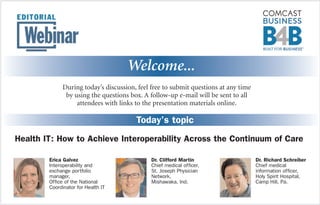

Welcome...
Today’s topic
Health IT: How to Achieve Interoperability Across the Continuum of Care
During today’s discussion, feel free to submit questions at any time
by using the questions box. A follow-up e-mail will be sent to all
attendees with links to the presentation materials online.
Dr. Richard Schreiber
Chief medical
information officer,
Holy Spirit Hospital,
Camp Hill, Pa.
Dr. Clifford Martin
Chief medical officer,
St. Joseph Physician
Network,
Mishawaka, Ind.
Erica Galvez
Interoperability and
exchange portfolio
manager,
Office of the National
Coordinator for Health IT
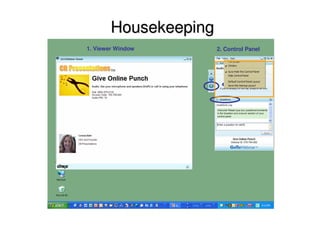
HousekeepingHousekeeping
1. Viewer Window 2. Control Panel
Joseph Conn
Reporter,
Modern Healthcare
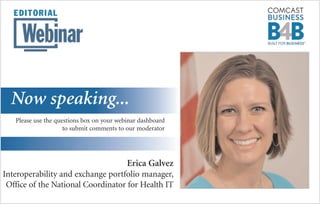
Now speaking...
Please use the questions box on your webinar dashboard
to submit comments to our moderator
Erica Galvez
Interoperability and exchange portfolio manager,
Office of the National Coordinator for Health IT
Now speaking...
Please use the questions box on your webinar dashboard
to submit comments to our moderator
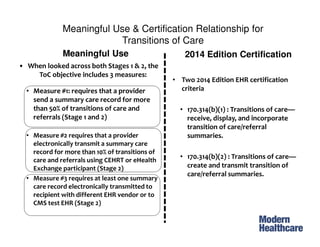
Meaningful Use & Certification Relationship for
Transitions of Care
• When looked across both Stages 1 & 2, the
ToC objective includes 3 measures:
• Measure #1: requires that a provider
send a summary care record for more
than 50% of transitions of care and
referrals (Stage 1 and 2)
• Measure #2 requires that a provider
electronically transmit a summary care
record for more than 10% of transitions of
care and referrals using CEHRT or eHealth
Exchange participant (Stage 2)
• Measure #3 requires at least one summary
care record electronically transmitted to
recipient with different EHR vendor or to
CMS test EHR (Stage 2)
Meaningful Use 2014 Edition Certification
• Two 2014 Edition EHR certification
criteria
• 170.314(b)(1) : Transitions of care—
receive, display, and incorporate
transition of care/referral
summaries.
• 170.314(b)(2) : Transitions of care—
create and transmit transition of
care/referral summaries.
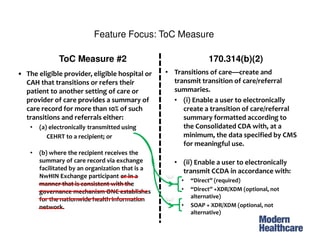
Feature Focus: ToC Measure(2)
• The eligible provider, eligible hospital or
CAH that transitions or refers their
patient to another setting of care or
provider of care provides a summary of
care record for more than 10% of such
transitions and referrals either:
• (a) electronically transmitted using
CEHRT to a recipient; or
• (b) where the recipient receives the
summary of care record via exchange
facilitated by an organization that is a
NwHIN Exchange participant or in a
manner that is consistent with the
governance mechanism ONC establishes
for the nationwide health information
network.
ToC Measure #2 170.314(b)(2)
• Transitions of care—create and
transmit transition of care/referral
summaries.
• (i) Enable a user to electronically
create a transition of care/referral
summary formatted according to
the Consolidated CDA with, at a
minimum, the data specified by CMS
for meaningful use.
• (ii) Enable a user to electronically
transmit CCDA in accordance with:
• “Direct” (required)
• “Direct” +XDR/XDM (optional, not
alternative)
• SOAP + XDR/XDM (optional, not
alternative)
1
2
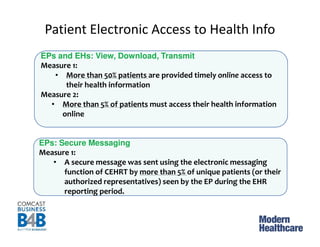
Patient Electronic Access to Health Info
EPs and EHs: View, Download, Transmit
Measure 1:
• More than 50% patients are provided timely online access to
their health information
Measure 2:
• More than 5% of patients must access their health information
online
EPs: Secure Messaging
Measure 1:
• A secure message was sent using the electronic messaging
function of CEHRT by more than 5% of unique patients (or their
authorized representatives) seen by the EP during the EHR
reporting period.
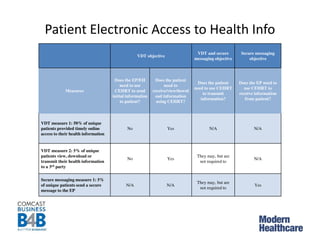
Patient Electronic Access to Health Info
VDT objective
VDT and secure
messaging objective
Secure messaging
objective
Measures
Does the EP/EH
need to use
CEHRT to send
initial information
to patient?
Does the patient
need to
receive/view/downl
oad information
using CEHRT?
Does the patient
need to use CEHRT
to transmit
information?
Does the EP need to
use CEHRT to
receive information
from patient?
VDT measure 1: 50% of unique
patients provided timely online
access to their health information
No Yes N/A N/A
VDT measure 2: 5% of unique
patients view, download or
transmit their health information
to a 3rd party
No Yes
They may, but are
not required to
N/A
Secure messaging measure 1: 5%
of unique patients send a secure
message to the EP
N/A N/A
They may, but are
not required to
Yes
Dr. Richard Schreiber
Chief medical information officer,
Holy Spirit Hospital, Camp Hill, Pa.
Now speaking...
Please use the questions box on your webinar dashboard
to submit comments to our moderator
Meaningful Use 2 and Interoperability
• Definitely stresses importance of interoperability
• Patient Portal replaces “electronic copy of discharge
information”
• Settles on C-CDA (Consolidated clinical document
architecture)
• Requires sending C-CDA to another vendor, but only once
Meaningful Use 2 and Interoperability, cont.
•Direct Messaging (DM)
–NOT an interoperable requirement
–very hard to achieve interoperability with DM
• Outside of EMR
• No clear way to add data to EMR
•Submit labs from EH’s to EP’s
–Nice, but actually done via interfacing, not true
interoperability
–Why not more emphasis on HIE?
• especially for those on different EMRs?
Transfer of Care Documents
Most difficult interoperability requirement of MU 2
• HISPs don’t talk to HISPs (lack connectivity)
• Dismally low adoption of direct addresses
• Offset of the reporting periods
–EHs: Federal Fiscal Year (attest Oct 1)
–EPs: Calendar year (attest by Jan 1)
• EPs have not caught up with EHs
• Puts EHs at disadvantage
With thanks to Michael Zaroukian, Colin Banas, Matthew Shafiroff
AMA Letter to CMMS and ONC
“JASON2 report funded by the Agency for Healthcare Research
and Quality concisely described the current state of
interoperability, finding “[a]t present, large-scale interoperability
amounts to little more than replacing fax machines with the
electronic delivery of page-formatted medical records.”3 If we
are to move away from this approach, the certification process
must be keenly focused on achieving true interoperability that is
deployed in a fashion that requires minimal user intervention.
We believe ONC should focus less on what specific data points
are exchanged, and more on identifying and coordinating the
standards needed to exchange information.”
• Lack of interoperability standards still impedes progress
1http://www.ihealthbeat.org/~/media/Files/2014/PDFs/CMS%20ONC%20Letter%20Stage%203.
ashx
2named for the Greek hero
3JASON, A Robust Health Data Infrastructure, November 2013
http://www.healthit.gov/sites/default/files/ptp13-700hhs_white.pdf
Meaningful Use Stage 3
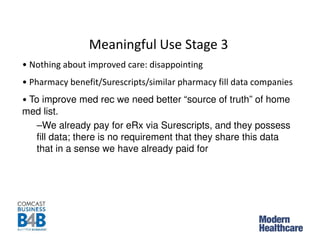
• Nothing about improved care: disappointing
• Pharmacy benefit/Surescripts/similar pharmacy fill data companies
• To improve med rec we need better “source of truth” of home
med list.
–We already pay for eRx via Surescripts, and they possess
fill data; there is no requirement that they share this data
that in a sense we have already paid for
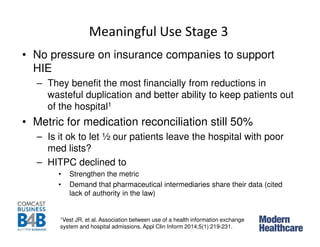
Meaningful Use Stage 3
• No pressure on insurance companies to support
HIE
– They benefit the most financially from reductions in
wasteful duplication and better ability to keep patients out
of the hospital1
• Metric for medication reconciliation still 50%
– Is it ok to let ½ our patients leave the hospital with poor
med lists?
– HITPC declined to
• Strengthen the metric
• Demand that pharmaceutical intermediaries share their data (cited
lack of authority in the law)
1Vest JR, et al. Association between use of a health information exchange
system and hospital admissions. Appl Clin Inform 2014;5(1):219-231.
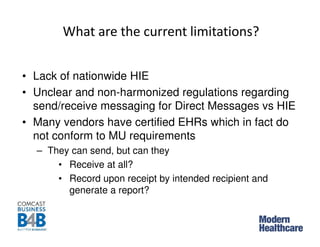
What are the current limitations?
• Lack of nationwide HIE
• Unclear and non-harmonized regulations regarding
send/receive messaging for Direct Messages vs HIE
• Many vendors have certified EHRs which in fact do
not conform to MU requirements
– They can send, but can they
• Receive at all?
• Record upon receipt by intended recipient and
generate a report?
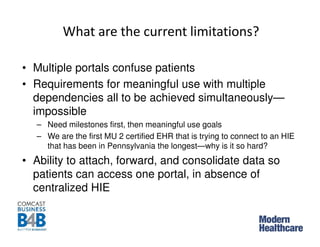
What are the current limitations?
• Multiple portals confuse patients
• Requirements for meaningful use with multiple
dependencies all to be achieved simultaneously—
impossible
– Need milestones first, then meaningful use goals
– We are the first MU 2 certified EHR that is trying to connect to an HIE
that has been in Pennsylvania the longest—why is it so hard?
• Ability to attach, forward, and consolidate data so
patients can access one portal, in absence of
centralized HIE
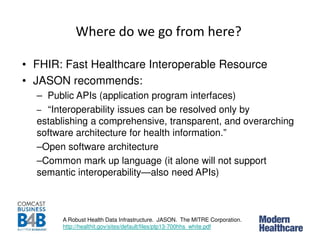
Where do we go from here?
• FHIR: Fast Healthcare Interoperable Resource
• JASON recommends:
– Public APIs (application program interfaces)
– “Interoperability issues can be resolved only by
establishing a comprehensive, transparent, and overarching
software architecture for health information.”
–Open software architecture
–Common mark up language (it alone will not support
semantic interoperability—also need APIs)
A Robust Health Data Infrastructure. JASON. The MITRE Corporation.
http://healthit.gov/sites/default/files/ptp13-700hhs_white.pdf
Dr. Clifford Martin
Chief medical officer,
St. Joseph Physician Network, Mishawaka, Ind.
Now speaking...
Please use the questions box on your webinar dashboard
to submit comments to our moderator
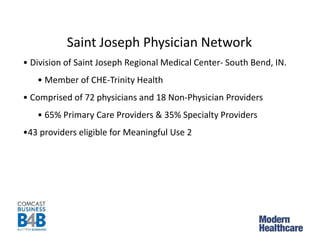
Saint Joseph Physician Network
• Division of Saint Joseph Regional Medical Center- South Bend, IN.
• Member of CHE-Trinity Health
• Comprised of 72 physicians and 18 Non-Physician Providers
• 65% Primary Care Providers & 35% Specialty Providers
•43 providers eligible for Meaningful Use 2
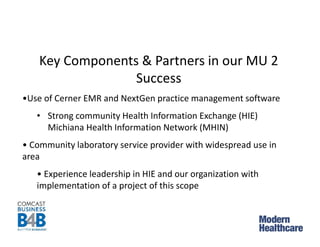
Key Components & Partners in our MU 2
Success
•Use of Cerner EMR and NextGen practice management software
• Strong community Health Information Exchange (HIE)
Michiana Health Information Network (MHIN)
• Community laboratory service provider with widespread use in
area
• Experience leadership in HIE and our organization with
implementation of a project of this scope
Most Recent Components Installed
• Preventive Care / Health Maintenance Modules
• Patient Specific Education for Exit Care
• Establishing Continuity of Care Documents
• Community Patient Portal
•Strategies to Engage Patients in use of Portal
Most Significant Challenges to Success
• Certification of Medical Assistants
• Rapid implementation of required software changes/bundles
• Increased need to utilize data in discrete fields
• Lab test and Radiology procedure terminology
• Processing Speed interruptions
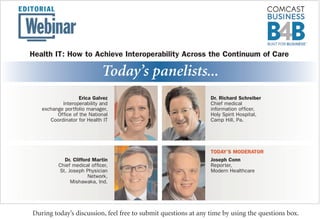
Today’s panelists...
Health IT: How to Achieve Interoperability Across the Continuum of Care
During today’s discussion, feel free to submit questions at any time by using the questions box.
Joseph Conn
Reporter,
Modern Healthcare
Dr. Clifford Martin
Chief medical officer,
St. Joseph Physician
Network,
Mishawaka, Ind.
Erica Galvez
Interoperability and
exchange portfolio manager,
Office of the National
Coordinator for Health IT
Dr. Richard Schreiber
Chief medical
information officer,
Holy Spirit Hospital,
Camp Hill, Pa.
TODAY’S MODERATOR
Thank you...
... for attending today’s editorial webinar on achieving interoperability across the care continuum.
We also thank our panelists, Erica Galvez, interoperability and exchange portfolio manager, Office of the National
Coordinator for Health IT; Dr. Clifford Martin, chief medical officer, St. Joseph Physician Network,
Mishawaka, Ind.; and Dr. Richard Schreiber, chief medical information officer, Holy Spirit Hospital, Camp Hill, Pa.
Expect a follow-up e-mail within two weeks. For more information,
send an e-mail to webinars@modernhealthcare.com
For more information about additional editorial webinars this year,
please visit modernhealthcare.com/webinars

Webinar: Information Technology: How to achieve interoperability across the continuum of care

  • 1.
    Welcome... Today’s topic Health IT:How to Achieve Interoperability Across the Continuum of Care During today’s discussion, feel free to submit questions at any time by using the questions box. A follow-up e-mail will be sent to all attendees with links to the presentation materials online. Dr. Richard Schreiber Chief medical information officer, Holy Spirit Hospital, Camp Hill, Pa. Dr. Clifford Martin Chief medical officer, St. Joseph Physician Network, Mishawaka, Ind. Erica Galvez Interoperability and exchange portfolio manager, Office of the National Coordinator for Health IT
  • 2.
  • 3.
    Joseph Conn Reporter, Modern Healthcare Nowspeaking... Please use the questions box on your webinar dashboard to submit comments to our moderator
  • 4.
    Erica Galvez Interoperability andexchange portfolio manager, Office of the National Coordinator for Health IT Now speaking... Please use the questions box on your webinar dashboard to submit comments to our moderator
  • 5.
    Meaningful Use &Certification Relationship for Transitions of Care • When looked across both Stages 1 & 2, the ToC objective includes 3 measures: • Measure #1: requires that a provider send a summary care record for more than 50% of transitions of care and referrals (Stage 1 and 2) • Measure #2 requires that a provider electronically transmit a summary care record for more than 10% of transitions of care and referrals using CEHRT or eHealth Exchange participant (Stage 2) • Measure #3 requires at least one summary care record electronically transmitted to recipient with different EHR vendor or to CMS test EHR (Stage 2) Meaningful Use 2014 Edition Certification • Two 2014 Edition EHR certification criteria • 170.314(b)(1) : Transitions of care— receive, display, and incorporate transition of care/referral summaries. • 170.314(b)(2) : Transitions of care— create and transmit transition of care/referral summaries.
  • 6.
    Feature Focus: ToCMeasure(2) • The eligible provider, eligible hospital or CAH that transitions or refers their patient to another setting of care or provider of care provides a summary of care record for more than 10% of such transitions and referrals either: • (a) electronically transmitted using CEHRT to a recipient; or • (b) where the recipient receives the summary of care record via exchange facilitated by an organization that is a NwHIN Exchange participant or in a manner that is consistent with the governance mechanism ONC establishes for the nationwide health information network. ToC Measure #2 170.314(b)(2) • Transitions of care—create and transmit transition of care/referral summaries. • (i) Enable a user to electronically create a transition of care/referral summary formatted according to the Consolidated CDA with, at a minimum, the data specified by CMS for meaningful use. • (ii) Enable a user to electronically transmit CCDA in accordance with: • “Direct” (required) • “Direct” +XDR/XDM (optional, not alternative) • SOAP + XDR/XDM (optional, not alternative) 1 2
  • 7.
    Patient Electronic Accessto Health Info EPs and EHs: View, Download, Transmit Measure 1: • More than 50% patients are provided timely online access to their health information Measure 2: • More than 5% of patients must access their health information online EPs: Secure Messaging Measure 1: • A secure message was sent using the electronic messaging function of CEHRT by more than 5% of unique patients (or their authorized representatives) seen by the EP during the EHR reporting period.
  • 8.
    Patient Electronic Accessto Health Info VDT objective VDT and secure messaging objective Secure messaging objective Measures Does the EP/EH need to use CEHRT to send initial information to patient? Does the patient need to receive/view/downl oad information using CEHRT? Does the patient need to use CEHRT to transmit information? Does the EP need to use CEHRT to receive information from patient? VDT measure 1: 50% of unique patients provided timely online access to their health information No Yes N/A N/A VDT measure 2: 5% of unique patients view, download or transmit their health information to a 3rd party No Yes They may, but are not required to N/A Secure messaging measure 1: 5% of unique patients send a secure message to the EP N/A N/A They may, but are not required to Yes
  • 9.
    Dr. Richard Schreiber Chiefmedical information officer, Holy Spirit Hospital, Camp Hill, Pa. Now speaking... Please use the questions box on your webinar dashboard to submit comments to our moderator
  • 10.
    Meaningful Use 2and Interoperability • Definitely stresses importance of interoperability • Patient Portal replaces “electronic copy of discharge information” • Settles on C-CDA (Consolidated clinical document architecture) • Requires sending C-CDA to another vendor, but only once
  • 11.
    Meaningful Use 2and Interoperability, cont. •Direct Messaging (DM) –NOT an interoperable requirement –very hard to achieve interoperability with DM • Outside of EMR • No clear way to add data to EMR •Submit labs from EH’s to EP’s –Nice, but actually done via interfacing, not true interoperability –Why not more emphasis on HIE? • especially for those on different EMRs?
  • 12.
    Transfer of CareDocuments Most difficult interoperability requirement of MU 2 • HISPs don’t talk to HISPs (lack connectivity) • Dismally low adoption of direct addresses • Offset of the reporting periods –EHs: Federal Fiscal Year (attest Oct 1) –EPs: Calendar year (attest by Jan 1) • EPs have not caught up with EHs • Puts EHs at disadvantage With thanks to Michael Zaroukian, Colin Banas, Matthew Shafiroff
  • 13.
    AMA Letter toCMMS and ONC “JASON2 report funded by the Agency for Healthcare Research and Quality concisely described the current state of interoperability, finding “[a]t present, large-scale interoperability amounts to little more than replacing fax machines with the electronic delivery of page-formatted medical records.”3 If we are to move away from this approach, the certification process must be keenly focused on achieving true interoperability that is deployed in a fashion that requires minimal user intervention. We believe ONC should focus less on what specific data points are exchanged, and more on identifying and coordinating the standards needed to exchange information.” • Lack of interoperability standards still impedes progress 1http://www.ihealthbeat.org/~/media/Files/2014/PDFs/CMS%20ONC%20Letter%20Stage%203. ashx 2named for the Greek hero 3JASON, A Robust Health Data Infrastructure, November 2013 http://www.healthit.gov/sites/default/files/ptp13-700hhs_white.pdf
  • 14.
    Meaningful Use Stage3 • Nothing about improved care: disappointing • Pharmacy benefit/Surescripts/similar pharmacy fill data companies • To improve med rec we need better “source of truth” of home med list. –We already pay for eRx via Surescripts, and they possess fill data; there is no requirement that they share this data that in a sense we have already paid for
  • 15.
    Meaningful Use Stage3 • No pressure on insurance companies to support HIE – They benefit the most financially from reductions in wasteful duplication and better ability to keep patients out of the hospital1 • Metric for medication reconciliation still 50% – Is it ok to let ½ our patients leave the hospital with poor med lists? – HITPC declined to • Strengthen the metric • Demand that pharmaceutical intermediaries share their data (cited lack of authority in the law) 1Vest JR, et al. Association between use of a health information exchange system and hospital admissions. Appl Clin Inform 2014;5(1):219-231.
  • 16.
    What are thecurrent limitations? • Lack of nationwide HIE • Unclear and non-harmonized regulations regarding send/receive messaging for Direct Messages vs HIE • Many vendors have certified EHRs which in fact do not conform to MU requirements – They can send, but can they • Receive at all? • Record upon receipt by intended recipient and generate a report?
  • 17.
    What are thecurrent limitations? • Multiple portals confuse patients • Requirements for meaningful use with multiple dependencies all to be achieved simultaneously— impossible – Need milestones first, then meaningful use goals – We are the first MU 2 certified EHR that is trying to connect to an HIE that has been in Pennsylvania the longest—why is it so hard? • Ability to attach, forward, and consolidate data so patients can access one portal, in absence of centralized HIE
  • 18.
    Where do wego from here? • FHIR: Fast Healthcare Interoperable Resource • JASON recommends: – Public APIs (application program interfaces) – “Interoperability issues can be resolved only by establishing a comprehensive, transparent, and overarching software architecture for health information.” –Open software architecture –Common mark up language (it alone will not support semantic interoperability—also need APIs) A Robust Health Data Infrastructure. JASON. The MITRE Corporation. http://healthit.gov/sites/default/files/ptp13-700hhs_white.pdf
  • 19.
    Dr. Clifford Martin Chiefmedical officer, St. Joseph Physician Network, Mishawaka, Ind. Now speaking... Please use the questions box on your webinar dashboard to submit comments to our moderator
  • 20.
    Saint Joseph PhysicianNetwork • Division of Saint Joseph Regional Medical Center- South Bend, IN. • Member of CHE-Trinity Health • Comprised of 72 physicians and 18 Non-Physician Providers • 65% Primary Care Providers & 35% Specialty Providers •43 providers eligible for Meaningful Use 2
  • 21.
    Key Components &Partners in our MU 2 Success •Use of Cerner EMR and NextGen practice management software • Strong community Health Information Exchange (HIE) Michiana Health Information Network (MHIN) • Community laboratory service provider with widespread use in area • Experience leadership in HIE and our organization with implementation of a project of this scope
  • 22.
    Most Recent ComponentsInstalled • Preventive Care / Health Maintenance Modules • Patient Specific Education for Exit Care • Establishing Continuity of Care Documents • Community Patient Portal •Strategies to Engage Patients in use of Portal
  • 23.
    Most Significant Challengesto Success • Certification of Medical Assistants • Rapid implementation of required software changes/bundles • Increased need to utilize data in discrete fields • Lab test and Radiology procedure terminology • Processing Speed interruptions
  • 24.
    Today’s panelists... Health IT:How to Achieve Interoperability Across the Continuum of Care During today’s discussion, feel free to submit questions at any time by using the questions box. Joseph Conn Reporter, Modern Healthcare Dr. Clifford Martin Chief medical officer, St. Joseph Physician Network, Mishawaka, Ind. Erica Galvez Interoperability and exchange portfolio manager, Office of the National Coordinator for Health IT Dr. Richard Schreiber Chief medical information officer, Holy Spirit Hospital, Camp Hill, Pa. TODAY’S MODERATOR
  • 25.
    Thank you... ... forattending today’s editorial webinar on achieving interoperability across the care continuum. We also thank our panelists, Erica Galvez, interoperability and exchange portfolio manager, Office of the National Coordinator for Health IT; Dr. Clifford Martin, chief medical officer, St. Joseph Physician Network, Mishawaka, Ind.; and Dr. Richard Schreiber, chief medical information officer, Holy Spirit Hospital, Camp Hill, Pa. Expect a follow-up e-mail within two weeks. For more information, send an e-mail to webinars@modernhealthcare.com For more information about additional editorial webinars this year, please visit modernhealthcare.com/webinars