Meaningful Use of
Health information Exchange
Savannah, Georgia
April 26, 2013
2
IOM Quality Chasm Report
• “If we want safer, higher‐quality care, we will 
need to have redesigned systems of care, 
including the use of information technology to 
support clinical and administrative processes.”
– IOM, Quality Chasm report, 2001
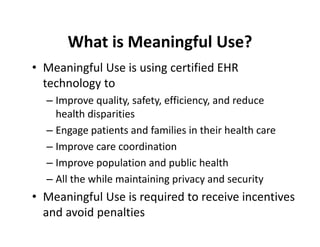
What is Meaningful Use? 
• Meaningful Use is using certified EHR 
technology to
– Improve quality, safety, efficiency, and reduce 
health disparities 
– Engage patients and families in their health care 
– Improve care coordination 
– Improve population and public health 
– All the while maintaining privacy and security 
• Meaningful Use is required to receive incentives 
and avoid penalties 
• 2014 Standards and Certification Criteria
• Stage 2 Meaningful Use
Stage 2 MU
ACOs 
Stage 3 MU
PCMHs
3‐Part Aim
Registries to manage 
patient populations
Team based care, 
case management
Enhanced access and 
continuity
Privacy & security 
protections
Care coordination
Privacy & security 
protections 
Patient centered 
care coordination
Improved 
population health
Registries for 
disease 
management
Evidenced based 
medicine 
Patient self 
management
Privacy & security 
protections
Care coordination
Structured data 
utilized  
Data utilized to 
improve delivery 
and outcomes
Data utilized to 
improve delivery 
and outcomes
Patient informed
Patient engaged, 
community 
resources
Stage 1 MU
Privacy & security 
protections
Basic EHR 
functionality, 
structured data
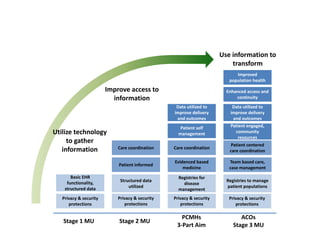
Improve access to 
information
Use information to 
transform
Meaningful Use as a Building Block
Utilize technology 
to gather 
information
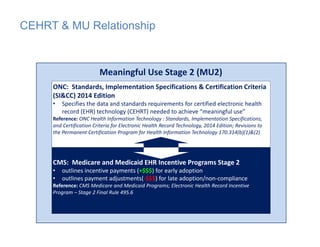
CEHRT & MU Relationship
Meaningful Use Stage 2 (MU2)
CMS:  Medicare and Medicaid EHR Incentive Programs Stage 2
• outlines incentive payments (+$$$) for early adoption
• outlines payment adjustments(‐$$$) for late adoption/non‐compliance
Reference: CMS Medicare and Medicaid Programs; Electronic Health Record Incentive 
Program – Stage 2 Final Rule 495.6
ONC:  Standards, Implementation Specifications & Certification Criteria 
(SI&CC) 2014 Edition
• Specifies the data and standards requirements for certified electronic health 
record (EHR) technology (CEHRT) needed to achieve “meaningful use”
Reference: ONC Health Information Technology : Standards, Implementation Specifications, 
and Certification Criteria for Electronic Health Record Technology, 2014 Edition; Revisions to 
the Permanent Certification Program for Health Information Technology 170.314(b)(1)&(2)
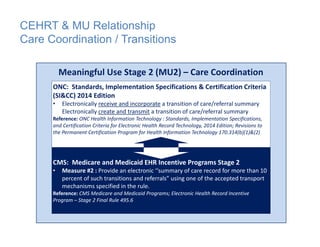
CEHRT & MU Relationship
Care Coordination / Transitions
Meaningful Use Stage 2 (MU2) – Care Coordination
CMS:  Medicare and Medicaid EHR Incentive Programs Stage 2
• Measure #2 : Provide an electronic ‘‘summary of care record for more than 10 
percent of such transitions and referrals” using one of the accepted transport 
mechanisms specified in the rule.
Reference: CMS Medicare and Medicaid Programs; Electronic Health Record Incentive 
Program – Stage 2 Final Rule 495.6
ONC:  Standards, Implementation Specifications & Certification Criteria 
(SI&CC) 2014 Edition
• Electronically receive and incorporate a transition of care/referral summary 
Electronically create and transmit a transition of care/referral summary
Reference: ONC Health Information Technology : Standards, Implementation Specifications, 
and Certification Criteria for Electronic Health Record Technology, 2014 Edition; Revisions to 
the Permanent Certification Program for Health Information Technology 170.314(b)(1)&(2)
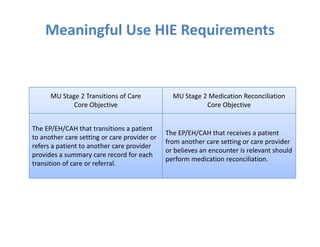
Meaningful Use HIE Requirements
MU Stage 2 Transitions of Care
Core Objective
MU Stage 2 Medication Reconciliation
Core Objective
The EP/EH/CAH that transitions a patient 
to another care setting or care provider or 
refers a patient to another care provider 
provides a summary care record for each 
transition of care or referral.
The EP/EH/CAH that receives a patient 
from another care setting or care provider 
or believes an encounter is relevant should 
perform medication reconciliation.
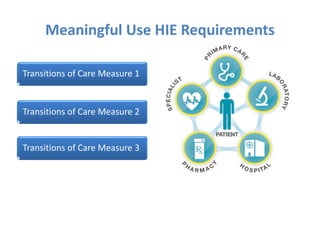
Transitions of Care Measure 1
Transitions of Care Measure 2
Transitions of Care Measure 3
Meaningful Use HIE Requirements
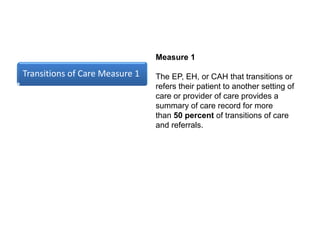
Transitions of Care Measure 1
Measure 1
The EP, EH, or CAH that transitions or
refers their patient to another setting of
care or provider of care provides a
summary of care record for more
than 50 percent of transitions of care
and referrals.
Transitions of Care Measure 1
Transitions of Care Measure 2
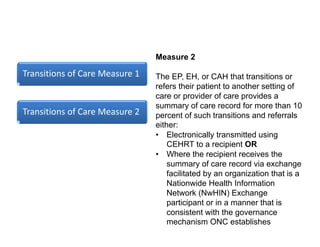
Measure 2
The EP, EH, or CAH that transitions or
refers their patient to another setting of
care or provider of care provides a
summary of care record for more than 10
percent of such transitions and referrals
either:
• Electronically transmitted using
CEHRT to a recipient OR
• Where the recipient receives the
summary of care record via exchange
facilitated by an organization that is a
Nationwide Health Information
Network (NwHIN) Exchange
participant or in a manner that is
consistent with the governance
mechanism ONC establishes
Transitions of Care Measure 1
Transitions of Care Measure 2
Transitions of Care Measure 3
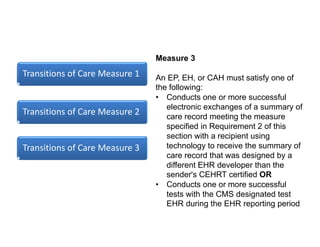
Measure 3
An EP, EH, or CAH must satisfy one of
the following:
• Conducts one or more successful
electronic exchanges of a summary of
care record meeting the measure
specified in Requirement 2 of this
section with a recipient using
technology to receive the summary of
care record that was designed by a
different EHR developer than the
sender's CEHRT certified OR
• Conducts one or more successful
tests with the CMS designated test
EHR during the EHR reporting period
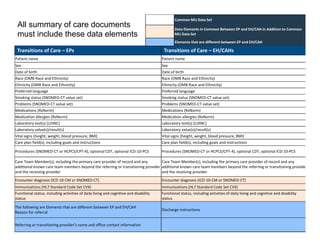
Transitions of Care – EPs Transitions of Care – EH/CAHs
Patient name Patient name
Sex Sex
Date of birth Date of birth
Race (OMB Race and Ethnicity) Race (OMB Race and Ethnicity)
Ethnicity (OMB Race and Ethnicity) Ethnicity (OMB Race and Ethnicity)
Preferred language Preferred language
Smoking status (SNOMED‐CT value set) Smoking status (SNOMED‐CT value set)
Problems (SNOMED‐CT value set) Problems (SNOMED‐CT value set)
Medications (RxNorm) Medications (RxNorm)
Medication allergies (RxNorm) Medication allergies (RxNorm)
Laboratory test(s) (LOINC) Laboratory test(s) (LOINC)
Laboratory value(s)/result(s) Laboratory value(s)/result(s)
Vital signs (height, weight, blood pressure, BMI) Vital signs (height, weight, blood pressure, BMI)
Care plan field(s), including goals and instructions Care plan field(s), including goals and instructions
Procedures (SNOMED‐CT or HCPCS/CPT‐4), optional CDT, optional ICD‐10‐PCS Procedures (SNOMED‐CT or HCPCS/CPT‐4), optional CDT, optional ICD‐10‐PCS
Care Team Member(s), including the primary care provider of record and any 
additional known care team members beyond the referring or transitioning provider 
and the receiving provider
Care Team Member(s), including the primary care provider of record and any 
additional known care team members beyond the referring or transitioning provide
and the receiving provider
Encounter diagnosis (ICD‐10‐CM or SNOMED‐CT) Encounter diagnosis (ICD‐10‐CM or SNOMED‐CT)
Immunizations (HL7 Standard Code Set CVX) Immunizations (HL7 Standard Code Set CVX)
Functional status, including activities of daily living and cognitive and disability 
status
Functional status, including activities of daily living and cognitive and disability 
status
The following are Elements that are different between EP and EH/CAH
Reason for referral
Discharge instructions
Referring or transitioning provider's name and office contact information
Common MU Data Set
Data Elements in Common Between EP and EH/CAH in Addition to Common 
MU Data Set
Elements that are different between EP and EH/CAH
All summary of care documents
must include these data elements
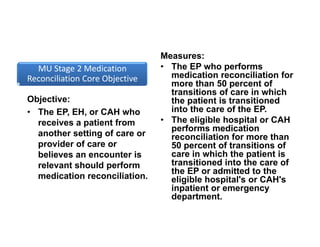
MU Stage 2 Medication 
Reconciliation Core Objective
Objective:
• The EP, EH, or CAH who
receives a patient from
another setting of care or
provider of care or
believes an encounter is
relevant should perform
medication reconciliation.
Measures:
• The EP who performs
medication reconciliation for
more than 50 percent of
transitions of care in which
the patient is transitioned
into the care of the EP.
• The eligible hospital or CAH
performs medication
reconciliation for more than
50 percent of transitions of
care in which the patient is
transitioned into the care of
the EP or admitted to the
eligible hospital's or CAH's
inpatient or emergency
department.
15
Why the attention on interoperability? 
• “Unless interoperability is achieved, 
physicians will still defer IT investments, 
potential clinical and economic benefits 
won’t be realized, and we will not move 
closer to badly needed healthcare reform in 
the US.”  
– Dr. David Brailer, HHS National HIT Coordinator, 
May 21, 2004
Federal Government Initiatives
Graphic: The Value Proposition for
Exchange; Doug Fridsma, July 2011
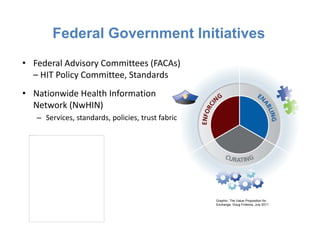
• Federal Advisory Committees (FACAs) 
– HIT Policy Committee, Standards
• Nationwide Health Information 
Network (NwHIN)
– Services, standards, policies, trust fabric
This image cannot currently be displayed.
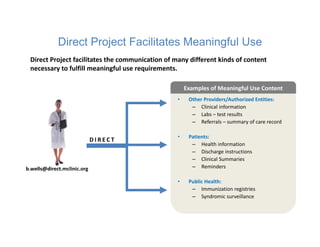
Direct Project Facilitates Meaningful Use
• Other Providers/Authorized Entities:
– Clinical information 
– Labs – test results
– Referrals – summary of care record
• Patients:
– Health information 
– Discharge instructions
– Clinical Summaries
– Reminders
• Public Health:
– Immunization registries
– Syndromic surveillance
b.wells@direct.mclinic.org 
Direct Project facilitates the communication of many different kinds of content 
necessary to fulfill meaningful use requirements.
Examples of Meaningful Use ContentExamples of Meaningful Use Content
D I R E C T
CCSNPC Technology Partner
1993 1999 2006
20 Years 14 Years 7 Years
• Standards‐based 
Solutions for Health 
Information Exchange
• Commercial Software 
and Support
• Open Architecture
• User Extensible
• Application and Data 
Integration Experts
Software 
Development
Software 
Development
Healthcare 
Focus
Healthcare 
Focus
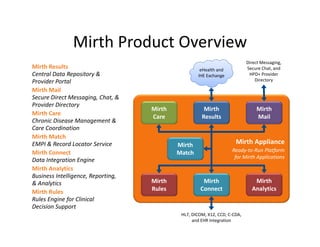
Mirth 
Products
Mirth Product Overview
Mirth Appliance
Ready‐to‐Run Platform
for Mirth Applications
Direct Messaging, 
Secure Chat, and 
HPD+ Provider 
Directory
HL7, DICOM, X12, CCD, C‐CDA, 
and EHR Integration
Mirth
Care
Mirth 
Match
Mirth
Mail
Mirth 
Connect
Mirth
Results
Mirth
Analytics
Mirth
Rules
eHealth and 
IHE Exchange
Mirth Results
Central Data Repository & 
Provider Portal
Mirth Mail
Secure Direct Messaging, Chat, & 
Provider Directory
Mirth Care
Chronic Disease Management & 
Care Coordination
Mirth Match
EMPI & Record Locator Service
Mirth Connect
Data Integration Engine
Mirth Analytics
Business Intelligence, Reporting, 
& Analytics
Mirth Rules
Rules Engine for Clinical 
Decision Support
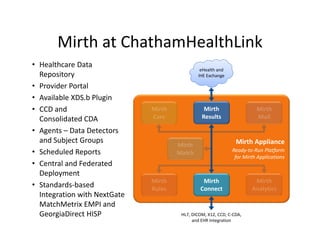
Mirth at ChathamHealthLink
• Healthcare Data 
Repository
• Provider Portal
• Available XDS.b Plugin
• CCD and 
Consolidated CDA
• Agents – Data Detectors 
and Subject Groups
• Scheduled Reports
• Central and Federated 
Deployment
• Standards‐based 
Integration with NextGate
MatchMetrix EMPI and 
GeorgiaDirect HISP
Mirth Appliance
Ready‐to‐Run Platform
for Mirth Applications
HL7, DICOM, X12, CCD, C‐CDA, 
and EHR Integration
Mirth 
Connect
Mirth
Results
eHealth and 
IHE Exchange
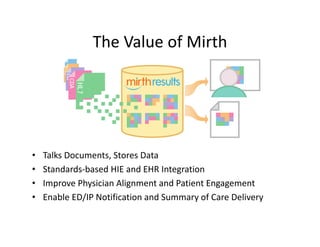
The Value of Mirth
• Talks Documents, Stores Data
• Standards‐based HIE and EHR Integration
• Improve Physician Alignment and Patient Engagement
• Enable ED/IP Notification and Summary of Care Delivery
CCD
EDI
CDA
HL7
Value Proposition for HIE
• Provide better, safer and more efficient 
patient care 
• Distribute hospital information to doctors 
• Savings on uncompensated care related to 
unnecessary or avoidable services
• Provides outreach to community partners
• Helps maintain referral patterns 
• Improved care coordination
• Aligns with shifting reimbursement models
Capacity Building Funding
• $492,500.00 funding award
• Opportunity to connect 
• Move beyond the pilot
• Next Steps:
– Strong policy development
– Build sustainability model
– Security assessment 
Questions?
brianahier@gmail.com
(541) 288‐1066

Meaningful Use of Health information Exchange