6 Essential Steps to Building a Scalable and
Profitable Telehealth and Remote Patient
Monitoring Program
Introduction
Launching or expanding a telehealth
and remote patient monitoring (RPM)
program can be an intimidating task.
From establishing goals and
determining your financial plan, to
choosing a technology partner and
building clinician and patient buy-in,
there are many essential factors to
consider to ensure your program is
successful.
This guide, informed by HRS health
system, home health, and hospice
clients across the country, as well as
HRS’ Client Success, Implementation,
Reimbursement and Clinical teams will
serve as a resource for your
organization as you start the telehealth
implementation journey.
1
DEFINE
Define Goals &
Objectives - Establish
Your Program's Vision
2
SELECT
Select a Technology
Partner Aligned With Your
Goals & Project Scope
3
IDENTIFY
Identify Telehealth Project
Champions & Leaders -
Build Your Telehealth Team
4
ASSESS
Assess Financial Objectives,
Rules, Regulations &
Reimbursement
5 6
ESTABLISH
Establish Telehealth
Buy-In & Educate
Your Clinical Team
DETERMINE
Determine Your Patient
Populations - Set Clear
Enrollment & Discharge
Criteria
2
Start with defining your goals and
objectives, both big and small. Why are
you launching a telehealth program and
what are you hoping to achieve? For your
program to be successful, it’s essential
that there is a clear vision backed by
quantitative goals (clinical, financial,
operational, etc.)  as well as a clear
understanding of how the telehealth
program will contribute to the overall
vision and mission of your organization.
Setting goals for your telehealth and
remote patient monitoring program does
not need to be difficult. Consider the
following when setting your goals and
objectives:
Reducing readmissions
Reducing ED utilization
Reducing overall cost of care
Increasing staff efficiency
Shortening length of stay
Improving clinical collaboration with
providers and partners
Increasing patient and/or caregiver
satisfaction and engagement
Increase reimbursement from CCM,
TCM, and virtual visit programs
Improving provider workflow and
morale
Enabling patients to age in place
Improving access to care in rural
areas
Increasing referrals and in-network
utilization
Define Goals &
Objectives - Establish
Your Program’s Vision
Again, the goals of the telehealth program
must be strategically valuable and align
with the goals of your organization.
There are many types of telehealth
programs, all with different goals and
objectives. It is important to  focus on a
few goals, as opposed to many. Common
goals we see include:
Your program should not set out to fix or
improve every organizational metric.
Focus on the goals that will provide the
most value to your patients, clinicians,
and organization as a whole. Once your
program is optimized, you can always
add more goals, or iterate on your initial
ones.
1
3
Clearly state in order of
precedence the business (financial
and operational) and clinical
(outcomes and quality) metrics
you are setting out to improve
Which clinical services and patient
cohorts lend themselves to
improving those metrics 
How a telehealth program will be
deployed and supported
operationally
How and when success will be
measured and what technology
will be implemented
1.
2.
3.
4.
The majority of organizations have
different goals for different patient
populations. Telehealth and RPM are not
a one-size-fits all solution. Regardless of
what your goals are, we recommend
utilizing the SMART goal model to
achieve them. Once you have your goals
and objectives in place, establish a
cadence for measuring your progress.
Depending on the goal, this can be
weekly, monthly, or quarterly.
SMART goals are:
SMARTSMART
Specific goals are well defined and clear on what needs
to be accomplished.
What outcomes do you need to see in order to consider
the goal accomplished?
Relevant goals are important to your organization and
will make an impact on achieving larger objectives. Does
it make a difference to your overall objectives if this goal
is met?
Specific
Measurable
Attainable
Relevant
Time-bound
SPECIFIC
Conduct 1 virtual check-in per week
with each CHF patient on the
telehealth program for the first 2
months of the telehealth program.
MEASURABLE
Measurable goals enable you to evaluate whether or
not the goal was achieved.
How will you decide whether the goal was achieved?
Conduct 1 virtual check-in per week
with each CHF patient on the
telehealth program for the first 2
months of the telehealth program.
ATTAINABLE
Attainable goals are realistic about what is possible
given the availability of resources. How likely is it that
you can accomplish this goal?
Based on the number of patients and
the number of staff we have, this is
possible.
RELEVANT
Improving clinician-provider
communication and providing
continuous engagement is a primary
objective of our telehealth program.
TIME-BOUND
Timely goals lock into a specific time frame and specify
when they need to be completed by. What is the
timeline for achieving this goal?
Reduce readmissions from current 20% to
below US average of 14.9% within 1 year
of program launch.
Reduce readmissions rate among CHF
patients enrolled in telehealth to below
US average 14.9%.
Based on data from other telehealth
programs, we believe this goal is
attainable.
Reducing readmissions among our
chronic care patients is a primary
objective of our organization.
Within 1 year of telehealth program
launch.
1 weekly visit per patient for first 2
months of telehealth program
EX 1: Home Health Telehealth Program 
 CHF Patients
EX 2: Hospital at Home Program
Physical Therapy, Surgical Recovery
4
In addition to SMART goals, it’s essential to
consider your model(s) of care delivery.
This will also help you define and refine
your program’s goals and objectives. The
model of care should align with your
SMART goals.
Model examples
Access to Care Model - telehealth
services as a tool for increasing access to
care (specialist and general) to those in
rural and/or underserved populations. In
many cases, patients are not able to
access care due to location, transportation
barriers, socioeconomic status, or other
factors. The goal of this model is to bring
telehealth to those populations. 
Hospital at Home Model - delivering
hospital level care to patients in the
comfort of their own home. This is used by
organizations who are looking to decrease
length of stay and readmissions, as well as
provide an alternative to hospital care
within the brick and mortar hospital or
clinic setting. This model enables patients
to receive acute and post acute care at
home.
Cost Savings Model - alternative care
delivery methods that aim to reduce costs
by reducing readmissions, improving care
coordination, increasing shared savings,
and avoiding  windshield time.
Chronic Care Management Model -
managing the health of patient
populations with multiple (two or more)
chronic conditions over a period of
time. 
Post-Acute Model - immediately at
hospital discharge, monitoring patients
to ensure they do not return back to the
hospital.
Aging in Place Model - telehealth
services as a tool for increasing peace of
mind and patient engagement. The goal
of this model is to ensure that patients
can receive care safely at home for as
long as possible.
Determining clear goals and objectives
that align with your organization’s
mission is the first step in launching 
successful, scalable and profitable
telehealth and RPM programs. Once
you’ve done this, you are ready to move
on to step 2 - selecting a technology
partner.
Focus on a few goals, as opposed to
many
Ensure every goal is a SMART goal
Determine your model of care
delivery early
Quick Tips
5
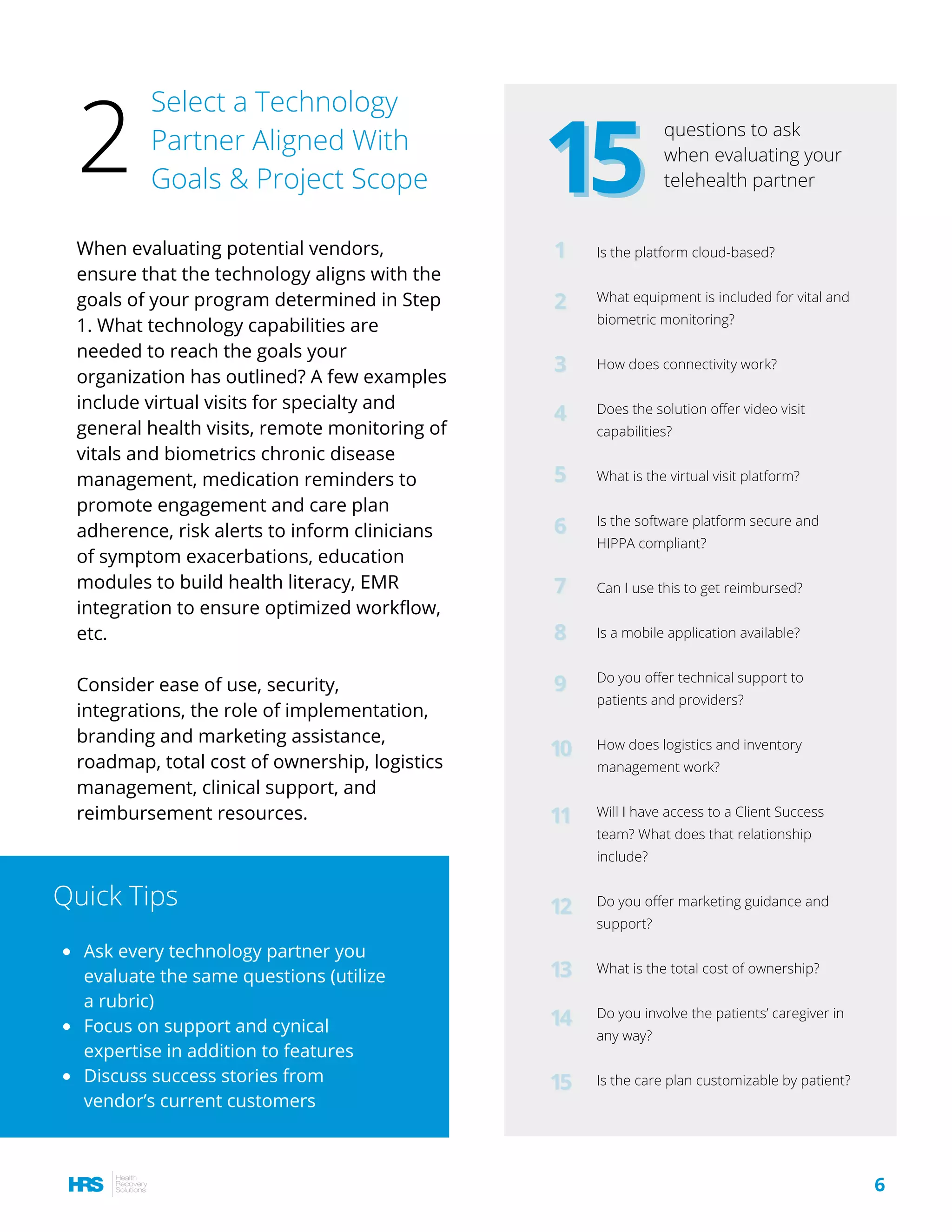
When evaluating potential vendors,
ensure that the technology aligns with the
goals of your program determined in Step
1. What technology capabilities are
needed to reach the goals your
organization has outlined? A few examples
include virtual visits for specialty and
general health visits, remote monitoring of
vitals and biometrics chronic disease
management, medication reminders to
promote engagement and care plan
adherence, risk alerts to inform clinicians
of symptom exacerbations, education
modules to build health literacy, EMR
integration to ensure optimized workflow,
etc.
Consider ease of use, security,
integrations, the role of implementation,
branding and marketing assistance,
roadmap, total cost of ownership, logistics
management, clinical support, and
reimbursement resources.
Ask every technology partner you
evaluate the same questions (utilize
a rubric)
Focus on support and cynical
expertise in addition to features
Discuss success stories from
vendor’s current customers
Quick Tips
Select a Technology
Partner Aligned With
Goals & Project Scope
2 1515
questions to ask
when evaluating your
telehealth partner
11 Is the platform cloud-based?
What equipment is included for vital and
biometric monitoring?
How does connectivity work?
Does the solution offer video visit
capabilities?
What is the virtual visit platform?
Is the software platform secure and
HIPPA compliant?
Can I use this to get reimbursed? 
Is a mobile application available?
Do you offer technical support to
patients and providers?
How does logistics and inventory
management work?
Will I have access to a Client Success
team? What does that relationship
include?
Do you offer marketing guidance and
support?
What is the total cost of ownership?
Do you involve the patients’ caregiver in
any way?
Is the care plan customizable by patient?
22
33
44
55
66
77
88
99
1010
1111
1212
1313
1414
1515
6
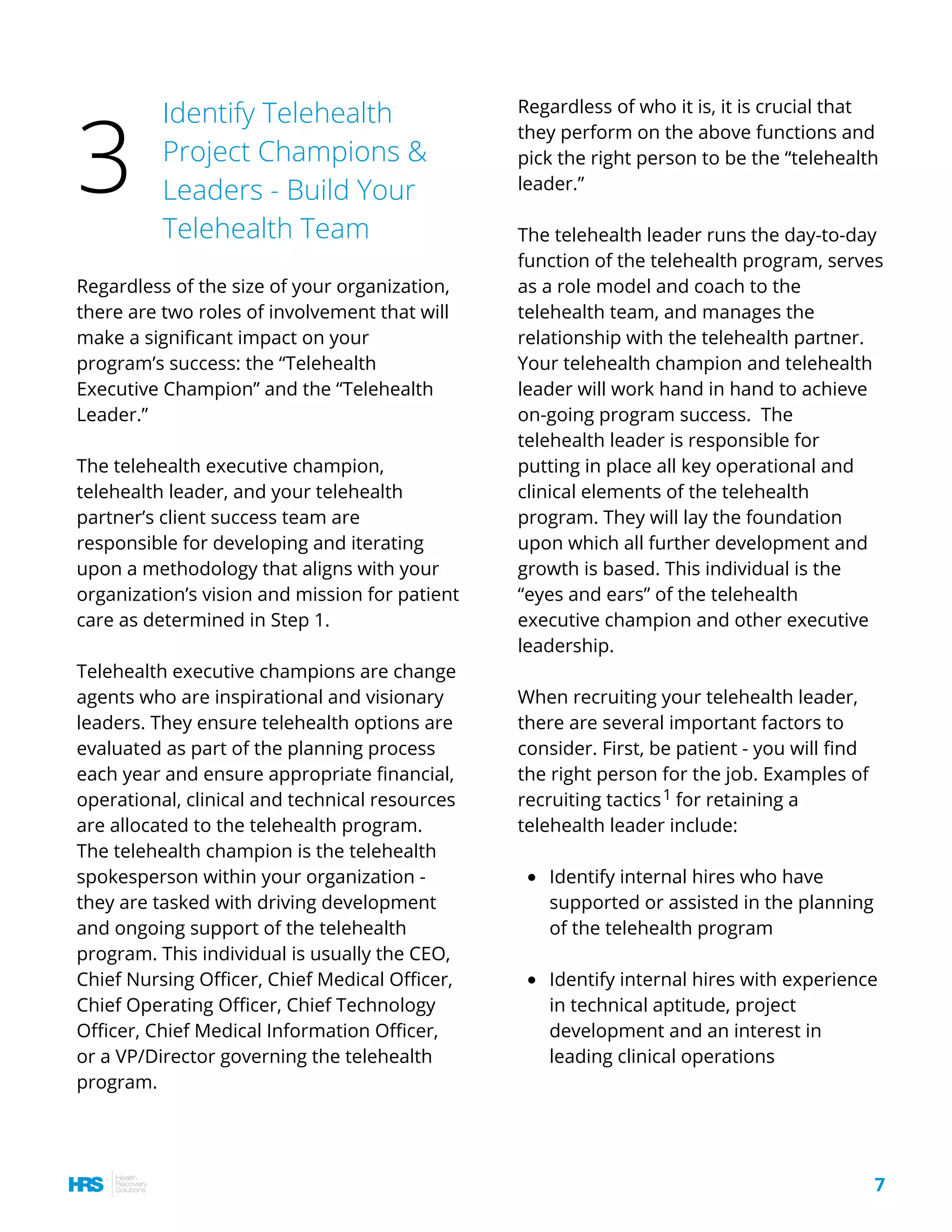
Regardless of the size of your organization,
there are two roles of involvement that will
make a significant impact on your
program’s success: the “Telehealth
Executive Champion” and the “Telehealth
Leader.”
The telehealth executive champion,
telehealth leader, and your telehealth
partner’s client success team are
responsible for developing and iterating
upon a methodology that aligns with your
organization’s vision and mission for patient
care as determined in Step 1.
Telehealth executive champions are change
agents who are inspirational and visionary
leaders. They ensure telehealth options are
evaluated as part of the planning process
each year and ensure appropriate financial,
operational, clinical and technical resources
are allocated to the telehealth program.
The telehealth champion is the telehealth
spokesperson within your organization -
they are tasked with driving development
and ongoing support of the telehealth
program. This individual is usually the CEO,
Chief Nursing Officer, Chief Medical Officer,
Chief Operating Officer, Chief Technology
Officer, Chief Medical Information Officer,
or a VP/Director governing the telehealth
program.
Identify internal hires who have
supported or assisted in the planning
of the telehealth program
Identify internal hires with experience
in technical aptitude, project
development and an interest in
leading clinical operations
Regardless of who it is, it is crucial that
they perform on the above functions and
pick the right person to be the “telehealth
leader.”
The telehealth leader runs the day-to-day
function of the telehealth program, serves
as a role model and coach to the
telehealth team, and manages the
relationship with the telehealth partner.
Your telehealth champion and telehealth
leader will work hand in hand to achieve
on-going program success.  The
telehealth leader is responsible for
putting in place all key operational and
clinical elements of the telehealth
program. They will lay the foundation
upon which all further development and
growth is based. This individual is the
“eyes and ears” of the telehealth
executive champion and other executive
leadership.
When recruiting your telehealth leader,
there are several important factors to
consider. First, be patient - you will find
the right person for the job. Examples of
recruiting tactics for retaining a
telehealth leader include:
Identify Telehealth
Project Champions &
Leaders - Build Your
Telehealth Team
3
7
1
Identify an external professional who
has proven experience in leading a data
driven and systemic telehealth
approach
Identify interim leadership (this is less
sustainable) from an organization who
have proven experience in executing on
telehealth methodology for other
vendors and agencies - this individual
can provide quicker time-to-initial-
value, and effectively hire new
telehealth leader once the program is
more mature
Work to develop telehealth clinical experts
within your program to build buy-in and
clinician engagement. Foster an
environment of continuous iteration and
support by emphasizing the importance of
sharing weekly patient stories and
improvement areas to ensure that your
program has continuous improvement and
momentum.
The telehealth and RPM team will learn the
most by seeing each other in action and
hearing frontline stories.
1 Arkwright, Bryan, et al. “Telehealth Governance: An Essential Tool to Empower
Today's Healthcare Leaders.” Telehealth and Medicine Today, 2 May 2018,
telehealthandmedicinetoday.com/index.php/journal/article/view/12.
8
The Importance of
Telehealth Governance
and Executive Buy-In
What is the patient to nurse ratio for
monitoring?Will you be using LPN’s or
RN’s?
Will there be a physician liaison for the
program?
Is there coverage for holidays,
weekends, PTO, etc? If not, does your
telehealth partner have a clinical call
center to assist with this?
Do you need to hire a telehealth
installer or technician? 
Are you managing the inventory
internally or outsourcing (or does your
telehealth partner offer inventory
management)?
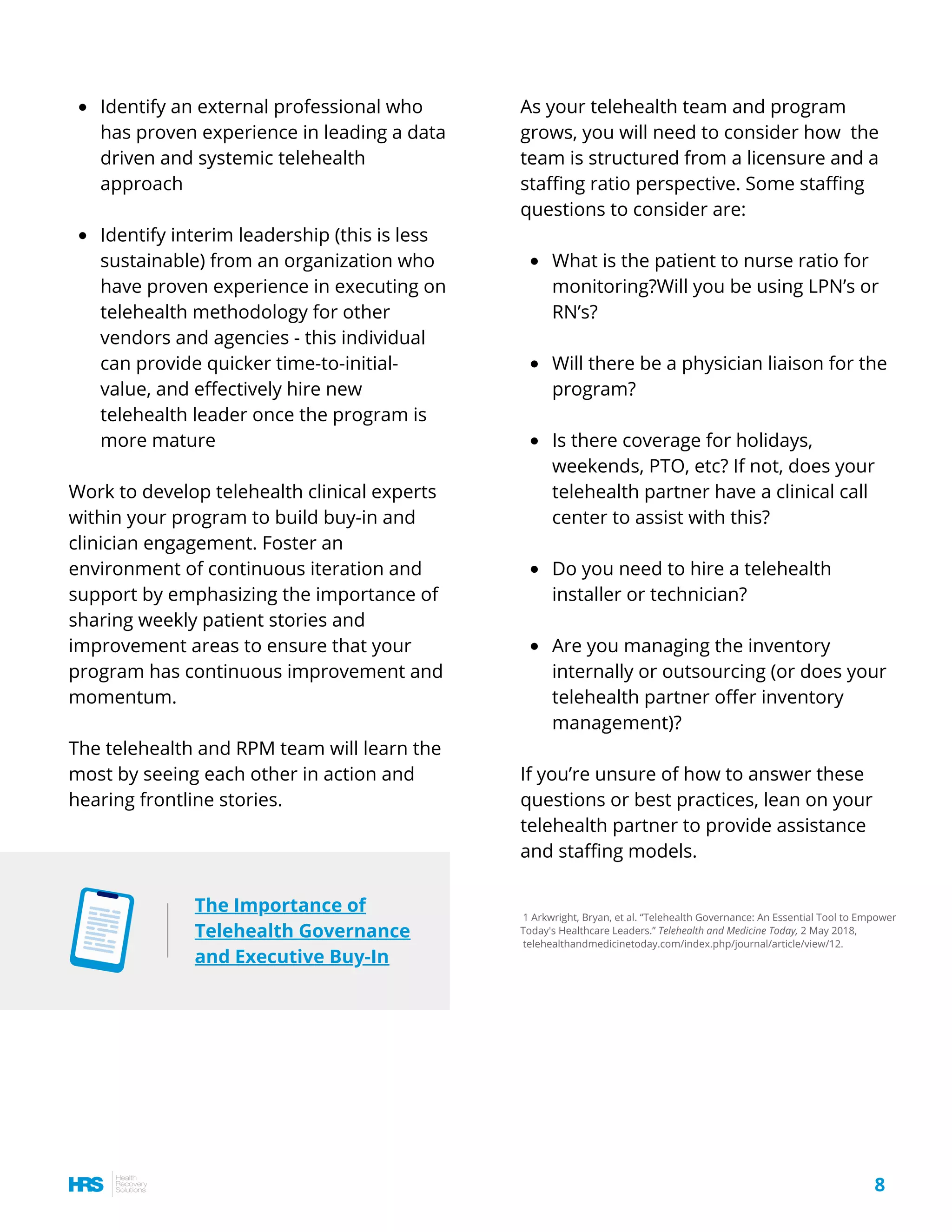
As your telehealth team and program
grows, you will need to consider how  the
team is structured from a licensure and a
staffing ratio perspective. Some staffing
questions to consider are:
If you’re unsure of how to answer these
questions or best practices, lean on your
telehealth partner to provide assistance
and staffing models.
Regardless, programs that begin with a
robust financial justification will be the
most successful.
Start with assessing your current
organizational structure (i.e. home
health, palliative care, hospice, physician
group, hospital group, etc.) and what type
of clinical staff your organization employs
(MDs, NPs, RNs, LPNS, PTs, etc).
Review your organizational structure and
determine what is required by your
organization to meet the regulations of
providing and receiving RPM and
telehealth reimbursement.
All financial models need to go beyond
reimbursement to include cost avoidance
metrics as well. Organizations often
include readmission reduction,
operational improvements such as
reduced home health visits or saved
time, improved shared savings, and other
non-reimbursement metrics.
Consider how you will measure your
short and long-term financial goals as
they relate to the telehealth program.
How and when will you measure financial
success?
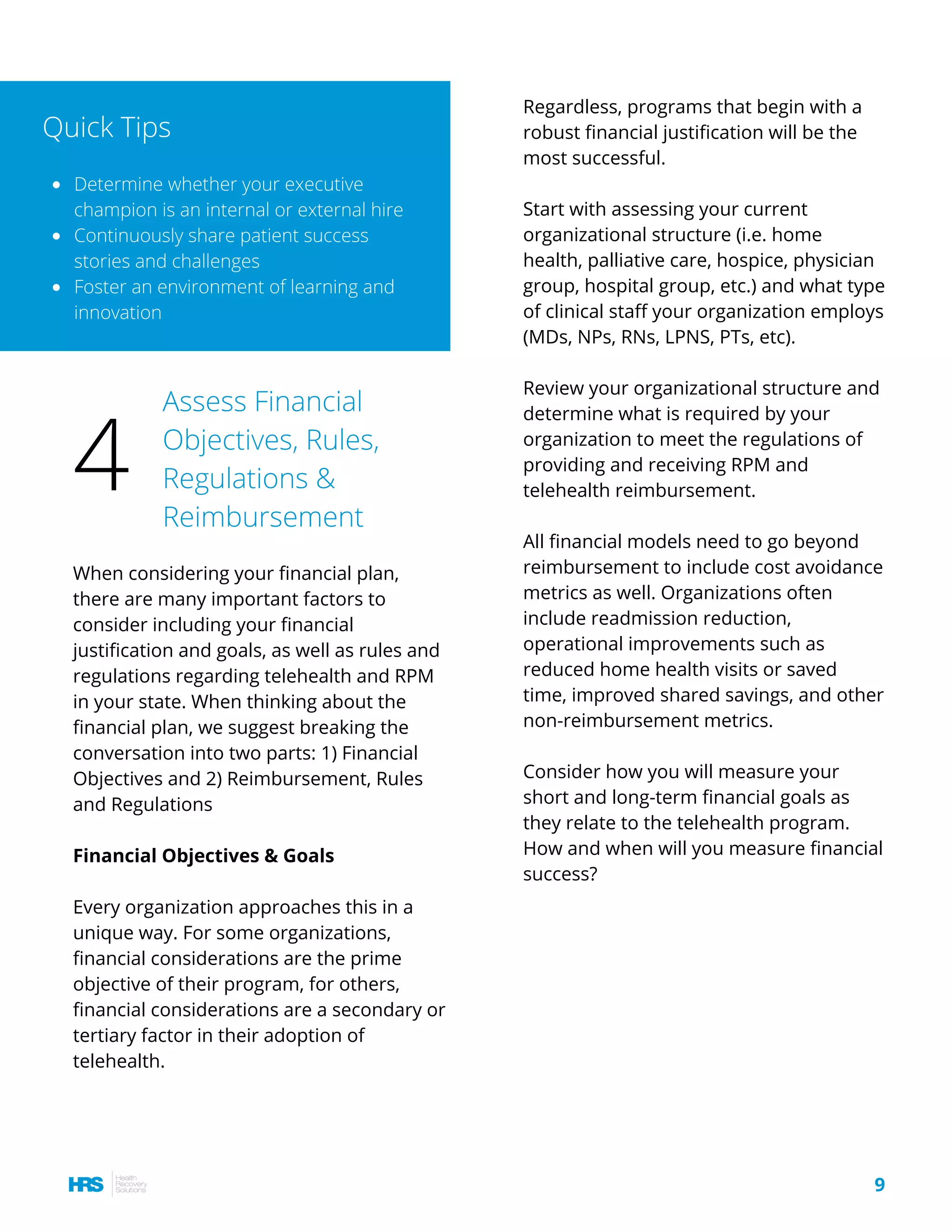
When considering your financial plan,
there are many important factors to
consider including your financial
justification and goals, as well as rules and
regulations regarding telehealth and RPM
in your state. When thinking about the
financial plan, we suggest breaking the
conversation into two parts: 1) Financial
Objectives and 2) Reimbursement, Rules
and Regulations
Financial Objectives & Goals
Every organization approaches this in a
unique way. For some organizations,
financial considerations are the prime
objective of their program, for others,
financial considerations are a secondary or
tertiary factor in their adoption of
telehealth.
Determine whether your executive
champion is an internal or external hire
Continuously share patient success
stories and challenges
Foster an environment of learning and
innovation
Quick Tips
Assess Financial
Objectives, Rules,
Regulations &
Reimbursement
4
9
Get acquainted with Medicare,
Medicaid, and commercial carriers; each
entity has  different rules and resources
available when it comes to the delivery
of telehealth services.
Many clinical organizations establish
contracts  with commercial carriers to
drive continued reimbursement for
their programs. When evaluating
telehealth partners, consider whether
they aid  in navigating these
relationships and contracting processes.
Also, be sure to consider which patient
populations are already part of cost
savings programs. Many  organizations
are part of Accountable Care
Organizations (ACOs) or have their own
health plans, so they can start
monitoring patients and achieving a
financial ROI without requiring direct
reimbursement.
If you are looking to provide RPM or
telehealth service to a Medicaid
population, be sure to review your
state’s Medicaid guidelines as not all
state Medicaid plans will cover RPM and
telehealth services, and provider
eligibility differs across states.
Grants are also important to consider.
During the COVID-19 pandemic, the FCC
provided grants to support expansion of
telehealth services. Some of the Managed
Care Organizations will offer grants that
are related to various disease
management groups that would benefit
from RPM/Telehealth services. Agencies
should reach out to their MCO contacts
and inquire if any grant projects are being
offered. There may also be an opportunity
at the state level for Medicaid grants as
well and we encourage every organization
to monitor Grants.gov to see if any  grant
opportunity arises.
Rules, Regulations and
Reimbursements
Telehealth and RPM rules and regulations
are a complex subject. The regulations and
reimbursement climate is continuously
evolving and is becoming increasingly
more progressive as telehealth gains
popularity and shows efficacy across the
continuum of care. Regulations vary from
state to state and it is essential that you
understand the rules in your unique
location. When considering your telehealth
or RPM partner, understand whether they
have reimbursement experts on their
team who can help you navigate through
all telehealth and RPM reimbursement
and regulations. 
The Center for Connected Health Policy
provides great resources on state by state
rules and regulations.
Research rules and regulations in your state
on The Center for Connected Health Policy
Discuss reimbursement opportunities with
your telehealth partner
Quick Tips
10
Educating Your Staff
Training and education is critical to
program success. Ensure your clinicians
understand the capabilities of the
telehealth platform, and what their
individual role is.  When evaluating
telehealth and RPM partners, be sure to
consider what their role  is in educating
your clinical team. Many times they will
have robust educational material that
you can utilize in the education process
with your teams.
By empowering your clinicians you will
empower your patients. Buy-in across
your organization is essential for
telehealth program success and it starts
by ensuring your team understands the
value, outcomes, and need surrounding
your new or expanded program.
You can accomplish this by stressing the
convenience the program will provide
patients, sharing frequent patient stories
and continuously sharing data and trends
on the program.
For example, if you are using telehealth for
your CHF population, provide examples
and stories of how telehealth has been
successful in treating and managing that
specific disease group.
Explore with your team how telehealth will
enable them to provide better and more
efficient care to their patients. On a daily
or weekly basis share the stories that
make your program so special; they’re
incredibly powerful tools to keep the
momentum of the program. 
11
Establish Telehealth
Buy-In & Educate Your
Clinical Team
5
Educate your staff on the importance of
maximizing utilization - if your
telehealth program is not utilized it will
lose steam quickly and you will not
reach your program’s goal.
Marketing can come in to play here to
ensure everyone knows the telehealth
program is a service your organization
provides
Your Telehealth
Program: The
Importance of Patient
and Clinician Education
Pre-training demo - kick off
presentation with a high level overview
of the telehealth platform. On a high
level, how does the solution work for
patients, and how does it work for
clinicians? During this conversation,
you should determine the clinical
training for the rest of the team. A
large focus should be on building
excitement around the telehealth
program and aligning your team with
the vision, goals, and objectives of the
telehealth program.
Clinical discussion - during this
conversation you will break down
workflows, patient identification,
eligibility criteria, discharge criteria,
and other clinical factors to consider.
ROI discussion - the goal of this
conversation is to discuss ROI goals
with your telehealth program and
create a data collection plan to track
program success metrics.
Clinical training - discuss and practice
how the telehealth software will work
in the field. Practice virtual visits, voice
calls, and text messaging. Practice
customizing care plans. Discuss the
clinical monitoring and the day-to-day
workflow of your clinical staff.
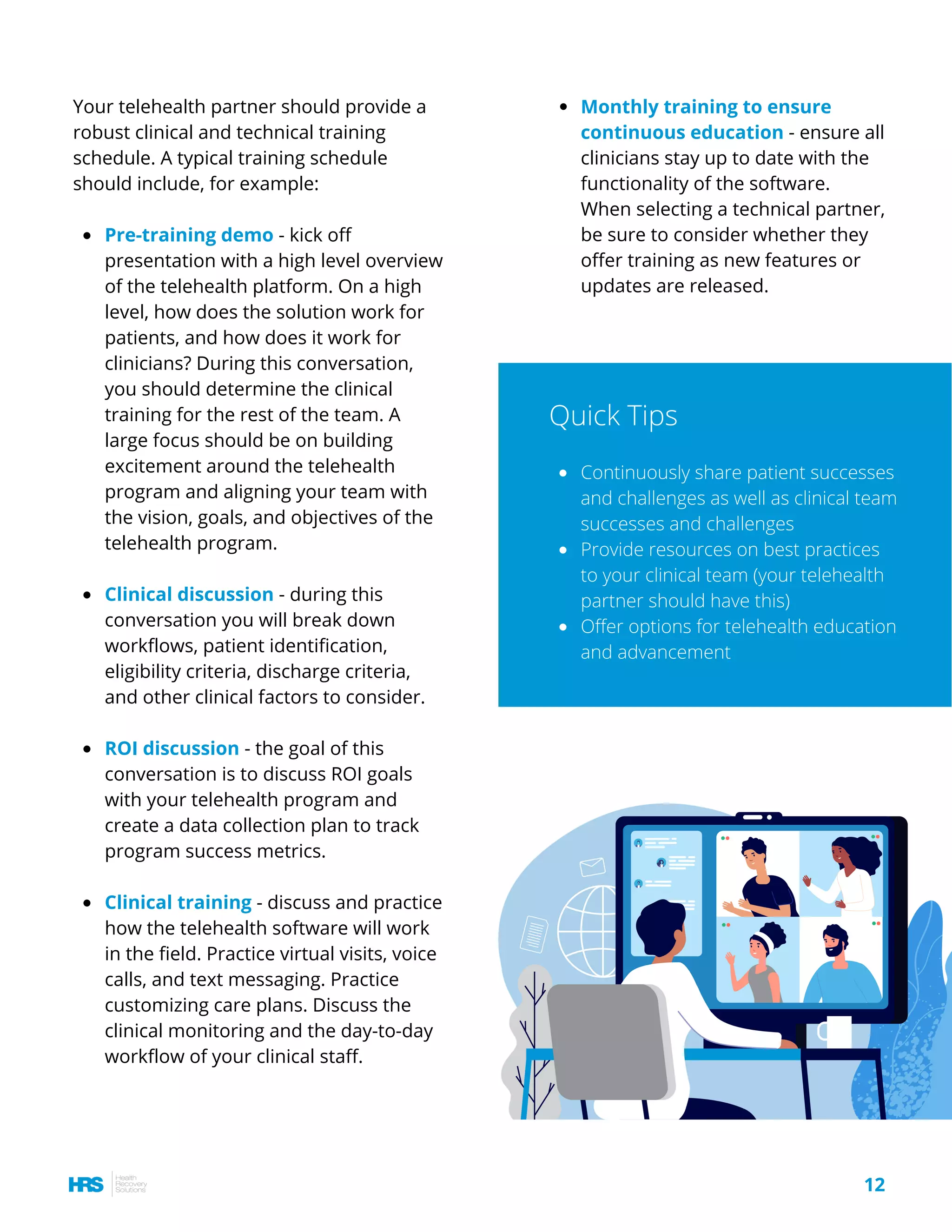
Your telehealth partner should provide a
robust clinical and technical training
schedule. A typical training schedule
should include, for example:
Monthly training to ensure
continuous education - ensure all
clinicians stay up to date with the
functionality of the software.
When selecting a technical partner,
be sure to consider whether they
offer training as new features or
updates are released.
Continuously share patient successes
and challenges as well as clinical team
successes and challenges
Provide resources on best practices
to your clinical team (your telehealth
partner should have this)
Offer options for telehealth education
and advancement
Quick Tips
12
Regardless of how you stratify your
patients, it is essential that the patient
population(s) chosen align with the goals
and objectives you outlined in
Step 1.
Establishing Enrollment Criteria
Before you launch your telehealth
program, you should have a clear plan
for patient enrollment. What is the
criteria to determine whether a patient
will be an eligible candidate for
telehealth?
Organizations use criteria as specific as
the organizations EMR’s algorithm risk
assessments, ICD-10 codes, and LACE
scores, to criteria as broad as Triggering
Events and Discharge Disposition.
Beyond that, it’s important to consider
whether the patient will be open to
utilizing telehealth to manage their care.
Based on the populations and patients
select for the program, enrollment
criteria is established.
Telehealth is not a one-size fits all
solution, in order to avoid operational
inefficiencies the program should be
tailored to respond to the needs of
patients based on cognitive/physical
abilities, home environment, social
determinants, caregiver support, and
the patients’ willingness to consistently
and thoroughly participate.
Which patient populations are you offering
telehealth to and what is the goal for each
group? Within the chosen patient
population(s), which patients should be
enrolled in telehealth? Once on the
program, when should patients be
discharged from the telehealth program?
These are very common questions that
must be considered when planning your
telehealth program launch.
Based on your goals determined in Step 1
(defining your vision and goals), which
patient populations align with that goal?
13
Determine Your
Patient Populations -
Set Clear Enrollment
& Discharge Criteria
6
SMART Goals for Your
Telehealth Program
Stratifying your patient cohorts is a
critical first step to enrollment. The
majority of telehealth programs select
their patient populations by diagnosis-
related groups (DRGs), or discharge
dispositions (i.e. home health, home,
hospice).
Setting discharge criteria and a
communication plan will alleviate a lot
of uncertainty and provide peace of
mind to both the patient, but also the
clinicians.
Discharge from the Telehealth Program
How do I know when a patient should be
discharged from the telehealth program?
This is different for every organization and
every patient cohort. The duration for
which patients are monitored depends on
your program model. For example, post
acute programs are short-term, while
chronic care management programs are
long-term. Some organizations keep their
patients on for 30 days, while will enroll
patients for 60 or 90 days.
However, it’s important  to always base 
discharges on health outcome
improvement - has this patient’s health
status improved to the point where they
no longer require a telehealth or RPM
platform? Will they be able to manage
their care without this tool? Setting an
estimated enrollment (30, 60, or 90+ days)
for each population will be a helpful
guideline, but we encourage all providers
to evaluate health status before
discharging the patient from telehealth or
RPM.
Ensure your enrollment and discharge
criteria align with your SMART goals
Telehealth is not a one-size-fits-all
solution, be sure to consider how each
individual patient will respond to
telehealth
Quick Tips
14
You’re Ready to Launch
Your Program!
A clear and methodological approach from
the onset  of your telehealth program will
prime your organization for initial and
continued success.
Through thoughtful planning and
execution and by partnering with the
correct telehealth and RPM partner you
will ensure that the program is always
working to meet the needs of both your
staff and patients.
15
It’s important to check in with your goals
regularly and reflect on what is working,
what needs to be improved and how
your partner can help you improve the
program.
By following the steps outlined here and
making adjustments as needed, your
patients, team and organization will
surely see the benefits of telehealth and
remote patient monitoring for years to
come.

Steps to building_a_telehealth_program

  • 1.
    6 Essential Stepsto Building a Scalable and Profitable Telehealth and Remote Patient Monitoring Program
  • 2.
    Introduction Launching or expandinga telehealth and remote patient monitoring (RPM) program can be an intimidating task. From establishing goals and determining your financial plan, to choosing a technology partner and building clinician and patient buy-in, there are many essential factors to consider to ensure your program is successful. This guide, informed by HRS health system, home health, and hospice clients across the country, as well as HRS’ Client Success, Implementation, Reimbursement and Clinical teams will serve as a resource for your organization as you start the telehealth implementation journey. 1 DEFINE Define Goals & Objectives - Establish Your Program's Vision 2 SELECT Select a Technology Partner Aligned With Your Goals & Project Scope 3 IDENTIFY Identify Telehealth Project Champions & Leaders - Build Your Telehealth Team 4 ASSESS Assess Financial Objectives, Rules, Regulations & Reimbursement 5 6 ESTABLISH Establish Telehealth Buy-In & Educate Your Clinical Team DETERMINE Determine Your Patient Populations - Set Clear Enrollment & Discharge Criteria 2
  • 3.
    Start with definingyour goals and objectives, both big and small. Why are you launching a telehealth program and what are you hoping to achieve? For your program to be successful, it’s essential that there is a clear vision backed by quantitative goals (clinical, financial, operational, etc.)  as well as a clear understanding of how the telehealth program will contribute to the overall vision and mission of your organization. Setting goals for your telehealth and remote patient monitoring program does not need to be difficult. Consider the following when setting your goals and objectives: Reducing readmissions Reducing ED utilization Reducing overall cost of care Increasing staff efficiency Shortening length of stay Improving clinical collaboration with providers and partners Increasing patient and/or caregiver satisfaction and engagement Increase reimbursement from CCM, TCM, and virtual visit programs Improving provider workflow and morale Enabling patients to age in place Improving access to care in rural areas Increasing referrals and in-network utilization Define Goals & Objectives - Establish Your Program’s Vision Again, the goals of the telehealth program must be strategically valuable and align with the goals of your organization. There are many types of telehealth programs, all with different goals and objectives. It is important to  focus on a few goals, as opposed to many. Common goals we see include: Your program should not set out to fix or improve every organizational metric. Focus on the goals that will provide the most value to your patients, clinicians, and organization as a whole. Once your program is optimized, you can always add more goals, or iterate on your initial ones. 1 3 Clearly state in order of precedence the business (financial and operational) and clinical (outcomes and quality) metrics you are setting out to improve Which clinical services and patient cohorts lend themselves to improving those metrics  How a telehealth program will be deployed and supported operationally How and when success will be measured and what technology will be implemented 1. 2. 3. 4.
  • 4.
    The majority oforganizations have different goals for different patient populations. Telehealth and RPM are not a one-size-fits all solution. Regardless of what your goals are, we recommend utilizing the SMART goal model to achieve them. Once you have your goals and objectives in place, establish a cadence for measuring your progress. Depending on the goal, this can be weekly, monthly, or quarterly. SMART goals are: SMARTSMART Specific goals are well defined and clear on what needs to be accomplished. What outcomes do you need to see in order to consider the goal accomplished? Relevant goals are important to your organization and will make an impact on achieving larger objectives. Does it make a difference to your overall objectives if this goal is met? Specific Measurable Attainable Relevant Time-bound SPECIFIC Conduct 1 virtual check-in per week with each CHF patient on the telehealth program for the first 2 months of the telehealth program. MEASURABLE Measurable goals enable you to evaluate whether or not the goal was achieved. How will you decide whether the goal was achieved? Conduct 1 virtual check-in per week with each CHF patient on the telehealth program for the first 2 months of the telehealth program. ATTAINABLE Attainable goals are realistic about what is possible given the availability of resources. How likely is it that you can accomplish this goal? Based on the number of patients and the number of staff we have, this is possible. RELEVANT Improving clinician-provider communication and providing continuous engagement is a primary objective of our telehealth program. TIME-BOUND Timely goals lock into a specific time frame and specify when they need to be completed by. What is the timeline for achieving this goal? Reduce readmissions from current 20% to below US average of 14.9% within 1 year of program launch. Reduce readmissions rate among CHF patients enrolled in telehealth to below US average 14.9%. Based on data from other telehealth programs, we believe this goal is attainable. Reducing readmissions among our chronic care patients is a primary objective of our organization. Within 1 year of telehealth program launch. 1 weekly visit per patient for first 2 months of telehealth program EX 1: Home Health Telehealth Program   CHF Patients EX 2: Hospital at Home Program Physical Therapy, Surgical Recovery 4
  • 5.
    In addition toSMART goals, it’s essential to consider your model(s) of care delivery. This will also help you define and refine your program’s goals and objectives. The model of care should align with your SMART goals. Model examples Access to Care Model - telehealth services as a tool for increasing access to care (specialist and general) to those in rural and/or underserved populations. In many cases, patients are not able to access care due to location, transportation barriers, socioeconomic status, or other factors. The goal of this model is to bring telehealth to those populations.  Hospital at Home Model - delivering hospital level care to patients in the comfort of their own home. This is used by organizations who are looking to decrease length of stay and readmissions, as well as provide an alternative to hospital care within the brick and mortar hospital or clinic setting. This model enables patients to receive acute and post acute care at home. Cost Savings Model - alternative care delivery methods that aim to reduce costs by reducing readmissions, improving care coordination, increasing shared savings, and avoiding  windshield time. Chronic Care Management Model - managing the health of patient populations with multiple (two or more) chronic conditions over a period of time.  Post-Acute Model - immediately at hospital discharge, monitoring patients to ensure they do not return back to the hospital. Aging in Place Model - telehealth services as a tool for increasing peace of mind and patient engagement. The goal of this model is to ensure that patients can receive care safely at home for as long as possible. Determining clear goals and objectives that align with your organization’s mission is the first step in launching  successful, scalable and profitable telehealth and RPM programs. Once you’ve done this, you are ready to move on to step 2 - selecting a technology partner. Focus on a few goals, as opposed to many Ensure every goal is a SMART goal Determine your model of care delivery early Quick Tips 5
  • 6.
    When evaluating potentialvendors, ensure that the technology aligns with the goals of your program determined in Step 1. What technology capabilities are needed to reach the goals your organization has outlined? A few examples include virtual visits for specialty and general health visits, remote monitoring of vitals and biometrics chronic disease management, medication reminders to promote engagement and care plan adherence, risk alerts to inform clinicians of symptom exacerbations, education modules to build health literacy, EMR integration to ensure optimized workflow, etc. Consider ease of use, security, integrations, the role of implementation, branding and marketing assistance, roadmap, total cost of ownership, logistics management, clinical support, and reimbursement resources. Ask every technology partner you evaluate the same questions (utilize a rubric) Focus on support and cynical expertise in addition to features Discuss success stories from vendor’s current customers Quick Tips Select a Technology Partner Aligned With Goals & Project Scope 2 1515 questions to ask when evaluating your telehealth partner 11 Is the platform cloud-based? What equipment is included for vital and biometric monitoring? How does connectivity work? Does the solution offer video visit capabilities? What is the virtual visit platform? Is the software platform secure and HIPPA compliant? Can I use this to get reimbursed?  Is a mobile application available? Do you offer technical support to patients and providers? How does logistics and inventory management work? Will I have access to a Client Success team? What does that relationship include? Do you offer marketing guidance and support? What is the total cost of ownership? Do you involve the patients’ caregiver in any way? Is the care plan customizable by patient? 22 33 44 55 66 77 88 99 1010 1111 1212 1313 1414 1515 6
  • 7.
    Regardless of thesize of your organization, there are two roles of involvement that will make a significant impact on your program’s success: the “Telehealth Executive Champion” and the “Telehealth Leader.” The telehealth executive champion, telehealth leader, and your telehealth partner’s client success team are responsible for developing and iterating upon a methodology that aligns with your organization’s vision and mission for patient care as determined in Step 1. Telehealth executive champions are change agents who are inspirational and visionary leaders. They ensure telehealth options are evaluated as part of the planning process each year and ensure appropriate financial, operational, clinical and technical resources are allocated to the telehealth program. The telehealth champion is the telehealth spokesperson within your organization - they are tasked with driving development and ongoing support of the telehealth program. This individual is usually the CEO, Chief Nursing Officer, Chief Medical Officer, Chief Operating Officer, Chief Technology Officer, Chief Medical Information Officer, or a VP/Director governing the telehealth program. Identify internal hires who have supported or assisted in the planning of the telehealth program Identify internal hires with experience in technical aptitude, project development and an interest in leading clinical operations Regardless of who it is, it is crucial that they perform on the above functions and pick the right person to be the “telehealth leader.” The telehealth leader runs the day-to-day function of the telehealth program, serves as a role model and coach to the telehealth team, and manages the relationship with the telehealth partner. Your telehealth champion and telehealth leader will work hand in hand to achieve on-going program success.  The telehealth leader is responsible for putting in place all key operational and clinical elements of the telehealth program. They will lay the foundation upon which all further development and growth is based. This individual is the “eyes and ears” of the telehealth executive champion and other executive leadership. When recruiting your telehealth leader, there are several important factors to consider. First, be patient - you will find the right person for the job. Examples of recruiting tactics for retaining a telehealth leader include: Identify Telehealth Project Champions & Leaders - Build Your Telehealth Team 3 7 1
  • 8.
    Identify an externalprofessional who has proven experience in leading a data driven and systemic telehealth approach Identify interim leadership (this is less sustainable) from an organization who have proven experience in executing on telehealth methodology for other vendors and agencies - this individual can provide quicker time-to-initial- value, and effectively hire new telehealth leader once the program is more mature Work to develop telehealth clinical experts within your program to build buy-in and clinician engagement. Foster an environment of continuous iteration and support by emphasizing the importance of sharing weekly patient stories and improvement areas to ensure that your program has continuous improvement and momentum. The telehealth and RPM team will learn the most by seeing each other in action and hearing frontline stories. 1 Arkwright, Bryan, et al. “Telehealth Governance: An Essential Tool to Empower Today's Healthcare Leaders.” Telehealth and Medicine Today, 2 May 2018, telehealthandmedicinetoday.com/index.php/journal/article/view/12. 8 The Importance of Telehealth Governance and Executive Buy-In What is the patient to nurse ratio for monitoring?Will you be using LPN’s or RN’s? Will there be a physician liaison for the program? Is there coverage for holidays, weekends, PTO, etc? If not, does your telehealth partner have a clinical call center to assist with this? Do you need to hire a telehealth installer or technician?  Are you managing the inventory internally or outsourcing (or does your telehealth partner offer inventory management)? As your telehealth team and program grows, you will need to consider how  the team is structured from a licensure and a staffing ratio perspective. Some staffing questions to consider are: If you’re unsure of how to answer these questions or best practices, lean on your telehealth partner to provide assistance and staffing models.
  • 9.
    Regardless, programs thatbegin with a robust financial justification will be the most successful. Start with assessing your current organizational structure (i.e. home health, palliative care, hospice, physician group, hospital group, etc.) and what type of clinical staff your organization employs (MDs, NPs, RNs, LPNS, PTs, etc). Review your organizational structure and determine what is required by your organization to meet the regulations of providing and receiving RPM and telehealth reimbursement. All financial models need to go beyond reimbursement to include cost avoidance metrics as well. Organizations often include readmission reduction, operational improvements such as reduced home health visits or saved time, improved shared savings, and other non-reimbursement metrics. Consider how you will measure your short and long-term financial goals as they relate to the telehealth program. How and when will you measure financial success? When considering your financial plan, there are many important factors to consider including your financial justification and goals, as well as rules and regulations regarding telehealth and RPM in your state. When thinking about the financial plan, we suggest breaking the conversation into two parts: 1) Financial Objectives and 2) Reimbursement, Rules and Regulations Financial Objectives & Goals Every organization approaches this in a unique way. For some organizations, financial considerations are the prime objective of their program, for others, financial considerations are a secondary or tertiary factor in their adoption of telehealth. Determine whether your executive champion is an internal or external hire Continuously share patient success stories and challenges Foster an environment of learning and innovation Quick Tips Assess Financial Objectives, Rules, Regulations & Reimbursement 4 9
  • 10.
    Get acquainted withMedicare, Medicaid, and commercial carriers; each entity has  different rules and resources available when it comes to the delivery of telehealth services. Many clinical organizations establish contracts  with commercial carriers to drive continued reimbursement for their programs. When evaluating telehealth partners, consider whether they aid  in navigating these relationships and contracting processes. Also, be sure to consider which patient populations are already part of cost savings programs. Many  organizations are part of Accountable Care Organizations (ACOs) or have their own health plans, so they can start monitoring patients and achieving a financial ROI without requiring direct reimbursement. If you are looking to provide RPM or telehealth service to a Medicaid population, be sure to review your state’s Medicaid guidelines as not all state Medicaid plans will cover RPM and telehealth services, and provider eligibility differs across states. Grants are also important to consider. During the COVID-19 pandemic, the FCC provided grants to support expansion of telehealth services. Some of the Managed Care Organizations will offer grants that are related to various disease management groups that would benefit from RPM/Telehealth services. Agencies should reach out to their MCO contacts and inquire if any grant projects are being offered. There may also be an opportunity at the state level for Medicaid grants as well and we encourage every organization to monitor Grants.gov to see if any  grant opportunity arises. Rules, Regulations and Reimbursements Telehealth and RPM rules and regulations are a complex subject. The regulations and reimbursement climate is continuously evolving and is becoming increasingly more progressive as telehealth gains popularity and shows efficacy across the continuum of care. Regulations vary from state to state and it is essential that you understand the rules in your unique location. When considering your telehealth or RPM partner, understand whether they have reimbursement experts on their team who can help you navigate through all telehealth and RPM reimbursement and regulations.  The Center for Connected Health Policy provides great resources on state by state rules and regulations. Research rules and regulations in your state on The Center for Connected Health Policy Discuss reimbursement opportunities with your telehealth partner Quick Tips 10
  • 11.
    Educating Your Staff Trainingand education is critical to program success. Ensure your clinicians understand the capabilities of the telehealth platform, and what their individual role is.  When evaluating telehealth and RPM partners, be sure to consider what their role  is in educating your clinical team. Many times they will have robust educational material that you can utilize in the education process with your teams. By empowering your clinicians you will empower your patients. Buy-in across your organization is essential for telehealth program success and it starts by ensuring your team understands the value, outcomes, and need surrounding your new or expanded program. You can accomplish this by stressing the convenience the program will provide patients, sharing frequent patient stories and continuously sharing data and trends on the program. For example, if you are using telehealth for your CHF population, provide examples and stories of how telehealth has been successful in treating and managing that specific disease group. Explore with your team how telehealth will enable them to provide better and more efficient care to their patients. On a daily or weekly basis share the stories that make your program so special; they’re incredibly powerful tools to keep the momentum of the program.  11 Establish Telehealth Buy-In & Educate Your Clinical Team 5 Educate your staff on the importance of maximizing utilization - if your telehealth program is not utilized it will lose steam quickly and you will not reach your program’s goal. Marketing can come in to play here to ensure everyone knows the telehealth program is a service your organization provides Your Telehealth Program: The Importance of Patient and Clinician Education
  • 12.
    Pre-training demo -kick off presentation with a high level overview of the telehealth platform. On a high level, how does the solution work for patients, and how does it work for clinicians? During this conversation, you should determine the clinical training for the rest of the team. A large focus should be on building excitement around the telehealth program and aligning your team with the vision, goals, and objectives of the telehealth program. Clinical discussion - during this conversation you will break down workflows, patient identification, eligibility criteria, discharge criteria, and other clinical factors to consider. ROI discussion - the goal of this conversation is to discuss ROI goals with your telehealth program and create a data collection plan to track program success metrics. Clinical training - discuss and practice how the telehealth software will work in the field. Practice virtual visits, voice calls, and text messaging. Practice customizing care plans. Discuss the clinical monitoring and the day-to-day workflow of your clinical staff. Your telehealth partner should provide a robust clinical and technical training schedule. A typical training schedule should include, for example: Monthly training to ensure continuous education - ensure all clinicians stay up to date with the functionality of the software. When selecting a technical partner, be sure to consider whether they offer training as new features or updates are released. Continuously share patient successes and challenges as well as clinical team successes and challenges Provide resources on best practices to your clinical team (your telehealth partner should have this) Offer options for telehealth education and advancement Quick Tips 12
  • 13.
    Regardless of howyou stratify your patients, it is essential that the patient population(s) chosen align with the goals and objectives you outlined in Step 1. Establishing Enrollment Criteria Before you launch your telehealth program, you should have a clear plan for patient enrollment. What is the criteria to determine whether a patient will be an eligible candidate for telehealth? Organizations use criteria as specific as the organizations EMR’s algorithm risk assessments, ICD-10 codes, and LACE scores, to criteria as broad as Triggering Events and Discharge Disposition. Beyond that, it’s important to consider whether the patient will be open to utilizing telehealth to manage their care. Based on the populations and patients select for the program, enrollment criteria is established. Telehealth is not a one-size fits all solution, in order to avoid operational inefficiencies the program should be tailored to respond to the needs of patients based on cognitive/physical abilities, home environment, social determinants, caregiver support, and the patients’ willingness to consistently and thoroughly participate. Which patient populations are you offering telehealth to and what is the goal for each group? Within the chosen patient population(s), which patients should be enrolled in telehealth? Once on the program, when should patients be discharged from the telehealth program? These are very common questions that must be considered when planning your telehealth program launch. Based on your goals determined in Step 1 (defining your vision and goals), which patient populations align with that goal? 13 Determine Your Patient Populations - Set Clear Enrollment & Discharge Criteria 6 SMART Goals for Your Telehealth Program Stratifying your patient cohorts is a critical first step to enrollment. The majority of telehealth programs select their patient populations by diagnosis- related groups (DRGs), or discharge dispositions (i.e. home health, home, hospice).
  • 14.
    Setting discharge criteriaand a communication plan will alleviate a lot of uncertainty and provide peace of mind to both the patient, but also the clinicians. Discharge from the Telehealth Program How do I know when a patient should be discharged from the telehealth program? This is different for every organization and every patient cohort. The duration for which patients are monitored depends on your program model. For example, post acute programs are short-term, while chronic care management programs are long-term. Some organizations keep their patients on for 30 days, while will enroll patients for 60 or 90 days. However, it’s important  to always base  discharges on health outcome improvement - has this patient’s health status improved to the point where they no longer require a telehealth or RPM platform? Will they be able to manage their care without this tool? Setting an estimated enrollment (30, 60, or 90+ days) for each population will be a helpful guideline, but we encourage all providers to evaluate health status before discharging the patient from telehealth or RPM. Ensure your enrollment and discharge criteria align with your SMART goals Telehealth is not a one-size-fits-all solution, be sure to consider how each individual patient will respond to telehealth Quick Tips 14
  • 15.
    You’re Ready toLaunch Your Program! A clear and methodological approach from the onset  of your telehealth program will prime your organization for initial and continued success. Through thoughtful planning and execution and by partnering with the correct telehealth and RPM partner you will ensure that the program is always working to meet the needs of both your staff and patients. 15 It’s important to check in with your goals regularly and reflect on what is working, what needs to be improved and how your partner can help you improve the program. By following the steps outlined here and making adjustments as needed, your patients, team and organization will surely see the benefits of telehealth and remote patient monitoring for years to come.