DMTP
Distribution Management Training
             Program

                   Cindy Joice
       Director Training and Development
Agenda


• Overview of SUPERVALU and the Distribution group

Distribution Management Training Program (DMTP)

• Program Needs Assessment & Objectives
• Content / Subject Matter
• Return on Investment & Program Impact
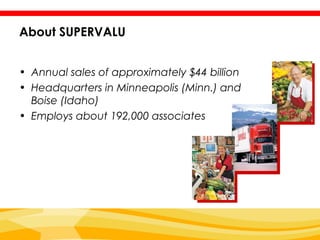
About SUPERVALU


• Annual sales of approximately $44 billion
• Headquarters in Minneapolis (Minn.) and
  Boise (Idaho)
• Employs about 192,000 associates
SUPERVALU Distribution
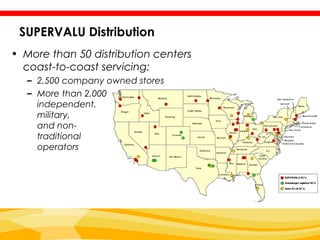
• More than 50 distribution centers
  coast-to-coast servicing:
   – 2,500 company owned stores
   – More than 2,000
     independent,
     military,
     and non-
     traditional
     operators
Distribution Management Training Program (DMTP)

Pre-Development Phase
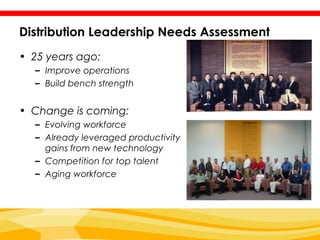
Distribution Leadership Needs Assessment
• 25 years ago:
  – Improve operations
  – Build bench strength


• Change is coming:
  – Evolving workforce
  – Already leveraged productivity
    gains from new technology
  – Competition for top talent
  – Aging workforce
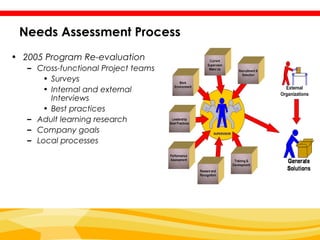
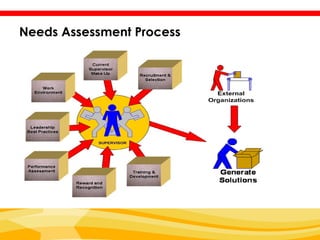
Needs Assessment Process
• 2005 Program Re-evaluation
   – Cross-functional Project teams
      • Surveys
      • Internal and external
        Interviews
      • Best practices
   – Adult learning research
   – Company goals
   – Local processes
Needs Assessment Process
Program Objectives


 Improve operations and build bench strength


  –   Increase Management effectiveness
  –   Improve core competencies linked to leadership success
  –   Enable collaboration and sharing of best practices
  –   Integrate training to enable readiness for advancement
Alignment with Company Priorities

• SUPERVALU Fiscal Year 2009 Priorities for Associates
   – Develop and support associates
      • Engage and involve employees
      • Recognize associates for their contributions
   – Enable collaboration
   – Serve customers better than anyone else can
   – Foster value and growth for shareholders
Program Development Phase
Program Content & Subject Matter
• Personal Effectiveness
   •   7 Habits of Highly Successful People
   •   Communication
   •   Myers-Briggs
   •   Reflection and Journaling
• Leading Teams
   •   Setting Priorities
   •   Recognition
   •   Coaching
   •   Decision Making and Problem Solving
   •   Motivation and Employee Engagement
• Providing Shareholder Value
   • Financial Acumen
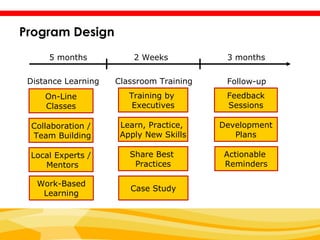
Program Design
      5 months           2 Weeks           3 months

 Distance Learning   Classroom Training    Follow-up
     On-Line            Training by        Feedback
     Classes             Executives        Sessions

 Collaboration /      Learn, Practice,    Development
 Team Building        Apply New Skills       Plans

 Local Experts /        Share Best        Actionable
    Mentors              Practices        Reminders

   Work-Based
                        Case Study
    Learning
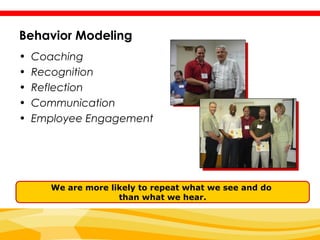
Behavior Modeling
•   Coaching
•   Recognition
•   Reflection
•   Communication
•   Employee Engagement


       We are more likely to repeat what we see and do
                     than what we hear.
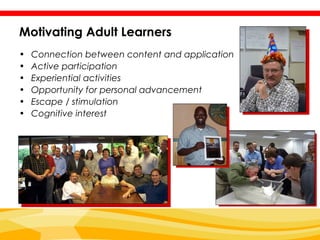
Motivating Adult Learners
•   Connection between content and application
•   Active participation
•   Experiential activities
•   Opportunity for personal advancement
•   Escape / stimulation
•   Cognitive interest
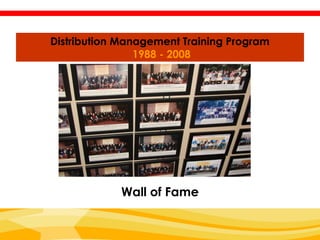
Distribution Management Training Program
                1988 - 2008


            Wall of Fame
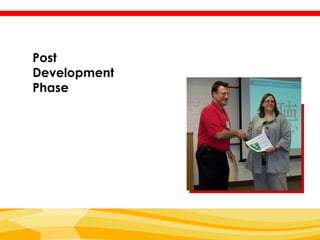
Post
Development
Phase
Measurable Results
• Results in the last 10 years
   – Net cost per case decrease each year
   – 49% of participants were promoted or moved laterally
   – 75% of distribution managers have completed the
     program
• Results last year
   – Significant net cost per case decrease
   – 80% of open management positions were filled by
     program graduates
            1 Year ROI ranged from 7 to 14.5%

          *Assumption: 5% – 10% of cost per case and turnover
               reduction is directly related to the program
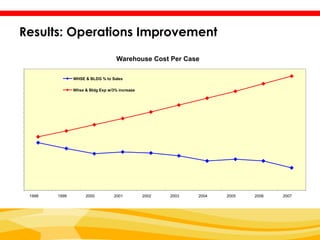
Results: Operations Improvement
                                         Warehouse Cost Per Case
5.5%
5.4%
5.3%                 WHSE & BLDG % to Sales
5.2%
5.1%                 Whse & Bldg Exp w/3% increase
5.0%
4.9%
4.8%
4.7%
4.6%
4.5%
4.4%
4.3%
4.2%
4.1%
4.0%
3.9%
3.8%
3.7%
3.6%
3.5%
3.4%
3.3%
3.2%
3.1%
3.0%
       1998   1999        2000          2001         2002   2003   2004   2005   2006   2007
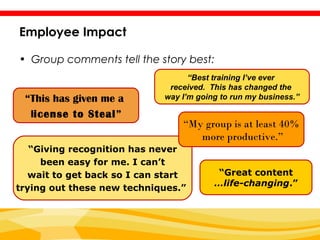
Employee Impact

• Group comments tell the story best:
                                   “Best training I’ve ever
                              received. This has changed the
 “This has given me a        way I’m going to run my business.”

  license to Steal”
                                 “My group is at least 40%
                                    more productive.”
   “Giving recognition has never
     been easy for me. I can’t
   wait to get back so I can start        “Great content
                                         …life-changing.”
trying out these new techniques.”

Distribution Management Training Program Overview for FMI MAXX Award

  • 1.
    DMTP Distribution Management Training Program Cindy Joice Director Training and Development
  • 2.
    Agenda • Overview ofSUPERVALU and the Distribution group Distribution Management Training Program (DMTP) • Program Needs Assessment & Objectives • Content / Subject Matter • Return on Investment & Program Impact
  • 3.
    About SUPERVALU • Annualsales of approximately $44 billion • Headquarters in Minneapolis (Minn.) and Boise (Idaho) • Employs about 192,000 associates
  • 4.
    SUPERVALU Distribution • Morethan 50 distribution centers coast-to-coast servicing: – 2,500 company owned stores – More than 2,000 independent, military, and non- traditional operators
  • 5.
    Distribution Management TrainingProgram (DMTP) Pre-Development Phase
  • 6.
    Distribution Leadership NeedsAssessment • 25 years ago: – Improve operations – Build bench strength • Change is coming: – Evolving workforce – Already leveraged productivity gains from new technology – Competition for top talent – Aging workforce
  • 7.
    Needs Assessment Process •2005 Program Re-evaluation – Cross-functional Project teams • Surveys • Internal and external Interviews • Best practices – Adult learning research – Company goals – Local processes
  • 8.
  • 9.
    Program Objectives Improveoperations and build bench strength – Increase Management effectiveness – Improve core competencies linked to leadership success – Enable collaboration and sharing of best practices – Integrate training to enable readiness for advancement
  • 10.
    Alignment with CompanyPriorities • SUPERVALU Fiscal Year 2009 Priorities for Associates – Develop and support associates • Engage and involve employees • Recognize associates for their contributions – Enable collaboration – Serve customers better than anyone else can – Foster value and growth for shareholders
  • 11.
  • 12.
    Program Content &Subject Matter • Personal Effectiveness • 7 Habits of Highly Successful People • Communication • Myers-Briggs • Reflection and Journaling • Leading Teams • Setting Priorities • Recognition • Coaching • Decision Making and Problem Solving • Motivation and Employee Engagement • Providing Shareholder Value • Financial Acumen
  • 13.
    Program Design 5 months 2 Weeks 3 months Distance Learning Classroom Training Follow-up On-Line Training by Feedback Classes Executives Sessions Collaboration / Learn, Practice, Development Team Building Apply New Skills Plans Local Experts / Share Best Actionable Mentors Practices Reminders Work-Based Case Study Learning
  • 14.
    Behavior Modeling • Coaching • Recognition • Reflection • Communication • Employee Engagement We are more likely to repeat what we see and do than what we hear.
  • 15.
    Motivating Adult Learners • Connection between content and application • Active participation • Experiential activities • Opportunity for personal advancement • Escape / stimulation • Cognitive interest
  • 16.
    Distribution Management TrainingProgram 1988 - 2008 Wall of Fame
  • 17.
  • 18.
    Measurable Results • Resultsin the last 10 years – Net cost per case decrease each year – 49% of participants were promoted or moved laterally – 75% of distribution managers have completed the program • Results last year – Significant net cost per case decrease – 80% of open management positions were filled by program graduates 1 Year ROI ranged from 7 to 14.5% *Assumption: 5% – 10% of cost per case and turnover reduction is directly related to the program
  • 19.
    Results: Operations Improvement Warehouse Cost Per Case 5.5% 5.4% 5.3% WHSE & BLDG % to Sales 5.2% 5.1% Whse & Bldg Exp w/3% increase 5.0% 4.9% 4.8% 4.7% 4.6% 4.5% 4.4% 4.3% 4.2% 4.1% 4.0% 3.9% 3.8% 3.7% 3.6% 3.5% 3.4% 3.3% 3.2% 3.1% 3.0% 1998 1999 2000 2001 2002 2003 2004 2005 2006 2007
  • 20.
    Employee Impact • Groupcomments tell the story best: “Best training I’ve ever received. This has changed the “This has given me a way I’m going to run my business.” license to Steal” “My group is at least 40% more productive.” “Giving recognition has never been easy for me. I can’t wait to get back so I can start “Great content …life-changing.” trying out these new techniques.”

Editor's Notes

  • #7 The DMT program was started in 1989 when Greg Heying, our current Sr. VP of Distribution moved from a leadership role in DC operations to a leadership role at home office. He and other Distribution leaders determined that their top priority was to improve operations and to do this they knew they would need their local leaders prepared to drive change. Looking at the strength of the management team, they realized that although their teams were really good at the day to day business of getting cases out the door, to improve operations they would need additional skills and abilities. They also saw that there were few managers currently ready to move into the next layer of management. I believe in this analysis, Greg and his team were probably ahead of the curve as it relates to identifying bench strength as a top organizational priority. Although the somewhat simple analysis done 20 years ago is still valid today, there can be no denying that change is coming. Our workforce and management team have different needs today vs 20 years ago. With RFID and Voice technology installed throughout our network, we also have less opportunity to gain productivity from new technology and will be relying even more on our people to drive improvements. There is increasing competition for our talented management team, and there is a significant number of leaders scheduled for retirement in the next 5 years.
  • #8 This forecast for change prompted me to re-evaluate the program when I took responsibility for it in 2005. There were 2 cross functional teams formed in 2004 responsible for analyzing the total company needs for Distribution leadership and also Employee Engagement. I used the great work done by these teams, current adult learning research, and alignment with both local and company goals to re-assess the direction of the DMT program. The research brought to light many areas important to the company and employees that we were not addressing in our program.
  • #11 SUPERVALU’s total company priorities are to develop and support associates, enable collaboration, serve our customers better than anyone else can, and to foster value and growth for our shareholders. Although our program goals are in perfect alignment with these priorities, we did change our content to strengthen these messages and create a unified message from top down.
  • #13 28
  • #15 28
  • #20 1