Activity 1
Which is matter, which is not?
Objectives:
After performing this activity, you should
be able to:
1. describe common properties of
matter;
2. distinguish properties of matter
from those of non-matter; and
3. demonstrate the skill of measuring
mass.
Materials Needed:
1 teaspoon sugar in a plastic cup or small
beaker
½ cup tapwater
1 piece, stone or small rock
1 piece, ball (basketball, volleyball, or small
beach ball)
3 pieces of leaves (from any plant or tree)
5 small wide-mouthed bottles or cups or 150-
mL or 200-mL beakers
1 platform balance or weighing scale
1 small air pump
Procedure:
1. Among the materials displayed in
front of you, which do you think is
classified as matter? Put a check ( )
under the appropriate column in Table
1. You may make a table similar to
the one below. With your group
mates, discuss the reason to explain
your answer for each sample. Write
your answer in the last column.
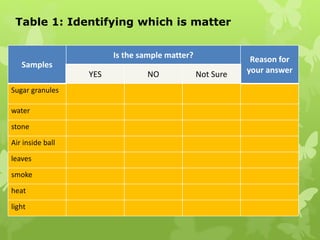
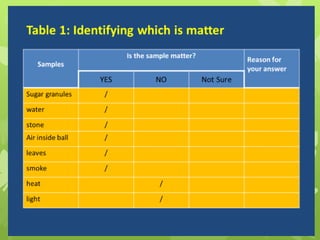
Samples
Is the sample matter? Reason for
your answer
YES NO Not Sure
Sugar granules
water
stone
Air inside ball
leaves
smoke
heat
light
Table 1: Identifying which is matter
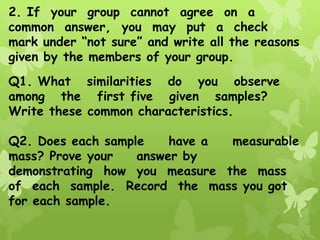
2. If your group cannot agree on a
common answer, you may put a check
mark under “not sure” and write all the reasons
given by the members of your group.
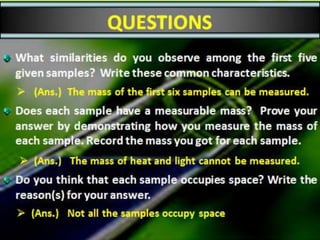
Q1. What similarities do you observe
among the first five given samples?
Write these common characteristics.
Q2. Does each sample have a measurable
mass? Prove your answer by
demonstrating how you measure the mass
of each sample. Record the mass you got
for each sample.
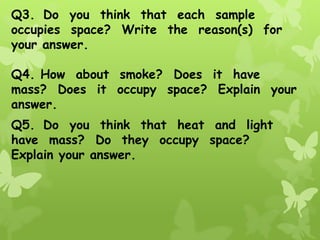
Q3. Do you think that each sample
occupies space? Write the reason(s) for
your answer.
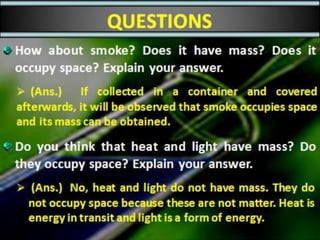
Q4. How about smoke? Does it have
mass? Does it occupy space? Explain your
answer.
Q5. Do you think that heat and light
have mass? Do they occupy space?
Explain your answer.
matter act. 1.pptx
matter act. 1.pptx
matter act. 1.pptx
matter act. 1.pptx
matter act. 1.pptx
matter act. 1.pptx
matter act. 1.pptx
matter act. 1.pptx
matter act. 1.pptx
matter act. 1.pptx
matter act. 1.pptx
matter act. 1.pptx

matter act. 1.pptx

  • 1.
    Activity 1 Which ismatter, which is not? Objectives: After performing this activity, you should be able to: 1. describe common properties of matter; 2. distinguish properties of matter from those of non-matter; and 3. demonstrate the skill of measuring mass.
  • 2.
    Materials Needed: 1 teaspoonsugar in a plastic cup or small beaker ½ cup tapwater 1 piece, stone or small rock 1 piece, ball (basketball, volleyball, or small beach ball) 3 pieces of leaves (from any plant or tree) 5 small wide-mouthed bottles or cups or 150- mL or 200-mL beakers 1 platform balance or weighing scale 1 small air pump
  • 3.
    Procedure: 1. Among thematerials displayed in front of you, which do you think is classified as matter? Put a check ( ) under the appropriate column in Table 1. You may make a table similar to the one below. With your group mates, discuss the reason to explain your answer for each sample. Write your answer in the last column.
  • 4.
    Samples Is the samplematter? Reason for your answer YES NO Not Sure Sugar granules water stone Air inside ball leaves smoke heat light Table 1: Identifying which is matter
  • 6.
    2. If yourgroup cannot agree on a common answer, you may put a check mark under “not sure” and write all the reasons given by the members of your group. Q1. What similarities do you observe among the first five given samples? Write these common characteristics. Q2. Does each sample have a measurable mass? Prove your answer by demonstrating how you measure the mass of each sample. Record the mass you got for each sample.
  • 7.
    Q3. Do youthink that each sample occupies space? Write the reason(s) for your answer. Q4. How about smoke? Does it have mass? Does it occupy space? Explain your answer. Q5. Do you think that heat and light have mass? Do they occupy space? Explain your answer.