Day 1
SCIENCE 5
1. Matter in daily life
2. Matter and the three
states
Learning
Competency/Objective
Describe matter as
anything that has mass
and takes up space.
SCIENCE 6
Describing mixtures
Learning
Competency/Objective
Describe the appearance
and uses of uniform and
non-uniform mixtures.
G5
Engage:
-"Can you name things around you
right now?"
-"Do air, water, and your pencil have
something in common?"
G5
Show and Ask:
Hold up a rock and a balloon. Ask:
"What do these two have in
common?"
G5
Let us learn about matter.
G5
oMatter is anything that
has mass (weight) and
takes up space (volume).
G5
Solid
- keeps its shape (e.g.,
book, stone)
G5
Liquid
- takes the shape of its
container (e.g., water, juice)
G5
Gas
- fills any space (e.g., air,
steam)
G5
Activity 1.“Mass and Volume Hunt”
Instructions:
Group students into teams of 3–4.
Give each group a small plastic
bottle, water, and a rock.
G5
Let them feel and weigh each item
using a simple balance (if available)
or just by lifting.
Ask:
o“Which is heavier?”
o“Do all these objects take up
space?”
G5
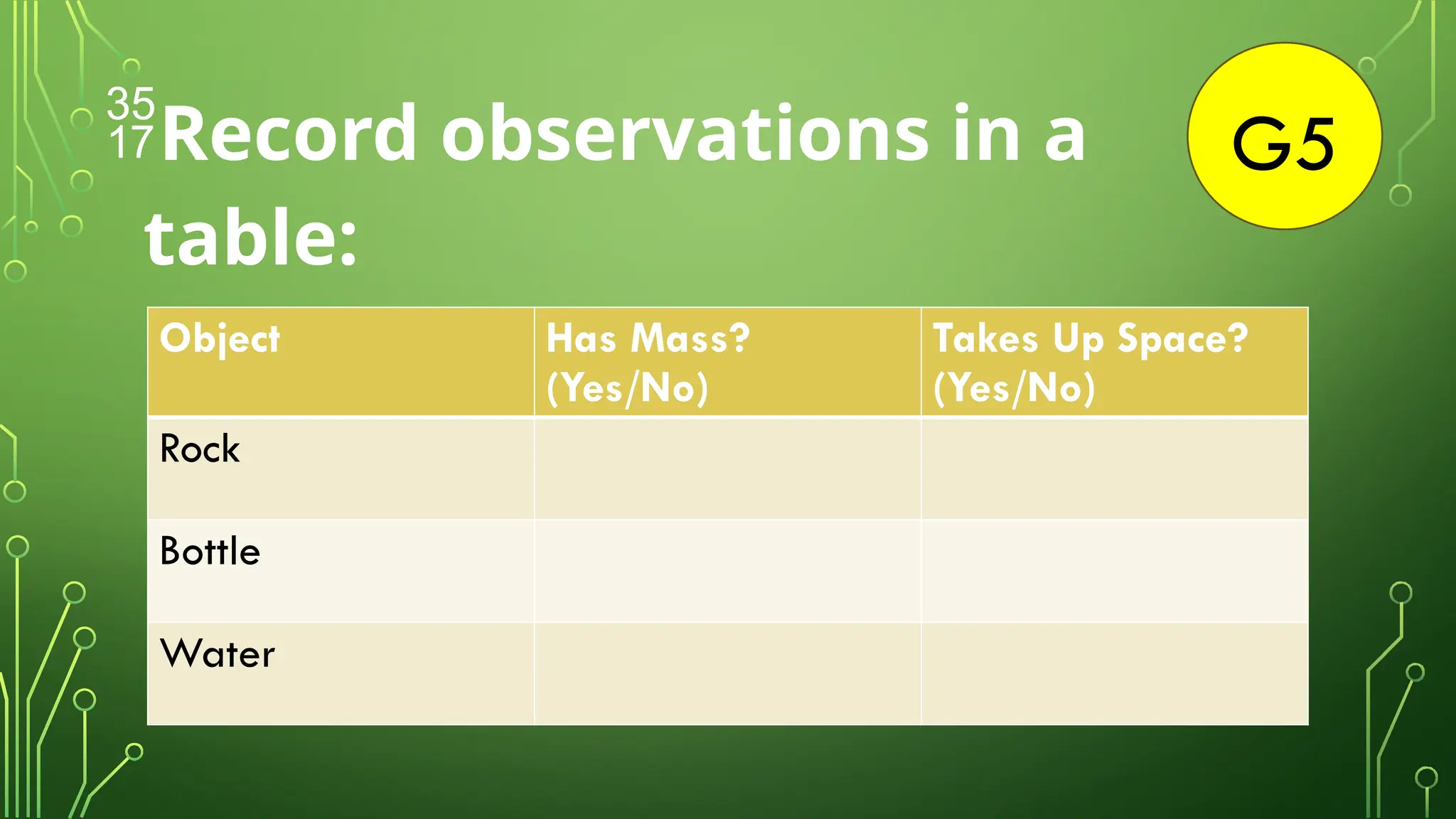
Record observations in a
table:
Object Has Mass?
(Yes/No)
Takes Up Space?
(Yes/No)
Rock
Bottle
Water
G6
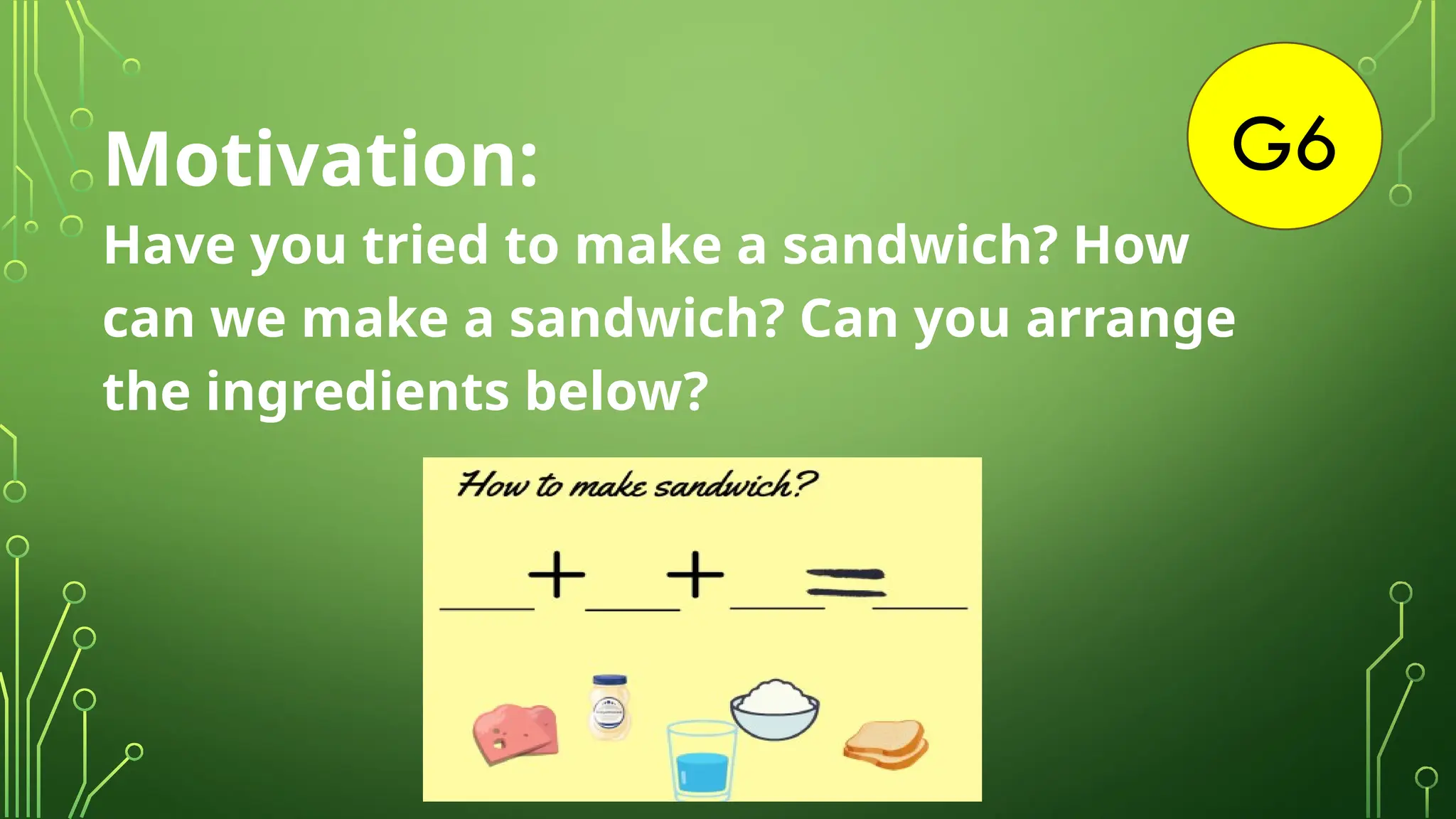
Motivation:
Have you tried to make a sandwich? How
can we make a sandwich? Can you arrange
the ingredients below?
G6
What have you notice in our
activity? Can you give another
example of foods that can be
mixed? Share it in our class.
G6
Let us learn about
describing mixtures.
G6
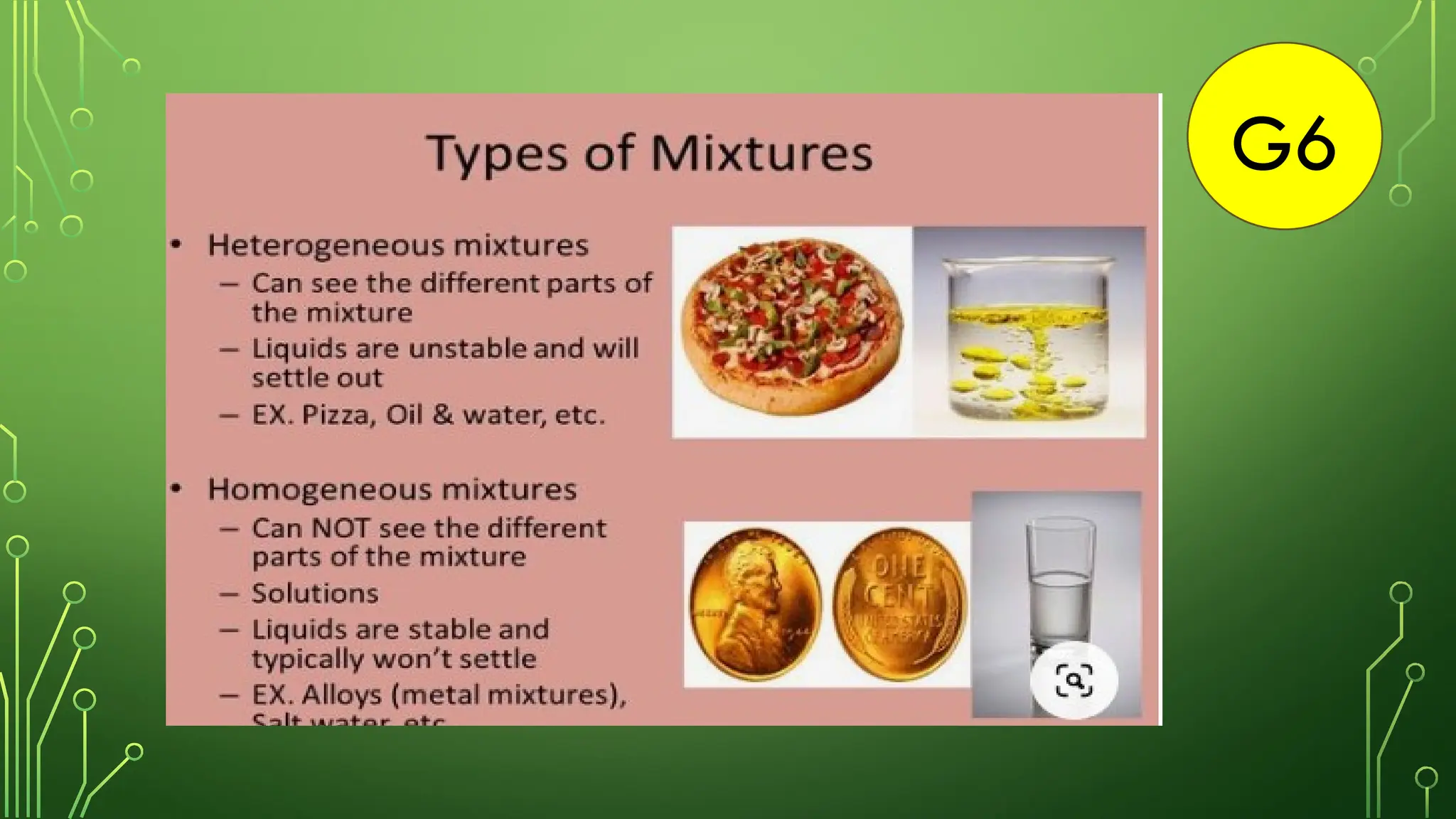
Mixtures are combinations of two or more
substances that can be
homogeneous or heterogeneous.
Homogeneous mixtures appear uniform all
throughout because they have the same
proportion. Heterogeneous mixtures
are not uniform in proportion where
combined substances are not evenly
spread or mixed.
DISCUSSION
G6
G6
1. How will you define mixture?
2. What are the 2 types of mixtures? __________
and ___________.
3. How can you differentiate the 2 mixtures?
Explain your answer.
4. Give at least 2 example of each mixture.
INSTRUCTION: From what we have discussed about
mixture, answer the following question to your
journal.
G6
Discuss the concept of the lesson.
5.
G6
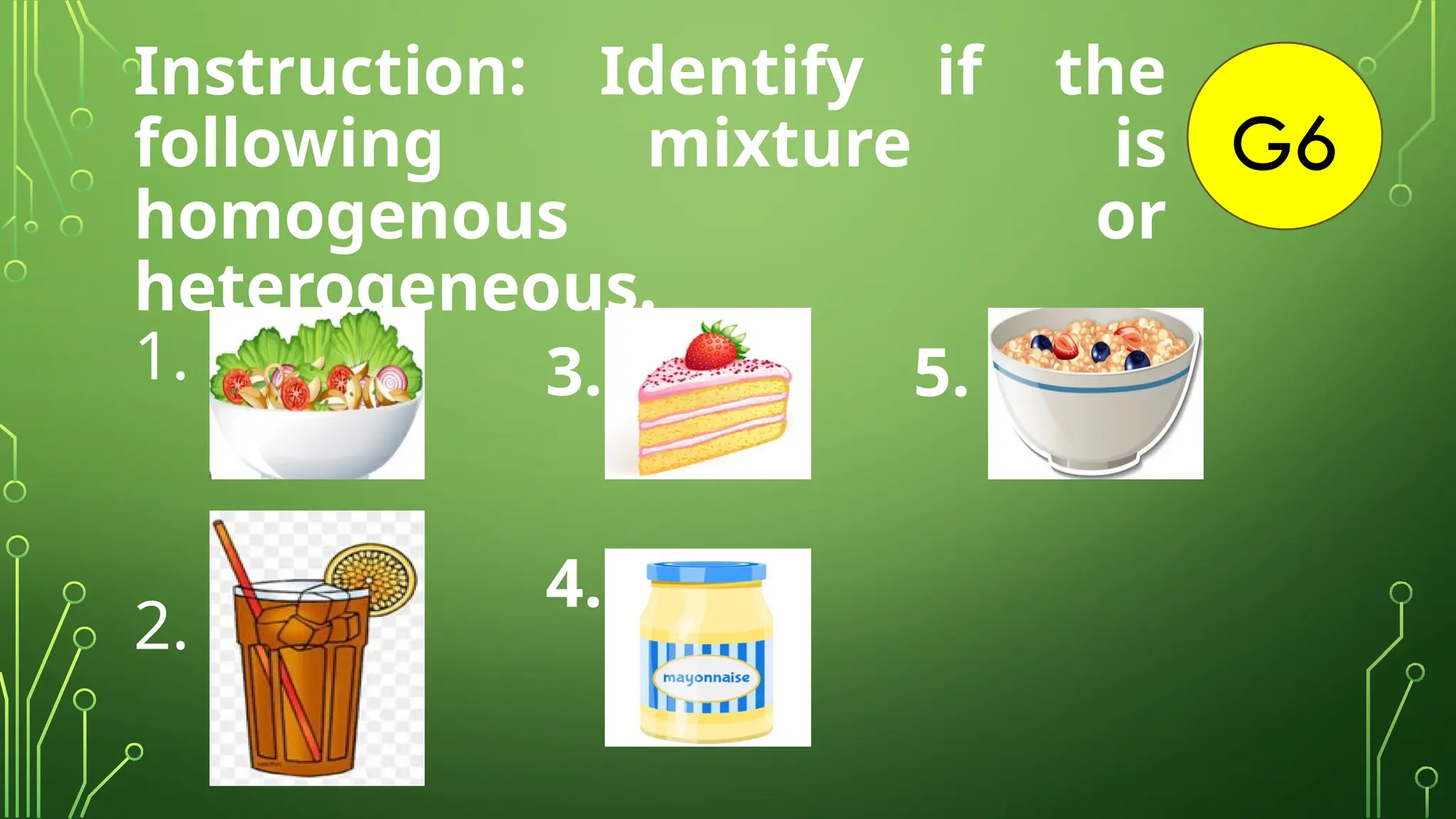
Instruction: Identify if the
following mixture is
homogenous or
heterogeneous.
1.
2.
3.
4.
G5
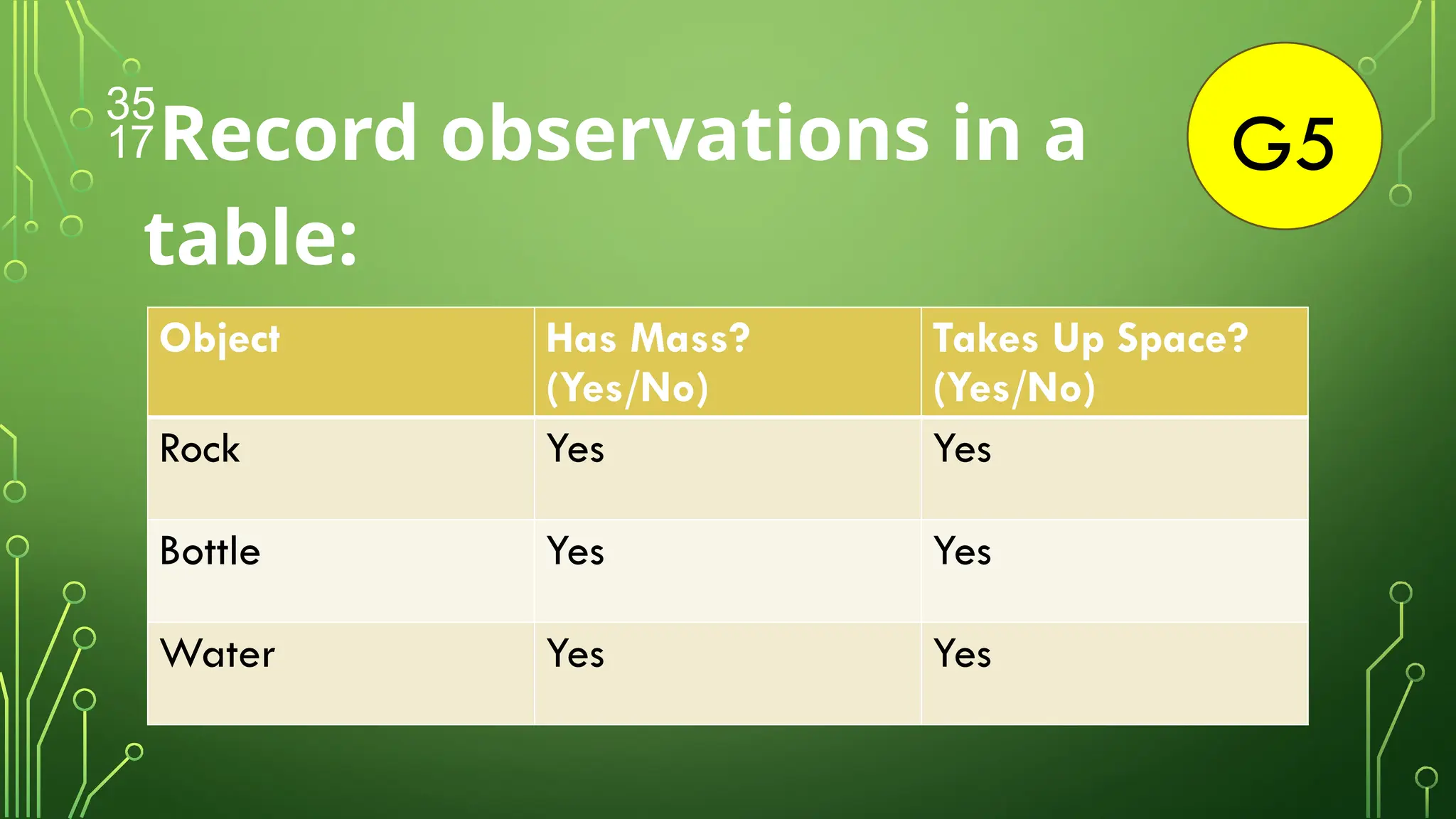
Record observations in a
table:
Object Has Mass?
(Yes/No)
Takes Up Space?
(Yes/No)
Rock Yes Yes
Bottle Yes Yes
Water Yes Yes
G5
Conclusion:
All these are matter because they
have mass and take up space.
G5
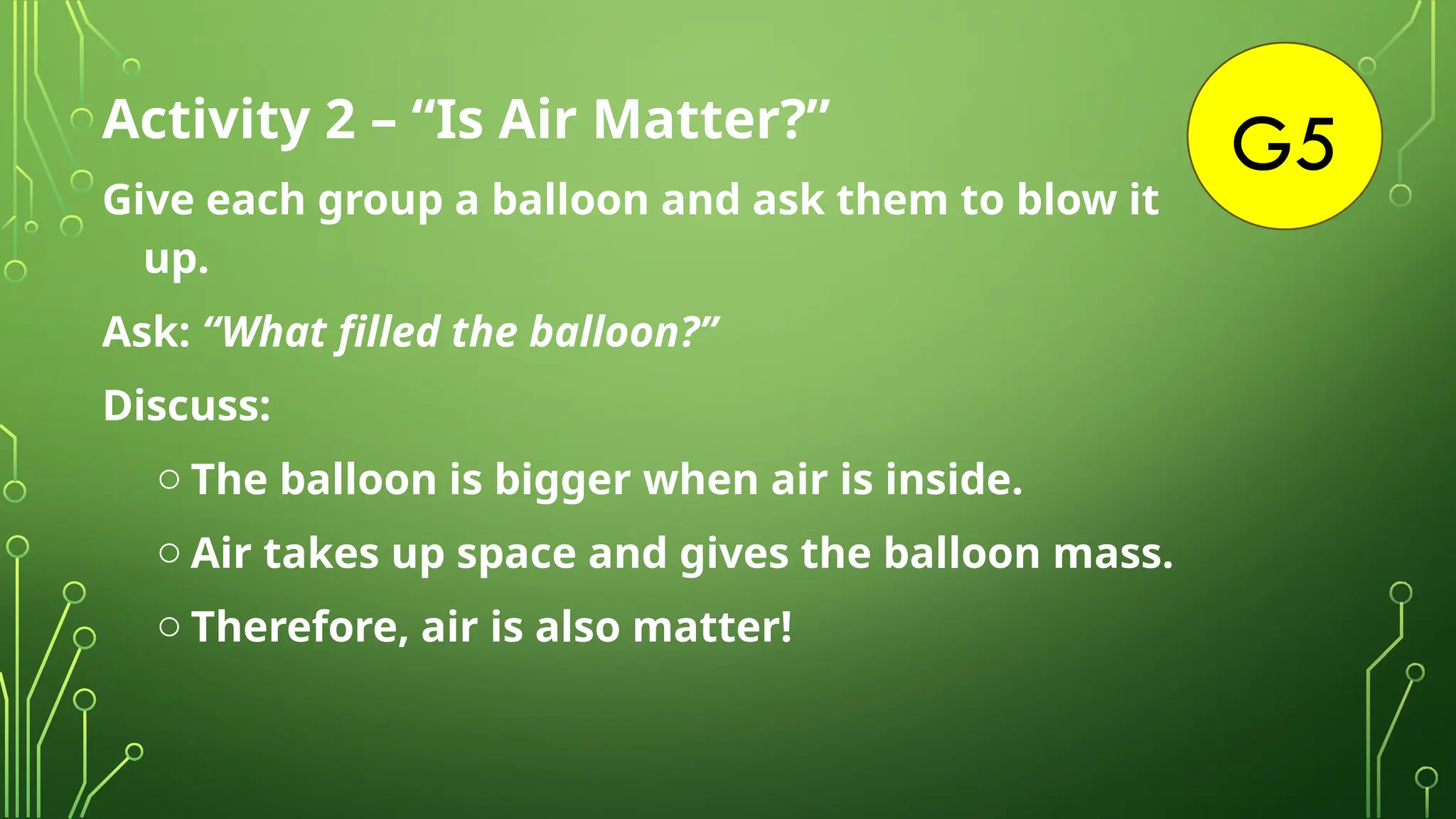
Activity 2 – “Is Air Matter?”
Give each group a balloon and ask them to blow it
up.
Ask: “What filled the balloon?”
Discuss:
o The balloon is bigger when air is inside.
o Air takes up space and gives the balloon mass.
o Therefore, air is also matter!
G5
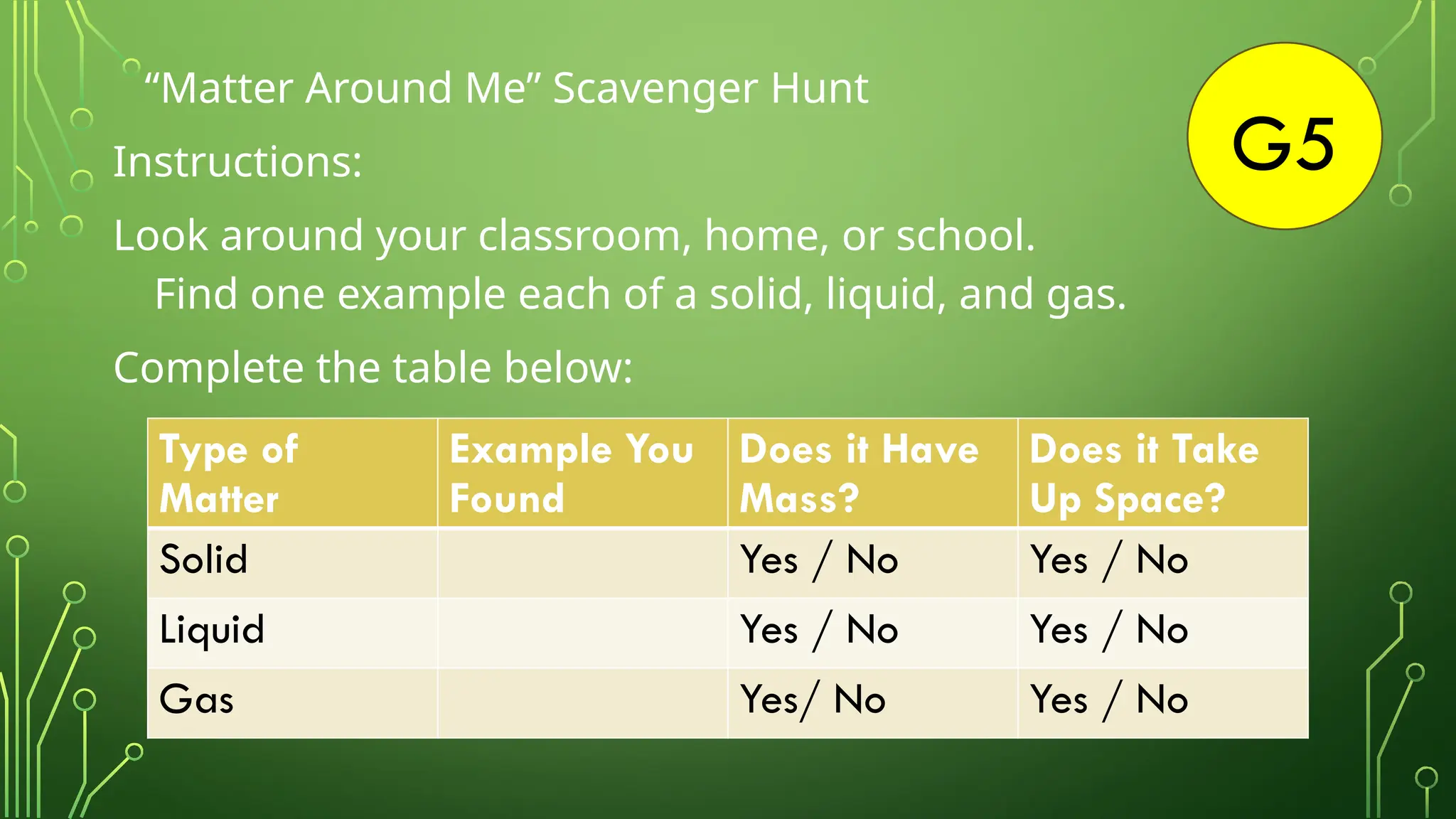
“Matter Around Me” Scavenger Hunt
Instructions:
Look around your classroom, home, or school.
Find one example each of a solid, liquid, and gas.
Complete the table below:
Type of
Matter
Example You
Found
Does it Have
Mass?
Does it Take
Up Space?
Solid Yes / No Yes / No
Liquid Yes / No Yes / No
Gas Yes/ No Yes / No
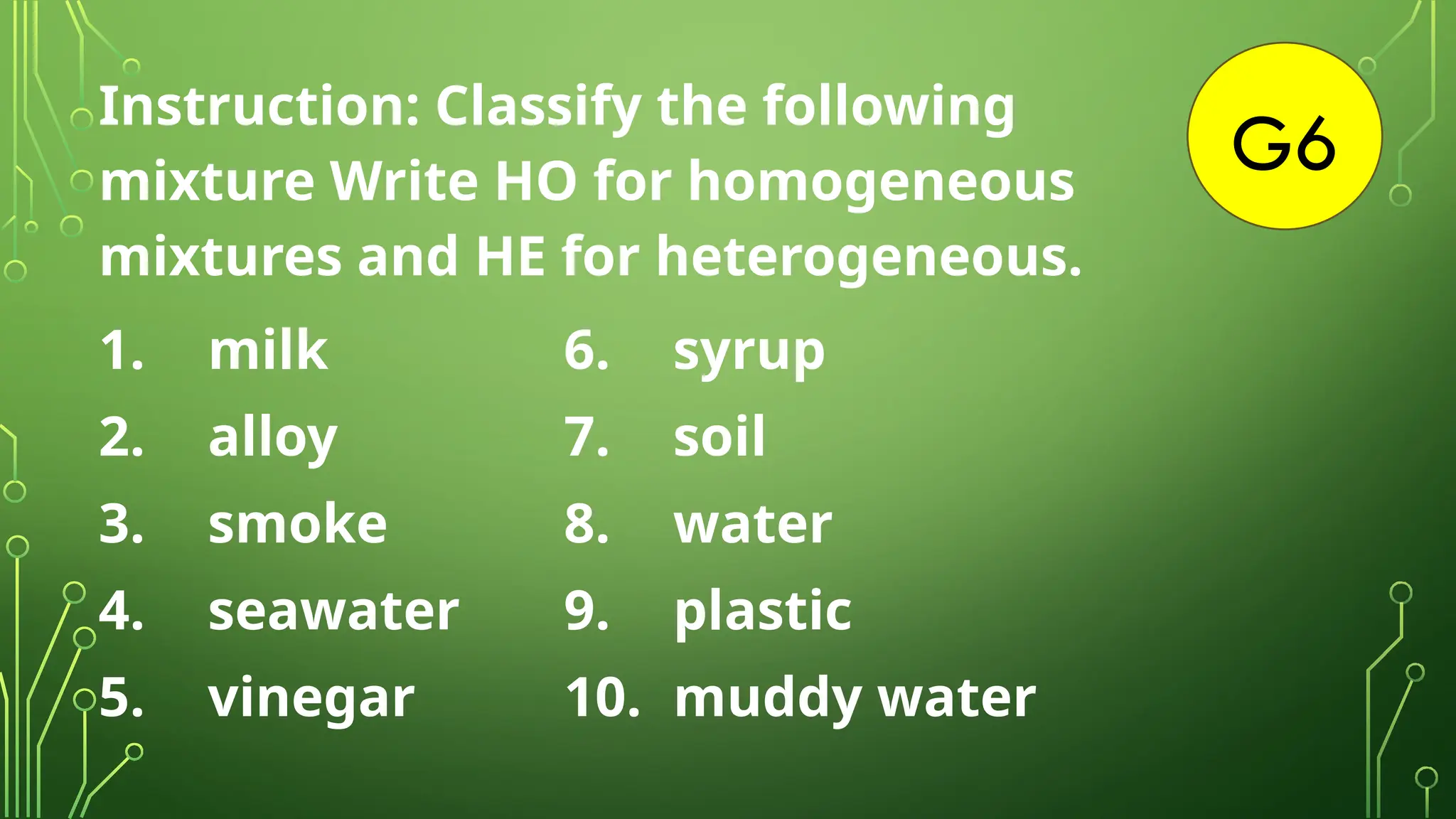
G6
Instruction: Classify the following
mixture Write HO for homogeneous
mixtures and HE for heterogeneous.
1. milk
2. alloy
3. smoke
4. seawater
5. vinegar
6. syrup
7. soil
8. water
9. plastic
10. muddy water
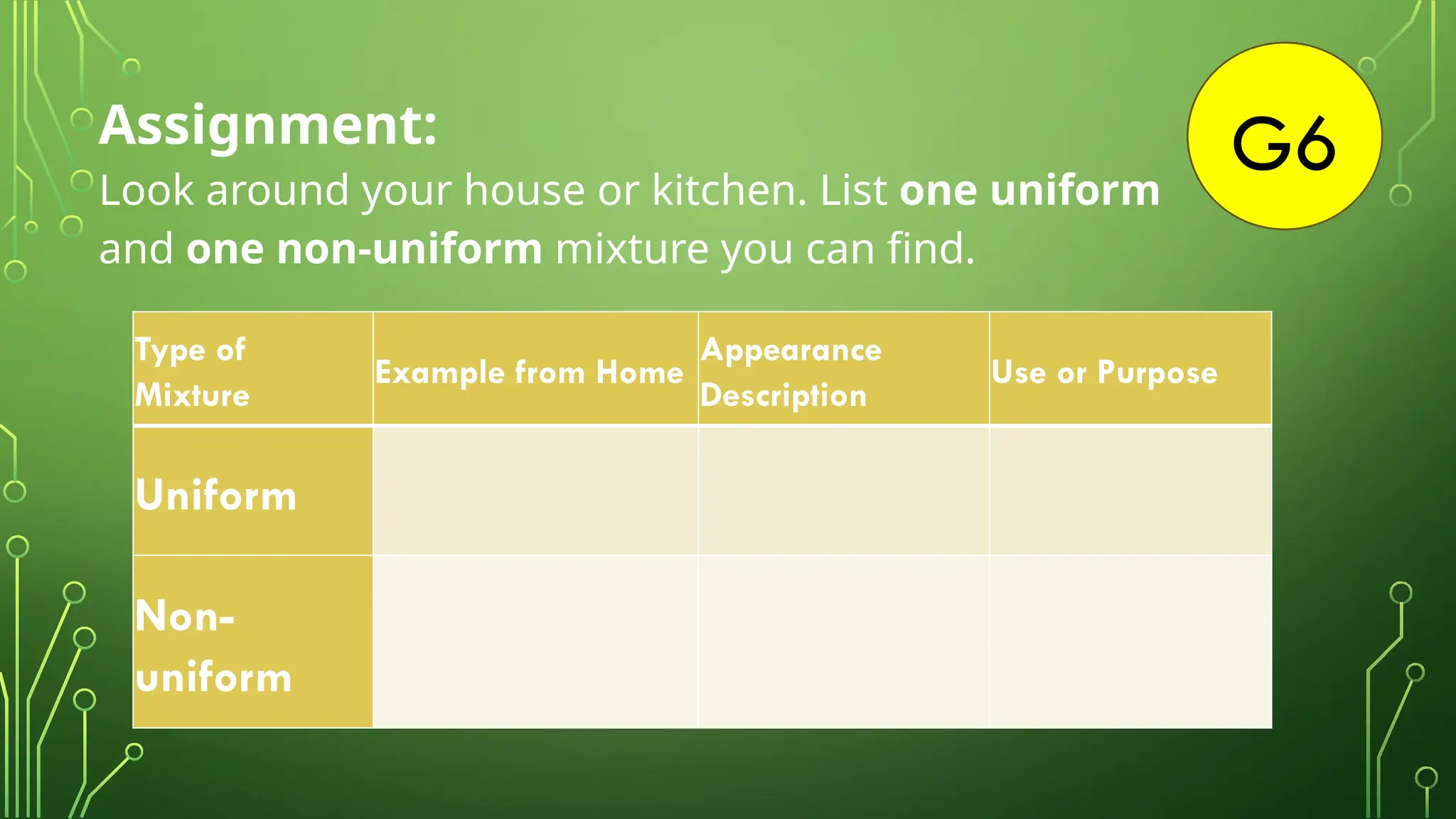
G6
Assignment:
Look around your house or kitchen. List one uniform
and one non-uniform mixture you can find.
Type of
Mixture
Example from Home
Appearance
Description
Use or Purpose
Uniform
Non-
uniform
G5
Answer the following questions:
Which of the examples was hardest to find?
Why?
How do you know gas is matter even if you
can't always see it?
Give one example of something that is not
matter. Why is it not matter?
G5
Matter is anything that has mass and
takes up space.
It can be a solid, liquid, or gas. Even air
is matter!
G5
Instructions: Write the correct answer.
1. What is matter?
A. Anything that is soft
B. Anything that moves
C. Anything that has mass and takes up space
D. Anything that we can see
2. Which of the following is NOT matter?
A. Air
B. Light
C. Water
D. Rock
G5
3. Which of these objects takes up space and has mass?
A. Music
B. Balloon
C. Shadow
D. Smell
4. What form of matter is juice?
A. Solid
B. Liquid
C. Gas
D. None
5. True or False: Gases like air are not matter because
we cannot see them.
_______
G5
3. Which of these objects takes up space and has mass?
A. Music
B. Balloon
C. Shadow
D. Smell
4. What form of matter is juice?
A. Solid
B. Liquid
C. Gas
D. None
G5
Assignment:
Instructions: Answer the following at home. You may
draw or write your answers.
1. List one solid object you can find at home.
2. List one liquid you can find in your kitchen.
3. Where can you find gas in your house?
4. Draw one object from your home that is matter and
label it.
5. Is light matter? Why or why not?
Day 2
G5
G6
Checking of assignment.
G5
Engage:
“What are some things you can touch,
pour, or breathe in? Do you think all of
these are the same?”
G5
Show examples:
Hold up or point to a rock, a glass of
water, and a balloon.
“What is different about each one?
G5
Show examples:
Hold up or point to a rock, a glass of
water, and a balloon.
“What is different about each one?
G5
Today, we will learn about the three
states of matter — solids, liquids,
and gases — and how to tell them
apart
G5
Today, we will learn about the three
states of matter — solids, liquids,
and gases — and how to tell them
apart
G5
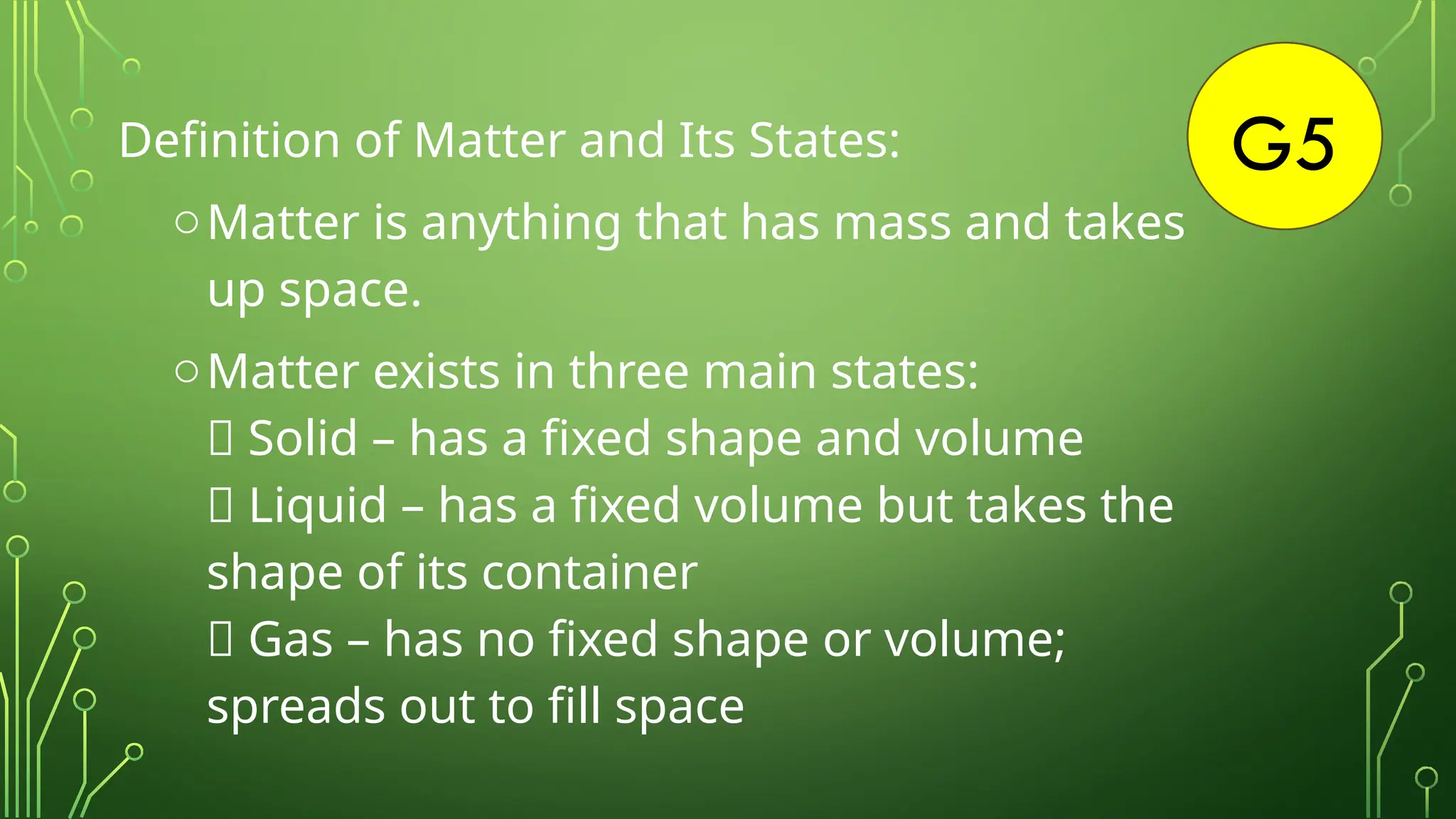
Definition of Matter and Its States:
oMatter is anything that has mass and takes
up space.
oMatter exists in three main states:
✅ Solid – has a fixed shape and volume
✅ Liquid – has a fixed volume but takes the
shape of its container
✅ Gas – has no fixed shape or volume;
spreads out to fill space
G5
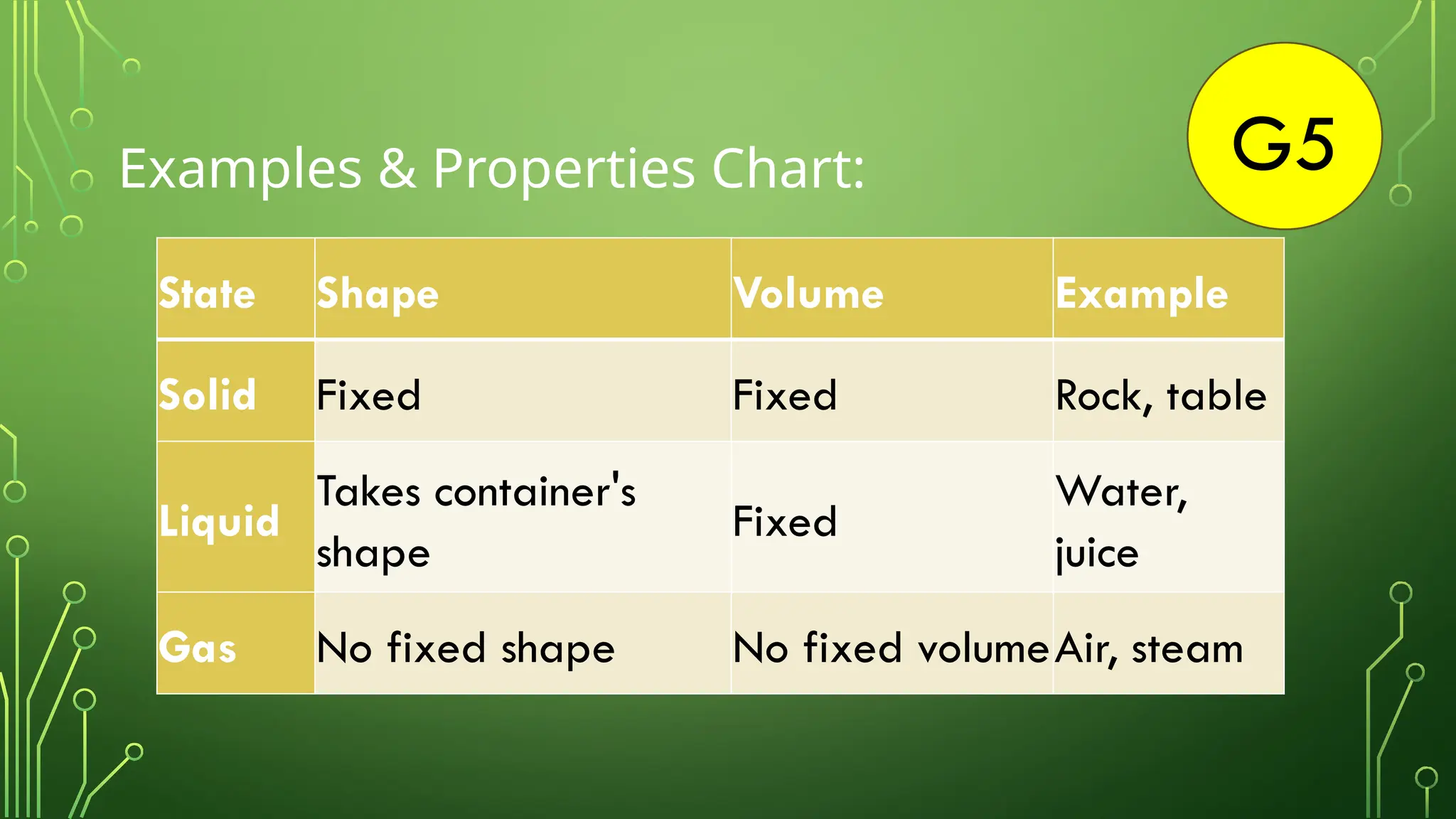
Examples & Properties Chart:
State Shape Volume Example
Solid Fixed Fixed Rock, table
Liquid
Takes container's
shape
Fixed
Water,
juice
Gas No fixed shape No fixed volumeAir, steam
G5
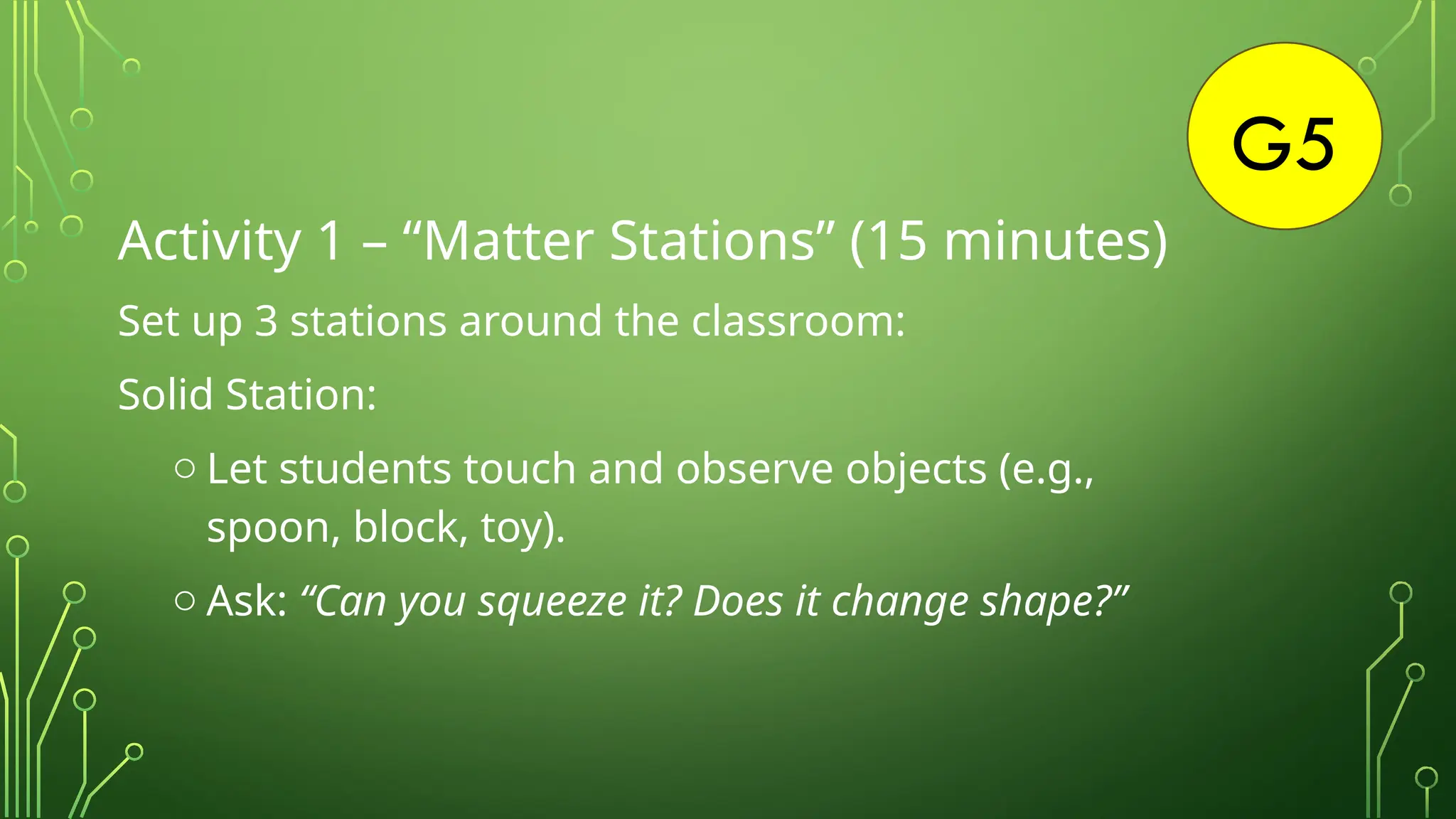
Activity 1 – “Matter Stations” (15 minutes)
Set up 3 stations around the classroom:
Solid Station:
o Let students touch and observe objects (e.g.,
spoon, block, toy).
o Ask: “Can you squeeze it? Does it change shape?”
G5
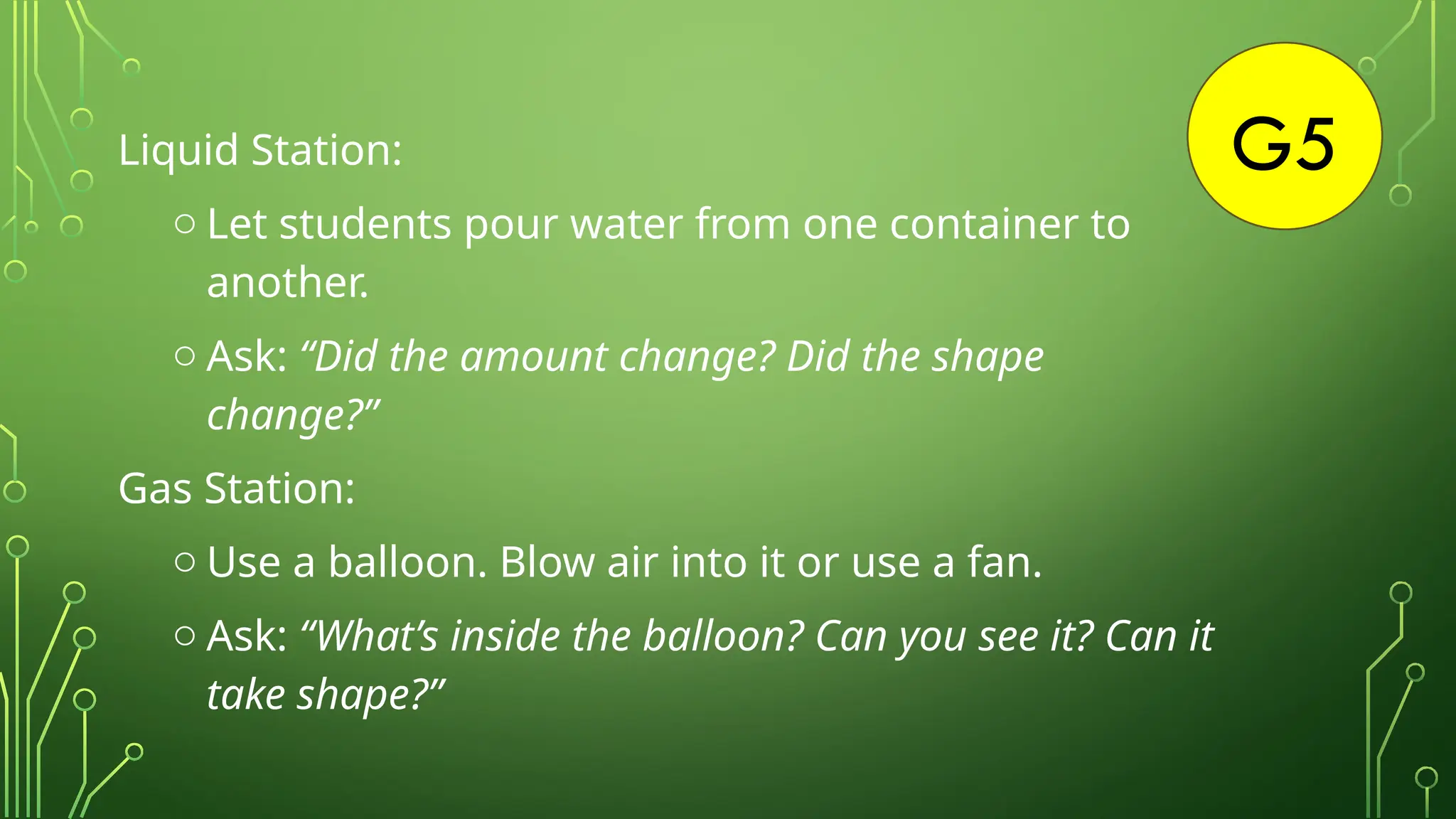
Liquid Station:
o Let students pour water from one container to
another.
o Ask: “Did the amount change? Did the shape
change?”
Gas Station:
o Use a balloon. Blow air into it or use a fan.
o Ask: “What’s inside the balloon? Can you see it? Can it
take shape?”
G5
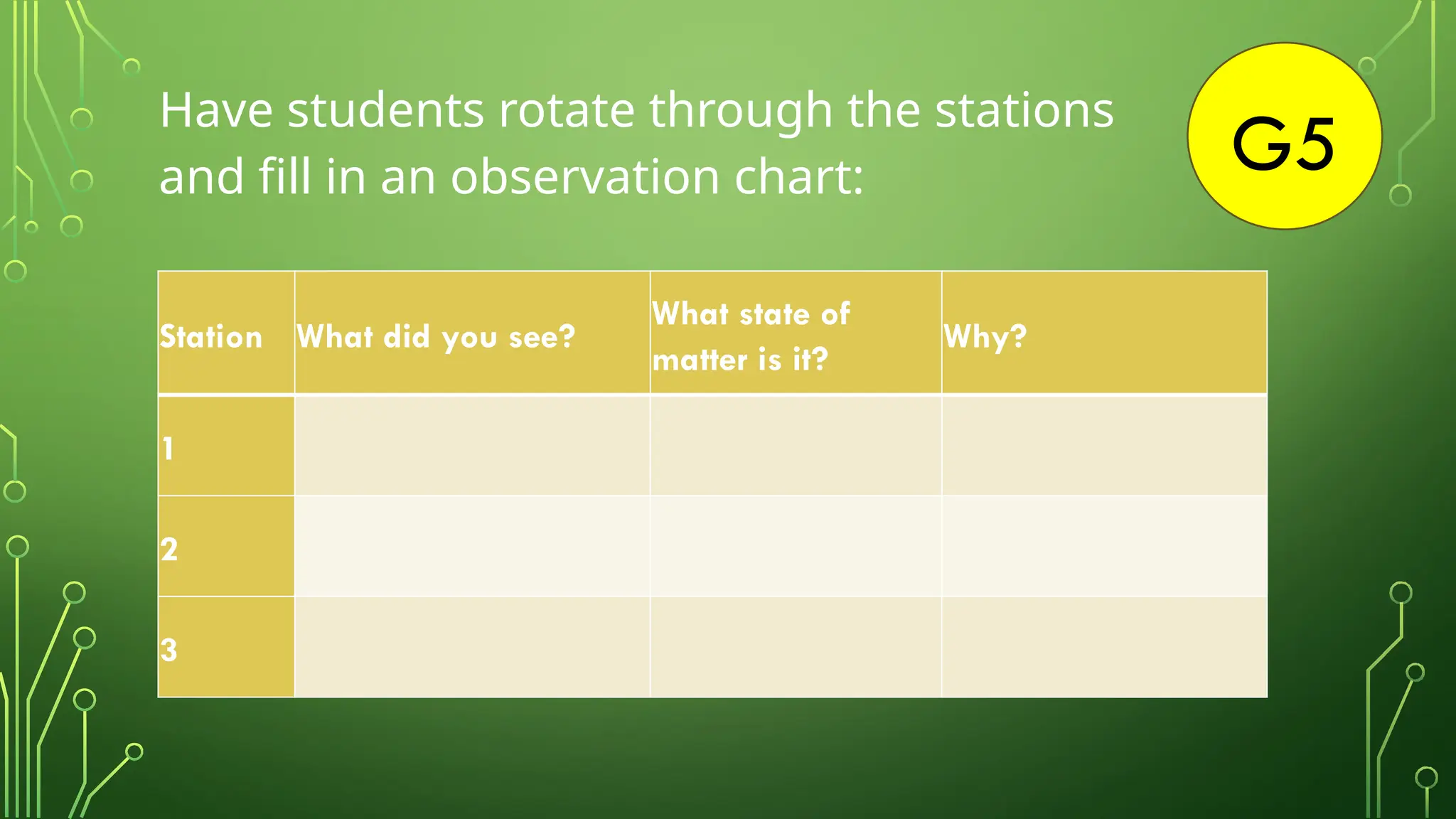
Have students rotate through the stations
and fill in an observation chart:
Station What did you see?
What state of
matter is it?
Why?
1
2
3
G6
Can you give an example of
mixtures?
From the examples, what are the
heterogeneous and homogenous
mixtures?
G6
Let’s experiment.
Combine the two mixtures
1. oil and water
2. sugar and water
G6
Let’s observe:
What have you observe from the
two mixtures? Explain your
answer.
G6
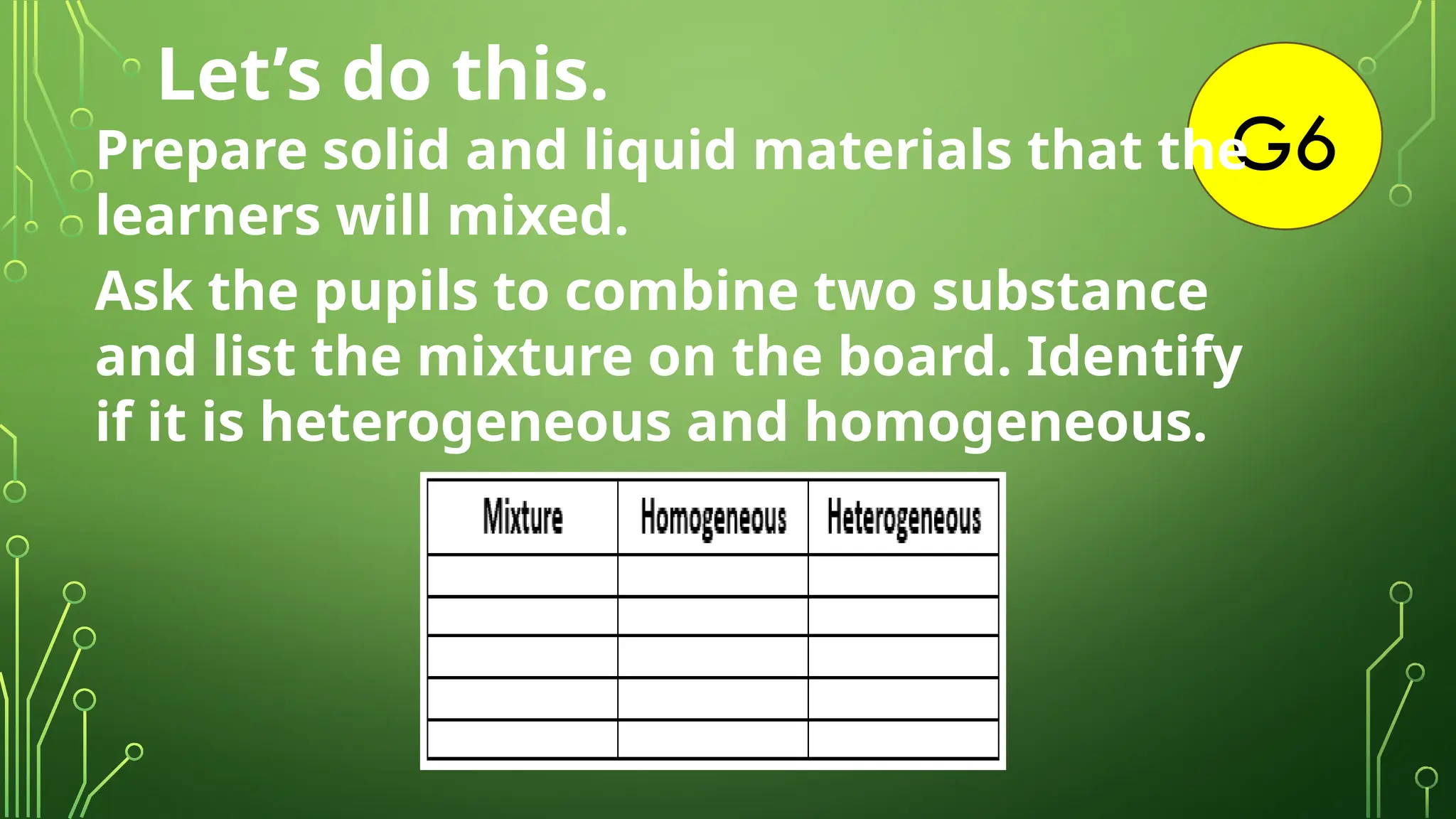
Let’s do this.
Prepare solid and liquid materials that the
learners will mixed.
Ask the pupils to combine two substance
and list the mixture on the board. Identify
if it is heterogeneous and homogeneous.
G6
Discuss the answers of the pupils.
Let them explain their answer for
understanding.
G5
Directions: Analyze each situation below
and answer the question that follows.
1. You left an ice cube on a plate under the
sun. After some time, it turned into water.
Question: What change of state occurred,
and what does this tell you about solids and
liquids?
____________________________________________________
→
G5
2. When you boil water in a pot, you see
steam rising.
Question: What state of matter is steam,
and how is it different from the water in the
pot?
→________________________________________
3. A balloon filled with air becomes firm,
but when the air is released, it goes flat.
Question: What does this experiment show
about gases and the space they occupy?
_______________________________________
→
G5
4. You accidentally spilled juice on the table. The juice
spread out but did not disappear.
Question: What does this tell you about how liquids
behave and their volume?
→ ____________________________________________
5. You put perfume on your wrist, and your classmate
smells it across the room.
Question: How does this example demonstrate a
property of gases?
→ ________________________________________
G6
4. You accidentally spilled juice on the table. The juice
spread out but did not disappear.
Question: What does this tell you about how liquids
behave and their volume?
→ ____________________________________________
5. You put perfume on your wrist, and your classmate
smells it across the room.
Question: How does this example demonstrate a
property of gases?
→ ________________________________________
G6
Mixtures are combinations of two or
more substances that can be
homogeneous or heterogeneous.
• Homogeneous mixtures appear
uniform all throughout because
they have the same proportion.
• Heterogeneous mixtures are not
uniform in proportion where
combined substances are not evenly
spread or mixed.
G6
Instruction: Read and answer the
following. Write the answers in your
journal.
1. What are the different forms of mixtures?
2.Jelly, mixed the two mixtures like coffee,
sugar, and water. Is it Heterogeneous or
Homogeneous? Why?
3. Shiela, combined the different vegetables
to make a salad. Is it Heterogeneous of
Homogeneous? Why?
G5
•Matter exists in three states: solid, liquid,
and gas.
Solids have a fixed shape and volume.
Liquids take the shape of their container but
keep their volume.
Gases have no fixed shape or volume and fill
the space available.
G5
Write S for Solid, L for Liquid, or G for Gas:
1.Juice
2.Air
3.Ice cube
4.Steam
5.Stone
G6
Mixtures are combinations of two
or more substances that can be
homogeneous or heterogeneous.
G6
Instruction: Choose the best
answer in the following questions.
1. There are two types of mixture. What are
those?
a. solid and liquid
b. Liquid and gas
c. heterogeneous and gas substance
d. heterogeneous and homogeneous
G6
2. What is the best definition for
heterogeneous?
a. We cannot distinguish their components.
b. It is made of solid and liquid substances.
c. It is made of liquid and gas substances.
d. we can distinguish their components.
G6
3. Which of the following mixtures which
components are easily identified?
a. juice drink
b. hot chocolate
c. hot coffee
d. taho
G6
4. Joana made a colored water what kind
of mixture is colored water?
a. heterogenenous mixtures
b. solid and liquid mixtures
c. homogeneous mixture
d. gas and liquid mixtures
G6
5. Janice, cooked a delicious dish called
Caldereta, you can see the ingredients in
her dish. What kind of mixture is the
Caldereta?
a. heterogeneous
b. homogeneous
c. solid and liquid
d. gas and liquid
Day 3
G5
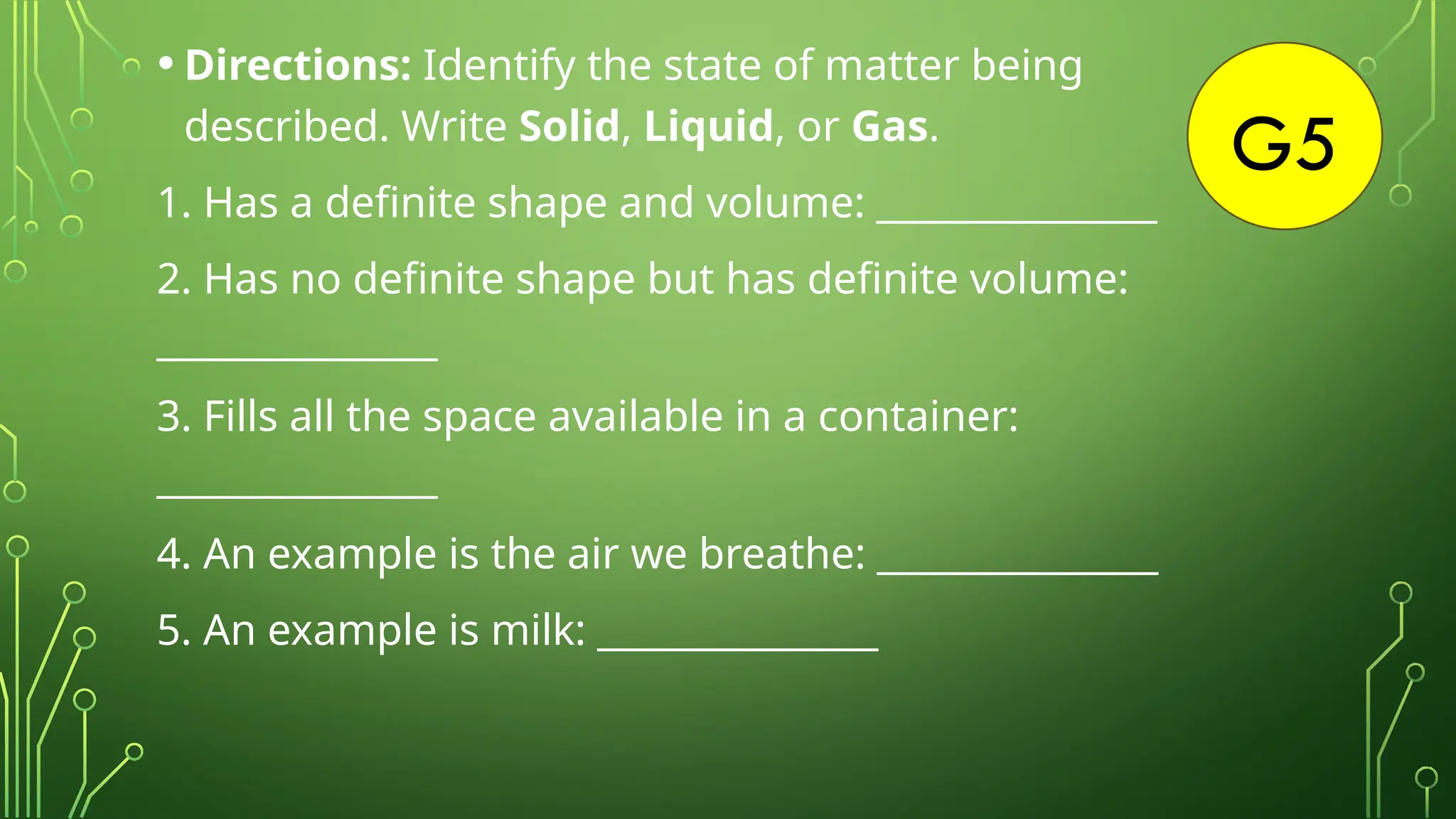
• Directions: Identify the state of matter being
described. Write Solid, Liquid, or Gas.
1. Has a definite shape and volume: _______________
2. Has no definite shape but has definite volume:
_______________
3. Fills all the space available in a container:
_______________
4. An example is the air we breathe: _______________
5. An example is milk: _______________
G6
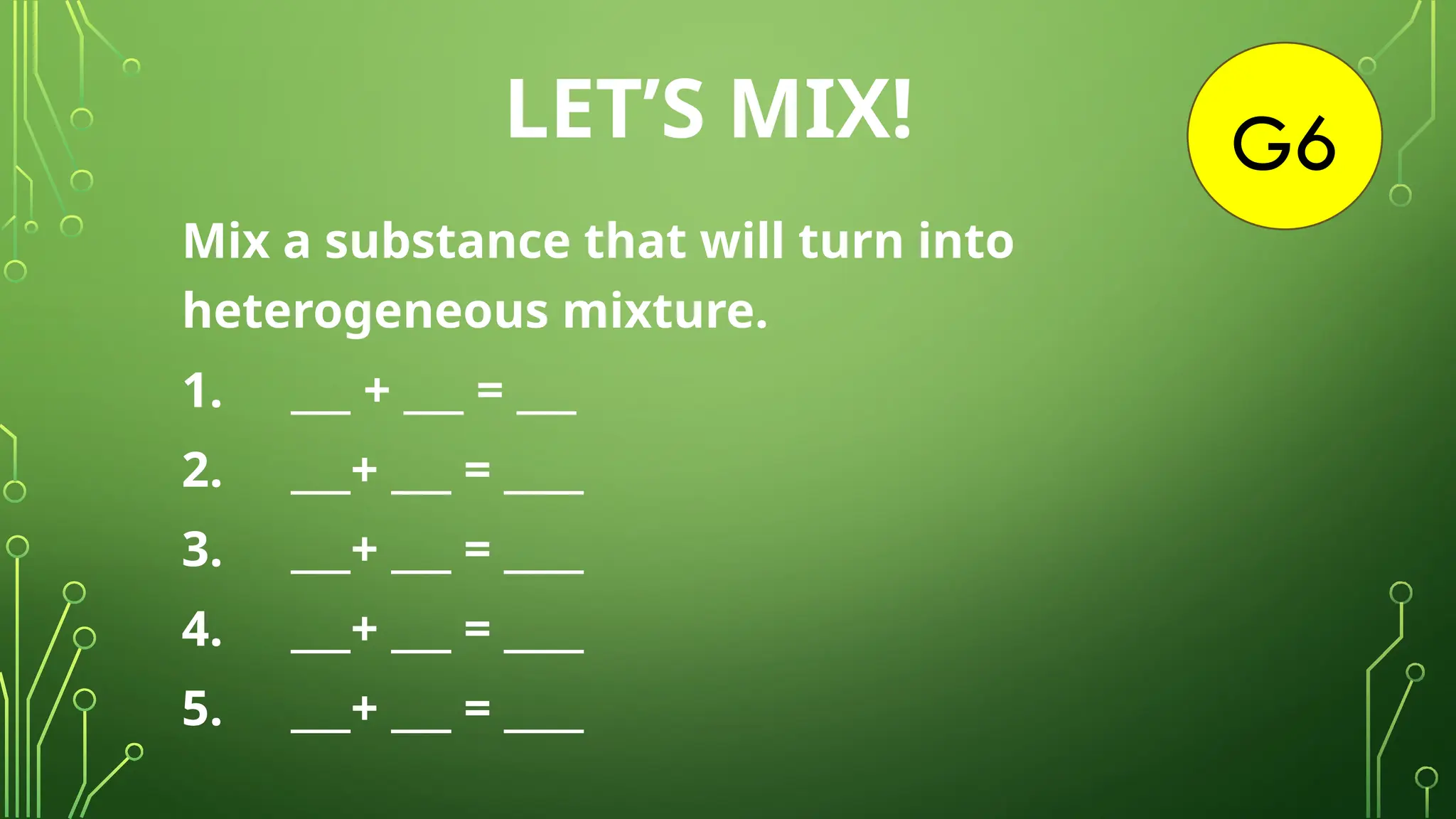
LET’S MIX!
Mix a substance that will turn into
heterogeneous mixture.
1. ___ + ___ = ___
2. ___+ ___ = ____
3. ___+ ___ = ____
4. ___+ ___ = ____
5. ___+ ___ = ____
G5
Let us learn again about
matter.
G5
Definition of Matter and Its States:
oMatter is anything that has mass and takes
up space.
oMatter exists in three main states:
✅ Solid – has a fixed shape and volume
✅ Liquid – has a fixed volume but takes the
shape of its container
✅ Gas – has no fixed shape or volume;
spreads out to fill space
G5
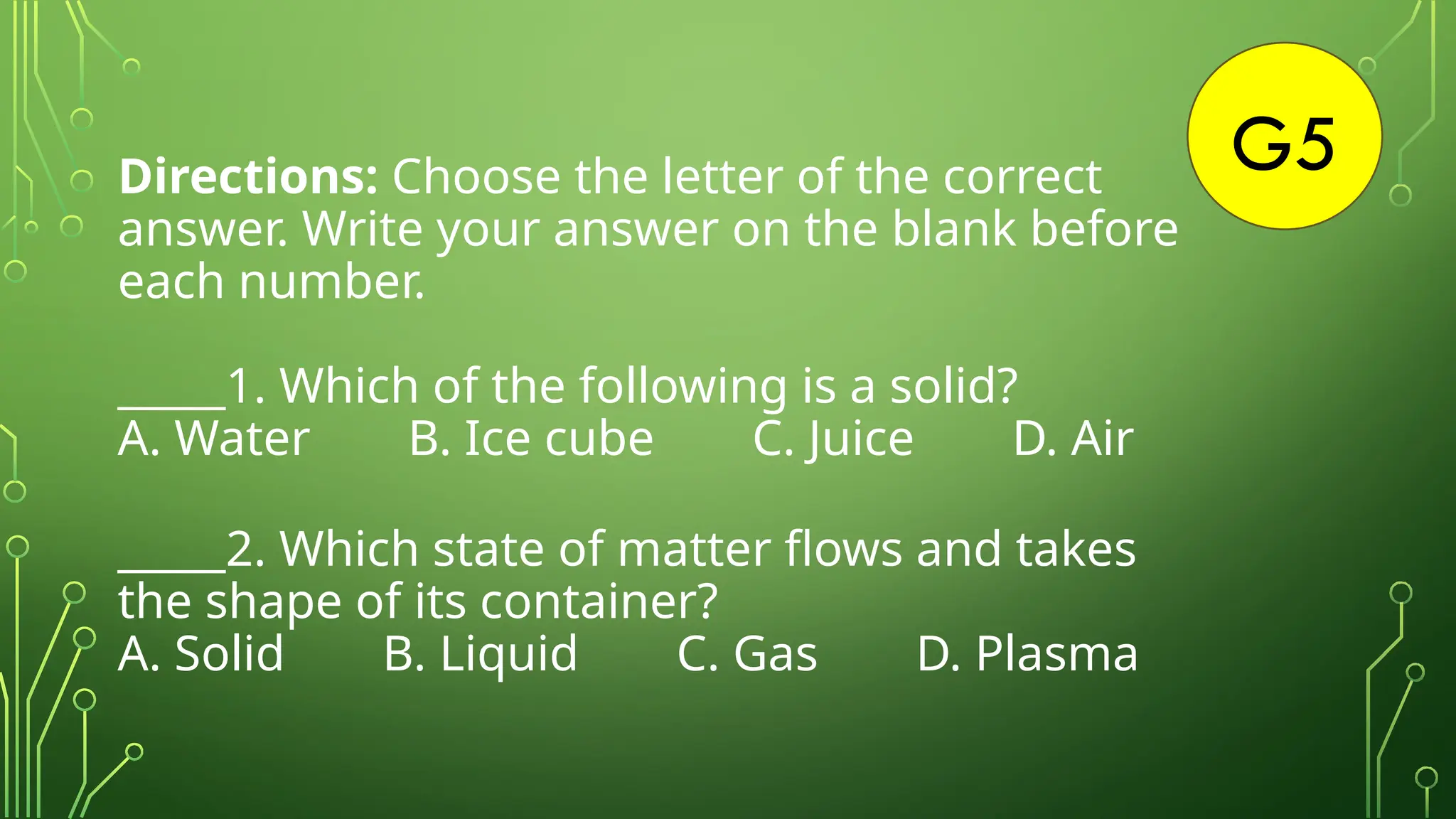
Directions: Choose the letter of the correct
answer. Write your answer on the blank before
each number.
_____1. Which of the following is a solid?
A. Water B. Ice cube C. Juice D. Air
_____2. Which state of matter flows and takes
the shape of its container?
A. Solid B. Liquid C. Gas D. Plasma
G5
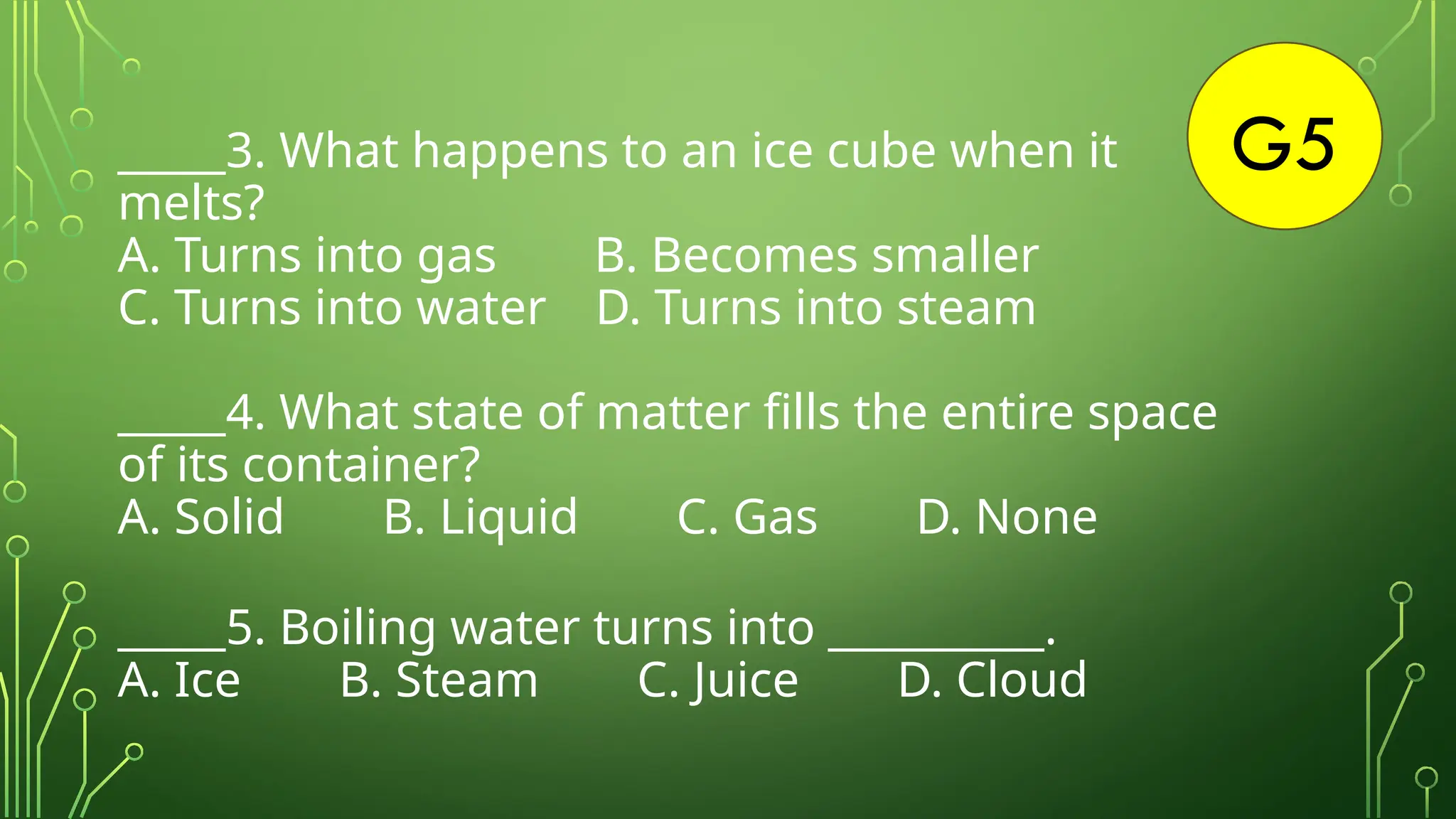
_____3. What happens to an ice cube when it
melts?
A. Turns into gas B. Becomes smaller
C. Turns into water D. Turns into steam
_____4. What state of matter fills the entire space
of its container?
A. Solid B. Liquid C. Gas D. None
_____5. Boiling water turns into __________.
A. Ice B. Steam C. Juice D. Cloud
G6
Give another examples of solid
homogeneous around you.
G6
List down 5 homogeneous mixtures
found around us and identify the
substances contained in the mixtures.
Use a table.
SCIENCE-WEEK-1.pptx matatag PowerPoint presentation

SCIENCE-WEEK-1.pptx matatag PowerPoint presentation

  • 1.
  • 2.
    SCIENCE 5 1. Matterin daily life 2. Matter and the three states
  • 3.
  • 4.
  • 5.
    Learning Competency/Objective Describe the appearance anduses of uniform and non-uniform mixtures.
  • 6.
    G5 Engage: -"Can you namethings around you right now?" -"Do air, water, and your pencil have something in common?"
  • 7.
    G5 Show and Ask: Holdup a rock and a balloon. Ask: "What do these two have in common?"
  • 8.
    G5 Let us learnabout matter.
  • 9.
    G5 oMatter is anythingthat has mass (weight) and takes up space (volume).
  • 10.
    G5 Solid - keeps itsshape (e.g., book, stone)
  • 11.
    G5 Liquid - takes theshape of its container (e.g., water, juice)
  • 12.
    G5 Gas - fills anyspace (e.g., air, steam)
  • 13.
    G5 Activity 1.“Mass andVolume Hunt” Instructions: Group students into teams of 3–4. Give each group a small plastic bottle, water, and a rock.
  • 14.
    G5 Let them feeland weigh each item using a simple balance (if available) or just by lifting. Ask: o“Which is heavier?” o“Do all these objects take up space?”
  • 15.
    G5 Record observations ina table: Object Has Mass? (Yes/No) Takes Up Space? (Yes/No) Rock Bottle Water
  • 16.
    G6 Motivation: Have you triedto make a sandwich? How can we make a sandwich? Can you arrange the ingredients below?
  • 17.
    G6 What have younotice in our activity? Can you give another example of foods that can be mixed? Share it in our class.
  • 18.
    G6 Let us learnabout describing mixtures.
  • 19.
    G6 Mixtures are combinationsof two or more substances that can be homogeneous or heterogeneous. Homogeneous mixtures appear uniform all throughout because they have the same proportion. Heterogeneous mixtures are not uniform in proportion where combined substances are not evenly spread or mixed. DISCUSSION
  • 20.
  • 21.
    G6 1. How willyou define mixture? 2. What are the 2 types of mixtures? __________ and ___________. 3. How can you differentiate the 2 mixtures? Explain your answer. 4. Give at least 2 example of each mixture. INSTRUCTION: From what we have discussed about mixture, answer the following question to your journal.
  • 22.
    G6 Discuss the conceptof the lesson.
  • 23.
    5. G6 Instruction: Identify ifthe following mixture is homogenous or heterogeneous. 1. 2. 3. 4.
  • 24.
    G5 Record observations ina table: Object Has Mass? (Yes/No) Takes Up Space? (Yes/No) Rock Yes Yes Bottle Yes Yes Water Yes Yes
  • 25.
    G5 Conclusion: All these arematter because they have mass and take up space.
  • 26.
    G5 Activity 2 –“Is Air Matter?” Give each group a balloon and ask them to blow it up. Ask: “What filled the balloon?” Discuss: o The balloon is bigger when air is inside. o Air takes up space and gives the balloon mass. o Therefore, air is also matter!
  • 27.
    G5 “Matter Around Me”Scavenger Hunt Instructions: Look around your classroom, home, or school. Find one example each of a solid, liquid, and gas. Complete the table below: Type of Matter Example You Found Does it Have Mass? Does it Take Up Space? Solid Yes / No Yes / No Liquid Yes / No Yes / No Gas Yes/ No Yes / No
  • 28.
    G6 Instruction: Classify thefollowing mixture Write HO for homogeneous mixtures and HE for heterogeneous. 1. milk 2. alloy 3. smoke 4. seawater 5. vinegar 6. syrup 7. soil 8. water 9. plastic 10. muddy water
  • 29.
    G6 Assignment: Look around yourhouse or kitchen. List one uniform and one non-uniform mixture you can find. Type of Mixture Example from Home Appearance Description Use or Purpose Uniform Non- uniform
  • 30.
    G5 Answer the followingquestions: Which of the examples was hardest to find? Why? How do you know gas is matter even if you can't always see it? Give one example of something that is not matter. Why is it not matter?
  • 31.
    G5 Matter is anythingthat has mass and takes up space. It can be a solid, liquid, or gas. Even air is matter!
  • 32.
    G5 Instructions: Write thecorrect answer. 1. What is matter? A. Anything that is soft B. Anything that moves C. Anything that has mass and takes up space D. Anything that we can see 2. Which of the following is NOT matter? A. Air B. Light C. Water D. Rock
  • 33.
    G5 3. Which ofthese objects takes up space and has mass? A. Music B. Balloon C. Shadow D. Smell 4. What form of matter is juice? A. Solid B. Liquid C. Gas D. None 5. True or False: Gases like air are not matter because we cannot see them. _______
  • 34.
    G5 3. Which ofthese objects takes up space and has mass? A. Music B. Balloon C. Shadow D. Smell 4. What form of matter is juice? A. Solid B. Liquid C. Gas D. None
  • 35.
    G5 Assignment: Instructions: Answer thefollowing at home. You may draw or write your answers. 1. List one solid object you can find at home. 2. List one liquid you can find in your kitchen. 3. Where can you find gas in your house? 4. Draw one object from your home that is matter and label it. 5. Is light matter? Why or why not?
  • 36.
  • 37.
  • 38.
    G5 Engage: “What are somethings you can touch, pour, or breathe in? Do you think all of these are the same?”
  • 39.
    G5 Show examples: Hold upor point to a rock, a glass of water, and a balloon. “What is different about each one?
  • 40.
    G5 Show examples: Hold upor point to a rock, a glass of water, and a balloon. “What is different about each one?
  • 41.
    G5 Today, we willlearn about the three states of matter — solids, liquids, and gases — and how to tell them apart
  • 42.
    G5 Today, we willlearn about the three states of matter — solids, liquids, and gases — and how to tell them apart
  • 43.
    G5 Definition of Matterand Its States: oMatter is anything that has mass and takes up space. oMatter exists in three main states: ✅ Solid – has a fixed shape and volume ✅ Liquid – has a fixed volume but takes the shape of its container ✅ Gas – has no fixed shape or volume; spreads out to fill space
  • 44.
    G5 Examples & PropertiesChart: State Shape Volume Example Solid Fixed Fixed Rock, table Liquid Takes container's shape Fixed Water, juice Gas No fixed shape No fixed volumeAir, steam
  • 45.
    G5 Activity 1 –“Matter Stations” (15 minutes) Set up 3 stations around the classroom: Solid Station: o Let students touch and observe objects (e.g., spoon, block, toy). o Ask: “Can you squeeze it? Does it change shape?”
  • 46.
    G5 Liquid Station: o Letstudents pour water from one container to another. o Ask: “Did the amount change? Did the shape change?” Gas Station: o Use a balloon. Blow air into it or use a fan. o Ask: “What’s inside the balloon? Can you see it? Can it take shape?”
  • 47.
    G5 Have students rotatethrough the stations and fill in an observation chart: Station What did you see? What state of matter is it? Why? 1 2 3
  • 48.
    G6 Can you givean example of mixtures? From the examples, what are the heterogeneous and homogenous mixtures?
  • 49.
    G6 Let’s experiment. Combine thetwo mixtures 1. oil and water 2. sugar and water
  • 50.
    G6 Let’s observe: What haveyou observe from the two mixtures? Explain your answer.
  • 51.
    G6 Let’s do this. Preparesolid and liquid materials that the learners will mixed. Ask the pupils to combine two substance and list the mixture on the board. Identify if it is heterogeneous and homogeneous.
  • 52.
    G6 Discuss the answersof the pupils. Let them explain their answer for understanding.
  • 53.
    G5 Directions: Analyze eachsituation below and answer the question that follows. 1. You left an ice cube on a plate under the sun. After some time, it turned into water. Question: What change of state occurred, and what does this tell you about solids and liquids? ____________________________________________________ →
  • 54.
    G5 2. When youboil water in a pot, you see steam rising. Question: What state of matter is steam, and how is it different from the water in the pot? →________________________________________ 3. A balloon filled with air becomes firm, but when the air is released, it goes flat. Question: What does this experiment show about gases and the space they occupy? _______________________________________ →
  • 55.
    G5 4. You accidentallyspilled juice on the table. The juice spread out but did not disappear. Question: What does this tell you about how liquids behave and their volume? → ____________________________________________ 5. You put perfume on your wrist, and your classmate smells it across the room. Question: How does this example demonstrate a property of gases? → ________________________________________
  • 56.
    G6 4. You accidentallyspilled juice on the table. The juice spread out but did not disappear. Question: What does this tell you about how liquids behave and their volume? → ____________________________________________ 5. You put perfume on your wrist, and your classmate smells it across the room. Question: How does this example demonstrate a property of gases? → ________________________________________
  • 57.
    G6 Mixtures are combinationsof two or more substances that can be homogeneous or heterogeneous. • Homogeneous mixtures appear uniform all throughout because they have the same proportion. • Heterogeneous mixtures are not uniform in proportion where combined substances are not evenly spread or mixed.
  • 58.
    G6 Instruction: Read andanswer the following. Write the answers in your journal. 1. What are the different forms of mixtures? 2.Jelly, mixed the two mixtures like coffee, sugar, and water. Is it Heterogeneous or Homogeneous? Why? 3. Shiela, combined the different vegetables to make a salad. Is it Heterogeneous of Homogeneous? Why?
  • 59.
    G5 •Matter exists inthree states: solid, liquid, and gas. Solids have a fixed shape and volume. Liquids take the shape of their container but keep their volume. Gases have no fixed shape or volume and fill the space available.
  • 60.
    G5 Write S forSolid, L for Liquid, or G for Gas: 1.Juice 2.Air 3.Ice cube 4.Steam 5.Stone
  • 61.
    G6 Mixtures are combinationsof two or more substances that can be homogeneous or heterogeneous.
  • 62.
    G6 Instruction: Choose thebest answer in the following questions. 1. There are two types of mixture. What are those? a. solid and liquid b. Liquid and gas c. heterogeneous and gas substance d. heterogeneous and homogeneous
  • 63.
    G6 2. What isthe best definition for heterogeneous? a. We cannot distinguish their components. b. It is made of solid and liquid substances. c. It is made of liquid and gas substances. d. we can distinguish their components.
  • 64.
    G6 3. Which ofthe following mixtures which components are easily identified? a. juice drink b. hot chocolate c. hot coffee d. taho
  • 65.
    G6 4. Joana madea colored water what kind of mixture is colored water? a. heterogenenous mixtures b. solid and liquid mixtures c. homogeneous mixture d. gas and liquid mixtures
  • 66.
    G6 5. Janice, cookeda delicious dish called Caldereta, you can see the ingredients in her dish. What kind of mixture is the Caldereta? a. heterogeneous b. homogeneous c. solid and liquid d. gas and liquid
  • 67.
  • 68.
    G5 • Directions: Identifythe state of matter being described. Write Solid, Liquid, or Gas. 1. Has a definite shape and volume: _______________ 2. Has no definite shape but has definite volume: _______________ 3. Fills all the space available in a container: _______________ 4. An example is the air we breathe: _______________ 5. An example is milk: _______________
  • 69.
    G6 LET’S MIX! Mix asubstance that will turn into heterogeneous mixture. 1. ___ + ___ = ___ 2. ___+ ___ = ____ 3. ___+ ___ = ____ 4. ___+ ___ = ____ 5. ___+ ___ = ____
  • 70.
    G5 Let us learnagain about matter.
  • 71.
    G5 Definition of Matterand Its States: oMatter is anything that has mass and takes up space. oMatter exists in three main states: ✅ Solid – has a fixed shape and volume ✅ Liquid – has a fixed volume but takes the shape of its container ✅ Gas – has no fixed shape or volume; spreads out to fill space
  • 72.
    G5 Directions: Choose theletter of the correct answer. Write your answer on the blank before each number. _____1. Which of the following is a solid? A. Water B. Ice cube C. Juice D. Air _____2. Which state of matter flows and takes the shape of its container? A. Solid B. Liquid C. Gas D. Plasma
  • 73.
    G5 _____3. What happensto an ice cube when it melts? A. Turns into gas B. Becomes smaller C. Turns into water D. Turns into steam _____4. What state of matter fills the entire space of its container? A. Solid B. Liquid C. Gas D. None _____5. Boiling water turns into __________. A. Ice B. Steam C. Juice D. Cloud
  • 74.
    G6 Give another examplesof solid homogeneous around you.
  • 75.
    G6 List down 5homogeneous mixtures found around us and identify the substances contained in the mixtures. Use a table.