Refactoring Into React Hooks
Matteo Antony Mistretta
Inglorious Coderz
@antonymistretta
Why
They separate stateful logic
They are composable functions
They keep our component hierarchy flat
They allow us to go fully functional
They are now stable
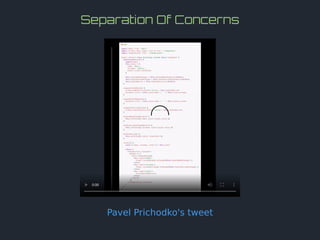
Separation Of Concerns
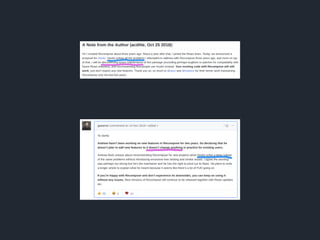
Pavel Prichodko's tweet
0:00
antony@ingloriouscoderz ~> whoami
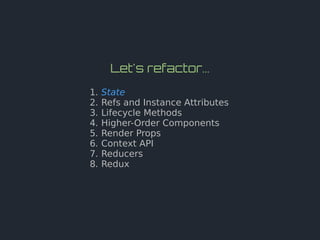
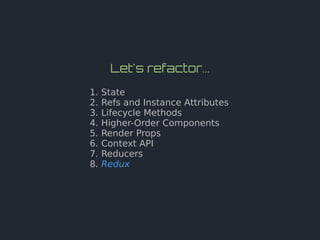
Let's refactor...
1. State
2. Refs and Instance Attributes
3. Lifecycle Methods
4. Higher-Order Components
5. Render Props
6. Context API
7. Reducers
8. Redux
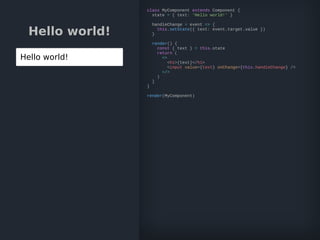
Hello world!
Hello world!
class MyComponent extends Component {
state = { text: 'Hello world!' }
handleChange = event => {
this.setState({ text: event.target.value })
}
render() {
const { text } = this.state
return (
<>
<h1>{text}</h1>
<input value={text} onChange={this.handleChange} />
</>
)
}
}
render(MyComponent)
Hello world!
Hello world!
function MyComponent() {
const [text, setText] = useState('Hello world!')
const handleChange = event => setText(event.target.value)
return (
<>
<h1>{text}</h1>
<input value={text} onChange={handleChange} />
</>
)
}
render(MyComponent)
Let's refactor...
1. State
2. Refs and Instance Attributes
3. Lifecycle Methods
4. Higher-Order Components
5. Render Props
6. Context API
7. Reducers
8. Redux
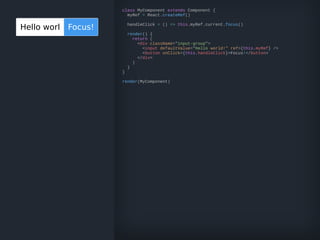
Focus!
class MyComponent extends Component {
myRef = React.createRef()
handleClick = () => this.myRef.current.focus()
render() {
return (
<div className="input-group">
<input defaultValue="Hello world!" ref={this.myRef} />
<button onClick={this.handleClick}>Focus!</button>
</div>
)
}
}
render(MyComponent)
Hello worl
Focus!
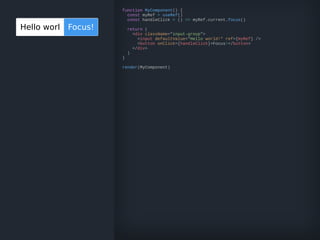
function MyComponent() {
const myRef = useRef()
const handleClick = () => myRef.current.focus()
return (
<div className="input-group">
<input defaultValue="Hello world!" ref={myRef} />
<button onClick={handleClick}>Focus!</button>
</div>
)
}
render(MyComponent)
Hello worl
Let's refactor...
1. State
2. Refs and Instance Attributes
3. Lifecycle Methods
4. Higher-Order Components
5. Render Props
6. Context API
7. Reducers
8. Redux
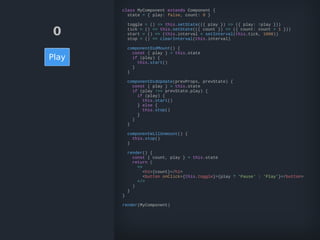
0
Play
class MyComponent extends Component {
state = { play: false, count: 0 }
toggle = () => this.setState(({ play }) => ({ play: !play }))
tick = () => this.setState(({ count }) => ({ count: count + 1 }))
start = () => (this.interval = setInterval(this.tick, 1000))
stop = () => clearInterval(this.interval)
componentDidMount() {
const { play } = this.state
if (play) {
this.start()
}
}
componentDidUpdate(prevProps, prevState) {
const { play } = this.state
if (play !== prevState.play) {
if (play) {
this.start()
} else {
this.stop()
}
}
}
componentWillUnmount() {
this.stop()
}
render() {
const { count, play } = this.state
return (
<>
<h1>{count}</h1>
<button onClick={this.toggle}>{play ? 'Pause' : 'Play'}</button>
</>
)
}
}
render(MyComponent)
0
Play
function MyComponent() {
const [play, setPlay] = useState(false)
const [count, setCount] = useState(0)
const toggle = () => setPlay(play => !play)
useEffect(() => {
let interval = null
const tick = () => setCount(count => count + 1)
const start = () => (interval = setInterval(tick, 1000))
const stop = () => clearInterval(interval)
if (play) {
start()
} else {
stop()
}
return () => stop()
}, [play])
return (
<>
<h1>{count}</h1>
<button onClick={toggle}>{play ? 'Pause' : 'Play'}</button>
</>
)
}
render(MyComponent)
Let's refactor...
1. State
2. Refs and Instance Attributes
3. Lifecycle Methods
4. Higher-Order Components
5. Render Props
6. Context API
7. Reducers
8. Redux
Hello world!
Hello world!
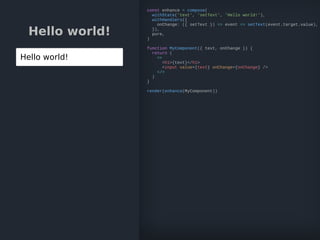
const enhance = compose(
withState('text', 'setText', 'Hello world!'),
withHandlers({
onChange: ({ setText }) => event => setText(event.target.value),
}),
pure,
)
function MyComponent({ text, onChange }) {
return (
<>
<h1>{text}</h1>
<input value={text} onChange={onChange} />
</>
)
}
render(enhance(MyComponent))
Hello world!
Hello world!
function useText() {
const [text, setText] = useState('Hello world!')
const handleChange = event => setText(event.target.value)
return { value: text, onChange: handleChange }
}
function MyComponent() {
const text = useText()
return (
<>
<h1>{text.value}</h1>
<input {...text} />
</>
)
}
render(memo(MyComponent))
Let's refactor...
1. State
2. Refs and Instance Attributes
3. Lifecycle Methods
4. Higher-Order Components
5. Render Props
6. Context API
7. Reducers
8. Redux
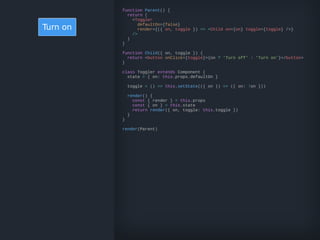
Turn on
function Parent() {
return (
<Toggler
defaultOn={false}
render={({ on, toggle }) => <Child on={on} toggle={toggle} />}
/>
)
}
function Child({ on, toggle }) {
return <button onClick={toggle}>{on ? 'Turn off' : 'Turn on'}</button>
}
class Toggler extends Component {
state = { on: this.props.defaultOn }
toggle = () => this.setState(({ on }) => ({ on: !on }))
render() {
const { render } = this.props
const { on } = this.state
return render({ on, toggle: this.toggle })
}
}
render(Parent)
Turn on
function Parent() {
const toggler = useToggler(false)
return <Child {...toggler} />
}
function Child({ on, toggle }) {
return <button onClick={toggle}>{on ? 'Turn off' : 'Turn on'}</button>
}
function useToggler(defaultOn) {
const [on, setOn] = useState(defaultOn)
const toggle = useCallback(() => setOn(!on), [on])
return { on, toggle }
}
render(Parent)
Let's refactor...
1. State
2. Refs and Instance Attributes
3. Lifecycle Methods
4. Higher-Order Components
5. Render Props
6. Context API
7. Reducers
8. Redux
Hello
Antony!
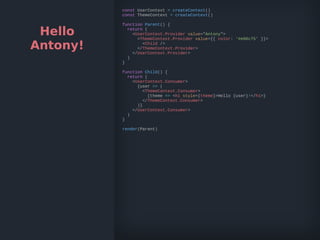
const UserContext = createContext()
const ThemeContext = createContext()
function Parent() {
return (
<UserContext.Provider value="Antony">
<ThemeContext.Provider value={{ color: '#e06c75' }}>
<Child />
</ThemeContext.Provider>
</UserContext.Provider>
)
}
function Child() {
return (
<UserContext.Consumer>
{user => (
<ThemeContext.Consumer>
{theme => <h1 style={theme}>Hello {user}!</h1>}
</ThemeContext.Consumer>
)}
</UserContext.Consumer>
)
}
render(Parent)
Hello
Antony!
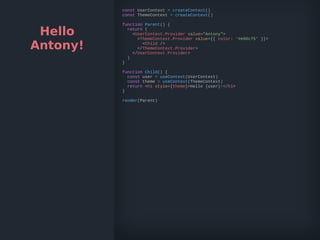
const UserContext = createContext()
const ThemeContext = createContext()
function Parent() {
return (
<UserContext.Provider value="Antony">
<ThemeContext.Provider value={{ color: '#e06c75' }}>
<Child />
</ThemeContext.Provider>
</UserContext.Provider>
)
}
function Child() {
const user = useContext(UserContext)
const theme = useContext(ThemeContext)
return <h1 style={theme}>Hello {user}!</h1>
}
render(Parent)
Let's refactor...
1. State
2. Refs and Instance Attributes
3. Lifecycle Methods
4. Higher-Order Components
5. Render Props
6. Context API
7. Reducers
8. Redux
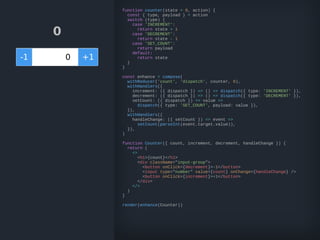
0
-1 +1
function counter(state = 0, action) {
const { type, payload } = action
switch (type) {
case 'INCREMENT':
return state + 1
case 'DECREMENT':
return state - 1
case 'SET_COUNT':
return payload
default:
return state
}
}
const enhance = compose(
withReducer('count', 'dispatch', counter, 0),
withHandlers({
increment: ({ dispatch }) => () => dispatch({ type: 'INCREMENT' }),
decrement: ({ dispatch }) => () => dispatch({ type: 'DECREMENT' }),
setCount: ({ dispatch }) => value =>
dispatch({ type: 'SET_COUNT', payload: value }),
}),
withHandlers({
handleChange: ({ setCount }) => event =>
setCount(parseInt(event.target.value)),
}),
)
function Counter({ count, increment, decrement, handleChange }) {
return (
<>
<h1>{count}</h1>
<div className="input-group">
<button onClick={decrement}>-1</button>
<input type="number" value={count} onChange={handleChange} />
<button onClick={increment}>+1</button>
</div>
</>
)
}
render(enhance(Counter))
0
0
-1 +1
function useCounter() {
const [count, dispatch] = useReducer(counter, 0)
const increment = () => dispatch({ type: 'INCREMENT' })
const decrement = () => dispatch({ type: 'DECREMENT' })
const setCount = value => dispatch({ type: 'SET_COUNT', payload: value })
const handleChange = event => setCount(parseInt(event.target.value))
return { count, increment, decrement, handleChange }
}
function Counter() {
const { count, increment, decrement, handleChange } = useCounter()
return (
<>
<h1>{count}</h1>
<div className="input-group">
<button onClick={decrement}>-1</button>
<input type="number" value={count} onChange={handleChange} />
<button onClick={increment}>+1</button>
</div>
</>
)
}
render(Counter)
function counter(state = 0, action) {
const { type, payload } = action
switch (type) {
case 'INCREMENT':
return state + 1
case 'DECREMENT':
return state - 1
case 'SET_COUNT':
return payload
default:
return state
}
}
0
Let's refactor...
1. State
2. Refs and Instance Attributes
3. Lifecycle Methods
4. Higher-Order Components
5. Render Props
6. Context API
7. Reducers
8. Redux
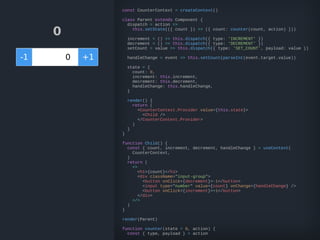
0
-1 +10
const CounterContext = createContext()
class Parent extends Component {
dispatch = action =>
this.setState(({ count }) => ({ count: counter(count, action) }))
increment = () => this.dispatch({ type: 'INCREMENT' })
decrement = () => this.dispatch({ type: 'DECREMENT' })
setCount = value => this.dispatch({ type: 'SET_COUNT', payload: value })
handleChange = event => this.setCount(parseInt(event.target.value))
state = {
count: 0,
increment: this.increment,
decrement: this.decrement,
handleChange: this.handleChange,
}
render() {
return (
<CounterContext.Provider value={this.state}>
<Child />
</CounterContext.Provider>
)
}
}
function Child() {
const { count, increment, decrement, handleChange } = useContext(
CounterContext,
)
return (
<>
<h1>{count}</h1>
<div className="input-group">
<button onClick={decrement}>-1</button>
<input type="number" value={count} onChange={handleChange} />
<button onClick={increment}>+1</button>
</div>
</>
)
}
render(Parent)
function counter(state = 0, action) {
const { type, payload } = action
0
-1 +10
const CounterContext = createContext()
function Parent() {
const counter = useCounter()
return (
<CounterContext.Provider value={counter}>
<Child />
</CounterContext.Provider>
)
}
function Child() {
const { count, increment, decrement, handleChange } = useContext(
CounterContext,
)
return (
<>
<h1>{count}</h1>
<div className="input-group">
<button onClick={decrement}>-1</button>
<input type="number" value={count} onChange={handleChange} />
<button onClick={increment}>+1</button>
</div>
</>
)
}
render(Parent)
function counter(state = 0, action) {
const { type, payload } = action
switch (type) {
case 'INCREMENT':
return state + 1
case 'DECREMENT':
return state - 1
case 'SET_COUNT':
return payload
default:
return state
}
}
function useCounter() {
const [count, dispatch] = useReducer(counter, 0)
const increment = () => dispatch({ type: 'INCREMENT' })
const decrement = () => dispatch({ type: 'DECREMENT' })
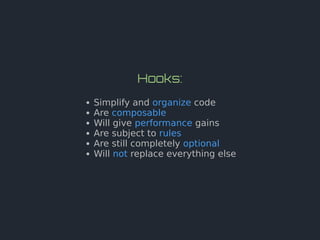
Hooks:
Simplify and organize code
Are composable
Will give performance gains
Are subject to rules
Are still completely optional
Will not replace everything else
Thank you.
Questions?
html | pdf | source

Matteo Antony Mistretta - Refactoring into React hooks - Codemotion Rome 2019

  • 1.
    Refactoring Into ReactHooks Matteo Antony Mistretta Inglorious Coderz @antonymistretta
  • 2.
    Why They separate statefullogic They are composable functions They keep our component hierarchy flat They allow us to go fully functional They are now stable
  • 3.
    Separation Of Concerns PavelPrichodko's tweet 0:00
  • 4.
  • 6.
    Let's refactor... 1. State 2.Refs and Instance Attributes 3. Lifecycle Methods 4. Higher-Order Components 5. Render Props 6. Context API 7. Reducers 8. Redux
  • 7.
    Hello world! Hello world! classMyComponent extends Component { state = { text: 'Hello world!' } handleChange = event => { this.setState({ text: event.target.value }) } render() { const { text } = this.state return ( <> <h1>{text}</h1> <input value={text} onChange={this.handleChange} /> </> ) } } render(MyComponent)
  • 8.
    Hello world! Hello world! functionMyComponent() { const [text, setText] = useState('Hello world!') const handleChange = event => setText(event.target.value) return ( <> <h1>{text}</h1> <input value={text} onChange={handleChange} /> </> ) } render(MyComponent)
  • 9.
    Let's refactor... 1. State 2.Refs and Instance Attributes 3. Lifecycle Methods 4. Higher-Order Components 5. Render Props 6. Context API 7. Reducers 8. Redux
  • 10.
    Focus! class MyComponent extendsComponent { myRef = React.createRef() handleClick = () => this.myRef.current.focus() render() { return ( <div className="input-group"> <input defaultValue="Hello world!" ref={this.myRef} /> <button onClick={this.handleClick}>Focus!</button> </div> ) } } render(MyComponent) Hello worl
  • 11.
    Focus! function MyComponent() { constmyRef = useRef() const handleClick = () => myRef.current.focus() return ( <div className="input-group"> <input defaultValue="Hello world!" ref={myRef} /> <button onClick={handleClick}>Focus!</button> </div> ) } render(MyComponent) Hello worl
  • 12.
    Let's refactor... 1. State 2.Refs and Instance Attributes 3. Lifecycle Methods 4. Higher-Order Components 5. Render Props 6. Context API 7. Reducers 8. Redux
  • 13.
    0 Play class MyComponent extendsComponent { state = { play: false, count: 0 } toggle = () => this.setState(({ play }) => ({ play: !play })) tick = () => this.setState(({ count }) => ({ count: count + 1 })) start = () => (this.interval = setInterval(this.tick, 1000)) stop = () => clearInterval(this.interval) componentDidMount() { const { play } = this.state if (play) { this.start() } } componentDidUpdate(prevProps, prevState) { const { play } = this.state if (play !== prevState.play) { if (play) { this.start() } else { this.stop() } } } componentWillUnmount() { this.stop() } render() { const { count, play } = this.state return ( <> <h1>{count}</h1> <button onClick={this.toggle}>{play ? 'Pause' : 'Play'}</button> </> ) } } render(MyComponent)
  • 14.
    0 Play function MyComponent() { const[play, setPlay] = useState(false) const [count, setCount] = useState(0) const toggle = () => setPlay(play => !play) useEffect(() => { let interval = null const tick = () => setCount(count => count + 1) const start = () => (interval = setInterval(tick, 1000)) const stop = () => clearInterval(interval) if (play) { start() } else { stop() } return () => stop() }, [play]) return ( <> <h1>{count}</h1> <button onClick={toggle}>{play ? 'Pause' : 'Play'}</button> </> ) } render(MyComponent)
  • 15.
    Let's refactor... 1. State 2.Refs and Instance Attributes 3. Lifecycle Methods 4. Higher-Order Components 5. Render Props 6. Context API 7. Reducers 8. Redux
  • 19.
    Hello world! Hello world! constenhance = compose( withState('text', 'setText', 'Hello world!'), withHandlers({ onChange: ({ setText }) => event => setText(event.target.value), }), pure, ) function MyComponent({ text, onChange }) { return ( <> <h1>{text}</h1> <input value={text} onChange={onChange} /> </> ) } render(enhance(MyComponent))
  • 20.
    Hello world! Hello world! functionuseText() { const [text, setText] = useState('Hello world!') const handleChange = event => setText(event.target.value) return { value: text, onChange: handleChange } } function MyComponent() { const text = useText() return ( <> <h1>{text.value}</h1> <input {...text} /> </> ) } render(memo(MyComponent))
  • 21.
    Let's refactor... 1. State 2.Refs and Instance Attributes 3. Lifecycle Methods 4. Higher-Order Components 5. Render Props 6. Context API 7. Reducers 8. Redux
  • 22.
    Turn on function Parent(){ return ( <Toggler defaultOn={false} render={({ on, toggle }) => <Child on={on} toggle={toggle} />} /> ) } function Child({ on, toggle }) { return <button onClick={toggle}>{on ? 'Turn off' : 'Turn on'}</button> } class Toggler extends Component { state = { on: this.props.defaultOn } toggle = () => this.setState(({ on }) => ({ on: !on })) render() { const { render } = this.props const { on } = this.state return render({ on, toggle: this.toggle }) } } render(Parent)
  • 23.
    Turn on function Parent(){ const toggler = useToggler(false) return <Child {...toggler} /> } function Child({ on, toggle }) { return <button onClick={toggle}>{on ? 'Turn off' : 'Turn on'}</button> } function useToggler(defaultOn) { const [on, setOn] = useState(defaultOn) const toggle = useCallback(() => setOn(!on), [on]) return { on, toggle } } render(Parent)
  • 24.
    Let's refactor... 1. State 2.Refs and Instance Attributes 3. Lifecycle Methods 4. Higher-Order Components 5. Render Props 6. Context API 7. Reducers 8. Redux
  • 25.
    Hello Antony! const UserContext =createContext() const ThemeContext = createContext() function Parent() { return ( <UserContext.Provider value="Antony"> <ThemeContext.Provider value={{ color: '#e06c75' }}> <Child /> </ThemeContext.Provider> </UserContext.Provider> ) } function Child() { return ( <UserContext.Consumer> {user => ( <ThemeContext.Consumer> {theme => <h1 style={theme}>Hello {user}!</h1>} </ThemeContext.Consumer> )} </UserContext.Consumer> ) } render(Parent)
  • 26.
    Hello Antony! const UserContext =createContext() const ThemeContext = createContext() function Parent() { return ( <UserContext.Provider value="Antony"> <ThemeContext.Provider value={{ color: '#e06c75' }}> <Child /> </ThemeContext.Provider> </UserContext.Provider> ) } function Child() { const user = useContext(UserContext) const theme = useContext(ThemeContext) return <h1 style={theme}>Hello {user}!</h1> } render(Parent)
  • 27.
    Let's refactor... 1. State 2.Refs and Instance Attributes 3. Lifecycle Methods 4. Higher-Order Components 5. Render Props 6. Context API 7. Reducers 8. Redux
  • 28.
    0 -1 +1 function counter(state= 0, action) { const { type, payload } = action switch (type) { case 'INCREMENT': return state + 1 case 'DECREMENT': return state - 1 case 'SET_COUNT': return payload default: return state } } const enhance = compose( withReducer('count', 'dispatch', counter, 0), withHandlers({ increment: ({ dispatch }) => () => dispatch({ type: 'INCREMENT' }), decrement: ({ dispatch }) => () => dispatch({ type: 'DECREMENT' }), setCount: ({ dispatch }) => value => dispatch({ type: 'SET_COUNT', payload: value }), }), withHandlers({ handleChange: ({ setCount }) => event => setCount(parseInt(event.target.value)), }), ) function Counter({ count, increment, decrement, handleChange }) { return ( <> <h1>{count}</h1> <div className="input-group"> <button onClick={decrement}>-1</button> <input type="number" value={count} onChange={handleChange} /> <button onClick={increment}>+1</button> </div> </> ) } render(enhance(Counter)) 0
  • 29.
    0 -1 +1 function useCounter(){ const [count, dispatch] = useReducer(counter, 0) const increment = () => dispatch({ type: 'INCREMENT' }) const decrement = () => dispatch({ type: 'DECREMENT' }) const setCount = value => dispatch({ type: 'SET_COUNT', payload: value }) const handleChange = event => setCount(parseInt(event.target.value)) return { count, increment, decrement, handleChange } } function Counter() { const { count, increment, decrement, handleChange } = useCounter() return ( <> <h1>{count}</h1> <div className="input-group"> <button onClick={decrement}>-1</button> <input type="number" value={count} onChange={handleChange} /> <button onClick={increment}>+1</button> </div> </> ) } render(Counter) function counter(state = 0, action) { const { type, payload } = action switch (type) { case 'INCREMENT': return state + 1 case 'DECREMENT': return state - 1 case 'SET_COUNT': return payload default: return state } } 0
  • 30.
    Let's refactor... 1. State 2.Refs and Instance Attributes 3. Lifecycle Methods 4. Higher-Order Components 5. Render Props 6. Context API 7. Reducers 8. Redux
  • 31.
    0 -1 +10 const CounterContext= createContext() class Parent extends Component { dispatch = action => this.setState(({ count }) => ({ count: counter(count, action) })) increment = () => this.dispatch({ type: 'INCREMENT' }) decrement = () => this.dispatch({ type: 'DECREMENT' }) setCount = value => this.dispatch({ type: 'SET_COUNT', payload: value }) handleChange = event => this.setCount(parseInt(event.target.value)) state = { count: 0, increment: this.increment, decrement: this.decrement, handleChange: this.handleChange, } render() { return ( <CounterContext.Provider value={this.state}> <Child /> </CounterContext.Provider> ) } } function Child() { const { count, increment, decrement, handleChange } = useContext( CounterContext, ) return ( <> <h1>{count}</h1> <div className="input-group"> <button onClick={decrement}>-1</button> <input type="number" value={count} onChange={handleChange} /> <button onClick={increment}>+1</button> </div> </> ) } render(Parent) function counter(state = 0, action) { const { type, payload } = action
  • 32.
    0 -1 +10 const CounterContext= createContext() function Parent() { const counter = useCounter() return ( <CounterContext.Provider value={counter}> <Child /> </CounterContext.Provider> ) } function Child() { const { count, increment, decrement, handleChange } = useContext( CounterContext, ) return ( <> <h1>{count}</h1> <div className="input-group"> <button onClick={decrement}>-1</button> <input type="number" value={count} onChange={handleChange} /> <button onClick={increment}>+1</button> </div> </> ) } render(Parent) function counter(state = 0, action) { const { type, payload } = action switch (type) { case 'INCREMENT': return state + 1 case 'DECREMENT': return state - 1 case 'SET_COUNT': return payload default: return state } } function useCounter() { const [count, dispatch] = useReducer(counter, 0) const increment = () => dispatch({ type: 'INCREMENT' }) const decrement = () => dispatch({ type: 'DECREMENT' })
  • 33.
    Hooks: Simplify and organizecode Are composable Will give performance gains Are subject to rules Are still completely optional Will not replace everything else
  • 34.