Redux's Three Principles
Single source of truth
State is read-only
Changes are made with pure functions
Glossary
State
type State = any
Action
type Action = { type: String , payload: any }
Reducer
type Reducer<State, Action> = ( State , Action ) => State
Dispatching Functions
type BaseDispatch = ( Action ) => Action
type Dispatch = ( Action | AsyncAction ) => any
Action Creator
type ActionCreator = ( ANY ) => Action | AsyncAction
Async Action
type AsyncAction = any
Middleware
type MiddlewareAPI = { dispatch: Dispatch , getState: () => State }
type Middleware = ( MiddlewareAPI ) => ( Dispatch ) => Dispatch
Store
type Store =
{
dispatch( Action | AsyncAction ) => any,
getState() => State,
subscribe( () => VOID ) => () => void,
replaceReducer( Reducer ) => void
}
Store Creator
type StoreCreator = ( Reducer , ?initialState , ?enhancer ) => Store
Store Enhancer
type StoreEnhancer = ( StoreCreator ) => StoreCreator
import React from 'react'
import ReactDOM from 'react-dom'
import { createStore, combineReducers,
applyMiddleware, bindActionCreators } from 'redux'
const greetingReducer = (state='' , action) => {
switch (action.type) {
case 'SAY_HELLO': return 'Hello '
case 'SAY_GOODBYE': return 'Goodbye '
}
return state
}
const nameReducer = (state='John', action) => {
switch (action.type) {
case 'CHANGE_NAME': return 'Joel'
}
return state
}
const actionLogger = ({dispatch, getState}) =>
(next) => (action) =>
{ console.log(action); return next(action) }
const reducers = combineReducers({
greeting: greetingReducer,
name: nameReducer
})
const middleware = applyMiddleware(actionLogger)
const store = createStore(
reducers,
{ greeting: '(Roll over me) '},
middleware
)
const changeName = () => {return { type: 'CHANGE_NAME' }}
const hello = () => {return { type: 'SAY_HELLO' }}
const goodbye = () => {return { type: 'SAY_GOODBYE' }}
const Hello = (props) =>
<div
onMouseOver={props.hello}
onMouseOut={props.goodbye}
onClick={props.changeName}>
{props.greeting}{props.name}
</div>
const render = () => {
ReactDOM.render(
<Hello
greeting={store.getState().greeting}
name={store.getState().name}
{...bindActionCreators({changeName, hello, goodbye}, 	 	
			 store.dispatch)}
/>,
document.getElementById('root')
)
}
render()
store.subscribe(render)
createStore( Reducer , ?initialState , ?enhancer ) ⇒ Store
action = { type: String, ...payload: any }
store = { ... }
function actionCreator( ?any ) ⇒ Action|AsyncAction
bindActionCreators( ActionCreators , Dispatch ) ⇒ Fn | Obj
combineReducers( {Reducers} ) ⇒ Function
function reducer( State , Action ) ⇒ State
applyMiddleware( ...middleWares ) ⇒ Function
Creates a Redux store that holds the complete state tree of your app.
There should only be a single store in your app.
Holds action payloads in plain javascript objects. Must have a type property that
indicates the performed action, typically be defined as string constants. All other
properties are the action's payload.
Brings together your application's state and has the following responsibilities:
•	 Allows access to state via getState();
•	 Allows state to be updated via dispatch(action);
•	 Registers listeners via subscribe(listener);
•	 Handles unregistering of listeners via the function returned by sub-
scribe(listener).
Creates an action with optional payload and bound dispatch.
Turns an object whose values are action creators, into an object with the same keys,
but with every action creator wrapped into a dispatch call so they may be invoked
directly.
Combines multiple reducers into a single reducing function with each reducer as a
key/value pair. Can then be passed to createStore().
Takes the previous state and an action, and returns the next state.
Splitting your app into multiple reducers (greetingsReducer, nameReducer) allows
for a clean separation of concerns when modifying your application's state.
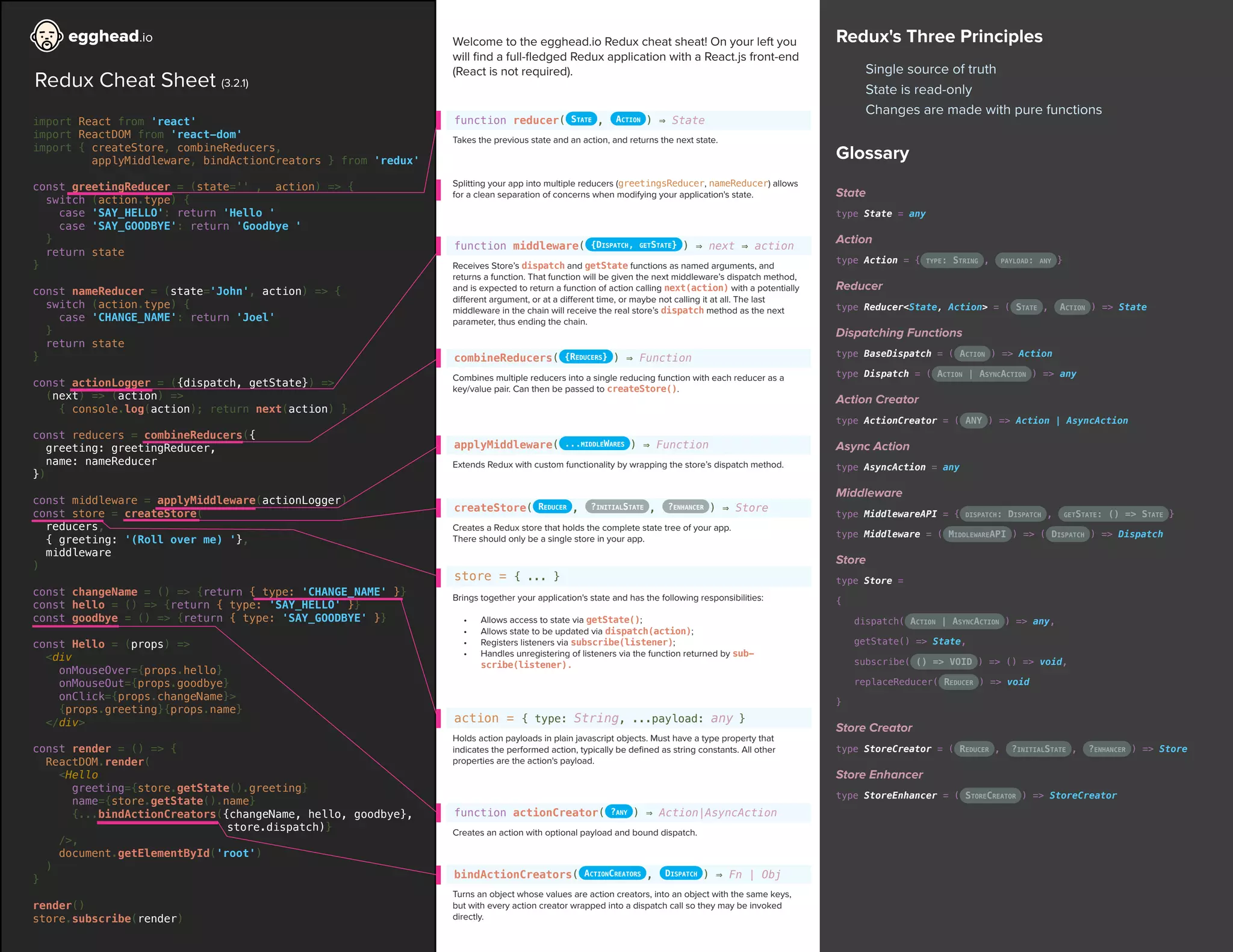
Welcome to the egghead.io Redux cheat sheat! On your left you
will find a full-fledged Redux application with a React.js front-end
(React is not required).
Extends Redux with custom functionality by wrapping the store’s dispatch method.
function middleware( {Dispatch, getState} ) ⇒ next ⇒ action
Receives Store’s dispatch and getState functions as named arguments, and
returns a function. That function will be given the next middleware’s dispatch method,
and is expected to return a function of action calling next(action) with a potentially
different argument, or at a different time, or maybe not calling it at all. The last
middleware in the chain will receive the real store’s dispatch method as the next
parameter, thus ending the chain.
Redux Cheat Sheet (3.2.1)

Egghead redux-cheat-sheet-3-2-1

  • 1.
    Redux's Three Principles Singlesource of truth State is read-only Changes are made with pure functions Glossary State type State = any Action type Action = { type: String , payload: any } Reducer type Reducer<State, Action> = ( State , Action ) => State Dispatching Functions type BaseDispatch = ( Action ) => Action type Dispatch = ( Action | AsyncAction ) => any Action Creator type ActionCreator = ( ANY ) => Action | AsyncAction Async Action type AsyncAction = any Middleware type MiddlewareAPI = { dispatch: Dispatch , getState: () => State } type Middleware = ( MiddlewareAPI ) => ( Dispatch ) => Dispatch Store type Store = { dispatch( Action | AsyncAction ) => any, getState() => State, subscribe( () => VOID ) => () => void, replaceReducer( Reducer ) => void } Store Creator type StoreCreator = ( Reducer , ?initialState , ?enhancer ) => Store Store Enhancer type StoreEnhancer = ( StoreCreator ) => StoreCreator import React from 'react' import ReactDOM from 'react-dom' import { createStore, combineReducers, applyMiddleware, bindActionCreators } from 'redux' const greetingReducer = (state='' , action) => { switch (action.type) { case 'SAY_HELLO': return 'Hello ' case 'SAY_GOODBYE': return 'Goodbye ' } return state } const nameReducer = (state='John', action) => { switch (action.type) { case 'CHANGE_NAME': return 'Joel' } return state } const actionLogger = ({dispatch, getState}) => (next) => (action) => { console.log(action); return next(action) } const reducers = combineReducers({ greeting: greetingReducer, name: nameReducer }) const middleware = applyMiddleware(actionLogger) const store = createStore( reducers, { greeting: '(Roll over me) '}, middleware ) const changeName = () => {return { type: 'CHANGE_NAME' }} const hello = () => {return { type: 'SAY_HELLO' }} const goodbye = () => {return { type: 'SAY_GOODBYE' }} const Hello = (props) => <div onMouseOver={props.hello} onMouseOut={props.goodbye} onClick={props.changeName}> {props.greeting}{props.name} </div> const render = () => { ReactDOM.render( <Hello greeting={store.getState().greeting} name={store.getState().name} {...bindActionCreators({changeName, hello, goodbye}, store.dispatch)} />, document.getElementById('root') ) } render() store.subscribe(render) createStore( Reducer , ?initialState , ?enhancer ) ⇒ Store action = { type: String, ...payload: any } store = { ... } function actionCreator( ?any ) ⇒ Action|AsyncAction bindActionCreators( ActionCreators , Dispatch ) ⇒ Fn | Obj combineReducers( {Reducers} ) ⇒ Function function reducer( State , Action ) ⇒ State applyMiddleware( ...middleWares ) ⇒ Function Creates a Redux store that holds the complete state tree of your app. There should only be a single store in your app. Holds action payloads in plain javascript objects. Must have a type property that indicates the performed action, typically be defined as string constants. All other properties are the action's payload. Brings together your application's state and has the following responsibilities: • Allows access to state via getState(); • Allows state to be updated via dispatch(action); • Registers listeners via subscribe(listener); • Handles unregistering of listeners via the function returned by sub- scribe(listener). Creates an action with optional payload and bound dispatch. Turns an object whose values are action creators, into an object with the same keys, but with every action creator wrapped into a dispatch call so they may be invoked directly. Combines multiple reducers into a single reducing function with each reducer as a key/value pair. Can then be passed to createStore(). Takes the previous state and an action, and returns the next state. Splitting your app into multiple reducers (greetingsReducer, nameReducer) allows for a clean separation of concerns when modifying your application's state. Welcome to the egghead.io Redux cheat sheat! On your left you will find a full-fledged Redux application with a React.js front-end (React is not required). Extends Redux with custom functionality by wrapping the store’s dispatch method. function middleware( {Dispatch, getState} ) ⇒ next ⇒ action Receives Store’s dispatch and getState functions as named arguments, and returns a function. That function will be given the next middleware’s dispatch method, and is expected to return a function of action calling next(action) with a potentially different argument, or at a different time, or maybe not calling it at all. The last middleware in the chain will receive the real store’s dispatch method as the next parameter, thus ending the chain. Redux Cheat Sheet (3.2.1)