Building Human Intelligence –
Pun Intended
Rohyt Belani
Co-founder & CEO, PhishMe
@rohytbelani @PhishMe
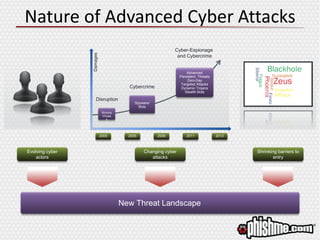
Nature of Advanced Cyber Attacks
Disruption
Cybercrime
Cyber-Espionage
and Cybercrime
Damages
2005 2005 2009 2011 2013
Worms
Viruse
s
Spyware/
Bots
Advanced
Persistent Threats
Zero-Day
Targeted Attacks
Dynamic Trojans
Stealth Bots
Changing cyber
attacks
Evolving cyber
actors
Shrinking barriers to
entry
New Threat Landscape
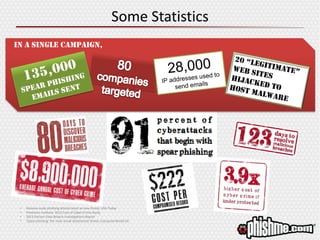
Some Statistics
• Massive-scale phishing attacks loom as new threat, USA Today
• Ponemon Institute: 2012 Cost of Cyber Crime Study
• 2012 Verizon Data Breach Investigations Report
• 'Spear phishing' the main email attachment threat, ComputerWorld UK
In a single campaign,
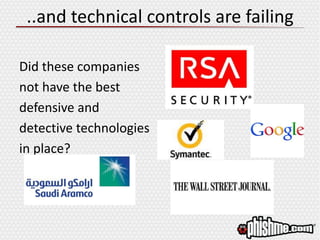
..and technical controls are failing
Did these companies
not have the best
defensive and
detective technologies
in place?
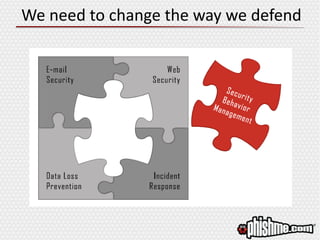
We need to change the way we defend
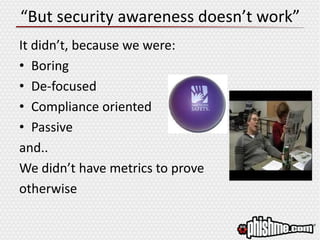
“But security awareness doesn’t work”
It didn’t, because we were:
• Boring
• De-focused
• Compliance oriented
• Passive
and..
We didn’t have metrics to prove
otherwise
Understanding the Hu Element
Memories associated
with emotional events
are stored here
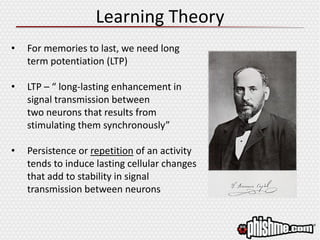
Learning Theory
• For memories to last, we need long
term potentiation (LTP)
• LTP – “ long-lasting enhancement in
signal transmission between
two neurons that results from
stimulating them synchronously”
• Persistence or repetition of an activity
tends to induce lasting cellular changes
that add to stability in signal
transmission between neurons
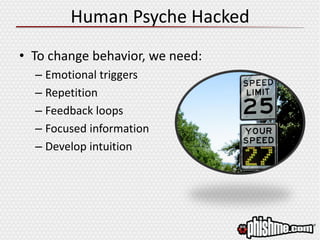
Human Psyche Hacked
• To change behavior, we need:
– Emotional triggers
– Repetition
– Feedback loops
– Focused information
– Develop intuition
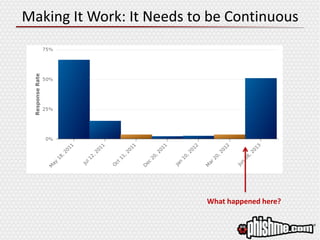
Making It Work: It Needs to be Continuous
What happened here?
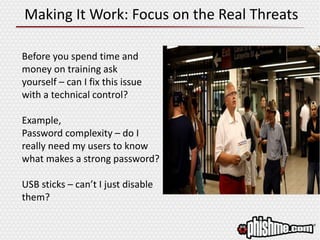
Making It Work: Focus on the Real Threats
Before you spend time and
money on training ask
yourself – can I fix this issue
with a technical control?
Example,
Password complexity – do I
really need my users to know
what makes a strong password?
USB sticks – can’t I just disable
them?
Making It Work: Think “Marketing”
Making It Work: Immerse in the Experience
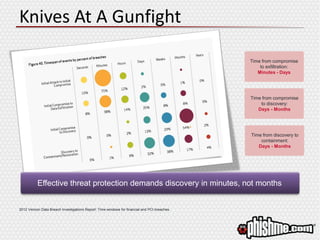
Knives At A Gunfight
2012 Verizon Data Breach Investigations Report: Time windows for financial and PCI breaches.
Time from compromise
to discovery:
Days - Months
Time from compromise
to exfiltration:
Minutes - Days
Effective threat protection demands discovery in minutes, not months
Time from discovery to
containment:
Days - Months
We Have a Detection Problem!
• Median number of days that attackers were
present on a victim network before detection?
2431
• Percentage of breaches that went undetected
for “months or more”?
66%2
1 www.mandiant.com/library/M-Trends_2013.pdf
2 http://www.verizonenterprise.com/DBIR/2013/
Can We Think Outside the Shiny Box?
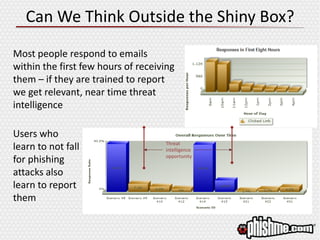
Most people respond to emails
within the first few hours of receiving
them – if they are trained to report
we get relevant, near time threat
intelligence
Users who
learn to not fall
for phishing
attacks also
learn to report
them
Threat
intelligence
opportunity
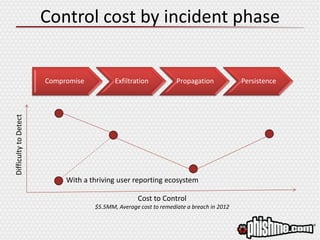
Control cost by incident phaseDifficultytoDetect
Cost to Control
$5.5MM, Average cost to remediate a breach in 2012
Compromise Exfiltration Propagation Persistence
With a thriving user reporting ecosystem
Improve Incident Response
• Users provide new source of near-time threat data
• Early detection drives down key cost factors such as
time from incident to response
• Response can start Day 1
– Redirect and capture C&C traffic
– Remove same/similar emails from other inboxes
– Block additional inbound/outbound
– Increase monitoring at targeted entities
– If a successful compromise containment may be limited
This is the end goal…
Thank You
Rohyt@PhishMe.com
@rohytbelani @PhishMe #humansensors

Building Human Intelligence – Pun Intended

  • 1.
    Building Human Intelligence– Pun Intended Rohyt Belani Co-founder & CEO, PhishMe @rohytbelani @PhishMe
  • 2.
    Nature of AdvancedCyber Attacks Disruption Cybercrime Cyber-Espionage and Cybercrime Damages 2005 2005 2009 2011 2013 Worms Viruse s Spyware/ Bots Advanced Persistent Threats Zero-Day Targeted Attacks Dynamic Trojans Stealth Bots Changing cyber attacks Evolving cyber actors Shrinking barriers to entry New Threat Landscape
  • 3.
    Some Statistics • Massive-scalephishing attacks loom as new threat, USA Today • Ponemon Institute: 2012 Cost of Cyber Crime Study • 2012 Verizon Data Breach Investigations Report • 'Spear phishing' the main email attachment threat, ComputerWorld UK In a single campaign,
  • 4.
    ..and technical controlsare failing Did these companies not have the best defensive and detective technologies in place?
  • 5.
    We need tochange the way we defend
  • 6.
    “But security awarenessdoesn’t work” It didn’t, because we were: • Boring • De-focused • Compliance oriented • Passive and.. We didn’t have metrics to prove otherwise
  • 7.
    Understanding the HuElement Memories associated with emotional events are stored here
  • 8.
    Learning Theory • Formemories to last, we need long term potentiation (LTP) • LTP – “ long-lasting enhancement in signal transmission between two neurons that results from stimulating them synchronously” • Persistence or repetition of an activity tends to induce lasting cellular changes that add to stability in signal transmission between neurons
  • 9.
    Human Psyche Hacked •To change behavior, we need: – Emotional triggers – Repetition – Feedback loops – Focused information – Develop intuition
  • 10.
    Making It Work:It Needs to be Continuous What happened here?
  • 11.
    Making It Work:Focus on the Real Threats Before you spend time and money on training ask yourself – can I fix this issue with a technical control? Example, Password complexity – do I really need my users to know what makes a strong password? USB sticks – can’t I just disable them?
  • 12.
    Making It Work:Think “Marketing”
  • 13.
    Making It Work:Immerse in the Experience
  • 14.
    Knives At AGunfight 2012 Verizon Data Breach Investigations Report: Time windows for financial and PCI breaches. Time from compromise to discovery: Days - Months Time from compromise to exfiltration: Minutes - Days Effective threat protection demands discovery in minutes, not months Time from discovery to containment: Days - Months
  • 15.
    We Have aDetection Problem! • Median number of days that attackers were present on a victim network before detection? 2431 • Percentage of breaches that went undetected for “months or more”? 66%2 1 www.mandiant.com/library/M-Trends_2013.pdf 2 http://www.verizonenterprise.com/DBIR/2013/
  • 16.
    Can We ThinkOutside the Shiny Box? Most people respond to emails within the first few hours of receiving them – if they are trained to report we get relevant, near time threat intelligence Users who learn to not fall for phishing attacks also learn to report them Threat intelligence opportunity
  • 17.
    Control cost byincident phaseDifficultytoDetect Cost to Control $5.5MM, Average cost to remediate a breach in 2012 Compromise Exfiltration Propagation Persistence With a thriving user reporting ecosystem
  • 18.
    Improve Incident Response •Users provide new source of near-time threat data • Early detection drives down key cost factors such as time from incident to response • Response can start Day 1 – Redirect and capture C&C traffic – Remove same/similar emails from other inboxes – Block additional inbound/outbound – Increase monitoring at targeted entities – If a successful compromise containment may be limited
  • 19.
    This is theend goal…
  • 20.