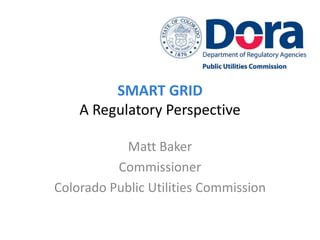
SMART GRID
    A Regulatory Perspective

           Matt Baker
          Commissioner
Colorado Public Utilities Commission
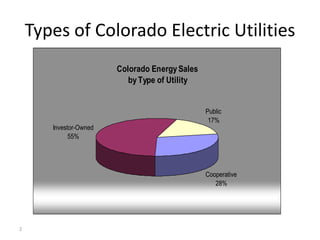
Types of Colorado Electric Utilities
                        Colorado Energy Sales
                           by Type of Utility


                                                Public
                                                 17%
       Investor-Owned
             55%


                                                Cooperative
                                                   28%


2
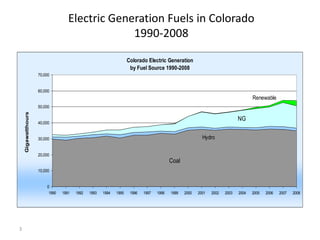
Electric Generation Fuels in Colorado
                                                1990-2008

                                                                   Colorado Electric Generation
                                                                    by Fuel Source 1990-2008
                    70,000


                    60,000
                                                                                                                                   Renewable
                    50,000
    Gigawatthours


                                                                                                                            NG
                    40,000


                    30,000                                                                               Hydro

                    20,000
                                                                                         Coal
                    10,000


                        0
                         1990   1991   1992   1993   1994   1995    1996   1997   1998   1999   2000   2001   2002   2003   2004   2005   2006   2007   2008


3
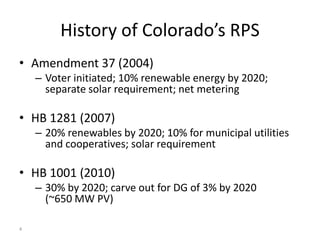
History of Colorado’s RPS
• Amendment 37 (2004)
    – Voter initiated; 10% renewable energy by 2020;
      separate solar requirement; net metering

• HB 1281 (2007)
    – 20% renewables by 2020; 10% for municipal utilities
      and cooperatives; solar requirement

• HB 1001 (2010)
    – 30% by 2020; carve out for DG of 3% by 2020
      (~650 MW PV)

4
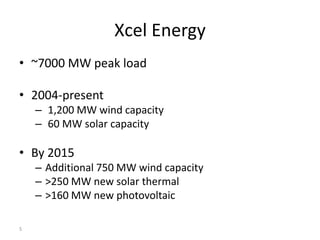
Xcel Energy
• ~7000 MW peak load

• 2004-present
    – 1,200 MW wind capacity
    – 60 MW solar capacity

• By 2015
    – Additional 750 MW wind capacity
    – >250 MW new solar thermal
    – >160 MW new photovoltaic

5
6
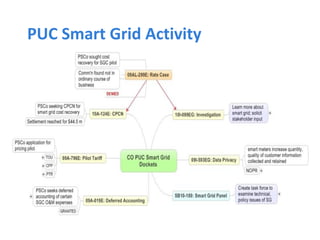
PUC Smart Grid Activity
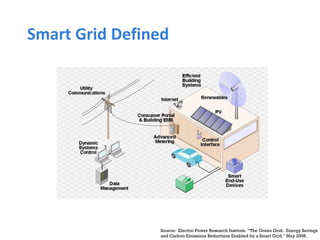
Smart Grid Defined


                Source: Electric Power Research Institute. “The Green Grid: Energy Savings
                and Carbon Emissions Reductions Enabled by a Smart Grid.” May 2008.
What is Smart Grid?
                            A Broad Definition:
  Overlay of Bi-Directional Communication and Control Mechanisms onto the
   Electricity Grid
  Marriage of Electricity Grids with Information Technology
  Involves the entire electricity value chain:
      Generation
      Transmission
      Distribution
      Consumption

 Smart Grid is an enabler:
      Demand Response
      Efficiency
      Renewable Integration (central and distributed)
      Plug-in Hybrid Electric Vehicle (PHEV) Integration
      Consumer Choice
Smart Grid Enabled System
 Electricity providers will have greater access to
  real-time information about the state of the
  system from generation to consumption

 Electricity providers will have greatly increased
  ability to control both supply and demand

 Consumers will have information about the cost
  and environmental attributes of their electricity
  and the ability to automate efficiency

                             Department of Energy, National Energy Technology Lab
                             http://www.netl.doe.gov/moderngrid/opportunity/vision_characteristics.html
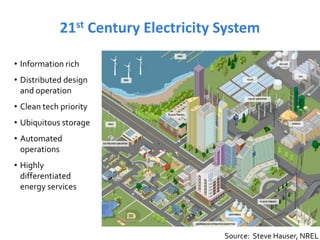
21st Century Electricity System

• Information rich
• Distributed design
  and operation
• Clean tech priority
• Ubiquitous storage
• Automated
  operations
• Highly
  differentiated
  energy services


                                      Source: Steve Hauser, NREL
Transitional Challenges
 Complex array of potential technology choices.
 Smart Grid technology (equipment and software) will be a moving
  target in the near term.
 Industry consolidation already occurring. Attrition likely as
  dominant providers emerge.
 Interoperability standards are critical.
 Consumer education and adoption extremely important, very
  uncertain.
 Regulatory landscape
    Balkanized regulations (Federal, State, local) will lead to
     deployment and integration challenges.
The Built Environment
• How can smart grid lower costs?
• What revenue centers will it provide?
   –   HVAC
   –   Energy management
   –   Energy production
   –   PHEVs . . .
• How do codes and regulations enable progress?
   – Implications to utility law?
        • vertically integrated versus componentized approach?
Urban Context
• T&D efficiency gains
   – i.e., distribution automation
• Building energy efficiency
• Microgrids
   – small, integrated energy systems in which generation and load are co-
     located
   – can operate in parallel with the grid or intentionally islanded
• Energy Storage
   – Utility scale or localized
• Renewables Integration
• Electric Vehicles
   – Vehicle to Grid (V2G)
   – Charging infrastructure
   – Parking

                                         Z. Ye, et al. Facility Microgrids, National Renewable Energy Laboratory
                                         http://www.nrel.gov/docs/fy05osti/38019.pdf at 1.
Smart Grid: Regulatory Evolution
• Regulatory landscape must keep abreast of
  innovation
   – Should promote -- not stymie -- investment
• Investors
   – Who has the expertise?
   – Who takes the risk?
   – Who owns smart grid infrastructure components?
• What codes, standards will apply?
• How to ensure cyber security?
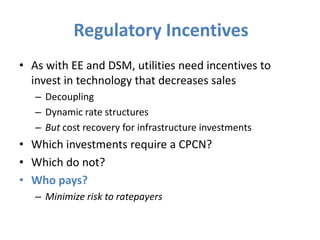
Regulatory Incentives
• As with EE and DSM, utilities need incentives to
  invest in technology that decreases sales
   – Decoupling
   – Dynamic rate structures
   – But cost recovery for infrastructure investments
• Which investments require a CPCN?
• Which do not?
• Who pays?
   – Minimize risk to ratepayers
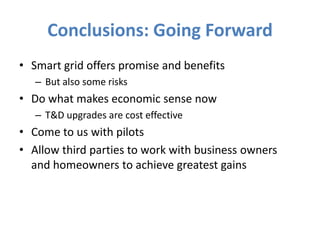
Conclusions: Going Forward
• Smart grid offers promise and benefits
   – But also some risks
• Do what makes economic sense now
   – T&D upgrades are cost effective
• Come to us with pilots
• Allow third parties to work with business owners
  and homeowners to achieve greatest gains
Questions?

Matt Baker invVEST Smart Grid Panel

  • 1.
    SMART GRID A Regulatory Perspective Matt Baker Commissioner Colorado Public Utilities Commission
  • 2.
    Types of ColoradoElectric Utilities Colorado Energy Sales by Type of Utility Public 17% Investor-Owned 55% Cooperative 28% 2
  • 3.
    Electric Generation Fuelsin Colorado 1990-2008 Colorado Electric Generation by Fuel Source 1990-2008 70,000 60,000 Renewable 50,000 Gigawatthours NG 40,000 30,000 Hydro 20,000 Coal 10,000 0 1990 1991 1992 1993 1994 1995 1996 1997 1998 1999 2000 2001 2002 2003 2004 2005 2006 2007 2008 3
  • 4.
    History of Colorado’sRPS • Amendment 37 (2004) – Voter initiated; 10% renewable energy by 2020; separate solar requirement; net metering • HB 1281 (2007) – 20% renewables by 2020; 10% for municipal utilities and cooperatives; solar requirement • HB 1001 (2010) – 30% by 2020; carve out for DG of 3% by 2020 (~650 MW PV) 4
  • 5.
    Xcel Energy • ~7000MW peak load • 2004-present – 1,200 MW wind capacity – 60 MW solar capacity • By 2015 – Additional 750 MW wind capacity – >250 MW new solar thermal – >160 MW new photovoltaic 5
  • 6.
  • 7.
  • 8.
    Smart Grid Defined Source: Electric Power Research Institute. “The Green Grid: Energy Savings and Carbon Emissions Reductions Enabled by a Smart Grid.” May 2008.
  • 9.
    What is SmartGrid? A Broad Definition:  Overlay of Bi-Directional Communication and Control Mechanisms onto the Electricity Grid  Marriage of Electricity Grids with Information Technology  Involves the entire electricity value chain:  Generation  Transmission  Distribution  Consumption  Smart Grid is an enabler:  Demand Response  Efficiency  Renewable Integration (central and distributed)  Plug-in Hybrid Electric Vehicle (PHEV) Integration  Consumer Choice
  • 10.
    Smart Grid EnabledSystem  Electricity providers will have greater access to real-time information about the state of the system from generation to consumption  Electricity providers will have greatly increased ability to control both supply and demand  Consumers will have information about the cost and environmental attributes of their electricity and the ability to automate efficiency Department of Energy, National Energy Technology Lab http://www.netl.doe.gov/moderngrid/opportunity/vision_characteristics.html
  • 11.
    21st Century ElectricitySystem • Information rich • Distributed design and operation • Clean tech priority • Ubiquitous storage • Automated operations • Highly differentiated energy services Source: Steve Hauser, NREL
  • 12.
    Transitional Challenges  Complexarray of potential technology choices.  Smart Grid technology (equipment and software) will be a moving target in the near term.  Industry consolidation already occurring. Attrition likely as dominant providers emerge.  Interoperability standards are critical.  Consumer education and adoption extremely important, very uncertain.  Regulatory landscape  Balkanized regulations (Federal, State, local) will lead to deployment and integration challenges.
  • 13.
    The Built Environment •How can smart grid lower costs? • What revenue centers will it provide? – HVAC – Energy management – Energy production – PHEVs . . . • How do codes and regulations enable progress? – Implications to utility law? • vertically integrated versus componentized approach?
  • 14.
    Urban Context • T&Defficiency gains – i.e., distribution automation • Building energy efficiency • Microgrids – small, integrated energy systems in which generation and load are co- located – can operate in parallel with the grid or intentionally islanded • Energy Storage – Utility scale or localized • Renewables Integration • Electric Vehicles – Vehicle to Grid (V2G) – Charging infrastructure – Parking Z. Ye, et al. Facility Microgrids, National Renewable Energy Laboratory http://www.nrel.gov/docs/fy05osti/38019.pdf at 1.
  • 15.
    Smart Grid: RegulatoryEvolution • Regulatory landscape must keep abreast of innovation – Should promote -- not stymie -- investment • Investors – Who has the expertise? – Who takes the risk? – Who owns smart grid infrastructure components? • What codes, standards will apply? • How to ensure cyber security?
  • 16.
    Regulatory Incentives • Aswith EE and DSM, utilities need incentives to invest in technology that decreases sales – Decoupling – Dynamic rate structures – But cost recovery for infrastructure investments • Which investments require a CPCN? • Which do not? • Who pays? – Minimize risk to ratepayers
  • 17.
    Conclusions: Going Forward •Smart grid offers promise and benefits – But also some risks • Do what makes economic sense now – T&D upgrades are cost effective • Come to us with pilots • Allow third parties to work with business owners and homeowners to achieve greatest gains
  • 18.