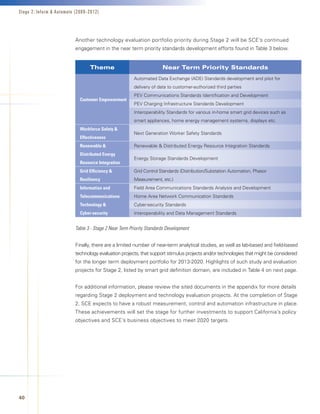
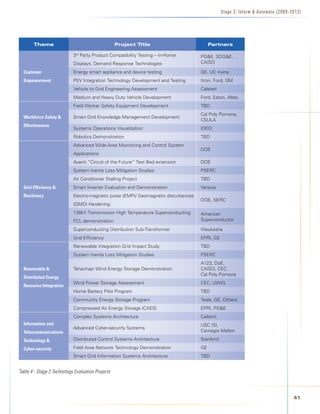
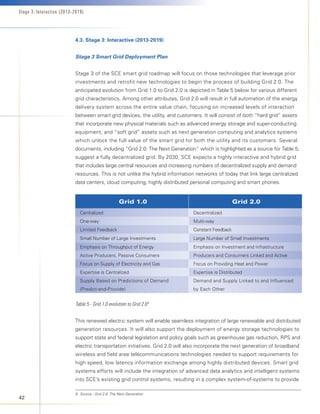
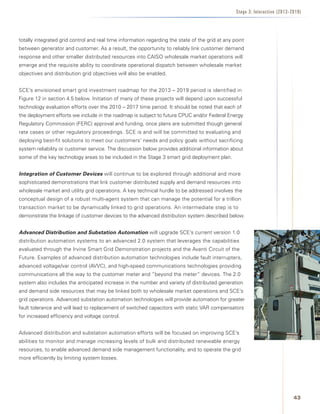
ADVANCED
TECHNOLOGY
Transmission & Distribution Business Unit


                                            Southern California Edison
                                            Smart Grid Strategy & Roadmap
In 2007, Southern California Edison developed its first comprehensive

Smart Grid Roadmap spanning transmission, distribution and customer

facing technologies. Since that time, national and state policy regarding

smart grid development has significantly grown including the passage of

the landmark Energy Independence and Security Act of 2007 (EISA). In

2009, California passed its version in Senate Bill 17.


The purpose of this updated Smart Grid Strategy and Roadmap is to

summarize SCE’s activities and plans for development and implementation

of a smarter grid as well as explain the organizing principles, decision

framework and methods used to manage the adoption and adaptation of

new technologies into our operation. While we hope that the document
proves useful for all readers, it is intended primarily to convey SCE’s

perspectives on the smart grid for policy makers, the electric utility

industry, and technology providers which serve our industry.


SCE is grateful for the supporting contributions by IBM, Enernex, Cisco,

Quanta and EPRI to the development of this document that began with
expanding the set of Use Cases to encompass the breadth of the smart

grid. We also appreciate the earlier support by Bridge on the development

of the 2007 roadmap that was the foundation for this effort. Finally, we

appreciate the reviews provided by our Technology Advisory Board, PG&E

and SDG&E, and Jesse Berst.
Table of Contents


1.	Introduction 	 .	 .	 .	 .	 .	 .	 .	 .	 .	 .	 .	 .	 .	 .	 .	 .	 .	 .	 .	 .	 .	 .	 .	 .	 .	 .	 .	 .	 .	 .	 .	 .	 .	 .	 .	 .	 .	 .	 .	 .	 .		4

    1.1. Why do we need a smarter grid? . . . . . . . . . . . . . . . . . . . . . . . . . . . . 4
    1.2. The SCE Smart Grid Vision . . . . . . . . . . . . . . . . . . . . . . . . . . . . . . . 6
    1.3. Smart Grid Value Proposition . . . . . . . . . . . . . . . . . . . . . . . . . . . . . . 7
    1.4. Smart Grid Definition . . . . . . . . . . . . . . . . . . . . . . . . . . . . . . . . . 10
         1.4.1. Customer Empowerment:
                    Energy Smart Customer Solutions & Advanced Electric Transportation. . . . . 11
         1.4.2. Workforce Safety & Effectiveness. . . . . . . . . . . . . . . . . . . . . . . . 13
         1.4.3. Renewable & Distributed Energy Resource Integration . . . . . . . . . . . . . 14
         1.4.4. Grid Efficiency & Resiliency . . . . . . . . . . . . . . . . . . . . . . . . . . . 15
         1.4.5. Information and Connectivity . . . . . . . . . . . . . . . . . . . . . . . . . . 16


2.	Smart	Grid	Development	Methodology	 .	 .	 .	 .	 .	 .	 .	 .	 .	 .	 .	 .	 .	 .	 .	 .	 .	 .	 .	 .	 .	 .	 .	 .	 .	 	18

    2.1. Customer-Focused Systems Engineering . . . . . . . . . . . . . . . . . . . . . . . 18
    2.2. Open Innovation . . . . . . . . . . . . . . . . . . . . . . . . . . . . . . . . . . . . 19
    2.3. Technology Development Scenario Planning . . . . . . . . . . . . . . . . . . . . . 20
    2.4. Proactive Standards Development . . . . . . . . . . . . . . . . . . . . . . . . . . 23
    2.5. Rigorous Technology Evaluation . . . . . . . . . . . . . . . . . . . . . . . . . . . . 25


3.	Smart	Grid	Engineering	and	Architecture	 .	 .	 .	 .	 .	 .	 .	 .	 .	 .	 .	 .	 .	 .	 .	 .	 .	 .	 .	 .	 .	 .	 .	 .	 	26

    3.1. Smart Grid Electric System Design . . . . . . . . . . . . . . . . . . . . . . . . . . 26
    3.2. Smart Grid Information System Architecture . . . . . . . . . . . . . . . . . . . . . 31


4.	Smart	Grid	Development	Roadmap	 .	 .	 .	 .	 .	 .	 .	 .	 .	 .	 .	 .	 .	 .	 .	 .	 .	 .	 .	 .	 .	 .	 .	 .	 .	 .	 .	 	35

    4.1. Stage 1: Foundation (1995-2008) . . . . . . . . . . . . . . . . . . . . . . . . . . . 37
    4.2. Stage 2: Inform & Automate (2009-2012) . . . . . . . . . . . . . . . . . . . . . . . 38
    4.3. Stage 3: Interactive (2013-2019). . . . . . . . . . . . . . . . . . . . . . . . . . . . 42
    4.4. Stage 4: Intuitive & Transactive Grid (2020-2030) . . . . . . . . . . . . . . . . . . . 46
    4.5. Summary of Technology Roadmap . . . . . . . . . . . . . . . . . . . . . . . . . . 48
    4.6. Managing and Maintaining the SCE Smart Grid Development Roadmap . . . . . . . 52


5.	Appendices	 	 .	 .	 .	 .	 .	 .	 .	 .	 .	 .	 .	 .	 .	 .	 .	 .	 .	 .	 .	 .	 .	 .	 .	 .	 .	 .	 .	 .	 .	 .	 .	 .	 .	 .	 .	 .	 .	 .	 .	 .	 	53

    5.1. SCE Smart Grid Reference Documents . . . . . . . . . . . . . . . . . . . . . . . . 53
    5.2. External Smart Grid Reference Documents . . . . . . . . . . . . . . . . . . . . . . 54
Why Do We Need a Smarter Grid?


                          1. Introduction

                          1.1.	Why	do	we	need	a	smarter	grid?	


                          The United States has arrived at a critical juncture in its energy future. The stakes for addressing
                          climate change, energy independence and infrastructure security could not be higher. Federal and
                          state policymakers alike have recognized the need for a smarter, more robust electricity infrastruc-
                          ture if we as a country are to rely on greater amounts of renewable generation, use electricity as
                          a fuel for vehicles, enable consumers to become active participants in the energy supply chain, and
                          ensure the continued reliability and vitality of our nation’s energy economy. Southern California
                          Edison (SCE) must meet these challenges while continuing to operate the grid in a safe and reliable
                          manner. SCE has served as a leader in fostering the development of advanced grid technologies
                          and the adoption of technology to create a smarter grid.


                          SCE recognized the need for the development of a smarter grid more than a decade ago. This need
                          was heightened with the wide range of climate and energy policy objectives introduced earlier in the
                          last decade after the 2001 California Energy Crisis. Also, post dot-com venture investment in clean
                          technology has yielded several emergent technologies that have made certain aspects of a smart
                          grid more viable. In 2007, SCE developed a detailed smart grid technology roadmap across five
                          themes described in our Smart Grid Vision in section 1.2. Many elements of this earlier roadmap are
                          valid and continue to be pursued. However, over the past three years a number of additional policy
                          targets have been introduced to create a very aggressive set of goals that have implications for
                          development of a smarter grid. It is important to note that it is not entirely clear that all these policy
                          targets are viable given the technology development and deployment timelines and customer rate
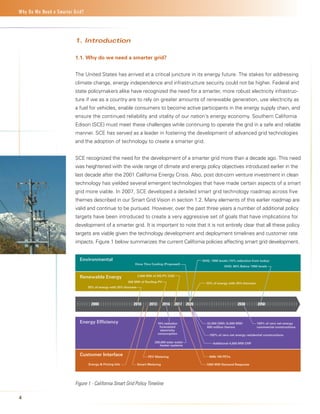
                          impacts. Figure 1 below summarizes the current California policies affecting smart grid development.


                            Environmental                                                          GHG:	1990	levels	(15%	reduction	from	today)
                                                              Once	Thru	Cooling	(Proposed)
                                                                                                                GHG:	80%	Below	1990	levels


                            Renewable	Energy                      3,000	MW	of	DG-PV	(CSI)
                                                         500	MW	of	Rooftop	PV                        33%	of	energy	with	20%	biomass
                                 20%	of	energy	with	20%	biomass


                          44444444444444442013	444444444444444444444444444444
                           4	442000	 44444442010	 444 44444444444444444444420504444444
                               44           44 44 2016	 2017	 2020	    2030	 4
                            Energy	Efficiency                                 10%	reduction	          32,000	GWh	(5,000	MW)           100%	of	zero	net	energy
                                                                               forecasted	            800	million	therms              commercial	constructions
                                                                                electricity	
                                                                              consumption              100%	of	zero	net	energy	residential	constructions

                                                                            200,000	solar	water	         Additional	4,000	MW	CHP
                                                                               heater	systems


                            Customer	Interface                          PEV	Metering                   400k-1M	PEVs

                                 Energy	&	Pricing	Info            Smart	Metering                     1000	MW	Demand	Response


                          Figure 1 - California Smart Grid Policy Timeline

4
Why Do We Need a Smarter Grid?


The breadth of the change required for modernizing the nation’s electricity grid is highlighted by the
policy objectives defined in the federal Energy Independence and Security Act of 2007 (EISA).
This law identifies the following specific capabilities that should be enabled by a smart grid:


                                          2007 EISA Smart Grid Policy

  1.	 	 ncreased	use	of	digital	information	and	controls	technology	to	improve	reliability,	security	and	efficiency	
      I
      of	the	electric	grid.
  2.	 Dynamic	optimization	of	grid	operations	and	resources,	with	full	cyber-security.
  3.	 Deployment	and	integration	of	distributed	resources	and	generation,	including	renewable	resources
  4.	 Development	and	incorporation	of	demand	response,	demand-side	resources	and	energy-efficiency	resources.
  5.	 	 eployment	of	smart	(real-time,	automated,	interactive)	technologies	that	optimize	the	physical	operation	of	
      D
      appliances	and	consumer	devices	for	metering,	communications	concerning	grid	operations	and	status,	and	
      distribution	automation.
  6.	 Integration	of	smart	appliances	and	consumer	devices.
  7.	 	 eployment	and	integration	of	advanced	electricity	storage	and	peak-shaving	technologies	including	plug-in	
      D
      electric	and	hybrid	electric	vehicles,	and	thermal	storage	air	conditioning.
  8.	 Consumer	access	to	timely	information	and	control	options.
  9.	 	 evelopment	of	standards	for	communication	and	interoperability	of	appliances	and	equipment	connected	to	
      D
      the	electric	grid	including	the	infrastructure	serving	the	grid.
  10.		 dentification	and	reduction	of	unreasonable	or	unnecessary	barriers	to	the	adoption	of	smart	grid	
      I
      technologies,	practices	and	services.


Table 1 - 2007 EISA Smart Grid Policy


These same objectives were incorporated into a recent California law, Senate Bill (SB) 17, which was                                          “…we’ll also do more to

enacted in October, 2009. The law recognizes the need for a smarter grid to support California’s                                              retrofit America for the

ambitious energy and environmental policies such as the Renewables Portfolio Standard , green-                               1                global economy. That

house gas reduction law , energy efficiency standards including requirements for Zero-Net Energy
                                  2                                                                                                           means updating the way

Homes, distributed resource goals like the California Solar Initiative, demand response objectives                                            we get our electricity

and support for widespread consumer adoption of plug-in electric vehicles (PEV). In this context,                                             by starting to build a

SCE believes that many aspects of its smart grid vision would need to be operational by the year                                              new smart grid that will

2020 to enable a number of California’s ambitious policy goals. In recognition of this challenge,                                             save us money, protect

SB 17 requires investor owned utilities to prepare a 2020 smart grid development plan and file it                                             our power sources from

with the CPUC by July 1, 2011. The parameters of this development plan will be identified in the                                              blackout or attack, and

Smart Grid OIR in the summer of 2010.                                                                                                         deliver clean, alternative

                                                                                                                                              forms of energy to every

While many details regarding development of a smart grid need to be resolved, including scope,                                                corner of our nation.”

standards, benefits, cost and timing, one thing is clear: We as an industry need to modernize our                                             – President Barack Obama,
                                                                                                                                                            January 2009
electric grid in order to support an increasing reliance on electricity to fuel the nation’s economy.


	 California’s	Renewables	Portfolio	Standard	(RPS)	requires	that	20%	of	electricity	sales	be	from	renewable	sources	by	200.	In	September	
   2009,	Governor	Schwarzenegger	signed	an	Executive	Order	raising	the	RPS	target	to	33%	by	2020.	SCE	supports	development	of	
   cleaner	energy	resources	and	currently	has	the	largest	RPS	portfolio	in	the	nation,	however	we	do	not	believe	that	a	33%	RPS	target	
   is	achievable	by	2020.
2	 California	Assembly	Bill	32	requires	that	carbon	emissions	be	reduced	to	990	levels	by	2020,	and	to	80%	below	990	levels	by	2050.
The SCE Smart Grid Vision


                            1.2.	The	SCE	Smart	Grid	Vision	


“SCE’s vision of a smart    SCE’s vision of a smart grid is to develop and deploy a more reliable, secure, economic, efficient,
grid is to develop and      safe and environmentally-friendly electric system. This vision covers all facets of energy from
deploy a more reliable,     its production to transmission, distribution, and finally its efficient use in homes, businesses and
secure, economic,           vehicles. This smart grid will incorporate high-tech digital devices throughout the transmission,
efficient, safe and         substation and distribution systems and integrate advanced intelligence to provide the informa-
environmentally-friendly    tion necessary to both optimize electric service and empower customers to make informed
electric system.”           energy decisions.


                            Consistent with the 2007 EISA and the U.S.
                            Department of Energy’s and National Energy
                            Technology Laboratory’s Vision for the Modern
                            Grid, SCE’s smart grid will enable increased
                            levels of intermittent and renewable resources
                            (such as wind and solar power) and lead to
                            greater use of Plug-in Electric Vehicles (PEV).
                            To achieve these goals and the complete
                            smart grid vision, the SCE smart grid will
                            increase system flexibility; reduce greenhouse
                            gas emissions; avoid the economic losses associated with catastrophic failures and wide-area
                            blackouts; foster energy conservation, energy efficiency and demand response capabilities by
                            providing customers with better energy use information and choices; reduce operating costs and
                            improve reliability and safety by providing real-time information for system monitoring and system
                            automation; improve maintenance and operations practices on the electrical grid; and facilitate
                            the development of a “Clean Tech” economy, which is expected to include the creation of new
                            jobs. We believe a true smart grid can help America achieve meaningful greenhouse gas reductions
                            and a more secure energy future.


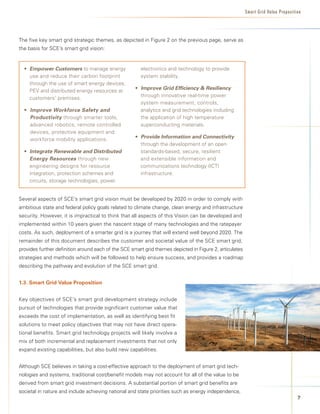
                            Figure 2 - SCE Smart Grid Vision Themes


6
Smart Grid Value Proposition


The five key smart grid strategic themes, as depicted in Figure 2 on the previous page, serve as
the basis for SCE’s smart grid vision:


  • 	 mpower Customers	to manage energy
    E                                                  electronics and technology to provide
    use and reduce their carbon footprint              system stability.
    through the use of smart energy devices,
                                                    • Improve Grid Efficiency  Resiliency	
    PEV and distributed energy resources at
                                                      through innovative real-time power
    customers’ premises.
                                                      system measurement, controls,
  • Improve Workforce Safety and                      analytics and grid technologies including
    Productivity through smarter tools,               the application of high temperature
    advanced robotics, remote controlled              superconducting materials.
    devices, protective equipment and
                                                    • Provide Information and Connectivity	
    workforce mobility applications.
                                                      through the development of an open
  • Integrate Renewable and Distributed               standards-based, secure, resilient
    Energy Resources through new                      and extensible information and
    engineering designs for resource                  communications technology (ICT)
    integration, protection schemes and               infrastructure.	
    circuits, storage technologies, power


Several aspects of SCE’s smart grid vision must be developed by 2020 in order to comply with
ambitious state and federal policy goals related to climate change, clean energy and infrastructure
security. However, it is impractical to think that all aspects of this Vision can be developed and
implemented within 10 years given the nascent stage of many technologies and the ratepayer
costs. As such, deployment of a smarter grid is a journey that will extend well beyond 2020. The
remainder of this document describes the customer and societal value of the SCE smart grid,
provides further definition around each of the SCE smart grid themes depicted in Figure 2, articulates
strategies and methods which will be followed to help ensure success, and provides a roadmap
describing the pathway and evolution of the SCE smart grid.


1.3.	Smart	Grid	Value	Proposition


Key objectives of SCE’s smart grid development strategy include
pursuit of technologies that provide significant customer value that
exceeds the cost of implementation, as well as identifying best fit
solutions to meet policy objectives that may not have direct opera-
tional benefits. Smart grid technology projects will likely involve a
mix of both incremental and replacement investments that not only
expand existing capabilities, but also build new capabilities.


Although SCE believes in taking a cost-effective approach to the deployment of smart grid tech-
nologies and systems, traditional cost/benefit models may not account for all of the value to be
derived from smart grid investment decisions. A substantial portion of smart grid benefits are
societal in nature and include achieving national and state priorities such as energy independence,
Smart Grid Value Proposition


                               reducing greenhouse gas emissions and increasing grid security, safety and reliability. These
                               benefits are often difficult to quantify, may vary widely in their justification of various smart grid
                               technologies, and are multi-faceted in terms of who receives benefits from them. Benefits may not
                               only accrue to SCE customers, but also to California residents or our broader society. In addition,
                               these benefits need to be considered within the context of the portfolio of smart grid technologies
                               to be deployed at different times over the next twenty years and beyond.


                               SCE has identified 10 broad smart grid benefits categories. Accordingly, the smart grid has
                               the potential to:


                                 1.	 Provide Customer Benefits by improving         6.		Increase Utility Worker Safety by
                                     grid reliability, enhancing customer               providing tools and information that allow
                                     communications, and by empowering                  them to perform their work in a safer
                                     customers to better manage their energy            manner.
                                     usage and costs.                               7.		Improve Grid Resiliency and Reliability
                                 2.			 educe Peak Demand through demand
                                     R                                                  by reducing the frequency and duration of
                                     management programs and services.                  outages and service interruptions, and by
                                 3.		Increase Energy Conservation                      improving power quality, accommodating
                                     Efficiency by enabling integration of              greater diversity of energy resources, and
                                     customer energy management systems                 increasing grid security.
                                     and grid energy management systems;            8.			 educe Greenhouse Gas Emissions
                                                                                        R
                                     this integration can reduce system                 by integrating renewable energy
                                     losses.                                            resources with the electric delivery
                                 4.	 Reduce Operating Expenses by                       system, and promoting the adoption
                                     lowering the cost of planning and support          of electric vehicles.
                                     functions, operating costs and energy          9.			 romote Energy Independence
                                                                                        P
                                     costs.                                             by facilitating electricity-based
                                 5.			 void, Reduce or Defer Capital
                                     A                                                  transportation.
                                     Investments by increasing capacity             10.		 romote Economic Growth 
                                                                                        P
                                     utilization, extending the useful lives            Productivity by fostering the
                                     of grid assets, optimizing energy                  development of California’s clean
                                     procurement practices, and investigating           technology economy, and associated
                                     new technologies.                                  job growth.


8
Smart Grid Value Proposition


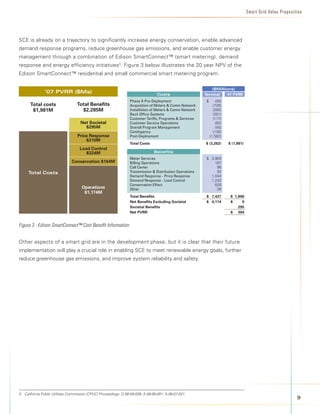
SCE is already on a trajectory to significantly increase energy conservation, enable advanced
demand response programs, reduce greenhouse gas emissions, and enable customer energy
management through a combination of Edison SmartConnect™ (smart metering), demand
response and energy efficiency initiatives3. Figure 3 below illustrates the 20 year NPV of the
Edison SmartConnect™ residential and small commercial smart metering program.

                                                                                                                   ($Millions)
               ‘07 PVRR ($Ms)                                                      Costs                        Nominal   ‘07	PVRR
                                                                   Phase	II	Pre-Deployment                  	   $       (45)
      Total	costs	                 Total	Benefits	                 Acquisition	of	Meters		Comm	Network               (726)
       $1,981M                       $2,285M                       Installation	of	Meters		Comm	Network              (285)
                                                                   Back	Office	Systems                                (251)
                                                                   Customer	Tariffs,	Programs		Services              (117)
                                     Net	Societal	                 Customer	Service	Operations                          (82)
                                       $295M                       Overall	Program	Management                           (45)
                                                                   Contingency                                        (130)
                                   Price	Response	                 Post-Deployment                                  (1,582)
                                       $310M
                                                                   Total	Costs                                  $	(3,263)      $	(1,981)
                                    Load	Control	
                                       $324M                                     Benefits
                                                                   Meter	Services                               $ 3,909
                                Conservation	$164M                 Billing	Operations                               187
                                                                   Call	Center                                       96
     Total Costs                                                   Transmission		Distribution	Operations            92
                                                                   Demand	Response	-	Price	Response               1,044
                                                                   Demand	Response	-	Load	Control                 1,242
                                                                   Conservation	Effect                              828
                                      Operations	                  Other                                             39
                                       $1,174M
                                                                   Total	Benefits                               $			7,437       $		1,990
                                                                   Net	Benefits	Excluding	Societal              $			4,174       $									9
                                                                   Societal	Benefits                                                 	295
                                                                   Net	PVRR                                                     $					304


Figure 3 - Edison SmartConnect™ Cost Benefit Information


Other aspects of a smart grid are in the development phase, but it is clear that their future
implementation will play a crucial role in enabling SCE to meet renewable energy goals, further
reduce greenhouse gas emissions, and improve system reliability and safety.


3	 	California	Public	Utilities	Commission	(CPUC)	Proceedings:	D.08-09-039;	A.08-06-00;	A.08-07-02.
Smart Grid Definition


                        1.4.	Smart	Grid	Definition


                        SCE defines the smart grid as an increasingly intelligent and highly automated electric power
                        system that utilizes technology advancements in telecommunications, information, computing,
                        sensing, controls, materials, in addition to other grid technologies. The smart grid will be able to
                        better meet customers’ energy demands, while also seamlessly integrating new sources of energy
                        and delivering power over a network that is increasingly interoperable, efficient and resilient.


                        The smart grid of 2020 will comprise an expansive network of grid components. Millions of
                        intelligent digital devices will continuously generate increasingly large amounts of data about the
                        system’s state. This data will ultimately yield visual and actionable information that can be used
                        to optimize control of the electric system and empower customers to make informed energy
                        decisions. In addition, a smart grid will enable customers to utilize electric power as a fuel source
                        for their transportation needs.


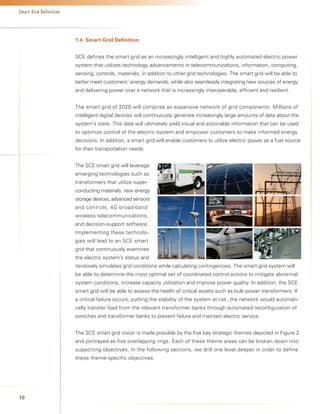
                        The SCE smart grid will leverage
                        emerging technologies such as
                        transformers that utilize super-
                        conducting materials, new energy
                        storage devices, advanced sensors
                        and controls, 4G broad-band
                        wireless telecommunications,
                        and decision-support software.
                        Implementing these technolo-
                        gies will lead to an SCE smart
                        grid that continuously examines
                        the electric system’s status and
                        iteratively simulates grid conditions while calculating contingencies. The smart grid system will
                        be able to determine the most optimal set of coordinated control actions to mitigate abnormal
                        system conditions, increase capacity utilization and improve power quality. In addition, the SCE
                        smart grid will be able to assess the health of critical assets such as bulk power transformers. If
                        a critical failure occurs, putting the stability of the system at risk, the network would automati-
                        cally transfer load from the relevant transformer banks through automated reconfiguration of
                        switches and transformer banks to prevent failure and maintain electric service.


                        The SCE smart grid vision is made possible by the five key strategic themes depicted in Figure 2
                        and portrayed as five overlapping rings. Each of these theme areas can be broken down into
                        supporting objectives. In the following sections, we drill one level deeper in order to define
                        these theme-specific objectives.


10
Sma rt Grid Definition


1.4.1.		 ustomer	Empowerment:		
       C
       Energy	Smart	Customer	Solutions		Advanced	Electric	Transportation


Energy Smart Customer Solutions


                              Definition: Empower customers to become active participants in
                              the energy supply chain by providing them with information and new
                              customer service options that enable management of their own energy
                              consumption and reduction in carbon emissions


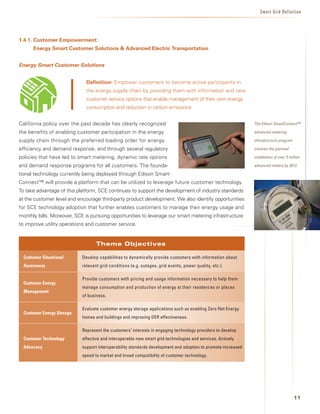
California policy over the past decade has clearly recognized                                                   The Edison SmartConnect™

the benefits of enabling customer participation in the energy                                                   advanced metering

supply chain through the preferred loading order for energy                                                     infrastructure program

efficiency and demand response, and through several regulatory                                                  involves the planned

policies that have led to smart metering, dynamic rate options                                                  installation of over 5 million

and demand response programs for all customers. The founda-                                                     advanced meters by 2012.

tional technology currently being deployed through Edison Smart-
Connect™ will provide a platform that can be utilized to leverage future customer technology.
To take advantage of this platform, SCE continues to support the development of industry standards
at the customer level and encourage third-party product development. We also identify opportunities
for SCE technology adoption that further enables customers to manage their energy usage and
monthly bills. Moreover, SCE is pursuing opportunities to leverage our smart metering infrastructure
to improve utility operations and customer service.


                                   Theme Objectives

  Customer	Situational	     Develop	capabilities	to	dynamically	provide	customers	with	information	about	
  Awareness                 relevant	grid	conditions	(e.g.	outages,	grid	events,	power	quality,	etc.).

                            Provide	customers	with	pricing	and	usage	information	necessary	to	help	them	
  Customer	Energy	
                            manage	consumption	and	production	of	energy	at	their	residences	or	places		
  Management
                            of	business.

                            Evaluate	customer	energy	storage	applications	such	as	enabling	Zero	Net	Energy	
  Customer	Energy	Storage
                            homes	and	buildings	and	improving	DER	effectiveness.

                            Represent	the	customers’	interests	in	engaging	technology	providers	to	develop	
  Customer	Technology	      effective	and	interoperable	new	smart	grid	technologies	and	services.	Actively	
  Advocacy                  support	interoperability	standards	development	and	adoption	to	promote	increased	
                            speed	to	market	and	broad	compatibility	of	customer	technology.


                                                                                                                                          11
Smart Grid Definition


                            Advanced Electric Transportation


                                   Definition: Provide support and infrastructure solutions for port and rail
                                   electrification, SCE fleet electrification, and electric vehicle charging.


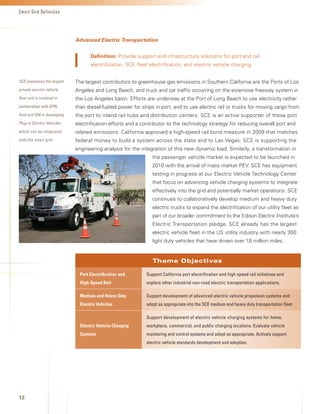
SCE possesses the largest   The largest contributors to greenhouse gas emissions in Southern California are the Ports of Los
private electric vehicle    Angeles and Long Beach, and truck and car traffic occurring on the extensive freeway system in
fleet and is involved in    the Los Angeles basin. Efforts are underway at the Port of Long Beach to use electricity rather
partnerships with EPRI,     than diesel-fueled power for ships in port, and to use electric rail or trucks for moving cargo from
Ford and GM in developing   the port to inland rail hubs and distribution centers. SCE is an active supporter of these port
Plug-In Electric Vehicles   electrification efforts and a contributor to the technology strategy for reducing overall port and
which can be integrated     related emissions. California approved a high-speed rail bond measure in 2009 that matches
with the smart grid.        federal money to build a system across the state and to Las Vegas. SCE is supporting the
                            engineering analysis for the integration of this new dynamic load. Similarly, a transformation in
                                                               the passenger vehicle market is expected to be launched in
                                                               2010 with the arrival of mass market PEV. SCE has equipment
                                                               testing in progress at our Electric Vehicle Technology Center
                                                               that focus on advancing vehicle charging systems to integrate
                                                               effectively into the grid and potentially market operations. SCE
                                                               continues to collaboratively develop medium and heavy duty
                                                               electric trucks to expand the electrification of our utility fleet as
                                                               part of our broader commitment to the Edison Electric Institute’s
                                                               Electric Transportation pledge. SCE already has the largest
                                                               electric vehicle fleet in the US utility industry with nearly 300
                                                               light duty vehicles that have driven over 18 million miles.


                                                               Theme Objectives

                              Port	Electrification	and	     Support	California	port	electrification	and	high	speed	rail	initiatives	and	
                              High	Speed	Rail               explore	other	industrial	non-road	electric	transportation	applications.

                              Medium	and	Heavy	Duty	        Support	development	of	advanced	electric	vehicle	propulsion	systems	and	
                              Electric	Vehicles             adopt	as	appropriate	into	the	SCE	medium	and	heavy	duty	transportation	fleet.

                                                            Support	development	of	electric	vehicle	charging	systems	for	home,	
                              Electric	Vehicle	Charging	    workplace,	commercial,	and	public	charging	locations.	Evaluate	vehicle	
                              Systems                       monitoring	and	control	systems	and	adopt	as	appropriate.	Actively	support	
                                                            electric	vehicle	standards	development	and	adoption.


12
Sma rt Grid Definition


1.4.2.	Workforce	Safety		Effectiveness


                                Definition:	Evaluate and adopt technologies that maximize
                                workforce productivity, effectiveness and safety through
                                application of enabling tools and technologies.


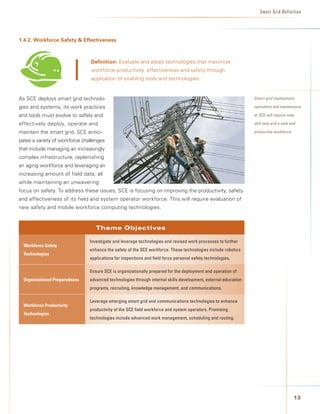
As SCE deploys smart grid technolo-                                                                              Smart grid deployment,

gies and systems, its work practices                                                                             operations and maintenance

and tools must evolve to safely and                                                                              at SCE will require new

effectively deploy, operate and                                                                                  skill sets and a safe and

maintain the smart grid. SCE antici-                                                                             productive workforce.

pates a variety of workforce challenges
that include managing an increasingly
complex infrastructure, replenishing
an aging workforce and leveraging an
increasing amount of field data, all
while maintaining an unwavering
focus on safety. To address these issues, SCE is focusing on improving the productivity, safety
and effectiveness of its field and system operator workforce. This will require evaluation of
new safety and mobile workforce computing technologies.


                                   Theme Objectives

                                Investigate	and	leverage	technologies	and	revised	work	processes	to	further	
  Workforce	Safety	
                                enhance	the	safety	of	the	SCE	workforce.	These	technologies	include	robotics	
  Technologies
                                applications	for	inspections	and	field	force	personal	safety	technologies.

                                Ensure	SCE	is	organizationally	prepared	for	the	deployment	and	operation	of	
  Organizational	Preparedness   advanced	technologies	through	internal	skills	development,	external	education	
                                programs,	recruiting,	knowledge	management,	and	communications.

                                Leverage	emerging	smart	grid	and	communications	technologies	to	enhance	
  Workforce	Productivity	
                                productivity	of	the	SCE	field	workforce	and	system	operators.	Promising	
  Technologies
                                technologies	include	advanced	work	management,	scheduling	and	routing.		


                                                                                                                                         13
Smart Grid Definition


                               1.4.3.	Renewable		Distributed	Energy	Resource	Integration


                                                           Definition:	Utilize intelligent monitoring, protection and control
                                                           technology, and storage technology to effectively integrate and
                                                           manage new sources of bulk and distributed renewable energy supply.


In 2009, SCE obtained          In 2009, California’s Governor signed an executive order to increase the renewables portfolio
approval to cover 65 million   standard from 20% to 33% by 2020. This target – one of the most aggressive RPS targets in
square feet of unused          the world – cannot be achieved without advances in grid technology and resource integration
Southern California            technology such as intelligent inverters and protection and control systems. Today’s electric grid
commercial rooftops            was not designed with these technologies and policy goals in mind and a significant effort is
with 250 megawatts of          underway within SCE and across the industry and academia to address the necessary redesigning
the latest photovoltaic        of the electric system. At the same time, SCE, like many industry stakeholders, recognizes the
technology – enough            potential for various energy storage technologies to help better integrate intermittent resources
generating capacity to         and address some fundamental changes such
meet the needs of              as bi-directional power flow on distribution
approximately                  systems. SCE has a twenty-year technology
162,000 homes.                 evaluation and testing legacy with battery
                               storage technologies that creates unique
                               opportunities to actively support product
                               development that is occurring at battery
                               technology suppliers.


                                                                 Theme Objectives

                                                              Conduct	studies	and	develop	technical	solutions	that	will	help	SCE	
                                 Renewables	and	DER	
                                                              accommodate	increased	RPS	targets	and	distributed	energy	resource	
                                 Integration
                                                              policies	in	both	the	transmission	and	distribution	systems.

                                 Dynamic	Response             Investigate	and	deploy	dynamic	response	storage	applications	that	support	
                                 Storage                      the	integration	of	intermittent	renewable	energy	resources	by	mitigating	
                                                              power	quality	issues	and	providing	grid	support.

                                                              Investigate	energy	shifting	storage	applications	to	assist	with	the	integration	
                                                              of	intermittent	renewable	energy	resources	by	storing	surplus	power	during	
                                 Energy	Shifting	Storage
                                                              off-peak	periods	and	supplying	power	during	peak	periods	or	periods	of	limited	
                                                              renewable	resource	output.


14
Sma rt Grid Definition


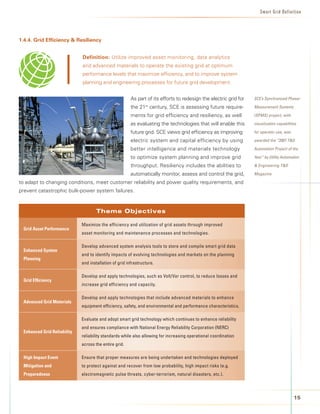
1.4.4.	Grid	Efficiency		Resiliency


                             Definition:	Utilize improved asset monitoring, data analytics
                             and advanced materials to operate the existing grid at optimum
                             performance levels that maximize efficiency, and to improve system
                             planning and engineering processes for future grid development.


                                                        As part of its efforts to redesign the electric grid for   SCE’s Synchronized Phasor

                                                        the 21st century, SCE is assessing future require-         Measurement Systems

                                                        ments for grid efficiency and resiliency, as well          (SPMS) project, with

                                                        as evaluating the technologies that will enable this       visualization capabilities

                                                        future grid. SCE views grid efficiency as improving        for operator use, was

                                                        electric system and capital efficiency by using            awarded the “2007 TD

                                                        better intelligence and materials technology               Automation Project of the

                                                        to optimize system planning and improve grid               Year” by Utility Automation

                                                        throughput. Resiliency includes the abilities to            Engineering TD

                                                        automatically monitor, assess and control the grid,        Magazine.

to adapt to changing conditions, meet customer reliability and power quality requirements, and
prevent catastrophic bulk-power system failures.


                                     Theme Objectives

                             Maximize	the	efficiency	and	utilization	of	grid	assets	through	improved		
 Grid	Asset	Performance
                             asset	monitoring	and	maintenance	processes	and	technologies.

                             Develop	advanced	system	analysis	tools	to	store	and	compile	smart	grid	data	
 Enhanced	System	
                             and	to	identify	impacts	of	evolving	technologies	and	markets	on	the	planning	
 Planning
                             and	installation	of	grid	infrastructure.

                             Develop	and	apply	technologies,	such	as	Volt/Var	control,	to	reduce	losses	and	
 Grid	Efficiency
                             increase	grid	efficiency	and	capacity.

                             Develop	and	apply	technologies	that	include	advanced	materials	to	enhance	
 Advanced	Grid	Materials
                             equipment	efficiency,	safety,	and	environmental	and	performance	characteristics.

                             Evaluate	and	adopt	smart	grid	technology	which	continues	to	enhance	reliability	
                             and	ensures	compliance	with	National	Energy	Reliability	Corporation	(NERC)	
 Enhanced	Grid	Reliability
                             reliability	standards	while	also	allowing	for	increasing	operational	coordination	
                             across	the	entire	grid.	

 High	Impact	Event	          Ensure	that	proper	measures	are	being	undertaken	and	technologies	deployed	
 Mitigation	and	             to	protect	against	and	recover	from	low	probability,	high	impact	risks	(e.g.	
 Preparedness                electromagnetic	pulse	threats,	cyber-terrorism,	natural	disasters,	etc.).


                                                                                                                                           1
Smart Grid Definition


                               1.4.5.	Information	and	Connectivity	


                                                                 Definition:	Evaluate and adopt information and telecommunications
                                                                 technologies which provide scalability, flexibility and interoperability
                                                                 for data and information exchange across the entire grid supply
                                                                 chain from generation to customer. These technologies will be
                                                                 able to be easily integrated into a resilient and secure smart grid
                                                                 architecture which supports electric system operations.


SCE currently has one of       Creating a 21st century electric grid requires significant investment in new information and telecom-
the most comprehensive         munication technologies. While several fundamental technologies exist in commercial form,
telecommunications             many require adaptation from their present use in other industries or in military applications. SCE
portfolios in the industry.    has an extensive ongoing effort to evaluate information and telecommunication technologies for
It is comprised of 5,250       electric system adoption. SCE is also designing a smart grid telecommunications network that
circuit miles of fiber optic   will provide connectivity, security and intelligent processing through a “network-of-networks”
communications, over           consisting of inter-utility, intra-utility and field area networks. This integrated set of networks will
30,000 Netcomm radios,         facilitate data exchange and communications among customer devices, utility field devices, the
and a proprietary satellite    field workforce, grid operators, utility computing systems and external parties such as the
communications system to       California Independent System Operator (CAISO).
monitor and control the

electric system.               A smarter grid will generate exponentially larger amounts of data. To meet this challenge, SCE
                               is also designing an integrated, resilient, adaptive, and interoperable information “system-of-
                               systems” to collect, interpret, and rapidly respond to this data. To ensure system survival in light
                               of potential cyber-security threats, SCE is taking measures to provide comprehensive end-to-end
                               security coverage. These measures address
                               security concerns at a holistic, system-wide
                               level and identify the impacts of any given
                               vulnerability or threat to the entire system.
                               SCE’s cyber-security efforts involve external
                               engagement with technology suppliers,
                               standards organizations and policy makers,
                               and internal engagement to address the
                               security requirements of SCE systems.


16
Sma rt Grid Definition


                              Theme Objectives

Information	and	
                       Develop	and	implement	a	unified	architecture	that	defines	functional		
Communications	
                       requirements	and	provides	required	availability,	reliability,	resiliency,	
Architecture	and	
                       interoperability,	and	security	(ARRIS).	
Engineering

                       Evaluate	and	deploy	high	speed	telecommunications	technology	to	interconnect	
High	Speed	Backbone	   substations	and	link	to	field	area	communications	that	will	support	utility	and	
Telecommunications     customer	communications	needs,	and	will	enable	the	grid	telecommunication	
                       systems	to	operate	as	an	integrated	network	of	networks.		

                       Evaluate	and	adopt	telecommunications	technologies	to	improve	field	area	
Advanced	Field	
                       networks	and	link	backhaul	field	area	information,	including	customer	information,		
Telecommunications
                       to	substations	and	utility	operations.	

                       Develop	and	implement	highly	reliable,	secure	and	scalable	information	systems		
Information	Systems    to	meet	future	needs	for	data	management,	analytics	and	complex	automation	
                       and	control	systems.

                       Develop	and	implement	common	security	services	to	resist	attacks	and	
Cyber-security
                       dynamically	respond	to	threats.


                                                                                                                                1
Customer-Focused Systems Engineering


                            2. Smart Grid Development Methodology

                                                                                  Much of SCE’s smart grid vision and strategy needs to
                                                                                  be realized over the next decade in order to meet state
                                                                                  and federal policy initiatives and to accomplish company
                                                                                  objectives. In order to execute on the broad smart grid
                                                                                  vision outlined above, SCE has employed several
                                                                                  methods that involve careful and customer-focused
                                                                                  technology planning, internal and external alignment
                                                                                  of resources, disciplined processes for technology
                                                                                  evaluation, and an open standards-based approach to
                            technology innovation. The following methods have been in use at SCE over the past five years
                            and have resulted in our successful smart metering and synchrophasor deployment programs:


                                 1.	Customer-Focused Systems Engineering
                                 2.		 pen Innovation
                                    O
                                 3.	Technology Development Scenario Planning
                                 4.	Proactive Standards Development
                                 5.		 igorous Technology Evaluation
                                    R


                            2.1.	Customer-Focused	Systems	Engineering	

“Creates a structured       An important aspect of smart grid deployment is the ability to balance cost, schedule and technical
framework in order to       constraints with a thorough understanding of customer needs, business goals, and the maturity
balance cost, schedule      level of technologies available in the marketplace. SCE’s Customer-Focused Systems Engineer-
and technical constraints   ing approach addresses these complexities by providing a structured framework for understanding
of smart grid deployment”   the value and risks inherent in deploying a complex “system-of-systems” and “network-of-
                            networks” such as the smart grid.


                            Design thinking for a smart grid requires the more robust and holistic approach offered by systems
                            engineering. Benefits of this approach include better solution quality, higher value solutions, lower
                            project costs, reduced project risks and shorter project schedules.


                            SCE was an early implementer of the IntelliGrid methodology to gather smart grid requirements
                            and develop architecture using a disciplined systems engineering approach. This approach was
                            subsequently adopted by several other utilities (e.g., Consumers Energy, Florida Power  Light,
                            Salt River Project, First Energy) and by NIST to develop their standards roadmap. This approach
                            has been codified in IEC standard 625594.


                            	 	IEC	standard	62559	-	http://webstore.iec.ch/preview/info_iecpas62559%7Bed.0%7Den.pdf
18
Open Innovation


The development of use cases is an important first step in the systems engineering process at          “System engineering is a

SCE (www.sce.com/usecases). Use cases support the generation and documentation of require-             robust approach to the

ment sets for smart grid technologies. The use cases accomplish this by focusing on business           design, creation, and

scenarios that identify the people, field technologies and information systems that must interact      operation of systems. In

to achieve a business goal. At SCE, concepts from the Customer Focused Technology Planning®            simple terms, the approach

(CFTP®) framework have been adapted to help evaluate smart grid requirements resulting from            consists of identification

the use case process. CFTP® is a methodology that has been used in a wide variety of industries        and quantification of

to help guide technology strategy and evaluation by providing a means to identify and prioritize       system goals, creation of

the deployment of smart grid technologies. It helps to ensure that the needs of customers and          alternative system design

other key stakeholders are considered in a way that balances the risks and rewards of implement-       concepts, performance of

ing new technologies. By incorporating CFTP® concepts into the Systems Engineering processes at        design trades, selection

SCE, the result is a methodology which we have called Customer-Focused Systems Engineering.            and implementation of the

                                                                                                       best design, verification

Our smart grid challenge and opportunity is to develop a technology game plan that appropriately       that the design is properly

balances state and federal policy objectives, our customers’ needs, SCE’s business objectives,         built and integrated, and

and the adoption of new smart grid technologies. In light of this challenge, before we engage in       post-implementation

any new smart grid opportunity, be it for emerging technology evaluation or commercial technol-        assessment of how well

ogy deployment, we first score and rank that opportunity using a standard rating system. This          the system meets (or met)

system considers three critical criteria: (1) alignment with business objectives (including customer   the goals.”

value, improved grid operations and compliance with state and federal energy policies); (2) risks                  – NASA Systems
                                                                                                                       Engineering
associated with adopting the technology; and (3) cost effectiveness. In the aggregate, potential                   Handbook, 1995.
smart grid investment opportunities over the next decade and beyond appear to follow a dimin-
ishing returns curve. SCE is therefore careful to consider opportunities based not only on their
potential value, but also with contemplation of the risks of technology adoption.


As such, SCE’s Customer-Focused Systems Engineering approach also includes a structured
framework for understanding the value and risks inherent in deploying complex, network-
centric systems such as the smart grid. SCE has developed several analytical models, including
Technology Capability Maturity (TCM) and early Stage Technology Adoption Risk (eSTAR) models
that are used to assist with early stage technology adoption and/or development decisions.


2.2.	Open	Innovation


SCE has a long history of following an open innovation approach to technology evaluation and           “Allows for the sharing of

adoption. Although Edison is recognized as a global leader in the development and implementa-          ideas and concepts across

tion of advanced technologies, it is aware that smart grid deployment is a complex undertaking         utilities, policy makers,

requiring a collaborative effort by many stakeholders. Therefore, SCE is actively pursuing an open     vendors, and research

innovation approach that involves working closely with many of the various stakeholder groups.         groups to advance

These groups include customers, other utilities, policymakers, technology manufacturers,               technology development

standards organizations, universities, national labs, and research institutes. This collaborative      and applied research”

approach is needed to achieve common understanding on key issues and interests across
these diverse groups.

                                                                                                                                   1
Open Innovation


                               Open innovation allows for sharing of ideas
                               and concepts across entities – utilities, policy
                               makers, vendors, and research groups – to
                               drive further applied research and technology
                               development in needed areas, and to better
                               understand the value proposition of smart grid
                               components for our customers, utility operations
                               and society as a whole. This approach builds
                               consensus and critical mass in the industry in
                               order to drive technology development to meet open and interoperable standards and new
                               performance requirements. Notable collaboration efforts with other smart grid stakeholder
                               organizations include the following:


                                   • SCE is actively engaged with the Edison Electric Institute’s (EEI) and the Electric Power
                                     Research Institute’s (EPRI) smart grid initiatives and is the current chair for both EEI’s and
                                     EPRI’s Smart Grid Executive working groups.
                                   • SCE co-chairs the Western Electric Industry Leaders (WEIL) technology collaborative.
                                   • SCE founded the Southern California Energy Research Consortium involving local distin-
                                     guished international research universities: Caltech, University of Southern California,
                                     University of California, Los Angeles, UC Irvine and UC Santa Barbara. SCE also collaborates
                                     with Massachusetts Institute of Technology, Stanford, University of Illinois, UC Berkeley,
                                     UC Davis and Carnegie Mellon.
                                   • SCE is collaborating with several national research labs, including Lawrence Berkeley National
                                     Lab, National Renewable Energy Lab, Idaho National Lab and Pacific Northwest National Lab.
                                   • SCE has technical exchange efforts underway with leading utilities in Asia, Australia,
                                     Europe, South America and Canada, in addition to our US utility collaborations.


                               2.3.	Technology	Development	Scenario	Planning


“Ensures that SCE’s smart      SCE engages in scenario planning as part of its strategy for ensuring success in achieving its smart
grid strategy remains a        grid vision. Over the past year, SCE’s scenario planning efforts have resulted in the development
viable technology adoption     of four potential pathways for the pace of technology development and adoption for the smart grid.
plan as driving forces alter   A key objective of this analysis is to ensure that the SCE’s smart grid strategy provides a viable
the smart grid landscape”      adoption roadmap in any of the four potential pathways. These scenarios were created following
                               a careful analysis of the critical driving forces affecting the smart grid, and after making some
                               assumptions as to the degree of impact (positive or negative) that these forces might have on
                               the pace of technology development and adoption. The following driving forces were considered:


                                     • Economic Growth                               • Energy Markets
                                     • Policy Focus                                  • Customer Trends
                                     • Technology Innovation  Adoption              • Environmental Developments


20
Technology Development Scenario Planning


The goal for developing future scenarios is not to identify the most likely future but to examine
how these important external forces may shape smart grid deployment through 2020 and beyond.
The characteristics of the resulting scenarios are used by SCE to help prioritize and select smart
grid technology projects. Those opportunities which seem to be relevant and viable across multiple
future scenarios receive additional consideration, in comparison to those opportunities which might
seem promising in a single future scenario but may look irrelevant or risky under other scenarios.
In addition, for each future scenario, SCE has developed specific proactive responses based on the
implications of that scenario. As evidence develops that the future is trending toward any given
scenario, these “contingency plan” responses for the given scenario can be called into action.


SCE’s smart grid future scenarios were developed by considering a spectrum of two of the
most critical driving forces – Economic Growth and Policy Driven Innovation – placed along
two axes as follows:
                                             POLICY DRIVEN INNOVATION


                    SLOW		STEADY                                          LIGHT	SPEED


                 WEAK ECONOMY                                           STRONG ECONOMY


                  KEEP	THE	LIGHTS	ON                                      MARKET	DRIVEN


Figure 4 - SCE Smart Grid Future Scenarios


These four scenarios have been defined as follows:


    • Slow	and	Steady: Policymakers continue to support utility investment in smart grid
       development and implementation. Progress towards energy and climate policy goals
       continues but is slowed by economic forces.
    • 	 ight	Speed: Policymakers issue mandates for utility investment in smart grid deployment
      L
       and provide financial support for technology innovation. A “clean tech” investment boom
       spurs technology innovation and development.
    • 	 arket	Driven: Policymakers shift emphasis towards market driven outcomes for tech-
      M
       nology innovation and infrastructure investment. Strong economic growth and potential
       new market opportunities encourage new entrants into the energy market.
    • Keep	the	Lights	On: Continued economic stagnation squeezes consumers and industry,
       slowing venture and technology industry investment and innovation in smart grid tech-
       nologies. Lower energy demand and a regulatory focus on rate containment reduce
       funding available for additional smart grid investment.
                                                                                                                              21
Technology Development Scenario Planning


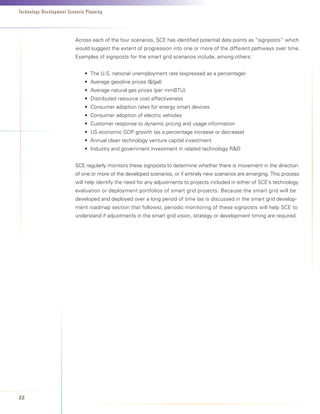
                           Across each of the four scenarios, SCE has identified potential data points as “signposts” which
                           would suggest the extent of progression into one or more of the different pathways over time.
                           Examples of signposts for the smart grid scenarios include, among others:


                               • The U.S. national unemployment rate (expressed as a percentage)
                               • Average gasoline prices ($/gal)
                               • Average natural gas prices (per mmBTU)
                               • Distributed resource cost effectiveness
                               • Consumer adoption rates for energy smart devices
                               • Consumer adoption of electric vehicles
                               • Customer response to dynamic pricing and usage information
                               • US economic GDP growth (as a percentage increase or decrease)
                               • Annual clean technology venture capital investment
                               • Industry and government investment in related technology RD


                           SCE regularly monitors these signposts to determine whether there is movement in the direction
                           of one or more of the developed scenarios, or if entirely new scenarios are emerging. This process
                           will help identify the need for any adjustments to projects included in either of SCE’s technology
                           evaluation or deployment portfolios of smart grid projects. Because the smart grid will be
                           developed and deployed over a long period of time (as is discussed in the smart grid develop-
                           ment roadmap section that follows), periodic monitoring of these signposts will help SCE to
                           understand if adjustments in the smart grid vision, strategy or development timing are required.


22
Proactive Standards Development


2.4.	Proactive	Standards	Development


As the grid evolves and becomes “smarter” and more capable over time, standards must also                                                       “Enables the adoption of

evolve to support higher degrees of interoperability and to enable more advanced capabilities.                                                  standards that encourage

When the concept of smart grid evolution is applied in the area of standards adoption, the                                                      interoperability of multiple

implication is that at any point in time the industry will be characterized by a mix of old technology                                          generations of smart grid

(or no technology at all), last-generation smart technology, current-generation smart technology,                                               technologies”

and “greenfield” technology opportunities, all of which must function together in an integrated
manner. Also, given that many smart grid technology lifecycles are much shorter than a typical
utility regulatory-to-deployment cycle, it is very likely that the grid will continuously evolve to the
degree by which intelligence is both incorporated and leveraged. Smart grid interoperability
standards will be critical in helping to bridge the gap between different generations of tech-
nologies and in supporting a gradual, multi-step transition to the smart grid vision.


The issue of evolution is particularly important because smart grid investments tend to fall
onto a continuum characterized by policy imperatives, system reliability and customer value.
Policymakers and utilities must balance these considerations regarding certain smart grid invest-
ments before a complete set of standards has been adopted and benefit to customers dictates
moving forward. In a number of instances across the nation, utilities and regulators have given
much thought to balancing acceleration of customer benefits, project cost-effectiveness, and
management of emerging technology risks. Smart grid systems that are planned and structured
appropriately should be able to accept updated and new standards as they progress, assuming
the following standards evolution principles5 are recognized:


     • Interoperability must be adopted as a design goal, regardless of the current state of standards.
     • Interoperability through standards must be viewed as a continuum.
     • Successive product generations must incorporate standards to realize the value of
         interoperability.
     • Smart grid technology roadmaps must consider each product’s role in the overall system
         and select standards-compliant commercial products accordingly.
     • Standards compliance testing to ensure common interpretation of standards is required.


These principles are being followed by many utilities implementing smart grid systems today
by requiring standard capabilities such as remote device upgradeability and support for robust
system-wide security. In addition, standard boundaries of interoperability are being identified to
allow smart grid investments to evolve in order to satisfy increasingly advanced capabilities.


5	 SCE	adopted	the	Gridwise	Architecture	Council’s	constitutional	principles	for	interoperability	and	the	several	papers	that	address	the	
   integration	of	interoperability	standards	over	time.	These	documents	can	be	found	at:	http://www.gridwiseac.org
                                                                                                                                                                        23
Proactive Standards Development


                           Determining what activities to prioritize and which smart grid standards to adopt and implement
                           requires an understanding of the capabilities the standard supports in the context of the overall
                           system. The smart grid is comprised of multiple integrated sub-systems. These include a “utility
                           system” which is composed of many individual systems including transmission, distribution and
                           customer systems within the utility, other entity systems comprised of the many unique customer
                           systems, services and resource provider systems, and overall macro-systems such as a wide-
                           area control system and RTO/ISO systems. As these “utility systems”, other entity systems and
                           macro-systems are linked, the result is a “System of Systems”, as illustrated in Figure 5 below.


                                                       System of Systems

                                                                 RTO/ISO


                                           GMS 									 EMS
                          Utility System


                                                                      Utility	System
                                              DMS		OMS

                                                      Smart
                                            CIS
                                                      Meter


                                           3rd	Party	Services                Customer


                                              Customer                Inter-system Interface

                                                                      Intra-system Interface


                           Figure 5 - Smart Grid Systems of Systems


                           Due to the importance of smart grid standards development, SCE has devoted considerable time
                           and resources to standards efforts over the past ten years. Over the past five years SCE has
                           testified at FERC, CPUC, CEC and the US House of Representatives on the need for standards
                           and has also authored and co-authored several standards development papers in 2009. Further-
                           more SCE employees serve on a number of working groups and governing boards for National
                           Institute of Standards and Technology (NIST), Institute of Electrical and Electronics Engineers
                           (IEEE), Society of Automotive Engineers (SAE), Utility Communications Architecture International
                           Users Group (UCAIug), Open Smart Grid (OpenSG), North American Synchrophasor Initiative
                           (NASPI) and others. SCE intends to continue contributing to the thought leadership on the
                           development of standards both at the state and national level.


24
Rigorous Technology Evaluation


2.5.	Rigorous	Technology	Evaluation


SCE is widely recognized in the electric utility industry as a leader in the evaluation, adoption and    “Defines SCE’s approach

implementation of advanced technology. Edison has achieved this leadership position by creating a        for testing, evaluating, and

rigorous and repeatable technology evaluation and testing process. SCE’s technology evaluation           deploying emerging smart

approach follows industry testing standards developed by, among others, the IEEE and the                 grid technologies”

International Organization for Standards (ISO).


This testing and evaluation process is first used to test technology in a laboratory environment
against its manufacturer’s specifications. Once the technology’s performance is verified to be in
compliance with specifications, a next step involves additional testing in small scale field trials,
typically following the same set of testing process steps as those used in the lab environment.
If the technology’s performance in the field trial is acceptable, and it is deemed to be commer-
cially viable, the technology then proceeds through a formal “tech transfer” process where it is
handed off to the appropriate engineering and operations divisions. SCE’s internal engineering
standards are then modified to include the new technology, so that the technology can be
incorporated in the plans and designs for future grid development. In some cases, where it
would be immediately beneficial for our customers, a new deployment project will be initiated
to ensure that the given technology is rapidly deployed in locations throughout the SCE trans-
mission and distribution network, as information technology infrastructure or within customer
service operations.


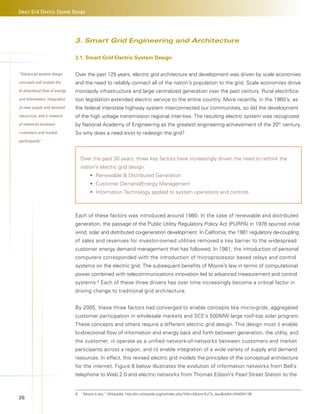
SCE’s rigorous technology evaluation process has been proven at its Electric Vehicle Technical
Center (EVTC) with the testing of various electric vehicle energy storage systems, in the Edison
SmartConnect™ program with both advanced metering infrastructure and peripheral HAN devices, and
with advanced distribution grid technolo-
gies, notably at the Avanti “Circuit of the
Future” test bed. Each of these examples
utilized both laboratory testing and
production-based field tests.


                                                                                                                                 2
Smart Grid Electric System Design


                                3. Smart Grid Engineering and Architecture

                                3.1.	Smart	Grid	Electric	System	Design


“Advanced system design         Over the past 125 years, electric grid architecture and development was driven by scale economies
concepts will enable the        and the need to reliably connect all of the nation’s population to the grid. Scale economies drove
bi-directional flow of energy   monopoly infrastructure and large centralized generation over the past century. Rural electrifica-
and information, integration    tion legislation extended electric service to the entire country. More recently, in the 1960’s, as
of new supply and demand        the federal interstate highway system interconnected our communities, so did the development
resources, and a network        of the high voltage transmission regional inter-ties. The resulting electric system was recognized
of networks between             by National Academy of Engineering as the greatest engineering achievement of the 20th century.
customers and market            So why does a need exist to redesign the grid?
participants.”


                                  Over the past 30 years, three key factors have increasingly driven the need to rethink the
                                  nation’s electric grid design:
                                        • Renewable  Distributed Generation
                                        • Customer Demand/Energy Management
                                        • Information Technology applied to system operations and controls


                                Each of these factors was introduced around 1980. In the case of renewable and distributed
                                generation, the passage of the Public Utility Regulatory Policy Act (PURPA) in 1978 spurred initial
                                wind, solar and distributed co-generation development. In California, the 1981 regulatory de-coupling
                                of sales and revenues for investor-owned utilities removed a key barrier to the widespread
                                customer energy demand management that has followed. In 1981, the introduction of personal
                                computers corresponded with the introduction of microprocessor based relays and control
                                systems on the electric grid. The subsequent benefits of Moore’s law in terms of computational
                                power combined with telecommunications innovation led to advanced measurement and control
                                systems.6 Each of these three drivers has over time increasingly become a critical factor in
                                driving change to traditional grid architecture.


                                By 2005, these three factors had converged to enable concepts like micro-grids, aggregated
                                customer participation in wholesale markets and SCE’s 500MW large roof-top solar program.
                                These concepts and others require a different electric grid design. This design must i) enable
                                bi-directional flow of information and energy back and forth between generation, the utility, and
                                the customer, ii) operate as a unified network-of-networks between customers and market
                                participants across a region, and iii) enable integration of a wide variety of supply and demand
                                resources. In effect, this revised electric grid models the principles of the conceptual architecture
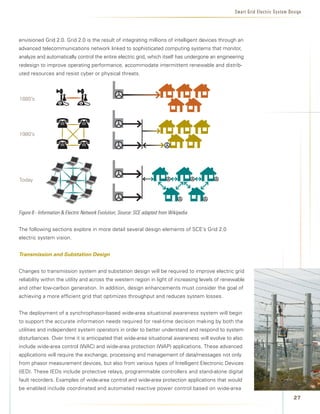
                                for the internet. Figure 6 below illustrates the evolution of information networks from Bell’s
                                telephone to Web 2.0 and electric networks from Thomas Edison’s Pearl Street Station to the


                                6	 	“Moore’s	law,”	Wikipedia,	http://en.wikipedia.org/w/index.php?title=Moore%27s_lawoldid=30538
26
Smart Grid Electric System Design


envisioned Grid 2.0. Grid 2.0 is the result of integrating millions of intelligent devices through an
advanced telecommunications network linked to sophisticated computing systems that monitor,
analyze and automatically control the entire electric grid, which itself has undergone an engineering
redesign to improve operating performance, accommodate intermittent renewable and distrib-
uted resources and resist cyber or physical threats.


1880’s


1980’s


Today


Figure 6 - Information  Electric Network Evolution, Source: SCE adapted from Wikipedia


The following sections explore in more detail several design elements of SCE’s Grid 2.0
electric system vision.


Transmission and Substation Design


Changes to transmission system and substation design will be required to improve electric grid
reliability within the utility and across the western region in light of increasing levels of renewable
and other low-carbon generation. In addition, design enhancements must consider the goal of
achieving a more efficient grid that optimizes throughput and reduces system losses.


The deployment of a synchrophasor-based wide-area situational awareness system will begin
to support the accurate information needs required for real-time decision making by both the
utilities and independent system operators in order to better understand and respond to system
disturbances. Over time it is anticipated that wide-area situational awareness will evolve to also
include wide-area control (WAC) and wide-area protection (WAP) applications. These advanced
applications will require the exchange, processing and management of data/messages not only
from phasor measurement devices, but also from various types of Intelligent Electronic Devices
(IED). These IEDs include protective relays, programmable controllers and stand-alone digital
fault recorders. Examples of wide-area control and wide-area protection applications that would
be enabled include coordinated and automated reactive power control based on wide-area
                                                                                                                               2
Smart Grid Electric System Design


                            measurements, adaptive system islanding and resynchronization, and advanced protection
                            mechanisms such as centralized remedial action scheme (C-RAS) systems.


                            In addition to wide-area monitoring and control technology, advanced materials will also begin
                            to be utilized in transmission and substation design. New equipment incorporating advanced
                            materials, such as superconducting fault current limiting transformers, will begin to be deployed
                            to increase system performance, to improve energy savings by reducing power consumption
                            and system losses, and reduce stress on protection systems. Moreover, these deployments will
                            provide improvements in power quality and reliability in an environment that will increasingly
                            be characterized by intermittent energy sources. Today’s conventional (and aging) substation
                            transformers have been cited as the source of up to 40% of total grid energy losses. Fractional
                            improvements in the efficiency of this equipment would lead to significant reductions in the
                            carbon footprint resulting from typical grid operations.


                            Finally, with environmental policies driving increased levels of renewable energy resources
                            interconnected to the grid, transmission systems will be designed to incorporate large amounts
                            of energy storage that can provide dynamic response and energy shifting capabilities to mitigate
                            the intermittency, ramping, and dump power issues associated with renewable generation.
                            Furthermore, because these new renewable energy resources are typically low-inertia generation
                            sources, and because California’s proposed once-through-cooling policies may lead to accelerated
                            decommissioning of higher-inertia coastal generation plants, future transmission designs will
                            likely need to incorporate the interconnection of equipment to provide increased system inertia,
                            such as synchronous condensers.


                            Distribution System Design


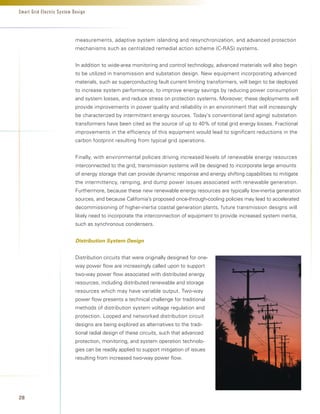
                            Distribution circuits that were originally designed for one-
                            way power flow are increasingly called upon to support
                            two-way power flow associated with distributed energy
                            resources, including distributed renewable and storage
                            resources which may have variable output. Two-way
                            power flow presents a technical challenge for traditional
                            methods of distribution system voltage regulation and
                            protection. Looped and networked distribution circuit
                            designs are being explored as alternatives to the tradi-
                            tional radial design of these circuits, such that advanced
                            protection, monitoring, and system operation technolo-
                            gies can be readily applied to support mitigation of issues
                            resulting from increased two-way power flow.


28
Smart Grid Electric System Design


Distribution automation technologies will evolve and be widely included in distribution system
design to extend intelligent control throughout the entire distribution grid and beyond, inclusive
of distributed energy resources, buildings and homes. Advances in distribution automation will
be driven by:


    • The need to improve reliability, particularly as existing system components age. More
      flexible and intelligent switches and interrupters on distribution circuits will help to
      minimize the extent of outages and speed restoration through Fault Detection, Isolation
      and Restoration (FDIR).
    • Increased penetration levels of distributed energy resources, most notably renewable
      distributed generation and energy storage. These resources can help achieve renewable
      portfolio goals and provide grid support capabilities, but can also destabilize the grid if not
      managed correctly.
    • Increased need for demand response and advanced load control to mitigate peak demand
      issues. Advanced distribution automation can offer a more precise level of control over
      demand side resources, allowing for increased levels of demand response to be achieved
      without significantly impacting the comfort or convenience of customers. Load control will
      be available to respond to various electric system needs, ranging from lack of generation
      resources to local distribution system overloads.
    • The need to limit distribution line losses and to operate circuits more efficiently in a future
      characterized by carbon constraints, increasing energy prices and customer requirements
      for improved power quality. We anticipate that this will be achieved in part through
      Advanced Volt VAR Control (AVVC), which maintains better Conservation Voltage
      Reduction (CVR) at the service point.


Distribution system design will also begin to incorporate advanced materials. One example is
found in the development of intelligent and communicating distribution transformers, which can
provide performance metrics and monitoring information on transformer life. In addition, new
distribution level energy storage technologies, called “community energy storage,” will start to
be designed into distribution circuits. This should buffer distribution-connected renewable
generation, provide localized load leveling and power factor correction, and serve as a source
of backup power for customers. To help control and manage distributed storage and other
distributed energy resources such as photovoltaic installations, communicating smart inverters
will also begin to be incorporated into circuit automation and distribution management schemes
which will extend all the way to behind-the-meter generation and storage resources.


                                                                                                                               2
Smart Grid Electric System Design


                            Advanced Protection


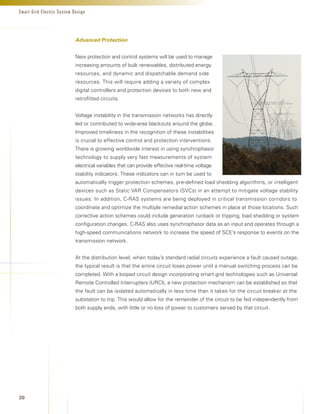
                            New protection and control systems will be used to manage
                            increasing amounts of bulk renewables, distributed energy
                            resources, and dynamic and dispatchable demand side
                            resources. This will require adding a variety of complex
                            digital controllers and protection devices to both new and
                            retrofitted circuits.


                            Voltage instability in the transmission networks has directly
                            led or contributed to wide-area blackouts around the globe.
                            Improved timeliness in the recognition of these instabilities
                            is crucial to effective control and protection interventions.
                            There is growing worldwide interest in using synchrophasor
                            technology to supply very fast measurements of system
                            electrical variables that can provide effective real-time voltage
                            stability indicators. These indicators can in turn be used to
                            automatically trigger protection schemes, pre-defined load shedding algorithms, or intelligent
                            devices such as Static VAR Compensators (SVCs) in an attempt to mitigate voltage stability
                            issues. In addition, C-RAS systems are being deployed in critical transmission corridors to
                            coordinate and optimize the multiple remedial action schemes in place at those locations. Such
                            corrective action schemes could include generation runback or tripping, load shedding or system
                            configuration changes. C-RAS also uses synchrophasor data as an input and operates through a
                            high-speed communications network to increase the speed of SCE’s response to events on the
                            transmission network.


                            At the distribution level, when today’s standard radial circuits experience a fault caused outage,
                            the typical result is that the entire circuit loses power until a manual switching process can be
                            completed. With a looped circuit design incorporating smart grid technologies such as Universal
                            Remote Controlled Interrupters (URCI), a new protection mechanism can be established so that
                            the fault can be isolated automatically in less time than it takes for the circuit breaker at the
                            substation to trip. This would allow for the remainder of the circuit to be fed independently from
                            both supply ends, with little or no loss of power to customers served by that circuit.


30
Smart Grid Infor mation System Architecture


3.2.	Smart	Grid	Information	System	Architecture


In addition to the need for an updated Smart Grid Electric System Design, SCE will also need to                                                                                 “An agile and flexible

develop and adopt a complementary enterprise-wide Smart Grid Information Systems Architecture.                                                                                  information systems

To achieve each of the elements of the SCE smart grid vision, this future architecture will need                                                                                architecture will fulfill data

to be agile and flexible in order to meet increasing data management and analytics demands,                                                                                     management and analytics

support unanticipated needs, and readily enable the integration of new smart grid technologies                                                                                  demands allow integration

that emerge over time.                                                                                                                                                          of emerging smart grid

                                                                                                                                                                                technologies, and provide

Information demands will include not only those from the utility to support operations, but also                                                                                robust cyber-security”

from customers and third parties looking to support their own near real-time decision making
needs. At the same time that it provides flexibility and interoperability with varied and evolving
technologies, the SCE Smart Grid Information Systems Architecture will also need to incorporate
robust cyber-security features in order to meet constantly changing and uncertain security
challenges. The NIST Smart Grid Framework 1.0 in Figure 7 below provides a reference model for
SCE’s Smart Grid Information Systems Architecture. It is comprised of integrated layers incorpo-
rating the various elements in the emerging system of systems including markets, generation,
grid operations, customers, field components, operational and information applications, services,
and multi-level networked telecommunications.


      Markets                                                 Operations                                                                 Service Providers
      Retailer /                  RTO/ISO               Transmission                 Distribution Ops                          Utility                   Third-Party
     Wholesaler                     Ops                     Ops                                                               Provider                    Provider
                                                                                            DMS        Asset
                                                                                                       Mgmt                     CIS                                     CIS
                                  EMS                       EMS                                                                                      Retail
 Aggregator                                                                      Demand
                                                                                Response                                                            Energy
                                                                    WAMS                             MDMS                                           Provider         Billing
                                                                                                                               Billing


     Energy                       Enterprise                Enterprise                    Enterprise                                                    Home / Building
     Market                          Bus                       Bus                           Bus                                                          Manager
  Clearinghouse

                                                                                                                                                           Aggregator
                                         RTO
                                                            Transmission         Metering         Distribution
   ISO/RTO                              SCADA
                                                               SCADA             System            SCADA
   Participant                                                                                                                                              Others
                                                                                                                          Internet /
                     Internet /                                                                                          e-Business
                    e-Business

                                                                                                                                             Electric
         Market                                                                                                                              Vehicle
                                                Wide Area                                                          Energy
        Services                                                                       Field Area
        Interface                               Networks                                                          Services                                    Distributed
                                                                                       Networks                   Interface                                   Generation
                                                                     Data
              Plant Control                                         Collector
                                                                                                                                                                     Electric
                 System                                                                                          Meter                                               Storage
                                          Substation              Substation      Field                                                  Premises
                                            LANs                  Controller     Device                                                  Networks
                  Generators
                                                                                                                 Customer                                      Appliances
    Bulk Generation                        Substation                                                            Equipment
                                            Device                              Distributed
        Domain                                                                  Generation
                                                               Electric
                                                               Storage                                              Customer                                Thermostat
        Network
        Actor                                                                                                         EMS
        Gateway Actor                             Transmission                                                                           Customer
                                                                                   Distribution
       Comms Path
       Comms Path Changes Owner / Domain


Figure 7 - NIST Smart Grid Framework 1.0


                                                                                                                                                                                                          31
Smart Grid Infor mation System Architecture


                            The SCE Smart Grid Information Systems Architecture must also provide for a graceful transition
                            from existing systems to the future state. SCE believes that by integrating legacy systems with new
                            technology in a layered, loosely coupled architecture, the ability to achieve the smart grid vision
                            is enabled while minimizing capital costs for deployed information systems. SCE’s proposed
                            smart grid Secure	Common	Operating	Environment	(SCOE) architecture has been designed to
                            help meet systems integration and cyber-security challenges posed by the SCE smart grid vision.
                            It also leverages the collaborative efforts of the NIST Architecture Team that developed the initial
                            version of the NIST Smart Grid Conceptual Model during Phase I of the NIST effort.


                            The NIST Architecture Team was a group of distinguished IT architects from technology providers,
                            consultants, researchers and utilities that came together in the Summer 2009 to build a conceptual
                            information reference model for the smart grid. The result of this team’s efforts was the NIST
                            Smart Grid Framework 1.0. SCE hosted and actively participated in the NIST Architecture Team
                            under NIST’s Smart Grid Interoperability program. Since the formal creation of the Smart Grid
                            Interoperability Panel (SGIP), the responsibilities of the Architecture Team to maintain and evolve
                            the NIST Smart Grid Conceptual Model have been transferred to the new Smart Grid Architecture
                            Committee (SGAC) – one of two permanent committees within the SGIP. Many of the original
                            members of the original NIST Architecture Team are now members of the SGAC, including two
                            of SCE’s smart grid architects. Their continued participation will ensure that the SCE smart grid
                            architecture remains in step with the architectural models and templates produced by the SGAC.


32
Smart Grid Infor mation System Architecture


Figure 8 below presents a depiction of SCE’s proposed smart grid SCOE architecture.

           Southern California Edison Smart Grid High-Level Systems Architecture


Figure 8 - SCE’s Proposed Smart Grid Architecture


This top level smart grid information systems architecture depicts the automation component
interfaces across the end-to-end solution, and it includes the communication protocols and
standards that will be used to integrate the devices, systems and services across the various
network domains. The architecture will ensure interoperability, utilizing a common service
environment that incorporates the latest industry standards. It will accommodate SCE’s AMI
meters, HAN devices, substation devices, energy storage, distributed renewable generation,
grid control systems, security and network management systems, as well as other new or future
smart grid technologies. The architecture also takes into account the low latency communication
performance requirements for managing and dispatching control commands, and sending and
receiving measurement data critical to establishing wide-area and deep situational awareness
across the electric grid. The resulting telecommunication network-of-networks will utilize a
variety of backbone and field area wireless technologies that will be Internet Protocol (IP) centric.
As such, this approach will allow for compliance and risk and security management, as well as
ensure functional quality, scalability, manageability and system performance.


                                                                                                                                 33
Smart Grid Infor mation System Architecture


                            One major challenge faced by any smart grid architecture is how to interface with customer and
                            third party owned devices and systems. This key interface must not only be highly secure but
                            also balance the interests for customer control of the devices and home area network. SCE has
                            expended significant effort over the past five years considering this engineering challenge in
                            close collaboration with many stakeholders across the world. This effort led to the development
                            of an approach that allows customer control of their home area network, through their gateway
                            or that of a services provider, while establishing a clear demarcation point at the smart meter.
                            This design recognizes the customer’s right to voluntarily connect to the meter to access their
                            real-time energy usage information. The architecture does not require connection to the meter for
                            any other information exchange which can be provided through the internet or other non-utility
                            means of communications. SCE has adopted the home area network architecture developed by
                            OpenHAN to address the issues above and has served to guide development of Smart Energy
                            Profile 2.0, OpenADE and ZigBee IP 2.0.


                            Another architectural challenge is addressing cyber-security. Secure communications between
                            smart grid devices and the utility is a basic requirement of the SCE Smart Grid Information
                            Systems Architecture. The smart grid necessitates a secure information technology backbone
                            to support U.S. smart grid policy, as described in the 2007 EISA, Title XIII. SCE will be testing
                            and demonstrating components of this SCOE architecture framework with its forthcoming
                            Irvine Smart Grid Demonstration (ISGD) project. Lessons learned from this project will provide
                            the input to further develop commercial technologies and the requisite integration for secure
                            communications with and between smart grid technologies. SCE expects that the resulting
                            architecture will further inform cyber-security and interoperability standards, and ultimately
                            accelerate smart grid deployment efforts.


                            SCE is also actively involved in the permanent SGIP working group on cyber-security. This NIST
                            lead SGIP group, called the Smart Grid Cyber Security Working Group (SGCSWG), is collaborating
                            closely with EPRI, DOE, utilities, and other industry players through the ASAP-SG project that
                            SCE is funding to accelerate the effort. SCE’s SCOE architecture is designed to fully support the
                            requirements and architectural elements coming out of the SGIP SGCSWG and evolve with them
                            as they are adjusted and extended over time.


34
Smart Grid Development Roadmap


4. Smart Grid Development Roadmap

Previous chapters defined SCE’s vision for the smart grid, the components of a strategic approach
and methodology for achieving that vision, and the architectural and design elements needed to
support it. This chapter presents SCE’s high-level development roadmap for the smart grid. This
roadmap identifies the types of technologies that SCE plans to pursue over the course of the
next two decades in order to make the SCE smart grid vision a reality.


                                                                                              STAGE 4:
                                                         INTELLIGENT
                                                                                              Intuitive	
                                                                                              Transactive	Grid
                                                                                              (2020	-	2030)

                                                                          STAGE 3:
                   INTERCONNECTED                                         Interactive
                                                                          (2013	-	2019)
RICHNESS


                                             STAGE 2:

           INSTRUMENTED                      Inform	
                                             Automate
                                             (2009	-	2012)


               STAGE 1:
               Foundation
               (1995	-	2008)

                                                           REACH


Figure 9 - Smart Grid Development Roadmap - Stages of Evolution to 2030 7


The smart grid will evolve in complexity and scale over time as the richness of systems
functionality increases and the reach extends to greater numbers of intelligent devices. The
fundamental elements of evolution as defined by IBM are Instrumented, Interconnected, and
Intelligent. Instrumented involves the deployment of measurement capabilities across the grid
from phasor measurement units to smart meters. Interconnected involves both the linkage of
devices through pervasive telecommunications networks and also the integration of operational
applications, such as the integration of distribution management systems with advanced load
control. Intelligent involves the synthesis of the information, controls and integrated systems in
combination with analytics and artificial intelligence to create an intelligent, self-optimizing and
resilient energy platform that enables broad market participation and highly reliable quality of
service. This evolution will not follow a strictly linear path, but will instead consist of four
overlapping steps, as depicted in Figure 9 above, which will transition from one phase to the
next as innovations in smart grid technologies emerge and become commercially available.


7	 	Adapted	from	IBM	presentation	at	CPUC	Smart	Grid	Workshop	on	March	8,	200	
                                                                                                                           3
Smart Grid Development Roadmap


                          Within each development roadmap stage, there are two portfolios of activities to be managed simulta-
                          neously. The smart grid deployment project portfolio includes smart grid technologies that are
                          commercially ready for deployment. The technology evaluation portfolio includes initiatives to identify,
                          evaluate and test emerging technologies which may be deployed during a later stage. Figure 10 below
                          illustrates the distinction between these two portfolios in terms of technology maturity over time.

                                                                                              Late	Majority                                          Laggards
                          TE C HnO lO Gy	 MAT uR I Ty


                                                                                                                     Smart Grid
                                                                                                                     Deployment
                                                                            Early	Majority
                                                                                                                     Project Portfolio


                                                                          Chasm
                                                                                                                Technology
                                                                  Leading	Edge                                  Evaluation
                                                                                                                Project Portfolio
                                                                                      EFFORT	 /	T IME


                                                                                                        Technology Monitoring
                                                        Bleeding	Edge
                          Figure 10 - Smart Grid Project Portfolios as a Function of Maturity


                          Technology evaluation portfolio projects are those which fall into the ‘Bleeding Edge’ or ‘Leading
                          Edge’ areas of the maturity curve. These projects require further evaluation of emerging technolo-
                          gies to better understand the capabilities such technologies would contribute to the smart grid vision,
                          their progress towards technical maturity, and the corresponding value that they might unlock. SCE
                          will pursue projects in the technology evaluation portfolio by working closely with partners at research
                          universities, research institutes and national labs, and by monitoring technology evaluation efforts at
                          other utilities. SCE has had a long history of early collaboration that has led to successful adoption or
                          adaption of grid technologies, including distribution automation and the previously mentioned smart
                          metering and synchrophasors. Most of SCE’s advanced technology labs8 are currently ISO-certified
                          and all of our labs will be certified within the next stage of the smart grid development roadmap.


                          Smart grid deployment portfolio projects, on the other hand, involve the planning and execution of
                          deployment plans for commercially available smart grid technologies. Although these technologies
                          have “crossed the chasm” of the maturity curve, given the urgency of California and national policy
                          goals they increasingly fall within the “Early Majority” or later areas of curve (Figure 10). Historically,
                          SCE and most utilities have preferred to adopt technology later in its maturity lifecycle, allowing for
                          greater confidence in the implementation and operation. Earlier adoption and adaption introduces
                          significant project risks that SCE believes can be substantially mitigated through an effective tech-
                          nology evaluation process as described previously in Section 2. SCE employs best practices
                          from the Project Management Institute and the Software Engineering Institute for execution and
                          deployment of technology projects.


                          8	 	SCE	has	extensive	technology	test	facilities	that	are	used	to	evaluate	supplier	products.	See	the	appendix	for	a	reference	to	a		
                             document	which	summarizes	SCE’s	laboratory	capabilities.
36
Stage 1: Foundation (1995-2008)


The sections which follow provide descriptions of each of the smart grid development roadmap
stages depicted in Figure 9, along with high level plans for the types of potential deployment and
technology evaluation projects to be included within each stage.


4.1.	Stage	1:	Foundation	(1995-2008)


Stage 1 of the smart grid development roadmap refers to foundational work in the deployment of
advanced measurement and control systems that was completed from the mid 1990s through 2008.
SCE’s smart grid accomplishments over this period included early experience with wide-area
measurement and control technologies, pioneering efforts in Synchronized Phasor Measurement
Systems, industry leadership in substation and distribution system automation and the rollout of
smart metering to large commercial and industrial (CI) customers. SCE also launched Energy
Manager, an online portal for large CI customers to access their smart meter data. SCE’s early
smart grid deployments were based on addressing the highest value opportunities first, across
transmission, distribution and customer engagement. Table 2 below provides some additional
highlights of SCE’s Stage 1 smart grid accomplishments. SCE has received a number of awards
for its early smart grid efforts. These awards include the 2007 TD Automation Project of the
Year for SCE’s Synchronized Phasor Measurement System, the 2006 Utility Planning Network’s
North American Smart Metering Project of the Year, and the 2003 Peak Load Management
Alliance Outstanding Research Award for Electricity Pricing Research Projects.


                  SCE Smart Grid Development Statistics
                   SCE Smart Grid Development Statistics
                   SCE Smart Grid Development Statistics
                             Grid Development Statistics
   Total synchrophasors on bulk transmission system
   Total synchrophasors on bulk transmission system
          synchrophasors on bulk transmission system
                                   transmission system                  27 27
                                                                           27
                                                                            27
   Advanced EMS System
   Advanced EMS System
             EMS System                                                 4     4
                                                                              44
   Total substations automated (% ofof 900 substations)
                                 (% 900 substations)
   Total substations automated (% of 900 substations)                  56%56%
                                                                          56%
   Total substations automated (% of 900 substations)                         56%
   Total substation transformers with DGA                              0%
   Total substation transformers with DGA
         substation transformers with DGA
                                 with DGA                                    0%
                                                                             0%
                                                                              0%
   Total substations with low latency, high bandwidth telecoms         33%
   Total substations with low latency, high bandwidth telecoms
         substations with low latency, high bandwidth telecoms
                               latency, high bandwidth telecoms             33%
                                                                            33%
                                                                             33%
   Distribution management and load control systems                     4
   Distribution management and load control systems
                management and load control systems
                           and load control systems                           4
                                                                              44
   Total circuits with outage mitigation (% of 4,400 circuits)         41%
   Total circuits with outage mitigation (% of 4,400 circuits)
   Total circuits with outage mitigation (% of 4,400 circuits)
                              mitigation (% of 4,400 circuits)              41%
                                                                            41%
                                                                             41%
   Total circuits with field automation (% of 4,400 circuits)          41%
   Total circuits with field automation (% of 4,400 circuits)
   Total circuits with field automation (% of 4,400 circuits)
                             automation (% of 4,400 circuits)               41%
                                                                            41%
                                                                             41%
   Total microprocessor relays                                         31%
   Total microprocessor relays
   Total microprocessor relays                                              31%
                                                                            31%
                                                                             31%
   Total fiber optic cable miles                                      3,100
   Total fiber optic cable miles
   Total fiber optic cable miles                                            3,100
                                                                            3,100
                                                                             3,100
   Total renewable resource capacity integrated
   Total renewable resource capacity integrated
   Total renewable resource capacity integrated
      Transmission             capacity integrated                  2,784 MW
      Transmission
      Distribution
      Transmission                                                   2.42,784 MW
                                                                        2,784 MW
                                                                         MW MW
                                                                         2,784
      Distribution
      Distribution
   Total Demand Response Capacity                                   1,5482.4 MW
                                                                         MWMW
                                                                         2.4 MW
                                                                          2.4
   SmartDemand Response Capacity
   Total Demand Response Capacity
   Total Metering        Capacity                                       1,548 MW
                                                                        1,548 MW
                                                                         1,548 MW
   Smart Metering
     Large CI
   Smart Metering                                                     100%
     Residential and Sm CI
     Large CI
     Large CI                                                         0%100%
                                                                         100%
     Large CI                                                               100%
     Residential and Sm CI
     Residential and Sm CI
     Residential and Sm CI                                                  0%
                                                                              0%
                                                                              0%


Table 2 - Smart Grid Development Roadmap Stage 1 Statistics


                                                                                                                         3
Stage 2: Infor m  Automate (2009-2012)


                           4.2.	Stage	2:	Inform		Automate	(2009-2012)


                           Stage 2 Smart Grid Deployment Plan


                           Building upon a set of initial smart grid technologies deployed during Stage 1, SCE is currently
                           executing a $1.5 billion capital deployment plan for advanced information, measurement and
                           automation systems through 2012. SCE’s largest investment is in deploying smart meters to all
                           5 million SCE customers with the completion of the Edison SmartConnect™ program. As part of
                           this program SCE will be launching a smart communicating thermostat program along with an
                           online customer portal for customers to access their smart meter usage information. A rebate
                           program is also included to buy down the cost of home area network devices that customers can
                           use to access real time information from their Edison SmartConnect™ meter.


                           This period will also include the deployment of phasor measurement units across all of SCE’s
                           500kV and 230kV substations, in conjunction with a western region deployment of synchro-
                           phasors coordinated by the Western Electric Coordinating Council (WECC). SCE is also making
                           significant improvements in its grid operations and control systems to support increasing amounts
                           of renewable resources and distributed energy resource integration. Our efforts include a focus
                           on expanding our protection and control systems involving C-RAS and wide-area controls. SCE
                           is also planning capital upgrades to accommodate the mass-market introduction of PEV in our
                           service area. Each of these investments includes state-of-the-art cyber-security capabilities and
                           technologies that are NIST open standards based. Figure 11 depicts SCE’s smart grid deployment
                           projects that are currently authorized for Stage 2 of its smart grid roadmap.


                                                                            2009   2010           2011         2012
                                                          PEV	Integration
                                          Renewable	Integration	Tech	Dev.
                                           Enhanced	Outage	Management
                                      Expanded	Distribution	Automation
                                  Centralized	Remedial	Action	Schemes
                                      Phasor	Measurement	Deployment
                                 Substation	Security	Video	Surveillance
                                  Energy	Management	System	Upgrade
                                  Distribution	Automation		DER	System
                                      Edison	SmartConnect™	Metering


                           Figure 11 - Stage 2 Smart Grid Deployment Timeline


38
Stage 2: Infor m  Automate (2009-2012)


Stage 2 Smart Grid Technology Evaluation Plan


Technology evaluation efforts during Stage 2 will be primarily focused on:
    • Evaluation of energy storage
    • Integration of renewable and distributed energy resources
    • Development and interoperability testing of home area network devices and vehicle
      charging equipment
    • Ongoing development of interoperability and cyber-security standards
    • Electric system studies and engineering analysis regarding operational impacts from
      dynamic resources, bi-directional distribution flows and new operating paradigms
    • Workforce safety and productivity technologies


A priority in terms of technology evaluation projects during Stage 2 will be execution of Department
of Energy (DOE) American Recovery  Reinvestment Act (ARRA) stimulus projects. In 2009, the
DOE awarded SCE several grants to support its various smart grid efforts. These projects include:


Irvine	Smart	Grid	Demonstration- Demonstrate an integrated, scalable smart grid system that
includes all of the interlocking pieces of an end-to-end smart grid system, from the transmission
and distribution systems to consumer applications like smart appliances and electric vehicles.
The demonstration will include a number of homes retrofitted to be zero net energy compliant
with solar PV, energy smart appliances, home energy storage and energy efficiency upgrades.
This demonstration also includes a Waukesha superconducting substation transformer and
focuses on the interoperability and interactions between the various field technologies and
information and communications systems. This project will also explore dynamic links between
distributed resources and wholesale markets and bulk power system operations with CAISO.


Tehachapi	Wind	Energy	Storage- Deploy and evaluate an 8 MW utility-scale lithium-ion battery
technology to improve grid performance and aid in the integration of wind generation into the
electric supply. This project is being done in partnership with CAISO. The project will evaluate a
wider range of applications for lithium-ion batteries that may spur broader demand for the technology,
bringing production to a scale that will make this form of large energy storage more affordable.


Other DOE ARRA and non-ARRA projects in which SCE is a sub-recipient or participant include:
EPRI PHEV Bucket Truck, WECC Wide-Area Disturbance Monitoring, High Penetration Solar
Deployment, American Superconductor Fault Current Limiter Project, and Application of
Advanced Wide-Area Early Warning Systems with Adaptive Protection. SCE has also received
several CEC research grants and has pending applications for additional funds from CEC and CPUC
to support the ARRA projects, other research areas and to study the integration of distributed
energy resources resulting from the California Solar Initiative.


                                                                                                                              3
Stage 2: Infor m  Automate (2009-2012)


                           Another technology evaluation portfolio priority during Stage 2 will be SCE’s continued
                           engagement in the near term priority standards development efforts found in Table 3 below.


                                  Theme                                Near Term Priority Standards
                                                        Automated Data Exchange (ADE) Standards development and pilot for
                                                        delivery of data to customer-authorized third parties
                                                        PEV Communications Standards Identification and Development
                             Customer	Empowerment
                                                        PEV Charging Infrastructure Standards Development
                                                        Interoperability Standards for various in-home smart grid devices such as
                                                        smart appliances, home energy management systems, displays etc.
                             Workforce	Safety		
                                                        Next Generation Worker Safety Standards
                             Effectiveness
                             Renewable		               Renewable  Distributed Energy Resource Integration Standards
                             Distributed	Energy	
                                                        Energy Storage Standards Development
                             Resource	Integration
                             Grid	Efficiency		         Grid Control Standards (Distribution/Substation Automation, Phasor
                             Resiliency                 Measurement, etc.)
                             Information	and	           Field Area Communications Standards Analysis and Development
                             Telecommunications	        Home Area Network Communication Standards
                             Technology			             Cyber-security Standards
                             Cyber-security             Interoperability and Data Management Standards


                           Table 3 - Stage 2 Near Term Priority Standards Development


                           Finally, there are a limited number of near-term analytical studies, as well as lab-based and field-based
                           technology evaluation projects, that support stimulus projects and/or technologies that might be considered
                           for the longer term deployment portfolio for 2013-2020. Highlights of such study and evaluation
                           projects for Stage 2, listed by smart grid definition domain, are included in Table 4 on next page.


                           For additional information, please review the sited documents in the appendix for more details
                           regarding Stage 2 deployment and technology evaluation projects. At the completion of Stage
                           2, SCE expects to have a robust measurement, control and automation infrastructure in place.
                           These achievements will set the stage for further investments to support California’s policy
                           objectives and SCE’s business objectives to meet 2020 targets.


40
Stage 2: Infor m  Automate (2009-2012)


       Theme                                       Project Title                          Partners

                            3rd Party Product Compatibility Testing – In-Home        PGE, SDGE,
                            Displays, Demand Response Technologies                   CAISO

  Customer	                 Energy smart appliance and device testing                GE, UC Irvine
  Empowerment               PEV Integration Technology Development and Testing       Itron, Ford, GM
                            Vehicle to Grid Engineering Assessment                   Calstart
                            Medium and Heavy Duty Vehicle Development                Ford, Eaton, Altec
                            Field Worker Safety Equipment Development                TBD
                                                                                     Cal Poly Pomona,
  Workforce	Safety		       Smart Grid Knowledge Management Development
                                                                                     CSULA
  Effectiveness
                            Systems Operations Visualization                         IDEO
                            Robotics Demonstration                                   TBD
                            Advanced Wide-Area Monitoring and Control System
                                                                                     DOE
                            Applications
                            Avanti “Circuit of the Future” Test Bed extension        DOE
                            System Inertia Loss Mitigation Studies                   PSERC
                            Air Conditioner Stalling Project                         TBD
  Grid	Efficiency		        Smart Inverter Evaluation and Demonstration              Various
  Resiliency                Electro-magnetic pulse (EMP)/ Geomagnetic disturbances
                                                                                     DOE, NERC
                            (GMD) Hardening
                            138kV Transmission High Temperature Superconducting      American
                            FCL demonstration                                        Superconductor

                            Superconducting Distribution Sub-Transformer             Waukesha
                            Grid Efficiency                                          EPRI, GE
                            Renewable Integration Grid Impact Study                  TBD
                            System Inertia Loss Mitigation Studies                   PSERC
                                                                                     A123, DoE,
  Renewable		              Tehachapi Wind Energy Storage Demonstration              CAISO, CEC,
                                                                                     Cal Poly Pomona
  Distributed	Energy	
                            Wind Power Storage Assessment                            CEC, UWIG
  Resource	Integration
                            Home Battery Pilot Program                               TBD
                            Community Energy Storage Program                         Tesla, GE, Others
                            Compressed Air Energy Storage (CAES)                     EPRI, PGE
                            Complex Systems Architecture                             Caltech
  Information	and	                                                                   USC ISI,
                            Advanced Cyber-security Systems
  Telecommunications	                                                                Carnegie Mellon

  Technology			            Distributed Control Systems Architecture                 Stanford

  Cyber-security            Field Area Network Technology Demonstration              GE
                            Smart Grid Information Systems Architecture              TBD


Table 4 - Stage 2 Technology Evaluation Projects


                                                                                                                                   41
Stage 3: Interactive (2013-2019)


                           4.3.	Stage	3:	Interactive	(2013-2019)


                           Stage 3 Smart Grid Deployment Plan


                           Stage 3 of the SCE smart grid roadmap will focus on those technologies that leverage prior
                           investments and retrofit new technologies to begin the process of building Grid 2.0. The
                           anticipated evolution from Grid 1.0 to Grid 2.0 is depicted in Table 5 below for various different
                           grid characteristics. Among other attributes, Grid 2.0 will result in full automation of the energy
                           delivery system across the entire value chain, focusing on increased levels of interaction
                           between smart grid devices, the utility, and customers. It will consist of both “hard grid” assets
                           that incorporate new physical materials such as advanced energy storage and super-conducting
                           equipment, and “soft grid” assets such as next generation computing and analytics systems
                           which unlock the full value of the smart grid for both the utility and its customers. Several
                           documents, including “Grid 2.0: The Next Generation” which is highlighted as a source for Table 5,
                           suggest a fully decentralized grid. By 2030, SCE expects a highly interactive and hybrid grid
                           that includes large central resources and increasing numbers of decentralized supply and demand
                           resources. This is not unlike the hybrid information networks of today that link large centralized
                           data centers, cloud computing, highly distributed personal computing and smart phones.


                                                     Grid 1.0                                      Grid 2.0
                              Centralized                                      Decentralized
                              One-way                                          Multi-way
                              Limited Feedback                                 Constant Feedback
                              Small Number of Large Investments                Large Number of Small Investments
                              Emphasis on Throughput of Energy                 Emphasis on Investment and Infrastructure
                              Active Producers, Passive Consumers              Producers and Consumers Linked and Active
                              Focus on Supply of Electricity and Gas           Focus on Providing Heat and Power
                              Expertise is Centralized                         Expertise is Distributed
                              Supply Based on Predictions of Demand            Demand and Supply Linked to and Influenced
                              (Predict-and-Provide)                            by Each Other


                           Table 5 - Grid 1.0 evolution to Grid 2.0 9


                           This renewed electric system will enable seamless integration of large renewable and distributed
                           generation resources. It will also support the deployment of energy storage technologies to
                           support state and federal legislation and policy goals such as greenhouse gas reduction, RPS and
                           electric transportation initiatives. Grid 2.0 will also incorporate the next generation of broadband
                           wireless and field area telecommunications technologies needed to support requirements for
                           high speed, low latency information exchange among highly distributed devices. Smart grid
                           systems efforts will include the integration of advanced data analytics and intelligent systems
                           into SCE’s existing grid control systems, resulting in a complex system-of-systems to provide

                           9	 Source	-	Grid	2.0:	The	Next	Generation
42
Stage 3: Interactive (2013-2019)


totally integrated grid control and real time information regarding the state of the grid at any point
between generator and customer. As a result, the opportunity to reliably link customer demand
response and other smaller distributed resources into CAISO wholesale market operations will
emerge and the requisite ability to coordinate operational dispatch between wholesale market
objectives and distribution grid objectives will also be enabled.


SCE’s envisioned smart grid investment roadmap for the 2013 – 2019 period is identified in
Figure 12 in section 4.5 below. Initiation of many of these projects will depend upon successful
technology evaluation efforts over the 2010 – 2017 time period. It should be noted that each of
the deployment efforts we include in the roadmap is subject to future CPUC and/or Federal Energy
Regulatory Commission (FERC) approval and funding, once plans are submitted though general
rate cases or other regulatory proceedings.	SCE is and will be committed to evaluating and
deploying best-fit solutions to meet our customers’ needs and policy goals without sacrificing
system reliability or customer service. The discussion below provides additional information about
some of the key technology areas to be included in the Stage 3 smart grid deployment plan.


Integration of Customer Devices	will continue to be explored through additional and more
sophisticated demonstrations that link customer distributed supply and demand resources into
wholesale market and utility grid operations. A key technical hurdle to be addressed involves the
conceptual design of a robust multi-agent system that can manage the potential for a trillion
transaction market to be dynamically linked to grid operations. An intermediate step is to
demonstrate the linkage of customer devices to the advanced distribution system described below.


Advanced Distribution and Substation Automation will upgrade SCE’s current version 1.0
distribution automation systems to an advanced 2.0 system that leverages the capabilities
evaluated through the Irvine Smart Grid Demonstration projects and the Avanti Circuit of the
Future. Examples of advanced distribution automation technologies include fault interrupters,
advanced voltage/var control (AVVC), and high-speed communications technologies providing
communications all the way to the customer meter and “beyond the meter” devices. The 2.0
system also includes the anticipated increase in the number and variety of distributed generation
and demand side resources that may be linked both to wholesale market operations and SCE’s
grid operations. Advanced substation automation technologies will provide automation for greater
fault tolerance and will lead to replacement of switched capacitors with static VAR compensators
for increased efficiency and voltage control.


Advanced distribution and substation automation efforts will be focused on improving SCE’s
abilities to monitor and manage increasing levels of bulk and distributed renewable energy
resources, to enable advanced demand side management functionality, and to operate the grid
more efficiently by limiting system losses.


                                                                                                                              43
Stage 3: Interactive (2013-2019)


                           Wide-Area Control and Advanced Synchrophasor Applications	will support grid operations
                           by offering increased intelligence and control over the transmission network. Advanced Wide-
                           Area Control deployments will include digital fault recorder (DFR) installation, transmission/
                           substation capacitor upgrades to support advanced volt/var control at the transmission level, and
                           further deployments of FACTS devices which can be operated or adjusted in response to near
                           real-time analysis of syncrophasor data. This effort would also include integration of advanced
                           centralized back-office and distributed software to support management of sensory and control
                           devices required for wide-area control.


                           4G Wireless Telecommunications Network will be deployed in order to meet the future
                           communications needs of both utility grid operations and customers requiring near-real time
                           availability of their energy information. A 4G telecomm network will enable monitoring and
                           control of increasing levels of distributed energy resources and allow for the coming shift from
                           centralized to distributed peer-to-peer control of network devices. The network will allow SCE
                           to manage communications with proliferating smart grid sensors and devices (including those
                                                       located behind the customer meter), enable advanced mobile work-
                                                       force automation, provide next generation backhaul for the smart
                                                       metering system and support high volume, low latency requirements
                                                       for near-real time system state measurement and control.


                                                       Advanced Analytics will enable smarter, faster decisions by utility
                                                       personnel, automated utility information systems, and customers.
                                                       Analytics systems will provide analytical tools which leverage
                                                       integrated databases containing smart grid data collected from Edison
                                                       SmartConnect™ meters, customer devices, distribution and substation
                           automation infrastructure, phasor measurement unit (PMU) devices, and smart inverters associ-
                           ated with distributed energy resources, among other data sources. Visualization and intelligent
                           alarming tools will use the results of these data analytics tools to provide useful and actionable
                           information to system operators responsible for real-time decision making. Engineers and
                           system planners will be able to make improved design decisions based on intelligence derived
                           from system loading and asset performance metrics, resulting in improved grid optimization.
                           Customer service representatives will have access to analytical tools to help them guide
                           customers towards optimal rate, product, and service selection choices. These are only a few
                           of the many potential future examples of smart grid data-driven decision making made possible
                           by advanced analytics systems.


                           Energy Storage Deployment involves widespread development and deployment of energy
                           storage technologies throughout SCE’s smart grid system. Energy storage has the potential to
                           support the electric system with various applications such as reliability, power quality, and generation
                           resource or energy functions, as well as provide customer-side energy management. For example,
                           California’s current and proposed energy policies relating to intermittent renewable resource
                           integration are pushing the need for energy storage as an asset that can be used to mitigate

44
Stage 3: Interactive (2013-2019)


renewable energy intermittency and enable energy shifting to harmonize differing periods of peak
demand and peak renewable supply. The next few years will be critical to identify and test the
feasibility of these applications and to determine how best to integrate them with the smart grid.


Inertia Loss Mitigation Technology will support power system stability in light of potential
system inertia losses associated with a reduction of local generation sources. California’s
proposed once-through-cooling regulation has the potential to negatively impact Southern
California’s ability to retain existing in-basin generation. Loss of this generation will likely cause
a significant loss of system inertia, which is critical for stability. Although studies are needed to
better understand this issue, SCE expects the projected loss of inertia will require mitigation by
repurposing the existing generation to provide a synchronous condenser function. Where that is
not possible, deployment locations for new synchronous condensers will be identified.


Stage 3 Technology Evaluation Plan


Stage 3 technology evaluation initiatives will include technologies that were in the earliest stages
of development during Stage 2. In addition this stage will consider studies which will pursue
unanswered questions and next steps resulting from the ARRA stimulus projects including the
Irvine Smart Grid Demonstration Project, the Tehachapi Wind Energy Storage Project, and others.
Technology evaluation efforts in Stage 3 will likely focus on the following areas, among others:


        Theme                                               Project Title
                               Development of grid asset lifecycle management systems
  Grid	Efficiency		
                               Development of transmission and distribution system power flow and
  Resiliency
                               voltage control systems to reduce system losses
                               Development of 2G and 3G energy storage technologies (electrochemical
  Renewable		Distributed	
                               and non-electrochemical)
  Energy	Resource	
                               Advanced monitoring  control of intelligent inverters associated with
  Integration
                               distributed energy resources
                               Exploration of advanced measurement and charging control for electric vehicles
  Customer	Empowerment         Development of a unified communications schema with and between
                               networks of evolving and increasingly interactive customer technologies
  Information	and	             Development of advanced analytic and visualization tools to support
  Telecommunications	          interpretation of increasing volumes of data
  Technology			               Assessment and development of unified cyber-security systems across
  Cyber-security               multiple computing and telecommunications platforms
  Workforce	Safety		          Evaluation and development of knowledge management expert systems to
  Effectiveness                support the anticipated large turnover in utility workforce due to retirements


Table 6 - Stage 3 Technology Evaluation Projects


                                                                                                                                        4
Stage 4: Intuitive  Transactive Grid (2020-2030)


                            4.4.	Stage	4:	Intuitive		Transactive	Grid	(2020-2030)


                            The 2020 decade will see continued deployment of Grid 2.0 capabilities across SCE’s system
                            as well as the introduction of highly distributed intelligent controls that will increasingly involve
                            machine-to-machine transactions. Stage 4 of the smart grid development roadmap assumes
                            full convergence of information and energy systems, as well as continued breakthroughs in
                            computing architectures, cyber-security, internet technologies, autonomous multi-agent control
                            systems, artificial intelligence applied to electric system operations, wireless telecommunications,
                            energy storage, power electronics, energy smart consumer devices, consumer information
                            technology and sensing technologies. Results should include wider deployments of distributed
                            computing technologies for faster system response times, the integration of many more sensory
                            and control nodes at the distribution and customer levels, and the ability to manage and precisely
                            react to supply and demand imbalances at the micro level or, through aggregation, at any level
                            or nodal point across the TD grid.


                            We currently anticipate that several significant milestones will be achieved during the decade of
                            2020 to 2030. SCE anticipates that renewable resources will reach 33% of power delivered on
                            its system. Plug-in electric vehicles in SCE’s service area should exceed one million before 2025.
                            The decade will see the mass introduction of zero net energy residential and commercial buildings
                            in California that may incorporate onsite renewable supply, energy storage, high efficiency
                            envelopes, energy smart appliances/devices and autonomous control systems interfaced to grid
                            and wholesale market operations. This will result in an integrated network with the potential of
                            20 million agents (people  devices) on SCE’s system. Also, vehicle-to-grid, microgrids and
                            dynamic scheduling across the western region using distributed resources will become operation-
                            ally and economically feasible options. As such, Grid 2.1 would need to provide a ubiquitous,
                            highly reliable and secure network that seamlessly integrates a wide variety of demand and
                            supply resources to enable broad market participation by consumers, suppliers and autonomous
                            devices involving trillions of micro-transactions per year.


46
Stage 4: Intuitive  Transactive Grid (2020-2030)


Table 7 below highlights several of the technology innovation activities that will be pursued over
the next five years to help spur the development of commercial solutions in the 2020 decade.
These items frequently involve very long development and testing cycles for broad commercial
introduction on a utility system. SCE recognizes the need to begin the technology development
lifecycle and is partnering on each of these areas with universities, research institutes, national
labs and other utilities to facilitate the development process and sharing of knowledge.


       Theme                                                Project Title
                            Electric grid as an increasingly complex network of networks
                                 • Applied research and design to manage the increasing complexity for
                                    transmission, distribution and customer systems and their integration
                                 • Redefining the limits of optimization at acceptable levels of instability risk
  Grid	Efficiency		
                                 • Identifying potential system inertia deficiencies and solutions
  Resiliency
                            Application of high-temperature superconducting materials to grid equipment
                                 • Superconducting transformers  fault current limiters
                                 • Superconducting cable
                                 • Superconducting Magnetic Energy Storage (SMES)
                            Development of 2G  3G energy storage technologies (electrochemical and
  Renewable		
                            non-electrochemical)
  Distributed	Energy	
                            Advanced monitoring  control of intelligent inverters associated with
  Resource	Integration
                            distributed energy resources
                            Evaluation and development of vehicle-to-grid capability
  Customer	                 Converting the electric grid to support a trillion micro-transactions market
  Empowerment               dynamically driving grid operations thru multi-agent based control systems
                            dynamics
  Information	and	
                            Evaluation and development of business applications using artificial intelligence
  Telecommunications	
                            to manage critical business operations
  Technology			
  Cyber-security
  Workforce	Safety		       Continued evaluation of potential adaptive technologies from other industries
  Effectiveness             such as defense and transportation


Table 7 - Stage 4 Technology Evaluation Projects


                                                                                                                                            4
Summary of Technology Roadmap


                         4.5.	Summary	of	Technology	Roadmap


                         The development of the smart grid will be a journey that will likely take 30 years to fully
                         accomplish, with key milestones along the way. A significant near-term milestone is the
                         completion of the deployment of SCE’s smart metering to all of its five million customers by
                         the end of 2012. The next key milestone is enabling the many state and federal climate and
                         energy policy objectives targeted for 2020. These and other policy milestones create signifi-
                         cant timing and time alignment challenges related to the relative maturity of the technologies
                         required to meet these goals, as well as key dependencies and predecessor relationships
                         between unique technology deployments. In an attempt to address these challenges, SCE is
                         simultaneously pursuing capital projects to deploy smart technologies and managing a large
                         portfolio of concurrent technology evaluation activities with development periods spanning
                         5 years, 10 years and 20 years. The net result of these activities is the transformation of the
                         electric grid and utility operations to a grid for the 21st century. The challenge of course is that
                         this transformation is occurring as SCE is replacing most of its existing core grid infrastructure,
                         supporting the development of an economy that is increasingly reliant on cleaner, but intermit-
                         tent, electricity resources and anticipating the retirement of 50% of its workforce by 2020. As
                         such, the pace and cost of the transformation from today’s electric grid to the smart grid are
                         critical questions. These issues must be explicitly considered in the development of smart grid
                         investment policy because reasonable cost and reliability of electric service are essential to
                         our customers. The evolution of this transformation is illustrated in the technology roadmap
                         summarized in Figure 12 on the following pages.


48
Summary of Technology Roadmap


                  Customer	Empowerment
                  n Technology Evaluation                  n Deployment


Customer Energy Smart Solution

  	     2010	           2012	                     2015	                    2018	                2021	                               2030

      Edison	
      SmartConnect™

      Customer	Information	Portal	Development

      Advanced	Load	
      Control	System

      Zero-Net	Energy		
      Homes/Commercial	Buildings

      HAN	Product		Appliance		
      Compatibility	Testing

      Advanced	SmartConnect	Functionality                 Advanced	SmartConnect	Functionality

      Home/Business	Automation		                          Home/Business	
      Systems	Interface                                   Automation

                                                                                                        Micro-Transaction	System	
      Micro-Transaction	System	Development
                                                                                                        Development

      PEV	Metrology		           PEV	Metrology		
      	Comms                   	Comms

      PEV	Charging	             PEV	Charging	
      Infrastructure            Infrastructure

      Advanced	PEV	Grid	Integration		                     Advanced	PEV	Grid	Integration	(DRW	2G)
      (DRW	2G)


Advanced Electric Transportation

  	     2010	           2012	                     2015	                    2018	                2021	                               2030

      SCE	Fleet-NextGen	
      Propulsion	Systems

      SCE	Fleet-PHEV/EV	        SCE	Fleet	-	PHEV/EV	Fleet	Deployment
      Fleet	Deployment

      Port	Electrification


      Rail	Electrification	(Indcluding	California	High	Speed	Rail)


                                                                                                                                                             4
Summary of Technology Roadmap


                                            Workforce	Safety		Effectiveness
                                            n Technology Evaluation                 n Deployment


                            	     2010	          2012	                     2015	                     2018	              2021	                                 2030

                                System	Operations		      System	Operations		
                                Visualization            Visualization

                                Smart	Grid	Workforce	Development                   Smart	Grid	Workforce	Development

                                Advanced	Mobile		                                  Advanced	Mobile		
                                Workforce	Automation                               Workforce	Automation

                                Field	Worker	Safety	Development                    Field	Worker	Safety	Development


                                Field	Robotics	Adaptation                          Field	Robotics	
                                                                                   Adaptation


                                            Renewables		DER	Integration
                                            n Technology Evaluation                 n Deployment


                            	     2010	          2012	                     2015	                     2018	              2021	                                 2030


                                Wind		PV	Dynamic	Modeling

                                                          Solar	PV	
                                Solar	PV	Readiness
                                                          Readiness

                                Smart	Inverter            Smart	Inverter
                                Development		Test        Deployment

                                Large	Scale	Lithium-Ion	Battery		
                                                                                   Large	Scale	Lithium-Ion	Battery	Deployment
                                Demonstration	(TSP)

                                Distributed	Battery	Storage		                      Distributed	Battery	Storage	Deployment	(ISGD)
                                Demonstration	(ISGD)

                                CAES	Evaluation		Feasibility	(EPRI)

                                                                                                                           3rd	Generation	Battery	Storage		
                                3rd	Generation	Battery	Storage	Technology	Development
                                                                                                                           Technology	Deployment


50
Summary of Technology Roadmap


                     Grid	Efficiency		Resiliency
                     n Technology Evaluation               n Deployment


Transmission/Substation

  	     2010	           2012	                    2015	                    2018	                2021	                                2030


      Phasor	Measurement	System


      Advanced	Wide-Area	Control	Systems                 Advanced	Wide-Area	Control	Systems

      Centralized	Remedial	Action	Schemes	
      (C-RAS)

      Substation	Automation	1.0


      Substation	Automation	2.0                          Substation	Automation	2.0


      System	Inertia	Mitigation	(Once-Through	Cooling)                                            System	Inertia	Mitigation	(OTC)

                                                                                                  PMU-Enabled	Dynamic		
      PMU-Enabled	Dynamic	Voltage/VAR	Control
                                                                                                  Voltage/VAR	Control

                                                                                                  Superconducting	Substation	
      Superconducting	Substation	Transformers
                                                                                                  Transformers

      Transformer	Dissolved	Gas	Analysis	(DGA)

      Advanced	Transmission	Technology	                  Advanced	Transmission	Technology
      (FCL,	SVC,	etc.)                                   (FCL,	SVC,	etc.)

      Advanced	Dynamic	Asset	Rating                      Advanced	Dynamic	Asset	Rating


      EMP/Disaster	Mitigation	Development                EMP/Disaster	Mitigation	Development


Distribution

  	     2010	           2012	                    2015	                    2018	                2021	                                2030


      Integrated	Distribution	Management	


      Distribution	Automation	1.0


      Distribution	Automation	2.0                        Distribution	Automation	2.0


      Distributed	Volt/VAR	Control                       Distributed	Volt/VAR	Control


      Micro	Grid		Islanding	Evaluation

      Advanced	Outage		         Advanced	Outage	Information		
      Information               	Management

      Intelligent               Intelligent	Distribution	Transformer
      Distribution


                                                                                                                                                             1
Summary of Technology Roadmap


                                            Information		Communication	Technologies
                                            n Technology Evaluation              n Deployment


                            	     2010	           2012	                 2015	                   2018	               2021	   2030

                                Smart	Grid	
                                                          Smart	Grid	Communications	Architecture
                                Communications

                                Cyber	Security	
                                                          Cyber	Security	Standards	Deployment
                                Standards

                                System	of	Systems	
                                                          System	of	Systems	Integration
                                Integration

                                Backbone	Network	
                                                          High-Speed	Backbone	Network	Development
                                Development

                                Very	Low	Latency	Protection	Comms               Very	Low	Latency	Protection	Comms


                         Figure 12 - Summary Technology Roadmap


                         4.6.	Managing	and	Maintaining	the	SCE	Smart	Grid	Development	Roadmap


                         Because of the staged and staggered deployment approach described above, the SCE smart grid
                         development roadmap must be flexible, particularly in the later years, and able to handle adjustments
                         and changes to the scope and sequencing of deployments. Re-evaluating and reconsidering the
                         smart grid deployment roadmap will be an important periodic activity as detailed business cases
                         are developed for specific smart grid initiatives, as lessons are learned through technology
                         deployment experience, and as policy drivers and business objectives change and evolve. To be
                         able to respond to such adjustments, SCE has created a function within its Advanced Technology
                         organization to manage and update its Smart Grid Strategy and Roadmap on an ongoing basis.
                         This effort will track both smart grid deployment and technology evaluation project portfolios.
                         It will closely monitor changes to state and federal policy, corporate goals, business case
                         developments, and emerging technology innovation, as well as broader macro-economic and
                         energy market developments (i.e. scenario planning ‘signposts’), to identify necessary course
                         corrections to the staged roadmap over time.


52
APPENDICES


5. Appendices

5.1.	SCE	Smart	Grid	Reference	Documents


Relevant SCE Documentation


The Tehachapi Wind Energy Storage Project.
http://www.sce.com/PowerandEnvironment/smartgrid/ 2009.


Irvine Smart Grid Demonstration http://www.sce.com/PowerandEnvironment/smartgrid/ 2009.


A Lifecycle Framework for Self-sustaining Implementation of Smart Grid Interoperability and
Cyber Security Standards http://www.sce.com/PowerandEnvironment/smartgrid/ 2009.


Smart Grid Standards Adoption http://www.sce.com/PowerandEnvironment/smartgrid/ 2009.


Smart Grid Standards Adoption Lifecycle
http://www.sce.com/PowerandEnvironment/ smartgrid/ 2009.


Securing the Smart Grid http://www.sce.com/PowerandEnvironment/smartgrid/ 2008.


Southern California Edison 2009 General Rate Case.
Transmission and Distribution Business Unit: SCE-03, Vol. 2, Pt. 2, Ch. VIII
http://www3.sce.com/law/cpucproceedings.nsf/vwMainPage?OpenviewRestrictToCategory=
2009%20GRC%20Start=1Count=25


Southern California Edison 2009 General Rate Case.
Transmission and Distribution Business Unit: SCE-03, Vol. 2, Pt. 3, Ch. IX
http://www3.sce.com/law/cpucproceedings.nsf/vwMainPage?OpenviewRestrictToCategory=
2009%20GRC%20Start=1Count=25


Southern California Edison 2009 General Rate Case.
Transmission and Distribution Business: SCE-03, Vol. 2, Pt. 4, Ch. XII
http://www3.sce.com/law/cpucproceedings.nsf/vwMainPage?OpenviewRestrictToCategory=
2009%20GRC%20Start=1Count=25


                                                                                                     3
External Smart Grid Reference Documents


                           5.2.	External	Smart	Grid	Reference	Documents


                           Relevant Documents and Publications


                           Litos Strategic Communication. What The Smart Grid Means to You and The People You Serve. 2008.
                           http://www.oe.energy.gov/DocumentsandMedia/Utilities.pdf


                           Science Applications International Corporation (SAIC). Pullins, Steve. Westerman, John. San
                           Diego Smart Grid Study Final Report. October 2006.


                           European Commission. Ruiz, Pablo Fernandez. Finat, Alfonso Gonzalez. “Vision and Strategy for
                           Europe’s Electricity Networks of the Future.” European SmartGrids Technology Platform.
                           http://ec.europa.eu/research/energy/pdf/smartgrids_en.pdf 2006.


                           Valocchi, Michael. Juliano, John. Schurr, Allan. IBM. Lighting the Way: Understanding the smart
                           energy consumer. 2009.


                           Van Nispen, Hugo. Wilhite, Robert. KEMA Inc. Utility of the Future. Directions for enhancing
                           sustainability, reliability and profitability. Volume 1. 2008.


                           Jacobson, Mark Z. Dlucchi, Mark A. “A Path to Sustainable Energy by 2030.” Scientific
                           American. November, 2009.


                           McDonald, John. “Leader or Follower? The Four Essentials of a Safe-and-Sane Smart Grid Plan.
                           SmartGridNews.com. June, 2009.


                           BC Transmission Research and Development Program Office. Transmission Technology
                           Roadmap. September, 2008.


                           Moore, Geoffrey A. Crossing The Chasm. New York: Harper Collins, 1991. Print.


                           World Economic Forum. Accelerating Smart Grid Investments. 2009
                           http://www.weforum.org/en/initiatives/SlimCity/AcceleratingSmartGridInvestments/index.htm


                           United States Department of Energy. Smart Grid System Report. 2009
                           www.oe.energy.gov/DocumentsandMedia/SGSRMain_090707_lowres.pdf


                           NIST Framework and Roadmap for Smart Grid Interoperability Standards Release 1.0: National
                           Institute for Standards  Technology, September 2009


                           GTM Research. Leeds, David J. The Smart Grid in 2010. 2009
                           www.gtmresearch.com/report/smart-grid-in-2010


                           Morgan Stanley. Allen, Nick. Hazlett, Sean. Nerlinger, Matt. Smart Grid: The Next Infrastructure
                           Revolution. New York: Morgan Stanley, 2009
54
Statements of Policy


Green Alliance. Willis, Rebecca Grid 2.0: The Next Generation. London: Green Alliance, 2006.


What is Systems Engineering? 2009. http://www.incose.org/practice/whatissystemseng.aspx


IEC standard 62559, http://webstore.iec.ch/preview/info_iecpas62559%7Bed1.0%7Den.pdf


GridWise Architecture Council (GWAC) Interoperability Constitution Whitepaper
http://www.gridwiseac.org/pdfs/constitution_whitepaper_v1_1.pdf


GridWise Architecture Council (GWAC) Interoperability Path Forward Whitepaper
http://www.gridwiseac.org/pdfs/interoperability_path_whitepaper_v1_0.pdf


GridWise Architecture Council (GWAC) Financial Benefits of Interoperability
http://www.gridwiseac.org/pdfs/financial_interoperability.pdf


GridWise Interoperability Context-Setting Framework
http://www.gridwiseac.org/pdfs/interopframework_v1_1.pdf


”Moore’s law,” Wikipedia,
http://en.wikipedia.org/w/index.php?title=Moore%27s_lawoldid=344054138


Statements of Policy


Energy Independence and Security Act (EISA) 2007
http://frwebgate.access.gpo.gov/cgi-bin/getdoc.cgi?dbname=110_cong_billsdocid=f:h6enr.txt.pdf


California Senate Bill 17
 http://www.leginfo.ca.gov/pub/09-10/bill/sen/sb_0001-0050/sb_17_bill_20091011_chaptered.pdf


CPUC Smart Grid OIR Phase I Final Decision
 http://docs.cpuc.ca.gov/word_pdf/FINAL_DECISION/111856.pdf


California Water Resources Control Board: Draft Policy on the Use of Coastal and Estuarine
Waters for Power Plant Cooling (Once Through Cooling)
http://www.swrcb.ca.gov/water_issues/programs/npdes/docs/cwa316/otcpolicy112309_clean.pdf


FERC Smart Grid Policy Statement
http://www.ferc.gov/whats-new/comm-meet/2009/071609/E-3.pdf


NIST Framework and Roadmap for Smart Grid Interoperability Standards, Release 1.0
http://www.nist.gov/public_affairs/releases/smartgrid_interoperability.pdf
SCE
Smart
 Grid
Vision
For more information on Advanced Technology and the
SCE Smart Grid, please visit www.sce.com/smartgrid,
or contact us at AdvancedTechnology@sce.com	          © Copyright 2010, Southern California Edison, All Rights Reserved

So Cal Edison Smart Grid Strategyand Roadmap

  • 1.
    ADVANCED TECHNOLOGY Transmission & DistributionBusiness Unit Southern California Edison Smart Grid Strategy & Roadmap
  • 2.
    In 2007, SouthernCalifornia Edison developed its first comprehensive Smart Grid Roadmap spanning transmission, distribution and customer facing technologies. Since that time, national and state policy regarding smart grid development has significantly grown including the passage of the landmark Energy Independence and Security Act of 2007 (EISA). In 2009, California passed its version in Senate Bill 17. The purpose of this updated Smart Grid Strategy and Roadmap is to summarize SCE’s activities and plans for development and implementation of a smarter grid as well as explain the organizing principles, decision framework and methods used to manage the adoption and adaptation of new technologies into our operation. While we hope that the document proves useful for all readers, it is intended primarily to convey SCE’s perspectives on the smart grid for policy makers, the electric utility industry, and technology providers which serve our industry. SCE is grateful for the supporting contributions by IBM, Enernex, Cisco, Quanta and EPRI to the development of this document that began with expanding the set of Use Cases to encompass the breadth of the smart grid. We also appreciate the earlier support by Bridge on the development of the 2007 roadmap that was the foundation for this effort. Finally, we appreciate the reviews provided by our Technology Advisory Board, PG&E and SDG&E, and Jesse Berst.
  • 3.
    Table of Contents 1. Introduction . . . . . . . . . . . . . . . . . . . . . . . . . . . . . . . . . . . . . . . . . 4 1.1. Why do we need a smarter grid? . . . . . . . . . . . . . . . . . . . . . . . . . . . . 4 1.2. The SCE Smart Grid Vision . . . . . . . . . . . . . . . . . . . . . . . . . . . . . . . 6 1.3. Smart Grid Value Proposition . . . . . . . . . . . . . . . . . . . . . . . . . . . . . . 7 1.4. Smart Grid Definition . . . . . . . . . . . . . . . . . . . . . . . . . . . . . . . . . 10 1.4.1. Customer Empowerment: Energy Smart Customer Solutions & Advanced Electric Transportation. . . . . 11 1.4.2. Workforce Safety & Effectiveness. . . . . . . . . . . . . . . . . . . . . . . . 13 1.4.3. Renewable & Distributed Energy Resource Integration . . . . . . . . . . . . . 14 1.4.4. Grid Efficiency & Resiliency . . . . . . . . . . . . . . . . . . . . . . . . . . . 15 1.4.5. Information and Connectivity . . . . . . . . . . . . . . . . . . . . . . . . . . 16 2. Smart Grid Development Methodology . . . . . . . . . . . . . . . . . . . . . . . . . 18 2.1. Customer-Focused Systems Engineering . . . . . . . . . . . . . . . . . . . . . . . 18 2.2. Open Innovation . . . . . . . . . . . . . . . . . . . . . . . . . . . . . . . . . . . . 19 2.3. Technology Development Scenario Planning . . . . . . . . . . . . . . . . . . . . . 20 2.4. Proactive Standards Development . . . . . . . . . . . . . . . . . . . . . . . . . . 23 2.5. Rigorous Technology Evaluation . . . . . . . . . . . . . . . . . . . . . . . . . . . . 25 3. Smart Grid Engineering and Architecture . . . . . . . . . . . . . . . . . . . . . . . . 26 3.1. Smart Grid Electric System Design . . . . . . . . . . . . . . . . . . . . . . . . . . 26 3.2. Smart Grid Information System Architecture . . . . . . . . . . . . . . . . . . . . . 31 4. Smart Grid Development Roadmap . . . . . . . . . . . . . . . . . . . . . . . . . . . 35 4.1. Stage 1: Foundation (1995-2008) . . . . . . . . . . . . . . . . . . . . . . . . . . . 37 4.2. Stage 2: Inform & Automate (2009-2012) . . . . . . . . . . . . . . . . . . . . . . . 38 4.3. Stage 3: Interactive (2013-2019). . . . . . . . . . . . . . . . . . . . . . . . . . . . 42 4.4. Stage 4: Intuitive & Transactive Grid (2020-2030) . . . . . . . . . . . . . . . . . . . 46 4.5. Summary of Technology Roadmap . . . . . . . . . . . . . . . . . . . . . . . . . . 48 4.6. Managing and Maintaining the SCE Smart Grid Development Roadmap . . . . . . . 52 5. Appendices . . . . . . . . . . . . . . . . . . . . . . . . . . . . . . . . . . . . . . . . 53 5.1. SCE Smart Grid Reference Documents . . . . . . . . . . . . . . . . . . . . . . . . 53 5.2. External Smart Grid Reference Documents . . . . . . . . . . . . . . . . . . . . . . 54
  • 4.
    Why Do WeNeed a Smarter Grid? 1. Introduction 1.1. Why do we need a smarter grid? The United States has arrived at a critical juncture in its energy future. The stakes for addressing climate change, energy independence and infrastructure security could not be higher. Federal and state policymakers alike have recognized the need for a smarter, more robust electricity infrastruc- ture if we as a country are to rely on greater amounts of renewable generation, use electricity as a fuel for vehicles, enable consumers to become active participants in the energy supply chain, and ensure the continued reliability and vitality of our nation’s energy economy. Southern California Edison (SCE) must meet these challenges while continuing to operate the grid in a safe and reliable manner. SCE has served as a leader in fostering the development of advanced grid technologies and the adoption of technology to create a smarter grid. SCE recognized the need for the development of a smarter grid more than a decade ago. This need was heightened with the wide range of climate and energy policy objectives introduced earlier in the last decade after the 2001 California Energy Crisis. Also, post dot-com venture investment in clean technology has yielded several emergent technologies that have made certain aspects of a smart grid more viable. In 2007, SCE developed a detailed smart grid technology roadmap across five themes described in our Smart Grid Vision in section 1.2. Many elements of this earlier roadmap are valid and continue to be pursued. However, over the past three years a number of additional policy targets have been introduced to create a very aggressive set of goals that have implications for development of a smarter grid. It is important to note that it is not entirely clear that all these policy targets are viable given the technology development and deployment timelines and customer rate impacts. Figure 1 below summarizes the current California policies affecting smart grid development. Environmental GHG: 1990 levels (15% reduction from today) Once Thru Cooling (Proposed) GHG: 80% Below 1990 levels Renewable Energy 3,000 MW of DG-PV (CSI) 500 MW of Rooftop PV 33% of energy with 20% biomass 20% of energy with 20% biomass 44444444444444442013 444444444444444444444444444444 4 442000 44444442010 444 44444444444444444444420504444444 44 44 44 2016 2017 2020 2030 4 Energy Efficiency 10% reduction 32,000 GWh (5,000 MW) 100% of zero net energy forecasted 800 million therms commercial constructions electricity consumption 100% of zero net energy residential constructions 200,000 solar water Additional 4,000 MW CHP heater systems Customer Interface PEV Metering 400k-1M PEVs Energy & Pricing Info Smart Metering 1000 MW Demand Response Figure 1 - California Smart Grid Policy Timeline 4
  • 5.
    Why Do WeNeed a Smarter Grid? The breadth of the change required for modernizing the nation’s electricity grid is highlighted by the policy objectives defined in the federal Energy Independence and Security Act of 2007 (EISA). This law identifies the following specific capabilities that should be enabled by a smart grid: 2007 EISA Smart Grid Policy 1. ncreased use of digital information and controls technology to improve reliability, security and efficiency I of the electric grid. 2. Dynamic optimization of grid operations and resources, with full cyber-security. 3. Deployment and integration of distributed resources and generation, including renewable resources 4. Development and incorporation of demand response, demand-side resources and energy-efficiency resources. 5. eployment of smart (real-time, automated, interactive) technologies that optimize the physical operation of D appliances and consumer devices for metering, communications concerning grid operations and status, and distribution automation. 6. Integration of smart appliances and consumer devices. 7. eployment and integration of advanced electricity storage and peak-shaving technologies including plug-in D electric and hybrid electric vehicles, and thermal storage air conditioning. 8. Consumer access to timely information and control options. 9. evelopment of standards for communication and interoperability of appliances and equipment connected to D the electric grid including the infrastructure serving the grid. 10. dentification and reduction of unreasonable or unnecessary barriers to the adoption of smart grid I technologies, practices and services. Table 1 - 2007 EISA Smart Grid Policy These same objectives were incorporated into a recent California law, Senate Bill (SB) 17, which was “…we’ll also do more to enacted in October, 2009. The law recognizes the need for a smarter grid to support California’s retrofit America for the ambitious energy and environmental policies such as the Renewables Portfolio Standard , green- 1 global economy. That house gas reduction law , energy efficiency standards including requirements for Zero-Net Energy 2 means updating the way Homes, distributed resource goals like the California Solar Initiative, demand response objectives we get our electricity and support for widespread consumer adoption of plug-in electric vehicles (PEV). In this context, by starting to build a SCE believes that many aspects of its smart grid vision would need to be operational by the year new smart grid that will 2020 to enable a number of California’s ambitious policy goals. In recognition of this challenge, save us money, protect SB 17 requires investor owned utilities to prepare a 2020 smart grid development plan and file it our power sources from with the CPUC by July 1, 2011. The parameters of this development plan will be identified in the blackout or attack, and Smart Grid OIR in the summer of 2010. deliver clean, alternative forms of energy to every While many details regarding development of a smart grid need to be resolved, including scope, corner of our nation.” standards, benefits, cost and timing, one thing is clear: We as an industry need to modernize our – President Barack Obama, January 2009 electric grid in order to support an increasing reliance on electricity to fuel the nation’s economy. California’s Renewables Portfolio Standard (RPS) requires that 20% of electricity sales be from renewable sources by 200. In September 2009, Governor Schwarzenegger signed an Executive Order raising the RPS target to 33% by 2020. SCE supports development of cleaner energy resources and currently has the largest RPS portfolio in the nation, however we do not believe that a 33% RPS target is achievable by 2020. 2 California Assembly Bill 32 requires that carbon emissions be reduced to 990 levels by 2020, and to 80% below 990 levels by 2050.
  • 6.
    The SCE SmartGrid Vision 1.2. The SCE Smart Grid Vision “SCE’s vision of a smart SCE’s vision of a smart grid is to develop and deploy a more reliable, secure, economic, efficient, grid is to develop and safe and environmentally-friendly electric system. This vision covers all facets of energy from deploy a more reliable, its production to transmission, distribution, and finally its efficient use in homes, businesses and secure, economic, vehicles. This smart grid will incorporate high-tech digital devices throughout the transmission, efficient, safe and substation and distribution systems and integrate advanced intelligence to provide the informa- environmentally-friendly tion necessary to both optimize electric service and empower customers to make informed electric system.” energy decisions. Consistent with the 2007 EISA and the U.S. Department of Energy’s and National Energy Technology Laboratory’s Vision for the Modern Grid, SCE’s smart grid will enable increased levels of intermittent and renewable resources (such as wind and solar power) and lead to greater use of Plug-in Electric Vehicles (PEV). To achieve these goals and the complete smart grid vision, the SCE smart grid will increase system flexibility; reduce greenhouse gas emissions; avoid the economic losses associated with catastrophic failures and wide-area blackouts; foster energy conservation, energy efficiency and demand response capabilities by providing customers with better energy use information and choices; reduce operating costs and improve reliability and safety by providing real-time information for system monitoring and system automation; improve maintenance and operations practices on the electrical grid; and facilitate the development of a “Clean Tech” economy, which is expected to include the creation of new jobs. We believe a true smart grid can help America achieve meaningful greenhouse gas reductions and a more secure energy future. Figure 2 - SCE Smart Grid Vision Themes 6
  • 7.
    Smart Grid ValueProposition The five key smart grid strategic themes, as depicted in Figure 2 on the previous page, serve as the basis for SCE’s smart grid vision: • mpower Customers to manage energy E electronics and technology to provide use and reduce their carbon footprint system stability. through the use of smart energy devices, • Improve Grid Efficiency Resiliency PEV and distributed energy resources at through innovative real-time power customers’ premises. system measurement, controls, • Improve Workforce Safety and analytics and grid technologies including Productivity through smarter tools, the application of high temperature advanced robotics, remote controlled superconducting materials. devices, protective equipment and • Provide Information and Connectivity workforce mobility applications. through the development of an open • Integrate Renewable and Distributed standards-based, secure, resilient Energy Resources through new and extensible information and engineering designs for resource communications technology (ICT) integration, protection schemes and infrastructure. circuits, storage technologies, power Several aspects of SCE’s smart grid vision must be developed by 2020 in order to comply with ambitious state and federal policy goals related to climate change, clean energy and infrastructure security. However, it is impractical to think that all aspects of this Vision can be developed and implemented within 10 years given the nascent stage of many technologies and the ratepayer costs. As such, deployment of a smarter grid is a journey that will extend well beyond 2020. The remainder of this document describes the customer and societal value of the SCE smart grid, provides further definition around each of the SCE smart grid themes depicted in Figure 2, articulates strategies and methods which will be followed to help ensure success, and provides a roadmap describing the pathway and evolution of the SCE smart grid. 1.3. Smart Grid Value Proposition Key objectives of SCE’s smart grid development strategy include pursuit of technologies that provide significant customer value that exceeds the cost of implementation, as well as identifying best fit solutions to meet policy objectives that may not have direct opera- tional benefits. Smart grid technology projects will likely involve a mix of both incremental and replacement investments that not only expand existing capabilities, but also build new capabilities. Although SCE believes in taking a cost-effective approach to the deployment of smart grid tech- nologies and systems, traditional cost/benefit models may not account for all of the value to be derived from smart grid investment decisions. A substantial portion of smart grid benefits are societal in nature and include achieving national and state priorities such as energy independence,
  • 8.
    Smart Grid ValueProposition reducing greenhouse gas emissions and increasing grid security, safety and reliability. These benefits are often difficult to quantify, may vary widely in their justification of various smart grid technologies, and are multi-faceted in terms of who receives benefits from them. Benefits may not only accrue to SCE customers, but also to California residents or our broader society. In addition, these benefits need to be considered within the context of the portfolio of smart grid technologies to be deployed at different times over the next twenty years and beyond. SCE has identified 10 broad smart grid benefits categories. Accordingly, the smart grid has the potential to: 1. Provide Customer Benefits by improving 6. Increase Utility Worker Safety by grid reliability, enhancing customer providing tools and information that allow communications, and by empowering them to perform their work in a safer customers to better manage their energy manner. usage and costs. 7. Improve Grid Resiliency and Reliability 2. educe Peak Demand through demand R by reducing the frequency and duration of management programs and services. outages and service interruptions, and by 3. Increase Energy Conservation improving power quality, accommodating Efficiency by enabling integration of greater diversity of energy resources, and customer energy management systems increasing grid security. and grid energy management systems; 8. educe Greenhouse Gas Emissions R this integration can reduce system by integrating renewable energy losses. resources with the electric delivery 4. Reduce Operating Expenses by system, and promoting the adoption lowering the cost of planning and support of electric vehicles. functions, operating costs and energy 9. romote Energy Independence P costs. by facilitating electricity-based 5. void, Reduce or Defer Capital A transportation. Investments by increasing capacity 10. romote Economic Growth P utilization, extending the useful lives Productivity by fostering the of grid assets, optimizing energy development of California’s clean procurement practices, and investigating technology economy, and associated new technologies. job growth. 8
  • 9.
    Smart Grid ValueProposition SCE is already on a trajectory to significantly increase energy conservation, enable advanced demand response programs, reduce greenhouse gas emissions, and enable customer energy management through a combination of Edison SmartConnect™ (smart metering), demand response and energy efficiency initiatives3. Figure 3 below illustrates the 20 year NPV of the Edison SmartConnect™ residential and small commercial smart metering program. ($Millions) ‘07 PVRR ($Ms) Costs Nominal ‘07 PVRR Phase II Pre-Deployment $ (45) Total costs Total Benefits Acquisition of Meters Comm Network (726) $1,981M $2,285M Installation of Meters Comm Network (285) Back Office Systems (251) Customer Tariffs, Programs Services (117) Net Societal Customer Service Operations (82) $295M Overall Program Management (45) Contingency (130) Price Response Post-Deployment (1,582) $310M Total Costs $ (3,263) $ (1,981) Load Control $324M Benefits Meter Services $ 3,909 Conservation $164M Billing Operations 187 Call Center 96 Total Costs Transmission Distribution Operations 92 Demand Response - Price Response 1,044 Demand Response - Load Control 1,242 Conservation Effect 828 Operations Other 39 $1,174M Total Benefits $ 7,437 $ 1,990 Net Benefits Excluding Societal $ 4,174 $ 9 Societal Benefits 295 Net PVRR $ 304 Figure 3 - Edison SmartConnect™ Cost Benefit Information Other aspects of a smart grid are in the development phase, but it is clear that their future implementation will play a crucial role in enabling SCE to meet renewable energy goals, further reduce greenhouse gas emissions, and improve system reliability and safety. 3 California Public Utilities Commission (CPUC) Proceedings: D.08-09-039; A.08-06-00; A.08-07-02.
  • 10.
    Smart Grid Definition 1.4. Smart Grid Definition SCE defines the smart grid as an increasingly intelligent and highly automated electric power system that utilizes technology advancements in telecommunications, information, computing, sensing, controls, materials, in addition to other grid technologies. The smart grid will be able to better meet customers’ energy demands, while also seamlessly integrating new sources of energy and delivering power over a network that is increasingly interoperable, efficient and resilient. The smart grid of 2020 will comprise an expansive network of grid components. Millions of intelligent digital devices will continuously generate increasingly large amounts of data about the system’s state. This data will ultimately yield visual and actionable information that can be used to optimize control of the electric system and empower customers to make informed energy decisions. In addition, a smart grid will enable customers to utilize electric power as a fuel source for their transportation needs. The SCE smart grid will leverage emerging technologies such as transformers that utilize super- conducting materials, new energy storage devices, advanced sensors and controls, 4G broad-band wireless telecommunications, and decision-support software. Implementing these technolo- gies will lead to an SCE smart grid that continuously examines the electric system’s status and iteratively simulates grid conditions while calculating contingencies. The smart grid system will be able to determine the most optimal set of coordinated control actions to mitigate abnormal system conditions, increase capacity utilization and improve power quality. In addition, the SCE smart grid will be able to assess the health of critical assets such as bulk power transformers. If a critical failure occurs, putting the stability of the system at risk, the network would automati- cally transfer load from the relevant transformer banks through automated reconfiguration of switches and transformer banks to prevent failure and maintain electric service. The SCE smart grid vision is made possible by the five key strategic themes depicted in Figure 2 and portrayed as five overlapping rings. Each of these theme areas can be broken down into supporting objectives. In the following sections, we drill one level deeper in order to define these theme-specific objectives. 10
  • 11.
    Sma rt GridDefinition 1.4.1. ustomer Empowerment: C Energy Smart Customer Solutions Advanced Electric Transportation Energy Smart Customer Solutions Definition: Empower customers to become active participants in the energy supply chain by providing them with information and new customer service options that enable management of their own energy consumption and reduction in carbon emissions California policy over the past decade has clearly recognized The Edison SmartConnect™ the benefits of enabling customer participation in the energy advanced metering supply chain through the preferred loading order for energy infrastructure program efficiency and demand response, and through several regulatory involves the planned policies that have led to smart metering, dynamic rate options installation of over 5 million and demand response programs for all customers. The founda- advanced meters by 2012. tional technology currently being deployed through Edison Smart- Connect™ will provide a platform that can be utilized to leverage future customer technology. To take advantage of this platform, SCE continues to support the development of industry standards at the customer level and encourage third-party product development. We also identify opportunities for SCE technology adoption that further enables customers to manage their energy usage and monthly bills. Moreover, SCE is pursuing opportunities to leverage our smart metering infrastructure to improve utility operations and customer service. Theme Objectives Customer Situational Develop capabilities to dynamically provide customers with information about Awareness relevant grid conditions (e.g. outages, grid events, power quality, etc.). Provide customers with pricing and usage information necessary to help them Customer Energy manage consumption and production of energy at their residences or places Management of business. Evaluate customer energy storage applications such as enabling Zero Net Energy Customer Energy Storage homes and buildings and improving DER effectiveness. Represent the customers’ interests in engaging technology providers to develop Customer Technology effective and interoperable new smart grid technologies and services. Actively Advocacy support interoperability standards development and adoption to promote increased speed to market and broad compatibility of customer technology. 11
  • 12.
    Smart Grid Definition Advanced Electric Transportation Definition: Provide support and infrastructure solutions for port and rail electrification, SCE fleet electrification, and electric vehicle charging. SCE possesses the largest The largest contributors to greenhouse gas emissions in Southern California are the Ports of Los private electric vehicle Angeles and Long Beach, and truck and car traffic occurring on the extensive freeway system in fleet and is involved in the Los Angeles basin. Efforts are underway at the Port of Long Beach to use electricity rather partnerships with EPRI, than diesel-fueled power for ships in port, and to use electric rail or trucks for moving cargo from Ford and GM in developing the port to inland rail hubs and distribution centers. SCE is an active supporter of these port Plug-In Electric Vehicles electrification efforts and a contributor to the technology strategy for reducing overall port and which can be integrated related emissions. California approved a high-speed rail bond measure in 2009 that matches with the smart grid. federal money to build a system across the state and to Las Vegas. SCE is supporting the engineering analysis for the integration of this new dynamic load. Similarly, a transformation in the passenger vehicle market is expected to be launched in 2010 with the arrival of mass market PEV. SCE has equipment testing in progress at our Electric Vehicle Technology Center that focus on advancing vehicle charging systems to integrate effectively into the grid and potentially market operations. SCE continues to collaboratively develop medium and heavy duty electric trucks to expand the electrification of our utility fleet as part of our broader commitment to the Edison Electric Institute’s Electric Transportation pledge. SCE already has the largest electric vehicle fleet in the US utility industry with nearly 300 light duty vehicles that have driven over 18 million miles. Theme Objectives Port Electrification and Support California port electrification and high speed rail initiatives and High Speed Rail explore other industrial non-road electric transportation applications. Medium and Heavy Duty Support development of advanced electric vehicle propulsion systems and Electric Vehicles adopt as appropriate into the SCE medium and heavy duty transportation fleet. Support development of electric vehicle charging systems for home, Electric Vehicle Charging workplace, commercial, and public charging locations. Evaluate vehicle Systems monitoring and control systems and adopt as appropriate. Actively support electric vehicle standards development and adoption. 12
  • 13.
    Sma rt GridDefinition 1.4.2. Workforce Safety Effectiveness Definition: Evaluate and adopt technologies that maximize workforce productivity, effectiveness and safety through application of enabling tools and technologies. As SCE deploys smart grid technolo- Smart grid deployment, gies and systems, its work practices operations and maintenance and tools must evolve to safely and at SCE will require new effectively deploy, operate and skill sets and a safe and maintain the smart grid. SCE antici- productive workforce. pates a variety of workforce challenges that include managing an increasingly complex infrastructure, replenishing an aging workforce and leveraging an increasing amount of field data, all while maintaining an unwavering focus on safety. To address these issues, SCE is focusing on improving the productivity, safety and effectiveness of its field and system operator workforce. This will require evaluation of new safety and mobile workforce computing technologies. Theme Objectives Investigate and leverage technologies and revised work processes to further Workforce Safety enhance the safety of the SCE workforce. These technologies include robotics Technologies applications for inspections and field force personal safety technologies. Ensure SCE is organizationally prepared for the deployment and operation of Organizational Preparedness advanced technologies through internal skills development, external education programs, recruiting, knowledge management, and communications. Leverage emerging smart grid and communications technologies to enhance Workforce Productivity productivity of the SCE field workforce and system operators. Promising Technologies technologies include advanced work management, scheduling and routing. 13
  • 14.
    Smart Grid Definition 1.4.3. Renewable Distributed Energy Resource Integration Definition: Utilize intelligent monitoring, protection and control technology, and storage technology to effectively integrate and manage new sources of bulk and distributed renewable energy supply. In 2009, SCE obtained In 2009, California’s Governor signed an executive order to increase the renewables portfolio approval to cover 65 million standard from 20% to 33% by 2020. This target – one of the most aggressive RPS targets in square feet of unused the world – cannot be achieved without advances in grid technology and resource integration Southern California technology such as intelligent inverters and protection and control systems. Today’s electric grid commercial rooftops was not designed with these technologies and policy goals in mind and a significant effort is with 250 megawatts of underway within SCE and across the industry and academia to address the necessary redesigning the latest photovoltaic of the electric system. At the same time, SCE, like many industry stakeholders, recognizes the technology – enough potential for various energy storage technologies to help better integrate intermittent resources generating capacity to and address some fundamental changes such meet the needs of as bi-directional power flow on distribution approximately systems. SCE has a twenty-year technology 162,000 homes. evaluation and testing legacy with battery storage technologies that creates unique opportunities to actively support product development that is occurring at battery technology suppliers. Theme Objectives Conduct studies and develop technical solutions that will help SCE Renewables and DER accommodate increased RPS targets and distributed energy resource Integration policies in both the transmission and distribution systems. Dynamic Response Investigate and deploy dynamic response storage applications that support Storage the integration of intermittent renewable energy resources by mitigating power quality issues and providing grid support. Investigate energy shifting storage applications to assist with the integration of intermittent renewable energy resources by storing surplus power during Energy Shifting Storage off-peak periods and supplying power during peak periods or periods of limited renewable resource output. 14
  • 15.
    Sma rt GridDefinition 1.4.4. Grid Efficiency Resiliency Definition: Utilize improved asset monitoring, data analytics and advanced materials to operate the existing grid at optimum performance levels that maximize efficiency, and to improve system planning and engineering processes for future grid development. As part of its efforts to redesign the electric grid for SCE’s Synchronized Phasor the 21st century, SCE is assessing future require- Measurement Systems ments for grid efficiency and resiliency, as well (SPMS) project, with as evaluating the technologies that will enable this visualization capabilities future grid. SCE views grid efficiency as improving for operator use, was electric system and capital efficiency by using awarded the “2007 TD better intelligence and materials technology Automation Project of the to optimize system planning and improve grid Year” by Utility Automation throughput. Resiliency includes the abilities to Engineering TD automatically monitor, assess and control the grid, Magazine. to adapt to changing conditions, meet customer reliability and power quality requirements, and prevent catastrophic bulk-power system failures. Theme Objectives Maximize the efficiency and utilization of grid assets through improved Grid Asset Performance asset monitoring and maintenance processes and technologies. Develop advanced system analysis tools to store and compile smart grid data Enhanced System and to identify impacts of evolving technologies and markets on the planning Planning and installation of grid infrastructure. Develop and apply technologies, such as Volt/Var control, to reduce losses and Grid Efficiency increase grid efficiency and capacity. Develop and apply technologies that include advanced materials to enhance Advanced Grid Materials equipment efficiency, safety, and environmental and performance characteristics. Evaluate and adopt smart grid technology which continues to enhance reliability and ensures compliance with National Energy Reliability Corporation (NERC) Enhanced Grid Reliability reliability standards while also allowing for increasing operational coordination across the entire grid. High Impact Event Ensure that proper measures are being undertaken and technologies deployed Mitigation and to protect against and recover from low probability, high impact risks (e.g. Preparedness electromagnetic pulse threats, cyber-terrorism, natural disasters, etc.). 1
  • 16.
    Smart Grid Definition 1.4.5. Information and Connectivity Definition: Evaluate and adopt information and telecommunications technologies which provide scalability, flexibility and interoperability for data and information exchange across the entire grid supply chain from generation to customer. These technologies will be able to be easily integrated into a resilient and secure smart grid architecture which supports electric system operations. SCE currently has one of Creating a 21st century electric grid requires significant investment in new information and telecom- the most comprehensive munication technologies. While several fundamental technologies exist in commercial form, telecommunications many require adaptation from their present use in other industries or in military applications. SCE portfolios in the industry. has an extensive ongoing effort to evaluate information and telecommunication technologies for It is comprised of 5,250 electric system adoption. SCE is also designing a smart grid telecommunications network that circuit miles of fiber optic will provide connectivity, security and intelligent processing through a “network-of-networks” communications, over consisting of inter-utility, intra-utility and field area networks. This integrated set of networks will 30,000 Netcomm radios, facilitate data exchange and communications among customer devices, utility field devices, the and a proprietary satellite field workforce, grid operators, utility computing systems and external parties such as the communications system to California Independent System Operator (CAISO). monitor and control the electric system. A smarter grid will generate exponentially larger amounts of data. To meet this challenge, SCE is also designing an integrated, resilient, adaptive, and interoperable information “system-of- systems” to collect, interpret, and rapidly respond to this data. To ensure system survival in light of potential cyber-security threats, SCE is taking measures to provide comprehensive end-to-end security coverage. These measures address security concerns at a holistic, system-wide level and identify the impacts of any given vulnerability or threat to the entire system. SCE’s cyber-security efforts involve external engagement with technology suppliers, standards organizations and policy makers, and internal engagement to address the security requirements of SCE systems. 16
  • 17.
    Sma rt GridDefinition Theme Objectives Information and Develop and implement a unified architecture that defines functional Communications requirements and provides required availability, reliability, resiliency, Architecture and interoperability, and security (ARRIS). Engineering Evaluate and deploy high speed telecommunications technology to interconnect High Speed Backbone substations and link to field area communications that will support utility and Telecommunications customer communications needs, and will enable the grid telecommunication systems to operate as an integrated network of networks. Evaluate and adopt telecommunications technologies to improve field area Advanced Field networks and link backhaul field area information, including customer information, Telecommunications to substations and utility operations. Develop and implement highly reliable, secure and scalable information systems Information Systems to meet future needs for data management, analytics and complex automation and control systems. Develop and implement common security services to resist attacks and Cyber-security dynamically respond to threats. 1
  • 18.
    Customer-Focused Systems Engineering 2. Smart Grid Development Methodology Much of SCE’s smart grid vision and strategy needs to be realized over the next decade in order to meet state and federal policy initiatives and to accomplish company objectives. In order to execute on the broad smart grid vision outlined above, SCE has employed several methods that involve careful and customer-focused technology planning, internal and external alignment of resources, disciplined processes for technology evaluation, and an open standards-based approach to technology innovation. The following methods have been in use at SCE over the past five years and have resulted in our successful smart metering and synchrophasor deployment programs: 1. Customer-Focused Systems Engineering 2. pen Innovation O 3. Technology Development Scenario Planning 4. Proactive Standards Development 5. igorous Technology Evaluation R 2.1. Customer-Focused Systems Engineering “Creates a structured An important aspect of smart grid deployment is the ability to balance cost, schedule and technical framework in order to constraints with a thorough understanding of customer needs, business goals, and the maturity balance cost, schedule level of technologies available in the marketplace. SCE’s Customer-Focused Systems Engineer- and technical constraints ing approach addresses these complexities by providing a structured framework for understanding of smart grid deployment” the value and risks inherent in deploying a complex “system-of-systems” and “network-of- networks” such as the smart grid. Design thinking for a smart grid requires the more robust and holistic approach offered by systems engineering. Benefits of this approach include better solution quality, higher value solutions, lower project costs, reduced project risks and shorter project schedules. SCE was an early implementer of the IntelliGrid methodology to gather smart grid requirements and develop architecture using a disciplined systems engineering approach. This approach was subsequently adopted by several other utilities (e.g., Consumers Energy, Florida Power Light, Salt River Project, First Energy) and by NIST to develop their standards roadmap. This approach has been codified in IEC standard 625594. IEC standard 62559 - http://webstore.iec.ch/preview/info_iecpas62559%7Bed.0%7Den.pdf 18
  • 19.
    Open Innovation The developmentof use cases is an important first step in the systems engineering process at “System engineering is a SCE (www.sce.com/usecases). Use cases support the generation and documentation of require- robust approach to the ment sets for smart grid technologies. The use cases accomplish this by focusing on business design, creation, and scenarios that identify the people, field technologies and information systems that must interact operation of systems. In to achieve a business goal. At SCE, concepts from the Customer Focused Technology Planning® simple terms, the approach (CFTP®) framework have been adapted to help evaluate smart grid requirements resulting from consists of identification the use case process. CFTP® is a methodology that has been used in a wide variety of industries and quantification of to help guide technology strategy and evaluation by providing a means to identify and prioritize system goals, creation of the deployment of smart grid technologies. It helps to ensure that the needs of customers and alternative system design other key stakeholders are considered in a way that balances the risks and rewards of implement- concepts, performance of ing new technologies. By incorporating CFTP® concepts into the Systems Engineering processes at design trades, selection SCE, the result is a methodology which we have called Customer-Focused Systems Engineering. and implementation of the best design, verification Our smart grid challenge and opportunity is to develop a technology game plan that appropriately that the design is properly balances state and federal policy objectives, our customers’ needs, SCE’s business objectives, built and integrated, and and the adoption of new smart grid technologies. In light of this challenge, before we engage in post-implementation any new smart grid opportunity, be it for emerging technology evaluation or commercial technol- assessment of how well ogy deployment, we first score and rank that opportunity using a standard rating system. This the system meets (or met) system considers three critical criteria: (1) alignment with business objectives (including customer the goals.” value, improved grid operations and compliance with state and federal energy policies); (2) risks – NASA Systems Engineering associated with adopting the technology; and (3) cost effectiveness. In the aggregate, potential Handbook, 1995. smart grid investment opportunities over the next decade and beyond appear to follow a dimin- ishing returns curve. SCE is therefore careful to consider opportunities based not only on their potential value, but also with contemplation of the risks of technology adoption. As such, SCE’s Customer-Focused Systems Engineering approach also includes a structured framework for understanding the value and risks inherent in deploying complex, network- centric systems such as the smart grid. SCE has developed several analytical models, including Technology Capability Maturity (TCM) and early Stage Technology Adoption Risk (eSTAR) models that are used to assist with early stage technology adoption and/or development decisions. 2.2. Open Innovation SCE has a long history of following an open innovation approach to technology evaluation and “Allows for the sharing of adoption. Although Edison is recognized as a global leader in the development and implementa- ideas and concepts across tion of advanced technologies, it is aware that smart grid deployment is a complex undertaking utilities, policy makers, requiring a collaborative effort by many stakeholders. Therefore, SCE is actively pursuing an open vendors, and research innovation approach that involves working closely with many of the various stakeholder groups. groups to advance These groups include customers, other utilities, policymakers, technology manufacturers, technology development standards organizations, universities, national labs, and research institutes. This collaborative and applied research” approach is needed to achieve common understanding on key issues and interests across these diverse groups. 1
  • 20.
    Open Innovation Open innovation allows for sharing of ideas and concepts across entities – utilities, policy makers, vendors, and research groups – to drive further applied research and technology development in needed areas, and to better understand the value proposition of smart grid components for our customers, utility operations and society as a whole. This approach builds consensus and critical mass in the industry in order to drive technology development to meet open and interoperable standards and new performance requirements. Notable collaboration efforts with other smart grid stakeholder organizations include the following: • SCE is actively engaged with the Edison Electric Institute’s (EEI) and the Electric Power Research Institute’s (EPRI) smart grid initiatives and is the current chair for both EEI’s and EPRI’s Smart Grid Executive working groups. • SCE co-chairs the Western Electric Industry Leaders (WEIL) technology collaborative. • SCE founded the Southern California Energy Research Consortium involving local distin- guished international research universities: Caltech, University of Southern California, University of California, Los Angeles, UC Irvine and UC Santa Barbara. SCE also collaborates with Massachusetts Institute of Technology, Stanford, University of Illinois, UC Berkeley, UC Davis and Carnegie Mellon. • SCE is collaborating with several national research labs, including Lawrence Berkeley National Lab, National Renewable Energy Lab, Idaho National Lab and Pacific Northwest National Lab. • SCE has technical exchange efforts underway with leading utilities in Asia, Australia, Europe, South America and Canada, in addition to our US utility collaborations. 2.3. Technology Development Scenario Planning “Ensures that SCE’s smart SCE engages in scenario planning as part of its strategy for ensuring success in achieving its smart grid strategy remains a grid vision. Over the past year, SCE’s scenario planning efforts have resulted in the development viable technology adoption of four potential pathways for the pace of technology development and adoption for the smart grid. plan as driving forces alter A key objective of this analysis is to ensure that the SCE’s smart grid strategy provides a viable the smart grid landscape” adoption roadmap in any of the four potential pathways. These scenarios were created following a careful analysis of the critical driving forces affecting the smart grid, and after making some assumptions as to the degree of impact (positive or negative) that these forces might have on the pace of technology development and adoption. The following driving forces were considered: • Economic Growth • Energy Markets • Policy Focus • Customer Trends • Technology Innovation Adoption • Environmental Developments 20
  • 21.
    Technology Development ScenarioPlanning The goal for developing future scenarios is not to identify the most likely future but to examine how these important external forces may shape smart grid deployment through 2020 and beyond. The characteristics of the resulting scenarios are used by SCE to help prioritize and select smart grid technology projects. Those opportunities which seem to be relevant and viable across multiple future scenarios receive additional consideration, in comparison to those opportunities which might seem promising in a single future scenario but may look irrelevant or risky under other scenarios. In addition, for each future scenario, SCE has developed specific proactive responses based on the implications of that scenario. As evidence develops that the future is trending toward any given scenario, these “contingency plan” responses for the given scenario can be called into action. SCE’s smart grid future scenarios were developed by considering a spectrum of two of the most critical driving forces – Economic Growth and Policy Driven Innovation – placed along two axes as follows: POLICY DRIVEN INNOVATION SLOW STEADY LIGHT SPEED WEAK ECONOMY STRONG ECONOMY KEEP THE LIGHTS ON MARKET DRIVEN Figure 4 - SCE Smart Grid Future Scenarios These four scenarios have been defined as follows: • Slow and Steady: Policymakers continue to support utility investment in smart grid development and implementation. Progress towards energy and climate policy goals continues but is slowed by economic forces. • ight Speed: Policymakers issue mandates for utility investment in smart grid deployment L and provide financial support for technology innovation. A “clean tech” investment boom spurs technology innovation and development. • arket Driven: Policymakers shift emphasis towards market driven outcomes for tech- M nology innovation and infrastructure investment. Strong economic growth and potential new market opportunities encourage new entrants into the energy market. • Keep the Lights On: Continued economic stagnation squeezes consumers and industry, slowing venture and technology industry investment and innovation in smart grid tech- nologies. Lower energy demand and a regulatory focus on rate containment reduce funding available for additional smart grid investment. 21
  • 22.
    Technology Development ScenarioPlanning Across each of the four scenarios, SCE has identified potential data points as “signposts” which would suggest the extent of progression into one or more of the different pathways over time. Examples of signposts for the smart grid scenarios include, among others: • The U.S. national unemployment rate (expressed as a percentage) • Average gasoline prices ($/gal) • Average natural gas prices (per mmBTU) • Distributed resource cost effectiveness • Consumer adoption rates for energy smart devices • Consumer adoption of electric vehicles • Customer response to dynamic pricing and usage information • US economic GDP growth (as a percentage increase or decrease) • Annual clean technology venture capital investment • Industry and government investment in related technology RD SCE regularly monitors these signposts to determine whether there is movement in the direction of one or more of the developed scenarios, or if entirely new scenarios are emerging. This process will help identify the need for any adjustments to projects included in either of SCE’s technology evaluation or deployment portfolios of smart grid projects. Because the smart grid will be developed and deployed over a long period of time (as is discussed in the smart grid develop- ment roadmap section that follows), periodic monitoring of these signposts will help SCE to understand if adjustments in the smart grid vision, strategy or development timing are required. 22
  • 23.
    Proactive Standards Development 2.4. Proactive Standards Development Asthe grid evolves and becomes “smarter” and more capable over time, standards must also “Enables the adoption of evolve to support higher degrees of interoperability and to enable more advanced capabilities. standards that encourage When the concept of smart grid evolution is applied in the area of standards adoption, the interoperability of multiple implication is that at any point in time the industry will be characterized by a mix of old technology generations of smart grid (or no technology at all), last-generation smart technology, current-generation smart technology, technologies” and “greenfield” technology opportunities, all of which must function together in an integrated manner. Also, given that many smart grid technology lifecycles are much shorter than a typical utility regulatory-to-deployment cycle, it is very likely that the grid will continuously evolve to the degree by which intelligence is both incorporated and leveraged. Smart grid interoperability standards will be critical in helping to bridge the gap between different generations of tech- nologies and in supporting a gradual, multi-step transition to the smart grid vision. The issue of evolution is particularly important because smart grid investments tend to fall onto a continuum characterized by policy imperatives, system reliability and customer value. Policymakers and utilities must balance these considerations regarding certain smart grid invest- ments before a complete set of standards has been adopted and benefit to customers dictates moving forward. In a number of instances across the nation, utilities and regulators have given much thought to balancing acceleration of customer benefits, project cost-effectiveness, and management of emerging technology risks. Smart grid systems that are planned and structured appropriately should be able to accept updated and new standards as they progress, assuming the following standards evolution principles5 are recognized: • Interoperability must be adopted as a design goal, regardless of the current state of standards. • Interoperability through standards must be viewed as a continuum. • Successive product generations must incorporate standards to realize the value of interoperability. • Smart grid technology roadmaps must consider each product’s role in the overall system and select standards-compliant commercial products accordingly. • Standards compliance testing to ensure common interpretation of standards is required. These principles are being followed by many utilities implementing smart grid systems today by requiring standard capabilities such as remote device upgradeability and support for robust system-wide security. In addition, standard boundaries of interoperability are being identified to allow smart grid investments to evolve in order to satisfy increasingly advanced capabilities. 5 SCE adopted the Gridwise Architecture Council’s constitutional principles for interoperability and the several papers that address the integration of interoperability standards over time. These documents can be found at: http://www.gridwiseac.org 23
  • 24.
    Proactive Standards Development Determining what activities to prioritize and which smart grid standards to adopt and implement requires an understanding of the capabilities the standard supports in the context of the overall system. The smart grid is comprised of multiple integrated sub-systems. These include a “utility system” which is composed of many individual systems including transmission, distribution and customer systems within the utility, other entity systems comprised of the many unique customer systems, services and resource provider systems, and overall macro-systems such as a wide- area control system and RTO/ISO systems. As these “utility systems”, other entity systems and macro-systems are linked, the result is a “System of Systems”, as illustrated in Figure 5 below. System of Systems RTO/ISO GMS EMS Utility System Utility System DMS OMS Smart CIS Meter 3rd Party Services Customer Customer Inter-system Interface Intra-system Interface Figure 5 - Smart Grid Systems of Systems Due to the importance of smart grid standards development, SCE has devoted considerable time and resources to standards efforts over the past ten years. Over the past five years SCE has testified at FERC, CPUC, CEC and the US House of Representatives on the need for standards and has also authored and co-authored several standards development papers in 2009. Further- more SCE employees serve on a number of working groups and governing boards for National Institute of Standards and Technology (NIST), Institute of Electrical and Electronics Engineers (IEEE), Society of Automotive Engineers (SAE), Utility Communications Architecture International Users Group (UCAIug), Open Smart Grid (OpenSG), North American Synchrophasor Initiative (NASPI) and others. SCE intends to continue contributing to the thought leadership on the development of standards both at the state and national level. 24
  • 25.
    Rigorous Technology Evaluation 2.5. Rigorous Technology Evaluation SCEis widely recognized in the electric utility industry as a leader in the evaluation, adoption and “Defines SCE’s approach implementation of advanced technology. Edison has achieved this leadership position by creating a for testing, evaluating, and rigorous and repeatable technology evaluation and testing process. SCE’s technology evaluation deploying emerging smart approach follows industry testing standards developed by, among others, the IEEE and the grid technologies” International Organization for Standards (ISO). This testing and evaluation process is first used to test technology in a laboratory environment against its manufacturer’s specifications. Once the technology’s performance is verified to be in compliance with specifications, a next step involves additional testing in small scale field trials, typically following the same set of testing process steps as those used in the lab environment. If the technology’s performance in the field trial is acceptable, and it is deemed to be commer- cially viable, the technology then proceeds through a formal “tech transfer” process where it is handed off to the appropriate engineering and operations divisions. SCE’s internal engineering standards are then modified to include the new technology, so that the technology can be incorporated in the plans and designs for future grid development. In some cases, where it would be immediately beneficial for our customers, a new deployment project will be initiated to ensure that the given technology is rapidly deployed in locations throughout the SCE trans- mission and distribution network, as information technology infrastructure or within customer service operations. SCE’s rigorous technology evaluation process has been proven at its Electric Vehicle Technical Center (EVTC) with the testing of various electric vehicle energy storage systems, in the Edison SmartConnect™ program with both advanced metering infrastructure and peripheral HAN devices, and with advanced distribution grid technolo- gies, notably at the Avanti “Circuit of the Future” test bed. Each of these examples utilized both laboratory testing and production-based field tests. 2
  • 26.
    Smart Grid ElectricSystem Design 3. Smart Grid Engineering and Architecture 3.1. Smart Grid Electric System Design “Advanced system design Over the past 125 years, electric grid architecture and development was driven by scale economies concepts will enable the and the need to reliably connect all of the nation’s population to the grid. Scale economies drove bi-directional flow of energy monopoly infrastructure and large centralized generation over the past century. Rural electrifica- and information, integration tion legislation extended electric service to the entire country. More recently, in the 1960’s, as of new supply and demand the federal interstate highway system interconnected our communities, so did the development resources, and a network of the high voltage transmission regional inter-ties. The resulting electric system was recognized of networks between by National Academy of Engineering as the greatest engineering achievement of the 20th century. customers and market So why does a need exist to redesign the grid? participants.” Over the past 30 years, three key factors have increasingly driven the need to rethink the nation’s electric grid design: • Renewable Distributed Generation • Customer Demand/Energy Management • Information Technology applied to system operations and controls Each of these factors was introduced around 1980. In the case of renewable and distributed generation, the passage of the Public Utility Regulatory Policy Act (PURPA) in 1978 spurred initial wind, solar and distributed co-generation development. In California, the 1981 regulatory de-coupling of sales and revenues for investor-owned utilities removed a key barrier to the widespread customer energy demand management that has followed. In 1981, the introduction of personal computers corresponded with the introduction of microprocessor based relays and control systems on the electric grid. The subsequent benefits of Moore’s law in terms of computational power combined with telecommunications innovation led to advanced measurement and control systems.6 Each of these three drivers has over time increasingly become a critical factor in driving change to traditional grid architecture. By 2005, these three factors had converged to enable concepts like micro-grids, aggregated customer participation in wholesale markets and SCE’s 500MW large roof-top solar program. These concepts and others require a different electric grid design. This design must i) enable bi-directional flow of information and energy back and forth between generation, the utility, and the customer, ii) operate as a unified network-of-networks between customers and market participants across a region, and iii) enable integration of a wide variety of supply and demand resources. In effect, this revised electric grid models the principles of the conceptual architecture for the internet. Figure 6 below illustrates the evolution of information networks from Bell’s telephone to Web 2.0 and electric networks from Thomas Edison’s Pearl Street Station to the 6 “Moore’s law,” Wikipedia, http://en.wikipedia.org/w/index.php?title=Moore%27s_lawoldid=30538 26
  • 27.
    Smart Grid ElectricSystem Design envisioned Grid 2.0. Grid 2.0 is the result of integrating millions of intelligent devices through an advanced telecommunications network linked to sophisticated computing systems that monitor, analyze and automatically control the entire electric grid, which itself has undergone an engineering redesign to improve operating performance, accommodate intermittent renewable and distrib- uted resources and resist cyber or physical threats. 1880’s 1980’s Today Figure 6 - Information Electric Network Evolution, Source: SCE adapted from Wikipedia The following sections explore in more detail several design elements of SCE’s Grid 2.0 electric system vision. Transmission and Substation Design Changes to transmission system and substation design will be required to improve electric grid reliability within the utility and across the western region in light of increasing levels of renewable and other low-carbon generation. In addition, design enhancements must consider the goal of achieving a more efficient grid that optimizes throughput and reduces system losses. The deployment of a synchrophasor-based wide-area situational awareness system will begin to support the accurate information needs required for real-time decision making by both the utilities and independent system operators in order to better understand and respond to system disturbances. Over time it is anticipated that wide-area situational awareness will evolve to also include wide-area control (WAC) and wide-area protection (WAP) applications. These advanced applications will require the exchange, processing and management of data/messages not only from phasor measurement devices, but also from various types of Intelligent Electronic Devices (IED). These IEDs include protective relays, programmable controllers and stand-alone digital fault recorders. Examples of wide-area control and wide-area protection applications that would be enabled include coordinated and automated reactive power control based on wide-area 2
  • 28.
    Smart Grid ElectricSystem Design measurements, adaptive system islanding and resynchronization, and advanced protection mechanisms such as centralized remedial action scheme (C-RAS) systems. In addition to wide-area monitoring and control technology, advanced materials will also begin to be utilized in transmission and substation design. New equipment incorporating advanced materials, such as superconducting fault current limiting transformers, will begin to be deployed to increase system performance, to improve energy savings by reducing power consumption and system losses, and reduce stress on protection systems. Moreover, these deployments will provide improvements in power quality and reliability in an environment that will increasingly be characterized by intermittent energy sources. Today’s conventional (and aging) substation transformers have been cited as the source of up to 40% of total grid energy losses. Fractional improvements in the efficiency of this equipment would lead to significant reductions in the carbon footprint resulting from typical grid operations. Finally, with environmental policies driving increased levels of renewable energy resources interconnected to the grid, transmission systems will be designed to incorporate large amounts of energy storage that can provide dynamic response and energy shifting capabilities to mitigate the intermittency, ramping, and dump power issues associated with renewable generation. Furthermore, because these new renewable energy resources are typically low-inertia generation sources, and because California’s proposed once-through-cooling policies may lead to accelerated decommissioning of higher-inertia coastal generation plants, future transmission designs will likely need to incorporate the interconnection of equipment to provide increased system inertia, such as synchronous condensers. Distribution System Design Distribution circuits that were originally designed for one- way power flow are increasingly called upon to support two-way power flow associated with distributed energy resources, including distributed renewable and storage resources which may have variable output. Two-way power flow presents a technical challenge for traditional methods of distribution system voltage regulation and protection. Looped and networked distribution circuit designs are being explored as alternatives to the tradi- tional radial design of these circuits, such that advanced protection, monitoring, and system operation technolo- gies can be readily applied to support mitigation of issues resulting from increased two-way power flow. 28
  • 29.
    Smart Grid ElectricSystem Design Distribution automation technologies will evolve and be widely included in distribution system design to extend intelligent control throughout the entire distribution grid and beyond, inclusive of distributed energy resources, buildings and homes. Advances in distribution automation will be driven by: • The need to improve reliability, particularly as existing system components age. More flexible and intelligent switches and interrupters on distribution circuits will help to minimize the extent of outages and speed restoration through Fault Detection, Isolation and Restoration (FDIR). • Increased penetration levels of distributed energy resources, most notably renewable distributed generation and energy storage. These resources can help achieve renewable portfolio goals and provide grid support capabilities, but can also destabilize the grid if not managed correctly. • Increased need for demand response and advanced load control to mitigate peak demand issues. Advanced distribution automation can offer a more precise level of control over demand side resources, allowing for increased levels of demand response to be achieved without significantly impacting the comfort or convenience of customers. Load control will be available to respond to various electric system needs, ranging from lack of generation resources to local distribution system overloads. • The need to limit distribution line losses and to operate circuits more efficiently in a future characterized by carbon constraints, increasing energy prices and customer requirements for improved power quality. We anticipate that this will be achieved in part through Advanced Volt VAR Control (AVVC), which maintains better Conservation Voltage Reduction (CVR) at the service point. Distribution system design will also begin to incorporate advanced materials. One example is found in the development of intelligent and communicating distribution transformers, which can provide performance metrics and monitoring information on transformer life. In addition, new distribution level energy storage technologies, called “community energy storage,” will start to be designed into distribution circuits. This should buffer distribution-connected renewable generation, provide localized load leveling and power factor correction, and serve as a source of backup power for customers. To help control and manage distributed storage and other distributed energy resources such as photovoltaic installations, communicating smart inverters will also begin to be incorporated into circuit automation and distribution management schemes which will extend all the way to behind-the-meter generation and storage resources. 2
  • 30.
    Smart Grid ElectricSystem Design Advanced Protection New protection and control systems will be used to manage increasing amounts of bulk renewables, distributed energy resources, and dynamic and dispatchable demand side resources. This will require adding a variety of complex digital controllers and protection devices to both new and retrofitted circuits. Voltage instability in the transmission networks has directly led or contributed to wide-area blackouts around the globe. Improved timeliness in the recognition of these instabilities is crucial to effective control and protection interventions. There is growing worldwide interest in using synchrophasor technology to supply very fast measurements of system electrical variables that can provide effective real-time voltage stability indicators. These indicators can in turn be used to automatically trigger protection schemes, pre-defined load shedding algorithms, or intelligent devices such as Static VAR Compensators (SVCs) in an attempt to mitigate voltage stability issues. In addition, C-RAS systems are being deployed in critical transmission corridors to coordinate and optimize the multiple remedial action schemes in place at those locations. Such corrective action schemes could include generation runback or tripping, load shedding or system configuration changes. C-RAS also uses synchrophasor data as an input and operates through a high-speed communications network to increase the speed of SCE’s response to events on the transmission network. At the distribution level, when today’s standard radial circuits experience a fault caused outage, the typical result is that the entire circuit loses power until a manual switching process can be completed. With a looped circuit design incorporating smart grid technologies such as Universal Remote Controlled Interrupters (URCI), a new protection mechanism can be established so that the fault can be isolated automatically in less time than it takes for the circuit breaker at the substation to trip. This would allow for the remainder of the circuit to be fed independently from both supply ends, with little or no loss of power to customers served by that circuit. 30
  • 31.
    Smart Grid Information System Architecture 3.2. Smart Grid Information System Architecture In addition to the need for an updated Smart Grid Electric System Design, SCE will also need to “An agile and flexible develop and adopt a complementary enterprise-wide Smart Grid Information Systems Architecture. information systems To achieve each of the elements of the SCE smart grid vision, this future architecture will need architecture will fulfill data to be agile and flexible in order to meet increasing data management and analytics demands, management and analytics support unanticipated needs, and readily enable the integration of new smart grid technologies demands allow integration that emerge over time. of emerging smart grid technologies, and provide Information demands will include not only those from the utility to support operations, but also robust cyber-security” from customers and third parties looking to support their own near real-time decision making needs. At the same time that it provides flexibility and interoperability with varied and evolving technologies, the SCE Smart Grid Information Systems Architecture will also need to incorporate robust cyber-security features in order to meet constantly changing and uncertain security challenges. The NIST Smart Grid Framework 1.0 in Figure 7 below provides a reference model for SCE’s Smart Grid Information Systems Architecture. It is comprised of integrated layers incorpo- rating the various elements in the emerging system of systems including markets, generation, grid operations, customers, field components, operational and information applications, services, and multi-level networked telecommunications. Markets Operations Service Providers Retailer / RTO/ISO Transmission Distribution Ops Utility Third-Party Wholesaler Ops Ops Provider Provider DMS Asset Mgmt CIS CIS EMS EMS Retail Aggregator Demand Response Energy WAMS MDMS Provider Billing Billing Energy Enterprise Enterprise Enterprise Home / Building Market Bus Bus Bus Manager Clearinghouse Aggregator RTO Transmission Metering Distribution ISO/RTO SCADA SCADA System SCADA Participant Others Internet / Internet / e-Business e-Business Electric Market Vehicle Wide Area Energy Services Field Area Interface Networks Services Distributed Networks Interface Generation Data Plant Control Collector Electric System Meter Storage Substation Substation Field Premises LANs Controller Device Networks Generators Customer Appliances Bulk Generation Substation Equipment Device Distributed Domain Generation Electric Storage Customer Thermostat Network Actor EMS Gateway Actor Transmission Customer Distribution Comms Path Comms Path Changes Owner / Domain Figure 7 - NIST Smart Grid Framework 1.0 31
  • 32.
    Smart Grid Information System Architecture The SCE Smart Grid Information Systems Architecture must also provide for a graceful transition from existing systems to the future state. SCE believes that by integrating legacy systems with new technology in a layered, loosely coupled architecture, the ability to achieve the smart grid vision is enabled while minimizing capital costs for deployed information systems. SCE’s proposed smart grid Secure Common Operating Environment (SCOE) architecture has been designed to help meet systems integration and cyber-security challenges posed by the SCE smart grid vision. It also leverages the collaborative efforts of the NIST Architecture Team that developed the initial version of the NIST Smart Grid Conceptual Model during Phase I of the NIST effort. The NIST Architecture Team was a group of distinguished IT architects from technology providers, consultants, researchers and utilities that came together in the Summer 2009 to build a conceptual information reference model for the smart grid. The result of this team’s efforts was the NIST Smart Grid Framework 1.0. SCE hosted and actively participated in the NIST Architecture Team under NIST’s Smart Grid Interoperability program. Since the formal creation of the Smart Grid Interoperability Panel (SGIP), the responsibilities of the Architecture Team to maintain and evolve the NIST Smart Grid Conceptual Model have been transferred to the new Smart Grid Architecture Committee (SGAC) – one of two permanent committees within the SGIP. Many of the original members of the original NIST Architecture Team are now members of the SGAC, including two of SCE’s smart grid architects. Their continued participation will ensure that the SCE smart grid architecture remains in step with the architectural models and templates produced by the SGAC. 32
  • 33.
    Smart Grid Information System Architecture Figure 8 below presents a depiction of SCE’s proposed smart grid SCOE architecture. Southern California Edison Smart Grid High-Level Systems Architecture Figure 8 - SCE’s Proposed Smart Grid Architecture This top level smart grid information systems architecture depicts the automation component interfaces across the end-to-end solution, and it includes the communication protocols and standards that will be used to integrate the devices, systems and services across the various network domains. The architecture will ensure interoperability, utilizing a common service environment that incorporates the latest industry standards. It will accommodate SCE’s AMI meters, HAN devices, substation devices, energy storage, distributed renewable generation, grid control systems, security and network management systems, as well as other new or future smart grid technologies. The architecture also takes into account the low latency communication performance requirements for managing and dispatching control commands, and sending and receiving measurement data critical to establishing wide-area and deep situational awareness across the electric grid. The resulting telecommunication network-of-networks will utilize a variety of backbone and field area wireless technologies that will be Internet Protocol (IP) centric. As such, this approach will allow for compliance and risk and security management, as well as ensure functional quality, scalability, manageability and system performance. 33
  • 34.
    Smart Grid Information System Architecture One major challenge faced by any smart grid architecture is how to interface with customer and third party owned devices and systems. This key interface must not only be highly secure but also balance the interests for customer control of the devices and home area network. SCE has expended significant effort over the past five years considering this engineering challenge in close collaboration with many stakeholders across the world. This effort led to the development of an approach that allows customer control of their home area network, through their gateway or that of a services provider, while establishing a clear demarcation point at the smart meter. This design recognizes the customer’s right to voluntarily connect to the meter to access their real-time energy usage information. The architecture does not require connection to the meter for any other information exchange which can be provided through the internet or other non-utility means of communications. SCE has adopted the home area network architecture developed by OpenHAN to address the issues above and has served to guide development of Smart Energy Profile 2.0, OpenADE and ZigBee IP 2.0. Another architectural challenge is addressing cyber-security. Secure communications between smart grid devices and the utility is a basic requirement of the SCE Smart Grid Information Systems Architecture. The smart grid necessitates a secure information technology backbone to support U.S. smart grid policy, as described in the 2007 EISA, Title XIII. SCE will be testing and demonstrating components of this SCOE architecture framework with its forthcoming Irvine Smart Grid Demonstration (ISGD) project. Lessons learned from this project will provide the input to further develop commercial technologies and the requisite integration for secure communications with and between smart grid technologies. SCE expects that the resulting architecture will further inform cyber-security and interoperability standards, and ultimately accelerate smart grid deployment efforts. SCE is also actively involved in the permanent SGIP working group on cyber-security. This NIST lead SGIP group, called the Smart Grid Cyber Security Working Group (SGCSWG), is collaborating closely with EPRI, DOE, utilities, and other industry players through the ASAP-SG project that SCE is funding to accelerate the effort. SCE’s SCOE architecture is designed to fully support the requirements and architectural elements coming out of the SGIP SGCSWG and evolve with them as they are adjusted and extended over time. 34
  • 35.
    Smart Grid DevelopmentRoadmap 4. Smart Grid Development Roadmap Previous chapters defined SCE’s vision for the smart grid, the components of a strategic approach and methodology for achieving that vision, and the architectural and design elements needed to support it. This chapter presents SCE’s high-level development roadmap for the smart grid. This roadmap identifies the types of technologies that SCE plans to pursue over the course of the next two decades in order to make the SCE smart grid vision a reality. STAGE 4: INTELLIGENT Intuitive Transactive Grid (2020 - 2030) STAGE 3: INTERCONNECTED Interactive (2013 - 2019) RICHNESS STAGE 2: INSTRUMENTED Inform Automate (2009 - 2012) STAGE 1: Foundation (1995 - 2008) REACH Figure 9 - Smart Grid Development Roadmap - Stages of Evolution to 2030 7 The smart grid will evolve in complexity and scale over time as the richness of systems functionality increases and the reach extends to greater numbers of intelligent devices. The fundamental elements of evolution as defined by IBM are Instrumented, Interconnected, and Intelligent. Instrumented involves the deployment of measurement capabilities across the grid from phasor measurement units to smart meters. Interconnected involves both the linkage of devices through pervasive telecommunications networks and also the integration of operational applications, such as the integration of distribution management systems with advanced load control. Intelligent involves the synthesis of the information, controls and integrated systems in combination with analytics and artificial intelligence to create an intelligent, self-optimizing and resilient energy platform that enables broad market participation and highly reliable quality of service. This evolution will not follow a strictly linear path, but will instead consist of four overlapping steps, as depicted in Figure 9 above, which will transition from one phase to the next as innovations in smart grid technologies emerge and become commercially available. 7 Adapted from IBM presentation at CPUC Smart Grid Workshop on March 8, 200 3
  • 36.
    Smart Grid DevelopmentRoadmap Within each development roadmap stage, there are two portfolios of activities to be managed simulta- neously. The smart grid deployment project portfolio includes smart grid technologies that are commercially ready for deployment. The technology evaluation portfolio includes initiatives to identify, evaluate and test emerging technologies which may be deployed during a later stage. Figure 10 below illustrates the distinction between these two portfolios in terms of technology maturity over time. Late Majority Laggards TE C HnO lO Gy MAT uR I Ty Smart Grid Deployment Early Majority Project Portfolio Chasm Technology Leading Edge Evaluation Project Portfolio EFFORT / T IME Technology Monitoring Bleeding Edge Figure 10 - Smart Grid Project Portfolios as a Function of Maturity Technology evaluation portfolio projects are those which fall into the ‘Bleeding Edge’ or ‘Leading Edge’ areas of the maturity curve. These projects require further evaluation of emerging technolo- gies to better understand the capabilities such technologies would contribute to the smart grid vision, their progress towards technical maturity, and the corresponding value that they might unlock. SCE will pursue projects in the technology evaluation portfolio by working closely with partners at research universities, research institutes and national labs, and by monitoring technology evaluation efforts at other utilities. SCE has had a long history of early collaboration that has led to successful adoption or adaption of grid technologies, including distribution automation and the previously mentioned smart metering and synchrophasors. Most of SCE’s advanced technology labs8 are currently ISO-certified and all of our labs will be certified within the next stage of the smart grid development roadmap. Smart grid deployment portfolio projects, on the other hand, involve the planning and execution of deployment plans for commercially available smart grid technologies. Although these technologies have “crossed the chasm” of the maturity curve, given the urgency of California and national policy goals they increasingly fall within the “Early Majority” or later areas of curve (Figure 10). Historically, SCE and most utilities have preferred to adopt technology later in its maturity lifecycle, allowing for greater confidence in the implementation and operation. Earlier adoption and adaption introduces significant project risks that SCE believes can be substantially mitigated through an effective tech- nology evaluation process as described previously in Section 2. SCE employs best practices from the Project Management Institute and the Software Engineering Institute for execution and deployment of technology projects. 8 SCE has extensive technology test facilities that are used to evaluate supplier products. See the appendix for a reference to a document which summarizes SCE’s laboratory capabilities. 36
  • 37.
    Stage 1: Foundation(1995-2008) The sections which follow provide descriptions of each of the smart grid development roadmap stages depicted in Figure 9, along with high level plans for the types of potential deployment and technology evaluation projects to be included within each stage. 4.1. Stage 1: Foundation (1995-2008) Stage 1 of the smart grid development roadmap refers to foundational work in the deployment of advanced measurement and control systems that was completed from the mid 1990s through 2008. SCE’s smart grid accomplishments over this period included early experience with wide-area measurement and control technologies, pioneering efforts in Synchronized Phasor Measurement Systems, industry leadership in substation and distribution system automation and the rollout of smart metering to large commercial and industrial (CI) customers. SCE also launched Energy Manager, an online portal for large CI customers to access their smart meter data. SCE’s early smart grid deployments were based on addressing the highest value opportunities first, across transmission, distribution and customer engagement. Table 2 below provides some additional highlights of SCE’s Stage 1 smart grid accomplishments. SCE has received a number of awards for its early smart grid efforts. These awards include the 2007 TD Automation Project of the Year for SCE’s Synchronized Phasor Measurement System, the 2006 Utility Planning Network’s North American Smart Metering Project of the Year, and the 2003 Peak Load Management Alliance Outstanding Research Award for Electricity Pricing Research Projects. SCE Smart Grid Development Statistics SCE Smart Grid Development Statistics SCE Smart Grid Development Statistics Grid Development Statistics Total synchrophasors on bulk transmission system Total synchrophasors on bulk transmission system synchrophasors on bulk transmission system transmission system 27 27 27 27 Advanced EMS System Advanced EMS System EMS System 4 4 44 Total substations automated (% ofof 900 substations) (% 900 substations) Total substations automated (% of 900 substations) 56%56% 56% Total substations automated (% of 900 substations) 56% Total substation transformers with DGA 0% Total substation transformers with DGA substation transformers with DGA with DGA 0% 0% 0% Total substations with low latency, high bandwidth telecoms 33% Total substations with low latency, high bandwidth telecoms substations with low latency, high bandwidth telecoms latency, high bandwidth telecoms 33% 33% 33% Distribution management and load control systems 4 Distribution management and load control systems management and load control systems and load control systems 4 44 Total circuits with outage mitigation (% of 4,400 circuits) 41% Total circuits with outage mitigation (% of 4,400 circuits) Total circuits with outage mitigation (% of 4,400 circuits) mitigation (% of 4,400 circuits) 41% 41% 41% Total circuits with field automation (% of 4,400 circuits) 41% Total circuits with field automation (% of 4,400 circuits) Total circuits with field automation (% of 4,400 circuits) automation (% of 4,400 circuits) 41% 41% 41% Total microprocessor relays 31% Total microprocessor relays Total microprocessor relays 31% 31% 31% Total fiber optic cable miles 3,100 Total fiber optic cable miles Total fiber optic cable miles 3,100 3,100 3,100 Total renewable resource capacity integrated Total renewable resource capacity integrated Total renewable resource capacity integrated Transmission capacity integrated 2,784 MW Transmission Distribution Transmission 2.42,784 MW 2,784 MW MW MW 2,784 Distribution Distribution Total Demand Response Capacity 1,5482.4 MW MWMW 2.4 MW 2.4 SmartDemand Response Capacity Total Demand Response Capacity Total Metering Capacity 1,548 MW 1,548 MW 1,548 MW Smart Metering Large CI Smart Metering 100% Residential and Sm CI Large CI Large CI 0%100% 100% Large CI 100% Residential and Sm CI Residential and Sm CI Residential and Sm CI 0% 0% 0% Table 2 - Smart Grid Development Roadmap Stage 1 Statistics 3
  • 38.
    Stage 2: Inform Automate (2009-2012) 4.2. Stage 2: Inform Automate (2009-2012) Stage 2 Smart Grid Deployment Plan Building upon a set of initial smart grid technologies deployed during Stage 1, SCE is currently executing a $1.5 billion capital deployment plan for advanced information, measurement and automation systems through 2012. SCE’s largest investment is in deploying smart meters to all 5 million SCE customers with the completion of the Edison SmartConnect™ program. As part of this program SCE will be launching a smart communicating thermostat program along with an online customer portal for customers to access their smart meter usage information. A rebate program is also included to buy down the cost of home area network devices that customers can use to access real time information from their Edison SmartConnect™ meter. This period will also include the deployment of phasor measurement units across all of SCE’s 500kV and 230kV substations, in conjunction with a western region deployment of synchro- phasors coordinated by the Western Electric Coordinating Council (WECC). SCE is also making significant improvements in its grid operations and control systems to support increasing amounts of renewable resources and distributed energy resource integration. Our efforts include a focus on expanding our protection and control systems involving C-RAS and wide-area controls. SCE is also planning capital upgrades to accommodate the mass-market introduction of PEV in our service area. Each of these investments includes state-of-the-art cyber-security capabilities and technologies that are NIST open standards based. Figure 11 depicts SCE’s smart grid deployment projects that are currently authorized for Stage 2 of its smart grid roadmap. 2009 2010 2011 2012 PEV Integration Renewable Integration Tech Dev. Enhanced Outage Management Expanded Distribution Automation Centralized Remedial Action Schemes Phasor Measurement Deployment Substation Security Video Surveillance Energy Management System Upgrade Distribution Automation DER System Edison SmartConnect™ Metering Figure 11 - Stage 2 Smart Grid Deployment Timeline 38
  • 39.
    Stage 2: Inform Automate (2009-2012) Stage 2 Smart Grid Technology Evaluation Plan Technology evaluation efforts during Stage 2 will be primarily focused on: • Evaluation of energy storage • Integration of renewable and distributed energy resources • Development and interoperability testing of home area network devices and vehicle charging equipment • Ongoing development of interoperability and cyber-security standards • Electric system studies and engineering analysis regarding operational impacts from dynamic resources, bi-directional distribution flows and new operating paradigms • Workforce safety and productivity technologies A priority in terms of technology evaluation projects during Stage 2 will be execution of Department of Energy (DOE) American Recovery Reinvestment Act (ARRA) stimulus projects. In 2009, the DOE awarded SCE several grants to support its various smart grid efforts. These projects include: Irvine Smart Grid Demonstration- Demonstrate an integrated, scalable smart grid system that includes all of the interlocking pieces of an end-to-end smart grid system, from the transmission and distribution systems to consumer applications like smart appliances and electric vehicles. The demonstration will include a number of homes retrofitted to be zero net energy compliant with solar PV, energy smart appliances, home energy storage and energy efficiency upgrades. This demonstration also includes a Waukesha superconducting substation transformer and focuses on the interoperability and interactions between the various field technologies and information and communications systems. This project will also explore dynamic links between distributed resources and wholesale markets and bulk power system operations with CAISO. Tehachapi Wind Energy Storage- Deploy and evaluate an 8 MW utility-scale lithium-ion battery technology to improve grid performance and aid in the integration of wind generation into the electric supply. This project is being done in partnership with CAISO. The project will evaluate a wider range of applications for lithium-ion batteries that may spur broader demand for the technology, bringing production to a scale that will make this form of large energy storage more affordable. Other DOE ARRA and non-ARRA projects in which SCE is a sub-recipient or participant include: EPRI PHEV Bucket Truck, WECC Wide-Area Disturbance Monitoring, High Penetration Solar Deployment, American Superconductor Fault Current Limiter Project, and Application of Advanced Wide-Area Early Warning Systems with Adaptive Protection. SCE has also received several CEC research grants and has pending applications for additional funds from CEC and CPUC to support the ARRA projects, other research areas and to study the integration of distributed energy resources resulting from the California Solar Initiative. 3
  • 40.
    Stage 2: Inform Automate (2009-2012) Another technology evaluation portfolio priority during Stage 2 will be SCE’s continued engagement in the near term priority standards development efforts found in Table 3 below. Theme Near Term Priority Standards Automated Data Exchange (ADE) Standards development and pilot for delivery of data to customer-authorized third parties PEV Communications Standards Identification and Development Customer Empowerment PEV Charging Infrastructure Standards Development Interoperability Standards for various in-home smart grid devices such as smart appliances, home energy management systems, displays etc. Workforce Safety Next Generation Worker Safety Standards Effectiveness Renewable Renewable Distributed Energy Resource Integration Standards Distributed Energy Energy Storage Standards Development Resource Integration Grid Efficiency Grid Control Standards (Distribution/Substation Automation, Phasor Resiliency Measurement, etc.) Information and Field Area Communications Standards Analysis and Development Telecommunications Home Area Network Communication Standards Technology Cyber-security Standards Cyber-security Interoperability and Data Management Standards Table 3 - Stage 2 Near Term Priority Standards Development Finally, there are a limited number of near-term analytical studies, as well as lab-based and field-based technology evaluation projects, that support stimulus projects and/or technologies that might be considered for the longer term deployment portfolio for 2013-2020. Highlights of such study and evaluation projects for Stage 2, listed by smart grid definition domain, are included in Table 4 on next page. For additional information, please review the sited documents in the appendix for more details regarding Stage 2 deployment and technology evaluation projects. At the completion of Stage 2, SCE expects to have a robust measurement, control and automation infrastructure in place. These achievements will set the stage for further investments to support California’s policy objectives and SCE’s business objectives to meet 2020 targets. 40
  • 41.
    Stage 2: Inform Automate (2009-2012) Theme Project Title Partners 3rd Party Product Compatibility Testing – In-Home PGE, SDGE, Displays, Demand Response Technologies CAISO Customer Energy smart appliance and device testing GE, UC Irvine Empowerment PEV Integration Technology Development and Testing Itron, Ford, GM Vehicle to Grid Engineering Assessment Calstart Medium and Heavy Duty Vehicle Development Ford, Eaton, Altec Field Worker Safety Equipment Development TBD Cal Poly Pomona, Workforce Safety Smart Grid Knowledge Management Development CSULA Effectiveness Systems Operations Visualization IDEO Robotics Demonstration TBD Advanced Wide-Area Monitoring and Control System DOE Applications Avanti “Circuit of the Future” Test Bed extension DOE System Inertia Loss Mitigation Studies PSERC Air Conditioner Stalling Project TBD Grid Efficiency Smart Inverter Evaluation and Demonstration Various Resiliency Electro-magnetic pulse (EMP)/ Geomagnetic disturbances DOE, NERC (GMD) Hardening 138kV Transmission High Temperature Superconducting American FCL demonstration Superconductor Superconducting Distribution Sub-Transformer Waukesha Grid Efficiency EPRI, GE Renewable Integration Grid Impact Study TBD System Inertia Loss Mitigation Studies PSERC A123, DoE, Renewable Tehachapi Wind Energy Storage Demonstration CAISO, CEC, Cal Poly Pomona Distributed Energy Wind Power Storage Assessment CEC, UWIG Resource Integration Home Battery Pilot Program TBD Community Energy Storage Program Tesla, GE, Others Compressed Air Energy Storage (CAES) EPRI, PGE Complex Systems Architecture Caltech Information and USC ISI, Advanced Cyber-security Systems Telecommunications Carnegie Mellon Technology Distributed Control Systems Architecture Stanford Cyber-security Field Area Network Technology Demonstration GE Smart Grid Information Systems Architecture TBD Table 4 - Stage 2 Technology Evaluation Projects 41
  • 42.
    Stage 3: Interactive(2013-2019) 4.3. Stage 3: Interactive (2013-2019) Stage 3 Smart Grid Deployment Plan Stage 3 of the SCE smart grid roadmap will focus on those technologies that leverage prior investments and retrofit new technologies to begin the process of building Grid 2.0. The anticipated evolution from Grid 1.0 to Grid 2.0 is depicted in Table 5 below for various different grid characteristics. Among other attributes, Grid 2.0 will result in full automation of the energy delivery system across the entire value chain, focusing on increased levels of interaction between smart grid devices, the utility, and customers. It will consist of both “hard grid” assets that incorporate new physical materials such as advanced energy storage and super-conducting equipment, and “soft grid” assets such as next generation computing and analytics systems which unlock the full value of the smart grid for both the utility and its customers. Several documents, including “Grid 2.0: The Next Generation” which is highlighted as a source for Table 5, suggest a fully decentralized grid. By 2030, SCE expects a highly interactive and hybrid grid that includes large central resources and increasing numbers of decentralized supply and demand resources. This is not unlike the hybrid information networks of today that link large centralized data centers, cloud computing, highly distributed personal computing and smart phones. Grid 1.0 Grid 2.0 Centralized Decentralized One-way Multi-way Limited Feedback Constant Feedback Small Number of Large Investments Large Number of Small Investments Emphasis on Throughput of Energy Emphasis on Investment and Infrastructure Active Producers, Passive Consumers Producers and Consumers Linked and Active Focus on Supply of Electricity and Gas Focus on Providing Heat and Power Expertise is Centralized Expertise is Distributed Supply Based on Predictions of Demand Demand and Supply Linked to and Influenced (Predict-and-Provide) by Each Other Table 5 - Grid 1.0 evolution to Grid 2.0 9 This renewed electric system will enable seamless integration of large renewable and distributed generation resources. It will also support the deployment of energy storage technologies to support state and federal legislation and policy goals such as greenhouse gas reduction, RPS and electric transportation initiatives. Grid 2.0 will also incorporate the next generation of broadband wireless and field area telecommunications technologies needed to support requirements for high speed, low latency information exchange among highly distributed devices. Smart grid systems efforts will include the integration of advanced data analytics and intelligent systems into SCE’s existing grid control systems, resulting in a complex system-of-systems to provide 9 Source - Grid 2.0: The Next Generation 42
  • 43.
    Stage 3: Interactive(2013-2019) totally integrated grid control and real time information regarding the state of the grid at any point between generator and customer. As a result, the opportunity to reliably link customer demand response and other smaller distributed resources into CAISO wholesale market operations will emerge and the requisite ability to coordinate operational dispatch between wholesale market objectives and distribution grid objectives will also be enabled. SCE’s envisioned smart grid investment roadmap for the 2013 – 2019 period is identified in Figure 12 in section 4.5 below. Initiation of many of these projects will depend upon successful technology evaluation efforts over the 2010 – 2017 time period. It should be noted that each of the deployment efforts we include in the roadmap is subject to future CPUC and/or Federal Energy Regulatory Commission (FERC) approval and funding, once plans are submitted though general rate cases or other regulatory proceedings. SCE is and will be committed to evaluating and deploying best-fit solutions to meet our customers’ needs and policy goals without sacrificing system reliability or customer service. The discussion below provides additional information about some of the key technology areas to be included in the Stage 3 smart grid deployment plan. Integration of Customer Devices will continue to be explored through additional and more sophisticated demonstrations that link customer distributed supply and demand resources into wholesale market and utility grid operations. A key technical hurdle to be addressed involves the conceptual design of a robust multi-agent system that can manage the potential for a trillion transaction market to be dynamically linked to grid operations. An intermediate step is to demonstrate the linkage of customer devices to the advanced distribution system described below. Advanced Distribution and Substation Automation will upgrade SCE’s current version 1.0 distribution automation systems to an advanced 2.0 system that leverages the capabilities evaluated through the Irvine Smart Grid Demonstration projects and the Avanti Circuit of the Future. Examples of advanced distribution automation technologies include fault interrupters, advanced voltage/var control (AVVC), and high-speed communications technologies providing communications all the way to the customer meter and “beyond the meter” devices. The 2.0 system also includes the anticipated increase in the number and variety of distributed generation and demand side resources that may be linked both to wholesale market operations and SCE’s grid operations. Advanced substation automation technologies will provide automation for greater fault tolerance and will lead to replacement of switched capacitors with static VAR compensators for increased efficiency and voltage control. Advanced distribution and substation automation efforts will be focused on improving SCE’s abilities to monitor and manage increasing levels of bulk and distributed renewable energy resources, to enable advanced demand side management functionality, and to operate the grid more efficiently by limiting system losses. 43
  • 44.
    Stage 3: Interactive(2013-2019) Wide-Area Control and Advanced Synchrophasor Applications will support grid operations by offering increased intelligence and control over the transmission network. Advanced Wide- Area Control deployments will include digital fault recorder (DFR) installation, transmission/ substation capacitor upgrades to support advanced volt/var control at the transmission level, and further deployments of FACTS devices which can be operated or adjusted in response to near real-time analysis of syncrophasor data. This effort would also include integration of advanced centralized back-office and distributed software to support management of sensory and control devices required for wide-area control. 4G Wireless Telecommunications Network will be deployed in order to meet the future communications needs of both utility grid operations and customers requiring near-real time availability of their energy information. A 4G telecomm network will enable monitoring and control of increasing levels of distributed energy resources and allow for the coming shift from centralized to distributed peer-to-peer control of network devices. The network will allow SCE to manage communications with proliferating smart grid sensors and devices (including those located behind the customer meter), enable advanced mobile work- force automation, provide next generation backhaul for the smart metering system and support high volume, low latency requirements for near-real time system state measurement and control. Advanced Analytics will enable smarter, faster decisions by utility personnel, automated utility information systems, and customers. Analytics systems will provide analytical tools which leverage integrated databases containing smart grid data collected from Edison SmartConnect™ meters, customer devices, distribution and substation automation infrastructure, phasor measurement unit (PMU) devices, and smart inverters associ- ated with distributed energy resources, among other data sources. Visualization and intelligent alarming tools will use the results of these data analytics tools to provide useful and actionable information to system operators responsible for real-time decision making. Engineers and system planners will be able to make improved design decisions based on intelligence derived from system loading and asset performance metrics, resulting in improved grid optimization. Customer service representatives will have access to analytical tools to help them guide customers towards optimal rate, product, and service selection choices. These are only a few of the many potential future examples of smart grid data-driven decision making made possible by advanced analytics systems. Energy Storage Deployment involves widespread development and deployment of energy storage technologies throughout SCE’s smart grid system. Energy storage has the potential to support the electric system with various applications such as reliability, power quality, and generation resource or energy functions, as well as provide customer-side energy management. For example, California’s current and proposed energy policies relating to intermittent renewable resource integration are pushing the need for energy storage as an asset that can be used to mitigate 44
  • 45.
    Stage 3: Interactive(2013-2019) renewable energy intermittency and enable energy shifting to harmonize differing periods of peak demand and peak renewable supply. The next few years will be critical to identify and test the feasibility of these applications and to determine how best to integrate them with the smart grid. Inertia Loss Mitigation Technology will support power system stability in light of potential system inertia losses associated with a reduction of local generation sources. California’s proposed once-through-cooling regulation has the potential to negatively impact Southern California’s ability to retain existing in-basin generation. Loss of this generation will likely cause a significant loss of system inertia, which is critical for stability. Although studies are needed to better understand this issue, SCE expects the projected loss of inertia will require mitigation by repurposing the existing generation to provide a synchronous condenser function. Where that is not possible, deployment locations for new synchronous condensers will be identified. Stage 3 Technology Evaluation Plan Stage 3 technology evaluation initiatives will include technologies that were in the earliest stages of development during Stage 2. In addition this stage will consider studies which will pursue unanswered questions and next steps resulting from the ARRA stimulus projects including the Irvine Smart Grid Demonstration Project, the Tehachapi Wind Energy Storage Project, and others. Technology evaluation efforts in Stage 3 will likely focus on the following areas, among others: Theme Project Title Development of grid asset lifecycle management systems Grid Efficiency Development of transmission and distribution system power flow and Resiliency voltage control systems to reduce system losses Development of 2G and 3G energy storage technologies (electrochemical Renewable Distributed and non-electrochemical) Energy Resource Advanced monitoring control of intelligent inverters associated with Integration distributed energy resources Exploration of advanced measurement and charging control for electric vehicles Customer Empowerment Development of a unified communications schema with and between networks of evolving and increasingly interactive customer technologies Information and Development of advanced analytic and visualization tools to support Telecommunications interpretation of increasing volumes of data Technology Assessment and development of unified cyber-security systems across Cyber-security multiple computing and telecommunications platforms Workforce Safety Evaluation and development of knowledge management expert systems to Effectiveness support the anticipated large turnover in utility workforce due to retirements Table 6 - Stage 3 Technology Evaluation Projects 4
  • 46.
    Stage 4: Intuitive Transactive Grid (2020-2030) 4.4. Stage 4: Intuitive Transactive Grid (2020-2030) The 2020 decade will see continued deployment of Grid 2.0 capabilities across SCE’s system as well as the introduction of highly distributed intelligent controls that will increasingly involve machine-to-machine transactions. Stage 4 of the smart grid development roadmap assumes full convergence of information and energy systems, as well as continued breakthroughs in computing architectures, cyber-security, internet technologies, autonomous multi-agent control systems, artificial intelligence applied to electric system operations, wireless telecommunications, energy storage, power electronics, energy smart consumer devices, consumer information technology and sensing technologies. Results should include wider deployments of distributed computing technologies for faster system response times, the integration of many more sensory and control nodes at the distribution and customer levels, and the ability to manage and precisely react to supply and demand imbalances at the micro level or, through aggregation, at any level or nodal point across the TD grid. We currently anticipate that several significant milestones will be achieved during the decade of 2020 to 2030. SCE anticipates that renewable resources will reach 33% of power delivered on its system. Plug-in electric vehicles in SCE’s service area should exceed one million before 2025. The decade will see the mass introduction of zero net energy residential and commercial buildings in California that may incorporate onsite renewable supply, energy storage, high efficiency envelopes, energy smart appliances/devices and autonomous control systems interfaced to grid and wholesale market operations. This will result in an integrated network with the potential of 20 million agents (people devices) on SCE’s system. Also, vehicle-to-grid, microgrids and dynamic scheduling across the western region using distributed resources will become operation- ally and economically feasible options. As such, Grid 2.1 would need to provide a ubiquitous, highly reliable and secure network that seamlessly integrates a wide variety of demand and supply resources to enable broad market participation by consumers, suppliers and autonomous devices involving trillions of micro-transactions per year. 46
  • 47.
    Stage 4: Intuitive Transactive Grid (2020-2030) Table 7 below highlights several of the technology innovation activities that will be pursued over the next five years to help spur the development of commercial solutions in the 2020 decade. These items frequently involve very long development and testing cycles for broad commercial introduction on a utility system. SCE recognizes the need to begin the technology development lifecycle and is partnering on each of these areas with universities, research institutes, national labs and other utilities to facilitate the development process and sharing of knowledge. Theme Project Title Electric grid as an increasingly complex network of networks • Applied research and design to manage the increasing complexity for transmission, distribution and customer systems and their integration • Redefining the limits of optimization at acceptable levels of instability risk Grid Efficiency • Identifying potential system inertia deficiencies and solutions Resiliency Application of high-temperature superconducting materials to grid equipment • Superconducting transformers fault current limiters • Superconducting cable • Superconducting Magnetic Energy Storage (SMES) Development of 2G 3G energy storage technologies (electrochemical and Renewable non-electrochemical) Distributed Energy Advanced monitoring control of intelligent inverters associated with Resource Integration distributed energy resources Evaluation and development of vehicle-to-grid capability Customer Converting the electric grid to support a trillion micro-transactions market Empowerment dynamically driving grid operations thru multi-agent based control systems dynamics Information and Evaluation and development of business applications using artificial intelligence Telecommunications to manage critical business operations Technology Cyber-security Workforce Safety Continued evaluation of potential adaptive technologies from other industries Effectiveness such as defense and transportation Table 7 - Stage 4 Technology Evaluation Projects 4
  • 48.
    Summary of TechnologyRoadmap 4.5. Summary of Technology Roadmap The development of the smart grid will be a journey that will likely take 30 years to fully accomplish, with key milestones along the way. A significant near-term milestone is the completion of the deployment of SCE’s smart metering to all of its five million customers by the end of 2012. The next key milestone is enabling the many state and federal climate and energy policy objectives targeted for 2020. These and other policy milestones create signifi- cant timing and time alignment challenges related to the relative maturity of the technologies required to meet these goals, as well as key dependencies and predecessor relationships between unique technology deployments. In an attempt to address these challenges, SCE is simultaneously pursuing capital projects to deploy smart technologies and managing a large portfolio of concurrent technology evaluation activities with development periods spanning 5 years, 10 years and 20 years. The net result of these activities is the transformation of the electric grid and utility operations to a grid for the 21st century. The challenge of course is that this transformation is occurring as SCE is replacing most of its existing core grid infrastructure, supporting the development of an economy that is increasingly reliant on cleaner, but intermit- tent, electricity resources and anticipating the retirement of 50% of its workforce by 2020. As such, the pace and cost of the transformation from today’s electric grid to the smart grid are critical questions. These issues must be explicitly considered in the development of smart grid investment policy because reasonable cost and reliability of electric service are essential to our customers. The evolution of this transformation is illustrated in the technology roadmap summarized in Figure 12 on the following pages. 48
  • 49.
    Summary of TechnologyRoadmap Customer Empowerment n Technology Evaluation n Deployment Customer Energy Smart Solution 2010 2012 2015 2018 2021 2030 Edison SmartConnect™ Customer Information Portal Development Advanced Load Control System Zero-Net Energy Homes/Commercial Buildings HAN Product Appliance Compatibility Testing Advanced SmartConnect Functionality Advanced SmartConnect Functionality Home/Business Automation Home/Business Systems Interface Automation Micro-Transaction System Micro-Transaction System Development Development PEV Metrology PEV Metrology Comms Comms PEV Charging PEV Charging Infrastructure Infrastructure Advanced PEV Grid Integration Advanced PEV Grid Integration (DRW 2G) (DRW 2G) Advanced Electric Transportation 2010 2012 2015 2018 2021 2030 SCE Fleet-NextGen Propulsion Systems SCE Fleet-PHEV/EV SCE Fleet - PHEV/EV Fleet Deployment Fleet Deployment Port Electrification Rail Electrification (Indcluding California High Speed Rail) 4
  • 50.
    Summary of TechnologyRoadmap Workforce Safety Effectiveness n Technology Evaluation n Deployment 2010 2012 2015 2018 2021 2030 System Operations System Operations Visualization Visualization Smart Grid Workforce Development Smart Grid Workforce Development Advanced Mobile Advanced Mobile Workforce Automation Workforce Automation Field Worker Safety Development Field Worker Safety Development Field Robotics Adaptation Field Robotics Adaptation Renewables DER Integration n Technology Evaluation n Deployment 2010 2012 2015 2018 2021 2030 Wind PV Dynamic Modeling Solar PV Solar PV Readiness Readiness Smart Inverter Smart Inverter Development Test Deployment Large Scale Lithium-Ion Battery Large Scale Lithium-Ion Battery Deployment Demonstration (TSP) Distributed Battery Storage Distributed Battery Storage Deployment (ISGD) Demonstration (ISGD) CAES Evaluation Feasibility (EPRI) 3rd Generation Battery Storage 3rd Generation Battery Storage Technology Development Technology Deployment 50
  • 51.
    Summary of TechnologyRoadmap Grid Efficiency Resiliency n Technology Evaluation n Deployment Transmission/Substation 2010 2012 2015 2018 2021 2030 Phasor Measurement System Advanced Wide-Area Control Systems Advanced Wide-Area Control Systems Centralized Remedial Action Schemes (C-RAS) Substation Automation 1.0 Substation Automation 2.0 Substation Automation 2.0 System Inertia Mitigation (Once-Through Cooling) System Inertia Mitigation (OTC) PMU-Enabled Dynamic PMU-Enabled Dynamic Voltage/VAR Control Voltage/VAR Control Superconducting Substation Superconducting Substation Transformers Transformers Transformer Dissolved Gas Analysis (DGA) Advanced Transmission Technology Advanced Transmission Technology (FCL, SVC, etc.) (FCL, SVC, etc.) Advanced Dynamic Asset Rating Advanced Dynamic Asset Rating EMP/Disaster Mitigation Development EMP/Disaster Mitigation Development Distribution 2010 2012 2015 2018 2021 2030 Integrated Distribution Management Distribution Automation 1.0 Distribution Automation 2.0 Distribution Automation 2.0 Distributed Volt/VAR Control Distributed Volt/VAR Control Micro Grid Islanding Evaluation Advanced Outage Advanced Outage Information Information Management Intelligent Intelligent Distribution Transformer Distribution 1
  • 52.
    Summary of TechnologyRoadmap Information Communication Technologies n Technology Evaluation n Deployment 2010 2012 2015 2018 2021 2030 Smart Grid Smart Grid Communications Architecture Communications Cyber Security Cyber Security Standards Deployment Standards System of Systems System of Systems Integration Integration Backbone Network High-Speed Backbone Network Development Development Very Low Latency Protection Comms Very Low Latency Protection Comms Figure 12 - Summary Technology Roadmap 4.6. Managing and Maintaining the SCE Smart Grid Development Roadmap Because of the staged and staggered deployment approach described above, the SCE smart grid development roadmap must be flexible, particularly in the later years, and able to handle adjustments and changes to the scope and sequencing of deployments. Re-evaluating and reconsidering the smart grid deployment roadmap will be an important periodic activity as detailed business cases are developed for specific smart grid initiatives, as lessons are learned through technology deployment experience, and as policy drivers and business objectives change and evolve. To be able to respond to such adjustments, SCE has created a function within its Advanced Technology organization to manage and update its Smart Grid Strategy and Roadmap on an ongoing basis. This effort will track both smart grid deployment and technology evaluation project portfolios. It will closely monitor changes to state and federal policy, corporate goals, business case developments, and emerging technology innovation, as well as broader macro-economic and energy market developments (i.e. scenario planning ‘signposts’), to identify necessary course corrections to the staged roadmap over time. 52
  • 53.
    APPENDICES 5. Appendices 5.1. SCE Smart Grid Reference Documents Relevant SCEDocumentation The Tehachapi Wind Energy Storage Project. http://www.sce.com/PowerandEnvironment/smartgrid/ 2009. Irvine Smart Grid Demonstration http://www.sce.com/PowerandEnvironment/smartgrid/ 2009. A Lifecycle Framework for Self-sustaining Implementation of Smart Grid Interoperability and Cyber Security Standards http://www.sce.com/PowerandEnvironment/smartgrid/ 2009. Smart Grid Standards Adoption http://www.sce.com/PowerandEnvironment/smartgrid/ 2009. Smart Grid Standards Adoption Lifecycle http://www.sce.com/PowerandEnvironment/ smartgrid/ 2009. Securing the Smart Grid http://www.sce.com/PowerandEnvironment/smartgrid/ 2008. Southern California Edison 2009 General Rate Case. Transmission and Distribution Business Unit: SCE-03, Vol. 2, Pt. 2, Ch. VIII http://www3.sce.com/law/cpucproceedings.nsf/vwMainPage?OpenviewRestrictToCategory= 2009%20GRC%20Start=1Count=25 Southern California Edison 2009 General Rate Case. Transmission and Distribution Business Unit: SCE-03, Vol. 2, Pt. 3, Ch. IX http://www3.sce.com/law/cpucproceedings.nsf/vwMainPage?OpenviewRestrictToCategory= 2009%20GRC%20Start=1Count=25 Southern California Edison 2009 General Rate Case. Transmission and Distribution Business: SCE-03, Vol. 2, Pt. 4, Ch. XII http://www3.sce.com/law/cpucproceedings.nsf/vwMainPage?OpenviewRestrictToCategory= 2009%20GRC%20Start=1Count=25 3
  • 54.
    External Smart GridReference Documents 5.2. External Smart Grid Reference Documents Relevant Documents and Publications Litos Strategic Communication. What The Smart Grid Means to You and The People You Serve. 2008. http://www.oe.energy.gov/DocumentsandMedia/Utilities.pdf Science Applications International Corporation (SAIC). Pullins, Steve. Westerman, John. San Diego Smart Grid Study Final Report. October 2006. European Commission. Ruiz, Pablo Fernandez. Finat, Alfonso Gonzalez. “Vision and Strategy for Europe’s Electricity Networks of the Future.” European SmartGrids Technology Platform. http://ec.europa.eu/research/energy/pdf/smartgrids_en.pdf 2006. Valocchi, Michael. Juliano, John. Schurr, Allan. IBM. Lighting the Way: Understanding the smart energy consumer. 2009. Van Nispen, Hugo. Wilhite, Robert. KEMA Inc. Utility of the Future. Directions for enhancing sustainability, reliability and profitability. Volume 1. 2008. Jacobson, Mark Z. Dlucchi, Mark A. “A Path to Sustainable Energy by 2030.” Scientific American. November, 2009. McDonald, John. “Leader or Follower? The Four Essentials of a Safe-and-Sane Smart Grid Plan. SmartGridNews.com. June, 2009. BC Transmission Research and Development Program Office. Transmission Technology Roadmap. September, 2008. Moore, Geoffrey A. Crossing The Chasm. New York: Harper Collins, 1991. Print. World Economic Forum. Accelerating Smart Grid Investments. 2009 http://www.weforum.org/en/initiatives/SlimCity/AcceleratingSmartGridInvestments/index.htm United States Department of Energy. Smart Grid System Report. 2009 www.oe.energy.gov/DocumentsandMedia/SGSRMain_090707_lowres.pdf NIST Framework and Roadmap for Smart Grid Interoperability Standards Release 1.0: National Institute for Standards Technology, September 2009 GTM Research. Leeds, David J. The Smart Grid in 2010. 2009 www.gtmresearch.com/report/smart-grid-in-2010 Morgan Stanley. Allen, Nick. Hazlett, Sean. Nerlinger, Matt. Smart Grid: The Next Infrastructure Revolution. New York: Morgan Stanley, 2009 54
  • 55.
    Statements of Policy GreenAlliance. Willis, Rebecca Grid 2.0: The Next Generation. London: Green Alliance, 2006. What is Systems Engineering? 2009. http://www.incose.org/practice/whatissystemseng.aspx IEC standard 62559, http://webstore.iec.ch/preview/info_iecpas62559%7Bed1.0%7Den.pdf GridWise Architecture Council (GWAC) Interoperability Constitution Whitepaper http://www.gridwiseac.org/pdfs/constitution_whitepaper_v1_1.pdf GridWise Architecture Council (GWAC) Interoperability Path Forward Whitepaper http://www.gridwiseac.org/pdfs/interoperability_path_whitepaper_v1_0.pdf GridWise Architecture Council (GWAC) Financial Benefits of Interoperability http://www.gridwiseac.org/pdfs/financial_interoperability.pdf GridWise Interoperability Context-Setting Framework http://www.gridwiseac.org/pdfs/interopframework_v1_1.pdf ”Moore’s law,” Wikipedia, http://en.wikipedia.org/w/index.php?title=Moore%27s_lawoldid=344054138 Statements of Policy Energy Independence and Security Act (EISA) 2007 http://frwebgate.access.gpo.gov/cgi-bin/getdoc.cgi?dbname=110_cong_billsdocid=f:h6enr.txt.pdf California Senate Bill 17 http://www.leginfo.ca.gov/pub/09-10/bill/sen/sb_0001-0050/sb_17_bill_20091011_chaptered.pdf CPUC Smart Grid OIR Phase I Final Decision http://docs.cpuc.ca.gov/word_pdf/FINAL_DECISION/111856.pdf California Water Resources Control Board: Draft Policy on the Use of Coastal and Estuarine Waters for Power Plant Cooling (Once Through Cooling) http://www.swrcb.ca.gov/water_issues/programs/npdes/docs/cwa316/otcpolicy112309_clean.pdf FERC Smart Grid Policy Statement http://www.ferc.gov/whats-new/comm-meet/2009/071609/E-3.pdf NIST Framework and Roadmap for Smart Grid Interoperability Standards, Release 1.0 http://www.nist.gov/public_affairs/releases/smartgrid_interoperability.pdf
  • 57.
  • 58.
    For more informationon Advanced Technology and the SCE Smart Grid, please visit www.sce.com/smartgrid, or contact us at AdvancedTechnology@sce.com © Copyright 2010, Southern California Edison, All Rights Reserved