Matrix
Erbil Polytechnic University
Shaqlawa Technical College
Information technology
Stage Two
evening
Prepared by:
Prepared For:
Dr.
Table of contents :
1. Introduction
2. History
3. Definition
4. Rules
5. Graphic representation
6. Application of intigration
7. Conclusion
Introduction
Inverse functions are a pair of function that perform the opposite operations. The inverse
function of f(x) is denoted by f-1(x), read "f-inverse". For example f(x) = x - 2 has an inverse
function f-1(x) = x + 2 because for any value of x the value for f(x) when substituted into f-1(x)
equals x.
f[ f 1 ( x ) ]=f( x+2 )=( x+2 ) 2=x
− −
What is a Matrix?
Definition
A matrix is a rectangular array of numbers,
symbols, or expressions arranged in rows and
columns. Each element in the matrix has a
specific location identified by its row and
column number.
Examples
Matrices are used in a variety of fields,
including engineering, economics, and
computer science. They are also used in many
everyday applications, such as spreadsheets
and databases.
1
2
3
The History of the Matrix
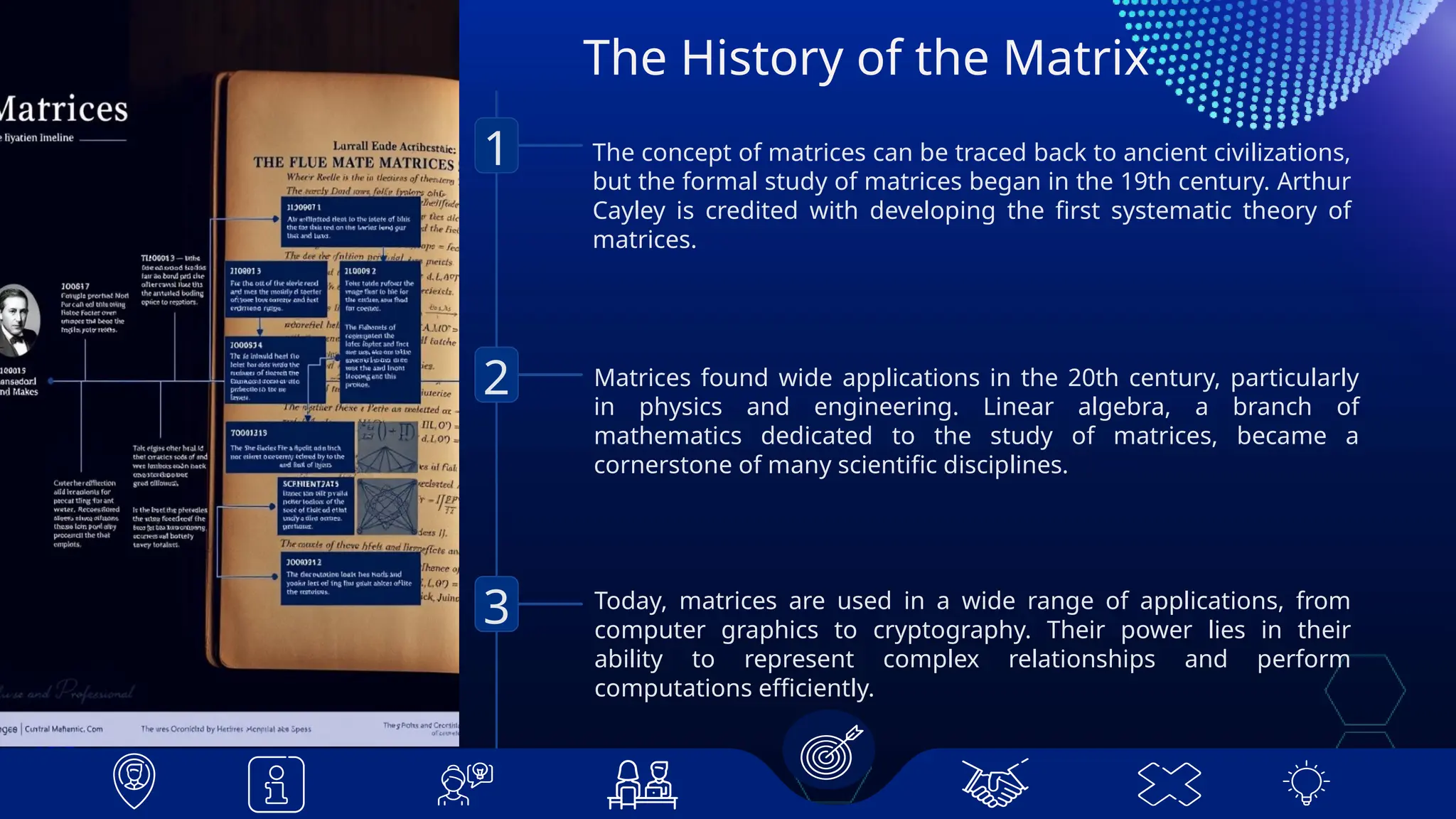
The concept of matrices can be traced back to ancient civilizations,
but the formal study of matrices began in the 19th century. Arthur
Cayley is credited with developing the first systematic theory of
matrices.
Matrices found wide applications in the 20th century, particularly
in physics and engineering. Linear algebra, a branch of
mathematics dedicated to the study of matrices, became a
cornerstone of many scientific disciplines.
Today, matrices are used in a wide range of applications, from
computer graphics to cryptography. Their power lies in their
ability to represent complex relationships and perform
computations efficiently.
Matrix Operations
1 Addition & Subtraction
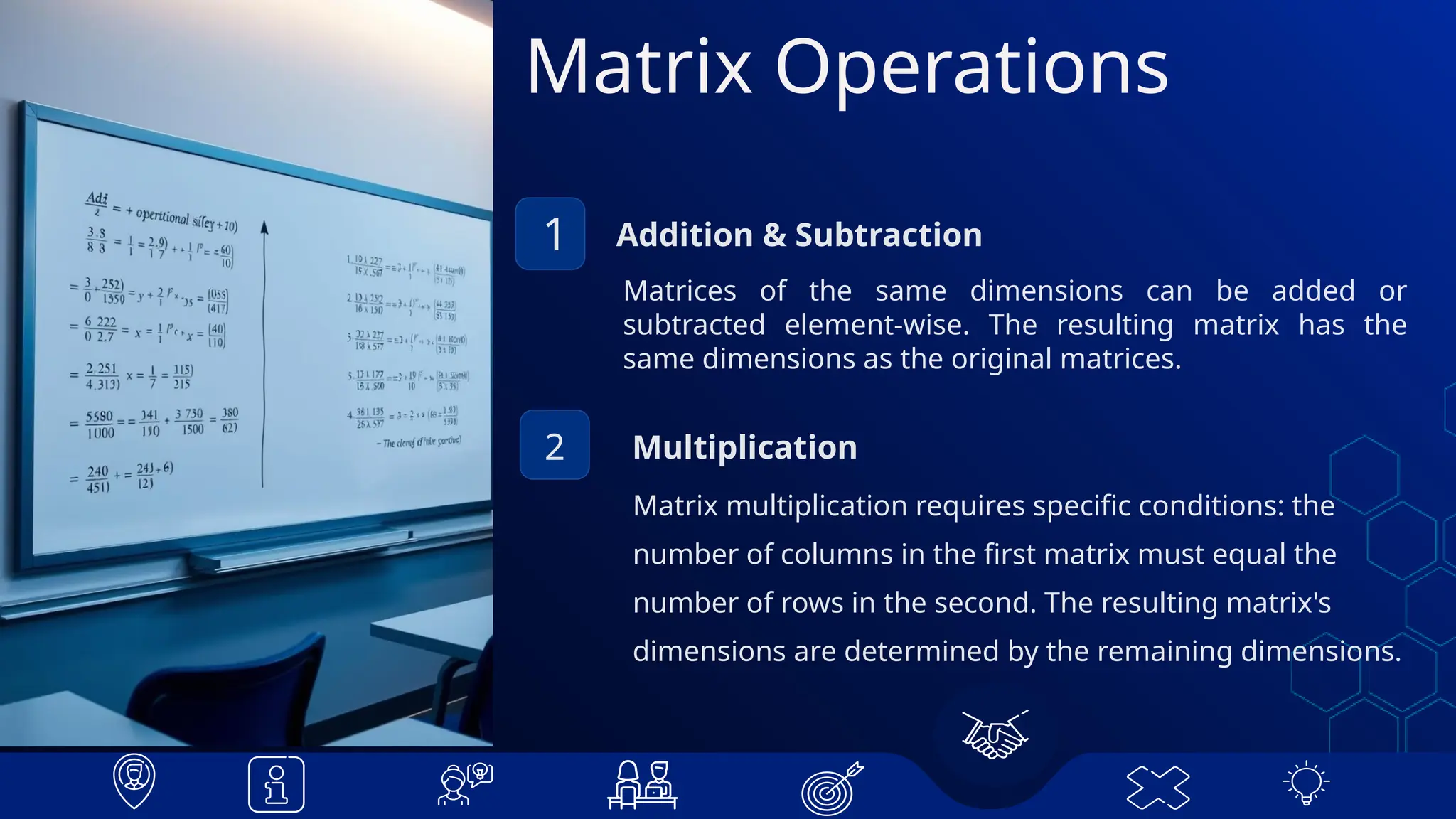
Matrices of the same dimensions can be added or
subtracted element-wise. The resulting matrix has the
same dimensions as the original matrices.
2 Multiplication
Matrix multiplication requires specific conditions: the
number of columns in the first matrix must equal the
number of rows in the second. The resulting matrix's
dimensions are determined by the remaining dimensions.
Matrix Operations
3 Transpose
The transpose of a matrix is created by swapping its
rows and columns. This operation is useful in various
applications, including finding the inverse of a matrix.
4 Inverse
The inverse of a square matrix, if it exists, is its
multiplicative inverse. It's used to solve systems of
linear equations and perform other operations.
Transposes:
The transpose of a matrix A is denoted AT , or in Matlab, A′.
The transpose of a matrix exchanges the rows and columns. The ith
column becomes the ith row. Or the aij entry becomes the aji entry.
Example:
Symmetric Matrices are square matrices that satisfy A = AT .
Example:
We’ll see that the eigenvalues of symmetric matrices are great. The eigen- vectors are
even better! And symmetric matrices come up all of the time.
Property of transposes: (AB)T =BTAT
Inverses Important Questions
• Is a matrix A invertible?
• How do you compute the inverse?
Let A be a square matrix. Suppose it has an inverse. We denote the inverse by
A 1, and it has the property that
−
AA 1 =I A 1A=I.
− −
The fact that the inverse is simultaneously a right and left inverse is not
immediately obvious. See if you can use the associative property (AB)C = A(BC)
to see why this must be the case when A is square.
If the inverse of A and B both exists, and both matrices have the same shape,
then
(AB) 1 = B 1A 1
− − −
Practical Applications of Matrices
Engineering
Matrices are used in structural analysis, circuit theory, and control systems,
providing tools for modeling complex systems and analyzing their behavior.
Computer Science
Matrices are fundamental in computer graphics, image processing,
machine learning, and cryptography, enabling efficient computations
and data manipulations.
Economics
Matrix algebra is used in econometrics, input-output analysis,
and game theory, helping model economic relationships and
predict market outcomes.
1
2
3
4
Data Analysis
Matrices are crucial in data analysis and statistics,
allowing for representation of data, correlation
analysis, and dimensionality reduction.
conclusion:
D O Y O U H A V E A N Y Q U E S T I O N ?
 https://www.wolframalpha.com/input?i=integrals
 https://tutorial.math.lamar.edu/Classes/CalcII/CalcII.aspx
 https://en.wikipedia.org/wiki/Integral
Reference :

matrix mathmatics information technology .pptx

  • 1.
    Matrix Erbil Polytechnic University ShaqlawaTechnical College Information technology Stage Two evening Prepared by: Prepared For: Dr.
  • 2.
    Table of contents: 1. Introduction 2. History 3. Definition 4. Rules 5. Graphic representation 6. Application of intigration 7. Conclusion
  • 3.
    Introduction Inverse functions area pair of function that perform the opposite operations. The inverse function of f(x) is denoted by f-1(x), read "f-inverse". For example f(x) = x - 2 has an inverse function f-1(x) = x + 2 because for any value of x the value for f(x) when substituted into f-1(x) equals x. f[ f 1 ( x ) ]=f( x+2 )=( x+2 ) 2=x − −
  • 4.
    What is aMatrix? Definition A matrix is a rectangular array of numbers, symbols, or expressions arranged in rows and columns. Each element in the matrix has a specific location identified by its row and column number. Examples Matrices are used in a variety of fields, including engineering, economics, and computer science. They are also used in many everyday applications, such as spreadsheets and databases.
  • 5.
    1 2 3 The History ofthe Matrix The concept of matrices can be traced back to ancient civilizations, but the formal study of matrices began in the 19th century. Arthur Cayley is credited with developing the first systematic theory of matrices. Matrices found wide applications in the 20th century, particularly in physics and engineering. Linear algebra, a branch of mathematics dedicated to the study of matrices, became a cornerstone of many scientific disciplines. Today, matrices are used in a wide range of applications, from computer graphics to cryptography. Their power lies in their ability to represent complex relationships and perform computations efficiently.
  • 6.
    Matrix Operations 1 Addition& Subtraction Matrices of the same dimensions can be added or subtracted element-wise. The resulting matrix has the same dimensions as the original matrices. 2 Multiplication Matrix multiplication requires specific conditions: the number of columns in the first matrix must equal the number of rows in the second. The resulting matrix's dimensions are determined by the remaining dimensions.
  • 7.
    Matrix Operations 3 Transpose Thetranspose of a matrix is created by swapping its rows and columns. This operation is useful in various applications, including finding the inverse of a matrix. 4 Inverse The inverse of a square matrix, if it exists, is its multiplicative inverse. It's used to solve systems of linear equations and perform other operations.
  • 8.
    Transposes: The transpose ofa matrix A is denoted AT , or in Matlab, A′. The transpose of a matrix exchanges the rows and columns. The ith column becomes the ith row. Or the aij entry becomes the aji entry. Example: Symmetric Matrices are square matrices that satisfy A = AT . Example: We’ll see that the eigenvalues of symmetric matrices are great. The eigen- vectors are even better! And symmetric matrices come up all of the time. Property of transposes: (AB)T =BTAT
  • 9.
    Inverses Important Questions •Is a matrix A invertible? • How do you compute the inverse? Let A be a square matrix. Suppose it has an inverse. We denote the inverse by A 1, and it has the property that − AA 1 =I A 1A=I. − − The fact that the inverse is simultaneously a right and left inverse is not immediately obvious. See if you can use the associative property (AB)C = A(BC) to see why this must be the case when A is square. If the inverse of A and B both exists, and both matrices have the same shape, then (AB) 1 = B 1A 1 − − −
  • 10.
    Practical Applications ofMatrices Engineering Matrices are used in structural analysis, circuit theory, and control systems, providing tools for modeling complex systems and analyzing their behavior. Computer Science Matrices are fundamental in computer graphics, image processing, machine learning, and cryptography, enabling efficient computations and data manipulations. Economics Matrix algebra is used in econometrics, input-output analysis, and game theory, helping model economic relationships and predict market outcomes. 1 2 3 4 Data Analysis Matrices are crucial in data analysis and statistics, allowing for representation of data, correlation analysis, and dimensionality reduction.
  • 11.
  • 12.
    D O YO U H A V E A N Y Q U E S T I O N ?
  • 13.