DEEP LEARNING FOR MANUFACTURING
Predicting and Preventing Manufacturing Defects
Get Connected: When CAE Simulation Meets Artificial Intelligence
Authors: Sumit Sinha, Pasquale Franciosa, Manoj Babu, Emile Glorieux, Darek Ceglarek
Presented by: Sumit Sinha
WMG, University of Warwick, Coventry, UK
4th February 2020 | Professor Lord Bhattacharya Building (NAIC), WMG | University of Warwick, Coventry, CV4 7AL
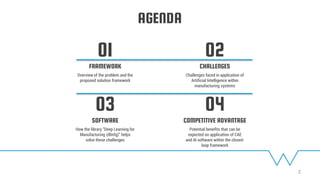
AGENDA
FRAMEWORK
Overview of the problem and the
proposed solution framework
01
SOFTWARE
How the library “Deep Learning for
Manufacturing (dlmfg)” helps
solve these challenges
03
CHALLENGES
Challenges faced in application of
Artificial Intelligence within
manufacturing systems
02
COMPETITIVE ADVANTAGE
Potential benefits that can be
expected on application of CAE
and AI software within the closed-
loop framework
04
2
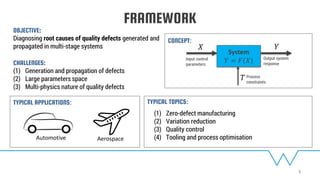
OBJECTIVE:
Diagnosing root causes of quality defects generated and
propagated in multi-stage systems
CHALLENGES:
(1) Generation and propagation of defects
(2) Large parameters space
(3) Multi-physics nature of quality defects
TYPICAL APPLICATIONS:
CONCEPT:
TYPICAL TOPICS:
(1) Zero-defect manufacturing
(2) Variation reduction
(3) Quality control
(4) Tooling and process optimisationAutomotive Aerospace
System
𝑌 = 𝐹(𝑋)
𝑋
Input control
parameters
𝑌
Output system
response
𝑇 Process
constraints
FRAMEWORK
3
FRAMEWORK
4
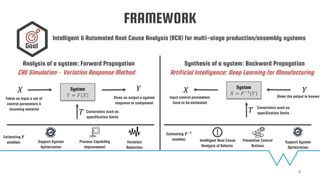
Intelligent & Automated Root Cause Analysis (RCA) for multi-stage production/assembly systems
Goal
Analysis of a system: Forward Propagation
𝑋
Takes as input a set of
control parameters &
incoming material
𝑌
Gives as output a system
response or component
𝑋
Input control parameters
have to be estimated
𝑌
Given the output is known
𝑇 Constraints such as
specification limits
Estimating 𝑭
enables: Support System
Optimization
Variation
Reduction
Estimating 𝑭−𝟏
enables: Intelligent Root Cause
Analysis of Defects
Preventive Control
Actions
System
𝑌 = 𝐹(𝑋)
𝑇
Synthesis of a system: Backward Propagation
System
𝑋 = 𝐹−1
(𝑌)
Process Capability
Improvement
Support System
Optimization
CAE Simulation – Variation Response Method Artificial Intelligence: Deep Learning for Manufacturing
Constraints such as
specification limits
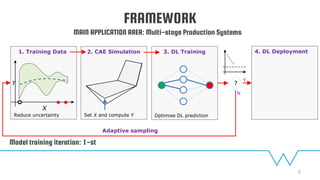
4. DL Deployment
X
𝑌 ?
N
Y
Adaptive sampling
3. DL Training1. Training Data 2. CAE Simulation
Set X and compute YReduce uncertainty Optimise DL prediction
Model training iteration: 1-st
5
FRAMEWORK
MAIN APPLICATION AREA: Multi-stage Production Systems
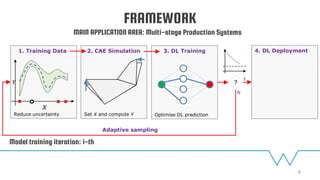
4. DL Deployment
X
𝑌 ?
3. DL Training1. Training Data 2. CAE Simulation
N
Y
Adaptive sampling
Set X and compute YReduce uncertainty Optimise DL prediction
Model training iteration: i-th
6
FRAMEWORK
MAIN APPLICATION AREA: Multi-stage Production Systems
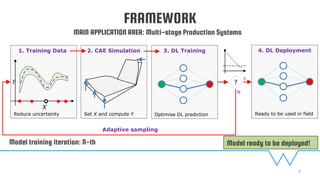
4. DL Deployment
X
𝑌 ?
Set X and compute Y
N
Y
Adaptive sampling
3. DL Training1. Training Data 2. CAE Simulation
Reduce uncertainty Optimise DL prediction Ready to be used in field
Model training iteration: N-th Model ready to be deployed!
7
FRAMEWORK
MAIN APPLICATION AREA: Multi-stage Production Systems
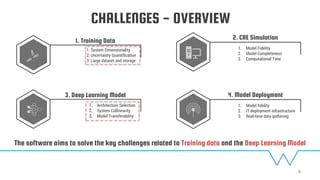
CHALLENGES - OVERVIEW
8
The software aims to solve the key challenges related to Training data and the Deep Learning Model
1. Architecture Selection
2. System Collinearity
3. Model Transferability
3. Deep Learning Model
1. System Dimensionality
2. Uncertainty Quantification
3. Large dataset and storage
1. Training Data
1. Model fidelity
2. IT deployment infrastructure
3. Real-time data gathering
4. Model Deployment
1. Model Fidelity
2. Model Completeness
3. Computational Time
2. CAE Simulation
9
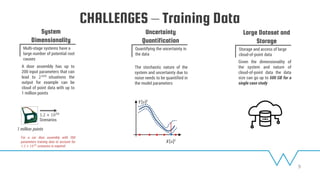
CHALLENGES – Training Data
Quantifying the uncertainty in
the data
Uncertainty
Quantification
The stochastic nature of the
system and uncertainty due to
noise needs to be quantified in
the model parameters
For a car door assembly with 200
parameters training data to account for
1.2 × 1030
scenarios is required
Multi-stage systems have a
large number of potential root
causes
System
Dimensionality
A door assembly has up to
200 input parameters that can
lead to 2200 situations the
output for example can be
cloud of point data with up to
1 million points
1 million points
1.2 × 1030
Scenarios
Storage and access of large
cloud-of-point data
Large Dataset and
Storage
Given the dimensionality of
the system and nature of
cloud-of-point data the data
size can go up to 500 GB for a
single case study
𝑋 𝑠 𝑖
𝑌 𝑠 𝑖
10
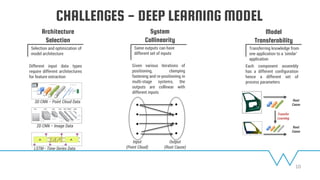
CHALLENGES - DEEP LEARNING MODEL
Same outputs can have
different set of inputs
System
Collinearity
Transferring knowledge from
one application to a ‘similar’
application
Model
Transferability
Selection and optimization of
model architecture
Architecture
Selection
Given various iterations of
positioning, clamping
fastening and re-positioning in
multi-stage systems, the
outputs are collinear with
different inputs
Each component assembly
has a different configuration
hence a different set of
process parameters
Different input data types
require different architectures
for feature extraction
3D CNN – Point Cloud Data
2D CNN – Image Data
LSTM– Time-Series Data
•
•
•
•
•
•
•
•
Input
(Point Cloud)
Output
(Root Cause)
Root
Cause
Root
Cause
Transfer
Learning
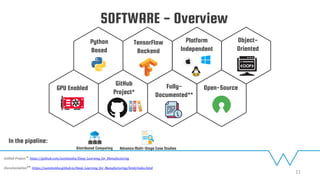
SOFTWARE - Overview
Python
Based
TensorFlow
Backend
Fully-
Documented**
Object-
Oriented
Open-Source
Platform
Independent
GitHub
Project*
GPU Enabled
GitHub Project *: https://github.com/sumitsinha/Deep_Learning_for_Manufacturing
Documentation**: https://sumitsinha.github.io/Deep_Learning_for_Manufacturing/html/index.html
11
In the pipeline:
Distributed Computing Advance Multi-Stage Case Studies
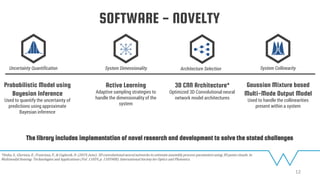
SOFTWARE - NOVELTY
Gaussian Mixture based
Multi-Mode Output Model
Used to handle the collinearities
present within a system
Active Learning
Adaptive sampling strategies to
handle the dimensionality of the
system
3D CNN Architecture*
Optimized 3D Convolutional neural
network model architectures
12
The library includes implementation of novel research and development to solve the stated challenges
*Sinha, S., Glorieux, E., Franciosa, P., & Ceglarek, D. (2019, June). 3D convolutional neural networks to estimate assembly process parameters using 3D point-clouds. In
Multimodal Sensing: Technologies and Applications (Vol. 11059, p. 110590B). International Society for Optics and Photonics.
Probabilistic Model using
Bayesian Inference
Used to quantify the uncertainty of
predictions using approximate
Bayesian inference
Uncertainty Quantification System CollinearitySystem Dimensionality Architecture Selection
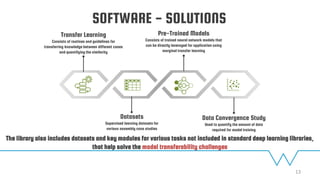
SOFTWARE - SOLUTIONS
Data Convergence Study
Used to quantify the amount of data
required for model training
Transfer Learning
Consists of routines and guidelines for
transferring knowledge between different cases
and quantifying the similarity
The library also includes datasets and key modules for various tasks not included in standard deep learning libraries,
that help solve the model transferability challenges
Datasets
Supervised learning datasets for
various assembly case studies
Pre-Trained Models
Consists of trained neural network models that
can be directly leveraged for application using
marginal transfer learning
13
SOFTWARE – CASE STUDY
Stage 1 –
Positioning
Stage 2 –
Clamping
Stage 3 –
Fastening
Stage 4 –
Release
Data
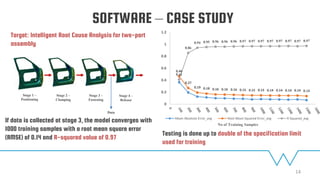
If data is collected at stage 3, the model converges with
1000 training samples with a root mean square error
(RMSE) of 0.14 and R-squared value of 0.97
Target: Intelligent Root Cause Analysis for two-part
assembly
0.46
0.27
0.19 0.18 0.16 0.16 0.16 0.15 0.15 0.15 0.14 0.14 0.14 0.14 0.13
0.41
0.86
0.94 0.95 0.96 0.96 0.96 0.97 0.97 0.97 0.97 0.97 0.97 0.97 0.97
0
0.2
0.4
0.6
0.8
1
1.2
No of Training Samples
Mean Absolute Error_avg Root Mean Squared Error_avg R Squared_avg
Testing is done up to double of the specification limit
used for training
14
15
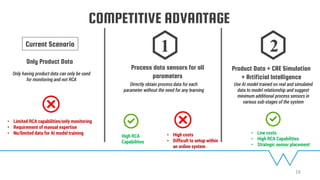
COMPETITIVE ADVANTAGE
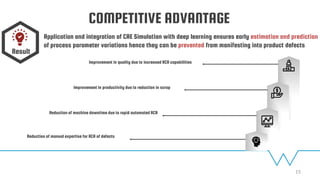
Improvement in quality due to increased RCA capabilities
Improvement in productivity due to reduction in scrap
Reduction of machine downtime due to rapid automated RCA
Reduction of manual expertise for RCA of defects
Application and integration of CAE Simulation with deep learning ensures early estimation and prediction
of process parameter variations hence they can be prevented from manifesting into product defects
Result
COMPETITIVE ADVANTAGE
Process data sensors for all
parameters
Only Product Data
Product Data + CAE Simulation
+ Artificial Intelligence
High RCA
Capabilities
• High costs
• Difficult to setup within
an online system
Directly obtain process data for each
parameter without the need for any learning
Only having product data can only be used
for monitoring and not RCA
• Limited RCA capabilities/only monitoring
• Requirement of manual expertise
• No/limited data for AI model training • Low costs
• High RCA Capabilities
• Strategic sensor placement
Use AI model trained on real and simulated
data to model relationship and suggest
minimum additional process sensors in
various sub-stages of the system
1 2Current Scenario
16
17
THANK-YOU
CONTACT
Does anyone have any questions?
sumit.sinha.1@warwick.ac.uk
+44 (0) 7570200029
IMC, WMG, University of Warwick
linkedin.com/in/sumit-sinha-32891956
MAIN SOFTWARE CONTRIBUTORS :
Sumit Sinha (Warwick University), Pasquale Franciosa (Warwick University), Manoj Babu (Warwick University), Emile Glorieux (Warwick University), Darek Ceglarek (Warwick University)
Acknowledgements
Dr. Pasquale Franciosa
Prof. Darek Ceglarek
WMG, University of Warwick, UK
Email: p.franciosa@warwick.ac.uk / d.j.ceglarek@warwick.ac.uk
M: +44(0) 7440022523 / 44(0) 7824540721
T: +44(0)24765 73422 / 44(0) 24765 72681

Deep learning in manufacturing predicting and preventing manufacturing defects - Sumit Sinha

  • 1.
    DEEP LEARNING FORMANUFACTURING Predicting and Preventing Manufacturing Defects Get Connected: When CAE Simulation Meets Artificial Intelligence Authors: Sumit Sinha, Pasquale Franciosa, Manoj Babu, Emile Glorieux, Darek Ceglarek Presented by: Sumit Sinha WMG, University of Warwick, Coventry, UK 4th February 2020 | Professor Lord Bhattacharya Building (NAIC), WMG | University of Warwick, Coventry, CV4 7AL
  • 2.
    AGENDA FRAMEWORK Overview of theproblem and the proposed solution framework 01 SOFTWARE How the library “Deep Learning for Manufacturing (dlmfg)” helps solve these challenges 03 CHALLENGES Challenges faced in application of Artificial Intelligence within manufacturing systems 02 COMPETITIVE ADVANTAGE Potential benefits that can be expected on application of CAE and AI software within the closed- loop framework 04 2
  • 3.
    OBJECTIVE: Diagnosing root causesof quality defects generated and propagated in multi-stage systems CHALLENGES: (1) Generation and propagation of defects (2) Large parameters space (3) Multi-physics nature of quality defects TYPICAL APPLICATIONS: CONCEPT: TYPICAL TOPICS: (1) Zero-defect manufacturing (2) Variation reduction (3) Quality control (4) Tooling and process optimisationAutomotive Aerospace System 𝑌 = 𝐹(𝑋) 𝑋 Input control parameters 𝑌 Output system response 𝑇 Process constraints FRAMEWORK 3
  • 4.
    FRAMEWORK 4 Intelligent & AutomatedRoot Cause Analysis (RCA) for multi-stage production/assembly systems Goal Analysis of a system: Forward Propagation 𝑋 Takes as input a set of control parameters & incoming material 𝑌 Gives as output a system response or component 𝑋 Input control parameters have to be estimated 𝑌 Given the output is known 𝑇 Constraints such as specification limits Estimating 𝑭 enables: Support System Optimization Variation Reduction Estimating 𝑭−𝟏 enables: Intelligent Root Cause Analysis of Defects Preventive Control Actions System 𝑌 = 𝐹(𝑋) 𝑇 Synthesis of a system: Backward Propagation System 𝑋 = 𝐹−1 (𝑌) Process Capability Improvement Support System Optimization CAE Simulation – Variation Response Method Artificial Intelligence: Deep Learning for Manufacturing Constraints such as specification limits
  • 5.
    4. DL Deployment X 𝑌? N Y Adaptive sampling 3. DL Training1. Training Data 2. CAE Simulation Set X and compute YReduce uncertainty Optimise DL prediction Model training iteration: 1-st 5 FRAMEWORK MAIN APPLICATION AREA: Multi-stage Production Systems
  • 6.
    4. DL Deployment X 𝑌? 3. DL Training1. Training Data 2. CAE Simulation N Y Adaptive sampling Set X and compute YReduce uncertainty Optimise DL prediction Model training iteration: i-th 6 FRAMEWORK MAIN APPLICATION AREA: Multi-stage Production Systems
  • 7.
    4. DL Deployment X 𝑌? Set X and compute Y N Y Adaptive sampling 3. DL Training1. Training Data 2. CAE Simulation Reduce uncertainty Optimise DL prediction Ready to be used in field Model training iteration: N-th Model ready to be deployed! 7 FRAMEWORK MAIN APPLICATION AREA: Multi-stage Production Systems
  • 8.
    CHALLENGES - OVERVIEW 8 Thesoftware aims to solve the key challenges related to Training data and the Deep Learning Model 1. Architecture Selection 2. System Collinearity 3. Model Transferability 3. Deep Learning Model 1. System Dimensionality 2. Uncertainty Quantification 3. Large dataset and storage 1. Training Data 1. Model fidelity 2. IT deployment infrastructure 3. Real-time data gathering 4. Model Deployment 1. Model Fidelity 2. Model Completeness 3. Computational Time 2. CAE Simulation
  • 9.
    9 CHALLENGES – TrainingData Quantifying the uncertainty in the data Uncertainty Quantification The stochastic nature of the system and uncertainty due to noise needs to be quantified in the model parameters For a car door assembly with 200 parameters training data to account for 1.2 × 1030 scenarios is required Multi-stage systems have a large number of potential root causes System Dimensionality A door assembly has up to 200 input parameters that can lead to 2200 situations the output for example can be cloud of point data with up to 1 million points 1 million points 1.2 × 1030 Scenarios Storage and access of large cloud-of-point data Large Dataset and Storage Given the dimensionality of the system and nature of cloud-of-point data the data size can go up to 500 GB for a single case study 𝑋 𝑠 𝑖 𝑌 𝑠 𝑖
  • 10.
    10 CHALLENGES - DEEPLEARNING MODEL Same outputs can have different set of inputs System Collinearity Transferring knowledge from one application to a ‘similar’ application Model Transferability Selection and optimization of model architecture Architecture Selection Given various iterations of positioning, clamping fastening and re-positioning in multi-stage systems, the outputs are collinear with different inputs Each component assembly has a different configuration hence a different set of process parameters Different input data types require different architectures for feature extraction 3D CNN – Point Cloud Data 2D CNN – Image Data LSTM– Time-Series Data • • • • • • • • Input (Point Cloud) Output (Root Cause) Root Cause Root Cause Transfer Learning
  • 11.
    SOFTWARE - Overview Python Based TensorFlow Backend Fully- Documented** Object- Oriented Open-Source Platform Independent GitHub Project* GPUEnabled GitHub Project *: https://github.com/sumitsinha/Deep_Learning_for_Manufacturing Documentation**: https://sumitsinha.github.io/Deep_Learning_for_Manufacturing/html/index.html 11 In the pipeline: Distributed Computing Advance Multi-Stage Case Studies
  • 12.
    SOFTWARE - NOVELTY GaussianMixture based Multi-Mode Output Model Used to handle the collinearities present within a system Active Learning Adaptive sampling strategies to handle the dimensionality of the system 3D CNN Architecture* Optimized 3D Convolutional neural network model architectures 12 The library includes implementation of novel research and development to solve the stated challenges *Sinha, S., Glorieux, E., Franciosa, P., & Ceglarek, D. (2019, June). 3D convolutional neural networks to estimate assembly process parameters using 3D point-clouds. In Multimodal Sensing: Technologies and Applications (Vol. 11059, p. 110590B). International Society for Optics and Photonics. Probabilistic Model using Bayesian Inference Used to quantify the uncertainty of predictions using approximate Bayesian inference Uncertainty Quantification System CollinearitySystem Dimensionality Architecture Selection
  • 13.
    SOFTWARE - SOLUTIONS DataConvergence Study Used to quantify the amount of data required for model training Transfer Learning Consists of routines and guidelines for transferring knowledge between different cases and quantifying the similarity The library also includes datasets and key modules for various tasks not included in standard deep learning libraries, that help solve the model transferability challenges Datasets Supervised learning datasets for various assembly case studies Pre-Trained Models Consists of trained neural network models that can be directly leveraged for application using marginal transfer learning 13
  • 14.
    SOFTWARE – CASESTUDY Stage 1 – Positioning Stage 2 – Clamping Stage 3 – Fastening Stage 4 – Release Data If data is collected at stage 3, the model converges with 1000 training samples with a root mean square error (RMSE) of 0.14 and R-squared value of 0.97 Target: Intelligent Root Cause Analysis for two-part assembly 0.46 0.27 0.19 0.18 0.16 0.16 0.16 0.15 0.15 0.15 0.14 0.14 0.14 0.14 0.13 0.41 0.86 0.94 0.95 0.96 0.96 0.96 0.97 0.97 0.97 0.97 0.97 0.97 0.97 0.97 0 0.2 0.4 0.6 0.8 1 1.2 No of Training Samples Mean Absolute Error_avg Root Mean Squared Error_avg R Squared_avg Testing is done up to double of the specification limit used for training 14
  • 15.
    15 COMPETITIVE ADVANTAGE Improvement inquality due to increased RCA capabilities Improvement in productivity due to reduction in scrap Reduction of machine downtime due to rapid automated RCA Reduction of manual expertise for RCA of defects Application and integration of CAE Simulation with deep learning ensures early estimation and prediction of process parameter variations hence they can be prevented from manifesting into product defects Result
  • 16.
    COMPETITIVE ADVANTAGE Process datasensors for all parameters Only Product Data Product Data + CAE Simulation + Artificial Intelligence High RCA Capabilities • High costs • Difficult to setup within an online system Directly obtain process data for each parameter without the need for any learning Only having product data can only be used for monitoring and not RCA • Limited RCA capabilities/only monitoring • Requirement of manual expertise • No/limited data for AI model training • Low costs • High RCA Capabilities • Strategic sensor placement Use AI model trained on real and simulated data to model relationship and suggest minimum additional process sensors in various sub-stages of the system 1 2Current Scenario 16
  • 17.
    17 THANK-YOU CONTACT Does anyone haveany questions? sumit.sinha.1@warwick.ac.uk +44 (0) 7570200029 IMC, WMG, University of Warwick linkedin.com/in/sumit-sinha-32891956 MAIN SOFTWARE CONTRIBUTORS : Sumit Sinha (Warwick University), Pasquale Franciosa (Warwick University), Manoj Babu (Warwick University), Emile Glorieux (Warwick University), Darek Ceglarek (Warwick University) Acknowledgements Dr. Pasquale Franciosa Prof. Darek Ceglarek WMG, University of Warwick, UK WMG, University of Warwick, UK Email: p.franciosa@warwick.ac.uk / d.j.ceglarek@warwick.ac.uk M: +44(0) 7440022523 / 44(0) 7824540721 T: +44(0)24765 73422 / 44(0) 24765 72681