MATHEMATIC
NUMBER SYSTEM
Question and solution
MADE BY : ADITYA MATHUR
1
ADITYA
ADITYA
2
EXERCISE 1.1
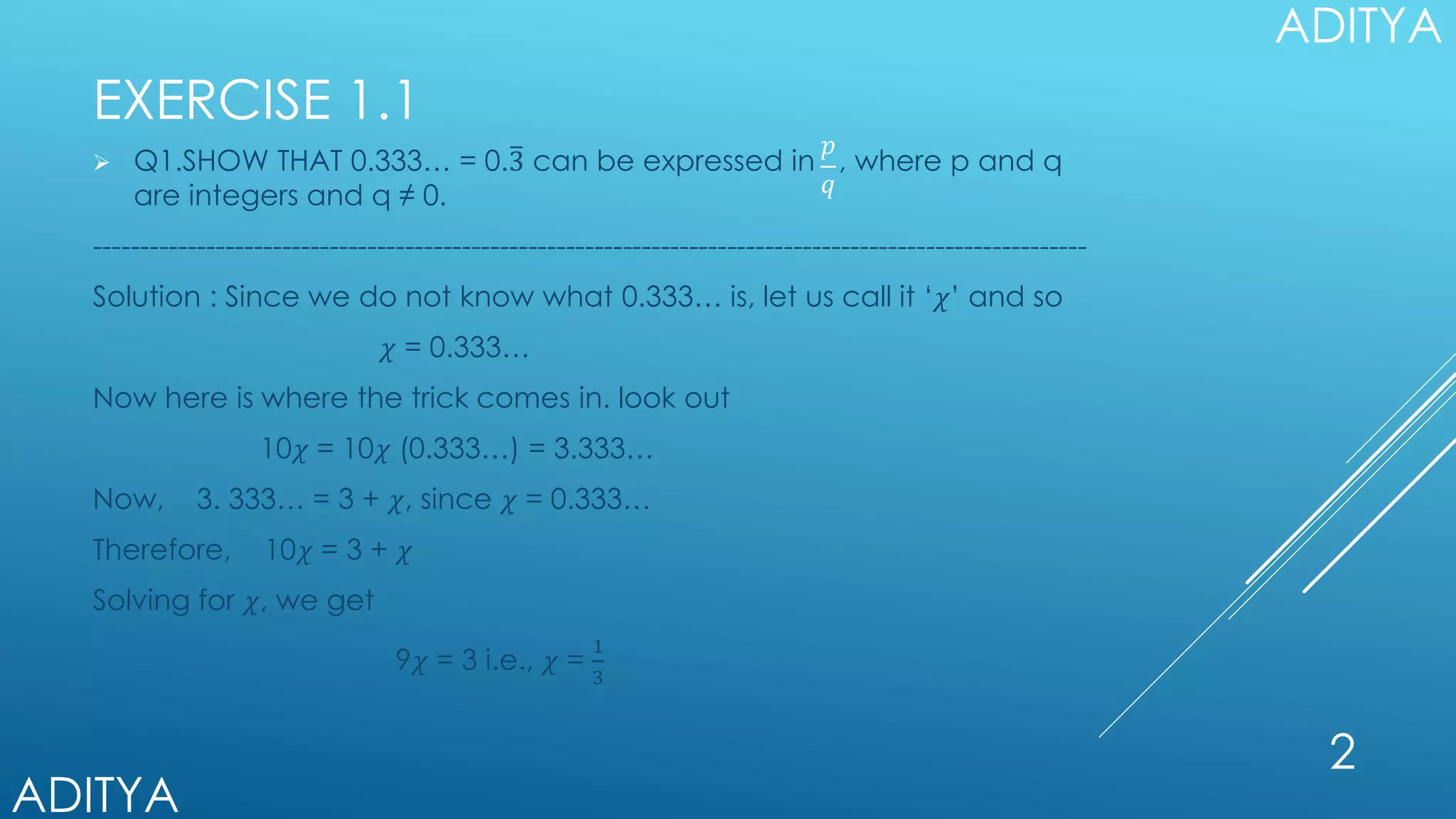
 Q1.SHOW THAT 0.333… = 0.3 can be expressed in , where p and q
are integers and q ≠ 0.
---------------------------------------------------------------------------------------------------------
Solution : Since we do not know what 0.333… is, let us call it ‘𝜒’ and so
𝜒 = 0.333…
Now here is where the trick comes in. look out
10𝜒 = 10𝜒 (0.333…) = 3.333…
Now, 3. 333… = 3 + 𝜒, since 𝜒 = 0.333…
Therefore, 10𝜒 = 3 + 𝜒
Solving for 𝜒, we get
9𝜒 = 3 i.e., 𝜒 =
1
3
𝑝
𝑞
ADITYA
ADITYA
3
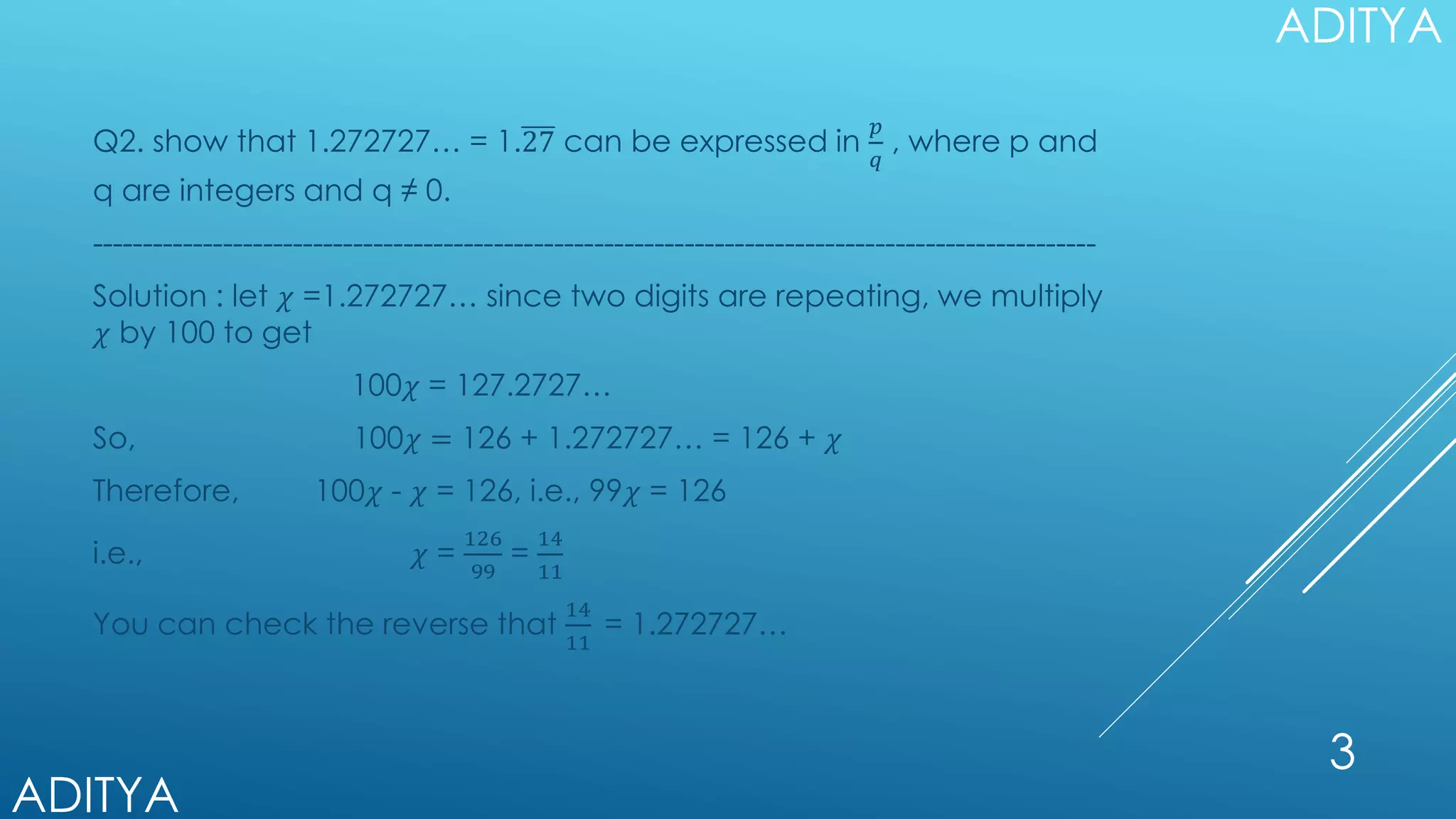
Q2. show that 1.272727… = 1.27 can be expressed in
𝑝
𝑞
, where p and
q are integers and q ≠ 0.
----------------------------------------------------------------------------------------------------
Solution : let 𝜒 =1.272727… since two digits are repeating, we multiply
𝜒 by 100 to get
100𝜒 = 127.2727…
So, 100𝜒 = 126 + 1.272727… = 126 + 𝜒
Therefore, 100𝜒 - 𝜒 = 126, i.e., 99𝜒 = 126
i.e., 𝜒 =
126
99
=
14
11
You can check the reverse that
14
11
= 1.272727…
ADITYA
ADITYA
4
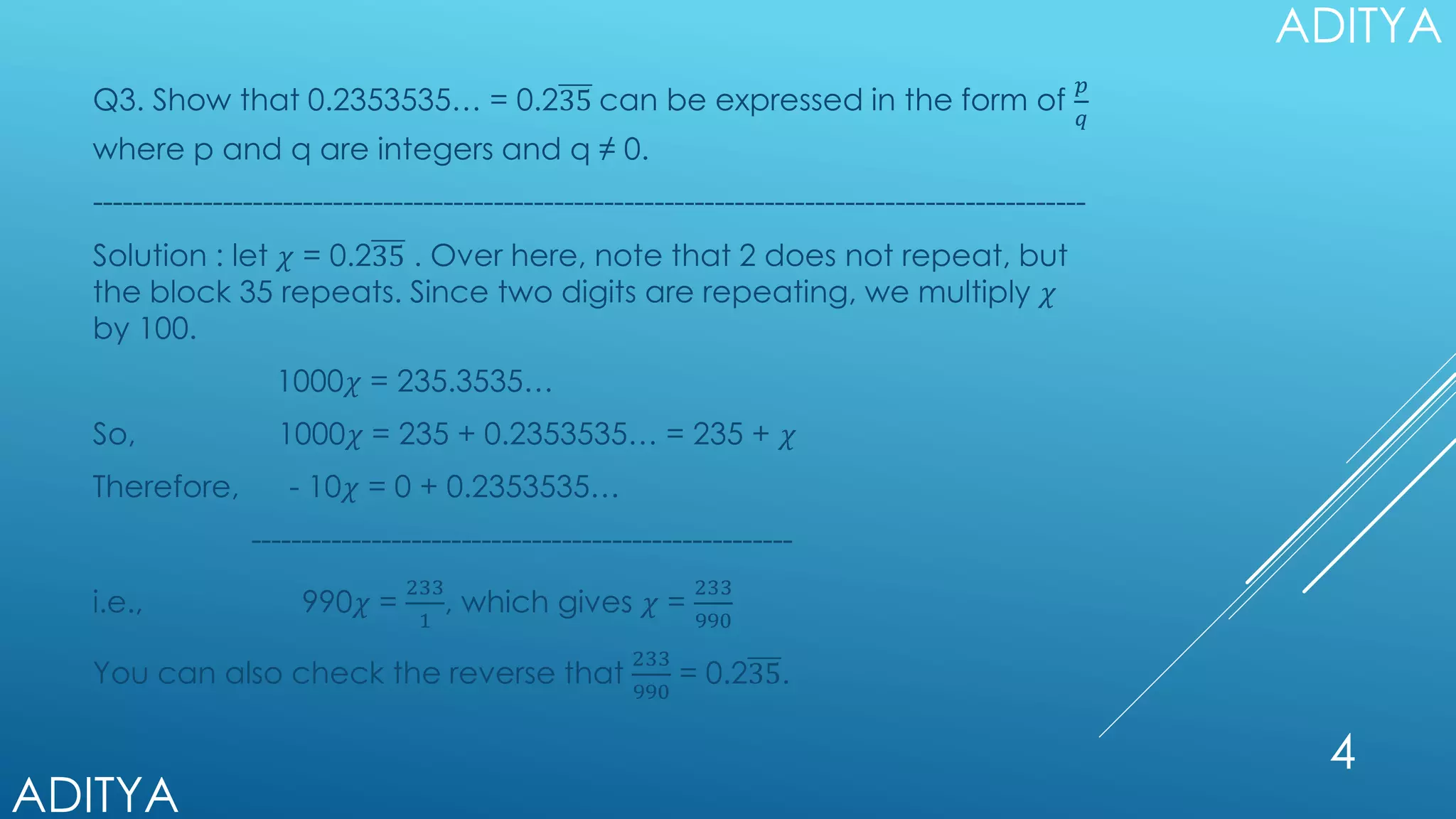
Q3. Show that 0.2353535… = 0.235 can be expressed in the form of
𝑝
𝑞
where p and q are integers and q ≠ 0.
---------------------------------------------------------------------------------------------------
Solution : let 𝜒 = 0.235 . Over here, note that 2 does not repeat, but
the block 35 repeats. Since two digits are repeating, we multiply 𝜒
by 100.
1000𝜒 = 235.3535…
So, 1000𝜒 = 235 + 0.2353535… = 235 + 𝜒
Therefore, - 10𝜒 = 0 + 0.2353535…
------------------------------------------------------
i.e., 990𝜒 =
233
1
, which gives 𝜒 =
233
990
You can also check the reverse that
233
990
= 0.235.
ADITYA
ADITYA
5
Q4. show that 0.3142678 is a rational number. In other words, express
3.142678 in the form
𝑝
𝑞
, where p and q are integers and q ≠ 0.
----------------------------------------------------------------------------------------------------
Solution : We have,
3.142678 =
3142678
1000000
and hence it is a rational number.
ADITYA
ADITYA
6
Q5. locate √2 on the number line.
----------------------------------------------------------------------------------------------------
Solution : to locate √2 on number line follow these steps :-
1) draw a line A and B such that AB = 1cm.
2) Construct a perpendicular line on point B of 1cm and mark that
point C.
3) Join A and C and you will get AC = √2.
4) Now, open your compass and take the radius AC and after
taking the radius from point A cut an arc between point B and D.
5) And mark the A to point where the arc has cut the number line
√2.
1 cm
1 cm√2
√2
A B
C
D
√2 cm
ADITYA
ADITYA
7
NOW YOU WHERE THINKING HOW AC = √2.
AC = √2 because of the formula of Pythagoras theorem.
𝑎2 + 𝑏2 = 𝑐2
So, 1 + 1 = √2
2 2
ADITYA
ADITYA
8
HOW TO LOCATE OTHER √ ’S ON NUMBER
LINE.
You can locate other √ ’s with the help of the Pythagoras theorem.
For example : to locate √3 on number line.
√2 + 1 (note : any √ multiply by the same √ give an integer.)
2 + 1 = 3
3 = √3
Now from this we know we have to take AB = √2cm and BC = 1cm
because we have to take AB = √2 we have to first make √2 on
number line and then √3.
2 2
ADITYA
ADITYA
9
THANKS FOR VIEWING
MADE BY : ADITYA MATHUR

Mathematics : NUMBER SYSTEM

  • 1.
    MATHEMATIC NUMBER SYSTEM Question andsolution MADE BY : ADITYA MATHUR 1
  • 2.
    ADITYA ADITYA 2 EXERCISE 1.1  Q1.SHOWTHAT 0.333… = 0.3 can be expressed in , where p and q are integers and q ≠ 0. --------------------------------------------------------------------------------------------------------- Solution : Since we do not know what 0.333… is, let us call it ‘𝜒’ and so 𝜒 = 0.333… Now here is where the trick comes in. look out 10𝜒 = 10𝜒 (0.333…) = 3.333… Now, 3. 333… = 3 + 𝜒, since 𝜒 = 0.333… Therefore, 10𝜒 = 3 + 𝜒 Solving for 𝜒, we get 9𝜒 = 3 i.e., 𝜒 = 1 3 𝑝 𝑞
  • 3.
    ADITYA ADITYA 3 Q2. show that1.272727… = 1.27 can be expressed in 𝑝 𝑞 , where p and q are integers and q ≠ 0. ---------------------------------------------------------------------------------------------------- Solution : let 𝜒 =1.272727… since two digits are repeating, we multiply 𝜒 by 100 to get 100𝜒 = 127.2727… So, 100𝜒 = 126 + 1.272727… = 126 + 𝜒 Therefore, 100𝜒 - 𝜒 = 126, i.e., 99𝜒 = 126 i.e., 𝜒 = 126 99 = 14 11 You can check the reverse that 14 11 = 1.272727…
  • 4.
    ADITYA ADITYA 4 Q3. Show that0.2353535… = 0.235 can be expressed in the form of 𝑝 𝑞 where p and q are integers and q ≠ 0. --------------------------------------------------------------------------------------------------- Solution : let 𝜒 = 0.235 . Over here, note that 2 does not repeat, but the block 35 repeats. Since two digits are repeating, we multiply 𝜒 by 100. 1000𝜒 = 235.3535… So, 1000𝜒 = 235 + 0.2353535… = 235 + 𝜒 Therefore, - 10𝜒 = 0 + 0.2353535… ------------------------------------------------------ i.e., 990𝜒 = 233 1 , which gives 𝜒 = 233 990 You can also check the reverse that 233 990 = 0.235.
  • 5.
    ADITYA ADITYA 5 Q4. show that0.3142678 is a rational number. In other words, express 3.142678 in the form 𝑝 𝑞 , where p and q are integers and q ≠ 0. ---------------------------------------------------------------------------------------------------- Solution : We have, 3.142678 = 3142678 1000000 and hence it is a rational number.
  • 6.
    ADITYA ADITYA 6 Q5. locate √2on the number line. ---------------------------------------------------------------------------------------------------- Solution : to locate √2 on number line follow these steps :- 1) draw a line A and B such that AB = 1cm. 2) Construct a perpendicular line on point B of 1cm and mark that point C. 3) Join A and C and you will get AC = √2. 4) Now, open your compass and take the radius AC and after taking the radius from point A cut an arc between point B and D. 5) And mark the A to point where the arc has cut the number line √2. 1 cm 1 cm√2 √2 A B C D √2 cm
  • 7.
    ADITYA ADITYA 7 NOW YOU WHERETHINKING HOW AC = √2. AC = √2 because of the formula of Pythagoras theorem. 𝑎2 + 𝑏2 = 𝑐2 So, 1 + 1 = √2 2 2
  • 8.
    ADITYA ADITYA 8 HOW TO LOCATEOTHER √ ’S ON NUMBER LINE. You can locate other √ ’s with the help of the Pythagoras theorem. For example : to locate √3 on number line. √2 + 1 (note : any √ multiply by the same √ give an integer.) 2 + 1 = 3 3 = √3 Now from this we know we have to take AB = √2cm and BC = 1cm because we have to take AB = √2 we have to first make √2 on number line and then √3. 2 2
  • 9.