NUMBER SYSTEMS
 Irrational Number
Presented by
Dr.T.Gandhimathi
Associate Professor of Mathematics
P.A.C.E.T, Pollachi
History of Irrational Number
 The Pythagoreans in Greece, followers of the
famous mathematician and philosopher
Pythagoras, were the first to discover the
numbers which were not rationals, around 400
BC.
 These numbers are called irrational
numbers(irrationals), because they cannot be
written in the form of a ratio of integers.
Definition
 The number ‘s’ which cannot be written in the
form of p/q is called irrational, where p and q
are integers and q ≠ 0 or the numbers which are
not rational are called Irrational Numbers
 The decimal expansion of an irrational number
is non-terminating and non-recurring
 Example :
√2, √11,  , 0.10110111011110...
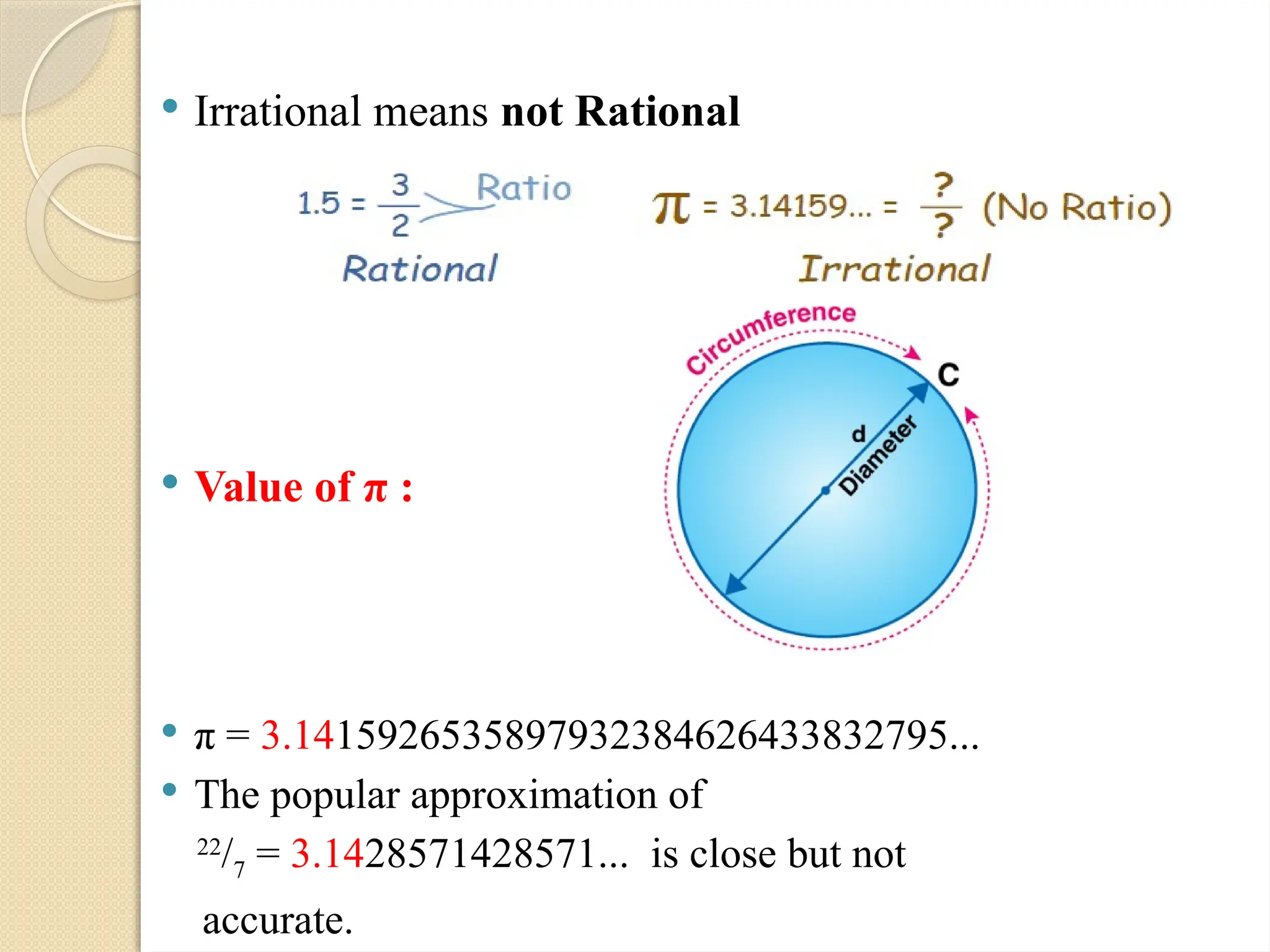
 Irrational means not Rational
 Value of π :
 π = 3.1415926535897932384626433832795...
 The popular approximation of
22
/7 = 3.1428571428571... is close but not
accurate.
Example 1:
Find the value of √2
Solution:
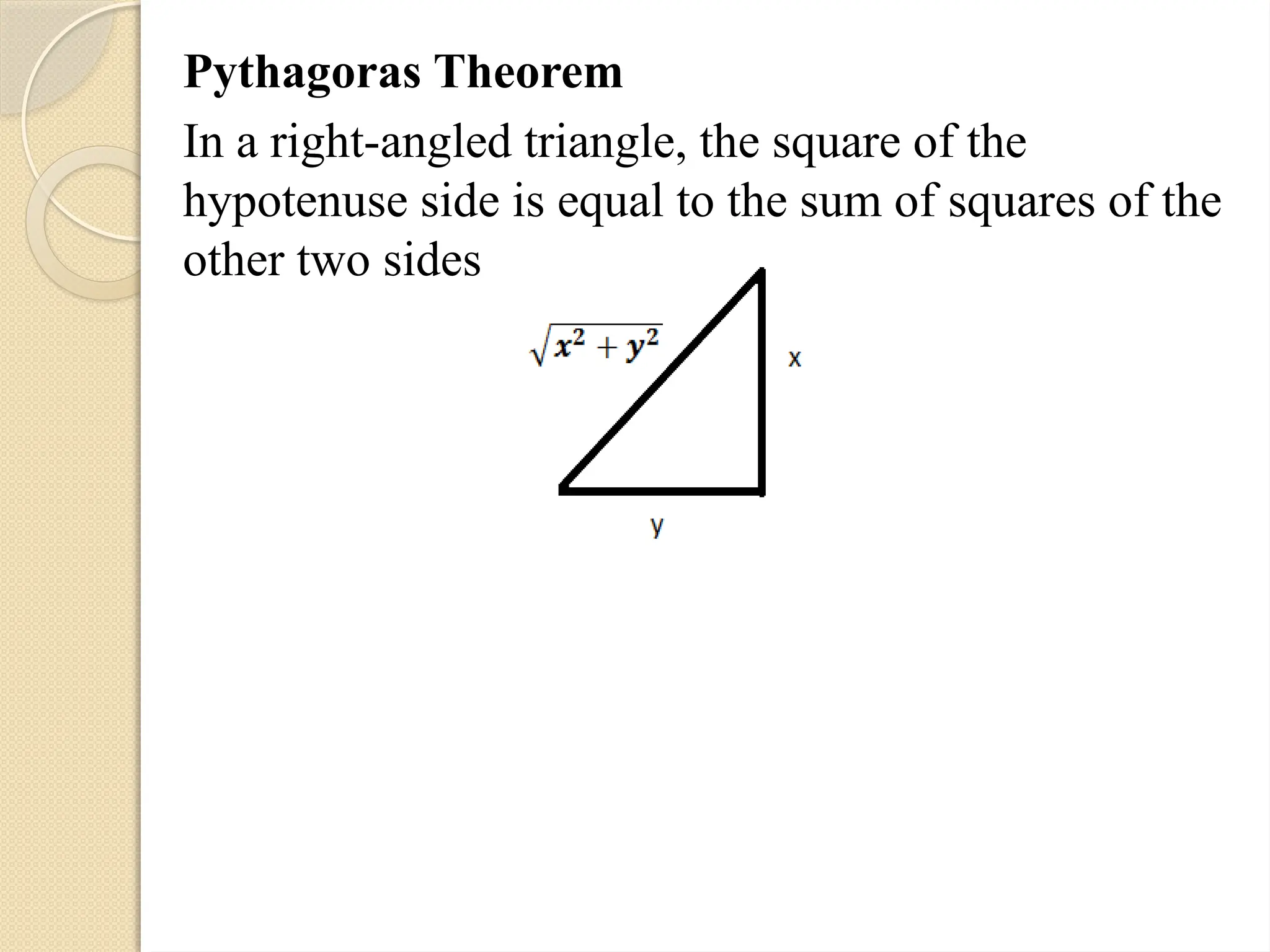
Pythagoras Theorem
In a right-angled triangle, the square of the
hypotenuse side is equal to the sum of squares of the
other two sides
Example 2:
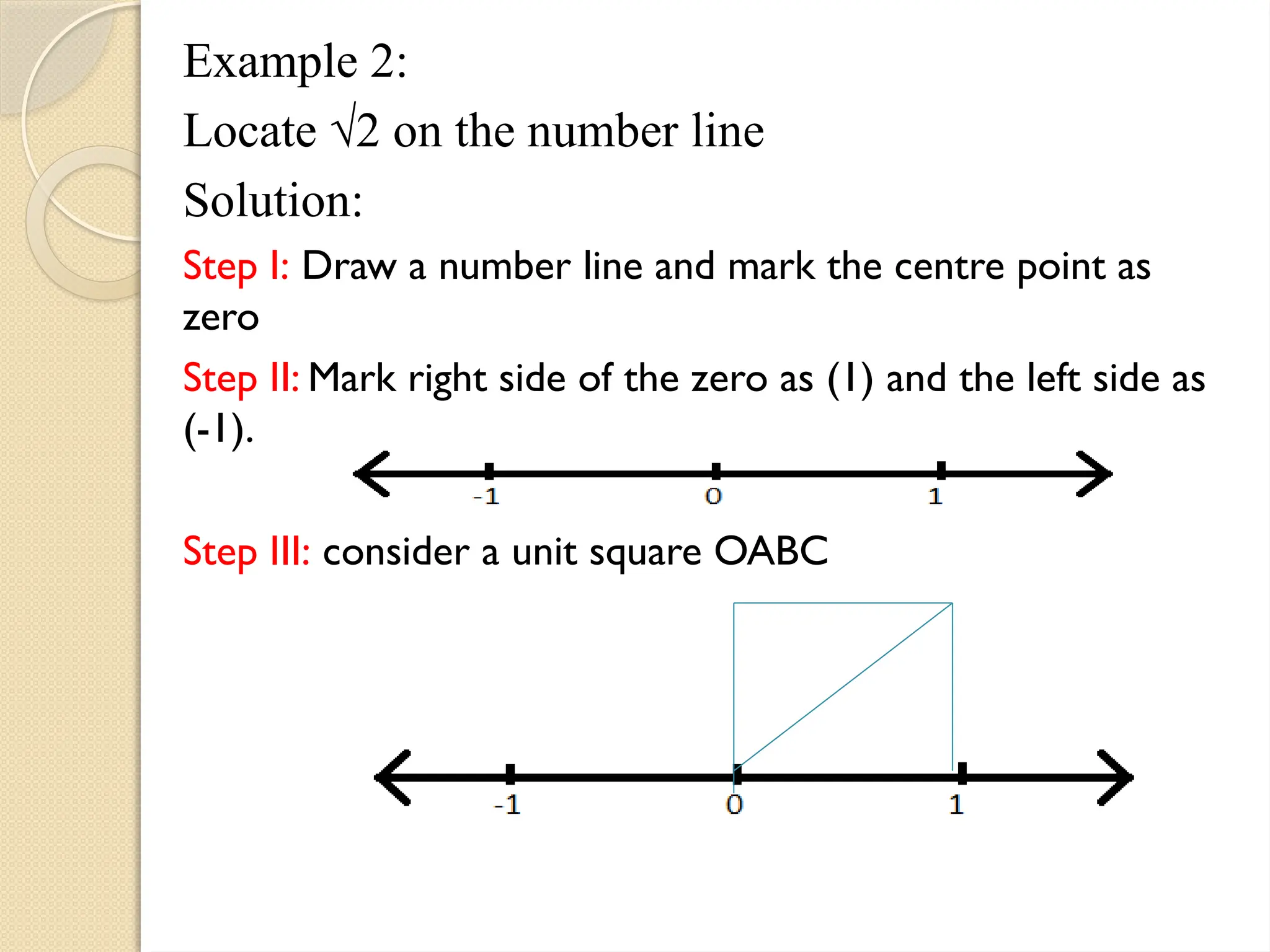
Locate √2 on the number line
Solution:
Step I: Draw a number line and mark the centre point as
zero
Step II: Mark right side of the zero as (1) and the left side as
(-1).
Step III: consider a unit square OABC
Oo
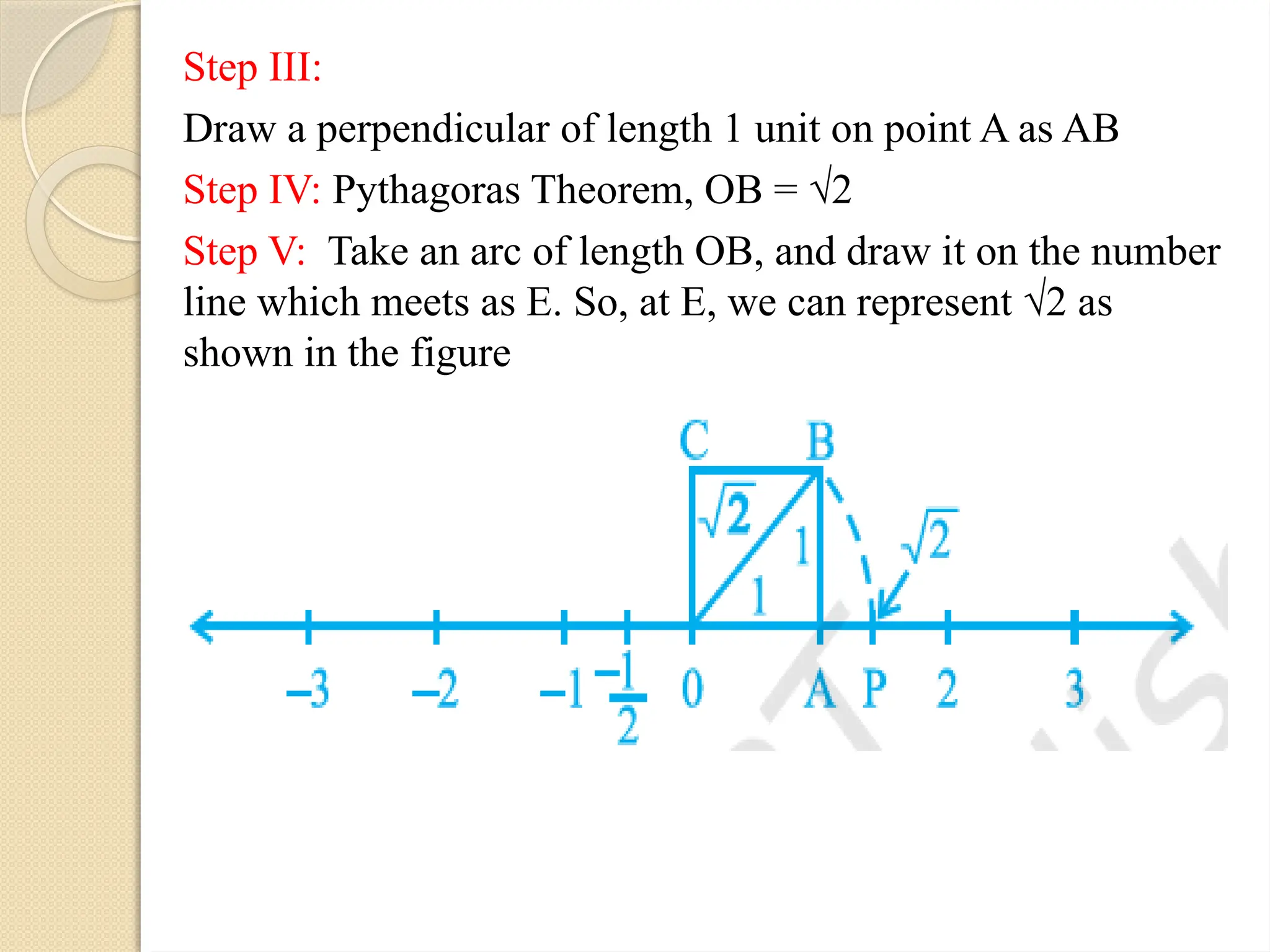
Step III:
Draw a perpendicular of length 1 unit on point A as AB
Step IV: Pythagoras Theorem, OB = √2
Step V: Take an arc of length OB, and draw it on the number
line which meets as E. So, at E, we can represent √2 as
shown in the figure
Example 3:
Locate √3 on the number line
Solution:
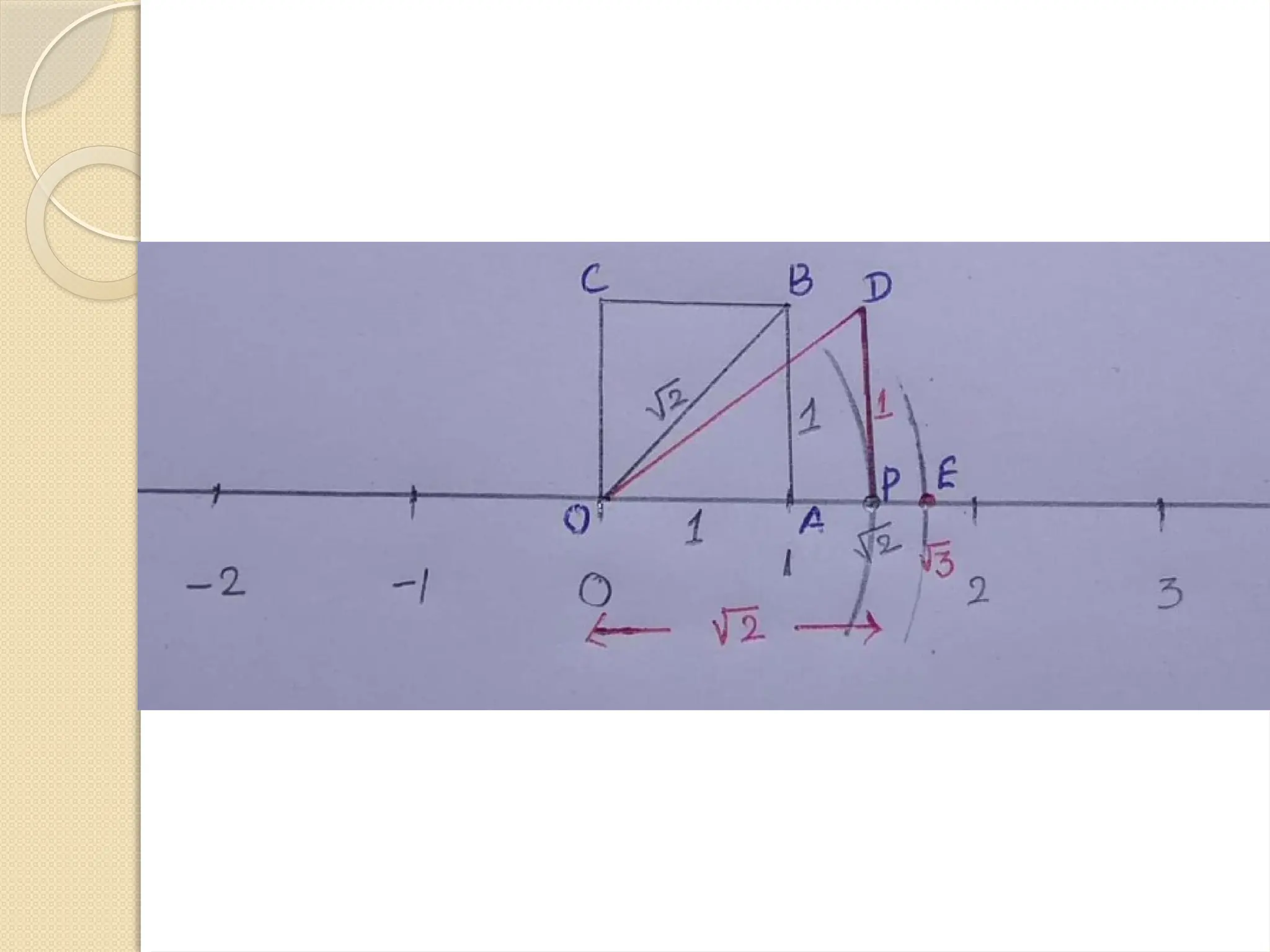
Step I: Draw a √2 on number line
Step II: Construct PD of unit length perpendicular to
OP
Step III: using the Pythagoras theorem,
OD = = √3
Step IV: Using a compass, with centre O and radius
OD, draw an arc which intersects the number line at
the point E.
Step V: Then E corresponds to √3 .
....DocumentsRepresent Root 3 on Number line -
YouTube (480p).mp4
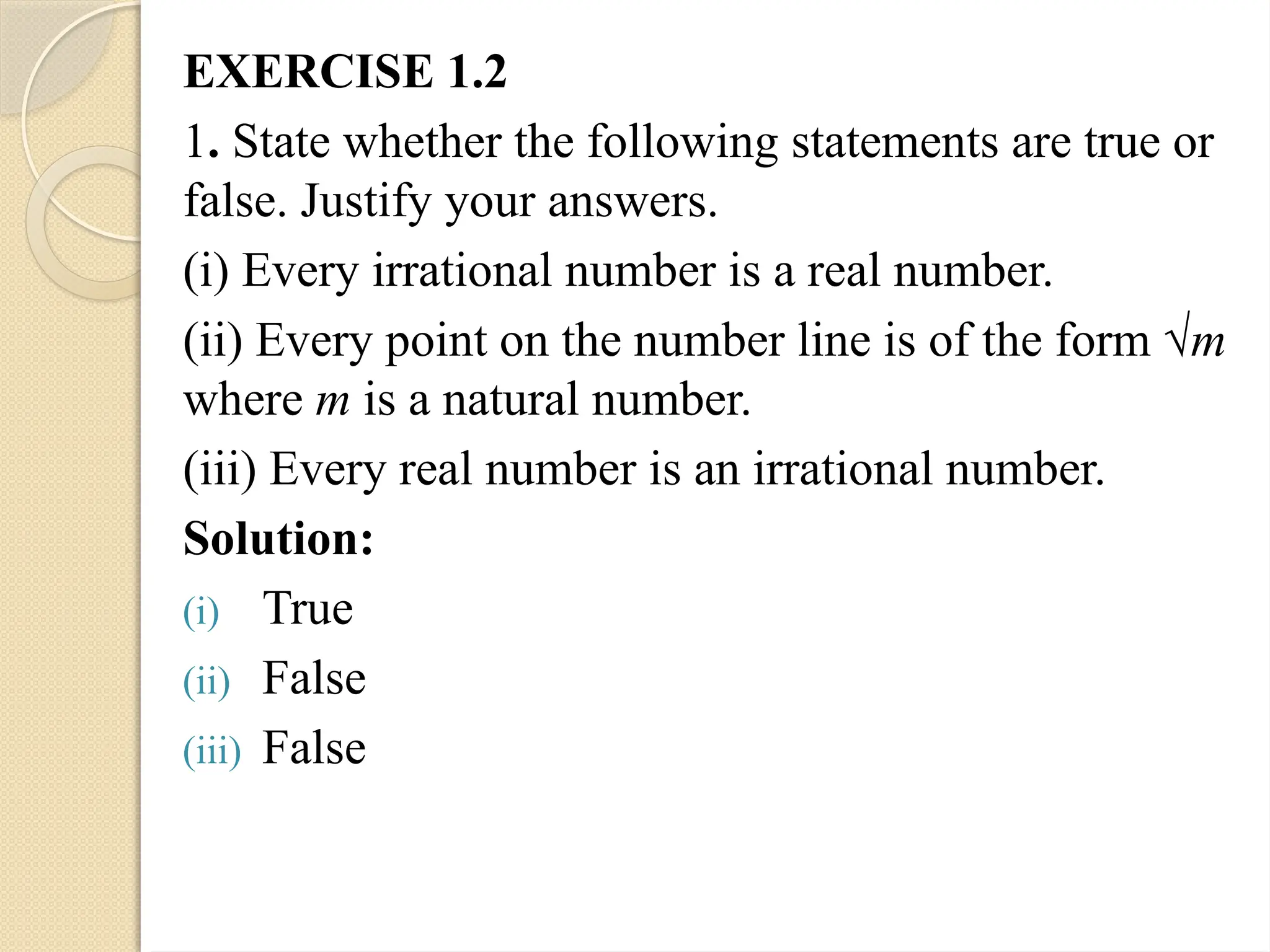
EXERCISE 1.2
1. State whether the following statements are true or
false. Justify your answers.
(i) Every irrational number is a real number.
(ii) Every point on the number line is of the form √m
where m is a natural number.
(iii) Every real number is an irrational number.
Solution:
(i) True
(ii) False
(iii) False
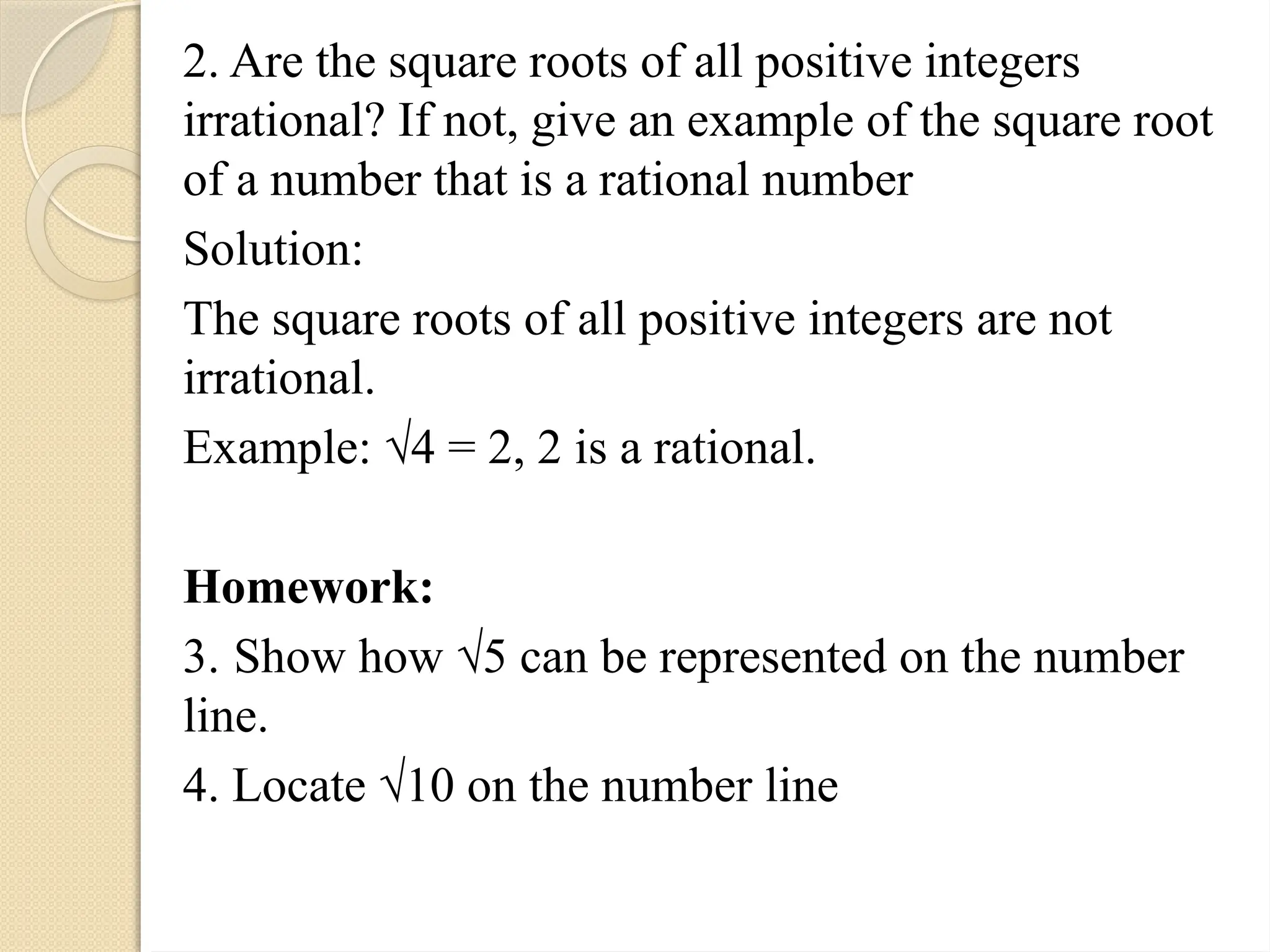
2. Are the square roots of all positive integers
irrational? If not, give an example of the square root
of a number that is a rational number
Solution:
The square roots of all positive integers are not
irrational.
Example: √4 = 2, 2 is a rational.
Homework:
3. Show how √5 can be represented on the number
line.
4. Locate √10 on the number line
Thank you

Chapter 1:Number system-Irrational numbers.pptx

  • 1.
    NUMBER SYSTEMS  IrrationalNumber Presented by Dr.T.Gandhimathi Associate Professor of Mathematics P.A.C.E.T, Pollachi
  • 2.
    History of IrrationalNumber  The Pythagoreans in Greece, followers of the famous mathematician and philosopher Pythagoras, were the first to discover the numbers which were not rationals, around 400 BC.  These numbers are called irrational numbers(irrationals), because they cannot be written in the form of a ratio of integers.
  • 3.
    Definition  The number‘s’ which cannot be written in the form of p/q is called irrational, where p and q are integers and q ≠ 0 or the numbers which are not rational are called Irrational Numbers  The decimal expansion of an irrational number is non-terminating and non-recurring  Example : √2, √11,  , 0.10110111011110...
  • 4.
     Irrational meansnot Rational  Value of π :  π = 3.1415926535897932384626433832795...  The popular approximation of 22 /7 = 3.1428571428571... is close but not accurate.
  • 5.
    Example 1: Find thevalue of √2 Solution:
  • 6.
    Pythagoras Theorem In aright-angled triangle, the square of the hypotenuse side is equal to the sum of squares of the other two sides
  • 7.
    Example 2: Locate √2on the number line Solution: Step I: Draw a number line and mark the centre point as zero Step II: Mark right side of the zero as (1) and the left side as (-1). Step III: consider a unit square OABC Oo
  • 8.
    Step III: Draw aperpendicular of length 1 unit on point A as AB Step IV: Pythagoras Theorem, OB = √2 Step V: Take an arc of length OB, and draw it on the number line which meets as E. So, at E, we can represent √2 as shown in the figure
  • 9.
    Example 3: Locate √3on the number line Solution: Step I: Draw a √2 on number line Step II: Construct PD of unit length perpendicular to OP Step III: using the Pythagoras theorem, OD = = √3 Step IV: Using a compass, with centre O and radius OD, draw an arc which intersects the number line at the point E. Step V: Then E corresponds to √3 . ....DocumentsRepresent Root 3 on Number line - YouTube (480p).mp4
  • 11.
    EXERCISE 1.2 1. Statewhether the following statements are true or false. Justify your answers. (i) Every irrational number is a real number. (ii) Every point on the number line is of the form √m where m is a natural number. (iii) Every real number is an irrational number. Solution: (i) True (ii) False (iii) False
  • 12.
    2. Are thesquare roots of all positive integers irrational? If not, give an example of the square root of a number that is a rational number Solution: The square roots of all positive integers are not irrational. Example: √4 = 2, 2 is a rational. Homework: 3. Show how √5 can be represented on the number line. 4. Locate √10 on the number line
  • 13.