Study of
P S
T
TTT
T E RN
A
Prepared by:
Celien L. Galvan
UEP Part-time Lecturer
After working on this module, you will be able to:
1. identify patterns in nature and irregularities;
2. articulate the importance in mathematics in one’s
life;
3. argue about mathematics, what it is, how it is expressed,
represented, and used; and
4. express appreciation for mathematics as a human
endeavor.
Learning Outcomes
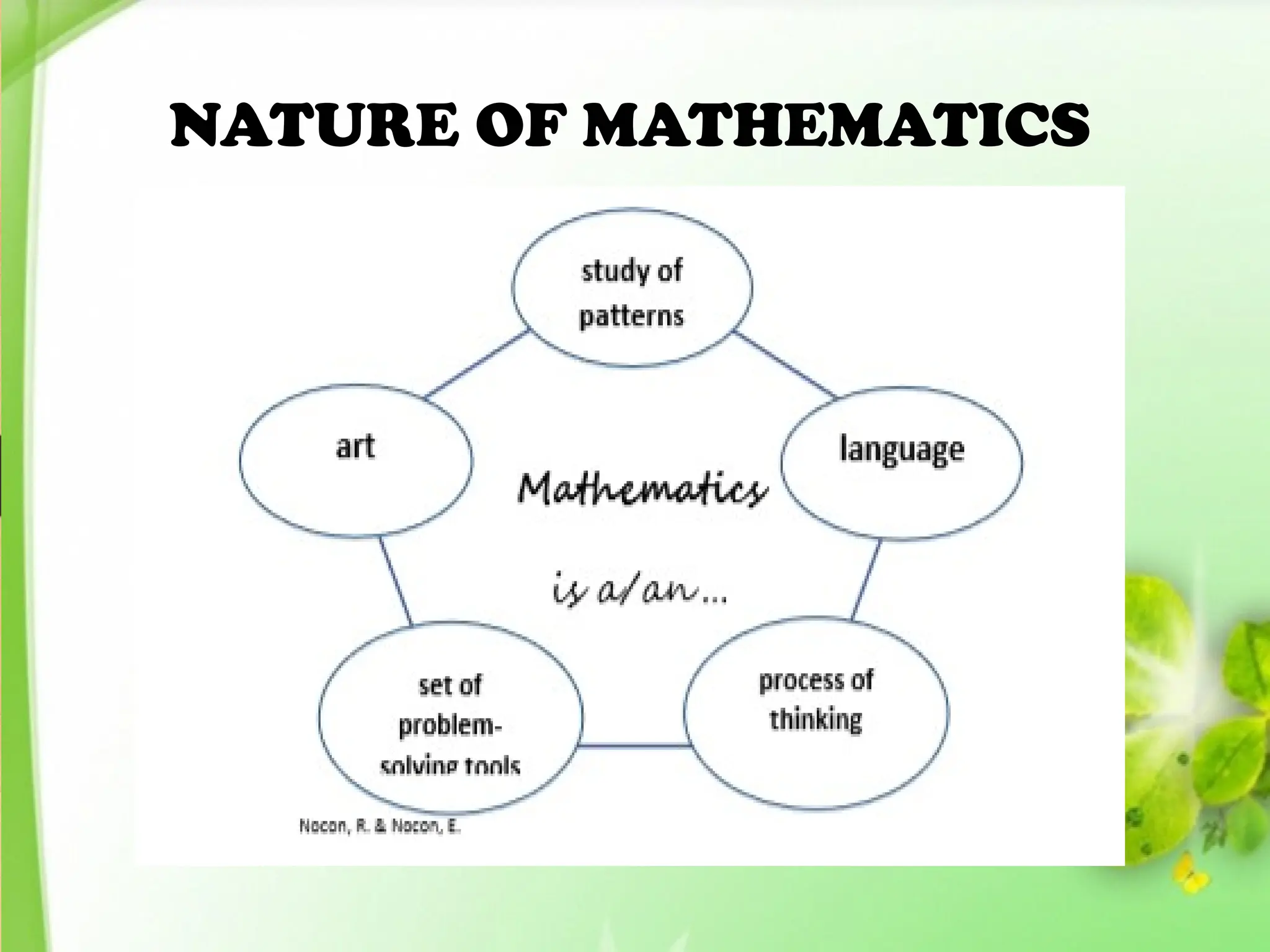
NATURE OF MATHEMATICS
QUESTIONS
• What are the different kinds and
forms of patterns you have seen in
the video and/or pictures?
• How does these patterns help us
understand the connection between
our world and mathematics?
Patterns and Numbers
in Nature and the World
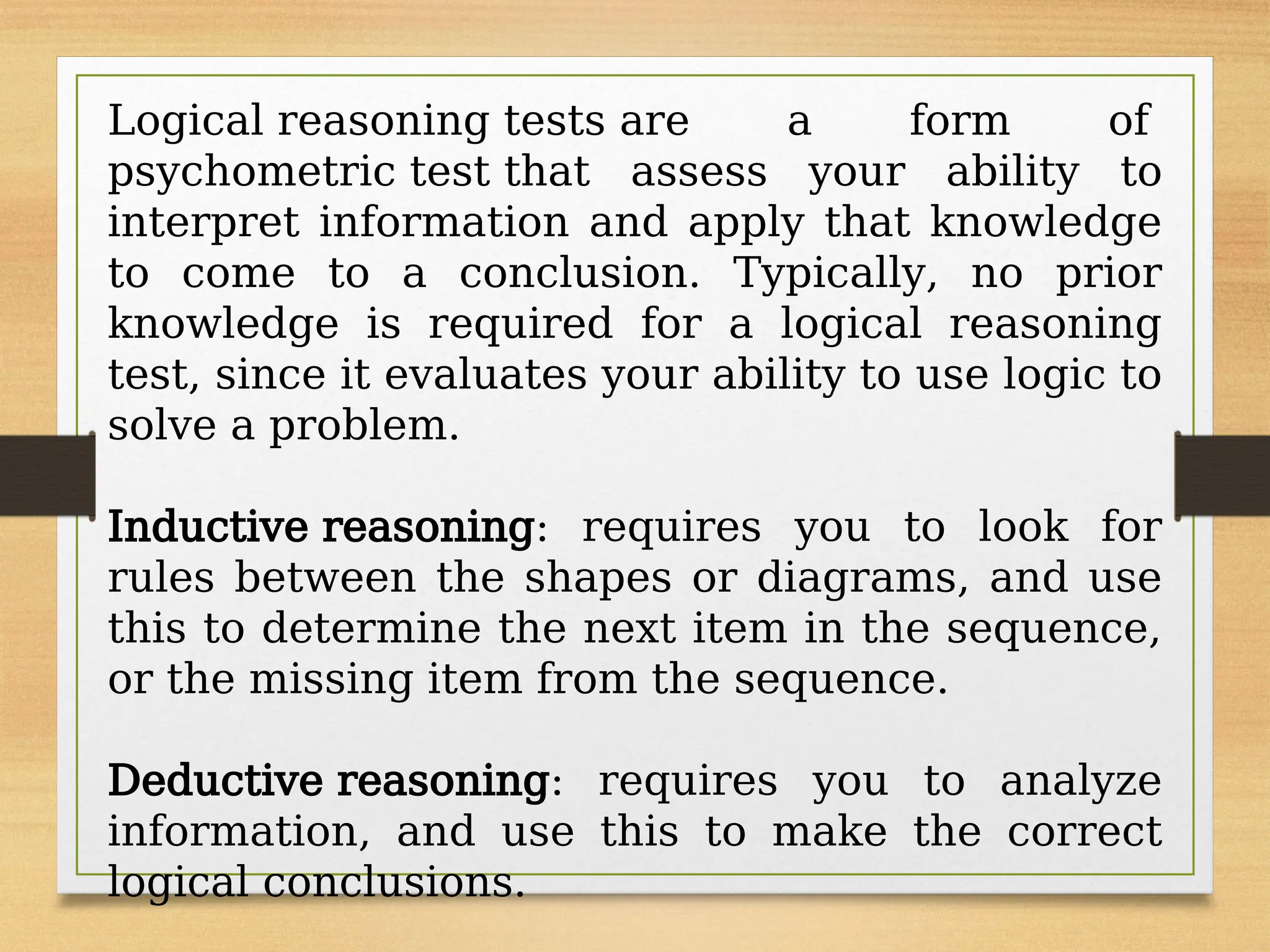
Logical reasoning tests are a form of
psychometric test that assess your ability to
interpret information and apply that knowledge
to come to a conclusion. Typically, no prior
knowledge is required for a logical reasoning
test, since it evaluates your ability to use logic to
solve a problem.
Inductive reasoning: requires you to look for
rules between the shapes or diagrams, and use
this to determine the next item in the sequence,
or the missing item from the sequence.
Deductive reasoning: requires you to analyze
information, and use this to make the correct
logical conclusions.
Diagrammatic reasoning: presents you with a series
of diagrams and symbols, and requires you to identify
a rule and apply this to reach the right conclusion.
Abstract reasoning: similar to diagrammatic and
inductive reasoning, abstract reasoning presents you
with visual sequences, from which you will need to
infer rules to identify the next item or missing item.
Critical reasoning: You will be given a passage of
information, and will be required to use logical
thinking skills to evaluate it and make a judgement.
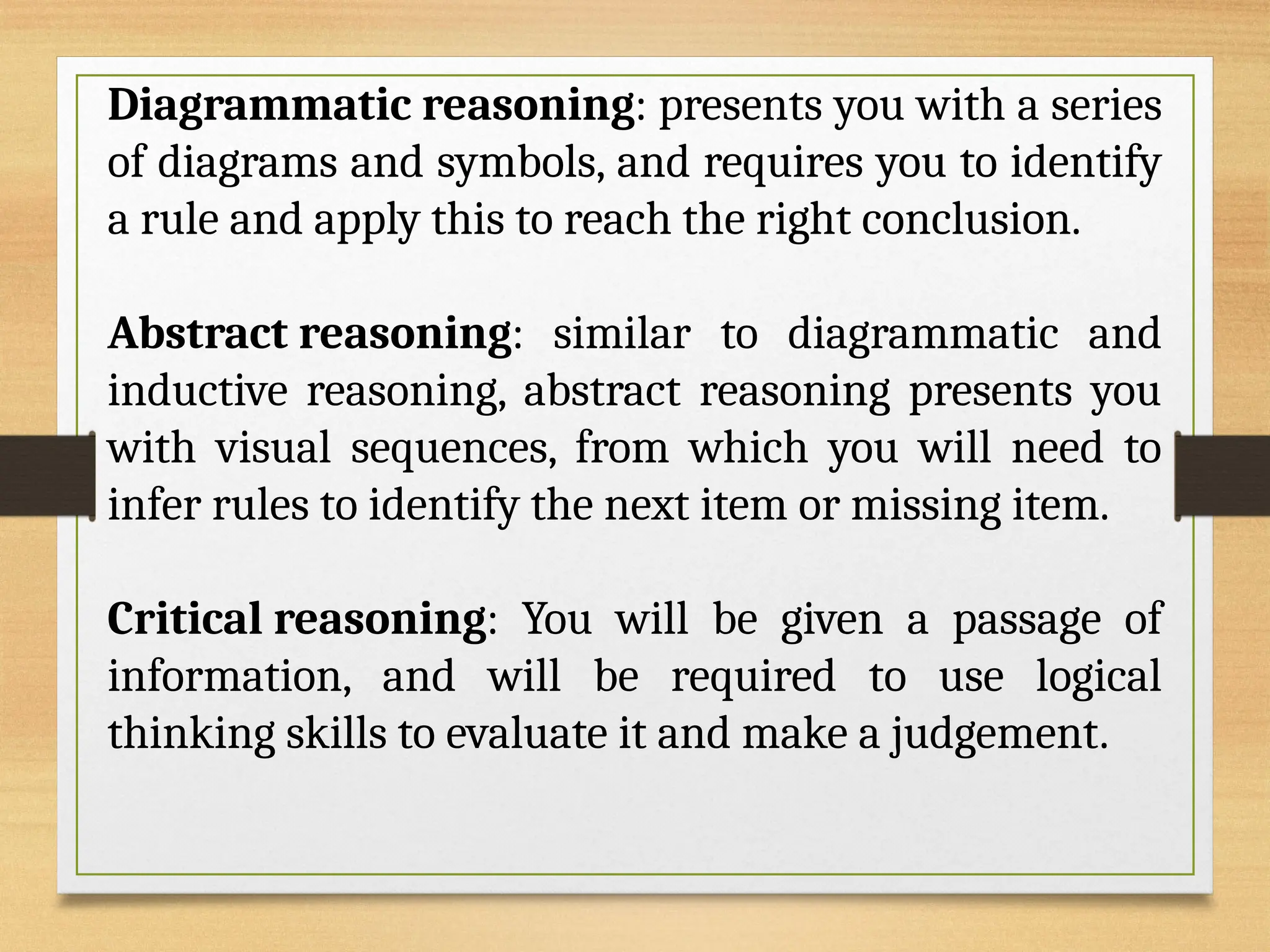
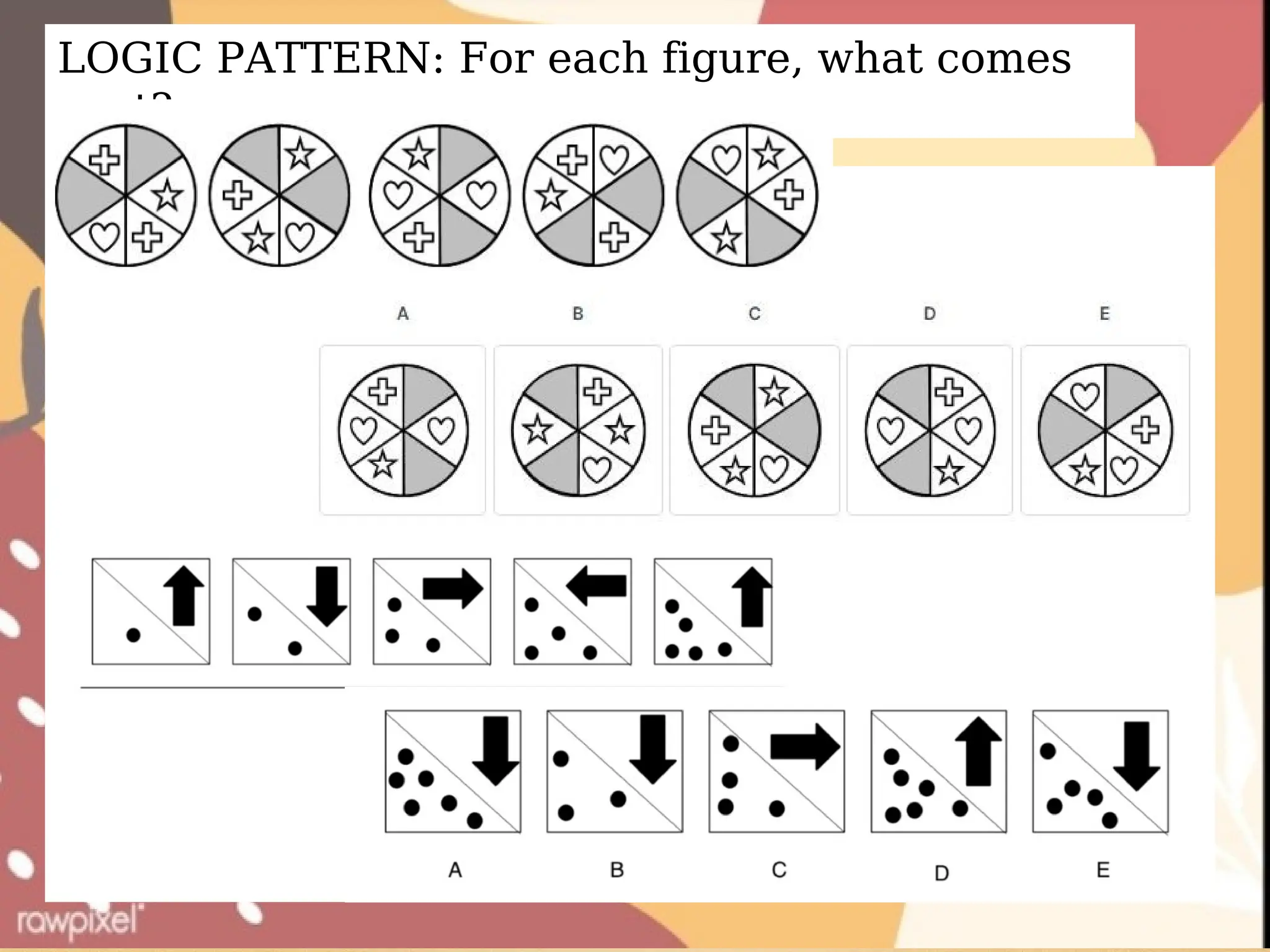
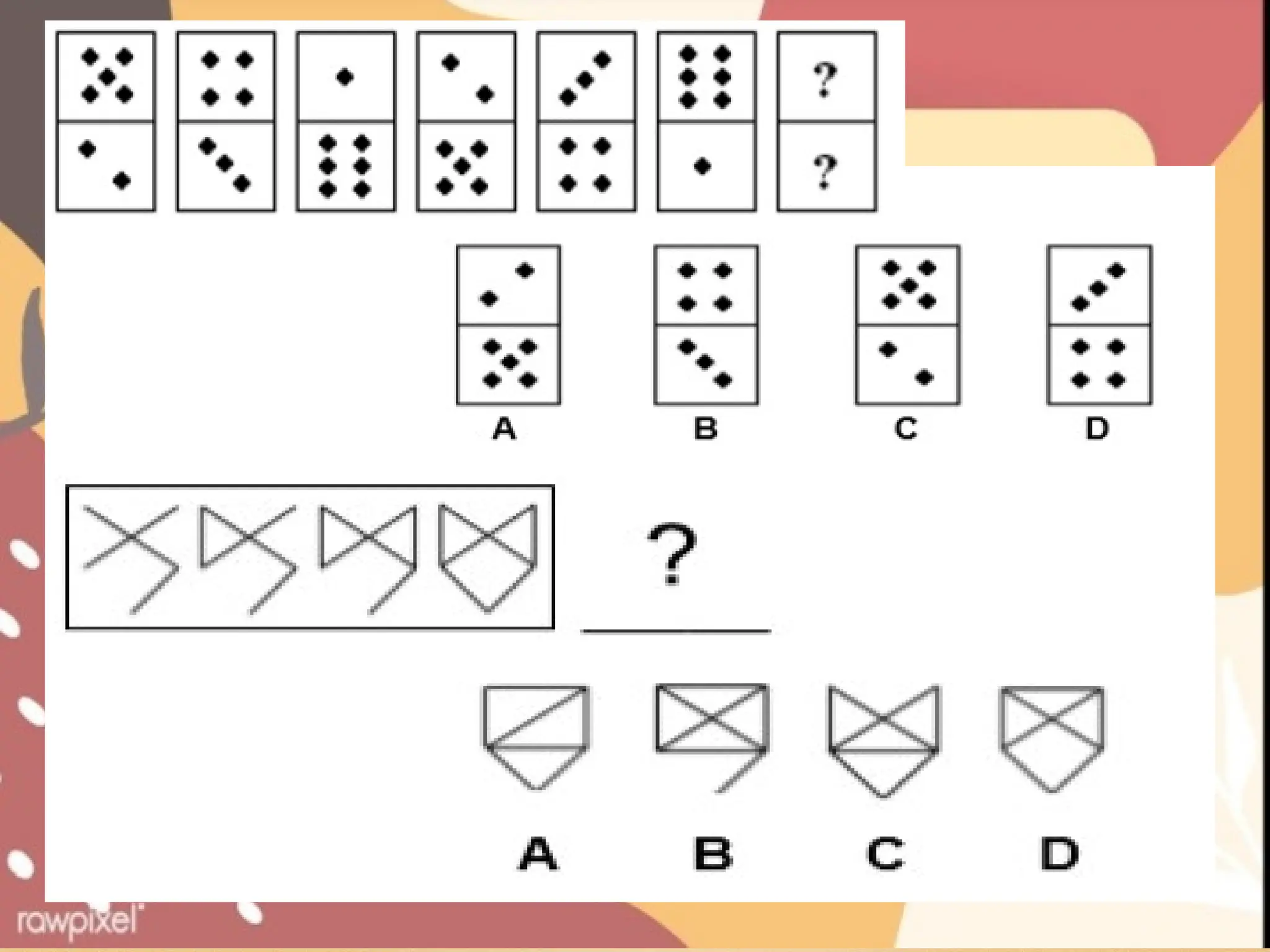
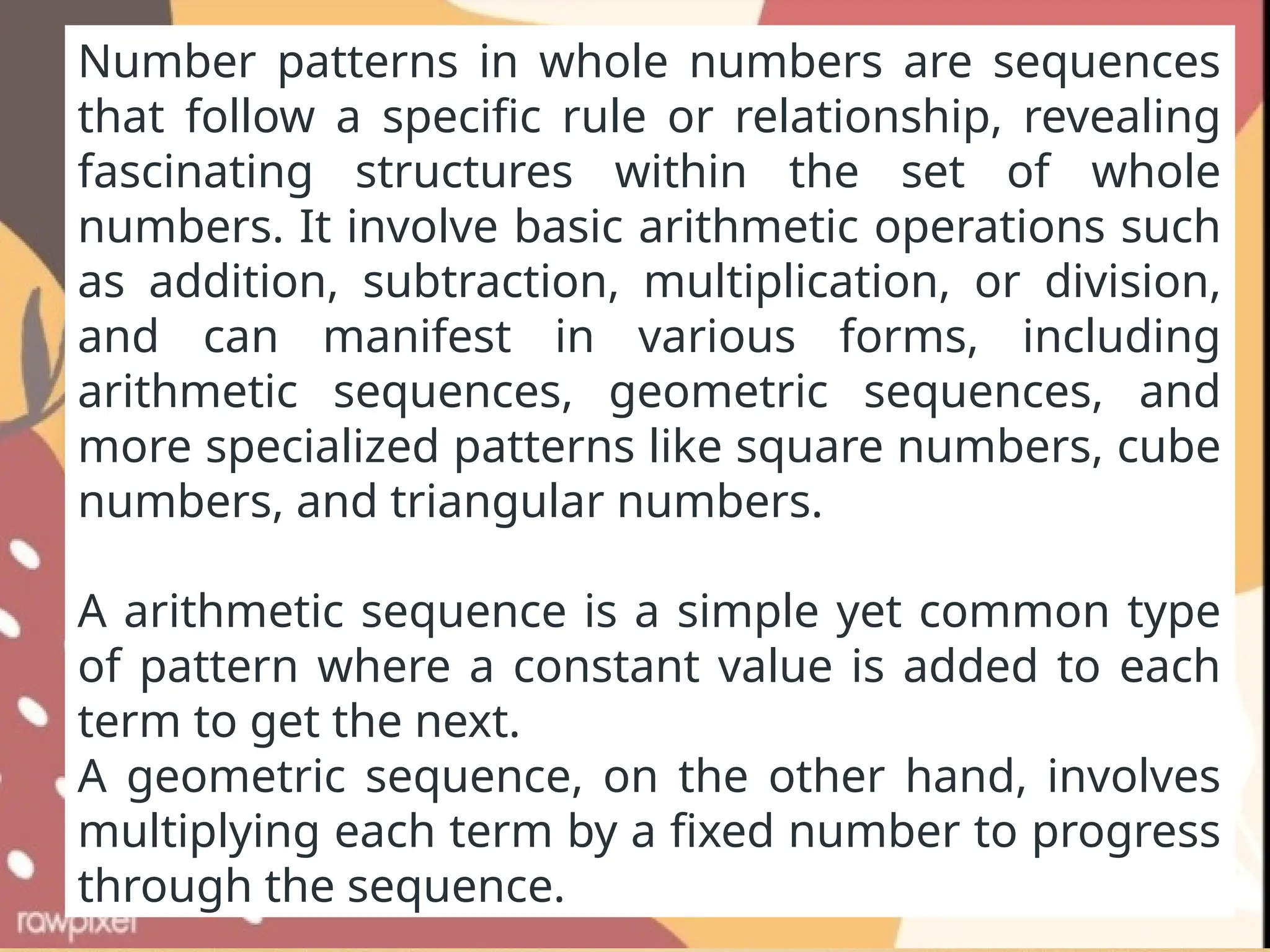
LOGIC PATTERN: For each figure, what comes
next?
Number patterns in whole numbers are sequences
that follow a specific rule or relationship, revealing
fascinating structures within the set of whole
numbers. It involve basic arithmetic operations such
as addition, subtraction, multiplication, or division,
and can manifest in various forms, including
arithmetic sequences, geometric sequences, and
more specialized patterns like square numbers, cube
numbers, and triangular numbers.
A arithmetic sequence is a simple yet common type
of pattern where a constant value is added to each
term to get the next.
A geometric sequence, on the other hand, involves
multiplying each term by a fixed number to progress
through the sequence.
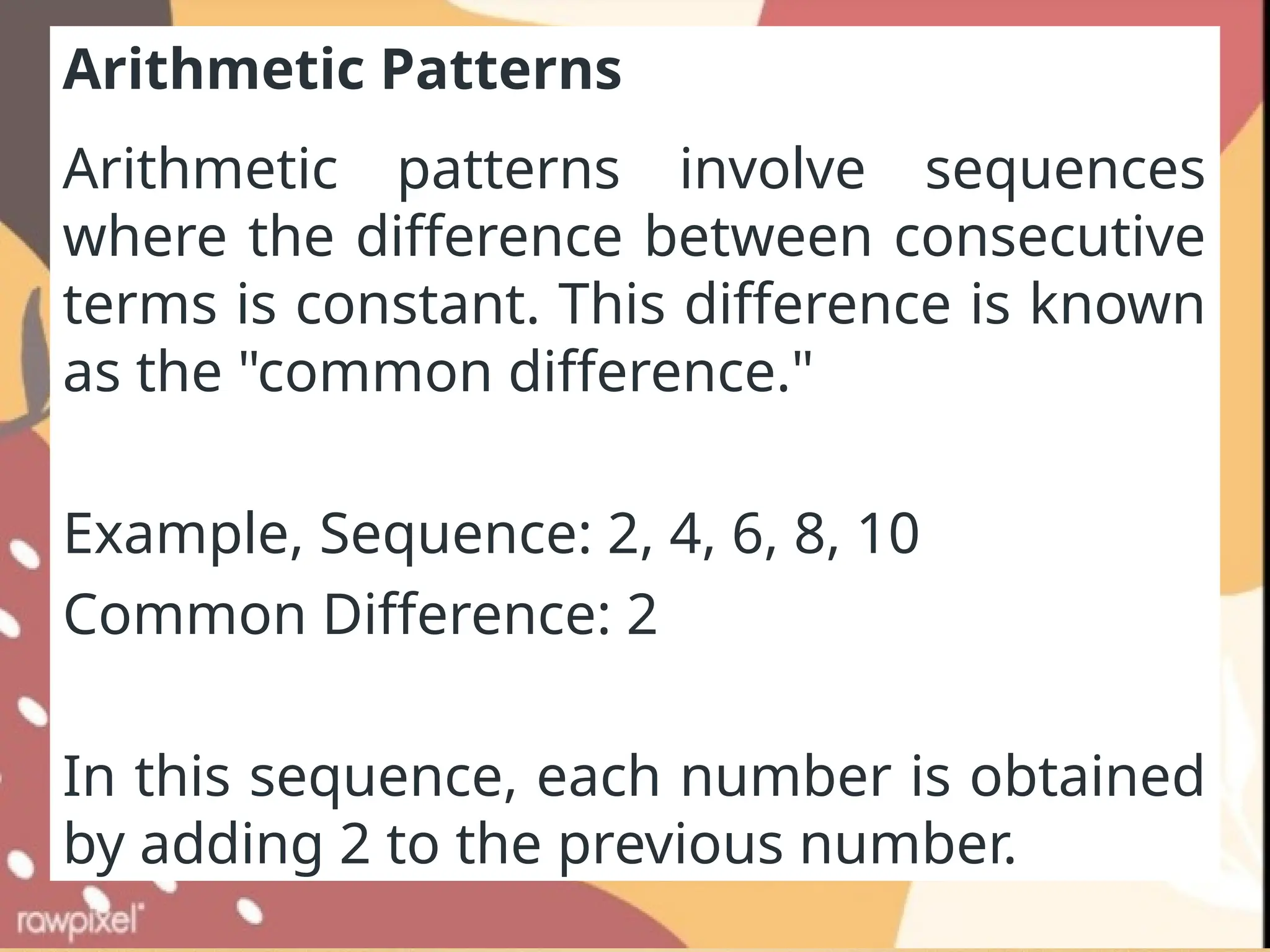
Arithmetic Patterns
Arithmetic patterns involve sequences
where the difference between consecutive
terms is constant. This difference is known
as the "common difference."
Example, Sequence: 2, 4, 6, 8, 10
Common Difference: 2
In this sequence, each number is obtained
by adding 2 to the previous number.
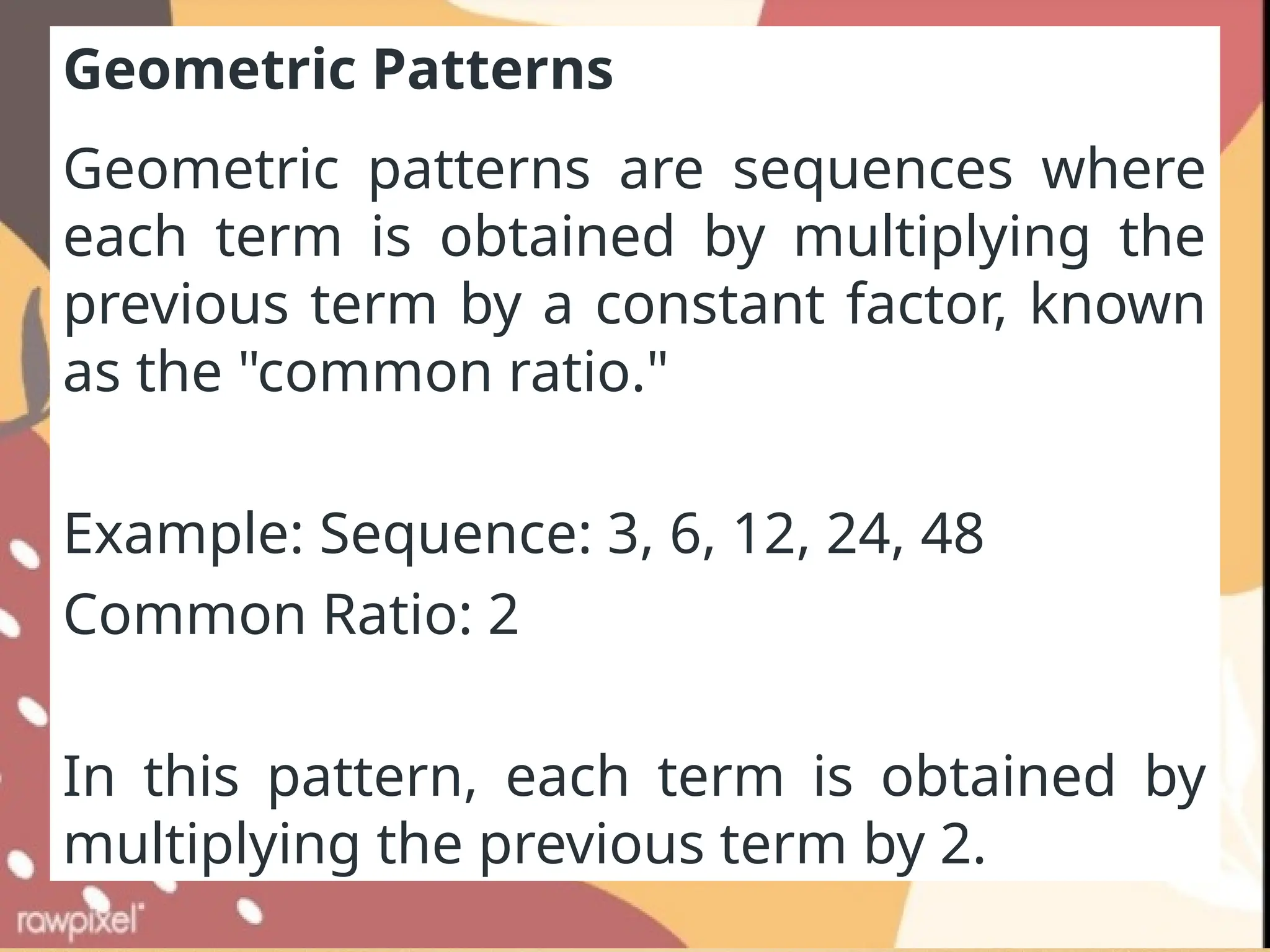
Geometric Patterns
Geometric patterns are sequences where
each term is obtained by multiplying the
previous term by a constant factor, known
as the "common ratio."
Example: Sequence: 3, 6, 12, 24, 48
Common Ratio: 2
In this pattern, each term is obtained by
multiplying the previous term by 2.
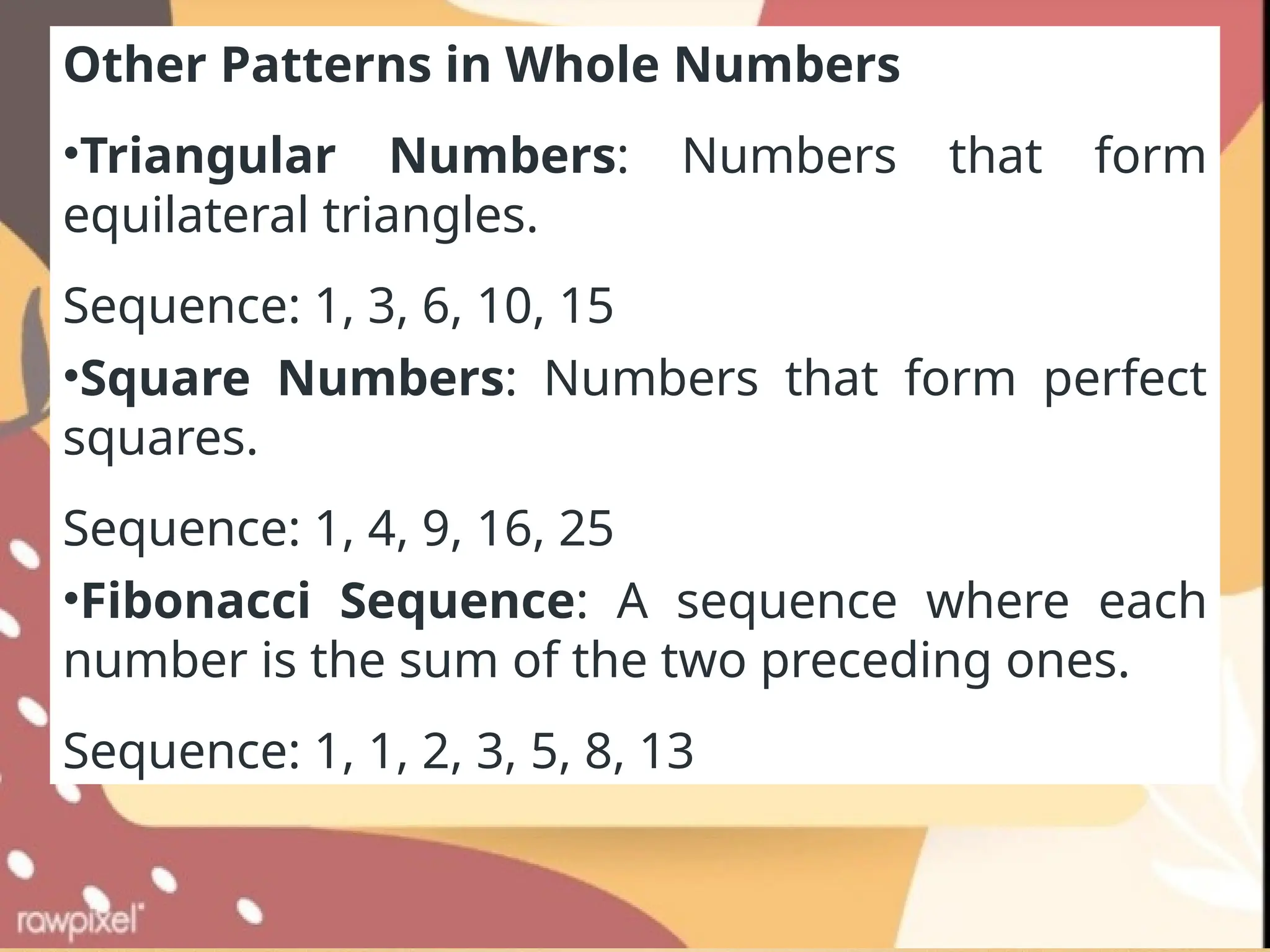
Other Patterns in Whole Numbers
•Triangular Numbers: Numbers that form
equilateral triangles.
Sequence: 1, 3, 6, 10, 15
•Square Numbers: Numbers that form perfect
squares.
Sequence: 1, 4, 9, 16, 25
•Fibonacci Sequence: A sequence where each
number is the sum of the two preceding ones.
Sequence: 1, 1, 2, 3, 5, 8, 13
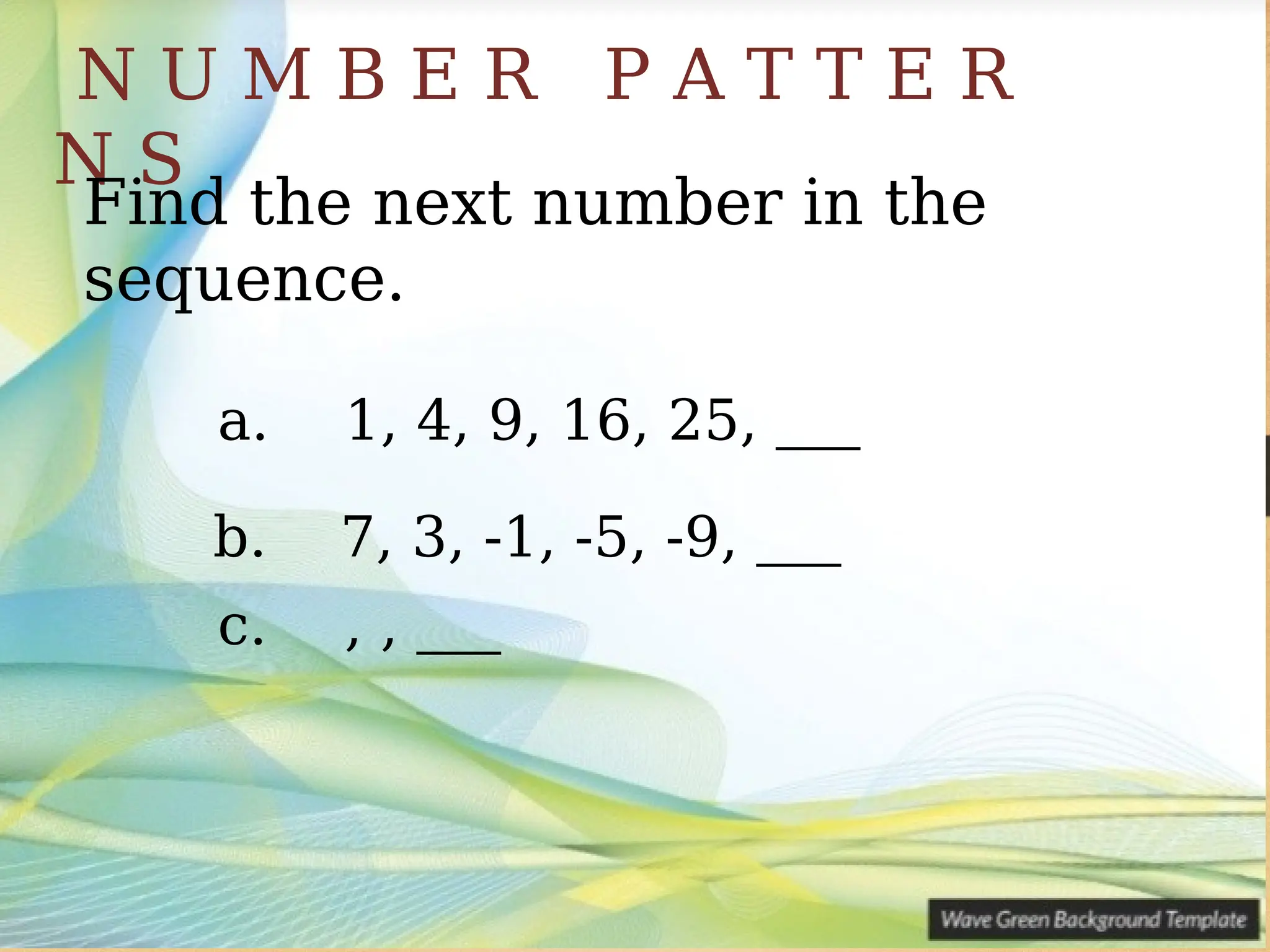
N U M B E R P A T T E R
N S
Find the next number in the
sequence.
a. 1, 4, 9, 16, 25, ___
b. 7, 3, -1, -5, -9, ___
c. , , ___
3. W O R D P A T T E R N S
Fill in the blanks.
a. Tree : leaf :: flower : _______
b. Dog : puppy :: cat : ________
c. Crocodile:
reptile::Dolphin:____________
d. Bees : hive :: bears : _______
e. Chef : food :: sculptor : _______
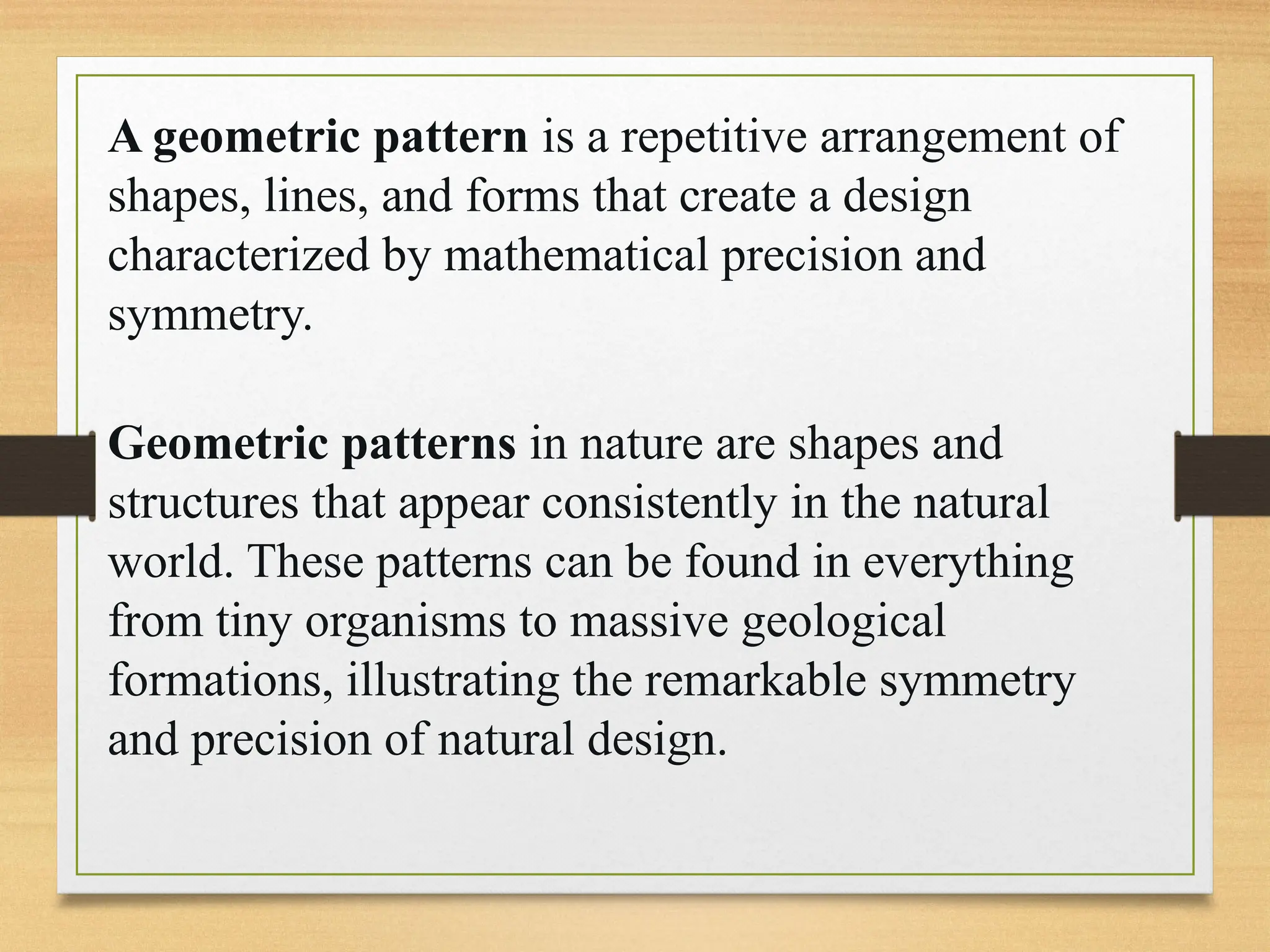
A geometric pattern is a repetitive arrangement of
shapes, lines, and forms that create a design
characterized by mathematical precision and
symmetry.
Geometric patterns in nature are shapes and
structures that appear consistently in the natural
world. These patterns can be found in everything
from tiny organisms to massive geological
formations, illustrating the remarkable symmetry
and precision of natural design.
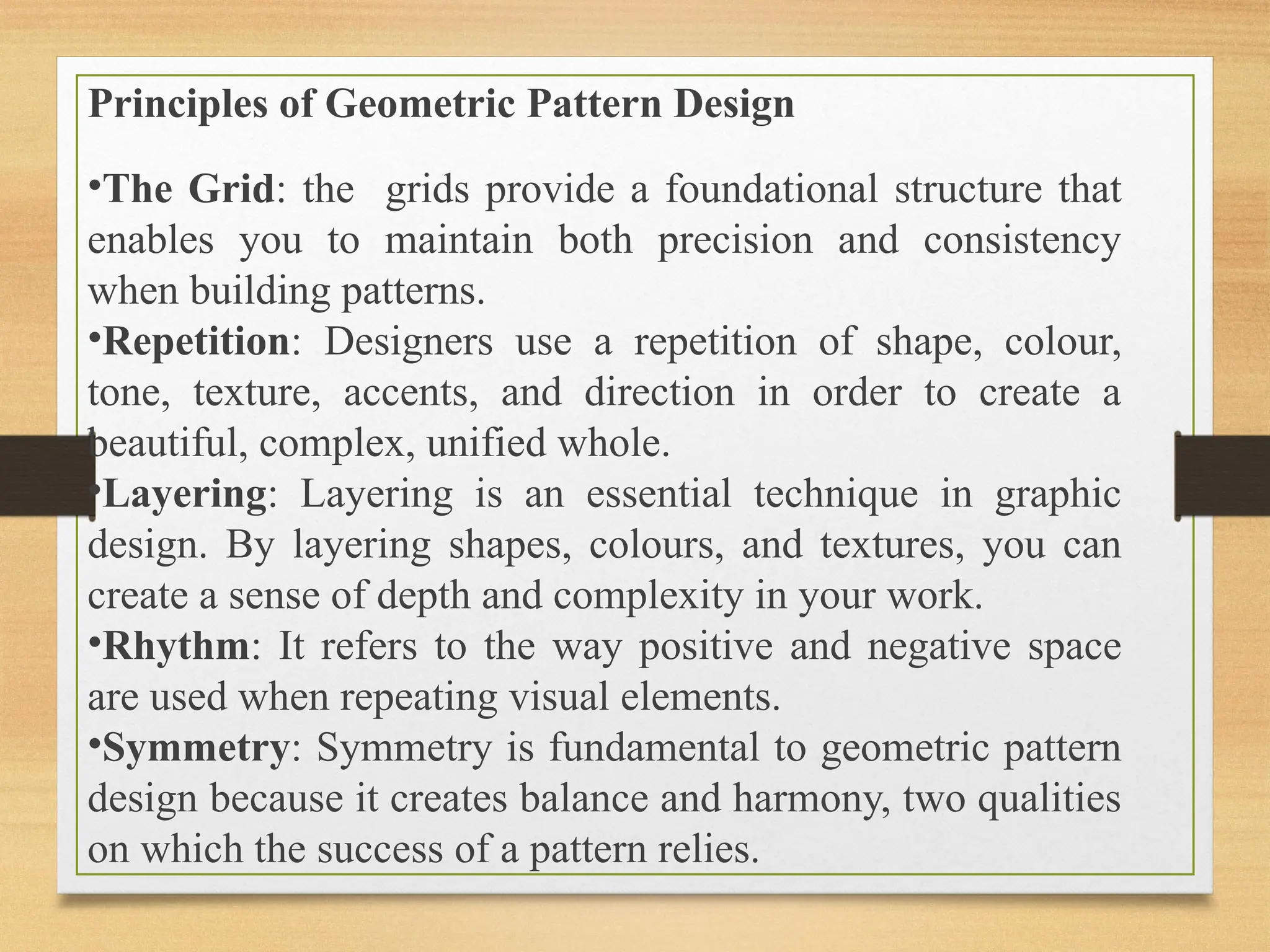
Principles of Geometric Pattern Design
•The Grid: the grids provide a foundational structure that
enables you to maintain both precision and consistency
when building patterns.
•Repetition: Designers use a repetition of shape, colour,
tone, texture, accents, and direction in order to create a
beautiful, complex, unified whole.
•Layering: Layering is an essential technique in graphic
design. By layering shapes, colours, and textures, you can
create a sense of depth and complexity in your work.
•Rhythm: It refers to the way positive and negative space
are used when repeating visual elements.
•Symmetry: Symmetry is fundamental to geometric pattern
design because it creates balance and harmony, two qualities
on which the success of a pattern relies.
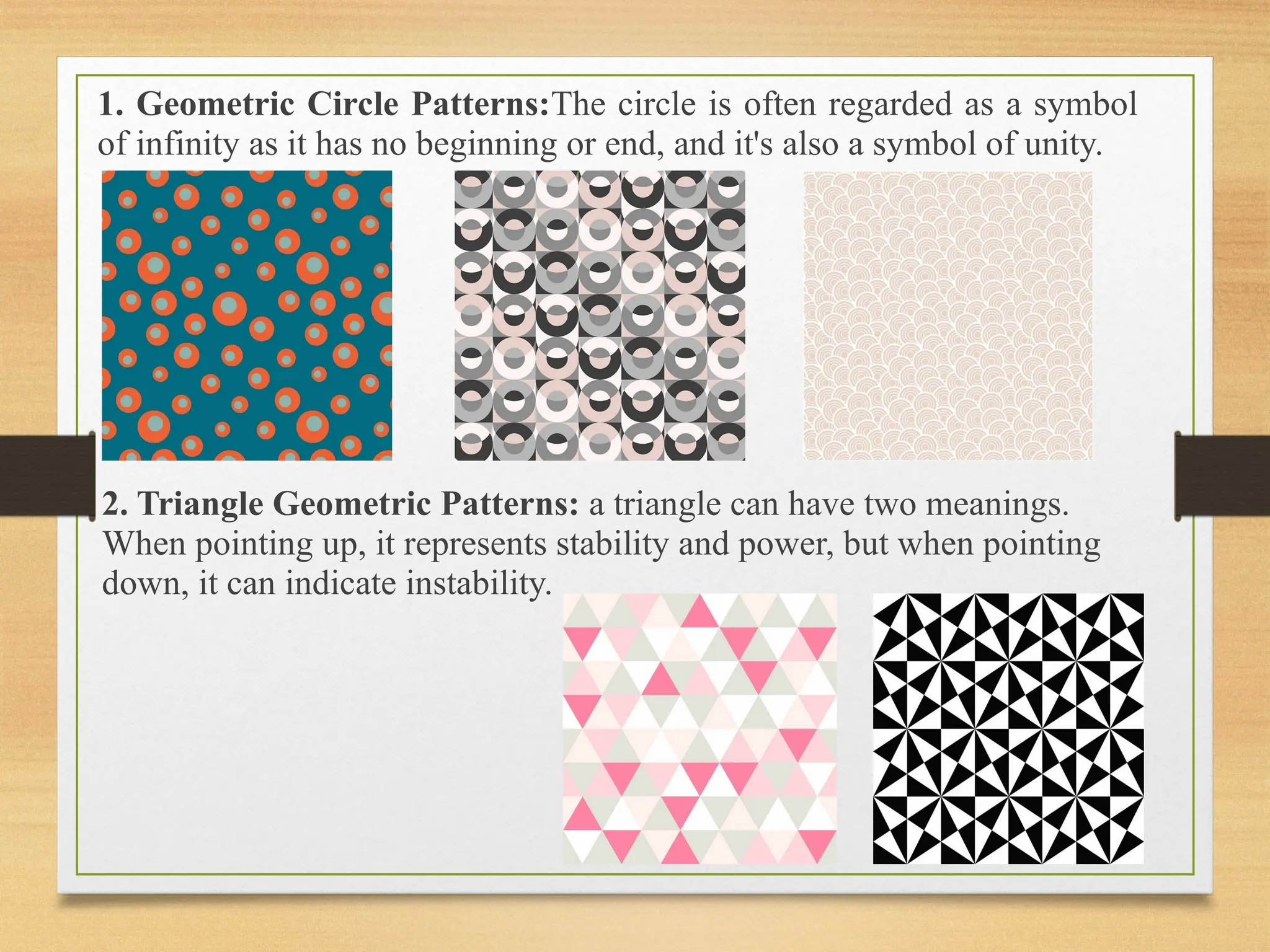
1. Geometric Circle Patterns:The circle is often regarded as a symbol
of infinity as it has no beginning or end, and it's also a symbol of unity.
2. Triangle Geometric Patterns: a triangle can have two meanings.
When pointing up, it represents stability and power, but when pointing
down, it can indicate instability.
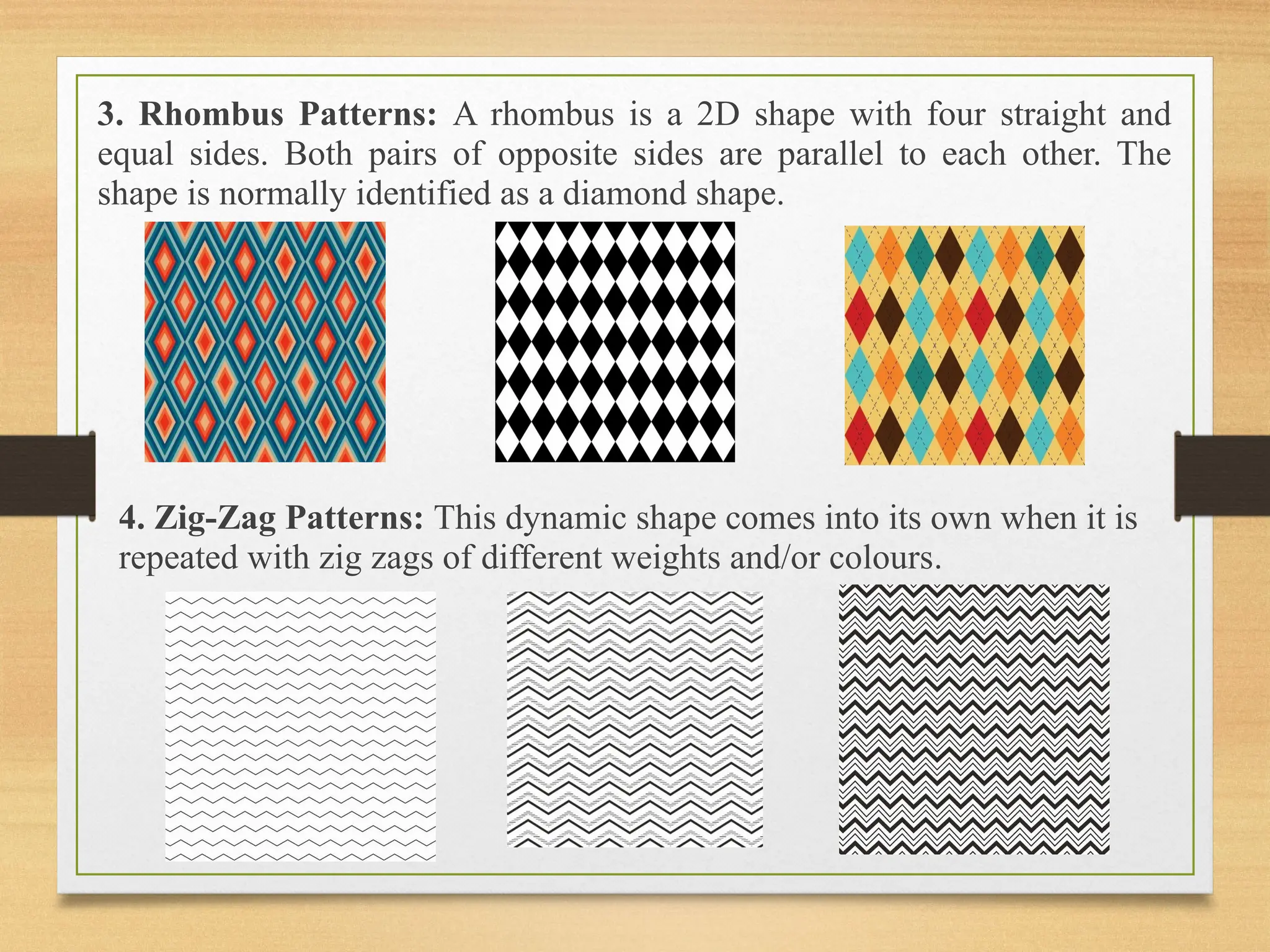
3. Rhombus Patterns: A rhombus is a 2D shape with four straight and
equal sides. Both pairs of opposite sides are parallel to each other. The
shape is normally identified as a diamond shape.
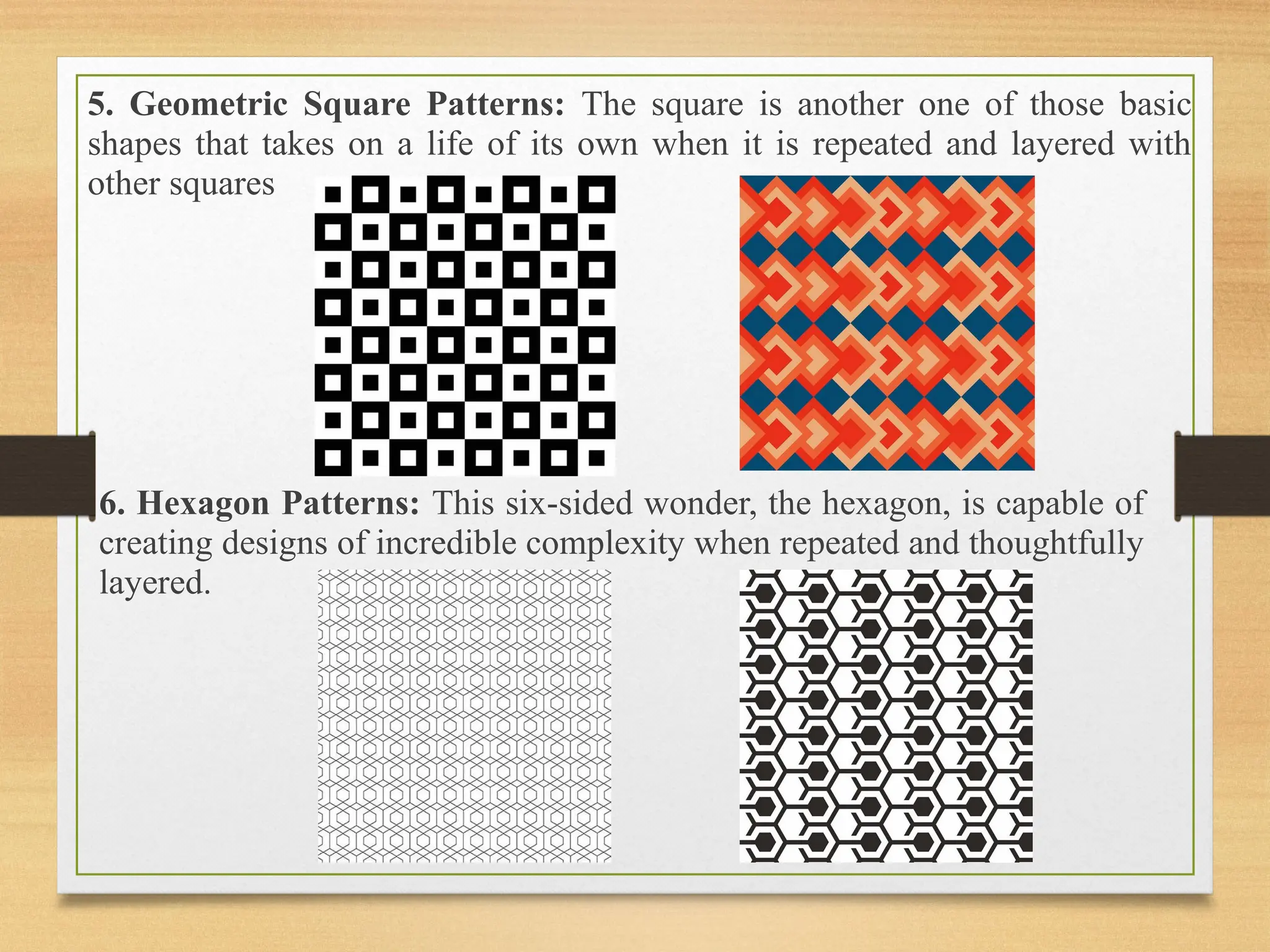
4. Zig-Zag Patterns: This dynamic shape comes into its own when it is
repeated with zig zags of different weights and/or colours.
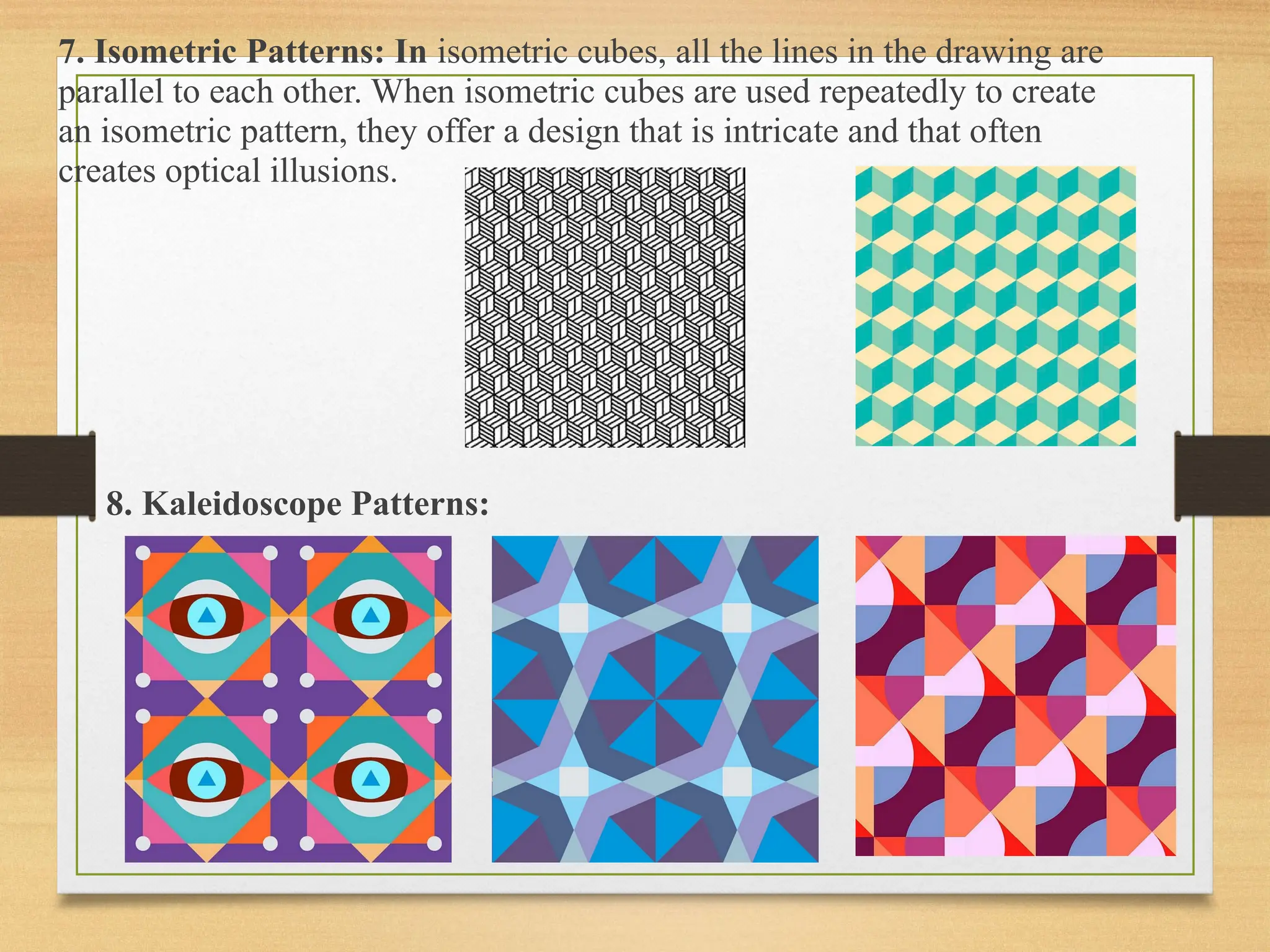
5. Geometric Square Patterns: The square is another one of those basic
shapes that takes on a life of its own when it is repeated and layered with
other squares
6. Hexagon Patterns: This six-sided wonder, the hexagon, is capable of
creating designs of incredible complexity when repeated and thoughtfully
layered.
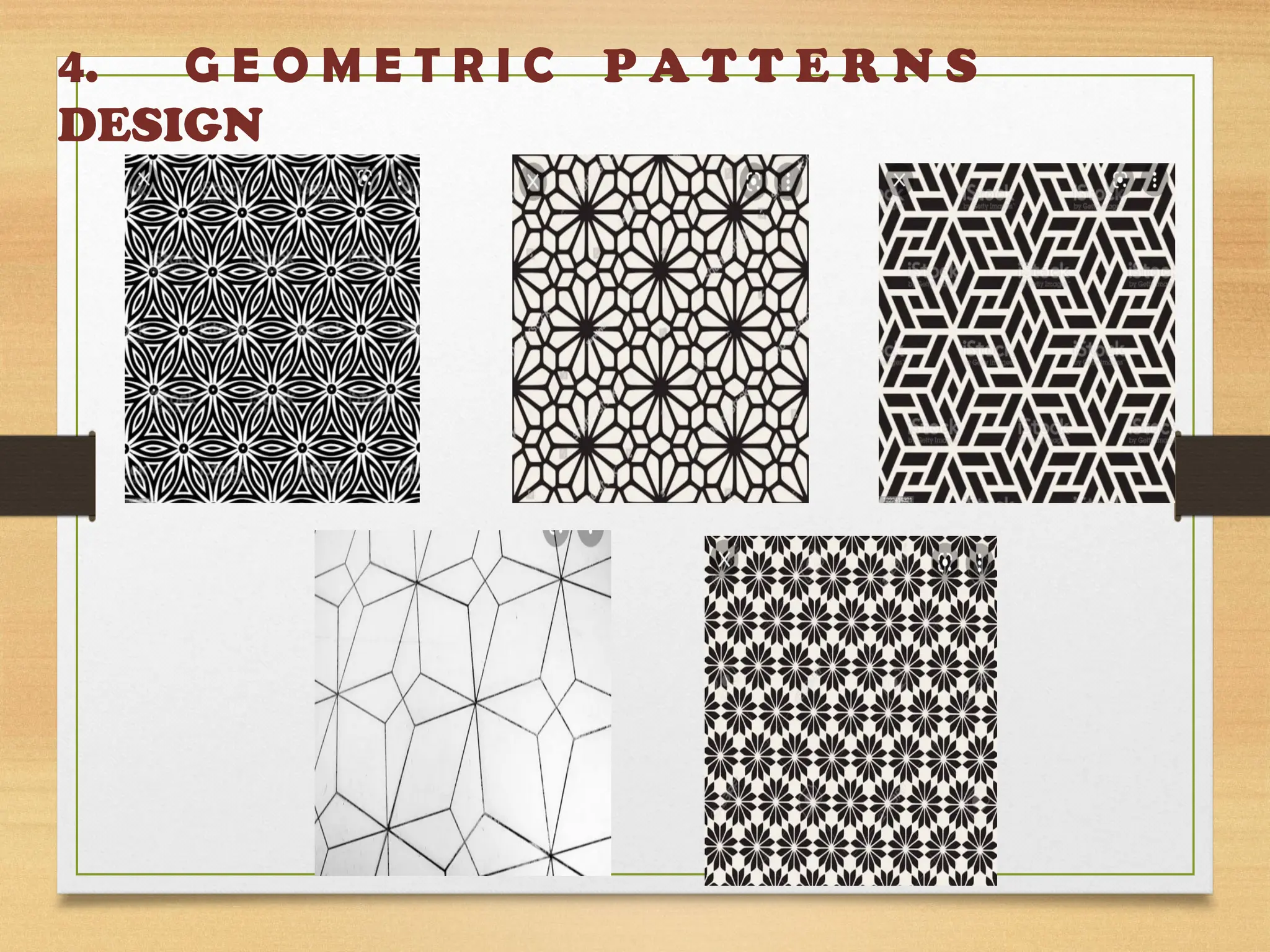
7. Isometric Patterns: In isometric cubes, all the lines in the drawing are
parallel to each other. When isometric cubes are used repeatedly to create
an isometric pattern, they offer a design that is intricate and that often
creates optical illusions.
8. Kaleidoscope Patterns:
4. G E O M E T R I C P A T T E R N S
DESIGN
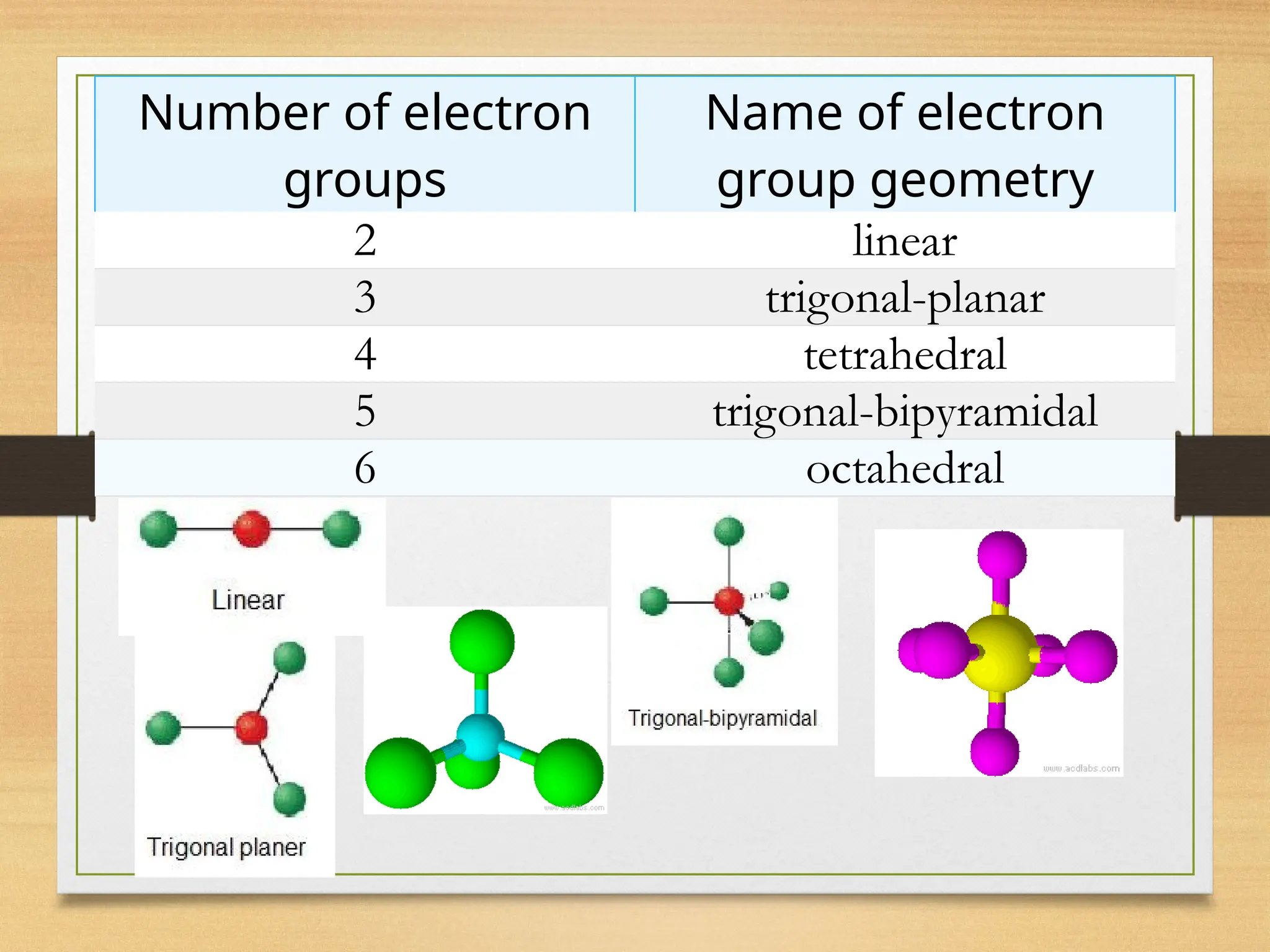
Number of electron
groups
Name of electron
group geometry
2 linear
3 trigonal-planar
4 tetrahedral
5 trigonal-bipyramidal
6 octahedral
EXAMPLES OF PATTERNS IN NATURE
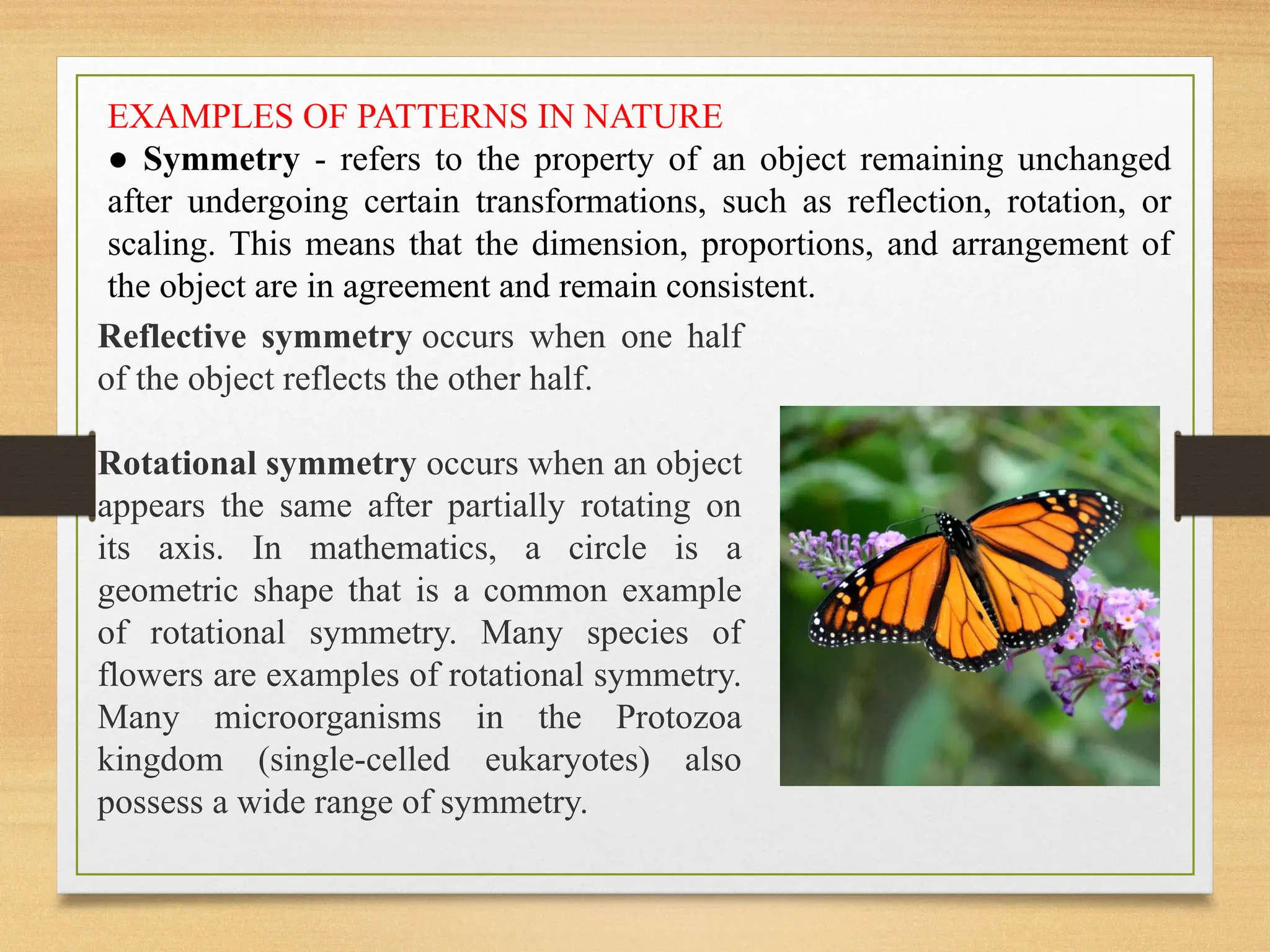
● Symmetry - refers to the property of an object remaining unchanged
after undergoing certain transformations, such as reflection, rotation, or
scaling. This means that the dimension, proportions, and arrangement of
the object are in agreement and remain consistent.
Reflective symmetry occurs when one half
of the object reflects the other half.
Rotational symmetry occurs when an object
appears the same after partially rotating on
its axis. In mathematics, a circle is a
geometric shape that is a common example
of rotational symmetry. Many species of
flowers are examples of rotational symmetry.
Many microorganisms in the Protozoa
kingdom (single-celled eukaryotes) also
possess a wide range of symmetry.
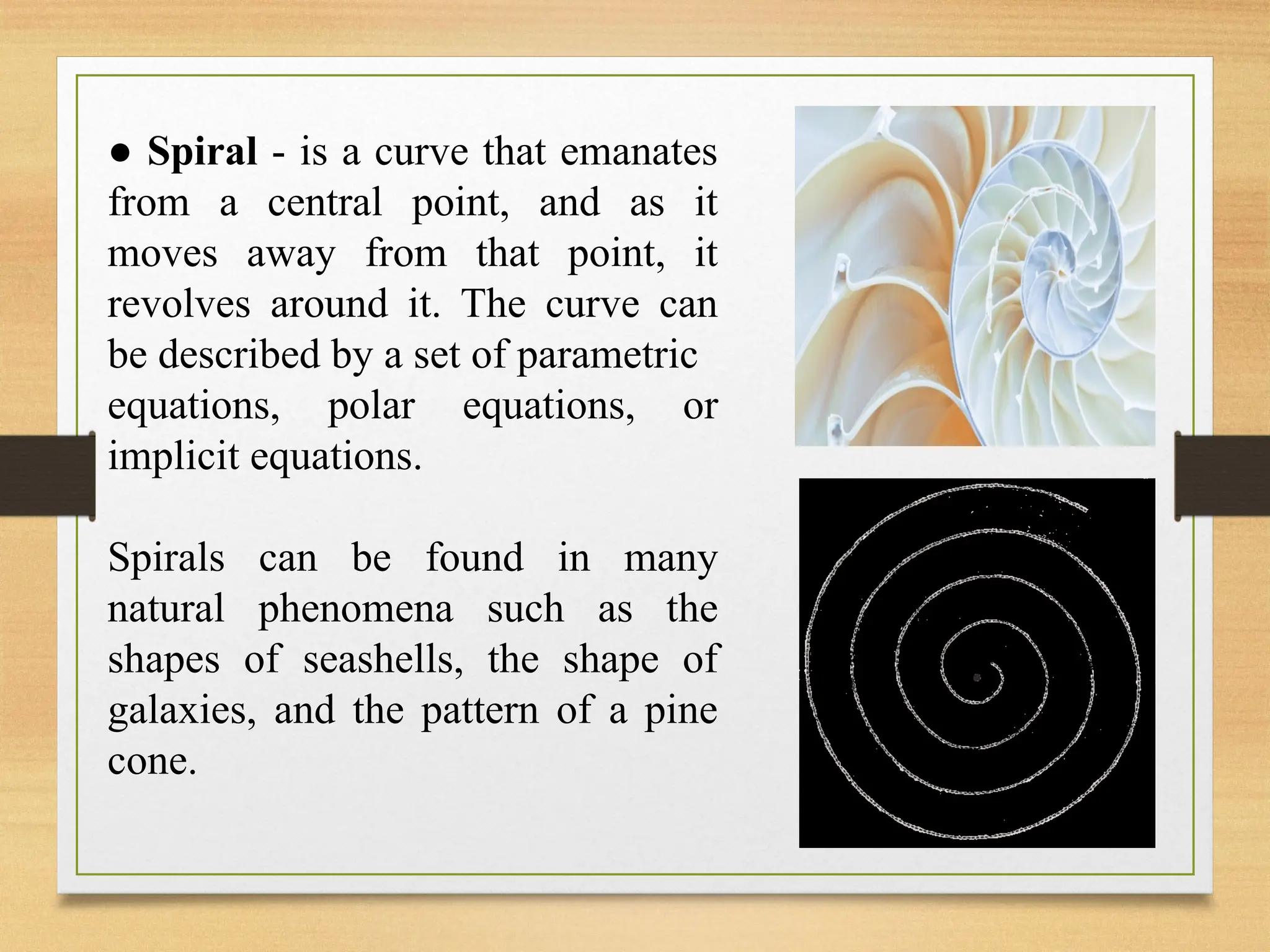
● Spiral - is a curve that emanates
from a central point, and as it
moves away from that point, it
revolves around it. The curve can
be described by a set of parametric
equations, polar equations, or
implicit equations.
Spirals can be found in many
natural phenomena such as the
shapes of seashells, the shape of
galaxies, and the pattern of a pine
cone.
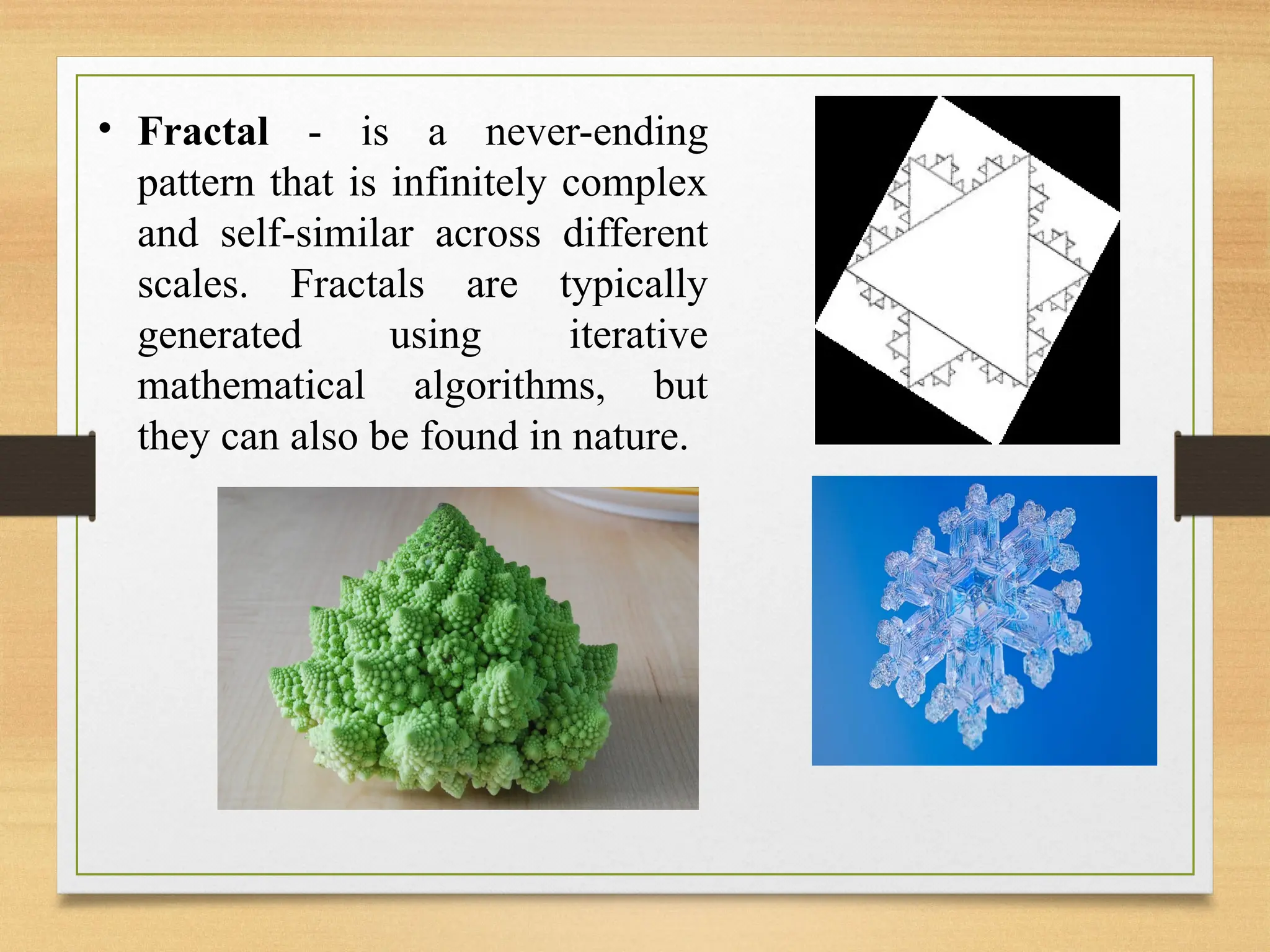
• Fractal - is a never-ending
pattern that is infinitely complex
and self-similar across different
scales. Fractals are typically
generated using iterative
mathematical algorithms, but
they can also be found in nature.
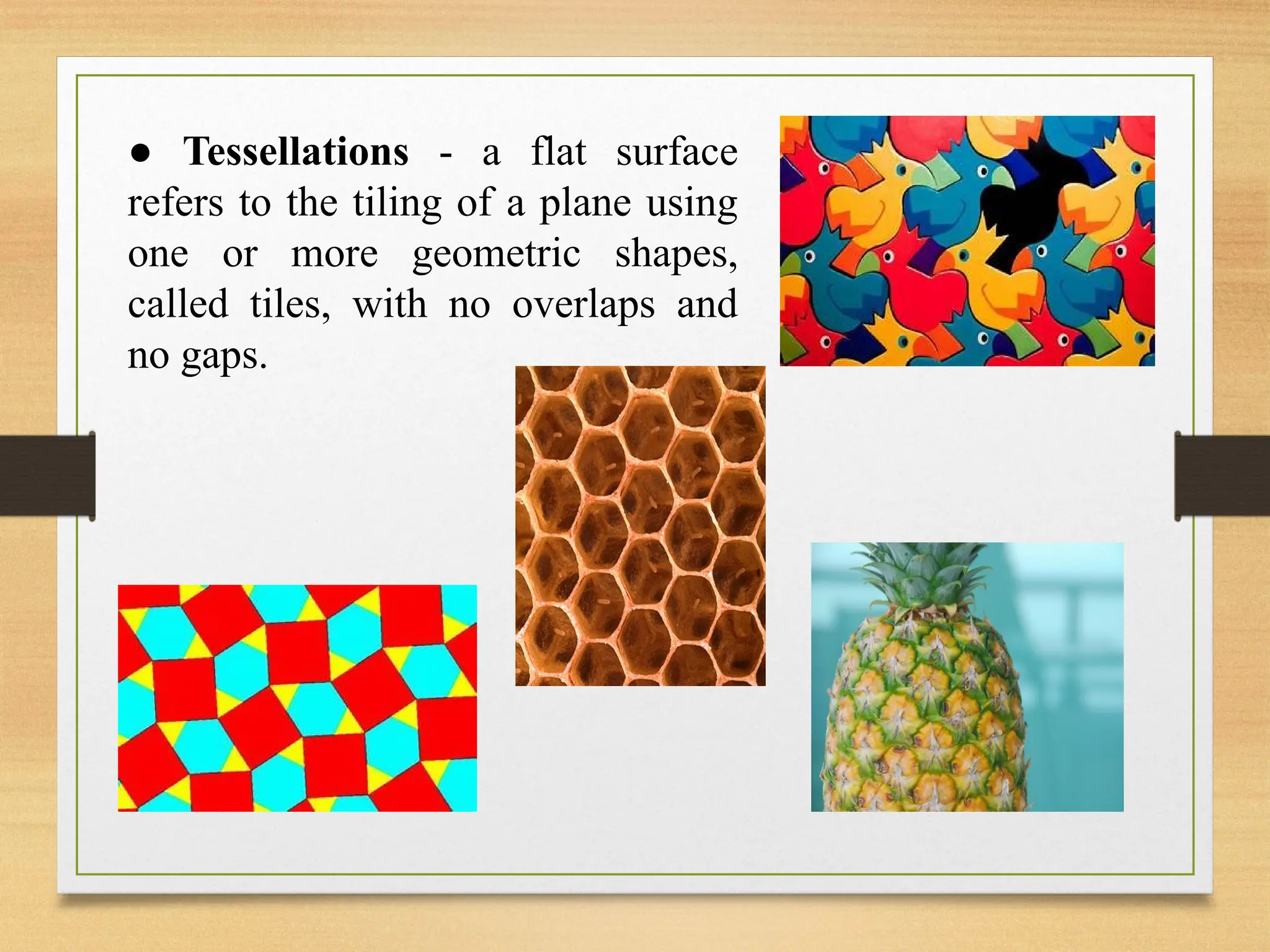
● Tessellations - a flat surface
refers to the tiling of a plane using
one or more geometric shapes,
called tiles, with no overlaps and
no gaps.
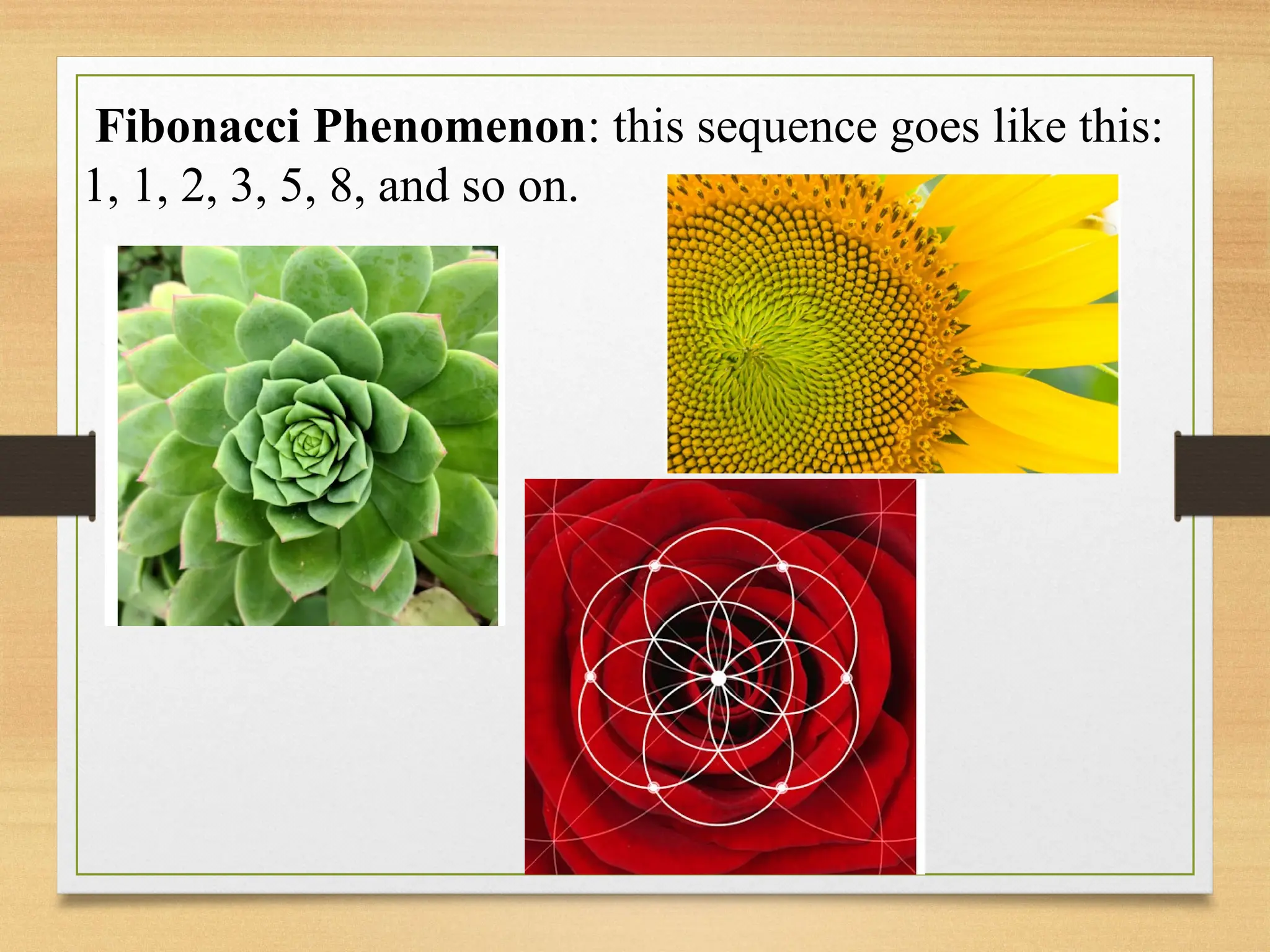
Fibonacci Phenomenon: this sequence goes like this:
1, 1, 2, 3, 5, 8, and so on.
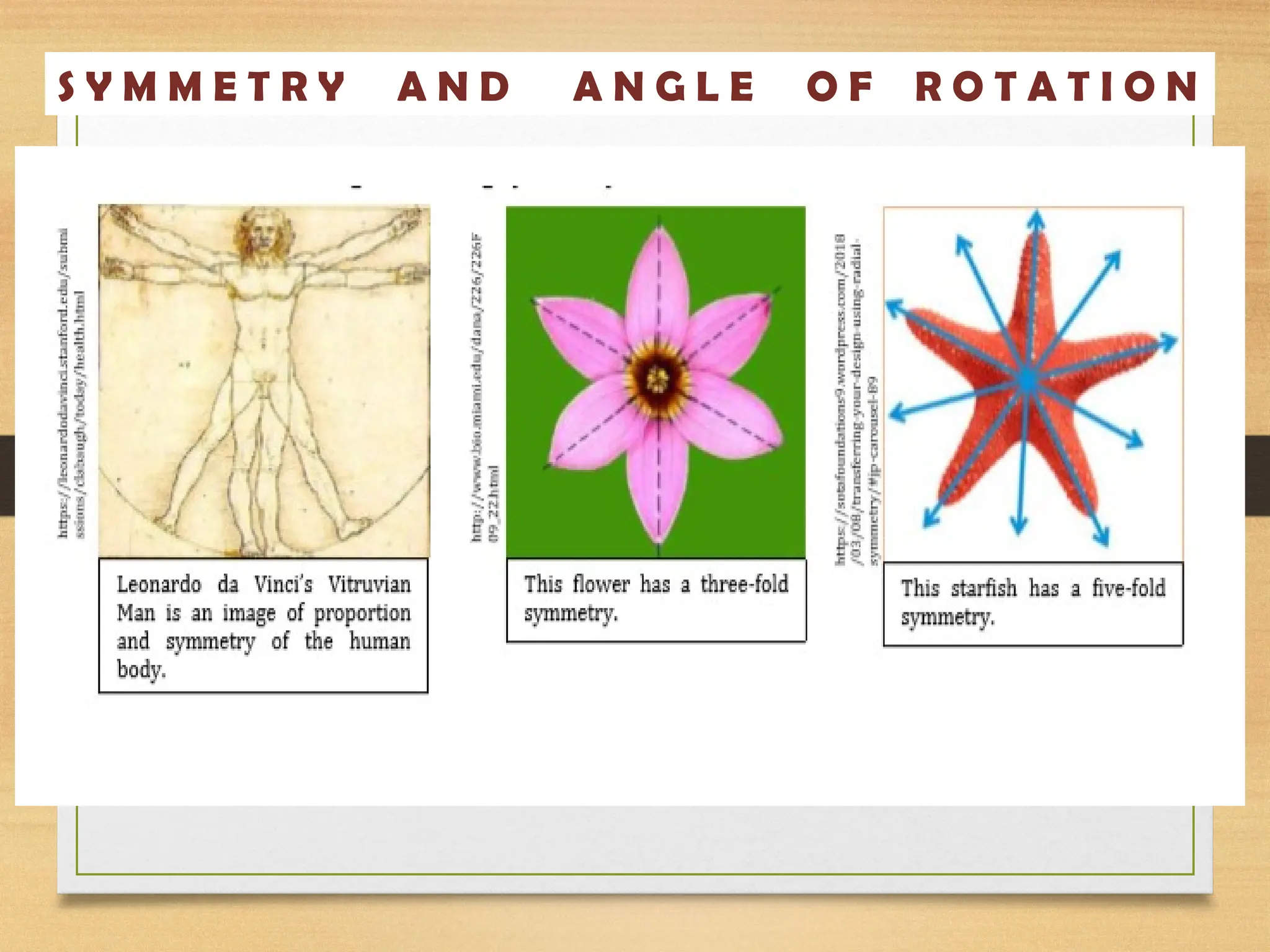
S Y M M E T R Y A N D A N G L E O F R O T A T I O N
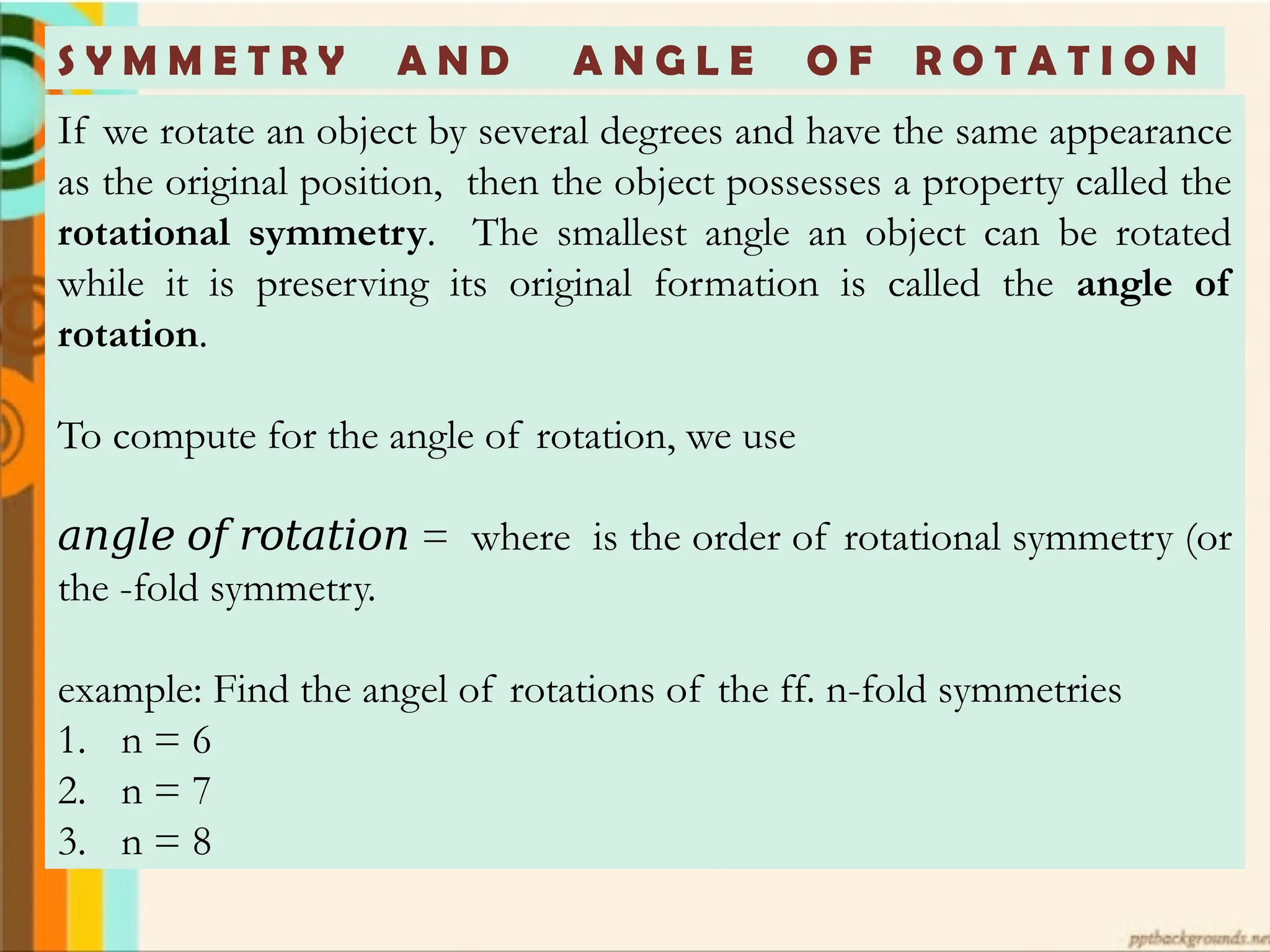
If we rotate an object by several degrees and have the same appearance
as the original position, then the object possesses a property called the
rotational symmetry. The smallest angle an object can be rotated
while it is preserving its original formation is called the angle of
rotation.
To compute for the angle of rotation, we use
𝑎𝑛𝑔𝑙𝑒 𝑜𝑓 𝑟𝑜𝑡𝑎𝑡𝑖𝑜𝑛 = where is the order of rotational symmetry (or
the -fold symmetry.
example: Find the angel of rotations of the ff. n-fold symmetries
1. n = 6
2. n = 7
3. n = 8
W O R L D P O P U L A T I O N
The exponential growth model is one of the two mathematical modelling of
population growth. It holds the assumption that the population grows at a rate
proportional to the present size of the population.
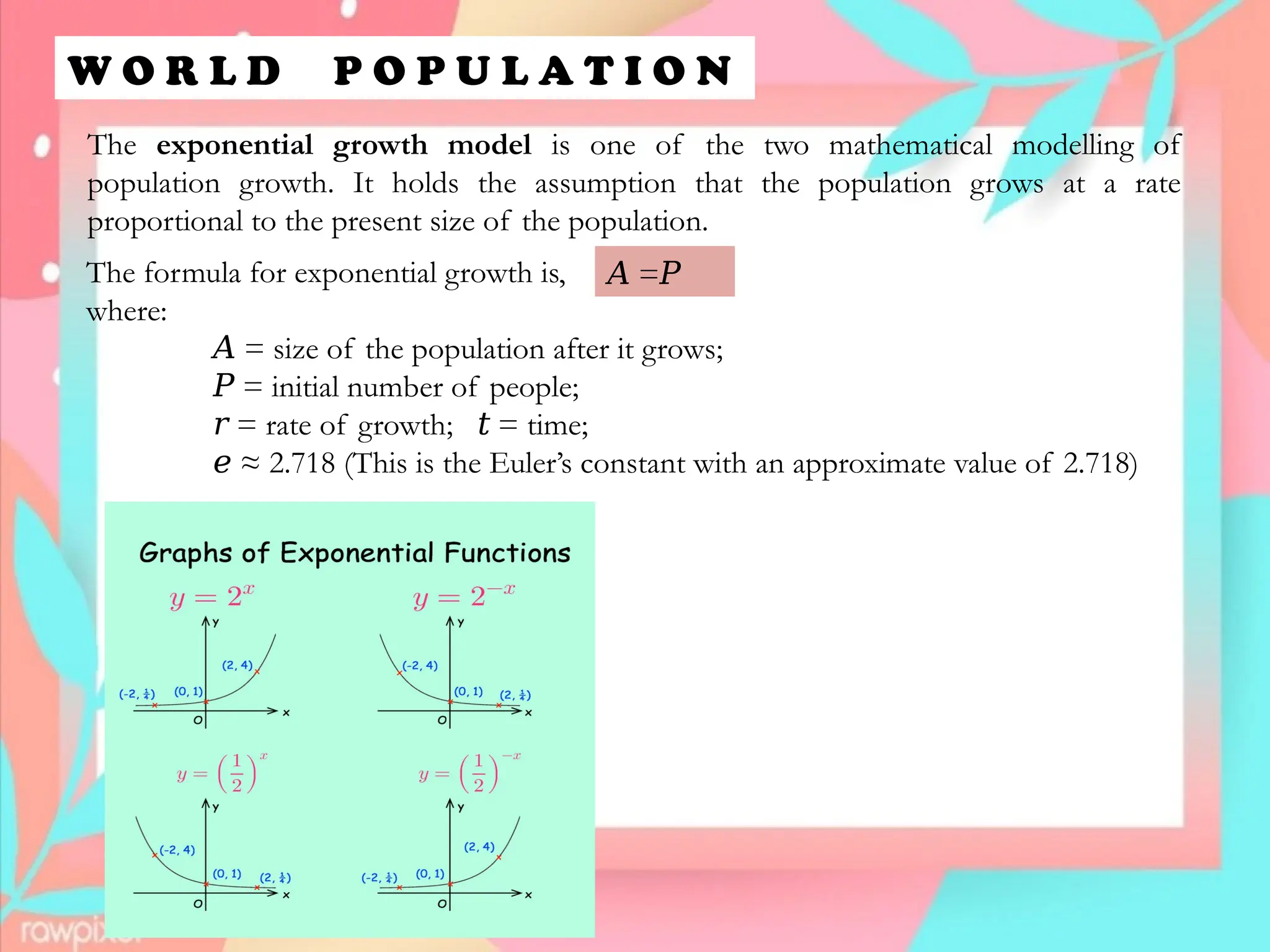
The formula for exponential growth is,
where:
𝐴 = size of the population after it grows;
𝑃 = initial number of people;
𝑟 = rate of growth; = time;
𝑡
≈
𝑒 2.718 (This is the Euler’s constant with an approximate value of 2.718)
𝐴 =𝑃
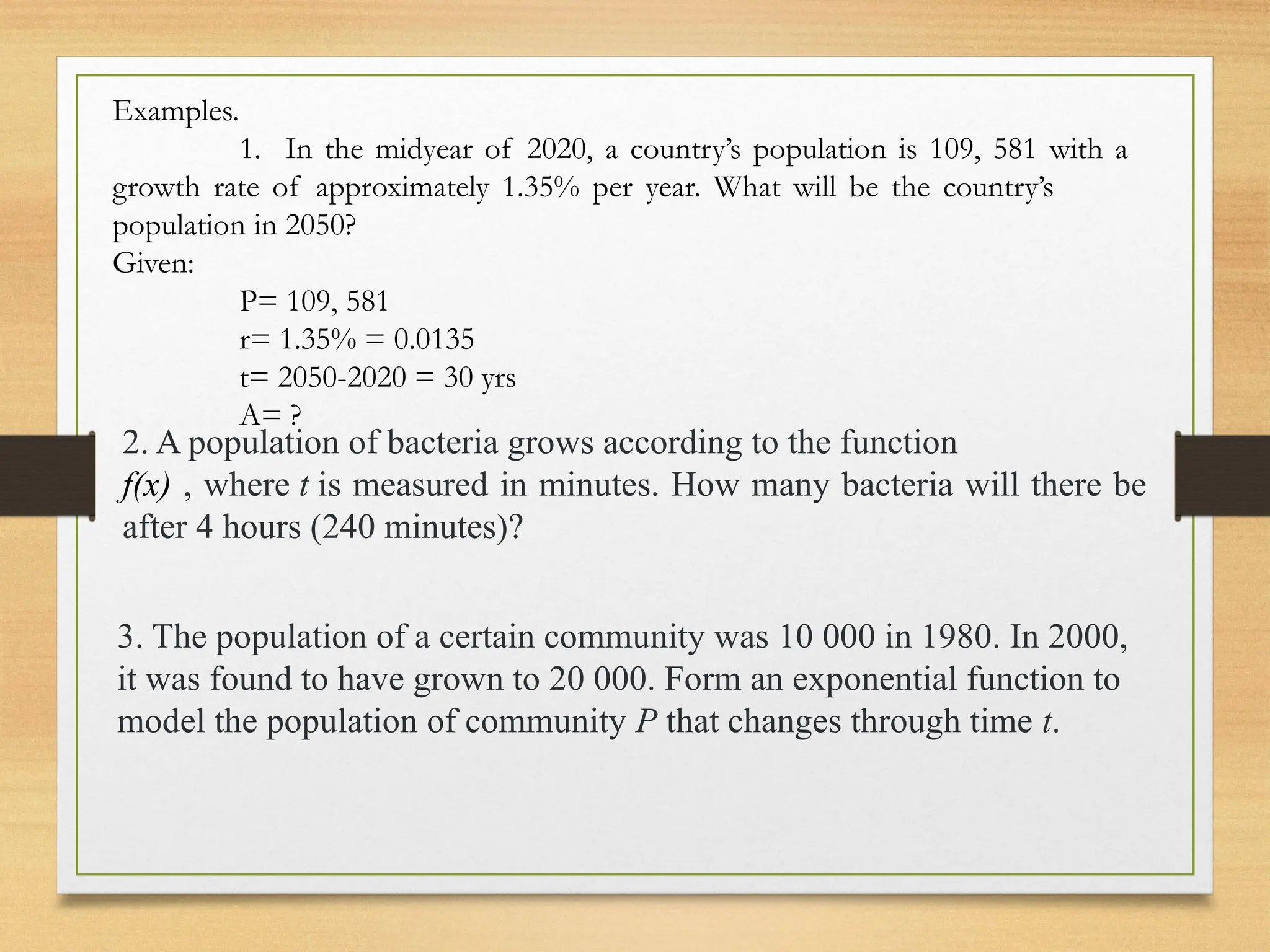
2. A population of bacteria grows according to the function
f(x) , where t is measured in minutes. How many bacteria will there be
after 4 hours (240 minutes)?
Examples.
1. In the midyear of 2020, a country’s population is 109, 581 with a
growth rate of approximately 1.35% per year. What will be the country’s
population in 2050?
Given:
P= 109, 581
r= 1.35% = 0.0135
t= 2050-2020 = 30 yrs
A= ?
3. The population of a certain community was 10 000 in 1980. In 2000,
it was found to have grown to 20 000. Form an exponential function to
model the population of community P that changes through time t.
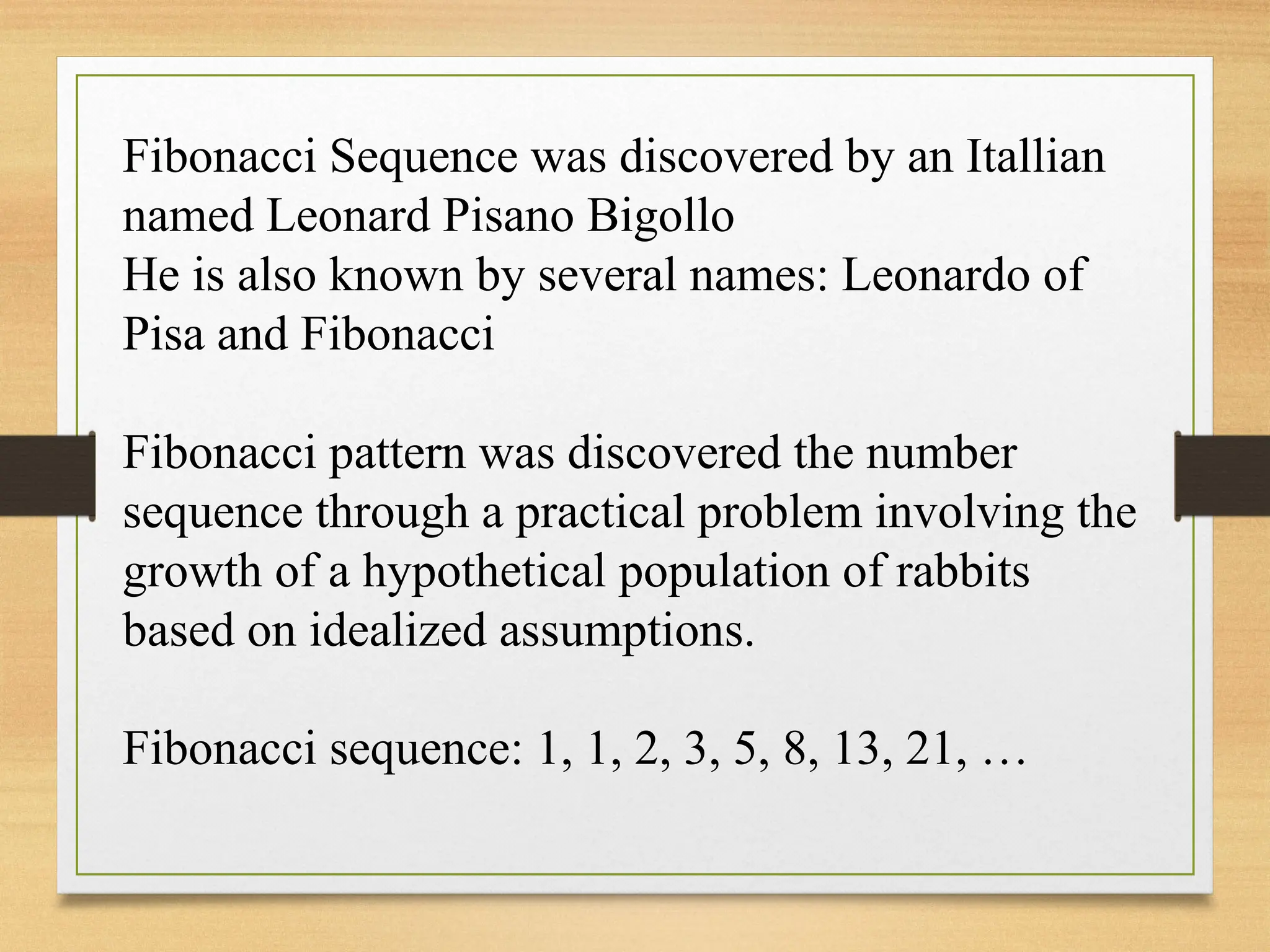
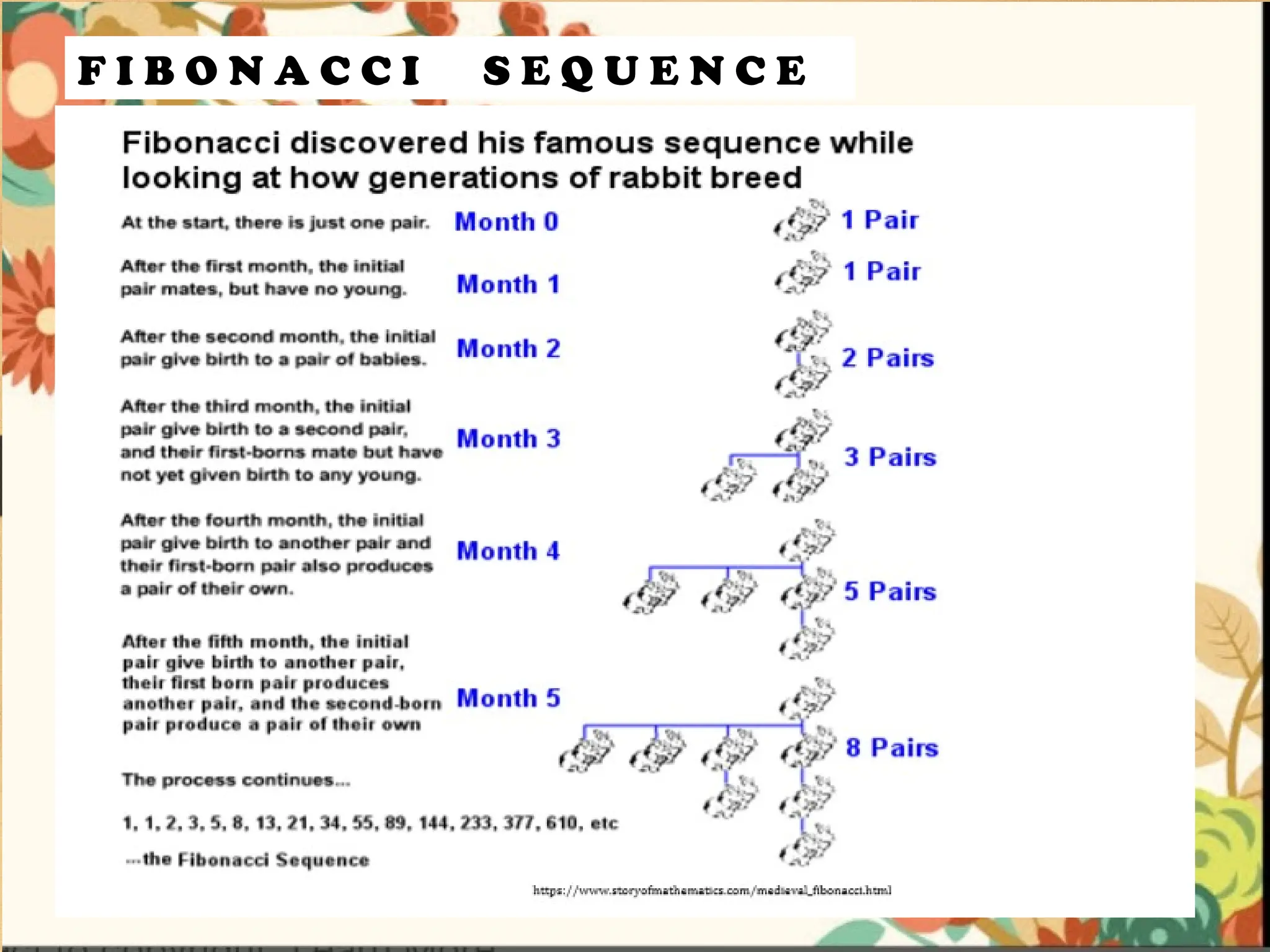
Fibonacci Sequence was discovered by an Itallian
named Leonard Pisano Bigollo
He is also known by several names: Leonardo of
Pisa and Fibonacci
Fibonacci pattern was discovered the number
sequence through a practical problem involving the
growth of a hypothetical population of rabbits
based on idealized assumptions.
Fibonacci sequence: 1, 1, 2, 3, 5, 8, 13, 21, …
F I B O N A C C I S E Q U E N C E
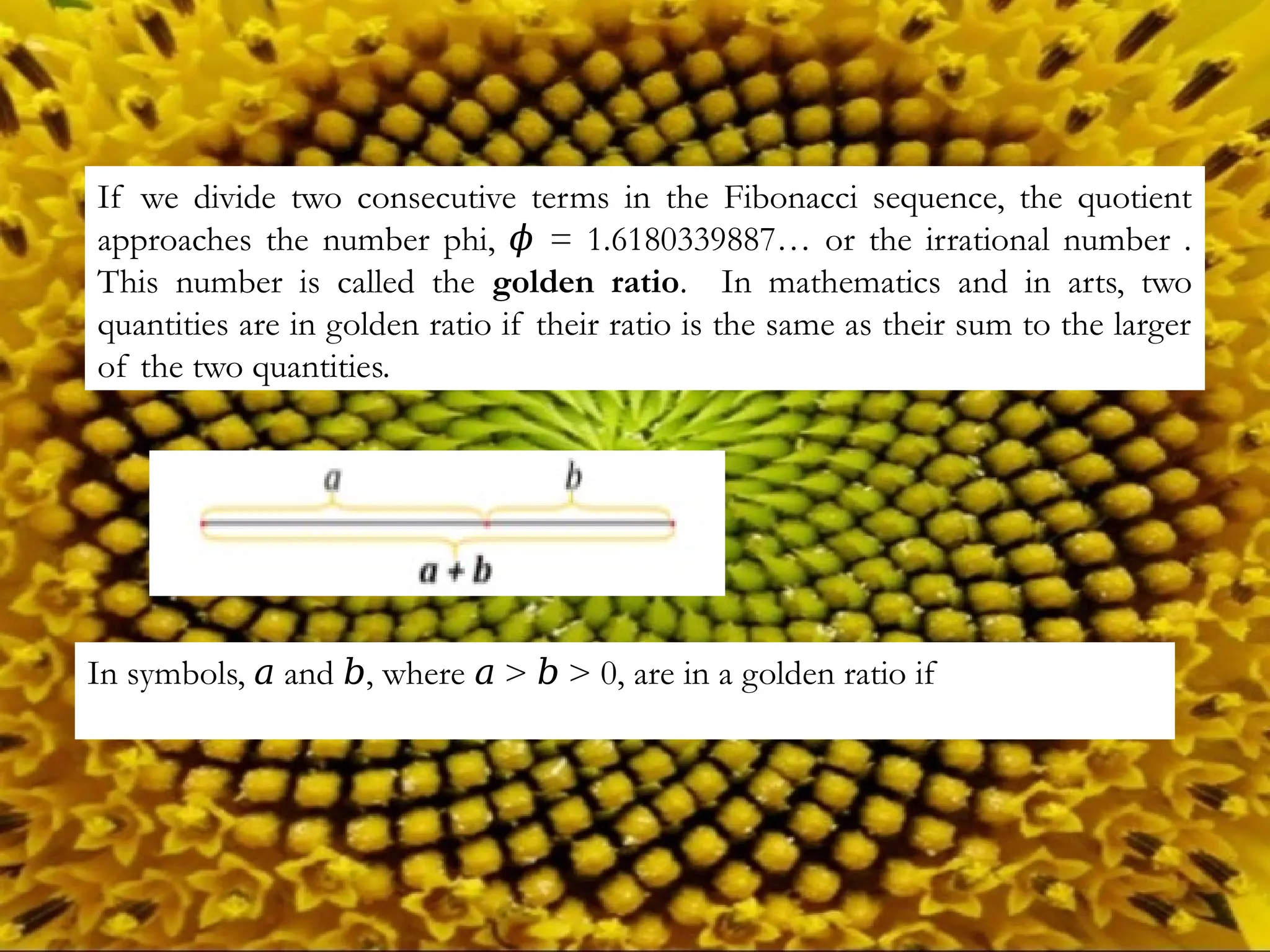
If we divide two consecutive terms in the Fibonacci sequence, the quotient
approaches the number phi, = 1.6180339887… or the irrational number .
𝜙
This number is called the golden ratio. In mathematics and in arts, two
quantities are in golden ratio if their ratio is the same as their sum to the larger
of the two quantities.
In symbols, and , where > > 0, are in a golden ratio if
𝑎 𝑏 𝑎 𝑏
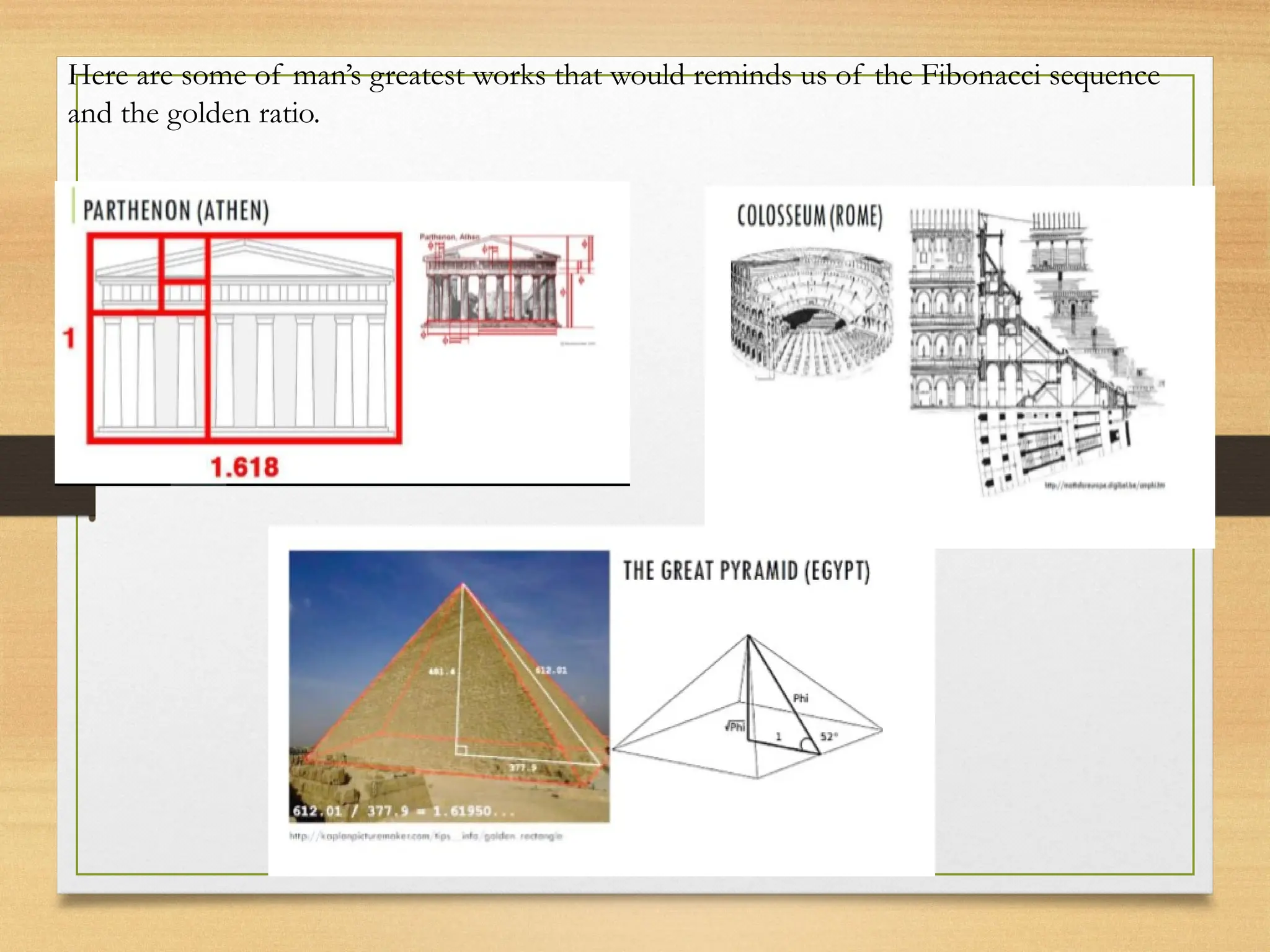
Here are some of man’s greatest works that would reminds us of the Fibonacci sequence
and the golden ratio.
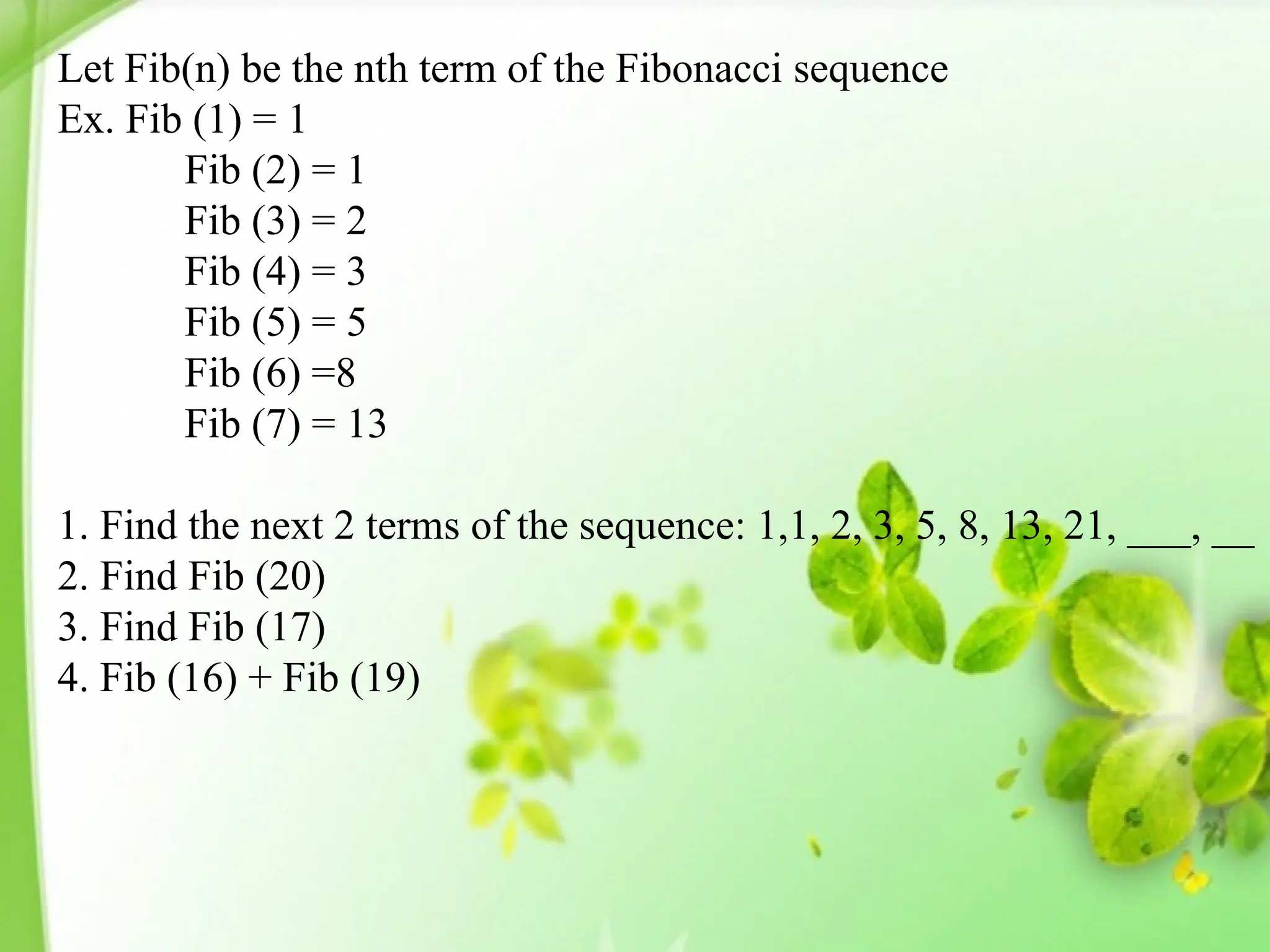
Let Fib(n) be the nth term of the Fibonacci sequence
Ex. Fib (1) = 1
Fib (2) = 1
Fib (3) = 2
Fib (4) = 3
Fib (5) = 5
Fib (6) =8
Fib (7) = 13
1. Find the next 2 terms of the sequence: 1,1, 2, 3, 5, 8, 13, 21, ___, __
2. Find Fib (20)
3. Find Fib (17)
4. Fib (16) + Fib (19)
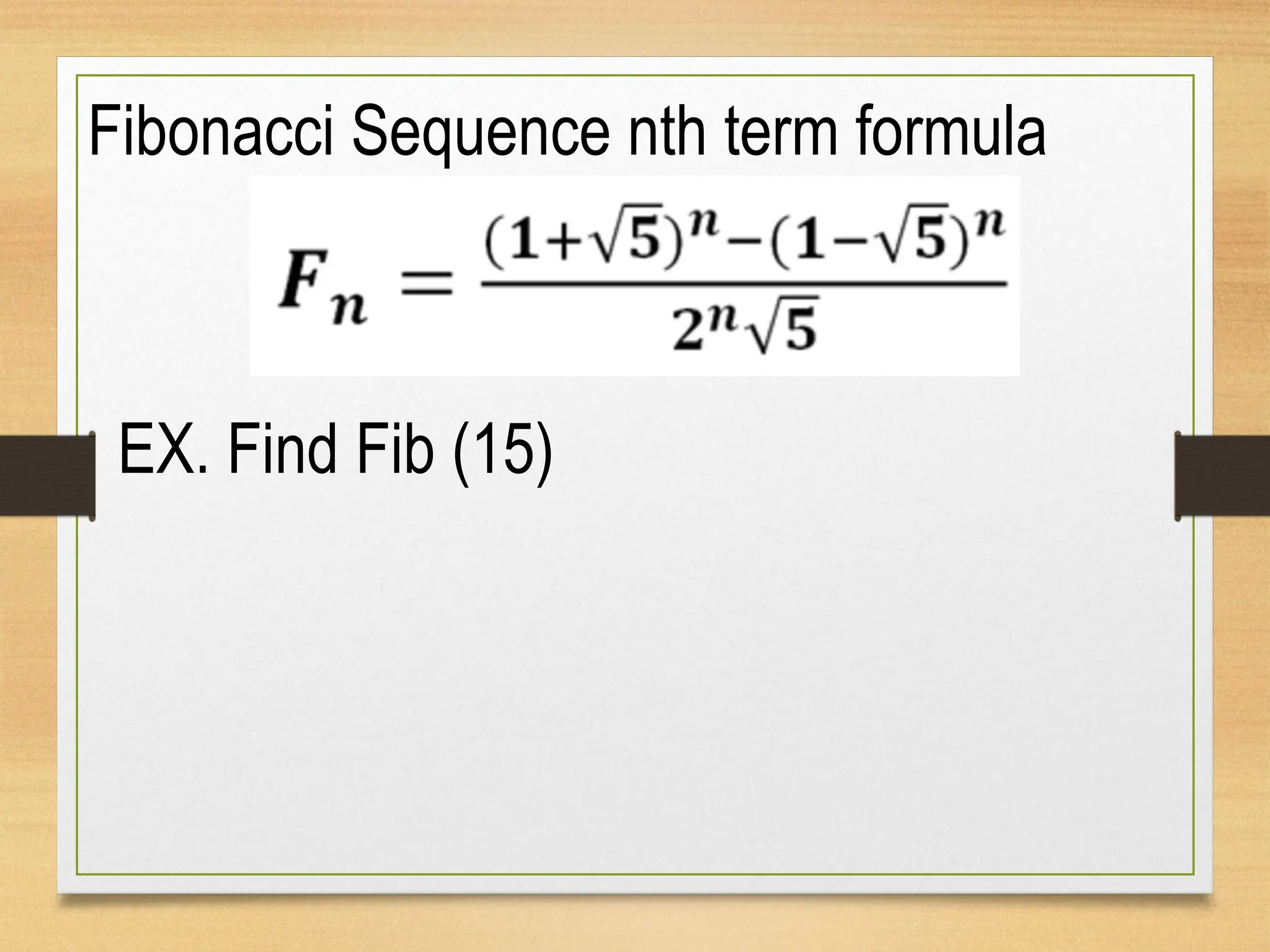
Fibonacci Sequence nth term formula
EX. Find Fib (15)
L A N G U A G E S
OF
M A T H E M A T I C S
LEARNING OUTCOMES
After working on this module, you will be able to:
1. know the characteristic of the language of mathematics
2. identify analogies of the English language and mathematical language;
3. distinguish mathematical expression from a mathematical sentence;
4. determine the truth of a mathematical sentence; 5. know the conventions in the
language of mathematics; and 6. translate English phrases to mathematical
expressions, and vice-versa
The language of mathematics is:
(1) precise.
It is able to give or make very fine distinctions between concepts.
(2) concise.
It is able to express concepts correctly and briefly.
(3) powerful.
It is able to express complex ideas with relative ease.
Characteristics of the Mathematical Language
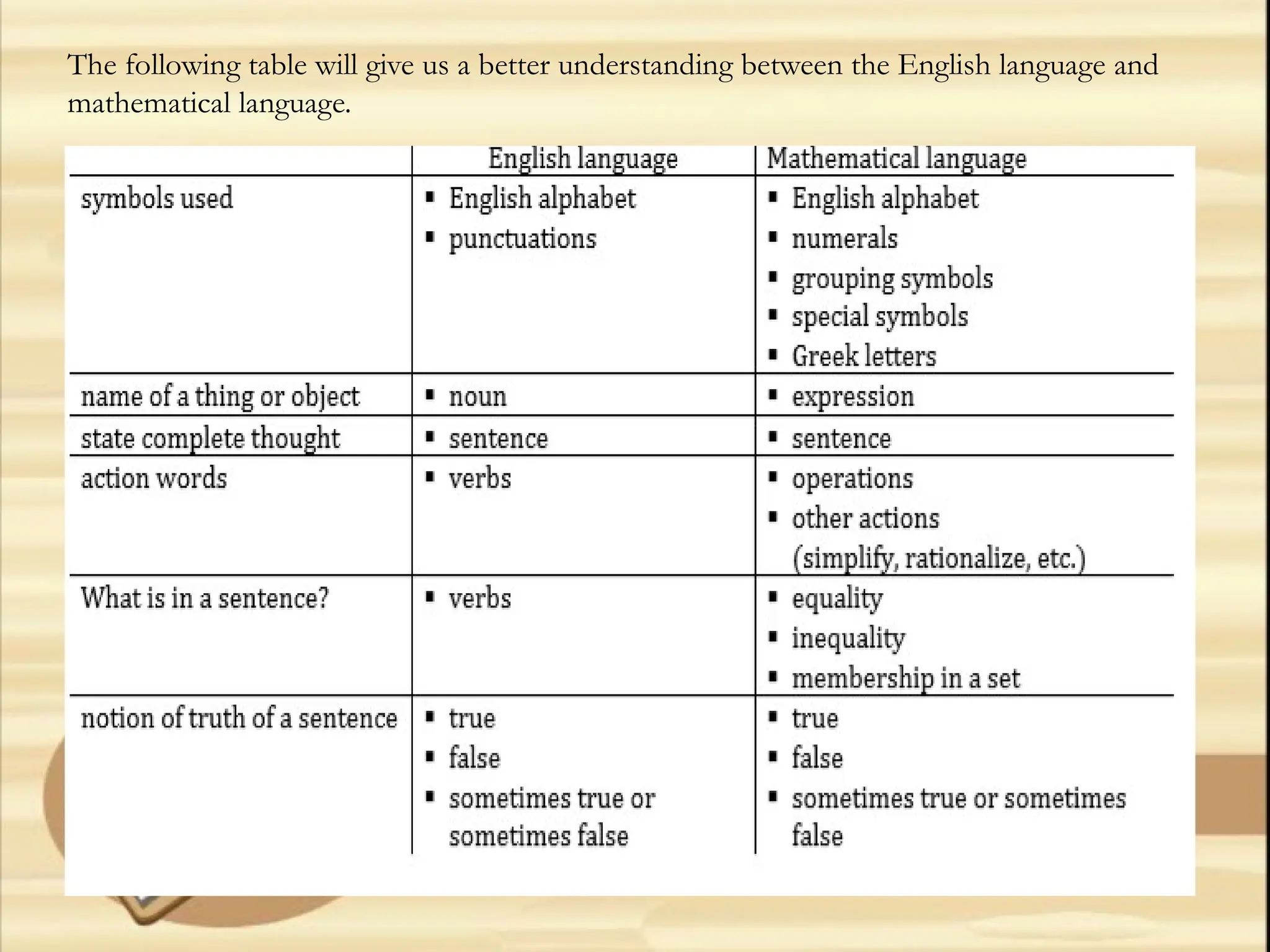
The following table will give us a better understanding between the English language and
mathematical language.
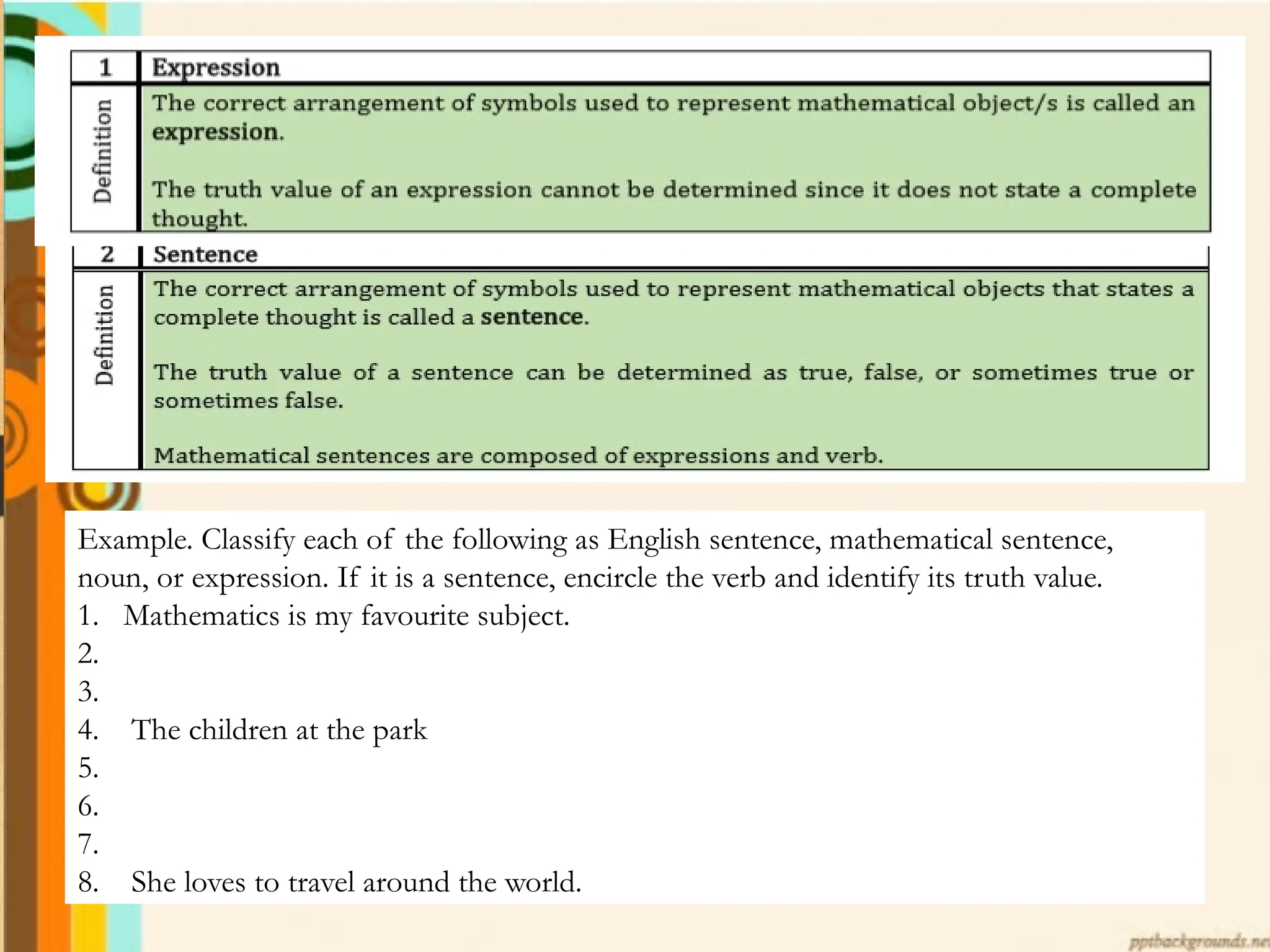
Example. Classify each of the following as English sentence, mathematical sentence,
noun, or expression. If it is a sentence, encircle the verb and identify its truth value.
1. Mathematics is my favourite subject.
2.
3.
4. The children at the park
5.
6.
7.
8. She loves to travel around the world.
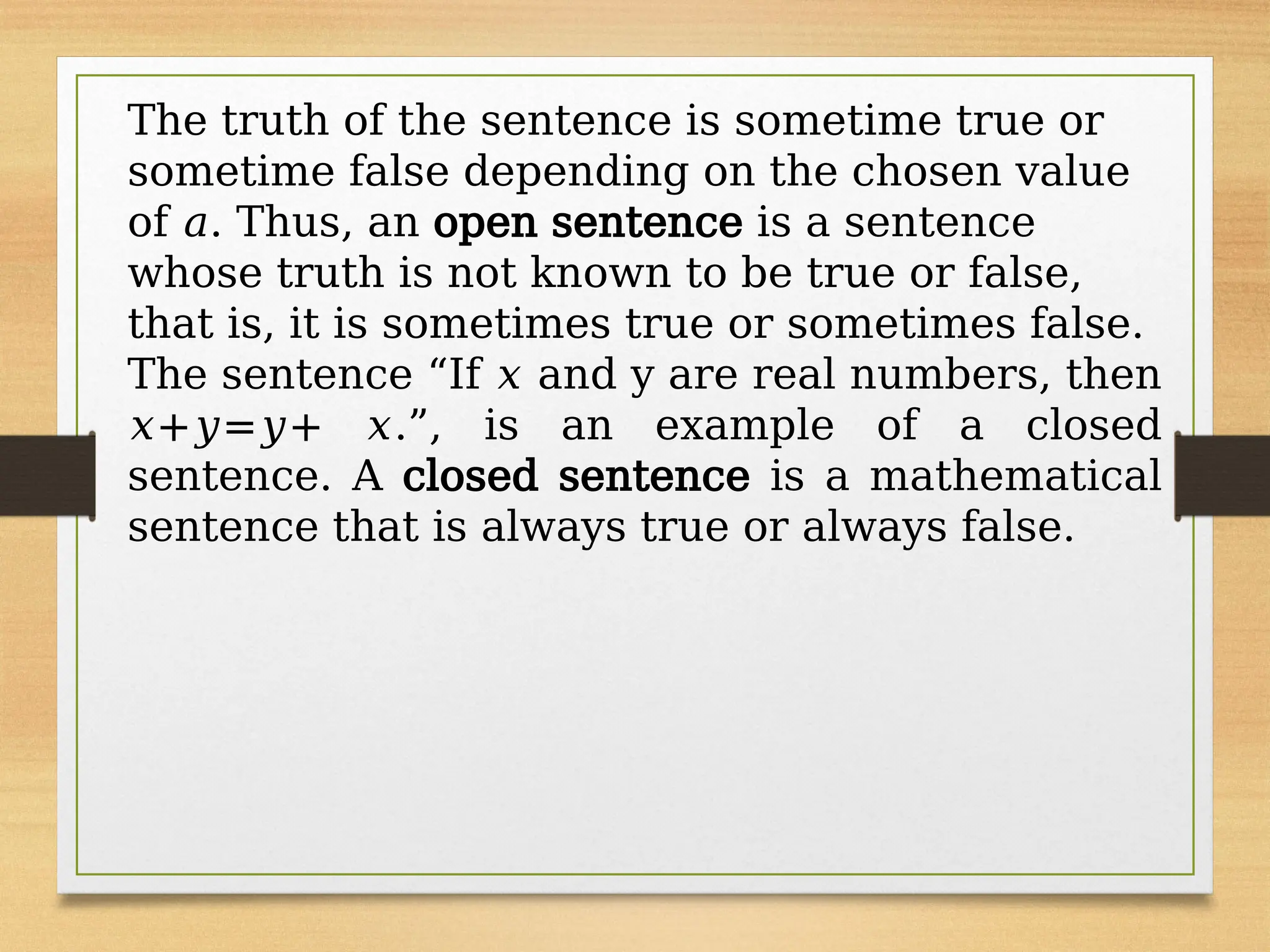
The truth of the sentence is sometime true or
sometime false depending on the chosen value
of 𝑎. Thus, an open sentence is a sentence
whose truth is not known to be true or false,
that is, it is sometimes true or sometimes false.
The sentence “If 𝑥 and y are real numbers, then
𝑥+𝑦=𝑦+ 𝑥.”, is an example of a closed
sentence. A closed sentence is a mathematical
sentence that is always true or always false.
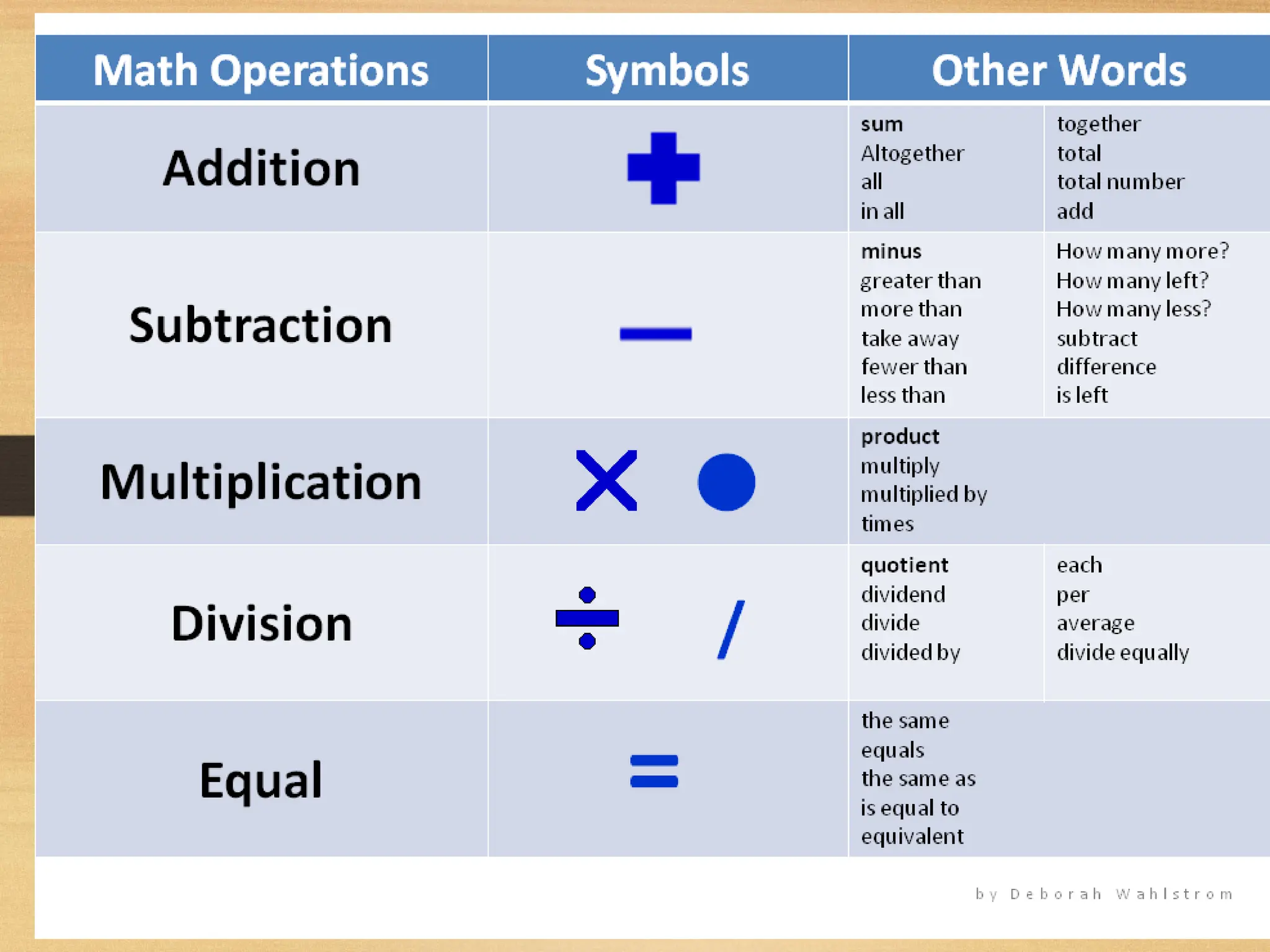
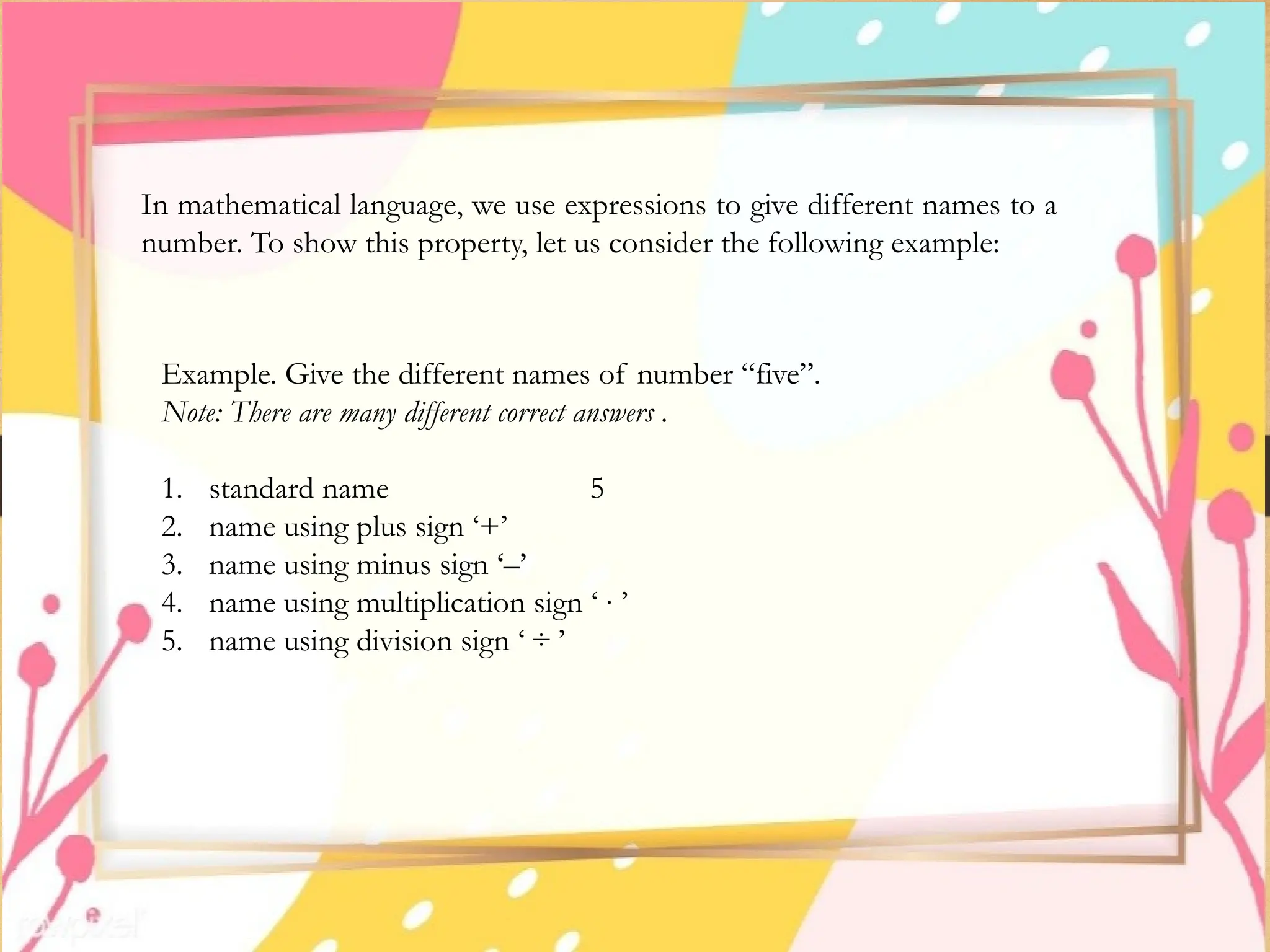
In mathematical language, we use expressions to give different names to a
number. To show this property, let us consider the following example:
Example. Give the different names of number “five”.
Note: There are many different correct answers .
1. standard name 5
2. name using plus sign ‘+’
3. name using minus sign ‘–’
4. name using multiplication sign ‘ ∙ ’
5. name using division sign ‘ ÷ ’
To simplify an expression means to get a different name for the expression, that
in some way is simpler. However, the notion of “simpler” have different
meanings, namely:
1. fewer symbols
2. fewer operations
3. better suited for current use
4. preferred format and style
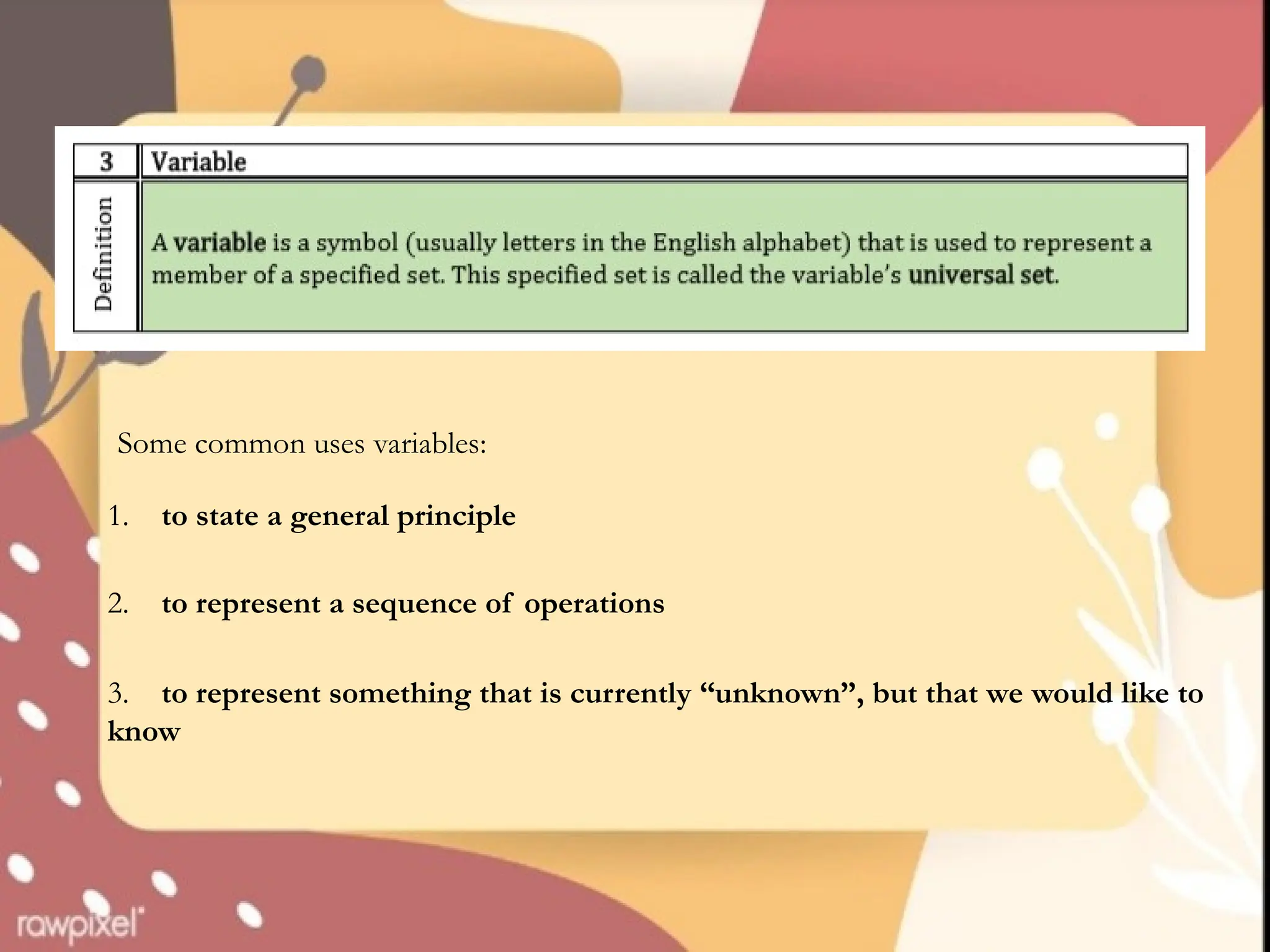
Some common uses variables:
1. to state a general principle
2. to represent a sequence of operations
3. to represent something that is currently “unknown”, but that we would like to
know
Reference
Calpa, MJ, Mathematics in the Modern World, University of Eastern Philippines, 2020
T h a n k y u!

mathematics in the modern world study of patterns

  • 1.
    Study of P S T TTT TE RN A Prepared by: Celien L. Galvan UEP Part-time Lecturer
  • 2.
    After working onthis module, you will be able to: 1. identify patterns in nature and irregularities; 2. articulate the importance in mathematics in one’s life; 3. argue about mathematics, what it is, how it is expressed, represented, and used; and 4. express appreciation for mathematics as a human endeavor. Learning Outcomes
  • 3.
  • 5.
    QUESTIONS • What arethe different kinds and forms of patterns you have seen in the video and/or pictures? • How does these patterns help us understand the connection between our world and mathematics?
  • 6.
    Patterns and Numbers inNature and the World
  • 7.
    Logical reasoning testsare a form of psychometric test that assess your ability to interpret information and apply that knowledge to come to a conclusion. Typically, no prior knowledge is required for a logical reasoning test, since it evaluates your ability to use logic to solve a problem. Inductive reasoning: requires you to look for rules between the shapes or diagrams, and use this to determine the next item in the sequence, or the missing item from the sequence. Deductive reasoning: requires you to analyze information, and use this to make the correct logical conclusions.
  • 8.
    Diagrammatic reasoning: presentsyou with a series of diagrams and symbols, and requires you to identify a rule and apply this to reach the right conclusion. Abstract reasoning: similar to diagrammatic and inductive reasoning, abstract reasoning presents you with visual sequences, from which you will need to infer rules to identify the next item or missing item. Critical reasoning: You will be given a passage of information, and will be required to use logical thinking skills to evaluate it and make a judgement.
  • 9.
    LOGIC PATTERN: Foreach figure, what comes next?
  • 11.
    Number patterns inwhole numbers are sequences that follow a specific rule or relationship, revealing fascinating structures within the set of whole numbers. It involve basic arithmetic operations such as addition, subtraction, multiplication, or division, and can manifest in various forms, including arithmetic sequences, geometric sequences, and more specialized patterns like square numbers, cube numbers, and triangular numbers. A arithmetic sequence is a simple yet common type of pattern where a constant value is added to each term to get the next. A geometric sequence, on the other hand, involves multiplying each term by a fixed number to progress through the sequence.
  • 12.
    Arithmetic Patterns Arithmetic patternsinvolve sequences where the difference between consecutive terms is constant. This difference is known as the "common difference." Example, Sequence: 2, 4, 6, 8, 10 Common Difference: 2 In this sequence, each number is obtained by adding 2 to the previous number.
  • 13.
    Geometric Patterns Geometric patternsare sequences where each term is obtained by multiplying the previous term by a constant factor, known as the "common ratio." Example: Sequence: 3, 6, 12, 24, 48 Common Ratio: 2 In this pattern, each term is obtained by multiplying the previous term by 2.
  • 14.
    Other Patterns inWhole Numbers •Triangular Numbers: Numbers that form equilateral triangles. Sequence: 1, 3, 6, 10, 15 •Square Numbers: Numbers that form perfect squares. Sequence: 1, 4, 9, 16, 25 •Fibonacci Sequence: A sequence where each number is the sum of the two preceding ones. Sequence: 1, 1, 2, 3, 5, 8, 13
  • 15.
    N U MB E R P A T T E R N S Find the next number in the sequence. a. 1, 4, 9, 16, 25, ___ b. 7, 3, -1, -5, -9, ___ c. , , ___
  • 16.
    3. W OR D P A T T E R N S Fill in the blanks. a. Tree : leaf :: flower : _______ b. Dog : puppy :: cat : ________ c. Crocodile: reptile::Dolphin:____________ d. Bees : hive :: bears : _______ e. Chef : food :: sculptor : _______
  • 17.
    A geometric patternis a repetitive arrangement of shapes, lines, and forms that create a design characterized by mathematical precision and symmetry. Geometric patterns in nature are shapes and structures that appear consistently in the natural world. These patterns can be found in everything from tiny organisms to massive geological formations, illustrating the remarkable symmetry and precision of natural design.
  • 18.
    Principles of GeometricPattern Design •The Grid: the grids provide a foundational structure that enables you to maintain both precision and consistency when building patterns. •Repetition: Designers use a repetition of shape, colour, tone, texture, accents, and direction in order to create a beautiful, complex, unified whole. •Layering: Layering is an essential technique in graphic design. By layering shapes, colours, and textures, you can create a sense of depth and complexity in your work. •Rhythm: It refers to the way positive and negative space are used when repeating visual elements. •Symmetry: Symmetry is fundamental to geometric pattern design because it creates balance and harmony, two qualities on which the success of a pattern relies.
  • 19.
    1. Geometric CirclePatterns:The circle is often regarded as a symbol of infinity as it has no beginning or end, and it's also a symbol of unity. 2. Triangle Geometric Patterns: a triangle can have two meanings. When pointing up, it represents stability and power, but when pointing down, it can indicate instability.
  • 20.
    3. Rhombus Patterns:A rhombus is a 2D shape with four straight and equal sides. Both pairs of opposite sides are parallel to each other. The shape is normally identified as a diamond shape. 4. Zig-Zag Patterns: This dynamic shape comes into its own when it is repeated with zig zags of different weights and/or colours.
  • 21.
    5. Geometric SquarePatterns: The square is another one of those basic shapes that takes on a life of its own when it is repeated and layered with other squares 6. Hexagon Patterns: This six-sided wonder, the hexagon, is capable of creating designs of incredible complexity when repeated and thoughtfully layered.
  • 22.
    7. Isometric Patterns:In isometric cubes, all the lines in the drawing are parallel to each other. When isometric cubes are used repeatedly to create an isometric pattern, they offer a design that is intricate and that often creates optical illusions. 8. Kaleidoscope Patterns:
  • 23.
    4. G EO M E T R I C P A T T E R N S DESIGN
  • 24.
    Number of electron groups Nameof electron group geometry 2 linear 3 trigonal-planar 4 tetrahedral 5 trigonal-bipyramidal 6 octahedral
  • 25.
    EXAMPLES OF PATTERNSIN NATURE ● Symmetry - refers to the property of an object remaining unchanged after undergoing certain transformations, such as reflection, rotation, or scaling. This means that the dimension, proportions, and arrangement of the object are in agreement and remain consistent. Reflective symmetry occurs when one half of the object reflects the other half. Rotational symmetry occurs when an object appears the same after partially rotating on its axis. In mathematics, a circle is a geometric shape that is a common example of rotational symmetry. Many species of flowers are examples of rotational symmetry. Many microorganisms in the Protozoa kingdom (single-celled eukaryotes) also possess a wide range of symmetry.
  • 26.
    ● Spiral -is a curve that emanates from a central point, and as it moves away from that point, it revolves around it. The curve can be described by a set of parametric equations, polar equations, or implicit equations. Spirals can be found in many natural phenomena such as the shapes of seashells, the shape of galaxies, and the pattern of a pine cone.
  • 27.
    • Fractal -is a never-ending pattern that is infinitely complex and self-similar across different scales. Fractals are typically generated using iterative mathematical algorithms, but they can also be found in nature.
  • 28.
    ● Tessellations -a flat surface refers to the tiling of a plane using one or more geometric shapes, called tiles, with no overlaps and no gaps.
  • 29.
    Fibonacci Phenomenon: thissequence goes like this: 1, 1, 2, 3, 5, 8, and so on.
  • 31.
    S Y MM E T R Y A N D A N G L E O F R O T A T I O N
  • 32.
    S Y MM E T R Y A N D A N G L E O F R O T A T I O N If we rotate an object by several degrees and have the same appearance as the original position, then the object possesses a property called the rotational symmetry. The smallest angle an object can be rotated while it is preserving its original formation is called the angle of rotation. To compute for the angle of rotation, we use 𝑎𝑛𝑔𝑙𝑒 𝑜𝑓 𝑟𝑜𝑡𝑎𝑡𝑖𝑜𝑛 = where is the order of rotational symmetry (or the -fold symmetry. example: Find the angel of rotations of the ff. n-fold symmetries 1. n = 6 2. n = 7 3. n = 8
  • 33.
    W O RL D P O P U L A T I O N The exponential growth model is one of the two mathematical modelling of population growth. It holds the assumption that the population grows at a rate proportional to the present size of the population. The formula for exponential growth is, where: 𝐴 = size of the population after it grows; 𝑃 = initial number of people; 𝑟 = rate of growth; = time; 𝑡 ≈ 𝑒 2.718 (This is the Euler’s constant with an approximate value of 2.718) 𝐴 =𝑃
  • 34.
    2. A populationof bacteria grows according to the function f(x) , where t is measured in minutes. How many bacteria will there be after 4 hours (240 minutes)? Examples. 1. In the midyear of 2020, a country’s population is 109, 581 with a growth rate of approximately 1.35% per year. What will be the country’s population in 2050? Given: P= 109, 581 r= 1.35% = 0.0135 t= 2050-2020 = 30 yrs A= ? 3. The population of a certain community was 10 000 in 1980. In 2000, it was found to have grown to 20 000. Form an exponential function to model the population of community P that changes through time t.
  • 35.
    Fibonacci Sequence wasdiscovered by an Itallian named Leonard Pisano Bigollo He is also known by several names: Leonardo of Pisa and Fibonacci Fibonacci pattern was discovered the number sequence through a practical problem involving the growth of a hypothetical population of rabbits based on idealized assumptions. Fibonacci sequence: 1, 1, 2, 3, 5, 8, 13, 21, …
  • 36.
    F I BO N A C C I S E Q U E N C E
  • 37.
    If we dividetwo consecutive terms in the Fibonacci sequence, the quotient approaches the number phi, = 1.6180339887… or the irrational number . 𝜙 This number is called the golden ratio. In mathematics and in arts, two quantities are in golden ratio if their ratio is the same as their sum to the larger of the two quantities. In symbols, and , where > > 0, are in a golden ratio if 𝑎 𝑏 𝑎 𝑏
  • 38.
    Here are someof man’s greatest works that would reminds us of the Fibonacci sequence and the golden ratio.
  • 39.
    Let Fib(n) bethe nth term of the Fibonacci sequence Ex. Fib (1) = 1 Fib (2) = 1 Fib (3) = 2 Fib (4) = 3 Fib (5) = 5 Fib (6) =8 Fib (7) = 13 1. Find the next 2 terms of the sequence: 1,1, 2, 3, 5, 8, 13, 21, ___, __ 2. Find Fib (20) 3. Find Fib (17) 4. Fib (16) + Fib (19)
  • 40.
    Fibonacci Sequence nthterm formula EX. Find Fib (15)
  • 41.
    L A NG U A G E S OF M A T H E M A T I C S
  • 42.
    LEARNING OUTCOMES After workingon this module, you will be able to: 1. know the characteristic of the language of mathematics 2. identify analogies of the English language and mathematical language; 3. distinguish mathematical expression from a mathematical sentence; 4. determine the truth of a mathematical sentence; 5. know the conventions in the language of mathematics; and 6. translate English phrases to mathematical expressions, and vice-versa
  • 43.
    The language ofmathematics is: (1) precise. It is able to give or make very fine distinctions between concepts. (2) concise. It is able to express concepts correctly and briefly. (3) powerful. It is able to express complex ideas with relative ease. Characteristics of the Mathematical Language
  • 44.
    The following tablewill give us a better understanding between the English language and mathematical language.
  • 46.
    Example. Classify eachof the following as English sentence, mathematical sentence, noun, or expression. If it is a sentence, encircle the verb and identify its truth value. 1. Mathematics is my favourite subject. 2. 3. 4. The children at the park 5. 6. 7. 8. She loves to travel around the world.
  • 47.
    The truth ofthe sentence is sometime true or sometime false depending on the chosen value of 𝑎. Thus, an open sentence is a sentence whose truth is not known to be true or false, that is, it is sometimes true or sometimes false. The sentence “If 𝑥 and y are real numbers, then 𝑥+𝑦=𝑦+ 𝑥.”, is an example of a closed sentence. A closed sentence is a mathematical sentence that is always true or always false.
  • 48.
    In mathematical language,we use expressions to give different names to a number. To show this property, let us consider the following example: Example. Give the different names of number “five”. Note: There are many different correct answers . 1. standard name 5 2. name using plus sign ‘+’ 3. name using minus sign ‘–’ 4. name using multiplication sign ‘ ∙ ’ 5. name using division sign ‘ ÷ ’
  • 49.
    To simplify anexpression means to get a different name for the expression, that in some way is simpler. However, the notion of “simpler” have different meanings, namely: 1. fewer symbols 2. fewer operations 3. better suited for current use 4. preferred format and style
  • 50.
    Some common usesvariables: 1. to state a general principle 2. to represent a sequence of operations 3. to represent something that is currently “unknown”, but that we would like to know
  • 52.
    Reference Calpa, MJ, Mathematicsin the Modern World, University of Eastern Philippines, 2020
  • 53.
    T h an k y u!