Matrices
Introduction
National Institute of Electronics & Information Technology
Ministry of Electronics & Information Technology (MeitY), Government of India
Gorakhpur Center
Matrices - Introduction
Matrix algebra has at least two advantages:
•Reduces complicated systems of equations to simple expressions
•Adaptable to systematic method of mathematical treatment and well
suited to computers
Definition:
A matrix is a set or group of numbers arranged in a square or rectangular array
enclosed by two brackets
 
1
1  





 0
3
2
4






d
c
b
a
National Institute of Electronics & Information Technology
Ministry of Electronics & Information Technology (MeitY), Government of India
Gorakhpur Center
Matrices - Introduction
Properties:
•A specified number of rows and a specified number of columns
•Two numbers (rows x columns) describe the dimensions or size of
the matrix.
Examples:
3x3 matrix
2x4 matrix
1x2 matrix











3
3
3
5
1
4
4
2
1





 
2
3
3
3
0
1
0
1
 
1
1 
National Institute of Electronics & Information Technology
Ministry of Electronics & Information Technology (MeitY), Government of India
Gorakhpur Center
Matrices - Introduction
A matrix is denoted by a bold capital letter and the elements within the
matrix are denoted by lower case letters
e.g. matrix [A] with elements aij














mn
ij
m
m
n
ij
in
ij
a
a
a
a
a
a
a
a
a
a
a
a
2
1
2
22
21
12
11
...
...




i goes from 1 to m
j goes from 1 to n
Amxn= mAn
=
National Institute of Electronics & Information Technology
Ministry of Electronics & Information Technology (MeitY), Government of India
Gorakhpur Center
Matrices - Operations
ADDITION AND SUBTRACTION OF MATRICES
The sum or difference of two matrices, A and B of the
same size yields a matrix C of the same size
ij
ij
ij b
a
c 

Matrices of different sizes cannot be added or
subtracted
National Institute of Electronics & Information Technology
Ministry of Electronics & Information Technology (MeitY), Government of India
Gorakhpur Center
Matrices - Operations
MULTIPLICATION OF MATRICES
The product of two matrices is another matrix
Two matrices A and B must be conformable for
multiplication to be possible
i.e. the number of columns of A must equal the number of
rows of B
Example.
A x B = C
(1x3) (3x1) (1x1)
National Institute of Electronics & Information Technology
Ministry of Electronics & Information Technology (MeitY), Government of India
Gorakhpur Center
Matrices - Operations























22
21
12
11
32
31
22
21
12
11
23
22
21
13
12
11
c
c
c
c
b
b
b
b
b
b
a
a
a
a
a
a
22
32
23
22
22
12
21
21
31
23
21
22
11
21
12
32
13
22
12
12
11
11
31
13
21
12
11
11
)
(
)
(
)
(
)
(
)
(
)
(
)
(
)
(
)
(
)
(
)
(
)
(
c
b
a
b
a
b
a
c
b
a
b
a
b
a
c
b
a
b
a
b
a
c
b
a
b
a
b
a
























Successive multiplication of row i of A with column j
of B – row by column multiplication
National Institute of Electronics & Information Technology
Ministry of Electronics & Information Technology (MeitY), Government of India
Gorakhpur Center
Matrices - Operations











































)
3
7
(
)
2
2
(
)
8
4
(
)
5
7
(
)
6
2
(
)
4
4
(
)
3
3
(
)
2
2
(
)
8
1
(
)
5
3
(
)
6
2
(
)
4
1
(
3
5
2
6
8
4
7
2
4
3
2
1







57
63
21
31
Remember also:
IA = A






1
0
0
1






57
63
21
31







57
63
21
31
National Institute of Electronics & Information Technology
Ministry of Electronics & Information Technology (MeitY), Government of India
Gorakhpur Center
Matrices - Operations
Assuming that matrices A, B and C are conformable for the operations
indicated, the following are true:
1. AI = IA = A
2. A(BC) = (AB)C = ABC - (associative law)
3. A(B+C) = AB + AC - (first distributive law)
4. (A+B)C = AC + BC - (second distributive law)
Caution!
1. AB not generally equal to BA, BA may not be conformable
2. If AB = 0, neither A nor B necessarily = 0
3. If AB = AC, B not necessarily = C
National Institute of Electronics & Information Technology
Ministry of Electronics & Information Technology (MeitY), Government of India
Gorakhpur Center
Matrices - Operations
AB not generally equal to BA, BA may not be conformable






















































0
10
6
23
0
5
2
1
2
0
4
3
20
15
8
3
2
0
4
3
0
5
2
1
2
0
4
3
0
5
2
1
ST
TS
S
T
National Institute of Electronics & Information Technology
Ministry of Electronics & Information Technology (MeitY), Government of India
Gorakhpur Center
Matrices - Operations
If AB = 0, neither A nor B necessarily = 0





















0
0
0
0
3
2
3
2
0
0
1
1
National Institute of Electronics & Information Technology
Ministry of Electronics & Information Technology (MeitY), Government of India
Gorakhpur Center
Matrices - Operations
TRANSPOSE OF A MATRIX
If :








1
3
5
7
4
2
3
2 A
A












1
7
3
4
5
2
3
2
T
T
A
A
Then transpose of A, denoted AT
is:
T
ji
ij a
a  For all i and j
National Institute of Electronics & Information Technology
Ministry of Electronics & Information Technology (MeitY), Government of India
Gorakhpur Center
Matrices - Operations
Properties of transposed matrices:
1. (A+B)T
= AT
+ BT
2. (AB)T
= BT
AT
3. (kA)T
= kAT
4. (AT
)T
= A
National Institute of Electronics & Information Technology
Ministry of Electronics & Information Technology (MeitY), Government of India
Gorakhpur Center
Matrices - Operations
SYMMETRIC MATRICES
A Square matrix is symmetric if it is equal to
its transpose:
A = AT














d
b
b
a
A
d
b
b
a
A
T
National Institute of Electronics & Information Technology
Ministry of Electronics & Information Technology (MeitY), Government of India
Gorakhpur Center
INVERSE OF A MATRIX
Consider a scalar k. The inverse is the reciprocal or division
of 1 by the scalar.
Example:
k=7 the inverse of k or k-1
= 1/k = 1/7
Division of matrices is not defined since there may be AB =
AC while B = C
Instead matrix inversion is used.
The inverse of a square matrix, A, if it exists, is the unique
matrix A-1
where:
AA-1
= A-1
A = I
National Institute of Electronics & Information Technology
Ministry of Electronics & Information Technology (MeitY), Government of India
Gorakhpur Center
Example:


















3
2
1
1
1
2
1
3
1
2
2
A
A
A










































1
0
0
1
3
2
1
1
1
2
1
3
1
0
0
1
1
2
1
3
3
2
1
1
Because:
National Institute of Electronics & Information Technology
Ministry of Electronics & Information Technology (MeitY), Government of India
Gorakhpur Center
Properties of the inverse:
1
1
1
1
1
1
1
1
1
1
)
(
)
(
)
(
)
(
)
(













A
k
kA
A
A
A
A
A
B
AB
T
T
A square matrix that has an inverse is called a nonsingular matrix
A matrix that does not have an inverse is called a singular matrix
Square matrices have inverses except when the determinant is zero
When the determinant of a matrix is zero the matrix is singular
National Institute of Electronics & Information Technology
Ministry of Electronics & Information Technology (MeitY), Government of India
Gorakhpur Center
Matrices - Operations
DETERMINANT OF A MATRIX
To compute the inverse of a matrix, the determinant is
required
Each square matrix A has a unit scalar value called the
determinant of A, denoted by det A or |A|
5
6
2
1
5
6
2
1








A
A
If
then
National Institute of Electronics & Information Technology
Ministry of Electronics & Information Technology (MeitY), Government of India
Gorakhpur Center
Matrices - Operations
If A = [A] is a single element (1x1), then the determinant is
defined as the value of the element
Then |A| =det A = a11
If A is (n x n), its determinant may be defined in terms of
order (n-1) or less.
National Institute of Electronics & Information Technology
Ministry of Electronics & Information Technology (MeitY), Government of India
Gorakhpur Center
Matrices - Operations
MINORS
If A is an n x n matrix and one row and one column are
deleted, the resulting matrix is an (n-1) x (n-1) submatrix of
A.
The determinant of such a submatrix is called a minor of A
and is designated by mij , where i and j correspond to the
deleted
row and column, respectively.
mij is the minor of the element aij in A.
National Institute of Electronics & Information Technology
Ministry of Electronics & Information Technology (MeitY), Government of India
Gorakhpur Center











33
32
31
23
22
21
13
12
11
a
a
a
a
a
a
a
a
a
A
Each element in A has a minor
Delete first row and column from A .
The determinant of the remaining 2 x 2 submatrix is the minor
of a11
eg.
33
32
23
22
11
a
a
a
a
m 
National Institute of Electronics & Information Technology
Ministry of Electronics & Information Technology (MeitY), Government of India
Gorakhpur Center
Therefore the minor of a12 is:
And the minor for a13 is:
33
31
23
21
12
a
a
a
a
m 
32
31
22
21
13
a
a
a
a
m 
National Institute of Electronics & Information Technology
Ministry of Electronics & Information Technology (MeitY), Government of India
Gorakhpur Center
COFACTORS
The cofactor Cij of an element aij is defined as:
ij
j
i
ij m
C 

 )
1
(
When the sum of a row number i and column j is even, cij = mij
and when i+j is odd, cij =-mij
13
13
3
1
13
12
12
2
1
12
11
11
1
1
11
)
1
(
)
3
,
1
(
)
1
(
)
2
,
1
(
)
1
(
)
1
,
1
(
m
m
j
i
c
m
m
j
i
c
m
m
j
i
c





















National Institute of Electronics & Information Technology
Ministry of Electronics & Information Technology (MeitY), Government of India
Gorakhpur Center
Therefore the 2 x 2 matrix :







22
21
12
11
a
a
a
a
A
Has cofactors :
22
22
11
11 a
a
m
c 


And:
21
21
12
12 a
a
m
c 





And the determinant of A is:
21
12
22
11
12
12
11
11 a
a
a
a
c
a
c
a
A 



National Institute of Electronics & Information Technology
Ministry of Electronics & Information Technology (MeitY), Government of India
Gorakhpur Center
Example 1:







2
1
1
3
A
5
)
1
)(
1
(
)
2
)(
3
( 


A
National Institute of Electronics & Information Technology
Ministry of Electronics & Information Technology (MeitY), Government of India
Gorakhpur Center
For a 3 x 3 matrix:











33
32
31
23
22
21
13
12
11
a
a
a
a
a
a
a
a
a
A
The cofactors of the first row are:
31
22
32
21
32
31
22
21
13
31
23
33
21
33
31
23
21
12
32
23
33
22
33
32
23
22
11
)
(
a
a
a
a
a
a
a
a
c
a
a
a
a
a
a
a
a
c
a
a
a
a
a
a
a
a
c











National Institute of Electronics & Information Technology
Ministry of Electronics & Information Technology (MeitY), Government of India
Gorakhpur Center
The determinant of a matrix A is:
21
12
22
11
12
12
11
11 a
a
a
a
c
a
c
a
A 



Which by substituting for the cofactors in this case is:
)
(
)
(
)
( 31
22
32
21
13
31
23
33
21
12
32
23
33
22
11 a
a
a
a
a
a
a
a
a
a
a
a
a
a
a
A 





National Institute of Electronics & Information Technology
Ministry of Electronics & Information Technology (MeitY), Government of India
Gorakhpur Center
ADJOINT MATRICES
A cofactor matrix C of a matrix A is the square matrix of the
same order as A in which each element aij is replaced by its
cofactor cij .
Example:








4
3
2
1
A








1
2
3
4
C
If
The cofactor C of A is
National Institute of Electronics & Information Technology
Ministry of Electronics & Information Technology (MeitY), Government of India
Gorakhpur Center
The adjoint matrix of A, denoted by adj A, is the transpose of its
cofactor matrix T
C
adjA 
It can be shown that:
A(adj A) = (adjA) A = |A| I
Example:





 














1
3
2
4
10
)
3
)(
2
(
)
4
)(
1
(
4
3
2
1
T
C
adjA
A
A
National Institute of Electronics & Information Technology
Ministry of Electronics & Information Technology (MeitY), Government of India
Gorakhpur Center
USING THE ADJOINT MATRIX IN MATRIX
INVERSION
A
adjA
A 
 1
Since
AA-1
= A-1
A = I
and
A(adj A) = (adjA) A = |A| I
then
National Institute of Electronics & Information Technology
Ministry of Electronics & Information Technology (MeitY), Government of India
Gorakhpur Center
Linear Equations
National Institute of Electronics & Information Technology
Ministry of Electronics & Information Technology (MeitY), Government of India
Gorakhpur Center
Linear Equations
Linear equations are common and important for survey problems
Matrices can be used to express these linear equations and aid in the
computation of unknown values
Example
n equations in n unknowns, the aij are numerical coefficients, the bi
are constants and the xj are unknowns
n
n
nn
n
n
n
n
n
n
b
x
a
x
a
x
a
b
x
a
x
a
x
a
b
x
a
x
a
x
a
















2
2
1
1
2
2
2
22
1
21
1
1
2
12
1
11
National Institute of Electronics & Information Technology
Ministry of Electronics & Information Technology (MeitY), Government of India
Gorakhpur Center
Linear Equations
The equations may be expressed in the form
AX = B
where
,
, 2
1
1
1
2
22
21
1
12
11


























n
nn
n
n
n
n
x
x
x
X
a
a
a
a
a
a
a
a
a
A







and













n
b
b
b
B

2
1
n x n n x 1 n x 1
Number of unknowns = number of equations = n
National Institute of Electronics & Information Technology
Ministry of Electronics & Information Technology (MeitY), Government of India
Gorakhpur Center
Linear Equations
If the determinant is nonzero, the equation can be solved to produce n
numerical values for x that satisfy all the simultaneous equations
To solve, premultiply both sides of the equation by A-1
which exists because |
A| = 0
A-1
AX = A-1
B
Now since
A-1
A = I
We get
X = A-1
B
So if the inverse of the coefficient matrix is found, the unknowns, X would
be determined
National Institute of Electronics & Information Technology
Ministry of Electronics & Information Technology (MeitY), Government of India
Gorakhpur Center
Linear Equations
Example
3
2
1
2
2
3
3
2
1
2
1
3
2
1








x
x
x
x
x
x
x
x
The equations can be expressed as

































3
1
2
1
2
1
0
1
2
1
1
3
3
2
1
x
x
x
National Institute of Electronics & Information Technology
Ministry of Electronics & Information Technology (MeitY), Government of India
Gorakhpur Center
Linear Equations
When A-1
is computed the equation becomes






































 
7
3
2
3
1
2
5
.
2
5
.
3
5
.
1
0
.
1
0
.
2
0
.
1
5
.
0
5
.
0
5
.
0
1
B
A
X
Therefore
7
,
3
,
2
3
2
1





x
x
x
National Institute of Electronics & Information Technology
Ministry of Electronics & Information Technology (MeitY), Government of India
Gorakhpur Center
Linear Equations
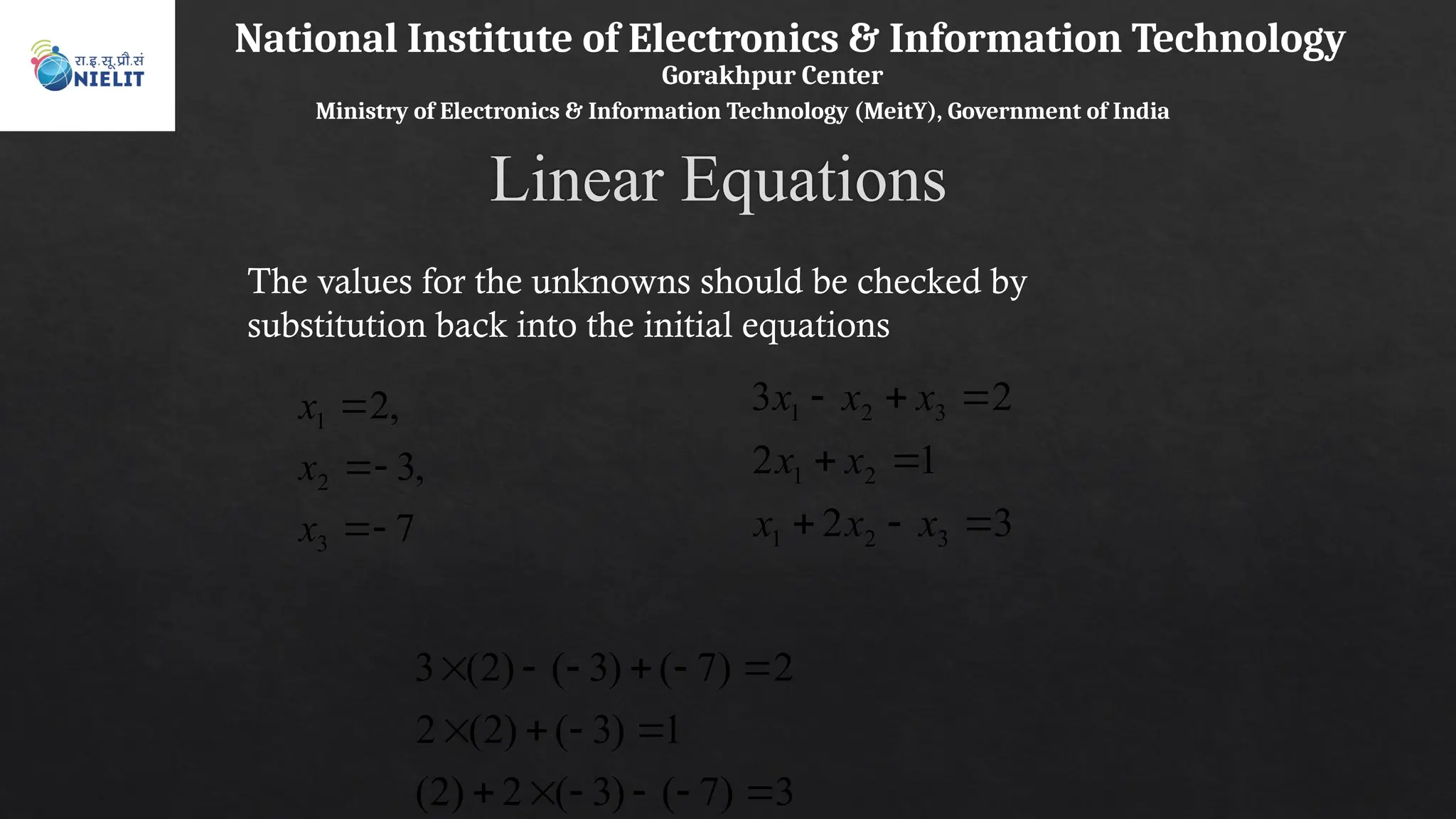
The values for the unknowns should be checked by
substitution back into the initial equations
3
2
1
2
2
3
3
2
1
2
1
3
2
1








x
x
x
x
x
x
x
x
3
)
7
(
)
3
(
2
)
2
(
1
)
3
(
)
2
(
2
2
)
7
(
)
3
(
)
2
(
3
















7
,
3
,
2
3
2
1





x
x
x
National Institute of Electronics & Information Technology
Ministry of Electronics & Information Technology (MeitY), Government of India
Gorakhpur Center
Introduction to Statistics and
Probability
National Institute of Electronics & Information Technology
Ministry of Electronics & Information Technology (MeitY), Government of India
Gorakhpur Center
STATISTICS
• It is the science of collecting, organizing, analyzing and interpreting
data.
• There are two types of Statistics:
Inferential Statistics : It is about using sample data from a dataset and
making inferences and conclusions using probability theory.
Descriptive Statistics: It is used to summarize and represent the data in
an accurate way using charts, tables and graphs.
For example, you might stand in a mall and ask a sample of 100
people if they like shopping at Sears. You could make a bar chart of
yes or no answers (that would be descriptive statistics) or you could
use your research (and inferential statistics) to reason that around
75%-80% of population.
National Institute of Electronics & Information Technology
Ministry of Electronics & Information Technology (MeitY), Government of India
Gorakhpur Center
DESCRIPTIVE STATISTICS
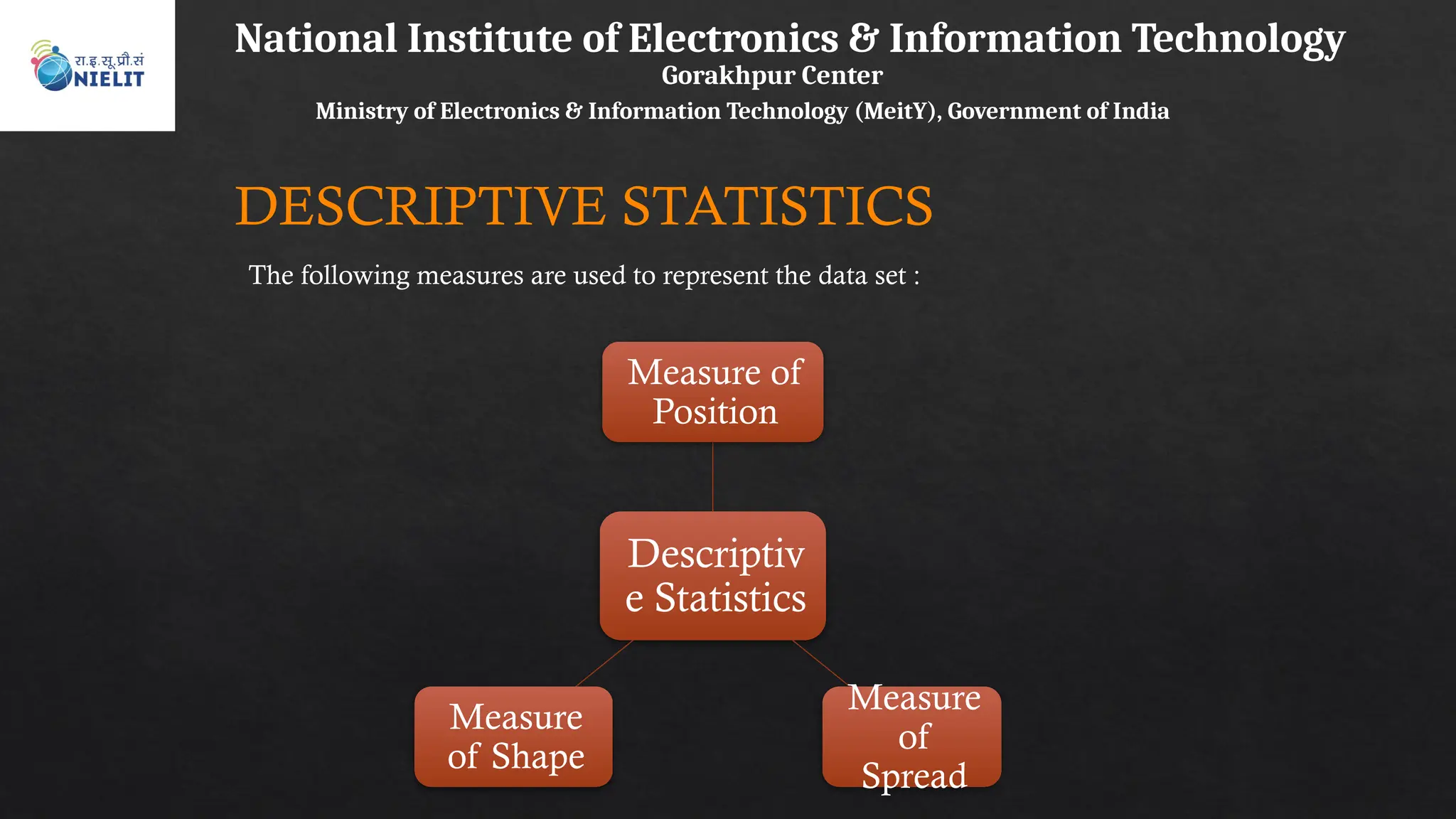
The following measures are used to represent the data set :
Descriptiv
e Statistics
Measure of
Position
Measure
of
Spread
Measure
of Shape
National Institute of Electronics & Information Technology
Ministry of Electronics & Information Technology (MeitY), Government of India
Gorakhpur Center
MEASURE OF POSITION
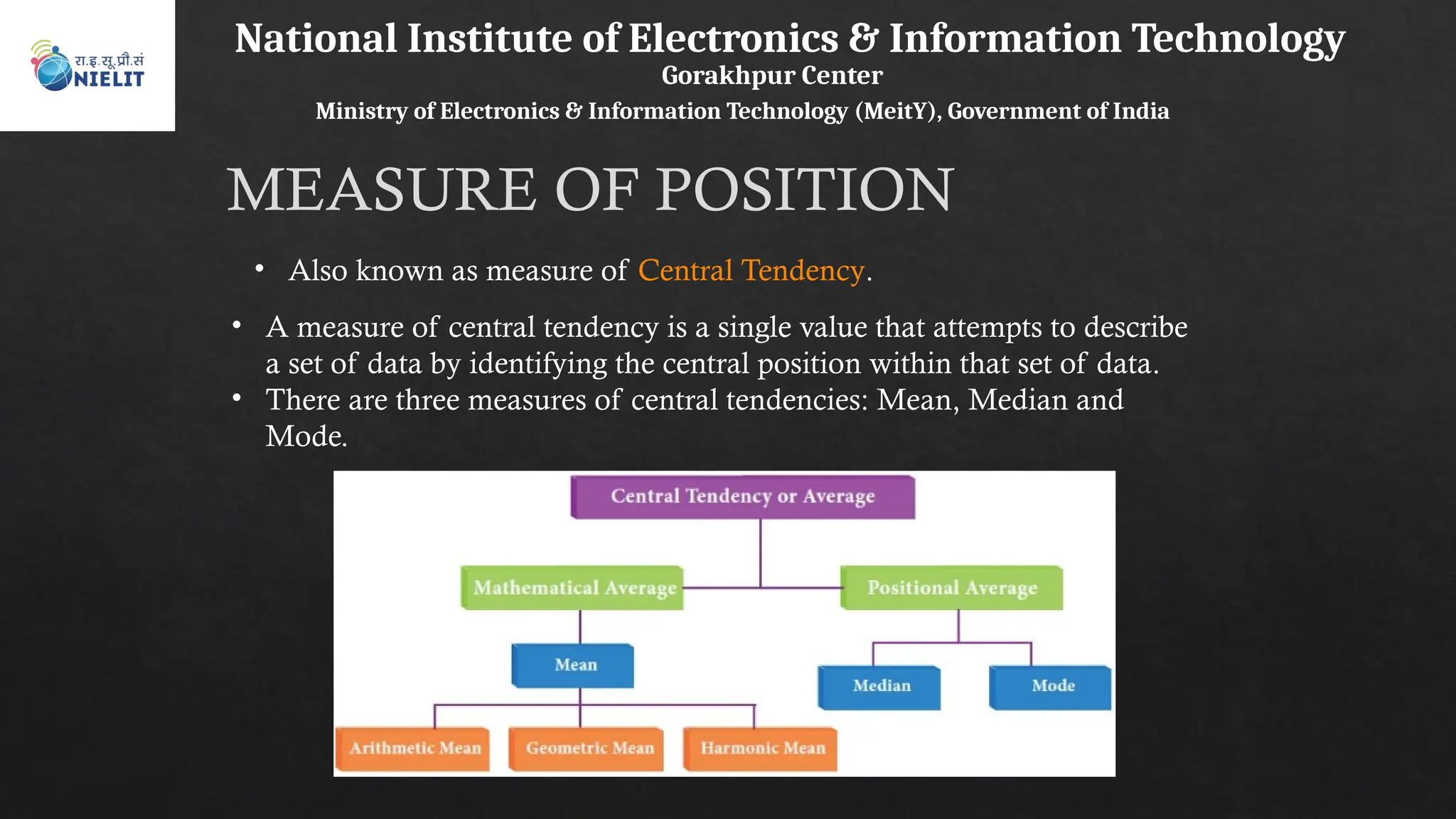
• Also known as measure of Central Tendency.
• A measure of central tendency is a single value that attempts to describe
a set of data by identifying the central position within that set of data.
• There are three measures of central tendencies: Mean, Median and
Mode.
National Institute of Electronics & Information Technology
Ministry of Electronics & Information Technology (MeitY), Government of India
Gorakhpur Center
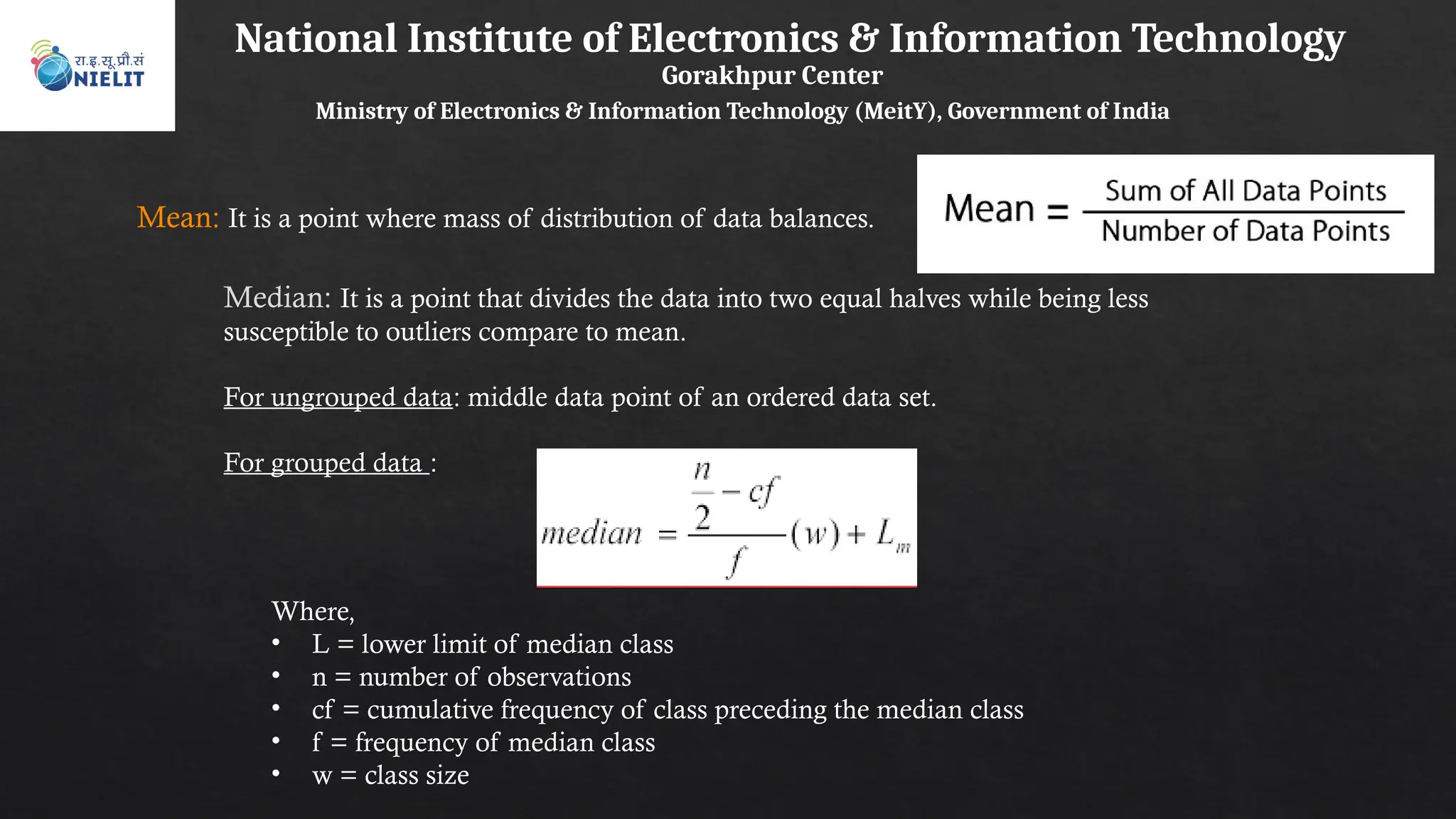
Median: It is a point that divides the data into two equal halves while being less
susceptible to outliers compare to mean.
For ungrouped data: middle data point of an ordered data set.
For grouped data :
Where,
• L = lower limit of median class
• n = number of observations
• cf = cumulative frequency of class preceding the median class
• f = frequency of median class
• w = class size
Mean: It is a point where mass of distribution of data balances.
National Institute of Electronics & Information Technology
Ministry of Electronics & Information Technology (MeitY), Government of India
Gorakhpur Center
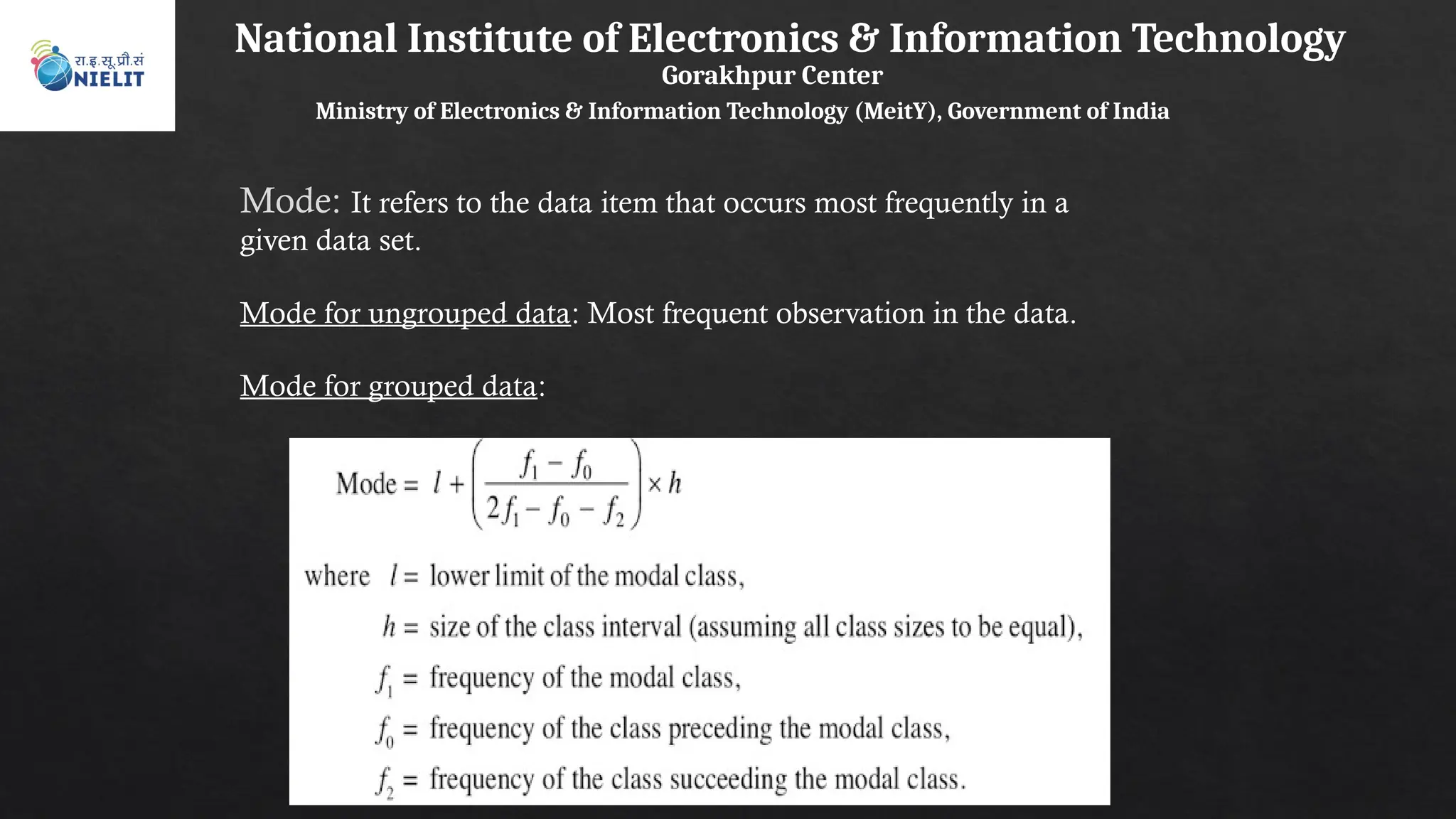
Mode: It refers to the data item that occurs most frequently in a
given data set.
Mode for ungrouped data: Most frequent observation in the data.
Mode for grouped data:
National Institute of Electronics & Information Technology
Ministry of Electronics & Information Technology (MeitY), Government of India
Gorakhpur Center
Example for ungrouped data:
Question:
National Institute of Electronics & Information Technology
Ministry of Electronics & Information Technology (MeitY), Government of India
Gorakhpur Center
MEASURE OF DISPERSION
• It refers to how the data deviates from the position measure i.e.
gives an indication of the amount of variation in the process.
• Dispersion of the data set can be described by:
Range: It is the difference between highest and the lowest values.
Standard Deviation: It is the measurement of average distance
between each quantity and mean i.e. how data is spread out from
mean. Higher the standard deviation, more is the data spread from
mean.
National Institute of Electronics & Information Technology
Ministry of Electronics & Information Technology (MeitY), Government of India
Gorakhpur Center
In normal distribution, when data is unimodal, z-scores is used to
calculate the probability of a score occurring within a standard normal
distribution and helps to compare two scores from different samples.
Below, calculating the probability of randomly obtaining a score from
the distribution.
68% probability for -1 and +1 standard deviation from mean.
Similarly, 95% for -1.96 and +1.96 standard deviation.
National Institute of Electronics & Information Technology
Ministry of Electronics & Information Technology (MeitY), Government of India
Gorakhpur Center
MEASURE OF SHAPE
• It is used to characterize the location and variability of data set.
• Two common statistics that measure the shape of the data are:
Skewness and Kurtosis
Skewness : It is the horizontal displacement of the normal curve
about the mean position. Skewness for a normal distribution is zero.
National Institute of Electronics & Information Technology
Ministry of Electronics & Information Technology (MeitY), Government of India
Gorakhpur Center
CORRELATION ANALYSIS
It is a statistical technique that can show whether and how strongly
pairs of variables are related.
If correlation coefficient (r) is
• Positive, then both variables are directly proportional.
• Zero, there is no relation between them.
• Negative, then both variables are inversely proportional
National Institute of Electronics & Information Technology
Ministry of Electronics & Information Technology (MeitY), Government of India
Gorakhpur Center
REGRESSION ANALYSIS
The statistical technique of estimating the unknown value of one
variable(i.e. dependent variable) from the known value of other variable
(i.e. independent variable) is called regression analysis.
The regression equation of X on Y is: X = a +bY
The regression equation of Y on X is: Y = a +bX
Dependent Variable: The single variable which we wish to estimate/predict
by regression model.
Independent Variable: The known variable(s) used to predict/estimate the
value of dependent variable.
X is dependent, Y
is independent
Y is depedent, X
is independent
National Institute of Electronics & Information Technology
Ministry of Electronics & Information Technology (MeitY), Government of India
Gorakhpur Center
PROBABILITY
Probability is a numerical description of how likely an event is to
occur or how likely it is that a proposition is true.
Tossing a coin: When a coin is tossed, there are two
possible outcomes: Heads (H) or Tails (T).Thus,
probability of the coin landing H is ½ and the
probability of the coin landing T is ½.
Rolling a die: When a single die is thrown, there are six
possible outcomes: 1, 2, 3, 4, 5, 6.The probability of
any one of them is 1/6.
Some examples are:
National Institute of Electronics & Information Technology
Ministry of Electronics & Information Technology (MeitY), Government of India
Gorakhpur Center
TERMINOLOGY
Experiment: A process by which an outcome is obtained.
Sample space: The set S of all possible outcomes of an experiment. i.e. the
sample space for a dice roll is {1, 2, 3, 4, 5, 6}
Event: Any subset E of the sample space i.e.
Let,
E1 = An even number is rolled.
E2 = A number less than three is rolled.
Outcome: Result of a single trial.
Equally likely outcomes: Two outcomes of a random experiment are said to be
equally likely, if upon performing the experiment a (very) large number of times,
the relative occurrences of the two outcomes turn out to be equal.
Trial: Performing a random experiment.
National Institute of Electronics & Information Technology
Ministry of Electronics & Information Technology (MeitY), Government of India
Gorakhpur Center
EVENTS
Simple Events : If the event E has only single element of a sample
space, it is called as a simple event. Eg: if S = {56 , 78 , 96 , 54 , 89}
and E = {78} then E is a simple event.
Compound Events: Any event consists of more than one element
of the sample space. Eg: if S = {56 ,78 ,96 ,54 ,89}, E1 = {56 ,54 },
E2 = {78 ,56 ,89 } then, E1 and E2 represent two compound events.
Independent Events and Dependent Events:
If the occurrence of any event is completely unaffected by the
occurrence of any other event, such events are Independent Events.
Probability of two independent event is given by,
National Institute of Electronics & Information Technology
Ministry of Electronics & Information Technology (MeitY), Government of India
Gorakhpur Center
The events which are affected by other events are Dependent Events.
Probability of dependent event is given by,
Exhaustive Events: A set of events is called exhaustive if all the events together
consume the entire sample space. Eg: A and B are sets of mutually exclusive events,
Mutually Exclusive Events: If the occurrence of one event
excludes the occurrence of another event i.e. no two events can occur
simultaneously.
Where,
S = sample space
National Institute of Electronics & Information Technology
Ministry of Electronics & Information Technology (MeitY), Government of India
Gorakhpur Center
Addition Theorem
Theorem 1: If A and B are two mutually exclusive events, then
P(A B) = P(A) + P(B)
∪
Where,
n = Total number of exhaustive cases
n1= Number of cases favorable to A.
n2= Number of cases favorable to B.
Theorem2: If A and B are two events that are not mutually exclusive, then
P(A B) = P( A ) + P( B ) - P ( A B )
∪ ∩
Where,
P (A B) = Probability of events favorable to both A and B
∩
National Institute of Electronics & Information Technology
Ministry of Electronics & Information Technology (MeitY), Government of India
Gorakhpur Center
Multiplication Theorem
If A and B are two independent events, then the probability that both
will occur is equal to the product of their individual probabilities.
Example:
The probability of appointing a lecturer who is B.Com, MBA, and PhD,
with probabilities 1/20, 1/25 and 1/40 is given by:
Using multiplicative theorem for independent events,
National Institute of Electronics & Information Technology
Ministry of Electronics & Information Technology (MeitY), Government of India
Gorakhpur Center
Conditional Probability
The conditional probability of an event B is the probability that the event
will occur given the knowledge that an event A has already occurred. It is
representated as P( B | A).
P(A | B) = P(A B) P(B)
∩ ⁄
Where A and B are two dependent events.
National Institute of Electronics & Information Technology
Ministry of Electronics & Information Technology (MeitY), Government of India
Gorakhpur Center
Total Probability Theorem
Given n mutually exclusive events A1, A2, … Ak such that their
probabilities sum is unity and their union is the event space E, then
Ai Aj = NULL, for all i not equal to j
∩
A1 U A2 U ... U Ak = E
Then Total Probability Theorem or Law of Total Probability is:
where B is an arbitrary event, and P(B/Ai) is the conditional probability of
B assuming A already occurred.
National Institute of Electronics & Information Technology
Ministry of Electronics & Information Technology (MeitY), Government of India
Gorakhpur Center
Proof of Total Probability Theorem :
As intersection and Union are Distributive. Therefore,
B = (B A1) U (B A2) U
∩ ∩ ….... U (B AK)
∩
Since all these partitions are disjoint. So, we have,
P (B A1) = P (B A1) U P(B A2) U ….... U P (B AK)
∩ ∩ ∩ ∩
This is, addition theorem of probabilities for union of disjoint events.
Using Conditional Probability:
P (B / A) = P(B A) / P(A)
∩
We know,
A1 U A2 U A3 U ….. U AK =
E(Total)
Then, for any event B, we have,
B = B E
∩
B = B (A1 U A2 U A3 U
∩ … U
AK)
National Institute of Electronics & Information Technology
Ministry of Electronics & Information Technology (MeitY), Government of India
Gorakhpur Center
As the events are said to be independent here,
P(A B) = P(A) * P(B)
∩
where P(B|A) is the conditional probability which gives the probability
of occurrence of event B when event A has already occurred. Hence,
P( B Ai ) = P( B | Ai ).P( Ai ) ; i = 1,2,3
∩ . . . k
Applying this rule above:
This is Law of Total Probability.
It is used for evaluation of denominator in Bayes’ Theorem.
National Institute of Electronics & Information Technology
Ministry of Electronics & Information Technology (MeitY), Government of India
Gorakhpur Center
BAYES’ THEOREM
It is a mathematical formula for
determining conditional probability.
In above formula, the posterior probability is equal to the conditional
probability of event B given A multiplied by the prior probability of A,
all divided by the prior probability of B.
Science itself is a special case of Bayes’ theorem
because we are revising a prior
probability( hypothesis) in the light of observation
or experience that confirms our
hypothesis( experimental evidence) to develop a
posterior probability( conclusion)
National Institute of Electronics & Information Technology
Ministry of Electronics & Information Technology (MeitY), Government of India
Gorakhpur Center
Example Bayes’ Theorem:
National Institute of Electronics & Information Technology
Ministry of Electronics & Information Technology (MeitY), Government of India
Gorakhpur Center
National Institute of Electronics & Information Technology
Ministry of Electronics & Information Technology (MeitY), Government of India
Gorakhpur Center
BINOMIAL DISTRIBUTION OF PROBABILITY
A binomial distribution is the probability of a SUCCESS or FAILURE
outcome in an experiment or survey that is repeated multiple times.
Criteria for binomial distribution:
• The number of observations or trials is fixed
• Each observation or trial is independent.
• The probability of success (tails, heads, fail or pass) is exactly the same from one
trial to another.
National Institute of Electronics & Information Technology
Ministry of Electronics & Information Technology (MeitY), Government of India
Gorakhpur Center
Example:
Q. A coin is tossed 10 times. What is the probability of getting exactly 6 heads?
The number of trials (n) is 10
x = 6
The odds of success (p) (tossing a heads) is 0.5
Odds of failure (q) = 1- p
P(x=6) = 10C6 * 0.5^6 * 0.5^4
= 210 * 0.015625 * 0.0625
= 0.205078125
National Institute of Electronics & Information Technology
Ministry of Electronics & Information Technology (MeitY), Government of India
Gorakhpur Center
POISSON DISTRIBUTION
OF PROBABILITY
The Poisson distribution is the discrete probability distribution of the
number of events occurring in a given time period, given the average
number of times the event occurs over that time period.
When the number of trials in a binomial distribution is very large, and the
probability of success is very small, then np ~ npq (as q ~ 1), therefore it is
possible to change the distribution to a Poisson distribution.
Where,
x = 0,1,2,3….
= mean number of occurrences in the interval
ƛ
e = Euler’s constant
National Institute of Electronics & Information Technology
Ministry of Electronics & Information Technology (MeitY), Government of India
Gorakhpur Center
Example:
Q. Twenty sheets of aluminum alloy were examined for surface flaws.
The frequency of the number of sheets with a given number of flaws
per sheet was as follows
The total number of flaws = (0x4)+(1x3)+(2x5)+(3x2+(4x4)+(5x1)+(6x1) = 46
So the average for 20 sheets ( ) = 46/20 = 2.3
ℳ
Probability = P(X>=3)
= 1 – (P(x0) +P(x1)+P(x2))
Using Poisson distribution formula
= 0.40396
What is the probability of finding a sheet chosen at random which contains 3 or
more surface flaws?
National Institute of Electronics & Information Technology
Ministry of Electronics & Information Technology (MeitY), Government of India
Gorakhpur Center
Continuous Distribution
A probability distribution in which the
random variable X can take on any value
(is continuous) i.e. the probability of X
taking on any one specific value is zero.
Normal Distribution: A continuous random variable x is said to
follow normal distribution, if its probability density function is define
as follow,
Where, ( )= means and ( )= standard deviations.
μ σ
National Institute of Electronics & Information Technology
Ministry of Electronics & Information Technology (MeitY), Government of India
Gorakhpur Center
Chi- Squared Test:
The Chi-Square statistic is commonly used for testing relationships
between categorical variables.
The null hypothesis of the Chi-Square test is that no relationship exists
on the categorical variables in the population. They are independent.
The calculation of the Chi-Square statistic is quite straight-forward and
intuitive.
Where,
fo = The observed frequency ,
fe = The expected frequency if NO relationship existed
between the variables,
χ2
= Degree of freedom.
National Institute of Electronics & Information Technology
Ministry of Electronics & Information Technology (MeitY), Government of India
Gorakhpur Center

mathematics for machine learning matrices.pptx

  • 1.
    Matrices Introduction National Institute ofElectronics & Information Technology Ministry of Electronics & Information Technology (MeitY), Government of India Gorakhpur Center
  • 2.
    Matrices - Introduction Matrixalgebra has at least two advantages: •Reduces complicated systems of equations to simple expressions •Adaptable to systematic method of mathematical treatment and well suited to computers Definition: A matrix is a set or group of numbers arranged in a square or rectangular array enclosed by two brackets   1 1         0 3 2 4       d c b a National Institute of Electronics & Information Technology Ministry of Electronics & Information Technology (MeitY), Government of India Gorakhpur Center
  • 3.
    Matrices - Introduction Properties: •Aspecified number of rows and a specified number of columns •Two numbers (rows x columns) describe the dimensions or size of the matrix. Examples: 3x3 matrix 2x4 matrix 1x2 matrix            3 3 3 5 1 4 4 2 1        2 3 3 3 0 1 0 1   1 1  National Institute of Electronics & Information Technology Ministry of Electronics & Information Technology (MeitY), Government of India Gorakhpur Center
  • 4.
    Matrices - Introduction Amatrix is denoted by a bold capital letter and the elements within the matrix are denoted by lower case letters e.g. matrix [A] with elements aij               mn ij m m n ij in ij a a a a a a a a a a a a 2 1 2 22 21 12 11 ... ...     i goes from 1 to m j goes from 1 to n Amxn= mAn = National Institute of Electronics & Information Technology Ministry of Electronics & Information Technology (MeitY), Government of India Gorakhpur Center
  • 5.
    Matrices - Operations ADDITIONAND SUBTRACTION OF MATRICES The sum or difference of two matrices, A and B of the same size yields a matrix C of the same size ij ij ij b a c   Matrices of different sizes cannot be added or subtracted National Institute of Electronics & Information Technology Ministry of Electronics & Information Technology (MeitY), Government of India Gorakhpur Center
  • 6.
    Matrices - Operations MULTIPLICATIONOF MATRICES The product of two matrices is another matrix Two matrices A and B must be conformable for multiplication to be possible i.e. the number of columns of A must equal the number of rows of B Example. A x B = C (1x3) (3x1) (1x1) National Institute of Electronics & Information Technology Ministry of Electronics & Information Technology (MeitY), Government of India Gorakhpur Center
  • 7.
  • 8.
    Matrices - Operations                                            ) 3 7 ( ) 2 2 ( ) 8 4 ( ) 5 7 ( ) 6 2 ( ) 4 4 ( ) 3 3 ( ) 2 2 ( ) 8 1 ( ) 5 3 ( ) 6 2 ( ) 4 1 ( 3 5 2 6 8 4 7 2 4 3 2 1        57 63 21 31 Rememberalso: IA = A       1 0 0 1       57 63 21 31        57 63 21 31 National Institute of Electronics & Information Technology Ministry of Electronics & Information Technology (MeitY), Government of India Gorakhpur Center
  • 9.
    Matrices - Operations Assumingthat matrices A, B and C are conformable for the operations indicated, the following are true: 1. AI = IA = A 2. A(BC) = (AB)C = ABC - (associative law) 3. A(B+C) = AB + AC - (first distributive law) 4. (A+B)C = AC + BC - (second distributive law) Caution! 1. AB not generally equal to BA, BA may not be conformable 2. If AB = 0, neither A nor B necessarily = 0 3. If AB = AC, B not necessarily = C National Institute of Electronics & Information Technology Ministry of Electronics & Information Technology (MeitY), Government of India Gorakhpur Center
  • 10.
    Matrices - Operations ABnot generally equal to BA, BA may not be conformable                                                       0 10 6 23 0 5 2 1 2 0 4 3 20 15 8 3 2 0 4 3 0 5 2 1 2 0 4 3 0 5 2 1 ST TS S T National Institute of Electronics & Information Technology Ministry of Electronics & Information Technology (MeitY), Government of India Gorakhpur Center
  • 11.
    Matrices - Operations IfAB = 0, neither A nor B necessarily = 0                      0 0 0 0 3 2 3 2 0 0 1 1 National Institute of Electronics & Information Technology Ministry of Electronics & Information Technology (MeitY), Government of India Gorakhpur Center
  • 12.
    Matrices - Operations TRANSPOSEOF A MATRIX If :         1 3 5 7 4 2 3 2 A A             1 7 3 4 5 2 3 2 T T A A Then transpose of A, denoted AT is: T ji ij a a  For all i and j National Institute of Electronics & Information Technology Ministry of Electronics & Information Technology (MeitY), Government of India Gorakhpur Center
  • 13.
    Matrices - Operations Propertiesof transposed matrices: 1. (A+B)T = AT + BT 2. (AB)T = BT AT 3. (kA)T = kAT 4. (AT )T = A National Institute of Electronics & Information Technology Ministry of Electronics & Information Technology (MeitY), Government of India Gorakhpur Center
  • 14.
    Matrices - Operations SYMMETRICMATRICES A Square matrix is symmetric if it is equal to its transpose: A = AT               d b b a A d b b a A T National Institute of Electronics & Information Technology Ministry of Electronics & Information Technology (MeitY), Government of India Gorakhpur Center
  • 15.
    INVERSE OF AMATRIX Consider a scalar k. The inverse is the reciprocal or division of 1 by the scalar. Example: k=7 the inverse of k or k-1 = 1/k = 1/7 Division of matrices is not defined since there may be AB = AC while B = C Instead matrix inversion is used. The inverse of a square matrix, A, if it exists, is the unique matrix A-1 where: AA-1 = A-1 A = I National Institute of Electronics & Information Technology Ministry of Electronics & Information Technology (MeitY), Government of India Gorakhpur Center
  • 16.
  • 17.
    Properties of theinverse: 1 1 1 1 1 1 1 1 1 1 ) ( ) ( ) ( ) ( ) (              A k kA A A A A A B AB T T A square matrix that has an inverse is called a nonsingular matrix A matrix that does not have an inverse is called a singular matrix Square matrices have inverses except when the determinant is zero When the determinant of a matrix is zero the matrix is singular National Institute of Electronics & Information Technology Ministry of Electronics & Information Technology (MeitY), Government of India Gorakhpur Center
  • 18.
    Matrices - Operations DETERMINANTOF A MATRIX To compute the inverse of a matrix, the determinant is required Each square matrix A has a unit scalar value called the determinant of A, denoted by det A or |A| 5 6 2 1 5 6 2 1         A A If then National Institute of Electronics & Information Technology Ministry of Electronics & Information Technology (MeitY), Government of India Gorakhpur Center
  • 19.
    Matrices - Operations IfA = [A] is a single element (1x1), then the determinant is defined as the value of the element Then |A| =det A = a11 If A is (n x n), its determinant may be defined in terms of order (n-1) or less. National Institute of Electronics & Information Technology Ministry of Electronics & Information Technology (MeitY), Government of India Gorakhpur Center
  • 20.
    Matrices - Operations MINORS IfA is an n x n matrix and one row and one column are deleted, the resulting matrix is an (n-1) x (n-1) submatrix of A. The determinant of such a submatrix is called a minor of A and is designated by mij , where i and j correspond to the deleted row and column, respectively. mij is the minor of the element aij in A. National Institute of Electronics & Information Technology Ministry of Electronics & Information Technology (MeitY), Government of India Gorakhpur Center
  • 21.
               33 32 31 23 22 21 13 12 11 a a a a a a a a a A Each element inA has a minor Delete first row and column from A . The determinant of the remaining 2 x 2 submatrix is the minor of a11 eg. 33 32 23 22 11 a a a a m  National Institute of Electronics & Information Technology Ministry of Electronics & Information Technology (MeitY), Government of India Gorakhpur Center
  • 22.
    Therefore the minorof a12 is: And the minor for a13 is: 33 31 23 21 12 a a a a m  32 31 22 21 13 a a a a m  National Institute of Electronics & Information Technology Ministry of Electronics & Information Technology (MeitY), Government of India Gorakhpur Center
  • 23.
    COFACTORS The cofactor Cijof an element aij is defined as: ij j i ij m C    ) 1 ( When the sum of a row number i and column j is even, cij = mij and when i+j is odd, cij =-mij 13 13 3 1 13 12 12 2 1 12 11 11 1 1 11 ) 1 ( ) 3 , 1 ( ) 1 ( ) 2 , 1 ( ) 1 ( ) 1 , 1 ( m m j i c m m j i c m m j i c                      National Institute of Electronics & Information Technology Ministry of Electronics & Information Technology (MeitY), Government of India Gorakhpur Center
  • 24.
    Therefore the 2x 2 matrix :        22 21 12 11 a a a a A Has cofactors : 22 22 11 11 a a m c    And: 21 21 12 12 a a m c       And the determinant of A is: 21 12 22 11 12 12 11 11 a a a a c a c a A     National Institute of Electronics & Information Technology Ministry of Electronics & Information Technology (MeitY), Government of India Gorakhpur Center
  • 25.
    Example 1:        2 1 1 3 A 5 ) 1 )( 1 ( ) 2 )( 3 (    A NationalInstitute of Electronics & Information Technology Ministry of Electronics & Information Technology (MeitY), Government of India Gorakhpur Center
  • 26.
    For a 3x 3 matrix:            33 32 31 23 22 21 13 12 11 a a a a a a a a a A The cofactors of the first row are: 31 22 32 21 32 31 22 21 13 31 23 33 21 33 31 23 21 12 32 23 33 22 33 32 23 22 11 ) ( a a a a a a a a c a a a a a a a a c a a a a a a a a c            National Institute of Electronics & Information Technology Ministry of Electronics & Information Technology (MeitY), Government of India Gorakhpur Center
  • 27.
    The determinant ofa matrix A is: 21 12 22 11 12 12 11 11 a a a a c a c a A     Which by substituting for the cofactors in this case is: ) ( ) ( ) ( 31 22 32 21 13 31 23 33 21 12 32 23 33 22 11 a a a a a a a a a a a a a a a A       National Institute of Electronics & Information Technology Ministry of Electronics & Information Technology (MeitY), Government of India Gorakhpur Center
  • 28.
    ADJOINT MATRICES A cofactormatrix C of a matrix A is the square matrix of the same order as A in which each element aij is replaced by its cofactor cij . Example:         4 3 2 1 A         1 2 3 4 C If The cofactor C of A is National Institute of Electronics & Information Technology Ministry of Electronics & Information Technology (MeitY), Government of India Gorakhpur Center
  • 29.
    The adjoint matrixof A, denoted by adj A, is the transpose of its cofactor matrix T C adjA  It can be shown that: A(adj A) = (adjA) A = |A| I Example:                      1 3 2 4 10 ) 3 )( 2 ( ) 4 )( 1 ( 4 3 2 1 T C adjA A A National Institute of Electronics & Information Technology Ministry of Electronics & Information Technology (MeitY), Government of India Gorakhpur Center
  • 30.
    USING THE ADJOINTMATRIX IN MATRIX INVERSION A adjA A   1 Since AA-1 = A-1 A = I and A(adj A) = (adjA) A = |A| I then National Institute of Electronics & Information Technology Ministry of Electronics & Information Technology (MeitY), Government of India Gorakhpur Center
  • 31.
    Linear Equations National Instituteof Electronics & Information Technology Ministry of Electronics & Information Technology (MeitY), Government of India Gorakhpur Center
  • 32.
    Linear Equations Linear equationsare common and important for survey problems Matrices can be used to express these linear equations and aid in the computation of unknown values Example n equations in n unknowns, the aij are numerical coefficients, the bi are constants and the xj are unknowns n n nn n n n n n n b x a x a x a b x a x a x a b x a x a x a                 2 2 1 1 2 2 2 22 1 21 1 1 2 12 1 11 National Institute of Electronics & Information Technology Ministry of Electronics & Information Technology (MeitY), Government of India Gorakhpur Center
  • 33.
    Linear Equations The equationsmay be expressed in the form AX = B where , , 2 1 1 1 2 22 21 1 12 11                           n nn n n n n x x x X a a a a a a a a a A        and              n b b b B  2 1 n x n n x 1 n x 1 Number of unknowns = number of equations = n National Institute of Electronics & Information Technology Ministry of Electronics & Information Technology (MeitY), Government of India Gorakhpur Center
  • 34.
    Linear Equations If thedeterminant is nonzero, the equation can be solved to produce n numerical values for x that satisfy all the simultaneous equations To solve, premultiply both sides of the equation by A-1 which exists because | A| = 0 A-1 AX = A-1 B Now since A-1 A = I We get X = A-1 B So if the inverse of the coefficient matrix is found, the unknowns, X would be determined National Institute of Electronics & Information Technology Ministry of Electronics & Information Technology (MeitY), Government of India Gorakhpur Center
  • 35.
    Linear Equations Example 3 2 1 2 2 3 3 2 1 2 1 3 2 1         x x x x x x x x The equationscan be expressed as                                  3 1 2 1 2 1 0 1 2 1 1 3 3 2 1 x x x National Institute of Electronics & Information Technology Ministry of Electronics & Information Technology (MeitY), Government of India Gorakhpur Center
  • 36.
    Linear Equations When A-1 iscomputed the equation becomes                                         7 3 2 3 1 2 5 . 2 5 . 3 5 . 1 0 . 1 0 . 2 0 . 1 5 . 0 5 . 0 5 . 0 1 B A X Therefore 7 , 3 , 2 3 2 1      x x x National Institute of Electronics & Information Technology Ministry of Electronics & Information Technology (MeitY), Government of India Gorakhpur Center
  • 37.
    Linear Equations The valuesfor the unknowns should be checked by substitution back into the initial equations 3 2 1 2 2 3 3 2 1 2 1 3 2 1         x x x x x x x x 3 ) 7 ( ) 3 ( 2 ) 2 ( 1 ) 3 ( ) 2 ( 2 2 ) 7 ( ) 3 ( ) 2 ( 3                 7 , 3 , 2 3 2 1      x x x National Institute of Electronics & Information Technology Ministry of Electronics & Information Technology (MeitY), Government of India Gorakhpur Center
  • 38.
    Introduction to Statisticsand Probability National Institute of Electronics & Information Technology Ministry of Electronics & Information Technology (MeitY), Government of India Gorakhpur Center
  • 39.
    STATISTICS • It isthe science of collecting, organizing, analyzing and interpreting data. • There are two types of Statistics: Inferential Statistics : It is about using sample data from a dataset and making inferences and conclusions using probability theory. Descriptive Statistics: It is used to summarize and represent the data in an accurate way using charts, tables and graphs. For example, you might stand in a mall and ask a sample of 100 people if they like shopping at Sears. You could make a bar chart of yes or no answers (that would be descriptive statistics) or you could use your research (and inferential statistics) to reason that around 75%-80% of population. National Institute of Electronics & Information Technology Ministry of Electronics & Information Technology (MeitY), Government of India Gorakhpur Center
  • 40.
    DESCRIPTIVE STATISTICS The followingmeasures are used to represent the data set : Descriptiv e Statistics Measure of Position Measure of Spread Measure of Shape National Institute of Electronics & Information Technology Ministry of Electronics & Information Technology (MeitY), Government of India Gorakhpur Center
  • 41.
    MEASURE OF POSITION •Also known as measure of Central Tendency. • A measure of central tendency is a single value that attempts to describe a set of data by identifying the central position within that set of data. • There are three measures of central tendencies: Mean, Median and Mode. National Institute of Electronics & Information Technology Ministry of Electronics & Information Technology (MeitY), Government of India Gorakhpur Center
  • 42.
    Median: It isa point that divides the data into two equal halves while being less susceptible to outliers compare to mean. For ungrouped data: middle data point of an ordered data set. For grouped data : Where, • L = lower limit of median class • n = number of observations • cf = cumulative frequency of class preceding the median class • f = frequency of median class • w = class size Mean: It is a point where mass of distribution of data balances. National Institute of Electronics & Information Technology Ministry of Electronics & Information Technology (MeitY), Government of India Gorakhpur Center
  • 43.
    Mode: It refersto the data item that occurs most frequently in a given data set. Mode for ungrouped data: Most frequent observation in the data. Mode for grouped data: National Institute of Electronics & Information Technology Ministry of Electronics & Information Technology (MeitY), Government of India Gorakhpur Center
  • 44.
    Example for ungroupeddata: Question: National Institute of Electronics & Information Technology Ministry of Electronics & Information Technology (MeitY), Government of India Gorakhpur Center
  • 45.
    MEASURE OF DISPERSION •It refers to how the data deviates from the position measure i.e. gives an indication of the amount of variation in the process. • Dispersion of the data set can be described by: Range: It is the difference between highest and the lowest values. Standard Deviation: It is the measurement of average distance between each quantity and mean i.e. how data is spread out from mean. Higher the standard deviation, more is the data spread from mean. National Institute of Electronics & Information Technology Ministry of Electronics & Information Technology (MeitY), Government of India Gorakhpur Center
  • 46.
    In normal distribution,when data is unimodal, z-scores is used to calculate the probability of a score occurring within a standard normal distribution and helps to compare two scores from different samples. Below, calculating the probability of randomly obtaining a score from the distribution. 68% probability for -1 and +1 standard deviation from mean. Similarly, 95% for -1.96 and +1.96 standard deviation. National Institute of Electronics & Information Technology Ministry of Electronics & Information Technology (MeitY), Government of India Gorakhpur Center
  • 47.
    MEASURE OF SHAPE •It is used to characterize the location and variability of data set. • Two common statistics that measure the shape of the data are: Skewness and Kurtosis Skewness : It is the horizontal displacement of the normal curve about the mean position. Skewness for a normal distribution is zero. National Institute of Electronics & Information Technology Ministry of Electronics & Information Technology (MeitY), Government of India Gorakhpur Center
  • 48.
    CORRELATION ANALYSIS It isa statistical technique that can show whether and how strongly pairs of variables are related. If correlation coefficient (r) is • Positive, then both variables are directly proportional. • Zero, there is no relation between them. • Negative, then both variables are inversely proportional National Institute of Electronics & Information Technology Ministry of Electronics & Information Technology (MeitY), Government of India Gorakhpur Center
  • 49.
    REGRESSION ANALYSIS The statisticaltechnique of estimating the unknown value of one variable(i.e. dependent variable) from the known value of other variable (i.e. independent variable) is called regression analysis. The regression equation of X on Y is: X = a +bY The regression equation of Y on X is: Y = a +bX Dependent Variable: The single variable which we wish to estimate/predict by regression model. Independent Variable: The known variable(s) used to predict/estimate the value of dependent variable. X is dependent, Y is independent Y is depedent, X is independent National Institute of Electronics & Information Technology Ministry of Electronics & Information Technology (MeitY), Government of India Gorakhpur Center
  • 50.
    PROBABILITY Probability is anumerical description of how likely an event is to occur or how likely it is that a proposition is true. Tossing a coin: When a coin is tossed, there are two possible outcomes: Heads (H) or Tails (T).Thus, probability of the coin landing H is ½ and the probability of the coin landing T is ½. Rolling a die: When a single die is thrown, there are six possible outcomes: 1, 2, 3, 4, 5, 6.The probability of any one of them is 1/6. Some examples are: National Institute of Electronics & Information Technology Ministry of Electronics & Information Technology (MeitY), Government of India Gorakhpur Center
  • 51.
    TERMINOLOGY Experiment: A processby which an outcome is obtained. Sample space: The set S of all possible outcomes of an experiment. i.e. the sample space for a dice roll is {1, 2, 3, 4, 5, 6} Event: Any subset E of the sample space i.e. Let, E1 = An even number is rolled. E2 = A number less than three is rolled. Outcome: Result of a single trial. Equally likely outcomes: Two outcomes of a random experiment are said to be equally likely, if upon performing the experiment a (very) large number of times, the relative occurrences of the two outcomes turn out to be equal. Trial: Performing a random experiment. National Institute of Electronics & Information Technology Ministry of Electronics & Information Technology (MeitY), Government of India Gorakhpur Center
  • 52.
    EVENTS Simple Events :If the event E has only single element of a sample space, it is called as a simple event. Eg: if S = {56 , 78 , 96 , 54 , 89} and E = {78} then E is a simple event. Compound Events: Any event consists of more than one element of the sample space. Eg: if S = {56 ,78 ,96 ,54 ,89}, E1 = {56 ,54 }, E2 = {78 ,56 ,89 } then, E1 and E2 represent two compound events. Independent Events and Dependent Events: If the occurrence of any event is completely unaffected by the occurrence of any other event, such events are Independent Events. Probability of two independent event is given by, National Institute of Electronics & Information Technology Ministry of Electronics & Information Technology (MeitY), Government of India Gorakhpur Center
  • 53.
    The events whichare affected by other events are Dependent Events. Probability of dependent event is given by, Exhaustive Events: A set of events is called exhaustive if all the events together consume the entire sample space. Eg: A and B are sets of mutually exclusive events, Mutually Exclusive Events: If the occurrence of one event excludes the occurrence of another event i.e. no two events can occur simultaneously. Where, S = sample space National Institute of Electronics & Information Technology Ministry of Electronics & Information Technology (MeitY), Government of India Gorakhpur Center
  • 54.
    Addition Theorem Theorem 1:If A and B are two mutually exclusive events, then P(A B) = P(A) + P(B) ∪ Where, n = Total number of exhaustive cases n1= Number of cases favorable to A. n2= Number of cases favorable to B. Theorem2: If A and B are two events that are not mutually exclusive, then P(A B) = P( A ) + P( B ) - P ( A B ) ∪ ∩ Where, P (A B) = Probability of events favorable to both A and B ∩ National Institute of Electronics & Information Technology Ministry of Electronics & Information Technology (MeitY), Government of India Gorakhpur Center
  • 55.
    Multiplication Theorem If Aand B are two independent events, then the probability that both will occur is equal to the product of their individual probabilities. Example: The probability of appointing a lecturer who is B.Com, MBA, and PhD, with probabilities 1/20, 1/25 and 1/40 is given by: Using multiplicative theorem for independent events, National Institute of Electronics & Information Technology Ministry of Electronics & Information Technology (MeitY), Government of India Gorakhpur Center
  • 56.
    Conditional Probability The conditionalprobability of an event B is the probability that the event will occur given the knowledge that an event A has already occurred. It is representated as P( B | A). P(A | B) = P(A B) P(B) ∩ ⁄ Where A and B are two dependent events. National Institute of Electronics & Information Technology Ministry of Electronics & Information Technology (MeitY), Government of India Gorakhpur Center
  • 57.
    Total Probability Theorem Givenn mutually exclusive events A1, A2, … Ak such that their probabilities sum is unity and their union is the event space E, then Ai Aj = NULL, for all i not equal to j ∩ A1 U A2 U ... U Ak = E Then Total Probability Theorem or Law of Total Probability is: where B is an arbitrary event, and P(B/Ai) is the conditional probability of B assuming A already occurred. National Institute of Electronics & Information Technology Ministry of Electronics & Information Technology (MeitY), Government of India Gorakhpur Center
  • 58.
    Proof of TotalProbability Theorem : As intersection and Union are Distributive. Therefore, B = (B A1) U (B A2) U ∩ ∩ ….... U (B AK) ∩ Since all these partitions are disjoint. So, we have, P (B A1) = P (B A1) U P(B A2) U ….... U P (B AK) ∩ ∩ ∩ ∩ This is, addition theorem of probabilities for union of disjoint events. Using Conditional Probability: P (B / A) = P(B A) / P(A) ∩ We know, A1 U A2 U A3 U ….. U AK = E(Total) Then, for any event B, we have, B = B E ∩ B = B (A1 U A2 U A3 U ∩ … U AK) National Institute of Electronics & Information Technology Ministry of Electronics & Information Technology (MeitY), Government of India Gorakhpur Center
  • 59.
    As the eventsare said to be independent here, P(A B) = P(A) * P(B) ∩ where P(B|A) is the conditional probability which gives the probability of occurrence of event B when event A has already occurred. Hence, P( B Ai ) = P( B | Ai ).P( Ai ) ; i = 1,2,3 ∩ . . . k Applying this rule above: This is Law of Total Probability. It is used for evaluation of denominator in Bayes’ Theorem. National Institute of Electronics & Information Technology Ministry of Electronics & Information Technology (MeitY), Government of India Gorakhpur Center
  • 60.
    BAYES’ THEOREM It isa mathematical formula for determining conditional probability. In above formula, the posterior probability is equal to the conditional probability of event B given A multiplied by the prior probability of A, all divided by the prior probability of B. Science itself is a special case of Bayes’ theorem because we are revising a prior probability( hypothesis) in the light of observation or experience that confirms our hypothesis( experimental evidence) to develop a posterior probability( conclusion) National Institute of Electronics & Information Technology Ministry of Electronics & Information Technology (MeitY), Government of India Gorakhpur Center
  • 61.
    Example Bayes’ Theorem: NationalInstitute of Electronics & Information Technology Ministry of Electronics & Information Technology (MeitY), Government of India Gorakhpur Center
  • 62.
    National Institute ofElectronics & Information Technology Ministry of Electronics & Information Technology (MeitY), Government of India Gorakhpur Center
  • 63.
    BINOMIAL DISTRIBUTION OFPROBABILITY A binomial distribution is the probability of a SUCCESS or FAILURE outcome in an experiment or survey that is repeated multiple times. Criteria for binomial distribution: • The number of observations or trials is fixed • Each observation or trial is independent. • The probability of success (tails, heads, fail or pass) is exactly the same from one trial to another. National Institute of Electronics & Information Technology Ministry of Electronics & Information Technology (MeitY), Government of India Gorakhpur Center
  • 64.
    Example: Q. A coinis tossed 10 times. What is the probability of getting exactly 6 heads? The number of trials (n) is 10 x = 6 The odds of success (p) (tossing a heads) is 0.5 Odds of failure (q) = 1- p P(x=6) = 10C6 * 0.5^6 * 0.5^4 = 210 * 0.015625 * 0.0625 = 0.205078125 National Institute of Electronics & Information Technology Ministry of Electronics & Information Technology (MeitY), Government of India Gorakhpur Center
  • 65.
    POISSON DISTRIBUTION OF PROBABILITY ThePoisson distribution is the discrete probability distribution of the number of events occurring in a given time period, given the average number of times the event occurs over that time period. When the number of trials in a binomial distribution is very large, and the probability of success is very small, then np ~ npq (as q ~ 1), therefore it is possible to change the distribution to a Poisson distribution. Where, x = 0,1,2,3…. = mean number of occurrences in the interval ƛ e = Euler’s constant National Institute of Electronics & Information Technology Ministry of Electronics & Information Technology (MeitY), Government of India Gorakhpur Center
  • 66.
    Example: Q. Twenty sheetsof aluminum alloy were examined for surface flaws. The frequency of the number of sheets with a given number of flaws per sheet was as follows The total number of flaws = (0x4)+(1x3)+(2x5)+(3x2+(4x4)+(5x1)+(6x1) = 46 So the average for 20 sheets ( ) = 46/20 = 2.3 ℳ Probability = P(X>=3) = 1 – (P(x0) +P(x1)+P(x2)) Using Poisson distribution formula = 0.40396 What is the probability of finding a sheet chosen at random which contains 3 or more surface flaws? National Institute of Electronics & Information Technology Ministry of Electronics & Information Technology (MeitY), Government of India Gorakhpur Center
  • 67.
    Continuous Distribution A probabilitydistribution in which the random variable X can take on any value (is continuous) i.e. the probability of X taking on any one specific value is zero. Normal Distribution: A continuous random variable x is said to follow normal distribution, if its probability density function is define as follow, Where, ( )= means and ( )= standard deviations. μ σ National Institute of Electronics & Information Technology Ministry of Electronics & Information Technology (MeitY), Government of India Gorakhpur Center
  • 68.
    Chi- Squared Test: TheChi-Square statistic is commonly used for testing relationships between categorical variables. The null hypothesis of the Chi-Square test is that no relationship exists on the categorical variables in the population. They are independent. The calculation of the Chi-Square statistic is quite straight-forward and intuitive. Where, fo = The observed frequency , fe = The expected frequency if NO relationship existed between the variables, χ2 = Degree of freedom. National Institute of Electronics & Information Technology Ministry of Electronics & Information Technology (MeitY), Government of India Gorakhpur Center