DIFFERENTIATE
TERMINOLOGY
FROM REPEATING,
NON-TERMINATING
DECIMAL
QUOTIENTS
DRILL:Mental competition – Game “PARTNER HELP
ME”
a. Divide the class into two groups.
b. Work the problem in pairs.
c. Two sets of problem card are put in front of the class.
Another new set of answer cards are hang beside the problem
cards.
d. The first pupil in the group will get 1 problem card and
he/she will read aloud. His/her partner will get the answer
from Answer cards hanging at the side. After pairing it they
will go at the back holding the problem card and the answer
card.
e. Continue the process until all the pupils in the group do
their task.
f. The teacher evaluates their answer, the group who have the
most correct answer wins the game.
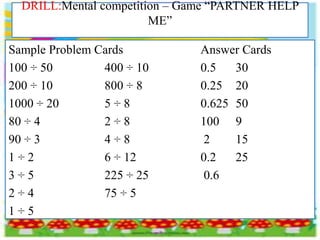
DRILL:Mental competition – Game “PARTNER HELP
ME”
Sample Problem Cards Answer Cards
100 ÷ 50 400 ÷ 10 0.5 30
200 ÷ 10 800 ÷ 8 0.25 20
1000 ÷ 20 5 ÷ 8 0.625 50
80 ÷ 4 2 ÷ 8 100 9
90 ÷ 3 4 ÷ 8 2 15
1 ÷ 2 6 ÷ 12 0.2 25
3 ÷ 5 225 ÷ 25 0.6
2 ÷ 4 75 ÷ 5
1 ÷ 5
REVIEW
How would you divide decimals by 10,
100, 1000
Answering of homework.
Decimal ÷10 ÷100 ÷100
1. 14.8
2. 2763.32
3. 129.74
4. 88.29
5. 212.73
MOTIVATION
Present a picture to the
class about bayanihan
(Transferring the house
to another place
MOTIVATION
i. What can you say about the picture?)
ii. What will you do so that you can
finish the task given to you on time?
iii. Elicit answers from the group
Mrs. Reyes bought 1/3 kg
of lansones. The reading
on the scale was 0.33. Did
Mrs. Reyes get what she
bought?
Ask: How did you get 0.33
PRESENTATION
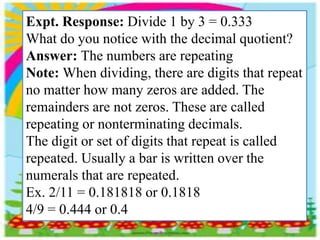
Expt. Response: Divide 1 by 3 = 0.333
What do you notice with the decimal quotient?
Answer: The numbers are repeating
Note: When dividing, there are digits that repeat
no matter how many zeros are added. The
remainders are not zeros. These are called
repeating or nonterminating decimals.
The digit or set of digits that repeat is called
repeated. Usually a bar is written over the
numerals that are repeated.
Ex. 2/11 = 0.181818 or 0.1818
4/9 = 0.444 or 0.4
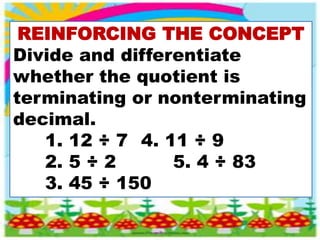
REINFORCING THE CONCEPT
Divide and differentiate
whether the quotient is
terminating or nonterminating
decimal.
1. 12 ÷ 7 4. 11 ÷ 9
2. 5 ÷ 2 5. 4 ÷ 83
3. 45 ÷ 150
PERFORMING THE
ACTIVITY:
Group the pupils into 5.
Let the members in each
group work
collaboratively. Let them
present their output one
at a time when done.
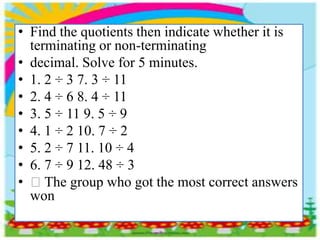
• Find the quotients then indicate whether it is
terminating or non-terminating
• decimal. Solve for 5 minutes.
• 1. 2 ÷ 3 7. 3 ÷ 11
• 2. 4 ÷ 6 8. 4 ÷ 11
• 3. 5 ÷ 11 9. 5 ÷ 9
• 4. 1 ÷ 2 10. 7 ÷ 2
• 5. 2 ÷ 7 11. 10 ÷ 4
• 6. 7 ÷ 9 12. 48 ÷ 3
• The group who got the most correct answers
won
After all groups have presented, ask,
How did you find the activity? How did
you
differentiate between terminating from
repeating decimal?
We divide the numbers, if the quotients
never ends, it is a repeating decimal
When the division terminates or comes
to and end with a zero remainder, it is
terminating decimal
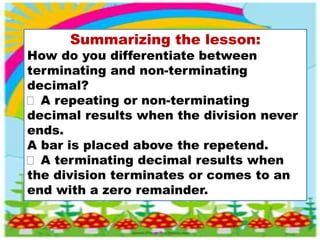
Summarizing the lesson:
How do you differentiate between
terminating and non-terminating
decimal?
A repeating or non-terminating
decimal results when the division never
ends.
A bar is placed above the repetend.
A terminating decimal results when
the division terminates or comes to an
end with a zero remainder.
APPLICATION
• Find out which of the following are
terminating decimals and repeating
decimals.
• 1. 70 ÷ 14
• 2. 9 ÷ 16
• 3. 9 ÷ 13
• 4. 3 ÷ 14
• 5. 99 ÷ 11
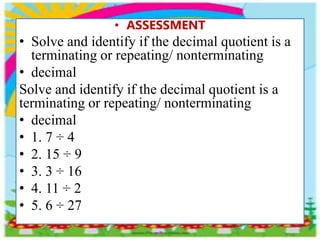
• ASSESSMENT
• Solve and identify if the decimal quotient is a
terminating or repeating/ nonterminating
• decimal
Solve and identify if the decimal quotient is a
terminating or repeating/ nonterminating
• decimal
• 1. 7 ÷ 4
• 2. 15 ÷ 9
• 3. 3 ÷ 16
• 4. 11 ÷ 2
• 5. 6 ÷ 27
Assignment:
Remediation
Find the quotient and differentiate the quotient if it is
terminating decimal or
repeating decimal.
1. 2 ÷ 9 4. 13 ÷ 16
2. 1 ÷ 6 5. 9 ÷ 45
3. 8 ÷ 9
Enrichment
Differentiate the quotient if it is terminating decimal or
repeating decimal:
1. 9/400 4. 104 ÷ 16
2. 790 ÷ 99 5. 106 ÷ 12
3. 999 ÷ 81

MATH 6 Q1 WK 9 D1-2-C.pptx

  • 1.
  • 2.
    DRILL:Mental competition –Game “PARTNER HELP ME” a. Divide the class into two groups. b. Work the problem in pairs. c. Two sets of problem card are put in front of the class. Another new set of answer cards are hang beside the problem cards. d. The first pupil in the group will get 1 problem card and he/she will read aloud. His/her partner will get the answer from Answer cards hanging at the side. After pairing it they will go at the back holding the problem card and the answer card. e. Continue the process until all the pupils in the group do their task. f. The teacher evaluates their answer, the group who have the most correct answer wins the game.
  • 3.
    DRILL:Mental competition –Game “PARTNER HELP ME” Sample Problem Cards Answer Cards 100 ÷ 50 400 ÷ 10 0.5 30 200 ÷ 10 800 ÷ 8 0.25 20 1000 ÷ 20 5 ÷ 8 0.625 50 80 ÷ 4 2 ÷ 8 100 9 90 ÷ 3 4 ÷ 8 2 15 1 ÷ 2 6 ÷ 12 0.2 25 3 ÷ 5 225 ÷ 25 0.6 2 ÷ 4 75 ÷ 5 1 ÷ 5
  • 4.
    REVIEW How would youdivide decimals by 10, 100, 1000 Answering of homework. Decimal ÷10 ÷100 ÷100 1. 14.8 2. 2763.32 3. 129.74 4. 88.29 5. 212.73
  • 5.
    MOTIVATION Present a pictureto the class about bayanihan (Transferring the house to another place
  • 6.
    MOTIVATION i. What canyou say about the picture?) ii. What will you do so that you can finish the task given to you on time? iii. Elicit answers from the group
  • 7.
    Mrs. Reyes bought1/3 kg of lansones. The reading on the scale was 0.33. Did Mrs. Reyes get what she bought? Ask: How did you get 0.33 PRESENTATION
  • 8.
    Expt. Response: Divide1 by 3 = 0.333 What do you notice with the decimal quotient? Answer: The numbers are repeating Note: When dividing, there are digits that repeat no matter how many zeros are added. The remainders are not zeros. These are called repeating or nonterminating decimals. The digit or set of digits that repeat is called repeated. Usually a bar is written over the numerals that are repeated. Ex. 2/11 = 0.181818 or 0.1818 4/9 = 0.444 or 0.4
  • 9.
    REINFORCING THE CONCEPT Divideand differentiate whether the quotient is terminating or nonterminating decimal. 1. 12 ÷ 7 4. 11 ÷ 9 2. 5 ÷ 2 5. 4 ÷ 83 3. 45 ÷ 150
  • 10.
    PERFORMING THE ACTIVITY: Group thepupils into 5. Let the members in each group work collaboratively. Let them present their output one at a time when done.
  • 11.
    • Find thequotients then indicate whether it is terminating or non-terminating • decimal. Solve for 5 minutes. • 1. 2 ÷ 3 7. 3 ÷ 11 • 2. 4 ÷ 6 8. 4 ÷ 11 • 3. 5 ÷ 11 9. 5 ÷ 9 • 4. 1 ÷ 2 10. 7 ÷ 2 • 5. 2 ÷ 7 11. 10 ÷ 4 • 6. 7 ÷ 9 12. 48 ÷ 3 • The group who got the most correct answers won
  • 12.
    After all groupshave presented, ask, How did you find the activity? How did you differentiate between terminating from repeating decimal? We divide the numbers, if the quotients never ends, it is a repeating decimal When the division terminates or comes to and end with a zero remainder, it is terminating decimal
  • 13.
    Summarizing the lesson: Howdo you differentiate between terminating and non-terminating decimal? A repeating or non-terminating decimal results when the division never ends. A bar is placed above the repetend. A terminating decimal results when the division terminates or comes to an end with a zero remainder.
  • 14.
    APPLICATION • Find outwhich of the following are terminating decimals and repeating decimals. • 1. 70 ÷ 14 • 2. 9 ÷ 16 • 3. 9 ÷ 13 • 4. 3 ÷ 14 • 5. 99 ÷ 11
  • 15.
    • ASSESSMENT • Solveand identify if the decimal quotient is a terminating or repeating/ nonterminating • decimal Solve and identify if the decimal quotient is a terminating or repeating/ nonterminating • decimal • 1. 7 ÷ 4 • 2. 15 ÷ 9 • 3. 3 ÷ 16 • 4. 11 ÷ 2 • 5. 6 ÷ 27
  • 16.
    Assignment: Remediation Find the quotientand differentiate the quotient if it is terminating decimal or repeating decimal. 1. 2 ÷ 9 4. 13 ÷ 16 2. 1 ÷ 6 5. 9 ÷ 45 3. 8 ÷ 9 Enrichment Differentiate the quotient if it is terminating decimal or repeating decimal: 1. 9/400 4. 104 ÷ 16 2. 790 ÷ 99 5. 106 ÷ 12 3. 999 ÷ 81