Mathematics in our
World
Mathematics
is …
a set of
problem-
solving
tools
a
language
an art
a study
of
patterns
a
process
of
thinking
“Mathematics is the alphabet
with which God has written
the universe.”
- Galileo Galilei
The elephant and the blind men
Fibonacci sequence
• Leonardo Fibonacci discovered the sequence.
• The sequence begins with zero. Each subsequent number
is the sum of the two preceding numbers.
• Thus the sequence begins as follows:
0, 1, 1, 2, 3, 5, 8, 13, 21, 34, 55, 89, 144….
The Fibonacci spiral
• The Fibonacci spiral is constructed by placing together
rectangles of relative side lengths equaling Fibonacci
numbers.
• Recall: 0, 1, 1, 2, 3, 5, 8, 13….
• A spiral can then be drawn starting from the corner of the
first rectangle of side length 1, all the way to the corner of
the rectangle of side length 13.
Golden ratio
• In mathematics and the arts, two quantities are in the golden ratio if the
ratio between the sum of those quantities and the larger one is the same as
the ratio between the larger one and the smaller.
• In this case, we refer to a very important number that is known as the
golden ratio.
• The golden ratio is a mathematical constant approximately 1.6180339887.
Golden ratio and Fibonacci numbers
Recall:
1, 1, 2, 3, 5, 8, 13, 21, 34, 55, 89, 144, 233, 377, 610, 987, 1597, ...
When we divide one of the Fibonacci numbers to the previous one, we
will get results that are so close to each other.
Moreover, after the 13th number in the sequence, the ratio will be fixed
at approximately 1.618, namely the golden number.
233 / 144, 377 / 233, 610 / 377, 987 / 610, 1597 / 987, 2584 / 1597,…
Activity
• Look at the rectangular shapes on the next slide.
• Chose the one figure on each group you feel has the most
appealing dimensions.
• Chosen figure will be tallied.
Activity
Activity
• The rectangles c and d were probably the rectangles chosen
as having the most pleasing shapes.
• Measure the length of the sides of these rectangles. Find the
ratio of the length of the longer side to the length of the
shorter side for each rectangles.
• This ratio approximates the famous Golden Ratio of the
ancient Greeks.
• These special rectangles are called Golden Rectangles
because the ratio of the length of the longer side to the
length of the shorter side is the Golden Ratio.
Golden Ratio in Arts and in Nature
Golden Ratio in logos
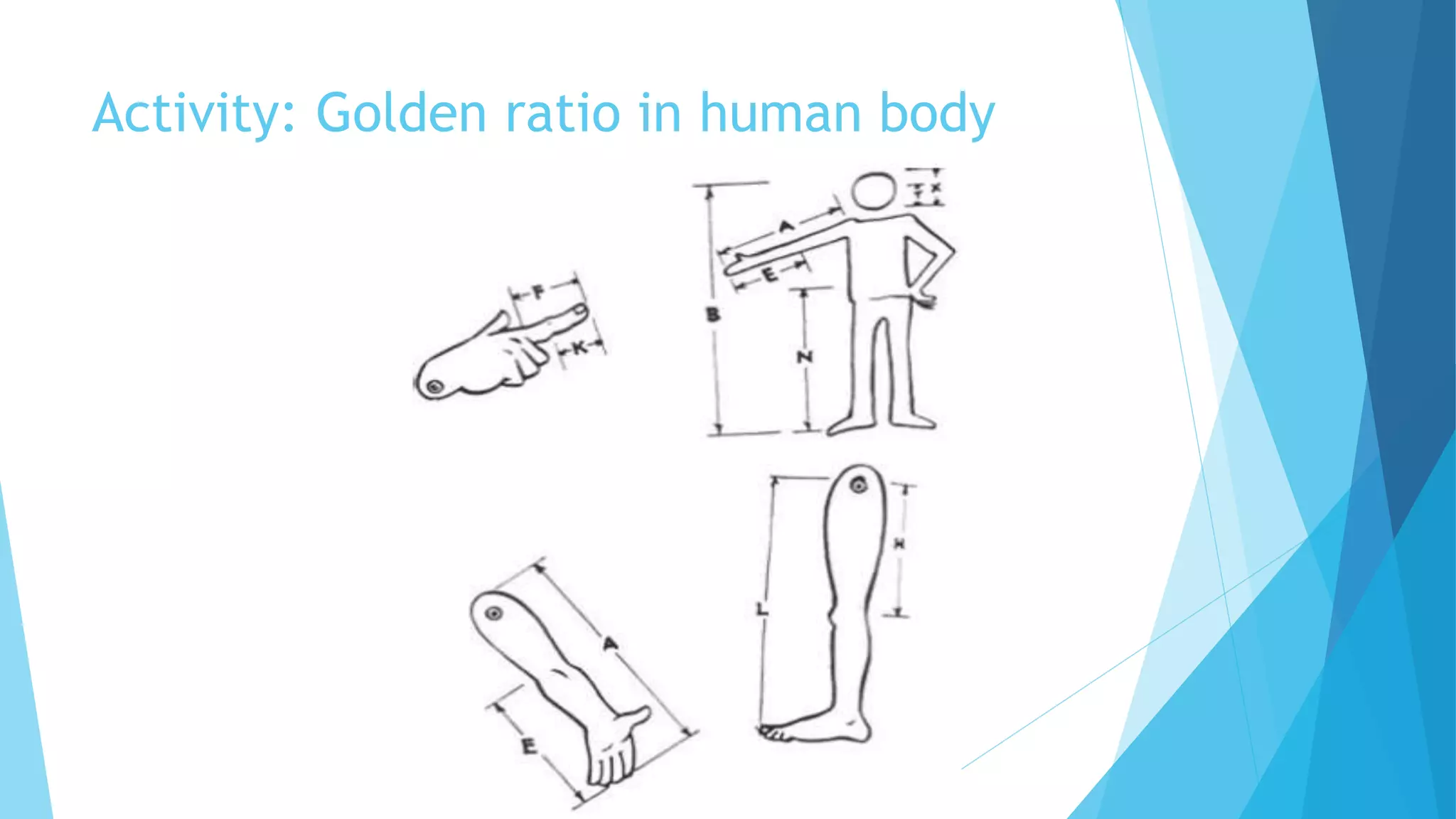
Activity: Golden ratio in human body
Culminating Activity
• Look for Fibonacci numbers in fruits, vegetables, flowers, or
plants available in your locality. Prepare a creative
presentation of the chosen object .
References:
• Calpa, MJ, Powerpoint Presentation: University of Eastern Philippines
(2017)
• Nature by Numbers,
https://www.youtube.com/watch?v=kkGeOWYOFoA
• Decoding the Secret Patterns of Nature-Fibonacci and Pi – Full
Documentary
https://www.youtube.com/watch?v=lXyCRP871VI
• Nocon R., Nocon E., Essential Mathematics for the Modern World
(2016)
• Stewart, I., Nature’s Numbers (1995)
• Vistro-Yu, C., Powerpoint Presentation: CHED ADMU GE Training (2016)

Math in the Modern World.pptx

  • 1.
  • 2.
    Mathematics is … a setof problem- solving tools a language an art a study of patterns a process of thinking “Mathematics is the alphabet with which God has written the universe.” - Galileo Galilei
  • 3.
    The elephant andthe blind men
  • 4.
    Fibonacci sequence • LeonardoFibonacci discovered the sequence. • The sequence begins with zero. Each subsequent number is the sum of the two preceding numbers. • Thus the sequence begins as follows: 0, 1, 1, 2, 3, 5, 8, 13, 21, 34, 55, 89, 144….
  • 5.
    The Fibonacci spiral •The Fibonacci spiral is constructed by placing together rectangles of relative side lengths equaling Fibonacci numbers. • Recall: 0, 1, 1, 2, 3, 5, 8, 13…. • A spiral can then be drawn starting from the corner of the first rectangle of side length 1, all the way to the corner of the rectangle of side length 13.
  • 6.
    Golden ratio • Inmathematics and the arts, two quantities are in the golden ratio if the ratio between the sum of those quantities and the larger one is the same as the ratio between the larger one and the smaller. • In this case, we refer to a very important number that is known as the golden ratio. • The golden ratio is a mathematical constant approximately 1.6180339887.
  • 7.
    Golden ratio andFibonacci numbers Recall: 1, 1, 2, 3, 5, 8, 13, 21, 34, 55, 89, 144, 233, 377, 610, 987, 1597, ... When we divide one of the Fibonacci numbers to the previous one, we will get results that are so close to each other. Moreover, after the 13th number in the sequence, the ratio will be fixed at approximately 1.618, namely the golden number. 233 / 144, 377 / 233, 610 / 377, 987 / 610, 1597 / 987, 2584 / 1597,…
  • 8.
    Activity • Look atthe rectangular shapes on the next slide. • Chose the one figure on each group you feel has the most appealing dimensions. • Chosen figure will be tallied.
  • 9.
  • 10.
    Activity • The rectanglesc and d were probably the rectangles chosen as having the most pleasing shapes. • Measure the length of the sides of these rectangles. Find the ratio of the length of the longer side to the length of the shorter side for each rectangles. • This ratio approximates the famous Golden Ratio of the ancient Greeks. • These special rectangles are called Golden Rectangles because the ratio of the length of the longer side to the length of the shorter side is the Golden Ratio.
  • 11.
    Golden Ratio inArts and in Nature
  • 12.
  • 13.
  • 14.
    Culminating Activity • Lookfor Fibonacci numbers in fruits, vegetables, flowers, or plants available in your locality. Prepare a creative presentation of the chosen object .
  • 15.
    References: • Calpa, MJ,Powerpoint Presentation: University of Eastern Philippines (2017) • Nature by Numbers, https://www.youtube.com/watch?v=kkGeOWYOFoA • Decoding the Secret Patterns of Nature-Fibonacci and Pi – Full Documentary https://www.youtube.com/watch?v=lXyCRP871VI • Nocon R., Nocon E., Essential Mathematics for the Modern World (2016) • Stewart, I., Nature’s Numbers (1995) • Vistro-Yu, C., Powerpoint Presentation: CHED ADMU GE Training (2016)