MATH 4
QUARTER 2 WEEK 4
Learning Competencies
and Objectives
1. Perform two or more different
operations by applying the MDAS
rules.
2. Represent situations involving
one or more of the four operations
using a number sentence.
Content
Order of Operations
(Applying the MDAS
rules)
DAY 1
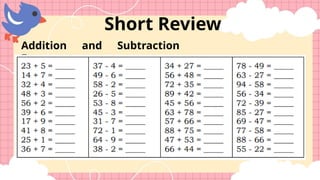
Short Review
Addition and Subtraction
Facts
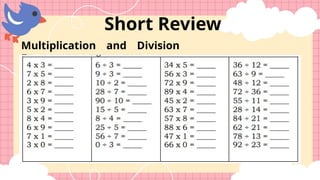
Short Review
Multiplication and Division
Facts
Guide Questions:
1. How did you find
the missing
numbers so that the
addition sentence is
correct?
2. How did you
check if your answer
is correct?
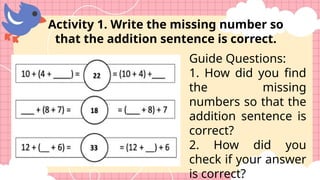
Activity 1. Write the missing number so
that the addition sentence is correct.
Guide Questions:
1. How did you find
the missing
numbers so that the
addition sentence is
correct?
2. How did you
check if your answer
is correct?
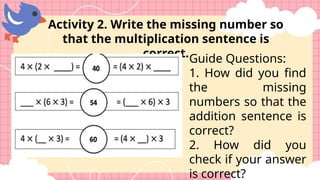
Activity 2. Write the missing number so
that the multiplication sentence is
correct.
Guide Questions:
1. How did you find
the missing
numbers so that the
addition sentence is
correct?
2. How did you
check if your answer
is correct?
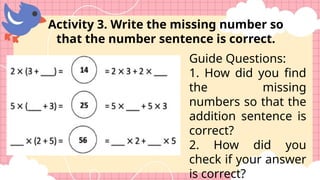
Activity 3. Write the missing number so
that the number sentence is correct.
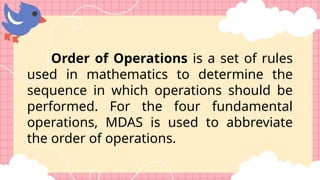
Order of Operations is a set of rules
used in mathematics to determine the
sequence in which operations should be
performed. For the four fundamental
operations, MDAS is used to abbreviate
the order of operations.
SUB-TOPIC 1:
Order of Operations
[Performing two
operations: Addition and
Subtraction (AS rule) and
Multiplication and Division
(MD rule)]
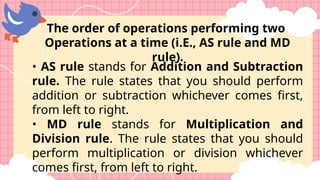
The order of operations performing two
Operations at a time (i.E., AS rule and MD
rule).
• AS rule stands for Addition and Subtraction
rule. The rule states that you should perform
addition or subtraction whichever comes first,
from left to right.
• MD rule stands for Multiplication and
Division rule. The rule states that you should
perform multiplication or division whichever
comes first, from left to right.
Worked Example
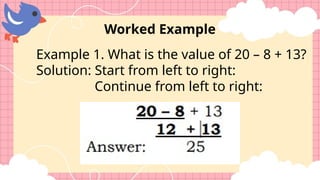
Example 1. What is the value of 20 – 8 + 13?
Solution: Start from left to right:
Continue from left to right:
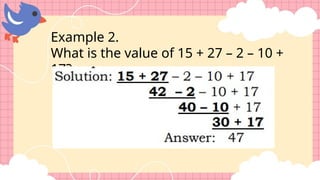
Example 2.
What is the value of 15 + 27 – 2 – 10 +
17?
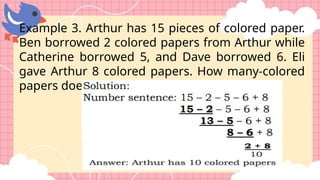
Example 3. Arthur has 15 pieces of colored paper.
Ben borrowed 2 colored papers from Arthur while
Catherine borrowed 5, and Dave borrowed 6. Eli
gave Arthur 8 colored papers. How many-colored
papers does Arthur have now?
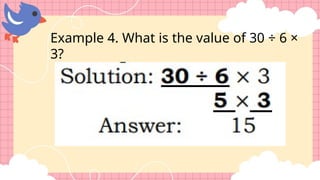
Example 4. What is the value of 30 ÷ 6 ×
3?
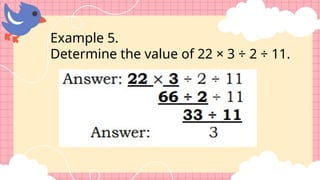
Example 5.
Determine the value of 22 × 3 ÷ 2 ÷ 11.
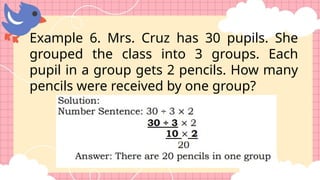
Example 6. Mrs. Cruz has 30 pupils. She
grouped the class into 3 groups. Each
pupil in a group gets 2 pencils. How many
pencils were received by one group?
DAY 2
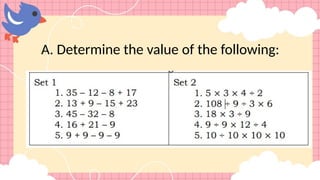
A. Determine the value of the following:
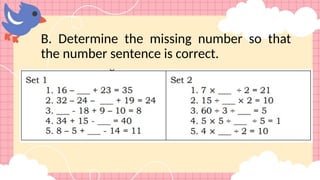
B. Determine the missing number so that
the number sentence is correct.
Learners’ Takeaways
Guide Question:
In solving a series of operations,
in what order do you perform
addition and subtraction?
multiplication and division?
DAY 3
SUB-TOPIC 2:
Order of Operations
(Performing three or
more operations
using the MDAS rules)
MDAS rule stands for Multiplication,
Division, Addition, and Subtraction
rule. The rule states that you should
perform first multiplication and division
in the order in which they occur followed
by addition or
subtraction, whichever comes first, from
left to right.
Worked Example
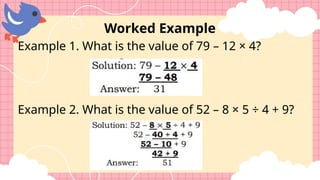
Example 1. What is the value of 79 – 12 × 4?
Example 2. What is the value of 52 – 8 × 5 ÷ 4 + 9?
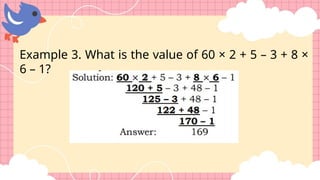
Example 3. What is the value of 60 × 2 + 5 – 3 + 8 ×
6 – 1?
Lesson Activity
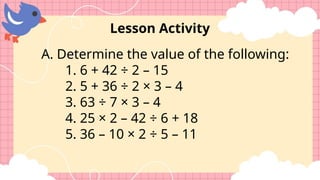
A. Determine the value of the following:
1. 6 + 42 ÷ 2 – 15
2. 5 + 36 ÷ 2 × 3 – 4
3. 63 ÷ 7 × 3 – 4
4. 25 × 2 – 42 ÷ 6 + 18
5. 36 – 10 × 2 ÷ 5 – 11
Lesson Activity
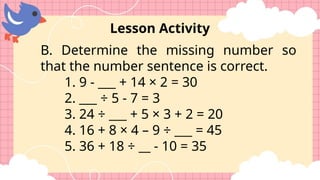
B. Determine the missing number so
that the number sentence is correct.
1. 9 - ___ + 14 × 2 = 30
2. ___ ÷ 5 - 7 = 3
3. 24 ÷ ___ + 5 × 3 + 2 = 20
4. 16 + 8 × 4 – 9 ÷ ___ = 45
5. 36 + 18 ÷ __ - 10 = 35
Learners’ Takeaways
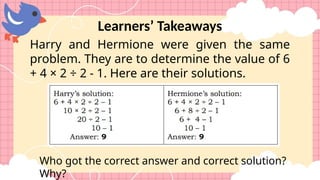
Harry and Hermione were given the same
problem. They are to determine the value of 6
+ 4 × 2 ÷ 2 - 1. Here are their solutions.
Who got the correct answer and correct solution?
Why?
DAY 4
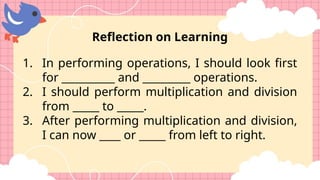
Reflection on Learning
1. In performing operations, I should look first
for __________ and _________ operations.
2. I should perform multiplication and division
from _____ to _____.
3. After performing multiplication and division,
I can now ____ or _____ from left to right.
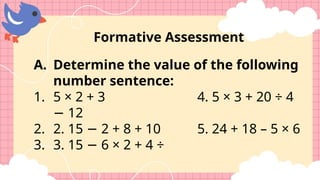
Formative Assessment
A. Determine the value of the following
number sentence:
1. 5 × 2 + 3 4. 5 × 3 + 20 ÷ 4
12
−
2. 2. 15 2 + 8 + 10
− 5. 24 + 18 – 5 × 6
3. 3. 15 6 × 2 + 4 ÷
−
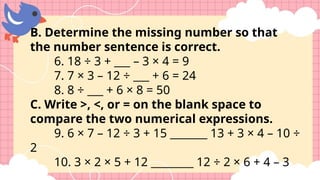
B. Determine the missing number so that
the number sentence is correct.
6. 18 ÷ 3 + ___ – 3 × 4 = 9
7. 7 × 3 – 12 ÷ ___ + 6 = 24
8. 8 ÷ ___ + 6 × 8 = 50
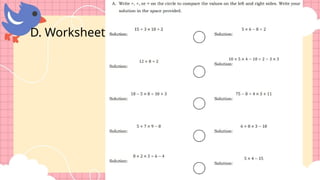
C. Write >, <, or = on the blank space to
compare the two numerical expressions.
9. 6 × 7 – 12 ÷ 3 + 15 _______ 13 + 3 × 4 – 10 ÷
2
10. 3 × 2 × 5 + 12 ________ 12 ÷ 2 × 6 + 4 – 3
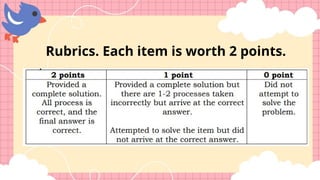
Rubrics. Each item is worth 2 points.
D. Worksheet
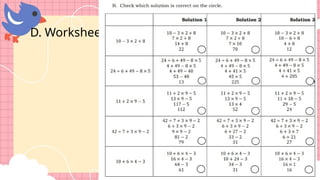
D. Worksheet
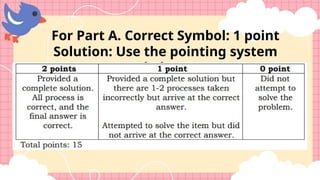
For Part A. Correct Symbol: 1 point
Solution: Use the pointing system
below:
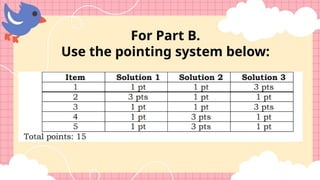
For Part B.
Use the pointing system below:

MATH 4_Q2_Week4 (1).pptx grade 4 ppt math

  • 1.
  • 2.
    Learning Competencies and Objectives 1.Perform two or more different operations by applying the MDAS rules. 2. Represent situations involving one or more of the four operations using a number sentence.
  • 3.
  • 4.
  • 5.
    Short Review Addition andSubtraction Facts
  • 6.
  • 7.
    Guide Questions: 1. Howdid you find the missing numbers so that the addition sentence is correct? 2. How did you check if your answer is correct? Activity 1. Write the missing number so that the addition sentence is correct.
  • 8.
    Guide Questions: 1. Howdid you find the missing numbers so that the addition sentence is correct? 2. How did you check if your answer is correct? Activity 2. Write the missing number so that the multiplication sentence is correct.
  • 9.
    Guide Questions: 1. Howdid you find the missing numbers so that the addition sentence is correct? 2. How did you check if your answer is correct? Activity 3. Write the missing number so that the number sentence is correct.
  • 10.
    Order of Operationsis a set of rules used in mathematics to determine the sequence in which operations should be performed. For the four fundamental operations, MDAS is used to abbreviate the order of operations.
  • 11.
    SUB-TOPIC 1: Order ofOperations [Performing two operations: Addition and Subtraction (AS rule) and Multiplication and Division (MD rule)]
  • 12.
    The order ofoperations performing two Operations at a time (i.E., AS rule and MD rule). • AS rule stands for Addition and Subtraction rule. The rule states that you should perform addition or subtraction whichever comes first, from left to right. • MD rule stands for Multiplication and Division rule. The rule states that you should perform multiplication or division whichever comes first, from left to right.
  • 13.
    Worked Example Example 1.What is the value of 20 – 8 + 13? Solution: Start from left to right: Continue from left to right:
  • 14.
    Example 2. What isthe value of 15 + 27 – 2 – 10 + 17?
  • 15.
    Example 3. Arthurhas 15 pieces of colored paper. Ben borrowed 2 colored papers from Arthur while Catherine borrowed 5, and Dave borrowed 6. Eli gave Arthur 8 colored papers. How many-colored papers does Arthur have now?
  • 16.
    Example 4. Whatis the value of 30 ÷ 6 × 3?
  • 17.
    Example 5. Determine thevalue of 22 × 3 ÷ 2 ÷ 11.
  • 18.
    Example 6. Mrs.Cruz has 30 pupils. She grouped the class into 3 groups. Each pupil in a group gets 2 pencils. How many pencils were received by one group?
  • 19.
  • 20.
    A. Determine thevalue of the following:
  • 21.
    B. Determine themissing number so that the number sentence is correct.
  • 22.
    Learners’ Takeaways Guide Question: Insolving a series of operations, in what order do you perform addition and subtraction? multiplication and division?
  • 23.
  • 24.
    SUB-TOPIC 2: Order ofOperations (Performing three or more operations using the MDAS rules)
  • 25.
    MDAS rule standsfor Multiplication, Division, Addition, and Subtraction rule. The rule states that you should perform first multiplication and division in the order in which they occur followed by addition or subtraction, whichever comes first, from left to right.
  • 26.
    Worked Example Example 1.What is the value of 79 – 12 × 4? Example 2. What is the value of 52 – 8 × 5 ÷ 4 + 9?
  • 27.
    Example 3. Whatis the value of 60 × 2 + 5 – 3 + 8 × 6 – 1?
  • 28.
    Lesson Activity A. Determinethe value of the following: 1. 6 + 42 ÷ 2 – 15 2. 5 + 36 ÷ 2 × 3 – 4 3. 63 ÷ 7 × 3 – 4 4. 25 × 2 – 42 ÷ 6 + 18 5. 36 – 10 × 2 ÷ 5 – 11
  • 29.
    Lesson Activity B. Determinethe missing number so that the number sentence is correct. 1. 9 - ___ + 14 × 2 = 30 2. ___ ÷ 5 - 7 = 3 3. 24 ÷ ___ + 5 × 3 + 2 = 20 4. 16 + 8 × 4 – 9 ÷ ___ = 45 5. 36 + 18 ÷ __ - 10 = 35
  • 30.
    Learners’ Takeaways Harry andHermione were given the same problem. They are to determine the value of 6 + 4 × 2 ÷ 2 - 1. Here are their solutions. Who got the correct answer and correct solution? Why?
  • 31.
  • 32.
    Reflection on Learning 1.In performing operations, I should look first for __________ and _________ operations. 2. I should perform multiplication and division from _____ to _____. 3. After performing multiplication and division, I can now ____ or _____ from left to right.
  • 33.
    Formative Assessment A. Determinethe value of the following number sentence: 1. 5 × 2 + 3 4. 5 × 3 + 20 ÷ 4 12 − 2. 2. 15 2 + 8 + 10 − 5. 24 + 18 – 5 × 6 3. 3. 15 6 × 2 + 4 ÷ −
  • 34.
    B. Determine themissing number so that the number sentence is correct. 6. 18 ÷ 3 + ___ – 3 × 4 = 9 7. 7 × 3 – 12 ÷ ___ + 6 = 24 8. 8 ÷ ___ + 6 × 8 = 50 C. Write >, <, or = on the blank space to compare the two numerical expressions. 9. 6 × 7 – 12 ÷ 3 + 15 _______ 13 + 3 × 4 – 10 ÷ 2 10. 3 × 2 × 5 + 12 ________ 12 ÷ 2 × 6 + 4 – 3
  • 35.
    Rubrics. Each itemis worth 2 points.
  • 36.
  • 37.
  • 38.
    For Part A.Correct Symbol: 1 point Solution: Use the pointing system below:
  • 39.
    For Part B. Usethe pointing system below: