MATH
4
QUARTER
2
QUARTER
2
QUARTER
2
MATATAG
CURRICULUM
MATATAG
CURRICULUM
Week 4 Day 1
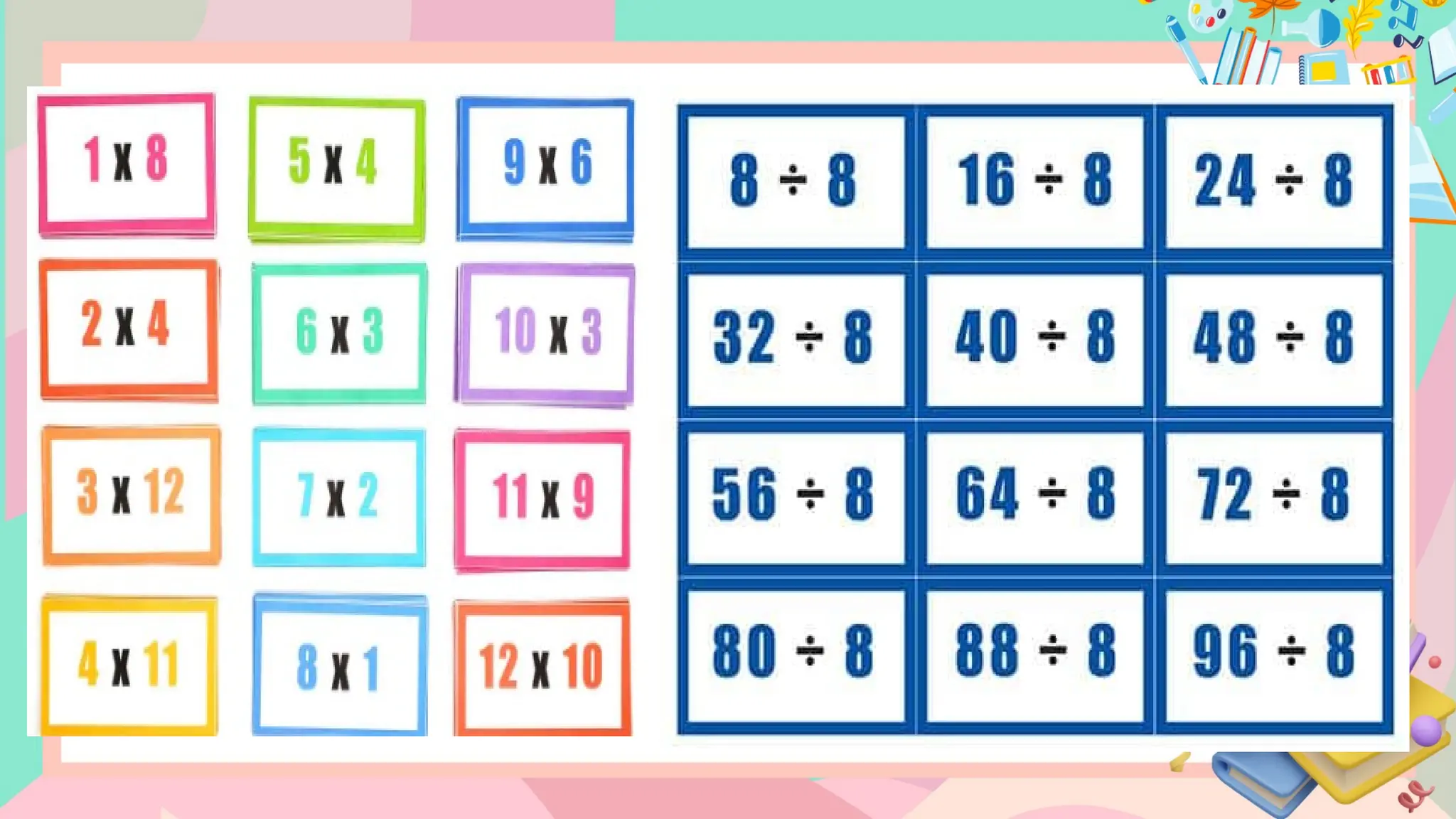
Game on Giant Step.
Use flashcards of addition, subtraction,
multiplication, and division.
Activity
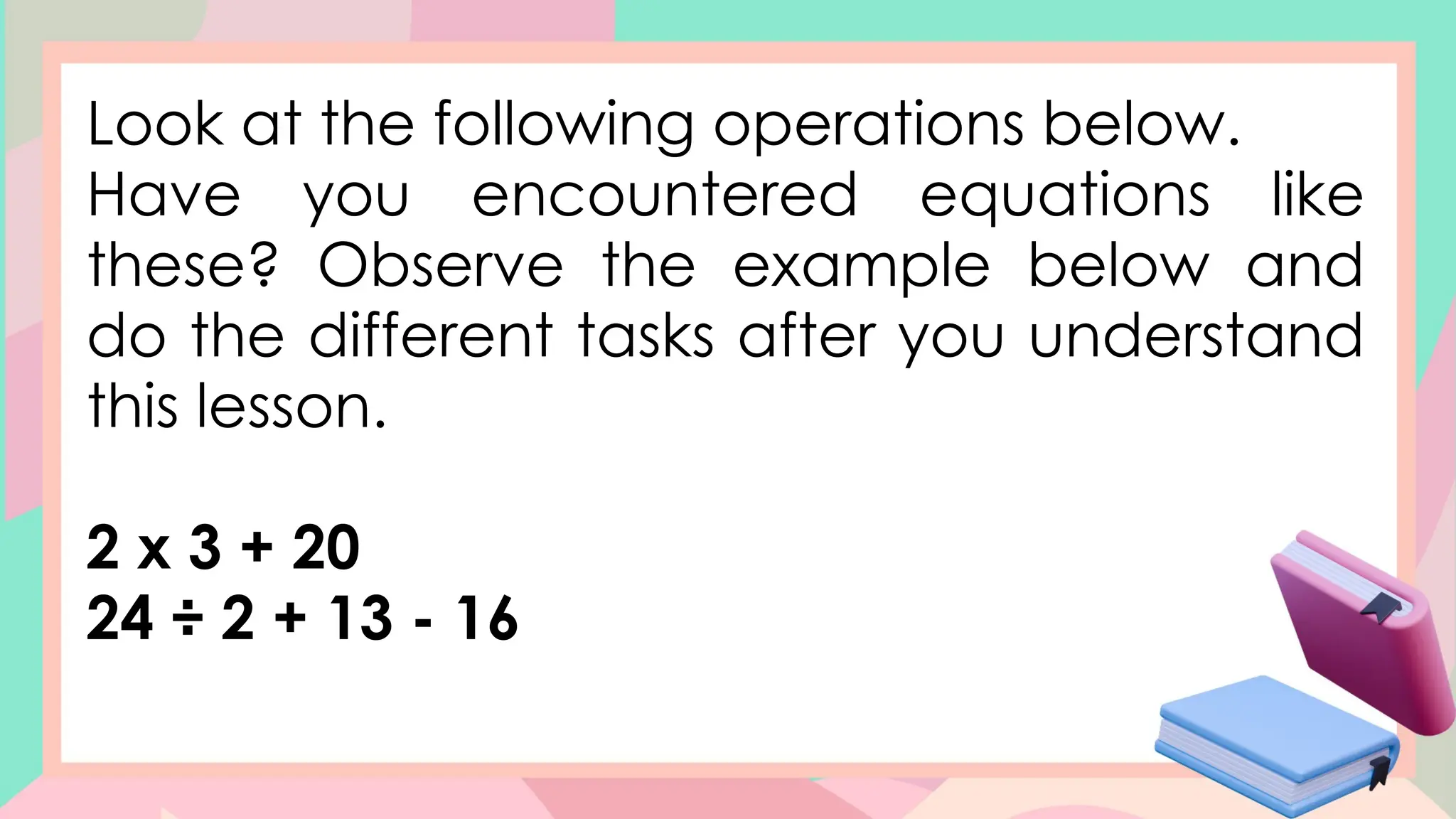
Look at the following operations below.
Have you encountered equations like
these? Observe the example below and
do the different tasks after you understand
this lesson.
2 x 3 + 20
24 ÷ 2 + 13 - 16
To solve the equation, we will use
the MDAS Rule. MDAS refers to the
basic operations such as
Multiplication, Division, Addition
and Subtraction. The rules must be
followed to solve the equation like
these.
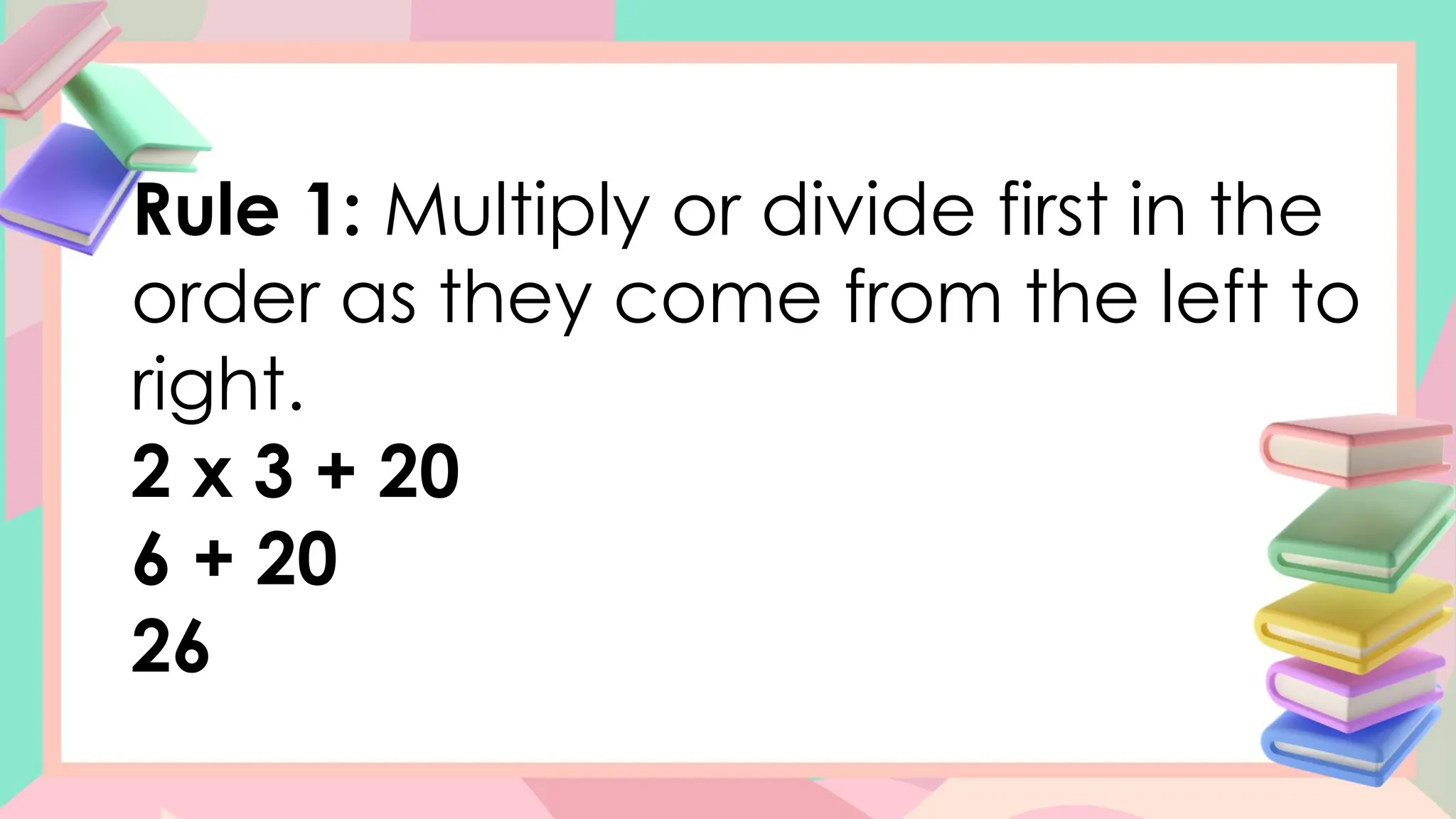
Rule 1: Multiply or divide first in the
order as they come from the left to
right.
2 x 3 + 20
6 + 20
26
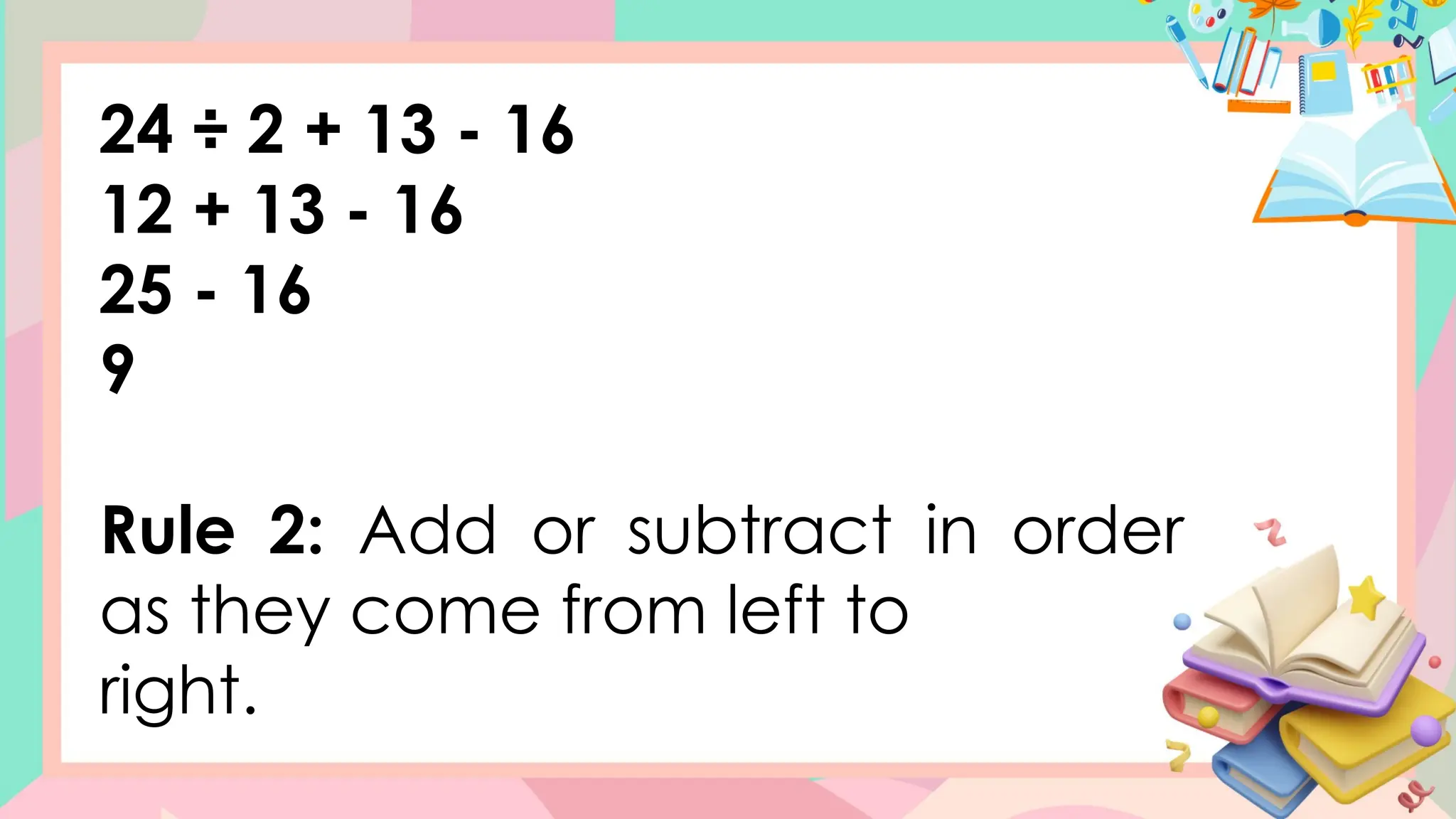
24 ÷ 2 + 13 - 16
12 + 13 - 16
25 - 16
9
Rule 2: Add or subtract in order
as they come from left to
right.
Activity 1
Solve the following equations. Show your
solutions and encircle the final answer.
1. 9 x 3 – 16 ÷ 4
2. 10 – 6 + 4
3. 18 ÷ 3 x 4 – 6 + 9
4. 60 + 48 ÷ 2 x 4
5. 30 ÷ 2 x 4 – 8 + 9
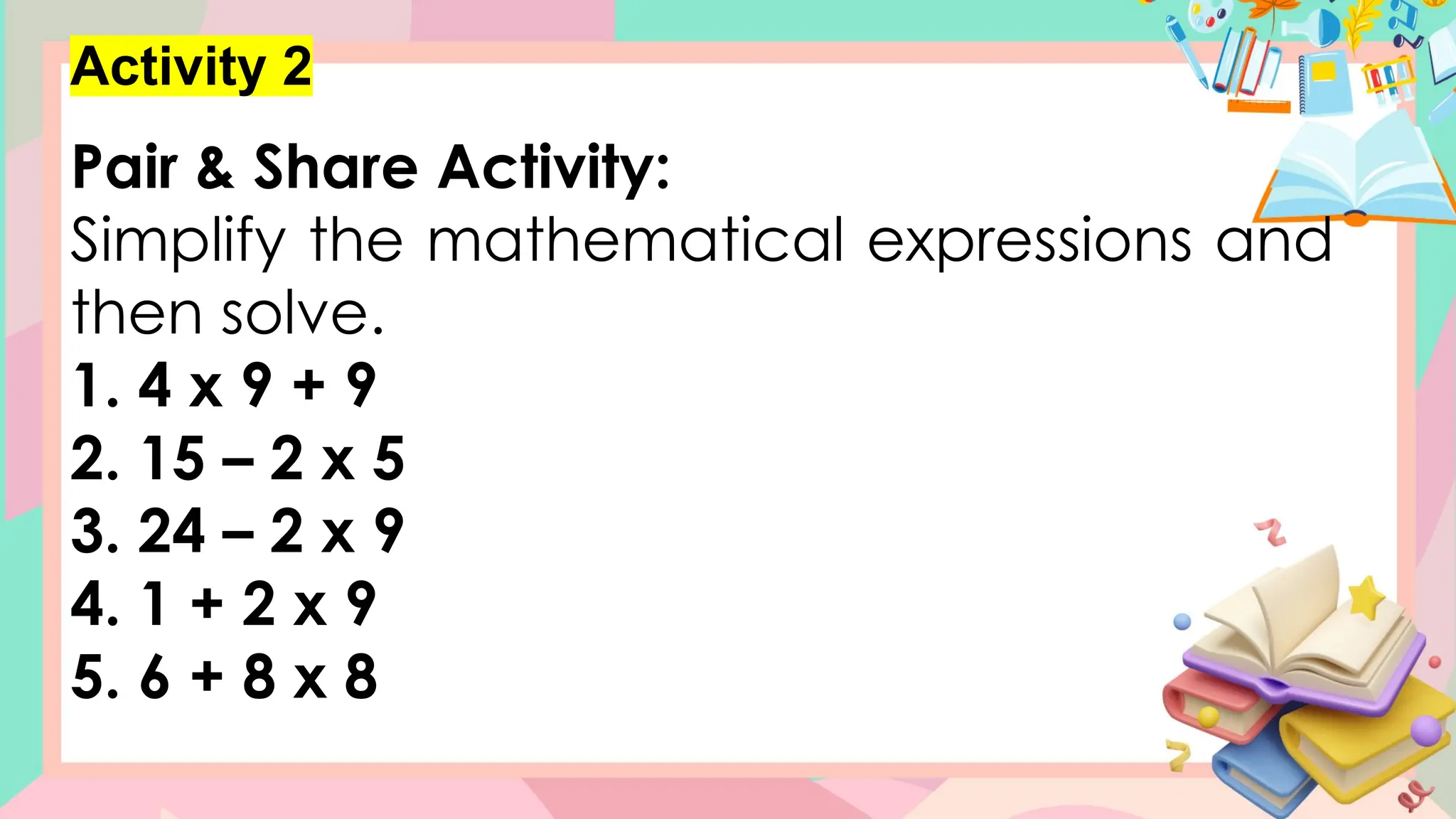
Activity 2
Pair & Share Activity:
Simplify the mathematical expressions and
then solve.
1. 4 x 9 + 9
2. 15 – 2 x 5
3. 24 – 2 x 9
4. 1 + 2 x 9
5. 6 + 8 x 8
Activity 3
Perform the indicated operations.
1) 14 – 8 + 3 = ___
2) 8 x 2 + 5 = ___
3) 6 + 8 ÷ 2 = ___
4) 18 – 10 ÷ 2 = ___
5) 25 – 7 x 3 = ___
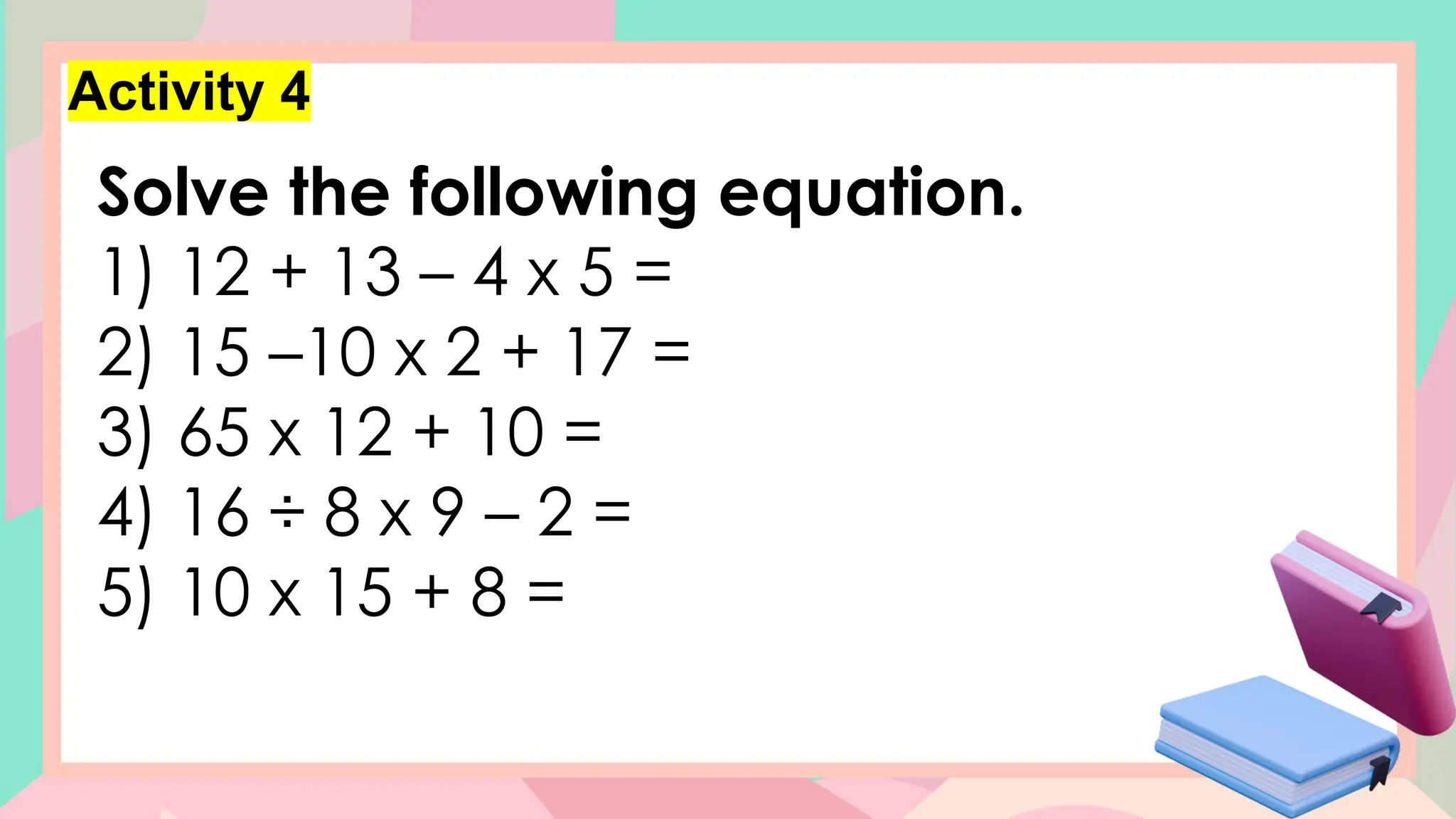
Activity 4
Solve the following equation.
1) 12 + 13 – 4 x 5 =
2) 15 –10 x 2 + 17 =
3) 65 x 12 + 10 =
4) 16 ÷ 8 x 9 – 2 =
5) 10 x 15 + 8 =
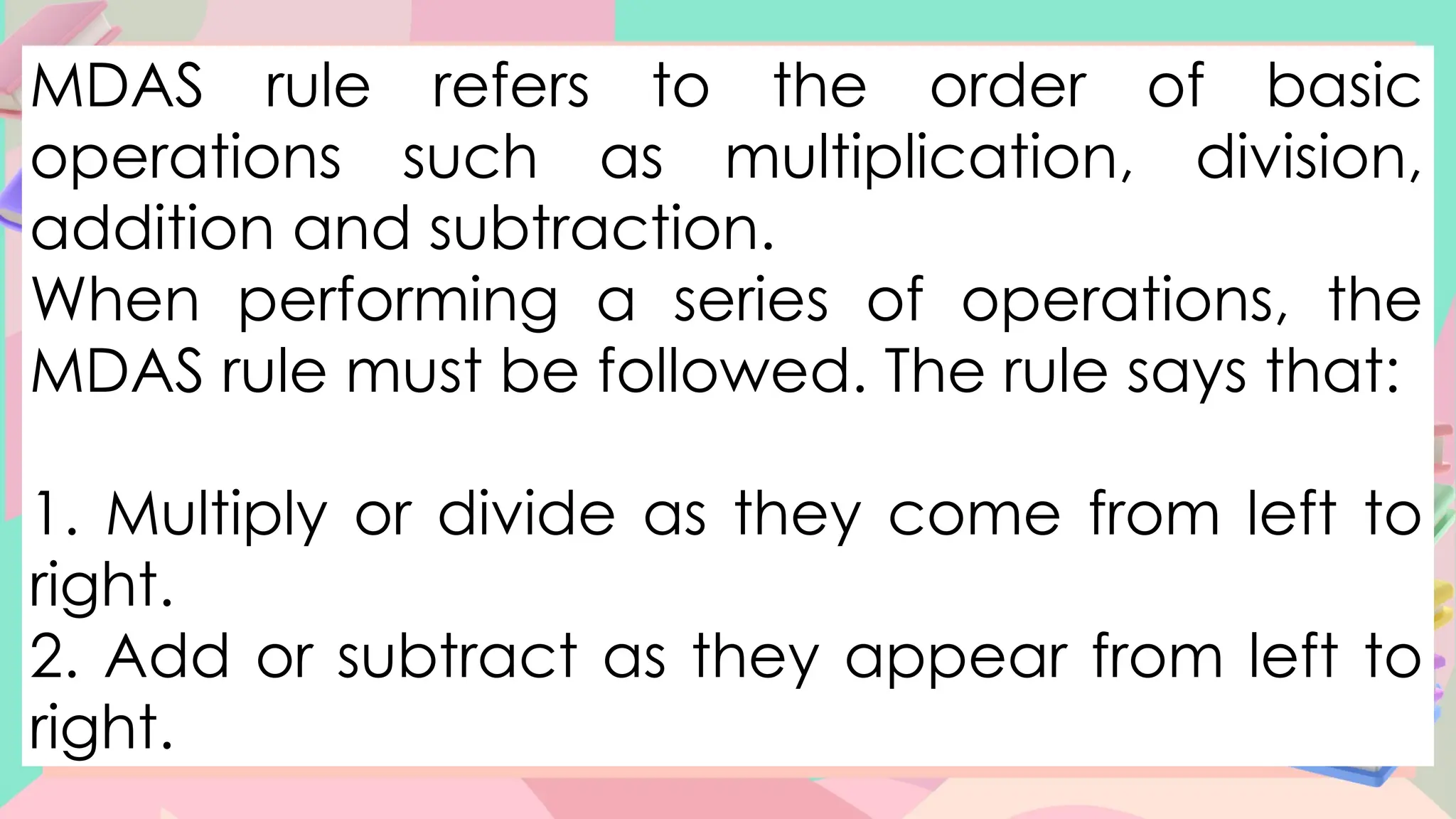
MDAS rule refers to the order of basic
operations such as multiplication, division,
addition and subtraction.
When performing a series of operations, the
MDAS rule must be followed. The rule says that:
1. Multiply or divide as they come from left to
right.
2. Add or subtract as they appear from left to
right.
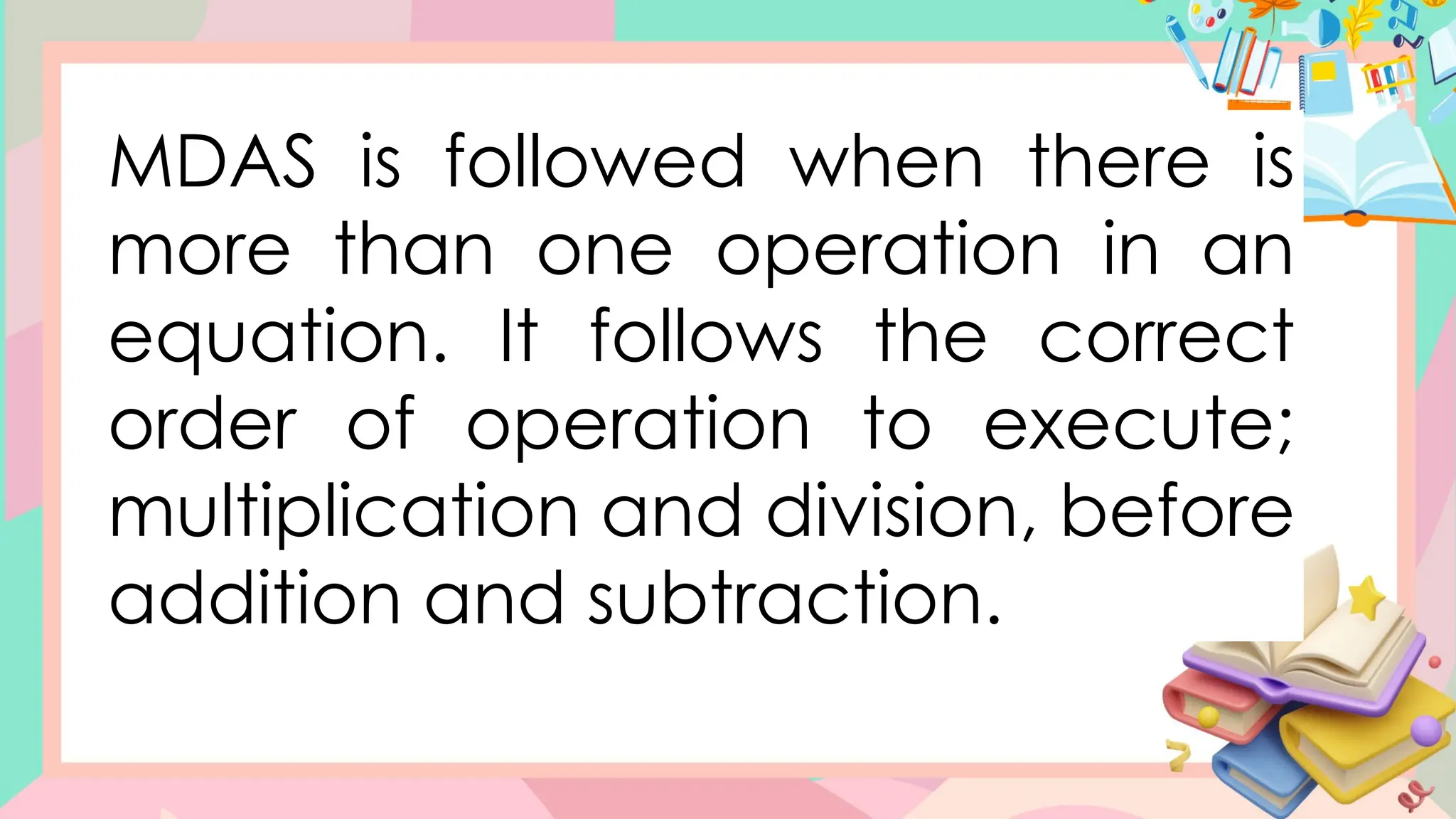
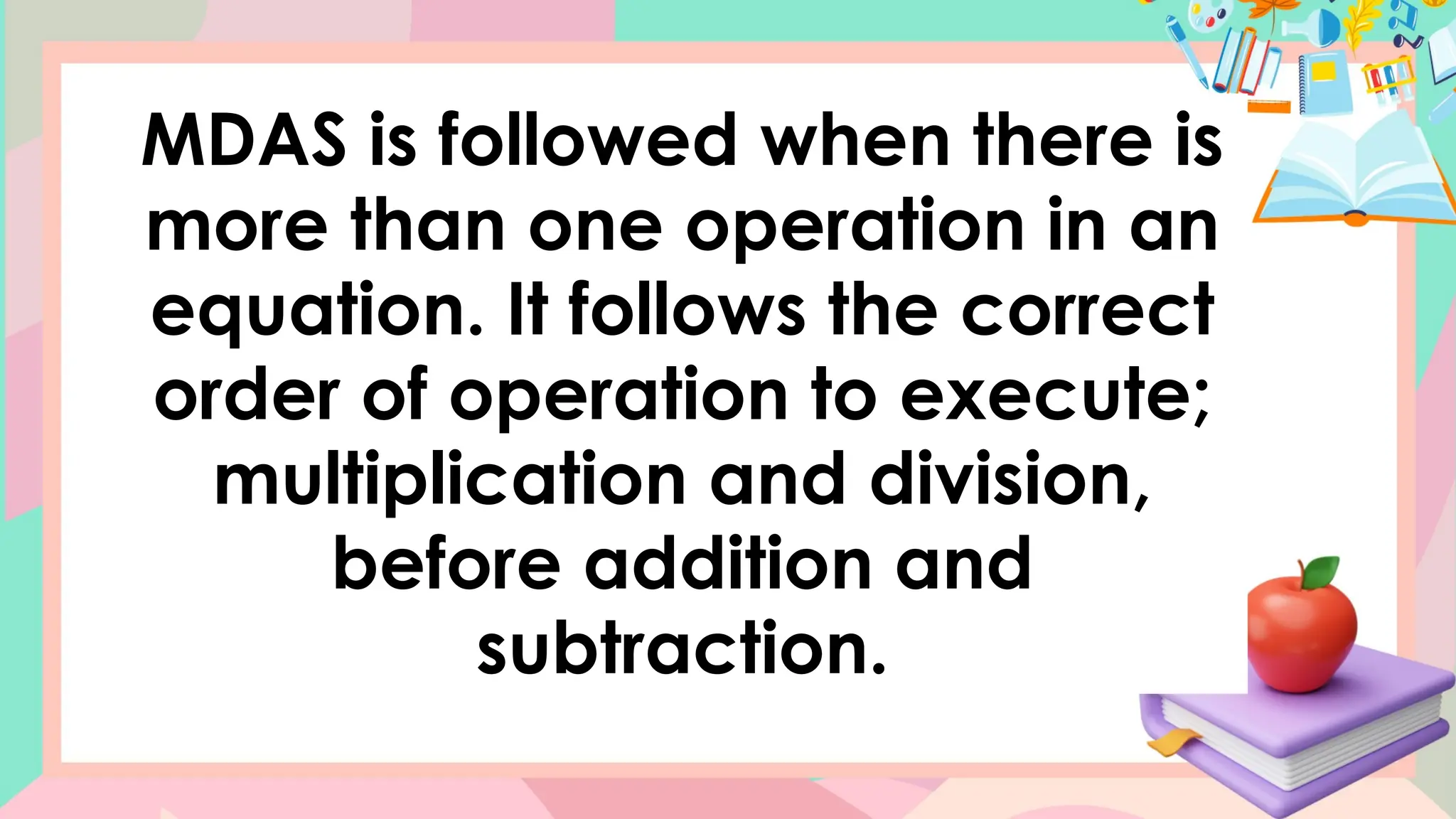
MDAS is followed when there is
more than one operation in an
equation. It follows the correct
order of operation to execute;
multiplication and division, before
addition and subtraction.
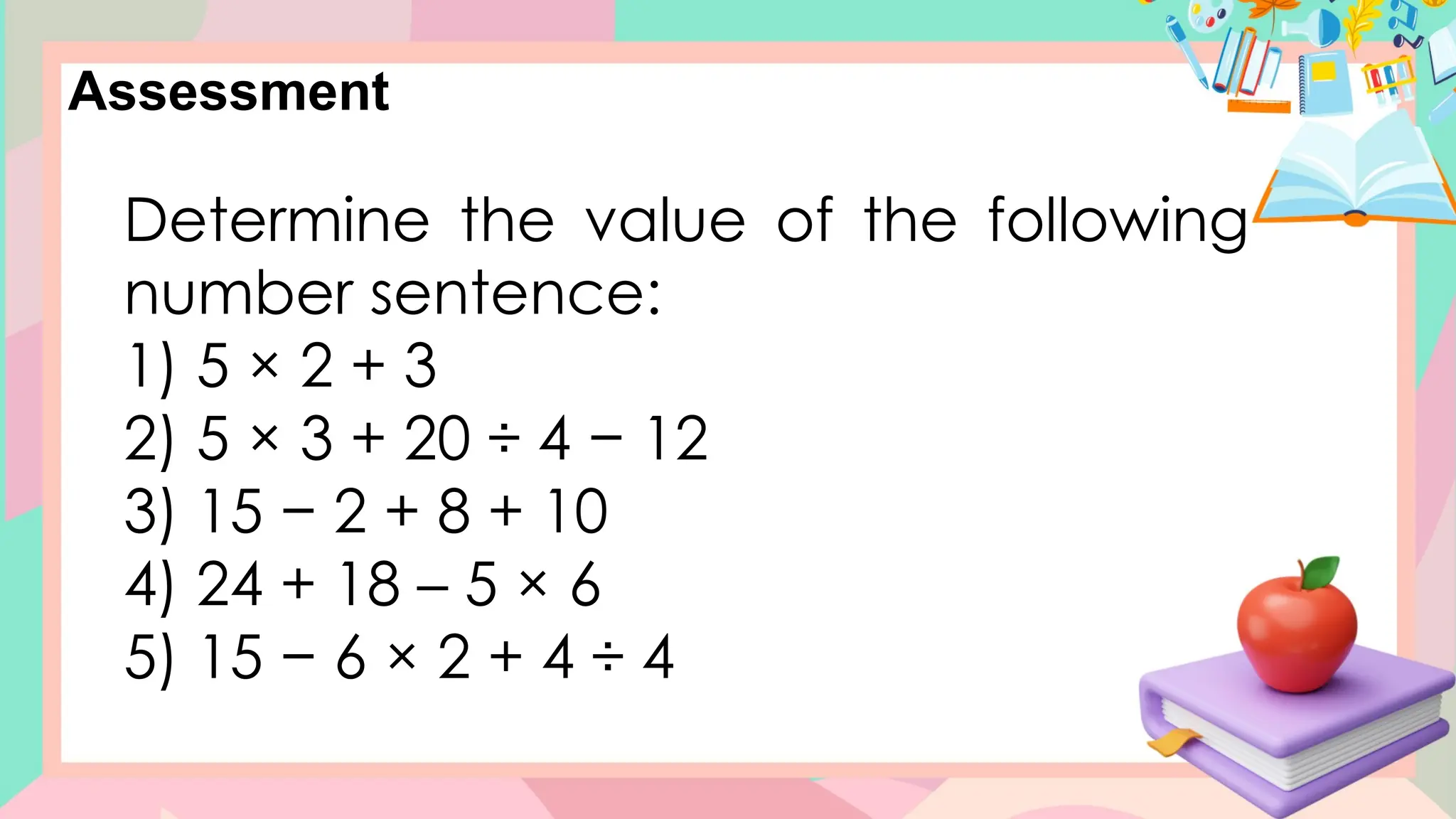
Assessment
Determine the value of the following
number sentence:
1) 5 × 2 + 3
2) 5 × 3 + 20 ÷ 4 − 12
3) 15 − 2 + 8 + 10
4) 24 + 18 – 5 × 6
5) 15 − 6 × 2 + 4 ÷ 4
Thank
You
MATH
4
QUARTER
2
QUARTER
2
QUARTER
2
MATATAG
CURRICULUM
MATATAG
CURRICULUM
Week 4 Day 2
Order of Operations
(Applying the MDAS
rules)
A. Let’s dance!
https://www.youtube.com/watch?
v=7bNOmVPj5T8
What are the fundamental operations
mentioned?
B. Have a game. “Pass the Ball”
Provide 4 equations and place in the basket.
Mechanics:
1. Play a math song.
2. Pass the ball. Once the song stops, the pupil
who is holding the ball will be the one to
answer one of the equations inside the basket.
3. Repeat until all equations will be answered.
Choose the letter of the correct answer.
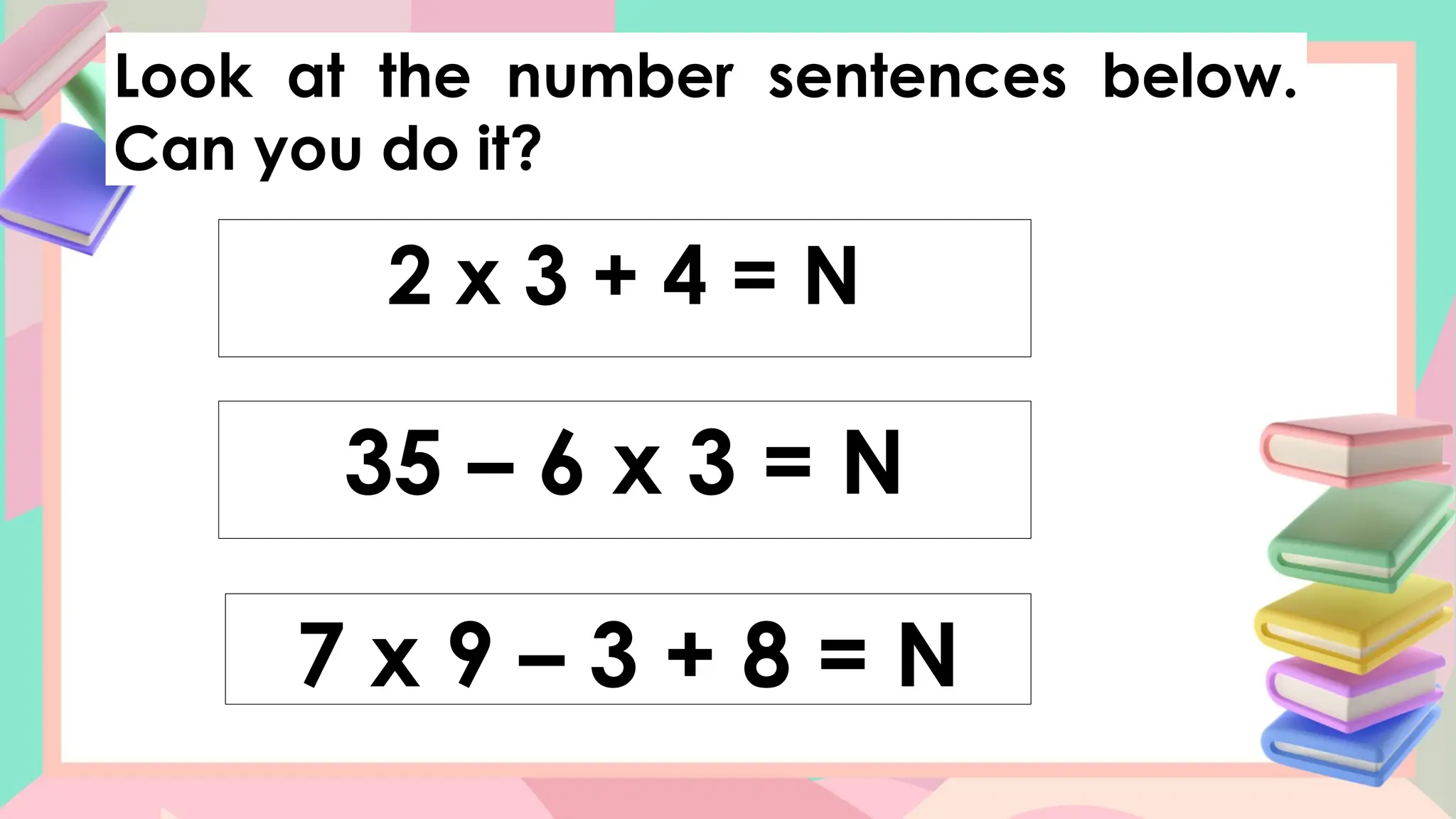
Look at the number sentences below.
Can you do it?
2 x 3 + 4 = N
35 – 6 x 3 = N
7 x 9 – 3 + 8 = N
Aims
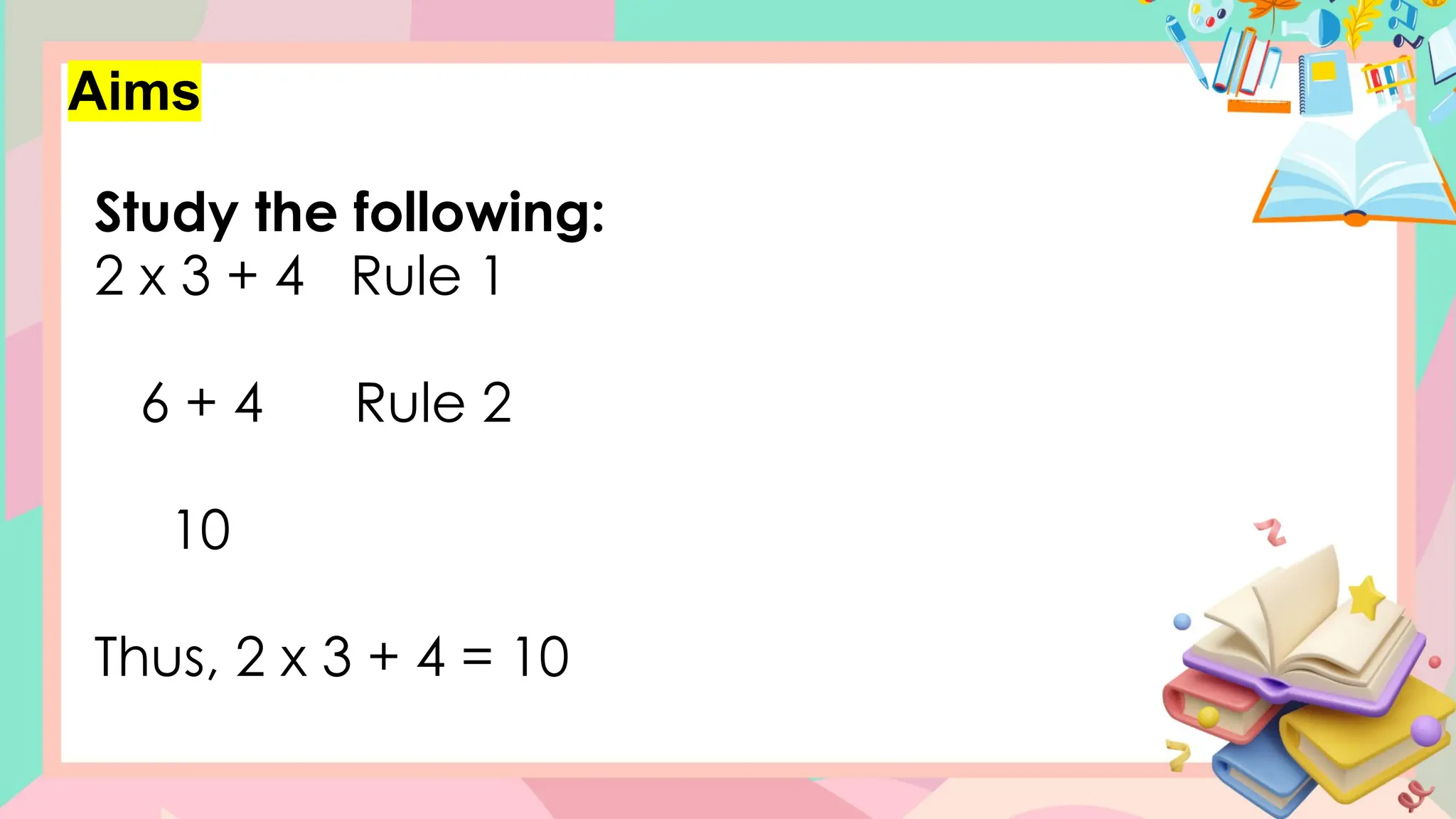
Study the following:
2 x 3 + 4 Rule 1
6 + 4 Rule 2
10
Thus, 2 x 3 + 4 = 10
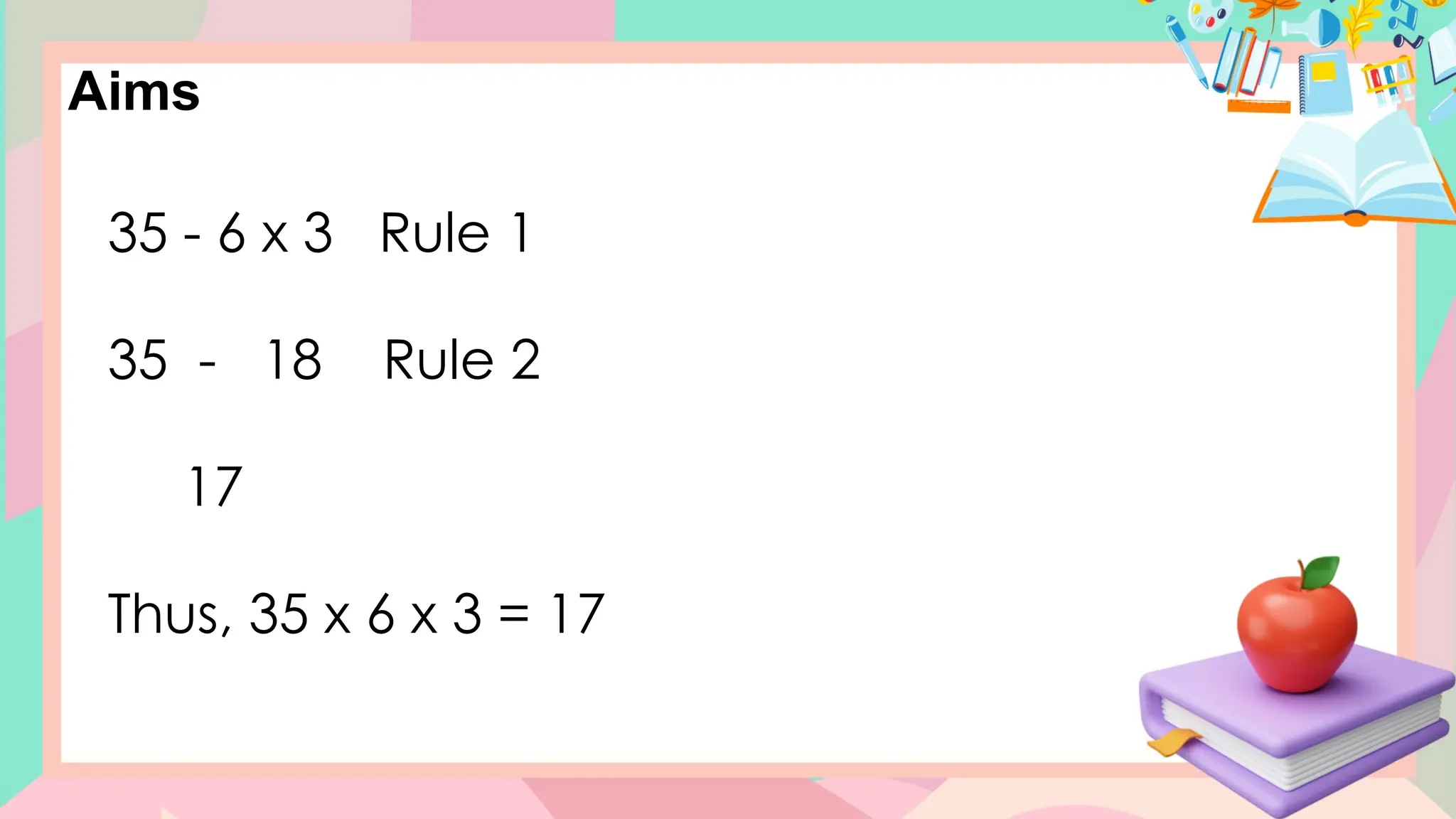
Aims
35 - 6 x 3 Rule 1
35 - 18 Rule 2
17
Thus, 35 x 6 x 3 = 17
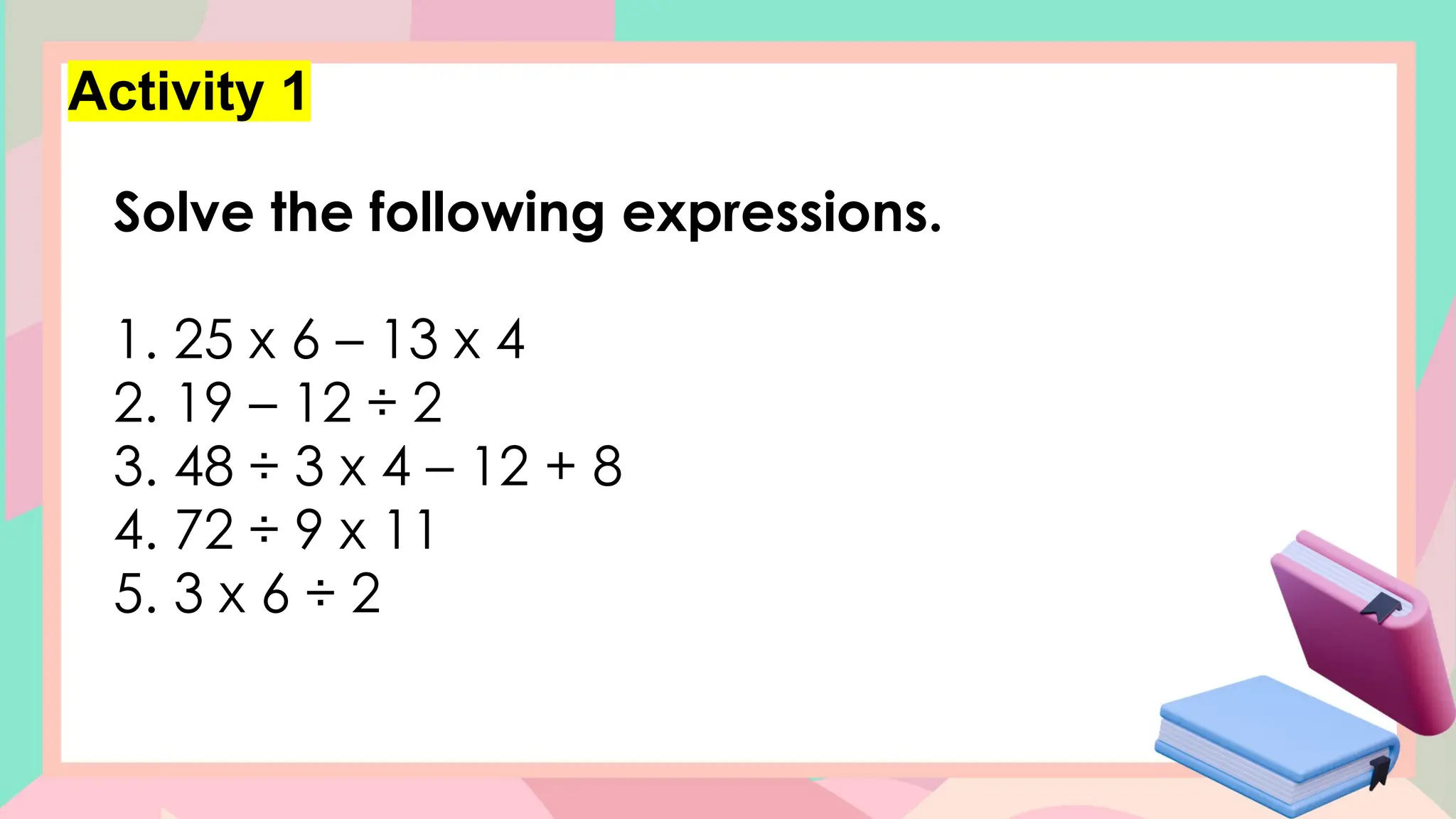
Activity 1
Solve the following expressions.
1. 25 x 6 – 13 x 4
2. 19 – 12 ÷ 2
3. 48 ÷ 3 x 4 – 12 + 8
4. 72 ÷ 9 x 11
5. 3 x 6 ÷ 2
Activity 2
Group Activity:
Solve the following equation.
1) 4 + 8 ÷ 2 - 7 =
2) 12 x 3 – 4 + 0 =
3) 12 + 13 – 4 x 5 =
4) 15 – 10 x 2 + 17 =
5) 20 + 5 x 4 ÷ 2 =
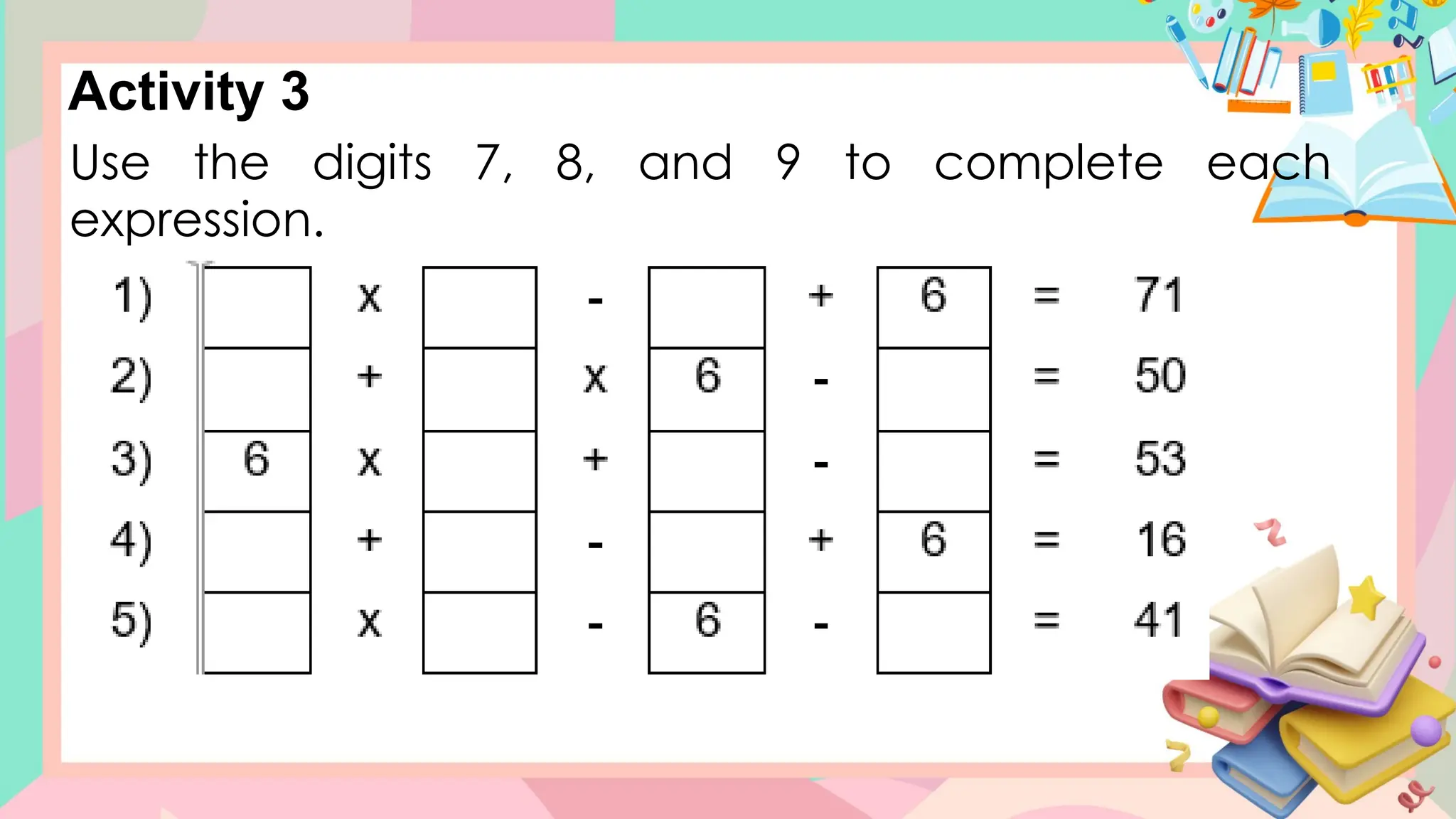
Activity 3
Use the digits 7, 8, and 9 to complete each
expression.
Activity 4
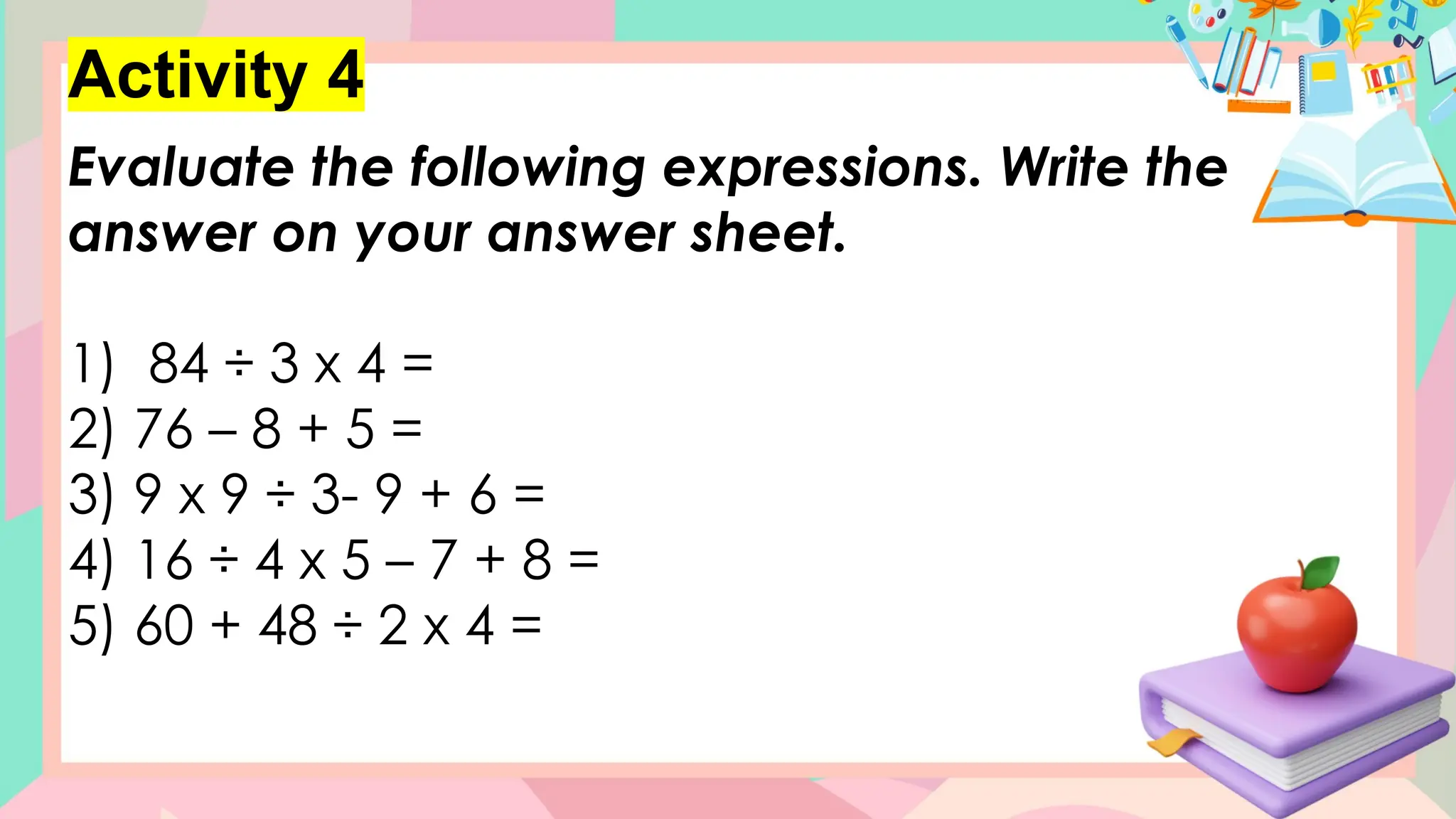
Evaluate the following expressions. Write the
answer on your answer sheet.
1) 84 ÷ 3 x 4 =
2) 76 – 8 + 5 =
3) 9 x 9 ÷ 3- 9 + 6 =
4) 16 ÷ 4 x 5 – 7 + 8 =
5) 60 + 48 ÷ 2 x 4 =
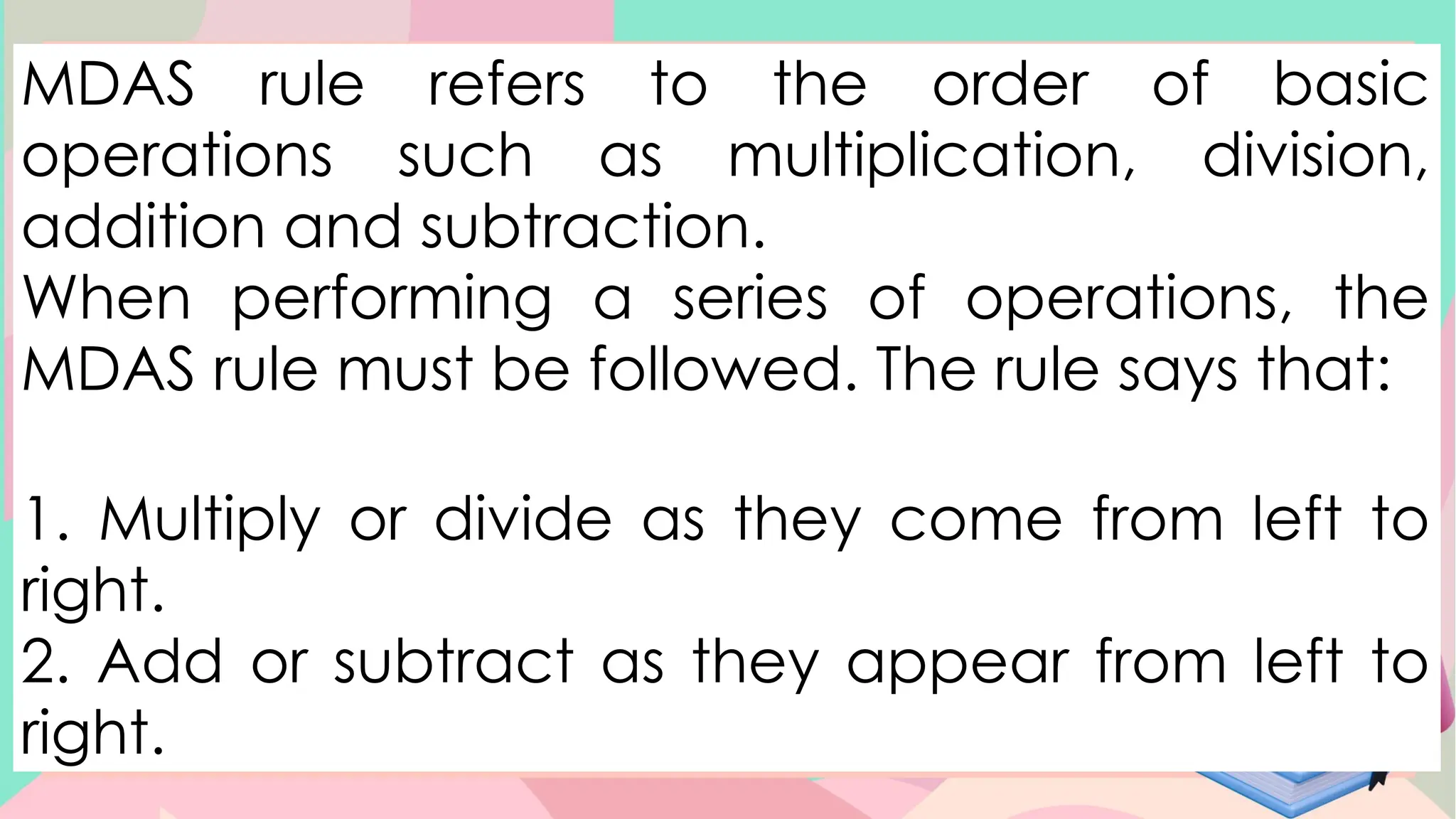
MDAS rule refers to the order of basic
operations such as multiplication, division,
addition and subtraction.
When performing a series of operations, the
MDAS rule must be followed. The rule says that:
1. Multiply or divide as they come from left to
right.
2. Add or subtract as they appear from left to
right.
MDAS is followed when there is
more than one operation in an
equation. It follows the correct
order of operation to execute;
multiplication and division,
before addition and
subtraction.
Assessment
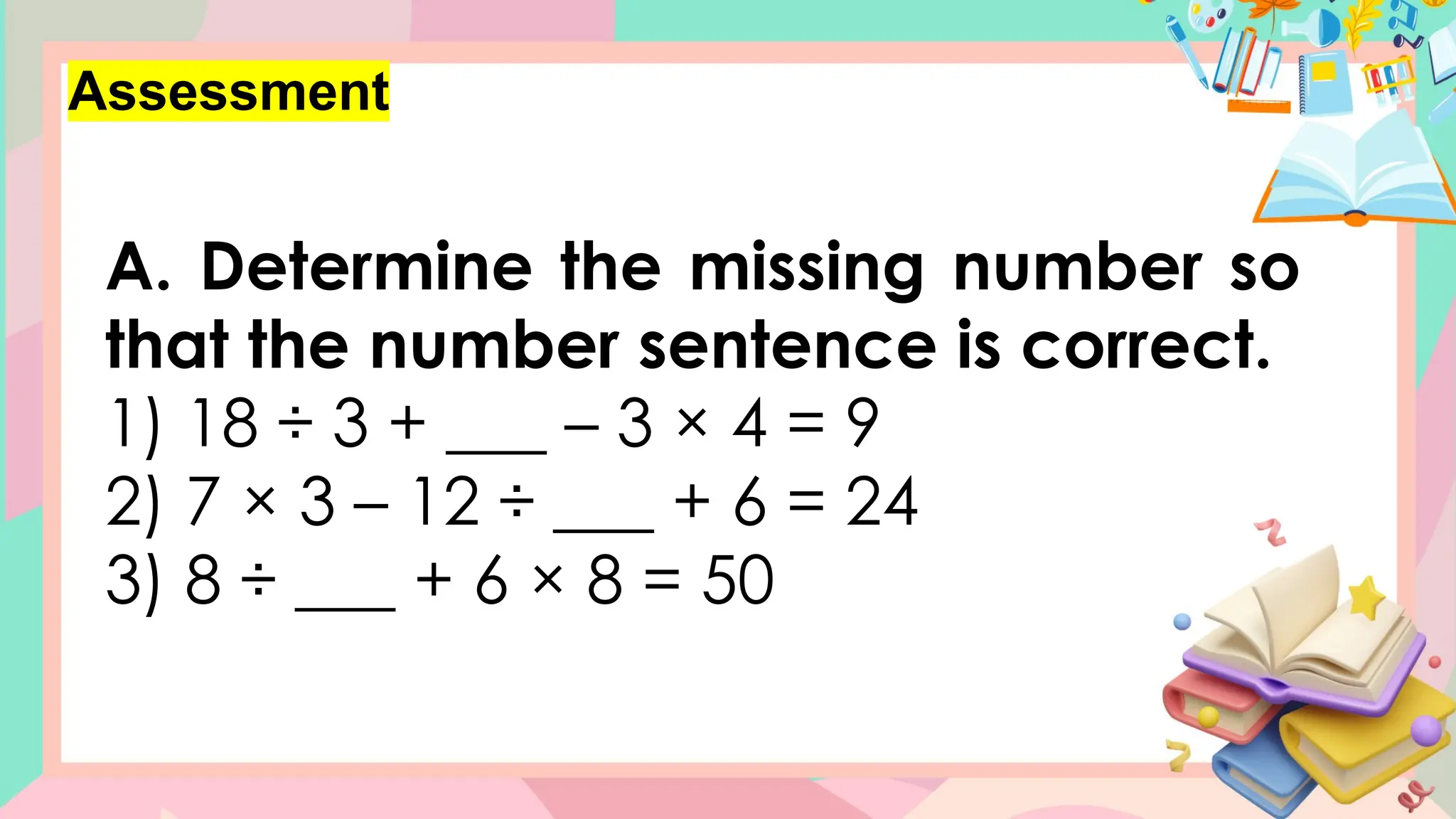
A. Determine the missing number so
that the number sentence is correct.
1) 18 ÷ 3 + ___ – 3 × 4 = 9
2) 7 × 3 – 12 ÷ ___ + 6 = 24
3) 8 ÷ ___ + 6 × 8 = 50
Assessment
B. Write >, <, or = on the blank space to
compare the two numerical expressions.
4) 6 × 7 – 12 ÷ 3 + 15 _______ 13 + 3 × 4 – 10 ÷ 2
5) 3 × 2 × 5 + 12 ________ 12 ÷ 2 × 6 + 4 – 3
Thank
You
MATH
4
QUARTER
2
QUARTER
2
QUARTER
2
MATATAG
CURRICULUM
MATATAG
CURRICULUM
Week 4 Day 3
Order of Operations
(Applying the MDAS
rules)
Mix and Match
Provide 5 cards of number sentences and
answers.
Mechanics:
1. If the teacher says “Mix” the participants will
scatter.
2. If the teacher says “Match” the participants
will find their partner.
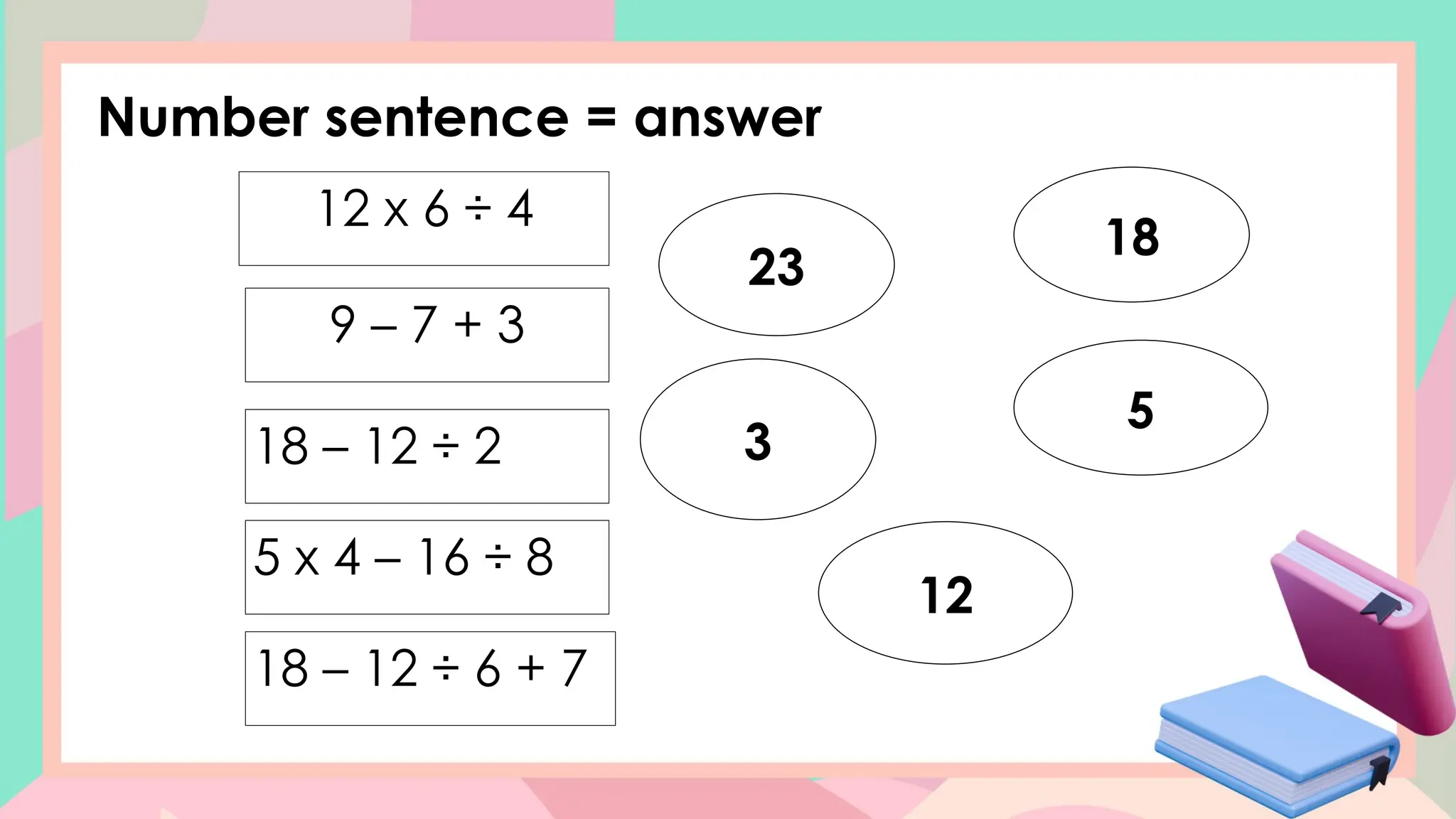
Number sentence = answer
12 x 6 ÷ 4
23
9 – 7 + 3
18 – 12 ÷ 2
5 x 4 – 16 ÷ 8
18
3
5
18 – 12 ÷ 6 + 7
12
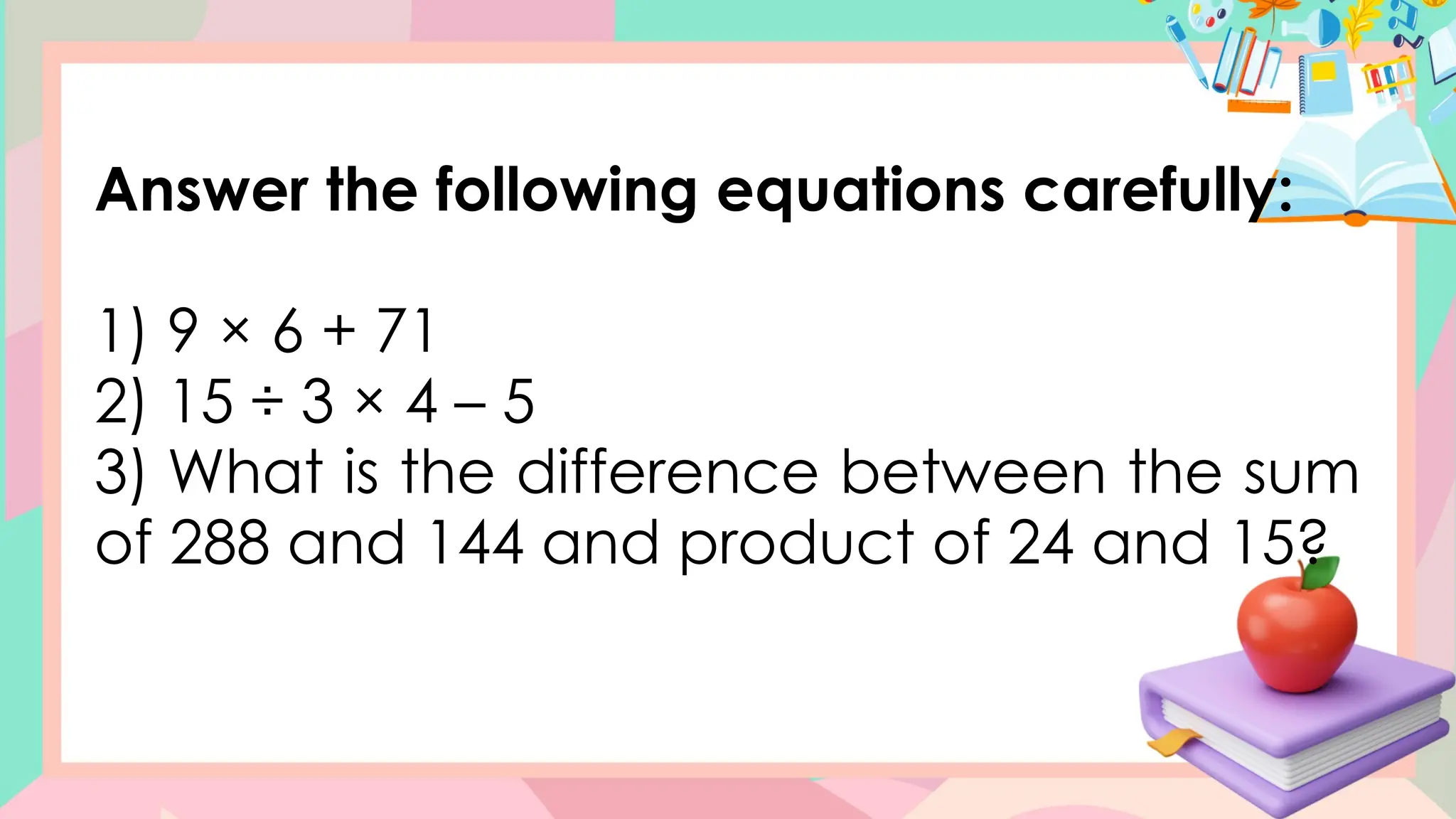
Answer the following equations carefully:
1) 9 × 6 + 71
2) 15 ÷ 3 × 4 – 5
3) What is the difference between the sum
of 288 and 144 and product of 24 and 15?
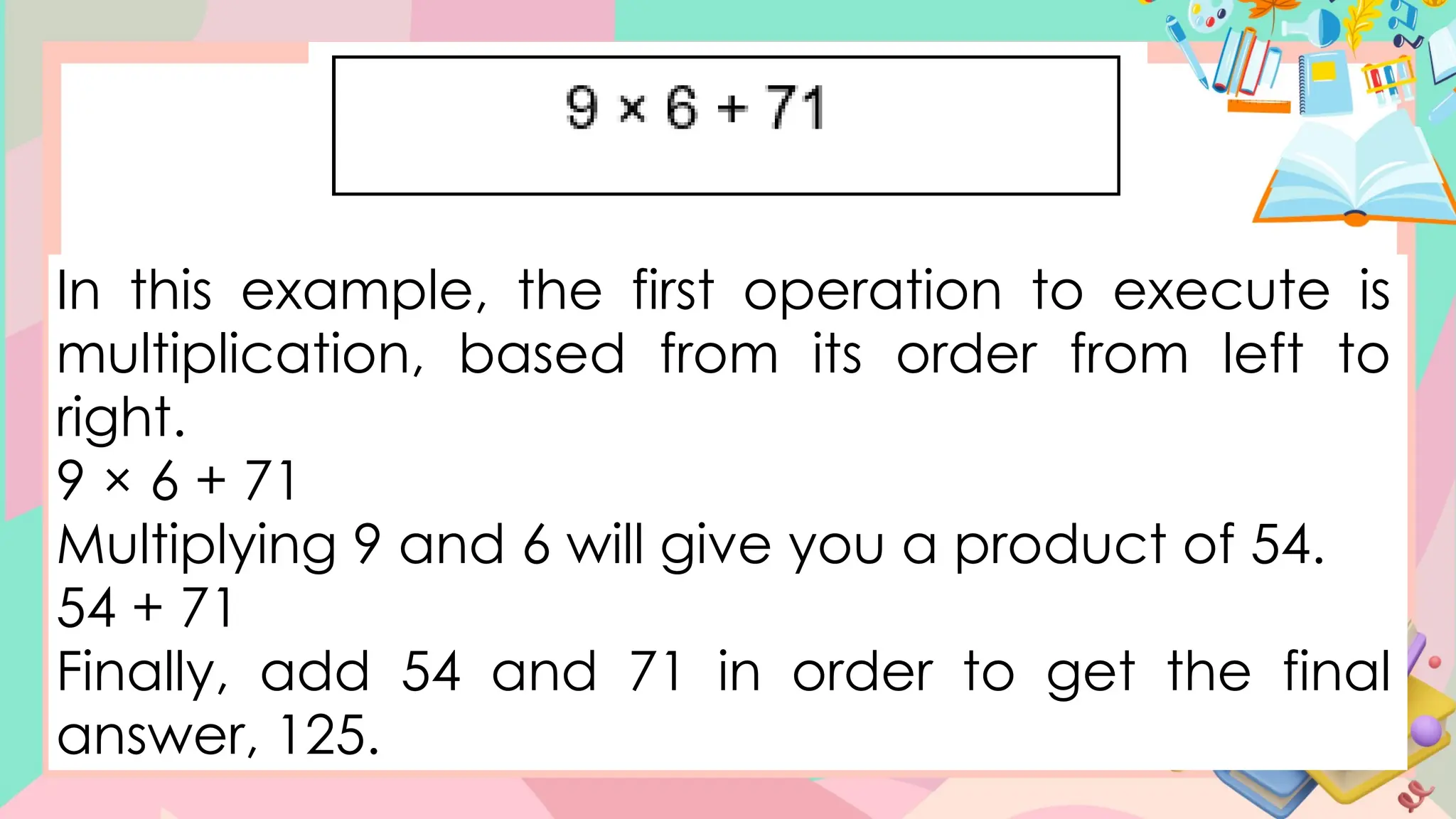
In this example, the first operation to execute is
multiplication, based from its order from left to
right.
9 × 6 + 71
Multiplying 9 and 6 will give you a product of 54.
54 + 71
Finally, add 54 and 71 in order to get the final
answer, 125.
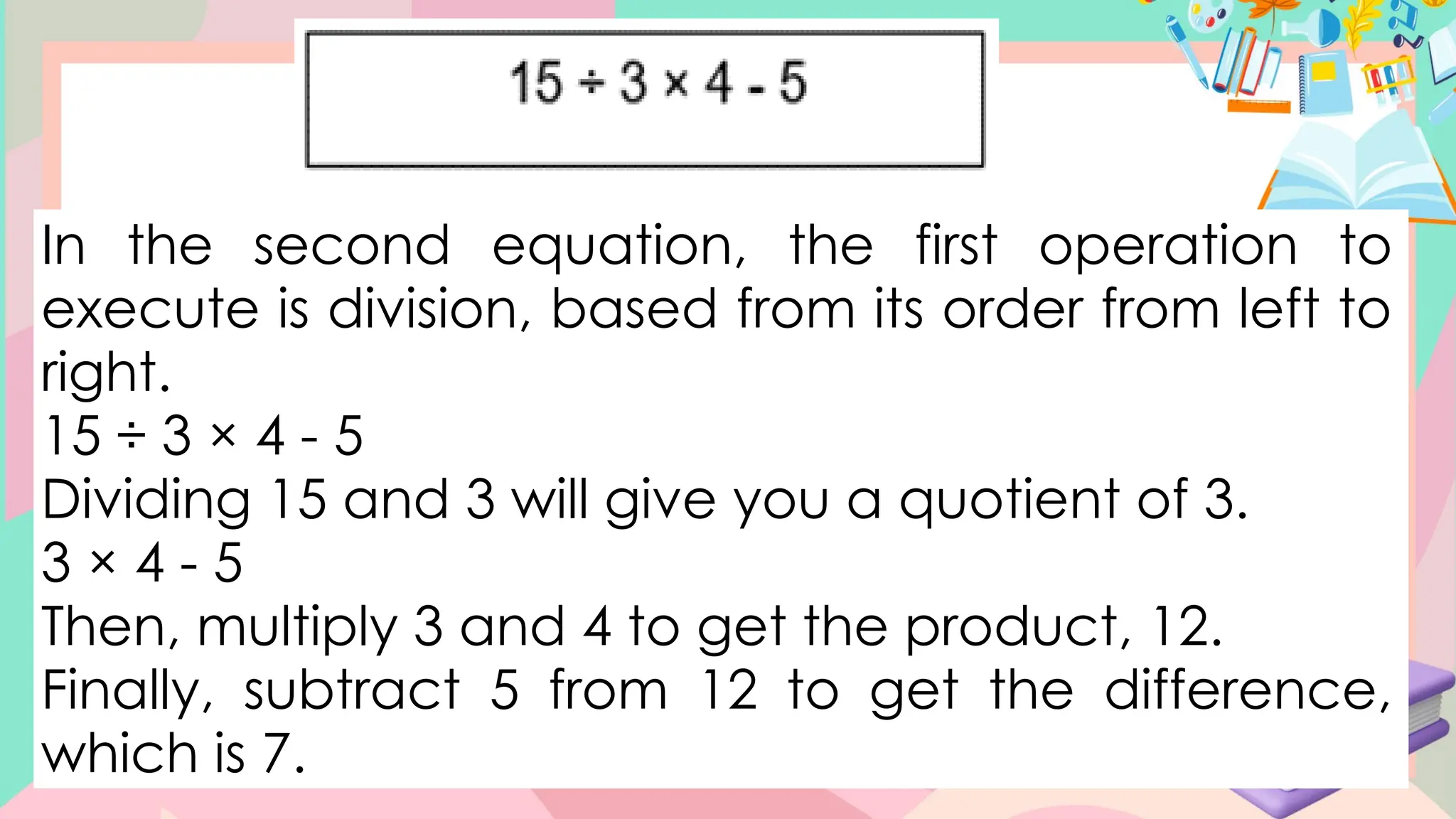
In the second equation, the first operation to
execute is division, based from its order from left to
right.
15 ÷ 3 × 4 - 5
Dividing 15 and 3 will give you a quotient of 3.
3 × 4 - 5
Then, multiply 3 and 4 to get the product, 12.
Finally, subtract 5 from 12 to get the difference,
which is 7.
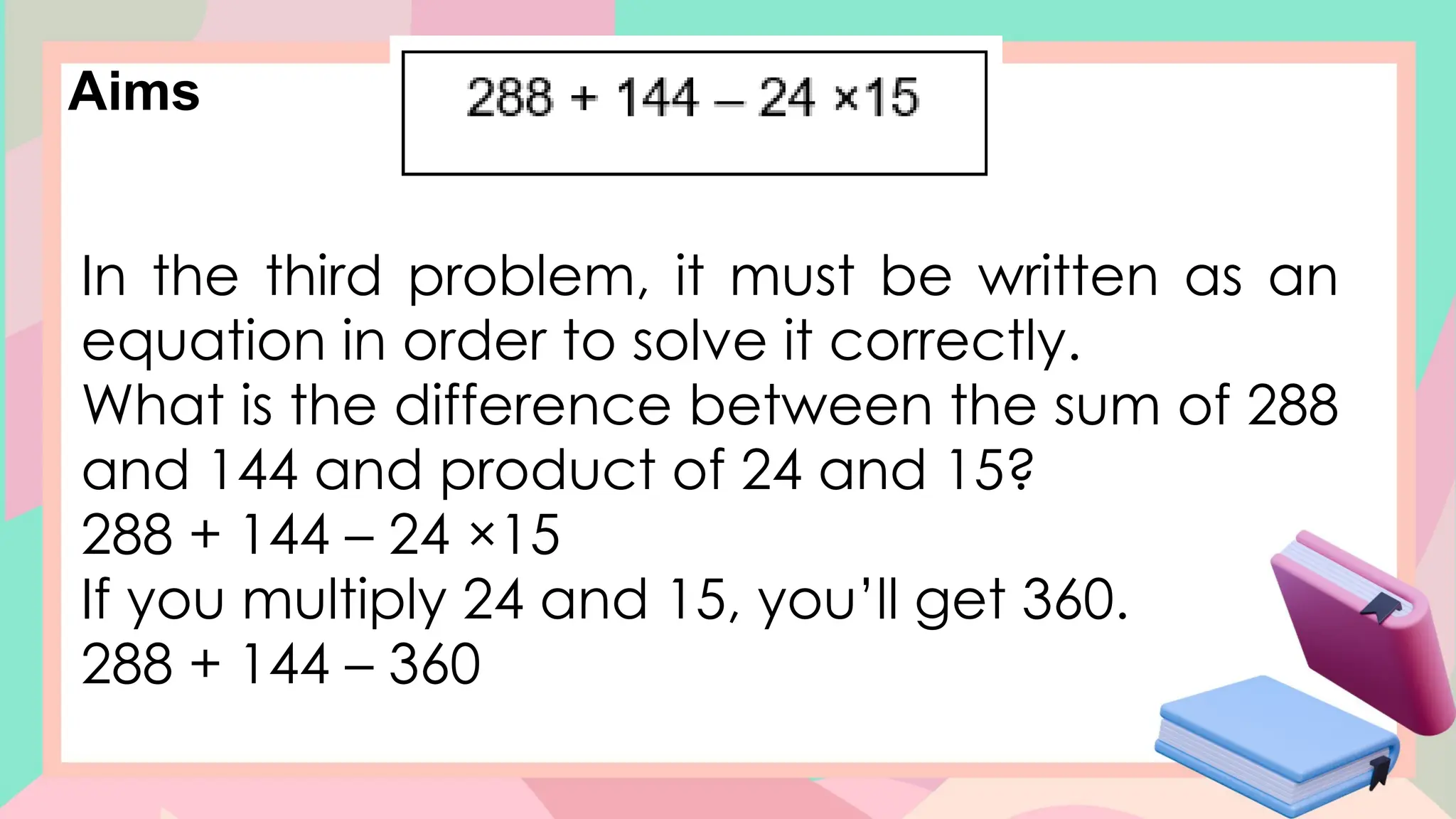
Aims
In the third problem, it must be written as an
equation in order to solve it correctly.
What is the difference between the sum of 288
and 144 and product of 24 and 15?
288 + 144 – 24 ×15
If you multiply 24 and 15, you’ll get 360.
288 + 144 – 360
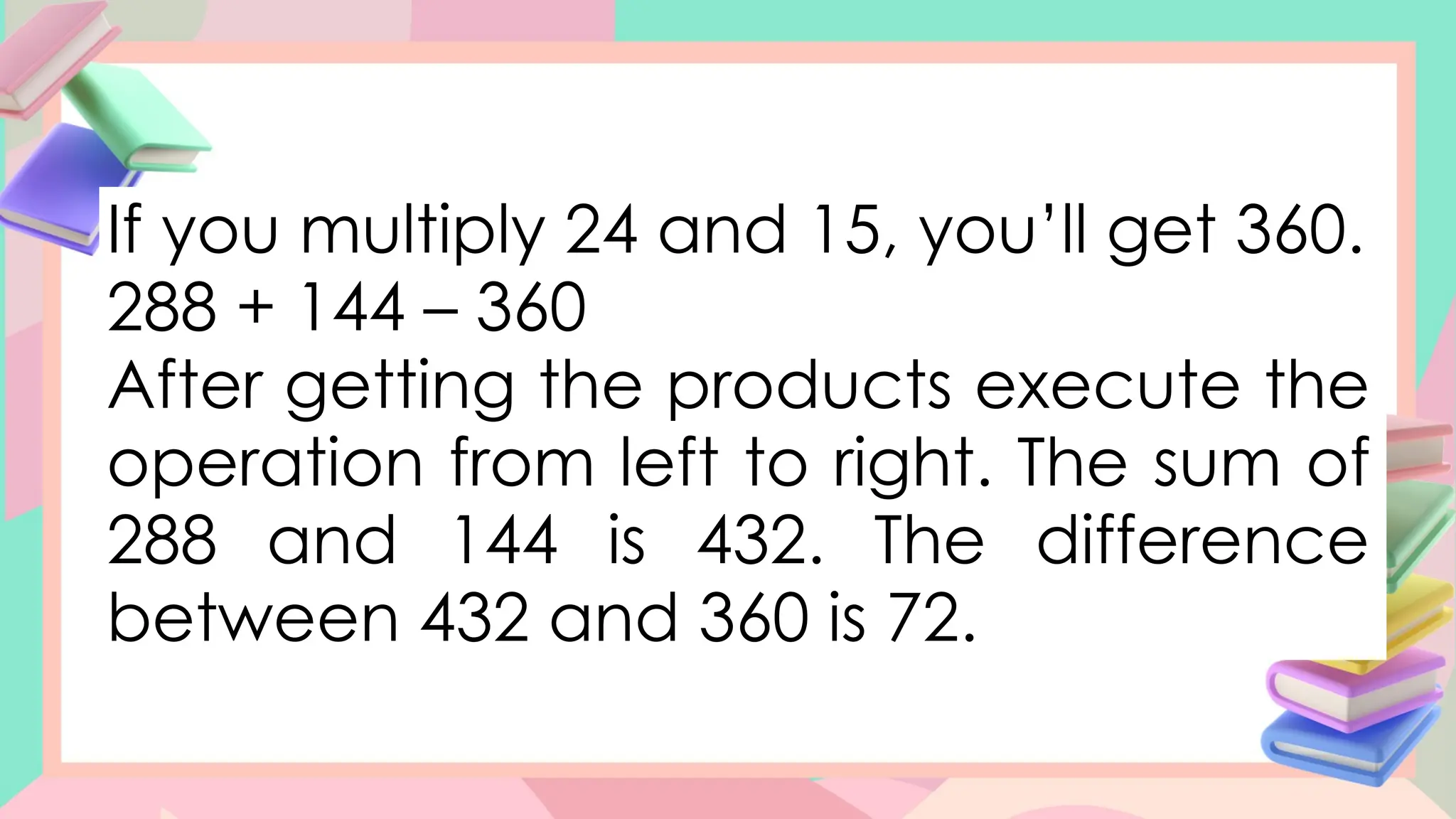
If you multiply 24 and 15, you’ll get 360.
288 + 144 – 360
After getting the products execute the
operation from left to right. The sum of
288 and 144 is 432. The difference
between 432 and 360 is 72.
Activity 1
Solve the following equations:
1) 15 + 12 × 25 ÷ 5
2) 8 + 7 – 6 ÷ 3
3) 26 – 13 + 6 × 3
4) 4 × 9 ÷ 2 × 10 + 40
5) 3 × 6 + 14 + 39 × 3
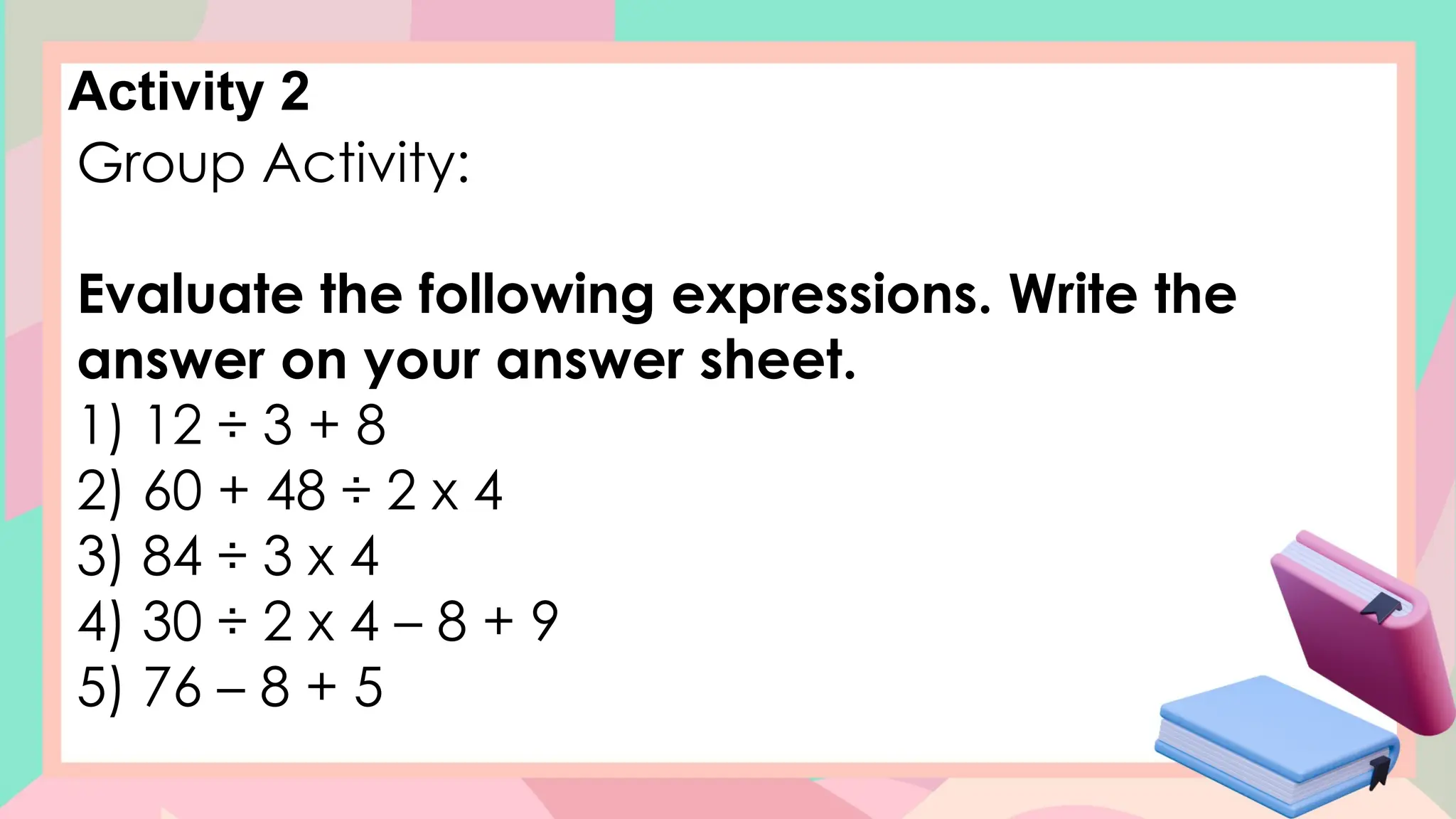
Activity 2
Group Activity:
Evaluate the following expressions. Write the
answer on your answer sheet.
1) 12 ÷ 3 + 8
2) 60 + 48 ÷ 2 x 4
3) 84 ÷ 3 x 4
4) 30 ÷ 2 x 4 – 8 + 9
5) 76 – 8 + 5
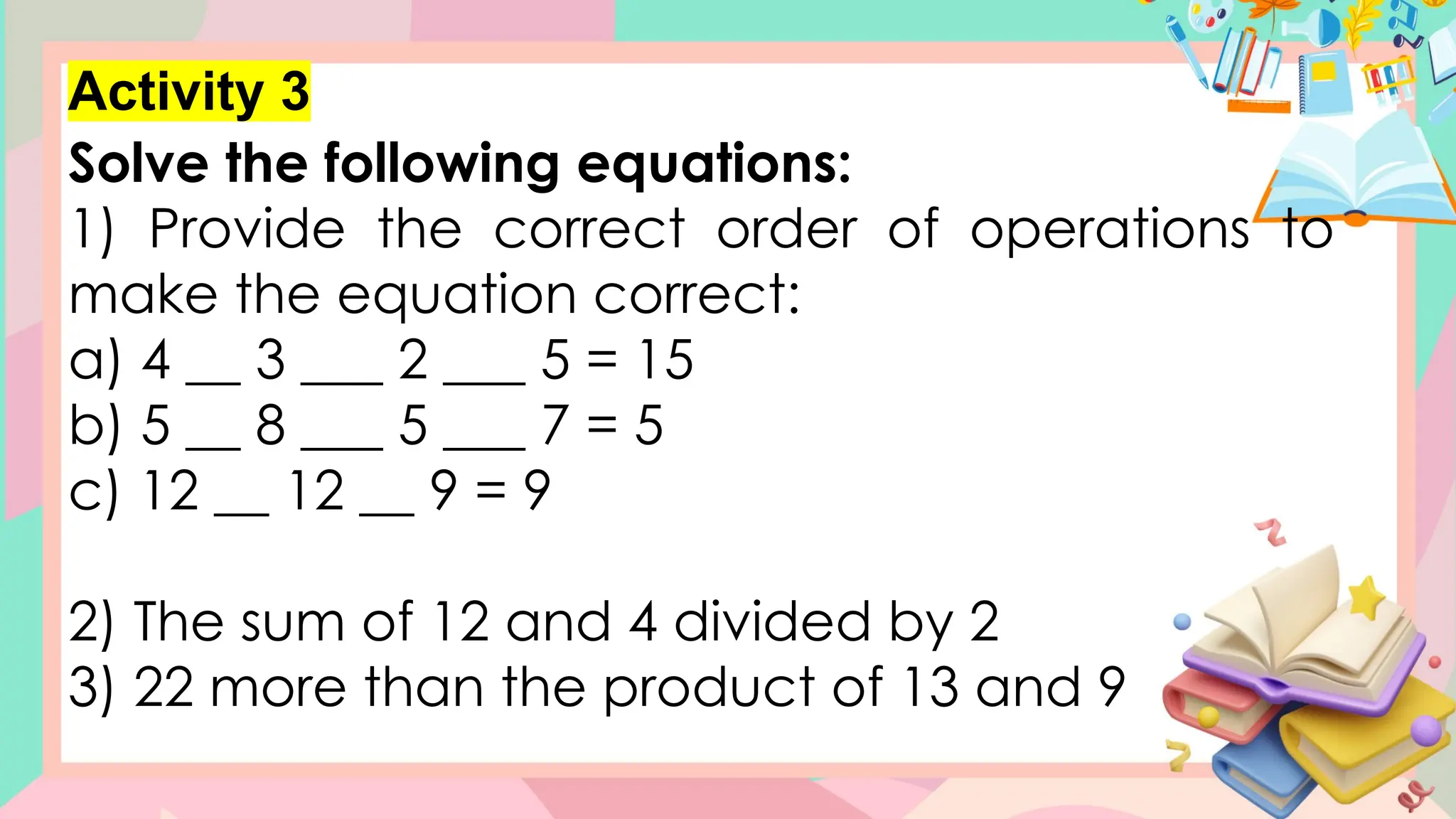
Activity 3
Solve the following equations:
1) Provide the correct order of operations to
make the equation correct:
a) 4 __ 3 ___ 2 ___ 5 = 15
b) 5 __ 8 ___ 5 ___ 7 = 5
c) 12 __ 12 __ 9 = 9
2) The sum of 12 and 4 divided by 2
3) 22 more than the product of 13 and 9
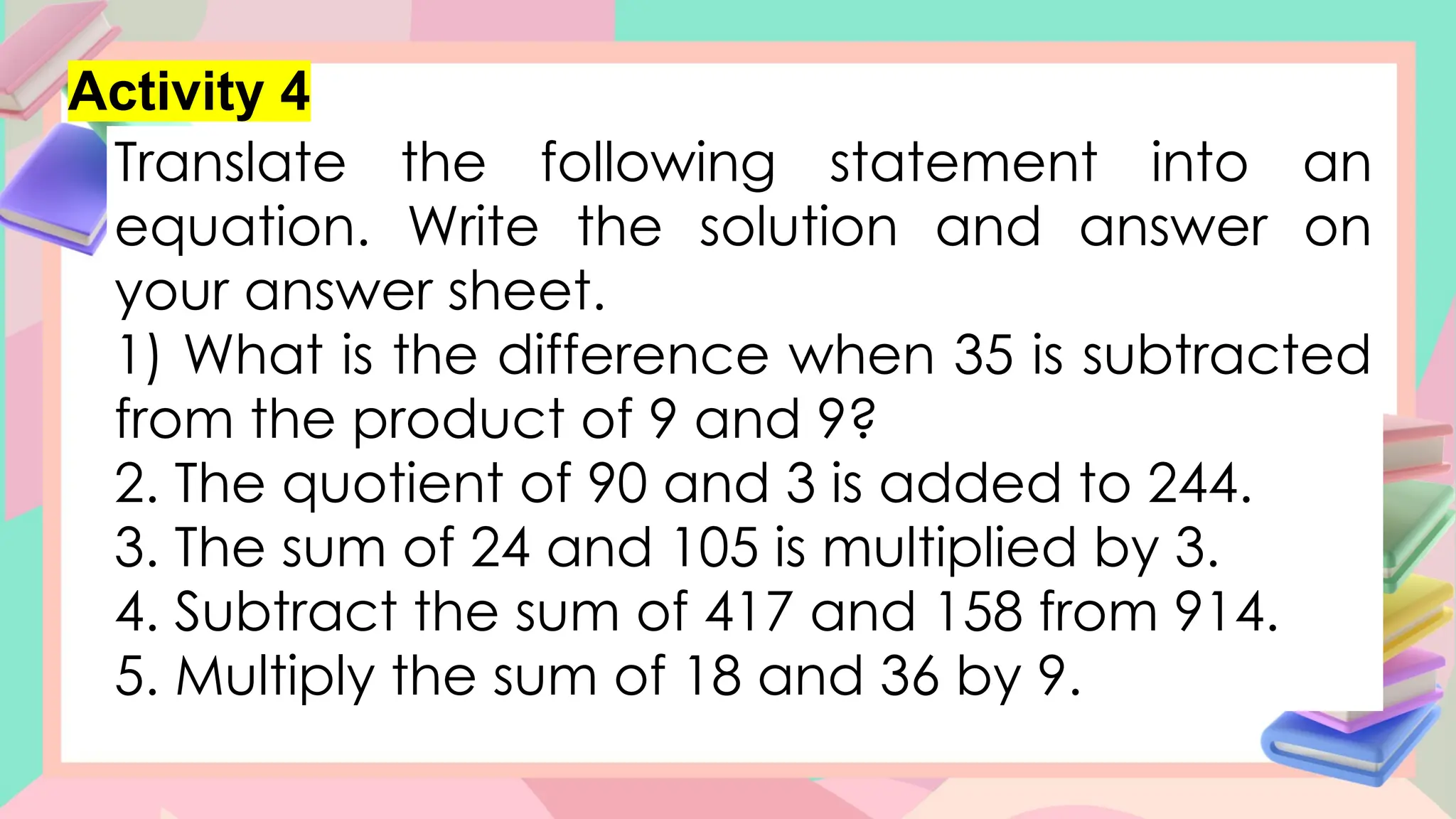
Activity 4
Translate the following statement into an
equation. Write the solution and answer on
your answer sheet.
1) What is the difference when 35 is subtracted
from the product of 9 and 9?
2. The quotient of 90 and 3 is added to 244.
3. The sum of 24 and 105 is multiplied by 3.
4. Subtract the sum of 417 and 158 from 914.
5. Multiply the sum of 18 and 36 by 9.
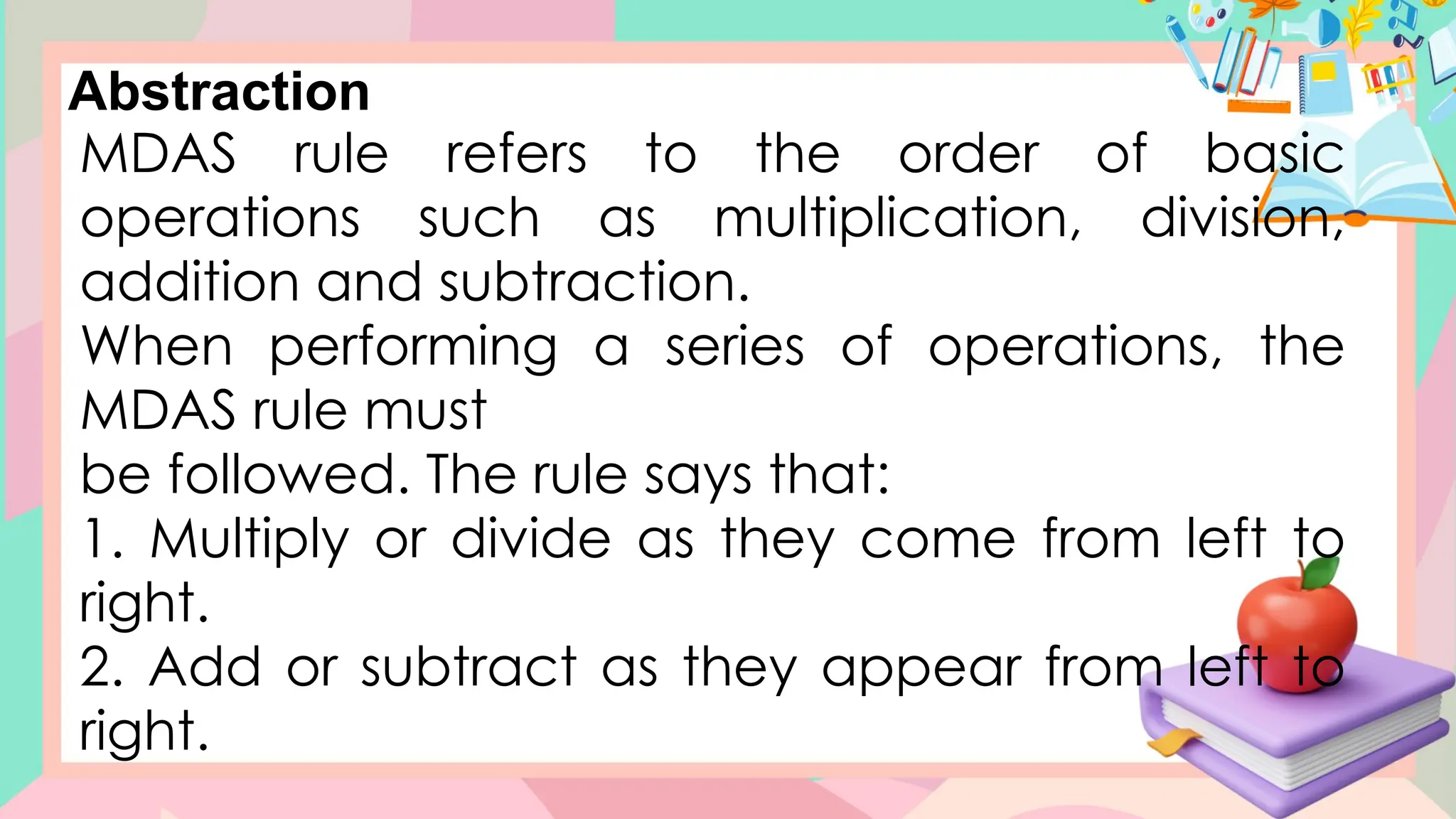
Abstraction
MDAS rule refers to the order of basic
operations such as multiplication, division,
addition and subtraction.
When performing a series of operations, the
MDAS rule must
be followed. The rule says that:
1. Multiply or divide as they come from left to
right.
2. Add or subtract as they appear from left to
right.
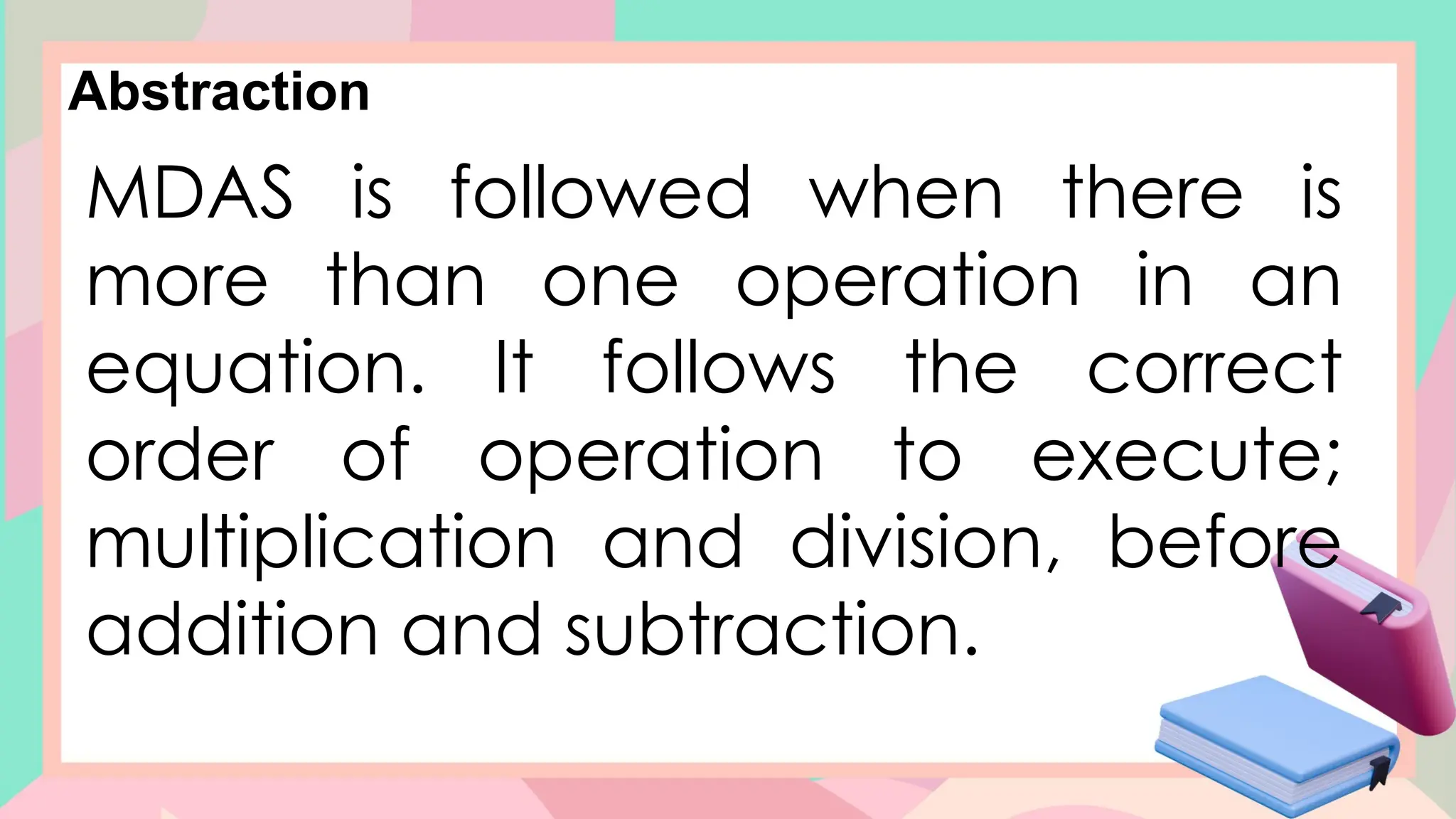
Abstraction
MDAS is followed when there is
more than one operation in an
equation. It follows the correct
order of operation to execute;
multiplication and division, before
addition and subtraction.
Assessment
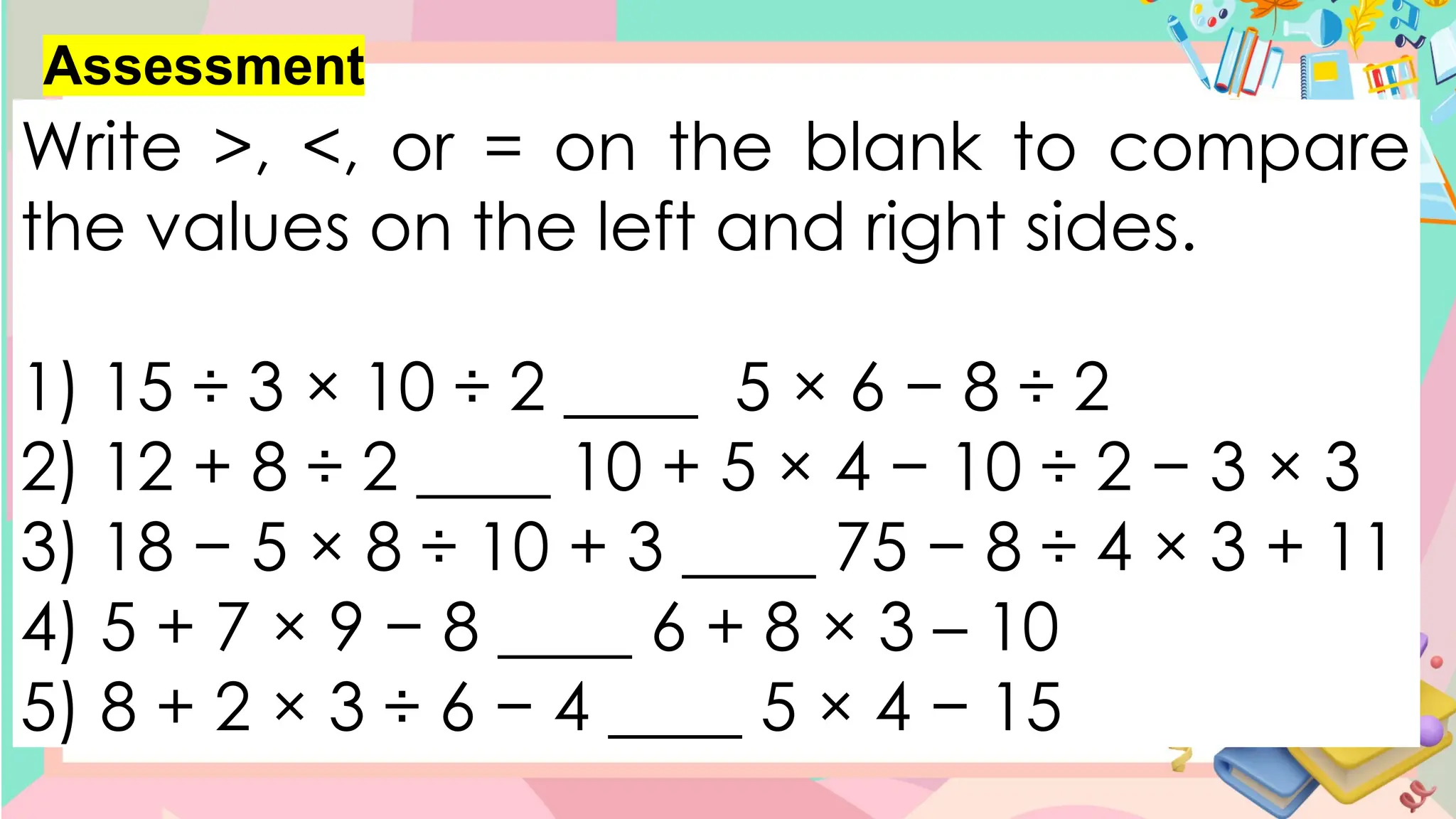
Write >, <, or = on the blank to compare
the values on the left and right sides.
1) 15 ÷ 3 × 10 ÷ 2 ____ 5 × 6 − 8 ÷ 2
2) 12 + 8 ÷ 2 ____ 10 + 5 × 4 − 10 ÷ 2 − 3 × 3
3) 18 − 5 × 8 ÷ 10 + 3 ____ 75 − 8 ÷ 4 × 3 + 11
4) 5 + 7 × 9 − 8 ____ 6 + 8 × 3 – 10
5) 8 + 2 × 3 ÷ 6 − 4 ____ 5 × 4 − 15
Thank
You
MATH
4
QUARTER
2
QUARTER
2
QUARTER
2
MATATAG
CURRICULUM
MATATAG
CURRICULUM
Week 4 Day 4
Order of Operations
(Applying the MDAS
rules)
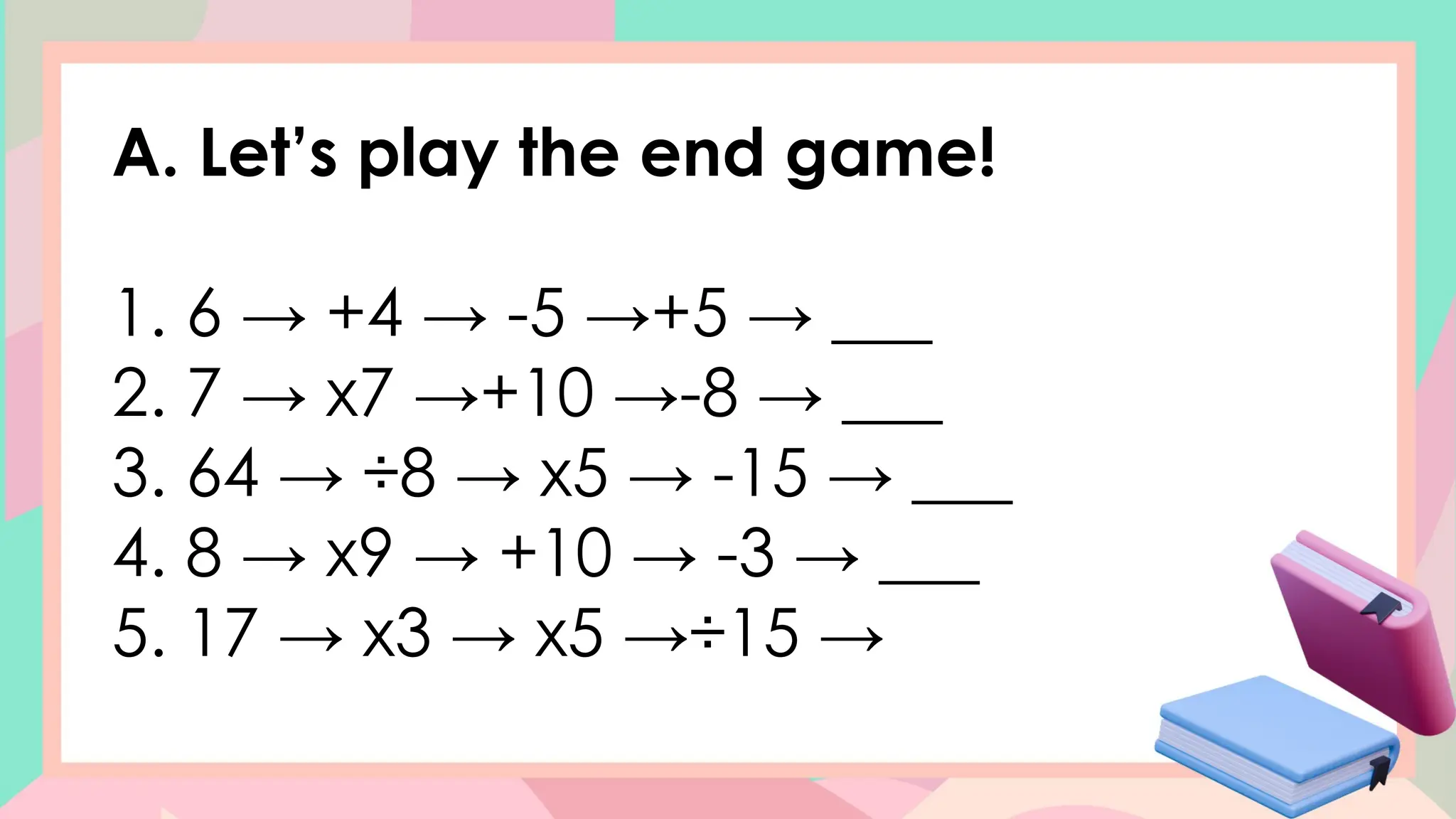
A. Let’s play the end game!
1. 6 → +4 → -5 →+5 → ___
2. 7 → x7 →+10 →-8 → ___
3. 64 → ÷8 → x5 → -15 → ___
4. 8 → x9 → +10 → -3 → ___
5. 17 → x3 → x5 →÷15 →
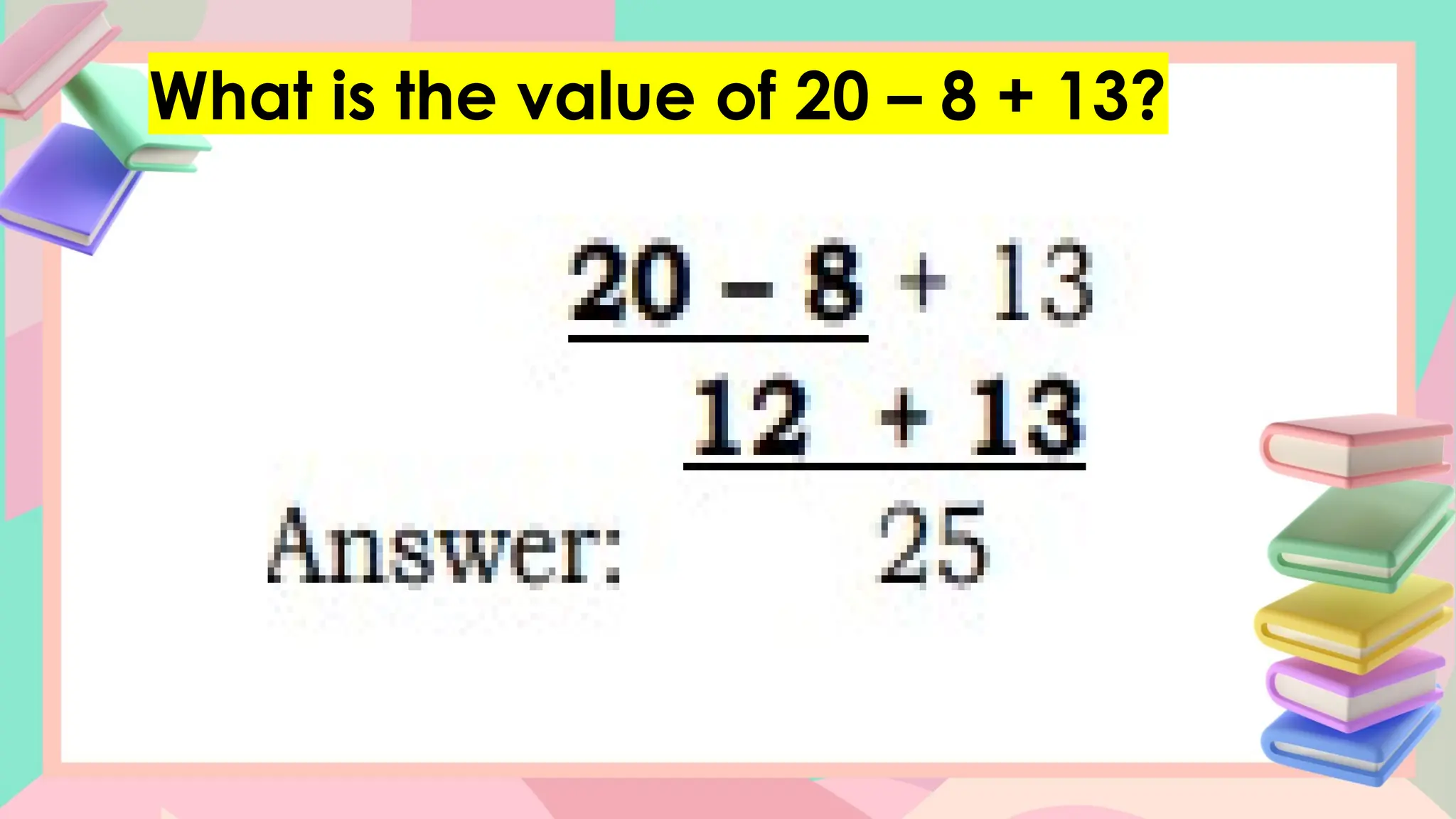
What is the value of 20 – 8 + 13?
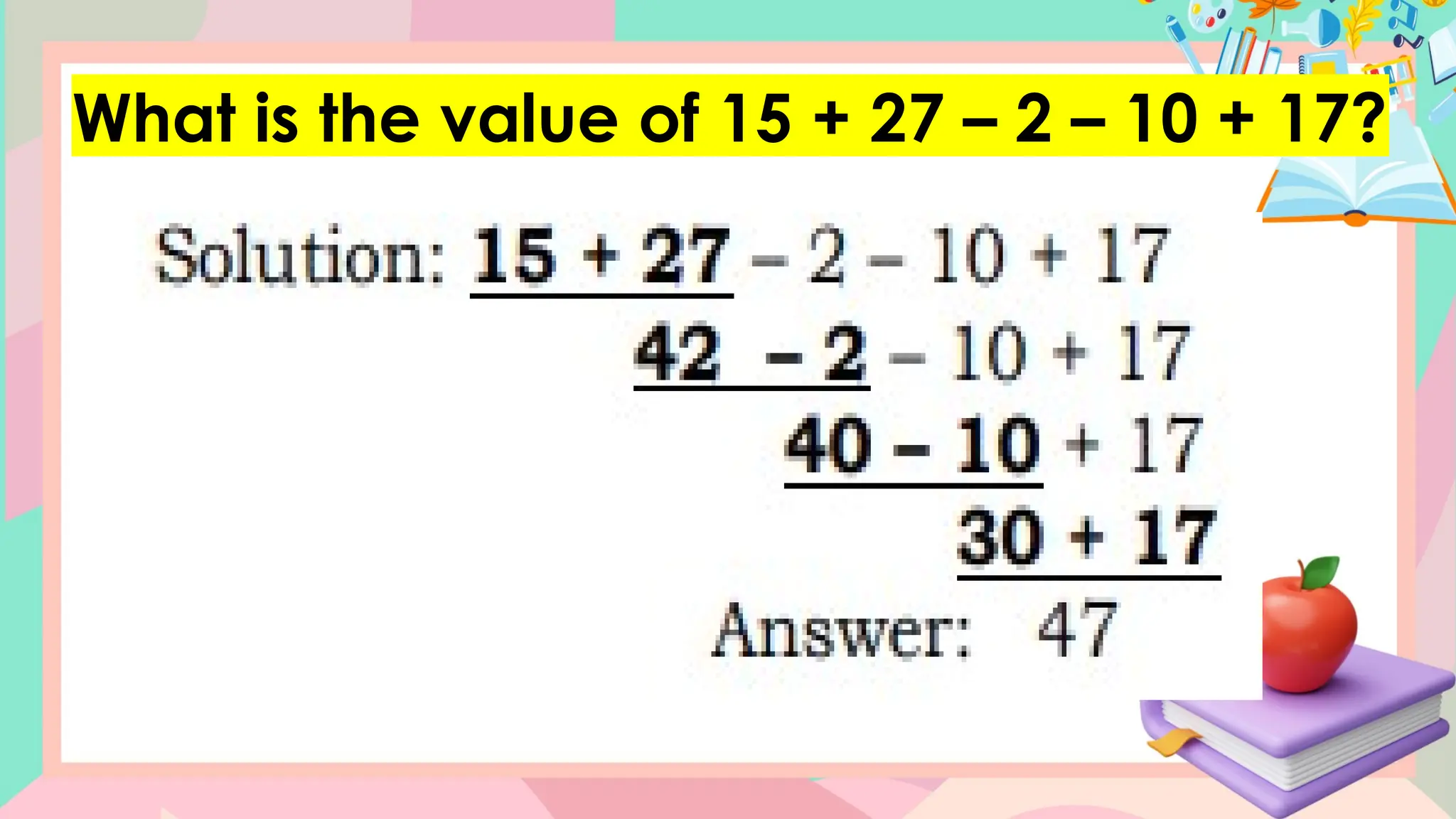
What is the value of 15 + 27 – 2 – 10 + 17?
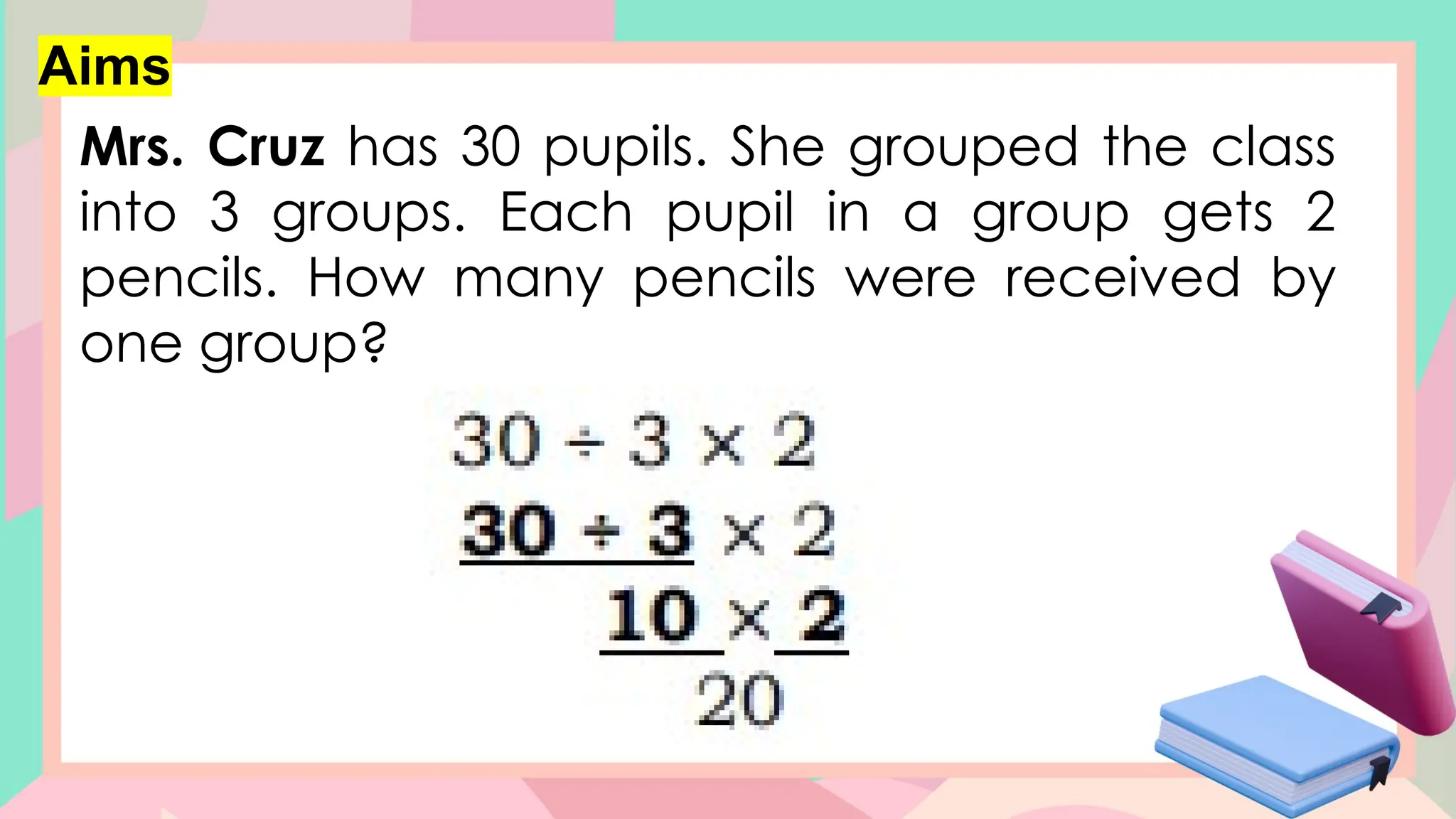
Aims
Mrs. Cruz has 30 pupils. She grouped the class
into 3 groups. Each pupil in a group gets 2
pencils. How many pencils were received by
one group?
Answer: There are 20
pencils in one group
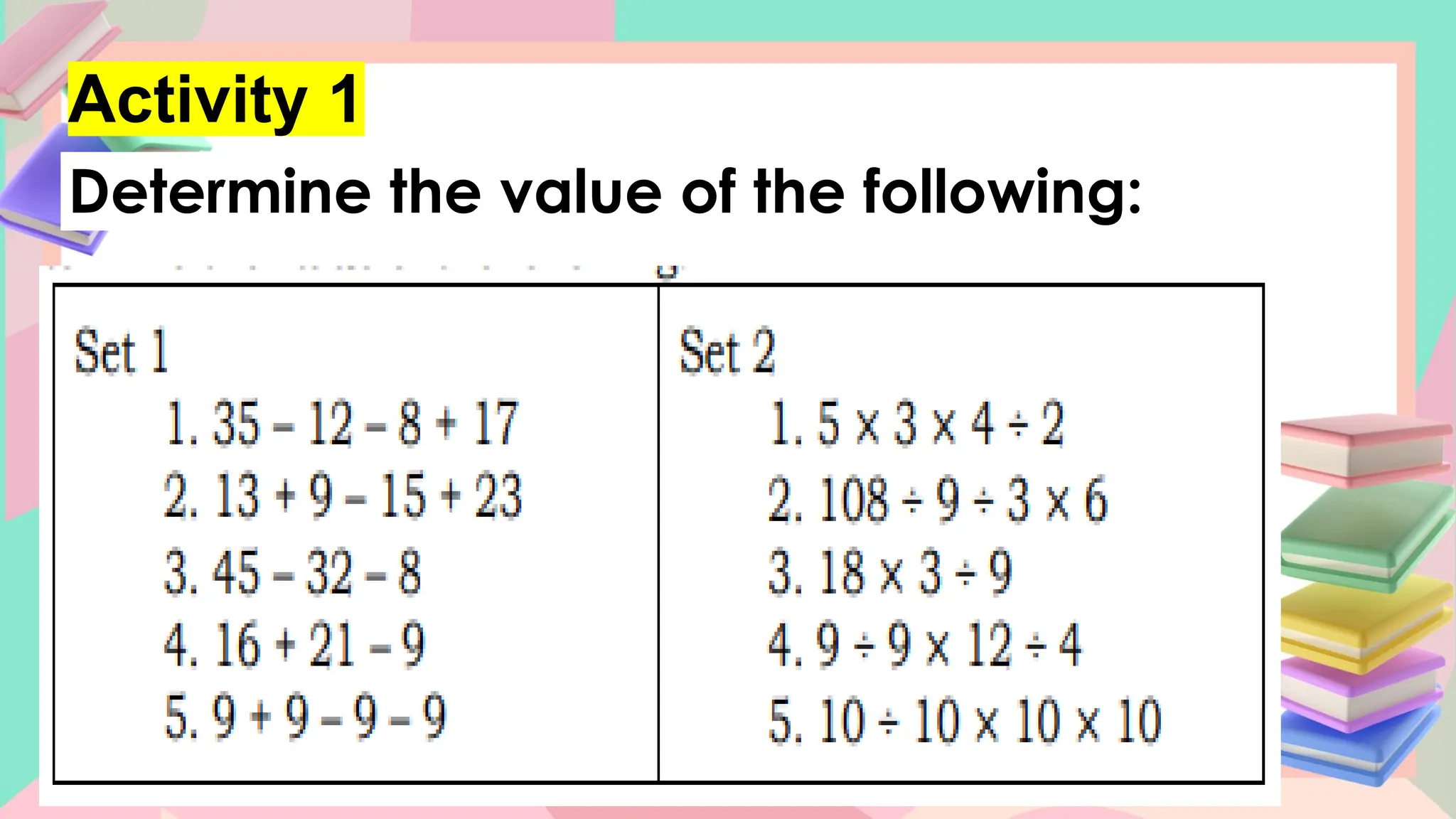
Activity 1
Determine the value of the following:
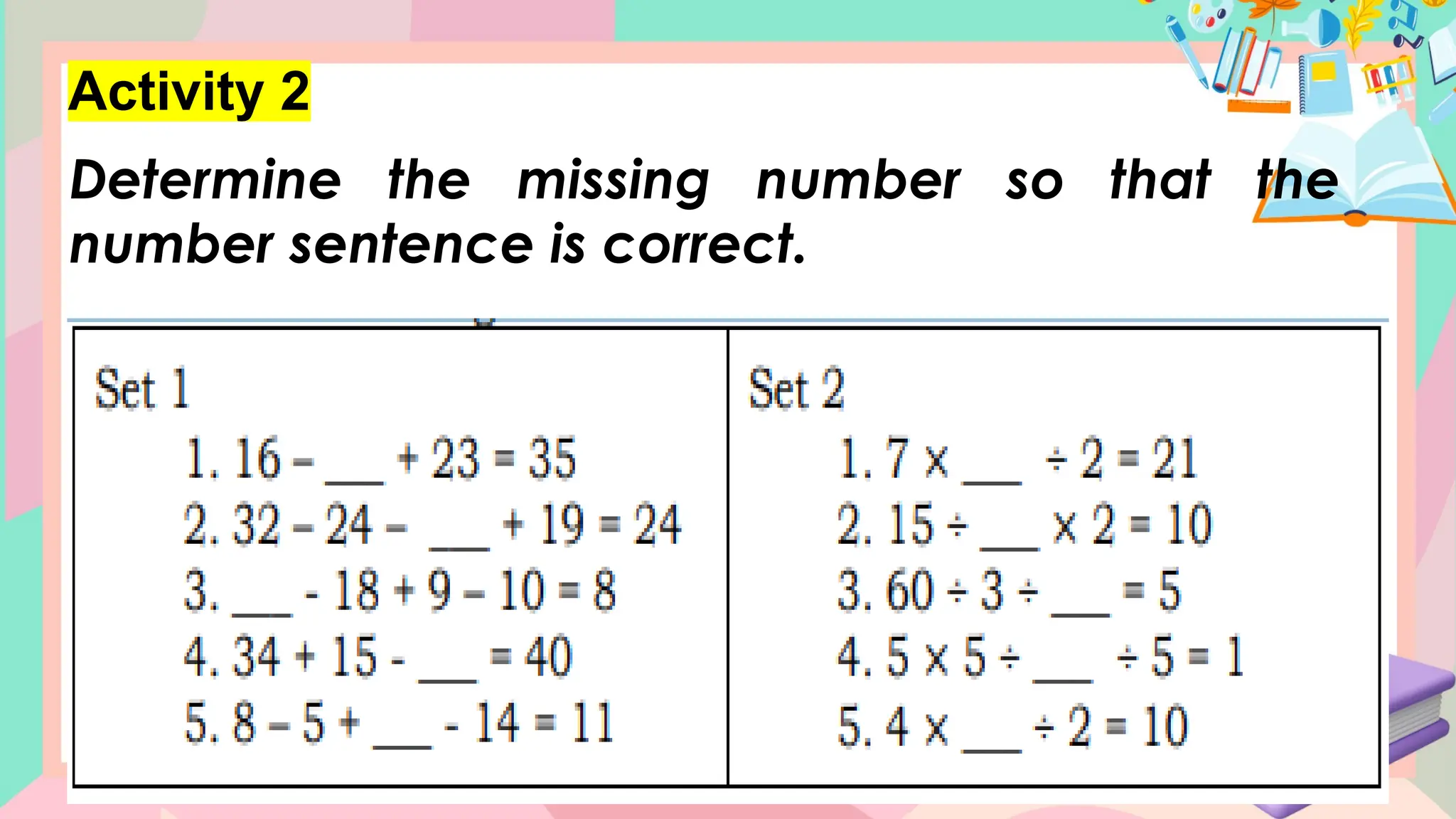
Activity 2
Determine the missing number so that the
number sentence is correct.
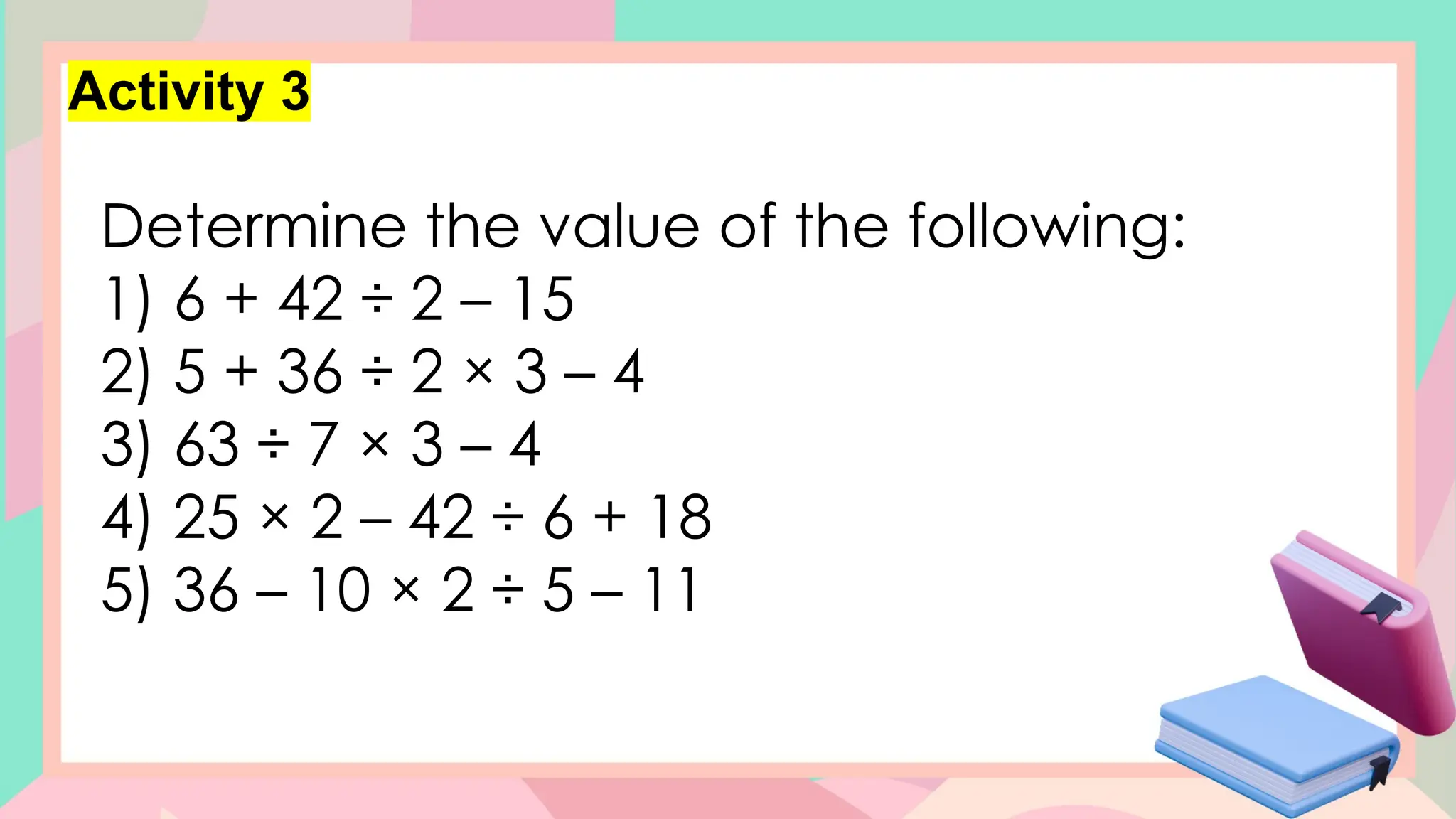
Activity 3
Determine the value of the following:
1) 6 + 42 ÷ 2 – 15
2) 5 + 36 ÷ 2 × 3 – 4
3) 63 ÷ 7 × 3 – 4
4) 25 × 2 – 42 ÷ 6 + 18
5) 36 – 10 × 2 ÷ 5 – 11
Activity 4
Determine the missing number so that
the number sentence is correct.
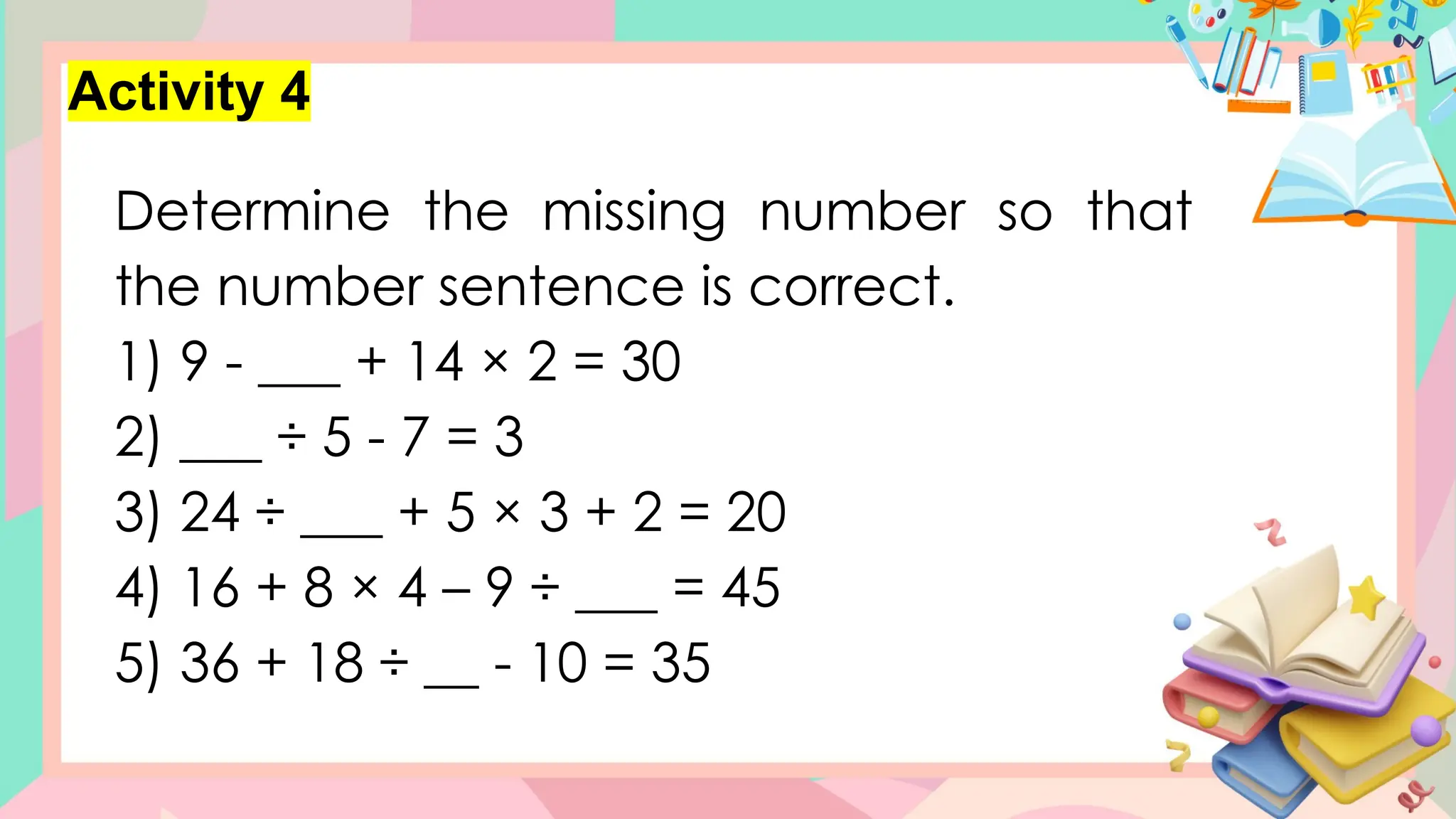
1) 9 - ___ + 14 × 2 = 30
2) ___ ÷ 5 - 7 = 3
3) 24 ÷ ___ + 5 × 3 + 2 = 20
4) 16 + 8 × 4 – 9 ÷ ___ = 45
5) 36 + 18 ÷ __ - 10 = 35
MDAS rule refers to the order of basic
operations such as multiplication, division,
addition and subtraction.
When performing a series of operations, the
MDAS rule must be followed. The rule says that:
1. Multiply or divide as they come from left to
right.
2. Add or subtract as they appear from left to
right.
Abstraction
MDAS is followed when there is more
than one operation in an equation. It
follows the correct order of operation
to execute; multiplication and division,
before addition and subtraction.
Assessment
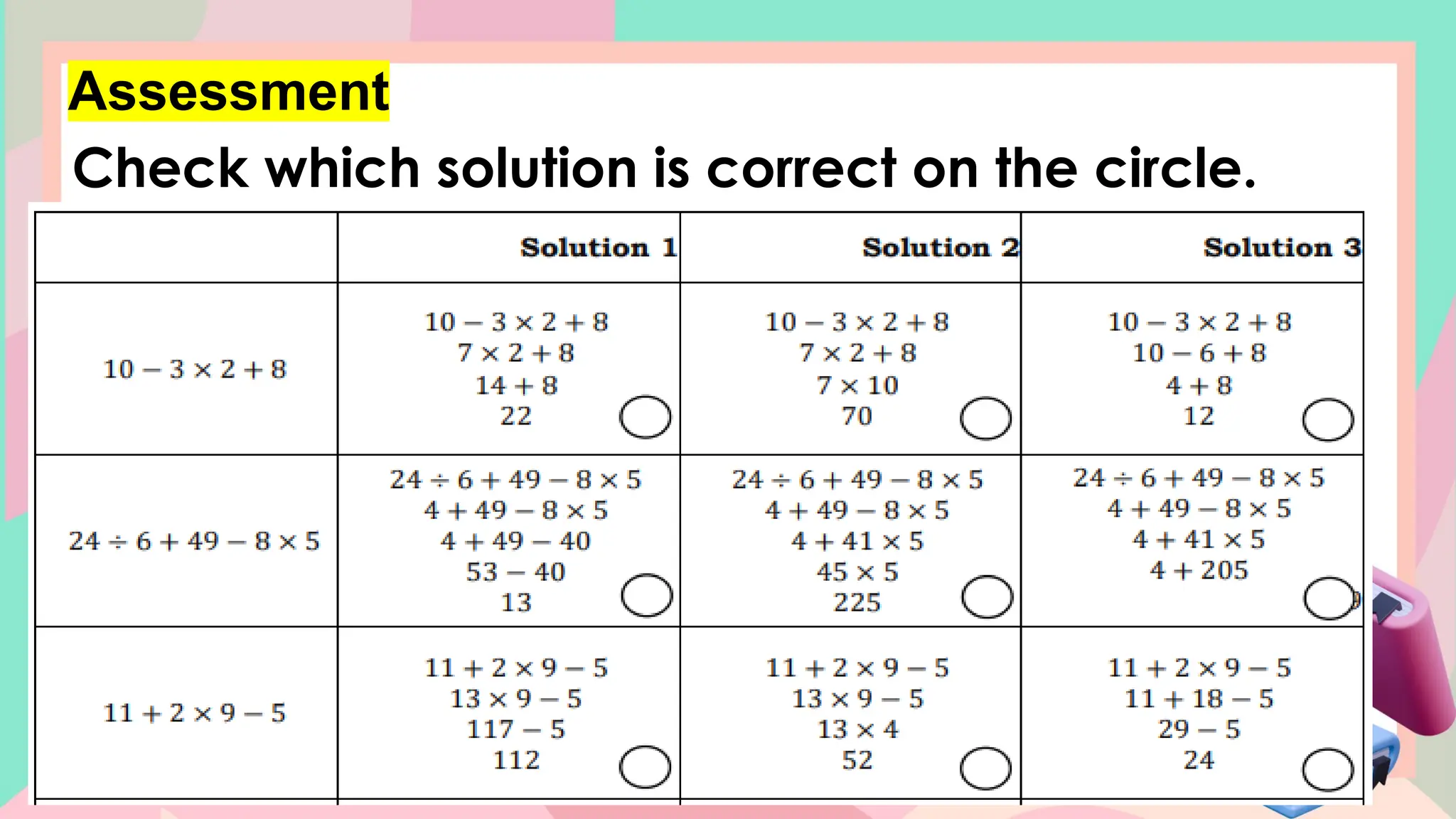
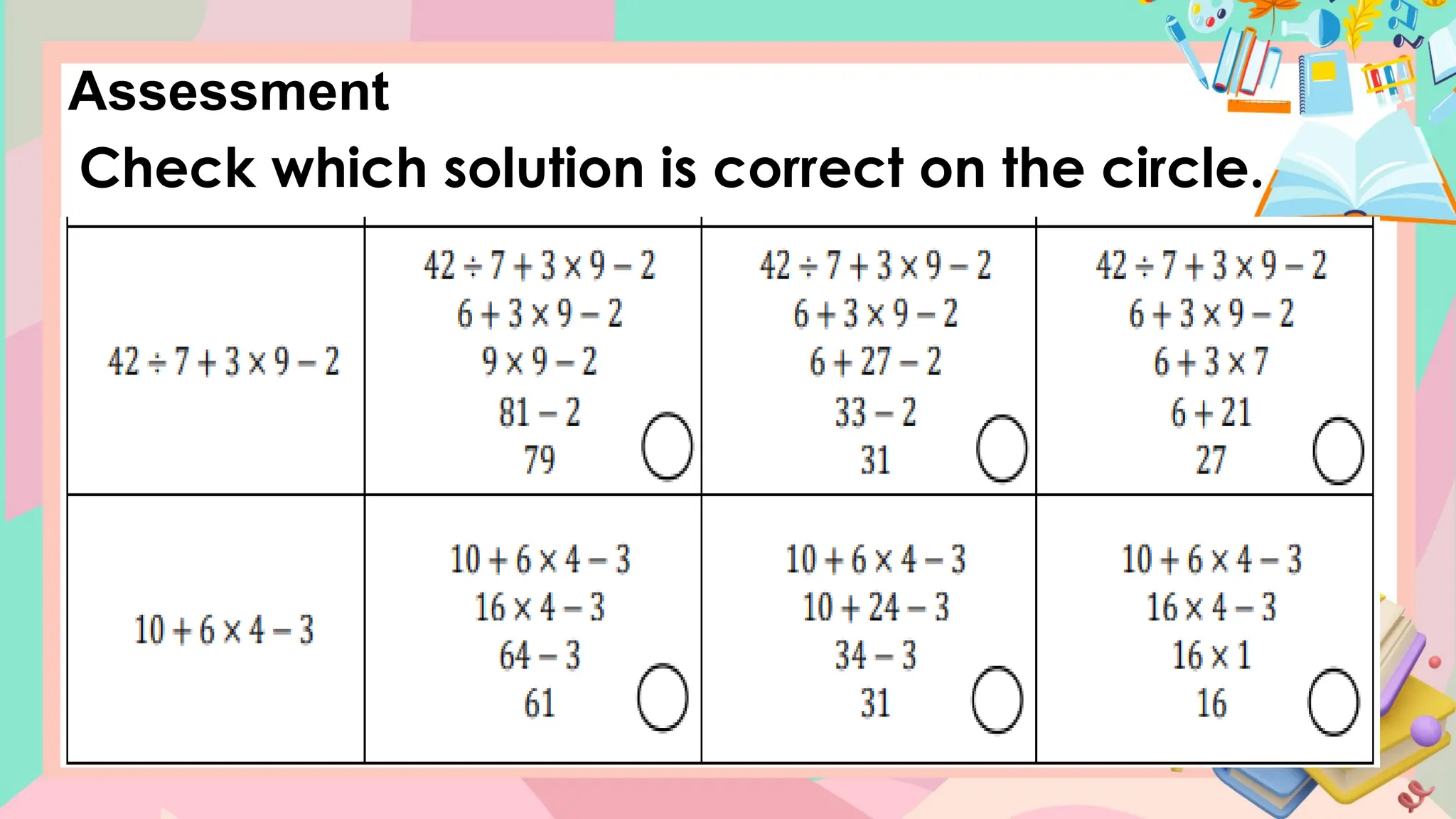
Check which solution is correct on the circle.
Assessment
Check which solution is correct on the circle.
Thank
You

POWERPOINT PRESENTATION IN MATHEMATICS GRADE 4

  • 1.
  • 2.
  • 3.
    Game on GiantStep. Use flashcards of addition, subtraction, multiplication, and division. Activity
  • 5.
    Look at thefollowing operations below. Have you encountered equations like these? Observe the example below and do the different tasks after you understand this lesson. 2 x 3 + 20 24 ÷ 2 + 13 - 16
  • 6.
    To solve theequation, we will use the MDAS Rule. MDAS refers to the basic operations such as Multiplication, Division, Addition and Subtraction. The rules must be followed to solve the equation like these.
  • 7.
    Rule 1: Multiplyor divide first in the order as they come from the left to right. 2 x 3 + 20 6 + 20 26
  • 8.
    24 ÷ 2+ 13 - 16 12 + 13 - 16 25 - 16 9 Rule 2: Add or subtract in order as they come from left to right.
  • 9.
    Activity 1 Solve thefollowing equations. Show your solutions and encircle the final answer. 1. 9 x 3 – 16 ÷ 4 2. 10 – 6 + 4 3. 18 ÷ 3 x 4 – 6 + 9 4. 60 + 48 ÷ 2 x 4 5. 30 ÷ 2 x 4 – 8 + 9
  • 10.
    Activity 2 Pair &Share Activity: Simplify the mathematical expressions and then solve. 1. 4 x 9 + 9 2. 15 – 2 x 5 3. 24 – 2 x 9 4. 1 + 2 x 9 5. 6 + 8 x 8
  • 11.
    Activity 3 Perform theindicated operations. 1) 14 – 8 + 3 = ___ 2) 8 x 2 + 5 = ___ 3) 6 + 8 ÷ 2 = ___ 4) 18 – 10 ÷ 2 = ___ 5) 25 – 7 x 3 = ___
  • 12.
    Activity 4 Solve thefollowing equation. 1) 12 + 13 – 4 x 5 = 2) 15 –10 x 2 + 17 = 3) 65 x 12 + 10 = 4) 16 ÷ 8 x 9 – 2 = 5) 10 x 15 + 8 =
  • 13.
    MDAS rule refersto the order of basic operations such as multiplication, division, addition and subtraction. When performing a series of operations, the MDAS rule must be followed. The rule says that: 1. Multiply or divide as they come from left to right. 2. Add or subtract as they appear from left to right.
  • 14.
    MDAS is followedwhen there is more than one operation in an equation. It follows the correct order of operation to execute; multiplication and division, before addition and subtraction.
  • 15.
    Assessment Determine the valueof the following number sentence: 1) 5 × 2 + 3 2) 5 × 3 + 20 ÷ 4 − 12 3) 15 − 2 + 8 + 10 4) 24 + 18 – 5 × 6 5) 15 − 6 × 2 + 4 ÷ 4
  • 16.
  • 17.
  • 18.
  • 19.
  • 20.
  • 21.
    B. Have agame. “Pass the Ball” Provide 4 equations and place in the basket. Mechanics: 1. Play a math song. 2. Pass the ball. Once the song stops, the pupil who is holding the ball will be the one to answer one of the equations inside the basket. 3. Repeat until all equations will be answered.
  • 22.
    Choose the letterof the correct answer.
  • 23.
    Look at thenumber sentences below. Can you do it? 2 x 3 + 4 = N 35 – 6 x 3 = N 7 x 9 – 3 + 8 = N
  • 24.
    Aims Study the following: 2x 3 + 4 Rule 1 6 + 4 Rule 2 10 Thus, 2 x 3 + 4 = 10
  • 25.
    Aims 35 - 6x 3 Rule 1 35 - 18 Rule 2 17 Thus, 35 x 6 x 3 = 17
  • 26.
    Activity 1 Solve thefollowing expressions. 1. 25 x 6 – 13 x 4 2. 19 – 12 ÷ 2 3. 48 ÷ 3 x 4 – 12 + 8 4. 72 ÷ 9 x 11 5. 3 x 6 ÷ 2
  • 27.
    Activity 2 Group Activity: Solvethe following equation. 1) 4 + 8 ÷ 2 - 7 = 2) 12 x 3 – 4 + 0 = 3) 12 + 13 – 4 x 5 = 4) 15 – 10 x 2 + 17 = 5) 20 + 5 x 4 ÷ 2 =
  • 28.
    Activity 3 Use thedigits 7, 8, and 9 to complete each expression.
  • 29.
    Activity 4 Evaluate thefollowing expressions. Write the answer on your answer sheet. 1) 84 ÷ 3 x 4 = 2) 76 – 8 + 5 = 3) 9 x 9 ÷ 3- 9 + 6 = 4) 16 ÷ 4 x 5 – 7 + 8 = 5) 60 + 48 ÷ 2 x 4 =
  • 30.
    MDAS rule refersto the order of basic operations such as multiplication, division, addition and subtraction. When performing a series of operations, the MDAS rule must be followed. The rule says that: 1. Multiply or divide as they come from left to right. 2. Add or subtract as they appear from left to right.
  • 31.
    MDAS is followedwhen there is more than one operation in an equation. It follows the correct order of operation to execute; multiplication and division, before addition and subtraction.
  • 32.
    Assessment A. Determine themissing number so that the number sentence is correct. 1) 18 ÷ 3 + ___ – 3 × 4 = 9 2) 7 × 3 – 12 ÷ ___ + 6 = 24 3) 8 ÷ ___ + 6 × 8 = 50
  • 33.
    Assessment B. Write >,<, or = on the blank space to compare the two numerical expressions. 4) 6 × 7 – 12 ÷ 3 + 15 _______ 13 + 3 × 4 – 10 ÷ 2 5) 3 × 2 × 5 + 12 ________ 12 ÷ 2 × 6 + 4 – 3
  • 34.
  • 35.
  • 36.
  • 37.
  • 38.
    Mix and Match Provide5 cards of number sentences and answers. Mechanics: 1. If the teacher says “Mix” the participants will scatter. 2. If the teacher says “Match” the participants will find their partner.
  • 39.
    Number sentence =answer 12 x 6 ÷ 4 23 9 – 7 + 3 18 – 12 ÷ 2 5 x 4 – 16 ÷ 8 18 3 5 18 – 12 ÷ 6 + 7 12
  • 40.
    Answer the followingequations carefully: 1) 9 × 6 + 71 2) 15 ÷ 3 × 4 – 5 3) What is the difference between the sum of 288 and 144 and product of 24 and 15?
  • 41.
    In this example,the first operation to execute is multiplication, based from its order from left to right. 9 × 6 + 71 Multiplying 9 and 6 will give you a product of 54. 54 + 71 Finally, add 54 and 71 in order to get the final answer, 125.
  • 42.
    In the secondequation, the first operation to execute is division, based from its order from left to right. 15 ÷ 3 × 4 - 5 Dividing 15 and 3 will give you a quotient of 3. 3 × 4 - 5 Then, multiply 3 and 4 to get the product, 12. Finally, subtract 5 from 12 to get the difference, which is 7.
  • 43.
    Aims In the thirdproblem, it must be written as an equation in order to solve it correctly. What is the difference between the sum of 288 and 144 and product of 24 and 15? 288 + 144 – 24 ×15 If you multiply 24 and 15, you’ll get 360. 288 + 144 – 360
  • 44.
    If you multiply24 and 15, you’ll get 360. 288 + 144 – 360 After getting the products execute the operation from left to right. The sum of 288 and 144 is 432. The difference between 432 and 360 is 72.
  • 45.
    Activity 1 Solve thefollowing equations: 1) 15 + 12 × 25 ÷ 5 2) 8 + 7 – 6 ÷ 3 3) 26 – 13 + 6 × 3 4) 4 × 9 ÷ 2 × 10 + 40 5) 3 × 6 + 14 + 39 × 3
  • 46.
    Activity 2 Group Activity: Evaluatethe following expressions. Write the answer on your answer sheet. 1) 12 ÷ 3 + 8 2) 60 + 48 ÷ 2 x 4 3) 84 ÷ 3 x 4 4) 30 ÷ 2 x 4 – 8 + 9 5) 76 – 8 + 5
  • 47.
    Activity 3 Solve thefollowing equations: 1) Provide the correct order of operations to make the equation correct: a) 4 __ 3 ___ 2 ___ 5 = 15 b) 5 __ 8 ___ 5 ___ 7 = 5 c) 12 __ 12 __ 9 = 9 2) The sum of 12 and 4 divided by 2 3) 22 more than the product of 13 and 9
  • 48.
    Activity 4 Translate thefollowing statement into an equation. Write the solution and answer on your answer sheet. 1) What is the difference when 35 is subtracted from the product of 9 and 9? 2. The quotient of 90 and 3 is added to 244. 3. The sum of 24 and 105 is multiplied by 3. 4. Subtract the sum of 417 and 158 from 914. 5. Multiply the sum of 18 and 36 by 9.
  • 49.
    Abstraction MDAS rule refersto the order of basic operations such as multiplication, division, addition and subtraction. When performing a series of operations, the MDAS rule must be followed. The rule says that: 1. Multiply or divide as they come from left to right. 2. Add or subtract as they appear from left to right.
  • 50.
    Abstraction MDAS is followedwhen there is more than one operation in an equation. It follows the correct order of operation to execute; multiplication and division, before addition and subtraction.
  • 51.
    Assessment Write >, <,or = on the blank to compare the values on the left and right sides. 1) 15 ÷ 3 × 10 ÷ 2 ____ 5 × 6 − 8 ÷ 2 2) 12 + 8 ÷ 2 ____ 10 + 5 × 4 − 10 ÷ 2 − 3 × 3 3) 18 − 5 × 8 ÷ 10 + 3 ____ 75 − 8 ÷ 4 × 3 + 11 4) 5 + 7 × 9 − 8 ____ 6 + 8 × 3 – 10 5) 8 + 2 × 3 ÷ 6 − 4 ____ 5 × 4 − 15
  • 52.
  • 53.
  • 54.
  • 55.
  • 56.
    A. Let’s playthe end game! 1. 6 → +4 → -5 →+5 → ___ 2. 7 → x7 →+10 →-8 → ___ 3. 64 → ÷8 → x5 → -15 → ___ 4. 8 → x9 → +10 → -3 → ___ 5. 17 → x3 → x5 →÷15 →
  • 57.
    What is thevalue of 20 – 8 + 13?
  • 58.
    What is thevalue of 15 + 27 – 2 – 10 + 17?
  • 59.
    Aims Mrs. Cruz has30 pupils. She grouped the class into 3 groups. Each pupil in a group gets 2 pencils. How many pencils were received by one group?
  • 60.
    Answer: There are20 pencils in one group
  • 61.
    Activity 1 Determine thevalue of the following:
  • 62.
    Activity 2 Determine themissing number so that the number sentence is correct.
  • 63.
    Activity 3 Determine thevalue of the following: 1) 6 + 42 ÷ 2 – 15 2) 5 + 36 ÷ 2 × 3 – 4 3) 63 ÷ 7 × 3 – 4 4) 25 × 2 – 42 ÷ 6 + 18 5) 36 – 10 × 2 ÷ 5 – 11
  • 64.
    Activity 4 Determine themissing number so that the number sentence is correct. 1) 9 - ___ + 14 × 2 = 30 2) ___ ÷ 5 - 7 = 3 3) 24 ÷ ___ + 5 × 3 + 2 = 20 4) 16 + 8 × 4 – 9 ÷ ___ = 45 5) 36 + 18 ÷ __ - 10 = 35
  • 65.
    MDAS rule refersto the order of basic operations such as multiplication, division, addition and subtraction. When performing a series of operations, the MDAS rule must be followed. The rule says that: 1. Multiply or divide as they come from left to right. 2. Add or subtract as they appear from left to right.
  • 66.
    Abstraction MDAS is followedwhen there is more than one operation in an equation. It follows the correct order of operation to execute; multiplication and division, before addition and subtraction.
  • 67.
    Assessment Check which solutionis correct on the circle.
  • 68.
    Assessment Check which solutionis correct on the circle.
  • 69.