Nursing care during the prenatal period
Prepared by: Marwah, Wjdan,Sharefa, Saleha & Amal.
Supervised by: Mrs.Hadeer AL-Morbaty.
outlines:
1. Introduction.
2. Nursing process for prenatal care.
3. Common discomforts of pregnancy.
4. Major family teaching topics to cover during prenatal care.
5. Balanced nutritional intake for pregnant woman.
6. References.
At the end of this lecture you will:
1. outline the nursing care and implication after prenatal assessment.
2 Identify common nursing diagnosis for a pregnant woman
3. Choose appropriate nursing interventions for the pregnant woman.
discomforts of pregnancy.
4. Teach the pregnant woman how to deal with the
common discomfort.
5. Discuss the importance of balanced nutritional intake for pregnant
woman.
6. Assist the woman to assess her own diet for adequacy by using the
food pyramid.
7. Evaluate the effectiveness of care given during pregnancy.
Objectives:
What is
the
meaning
of
prenatal ?
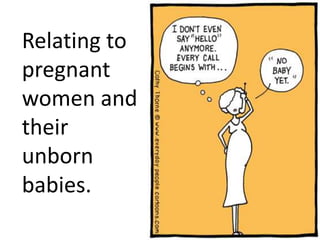
Relating to
pregnant
women and
their
unborn
babies.
Nurses are in a unique position to
influence behaviors of the pregnant
woman and to increase the chance
she and her baby will stay healthy.
Through consistent use of the nursing
process, we can detect problems
early in order to intervene, or assist
,and support the woman through her
pregnancy.
What is the
primary nursing
intervention
throughout
pregnancy ?
Teaching
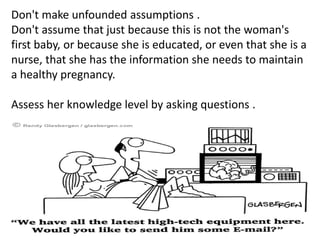
Don't make unfounded assumptions .
Don't assume that just because this is not the woman's
first baby, or because she is educated, or even that she is a
nurse, that she has the information she needs to maintain
a healthy pregnancy.
Assess her knowledge level by asking questions .
Essential components of prenatal visits:
1-Ongoing assessment and
2-data collection .
During the 1st prenatal visit, pay close attention to
cues the woman may giveregarding her feelings
toward the pregnancy. ( Ambivalence is normal ).
E.g.: The woman may express feelings
of doubt about the pregnancy or her
ability to be a good parent. These are
normal reactions when a woman 1st
finds out she is pregnant, and she
needs reassurance that her responses
are normal.
1st prenatal visit
A) Medical history:
1- mensteral cycle.
2-use of birth controle
3- post pregnency.
4- personal medical history.
5- family medical history.
6-medication use.
1st prenatal visit
B) Lab test:
1- check blood type ( Rh ),
2- check ( Hgb ).
3- check immunity to certain infections ( rubella
& chickenpox )
4- detect exposue to other infections.
5- screening test for fetal abnormalities
At every visit, inquire
1- Medications, OTC
2- Food supple. (Pay close attention to signs that might
indicate poor nutritional status - Weight is an obvious
clue).
warning signs of poor nutritional status include (dull, brittle
hair, poor condition of skin and nails or a low hemoglobin
level.
*If the woman is overweight or underweight, she will need
special assistance with nutritional concerns throughout the
pregnancy.
Cont. at every visit, inquire
3- Note if she experiencing nausea and vomiting.
4- Determine her education level and knowledge
of pregnancy and prenatal care.
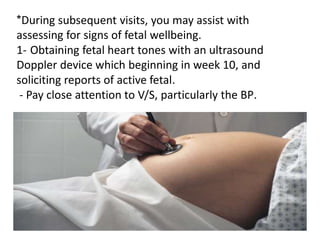
*During subsequent visits, you may assist with
assessing for signs of fetal wellbeing.
1- Obtaining fetal heart tones with an ultrasound
Doppler device which beginning in week 10, and
soliciting reports of active fetal.
- Pay close attention to V/S, particularly the BP.
Inquire regarding these warning signals at every visit.
Instruct the woman to report any of these signs to health care
provider right Away:
1 Fever or severe vomiting unrelieved by Tylenol or
other relief
2- Headache,
3- Blurred vision or spots
4- Pain in the epigastria region
5- Sudden weight gain or sudden onset of
Cont,
6- Vaginal bleeding
7- Painful urination
8-uncontrollable leaking of fluid from the vagina
9- Decreased fetal movement (is Signs of preterm
labor )
10- lower Uterine contractions
11- Menstrual-like Increase in vaginal discharge
12-A feeling that something is not right
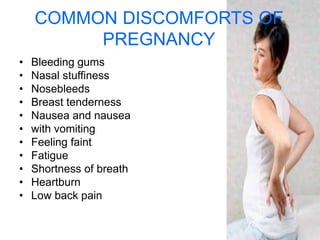
• Bleeding gums
• Nasal stuffiness
• Nosebleeds
• Breast tenderness
• Nausea and nausea
• with vomiting
• Feeling faint
• Fatigue
• Shortness of breath
• Heartburn
• Low back pain
COMMON DISCOMFORTS OF
PREGNANCY
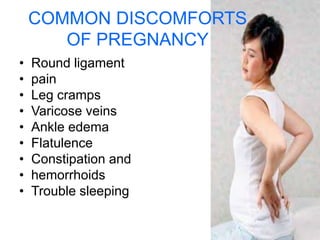
• Round ligament
• pain
• Leg cramps
• Varicose veins
• Ankle edema
• Flatulence
• Constipation and
• hemorrhoids
• Trouble sleeping
COMMON DISCOMFORTS
OF PREGNANCY
Maintaining balanced nutritional
intake
With in first trimester ,the fetus’
demands on maternal stores are less
than at other times during the pregnancy.
Some times it is difficult to maintain a
well- balanced diet when she is coping
with nausea.
Maintaining balanced nutritional
intake
1- In the first visit focus on assessing
the adequacy of her diet and answer
questions.
2- Emphasize the important of taking
the prenatal vitamins.
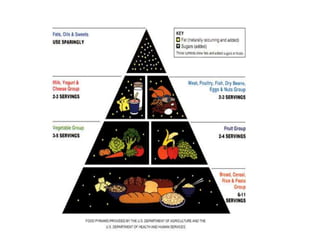
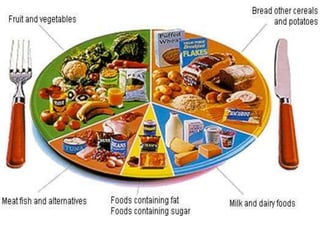
3- My pyramid can assist the pregnant
woman achieve balanced die.
Maintaining balanced nutritional
intake
4- Monitor weight gain throughout
pregnancy .there should be steady in
crease in weight throughout pregnancy,
for total in crease of to 25 to 35 Ib.
5- Sudden weight gain often is associated
with fluid retention and may be sign of
developing preeclampsia.
Maintaining balanced nutritional
intake
6- Encourage the woman to take her iron
and folic acid supplement.
7- Monitor the hemoglobin and
hematocrit at the 28-week check up for
any decreases.
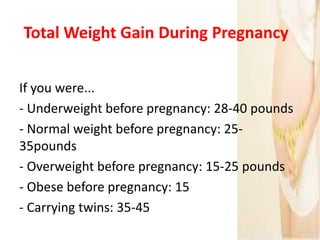
If you were...
- Underweight before pregnancy: 28-40 pounds
- Normal weight before pregnancy: 25-
35pounds
- Overweight before pregnancy: 15-25 pounds
- Obese before pregnancy: 15
- Carrying twins: 35-45
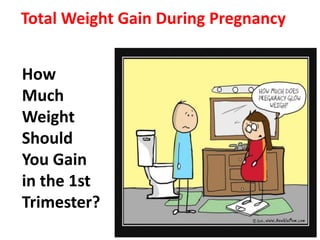
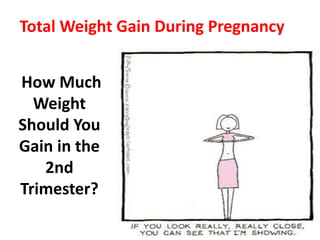
Total Weight Gain During Pregnancy
How
Much
Weight
Should
You Gain
in the 1st
Trimester?
Gain 1 to 1 1/2 pounds per
month for a total of 3-5
pounds.
Consume an extra 200
calories a day (for example,
a glass of skim milk, and
two slices of turkey breast).
Total Weight Gain During Pregnancy
How Much
Weight
Should You
Gain in the
2nd
Trimester?
Gain about 1 pound per
week for a total of 12 to 14
pounds.
Consume an extra 300
calories a day (for example,
a cup of carrot-orange juice
and a cup of low-fat fruit-
flavored yogurt.
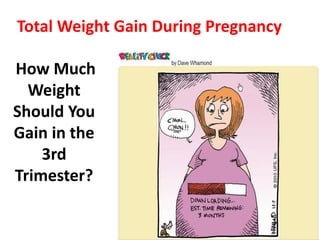
Total Weight Gain During Pregnancy
How Much
Weight
Should You
Gain in the
3rd
Trimester?
Gain 3/4 to 1 pound per week
(weight gain often slows during the
last month) for a total of 10 to 14
pounds.
Consume an extra 300-500 calories
a day (for example, a cup of low-
sodium tomato juice and a whole-
grain bagel spread with low-fat
cream cheese).
Major components of prenatal self care
1- Avoid alcohol - alcohol harms the
fetus.
2- Avoid smoking ,it can lead to lower
birth weight and increase the
incidence of preterm labor.
3- Eat a healthy ,well- balanced diet .
Major components of prenatal self care
4- Consume approximately 300
calories more per day than before
pregnancy.
5- Take an extra 400 mcg of folic acid
per day .if the doctor ordered prenatal
vitamins, the recommended dose will
be met.
Major components of prenatal self care
6- Avoid dieting during pregnancy .every
pregnant women with a normal body
mass index should gain 25 to 30 Ib during
the pregnancy.
7-Continue to exercise during pregnancy
.how ever, do not exercise to the point of
exhaustion or start a grueling new work
out that you were not doing before
pregnancy.
Major components of prenatal self care
8- Avoid douching during pregnancy
because it will increase the risk of
bacterial infection .
9- Avoid taking any medication
(other than acetaminophen) or over
the counter herbal remedy unless
your primary care provider has
approved it.
Dental hygiene
1- A pregnant woman needs to continue regular dental
checkups and practice excellent dental hygiene.
2- This includes at least twice-daily brushing, once daily
flossing ,and a nutritious diet .
3- If pregnancy gingivitis is a problem, then regular dental
checkups are necessary.
4- Untreated gingivitis can damage the gums and result in
bone and tooth loss.
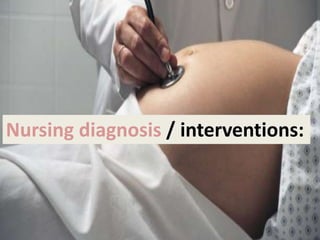
Nursing diagnosis / interventions:
1- Anxiety related to uncertainty regarding
pregnancy diagnosis and not knowing what to
expect during the office visit.
2- Health-seeking Behaviors related to maintaining
a healthy pregnancy and concerns regarding the
common discomforts ofpregnancy.
3- Deficient Knowledge of self-care during
pregnancy.
Nursing diagnosis / interventions:
4- Risk for injury related to complications of
pregnancy.
5- Fear related to the unknown of childbirth,
concerns regarding safe passage of self and infant
through the delivery experience, and concerns
related to assuming the parenting role.
1-Anxiety related to uncertainty
regarding pregnancy diagnosis and
not knowing what to expect during
the office visit;
Escort women to the examination room and explain the
procedures to her and what she can expect during the visit .
Much anxiety can be alleviated when women know what to
expect , maintain calm , confident demeanor while giving
care and protect women privacy during invasive
examinations .
Try to understand women perspective .
1-Anxiety related to uncertainty
regarding pregnancy diagnosis and
not knowing what to expect during
the office visit;
Note if her anxiety level increases.
Anticipate concerns when fetal testing is planned .
Attend to women's questions and misunderstanding .
Provide factual information concerning the treatment plan .
Use active listening .
Encourage positive coping behaviors .
2-Health-seeking Behaviors related to
maintaining a healthy pregnancy and concerns
regarding the common discomforts of pregnancy.
3-Deficient Knowledge of self-care during pregnancy.
Teaching self-care during pregnancy.
* Maintaining a balanced nutritional intake.
* Dental hygiene
* Exercise
* Hygiene
* Breast care
* Clothing
* Sexual activity
* Employment
* *Travel
* Medications and herbal remedies
* Teaching about substance use and abuse .
4- Risk for injury related to
complications of pregnancy.
Your baby is well protected from the outside
world while inside your uterus. There is
even more protection during the first three
months of pregnancy when the uterus is
still surrounded by the pelvic bones. For
these reasons, it's hard to hurt your baby
during normal day-to-day activities.
4- Risk for injury related to
complications of pregnancy.
To avoid falls, be especially careful when
you do things that require a good sense of
balance. This includes climbing stairs,
carrying packages, or walking where there
is ice, snow, sand, or gravel. Be sure to
ask for help if you feel unsteady.
Refer to Newborn discharge teaching
5-Fear related to the unknown of
childbirth, concerns regarding safe
passage of self and infant through
the delivery experience, and
concerns related to assuming the
parenting role.
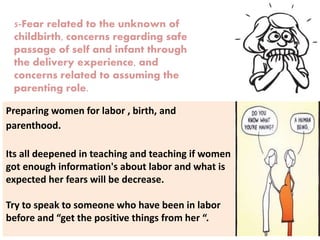
Preparing women for labor , birth, and
parenthood.
Its all deepened in teaching and teaching if women
got enough information's about labor and what is
expected her fears will be decrease.
Try to speak to someone who have been in labor
before and “get the positive things from her “.
Learn relaxation technique to do it
whenever you got this fear .
Have support from her parents or friends
with children or through attending classes
about the role of parents .
5-Fear related to the unknown of
childbirth, concerns regarding safe
passage of self and infant through the
delivery experience, and concerns related
to assuming the parenting role.
Evaluation of care giving during
pregnancy
Evaluation of care giving during pregnancy
1- The pregnant women anxiety is reduced.
2- The pregnant women manage the symptoms
and discomforts associated with pregnancy that
she nor the fetus will experience injury from the
complication of pregnancy.
Evaluation of care giving during pregnancy
3- The pregnant women is having sufficient
knowledge to adequately meet the needs
of the growing fetus throughout the
pregnancy
4- She express confidence in her ability to
go through the labor and birth experience
and assume the parenting role.
References:
1- Essentials of maternity, newborn, and women’s
health nursing. 2ed edition. Lippincott williams &
wilkins.
2- Maternity & pediatric nursing.2ed edition.
Lippincott williams & wilkins.
Maternal

Maternal

  • 1.
    Nursing care duringthe prenatal period Prepared by: Marwah, Wjdan,Sharefa, Saleha & Amal. Supervised by: Mrs.Hadeer AL-Morbaty.
  • 2.
    outlines: 1. Introduction. 2. Nursingprocess for prenatal care. 3. Common discomforts of pregnancy. 4. Major family teaching topics to cover during prenatal care. 5. Balanced nutritional intake for pregnant woman. 6. References.
  • 3.
    At the endof this lecture you will: 1. outline the nursing care and implication after prenatal assessment. 2 Identify common nursing diagnosis for a pregnant woman 3. Choose appropriate nursing interventions for the pregnant woman. discomforts of pregnancy. 4. Teach the pregnant woman how to deal with the common discomfort. 5. Discuss the importance of balanced nutritional intake for pregnant woman. 6. Assist the woman to assess her own diet for adequacy by using the food pyramid. 7. Evaluate the effectiveness of care given during pregnancy. Objectives:
  • 4.
  • 6.
  • 7.
    Nurses are ina unique position to influence behaviors of the pregnant woman and to increase the chance she and her baby will stay healthy. Through consistent use of the nursing process, we can detect problems early in order to intervene, or assist ,and support the woman through her pregnancy.
  • 8.
    What is the primarynursing intervention throughout pregnancy ?
  • 9.
  • 11.
    Don't make unfoundedassumptions . Don't assume that just because this is not the woman's first baby, or because she is educated, or even that she is a nurse, that she has the information she needs to maintain a healthy pregnancy. Assess her knowledge level by asking questions .
  • 12.
    Essential components ofprenatal visits: 1-Ongoing assessment and 2-data collection .
  • 13.
    During the 1stprenatal visit, pay close attention to cues the woman may giveregarding her feelings toward the pregnancy. ( Ambivalence is normal ).
  • 14.
    E.g.: The womanmay express feelings of doubt about the pregnancy or her ability to be a good parent. These are normal reactions when a woman 1st finds out she is pregnant, and she needs reassurance that her responses are normal.
  • 15.
    1st prenatal visit A)Medical history: 1- mensteral cycle. 2-use of birth controle 3- post pregnency. 4- personal medical history. 5- family medical history. 6-medication use.
  • 16.
    1st prenatal visit B)Lab test: 1- check blood type ( Rh ), 2- check ( Hgb ). 3- check immunity to certain infections ( rubella & chickenpox ) 4- detect exposue to other infections. 5- screening test for fetal abnormalities
  • 17.
    At every visit,inquire 1- Medications, OTC 2- Food supple. (Pay close attention to signs that might indicate poor nutritional status - Weight is an obvious clue). warning signs of poor nutritional status include (dull, brittle hair, poor condition of skin and nails or a low hemoglobin level. *If the woman is overweight or underweight, she will need special assistance with nutritional concerns throughout the pregnancy.
  • 18.
    Cont. at everyvisit, inquire 3- Note if she experiencing nausea and vomiting. 4- Determine her education level and knowledge of pregnancy and prenatal care.
  • 19.
    *During subsequent visits,you may assist with assessing for signs of fetal wellbeing. 1- Obtaining fetal heart tones with an ultrasound Doppler device which beginning in week 10, and soliciting reports of active fetal. - Pay close attention to V/S, particularly the BP.
  • 20.
    Inquire regarding thesewarning signals at every visit. Instruct the woman to report any of these signs to health care provider right Away: 1 Fever or severe vomiting unrelieved by Tylenol or other relief 2- Headache, 3- Blurred vision or spots 4- Pain in the epigastria region 5- Sudden weight gain or sudden onset of
  • 21.
    Cont, 6- Vaginal bleeding 7-Painful urination 8-uncontrollable leaking of fluid from the vagina 9- Decreased fetal movement (is Signs of preterm labor ) 10- lower Uterine contractions 11- Menstrual-like Increase in vaginal discharge 12-A feeling that something is not right
  • 22.
    • Bleeding gums •Nasal stuffiness • Nosebleeds • Breast tenderness • Nausea and nausea • with vomiting • Feeling faint • Fatigue • Shortness of breath • Heartburn • Low back pain COMMON DISCOMFORTS OF PREGNANCY
  • 23.
    • Round ligament •pain • Leg cramps • Varicose veins • Ankle edema • Flatulence • Constipation and • hemorrhoids • Trouble sleeping COMMON DISCOMFORTS OF PREGNANCY
  • 24.
    Maintaining balanced nutritional intake Within first trimester ,the fetus’ demands on maternal stores are less than at other times during the pregnancy. Some times it is difficult to maintain a well- balanced diet when she is coping with nausea.
  • 25.
    Maintaining balanced nutritional intake 1-In the first visit focus on assessing the adequacy of her diet and answer questions. 2- Emphasize the important of taking the prenatal vitamins. 3- My pyramid can assist the pregnant woman achieve balanced die.
  • 26.
    Maintaining balanced nutritional intake 4-Monitor weight gain throughout pregnancy .there should be steady in crease in weight throughout pregnancy, for total in crease of to 25 to 35 Ib. 5- Sudden weight gain often is associated with fluid retention and may be sign of developing preeclampsia.
  • 27.
    Maintaining balanced nutritional intake 6-Encourage the woman to take her iron and folic acid supplement. 7- Monitor the hemoglobin and hematocrit at the 28-week check up for any decreases.
  • 30.
    If you were... -Underweight before pregnancy: 28-40 pounds - Normal weight before pregnancy: 25- 35pounds - Overweight before pregnancy: 15-25 pounds - Obese before pregnancy: 15 - Carrying twins: 35-45 Total Weight Gain During Pregnancy
  • 31.
    Total Weight GainDuring Pregnancy How Much Weight Should You Gain in the 1st Trimester?
  • 32.
    Gain 1 to1 1/2 pounds per month for a total of 3-5 pounds. Consume an extra 200 calories a day (for example, a glass of skim milk, and two slices of turkey breast).
  • 33.
    Total Weight GainDuring Pregnancy How Much Weight Should You Gain in the 2nd Trimester?
  • 34.
    Gain about 1pound per week for a total of 12 to 14 pounds. Consume an extra 300 calories a day (for example, a cup of carrot-orange juice and a cup of low-fat fruit- flavored yogurt.
  • 35.
    Total Weight GainDuring Pregnancy How Much Weight Should You Gain in the 3rd Trimester?
  • 36.
    Gain 3/4 to1 pound per week (weight gain often slows during the last month) for a total of 10 to 14 pounds. Consume an extra 300-500 calories a day (for example, a cup of low- sodium tomato juice and a whole- grain bagel spread with low-fat cream cheese).
  • 37.
    Major components ofprenatal self care 1- Avoid alcohol - alcohol harms the fetus. 2- Avoid smoking ,it can lead to lower birth weight and increase the incidence of preterm labor. 3- Eat a healthy ,well- balanced diet .
  • 38.
    Major components ofprenatal self care 4- Consume approximately 300 calories more per day than before pregnancy. 5- Take an extra 400 mcg of folic acid per day .if the doctor ordered prenatal vitamins, the recommended dose will be met.
  • 39.
    Major components ofprenatal self care 6- Avoid dieting during pregnancy .every pregnant women with a normal body mass index should gain 25 to 30 Ib during the pregnancy. 7-Continue to exercise during pregnancy .how ever, do not exercise to the point of exhaustion or start a grueling new work out that you were not doing before pregnancy.
  • 40.
    Major components ofprenatal self care 8- Avoid douching during pregnancy because it will increase the risk of bacterial infection . 9- Avoid taking any medication (other than acetaminophen) or over the counter herbal remedy unless your primary care provider has approved it.
  • 41.
    Dental hygiene 1- Apregnant woman needs to continue regular dental checkups and practice excellent dental hygiene. 2- This includes at least twice-daily brushing, once daily flossing ,and a nutritious diet . 3- If pregnancy gingivitis is a problem, then regular dental checkups are necessary. 4- Untreated gingivitis can damage the gums and result in bone and tooth loss.
  • 42.
    Nursing diagnosis /interventions:
  • 43.
    Nursing diagnosis /interventions: 1- Anxiety related to uncertainty regarding pregnancy diagnosis and not knowing what to expect during the office visit. 2- Health-seeking Behaviors related to maintaining a healthy pregnancy and concerns regarding the common discomforts ofpregnancy. 3- Deficient Knowledge of self-care during pregnancy.
  • 44.
    Nursing diagnosis /interventions: 4- Risk for injury related to complications of pregnancy. 5- Fear related to the unknown of childbirth, concerns regarding safe passage of self and infant through the delivery experience, and concerns related to assuming the parenting role.
  • 45.
    1-Anxiety related touncertainty regarding pregnancy diagnosis and not knowing what to expect during the office visit; Escort women to the examination room and explain the procedures to her and what she can expect during the visit . Much anxiety can be alleviated when women know what to expect , maintain calm , confident demeanor while giving care and protect women privacy during invasive examinations . Try to understand women perspective .
  • 46.
    1-Anxiety related touncertainty regarding pregnancy diagnosis and not knowing what to expect during the office visit; Note if her anxiety level increases. Anticipate concerns when fetal testing is planned . Attend to women's questions and misunderstanding . Provide factual information concerning the treatment plan . Use active listening . Encourage positive coping behaviors .
  • 47.
    2-Health-seeking Behaviors relatedto maintaining a healthy pregnancy and concerns regarding the common discomforts of pregnancy.
  • 48.
    3-Deficient Knowledge ofself-care during pregnancy. Teaching self-care during pregnancy. * Maintaining a balanced nutritional intake. * Dental hygiene * Exercise * Hygiene * Breast care * Clothing * Sexual activity * Employment * *Travel * Medications and herbal remedies * Teaching about substance use and abuse .
  • 49.
    4- Risk forinjury related to complications of pregnancy. Your baby is well protected from the outside world while inside your uterus. There is even more protection during the first three months of pregnancy when the uterus is still surrounded by the pelvic bones. For these reasons, it's hard to hurt your baby during normal day-to-day activities.
  • 50.
    4- Risk forinjury related to complications of pregnancy. To avoid falls, be especially careful when you do things that require a good sense of balance. This includes climbing stairs, carrying packages, or walking where there is ice, snow, sand, or gravel. Be sure to ask for help if you feel unsteady.
  • 51.
    Refer to Newborndischarge teaching
  • 52.
    5-Fear related tothe unknown of childbirth, concerns regarding safe passage of self and infant through the delivery experience, and concerns related to assuming the parenting role. Preparing women for labor , birth, and parenthood. Its all deepened in teaching and teaching if women got enough information's about labor and what is expected her fears will be decrease. Try to speak to someone who have been in labor before and “get the positive things from her “.
  • 53.
    Learn relaxation techniqueto do it whenever you got this fear . Have support from her parents or friends with children or through attending classes about the role of parents . 5-Fear related to the unknown of childbirth, concerns regarding safe passage of self and infant through the delivery experience, and concerns related to assuming the parenting role.
  • 54.
    Evaluation of caregiving during pregnancy
  • 55.
    Evaluation of caregiving during pregnancy 1- The pregnant women anxiety is reduced. 2- The pregnant women manage the symptoms and discomforts associated with pregnancy that she nor the fetus will experience injury from the complication of pregnancy.
  • 56.
    Evaluation of caregiving during pregnancy 3- The pregnant women is having sufficient knowledge to adequately meet the needs of the growing fetus throughout the pregnancy 4- She express confidence in her ability to go through the labor and birth experience and assume the parenting role.
  • 58.
    References: 1- Essentials ofmaternity, newborn, and women’s health nursing. 2ed edition. Lippincott williams & wilkins. 2- Maternity & pediatric nursing.2ed edition. Lippincott williams & wilkins.