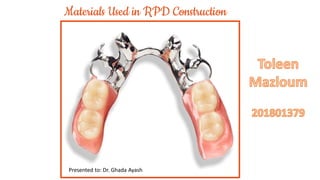
Materials Used in RPD Construction
Presented to: Dr. Ghada Ayash
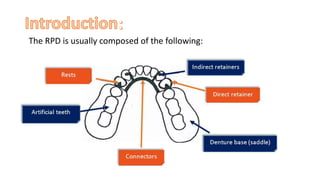
“The RPD is usually composed of the following:”
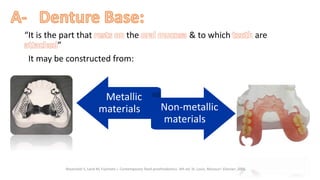
“It is the part that rests on the oral mucosa & to which teeth are
attached”
“It may be constructed from:”
“Metallic
materials” “Non-metallic
materials”
“ ”
“Rosenstiel S, Land M, Fujimoto J. Contemporary fixed prosthodontics. 4th ed. St. Louis, Missouri: Elsevier; 2006.”
"
“ ”
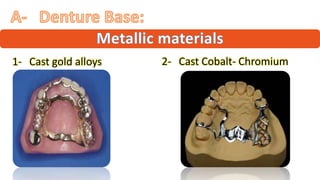
1- Cast gold alloys 2- Cast Cobalt- Chromium
"
“ ”
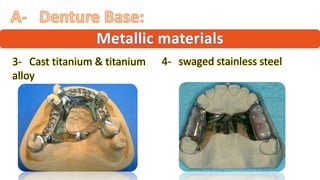
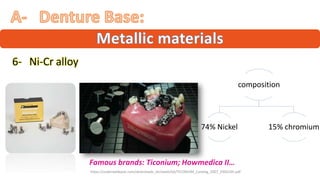
3- Cast titanium & titanium
alloy
4- swaged stainless steel
"
“ ”
5- Co-Cr-Mo alloy
composition
65%
Cobalt
30%
Chromium
5%
molybdenum
“Famous brands: Vitallium; Nobilium”
“Vitallium 2 (V2). Abbeydentalsupplies.com. 2020. Available from: https://www.abbeydentalsupplies.com/vitallium-2”
"
“ ”
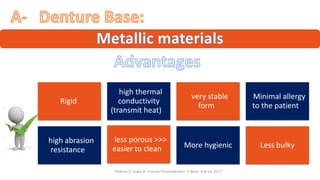
6- Ni-Cr alloy
composition
74% Nickel 15% chromium
https://usdentaldepot.com/downloads_dir/webUSA/TICONIUM_Catalog_2007_ENGLISH.pdf
“Famous brands: Ticonium; Howmedica II…”
"
“ ”
“tooth supported
edentulous space where
further bone resorption
is not expected”
“when a facing (metal
pontic or metal
reinforced denture tooth)
is to be used”
“Files.sld.cu. Available from: http://files.sld.cu/protesis/files/2018/06/chapter6denture-bases.pdf”
"
“ ”
“tooth supported edentulous space where bone
resorption is expected”
“tooth-tissue supported edentulous space”
“Files.sld.cu. Available from: http://files.sld.cu/protesis/files/2018/06/chapter6denture-bases.pdf”
"
“ ”
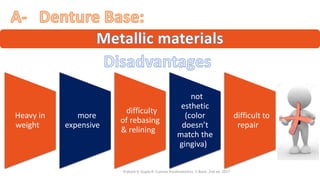
“Rigid ”
“high thermal
conductivity
(transmit heat) ”
“very stable
form”
“Minimal allergy
to the patient”
“high abrasion
resistance”
“less porous >>>
easier to clean” “More hygienic” “Less bulky”
“Prakash V, Gupta R. Concise Prosthodontics- E Book. 2nd ed. 2017”
"
“ ”
Heavy in
weight ”
“more
expensive ”
“difficulty
of rebasing
& relining”
“not
esthetic
(color
doesn’t
match the
gingiva)”
“difficult to
repair”
"Prakash V, Gupta R. Concise Prosthodontics- E Book. 2nd ed. 2017"
"
“ ”
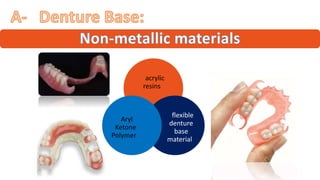
“acrylic
resins”
“flexible
denture
base
material”
“Aryl
Ketone
Polymer”
"
“ ”
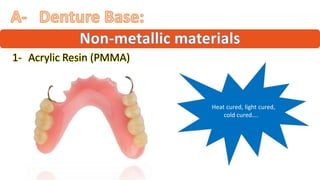
1- Acrylic Resin (PMMA)
“Heat cured, light cured,
cold cured….”
"
“ ”
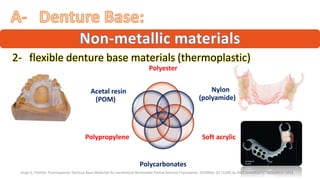
“Polyester”
“Nylon
(polyamide)”
“Soft acrylic”
“Polycarbonates”
“Polypropylene”
“Acetal resin
(POM)”
2- flexible denture base materials (thermoplastic)
“Singh K. Flexible Thermoplastic Denture Base Materials for Aesthetical Removable Partial Denture Framework. JOURNAL OF CLINICAL AND DIAGNOSTIC RESEARCH. 2013”
"
“ ”
3- aryl ketone polymer (AKP)
Not flexible & not
too rigid like metals
“ Dentist Information | Ultaire® AKP RPDs. Solvay® Dental 360. 2020. Available from: https://www.solvaydental360.com/dentistmain/dentists/”
"
“ ”
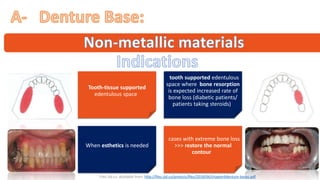
Tooth-tissue supported
edentulous space”
“tooth supported edentulous
space where bone resorption
is expected increased rate of
bone loss (diabetic patients/
patients taking steroids)”
“When esthetics is needed”
“cases with extreme bone loss
>>> restore the normal
contour”
“Files.sld.cu. Available from: http://files.sld.cu/protesis/files/2018/06/chapter6denture-bases.pdf”
"
“ ”
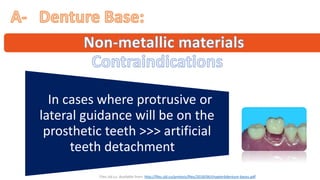
“In cases where protrusive or
lateral guidance will be on the
prosthetic teeth >>> artificial
teeth detachment ”
“Files.sld.cu. Available from: http://files.sld.cu/protesis/files/2018/06/chapter6denture-bases.pdf”
"
“ ”
Easily relined”
“easy to
fabricate”
“easy to adjust &
repair”
“easy to finish &
polish”
“more esthetic”
“Files.sld.cu. Available from: http://files.sld.cu/protesis/files/2018/06/chapter6denture-bases.pdf”
"
“ ”
More porous
>>> difficult
to clean”
“requires
more bulk for
rigidity ”
“easily
abraded &
fractured”
“less
dimensionally
stable”
“poor thermal
conductivity
>>> less
stimulation to
underlying
tissues ”
(1):
“Files.sld.cu. Available from: http://files.sld.cu/protesis/files/2018/06/chapter6denture-bases.pdf”
(1):
"
“ ”
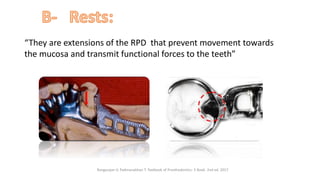
“They are extensions of the RPD that prevent movement towards
the mucosa and transmit functional forces to the teeth”
“Rangarajan V, Padmanabhan T. Textbook of Prosthodontics- E Book. 2nd ed. 2017.”
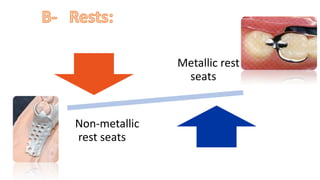
“Metallic rest
seats”
“Non-metallic
rest seats”
“ ”
"
“ ”
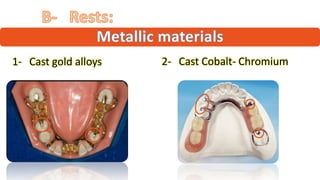
1- Cast gold alloys 2- Cast Cobalt- Chromium
"
“ ”
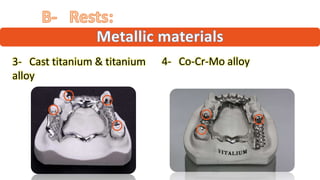
3- Cast titanium & titanium
alloy
4- Co-Cr-Mo alloy
"
“ ”
5- Stainless steel” 6- Ni-Cr”
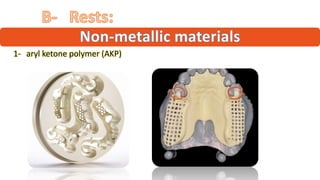
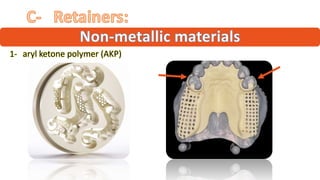
““1- “aryl ketone polymer (AKP)”
“ ”
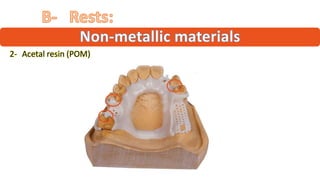
“2- “Acetal resin (POM)”
“ ”
"
“ ”
"
“ ”
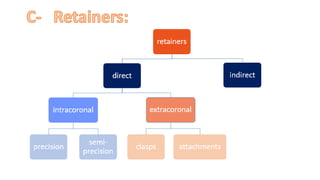
“They could be made from:”
“Non-
metallic
material”
“Metallic
material”
"
“ ”
1- Cast gold alloys 2- Cast Cobalt- Chromium
"
“ ”
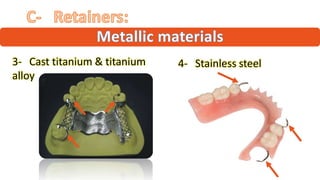
3- Cast titanium & titanium
alloy
4- Stainless steel”
"
“ ”
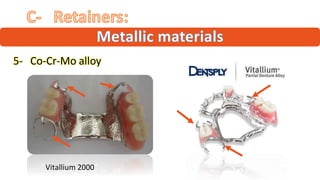
5- Co-Cr-Mo alloy
“Vitallium 2000”
"
“ ”
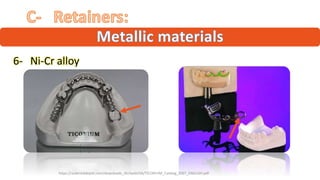
6- Ni-Cr alloy
https://usdentaldepot.com/downloads_dir/webUSA/TICONIUM_Catalog_2007_ENGLISH.pdf
“1- “aryl ketone polymer (AKP)”
“ ”
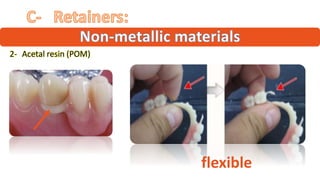
“2- “Acetal resin (POM)”
“ ”
flexible
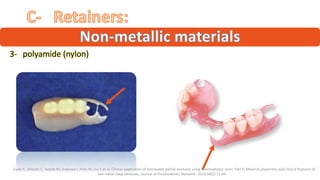
“3- “polyamide (nylon) ”
“ ”
“ Fueki K, Ohkubo C, Yatabe M, Arakawa I, Arita M, Ino S et al. Clinical application of removable partial dentures using thermoplastic resin. Part II: Material properties and clinical features of
non-metal clasp dentures. Journal of Prosthodontic Research. 2014;58(2):71-84.”
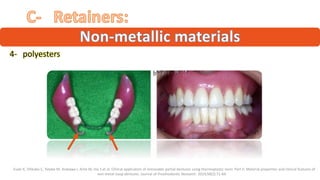
“4- “polyesters ”
“ ”
“ Fueki K, Ohkubo C, Yatabe M, Arakawa I, Arita M, Ino S et al. Clinical application of removable partial dentures using thermoplastic resin. Part II: Material properties and clinical features of
non-metal clasp dentures. Journal of Prosthodontic Research. 2014;58(2):71-84.”
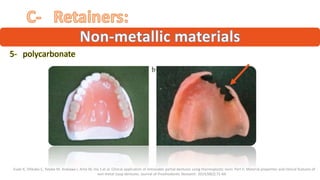
“5- “polycarbonate ”
“ ”
“ Fueki K, Ohkubo C, Yatabe M, Arakawa I, Arita M, Ino S et al. Clinical application of removable partial dentures using thermoplastic resin. Part II: Material properties and clinical features of
non-metal clasp dentures. Journal of Prosthodontic Research. 2014;58(2):71-84.”
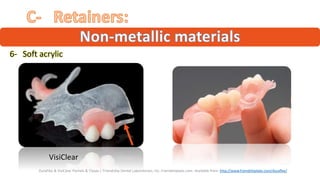
“6- “Soft acrylic ”
“ ”
VisiClear
“DuraFlex & VisiClear Partials & Clasps | Friendship Dental Laboratories, Inc. Friendshiplabs.com. Available from: http://www.friendshiplabs.com/duraflex/”
“ ”
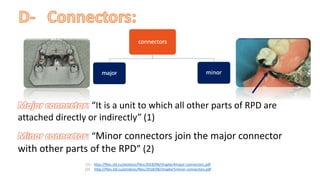
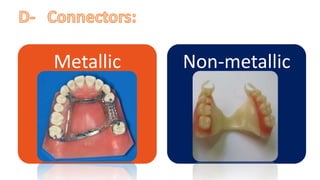
Major connector: “It is a unit to which all other parts of RPD are
attached directly or indirectly” (1)
Minor connector: “Minor connectors join the major connector
with other parts of the RPD” (2)
(1):” http://files.sld.cu/protesis/files/2018/06/chapter4major-connectors.pdf”
(2):” http://files.sld.cu/protesis/files/2018/06/chapter5minor-connectors.pdf”
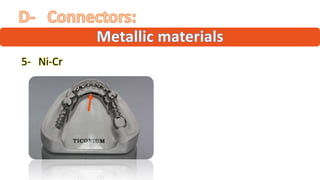
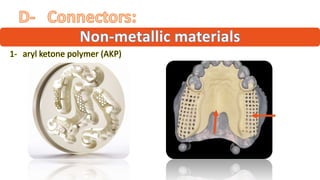
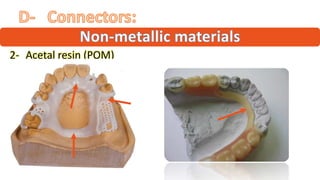
“Metallic” “Non-metallic”
“ ”
"
“ ”
1- Cast gold alloys 2- Cast Cobalt- Chromium
"
“ ”
3- Cast titanium & titanium
alloy
4- Co-Cr-Mo”
"
“ ”
5- Ni-Cr”
“1- “aryl ketone polymer (AKP)”
“ ”
“2- “Acetal resin (POM)”
“ ”
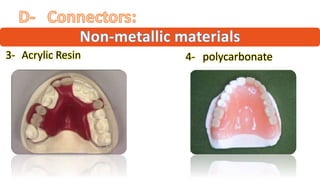
3- “Acrylic Resin”
“ ”
4- polycarbonate”
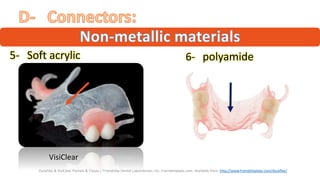
“5- “Soft acrylic” ”
“ ”
VisiClear
6- polyamide”
“DuraFlex & VisiClear Partials & Clasps | Friendship Dental Laboratories, Inc. Friendshiplabs.com. Available from: http://www.friendshiplabs.com/duraflex/”
(1):
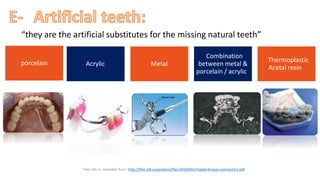
“they are the artificial substitutes for the missing natural teeth”
“ ”
“porcelain” “Acrylic” “Metal”
“Combination
between metal &
porcelain / acrylic”
“Thermoplastic
Acetal resin”
“Files.sld.cu. Available from: http://files.sld.cu/protesis/files/2018/06/chapter4major-connectors.pdf”
“ ”
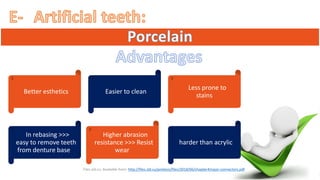
1- “Porcelain
“Mechanical retention (pins, holes…)”
“Files.sld.cu. Available from: http://files.sld.cu/protesis/files/2018/06/chapter4major-connectors.pdf”
“ ”
“Better esthetics” “Easier to clean”
“Less prone to
stains”
“In rebasing >>>
easy to remove teeth
from denture base “
“Higher abrasion
resistance >>> Resist
wear”
“harder than acrylic”
“Files.sld.cu. Available from: http://files.sld.cu/protesis/files/2018/06/chapter4major-connectors.pdf”
“ ”
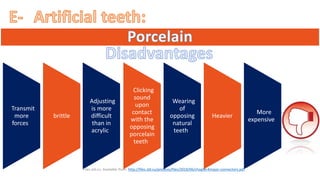
“Transmit
more
forces”
“brittle”
“Adjusting
is more
difficult
than in
acrylic”
“Clicking
sound
upon
contact
with the
opposing
porcelain
teeth”
“Wearing
of
opposing
natural
teeth”
“Heavier”
“More
expensive”
“Files.sld.cu. Available from: http://files.sld.cu/protesis/files/2018/06/chapter4major-connectors.pdf”
“ ”
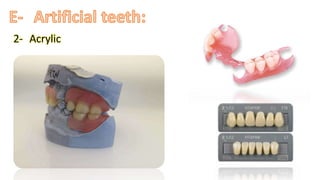
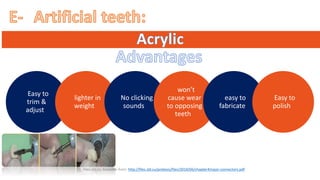
2- “Acrylic
“ ”
“Easy to
trim &
adjust”
“lighter in
weight”
“No clicking
sounds”
“won’t
cause wear
to opposing
teeth”
“easy to
fabricate”
“Easy to
polish”
“Files.sld.cu. Available from: http://files.sld.cu/protesis/files/2018/06/chapter4major-connectors.pdf”
“ ”
“more prone to
staining”
“lighter in rebasing
>>> difficult to
remove teeth from
the denture base”
“lower esthetics
than porcelain ”
“ low abrasion
resistance”
“Files.sld.cu. Available from: http://files.sld.cu/protesis/files/2018/06/chapter4major-connectors.pdf”
“ ”
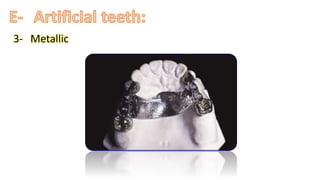
3- “Metallic
“ ”
“wear
resistance”
“dense surface”
“permanence of
form”
“Files.sld.cu. Available from: http://files.sld.cu/protesis/files/2018/06/chapter4major-connectors.pdf”
“ ”
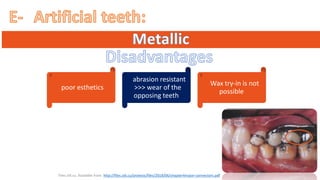
“poor esthetics”
“abrasion resistant
>>> wear of the
opposing teeth”
“Wax try-in is not
possible”
“Files.sld.cu. Available from: http://files.sld.cu/protesis/files/2018/06/chapter4major-connectors.pdf”
“ ”
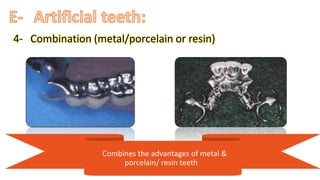
4- “Combination (metal/porcelain or resin)
“Combines the advantages of metal &
porcelain/ resin teeth”
“ ”
5- “Thermoplastic Acetal Resin
“Das C. Thermoplastic Elastomers: Synthesis and Applications. 2015.”
(1):
“ ”
“1- Rosenstiel S, Land M, Fujimoto J. Contemporary fixed
prosthodontics. 4th ed. St. Louis, Missouri: Elsevier; 2006.”
“2- Prakash V, Gupta R. Concise Prosthodontics- E Book. 2nd ed. 2017”
“3- Singh K. Flexible Thermoplastic Denture Base Materials for
Aesthetical Removable Partial Denture Framework. JOURNAL OF
CLINICAL AND DIAGNOSTIC RESEARCH. 2013””
“4- Rangarajan V, Padmanabhan T. Textbook of Prosthodontics- E Book.
2nd ed. 2017.”
“5- Fueki K, Ohkubo C, Yatabe M, Arakawa I, Arita M, Ino S et al.
Clinical application of removable partial dentures using thermoplastic
resin. Part II: Material properties and clinical features of non-metal
clasp dentures. Journal of Prosthodontic Research. 2014;58(2):71-84.”
“6- Das C. Thermoplastic Elastomers: Synthesis and Applications.
2015.””
(1):

Materials used in RPD construction

  • 1.
    Materials Used inRPD Construction Presented to: Dr. Ghada Ayash
  • 2.
    “The RPD isusually composed of the following:”
  • 4.
    “It is thepart that rests on the oral mucosa & to which teeth are attached” “It may be constructed from:” “Metallic materials” “Non-metallic materials” “ ” “Rosenstiel S, Land M, Fujimoto J. Contemporary fixed prosthodontics. 4th ed. St. Louis, Missouri: Elsevier; 2006.”
  • 5.
    " “ ” 1- Castgold alloys 2- Cast Cobalt- Chromium
  • 6.
    " “ ” 3- Casttitanium & titanium alloy 4- swaged stainless steel
  • 7.
    " “ ” 5- Co-Cr-Moalloy composition 65% Cobalt 30% Chromium 5% molybdenum “Famous brands: Vitallium; Nobilium” “Vitallium 2 (V2). Abbeydentalsupplies.com. 2020. Available from: https://www.abbeydentalsupplies.com/vitallium-2”
  • 8.
    " “ ” 6- Ni-Cralloy composition 74% Nickel 15% chromium https://usdentaldepot.com/downloads_dir/webUSA/TICONIUM_Catalog_2007_ENGLISH.pdf “Famous brands: Ticonium; Howmedica II…”
  • 9.
    " “ ” “tooth supported edentulousspace where further bone resorption is not expected” “when a facing (metal pontic or metal reinforced denture tooth) is to be used” “Files.sld.cu. Available from: http://files.sld.cu/protesis/files/2018/06/chapter6denture-bases.pdf”
  • 10.
    " “ ” “tooth supportededentulous space where bone resorption is expected” “tooth-tissue supported edentulous space” “Files.sld.cu. Available from: http://files.sld.cu/protesis/files/2018/06/chapter6denture-bases.pdf”
  • 11.
    " “ ” “Rigid ” “highthermal conductivity (transmit heat) ” “very stable form” “Minimal allergy to the patient” “high abrasion resistance” “less porous >>> easier to clean” “More hygienic” “Less bulky” “Prakash V, Gupta R. Concise Prosthodontics- E Book. 2nd ed. 2017”
  • 12.
    " “ ” Heavy in weight” “more expensive ” “difficulty of rebasing & relining” “not esthetic (color doesn’t match the gingiva)” “difficult to repair” "Prakash V, Gupta R. Concise Prosthodontics- E Book. 2nd ed. 2017"
  • 13.
  • 14.
    " “ ” 1- AcrylicResin (PMMA) “Heat cured, light cured, cold cured….”
  • 15.
    " “ ” “Polyester” “Nylon (polyamide)” “Soft acrylic” “Polycarbonates” “Polypropylene” “Acetalresin (POM)” 2- flexible denture base materials (thermoplastic) “Singh K. Flexible Thermoplastic Denture Base Materials for Aesthetical Removable Partial Denture Framework. JOURNAL OF CLINICAL AND DIAGNOSTIC RESEARCH. 2013”
  • 16.
    " “ ” 3- arylketone polymer (AKP) Not flexible & not too rigid like metals “ Dentist Information | Ultaire® AKP RPDs. Solvay® Dental 360. 2020. Available from: https://www.solvaydental360.com/dentistmain/dentists/”
  • 17.
    " “ ” Tooth-tissue supported edentulousspace” “tooth supported edentulous space where bone resorption is expected increased rate of bone loss (diabetic patients/ patients taking steroids)” “When esthetics is needed” “cases with extreme bone loss >>> restore the normal contour” “Files.sld.cu. Available from: http://files.sld.cu/protesis/files/2018/06/chapter6denture-bases.pdf”
  • 18.
    " “ ” “In caseswhere protrusive or lateral guidance will be on the prosthetic teeth >>> artificial teeth detachment ” “Files.sld.cu. Available from: http://files.sld.cu/protesis/files/2018/06/chapter6denture-bases.pdf”
  • 19.
    " “ ” Easily relined” “easyto fabricate” “easy to adjust & repair” “easy to finish & polish” “more esthetic” “Files.sld.cu. Available from: http://files.sld.cu/protesis/files/2018/06/chapter6denture-bases.pdf”
  • 20.
    " “ ” More porous >>>difficult to clean” “requires more bulk for rigidity ” “easily abraded & fractured” “less dimensionally stable” “poor thermal conductivity >>> less stimulation to underlying tissues ” (1): “Files.sld.cu. Available from: http://files.sld.cu/protesis/files/2018/06/chapter6denture-bases.pdf”
  • 21.
  • 22.
    " “ ” “They areextensions of the RPD that prevent movement towards the mucosa and transmit functional forces to the teeth” “Rangarajan V, Padmanabhan T. Textbook of Prosthodontics- E Book. 2nd ed. 2017.”
  • 23.
  • 24.
    " “ ” 1- Castgold alloys 2- Cast Cobalt- Chromium
  • 25.
    " “ ” 3- Casttitanium & titanium alloy 4- Co-Cr-Mo alloy
  • 26.
    " “ ” 5- Stainlesssteel” 6- Ni-Cr”
  • 27.
    ““1- “aryl ketonepolymer (AKP)” “ ”
  • 28.
    “2- “Acetal resin(POM)” “ ”
  • 30.
  • 31.
    " “ ” “They couldbe made from:” “Non- metallic material” “Metallic material”
  • 32.
    " “ ” 1- Castgold alloys 2- Cast Cobalt- Chromium
  • 33.
    " “ ” 3- Casttitanium & titanium alloy 4- Stainless steel”
  • 34.
    " “ ” 5- Co-Cr-Moalloy “Vitallium 2000”
  • 35.
    " “ ” 6- Ni-Cralloy https://usdentaldepot.com/downloads_dir/webUSA/TICONIUM_Catalog_2007_ENGLISH.pdf
  • 36.
    “1- “aryl ketonepolymer (AKP)” “ ”
  • 37.
    “2- “Acetal resin(POM)” “ ” flexible
  • 38.
    “3- “polyamide (nylon)” “ ” “ Fueki K, Ohkubo C, Yatabe M, Arakawa I, Arita M, Ino S et al. Clinical application of removable partial dentures using thermoplastic resin. Part II: Material properties and clinical features of non-metal clasp dentures. Journal of Prosthodontic Research. 2014;58(2):71-84.”
  • 39.
    “4- “polyesters ” “” “ Fueki K, Ohkubo C, Yatabe M, Arakawa I, Arita M, Ino S et al. Clinical application of removable partial dentures using thermoplastic resin. Part II: Material properties and clinical features of non-metal clasp dentures. Journal of Prosthodontic Research. 2014;58(2):71-84.”
  • 40.
    “5- “polycarbonate ” “” “ Fueki K, Ohkubo C, Yatabe M, Arakawa I, Arita M, Ino S et al. Clinical application of removable partial dentures using thermoplastic resin. Part II: Material properties and clinical features of non-metal clasp dentures. Journal of Prosthodontic Research. 2014;58(2):71-84.”
  • 41.
    “6- “Soft acrylic” “ ” VisiClear “DuraFlex & VisiClear Partials & Clasps | Friendship Dental Laboratories, Inc. Friendshiplabs.com. Available from: http://www.friendshiplabs.com/duraflex/”
  • 43.
    “ ” Major connector:“It is a unit to which all other parts of RPD are attached directly or indirectly” (1) Minor connector: “Minor connectors join the major connector with other parts of the RPD” (2) (1):” http://files.sld.cu/protesis/files/2018/06/chapter4major-connectors.pdf” (2):” http://files.sld.cu/protesis/files/2018/06/chapter5minor-connectors.pdf”
  • 44.
  • 45.
    " “ ” 1- Castgold alloys 2- Cast Cobalt- Chromium
  • 46.
    " “ ” 3- Casttitanium & titanium alloy 4- Co-Cr-Mo”
  • 47.
  • 48.
    “1- “aryl ketonepolymer (AKP)” “ ”
  • 49.
    “2- “Acetal resin(POM)” “ ”
  • 50.
    3- “Acrylic Resin” “” 4- polycarbonate”
  • 51.
    “5- “Soft acrylic”” “ ” VisiClear 6- polyamide” “DuraFlex & VisiClear Partials & Clasps | Friendship Dental Laboratories, Inc. Friendshiplabs.com. Available from: http://www.friendshiplabs.com/duraflex/”
  • 52.
  • 53.
    “they are theartificial substitutes for the missing natural teeth” “ ” “porcelain” “Acrylic” “Metal” “Combination between metal & porcelain / acrylic” “Thermoplastic Acetal resin” “Files.sld.cu. Available from: http://files.sld.cu/protesis/files/2018/06/chapter4major-connectors.pdf”
  • 54.
    “ ” 1- “Porcelain “Mechanicalretention (pins, holes…)” “Files.sld.cu. Available from: http://files.sld.cu/protesis/files/2018/06/chapter4major-connectors.pdf”
  • 55.
    “ ” “Better esthetics”“Easier to clean” “Less prone to stains” “In rebasing >>> easy to remove teeth from denture base “ “Higher abrasion resistance >>> Resist wear” “harder than acrylic” “Files.sld.cu. Available from: http://files.sld.cu/protesis/files/2018/06/chapter4major-connectors.pdf”
  • 56.
    “ ” “Transmit more forces” “brittle” “Adjusting is more difficult thanin acrylic” “Clicking sound upon contact with the opposing porcelain teeth” “Wearing of opposing natural teeth” “Heavier” “More expensive” “Files.sld.cu. Available from: http://files.sld.cu/protesis/files/2018/06/chapter4major-connectors.pdf”
  • 57.
  • 58.
    “ ” “Easy to trim& adjust” “lighter in weight” “No clicking sounds” “won’t cause wear to opposing teeth” “easy to fabricate” “Easy to polish” “Files.sld.cu. Available from: http://files.sld.cu/protesis/files/2018/06/chapter4major-connectors.pdf”
  • 59.
    “ ” “more proneto staining” “lighter in rebasing >>> difficult to remove teeth from the denture base” “lower esthetics than porcelain ” “ low abrasion resistance” “Files.sld.cu. Available from: http://files.sld.cu/protesis/files/2018/06/chapter4major-connectors.pdf”
  • 60.
  • 61.
    “ ” “wear resistance” “dense surface” “permanenceof form” “Files.sld.cu. Available from: http://files.sld.cu/protesis/files/2018/06/chapter4major-connectors.pdf”
  • 62.
    “ ” “poor esthetics” “abrasionresistant >>> wear of the opposing teeth” “Wax try-in is not possible” “Files.sld.cu. Available from: http://files.sld.cu/protesis/files/2018/06/chapter4major-connectors.pdf”
  • 63.
    “ ” 4- “Combination(metal/porcelain or resin) “Combines the advantages of metal & porcelain/ resin teeth”
  • 64.
    “ ” 5- “ThermoplasticAcetal Resin “Das C. Thermoplastic Elastomers: Synthesis and Applications. 2015.”
  • 65.
  • 66.
    “ ” “1- RosenstielS, Land M, Fujimoto J. Contemporary fixed prosthodontics. 4th ed. St. Louis, Missouri: Elsevier; 2006.” “2- Prakash V, Gupta R. Concise Prosthodontics- E Book. 2nd ed. 2017” “3- Singh K. Flexible Thermoplastic Denture Base Materials for Aesthetical Removable Partial Denture Framework. JOURNAL OF CLINICAL AND DIAGNOSTIC RESEARCH. 2013”” “4- Rangarajan V, Padmanabhan T. Textbook of Prosthodontics- E Book. 2nd ed. 2017.” “5- Fueki K, Ohkubo C, Yatabe M, Arakawa I, Arita M, Ino S et al. Clinical application of removable partial dentures using thermoplastic resin. Part II: Material properties and clinical features of non-metal clasp dentures. Journal of Prosthodontic Research. 2014;58(2):71-84.” “6- Das C. Thermoplastic Elastomers: Synthesis and Applications. 2015.””
  • 67.