MATERIALS IN
KITCHEN
TOOLS &
EQUIPMENT
Any cook should be familiar with the correct
utensils, devices and equipment inthe kitchen. It
is important to consider several things and not
only the price when buying them. The job of
cooking requires specific tools, utensils, and
equipment for proper and efficient preparation of
food. Each piece has been designed to accomplish
a specific job in the kitchen. The tools, utensils
and equipment are made of different materials,
each having certain advantages and
disadvantages. The following lists are materials of
kitchen utensils and equipment commonly found
in the kitchen.
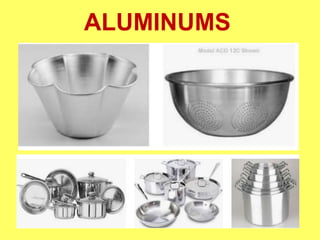
ALUMINUMS
ALUMINUMS
Aluminum is the best for all-around use. It is the
most popular, lightweight, attractive and less
expensive. It requires care to keep it shiny and
clean. Much more, it gives even heat distribution
no matter what heat temperature you have. It is
available in sheet or cast aluminum. Since it is a
soft metal, the lighter gauges will dent and scratch
easily, making the utensil unusable. Aluminum
turns dark when used with alkalis, such as
potatoes, beets, carrots and other vegetables. Acid
vegetables like tomatoes will brighten it.
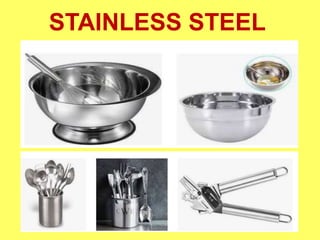
STAINLESS STEEL
STAINLESS STEEL
Stainless Steel is the most popular material
used for tools and equipments, but is more
expensive. It is easier to clean and shine and
will not wear out as soon as aluminum.
Choose those with copper, aluminum or
laminated steel bottoms to spread heat and
keep the pot from getting heat dark spots.
Stainless steel utensils maybe bought in
many gauges, from light to heavy.
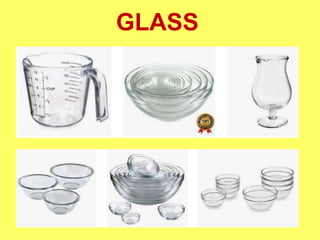
GLASS
GLASS
Glass is good for baking but
not practical on top or
surface cooking. Great care
is needed to make sure for
long shelf life.
CAST IRON
CAST IRON
Cast Iron is sturdy but must be
kept seasoned to avoid rust.
Salad oil with no salt or
shortening can be rub inside
and out and dry. Wash with
soap (not detergent) before
using.
CERAMIC & HEAT PROOF GLASS
Ceramic and heat-proof glass is
used especially for baking dishes,
casseroles, and measuring cups.
Glass and ceramic conduct the
heat slowly and evenly. Many of
these baking dishes are decorated
and can go from stove or oven to
the dining table.
TEFLON
TEFLON
Teflon is a special coating applied to the
inside of some aluminum or steel pots
and pans. It helps food from not sticking
to the pan. It is easier to wash and clean,
however, take care not to scratch the
Teflon coating with sharp instrument such
as knife or fork. Use wooden or plastic
spatula to turn or mix food inside.
PLASTIC & HARD RUBBER
Plastic and Hard Rubber are used for
cutting and chopping boards,
tabletops, bowls, trays, garbage pails
and canisters. They are much less
dulling to knives than metal and
more sanitary than wood. Plastics
are greatly durable and cheap but
may not last long.

Materials in Kitchen Utensils.pptx

  • 1.
  • 2.
    Any cook shouldbe familiar with the correct utensils, devices and equipment inthe kitchen. It is important to consider several things and not only the price when buying them. The job of cooking requires specific tools, utensils, and equipment for proper and efficient preparation of food. Each piece has been designed to accomplish a specific job in the kitchen. The tools, utensils and equipment are made of different materials, each having certain advantages and disadvantages. The following lists are materials of kitchen utensils and equipment commonly found in the kitchen.
  • 3.
  • 4.
    ALUMINUMS Aluminum is thebest for all-around use. It is the most popular, lightweight, attractive and less expensive. It requires care to keep it shiny and clean. Much more, it gives even heat distribution no matter what heat temperature you have. It is available in sheet or cast aluminum. Since it is a soft metal, the lighter gauges will dent and scratch easily, making the utensil unusable. Aluminum turns dark when used with alkalis, such as potatoes, beets, carrots and other vegetables. Acid vegetables like tomatoes will brighten it.
  • 5.
  • 6.
    STAINLESS STEEL Stainless Steelis the most popular material used for tools and equipments, but is more expensive. It is easier to clean and shine and will not wear out as soon as aluminum. Choose those with copper, aluminum or laminated steel bottoms to spread heat and keep the pot from getting heat dark spots. Stainless steel utensils maybe bought in many gauges, from light to heavy.
  • 7.
  • 8.
    GLASS Glass is goodfor baking but not practical on top or surface cooking. Great care is needed to make sure for long shelf life.
  • 9.
  • 10.
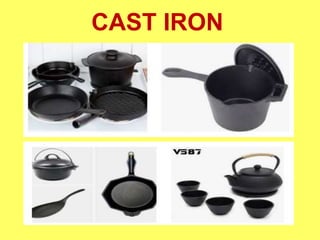
    CAST IRON Cast Ironis sturdy but must be kept seasoned to avoid rust. Salad oil with no salt or shortening can be rub inside and out and dry. Wash with soap (not detergent) before using.
  • 11.
    CERAMIC & HEATPROOF GLASS
  • 12.
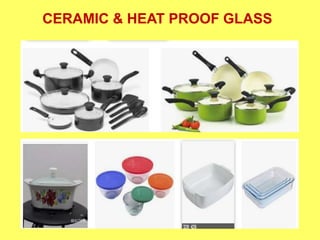
    CERAMIC & HEATPROOF GLASS Ceramic and heat-proof glass is used especially for baking dishes, casseroles, and measuring cups. Glass and ceramic conduct the heat slowly and evenly. Many of these baking dishes are decorated and can go from stove or oven to the dining table.
  • 13.
  • 14.
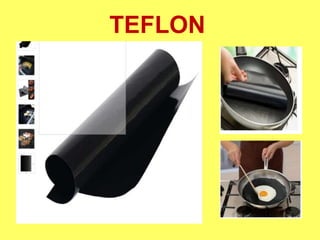
    TEFLON Teflon is aspecial coating applied to the inside of some aluminum or steel pots and pans. It helps food from not sticking to the pan. It is easier to wash and clean, however, take care not to scratch the Teflon coating with sharp instrument such as knife or fork. Use wooden or plastic spatula to turn or mix food inside.
  • 15.
  • 16.
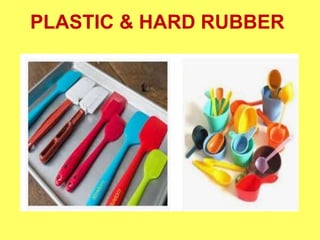
    PLASTIC & HARDRUBBER Plastic and Hard Rubber are used for cutting and chopping boards, tabletops, bowls, trays, garbage pails and canisters. They are much less dulling to knives than metal and more sanitary than wood. Plastics are greatly durable and cheap but may not last long.

Editor's Notes

  • #15 Teflon is a special coating applied to the inside of some aluminum or steel pots and pans. It helps food from not sticking to the pan. It is easier to wash and clean, however, take care not to scratch the Teflon coating with sharp instrument such as knife or fork. Use wooden or plastic spatula to turn or mix food inside.