Kitchen Set Up:
Basic Tools
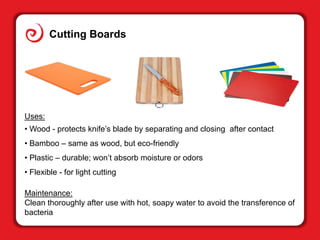
Cutting Boards
Uses:
• Wood - protects knife’s blade by separating and closing after contact
• Bamboo – same as wood, but eco-friendly
• Plastic – durable; won’t absorb moisture or odors
• Flexible - for light cutting
Maintenance:
Clean thoroughly after use with hot, soapy water to avoid the transference of
bacteria
Utensils
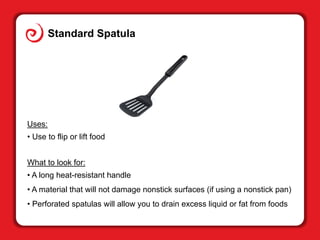
Standard Spatula
Uses:
• Use to flip or lift food
What to look for:
• A long heat-resistant handle
• A material that will not damage nonstick surfaces (if using a nonstick pan)
• Perforated spatulas will allow you to drain excess liquid or fat from foods
Flexible Spatula
Uses:
• Scrape batters out of bowls or nut butters out of jars
• Also for blending, folding and spreading
Wooden Spoon
Uses:
• Will not conduct heat
What to look for:
• A spoon made of one solid piece of wood
Maintenance:
• Wash your wooden spoons by hand. Never leave them to soak, as this
encourages bacteria growth and can damage the spoon.
Tongs
Uses:
• Use to pick up food, especially hot food
What to look for:
• Spring action tongs stay open unless you apply pressure to close them
• Some lock closed for storage
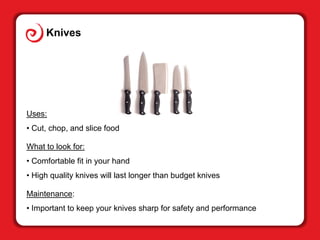
Knives
Uses:
• Cut, chop, and slice food
What to look for:
• Comfortable fit in your hand
• High quality knives will last longer than budget knives
Maintenance:
• Important to keep your knives sharp for safety and performance
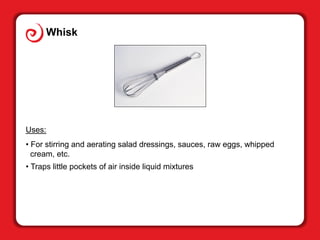
Whisk
Uses:
• For stirring and aerating salad dressings, sauces, raw eggs, whipped
cream, etc.
• Traps little pockets of air inside liquid mixtures
Cookware
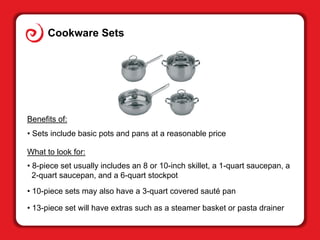
Cookware Sets
Benefits of:
• Sets include basic pots and pans at a reasonable price
What to look for:
• 8-piece set usually includes an 8 or 10-inch skillet, a 1-quart saucepan, a
2-quart saucepan, and a 6-quart stockpot
• 10-piece sets may also have a 3-quart covered sauté pan
• 13-piece set will have extras such as a steamer basket or pasta drainer
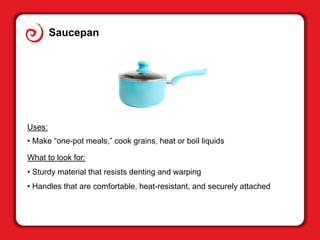
Saucepan
Uses:
• Make “one-pot meals,” cook grains, heat or boil liquids
What to look for:
• Sturdy material that resists denting and warping
• Handles that are comfortable, heat-resistant, and securely attached
6-8 Quart Stockpot
Uses:
• Make soups and stocks
What to look for:
• Enamel-coated or stainless steel with an aluminum core
• Tall and narrow shape
Material Matters
Glass and cookware with a porcelain-enamel coating: least reactive to foods
and easiest to clean
Cast iron: good for quick breads, pancakes, and crêpes; not recommended for
soups, stews, or acidic foods that require prolonged cooking
Stainless steel: poor heat conductor unless layered with a highly conductible
metal like aluminum
Anodized aluminum: toxic to the environment; not recommended
Copper: excellent conductibility though typically expensive and may require
polishing
for safety, even-cooking, and efficiency
The Truth about Teflon
Teflon can be toxic to humans, animals and the environment.
If you choose to use Teflon pans, follow these rules for your safety:
1. Do not use at high temperatures - only medium to medium-low.
2. Do not heat dry – this may cause toxic particles to become airborne and embed
into your lungs. Always have oil or liquid in a Teflon-coated pan before heating.
3. Do not scratch- if you scratch a Teflon-coated pan, discard it to avoid releasing
chemicals into your food. Always use wood, silicon or other non-scratch utensils
with nonstick pots and pans.
4. Follow the manufacturer’s directions for cleaning so as not to damage the
surface.
Steamer Basket
Uses:
• Cook vegetables quickly; their water-soluble vitamins will stay intact
What to look for:
• Legs ½ inch or higher
• A collapsible basket will fit almost any size pot and folds for storage
• Enamel steamers are easiest to clean. Acidic foods may leave a film
on stainless steel
Maintenance:
• Wash by hand with a soft brush or use the dishwasher
Bamboo Steamers
Uses:
• Cook multiple dishes at once by stacking layers of bamboo racks
• Only one burner and one pan required
For consideration:
• The lowest tier of the stacked steamers will cook food faster than the
upper so foods that require more cooking time should be placed on
the bottom
• Place food directly on slots, or over a lettuce leaf or parchment paper
Baking Sheet
Uses:
• For baking sweets and roasting vegetables, tofu, tempeh, etc.
Considerations:
• A non-stick surface will allow you to bake without using butter to grease
the pan
• Can also purchase a non-stick baking mat to place over baking sheet
Storage Containers
Glass Jars
Uses:
• Ideal for storing grains, nuts, and dried legumes
• Unlike plastic, glass will not react with food
Glass Storage Containers
Benefits of:
• Won’t stain, warp or absorb odors
• Can be used in the oven, refrigerator, or freezer
• Brands made from tempered (heat-treated) glass are tougher than
normal glass and will usually shatter into small fragments, rather than
sharp shards if broken
Stainless Steel or Ceramic Canisters
Uses:
• For storing dry goods like grains, flours, pastas and cereals
• Can be kept on your countertop for easy-access
Handy Tools
Colander
Uses:
• Drain pasta or rinse fresh fruits and vegetables
• Can also be used as a fruit and vegetable bowl; the holes allow air to
circulate
Oven Mitts
Uses:
• Protect your hands from getting burned when reaching into the oven
and when handling hot pots and pans
What to look for:
• Heavy-duty, oversized mitts
• Heat and flame-resistant
• Silicone oven mitts are waterproof, slip-resistant and stain-proof. They
can protect from heat up to 500 degrees, and can be cleaned in the
dishwasher.
Mesh Strainer
Uses:
• Rinse grains, berries, vegetables, and legumes
• Use a fine mesh strainer to sift flours and strain liquids
• Use a double-mesh strainer for smaller grains such as quinoa and millet
Maintenance:
• Soak in hot water, then flush particles from the outside with a strong
stream of water or scrub with a vegetable brush or use a dishwasher
Vegetable Peeler
Uses:
• Peel the skin off vegetables
• Remove sprayed-on chemicals
Vegetable Scrub Brush
Uses:
• Clean root vegetables like potatoes, yams, carrots, daikon and burdock
Grater
Uses:
• Grate potatoes, carrots, daikon, cheese, etc.
What to look for:
• Sharply-perforated surface
• Sturdy, comfortable to use, and made of non-corrosive metal
Can Opener
Uses:
• Open cans safely and easily
• Available in manual or electric
What to look for in a manual model:
• Non-slip handles, durable stainless steel or die cast aluminum blades
• Large, soft turning knob
• Magnet to prevent can from falling into food
Mixing Bowls
Uses:
• Mix salads, batters, etc.
• Can also be used as serving dishes, or to hold fruit
What to look for:
• Sets that stack neatly inside one another for space-saving storage
• Glass bowls are least reactive to foods
Measuring Cups
Uses:
• Measure grains, flours, liquids, etc. when following recipes
Recommended:
• Purchase a set of measuring cups that comes with a few different sizes
Measuring Spoons
Uses:
• Measure salt, spices, baking ingredients, liquids, etc.
Kitchen Shears
Uses:
• Cut meat, vegetables, spices like cilantro and parsley, and other
ingredients
Timer
Uses:
• Time foods that require specific cooking or baking times
Kitchen Towels
Use:
• Dry dishes and wipe up countertops
• More ecological to dry hands using cloth towels rather than paper towels
What to look for:
• 100% cotton to ensure maximum absorption

Basic Kitchen Tools

  • 1.
  • 2.
    Cutting Boards Uses: • Wood- protects knife’s blade by separating and closing after contact • Bamboo – same as wood, but eco-friendly • Plastic – durable; won’t absorb moisture or odors • Flexible - for light cutting Maintenance: Clean thoroughly after use with hot, soapy water to avoid the transference of bacteria
  • 3.
  • 4.
    Standard Spatula Uses: • Useto flip or lift food What to look for: • A long heat-resistant handle • A material that will not damage nonstick surfaces (if using a nonstick pan) • Perforated spatulas will allow you to drain excess liquid or fat from foods
  • 5.
    Flexible Spatula Uses: • Scrapebatters out of bowls or nut butters out of jars • Also for blending, folding and spreading
  • 6.
    Wooden Spoon Uses: • Willnot conduct heat What to look for: • A spoon made of one solid piece of wood Maintenance: • Wash your wooden spoons by hand. Never leave them to soak, as this encourages bacteria growth and can damage the spoon.
  • 7.
    Tongs Uses: • Use topick up food, especially hot food What to look for: • Spring action tongs stay open unless you apply pressure to close them • Some lock closed for storage
  • 8.
    Knives Uses: • Cut, chop,and slice food What to look for: • Comfortable fit in your hand • High quality knives will last longer than budget knives Maintenance: • Important to keep your knives sharp for safety and performance
  • 9.
    Whisk Uses: • For stirringand aerating salad dressings, sauces, raw eggs, whipped cream, etc. • Traps little pockets of air inside liquid mixtures
  • 10.
  • 11.
    Cookware Sets Benefits of: •Sets include basic pots and pans at a reasonable price What to look for: • 8-piece set usually includes an 8 or 10-inch skillet, a 1-quart saucepan, a 2-quart saucepan, and a 6-quart stockpot • 10-piece sets may also have a 3-quart covered sauté pan • 13-piece set will have extras such as a steamer basket or pasta drainer
  • 12.
    Saucepan Uses: • Make “one-potmeals,” cook grains, heat or boil liquids What to look for: • Sturdy material that resists denting and warping • Handles that are comfortable, heat-resistant, and securely attached
  • 13.
    6-8 Quart Stockpot Uses: •Make soups and stocks What to look for: • Enamel-coated or stainless steel with an aluminum core • Tall and narrow shape
  • 14.
    Material Matters Glass andcookware with a porcelain-enamel coating: least reactive to foods and easiest to clean Cast iron: good for quick breads, pancakes, and crêpes; not recommended for soups, stews, or acidic foods that require prolonged cooking Stainless steel: poor heat conductor unless layered with a highly conductible metal like aluminum Anodized aluminum: toxic to the environment; not recommended Copper: excellent conductibility though typically expensive and may require polishing for safety, even-cooking, and efficiency
  • 15.
    The Truth aboutTeflon Teflon can be toxic to humans, animals and the environment. If you choose to use Teflon pans, follow these rules for your safety: 1. Do not use at high temperatures - only medium to medium-low. 2. Do not heat dry – this may cause toxic particles to become airborne and embed into your lungs. Always have oil or liquid in a Teflon-coated pan before heating. 3. Do not scratch- if you scratch a Teflon-coated pan, discard it to avoid releasing chemicals into your food. Always use wood, silicon or other non-scratch utensils with nonstick pots and pans. 4. Follow the manufacturer’s directions for cleaning so as not to damage the surface.
  • 16.
    Steamer Basket Uses: • Cookvegetables quickly; their water-soluble vitamins will stay intact What to look for: • Legs ½ inch or higher • A collapsible basket will fit almost any size pot and folds for storage • Enamel steamers are easiest to clean. Acidic foods may leave a film on stainless steel Maintenance: • Wash by hand with a soft brush or use the dishwasher
  • 17.
    Bamboo Steamers Uses: • Cookmultiple dishes at once by stacking layers of bamboo racks • Only one burner and one pan required For consideration: • The lowest tier of the stacked steamers will cook food faster than the upper so foods that require more cooking time should be placed on the bottom • Place food directly on slots, or over a lettuce leaf or parchment paper
  • 18.
    Baking Sheet Uses: • Forbaking sweets and roasting vegetables, tofu, tempeh, etc. Considerations: • A non-stick surface will allow you to bake without using butter to grease the pan • Can also purchase a non-stick baking mat to place over baking sheet
  • 19.
  • 20.
    Glass Jars Uses: • Idealfor storing grains, nuts, and dried legumes • Unlike plastic, glass will not react with food
  • 21.
    Glass Storage Containers Benefitsof: • Won’t stain, warp or absorb odors • Can be used in the oven, refrigerator, or freezer • Brands made from tempered (heat-treated) glass are tougher than normal glass and will usually shatter into small fragments, rather than sharp shards if broken
  • 22.
    Stainless Steel orCeramic Canisters Uses: • For storing dry goods like grains, flours, pastas and cereals • Can be kept on your countertop for easy-access
  • 23.
  • 24.
    Colander Uses: • Drain pastaor rinse fresh fruits and vegetables • Can also be used as a fruit and vegetable bowl; the holes allow air to circulate
  • 25.
    Oven Mitts Uses: • Protectyour hands from getting burned when reaching into the oven and when handling hot pots and pans What to look for: • Heavy-duty, oversized mitts • Heat and flame-resistant • Silicone oven mitts are waterproof, slip-resistant and stain-proof. They can protect from heat up to 500 degrees, and can be cleaned in the dishwasher.
  • 26.
    Mesh Strainer Uses: • Rinsegrains, berries, vegetables, and legumes • Use a fine mesh strainer to sift flours and strain liquids • Use a double-mesh strainer for smaller grains such as quinoa and millet Maintenance: • Soak in hot water, then flush particles from the outside with a strong stream of water or scrub with a vegetable brush or use a dishwasher
  • 27.
    Vegetable Peeler Uses: • Peelthe skin off vegetables • Remove sprayed-on chemicals
  • 28.
    Vegetable Scrub Brush Uses: •Clean root vegetables like potatoes, yams, carrots, daikon and burdock
  • 29.
    Grater Uses: • Grate potatoes,carrots, daikon, cheese, etc. What to look for: • Sharply-perforated surface • Sturdy, comfortable to use, and made of non-corrosive metal
  • 30.
    Can Opener Uses: • Opencans safely and easily • Available in manual or electric What to look for in a manual model: • Non-slip handles, durable stainless steel or die cast aluminum blades • Large, soft turning knob • Magnet to prevent can from falling into food
  • 31.
    Mixing Bowls Uses: • Mixsalads, batters, etc. • Can also be used as serving dishes, or to hold fruit What to look for: • Sets that stack neatly inside one another for space-saving storage • Glass bowls are least reactive to foods
  • 32.
    Measuring Cups Uses: • Measuregrains, flours, liquids, etc. when following recipes Recommended: • Purchase a set of measuring cups that comes with a few different sizes
  • 33.
    Measuring Spoons Uses: • Measuresalt, spices, baking ingredients, liquids, etc.
  • 34.
    Kitchen Shears Uses: • Cutmeat, vegetables, spices like cilantro and parsley, and other ingredients
  • 35.
    Timer Uses: • Time foodsthat require specific cooking or baking times
  • 36.
    Kitchen Towels Use: • Drydishes and wipe up countertops • More ecological to dry hands using cloth towels rather than paper towels What to look for: • 100% cotton to ensure maximum absorption