Facilitated By:
Amy Jackson Sellers
Assistant Director of CCESL
Catherine Sherwood and Alexa Tierney
Civic Co-Leaders of Literacy
Information drawn from:
Intervening for Literacy: The Joy
of Reading to Young Children.
By: Charles Temple
& James MaKinster
America Reads Tutor Resource
Manual
By: Hannah Hood WS ‘12 MAT ‘13
Session ONE
Training Topics
 Who’s Here?
 Rules & Paperwork
 Who Are You Working With?
 Why Are You Here?
 History
 Mission
 Expectations of America Reads
 Risk Factors/Literacy Challenges
 What You Can Do to Help
Work Eligibility & Timesheets
 All tutors must complete NY wage notice to work
 Lyons site paid differently
 First time student worker?
 I-9 (US eligibility—state ID AND EITHER social security card
or birth certificate OR a valid passport), W-4 must be
completed to work
 HW in Gulick Hall / HR Hours: 8:30-5 M-F
 Timesheets online / Two-week pay periods / Confused about
your status? Ask!
 Remember to round hours to .25, .50, .75, .00
Online Timesheets
 Your coordinator will walk through this with you
 How to fill out online timesheets
 Trouble submitting hours for AR? Contact HR
 Please submit hours correctly and promptly
 Coordinators will confirm your attendance…
 They cannot verify or approve your hours
 …it’s up to you!
Why Are We Here? – Tradition and the Future
Literacy Programs at HWS
•Volunteer Student Literacy Corps began in 1988 – 30 years ago
•Evolved into America Reads in 1996 with federal funding
•HWS devotes >31% of its FWS $ to service-work
•4x the law, which mandates minimum 7%
•One semester, ~3-4 hours/week, one-on-one tutoring
•FWS students paid $11.10/hour / Volunteers rock!!!
•Work with 2nd - 8th graders at 3 sites in 2 districts
•Students are usually below grade level in reading ability
AR Mission & Goals
Help motivate children to read
Improve children’s literacy abilities
Provide greater access to books and
opportunities to read with an adult
Support literacy development at home
Tutors
Community Partner / School
Children
Tutor Expectations
 Positive attitude about reading/working with your
student
 Adapt to your student’s needs and interests – show
initiative and creativity
 Remember your paperwork & HWS Engage curriculum
 Use resources to help you succeed (HWS Engage, your
peers, your coordinator, Amy, Katie)
 Communicate with your coordinator
 Respect:
 Your coordinator, your fellow tutors, the school
and students
Punctuality /Reliability / Attendance
Appropriate Tutoring Relationships
 Limit physical contact
 No pictures – privacy is important
 Refrain from exchanging phone #s/emails
 When your tutee needs a bathroom break,
stay outside
 Avoid in depth conversations about mature,
adult, topics (i.e. partying, romance, politics)
 DO talk about hobbies, family and friends, etc.
Rules and Policies
 Attendance: No absences
 Except for an emergency
 Give coordinator and Amy 24 hrs advance notice
 Dress appropriately / follow dress code
 Cell phone usage ≠ Active Reading
 Acceptable Post-reading activities:
 Crosswords, word searches
 Scrabble or literacy-related games
 Not: Hangman, coloring, etc.
HWS Tutor Learning Outcomes
 Tutors become more connected to local community
where they tutor
 Tutors can connect to what they are learning about in
their classes
 Tutors are more aware of challenges and opportunities
facing local youth
 Tutors’ experience in AR gives them a clearer sense of
possible career options
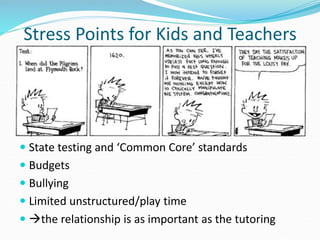
Stress Points for Kids and Teachers
 State testing and ‘Common Core’ standards
 Budgets
 Bullying
 Limited unstructured/play time
 the relationship is as important as the tutoring
Alex
Evan
Emily
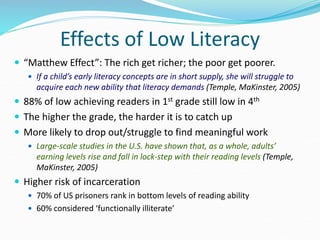
Effects of Low Literacy
 “Matthew Effect”: The rich get richer; the poor get poorer.
 If a child’s early literacy concepts are in short supply, she will struggle to
acquire each new ability that literacy demands (Temple, MaKinster, 2005)
 88% of low achieving readers in 1st grade still low in 4th
 The higher the grade, the harder it is to catch up
 More likely to drop out/struggle to find meaningful work
 Large-scale studies in the U.S. have shown that, as a whole, adults’
earning levels rise and fall in lock-step with their reading levels (Temple,
MaKinster, 2005)
 Higher risk of incarceration
 70% of US prisoners rank in bottom levels of reading ability
 60% considered ‘functionally illiterate’
Which risk factors can
cause low literacy?
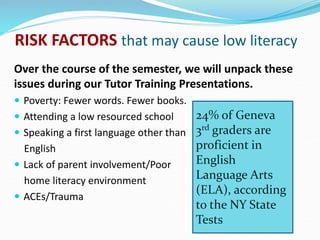
RISK FACTORS that may cause low literacy
Over the course of the semester, we will unpack these
issues during our Tutor Training Presentations.
 Poverty: Fewer words. Fewer books.
 Attending a low resourced school
 Speaking a first language other than
English
 Lack of parent involvement/Poor
home literacy environment
 ACEs/Trauma
24% of Geneva
3rd graders are
proficient in
English
Language Arts
(ELA), according
to the NY State
Tests.
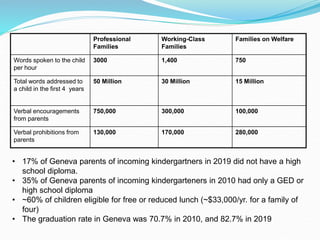
Professional
Families
Working-Class
Families
Families on Welfare
Words spoken to the child
per hour
3000 1,400 750
Total words addressed to
a child in the first 4 years
50 Million 30 Million 15 Million
Verbal encouragements
from parents
750,000 300,000 100,000
Verbal prohibitions from
parents
130,000 170,000 280,000
• 17% of Geneva parents of incoming kindergartners in 2019 did not have a high
school diploma.
• 35% of Geneva parents of incoming kindergarteners in 2010 had only a GED or
high school diploma
• ~60% of children eligible for free or reduced lunch (~$33,000/yr. for a family of
four)
• The graduation rate in Geneva was 70.7% in 2010, and 82.7% in 2019
HWS Path Tutor Training
 Over the semester, there will be an online training
component to enhance your understanding of Tutor
Presentations.
 These include pre-lessons and post-lessons
 Your coordinator will walk you through this process in
your individual meetings.
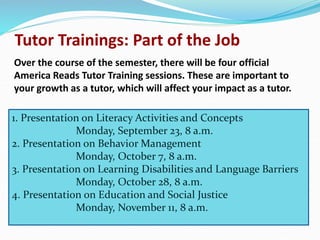
Tutor Trainings: Part of the Job
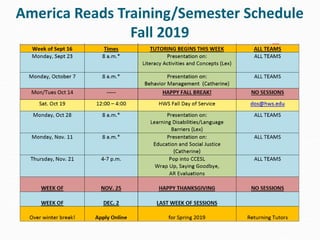
Over the course of the semester, there will be four official
America Reads Tutor Training sessions. These are important to
your growth as a tutor, which will affect your impact as a tutor.
1. Presentation on Literacy Activities and Concepts
Monday, September 23, 8 a.m.
2. Presentation on Behavior Management
Monday, October 7, 8 a.m.
3. Presentation on Learning Disabilities and Language Barriers
Monday, October 28, 8 a.m.
4. Presentation on Education and Social Justice
Monday, November 11, 8 a.m.
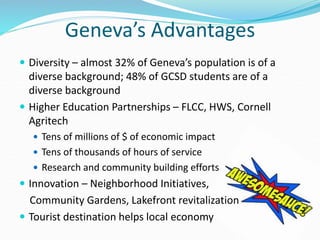
Geneva’s Advantages
 Diversity – almost 32% of Geneva’s population is of a
diverse background; 48% of GCSD students are of a
diverse background
 Higher Education Partnerships – FLCC, HWS, Cornell
Agritech
 Tens of millions of $ of economic impact
 Tens of thousands of hours of service
 Research and community building efforts
 Innovation – Neighborhood Initiatives,
Community Gardens, Lakefront revitalization
 Tourist destination helps local economy
You Can Make A Difference
• Parents from all income brackets and education levels are
getting the message that reading to their children is beneficial
• Scores improving across all education/income backgrounds
 between 1 and 4 reading levels per child per semester
• College tutors have amazing power: if your message is
“Reading is cool and fun,” they believe you.
• Encourage them to achieve at reading
• Have literacy materials available
 Activities specific to the child’s interests, encourage them to bring in
books, check Geneva Public Library, look up ideas on Engage, etc.)
• Read with and to your student.
Session Two Information
Facilitated By:
Amy Jackson Sellers
Assistant Director of CCESL
Catherine Sherwood and Alexa Tierney
Civic Co-Leaders of Literacy
Information drawn from:
Intervening for Literacy: The Joy
of Reading to Young Children.
By: Charles Temple
& James MaKinster
America Reads Tutor Resource
Manual
By: Hannah Hood WS ‘12 MAT ‘13
Session TWO
Favorite book?
Favorite food?
Favorite show?
Training Topics
 AR Lesson Plans
 Reading Essentials, Levels, & Strategies
 Working with (Site) Words
 Behavior Management 101
 Online Resources
 Further Trainings
 Semester Schedule
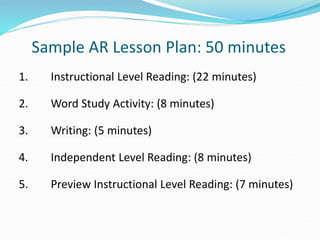
Sample AR Lesson Plan: 50 minutes
1. Instructional Level Reading: (22 minutes)
2. Word Study Activity: (8 minutes)
3. Writing: (5 minutes)
4. Independent Level Reading: (8 minutes)
5. Preview Instructional Level Reading: (7 minutes)
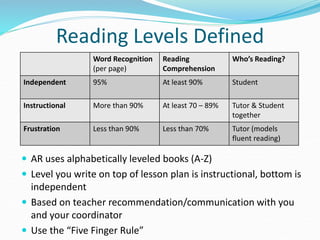
Reading Levels Defined
 AR uses alphabetically leveled books (A-Z)
 Level you write on top of lesson plan is instructional, bottom is
independent
 Based on teacher recommendation/communication with you
and your coordinator
 Use the “Five Finger Rule”
Word Recognition
(per page)
Reading
Comprehension
Who’s Reading?
Independent 95% At least 90% Student
Instructional More than 90% At least 70 – 89% Tutor & Student
together
Frustration Less than 90% Less than 70% Tutor (models
fluent reading)
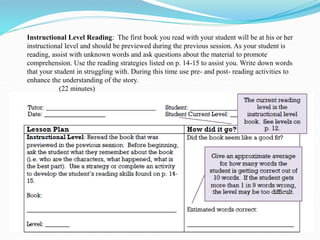
Instructional Level Reading: The first book you read with your student will be at his or her
instructional level and should be previewed during the previous session. As your student is
reading, assist with unknown words and ask questions about the material to promote
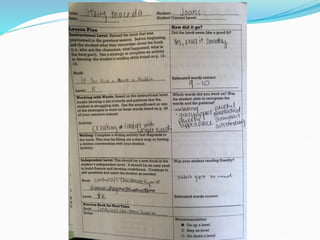
comprehension. Use the reading strategies listed on p. 14-15 to assist you. Write down words
that your student in struggling with. During this time use pre- and post- reading activities to
enhance the understanding of the story.
(22 minutes)
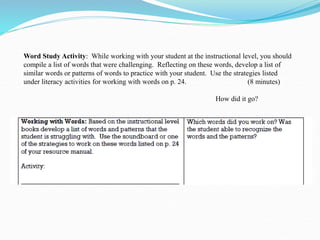
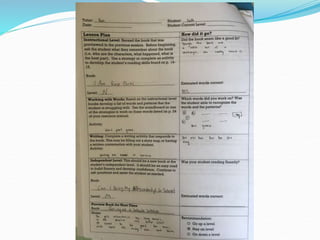
Word Study Activity: While working with your student at the instructional level, you should
compile a list of words that were challenging. Reflecting on these words, develop a list of
similar words or patterns of words to practice with your student. Use the strategies listed
under literacy activities for working with words on p. 24. (8 minutes)
How did it go?
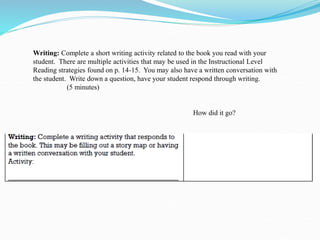
Writing: Complete a short writing activity related to the book you read with your
student. There are multiple activities that may be used in the Instructional Level
Reading strategies found on p. 14-15. You may also have a written conversation with
the student. Write down a question, have your student respond through writing.
(5 minutes)
How did it go?
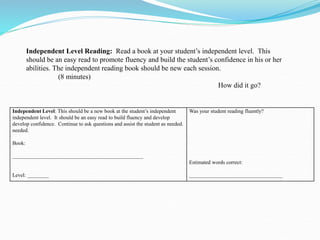
Independent Level Reading: Read a book at your student’s independent level. This
should be an easy read to promote fluency and build the student’s confidence in his or her
abilities. The independent reading book should be new each session.
(8 minutes)
How did it go?
Independent Level: This should be a new book at the student’s independent
independent level. It should be an easy read to build fluency and develop
develop confidence. Continue to ask questions and assist the student as needed.
needed.
Book:
_________________________________________________
Level: ________
Was your student reading fluently?
Estimated words correct:
___________________________________
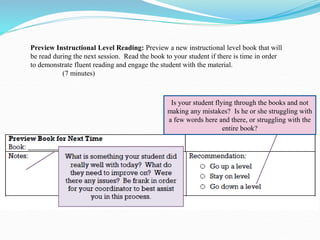
Preview Instructional Level Reading: Preview a new instructional level book that will
be read during the next session. Read the book to your student if there is time in order
to demonstrate fluent reading and engage the student with the material.
(7 minutes)
Is your student flying through the books and not
making any mistakes? Is he or she struggling with
a few words here and there, or struggling with the
entire book?
You needed this K-12 and you
will need it NOW!
Always remember to bring a
pencil with you when you tutor!
The Five
Essentials in
Reading are
on pages 8-9
in AR Tutoring
Binder
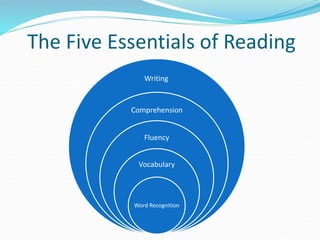
The Five Essentials of Reading
Comprehension
Fluency
Vocabulary
Word Recognition
Writing
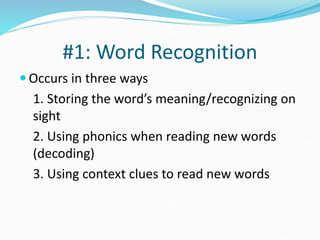
#1: Word Recognition
 Occurs in three ways
1. Storing the word’s meaning/recognizing on
sight
2. Using phonics when reading new words
(decoding)
3. Using context clues to read new words
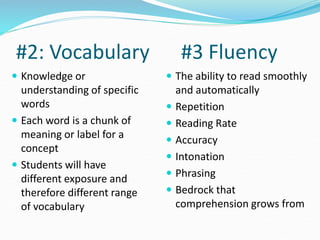
#2: Vocabulary #3 Fluency
 Knowledge or
understanding of specific
words
 Each word is a chunk of
meaning or label for a
concept
 Students will have
different exposure and
therefore different range
of vocabulary
 The ability to read smoothly
and automatically
 Repetition
 Reading Rate
 Accuracy
 Intonation
 Phrasing
 Bedrock that
comprehension grows from
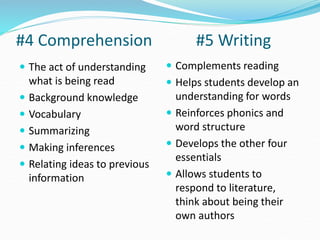
#4 Comprehension #5 Writing
 The act of understanding
what is being read
 Background knowledge
 Vocabulary
 Summarizing
 Making inferences
 Relating ideas to previous
information
 Complements reading
 Helps students develop an
understanding for words
 Reinforces phonics and
word structure
 Develops the other four
essentials
 Allows students to
respond to literature,
think about being their
own authors
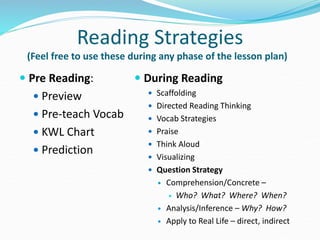
Reading Strategies
(Feel free to use these during any phase of the lesson plan)
 Pre Reading:
 Preview
 Pre-teach Vocab
 KWL Chart
 Prediction
 During Reading
 Scaffolding
 Directed Reading Thinking
 Vocab Strategies
 Praise
 Think Aloud
 Visualizing
 Question Strategy
 Comprehension/Concrete –
 Who? What? Where? When?
 Analysis/Inference – Why? How?
 Apply to Real Life – direct, indirect
Reading Strategies – Post-Reading
 Retelling/Summarizing
 Discussion (specifics, surprises?)
 Story Map
 Semantic Map
 Character Development
 Letter to the Author
 Comic Strip
 Epilogue/New Ending?
Dolch Site Words & Sound Boards
 Dolch Sight Words are the foundation of teaching,
reading, and writing English -- over half the words you
read in a typical English document appear on this list.
 The list contains 220 commonly used words that should
be recognized by "sight" for fast or "fluent" reading.
 Many of the 220 Dolch words do not follow the basic
phonics principles, so they cannot be "sounded out."
 Use your Sound Boards - build the words with the tiles
When Your Student Doesn’t Know A Word…
 Break word into parts
 Sound out each part or phoneme.
 Read to the end of the sentence, go back, ask
 Use words that the student does know
 Sound out parts of the word
 Use a Sound Board / Dolch Site Word list
 Last Resort: tell the student the word
Keeping Your Student Engaged
 What are your student’s interests?
 Read with an animated voice
 Make connections to real life

 Bring relevant activities
 High Expectations
 Reward Good Work / Praise
 Provide Choice / Be Flexible
Behavior Management
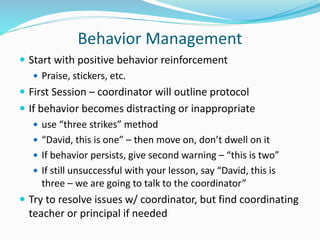
 Start with positive behavior reinforcement
 Praise, stickers, etc.
 First Session – coordinator will outline protocol
 If behavior becomes distracting or inappropriate

 use “three strikes” method
 “David, this is one” – then move on, don’t dwell on it
 If behavior persists, give second warning – “this is two”
 If still unsuccessful with your lesson, say “David, this is
three – we are going to talk to the coordinator”
 Try to resolve issues w/ coordinator, but find coordinating
teacher or principal if needed
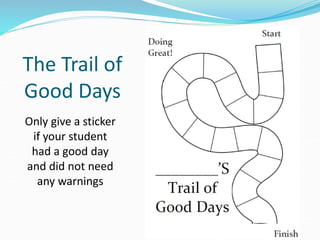
The Trail of
Good Days
Only give a sticker
if your student
had a good day
and did not need
any warnings
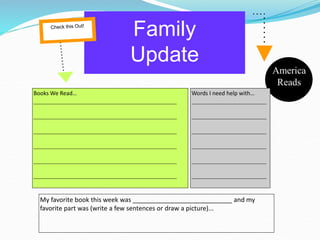
My favorite book this week was ____________________________ and my
favorite part was (write a few sentences or draw a picture)...
Family
Update
America
Reads
Books We Read…
______________________________________________
______________________________________________
______________________________________________
______________________________________________
______________________________________________
______________________________________________
Words I need help with…
________________________
________________________
________________________
________________________
________________________
________________________
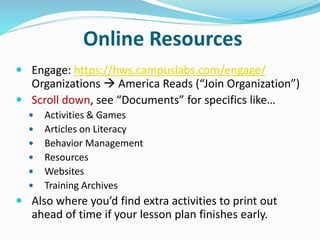
Online Resources
 Engage: https://hws.campuslabs.com/engage/
Organizations  America Reads (“Join Organization”)
 Scroll down, see “Documents” for specifics like…
 Activities & Games
 Articles on Literacy
 Behavior Management
 Resources
 Websites
 Training Archives
 Also where you’d find extra activities to print out
ahead of time if your lesson plan finishes early.
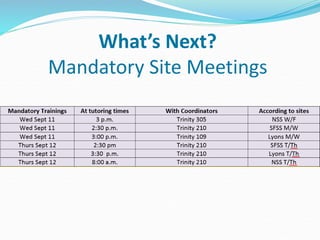
What’s Next?
Mandatory Site Meetings
America Reads Training/Semester Schedule
Fall 2019
Good Luck Next Week!
 You have the opportunity to make a difference.
 Try to remember when you thought reading
was fun…or not fun (and make it better for
your child).
 Use the Tutor Manual and “Big Five”
 You are now a role model. Be present.
 Seek out your coordinators, Lex, Catherine, or
Amy as resources – we are here to help you.
One Last Thing!
Add phone numbers now:
Alexa Tierney : 781-686-8455
Catherine Sherwood: 585-857-1369
Amy Jackson Sellers: 315-521-0841
And make SURE you have your
coordinator’s number!
Thank you and have fun!

Literacy training fall 2019

  • 1.
    Facilitated By: Amy JacksonSellers Assistant Director of CCESL Catherine Sherwood and Alexa Tierney Civic Co-Leaders of Literacy Information drawn from: Intervening for Literacy: The Joy of Reading to Young Children. By: Charles Temple & James MaKinster America Reads Tutor Resource Manual By: Hannah Hood WS ‘12 MAT ‘13 Session ONE
  • 2.
    Training Topics  Who’sHere?  Rules & Paperwork  Who Are You Working With?  Why Are You Here?  History  Mission  Expectations of America Reads  Risk Factors/Literacy Challenges  What You Can Do to Help
  • 3.
    Work Eligibility &Timesheets  All tutors must complete NY wage notice to work  Lyons site paid differently  First time student worker?  I-9 (US eligibility—state ID AND EITHER social security card or birth certificate OR a valid passport), W-4 must be completed to work  HW in Gulick Hall / HR Hours: 8:30-5 M-F  Timesheets online / Two-week pay periods / Confused about your status? Ask!  Remember to round hours to .25, .50, .75, .00
  • 4.
    Online Timesheets  Yourcoordinator will walk through this with you  How to fill out online timesheets  Trouble submitting hours for AR? Contact HR  Please submit hours correctly and promptly  Coordinators will confirm your attendance…  They cannot verify or approve your hours  …it’s up to you!
  • 5.
    Why Are WeHere? – Tradition and the Future
  • 6.
    Literacy Programs atHWS •Volunteer Student Literacy Corps began in 1988 – 30 years ago •Evolved into America Reads in 1996 with federal funding •HWS devotes >31% of its FWS $ to service-work •4x the law, which mandates minimum 7% •One semester, ~3-4 hours/week, one-on-one tutoring •FWS students paid $11.10/hour / Volunteers rock!!! •Work with 2nd - 8th graders at 3 sites in 2 districts •Students are usually below grade level in reading ability
  • 7.
    AR Mission &Goals Help motivate children to read Improve children’s literacy abilities Provide greater access to books and opportunities to read with an adult Support literacy development at home
  • 8.
  • 9.
    Tutor Expectations  Positiveattitude about reading/working with your student  Adapt to your student’s needs and interests – show initiative and creativity  Remember your paperwork & HWS Engage curriculum  Use resources to help you succeed (HWS Engage, your peers, your coordinator, Amy, Katie)  Communicate with your coordinator  Respect:  Your coordinator, your fellow tutors, the school and students Punctuality /Reliability / Attendance
  • 10.
    Appropriate Tutoring Relationships Limit physical contact  No pictures – privacy is important  Refrain from exchanging phone #s/emails  When your tutee needs a bathroom break, stay outside  Avoid in depth conversations about mature, adult, topics (i.e. partying, romance, politics)  DO talk about hobbies, family and friends, etc.
  • 11.
    Rules and Policies Attendance: No absences  Except for an emergency  Give coordinator and Amy 24 hrs advance notice  Dress appropriately / follow dress code  Cell phone usage ≠ Active Reading  Acceptable Post-reading activities:  Crosswords, word searches  Scrabble or literacy-related games  Not: Hangman, coloring, etc.
  • 12.
    HWS Tutor LearningOutcomes  Tutors become more connected to local community where they tutor  Tutors can connect to what they are learning about in their classes  Tutors are more aware of challenges and opportunities facing local youth  Tutors’ experience in AR gives them a clearer sense of possible career options
  • 13.
    Stress Points forKids and Teachers  State testing and ‘Common Core’ standards  Budgets  Bullying  Limited unstructured/play time  the relationship is as important as the tutoring
  • 14.
  • 15.
    Effects of LowLiteracy  “Matthew Effect”: The rich get richer; the poor get poorer.  If a child’s early literacy concepts are in short supply, she will struggle to acquire each new ability that literacy demands (Temple, MaKinster, 2005)  88% of low achieving readers in 1st grade still low in 4th  The higher the grade, the harder it is to catch up  More likely to drop out/struggle to find meaningful work  Large-scale studies in the U.S. have shown that, as a whole, adults’ earning levels rise and fall in lock-step with their reading levels (Temple, MaKinster, 2005)  Higher risk of incarceration  70% of US prisoners rank in bottom levels of reading ability  60% considered ‘functionally illiterate’
  • 16.
    Which risk factorscan cause low literacy?
  • 17.
    RISK FACTORS thatmay cause low literacy Over the course of the semester, we will unpack these issues during our Tutor Training Presentations.  Poverty: Fewer words. Fewer books.  Attending a low resourced school  Speaking a first language other than English  Lack of parent involvement/Poor home literacy environment  ACEs/Trauma 24% of Geneva 3rd graders are proficient in English Language Arts (ELA), according to the NY State Tests.
  • 18.
    Professional Families Working-Class Families Families on Welfare Wordsspoken to the child per hour 3000 1,400 750 Total words addressed to a child in the first 4 years 50 Million 30 Million 15 Million Verbal encouragements from parents 750,000 300,000 100,000 Verbal prohibitions from parents 130,000 170,000 280,000 • 17% of Geneva parents of incoming kindergartners in 2019 did not have a high school diploma. • 35% of Geneva parents of incoming kindergarteners in 2010 had only a GED or high school diploma • ~60% of children eligible for free or reduced lunch (~$33,000/yr. for a family of four) • The graduation rate in Geneva was 70.7% in 2010, and 82.7% in 2019
  • 19.
    HWS Path TutorTraining  Over the semester, there will be an online training component to enhance your understanding of Tutor Presentations.  These include pre-lessons and post-lessons  Your coordinator will walk you through this process in your individual meetings.
  • 20.
    Tutor Trainings: Partof the Job Over the course of the semester, there will be four official America Reads Tutor Training sessions. These are important to your growth as a tutor, which will affect your impact as a tutor. 1. Presentation on Literacy Activities and Concepts Monday, September 23, 8 a.m. 2. Presentation on Behavior Management Monday, October 7, 8 a.m. 3. Presentation on Learning Disabilities and Language Barriers Monday, October 28, 8 a.m. 4. Presentation on Education and Social Justice Monday, November 11, 8 a.m.
  • 21.
    Geneva’s Advantages  Diversity– almost 32% of Geneva’s population is of a diverse background; 48% of GCSD students are of a diverse background  Higher Education Partnerships – FLCC, HWS, Cornell Agritech  Tens of millions of $ of economic impact  Tens of thousands of hours of service  Research and community building efforts  Innovation – Neighborhood Initiatives, Community Gardens, Lakefront revitalization  Tourist destination helps local economy
  • 22.
    You Can MakeA Difference • Parents from all income brackets and education levels are getting the message that reading to their children is beneficial • Scores improving across all education/income backgrounds  between 1 and 4 reading levels per child per semester • College tutors have amazing power: if your message is “Reading is cool and fun,” they believe you. • Encourage them to achieve at reading • Have literacy materials available  Activities specific to the child’s interests, encourage them to bring in books, check Geneva Public Library, look up ideas on Engage, etc.) • Read with and to your student.
  • 23.
  • 24.
    Facilitated By: Amy JacksonSellers Assistant Director of CCESL Catherine Sherwood and Alexa Tierney Civic Co-Leaders of Literacy Information drawn from: Intervening for Literacy: The Joy of Reading to Young Children. By: Charles Temple & James MaKinster America Reads Tutor Resource Manual By: Hannah Hood WS ‘12 MAT ‘13 Session TWO
  • 25.
  • 26.
    Training Topics  ARLesson Plans  Reading Essentials, Levels, & Strategies  Working with (Site) Words  Behavior Management 101  Online Resources  Further Trainings  Semester Schedule
  • 27.
    Sample AR LessonPlan: 50 minutes 1. Instructional Level Reading: (22 minutes) 2. Word Study Activity: (8 minutes) 3. Writing: (5 minutes) 4. Independent Level Reading: (8 minutes) 5. Preview Instructional Level Reading: (7 minutes)
  • 28.
    Reading Levels Defined AR uses alphabetically leveled books (A-Z)  Level you write on top of lesson plan is instructional, bottom is independent  Based on teacher recommendation/communication with you and your coordinator  Use the “Five Finger Rule” Word Recognition (per page) Reading Comprehension Who’s Reading? Independent 95% At least 90% Student Instructional More than 90% At least 70 – 89% Tutor & Student together Frustration Less than 90% Less than 70% Tutor (models fluent reading)
  • 29.
    Instructional Level Reading:The first book you read with your student will be at his or her instructional level and should be previewed during the previous session. As your student is reading, assist with unknown words and ask questions about the material to promote comprehension. Use the reading strategies listed on p. 14-15 to assist you. Write down words that your student in struggling with. During this time use pre- and post- reading activities to enhance the understanding of the story. (22 minutes)
  • 30.
    Word Study Activity:While working with your student at the instructional level, you should compile a list of words that were challenging. Reflecting on these words, develop a list of similar words or patterns of words to practice with your student. Use the strategies listed under literacy activities for working with words on p. 24. (8 minutes) How did it go?
  • 31.
    Writing: Complete ashort writing activity related to the book you read with your student. There are multiple activities that may be used in the Instructional Level Reading strategies found on p. 14-15. You may also have a written conversation with the student. Write down a question, have your student respond through writing. (5 minutes) How did it go?
  • 32.
    Independent Level Reading:Read a book at your student’s independent level. This should be an easy read to promote fluency and build the student’s confidence in his or her abilities. The independent reading book should be new each session. (8 minutes) How did it go? Independent Level: This should be a new book at the student’s independent independent level. It should be an easy read to build fluency and develop develop confidence. Continue to ask questions and assist the student as needed. needed. Book: _________________________________________________ Level: ________ Was your student reading fluently? Estimated words correct: ___________________________________
  • 33.
    Preview Instructional LevelReading: Preview a new instructional level book that will be read during the next session. Read the book to your student if there is time in order to demonstrate fluent reading and engage the student with the material. (7 minutes) Is your student flying through the books and not making any mistakes? Is he or she struggling with a few words here and there, or struggling with the entire book?
  • 36.
    You needed thisK-12 and you will need it NOW! Always remember to bring a pencil with you when you tutor!
  • 38.
    The Five Essentials in Readingare on pages 8-9 in AR Tutoring Binder
  • 39.
    The Five Essentialsof Reading Comprehension Fluency Vocabulary Word Recognition Writing
  • 40.
    #1: Word Recognition Occurs in three ways 1. Storing the word’s meaning/recognizing on sight 2. Using phonics when reading new words (decoding) 3. Using context clues to read new words
  • 41.
    #2: Vocabulary #3Fluency  Knowledge or understanding of specific words  Each word is a chunk of meaning or label for a concept  Students will have different exposure and therefore different range of vocabulary  The ability to read smoothly and automatically  Repetition  Reading Rate  Accuracy  Intonation  Phrasing  Bedrock that comprehension grows from
  • 42.
    #4 Comprehension #5Writing  The act of understanding what is being read  Background knowledge  Vocabulary  Summarizing  Making inferences  Relating ideas to previous information  Complements reading  Helps students develop an understanding for words  Reinforces phonics and word structure  Develops the other four essentials  Allows students to respond to literature, think about being their own authors
  • 43.
    Reading Strategies (Feel freeto use these during any phase of the lesson plan)  Pre Reading:  Preview  Pre-teach Vocab  KWL Chart  Prediction  During Reading  Scaffolding  Directed Reading Thinking  Vocab Strategies  Praise  Think Aloud  Visualizing  Question Strategy  Comprehension/Concrete –  Who? What? Where? When?  Analysis/Inference – Why? How?  Apply to Real Life – direct, indirect
  • 44.
    Reading Strategies –Post-Reading  Retelling/Summarizing  Discussion (specifics, surprises?)  Story Map  Semantic Map  Character Development  Letter to the Author  Comic Strip  Epilogue/New Ending?
  • 45.
    Dolch Site Words& Sound Boards  Dolch Sight Words are the foundation of teaching, reading, and writing English -- over half the words you read in a typical English document appear on this list.  The list contains 220 commonly used words that should be recognized by "sight" for fast or "fluent" reading.  Many of the 220 Dolch words do not follow the basic phonics principles, so they cannot be "sounded out."  Use your Sound Boards - build the words with the tiles
  • 46.
    When Your StudentDoesn’t Know A Word…  Break word into parts  Sound out each part or phoneme.  Read to the end of the sentence, go back, ask  Use words that the student does know  Sound out parts of the word  Use a Sound Board / Dolch Site Word list  Last Resort: tell the student the word
  • 47.
    Keeping Your StudentEngaged  What are your student’s interests?  Read with an animated voice  Make connections to real life  Bring relevant activities  High Expectations  Reward Good Work / Praise  Provide Choice / Be Flexible
  • 48.
    Behavior Management  Startwith positive behavior reinforcement  Praise, stickers, etc.  First Session – coordinator will outline protocol  If behavior becomes distracting or inappropriate  use “three strikes” method  “David, this is one” – then move on, don’t dwell on it  If behavior persists, give second warning – “this is two”  If still unsuccessful with your lesson, say “David, this is three – we are going to talk to the coordinator”  Try to resolve issues w/ coordinator, but find coordinating teacher or principal if needed
  • 49.
    The Trail of GoodDays Only give a sticker if your student had a good day and did not need any warnings
  • 50.
    My favorite bookthis week was ____________________________ and my favorite part was (write a few sentences or draw a picture)... Family Update America Reads Books We Read… ______________________________________________ ______________________________________________ ______________________________________________ ______________________________________________ ______________________________________________ ______________________________________________ Words I need help with… ________________________ ________________________ ________________________ ________________________ ________________________ ________________________
  • 51.
    Online Resources  Engage:https://hws.campuslabs.com/engage/ Organizations  America Reads (“Join Organization”)  Scroll down, see “Documents” for specifics like…  Activities & Games  Articles on Literacy  Behavior Management  Resources  Websites  Training Archives  Also where you’d find extra activities to print out ahead of time if your lesson plan finishes early.
  • 52.
  • 53.
  • 54.
    Good Luck NextWeek!  You have the opportunity to make a difference.  Try to remember when you thought reading was fun…or not fun (and make it better for your child).  Use the Tutor Manual and “Big Five”  You are now a role model. Be present.  Seek out your coordinators, Lex, Catherine, or Amy as resources – we are here to help you.
  • 55.
    One Last Thing! Addphone numbers now: Alexa Tierney : 781-686-8455 Catherine Sherwood: 585-857-1369 Amy Jackson Sellers: 315-521-0841 And make SURE you have your coordinator’s number! Thank you and have fun!